
 Martal
 Technology
 Education and training
 Web Development and UI / UX
 Healthcare/Medical
 Logistics and Supply Chain
 Information Technology
 Insuretech and Financial Services
 Marketplaces
 Software Development
 E-commerce and retail
 AI and Machine Learning
 Energy and Solar
 Manufacturing
 Security and Surveillance
 Digital Marketing Agency
 Transportation
 MSP
MSP
 Telecom
 B2B SaaS
 Cybersecurity
 HR tech
 Fintech
 Cleantech
 Consulting
The B2B Leader’s Playbook for Automated Lead Generation in 2026
Major Takeaways: Automated Lead Generation
Automated lead generation uses software to handle prospect identification, outreach sequencing, lead capture, and qualification at scale, freeing sales teams to focus on conversations that convert rather than manual prospecting tasks that consume the majority of their week.
Companies that implement lead management automation report a 10% or greater increase in revenue within 6–9 months, making it one of the highest-return investments available to B2B sales and marketing organizations.
Lead generation automation is outbound-first and targets cold, unaware prospects at the top of the funnel; marketing automation manages warm leads through nurture workflows and scoring in the mid and lower funnel — they serve different purposes and require different tools, though the strongest B2B programs integrate both.
Research from the Harvard Business Review found that following up within one hour makes a meaningful conversation with a decision-maker seven times more likely, making response speed a structural pipeline advantage that automated lead capture workflows are specifically designed to deliver.
AI-powered tools now generate contact-level personalization at scale by analyzing LinkedIn activity, company news, and job change data, with 61% of sales leaders identifying AI as having the greatest impact on prospecting, according to LinkedIn’s State of Sales Report.
Email sequencing, LinkedIn outreach, cold calling with power dialers, website visitor capture, and paid retargeting can all be automated or semi-automated, with the highest-performing programs coordinating all channels within a single multi-touch sequence rather than running each channel independently.
The metrics that reveal true system health are meeting booked rate, MQL-to-SQL conversion rate, and cost per qualified lead, not surface-level activity metrics like emails sent, which measure effort rather than pipeline impact.
The most common failure mode is optimizing for volume over quality, high-volume automated outreach to poorly targeted lists degrades sender reputation, violates platform terms on LinkedIn, and produces pipeline that sales teams reject, compounding the cost of a misconfigured system.
Introduction
Most B2B sales teams excel when they have strong closers, but their results improve even further when the top of the funnel is healthy, conversations are highly qualified, and outreach is guided by actionable data.
Automated lead generation helps teams achieve exactly that. Done well, it enhances the judgment of experienced sales reps rather than replacing it, allowing them to focus on opportunities that are most likely to convert instead of spending time on administrative tasks like list-building and follow-up sequencing. This makes it an essential part of modern B2B lead generation strategies.
This guide was built for sales and marketing leaders who are ready to move past the basics. We will walk through how automated lead generation actually works, the components that hold a system together, the tools worth considering, and the traps worth avoiding. We will also cover how lead generation automation and marketing automation interact, because treating them as the same thing is a mistake that costs teams real pipeline.
Whether you are building your first automated system or rearchitecting a broken one, this is the playbook.
What Is Automated Lead Generation and How Does It Work?
Automating lead management often drives a 10%+ revenue increase within 6–9 months.
Reference Source: Gartner via HubSpot
Automated lead generation is the use of software and defined workflows to identify, attract, capture, and qualify potential customers with minimal manual intervention. The word “automated” does not mean the process runs without human input, it means the repetitive, high-volume tasks that would otherwise consume your team’s time are handled by technology. Companies that implement automated lead management often see tangible results, with revenue increasing by 10% or more within just 6–9 months (1).
At its core, an automated lead generation system connects three things: data (who fits your ideal customer profile), outreach (how you initiate contact), and qualification (which leads are worth pursuing further). The automation layer sits between all three, reducing the time from prospect identification to first meaningful conversation.
Here is how the process typically flows in a B2B context:
- Prospect identification: The system pulls from databases, intent data platforms, or LinkedIn filters to build a list of accounts and contacts that match your ICP.
- Data enrichment: Contact records are enriched with firmographics, technographics, and buying signals — so reps know what they are walking into before the first touch.
- Multi-channel outreach: Automated sequences trigger across email, LinkedIn, and sometimes phone, based on predefined timing and logic.
- Lead capture: Web forms, chatbots, or content gates collect inbound interest and feed new contacts into the system.
- Scoring and qualification: Leads are scored based on behavior and fit. High-scorers are routed to sales. Lower-scorers enter nurture workflows.
- CRM sync: All activity is logged automatically, giving sales and marketing a shared view of where each lead stands.
What separates a working automated system from a broken one is not the tools — it is the logic. Automation will send your message at scale, but it will also amplify your mistakes at scale. If your ICP definition is vague, your sequences will hit the wrong people. If your scoring model is poorly calibrated, your best leads will sit unworked. Automation is an accelerant, It makes a good lead generation process faster.
What’s the Difference Between Lead Generation Automation and Marketing Automation?
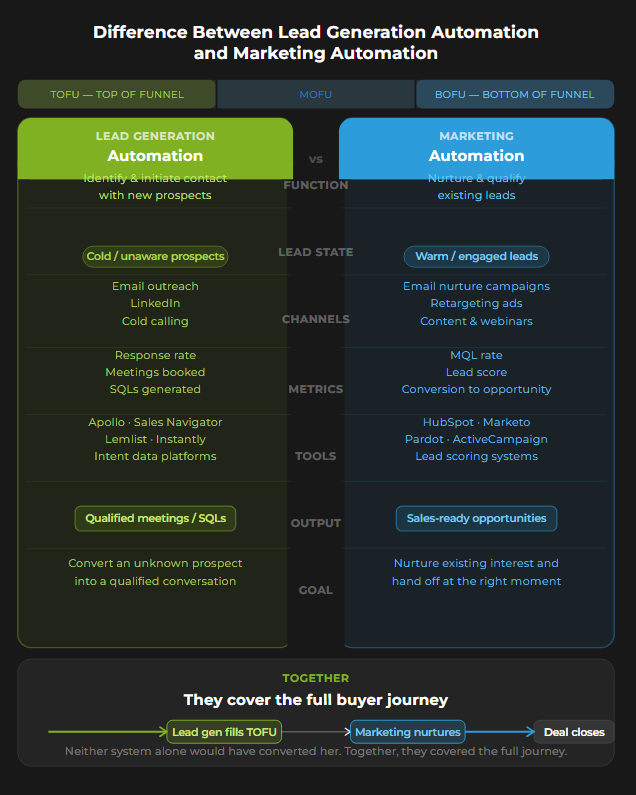
These terms appear together constantly, and they are often used interchangeably. They should not be. Lead generation automation and marketing automation serve different purposes, target different parts of the funnel, and are optimized for different outcomes. Understanding the distinction matters because it affects tooling decisions, team structure, and how you measure success.
Lead Generation Automation: Built for the Top of the Funnel
Lead generation automation focuses on identifying and initiating contact with people who do not yet know your company. It is outbound-first in its orientation. The goal is to convert an unknown prospect — someone that fits your ICP but has never interacted with your brand — into a qualified conversation.
This is where tools like LinkedIn Sales Navigator, intent data platforms, email sequencing software, and AI-powered prospecting engines live. The workflows here are about reach, relevance, and response rate.
Marketing Automation: Built for the Middle and Bottom of the Funnel
Marketing automation is oriented around leads who have already raised their hand in some way — they downloaded a guide, filled out a form, attended a webinar, or visited your pricing page. The goal is to nurture that existing interest, qualify it over time, and hand it off to sales at the right moment.
Tools like HubSpot, Marketo, and Pardot sit in this lane. They manage email nurture campaigns, lead scoring based on engagement, segmentation, and automated handoffs between marketing and sales.
How Lead Generation and Marketing Automation Work Together
The real leverage comes from connecting both. Lead generation automation fills the top of the funnel with qualified new contacts. Marketing automation then takes those contacts — especially the ones that did not immediately convert — and keeps them engaged over time.
A practical example: an automated outbound sequence on LinkedIn generates a response from a VP of Sales. She is interested but not ready to buy. She downloads a white paper. At that point, she moves from lead gen automation into a marketing automation nurture track. Six weeks later, she books a demo.
Neither system alone would have converted her. Together, they covered the full journey.
Dimension
Lead Generation Automation
Marketing Automation
Primary Function
Identify and initiate contact with new prospects
Nurture and qualify existing leads
Funnel Stage
Top of funnel (TOFU)
Mid and bottom of funnel (MOFU/BOFU)
Lead State
Cold or unaware prospects
Warm or engaged leads
Primary Channels
Email outreach, LinkedIn, cold calling
Email nurture, retargeting, content
Key Metrics
Response rate, meetings booked, SQLs
MQL rate, lead score, conversion to opportunity
Output
Qualified meetings / SQLs
Sales-ready opportunities
Core Components of an Automated Lead Generation System
Automated lead generation ensures follow-ups within 60 minutes, making meaningful conversations with decision-makers 7× more likely.
Reference Source: Harvard Business Review
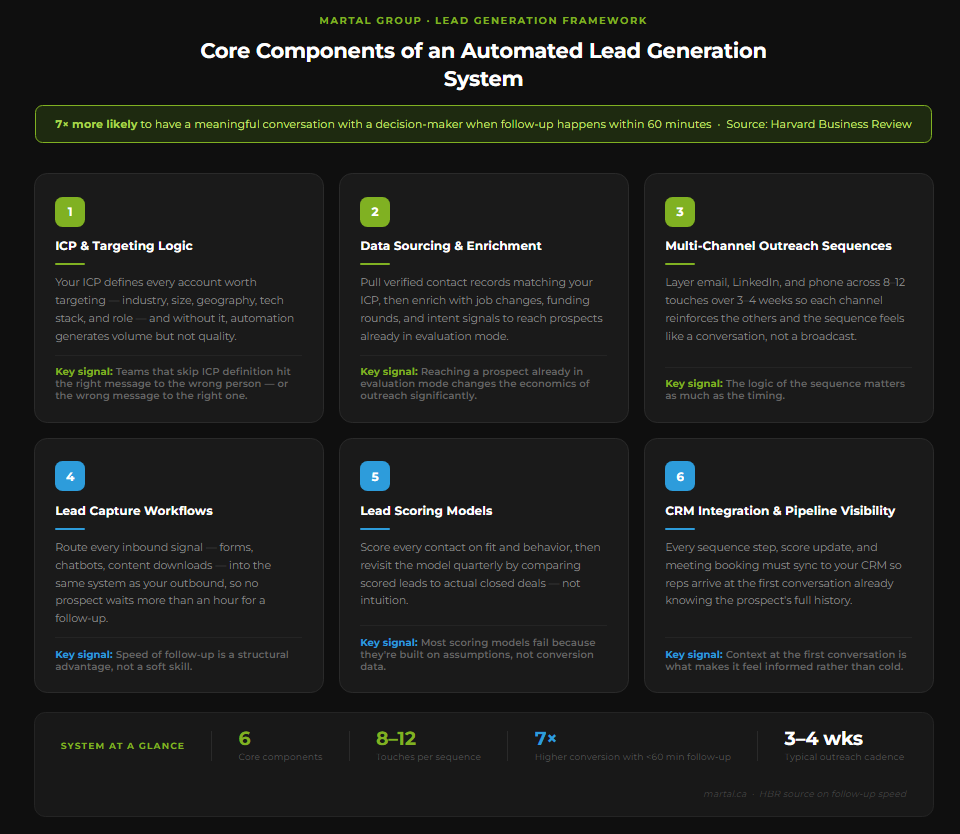
A well-built automated lead generation system is not a single tool, it is a stack of connected components, each handling a specific function. When these components work together, the result is a pipeline that generates qualified conversations at scale without requiring your team to manually touch every step.
Here are the six core components that every functioning system needs:
1. Ideal Customer Profile (ICP) and Targeting Logic
Everything downstream depends on this. Your ICP defines the accounts and contacts worth targeting — industry, company size, geography, tech stack, revenue, growth signals, and role. Without a clean, specific ICP, automation generates volume but not quality.
One thing we see often in B2B outbound: teams rush to build sequences before they have finished defining their ICP. The result is outreach that reaches the right message to the wrong person — or the wrong message to the right person. Both waste time.
Strong ICP definition includes negative criteria as well as positive ones. Knowing who to exclude is just as important as knowing who to include.
2. Data Sourcing and Enrichment
Your system is only as good as the data it runs on. Data sourcing involves pulling contact and account records that match your ICP from databases like ZoomInfo, Lusha, or Apollo. Data enrichment layers in additional context — job changes, technology installs, funding rounds, or hiring activity — that makes your outreach more relevant. Platforms like Coresignal provide structured company, employee, and job data that teams can use to enrich prospect records and sharpen their targeting.
Intent data is the advanced layer here. You can use advanced lead generation tools to surface accounts that are actively researching solutions in your category. Reaching a prospect at the moment they are already in evaluation mode changes the economics of outreach significantly.
Pro tip: When gathering prospect data from multiple public sources, businesses often use a residential proxy to improve data collection reliability and reduce the risk of IP-based restrictions interrupting their research efforts.
3. Multi-Channel Outreach Sequences
Effective automated lead generation does not rely on a single channel. Modern sequences layer email, LinkedIn touchpoints, and phone calls across a defined cadence — typically 8 to 12 touches over 3 to 4 weeks. Each channel reinforces the others.
The logic matters as much as the timing. A well-structured sequence is not the same message repeated. It evolves — the first email leads with a relevant insight, the second references a trigger event (a funding announcement, a hiring spike), the LinkedIn message takes a lighter tone. The sequence feels like a conversation, not a broadcast.
4. Lead Capture Workflows
Inbound interest — web form submissions, chatbot conversations, content downloads — needs to flow into the same system that handles your outbound activity. Lead capture workflows ensure that a prospect who finds you organically is routed, scored, and followed up with at the same speed as one you reached out to proactively.
Response time matters more than most teams realize. Lead generation statistics from the Harvard Business Review found that companies that followed up within an hour were seven times more likely to have a meaningful conversation with a decision-maker than those that waited even one hour longer (2).
5. Lead Scoring Models
Lead scoring assigns a numerical value to each contact based on two dimensions: fit (how closely they match your ICP) and behavior (how they have engaged with your brand). High scores on both dimensions signal a sales-ready lead.
A basic scoring model might assign points for job title, company size, and email opens. A more sophisticated model uses predictive scoring — drawing on historical conversion data to identify which combinations of signals actually predict a deal closing.
The practical friction point tends to be calibration. Most scoring models are built by marketing teams based on intuition rather than conversion data. Revisiting the model quarterly and comparing scored leads to actual closed deals is the only way to know if it is working.
6. CRM Integration and Pipeline Visibility
All of this activity — every sequence step, lead score update, form submission, and meeting booking — needs to live in your CRM. Without that integration, sales and marketing are operating from different data sets and the handoff between automated and human-led activity becomes unreliable.
A properly integrated system means that when a lead is ready for a sales conversation, the rep already knows what emails they opened, which LinkedIn messages they responded to, what content they downloaded, and how long they have been in the system. That context is what makes the first conversation feel informed rather than cold.
Benefits of Lead Generation and Marketing Automation
80% of marketing automation users see an increase in leads, and 77% see an increase in conversions.
Reference Source: Invespcro
The case for automating lead generation is not abstract. It comes down to specific, measurable improvements in how teams operate and how pipelines perform. The benefits of lead generation automation are measurable, 80% of marketing automation users see an increase in leads, and 77% see an increase in conversions (3). Here is what the best implementations consistently deliver:
Scale Without Proportional Headcount
The most immediate benefit of lead generation automation is the ability to run high-volume outreach without adding proportional headcount. A single SDR or lead generator using well-structured automated sequences can manage outreach to hundreds of prospects simultaneously, while still personalizing the first touch and any responses that come back.
That ratio — volume managed per rep — improves meaningfully with automation. For early-stage companies or sales teams operating under hiring constraints, this is often the difference between a functioning pipeline and a dormant one.
Faster Follow-Up and Shorter Sales Cycles
Automated systems react in real time. When a prospect fills out a form, opens a specific email, or visits a pricing page, the system can trigger a follow-up immediately — without a rep having to monitor every signal manually. That speed consistently improves conversion rates, especially in competitive markets where the first vendor to follow up often earns the meeting.
Consistent, Measurable Outreach
Manual outreach is inconsistent. Reps have good days and bad days, different styles, and varying discipline around follow-up. Automated sequences run consistently regardless of whether it is a Monday morning or a Friday afternoon. That consistency makes performance measurement more meaningful — you can actually compare sequence A to sequence B, or January to February, knowing the variable is the message rather than the rep.
Better Lead Quality Through Scoring
When lead scoring is properly configured, sales reps stop working leads that are not ready. Instead of calling every form submission or every new contact in the database, they focus on the accounts that have already demonstrated both fit and intent. That focus translates directly into higher conversion rates from first conversation to opportunity.
Reduced Cost Per Qualified Lead
Across most B2B categories, the cost to source a qualified lead manually — through a combination of SDR time, data tool costs, and management overhead — is significantly higher than the equivalent cost in an automated system. The efficiency gains compound over time as scoring models improve and sequences are refined based on response data.
Pipeline Predictability
One of the hardest things to build in B2B sales is a predictable pipeline. Manual outreach is inherently lumpy — it depends too heavily on individual effort and energy. Automated systems generate a more consistent volume of qualified conversations month over month, which makes revenue forecasting significantly more reliable.
Best Tools for Lead Generation Automation
Outsourced or automated lead generation can ramp up sales 3× faster than onboarding a full-time SDR.
Reference Source: Martal Group
Choosing the right lead generation automation tool is not just a software decision, it is a strategic one. The options below span managed services, prospecting platforms, outreach tools, and data providers. We have organized them to reflect the full range of what B2B teams actually use, starting with the option that goes furthest beyond software alone.
Tool / Service
Overview / Focus
Key Features
Ideal For
1. Martal Group
Fully managed B2B lead generation and sales outsourcing combining experienced SDRs, AI platform, and omnichannel execution.
Omnichannel lead gen, B2B appointment setting, Sales-as-a-Service, AI sales platform, LinkedIn & cold email/call, Martal Academy training
B2B tech & services companies needing immediate pipeline without building an internal SDR team
2. Apollo.io
B2B contact database with built-in email sequencing.
275M+ contact records, email sequencing, basic LinkedIn tasks, lead scoring, CRM integration
Outbound teams of 5–50 looking for combined data + outreach
3. ZoomInfo
Comprehensive B2B contact & company database with intent signals.
Large verified database, technographics, intent data, workflow automation, sales intelligence alerts
Mid-market & enterprise teams needing premium data
4. LinkedIn Sales Navigator
Access to LinkedIn network with advanced filters and alerts.
Advanced lead/account filters, InMail, account mapping, CRM sync
Teams focused on account-based or social selling
5. Lemlist
Cold email tool with visual personalization and basic multichannel steps.
Email sequences with images/video, basic LinkedIn/call steps, deliverability tools, A/B testing, integrations
Small/mid outbound teams wanting creative email personalization
6. Instantly.ai
Email-only outreach with emphasis on deliverability infrastructure.
Unlimited accounts, automated warm-up, multi-domain management, campaign analytics, CRM integrations
Growth-stage teams running high-volume cold email
7. Clay
Data enrichment and workflow automation with AI-personalized messaging.
75+ data sources, AI-generated personalization, waterfall enrichment, company news/LinkedIn updates, sequencing integrations
RevOps/growth teams with technical resources
8. Kaspr
Chrome extension revealing emails & phone numbers on LinkedIn profiles.
Contact data retrieval, verification, basic LinkedIn sequences, GDPR/CCPA compliance, integrations
SDRs & recruiters doing LinkedIn-first prospecting
9. UpLead
Prospecting database emphasizing verified contact info at export.
Real-time email verification, advanced search filters, CRM integrations, bulk export, LinkedIn extension
Teams needing accurate contacts without enterprise cost
10. Outreach.io
Enterprise/mid-market sales engagement platform with AI coaching and multi-channel sequences.
Multi-channel sequences, revenue intelligence, AI-guided recommendations, call analytics, Salesforce/HubSpot integration
Enterprise sales teams with 20+ reps & dedicated RevOps
11. HubSpot Marketing Hub
Mid-to-lower funnel marketing automation integrated with CRM.
Email workflows, lead scoring, forms/landing pages, ad reporting, native CRM integration
SMB/mid-market teams using HubSpot CRM wanting automation
12. Bombora
Tracks research activity to identify in-market accounts.
Topic-level intent signals, account-level data, CRM/MAP/ABM integrations, surge scores, audience segmentation
Mid-market & enterprise ABM teams prioritizing in-market accounts
13. Reply.io
Manages email, LinkedIn, call, and SMS sequences with AI content.
Multichannel sequences, AI email writer, unified inbox, A/B testing, CRM integrations
Small/mid outbound teams wanting multichannel sequencing
14. Leadfeeder (Dealfront)
Identifies companies visiting your website via IP matching.
Company-level identification, behavioral filtering, automated lead scoring, CRM integration, custom alerts
B2B companies with significant inbound traffic
15. Growth List
Curated database of recently funded startups with verified contacts.
Double-verified emails, funding stage/round/investor info
Sales teams targeting recently funded startups
1. Martal Group — B2B Lead Generation and Sales Outsourcing
Most tools in this list hand you a platform and expect your team to figure out the rest. Martal Group is different. Rather than software that requires configuration, training, and ongoing management, Martal provides a fully managed lead generation and sales outsourcing service, bringing experienced North American SDRs, a proprietary AI SDR platform, and proven omnichannel execution together under one engagement.
For B2B companies that need qualified pipeline but cannot afford to lose months ramping up an in-house team or configuring a new tech stack, Martal delivers results from the start.
Overview
Martal Group has spent over a decade generating pipeline for B2B technology and services companies — from growth-stage startups to Fortune 500 enterprises — across more than 50 industries. The firm operates as a fractional extension of the client’s sales team, handling everything from ICP definition and prospect list building to outreach, qualification, and appointment setting.
What separates Martal’s approach is the combination of experienced human execution and proprietary AI infrastructure. Their AI sales platform analyzes over 3,000 buying intent signals to build ICP-specific lead lists and optimize outreach messaging in real time. This is not a bolt-on AI feature; it is integrated into how Martal’s team prospects and prioritizes across every campaign.
Key Services
- Omnichannel B2B Lead Generation: Cold email, LinkedIn outreach, and cold calling are executed as a coordinated omnichannel strategy — not as standalone services. Each channel reinforces the others, preventing channel fatigue and increasing the probability of reaching decision-makers where they are most responsive.
- B2B Appointment Setting Service: Martal’s North American-based SDR team contacts, qualifies, and nurtures prospects through the outreach sequence, then schedules meetings directly on the client’s calendar. Clients receive conversations with decision-makers who have already been vetted against their ICP, not cold introductions.
- Sales Outsourcing (Sales-as-a-Service): For teams that need a complete outbound function, Martal provides fractional sales executives and SDRs on demand. These professionals operate as an extension of the client’s team — managing prospecting, outreach, follow-up, and pipeline reporting from end to end. The engagement scales as the client’s requirements grow, without the overhead of full-time hires.
- AI SDR Platform: Martal’s proprietary outreach system automates contact validation, monitors email deliverability across custom sending domains, and tracks real-time engagement data. Intent signals are used to identify prospects who are actively in evaluation mode — improving timing and conversion rates across campaigns.
- LinkedIn Lead Generation Services: Martal’s LinkedIn specialists use signal-driven prospecting to identify and engage decision-makers on the platform, coordinating LinkedIn touchpoints with email and phone activity across a unified sequence. This human-in-the-loop approach keeps outreach compliant with LinkedIn’s terms while maintaining a personalized tone that automated-only tools cannot replicate.
- Cold Email Services: Martal’s deliverability team sets up and warms custom sending domains, manages list hygiene, and crafts persona-specific messaging, addressing the spam and deliverability problems that plague most self-managed cold email programs.
- Cold Calling Services: Martal’s SDR team handles outbound calling as part of the omnichannel mix, using AI-built lead lists and optimized scripts to engage prospects and generate live conversations with qualified buyers.
- Martal Academy (B2B Sales Training): For companies building internal capability, the Martal Academy provides B2B lead generation and sales training covering outbound prospecting, omnichannel outreach execution, pipeline management, and performance tracking. It is suited for both SDRs learning the fundamentals and sales leaders looking to systematize team execution.
Ideal For
B2B technology and services companies that need qualified pipeline without the ramp time of building an in-house SDR team. Particularly well-suited for companies entering new markets, scaling after funding, or replacing underperforming outbound programs. Martal’s multi-industry experience across 50+ verticals means they can adapt to complex or technical sales environments quickly.
Engagement Model
Martal operates on tiered engagements starting with a 3-month pilot campaign, followed by a monthly subscription. Pricing is a flat monthly fee, customized based on scope. Tier 2 and Tier 3 engagements extend into deal closing and account management for clients that want end-to-end sales coverage.
2. Apollo.io
Overview
Apollo.io combines a B2B contact database with built-in email sequencing, making it a single-platform option for teams that want prospecting and outreach in one place. The database includes firmographic filters, technographic data, and basic intent signals. One limitation worth noting: teams that need deep personalization or complex multi-channel coordination often find themselves needing additional tools alongside Apollo, since the platform’s outreach capabilities are functional but not specialized.
Key Features
- Contact and account database with 275M+ records
- Email sequencing with open and click tracking
- Basic LinkedIn outreach tasks within sequences
- Lead scoring and buying intent signals
- CRM integrations with Salesforce and HubSpot
Ideal For: Outbound-focused teams of 5–50 people looking for a combined data and outreach tool at a mid-range price point.
3. ZoomInfo
Overview
ZoomInfo is one of the most comprehensive B2B contact and company databases on the market, with strong firmographic, technographic, and intent data coverage. It is primarily a data platform — teams typically use it alongside a separate outreach or sequencing tool. The platform carries a significant price premium, and smaller teams sometimes find the contract minimums and feature breadth exceed what they actually need.
Key Features
- Large database of verified B2B contacts and company records
- Technographic data (installed technologies at target accounts)
- Intent data via ZoomInfo’s proprietary data network
- Workflow automation and CRM sync
- Sales intelligence alerts for job changes and company events
Ideal For: Mid-market and enterprise sales teams with budget for a premium data subscription and a separate outreach platform.
4. LinkedIn Sales Navigator
Overview
Sales Navigator gives sales teams access to LinkedIn’s full professional network through advanced search filters, account lists, and real-time alerts for job changes and company activity. It is one of the most effective channels for reaching senior B2B decision-makers, but it operates as a standalone prospecting environment — outreach execution, sequencing, and CRM logging all require additional tools or manual workflows.
Key Features
- Advanced lead and account filters (title, seniority, industry, company size)
- Real-time job change and hiring alerts
- InMail messaging to prospects outside your network
- Account mapping and stakeholder identification
- CRM sync with Salesforce and HubSpot
Ideal For: Teams running account-based prospecting or social selling motions where LinkedIn is a primary outreach channel.
5. Lemlist
Overview
Lemlist is an email sequencing tool with a focus on visual personalization — including dynamic images and video thumbnails within emails. It is designed to help outreach stand out in crowded inboxes. The platform covers multi-step email sequences with basic LinkedIn and call steps, though teams running sophisticated multi-channel programs typically need to supplement it with additional tools for data sourcing and CRM management.
Key Features
- Email sequences with personalized images and video thumbnails
- Basic LinkedIn and call steps within sequences
- Deliverability tools including email warm-up
- A/B testing for subject lines and email copy
- Integrations with Apollo, HubSpot, and Salesforce
Ideal For: Small to mid-sized outbound teams that want creative personalization in cold email without a large tool budget.
6. Instantly.ai
Overview
Instantly.ai is built for teams running large-scale cold email campaigns, with an emphasis on deliverability infrastructure — including multi-account rotation, email warming, and domain management. It handles volume well, but its focus on email-only outreach means it does not replace a full multi-channel strategy. Teams relying solely on high-volume email also carry elevated risk around sender reputation degradation if list hygiene and targeting are not carefully managed.
Key Features
- Unlimited email account sending with account rotation
- Automated email warm-up across sending accounts
- Multi-domain management for sender reputation protection
- Campaign analytics and A/B testing
- Basic CRM integrations
Ideal For: Growth-stage teams running high-volume outbound email campaigns who prioritize deliverability infrastructure over multi-channel capabilities.
7. Clay
Overview
Clay is a data enrichment and workflow automation tool that pulls from over 75 data providers to build highly detailed prospect records and generate AI-personalized outreach at scale. It is primarily a data and workflow layer — teams use it to enrich lists and auto-generate personalized messaging, then pass those outputs to a sequencing tool for actual delivery. Clay requires meaningful technical setup and works best in organizations that have existing outreach infrastructure.
Key Features
- Access to 75+ data providers through a single interface
- AI-generated personalization at the contact level (icebreakers, value props)
- Waterfall enrichment (tries multiple sources to fill data gaps)
- Automated research on company news, job changes, and LinkedIn activity
- Integration with sequencing tools like Outreach and Lemlist
Ideal For: RevOps or growth teams with technical resources who want to build highly personalized outreach at scale without manual research.
8. Kaspr
Overview
Kaspr is a contact data tool that surfaces phone numbers and email addresses directly on LinkedIn profiles through a Chrome extension. It is a narrow but useful tool for teams that do heavy LinkedIn prospecting and need verified contact details quickly. Its focus is contact data retrieval — it does not manage sequences, scoring, or pipeline.
Key Features
- Chrome extension that reveals contact data on LinkedIn profiles
- Phone number and email verification against 150+ data sources
- Basic LinkedIn outreach sequences
- GDPR and CCPA-aligned data handling
- Integrations with HubSpot, Pipedrive, Lemlist, and Salesforce
Ideal For: SDRs and recruiters doing LinkedIn-first prospecting who need fast access to verified contact details without a full database subscription.
9. UpLead
Overview
UpLead is a contact database and prospecting tool that differentiates itself through real-time email verification — checking email validity at the moment of export rather than relying on batch verification. This reduces bounce rates on outreach campaigns. The database is smaller than ZoomInfo or Apollo, which can be a limiting factor for teams targeting broad markets or needing deep coverage of specific geographies.
Key Features
- Real-time email verification before contact export
- Advanced search filters including technographics and intent data
- CRM integrations with Salesforce, HubSpot, and Pipedrive
- Bulk list building and CSV export
- Chrome extension for prospecting on LinkedIn and company websites
Ideal For: Teams prioritizing data accuracy and deliverability who need a straightforward contact database without the cost or complexity of enterprise platforms.
10. Outreach.io
Overview
Outreach.io is a sales engagement platform built for enterprise and mid-market sales organizations. It manages multi-step sequences, call recording, pipeline analytics, and AI-assisted coaching across a large sales team. The platform’s depth is its main selling point and also its main drawback for smaller teams — the onboarding complexity and seat-based pricing make it a significant investment that requires dedicated ops support to maintain effectively.
Key Features
- Multi-channel sequences (email, phone, LinkedIn, SMS)
- Revenue intelligence and deal forecasting
- AI-guided selling recommendations
- Call recording and conversation analytics
- Deep Salesforce and HubSpot integration
Ideal For: Enterprise sales organizations with 20+ reps and dedicated RevOps support looking for a centralized sales engagement and intelligence platform.
11. HubSpot Marketing Hub
Overview
HubSpot’s Marketing Hub handles mid-to-lower funnel automation — email nurture workflows, lead scoring, form capture, and CRM integration. It is one of the more complete marketing automation platforms available at the SMB and mid-market tier. Teams that use HubSpot as their CRM benefit from native integration, but outbound prospecting still requires external tools. HubSpot does not replace a dedicated outreach platform or data provider.
Key Features
- Email marketing and automated nurture workflows
- Lead scoring based on behavior and firmographic criteria
- Landing page and form builder
- Ad management and attribution reporting
- Native CRM integration
Ideal For: SMB and mid-market teams that want marketing automation, CRM, and lead nurturing in one ecosystem — particularly those already using HubSpot CRM.
12. Bombora
Overview
Bombora tracks research activity across thousands of B2B media and publisher sites to identify accounts that are actively consuming content related to specific topics, a signal that they may be in-market. Intent data from Bombora is useful as a prioritization layer on top of an existing ICP list, not as a standalone prospecting source. The data requires interpretation, and signal-to-noise quality varies by topic and market segment.
Key Features
- Topic-level intent signals across B2B publishing network
- Account-level (not contact-level) intent data
- Integrations with CRM, MAP, and ABM platforms
- Surge scores indicating intensity of research activity
- Audience segmentation for ad targeting based on intent
Ideal For: Mid-market and enterprise teams running account-based programs who want to prioritize outreach to accounts that are actively researching relevant topics.
13. Reply.io
Overview
Reply.io is a sales engagement platform that manages outreach sequences across email, LinkedIn, calls, and SMS. It includes AI-generated email content, a unified inbox for managing replies, and basic sequence analytics. Teams evaluating Reply.io for enterprise use typically find the analytics and CRM integration depth less mature than dedicated enterprise platforms, though the pricing and setup make it accessible for smaller outbound teams.
Key Features
- Multichannel sequences covering email, LinkedIn, phone, and SMS
- AI email writer for sequence content generation
- Centralized inbox for managing replies across all channels
- A/B testing and sequence performance analytics
- Integrations with CRM and data providers including Apollo and ZoomInfo
Ideal For: Small to mid-sized outbound sales teams looking for a multichannel sequencing tool without the enterprise cost and complexity of platforms like Outreach.
14. Leadfeeder (Dealfront)
Overview
Leadfeeder — now part of Dealfront — identifies companies visiting your website by matching IP addresses to company records. It surfaces account-level intent from your own site traffic, which is useful for prioritizing outreach to companies that have already shown interest. The tool does not identify individual visitors, only the company, which limits how directly actionable the data is without further research or contact enrichment.
Key Features
- Company-level identification of website visitors
- Behavioral filtering (pages visited, time on site, visit frequency)
- Automated lead scoring based on website activity
- CRM integrations and automated lead routing
- Custom alerts for target account visits
Ideal For: B2B companies with meaningful inbound web traffic who want to convert anonymous site visits into outbound triggers for their sales team.
15. Growth List
Overview
Growth List is a niche prospecting database focused exclusively on recently funded startups — Seed through Series C+. Every record includes verified funding data and double-checked decision-maker contact details, making it useful for teams selling to growth-stage companies where funding events are a strong buying trigger. The database is narrow by design, covering approximately 70,000 funded companies with weekly updates. Teams targeting established enterprises or non-venture-backed businesses will not find meaningful coverage here.
Key Features
- Curated database of 70,000+ funded startups with weekly additions
- Double-verified emails for CEOs and senior decision-makers
- Funding stage, round size, and investor data included
- Designed for teams that trigger outreach on funding announcements
Ideal For: Sales teams whose ICP centers on recently funded startups — particularly those selling SaaS, recruiting services, office space, or any product with a clear funding-event trigger.
Can AI Automate Lead Generation and Outreach?
AI in sales can boost leads and appointments by over 50%, cut costs by 40–60%, and reduce call time by 60–70%.
Reference Source: McKinsey & Company
Yes, and it is already happening across sales teams that are ahead of the curve. AI has moved from a marketing buzzword to a practical component of B2B prospecting in a relatively short period. In practice, it can increase leads and appointments by more than 50%, lower costs by 40–60%, and shorten call time by 60–70% (4). The practical applications worth understanding are more specific than the hype suggests.
AI-Powered Personalization at Scale
Traditional sequencing software sends the same message, with maybe a first-name merge, to hundreds of prospects. AI-assisted tools go further: they analyze a contact’s LinkedIn activity, recent company news, or job change history and generate a personalized opening line or value proposition for each prospect.
The practical effect is that outreach feels less templated, which improves open rates and response rates. Modern lead generation software and tools are building this capability into prospecting workflows, allowing teams to personalize at volumes that would have required an army of copywriters to achieve manually.
Predictive Lead Scoring
Rule-based scoring models assign fixed point values to actions — five points for an email open, ten for a page visit. The problem is that not all email opens are equal, and not all page visits signal the same intent. AI-driven scoring models are trained on historical conversion data and learn which patterns actually predict a closed deal, rather than which ones a marketing manager thought would be important.
The result is a scoring model that improves over time rather than sitting static until someone decides to revisit the rubric.
Sequence Optimization and Send-Time Intelligence
AI tools can analyze response patterns across thousands of outreach attempts and recommend the optimal send time, subject line format, or message length for a specific audience segment. Over time, this data-driven optimization improves sequence performance without requiring manual A/B testing at every step.
Conversational AI for Lead Qualification
AI-powered chatbots can handle the first layer of lead qualification by asking essential lead generation questions about budget, timeline, and decision-making authority, and route conversations to a human rep only when the signals are strong enough. This keeps response times fast without burning rep bandwidth on leads that are clearly not ready. Conversational AI is also one of the most impactful lead generation trends, accelerating qualification while preserving human judgment where it matters.
The caution here is real: AI-generated responses that sound robotic or miss obvious context can actively damage your brand’s credibility with high-value prospects. The best implementations use AI to accelerate the process, not to replace the human judgment that makes conversations feel valuable.
Lead Capture, Scoring, and Nurturing Workflows
The mechanics of how a lead moves through your system, from first contact to sales conversation, determine how much value you get from automation. Getting this right requires clear definitions, clean handoffs, and a willingness to update the model as you learn.
How Automated Lead Generation Tools Qualify and Score Leads
Lead qualification in an automated system happens across two dimensions: explicit data (what you know about the account and contact) and behavioral signals (what actions they have taken).
Explicit scoring criteria typically include:
- Job title and seniority (does this person have budget authority?)
- Company size and revenue (does this account match your ICP?)
- Industry and vertical fit
- Technology stack (are they already using tools your systems integrate with?)
- Geography and market coverage
Behavioral scoring adds weight based on actions:
- Email opens and clicks
- Website pages visited and time spent
- Content downloads and form submissions
- Webinar attendance or video views
- LinkedIn engagement with your company’s content
Leads that cross a defined threshold score get routed to sales as Marketing Qualified Leads (MQLs). Those that fall below the threshold enter nurture workflows, where they receive automated content and touchpoints designed to keep them engaged until their readiness signals improve.
How Automated Email Sequences Help with Lead Nurturing
Email nurture sequences are the backbone of mid-funnel automation. A well-built sequence does not just send the same newsletter every two weeks. It delivers contextually relevant content based on where the lead is in their buying journey, what they have already engaged with, and how long they have been in the system.
A practical nurture architecture looks like this:
- Educational content (weeks 1–2): Thought leadership, market research, or problem-framing content that helps the prospect understand their challenge better.
- Solution framing (weeks 3–4): Content that positions your category as the right approach — case studies, comparison guides, ROI frameworks.
- Social proof (weeks 5–6): Customer stories, testimonials, or third-party validation.
- Direct offer (week 7+): A specific call to action — a demo, a free audit, a consultation — timed for when the lead has had enough exposure to be ready.
The key is to build sequences that branch based on engagement. If a lead clicks on a case study about manufacturing, the next email should be about manufacturing — not a generic follow-up that ignores what they just told you about their interest.
How You Ensure Lead Quality When Using Automated Lead Generation
Volume and quality are in constant tension in any automated system. Here is how the best teams manage that tension:
- Start with a specific ICP, not a broad market: The tighter your targeting criteria, the higher the baseline quality of leads entering the system.
- Use negative scoring signals: Job titles outside your buying committee, companies below your minimum size, or geographic regions you do not serve should actively reduce a lead’s score — not just fail to increase it.
- Monitor MQL-to-SQL conversion rate obsessively: If marketing is handing off a lot of MQLs but sales is only accepting a fraction as SQLs, the scoring model is miscalibrated.
- Build in manual review checkpoints: For enterprise-level deals, automated scoring should inform — not replace — human judgment about which accounts to pursue.
- Keep your data clean: Stale contact data is one of the most common quality killers. Regular database hygiene — removing bounced emails, updating job titles, pruning inactive contacts — is non-negotiable.
What Channels Can Be Automated for Lead Generation Campaigns?
Omnichannel outbound strategies that combine email and LinkedIn deliver2–3× higher results than single-channel approaches.
Reference Source: Outbound Republic
The answer to this question has expanded significantly over the past few years. Most channels now have automation tooling available, but not all automations are created equal, and some platforms have specific rules about what is and is not permitted. Research shows that combining email and LinkedIn in an omnichannel outbound strategy can produce 2–3× better results than using a single channel alone (5).
Email remains the highest-ROI outbound channel for most B2B teams, and it is also the most mature in terms of automation tooling. Sequencing platforms can trigger messages based on time, prospect behavior, or CRM status, and can dynamically personalize content at the individual level.
The main risk is deliverability. High-volume automated email can trigger spam filters if not managed carefully. Best practices include warming up new sending domains, monitoring bounce rates, maintaining proper SPF/DKIM/DMARC authentication, and keeping sending volumes below thresholds that flag as bulk.
LinkedIn automation sits in a more nuanced position. The platform is one of the most effective B2B channels for reaching decision-makers — but LinkedIn’s terms of service explicitly restrict automated connection requests and messaging at scale.
What is permissible: using Sales Navigator filters to build targeted lists, receiving InMail alerts, and using LinkedIn’s native sequencing features through their Sales Navigator product. What creates risk: third-party tools that automate connection requests or scrape profile data at scale.
For teams using LinkedIn as part of their outbound mix, the safest approach is a human-in-the-loop model — automation handles list building and scheduling, but a human reviews and approves each message before it sends. This keeps the outreach personalized, compliant, and protected from account suspension.
Phone / Cold Calling
Call automation in the form of power dialers and parallel dialers has become more common. Tools like Salesloft Dialer, Orum, and Nooks can connect reps to answered calls automatically, skipping voicemails, bad numbers, and hold time. This significantly increases the number of live conversations a rep can have in a day.
AI voice tools are emerging, but for high-value B2B prospects, the consensus among practitioners is that the first live conversation should still be human-led. The personalization and judgment required to open a cold call effectively with a senior executive is not something current AI voice technology handles reliably.
Content and SEO (Inbound Capture)
While not outbound automation in the traditional sense, inbound lead capture can be significantly automated. Gated content, chatbots, exit-intent popups, and dynamic CTAs capture prospect information and trigger follow-up sequences automatically — integrating with the same CRM and scoring infrastructure as outbound leads.
Paid Media Retargeting
Paid retargeting campaigns on LinkedIn and Google can be set to automatically serve ads to visitors who hit specific pages on your site, contacts in your CRM, or lookalike audiences built from your best customers. These campaigns run continuously and re-engage prospects who have already shown interest without requiring manual campaign management at each step.
Best Strategies for B2B Automated Lead Generation
80% of marketers report that account-based marketing (ABM) generates a higher ROI than any other marketing initiative.
Reference Source: ITSMA via Content Marketing Institute
Tactics matter, but strategy determines whether the tactics add up to a pipeline. For B2B teams running automated lead generation at scale, the strategies that consistently deliver results include account-based marketing (ABM), which 80% of marketers say generates higher ROI than any other marketing approach (6).
Account-Based Lead Generation
Account-based marketing (ABM) and automated lead generation are increasingly converging. Instead of sending the same sequence to a broad list, account-based programs target a specific set of high-value accounts with coordinated outreach across multiple contacts and channels simultaneously.
Automation makes ABM scalable. Rather than manually crafting personalized outreach for 50 accounts, teams can use data enrichment tools to auto-populate personalization fields, trigger account-level alerts when target contacts engage with content, and coordinate email, LinkedIn, and ad retargeting in a single lead generation workflow.
Trigger-Based Outreach
One of the highest-leverage moves in automated lead generation is replacing time-based sequences with trigger-based ones. Instead of sending email three after seven days regardless of what has happened, the system monitors for specific signals and fires the next touch based on behavior.
Valuable triggers include:
- A contact visiting your pricing page
- A company announcing a funding round or acquisition
- A key contact changing jobs
- A prospect engaging with a competitor’s content (identified via intent data)
- A lead reopening an email after a long period of inactivity
Trigger-based outreach feels more relevant because it is. The prospect did something. You responded. That relevance converts at a higher rate than time-based cadences sent without context.
Multi-Channel Sequencing with Channel-Specific Messaging
The mistake most teams make with multi-channel automation is running the same message across every touchpoint. A LinkedIn message that reads like a cold email feels off. An email that reads like a text message loses authority. Each channel has its own conventions, and effective sequences adapt to those conventions.
From the outbound side, the cadence we consistently see work in B2B is:
- Day 1: Personalized cold email
- Day 3: LinkedIn connection request (no note, or a brief one that does not pitch)
- Day 5: Follow-up email with a relevant insight or piece of content
- Day 8: LinkedIn message (now that connected)
- Day 11: Phone call
- Day 14: Final break-up email with a low-commitment CTA
This is not a universal template — it is a starting framework that needs to be tested and adjusted based on your market, ICP, and the response data your system generates.
Continuous Testing and Iteration
Automated systems create the infrastructure for systematic A/B testing that manual outreach simply cannot support. Subject line tests, value proposition variations, CTA phrasing, sequence timing — each of these variables can be tested at scale and optimized based on response data.
The teams that get the most out of lead generation automation treat it as a learning system, not a set-and-forget machine. They review response rates weekly, adjust underperforming sequences within 30 days, and build a library of what works for each segment of their ICP.
Challenges and Risks of Automated Lead Generation
Even with automation, 61% of marketers say that maintaining high-quality leads remains their top lead-generation challenge.
Reference Source: DemandSage
Automation does not eliminate the core challenges of B2B lead generation. Even with automated tools, 61% of marketers say maintaining high-quality leads remains their top challenge (7). Understanding the real risks helps teams build systems that generate pipeline without burning brand equity or creating compliance exposure
What Are the Risks of Automating Lead Generation on Platforms Like LinkedIn?
LinkedIn is explicit about its position on automation: tools that simulate human behavior — auto-connecting, auto-messaging, auto-visiting profiles at scale — violate the platform’s User Agreement. Accounts that trigger these violations can be temporarily restricted or permanently banned.
The risk level correlates with volume and detection. Low-volume activity that mimics natural human behavior rarely triggers enforcement. High-volume scraping or mass connection campaigns are more likely to surface in LinkedIn’s detection systems.
The practical recommendation: use LinkedIn’s native tools where possible, use third-party tools with restraint and human oversight, and prioritize quality interactions over raw connection volume. A targeted approach that connects with 20 highly relevant prospects per week consistently outperforms a spray approach that hits 200 random ones.
Volume-Over-Quality Thinking
The most common failure mode in automated lead generation is optimizing for activity metrics — emails sent, connection requests made, sequence steps completed — rather than outcome metrics like qualified conversations and pipeline generated.
More volume is not inherently better. A tightly targeted sequence of 500 relevant prospects will almost always outperform a broad campaign hitting 5,000 poorly matched ones. The difference shows up in response rates, in meeting quality, and eventually in close rates.
Email Deliverability Degradation
High-volume automated email campaigns can damage sending domain reputation if not managed carefully. Signs of deliverability problems include rising bounce rates, declining open rates, and spam folder placement. Prevention requires consistent domain warming, list hygiene, proper authentication setup, and monitoring of sender reputation scores through tools like Google Postmaster or MXToolbox.
Data Privacy and Compliance
Automated outreach at scale creates compliance exposure under regulations like GDPR (in the EU), CASL (in Canada), and CAN-SPAM (in the US). Each regulation has specific requirements around consent, opt-out mechanisms, and data handling that vary by jurisdiction.
Before launching automated outreach campaigns in regulated markets, legal review of sequences and data handling practices is not optional. The cost of a compliance violation — both financial and reputational — significantly outweighs the cost of getting it right upfront.
How Much Lead Generation Can Realistically Be Automated?
The honest answer: a lot of the process, but not all of it — and the parts that resist automation are often the parts that matter most.
What can be fully automated: list building, data enrichment, sequence triggering, lead scoring, CRM logging, and nurture workflows. What requires human judgment: strategic ICP definition, sequence messaging that resonates with a specific market, handling of complex objections, relationship development with enterprise accounts, and the actual sales conversation.
The goal is not to remove humans from lead generation. It is to remove humans from the tasks that do not benefit from their judgment — so they can apply that judgment where it actually moves deals forward. If the judgment work is what you lack rather than the tooling, the alternative is buying the function outright, and our guide to lead generation as a service covers what that arrangement should commit to before you sign.
What Metrics Should You Track in an Automated Lead Generation System?
80% of automation users report more leads, showing why monitoring lead growth metrics matter.
Reference Source: GTM 80/20
Metrics turn an automated system from a black box into a manageable, improvable machine. The challenge is separating metrics and lead generation KPIs that provide insight from those that only seem active. With 80% of automation users generating more leads, tracking lead growth is critical (8).
Metric
What It Measures
Why It Matters
Email Open Rate
Percentage of sent emails opened
Signals subject line effectiveness and sender reputation
Reply / Response Rate
Percentage of contacts who respond
More meaningful than opens; indicates message relevance
Positive Response Rate
Replies expressing interest vs. all replies
Separates genuine engagement from opt-outs and objections
Meeting Booked Rate
Meetings booked per 100 prospects contacted
The core conversion metric for outbound sequences
MQL-to-SQL Conversion Rate
MQLs accepted by sales as SQLs
Reveals calibration quality of your lead scoring model
Cost Per Qualified Lead
Total spend / qualified leads generated
Efficiency benchmark across channels and campaigns
Pipeline Contribution by Channel
Pipeline attributed to each outreach channel
Identifies which channels generate the most value
Sequence Completion Rate
Prospects who receive all sequence touches
Helps identify early drop-off points in the cadence
Lead Response Time
Time from lead creation to first sales contact
Speed directly correlates with conversion probability
Beyond these leading indicators, the metrics that matter most at the revenue level are pipeline generated by source, close rate by lead source, and customer acquisition cost by channel. Those three numbers reveal which parts of your automated system are actually driving business, not just activity.
How Do You Build an Automated Lead Generation System from Scratch?
Building a system from scratch is more achievable than most teams assume — but it requires sequencing the work correctly. Jump to tools too early and you end up with expensive software running poorly defined processes. Get the fundamentals right first and the technology becomes relatively straightforward.
Here is the build sequence that works:
- Define your ICP before anything else. Who are you targeting? What firmographic criteria matter? What roles have buying authority? What problems are they trying to solve? Write this down explicitly before touching a tool.
- Audit your existing data. What contact records do you already have? How clean are they? What gaps exist? This determines which data sourcing tools you actually need.
- Choose your core stack. At minimum: a prospecting database, an email sequencing tool, a CRM, and a way to track engagement. Start simple and add complexity as you validate what works.
- Build and test your first sequence. Write a 6-to-8-touch sequence for one specific ICP segment. Send it manually if you need to — the goal is to validate the messaging before automating it.
- Automate the validated sequence. Once you have a sequence with a proven response rate, automate the sending logic, set up CRM sync, and add lead scoring rules based on what engagement patterns you observed manually.
- Layer in additional channels. Add LinkedIn touchpoints and phone steps once email is working. Multi-channel amplifies results but also amplifies complexity — sequence the introduction deliberately.
- Build nurture workflows for non-converters. Not every lead will convert in the first sequence. Build automated nurture tracks that maintain presence with leads that showed some interest but were not ready.
- Establish a measurement cadence. Decide which metrics you will review weekly, which monthly. Set performance benchmarks and treat underperforming sequences as things to fix, not accept.
Scale Your Pipeline Without Scaling Your Team: How Martal Group Can Help
Building an effective automated lead generation system takes more than the right software. It takes a clear ICP, proven outreach methodology, experienced SDRs and lead generation specialists who know how to handle responses, and a measurement framework that connects activity to revenue.
That is precisely what we do at Martal Group. We are a B2B lead generation and sales outsourcing agency that has spent over a decade building pipelines for technology and services companies. We help technology and services companies scale through outsourced lead generation, serving clients from growth-stage startups to enterprise organizations worldwide.
Our approach offers done for you lead generation, combining a proprietary AI outreach system with an experienced team of North American-based sales executives, SDRs, and appointment setters. The result is an omnichannel lead generation engine that spans cold email, LinkedIn outreach, and cold calling — coordinated as part of a unified strategy, not executed as isolated channels.
Here is what working with us looks like in practice:
- ICP development and list building: We work with you to define exactly who to target, then build a highly qualified prospect list using verified data and real-time intent signals.
- Multi-channel outbound execution: Our team runs coordinated lead generation campaigns across email, LinkedIn, and phone — with messaging crafted for your market and refined continuously based on response data.
- Appointment setting: We handle the outreach, follow-up, and qualification — you receive meetings with decision-makers who are ready to talk.
- Sales outsourcing: For teams that need a full SDR function, we provide fractional sales executives on demand who operate as an extension of your internal team.
- Martal Academy: For teams building internal capability, our B2B sales training program equips your SDRs with the frameworks, sequences, and skills to execute outbound at a high level.
The difference between Martal and a software platform is that we bring the execution. You do not need to figure out the right sequence structure, manage deliverability issues, or train a new SDR from scratch. We bring an experienced, proven team that has done this across more than 50 industries.
Conclusion
Automated lead generation is not a silver bullet. But for B2B sales teams that are serious about pipeline predictability, it is one of the highest-leverage investments available. The right system, built on a clean ICP, reliable data, validated sequences, and a properly integrated CRM, can generate a consistent flow of qualified conversations without proportional headcount growth.
The teams that get the most out of lead generation automation are the ones that treat it as a system to be managed, not a machine to be set and forgotten. They test sequences methodically. They monitor scoring model calibration. They revisit their ICP as markets evolve. And they maintain the human judgment that turns a qualified lead into a closed deal.
If you take one thing from this guide, let it be this, start with clarity before you start with tools. Define who you are targeting, build a message worth automating, and then let technology scale it. Done in that order, automated lead generation becomes one of your most powerful competitive advantages. Book a consultation today and discover how automated lead generation can become your most powerful competitive advantage.
References
- Gartner via HubSpot
- Harvard Business Review
- Invespcro
- McKinsey & Company
- Outbound Republic
- ITSMA via Content Marketing Institute
- DemandSage
- GTM 80/20
FAQs: Automated Lead Generation
How can I automate lead generation for my business?
Start with a clearly defined ICP before selecting any tools. Once you know exactly who you are targeting, build and test a short outreach sequence manually to validate the messaging. Then automate the validated sequence using a sequencing platform, connect it to your CRM, and set up lead scoring rules based on the engagement signals you observed. Add channels and complexity incrementally — email first, then LinkedIn and phone. Measure response rates and meeting bookings weekly and refine underperforming sequences based on data.
How do automated lead generation tools qualify and score leads?
Qualification happens across two dimensions: fit (firmographic criteria like company size, industry, and job title) and behavior (actions like email opens, website visits, content downloads, and form submissions). Each criterion is assigned a point value, and leads that cross a defined score threshold are routed to sales as MQLs. More advanced systems use predictive scoring trained on historical conversion data, which improves accuracy over time. The MQL-to-SQL conversion rate is the key indicator of whether your scoring model is calibrated correctly.
What are the risks of automating lead generation on platforms like LinkedIn?
LinkedIn’s User Agreement restricts automated connection requests and mass messaging through third-party tools. Accounts that trigger violations can face temporary restrictions or permanent bans. The safest approach is a human-in-the-loop model — automation handles list building and scheduling, but a human reviews and approves each message. High-quality, targeted outreach to 20 relevant contacts per week consistently outperforms high-volume automated campaigns that risk account suspension and brand damage.
What metrics should you track in an automated lead generation system?
The most important metrics are: email reply rate (indicates message relevance), meeting booked rate (the core outbound conversion metric), MQL-to-SQL conversion rate (reveals scoring model accuracy), cost per qualified lead (efficiency benchmark), and pipeline contribution by channel (shows where revenue actually comes from). At the revenue level, track close rate by lead source and lead acquisition cost by channel. Activity metrics like emails sent tell you volume; outcome metrics tell you value.
What’s the difference between lead generation automation and marketing automation?
Lead generation automation is outbound-first: it identifies cold prospects and initiates contact through email sequences, LinkedIn outreach, and cold calling. Marketing automation handles warm leads — people who have already engaged with your brand in some way — nurturing them through content and scoring them toward sales readiness. The real leverage comes from connecting both: lead gen automation fills the top of the funnel, and marketing automation converts that interest into pipeline over time.