
 Martal
 Technology
 Education and training
 Web Development and UI / UX
 Healthcare/Medical
 Logistics and Supply Chain
 Information Technology
 Insuretech and Financial Services
 Marketplaces
 Software Development
 E-commerce and retail
 AI and Machine Learning
 Energy and Solar
 Manufacturing
 Security and Surveillance
 Digital Marketing Agency
 Transportation
 MSP
MSP
 Telecom
 B2B SaaS
 Cybersecurity
 HR tech
 Fintech
 Cleantech
 Consulting
Competitive Displacement: The ABM Strategy Most Sales Teams Are Missing
Major Takeaways: Competitive Displacement
Competitive displacement is a targeted outbound strategy for winning accounts already using a competitor — persuading them to switch rather than convincing them they need a solution at all. In mature, crowded categories, a growing share of winnable deals are already someone else’s customers.
By the time a buyer formally evaluates, the winning vendor is on their Day One shortlist 95% of the time (6sense, 2025). A competitive displacement strategy gets you into the consideration set before the renewal window opens — when there’s still a decision to influence.
Technographic data shows who’s running the competitor; intent surges show who’s getting restless; review-mined complaints show exactly why. Trigger events — renewals, leadership changes, outages, funding, M&A — tell you when to move.
Signal-personalized outreach earns roughly 15–25% reply rates versus 3–5% for generic cold outreach, climbing to 25–40% when multiple signals are stacked with context (4). Relevance, not volume, creates conversations.
AI scores and prioritizes accounts by fit and signal strength across hundreds of targets, then drafts the first personalized angle. The teams winning pair AI’s pattern-matching with experienced reps who decide what to say.
Reviews on G2, Capterra, and Clutch surface the everyday frustrations vendors never put in their marketing. With 92.4% of B2B buyers guided by others’ experiences, that feedback becomes the foundation for messaging that resonates.
The strongest displacement copy never names the competitor. You name a frustration the prospect already feels and show you understand it better than the vendor they’re paying — restraint that reads as confidence.
Displaced customers made a deliberate choice to switch, so they tend to be more engaged and churn less than buyers who defaulted to the status quo. But switching costs and inertia mean a discount alone rarely wins — you have to make staying more painful than moving.
Introduction
If reviews influence 92.4 percent of B2B buyers, why aren’t we using this feedback as a powerful sales tool (1)?
There are golden nuggets of information about your competitors waiting to be discovered on platforms like G2, Capterra, and Clutch. You just have to be able to tell the difference between genuine responses and counterfeit claims.
But you may be asking yourself, “How can I ethically use competitors’ customer reviews to my advantage?”
It’s a solid question with one simple answer: competitive displacement campaigns.
Here’s why timing matters more than ever. By the time a buyer formally enters a purchase, the decision is largely made —data shows that the winning vendor is already on the buyer’s Day One shortlist 95% of the time, with buyers weighing roughly five vendors and not contacting sellers until about 61% of the way through their journey (2). If you’re not in that consideration set, there’s no one to displace. A competitive displacement strategy is how you earn the spot — reaching the right accounts, with the right insight, before the renewal conversation ever starts.
And it just so happens that, after months of hypothesizing, testing, and optimizing, one of our sales executives mastered the subtle art of this underutilized yet highly effective strategy.
In this article, not only will we go over our favorite account-based marketing (ABM) approach to competitive displacement, but we’ll also share the exact messaging examples that took his campaigns from mediocre to consistently booking meetings.
Let’s dig in.
What Are Competitive Displacement Campaigns?
So what is competitive displacement, exactly? A competitive displacement campaign is a targeted outbound effort built to win over accounts already using a competitor — persuading them to switch to a better-fit solution. Unlike standard demand generation, you’re not convincing buyers they need a solution. They already have one. The job is to make the case for change.
In the high-stakes arena of B2B tech sales, competitive displacement campaigns emerge as a masterstroke in the ABM playbook.
This strategy isn’t about a frontal attack on competitors; rather, it’s a sophisticated approach that leverages technographic data, buyer intent signals, and a thorough analysis of customer reviews.
By identifying gaps in competitors’ offerings and aligning these insights with prospects’ specific needs and pain points, you can tailor hyper-personalized, omnichannel campaigns that pave a clear path to a better solution.
In practice, this is where Martal lives. Pairing review-mined insight with our signal-driven prospecting has driven 2x conversion via intent-based prospecting (3) because the right message only works when it reaches the right account at the right moment.
Why Use Competitive Displacement Campaigns
At their core, competitive displacement campaigns are an exercise in empathy and precision. They require a deep understanding of the prospect’s challenges, an appreciation of the limitations they face with current solutions, and the creativity to position your product as an inevitable upgrade.
Sure, the ultimate aim is to capture some of your competitors’ market share. But when done correctly, this strategy can also help you build a community of informed, loyal customers who value your insights and look forward to even greater advancement.
There’s a hard truth underneath all of this, though: the biggest competitor in a displacement deal usually isn’t the other vendor. It’s inertia. Ripping out an entrenched tool means migration work, retraining, and the risk that something breaks — so a 10% price cut rarely moves anyone. One thing we see often in outbound is that the accounts worth winning don’t switch because you’re cheaper; they switch because staying put has become more painful than moving.
That’s also what makes these accounts worth the effort. A buyer who actively chooses to leave a working relationship has weighed the trade-offs and committed — which is why displaced customers tend to be more engaged and stickier than buyers who simply defaulted to the status quo. And as categories mature and net-new buyers get scarcer, a growing share of winnable deals are already someone else’s customers. A team that can’t run competitor displacement is effectively locked out of that part of its market.
When to Launch a Competitive Displacement Campaign
Implementing a competitive displacement campaign is a strategic decision that begins with recognizing the opportune moments when your offering can truly outshine the competition. This approach is best suited for scenarios where market dynamics, customer dissatisfaction, or technological advancements create a ripe environment for change.
Here are the three optimal environments we’ve identified for competitive displacement campaigns:
- Undeniable Competitive Advantage in an Oversaturated Market: In a landscape cluttered with options, the moment your product distinguishes itself through a unique feature, benefit, or price advantage becomes critical. This distinct value proposition makes it the perfect opportunity to encourage customers to switch, especially in an environment where differentiation is key to capturing attention and securing consumer preference.
- Market Shifts that Lead to Technological Advancements: Initiate a competitive displacement campaign when significant market shifts—such as new regulations or evolving customer preferences—drive the need for technological advancements, and your product uniquely leverages this new technology or innovation to offer a dramatically improved solution over existing options.
- Leveraging Customer Dissatisfaction in an Oversaturated Market: High levels of dissatisfaction among users of competitors’ products, made evident through negative reviews and feedback, signify a prime moment for your offering to shine. By honing in on specific areas of discontent and presenting your product or service as the superior alternative, you’re providing the remedy to their current frustrations.
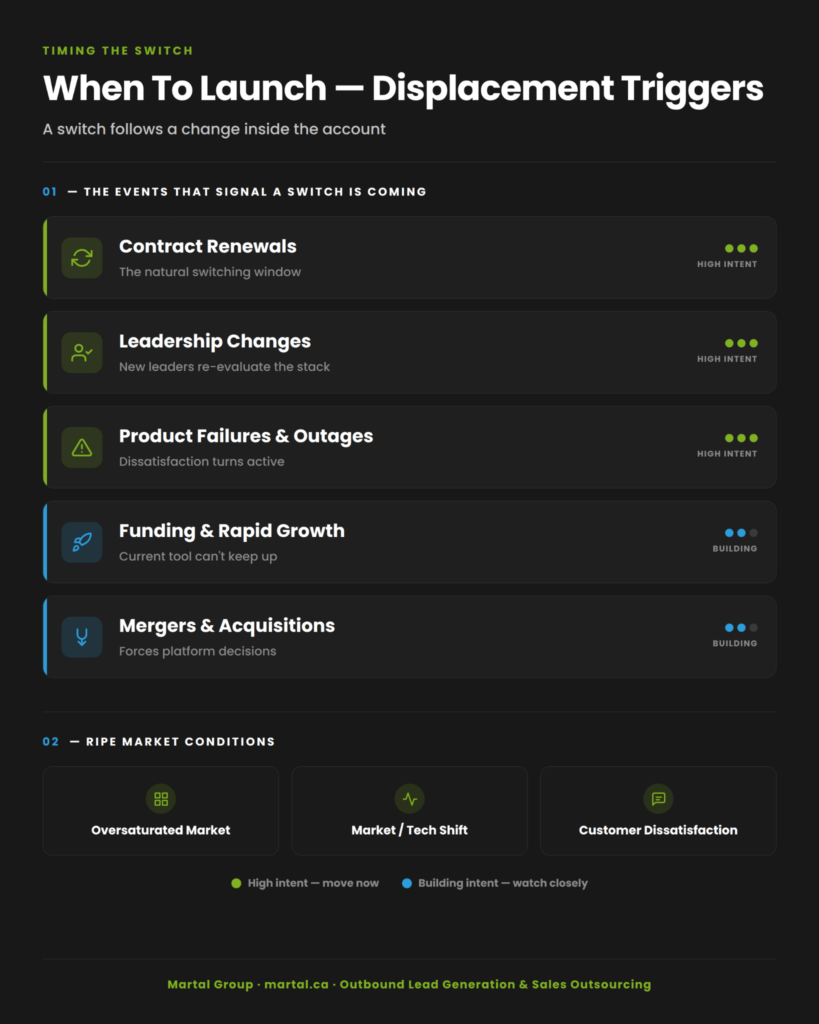
The Trigger Events That Signal a Switch Is Coming
The three environments above tell you where displacement works. Trigger events tell you when to move. A switch rarely happens out of nowhere — it follows a change inside the account, and the first vendor to show up with relevance usually wins. One thing we see often in outbound: the account that ignored you for six months suddenly replies the week after a reorg.
The triggers worth watching for:
– Contract renewals — the natural switching window, especially when the buyer is already frustrated. Time outreach to land before the renewal locks in for another year.
– Leadership changes — a new VP or department head almost always re-evaluates the inherited tech stack. Fresh decision-makers arrive with opinions formed at their last company.
– Product failures or outages — an incumbent’s downtime, security incident, or missed roadmap turns quiet dissatisfaction into active intent.
– Funding or rapid growth — a raise or hiring surge often means the current solution can no longer keep up with scale.
– Mergers and acquisitions — consolidation forces platform decisions and frequently puts incumbents up for review.
Each of these is an observable signal. The hard part isn’t agreeing they matter — it’s catching them across hundreds of accounts before a competitor does. That’s the targeting problem we’ll tackle next.”
Initiating a competitive displacement campaign during these scenarios will help you drive conversions and secure an edge in the marketplace.
How to Find Displacement Targets: Signals, Technographics, and AI
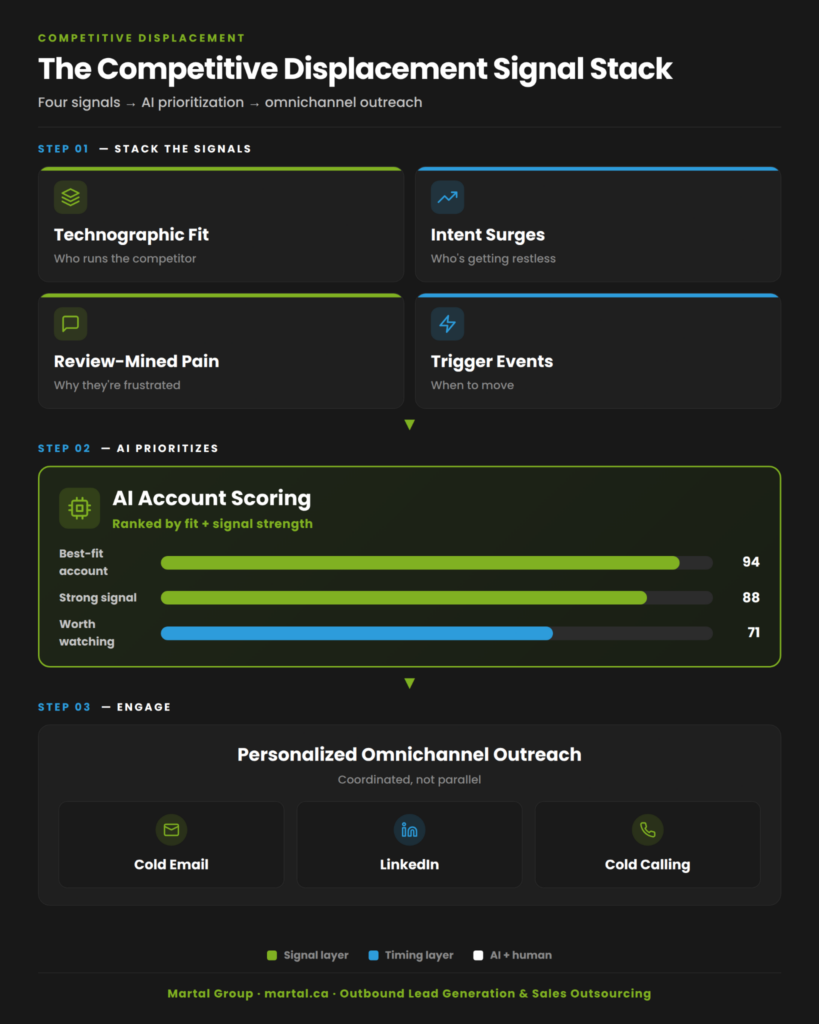
Knowing when a switch is possible is only half the battle. The harder question is which accounts — out of thousands — are showing the signs right now. This is where most displacement efforts quietly fall apart: the strategy is sound, but the targeting is a guess.
The fix is to stop treating “fit” as a single data point and start stacking signals.
Technographic data: who’s running the competitor right now
Technographic data shows what’s actually in an account’s tech stack — which CRM, which platform, which competing tool. For displacement, that’s the starting line. You can’t make the case to switch off a competitor until you know who’s running it. One thing we see often in outbound: a clean technographic filter turns a vague “companies like this” list into a named set of accounts already living with the exact pain you solve.
Intent signals: who’s getting restless
Technographics tell you who could switch. Intent signals tell you who’s starting to think about it — surges in research activity, comparison-keyword searches, review-site visits, content engagement around your category. Layered on top of trigger events like renewals and leadership changes, intent is what separates “good fit” from “good fit, and moving.”
The numbers make the case for precision over volume. Signal-personalized outreach lands reply rates of roughly 15–25%, against the 3–5% that generic cold outreach typically musters — and stacking two or three signals with real context pushes that toward 25–40% (4). That pattern is familiar from our own outbound work: relevance, not send volume, is what turns a cold account into a conversation.
Here’s the strategic part — most teams aren’t doing this yet. Only about a quarter of B2B companies use intent or signal tooling at all, and just 8% lean on advanced buyer and account intelligence to shape outreach (5). For a displacement strategy, that gap is the opportunity: you’re reaching dissatisfied accounts while competitors are still blasting the whole list.
AI: the part that makes it work at scale
Catching one trigger event on one account is easy. Catching them across hundreds of accounts, every day, before a competitor does — that’s not a human-speed task. This is where AI earns its place in a competitive displacement strategy: scoring and prioritizing accounts by fit and signal strength, surfacing the handful worth a rep’s attention this week, and drafting the first personalized angle from the data.
The market has moved fast here, but unevenly. AI adoption in B2B sales is now near-universal, yet far fewer teams have operationalized it in a way that actually changes pipeline — and the ones winning pair AI’s pattern-matching with human judgment rather than automating the rep out of the loop (2). That’s the model we believe in: AI surfaces and prioritizes the signal; an experienced Sales Executive decides what to say and how to say it. Our AI Sales Platform handles the first part so the human can focus on the part that closes.
It works. In one engagement with an AI freight platform entering a competitive logistics market, signal-led targeting and fast, relevant outreach delivered 122 SQLs and 108 booked meetings in just three months — the kind of result that comes from showing up at the right accounts before anyone else does.
The Pivotal Role of Customer Reviews in Competitive Displacement Campaigns
Of the four signals we just covered, review-mined pain is the one most teams overlook — and it’s often the richest. Intent data tells you an account is restless; reviews tell you exactly why.
Our sales executive discovered that an analysis of customer feedback serves as the foundation for developing hyper-personalized, omnichannel campaigns aimed at competitive displacement. By understanding the specific issues and dissatisfactions expressed by users of competing products, he was able to tailor his messaging in a way that highlighted how our clients’ solutions effectively addressed the market gaps. This not only positions our clients as superior alternatives but also demonstrates a deep understanding of the prospect’s needs, enhancing the credibility and attractiveness of the offer.
The strongest displacement messaging never mentions the competitor by name. You’re not running them down — you’re naming a frustration the prospect already feels and showing you understand it better than the vendor they’re paying. That restraint reads as confidence, not avoidance. We recommend that rather than direct criticism of competitors, the focus should be on presenting a compelling narrative that showcases the benefits and unique value proposition of your solution, informed by real user experiences.
In doing so, your campaigns will resonate more profoundly with the target audience, making them more likely to consider a switch to a product that promises to resolve their current challenges and frustrations.
The Process: Reviewing the Reviews
Now that we’ve covered the “what,” “why,” “when,” and how to find your targets, let’s get into the “how” in practice — what this looks like when a real rep runs it.
Let’s explore our sales executive’s journey of developing and implementing this strategy, as well as the impact these campaigns had on our clients’ pipelines.
What follows is one rep’s version of the review-mining layer in action — the same insight engine, applied by hand, before the AI did the heavy lifting.
The Background
If you run outbound, this next part will sound familiar. You’ve got a solid process for building outbound lead gen campaigns: you study the ideal client profiles (ICPs), analyze the competition, build segmented prospect lists, and launch omnichannel sequences. You do everything right. And still, sometimes, the results come back mediocre.
That’s exactly where one of our sales executives landed. Every box was checked, the process was sound — and the pipeline still wouldn’t move. During an internal debate about whether to make another call or send another email, he hit a wall of frustration. Realizing that none of the typical optimization tactics were improving performance, he decided to dive back into the market research.
It was pretty clear that he covered every known problem in his current campaigns, and he found no alternative angles to explore in the client’s initial market research. So, following a hunch, he started to browse some of the most popular review sites, G2, Capterra, and Clutch, and quickly discovered why he wasn’t resonating with his prospects’ pain.
The problems these customers were expressing online simply were not mentioned in the marketing materials, which ultimately meant his messaging was missing the mark.
“Oftentimes,” the sales executive pointed out, “Companies are so close to their products or services that it’s hard to express the value in a way that addresses the everyday struggles these users face.”
To rectify this wrong, our sales executive recorded and absorbed all the information he could from the reviews and then proceeded to match the newly discovered pain points with the corresponding ICPs.
From there, he rebuilt the copy from the ground up in hopes of scheduling an extra meeting or two a month.
Unexpectedly, the results far exceeded expectations. He landed five sales meetings within a few days of launching his revised campaign.
Not bad, right? So, now the big question is, what does this process look like?
To better understand how you might implement this process in your lead generation strategy, let’s review a few reviews and the copy he used to land more meetings.
Finding the Competitive Advantage in an Oversaturated Market
Our sales executive started developing a competitive displacement strategy while campaigning for a telecommunications company. The market was (and is still) saturated, and the only hope for success was to pinpoint a competitive advantage that could turn the tide.
What he found was the myriad of providers in the telecom industry actually made it more difficult for businesses to select a reliable service. In other words, prospects were experiencing analysis paralysis. An aspect easily overlooked amid the ever-expanding list of features and benefits.
The telecom company our sales executive was working with had a simple yet powerful solution for those prospects struggling to compile a shortlist of vendors.
Here’s how he positioned the company’s competitive advantage.
Customer Review Snippet:
“We found lots of issues with integration, inexperienced partners, and software issues.”
The Differentiator:
Inexperienced telephony and communications partners can cause more problems than the actual technology platform they are re-selling.
The Copy:
“While working with clients like {{company name}}, we’ve found that partnering with a reliable telecom provider is just as important as the platform and equipment you integrate. We not only discover new ways you can implement a more cost-effective communications solution but also help you choose the best provider based on your needs and service area.”
The Results:
Our sales executive increased the number of new meetings scheduled by 54 percent with this simple but effective change.
Highlighting a Market Shift that Led to Technological Advancements
In the following example, we have a SaaS startup helping businesses tackle the increased complexity of managing hybrid workplaces.
The pandemic brought a swift and unprecedented shift in market demand for HR SaaS. Tech companies in this niche sector were racing to conquer the new challenges of employee collaboration.
During his deep dive into online deliberations, our sales executive found that certain high-demand features were lacking among some of the most popular products.
Seeing this as a golden opportunity for our client, he segmented the outbound campaigns based on company size, departments, and job titles to reach the users who have typically been left longing for a more technologically advanced solution.
Here’s how he used the customer review below to write copy with a renewed perspective of the prospect’s pain.
Customer Review Snippet:
“I’d like to further segment our hot desk spaces by pods and neighborhoods, helping our organization teams ensure they can sit and work together when they are on site.”
The Differentiator:
A remote workforce may be the new normal; however, there is still the need and value for in-person meetings and collaborations. How can an organization facilitate this efficiently and safely?
The Copy:
“Do you and your team find it hard to collaborate in a hybrid workforce environment? Our platform allows everyone at {company name} to coordinate in-person meetings based on when and where co-workers will be in the office.”
The Results:
Because hybrid workforce platforms are just now scraping the surface of capabilities, it can be hard to express these concepts to organizations that recently embraced the new norm.
With newer technologies such as this, Martal Group has often experienced a slow but steady progression in business development.
Despite these hurdles, our sales executive secured three qualified sales meetings per week, surpassing the historical track record of one new meeting every 7-10 days.
Leveraging Customer Dissatisfaction in an Oversaturated Market
Most of the time, the differentiators are not obvious. It’s the small details, or lack thereof, that mean the most to buyers.
Take cybersecurity, for example.
It’s easy to assume there’s not much room for improvement in the training department. Regulations that keep companies in compliance are quite unwavering. However, our sales executive found that most training companies focus on the “how” and leave out the “why” of cybersecurity laws, resulting in many dissatisfied customers.
Our sales executive decided to take a chance and leveraged this commonly cited issue in his campaigns. By highlighting the importance of upskilling cybersecurity teams with a more advanced understanding of the ethical and infrastructural implications, he was able to help our client stand out in an oversaturated market.
Customer Review Snippet:
“I would like the platform to better help me understand the importance of adhering to ethical cyber security behaviors for risk mitigation and analysis.”
The Differentiator:
Cybersecurity professionals need a platform that helps improve their skills while also incorporating the “business” aspects of an enterprise cybersecurity program, such as audit, privacy, compliance, and risk management.
The Copy:
“Without a concrete understanding of why regulations exist, your team will struggle to remember important cybersecurity compliance requirements. Change the way your team views cybersecurity training with an intuitive platform that’s proven to increase memory retention.”
The Results:
Straight away, the sales rep produced five qualified meetings within the first two weeks of campaigning.
Conclusion
You can sift through firmographics and stats all day, but there’s still no substitute for a customer’s honest opinion. The sales executive’s results make the case: the campaigns that landed weren’t the ones with more volume — they were the ones that named a frustration the prospect already felt.
That’s the real lesson of competitive displacement. It isn’t about attacking competitors; it’s about reaching the right accounts at the right moment with a message that proves you understand their world better than the vendor they’re paying. Technographics tell you who’s running the competitor. Intent and trigger signals tell you who’s ready to move. Reviews tell you why. AI ties them together at scale — and an experienced rep turns the signal into a conversation.
The data backs the instinct: 92.4 percent of B2B buyers are guided by the experiences of others (1). When you harness that insight ethically — solving, not just selling — you don’t just win accounts. You win the trust that keeps them
Turn Competitor Dissatisfaction Into Your Pipeline
Competitive displacement works when three things line up: you find the accounts already frustrated with a competitor, you reach them at the moment they’re ready to move, and you show up with a message that proves you understand the problem better than the vendor they’re paying. Doing that across hundreds of accounts — consistently — is the hard part.
That’s what we do. Martal pairs experienced onshore Sales Executives with our AI Sales Platform to surface in-market accounts from technographic, intent, and trigger signals — then runs personalized outreach across cold email, cold calling, and LinkedIn as one coordinated omnichannel campaign. Our reps mine the reviews, build the displacement angle, and book the meetings, while the AI handles the targeting and prioritization at scale.
If your team is ready to win accounts your competitors think they already own, book a consultation and we’ll show you what a signal-driven displacement pipeline looks like for your market.
References