
 Martal
 Technology
 Education and training
 Web Development and UI / UX
 Healthcare/Medical
 Logistics and Supply Chain
 Information Technology
 Insuretech and Financial Services
 Marketplaces
 Software Development
 E-commerce and retail
 AI and Machine Learning
 Energy and Solar
 Manufacturing
 Security and Surveillance
 Digital Marketing Agency
 Transportation
 MSP
MSP
 Telecom
 B2B SaaS
 Cybersecurity
 HR tech
 Fintech
 Cleantech
 Consulting
15 Top Marketing Agencies in Japan for 2026, Organized by B2B Use Case
Major Takeaways: Marketing Agency in Japan
Most “best of” lists rank agencies in a single flat hierarchy, but B2B buyer fit is what determines outcomes. A top brand-campaign agency is wrong for direct-response B2B pipeline; a top influencer agency is wrong for cross-border outbound. Direction of growth — inbound into Japan or outbound from Japan — determines the right category before any agency is shortlisted.
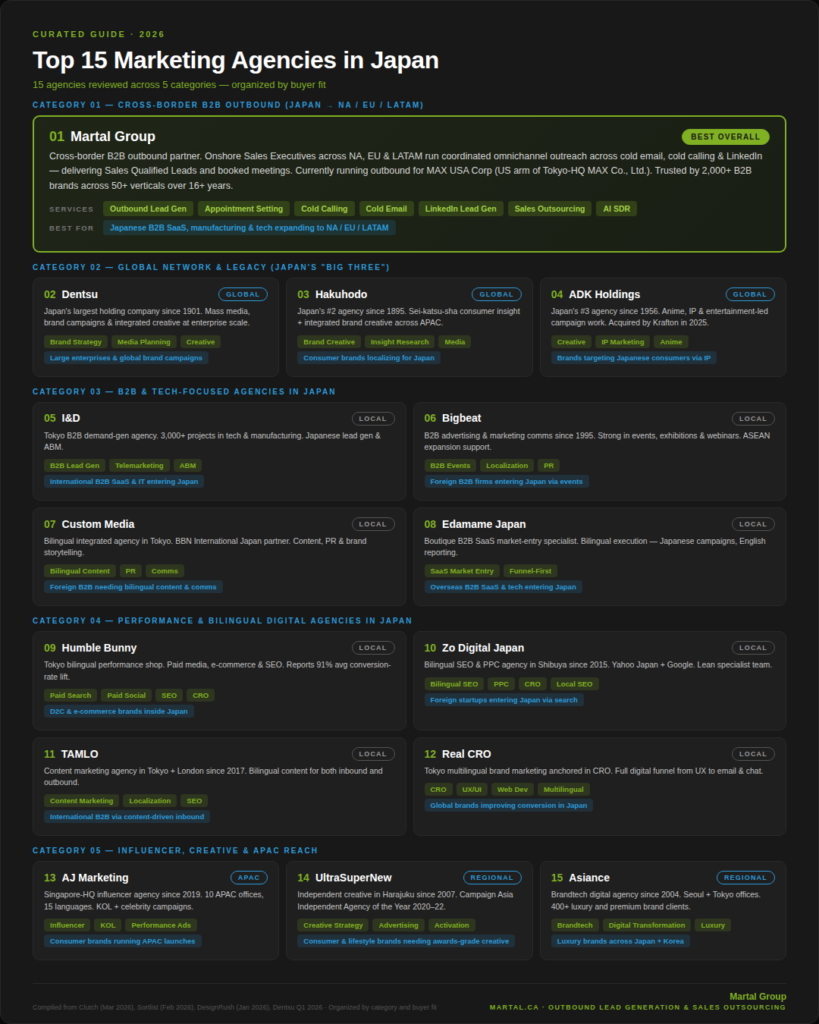
The 15 agencies in this guide split into five categories: cross-border B2B outbound (Japan → NA / EU / LATAM), global network and legacy (Dentsu, Hakuhodo, ADK), B2B and tech-focused in Japan, performance and bilingual digital, and influencer/creative/APAC reach. Each is built for a different buyer journey.
Cross-border B2B outbound from Japan into North America, Europe, or LATAM is the most underserved category on standard Japan-agency lists. Most Japan-domestic agencies don’t run pipeline-quality outbound into foreign target markets. Martal Group is the dedicated specialist in this category and currently runs the model for MAX USA Corp, the US subsidiary of Tokyo-headquartered MAX Co., Ltd.
Foreign B2B and tech firms entering Japan should prioritize agencies with verifiable B2B work (not pure B2C influencer shops), bilingual project management, and execution depth in the channels Japanese buyers actually use — Yahoo Japan SEO, LINE distribution, B2B events, Japanese-language demand generation. Custom Media, Bigbeat, I&D, and Edamame Japan are the specialists in this category.
Japan’s total ad spend reached ¥8.06 trillion in 2025, with internet advertising crossing 50.2% of total ad spend for the first time — ¥4.05 trillion. Total digital ad spend is forecast to hit US$64.88 billion in 2026, growing 14.1% year-over-year. Japan now has 107 million internet users at 87% population penetration.
Dentsu, Hakuhodo, and ADK Holdings are Japan’s largest advertising holding companies and dominate brand-campaign creative, mass media, and integrated advertising at enterprise scale. They aren’t built for direct-response B2B pipeline generation — their value lies in brand investment and category-defining work, typically for multinational consumer brands with significant media budgets.
Cross-border B2B outbound into NA, EU, or LATAM requires onshore Sales Executives in the buyer’s timezone, omnichannel coordination across cold email, cold calling, and LinkedIn, ICP refinement built on real-time intent signals, and outcomes measured in Sales Qualified Leads and booked meetings — not impressions, raw activity volume, or untriaged MQLs.
Introduction
Japan’s digital ad market just crossed a structural threshold. In its 2025 Japan Advertising Expenditures report, Dentsu reported that internet advertising reached ¥4.05 trillion in 2025 — 50.2% of Japan’s ¥8.06 trillion total ad spend (1), the first time digital has exceeded half. Total digital ad spend is on track to hit US$64.88 billion in 2026 (2), growing 14.1% year-over-year. With 107 million internet users and 87% penetration (3), Japan is one of the most digitally mature B2B audiences anywhere — and one of the harder markets to crack from the outside.
That scale comes with a buyer problem: choosing the right marketing agency in Japan is harder than choosing one almost anywhere else. Most “best of” lists conflate two very different decisions wearing the same label.
The first decision is inbound — a foreign company entering Japan needs an agency fluent in Yahoo! Japan SEO, LINE distribution, bilingual creative, and the cultural calibration that turns Western messaging into something Japanese buyers actually trust.
The second is outbound — a Japanese B2B company expanding into North America, Europe, or LATAM needs a sales partner running prospecting, cold outreach, and pipeline generation in the buyer’s language and timezone, not Japanese-language brand work.
These are fundamentally different agencies. A Tokyo-based bilingual SEO firm cannot run an SDR campaign into Boston enterprise accounts. A North American outbound team cannot place a national TVC on Yahoo Japan. Mixing the two is one of the most common mistakes foreign agency lists make.
This guide separates them clearly. We’ve reviewed 15 agencies operating in or relevant to the Japanese B2B market — segmented by buyer fit so you can find the right partner for your direction of growth. We start with cross-border outbound (Japan → North America / EU / LATAM), then move into B2B and tech-focused agencies in Japan, performance and bilingual digital, global network firms, and influencer/APAC reach.
How we built this guide
We reviewed agencies serving the Japanese B2B market by analyzing public directories (Clutch, Sortlist, GoodFirms, TechBehemoths), Dentsu’s published Japan ad market data, agency websites, third-party reviews, and available case studies. We then narrowed to 15 by applying three filters:
- B2B relevance. Agencies with verifiable B2B work — not pure-play B2C influencer or consumer brand shops.
- Verifiable credibility. Third-party reviews, public client work, or recognized presence in Japanese-market trade media.
- Buyer-fit categorization. Each shortlisted agency had to fall into one of five clearly defined categories so readers can match an agency to their direction of growth, not the other way around.
The Top 14 Marketing Agencies in Japan to Compare in 2026
The 14 agencies below cover the rest of Japan’s marketing landscape — from the country’s century-old advertising holding companies to bilingual SEO specialists in Shibuya, performance media shops in Harajuku, and pan-Asian influencer networks operating across 10 markets. They’re organized into five categories by buyer fit: one for the cross-border outbound use case Martal Group occupies, and four covering the rest of the Japan-agency landscape. Skip to the category that matches your direction of growth.
Category 01 — Cross-Border B2B Outbound (Japan → North America / EU / LATAM)
Martal Group, featured above. The right fit for Japanese B2B SaaS, manufacturing, industrial, and tech companies expanding into North America, Europe, or LATAM — with onshore Sales Executives running pipeline-quality outbound in the buyer’s timezone.
Category 02 — Global Network & Legacy Agencies (Japan’s “Big Three”)
Dentsu, Hakuhodo, and ADK Holdings. Brand-and-media engines built for enterprise-scale television, integrated creative, and large-budget campaigns. The right fit for multinational brand investment and category-defining work — not direct-response B2B pipeline.
Category 03 — B2B & Tech-Focused Agencies in Japan
I&D, Bigbeat, Custom Media, and Edamame Japan. Four Tokyo-based specialists handling B2B demand generation, events, bilingual content, and SaaS market entry inside Japan. The right fit for foreign B2B and tech firms entering the Japanese market through bilingual execution.
Category 04 — Performance & Bilingual Digital Agencies in Japan
Humble Bunny, Zo Digital Japan, TAMLO, and Real CRO. SEO, PPC, content marketing, and conversion rate optimization built around making owned channels and paid media perform in Japanese. The right fit for foreign brands operating in Japan that need bilingual digital execution at the channel level.
Category 05 — Influencer, Creative & APAC Reach
AJ Marketing, UltraSuperNew, and Asiance. Influencer activation, brand-and-creative storytelling, and pan-Asian digital campaign work. The right fit for consumer brands and APAC-wide launches where reach and brand impact are the primary objectives.
Each entry below follows the same structure: a brief overview, a key-features list, and an ideal-for definition.
Category 01 — Cross-Border B2B Outbound (Japan → North America / EU / LATAM)
The most overlooked category in standard Japan-agency lists, and the one with the highest stakes for Japanese B2B leaders. Selling into North America, Europe, or LATAM isn’t a localization challenge — it’s a sales-execution challenge. Japanese B2B companies expanding outward need an outbound partner with onshore Sales Executives in the buyer’s region, omnichannel outreach coordinated as one motion across cold email, cold calling, and LinkedIn, and outcomes measured in Sales Qualified Leads and booked meetings — not impressions or activity volume.
1. Martal Group
Martal Group is a B2B outbound sales and lead generation partner for Japanese companies expanding into North America, Europe, and LATAM. Onshore Sales Executives in the buyer’s region run coordinated omnichannel outreach across cold email, cold calling, and LinkedIn — qualifying responses into Sales Qualified Leads (SQLs) and booked meetings rather than handing back prospect lists or reporting on raw activity volume.
Founded in 2009, we’ve delivered 16+ years of outbound campaigns for 2,000+ B2B brands across 50+ verticals — from early-stage startups to Fortune 500 enterprises. The Japan-to-US expansion model is one we know directly. We currently run outbound for MAX USA Corp — the New York–based subsidiary of MAX Co., Ltd., the Tokyo-headquartered industrial tools manufacturer founded in 1942. The campaign reaches Product, Engineering, and EHS leaders at electrical and safety companies across the US: 5,000 prospects engaged per month, 15 SQLs delivered monthly, and consistent penetration into a niche industrial-tools market that internal teams couldn’t reproduce without doubling headcount.
- Target market: B2B
- Services offered: Outbound Lead Generation, B2B Appointment Setting, Cold Calling, Cold Emailing, LinkedIn Lead Generation, Sales Outsourcing, AI SDR Platform
- Target industries: B2B SaaS, Cybersecurity, AI/ML, Telecom, MSP, Manufacturing, Logistics & Supply Chain, Energy, Fintech, HR Tech, and 50+ more
- Best for: Japanese B2B SaaS, manufacturing, industrial, and tech companies expanding into North America, Europe, or LATAM — with onshore Sales Executives running pipeline-quality outbound in the buyer’s timezone
Key advantages
- Onshore teams across NA, EU, and LATAM. Locally aligned Sales Executives operating in the same timezone and cultural context as your buyers — same-day responsiveness, no offshore handoff.
- Human-led, AI-powered. Senior onshore SEs assisted by Martal’s proprietary AI Sales Platform — trained on 15+ years of B2B outbound data and 40M+ campaigns to identify ideal buyers via real-time intent signals, personalize outreach, and qualify responses.
- Omnichannel by default. Cold email, cold calling, and LinkedIn run as one coordinated sequence — not three disconnected tactics being manually stitched together by an in-house team.
Quantified outcomes. Reporting is built around SQLs and booked meetings, not prospects engaged. Standard Tier 1 plans benchmark up to a 66% increase in SQLs and a 25% reduction in sales cycle length compared with internal SDR builds.
Martal Group: A Trusted Marketing Partner for Japanese Companies


Why Japanese B2B Companies Partner With Us
For Japanese B2B leaders, the real question isn’t whether the destination market is worth entering — it’s whether the agency you hire can actually run the outbound motion that delivers pipeline rather than activity. Five things shape why Japanese companies choose us:
- A 16+ year cross-border track record. Founded in 2009, we’ve worked with 2,000+ B2B brands across 50+ verticals — including direct experience supporting the US arm of a Tokyo-headquartered industrial manufacturer entering the US electrical and safety market.
- Onshore execution in the markets you’re entering. Sales Executives based in North America, Europe, and LATAM — locally aligned, operating in the same timezone and business culture as your buyers. Not offshore call centers running overnight shifts.
- Sales-led, not marketing-led. We deliver SQLs and booked discovery calls — not impressions, untriaged MQLs, or content-marketing engagement. One team owns the full process from prospecting through qualification to handoff.
- AI-powered, human-led. Our proprietary AI Sales Platform handles repetitive prospecting, intent-signal scoring, and message personalization at scale, so senior SEs spend their time on conversations, qualification, and trust-building — where they’re irreplaceable.
- Independently validated. #1 in Lead Generation on Clutch, with 200+ five-star reviews across Clutch, G2, and Capterra. The track record is third-party verified, not self-reported.
For Japanese B2B companies expanding outward, the partnership model is simple: you focus on product, delivery, and closing. We run the outbound motion that fills the pipeline.
Category 02 — Global Network & Legacy Agencies (Japan’s “Big Three”)
Three agencies dominate Japan’s advertising market by scale and history: Dentsu, Hakuhodo, and ADK Holdings. Between them they shape much of the country’s mass-media buying, brand-campaign creative, and integrated communications infrastructure — and they’re the names that show up most often when B2B buyers research “marketing agency Japan.” The fit question is what these agencies are built for. They’re brand-and-media engines anchored in television, integrated creative, and large-budget campaigns — not outbound sales partners running cold email and SDR motions. For a Japanese B2B company expanding into NA, EU, or LATAM, that distinction matters: brand campaigns and direct-response pipeline generation require fundamentally different operating models. The Big Three excel at the first.
2. Dentsu
Dentsu Group is Japan’s largest advertising holding company, founded in 1901 and headquartered in Tokyo. It’s the only Japanese member of the global “Big Six” advertising network, and its scale spans television, print, OOH, integrated brand campaigns, and digital execution through Dentsu Digital. Most engagements start at the brand-strategy and media-buying level, where Dentsu’s leverage on Japanese media inventory and creative production is hard to replicate. The agency publishes the country’s most-cited annual ad market report, which signals where its analytical depth lives — mass-media spending behavior and brand effectiveness, rather than direct-response SDR pipeline.
- Services: Brand strategy, integrated advertising, creative production, media planning and buying, digital transformation
- Target market: Primarily B2C; B2B for large Japanese enterprises and public-sector clients
- Best for: Large Japanese enterprises and global brands running national or international brand campaigns with significant media budgets
3. Hakuhodo
Hakuhodo is Japan’s second-largest agency and the core agency of Hakuhodo DY Holdings, founded in 1895 and headquartered at Akasaka Biz Tower in Tokyo. The agency’s identity is built around its sei-katsu-sha insight approach — a worldview that treats consumers as multidimensional people rather than transaction targets, recently extended into a generative-AI persona platform called Virtual Sei-katsu-sha launched globally in January 2026. The model leans heavily into consumer brand storytelling, integrated media, and creative production for B2C and lifestyle categories, which positions it differently from B2B pipeline-execution work where the deliverable is a qualified sales meeting in a target buyer’s calendar rather than a brand activation.
- Services: Brand creative, integrated communications, consumer insight research, media planning, digital production
- Target market: Primarily B2C
- Best for: Consumer-facing Japanese brands and multinational brands localizing for Japanese audiences with creative-led, insight-driven campaigns
4. ADK Holdings (Asatsu-DK)
ADK is Japan’s third-largest advertising agency, founded in 1956 and headquartered at Toranomon Hills Mori Tower in Tokyo. The group is structured under three operating companies: ADK Marketing Solutions, ADK Creative One, and ADK Emotions. ADK’s heritage is deeply tied to anime, entertainment, and IP-driven campaign work — including long-running relationships with major Japanese animation properties like Doraemon — and that focus sharpened in June 2025 when the group was acquired by Korean gaming giant Krafton. The current model centers on consumer activation, IP rights marketing, and content production, rather than outbound B2B sales motion or SDR pipeline delivery.
- Services: Creative and content production, anime and IP marketing, entertainment content business, media planning, digital communications
- Target market: Primarily B2C; B2B for entertainment, gaming, and consumer industries
- Best for: Brands targeting Japanese consumer audiences through entertainment, IP, content-led campaigns, and anime-adjacent properties
Category 03 — B2B & Tech-Focused Agencies in Japan
Most “marketing agency Japan” lists skew toward consumer brand and influencer work, leaving foreign B2B brands without a useful shortlist. The four agencies below specialize in B2B execution inside Japan — bilingual demand generation, B2B events, localized content, and SaaS market entry. Each is built for the inbound direction (foreign company entering Japan) rather than outbound execution into NA, EU, or LATAM. For Japanese B2B leaders expanding outward, this category is informational context, not a target shortlist.
5. I&D (Inquire & Develop)
Overview
I&D is a Tokyo-based B2B marketing and demand-generation agency that supports inbound lead generation, account-based marketing, telemarketing, and lead nurturing for technology and manufacturing clients targeting the Japanese market. The agency reports completing 3,000+ projects across its history, with a focus on cold outreach to Japanese decision-makers in IT, SaaS, and industrial sectors. The operating model is research-and-call-led inside Japan — useful for B2B brands that need Japanese-language prospecting, less applicable for companies whose pipeline needs to land in target accounts outside Japan.
Key features
- B2B lead generation and lead nurturing in Japanese
- Telemarketing and cold outreach to Japanese decision-makers
- Account-based marketing programs
- IT and manufacturing specialization
- English-speaking project management for international clients
Ideal for: International B2B SaaS, IT, and industrial companies entering the Japanese market and needing Japanese-language demand generation and qualification.
6. Bigbeat
Overview
Bigbeat is a Tokyo-based B2B advertising and marketing communications agency founded in 1995, with additional offices in Bangkok and Vietnam supporting Japanese B2B companies expanding within ASEAN. The agency operates as a one-stop service for B2B marketing in Japan — covering localization, B2B events and exhibitions, webinar production, PR, and content. Bigbeat is also known for BIGBEAT LIVE, its annual B2B marketers’ conference in Tokyo. Strengths sit in event-led demand generation and Japan-market localization — the model assumes the buyer is already inside the funnel, rather than building outbound pipeline from cold contact onward.
Key features
- B2B events, exhibitions, and webinar production
- Marketing localization for foreign B2B firms entering Japan
- ASEAN expansion support for Japanese B2B companies (Bangkok and Vietnam offices)
- Tech-industry media relations and PR
- B2B content, brochures, and digital production
Ideal for: Foreign B2B firms entering Japan via event-driven demand generation, and Japanese B2B companies expanding regionally into ASEAN markets.
7. Custom Media
Overview
Custom Media is a Tokyo-based bilingual integrated marketing, content-creation, and strategic communications agency headquartered at Toranomon Hills Business Tower, founded around 2008. The agency is the Japan partner of the global B2B network BBN International and produces BIJ.TV, a bilingual video channel covering Japan-business executives. Client work spans B2B SaaS, luxury real estate, hotels, education, and consumer brands — a wide aperture for a single agency, which can dilute focus on the deeper B2B sales-execution needs of a SaaS or tech buyer compared with a specialist outbound partner.
Key features
- Bilingual content creation, video, and publishing (English/Japanese)
- Integrated marketing strategy and brand communications
- Public relations and corporate communications
- Web development and digital design
- BBN International Japan partnership for cross-border B2B accounts
Ideal for: Foreign B2B brands needing bilingual content, brand storytelling, and integrated communications inside Japan — particularly mid-market firms that value editorial-led content marketing.
8. Edamame Japan
Overview
Edamame Japan is a Tokyo-based boutique marketing agency specialized in B2B technology and SaaS market entry into Japan. The agency builds localized ad campaigns, funnel-based demand generation, and bilingual strategy-to-execution programs — operating Japanese-language campaigns and reporting results back in English. The model is execution-heavy on the inbound side, with the trade-off being scale: boutique sizing favors hands-on engagement over the broader headcount needed to drive cross-border outbound motions across multiple international markets.
Key features
- B2B SaaS and technology market entry to Japan
- Bilingual campaign management (Japanese execution, English reporting)
- Funnel-first demand generation
- Localized advertising and content production
- Insights-led research on Japanese B2B buyer behavior
Ideal for: Overseas B2B SaaS and tech firms entering Japan that want a single bilingual partner managing end-to-end execution without building an internal Japan marketing function.
Category 04 — Performance & Bilingual Digital Agencies in Japan
For foreign brands operating in or entering Japan, the executional layer of digital marketing is its own discipline — Yahoo Japan SEO, Google Ads in Japanese, bilingual creative, content localization, and CRO calibrated for Japanese user behavior. The four agencies below specialize in that layer. None of them run cross-border outbound sales motions; their value is in making a brand’s owned channels and paid media perform inside the Japanese market. Each is bilingual (English/Japanese) and primarily inbound-into-Japan in orientation.
9. Humble Bunny
Overview
Humble Bunny is a Tokyo-based bilingual performance marketing agency focused on paid advertising, e-commerce, and SEO for brands operating in Japan. The agency reports client-wide averages of 91.1% increase in conversion rates and 51.7% reduction in platform acquisition costs across its book. The operating model is paid-media-first and brand-side — the team optimizes funnels and creative for buyers who already engage with digital channels, rather than building outbound sales pipeline from cold accounts.
Key features
- Paid search and paid social campaign management (Google, Meta, Yahoo Japan)
- E-commerce performance marketing
- Bilingual SEO and content
- Conversion rate optimization and landing page testing
- Programmatic and display media buying
Ideal for: Foreign D2C, e-commerce, and consumer brands running paid-media and conversion-led growth inside Japan.
10. Zo Digital Japan
Overview
Zo Digital Japan is a Tokyo-based bilingual SEO and digital marketing agency (founded 2015, formerly JC Digital Consulting) headquartered in Jingumae, Shibuya-ku. Specializations span Japanese SEO, PPC across Google and Yahoo Japan, conversion rate optimization, digital PR, and analytics — for both B2B and B2C clients. Initial engagements typically range from $5,000 to $15,000 USD, with monthly retainers between $2,000 and $10,000 USD. Strengths lie in search-and-PPC execution for foreign brands targeting Japanese audiences. The lean team structure (under 15 employees) suits focused campaigns rather than the broader headcount needed to run cold outreach across multiple international markets.
Key features
- Bilingual SEO (Yahoo Japan + Google) for foreign brands targeting Japanese audiences
- PPC campaign management (Google Ads, Yahoo Japan, Meta, LinkedIn)
- Conversion rate optimization and landing page testing
- Local SEO and Google Business Profile optimization
- Bilingual website development and digital PR / link building
Ideal for: Foreign B2B and B2C startups and fast-growing businesses entering Japan that need search-led organic and paid acquisition with bilingual project management.
11. TAMLO
Overview
TAMLO is a Japanese content marketing agency with offices in Tokyo (Chiyoda-ku) and London, founded in 2017. The agency works in both directions — helping international companies localize content for the Japanese market and helping Japanese companies create content for international audiences. Services span market and audience research, content planning, content production, SEO, and ongoing content management. Engagements are content-led, which means lead generation comes downstream of editorial assets rather than through direct outbound prospecting motions.
Key features
- Bilingual content marketing strategy and production (Japanese ↔ English)
- Market, industry, and audience research
- SEO-optimized content for both Japanese and international audiences
- Content localization and ongoing content management
- Content-led inbound demand generation
Ideal for: International B2B and tech firms entering Japan via content-driven inbound demand, and Japanese companies producing English-language content for global markets.
12. Real CRO
Overview
Real CRO is a Tokyo-based multilingual brand marketing agency specializing in conversion rate optimization across the full digital experience — from off-site SEO and digital PR to UX/UI design, web development, email marketing, and chatbot/conversational marketing. The model is anchored in CRO as the central discipline that makes every other channel work harder. Operating focus is on the experience layer — improving the conversion of inbound traffic foreign brands already attract in Japan, rather than generating the upstream qualified-lead supply that outbound sales motions deliver.
Key features
- Conversion rate optimization across the full digital funnel
- Multilingual brand marketing for global brands in Japan
- UX/UI design and web development
- Off-site SEO, digital PR, and content placement
- Email marketing and conversational marketing (chatbots, live chat, messaging apps)
Ideal for: Inspiring global brands operating in Japan that want to improve conversion across owned digital properties without expanding internal headcount.
Category 05 — Influencer, Creative & APAC Reach
The final category covers agencies built around brand storytelling, influencer activations, and pan-Asian creative campaigns — useful for consumer brands and B2C-leaning launches, less useful for B2B pipeline generation. These agencies do creative and reach exceptionally; they don’t run outbound sales motions. For a Japanese B2B leader scanning this guide, treat this category as adjacent context, not a target shortlist.
13. AJ Marketing
Overview
AJ Marketing is a Singapore-headquartered influencer and creative agency with local offices in Japan, Korea, India, Indonesia, Malaysia, Philippines, Vietnam, Thailand, and Taiwan — founded in 2019 with a team operating in 15 languages across 10 countries. The agency manages an Asia-Pacific influencer and KOL network spanning gaming, beauty, fashion, and tech, with named clients including BMW MINI, ByteDance/TikTok, AMD, FIBA, Adobe, Microsoft, and Philips. The model is influencer- and social-led — geared to brand reach and engagement, rather than pipeline generation into qualified B2B accounts.
Key features
- Influencer and KOL campaign management across 10 APAC markets
- Celebrity partnerships and K-pop / J-pop collaborations
- Performance advertising and paid social
- Digital billboard campaigns
- TikTok, Instagram, YouTube content strategy
Ideal for: Global consumer and tech brands running multi-market APAC launches (Japan + Korea + SEA) where influencer marketing is the core channel.
14. UltraSuperNew
Overview
UltraSuperNew (USN) is an independent creative agency founded in 2007 and headquartered in Harajuku, Tokyo, with additional offices in Singapore, Taipei, Colombo, and Amsterdam — a team of 60+ creative specialists. The agency holds Campaign Asia-Pacific’s Japan/Korea Independent Agency of the Year award (Silver 2020, Gold 2021, Gold 2022) and has produced work for Red Bull, Heineken, Netflix, Uber Eats, Asics, MINI, Puma, Porsche, Salesforce, Nike, Amazon, and Mitsubishi Fuso. Specialization sits in advertising, design, branding, social, and activation aimed at Millennial and Gen Z audiences. The work is brand-and-creative-first, which means it generates cultural impact and audience awareness rather than the qualified sales meetings that outbound execution delivers.
Key features
- Creative and brand strategy
- Advertising campaign development across digital, social, and activation
- Branded content and video production
- Brand identity, design, and out-of-home (USN gallery network)
- Millennial and Gen Z audience specialization
Ideal for: Consumer and lifestyle brands needing distinctive, awards-grade creative work across Tokyo and APAC, particularly when targeting younger demographics.
15. Asiance
Overview
Asiance is a Brandtech digital agency founded in 2004 with offices in Seoul and Tokyo, working in English, French, Korean, and Japanese. With 20+ years in Asian digital marketing and 400+ clients to date, the agency focuses on the intersection of luxury branding, technology, and digital transformation — named clients include Lacoste, Calvin Klein, Bulgari, Montblanc, Chanel, Air France, 3M, Henkel, Pfizer, Samsung, and LG. The Brandtech model fuses brand strategy with technology and performance marketing into one framework. Operating focus sits at the brand-identity and digital-experience layer for premium and luxury categories — adjacent to, rather than overlapping with, the cold prospecting and SDR motion that B2B outbound execution requires.
Key features
- Brandtech model integrating brand strategy, technology, and performance marketing
- Luxury and premium brand specialization
- Digital transformation and end-to-end customer experience design
- Cross-market campaigns spanning Korea and Japan
- Multilingual project management (English, French, Korean, Japanese)
Ideal for: Luxury, premium, and lifestyle brands needing sophisticated digital execution across Japan and Korea simultaneously, with brand-strategy depth as a primary requirement.
Cross-Border B2B Outbound: Five Questions Japanese Leaders Ask (and the Cases That Answer Them)
For Japanese B2B leaders evaluating an external partner for North American, European, or LATAM expansion, the conversation tends to circle the same five questions. Each one is reasonable. Each one deserves a concrete answer rather than a generic pitch. What follows is five published Martal case studies — each framed against the specific buyer concern it addresses. The Japan-specific case (MAX USA Corp) leads, since it’s the most directly applicable proof point for Japanese B2B leaders. The rest demonstrate that the model travels across origins, industries, and timelines.
MAX USA Corp — Tokyo, Japan → New York, United States
For Japanese B2B leaders considering an external partner for US expansion, the first question is almost always direct: has anyone actually done this for a Japanese-headquartered company before?
MAX USA Corp is the New York–based US subsidiary of MAX Co., Ltd., the Tokyo-headquartered industrial tools manufacturer founded in 1942. The US arm sells into the electrical and safety industrial markets — concentrated buying committees of Product, Engineering, and EHS leaders inside large electrical contractors, utility OEMs, and safety equipment distributors. Internally building the outreach capability to map that buyer pool would have meant hiring multiple specialist SDRs, ramping them on technical product positioning, and absorbing 6–9 months of pipeline lag before payoff.
Martal currently runs the outbound program:
- 5,000 prospects engaged per month across electrical and safety verticals
- 15 Sales Qualified Leads delivered per month into the MAX USA pipeline
- Active multi-quarter campaign with consistent niche-market penetration
What this answers: the worry that cross-border B2B outbound is theoretical for Japanese parent companies. It isn’t. The Japan-to-US model is currently running for a Tokyo-headquartered industrial manufacturer in a technical niche — and producing pipeline at scale.
Polygon — Stockholm, Sweden → United States
The next concern is usually about ramp time: how long before meetings actually start landing in calendars, not just emails in inboxes?
Polygon is a Swedish IoT climate-control company that needed to break into the US market without building a North American sales team from scratch. The outbound program targeted facilities managers, building operators, and engineering leaders at commercial real estate and industrial properties across the US.
- 139 booked meetings delivered over the 24-month engagement
- 203 Sales Qualified Leads generated across the campaign
- Sustained outbound presence in a category where most competitors were US-domestic
What this answers: the doubt that non-US-HQ companies can realistically expect consistent meeting flow from an outbound program. Polygon’s numbers say otherwise — and the structural profile (European HQ, technical industrial product, long enterprise sales cycle) maps closely to what a Japanese industrial or B2B SaaS company would face entering North America.
Awin — Berlin, Germany → United States
The third question is about durability: does outbound execution actually sustain over a multi-year horizon, or does the engine sputter after the first few quarters?
Awin is a Berlin-headquartered affiliate marketing network that engaged Martal to scale US pipeline development across a multi-year partnership. The campaign focused on growth marketers, performance media leads, and affiliate-channel decision-makers at US e-commerce and DTC brands.
- 1,204 leads generated over a 3-year engagement
- 100 Sales Qualified Leads delivered
- 74 booked meetings with target-account decision-makers
What this answers: the assumption that outbound programs decay after the first 6–12 months. Awin’s three-year continuity proves the opposite. Sustained outbound is possible when the model is built around ongoing ICP refinement, message iteration, and weekly market feedback — not one-time campaign blasts that pause once the initial list is worked through.
Joopy (Incentives Solutions) — Israel → US / Canada
The fourth concern goes deeper into the operating model: can an outbound partner actually run the full sales cycle, or does the value end at the booked meeting?
Joopy is an Israeli HR tech company specializing in sales performance management and incentive compensation software. The engagement was a full-cycle sales outsourcing model — not just lead generation, but the entire process from prospecting through to close.
- 100+ deals managed across the engagement
- Full sales cycle outsourced, not just appointment setting
- Cross-border SaaS expansion into both US and Canadian markets
What this answers: the assumption that outbound agencies cap at the SDR layer and hand everything over to the client thereafter. Joopy shows the model can extend further when the client wants it to — from cold prospecting all the way to closed revenue, with Martal acting as the outsourced sales arm. For Japanese B2B SaaS founders who don’t yet have an internal US sales hire, this is the most useful proof of how far an engagement can scale.
Berger-Levrault — France → US / Canada
The final and often most important question is economic: will the campaign math actually work for long-cycle enterprise B2B, where deal sizes are large but close rates are low?
Berger-Levrault is a French public-sector and enterprise software company that needed North American pipeline development across a long, complex enterprise sales cycle.
- 12 Sales Qualified Leads delivered per month consistently
- Two enterprise deals alone justified the entire campaign investment — a ROI ceiling test the engagement passed in year one
- Sustained pipeline into government, education, and large-enterprise buyers across US and Canada
What this answers: the worry that cost-per-meeting math doesn’t work for enterprise B2B. It does — because in long-cycle high-ACV sales, the campaign payback compounds against a small number of high-value deals. For Berger-Levrault, two enterprise closes alone covered the full campaign cost. Everything after that was upside.
The Through-Line
After five questions, the natural follow-up is the meta-question: what’s the actual pattern across these engagements?
Across all five, non-US-headquartered B2B companies — Japanese, Swedish, German, Israeli, French — needed to reach North American decision-makers without standing up an internal SDR function. Each used Martal as an onshore execution layer: Sales Executives based in the target market, omnichannel outreach across cold email, cold calling, and LinkedIn, and outcomes measured in SQLs and booked meetings rather than activity volume.
For Japanese B2B leaders evaluating an international expansion partner, the MAX USA Corp case is the single most directly applicable proof point on this list. The rest demonstrate that the model travels — across countries of origin, across industries, and across the multi-year horizon enterprise pipeline actually requires.
Choosing the Right Marketing Agency in Japan
The biggest mistake B2B leaders make when shortlisting marketing agencies in Japan isn’t choosing the wrong agency — it’s choosing the wrong category. Most “best of” lists conflate two distinct decisions: helping a foreign brand enter Japan, and helping a Japanese brand expand outward into North America, Europe, or LATAM. These are different problems, and the agencies that solve them aren’t interchangeable.
For foreign brands entering Japan, the decision lives somewhere in Categories 02 through 05 above. Bilingual Yahoo Japan SEO, Japanese-language demand generation, B2B events, paid media inside the LINE and Yahoo ecosystem, content localization, KOL activation — these are different specialties, and matching the agency to your channel mix and buyer behavior matters more than picking the largest or most-awarded brand on the list.
For Japanese B2B leaders expanding outward, the decision is simpler but lonelier. Category 01 — cross-border B2B outbound into NA, EU, and LATAM — is underrepresented on most Japan-agency lists because most Japan-domestic agencies don’t run it. Pipeline-quality outbound execution into foreign markets requires onshore Sales Executives in the buyer’s timezone, omnichannel coordination across cold email, cold calling, and LinkedIn, and outcomes measured in Sales Qualified Leads and booked meetings rather than impressions or activity volume.
If your team is building a North American, European, or LATAM pipeline from a Japanese (or any non-NA) base, Martal Group’s Sales-as-a-Service model combines onshore Sales Executives in your buyers’ regions with our proprietary AI SDR Platform — running cold email, cold calling, and LinkedIn outreach as one coordinated omnichannel motion.
Book a consultation to see what a qualified pipeline into North America actually looks like from a non-US starting point — built on intent signals, run by senior onshore SEs, and measured in meetings booked rather than prospects engaged.
References
FAQs: Marketing Agency in Japan
How much does a marketing agency in Japan cost?
Engagement costs vary widely depending on agency type and scope. Bilingual SEO and digital agencies in Tokyo typically publish initial engagement bands of $5,000–$15,000 USD with monthly retainers of $2,000–$10,000 USD. B2B agencies in Japan generally command monthly retainers starting around ¥400,000 (roughly $2,800 USD) for ongoing demand-generation work. The Big Three (Dentsu, Hakuhodo, ADK Holdings) operate at significantly higher rates suited to enterprise brand campaigns. Cross-border B2B outbound partners like Martal Group price by service tier, with fully managed lead generation starting at the Tier 1 level. The single most important cost variable isn’t agency size — it’s whether the agency model matches your direction of growth. A category misfit at any price wastes budget.
Should I hire a Japan-based agency or a foreign agency to enter Japan?
The honest answer depends on what “enter Japan” actually means for your business. If your goal is acquiring Japanese customers through Japanese-language channels — Yahoo Japan SEO, LINE distribution, KOL activation, Japanese-language content marketing — a Japan-based bilingual agency is almost always the right choice. Custom Media, Bigbeat, Humble Bunny, Zo Digital Japan, and Edamame Japan all specialize in this work. If your goal is the opposite — a Japanese B2B company expanding outward into North America, Europe, or LATAM — you need an agency operating in the target market, not in Japan. Cross-border outbound execution requires onshore Sales Executives in the buyer’s timezone, which Japan-domestic agencies are structurally not built to provide.
Do I need a bilingual marketing agency in Japan, or can I work in English only?
For execution inside Japan, you need bilingual capability somewhere in your engagement — either at the agency level or your internal team level. Japanese B2B buyers expect Japanese-language outreach, Japanese SEO targeting Yahoo Japan and Google, and Japanese-language content. English-only execution rarely converts at scale in Japan, even in technical B2B categories. Bilingual agencies like Custom Media, TAMLO, Zo Digital Japan, Edamame Japan, and Real CRO bridge the gap by handling Japanese execution while reporting and managing the engagement in English. For cross-border outbound in the other direction — Japanese B2B companies expanding into NA, EU, or LATAM — the language requirement flips: English-language execution into the target market is what matters, not Japanese fluency at the agency level.
What’s the difference between a marketing agency in Japan and one that helps Japanese companies expand abroad?
They’re structurally different services. A marketing agency in Japan helps brands reach Japanese audiences — Japanese-language SEO, LINE and Yahoo Japan media, B2B events in Tokyo, bilingual content. The team is local, the channels are local, and the buyer is in Japan. An agency that helps Japanese companies expand abroad does the opposite: it reaches North American, European, or LATAM decision-makers in their languages, timezones, and channels. The team operates in the buyer’s region, not in Japan. Cross-border outbound execution falls into this second category. Most lists of “marketing agencies in Japan” don’t distinguish between these two services, which leads to mismatched agency selections. Martal Group specializes in the second — cross-border B2B outbound from Japan and other non-NA origins into NA, EU, and LATAM markets.
Why is Yahoo Japan still important for B2B SEO in 2026?
Unlike most Western markets where Google dominates near-monopolistically, Japanese buyers actively use both Yahoo Japan and Google for product research and B2B vendor evaluation. Yahoo Japan operates its own ads platform, partner network, and content ecosystem separate from Google Ads, which means bilingual SEO and PPC campaigns targeting Japanese audiences need optimization for both engines, not just one. Yahoo Japan also remains a strong content hub via Yahoo News and the LINE ecosystem integration consolidating through 2026 under LY Corporation. Agencies specialized in this dual-engine approach — Zo Digital Japan, Humble Bunny, Real CRO — handle the Yahoo Japan-specific technical and content requirements that purely Google-trained agencies often miss.
How long does it take to see results from a marketing agency in Japan?
Timelines vary by service type and direction of growth. Bilingual SEO results in Japan typically begin to compound at 6–12 months for competitive verticals, though quick wins can appear in 1–2 weeks for sites with obvious technical fixes. PPC campaigns can drive traffic within days but optimize meaningfully over 60–90 days. B2B demand generation through events, content, and ABM typically produces qualified pipeline within 90–120 days. Cross-border outbound execution (Japanese B2B companies expanding into NA, EU, or LATAM) typically produces the first Sales Qualified Leads within 30 days of campaign launch, with month-over-month scaling thereafter. The single biggest accelerator across all formats is whether the agency starts with a clear ICP and intent-signal-based targeting, or builds the list from scratch in week one.