
 Martal
 Technology
 Education and training
 Web Development and UI / UX
 Healthcare/Medical
 Logistics and Supply Chain
 Information Technology
 Insuretech and Financial Services
 Marketplaces
 Software Development
 E-commerce and retail
 AI and Machine Learning
 Energy and Solar
 Manufacturing
 Security and Surveillance
 Digital Marketing Agency
 Transportation
 MSP
MSP
 Telecom
 B2B SaaS
 Cybersecurity
 HR tech
 Fintech
 Cleantech
 Consulting
Appointment Setters in 2026: Cost, Skills, and the In-House vs. Outsourced Decision
Major Takeaways: Appointment Setters
Appointment setters are the first point of contact with potential clients — they qualify interest, set the appointment, and hand off a clean, contextual brief so closers walk into a meeting that’s ready to move.
Top appointment setters excel in communication, active listening, consultative judgment, time management, adaptability, technical proficiency, and resilience to maximize conversions.
Gain client-facing experience, understand the B2B sales funnel, learn CRM and dialer tools, practice objection handling, and track performance metrics to accelerate career growth.
In the USA, base salaries typically run $33,000 to $78,000 annually, with hourly rates between $14 and $33. Top-decile earners exceed $89,000, and commissions or per-appointment bonuses lift total compensation higher.
Outsourced qualified B2B appointments commonly fall in a $550–$1,700 per meeting range depending on industry, target seniority, and qualification depth — useful as a benchmark against the loaded cost of doing it in-house.
AI handles the repetitive layer — list building, sequence sends, dialer prioritization, CRM logging — while human setters handle qualification, judgment calls, and live conversation. The strongest setups pair the two rather than replacing one with the other.
Outsourcing to appointment setting firms removes the hiring, training, and turnover risk of building in-house — and gets a tested team running on your pipeline in days, not the 4 to 6 weeks it takes a new hire to ramp.
Week 1: Industry & product immersion; Week 2: Tools and communication training; Week 3: Lead engagement practice; Week 4: Independent call performance and KPI tracking.
The two highest-leverage moves are CRM hygiene and AE handoff discipline — incomplete logging is one of the biggest hidden drags on follow-up, and a clean handoff brief is what turns a booked meeting into a real opportunity.
High-performing appointment setters can progress to sales development representative (SDR), account executive (AE), or sales manager roles, especially with continuous learning and measurable results.
Introduction
Your reps made 80 dials yesterday and booked zero meetings. Your AEs are complaining about garbage leads. Pipeline is flat even though headcount went up. The problem isn’t effort — it’s the system around the effort, and appointment setters sit at the center of that system.
Done well, knowing what’s an appointment setter and having reliable B2B appointment setting services running behind your sales team is what separates a pipeline that compounds from one that stalls. Done poorly, it’s expensive busywork.
This guide unpacks the role end-to-end — what appointment setters actually do day to day, the skills that separate the strong ones from the rest, what they cost, where AI fits in, and how to decide whether to build the function in-house or outsource it. We’ve worked alongside thousands of B2B sales teams over the past 16 years, so we’ll be honest about the tradeoffs at every step.
What Is an Appointment Setter and What Do They Bring to Your Sales Team?
An appt setter is an entry-level-to-mid-level sales professional responsible for identifying, contacting, qualifying, and scheduling appointments with potential clients for account executives. The role sits between list building and sales opportunity creation — close enough to pipeline that quality really matters, but distinct from the closing role that owns the deal.
Professional appointment setters do four things that move revenue:
- Open conversations with prospects who didn’t ask to hear from you
- Qualify basic fit early so weak leads don’t get pushed downstream to AEs
- Capture context in the CRM so closers don’t have to repeat discovery in the meeting
- Protect the meeting with reminders, confirmations, and a no-show recovery sequence
That last point is where most teams quietly lose the most pipeline value. A well-set appointment that the prospect skips, with no recovery plan, is worth roughly the same as one that was never set at all. The strongest setters treat the meeting as something to be defended — not just booked.
One thing we see often: when a setter under-qualifies, AEs lose trust in the pipeline. When they over-qualify, pipeline slows down. The job is to manage that tension with judgment, which is exactly why the right experience level and training matter more than raw call volume.
What Do Appointment Setters Do Day to Day?
What does an appointment setter do exactly? They run the top of the funnel — researching prospects, opening conversations across phone (often referred to as cold calling), email, and LinkedIn, qualifying interest, and booking meetings that closers can actually work.
What that looks like on a typical day:
- Prospect Research: Identify accounts and contacts that match the ideal customer profile, then verify the data before any outreach goes out
- Initiating Contact: Open conversations across cold calls, email, and LinkedIn — coordinated, not stacked on top of each other
- Qualifying Leads: Assess fit, interest, and authority to determine which prospects are ready for a closer
- Set Appointment: Arrange meetings or calls between qualified leads and sales representatives, with confirmation and reminder sequences built in
- Appointment Scheduler Duties: Manage sales representatives’ calendars, coordinate timezones, and rebook no-shows quickly so the meeting doesn’t die after one missed slot
- Handoff to AEs: Capture pain points discussed, why the prospect agreed to meet, and any objections raised — five fields, ninety seconds, before passing to a closer
- CRM Hygiene: Log every touchpoint accurately so follow-ups don’t fall through the cracks
- Feedback Loop: Surface objection patterns, ICP misses, and messaging gaps back to the sales team to sharpen future campaigns
How many calls does an appointment setter make a day?
This is one of the most common questions we see from people researching the role. The honest answer is that volume varies by motion, but the working benchmarks for B2B outbound are roughly 80 to 100 dials per day and 8 to 10 qualified outbound calls per hour for setters who are sustaining real pipeline velocity. Top performers also maintain near-100% CRM logging — and that hygiene matters more than most teams realize. Industry research has linked incomplete CRM data to a 35% to 50% drop in follow-up efficacy, which means a setter who hits activity targets but logs poorly is quietly leaking pipeline downstream.
The modern appointment setter goes beyond smile-and-dial volume — they bring strategic judgment toqualified appointment setting, making sure the meetings booked are with people who have real interest, real authority, and a real reason to take the call.
The 7 Must-Have Appointment Setter Skills
While the role of an appointment setter is full of repetitive tasks, effectiveness hinges on a tight set of skills that decide whether a setter quietly leaks pipeline or compounds it.
As an agency that has hired and trained appointment setters across 50+ verticals over the last 16 years, here are the seven skills we screen for in every candidate — and what we look for behind each one.
1. Communication: Can the candidate convey information clearly, in short, relevant messages? The role doesn’t reward long explanations. It rewards calm, direct conversations and written follow-ups that get read.
2. Active Listening: Does the candidate actually hear what the prospect is saying — including what they’re not saying? Pain points, hesitations, and timing cues live in the things prospects mention in passing. Setters who only listen for buying signals miss most of them.
3. Consultative Judgment: This is the piece most job descriptions miss. Strong setters don’t interrogate prospects with a checklist. They guide a short business conversation that surfaces fit, timing, and stakeholder relevance — and they know when to keep moving and when to qualify deeper.
4. Time Management: Can the candidate hold pace across research, dials, follow-ups, and CRM updates without one bucket dropping? In a typical day of 80 to 100 dials, the difference between a strong setter and an average one is rarely talent — it’s discipline.
5. Adaptability: How quickly does the candidate adjust when a script breaks down, a new objection lands, or a vertical shifts? Sales environments move. Setters who freeze when the call goes off-script don’t last long.
6. Technical Proficiency: Does the candidate work cleanly inside CRMs, dialers, sequencers, and AI assistants? Day-one comfort with the stack matters more in 2026 than it did even two years ago — most modern outbound motions depend on AI-assisted enrichment, sequencing, and call prioritization.
7. Resilience: Can the candidate stay steady through a string of rejections without their tone shifting on the eighth call of the morning? Prospects can hear fatigue. The setters who stay even-keeled book the meetings the others don’t.
One thing worth flagging: the difference between activity and outcome usually comes down to CRM discipline and handoff quality, not raw skill. A setter who is excellent on the phone but logs incomplete notes will quietly create downstream pipeline problems for AEs that show up weeks later as confused handoffs and missed follow-ups. We weight CRM hygiene heavily in screening for that reason.
How to Become an Appointment Setter and Win Big in Sales
If you’re aiming to land a role that matches a strong appointment setter job description, preparation and strategic effort are key. The role looks easy from the outside — make calls, book meetings — but the strongest setters take it seriously as a craft, and that shows in the first 30 seconds of any interview.
Here’s a tight, step-by-step plan, plus some often-overlooked appointment setting tips for anyone searching for appointment setting jobs or wondering “Is appointment setter a good job?”
Step
Focus Area
Details & Tips
1
Gain Practical Experience
Start with client-facing roles — customer service, telemarketing, sales support — to build core skills (objection handling, active listening, follow-through). Get comfortable with at least one CRM and one dialer. Track real metrics from day one: dials per day, connect rate, conversion rate.
2
Understand the B2B Sales Process
Learn the funnel from cold outreach through qualified handoff. Read three to five real appointment setter job descriptions in your target industry to see what employers actually expect. Learn how to identify and prioritize high-quality leads — that judgment is what separates entry-level from mid-level.
3
Craft a Compelling Resume
Lead with measurable results, not duties. “Made 80+ daily dials at a 15% connect rate” beats “responsible for outreach.” Include keywords the ATS is scanning for: appointment specialist, lead qualification, CRM. Sales-adjacent experience (retail, hospitality) counts if you frame it around objection handling and resilience.
4
Network and Apply Strategically
Use LinkedIn to follow target companies and engage with sales-leader content. Apply on LinkedIn (search “appointment setters jobs” + “entry level”), WeWorkRemotely, Dynamite Jobs. Target companies whose product genuinely interests you — your tone shifts when you actually care about what you’re representing.
5
Prepare for Interviews That Test the Role
Strong hiring managers don’t assess setters with conversation alone — they test how you think under pressure. Be ready for live role-play (objection handling, voicemail, post-call CRM note) and short pre-screen tasks. The polished talker often loses to the candidate who shows process and self-awareness.
1. Gain Practical Experience
Employers value candidates with relevant client-facing experience. If you’re new to the field, start with customer service, telemarketing appointment setting, or sales support roles. Understanding what are appointment setters expected to do in these roles will help you build the right foundation.
What many miss: get hands-on with at least one CRM and one dialer before you apply. Day-one comfort with the stack is increasingly a hiring filter. Track your own metrics — call-to-appointment ratios, connect rate — and bring those numbers into interviews.
2. Understand the B2B Sales Process
A solid grasp of the B2B sales funnel is non-negotiable. Familiarize yourself with how B2B appointment setting fits between marketing-generated interest and sales-ready opportunity, and how each stage of the appointment funnel moves a prospect closer to a closer. Reading through a complete campaign playbook is the fastest way to see where a setter’s daily work fits in the larger system.
Most postings — including the typical appointment setter job description — outline the skills and metrics expected. Read three to five carefully before applying. They tell you what good looks like in your target market.
3. Craft a Compelling Resume
Lead with measurable results. “Made 80+ daily dials at a 15% connect rate” tells a hiring manager more than any duties list. Highlight scheduling efficiency, client engagement metrics, and any sales-adjacent experience you can frame around objection handling and resilience.
Include keywords the ATS is scanning for: appointment specialist, lead qualification, CRM systems. Soft skills matter too — emotional resilience and team collaboration are increasingly valued in appointment setters jobs.
4. Network and Apply Strategically
The market is competitive, and most candidates lose ground by applying indiscriminately. Use LinkedIn to follow target companies and engage with sales-leader content — it’s a faster path to a real conversation than another cold application. Attend local sales meetups when you can.
Where to find the strongest opportunities:
- LinkedIn (search “appointment setters jobs” + “entry level”)
- Remote job boards (WeWorkRemotely, Dynamite Jobs)
- Sales-specialized staffing agencies
5. Prepare for Interviews That Test the Role
Strong hiring managers won’t assess you with conversation alone. They’ll test how you think — short pre-screen tasks (a sample follow-up email, a mock voicemail, a CRM note after a call), live role-play scenarios, and structured behavioral questions. The polished talker often loses to the candidate who shows process and self-awareness.
Be ready to discuss how you handle rejection, how you stay motivated through a string of no’s, and what your own follow-up cadence looks like. Ask about training, performance metrics, and how the team handles handoffs to AEs — those questions signal you understand where the role actually creates value.
How Much Do Appointment Setters Make?
Compensation for appointment setters varies widely based on experience, geographic market, industry, and how heavily the role is weighted toward base pay versus performance incentives. Here’s what the 2026 picture actually looks like — pulled from multiple compensation databases so the range reflects real market spread, not a single source.
Salary Ranges (2026)
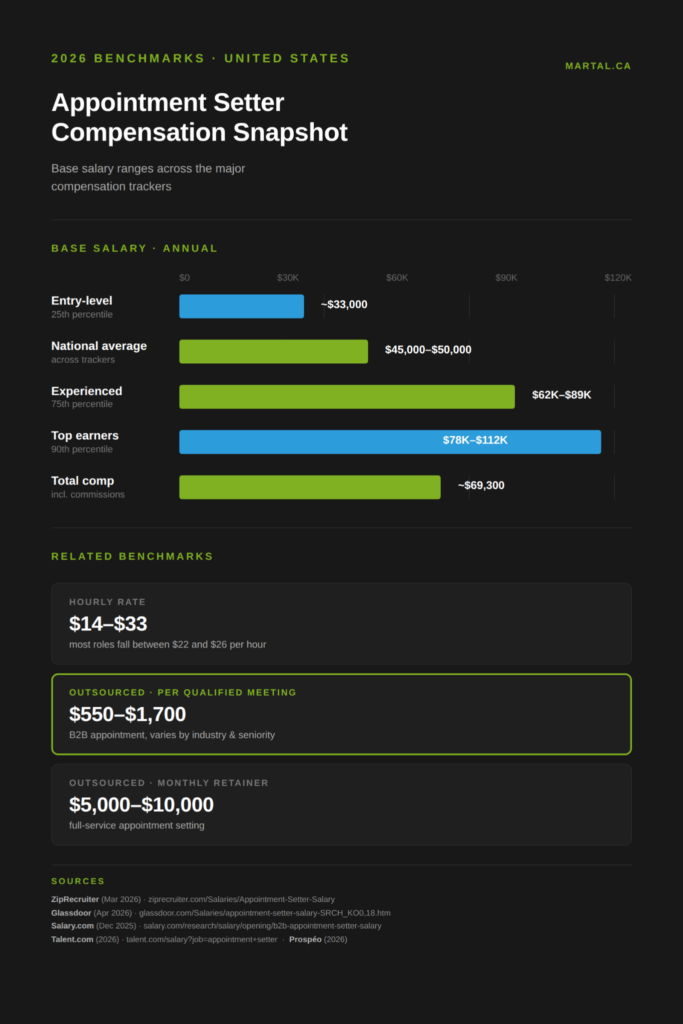
Across the major compensation trackers, U.S. appointment setter base salaries cluster like this:
- Entry-level: ~$33,000 per year
- National average: $45,000–$50,000 per year, depending on source
- Experienced (75th percentile): $62,000–$89,000 per year
- Top earners (90th percentile): $78,000–$112,000 per year
- Hourly rate: $14 to $33, with most roles landing between $22 and $26
For perspective on movement, the U.S. average at $45,380 (1). According to ZipRecruiter’s data centers around $50,455 with top-decile earners at $78,000 (2); Salary.com reports $49,603 for a B2B-specific appointment setter (3); and Glassdoor’s data — which folds in commissions and bonuses — runs higher at $69,306 total compensation, with top earners reaching $111,984 (4).
The takeaway isn’t a single number. It’s that compensation has drifted upward by 15–25% since 2024, especially at the experienced and top-decile end. That matters when you’re modeling the loaded cost of bringing the role in-house.
Regional Variation
Geography still moves the number meaningfully. According to market benchmarks, the current top-paying U.S. states for the role include South Dakota, Hawaii, Alaska, Washington, California, Massachusetts, and the District of Columbia, where averages run $52,000–$73,000 (5). Lower-cost states in the South and Midwest typically trend below national averages. Remote work has flattened some of this — many employers now benchmark to national averages rather than strictly local markets — but cost-of-living adjustments are still common.
What Outsourced Appointment Setting Actually Costs
Salary is one half of the equation. The other half is what an outsourced qualified B2B appointment costs on the open market — because that’s the alternative most buyers are weighing.
Current industry benchmarks put outsourced qualified B2B appointments in the $550 to $1,700 per meeting range, depending on industry, target seniority, and qualification depth. Hourly outsourced rates typically fall between $15 and $40 per hour, with monthly retainers for full-service appointment setting commonly landing in the $5,000 to $10,000 per month range for sustained pipeline work (6).
One thing worth flagging: the pay-per-appointment model sounds appealing on paper but often produces calendar stuffing — meetings booked to hit the bonus, with weak qualification underneath. Retainer-based models tied to qualification depth tend to produce stronger long-term pipeline.
How to Hire an Appointment Setter: Choosing the Best-of-the-Best
Hiring the right appointment setter is one of the highest-leverage decisions a sales leader makes. The wrong hire doesn’t just miss meetings — they damage AE trust in the pipeline, burn through your CRM with half-logged outreach, and quietly cost you 4 to 6 weeks of lost momentum before you realize the role isn’t working.
If you’re wondering how to hire appointment setters who actually deliver results, the process needs to test for the things that matter — and most hiring processes don’t. Here are 9 steps that do.
1. Craft a Magnetic Job Description: Write an appointment setter job description that ties each responsibility to a measurable business outcome — daily activity targets, qualification criteria, CRM hygiene expectations, and AE handoff standards. If your job description could also describe a receptionist, it isn’t specific enough for B2B outbound.
2. Strategically Post Your Job Opening: Post on platforms where B2B sales professionals actually look — LinkedIn, sales-specialized boards, and remote-first job sites. Generic job boards produce generic candidates.
3. Selective Resume Screening: Shortlist candidates with measurable evidence of role fit — outreach volume, connect rates, qualification ownership, CRM use, AE collaboration. Customer support backgrounds with structured communication discipline often translate better than people expect.
4. Use Short Pre-Screen Tasks: Before the first interview, ask for a sample follow-up email, a 60-second mock voicemail, or a CRM note they would leave after a discovery call. The way someone writes a CRM note tells you more about how they’ll perform than thirty minutes of conversation.
5. Conduct Real-World Mock Calling Sessions: Test live objection handling, recovery from a stumble, and the ability to keep a conversation moving without sounding rehearsed. Polished talkers often fall apart when the prospect goes off-script.
6. Run Behavioral Interviews That Probe Process: Ask how they handle a string of rejections in a single morning. Ask what their handoff brief to an AE looks like. Ask what they do when they suspect a meeting is going to no-show. Their answers reveal whether they treat the role as a craft or as a stepping stone.
7. Analyze Performance Metrics: Dig into specific past numbers — average dials per day, connect rate, qualification-to-meeting ratio, no-show rate, AE acceptance rate on booked meetings. Vague answers are a red flag.
8. Perform Revenue-Impact Reference Checks: Ask references about pipeline contribution, qualification quality, and how the candidate worked with AEs. References will tell you things resumes can’t — especially around CRM discipline and ownership.
9. Deploy a Robust Onboarding and Training Program: A new appointment setter typically needs 4 to 6 weeks to become fully productive, even if they can start dialing in week one. Without structured ramp-up — product training, ICP immersion, CRM workflows, AE handoff standards, and ongoing coaching — a strong candidate still underperforms.
Now, let’s be honest about what this process actually costs.
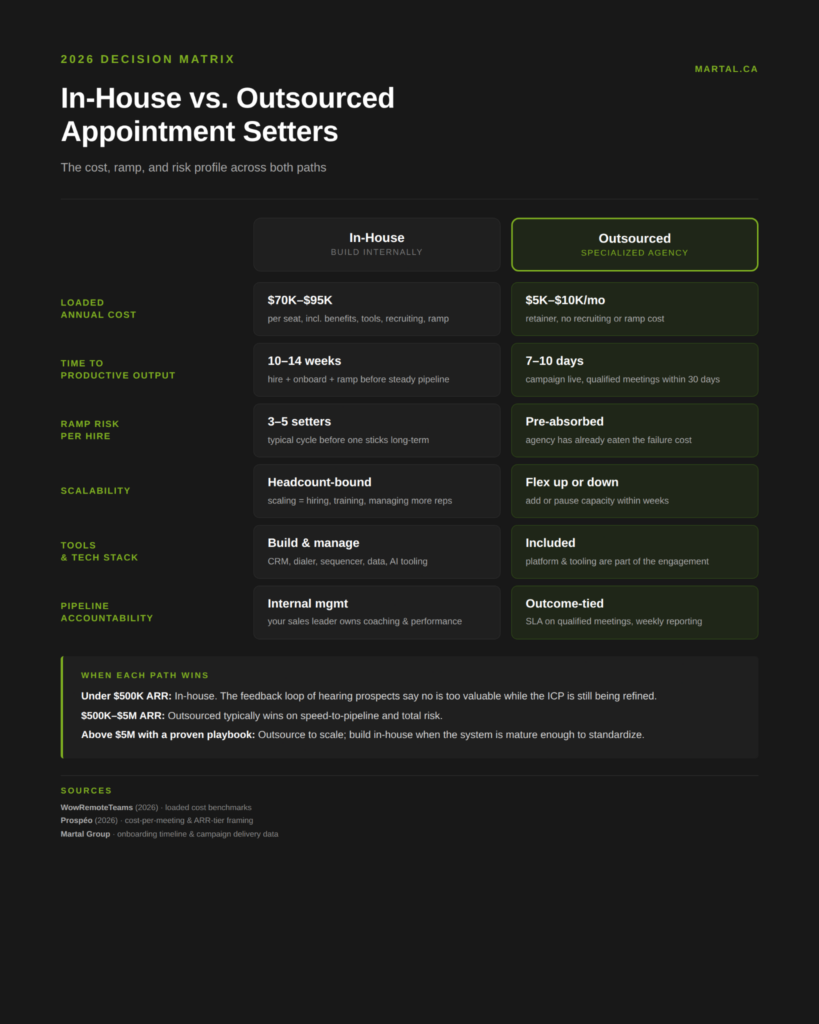
Even when it works, in-house hiring is slow, expensive, and uncertain. The job posting takes a week. Sourcing and screening eat another two to three. Interviews and references run another week or two. Onboarding and ramp run 4 to 6 weeks more. By the time you have a productive setter, you’re 10 to 14 weeks deep — and that’s the success scenario.
The failure scenario is more common than most sales leaders admit. The candidate looks great on paper, interviews well, then underperforms once the calls actually start. You’ve now spent 3 months and a hire’s worth of salary, and you’re back to the start. Most teams cycle through 3 to 5 setters before landing one who sticks. That’s expensive feedback.
Outsourcing appointment setting offsets that risk. A specialized agency walks in with trained setters, tested playbooks, and a delivery infrastructure that’s already absorbed the failure cost — meaning the team you work with has already gone through the cycle so you don’t have to. The right partner gets a campaign live in days, not weeks, and is accountable to outcomes rather than activity.
The Proven 4-Week Appointment Setter Training Blueprint
Onboarding is where most appointment setting programs quietly fall apart. A strong candidate gets handed a script, a CRM login, and a list — then expected to figure out the rest. Six weeks later, AEs are rejecting their meetings and the rep is updating their resume.
Our 4-week onboarding and training program at Martal Group is built to prevent that. It’s the framework we run for every new appointment setter on a client campaign — onshore Sales Executives in North America, Europe, and LATAM — and it’s the same framework that turns out appointment setting call center teams and field setters who can hold their own from week 5 forward.
Week & Days
Goal
Focus Areas
Week 1
Build deep industry knowledge and product expertise to confidently represent your company.
Days 1–3
Understand the industry landscape, key players, market trends, and competitor offerings.
Industry orientation, key players, market trends, competitor analysis
Days 4–5
Master the product/service thoroughly to communicate its value and customer benefits.
Interactive product demos, customer scenarios, value proposition workshops
Week 2
Become proficient with essential sales tools and sharpen communication skills.
Days 1–2
Get certified on CRM, dialers, and email tools used in appointment setting.
CRM training, email sequencing tools, dialer software
Days 3–5
Enhance verbal communication, objection handling, and role-play real outreach scenarios.
Voice coaching, objection handling frameworks, live role-plays
Week 3
Develop advanced lead qualification and engagement skills through hands-on practice.
Days 1–3
Use prospecting tools to identify, score, and personalize outreach to qualified leads.
LinkedIn Navigator, personalized icebreakers, lead scoring
Days 4–5
Apply skills in mock calls with coaching and peer feedback to boost confidence.
Mock calls, real-time coaching, peer feedback sessions
Week 4
Align performance goals and transition to independent appointment setting.
Days 1–2
Set measurable KPIs and optimize workflows using CRM dashboards and time-blocking.
KPI setting, CRM dashboard customization, time management
Days 3–5
Gradually take over live calls, receive feedback, and review performance progress.
Shadowing senior reps, graduated call responsibility, performance reviews
Ongoing Excellence Program
Maintain continuous improvement through coaching, advanced training, and workshops.
Weekly
Refine skills through personalized 1:1 coaching and call review.
1:1 coaching, technique refinement
Monthly
Deepen expertise with advanced sales tactics and product training modules.
Sales skill development, product updates
Quarterly
Participate in “Top Performer” workshops to learn best practices and celebrate success.
Peer learning, recognition, leadership insights
Week 1: Industry & Product Immersion
Goal: Turn new setters into people who can hold a real industry conversation, not script-readers.
Days 1–3: Industry Deep Dive
– Map the key players, market trends, and competitive landscape in the client’s vertical
– Learn the industry-specific pain points and the language buyers actually use
– Study competitor offerings through hands-on comparison exercises
Days 4–5: Product Mastery
– Interactive product demos — not slide-deck reading
– “Day in the life” customer scenario training, role-played
– Value proposition workshops, with each setter writing and refining their own articulation
One thing we see often: setters who skip industry depth in week one end up over-relying on scripts in week three, and prospects can hear it. Week 1 is where credibility is built.
Week 2: Tools & Communication Bootcamp
Goal: Equip every setter for real-world outreach across the omnichannel stack.
Days 1–2: Tech Stack Certification
– CRM drills (Salesforce, HubSpot, or the client’s system)
– Email sequencing tools and deliverability fundamentals
– Dialer software and AI-assisted call prioritization
Days 3–5: Communication Intensive
– Voice modulation coaching for cold calling
– Objection handling frameworks built on real client objections
– Live role-plays with recorded playback and structured critique
Week 3: Lead Engagement Mastery
Goal: Move from theory to live qualification under coaching.
Days 1–3: Advanced Prospecting
– LinkedIn Sales Navigator training
– Personalized icebreaker frameworks tied to intent signals
– Account scoring and prioritization workflows
Days 4–5: Mock Call Marathon
– 25+ simulated calls with escalating difficulty
– Real-time coaching during calls
– Peer evaluation sessions
Whether the campaign is in SaaS, manufacturing, fintech, or cybersecurity, week 3 is where qualification judgment gets built. Every vertical has different signals — but the discipline of qualifying before booking is universal.
Week 4: Performance Optimization
Goal: Transition into independent performers with clear metrics and AE handoff discipline.
Days 1–2: KPI Alignment
– Set targets for appointment setting goals: dials per day, connect rate, qualified meetings booked, AE acceptance rate
– CRM dashboard customization and reporting cadence
– Time-blocking strategies for sustained output
Days 3–5: Live Call Transition
– Shadow senior Sales Executives on live calls
– Graduated call responsibility: listen → co-call → solo
– First-week performance review with the Sales Operations Manager
This is also where AE handoff discipline gets locked in. Every booked meeting comes with a five-field brief — prospect name, company, pain points discussed, why they agreed to meet, and any objections raised. Ninety seconds of work that protects the AE’s time and the prospect’s experience.
The Ongoing Excellence Program
Training doesn’t end at week four. The setters who stay sharp are the ones who keep iterating, and the program continues:
- Weekly: 1:1 coaching sessions reviewing call recordings to refine appointment setting techniques
- Monthly: Advanced training modules on objection handling, AI tooling, and vertical-specific tactics
- Quarterly: “Top Performer” workshops — peer-led sessions where the best setters break down what’s working and why
Job Titles and Career Progression
Strong appointment setters typically spend 6 months to 2 years in the role before advancing to sales development representative (SDR) or account executive (AE) positions. The progression accelerates for high performers in companies with active growth — continuous coaching, hitting structured targets, and consistent CRM and handoff discipline are what move the needle, not raw call volume.
In-House vs. Outsourced Appointment Setters: The Math Most Sales Leaders Skip
Most sales leaders make this decision on instinct rather than math. They build in-house because it feels safer, or they outsource because it feels faster. Both decisions deserve a clearer view of what each path actually costs.
What an In-House Appointment Setter Really Costs
Base salary is the easy number. The harder one is loaded cost — what it actually takes to put a productive setter in a seat and keep them there.
Using current 2026 benchmarks, the loaded annual cost of one in-house U.S. appointment setter typically runs:
– Base salary: $45,000–$50,000 (national average)
– Payroll taxes & benefits: 15–30% on top of base — roughly $7,000–$15,000
– Tools & tech stack: CRM seat, dialer, sequencer, data, LinkedIn Sales Navigator — typically $3,000–$6,000 per year per seat
– Equipment & overhead: Laptop, monitor, headset, software, workspace allocation — $2,000–$4,000
– Recruiting & onboarding: Time-to-hire (3–6 weeks) plus 4–6 weeks of paid ramp before productive output — easily $10,000–$15,000 in fully-loaded cost
– Management overhead: Sales manager time spent coaching, reviewing calls, fixing handoff issues — often the biggest hidden line item
Conservative loaded cost: $70,000–$95,000 per year per seat, before turnover. And the appointment setting cost gets worse if the hire doesn’t stick — which is more common than most teams admit.
Where the Real Hidden Cost Lives
The line item that sales leaders consistently underestimate is turnover and re-hire cost. Most teams cycle through 3 to 5 setters before landing one who genuinely sticks, and each failed hire absorbs roughly 3 months of salary, tools, and management attention before the team realizes it isn’t working. That’s not a worst-case scenario — that’s the typical scenario.
The second hidden cost is AE pipeline damage. When an underperforming setter books low-quality meetings, AEs lose trust in the pipeline. They start arriving cold, doing the qualification themselves, and complaining about lead quality. That trust takes a quarter or two to rebuild, even after the setter is replaced.
What Outsourced Appointment Setting Looks Like by Comparison
Outsourced appointment setting shifts the structure rather than just the line items. The agency absorbs the recruiting, training, retention, management, and tooling cost — and the team you work with has already gone through the failure cycle so you don’t have to.
The tradeoff is real: you have less direct control over individual setters, and the agency model only works when the partner is genuinely accountable to outcomes rather than activity. Some agencies stuff calendars with low-quality meetings to hit retainer terms. Others run with the discipline of an internal team. The difference shows up in the contract — qualified meeting definitions, AE acceptance rate accountability, and ramp-down clauses for underperformance.
For most B2B teams between $500K and $5M ARR, the outsourced path is faster to productive pipeline and lower in total risk. For teams under $500K ARR, the feedback loop of in-house outbound matters too much to skip — there’s value in hearing prospects say no firsthand, especially while the ICP is still being refined. For teams above $5M with a proven playbook, the question becomes whether you’re scaling a system that already works or asking an agency to build the system for you. Those are different decisions.
Real client example. When Complete EDI needed to test outbound demand without committing to the multi-month cycle of building an in-house function, they partnered with Martal on a 3-month fractional pilot — a single dedicated rep, omnichannel outreach, qualified meeting accountability. The pilot delivered 14 SQLs in 3 months. That’s the speed-to-pipeline difference an outsourced model creates: you get to the answer fast enough to make a real decision about whether outbound works for your motion before you’ve spent 6 months and a hire’s worth of salary finding out.
If you’d like to compare what outsourced appointment setting could look like for your team, our ROI calculator builds out a personalized estimate.
AI Appointment Setters: How Automation Is Changing the Role
Search volume around AI appointment setters has climbed sharply through 2025 and 2026, and the marketing around them has moved faster than the reality. Some vendors describe AI as a full replacement for human setters. Most credible operators describe it as a force multiplier for the parts of the job humans do worst.
Both views are partly right. The honest framing is that AI now handles the repetitive layer of the role — list building, sequence sends, dialer prioritization, CRM logging, basic personalization — while humans handle the layer that still requires judgment: live qualification, objection handling, stakeholder navigation, and the AE handoff. The strongest setups pair the two rather than replacing one with the other.
What AI Does Well in Appointment Setting
The areas where AI has materially changed the role over the last 18 months:
– Account discovery and enrichment: AI surfaces lookalike accounts and adds firmographic, technographic, and intent context that used to take hours of manual research per prospect
– Intent signal detection: Funding rounds, hiring surges, tech stack changes, and content engagement get scored automatically — so outreach lands when something has actually shifted in the buyer’s world, not on an arbitrary cadence
– Personalization at scale: AI-generated outreach that references a prospect’s role, industry, and recent activity is now table stakes, not a differentiator. Generic templates underperform sharply against well-prompted AI personalization
– Cadence orchestration: AI handles email/LinkedIn/phone sequencing, deliverability monitoring, and timing adjustments — the operational layer that used to require stitching together 8 to 12 separate tools
– CRM logging and handoff context: This is the underrated one. AI auto-captures call notes, summarizes conversations, and produces structured handoff briefs for AEs. The CRM hygiene gap that costs most teams 35-50% of follow-up efficacy starts to close when this is done automatically
What AI Still Doesn’t Do Well
An honest list of what AI still struggles with in B2B appointment setting:
– Live qualification on a call: Reading hesitation, picking up on what a prospect isn’t saying, and deciding when to push deeper versus pull back — these are human judgment calls
– Multi-stakeholder navigation: Complex B2B deals involve buying committees, internal politics, and timing windows that don’t map cleanly to scoring models
– Recovery when a script breaks: When a prospect goes off-script with a question or objection the AI hasn’t seen before, response quality drops fast
– Trust at the meeting transition: Prospects who agree to a meeting often want to feel that the next conversation will be with someone who actually understands their world. Pure-AI engagement still struggles with this trust handoff
How Martal’s AI SDR Platform Fits
Martal’s AI SDR is built to handle the AI-native layer of the role — the Martal AI SDR Platform runs intent monitoring, account targeting, omnichannel orchestration, and handoff context — while our onshore Sales Executives across North America, Europe, and LATAM run the live qualification and meeting-protection layer.
The pairing produces a different kind of pipeline output. Setters arrive at every call with full account context, recent intent signals, and competitive background. AEs receive structured handoff briefs that captures pain points, why the prospect agreed to meet, and any objections raised. The AI handles the repetition; the humans handle the judgment.
One thing we tell prospective clients directly: if a vendor is selling you fully autonomous AI appointment setting with no human in the loop for B2B outbound, ask them to show you the AE acceptance rates on their booked meetings. The number tells you whether the meetings are real or whether the AI is calendar-stuffing to hit retainer terms.
Should You Use AI Appointment Setters?
The decision usually comes down to motion fit:
– High-volume, transactional B2B: AI-heavy with thin human layer often works. Lower-stakes meetings, faster sales cycles, less judgment needed at the qualification step
– Mid-market enterprise B2B with multi-stakeholder buying: AI-augmented human setters perform meaningfully better. The judgment calls and trust handoff matter too much to automate fully
– Highly technical or regulated industries: Cybersecurity, healthcare, fintech, manufacturing — buyers expect a knowledgeable conversation, not a polished AI script. Human setters with AI tooling typically win here
How to Hire Outsourced Appointment Setters
The first and most important step when outsourcing appointment setters is to define what success actually looks like — not just “more leads,” but the specific shape of pipeline you need. Are you increasing top-of-funnel volume? Entering a new market segment? Filling AE calendars while you build internal capacity? The clearer your goal, the more useful the partnership and the easier it becomes to evaluate performance against it. That clarity will also guide you in selecting the right outsourcing partner for lead generation and appointment setting.
What to Evaluate in Appointment Setting Firms
When evaluating appointment setting companies and appointment setting firms, weigh six factors carefully. Most buyers stop at three or four — usually pricing, reputation, and industry experience — and miss the operational details that actually predict whether the engagement will work.
Relevant Experience. When evaluating appointment setting firms, look for a partner with a proven track record in your specific industry or with projects similar to yours — and ask for concrete results, not just logo walls. A firm that has run campaigns in cybersecurity SaaS, manufacturing, or fintech understands the buying cycles, compliance considerations, and industry-specific objections in a way that translates directly to faster pipeline.
Reputation and Proof. Investigate what the market actually says, not just what’s on the homepage. Read client testimonials and review case studies, and check for industry awards or recognition from third-party platforms like Clutch and G2. A reputable partner has documented outcomes — specific lead counts, SQL volumes, meetings booked — and can show how those numbers translated to revenue.
Communication Style and Cadence. Ask how often you’ll get updates, what the reporting looks like, and who your day-to-day point of contact is. Regular weekly meetings, live campaign progression sheets, and transparent dialogue are essential — and a partner who fights against transparency is a partner who’ll fight against accountability later.
Technological Capabilities. The platform underneath the team matters as much as the team itself. Ask about CRM integration, AI tooling for prospecting and qualification, omnichannel orchestration across email, phone, and LinkedIn, and how AE handoff context is captured and delivered. The strongest partners run on proprietary platforms purpose-built for outbound, not patchworks of off-the-shelf tools.
Qualified Meeting Definition. This is the one most buyers skip — and it’s the one that determines whether you’ll be happy with the partnership six months in. Get the agency to define, in writing, what qualifies a meeting as “booked” and what qualifies it as “qualified.” Acceptance criteria, no-show recovery process, and AE handoff brief format should all be documented before the contract is signed.
Pricing Structure. Understand the model before you sign. Retainer-based pricing tied to qualification depth produces stronger long-term pipeline than pay-per-appointment models, which create incentives to calendar-stuff. The cost should be transparent and aligned with the ROI you expect from the appointment setting services.
Why Buyers Choose Martal
At Martal, we run scalable B2B appointment setting for clients across 50+ industries through onshore Sales Executives in North America, Europe, and LATAM — paired with our proprietary AI Sales Platform that handles the data, intent, and orchestration layer. Trusted by 2,000+ B2B brands over 16+ years, with 200+ five-star reviews and the #1 Lead Generation ranking on Clutch.
What that looks like in practice across a few real engagements:
– Berger-Levrault — a fintech and ERP software provider expanding in the U.S. market — saw two closed deals from Martal’s campaign that, on their own, justified the entire engagement investment
– HALO Recognition — an HR services firm — generated $10M+ in new business opportunities through Martal’s outbound program
– Polygon — a Stockholm-based IoT climate control company entering the U.S. market — booked 139 qualified meetings over 24 months
– Total Energy Connections — a ~10-person energy firm — receives 20 qualified leads per month, sustained, from a single Martal team
Keep in mind that outcomes vary, every campaign is shaped by the ICP, the market, and the messaging, but they’re representative of what onshore, AI-augmented, omnichannel outbound looks like when it’s run as a system rather than a script.
Conclusion
Appointment setting is one of the most-misunderstood functions in B2B sales. From the outside, it looks like dialing and scheduling. From inside the system, it’s the layer that decides whether your AEs walk into qualified conversations or wasted hours, whether your CRM holds usable context or noise, and whether your pipeline compounds or stalls.
The right appointment setter — whether built in-house or run through an outsourced SDR and appointment setting partner — does four things consistently: opens conversations with the right prospects, qualifies before booking, captures handoff context cleanly, and protects the meeting until it actually happens. Everything else is supporting infrastructure.
The decision between building this function internally or outsourcing comes down to where your team is right now. If you’re under $500K ARR with an unrefined ICP, in-house feedback is worth the slower ramp. If you’re between $500K and $5M ARR and your sales leader is being pulled away from coaching to manage outbound logistics, outsourcing typically wins on speed and total risk. If you’re scaling a proven playbook, the conversation shifts from whether to outsource to what to outsource and to whom.
Wherever you sit, the worst decision is the one made on instinct rather than math.
If you’d like to put numbers behind the decision for your team, book a consultation — a 30-minute walkthrough where we’ll map your goals, the realistic pipeline shape your motion can support, and what an omnichannel campaign run by onshore Sales Executives plus Martal’s AI Sales Platform would actually deliver. No pitch deck, no pressure — just the math.
References
FAQs: Appointment Setters
How do appointment setters make money?
Appointment setters typically earn through one of five compensation structures: base salary only, base salary plus performance bonuses tied to meetings booked, commission on revenue from closed appointments, pay-per-lead or pay-per-appointment, or hourly wages — common in part-time and offshore arrangements. The most common in-house structure for B2B is base plus bonus, since pure commission creates slow feedback loops in long sales cycles and pay-per-appointment creates incentives for quantity over qualification quality. Top setters in commission-heavy roles can earn $300–$600 per closed appointment in some industries, but those numbers come with high variance.
How much does it cost to outsource appointment setting?
Outsourced appointment setting in 2026 typically falls in three pricing models: per-meeting pricing at $550 to $1,700 per qualified B2B appointment depending on industry and target seniority, hourly rates of $15 to $40 per hour for contract setters, and monthly retainers of $5,000 to $10,000 for full-service appointment setting with sustained pipeline output. Retainer models tied to qualification depth produce stronger long-term pipeline than pay-per-appointment models, which often produce calendar stuffing.
What’s the difference between an appointment setter and an SDR?
An appointment setter’s primary role is scheduling qualified meetings between prospects and account executives — the focus is on conversation initiation, basic qualification, and meeting protection. A Sales Development Representative (SDR) typically owns more of the qualification process, runs longer discovery conversations, and may nurture leads through multiple touchpoints before handing off. The roles overlap heavily and the line varies by company. In smaller organizations, one person does both. In larger ones, appointment setters feed SDRs, who feed AEs.
What’s the difference between an appointment setter and a lead generation specialist?
An appointment setter focuses on converting qualified leads into confirmed meetings on a closer’s calendar. A lead generation specialist sits one step earlier in the funnel — developing and executing strategies to identify and qualify potential prospects, often through initial outreach, but not necessarily setting appointments directly. Both roles can use cold outreach, appointment setting scripts, and intent signals, but the deliverable differs: a lead generation specialist hands off qualified prospects; an appointment setter hands off scheduled meetings.
How do appointment setters measure their success?
The strongest setters track key performance indicators (KPIs) at two levels — activity and outcome. Activity KPIs include dials per day (typically 80–100), connect rate, email reply rate, and qualified outbound calls per hour (8–10 for B2B). Outcome KPIs include meetings booked, meetings held (no-show rate matters), AE acceptance rate on booked meetings, qualified-to-booked ratio, and pipeline contribution. Activity numbers without outcome accountability produce calendar stuffing; outcome numbers without activity discipline produce inconsistent pipeline.
Why do AEs reject the meetings my setters book?
This is one of the most common frustrations in B2B outbound, and the cause is almost always one of three things: weak qualification at the booking stage, missing handoff context (the AE walks in cold and has to redo discovery), or misalignment between what the setter promised the prospect and what the AE actually offers. The fix is structural, not motivational. Build a five-field handoff brief — prospect name, company, pain points discussed, why they agreed to meet, objections raised — that every booked meeting requires before it lands on an AE’s calendar. The brief takes 90 seconds and prevents the trust erosion that quietly kills outbound programs.