
 Martal
 Technology
 Education and training
 Web Development and UI / UX
 Healthcare/Medical
 Logistics and Supply Chain
 Information Technology
 Insuretech and Financial Services
 Marketplaces
 Software Development
 E-commerce and retail
 AI and Machine Learning
 Energy and Solar
 Manufacturing
 Security and Surveillance
 Digital Marketing Agency
 Transportation
 MSP
MSP
 Telecom
 B2B SaaS
 Cybersecurity
 HR tech
 Fintech
 Cleantech
 Consulting
B2B Email Marketing Tips: 12 Strategies That Drive Pipeline in 2026
Major Takeaways: B2B Email Marketing Tips for 2026
Marketers using AI for personalization report a 41% revenue lift and a 13.44% click-through rate increase, according to DemandSage’s benchmark data. The shift in 2026 is from AI as a writing assistant to AI as an autonomous workflow agent — sequencing, qualifying, and routing replies without human intervention.
Across major benchmark sources, the B2B email open rate sits between 15.1% and 22.8%, with cold outreach averaging closer to 27.7%. The wide variance reflects audience type more than performance — opted-in newsletters, warm campaigns, and cold outreach should never share a benchmark.
More than ever. Since February 2024, bulk senders to Gmail and Yahoo must implement SPF, DKIM, and DMARC. Without all three, your B2B emails get throttled or routed straight to spam — regardless of how good the copy is.
Segmented campaigns see 14% higher open rates and 101% higher click-through rates than broadcast sends. In our outbound work, the gap is even wider: a tightly segmented list of 500 prospects routinely outperforms a generic list of 5,000.
No, and this is where most teams lose. Cold outreach averages 3–5% reply rates and 27.7% opens; opt-in newsletters average 21.5% opens and 2.3% CTR. Different benchmarks, different cadences, different deliverability rules — different playbooks.
For nurture and newsletter: weekly to biweekly is the proven sweet spot — daily kills lists, monthly makes you forgettable. For cold outreach: 3 emails total (1 initial + 2 follow-ups) spaced 3 and 6–7 days apart, capped at under 100 sends per mailbox per day to protect deliverability.
Coordinated, not parallel. When the same prospect sees a relevant email and a contextual LinkedIn message in the same week, reply rates lift meaningfully versus running either channel alone. This is the omnichannel logic that drives Martal’s reported 4–7x conversion lift versus single-channel outreach.
Email continues to deliver $36 to $46 for every $1 spent across benchmarks. The lift comes from the same fundamentals that have always worked: relevant message, real list hygiene, clear CTA, and a follow-up plan that doesn’t quit at email one.
Introduction
Email is still the highest-ROI channel in B2B marketing. Across industry benchmark data, every $1 spent on email returns between $36 and $46 — outperforming paid search, social, and most content channels on a dollar-for-dollar basis (1) (2). What’s changed isn’t email’s value. It’s the gap between teams that treat it as a precision instrument and teams that treat it as a broadcast channel.
That gap is widening. Inbox saturation is real — the average B2B professional now receives 120 to 150 emails per day (2). Apple Mail Privacy Protection has made open rates an unreliable signal. Gmail and Yahoo’s bulk sender enforcement (live since February 2024) means SPF, DKIM, and DMARC are no longer optional. AI is rewriting how outbound runs, from copy generation to autonomous reply qualification. And buyers are quietly raising the bar on what they’ll engage with — generic blasts get archived in seconds.
For B2B teams trying to grow pipeline through email, the question isn’t whether to invest in the channel. It’s where to invest, what to retire, and which tactics actually move qualified leads through the funnel in 2026.
This guide walks through 12 B2B email marketing tips and trends shaping pipeline performance right now — each backed by data, paired with practical takeaways, and grounded in what we see working across our outbound campaigns. We then layer in the foundational best practices that don’t go out of style, the cold-versus-warm distinction most teams get wrong, and the metrics that actually matter once Apple’s privacy changes are factored in. Whether you’re trying to fix deliverability, lift reply rates, or build a coordinated outreach program that doesn’t burn your domain, the playbook below is built to be used — not just read.
How we built this guide: We pulled from current 2026 benchmark research, reviewed what the leading B2B email coverage misses, and grounded the practical guidance in patterns we see across the outbound campaigns Martal runs for clients in technology, manufacturing, fintech, healthcare, logistics, and more. The goal is a guide that’s current, honest about what’s directional vs. measured, and useful in the next campaign you ship.
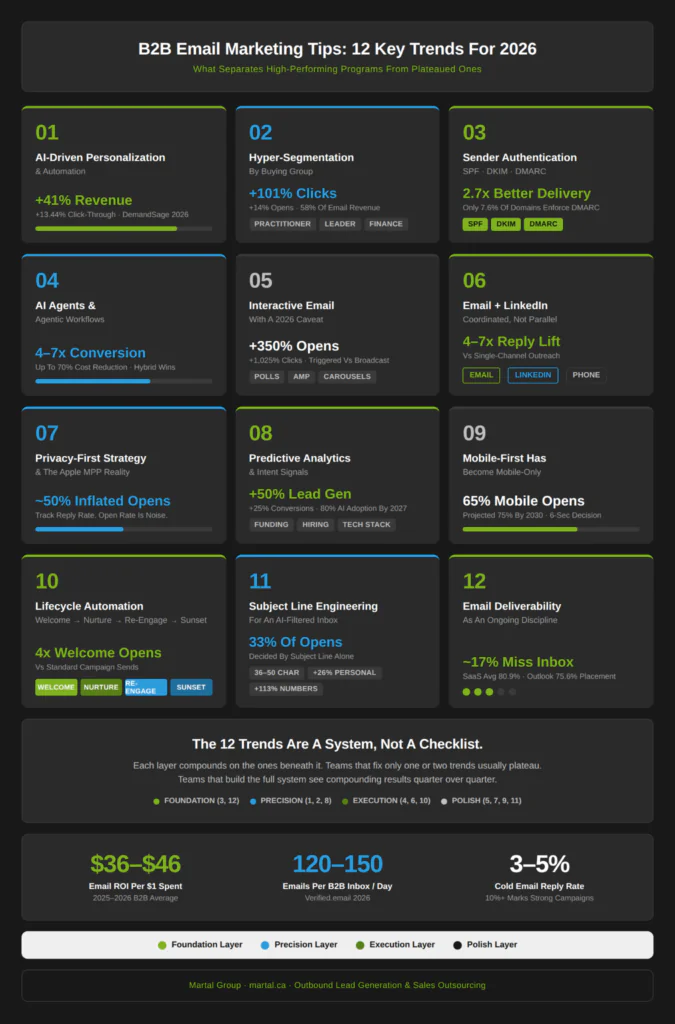
B2B Email Marketing Tips: 12 Key Trends for 2026
The B2B inbox got harder in the last 18 months. Apple Mail Privacy Protection broke open-rate tracking. Gmail and Yahoo’s bulk sender enforcement made authentication mandatory. AI flooded inboxes with synthetic outreach, and corporate security gateways now click links before any human sees them. Meanwhile, the average B2B professional gets 120 to 150 emails per day (2).
The teams winning in this environment aren’t sending more email. They’re sending more relevant email, to better-targeted segments, through cleaner infrastructure, with smarter follow-up logic. Below are the 12 trends and tips actually moving pipeline in [current_page] — what we see working across our outbound campaigns and what the current benchmark research backs up. Each section covers why the trend matters, the data behind it, and what to do about it this quarter.
1. AI-Driven Personalization and Automation
Marketers using AI for email personalization report 41% revenue lift and 13.44% higher click-through rates.
Reference Source: Mailmend
Personalization in 2026 means something different than it did even 18 months ago. “Hi {FirstName}” is table stakes. The real shift is from AI as a writing helper to AI as a campaign optimization layer — analyzing reply patterns, adjusting send times by individual recipient, generating contextual variations for different roles in the same buying group, and rewriting subject lines when engagement drops mid-campaign. The emails that get opens now feel like they were written for one person, not blasted to a list.
The data backs this up. 39% of email marketing professionals say AI-driven hyper-personalization will have the biggest effect on email campaigns going forward (4). Verified.email’s forecast projects AI adoption among B2B email teams at 64% in 2025, climbing to 80% by 2027 and 90% by 2030 (2). The performance gap between AI-augmented teams and manual teams is widening every quarter, and it’s no longer just about open rates — it’s about reply quality, meeting conversion, and pipeline velocity.
In practice, where we see this work hardest is in messaging variation by ICP segment. Running an outbound campaign into 12 verticals with one email template produces a flat reply rate. Running the same campaign with role-specific value props, persona-aligned proof points, and AI-generated context lines per account routinely lifts replies by 2–4×. The work isn’t writing more email — it’s letting the AI do the variation work that used to take a copywriter a full day per segment.
Takeaway: Pick one place in your email program where personalization is currently shallow — most teams find it in the second or third email of a sequence, where reps default to generic follow-up copy. Start by integrating AI-driven tools into your email platform to generate 3–5 contextual variations per role for that step, then test them against your baseline. The lift comes from depth in the few touches that matter, not from sprinkling first names across the whole sequence. If you’re new to B2B email and trying to figure out where to start with AI, start there: one sequence, one step, one round of variation testing. The ROI math becomes obvious within two weeks.
2. Hyper-Segmentation for Ultra-Targeted Messaging
Segmented campaigns drive 101% more clicks and 14% higher open rates than non-segmented sends and generate 58% of all email revenue.
Reference Source: Stripo
Segmentation now isn’t industry + company size. That’s the floor, not the ceiling. The teams pulling ahead are segmenting by role within the buying group — running parallel email tracks for the practitioner, the executive sponsor, and the finance or procurement contact at the same target account. Each track speaks to a different priority: the practitioner cares about workflow and rollout, the leader cares about KPIs and risk, and finance cares about total cost and vendor risk questions (2).
This matters because B2B purchases involve six to ten people on average. Sending the same email to all of them produces a flat reply rate. Sending three coordinated, role-aware emails into the same account produces internal conversations — which is what actually moves a deal forward.
The data backs the effort. Beyond the 101% click lift, segmented campaigns produce 14% higher open rates and account for 58% of all email-driven revenue in B2B programs (5). Layering signals — firmographics + role + recent intent activity + tech stack — is what separates the campaigns that book meetings from the ones that get archived.
In our outbound work, the gap is even sharper than the benchmark numbers suggest. A tightly segmented list of 500 prospects routinely outperforms a generic list of 5,000. One example from our case work: in a 14-month engagement with a manufacturing client targeting the U.S. electrical and safety market, segmenting by buyer role and use case produced 1,596 leads, 1,364 MQLs, and 203 SQLs. The volume wasn’t the variable — relevance was.
Takeaway: Map your top 20 target accounts and identify three roles per account (practitioner, decision-maker, financial gatekeeper). Build one short email sequence per role, anchored to that role’s specific concern. Track click-through and reply rate by role, not by campaign average — averages hide which track is actually working. Most teams discover within 30 days that one role drives 70% of the engagement, and they reallocate from there. That’s the segmentation discipline competitors aren’t doing well in 2026.
3. Sender Authentication and Inbox Placement
Fully authenticated domains deliver 2.7× better to the inbox than unauthenticated senders, yet only 7.6% of domains actually enforce DMARC.
Reference Source: Prospeo
This is the trend that makes or breaks every other tip in this guide. The best subject line in the world doesn’t matter if your email never reaches the inbox.
Since February 2024, Gmail and Yahoo have required bulk senders (5,000+ emails per day) to implement SPF, DKIM, and DMARC — full stop, no grace period. In November 2025, Gmail tightened enforcement to hard rejections: emails without proper authentication don’t go to spam, they bounce. Microsoft began enforcement in May 2025. Apple iCloud and Yahoo are aligned (7).
The numbers behind the urgency are sobering. Roughly 17% of legitimate B2B marketing emails never reach the inbox (7). Microsoft Outlook inbox placement has dropped to 75.6% — the lowest of any major provider. The B2B SaaS industry specifically averages 80.9% deliverability, meaning roughly one in five emails sits in spam folders, delivered but invisible (7).
What we see in practice mirrors the research. When clients come to us with stalled outbound campaigns, deliverability problems are the cause more often than copy problems. Reps blame the messaging, leadership blames the SDRs, but the actual failure is technical — a misconfigured DMARC record, a single shared sending domain handling both marketing and outbound, no warm-up period before scaling sends. The fix isn’t a better email. It’s the foundation that makes every email work. Authentication gets mail past spam filters, but inbox placement still depends on sender reputation — a platform like Warmy automates the warmup layer that sits on top of SPF/DKIM/DMARC and keeps the sending domain in good standing.
The three records every B2B sender needs:
- SPF (Sender Policy Framework) — tells receiving servers which IPs are authorized to send from your domain. Required.
- DKIM (DomainKeys Identified Mail) — adds a cryptographic signature proving the email wasn’t tampered with in transit. Required.
- DMARC (Domain-based Message Authentication) — sets the policy for what happens when SPF or DKIM fails (none, quarantine, or reject) and reports authentication failures to you. Required for bulk senders, and increasingly required for everyone.
Beyond the three records, the baseline for any serious outbound program includes a separate sending domain (never use your main marketing domain for cold outreach), a 45–60 day warm-up period before scaling new domains, spam complaint rates kept below 0.1% (Gmail filtering penalties trigger above 0.3%), and active monitoring of inbox placement across the major providers (2).
Takeaway: Audit your authentication setup this week, not next quarter. Run your sending domain through a free DMARC checker (Google’s Postmaster Tools, MXToolbox, or DMARC Analyzer all work) and confirm SPF, DKIM, and DMARC are configured and aligned. If your DMARC policy is still set to p=none, plan the move to quarantine or reject over the next 60 days — the non-enforcing policy gives you reporting visibility but no actual protection. If you’re running cold outreach, separate it onto a dedicated domain and warm it for at least six weeks before scaling sends. Most teams discover within an hour of the audit that one of the three records is missing or misaligned. That hour is the highest-ROI work in your entire email program.
4. AI Agents and Agentic Email Workflows
AI SDR platforms now deliver 4–7× higher conversion rates while automating up to 80% of repetitive tasks.
Reference Source: Martal AI SDR Platform
The big email shift in 2026 isn’t AI writing better subject lines. It’s AI running entire campaigns. Multi-agent platforms now handle prospect research, sequence orchestration, reply detection, qualification scoring, and meeting routing — work that used to require a full SDR pod. The market is moving fast: every major sales engagement vendor has shipped an “AI agent” tier, and a wave of dedicated platforms (11x.ai, Artisan, Salesforge, Outreach AI Revenue Agent, Salesforce Agentforce) are now standard candidates in any RevOps build-versus-buy conversation (6).
Underneath the marketing, the actual results split sharply by use case. Fully autonomous AI SDRs perform well when the ICP is broad, the offer is simple, and the prospect just needs a relevant trigger to engage. They underperform when the deal involves multiple stakeholders, technical evaluation, or any nuance the AI hasn’t seen in training. Independent reviews of fully autonomous platforms note “mixed results at scale, with many teams adopting hybrid (AI + human) models rather than full replacement” (3).
That’s the honest read, and it matches what we see in our own work. We’ve run the hybrid model — experienced sales executives plus AI infrastructure for prospecting, sequencing, and reply qualification — across 50+ B2B verticals for over a decade. The AI handles the volume and the variation. The human handles the conversation, the objection, and the close. Replacing the human entirely produces faster output and lower close rates. Replacing the AI entirely produces higher close rates and pipeline that doesn’t scale.
The practical question for most B2B teams isn’t “should we deploy an AI SDR?” — it’s “which parts of our outbound motion should the AI run, and where do we keep humans in the loop?” From what we observe, the highest-ROI splits look like this:
- AI handles: account research, intent signal monitoring, list enrichment, sequence orchestration, send-time optimization, A/B variation generation, reply classification, and out-of-office detection.
- Humans handle: the message itself for high-value accounts, the response to interested replies, the qualification call, the objection handling, and the meeting close.
The teams who get this split right report meaningful pipeline lift without burning their domain reputation or sending generic AI slop into 5,000 inboxes a month. The teams who don’t get it right end up with high send volume and low conversation quality — exactly the problem AI was supposed to solve.
Takeaway: Audit your current outbound workflow and identify the three highest-volume, lowest-judgment tasks your reps are doing. For most teams that’s list building, basic enrichment, and first-touch sequencing. Test an AI agent on those three tasks for 60 days, measure reply quality (not just reply rate), and protect the parts of the workflow where human judgment compounds — discovery questions, objection handling, and close. If you don’t have the infrastructure to run this hybrid in-house,Martal’s AI SDR platform and managed sales outsourcing services run it as one integrated motion across email, LinkedIn, and phone — built for B2B teams that want the AI lift without the AI risk.
5. Interactive Email Content — With a 2026 Caveat
97% of marketers used at least one interactive element in their email campaigns.
Reference Source: Litmus
Interactive content — polls, image carousels, animated GIFs, embedded video, and AMP for Email components like in-line forms or RSVP buttons — has become the default rather than the differentiator. Adoption is at near-saturation, and the engagement lift is real when the email actually reaches a human reader.
The “when” is the part most coverage gets wrong. In 2026, corporate security gateways pre-click links and pre-fire interactive elements before any human opens the email. That means open rates inflate, click rates inflate, and traditional engagement metrics get noisier every quarter (8). The interactive element still works for the readers it reaches — but the metrics measuring its success need to be paired with reply rate and pipeline-influence data to mean anything in B2B.
The other reality: AMP for Email is supported in Gmail, Yahoo Mail, and Mail.ru, but corporate Microsoft 365 environments — where most enterprise B2B buyers live — render the static fallback in the majority of inboxes. So the AMP-powered RSVP button you spent two weeks building works beautifully for one segment of your audience and looks like plain text to another. That doesn’t make AMP useless — it means treating it as enhancement, not foundation.
Where interactive content earns its place in 2026 is in the post-engagement layer of your program: nurture emails to known contacts, customer onboarding sequences, event RSVP flows, and webinar follow-ups (9). For top-of-funnel cold outreach, the lift is marginal at best and often negative — interactive elements in cold email frequently trigger spam filters and corporate security policies, hurting deliverability for the messages that need it most.
Takeaway: Use interactive elements where the audience is warm and the inbox supports it. A quarterly customer newsletter, an event invitation, or a webinar follow-up are all good candidates — try a polling question, an animated GIF showing a product feature, or an inline carousel of screenshots. Reserve AMP-powered components like in-line forms or RSVPs for warm audiences in supported inboxes (Gmail, Yahoo). Keep cold outreach plain-text or lightly formatted HTML — the deliverability cost of interactive elements in cold email outweighs the engagement upside in nine out of ten cases. And measure the impact with reply rate or downstream pipeline action, not click-to-open rate alone.
6. Email and LinkedIn — Coordinated, Not Parallel
Coordinated omnichannel outreach across email, LinkedIn, and phone generate 40% higher response rates and reduce cost per lead by 31% compared to single-channel campaigns.
Reference Source: Martal Group
The single-channel email playbook is a 2018 strategy. In 2026, the buyers most B2B teams are trying to reach get 120 to 150 emails a day (2) — so showing up only in the inbox means competing with every other vendor doing the same thing. The teams getting through are the ones layering email with LinkedIn touchpoints (and, for higher-value accounts, phone) in a sequenced, context-aware motion.
The mechanic is straightforward. A prospect receives a relevant email on Monday referencing their recent funding round. Wednesday, the same person sees a LinkedIn engagement — a thoughtful comment on a post they shared, or a connection request with context. Friday, a follow-up email lands that builds on the LinkedIn touch. By the time the second email arrives, the prospect has seen the sender’s name three times in a week, in three places, with three different angles. Familiarity compounds. Reply rates lift. The same outreach delivered as three disconnected emails would land in the trash by message two.
The data backs this up. Coordinated omnichannel campaigns deliver 4–7× higher conversion rates than single-channel sends (6), and B2B research consistently shows email working best when it operates as the connective layer between LinkedIn engagement, content touchpoints, and phone outreach — not as the standalone channel doing all the work (10).
In our outbound work, the gap between coordinated and parallel runs is one of the most consistent patterns we see. Running email and LinkedIn as separate channels — different reps, different sequences, different timing — produces email reply rates around the 3–5% benchmark. Running them as a coordinated motion, where each touch builds on the last, lifts replies meaningfully and changes the kind of replies you get. Prospects respond with context. They reference the LinkedIn comment. The conversation starts further along than a cold reply would.
A telecom equipment client running coordinated email + LinkedIn + phone outreach into mid-market US carriers booked 339 meetings over 24 months from 1,442 leads engaged — a 23.5% lead-to-meeting rate that single-channel email would not produce. The volume wasn’t unusual. The coordination was. Read the full use case.
What separates coordination from parallel:
- Same sequencing logic across channels. The LinkedIn touch references the email, or vice versa. Each touchpoint assumes the prospect saw the previous one.
- One operator, not three. A single sales executive owns the account across email, LinkedIn, and phone — not three different reps competing for inbox attention.
- Context-aware messaging. The third touch reads like message three, not like another message one. Most teams default to repeating the value prop; the strong teams advance the conversation.
- Cadence discipline. Three to five total touches across a two-week window, then space out. Eight touches in five days is harassment, not omnichannel.
Takeaway: Pick your top 50 target accounts and design one coordinated sequence across email and LinkedIn for the next 30 days — three emails, two LinkedIn touches, sequenced so each builds on the last. Assign one rep to own each account end-to-end. Track reply rate and reply quality (not just volume), and compare to your standard email-only baseline. Most teams see the lift within two weeks. If the cadence works, scale it. If you don’t have the infrastructure to coordinate cross-channel at scale, our omnichannel outbound program runs the email, LinkedIn, and phone motion as a single integrated campaign — built specifically to capture the 4–7× conversion lift coordinated outreach delivers over single-channel sends.
7. Privacy-First Strategy and the Apple MPP Measurement Reality
Apple Mail Privacy Protection now affects roughly 50% of B2B email opens and inflates open-rate data across virtually every B2B email program.
Reference Source: Litmus
Privacy regulation is the easy part of this trend. By early 2026, more than 20 U.S. states have enacted comprehensive consumer privacy laws, and GDPR, CCPA, CASL, and the EU’s emerging AI Act have made consent, transparency, and easy unsubscribe the global baseline. The legal floor is now well-understood — and most B2B email platforms handle the mechanics for you.
The harder part is what privacy enforcement has done to measurement. Apple Mail Privacy Protection, rolled out in 2021 and now standard across iOS, iPadOS, and macOS, prefetches images on every email Apple Mail opens — which fires the open-tracking pixel whether or not a human ever reads the message. The result: Apple-sourced opens look identical to genuine opens, and they account for roughly half of all B2B email opens in 2026.
What this means in practice is that the open rate as a primary success metric is structurally broken for B2B. A 35% reported open rate could be 35% real opens or 18% real opens with the rest being bot prefetches and corporate security gateway pre-clicks (8). The teams still optimizing primarily on open rate are optimizing on noise.
The measurement stack that actually reflects performance:
- Reply rate — the only metric that confirms a human read the email and chose to engage. The benchmark for cold outbound is 3–5%, with 10%+ marking strong campaigns.
- Click-through rate (with caveats) — still useful, but pair it with click-source analysis. Corporate security gateways now click links before any human sees the email; if your CTR spikes but reply rate is flat, you’re measuring security software, not buyer interest.
- Pipeline-influence attribution — meetings booked, opportunities created, and revenue influenced by an email touch. The most honest end-state metric and the one Martal optimizes for in our managed campaigns.
- List health metrics — bounce rate, spam complaint rate, and unsubscribe rate. These signal deliverability risk before it shows up in inbox placement.
The privacy regulation side still matters, of course. Clean opt-in mechanisms (double opt-in for EU and Canadian audiences), one-click unsubscribe (now mandatory for Gmail and Yahoo bulk senders), transparent data-use disclosures, and prompt opt-out honoring are all baseline. But these are the table stakes — the strategic question is what you measure once compliance is handled.
Takeaway: Drop open rate as your primary success metric for B2B email this quarter. Replace it with a two-metric scorecard: reply rate for engagement and pipeline-influence (meetings booked, opportunities created) for outcome. Track open rate as a directional signal, not a target. If your team currently sets quarterly goals on open rate, that’s the conversation worth having before the next planning cycle — most teams discover within a month that reply-rate-driven campaigns produce more pipeline than open-rate-driven ones, even when the open numbers look worse on paper.
8. Predictive Analytics and Intent Signals
Marketers using predictive analytics report a 25% increase in conversions and 50% boost in lead generation.
Reference Source: Breaker
The evolution of predictive analytics in B2B email isn’t really about prediction at all. It’s about intent-triggered orchestration — outreach that fires when a buyer signal hits, not when a Tuesday calendar slot says it should. The shift looks subtle on paper and is dramatic in performance.
The traditional model: schedule a 14-day nurture sequence and run it. The 2026 model: monitor cross-platform behavior signals — funding announcements, hiring surges, tech stack changes, content engagement, website visits, competitor evaluation patterns — and trigger relevant outreach within minutes of the signal landing. iTMunch and Improvado both call this “Hyper-Triggered Orchestration”; Cognism describes it as “signal-based selling”; the underlying mechanic is identical: relevance compounds when the timing is right.
The data behind the shift is striking. Predictive-analytics-driven email programs report a 25% increase in conversions and a 50% boost in lead generation versus rules-based scheduling (11). One forecast projects 80% AI adoption among B2B email teams by 2027 (2) — and the early adopters are already pulling ahead on reply rate and meeting conversion. The teams still running rules-based nurtures off Tuesday-Thursday-Tuesday cadences are competing with teams whose outreach reaches the prospect within 60 seconds of a relevant trigger.
What we see in our outbound work: the gap between intent-driven campaigns and demographic-only campaigns is the largest single performance variable in modern B2B email. Running outreach into a tightly defined ICP without intent signals produces standard-benchmark reply rates. Layering in real-time intent — a target account just raised a Series B, a prospect just downloaded a competitor comparison, a company just hired a VP of Engineering — lifts replies 2x because the email shows up at exactly the right moment in the buyer’s world. The Martal AI SDR Platform monitors over 10 million such signals and surfaces the accounts most likely to convert; the principle works at any scale, with any tool, as long as the signal-to-trigger latency is short.
The categories of signals that consistently move B2B outreach performance:
- Funding events — Series A/B/C announcements, debt rounds, public offerings. Often correlate with imminent hiring and tooling decisions.
- Hiring patterns — sudden increases in open roles for a specific function (e.g., a 5x jump in security engineering hires usually precedes a security tooling evaluation).
- Tech stack changes — adoption of a new platform or removal of an existing one, surfaced via job listings, public integrations, or DNS records.
- Content engagement — repeated visits to specific solution pages, whitepaper downloads, or competitor comparisons.
- Leadership changes — new CFOs, CROs, or CISOs almost always reset vendor relationships within their first 90 days.
Takeaway: Identify the three or four intent signals most predictive of buying behavior in your category, and configure your outbound platform to trigger relevant outreach within 24 hours of each signal landing. Most modern sales engagement tools support this natively — but the work is in the trigger logic, not the tool. Test against your existing rules-based cadence and measure reply rate. The intent-driven campaigns nearly always win on reply quality, even at lower send volume — fewer emails, better conversations, faster pipeline.
9. Mobile-First Has Become Mobile-Only
65% of B2B email opens now happen on mobile, projected to reach 75% by 2030.
Reference Source: VerifiedEmail
The mobile-first conversation is over. In 2026, B2B email is a mobile-first, mobile-dominant channel — and the design implications run deeper than “use a single-column layout.” A B2B prospect opening your email on their phone has roughly six seconds to decide whether to read, archive, or delete. Everything about the email — the subject line, the preview text, the first sentence, the CTA — needs to work in that six-second window on a five-inch screen.
The stat that should reset most B2B email programs: 41.9% of recipients delete emails that aren’t mobile-optimized (12). Almost half your audience will trash your message before reading it if the formatting breaks on mobile — which means design issues most teams treat as polish issues are actually deliverability issues in disguise.
The 2026 design baseline goes beyond responsive layouts and include evolving best practices such as (13):
- Lighter, faster, more sustainable email weight. Heavy HTML and oversized images slow load times, hurt deliverability, and frustrate mobile users. Optimize images, streamline code, and aim for total email weight under 100KB where possible.
- Dark mode support. Roughly 35% of email opens now happen in dark mode. Test your designs in both light and dark — logos, icons, and brand colors that look fine in light mode often disappear or invert badly in dark.
- Accessibility as standard, not afterthought. The European Accessibility Act (EAA) made digital accessibility a regulatory requirement in 2025; strong contrast, meaningful alt text, clear structure, and reliable dark-mode support are now baseline.
- Linear scan structure. B2B recipients read top-to-bottom, not eye-tracking around a layout. The first sentence must deliver the core value or observation. Open with the point, not with throat-clearing or warm-up copy.
- One CTA, tappable, above the fold. Multiple CTAs reduce action; a single, clear, 44×44-pixel-minimum tap target outperforms a layout with three competing buttons.
What we see in outbound reply data: the emails that get the highest reply rates on mobile are the ones that look like they were typed on a phone. Short, plain-text or lightly formatted HTML, no images, no logo, signature lines that say “sent from my iPhone” or look like a colleague’s typical email format. iTMunch’s framing of this is “the Raw Human Note” — in an era of AI-perfect emails, intentional plainness reads as trust (14). For cold outbound especially, the polished marketing-design email loses to the four-sentence note that looks like it took 30 seconds to write.
Takeaway: Run a mobile audit of your last five email campaigns this week. Open them on a phone (not your laptop’s mobile preview), and time how long it takes to identify the value proposition and the CTA. If it takes more than six seconds, the email is broken regardless of how it looks on desktop. Tighten the subject line to 30-50 characters, lead the body with the single most important sentence, and use one CTA at 44×44 pixels minimum. For cold outbound, test plain-text against your designed templates — most teams discover the plain-text version wins on reply rate within two weeks.
10. Lifecycle Automation — Welcome, Nurture, Re-Engagement, Sunset
Behavior-triggered emails outperform mass sends, delivering up to 75% better open rates and 162% higher click-through rates.
Reference Source: AdRoll
The lifecycle program is four flows running in parallel — not one nurture sequence. Each flow has a different job, a different cadence, and a different success metric. Treat them as a single “automation” and most of the engagement data gets buried under noise.
The Welcome Series. The highest-engagement email any subscriber ever receives is the first one. Welcome emails outperform standard campaigns by 4× on opens and 5× on clicks, and the engagement decays fast — by email three of a generic newsletter rotation, opens drop back to baseline. A strong welcome series is three to five emails over seven to fourteen days (15), progressing from introduction → education → community or product immersion. For B2B, the welcome flow should set expectation, deliver immediate value (a relevant resource, not a sales pitch), and confirm what the subscriber will get going forward. Most B2B teams still don’t run a true welcome series — they default to “thanks for signing up” and a quarterly newsletter. That’s the easiest 60-day improvement most programs can make.
The Nurture Sequence. This is where most B2B email programs live, and it’s also where most go stale. The nurture playbook isn’t a 14-day linear drip — it’s a behavior-triggered, role-segmented sequence that adapts based on what the prospect engages with. Cadence matters: active nurture for engaged prospects runs one to two emails per week; subscribers in slower buying cycles get two to four per month; inactive contacts get pulled into the re-engagement flow rather than continuing to receive nurture content (8). Done well, automated nurture sequences materially lift sales-ready lead generation versus one-off campaign sends.
In our outbound work, the nurture sequences that consistently outperform are the ones that progress the conversation rather than repeat the value prop. Email three should read like message three, not like message one rewritten. A B2B SaaS client running CMMS software through this approach generated 1,708 leads, 936 MQLs, 185 SQLs, and 144 booked meetings over 26 months — the volume came from coordinated nurture, not from sending more email at the top of the funnel. The HALO Recognition team, who we’ve worked with on long-cycle nurture programs, generated $10M+ in new business opportunities from a 5-leads-per-month pace — the math works because nurture done well stretches the productive lifespan of every contact.
Re-Engagement Campaigns. Roughly 20–30% of any B2B list goes inactive every year — job changes, role shifts, inbox abandonment, or simple content fatigue (10). The standard is a re-engagement flow that runs at 90 days of inactivity, not 12 months. Two to three emails over two weeks: a “we miss you” reset email, a value-forward content offer, and a final “is this still relevant?” preference-update prompt. The goal isn’t to win everyone back — it’s to identify who’s still engaged and who isn’t.
Sunset Campaigns. The contacts who don’t engage with the re-engagement flow get sunsetted — removed from active sends. This is the part most B2B teams skip, and it’s the part deliverability rewards most. Inactive contacts hurt sender reputation, inflate bounce rates, and drag inbox placement down for the engaged contacts on your list. A clean sunset cadence — typically a final goodbye email, a 14-day grace period, then suppression — protects deliverability for everyone else and is now table stakes for any program sending more than a few thousand emails a month.
The integrated framework looks like this in practice:
Flow
Trigger
Cadence
Goal Metric
Welcome
New subscriber
3–5 emails over 7–14 days
Opens, immediate engagement
Nurture
Active subscriber
1–2/week (active) to 2–4/month (slow)
Reply rate, pipeline-influence
Re-Engagement
90 days inactive
2–3 emails over 2 weeks
Re-engagement opens / clicks
Sunset
Re-engagement non-response
Final email + 14-day grace
List health (bounce rate, complaints)
Takeaway: Audit which of the four flows you currently have running. Most B2B programs have a basic nurture and nothing else — no real welcome series, no 90-day re-engagement trigger, no sunset cadence. Build the welcome series first (highest-ROI add for most teams), the sunset flow second (highest-deliverability protection), and treat re-engagement as the bridge between them. If you don’t have the infrastructure to run the full lifecycle in-house,Martal’s lead nurturing programs and marketing automation services build the four-flow architecture into your existing CRM and run it as part of an integrated outbound + nurture motion.
11. Subject Line Engineering for an AI-Filtered Inbox
33% of email opens are decided by the subject line alone, personalized subject lines lift opens by 26%, and subject lines containing numbers see a 113% open lift versus generic alternatives.
Reference Source: Mailmend
The subject line is the smallest, most-tested piece of B2B email copy and it’s also the part of the email most exposed to AI. Gmail’s Gemini-powered Smart Reply, Microsoft 365 Copilot, and Apple Intelligence now read, summarize, and prioritize emails before any human opens them. Subject lines that sound like marketing copy get triaged into Promotions or summarized into nothing. Subject lines that read like a colleague’s note get prioritized.
The benchmarks haven’t changed as much as the context around them. The data still holds:
- Length: 36–50 characters is the sweet spot for desktop and mobile rendering. Above 60 characters, subject lines get cut off in mobile previews. Below 30 characters, they often look incomplete or spammy.
- Personalization lifts opens 26% (16) — but only when the personalization is meaningful. “{First Name}, check this out” no longer counts. Role-aware or context-aware personalization (“Question about your Q4 hiring plan”) still moves the needle.
- Numbers lift opens 113% when used naturally — concrete figures cue specificity and ground the email in something measurable.
- Question-based subject lines outperform statements by roughly 10% on average — they invite engagement rather than announcing it.
- Urgency without manipulation — phrases like “today only” or “last chance” are now flagged by spam filters and AI summarizers as marketing language. Real urgency tied to a specific event (“before your renewal hits next month”) still works; manufactured urgency doesn’t.
The wrinkle is what AI does to a subject line before it’s read. Marketing-perfect subject lines — the kind a copywriter optimizes over three rounds — increasingly trigger AI categorization as promotional content (14). Meanwhile, plain, conversational, slightly-imperfect subject lines that read like a colleague typed them on their phone get prioritized. iTMunch’s framing of this is the “Raw Human Note” — short, lowercase, occasionally with a typo, often with no preview text, looking exactly like a one-off internal email.
What we see in our outbound reply data backs this up at a striking margin. The polished, A/B-tested subject line — “Boost your pipeline 40% with [Product]” — gets opens but few replies. The plain subject line — “quick question about [Company]” — gets fewer opens but markedly higher reply rates. For cold outbound especially, opens without replies are noise. Reply rate is what matters, and reply rate consistently rewards subject lines that don’t sound like marketing.
The cold-versus-warm distinction matters here too. Marketing newsletters and warm nurture still benefit from polished, optimized subject lines tuned for open rate — the audience expects branded communication and the metrics support engagement-style copy. Cold outbound runs on different rules: plain, specific, conversational subject lines that look like a colleague reaching out. Optimizing both the same way is one of the most common mistakes we see, and it costs reply rate disproportionately on the cold side.
A practical subject line audit: take your last ten cold outbound subject lines and read them aloud as if you were speaking to a colleague. If they sound like marketing copy, they’re probably underperforming. If they sound like something a real person would actually say in a one-off email, you’re closer to the standard than 90% of the outbound you’re competing with.
Takeaway: Run an A/B test this month with two parallel subject line styles for the same campaign — one polished marketing-optimized variant, one plain “Raw Human Note” variant. Track open rate, reply rate, and meeting conversion separately for cold outbound vs. warm nurture. Most teams discover the plain subject line wins on reply rate for cold outbound by a meaningful margin, even when the polished version edges it out on opens. Optimize for the metric that maps to pipeline — reply rate, not opens — and let the subject line style follow the audience: polished for warm, plain for cold. If you’re new to subject line testing, start with the same offer and rotate three variants per send for two weeks; the patterns become clear within roughly 200 sends per variant.
12. Email Deliverability as an Ongoing Discipline
Roughly 17% of legitimate B2B marketing emails never reach the inbox.
Reference Source: MarketBetter
The authentication setup covered in Trend 3 is the foundation. Deliverability as a discipline is everything that has to happen on top of it — the daily, weekly, and quarterly operational work that keeps emails landing in the inbox over months and years, not just on day one of a new campaign.
This is the part of email programs most teams treat as set-and-forget, and it’s the part where domain reputation quietly erodes when nobody’s watching. By the time a team notices their reply rate dropped, the damage is usually 30 to 60 days old.
The operational baseline for B2B deliverability in 2026:
Separate your sending infrastructure. Never run cold outbound from your main marketing domain. The deliverability profiles are completely different: cold outbound carries higher complaint risk and benefits from dedicated infrastructure, while marketing nurture relies on long-term sender reputation that one bad cold campaign can destroy. The standard is a separate domain (often a variant: yourcompany.com for marketing, getyourcompany.com or yourcompany.io for outbound), with separate IPs, separate warming, and separate reputation tracking (7).
Warm new domains for 45 to 60 days before scaling sends. New domains start at zero reputation. Sending 1,000 cold emails on day one from a new domain is the fastest way to land on a permanent blocklist. The proper warm-up: start at 10-20 emails per day, ramp gradually, vary recipient providers (Gmail, Outlook, Yahoo), prioritize replies and engagement on early sends, and reach full sending volume only after 6-8 weeks. Skipping this is the single most common deliverability mistake we see in teams running outbound for the first time.
Cap sends per mailbox. The safe ceiling for cold outbound is under 100 sends per mailbox per day. Above that, even authenticated, well-warmed domains get throttled. Most modern outbound platforms enable mailbox rotation — distributing sends across multiple addresses on the same domain — which preserves total volume while keeping per-mailbox sends below the threshold.
Keep complaint rate below 0.1%. Gmail’s filtering penalties trigger above 0.3%, but the operational target is below 0.1% — that’s the threshold below which sender reputation stays clean across all major providers. Above 0.3%, expect rate limiting and outright rejections. The way to stay below 0.1% is consistent: tight ICP targeting, clear opt-out, and prompt removal of disengaged contacts before they mark you as spam.
Run list hygiene weekly, not quarterly. Bounce rate above 2% signals list decay. The standard is real-time email verification at point of send, weekly removal of hard bounces, and the 90-day re-engagement / sunset cadence covered in Trend 10. Lists with bounce rates above 5% get throttled across the board.
Monitor inbox placement, not just delivery rate. Most ESPs report 98%+ delivery rates — meaning the email left their server. That’s not the same as inbox placement, which sits closer to 80% for B2B SaaS (7). The 18-percentage-point gap is where deals quietly disappear. Tools like Google Postmaster Tools, Microsoft SNDS, MailReach, and Folderly surface this gap; manual seed-list testing across the major providers also works.
In our outbound work, the deliverability discipline shows up in the results more than in any single tactical move. Clients running disciplined deliverability infrastructure produce dramatically different output volume than clients running outbound from their primary marketing domain with no warm-up. A telecom equipment client running disciplined separated infrastructure produced 1,442 leads engaged and 339 booked meetings over 24 months. Complete EDI generated 14 SQLs in a 3-month pilot with a single fractional rep — possible only because deliverability stayed clean throughout the pilot. For a manufacturing client, we delivered 1,596 leads and 203 SQLs in 14 months on the back of consistent inbox placement. The numbers aren’t flashy because of clever copy or aggressive volume — they’re consistent because the underlying infrastructure stayed healthy.
Takeaway: Build a deliverability ops checklist and run it weekly. Verify sending domain authentication is still aligned (records expire, providers update requirements). Check spam complaint rate, bounce rate, and inbox placement across Gmail, Outlook, and Yahoo. Suppress hard bounces. Confirm warm-up volume ramps for any newly-added mailboxes. Most teams discover within a month that one or two operational issues are quietly costing 10-15% of their inbox placement — fixing them lifts every other email metric without requiring any change to copy, list, or strategy. If running this in-house feels heavier than your team is built for, Martal’s cold email service handles deliverability as a managed layer of every campaign — separated domains, full warm-up cycles, complaint monitoring, and inbox placement reporting baked into the engagement.
B2B Email Marketing Fundamentals That Win in 2026
Trends shape what to test next. The fundamentals below are what separates email programs that compound over time from programs that plateau after the first quarter. These are the operating discipline that makes every trend in this guide actually work.
Cold vs. Warm Email — Different Playbooks, Different Benchmarks
This is the distinction most B2B email programs miss, and it’s the one that costs the most in misallocated effort. Cold outbound and warm marketing email run on completely different physics:
Cold Outbound
Warm Marketing / Nurture
Audience relationship
No prior consent or engagement
Opted-in, has engaged before
Open rate benchmark
27.7% (with MPP inflation)
21.5% average B2B
Reply rate benchmark
3–5% (10%+ is excellent)
Less critical — measured on click and conversion
Click-through benchmark
Not the primary metric
2.3% B2B average
Optimal cadence
3 emails total over 9–10 days
1–2 per week (active) to 2–4 per month (slow)
Optimal email length
Under 120 words
Variable — newsletter format up to 600 words
Optimal design
Plain text or lightly formatted
Branded HTML with imagery acceptable
Sending domain
Dedicated, separate from marketing
Primary marketing domain
Compliance focus
CAN-SPAM, opt-out, no manipulation
GDPR/CCPA consent, easy unsubscribe
Running these the same way is one of the most common 2026 mistakes. Cold outbound benchmarked against warm marketing rates looks like a failure when it’s performing fine. Warm nurture benchmarked against cold reply rates looks like a runaway success when it’s actually underperforming. Set the right benchmark for the right use case, and the optimization work becomes obvious.
Subject Line Discipline
A condensed cheat sheet pulled forward from Trend 11:
- Length: 36-50 characters for both cold outbound and warm marketing.
- Personalization: Lifts opens 26% — but only meaningful personalization (role, context, recent activity), not just {First Name}.
- Numbers: Lift opens 113% when used naturally.
- Questions: Outperform statements by ~10% on average.
- Cold outbound: Plain, conversational, lowercase. Looks like a colleague typed it on their phone. “quick question about [Company]” beats marketing-polished copy on reply rate.
- Warm marketing: Polished, optimized, on-brand. Newsletter audiences expect branded communication.
- Avoid: Manufactured urgency (“today only,” “last chance”), all-caps, excessive punctuation. AI summarizers and spam filters flag all three.
For a deeper walk-through of subject line testing and the specific changes that move open rate fastest, our guide on how to increase email open rate covers the full A/B testing framework.
Cadence by Use Case
How often you should email depends entirely on the audience and the goal. The 2026 reference cadences:
- Cold outbound to a single prospect: 3 emails total. Initial + follow-up at +3 days + final at +6-7 days. Stop after the third email if no response. Keep per-mailbox sends below 100 per day to protect deliverability.
- Warm nurture for engaged subscribers: 1-2 emails per week. Test against your audience — engaged B2B subscribers can handle weekly, less-engaged segments may prefer biweekly.
- Newsletter for slower-cycle subscribers: 2-4 per month. Monthly is the floor — quarterly newsletters underperform because the audience forgets the brand between sends.
- Welcome series for new subscribers: 3-5 emails over 7-14 days, front-loaded with the strongest content.
- Re-engagement flow for inactive contacts: 2-3 emails over 2 weeks at the 90-day inactivity mark. After non-response, sunset.
The wrong frequency for the audience kills lists faster than bad copy. Daily emails to a slow-cycle B2B audience produces unsubscribes; quarterly newsletters to active prospects produce indifference. Match cadence to engagement, not to a calendar. For deeper guidance on tuning cadence to your specific audience, our email cadence framework walks through the full setup.
Engagement Metrics That Matter in 2026
Apple Mail Privacy Protection broke open rates as a primary success metric for B2B (covered in Trend 7). The 2026 measurement stack:
- Reply rate — the only metric that confirms a human read and chose to engage. Primary metric for cold outbound.
- Click-through rate (with caveats) — useful for warm marketing, but pair it with reply rate to filter out corporate security gateway pre-clicks.
- Pipeline-influence attribution — meetings booked, opportunities created, revenue influenced by an email touch. The honest end-state metric.
- List health — bounce rate, spam complaint rate, unsubscribe rate. Signal deliverability risk before it shows up in inbox placement.
- Open rate — directional only. Track it for trend analysis, don’t set quarterly goals on it.
UGC and Visual Considerations in B2B Emails
User-generated content didn’t make the top 12 trends because it isn’t moving B2B email performance the way it moves B2C. But it remains a legitimate practice in two specific use cases: customer success stories embedded in nurture sequences, and social proof in cold outbound (a single quote from a relevant customer can outperform three sentences of value-prop copy). For B2B teams running customer marketing programs, working with a dedicated UGC platform — like a content creation agency such as Inbeat, or a creator marketplace like Influee — provides access to video testimonials and visual content at scale.
On the visual side, simple matters more than polished. One strong CTA usually outperforms multiple competing links, unless it’s a newsletter with clearly separated sections. If you’re including product images or graphics, consider tools to remove background clutter so the main visual focus stays on the CTA. For cold outbound especially, the rule from Trend 9 stands: plain-text or lightly formatted HTML usually wins on reply rate against polished marketing-design email.
Foundations Still Worth Naming
The non-trend fundamentals every B2B email program should run on autopilot:
- List quality over list size. A 5,000-contact list of engaged ICP fits outperforms a 50,000-contact list of generic prospects. Always. For tightening your ICP definition, audit segmentation every quarter — ICPs evolve, roles change, and the segments that worked last year may not work this year.
- Verify before sending. Run new contacts through a verification tool before they hit a sequence. Hard bounces destroy sender reputation.
- Provide value before asking. Educational content, useful frameworks, exclusive insights, relevant resources — earn the right to make an ask.
- Test the elements that move the needle. Subject lines and offer copy move reply rate. Send time, button color, and font size move it less than most teams hope. Allocate test budget accordingly.
- Iterate based on reply quality, not just reply volume. A campaign with 3% reply rate and high-quality “interested” replies outperforms a campaign with 6% reply rate of “remove me” responses. The vanity metric is reply count; the real metric is what the replies say.
The teams that consistently outperform on B2B email aren’t doing more of any one thing — they’re running these fundamentals with discipline while testing the trends from earlier in this guide on top of them. The fundamentals are the floor; the trends are the ceiling. Both matter.
Conclusion: Embracing B2B Email Marketing Tips in 2026
B2B email marketing in 2026 looks dramatically different than it did even 18 months ago. Apple Mail Privacy Protection broke open rates as a primary metric. Gmail and Yahoo’s authentication enforcement made deliverability a technical discipline, not a check-the-box exercise. AI agents are running entire campaigns. The teams winning in this environment aren’t sending more email — they’re sending more relevant email, to better-targeted segments, through cleaner infrastructure, with smarter follow-up logic.
The 12 trends in this guide aren’t a checklist to work through. They’re a system. Sender authentication and deliverability are the foundation. Hyper-segmentation by buying group, AI-driven personalization, and intent-triggered orchestration are the precision layer. Lifecycle automation, coordinated email + LinkedIn omnichannel, and the cold-vs-warm distinction are the execution layer. Subject line discipline and mobile-first design are the polish layer. Each layer compounds on the ones beneath it — which is why teams that try to fix only one or two trends usually plateau, and teams that build the system see results that keep improving quarter over quarter.
The honest reality for most B2B teams: building all of this in-house takes 12 to 18 months and a meaningful headcount investment. Plugging into a team that already runs the system gets you there faster. Either path works. The wrong path is doing nothing — because the gap between teams running the 2026 playbook and teams running the 2022 playbook is widening every quarter.
Pick one trend from this guide that addresses your biggest current gap and run it for the next 30 days. Measure reply rate and pipeline-influence, not opens. If the change works, scale it. If it doesn’t, you’ve still learned something about your audience that the next experiment can build on. That’s how email programs compound — one disciplined test at a time.
How Martal Can Boost Your B2B Email Marketing
The trends and tips in this guide point to one consistent pattern: B2B email in 2026 rewards precision over volume, coordination over channel-by-channel sends, and operator discipline over set-and-forget campaigns. Most teams know this. The harder question is whether to build the capability internally — hiring SDRs, layering in AI tooling, managing deliverability infrastructure, building lifecycle flows, coordinating email with LinkedIn and phone — or to plug into a team that already runs it.
That’s where Martal fits. We’ve spent 16+ years running B2B outbound for over 2,000 B2B brands worldwide across 50+ verticals — SaaS, cybersecurity, fintech, manufacturing, healthcare, logistics, energy, and more — and the playbook in this guide is the playbook we run for clients. Onshore sales executives in North America, Europe, and LATAM, paired with the Martal AI Sales Platform, executing coordinated email + LinkedIn + phone outreach as a single integrated motion. Standard Tier 1 engagements deliver up to a 66% increase in SQLs and 3x faster ramp than building outbound capability in-house.
What that looks like in practice depends on where your team is today:
- Building outbound from scratch? Our managed lead generation techniques handle the full motion — list, copy, deliverability, sequencing, qualification, meeting booking — so your team focuses on the sales calls, not the setup work.
- Already running outbound but stuck on results? Most of the time the issue is one of three things: deliverability infrastructure, ICP precision, or the cold-vs-warm distinction this guide opened with. We diagnose where the program is leaking and rebuild the layer that’s failing.
- Trying to scale a sales pipeline without adding headcount? The fractional team model — typically two senior sales executives plus a sales operations manager — runs your outbound at the volume of a full SDR pod, without the hiring, training, or overhead.
The teams we work with don’t need a vendor to walk them through the basics. They need a partner who can run the trends in this guide as a coordinated program, measure what matters in 2026 (reply rate, pipeline-influence — not opens), and produce qualified meetings on a predictable cadence. That’s what we do.
Book a consultation and we’ll walk through your current email program, identify the specific layer that’s costing you pipeline, and show you what a coordinated 2026 outbound motion looks like for your specific ICP. No deck. No pitch. Just an honest conversation about where the gap is and what closing it would look like.
References
- Orange Owl
- VerifiedEmail
- DevCommX
- Shopify
- Implicit
- Monday
- MarketBetter
- Leadfeedr
- Mailmodo
- ViB
- Clearout
- Mailmend
- LItmus
- ITMunch
- Deploytec
- Klaviyo
FAQs: B2B Email Marketing Tips
How often should I send emails to my B2B email list?
It depends on the audience and the goal. For cold outbound to a single prospect, three emails total is the standard — initial, follow-up at +3 days, final at +6–7 days, then stop. For warm nurture to engaged subscribers, one to two emails per week works for most B2B audiences, with biweekly as a fallback for less-engaged segments. For newsletters to slower-cycle subscribers, two to four sends per month is the sweet spot — monthly is the floor, since quarterly newsletters cause the audience to forget the brand between sends. The wrong frequency for the audience kills lists faster than bad copy. Match cadence to engagement, not to a calendar. The Cadence by Use Case section covers the full breakdown.
My cold emails are being opened but no responses. What should I do?
This is one of the most common B2B email problems, and it almost always traces to one of three causes. First, the opens are inflated — Apple Mail Privacy Protection and corporate security gateways pre-fire open tracking before any human sees the email, so your “open rate” is partly bots. Second, the subject line is doing the work but the email isn’t — a clever subject opens the message, but if the body reads like generic marketing copy, the prospect closes it. Third, there’s no clear reason to reply — most cold emails ask for a meeting before establishing why the prospect should care. Fix the body before the subject: lead with a specific observation about the prospect’s company or role, deliver one concrete value point in under 120 words, and close with a single low-friction question. Reply rate of 3–5% is the cold outbound benchmark; 10%+ marks a strong campaign.
What is the average response rate to a cold email outreach campaign?
The 2026 B2B cold email reply rate benchmark is 3–5% for typical campaigns, with 10%+ marking strong campaigns that have tight ICP targeting, plain-text formatting, and personalized opening lines. Response rates vary significantly by industry, seniority of the recipient, and the relevance of the offer — campaigns into well-defined ICPs with relevant value props consistently outperform broader sends. Open rates are no longer a reliable proxy for response rates, since Apple MPP inflates opens by roughly 50%. Track reply rate and meeting-conversion rate as your primary metrics, not opens. Trend 7 covers the post-MPP measurement reset in detail.
What’s the next step if no response from cold email outreach sequence?
Stop emailing after the third send. Continuing past three messages without a response erodes deliverability, drives spam complaints, and damages sender reputation for the next campaign. The 2026 standard for unresponsive prospects is to suppress them from active outreach for 90 days, then re-evaluate — they may have changed roles, the buying cycle may have shifted, or a new intent signal may surface. For high-priority accounts, switch channels rather than send a fourth email: a contextual LinkedIn touch or a phone call often gets through where the inbox doesn’t. The coordinated email + LinkedIn + phone motion in Trend 6 covers the omnichannel approach that lifts reply rates 4–7× over single-channel cold email.
What metrics should you use to measure the success of your B2B email marketing efforts?
The 2026 measurement stack drops open rate as a primary metric and replaces it with a four-metric scorecard: reply rate (the only signal that confirms a human read and engaged — the primary metric for cold outbound), click-through rate paired with reply rate (useful for warm marketing, but click-through alone is increasingly inflated by corporate security gateway pre-clicks), pipeline-influence attribution (meetings booked, opportunities created, revenue influenced — the honest end-state metric), and list health (bounce rate, spam complaint rate, unsubscribe rate — early signals of deliverability risk). Apple Mail Privacy Protection has structurally broken open rate as a B2B success metric, so track it as a directional signal only. Trend 7 covers the post-MPP measurement framework in full.
Which is the right email service provider for your B2B needs?
The right ESP depends on your motion. For warm marketing and nurture, platforms like HubSpot, Customer.io, Klaviyo, and Marketo handle list management, segmentation, automation flows, and deliverability infrastructure well. For cold outbound, dedicated tools like Smartlead, Instantly, and Lemlist are purpose-built for sender rotation, domain warm-up, and deliverability monitoring at the volumes cold campaigns require. The most common mistake is running cold outbound through a marketing ESP — the deliverability profiles are completely different, and one bad cold campaign can destroy the sender reputation of your marketing domain. The cleanest setup in 2026 separates the two: a marketing ESP for warm communications and a dedicated outbound tool with separate sending domains for cold campaigns. Trend 12 covers the deliverability infrastructure separation in more detail.