
 Martal
 Technology
 Education and training
 Web Development and UI / UX
 Healthcare/Medical
 Logistics and Supply Chain
 Information Technology
 Insuretech and Financial Services
 Marketplaces
 Software Development
 E-commerce and retail
 AI and Machine Learning
 Energy and Solar
 Manufacturing
 Security and Surveillance
 Digital Marketing Agency
 Transportation
 MSP
MSP
 Telecom
 B2B SaaS
 Cybersecurity
 HR tech
 Fintech
 Cleantech
 Consulting
Sales as a Service: A Complete Guide to Outsourced Sales for B2B Companies
Major Takeaways: Sales as a Service
Sales as a service is a managed B2B model where you delegate part or all of your outbound sales function — prospecting, outreach, qualification, and appointment setting — to an external partner that runs it as a service. Instead of hiring SDRs and the operations layer behind them, you subscribe to a pre-built sales engine of people, technology, and process.
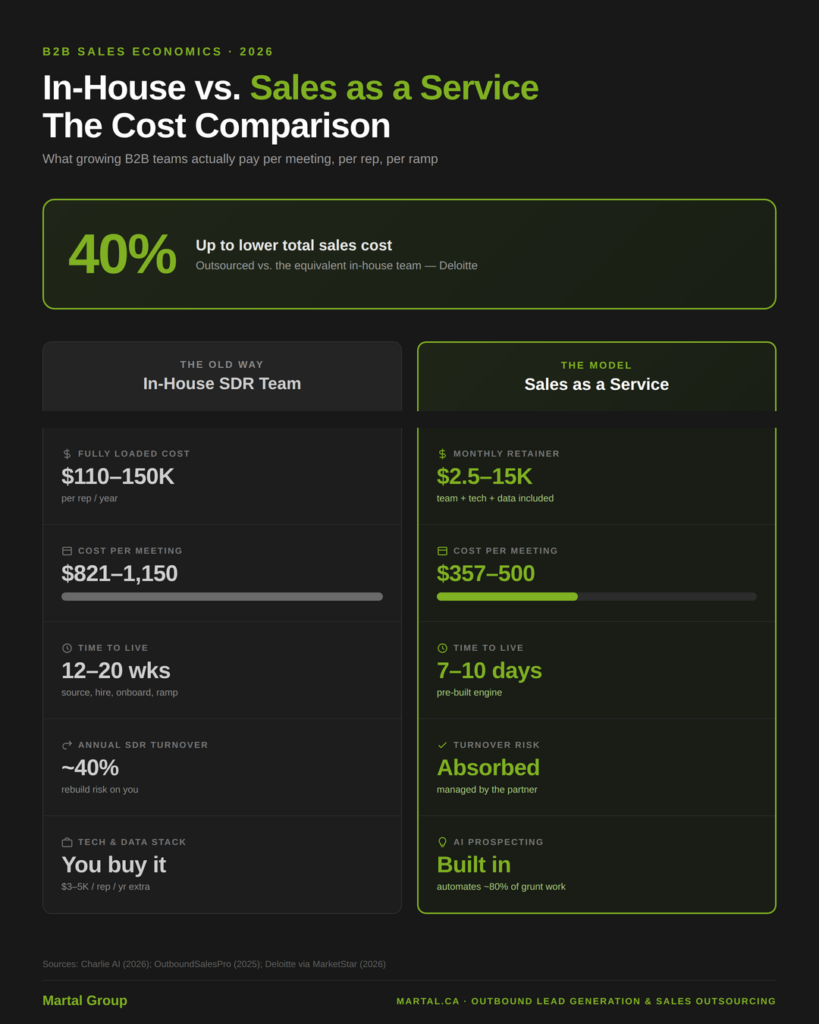
B2B buying groups now span five to 16 stakeholders per deal (1), and an in-house SDR costs $110,000 to $150,000 fully loaded (2) with a 3–6 month ramp. Sales as a service lets growing companies build pipeline without absorbing that cost, ramp time, or management overhead.
Retainers typically run $2,500–$15,000+ per month depending on team size and scope, with performance pricing around $175–$350 per qualified meeting. The metric that matters is cost per meeting: outsourced programs commonly hit $357–$500 versus $821–$1,150 in-house.
Usually, yes. Deloitte research shows outsourced sales cuts total costs up to 40%, with broader benchmarks at 30–50% (3) largely because AI now automates roughly 80% of repetitive prospecting work, letting each Sales Executive cover more accounts.
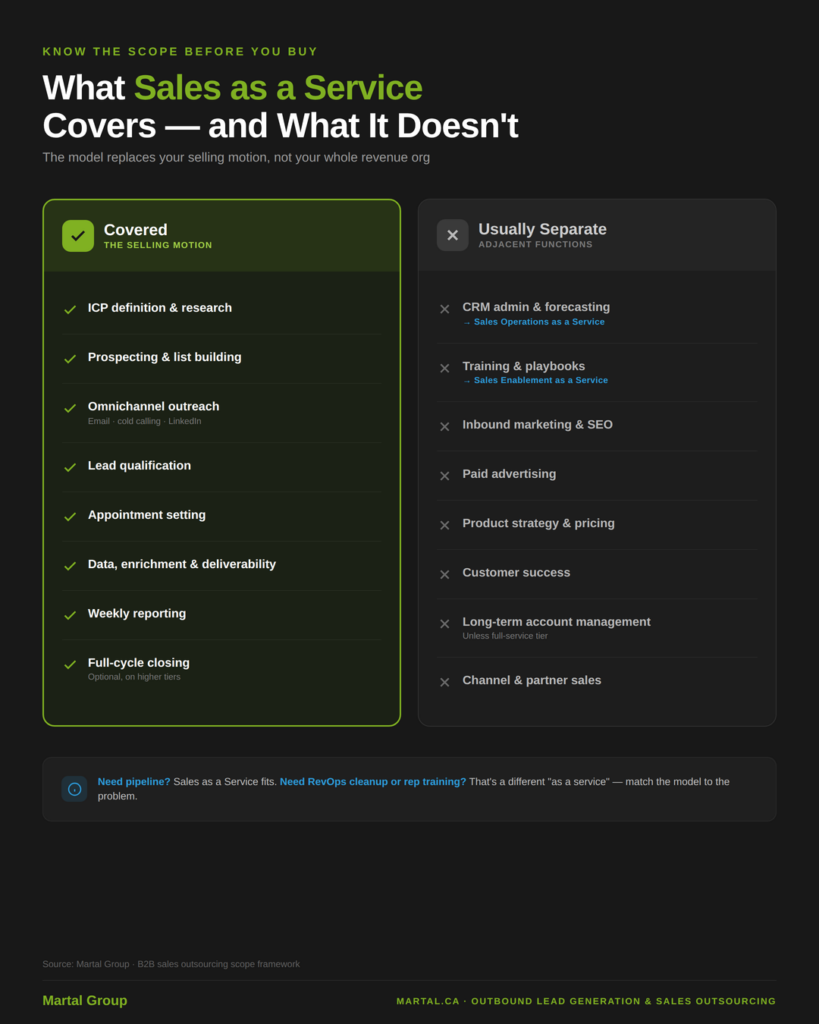
Inside sales as a service is the most common subset — remote outbound and qualification, effectively interchangeable with sales as a service. Sales operations as a service outsources CRM, reporting, and forecasting. Sales enablement as a service outsources training, playbooks, and content. Only the first replaces your selling motion.
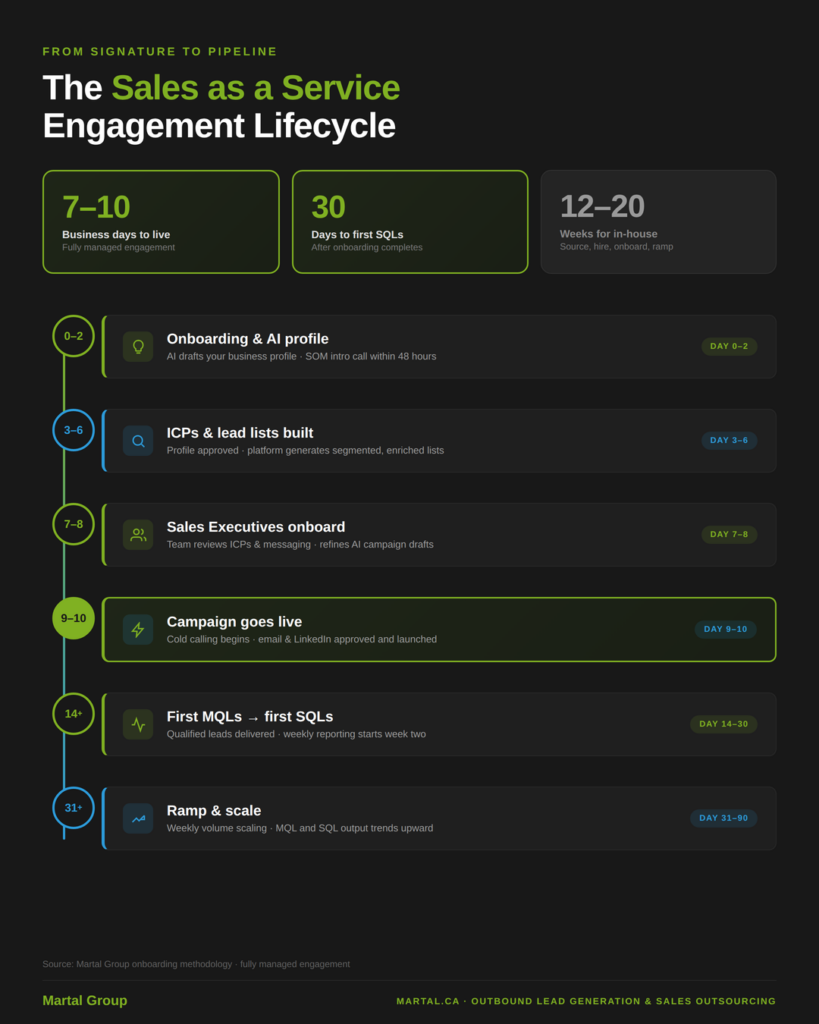
A fully managed engagement typically goes live within 7–10 business days, with first MQLs in the first month and first SQLs within 30 days of onboarding — compared with the 12–20 weeks needed to source, hire, and ramp an in-house SDR.
Prioritize industry-matched experience, weekly reporting depth, a real AI and data stack, compliance certifications (SOC II, GDPR, CAN-SPAM), dedicated team continuity, and transparent exit terms. A provider without AI infrastructure will run a cost per meeting 30–50% higher than one that has it.
It fits companies that need pipeline faster than they can hire, want to enter a new market before committing headcount, or have closers spending too little time closing — reps spend just 28% of their week actually selling (4). It is less suited to teams that simply need RevOps cleanup or enablement.
Introduction
B2B selling has changed faster in the last two years than in the previous ten. Gartner’s buyer research finds that the typical buying group now ranges from five to 16 people across as many as four functions, with 74% of those groups experiencing unhealthy internal conflict before they reach a decision (1). Buyers are doing more research, looping back through earlier stages, and giving sellers a smaller window to land a relevant message.
For most of the companies we work with — operating with lean revenue teams and aggressive growth targets — that shift created a real problem. Hiring more in-house SDRs costs $110,000 to $150,000 per rep all-in once benefits, tools, training, and management overhead are included (2). Even when the budget is there, it takes three to six months before a new hire produces consistent pipeline. By the time the seat is full, the market has moved again.
That is why sales as a service has shifted from a niche option to a mainstream go-to-market lever. It pairs experienced sellers with AI-powered prospecting infrastructure so growing companies can build pipeline without absorbing the cost, ramp time, and management overhead of expanding headcount.
This guide is built on Martal’s 16+ years of running outbound campaigns for 2,000+ B2B brands across 50+ verticals, combined with current market research from Gartner, Deloitte, and Forrester. We walk through what sales as a service actually is, how the engagement runs day-to-day, what it costs in 2026, the trade-offs against in-house, and how to evaluate a partner. The goal is to help you decide whether the model fits your business, not to convince you it does.
What is Sales as a Service?
Sales as a service is a B2B engagement model where a company delegates part or all of its outbound sales function — prospecting, outreach, qualification, appointment setting, and in some cases full-cycle closing — to an external partner that runs the work as a managed service.
In practice the term gets used loosely. The clearer way to think about it: instead of hiring SDRs, AEs, and the operations layer that sits behind them, the client subscribes to a pre-built sales engine — people, technology, and process — operated by a partner that has already done the hiring, training, and tooling.
One of the most common questions buyers ask before considering this model is some version of “What do you think about a sales as a service company?” — a thread that surfaces regularly in r/SaaS and across B2B founder forums. The honest answer depends on what you are actually trying to outsource. Most engagements fall into one of four scopes:
- Prospecting and list building — research, ICP definition, data enrichment, list curation
- Outbound outreach — coordinated email, cold calling, and LinkedIn campaigns to engage target accounts
- Qualification and appointment setting — handling responses, qualifying interest, and booking discovery meetings with your closers
- Full-cycle sales — everything above plus closing, contract negotiation, and account management
The most common engagement we run covers the first three — outbound through appointment setting — with the client’s internal closers handling discovery, demos, and contract close. The fourth model (full-cycle outsourcing) suits clients who want to test a new market or product line before committing internal headcount. Joopy, for example, used our full-cycle service to manage 100+ deals from lead to contract while expanding into North America from Israel.
What separates a modern sales-as-a-service engagement from traditional sales outsourcing is the technology layer underneath it. The work that used to live in spreadsheets and disconnected tools — list building, intent monitoring, sequence personalization, deliverability management — now runs on AI infrastructure purpose-built for outbound. Martal’s AI SDR platform handles the prospecting and signal layer. Our Sales Executives handle the conversations and qualification. That combination is what makes the model viable at scale today.
Inside Sales as a Service vs. Sales Operations as a Service vs. Sales Enablement as a Service
The “as a service” branding has spread across the sales category, and the terms now overlap in confusing ways. A question that surfaces repeatedly in r/sales threads and B2B founder discussions is “What is the difference between SDR as a Service and outsourced SDRs?” The underlying confusion runs wider than that, and it is worth untangling before you evaluate providers.
Here is how the three closest variants line up against sales as a service.
Inside Sales as a Service
Inside sales as a service is the most common subset of sales as a service. It covers outbound and inbound sales work performed remotely — cold calling, cold emailing, LinkedIn outreach, and qualification — rather than field or in-person sales. Most engagements that get marketed as “sales as a service” are technically inside sales as a service.
When buyers search for inside sales as a service, they are usually looking for what we deliver under our omnichannel outbound model: a team of remote Sales Executives running coordinated email, phone, and LinkedIn campaigns to engage and qualify B2B accounts. In practice the two labels are interchangeable.
Sales Operations as a Service
Sales operations as a service is narrower and structurally different. It refers to outsourcing the back-end of a sales organization — CRM administration, pipeline reporting, territory design, commission management, forecasting, sales-tech stack management — typically to a specialist firm or fractional RevOps team.
This is not the same as outsourcing the sales motion itself. A company can hire sales operations as a service to clean up its Salesforce instance and build reporting dashboards while keeping its in-house SDR team intact. Sales as a service replaces the SDRs; sales operations as a service supports them.
Sales Enablement as a Service
Sales enablement as a service sits between the two. It is the outsourced delivery of the content, training, playbooks, battle cards, and onboarding materials a sales team needs to perform — without the cost of hiring an internal enablement leader. It is typically purchased by companies that already have closers but want to professionalize how those closers sell.
Some sales-as-a-service providers bundle enablement into their offering. Martal includes a Lunch and Learn program with every account, which functions as a structured knowledge-transfer layer between our team and the client’s. Pure-play sales enablement firms exist too — they will not run outreach on your behalf, but they make sure your team is ready when leads come in.
How to choose between them
A short test, in plain language:
- You need more pipeline → Sales as a service or inside sales as a service
- You have pipeline but your CRM, reporting, and process are a mess → Sales operations as a service
- You have leads and reps but inconsistent execution → Sales enablement as a service
Most companies that come to us are in the first situation. A smaller group wants a combination — pipeline generation plus the rigor of weekly reporting, structured nurture playbooks, and an enablement layer for the in-house closers — which is how we typically structure our managed engagements.
What Are the Benefits of Sales as a Service?
Done well, sales as a service produces five durable outcomes for the businesses that adopt it. We have watched these play out across 2,000+ B2B engagements over 16+ years, and they show up consistently in independent research. Here is what to expect from a sales-as-a-service business — and what the evidence actually looks like.
1. Faster, More Consistent Pipeline Generation
A sales-as-a-service partner brings a fully assembled engine: experienced sellers, an AI-powered prospecting platform, deliverability infrastructure, and a tested playbook for engaging your specific ICP. The result is pipeline that moves faster than an in-house build can produce.
Industry researchfinds outsourced sales programs reach productivity 39% faster on hiring and 50% faster on training than the equivalent in-house build (3). For most of our clients, the first SQLs land within 30 days of completed onboarding — a timeline an in-house SDR team rarely matches in its first quarter.
The AI layer compounds that speed. Instead of an SDR manually researching every account, our platform scores accounts against your ICP using 1,500+ enrichment fields per company record, then surfaces buyers showing real intent signals — funding events, hiring surges, technology changes. The Sales Executive runs the conversation. The pipeline that comes out is qualified, not just numerous.
How Martal Helped HALO Recognition Land $10M+ in 8 Months
In eight months, we helped HALO Recognition secure over $10 million in new business opportunities. The results came from a coordinated omnichannel approach, not a volume play:
- $10M+ in new business opportunities generated with enterprise decision-makers
- 9,000 prospects engaged per month across the target segment
- 5 qualified meetings per month booked with high-value buyers
What drove the outcome:
- Direct project leadership — senior collaboration with HALO at every stage of the campaign
- Weekly performance reviews — data examined and strategy refined every week
- Omnichannel campaigns — coordinated email, cold calling, and LinkedIn outreach that gave HALO multiple visible touchpoints with each account
Read the full HALO Recognition case study.
2. Time and Talent You Can’t Build Internally Fast Enough
A common founder question — surfaced repeatedly in r/SaaS and B2B sales forums — is “Should you outsource sales for your SaaS product?” The honest framing is not whether outsourcing is “better” than in-house. It is whether you can realistically build, ramp, and retain an in-house team fast enough to capture the market you are aiming at.
The math rarely works for growing companies. SDR annual turnover sits around 40% (2), and many companies effectively replace 75% of their SDR team in a given year once promotions and exits are counted. The team you build in Q1 is often unrecognizable by Q4.
A sales as a service partner absorbs that volatility. We hire, train, retain, and manage the SDR layer. You get experienced Sales Executives — ours average 3 to 5 years of B2B experience — without the recruiting cycle, the ramp time, or the management overhead. Your internal team focuses on closing, product, and customer success.
This frees real capacity. Salesforce’s State of Sales research finds sales reps spend just 28% of their week actually selling (4) the rest is consumed by prospecting, list building, CRM updates, and internal coordination. Moving prospecting outside the team is one of the cleanest ways to reclaim that time for closing.
How Martal Built a 20,000-Prospect Monthly Engine for Southern Code
When Southern Code wanted to grow pipeline without expanding internal headcount, we built and ran an omnichannel outbound program targeting the mid-market industries where they had a proven track record.
- 20,000 prospects engaged monthly across targeted industries
- 1 closed deal per month maintained as a steady-state outcome
- Nurture cycles up to 10 months handled by our team, freeing Southern Code’s AEs to focus on closing
What made it work:
- Weekly strategic refinement — best practices and messaging adjusted based on market feedback
- Industry-specific targeting — manual, semi-automated, and AI-driven approaches combined for ICP precision
- Long-cycle nurture management — qualified accounts kept warm as the campaign expanded into new geographies and niches
Read the full Southern Code case study.
3. Lower Cost per Meeting and Cost per Pipeline Dollar
The biggest financial argument for sales as a service is that it converts the fixed cost of an in-house team into a variable, performance-aligned spend.
Data finds B2B companies running outsourced sales achieve cost savings of up to 40% compared with maintaining the equivalent team in-house (3). Other industry benchmarks put the range at 30 to 50%, primarily because outsourced providers spread fixed costs across multiple clients, run from lower-cost labor markets, and lean on AI to automate the work that used to require an extra rep.
What makes this work is not price arbitrage alone. It is the AI infrastructure underneath the model. A modern sales-as-a-service stack automates roughly 80% of repetitive prospecting work — list building, enrichment, sequence personalization, deliverability management — which lets each Sales Executive cover more accounts at higher quality than a manual SDR could. We unpack the cost ranges in detail further down. For Martal’s specific service tiers, see our pricing page.
4. Consistent Sales Growth Through Market Cycles
In-house sales teams contract when budgets tighten, scale slowly when growth accelerates, and break entirely when key people leave. A sales-as-a-service partner gives you a more stable curve. You can flex the engagement up to enter a new market or down to consolidate, without the lag time of hiring or the trauma of layoffs.
This matters more than it used to. Gartner’s research finds 74% of B2B buying groups experience unhealthy internal conflict before reaching a decision, with five to 16 stakeholders typically involved per deal (1). That pace does not reward sales teams that have to rebuild themselves every two quarters — it rewards continuity.
How a 9-Year Partnership Built $4.5M in Recurring Revenue for Clickworker
When Clickworker engaged us to expand in the U.S. market, we built the outbound foundation for their North American business from scratch. Nine years later, the partnership has produced one of the most durable outcomes in our case study library:
- $4.5M in recurring revenue generated through the engagement
- 500% ROI measured over the full nine-year partnership
- 6 enterprise deals closed with Fortune-listed organizations — three Fortune 10, three Fortune 500
What made it work over nearly a decade:
- A stable, evolving pipeline — built once and continuously refreshed with new accounts and signals, not rebuilt every quarter
- Tight collaboration cadence — weekly calls, regular updates, and working sessions across email, Microsoft Teams, WhatsApp, and video
- Two parallel strategies — Account-Based Marketing for high-value enterprise accounts, and omnichannel outreach across email, LinkedIn, and phone for Data Science decision-makers
“Martal Group has successfully obtained marketing-ready and sales-ready leads, resulting in an excellent ROI.” — VP of Growth, Clickworker
Read the full Clickworker case study.
5. Built-In Compliance and Brand Risk Reduction
This is the benefit most “sales as a service” articles skip, and it has gotten more important. B2B buyers — particularly in regulated industries, large enterprises, and the EU and UK — increasingly require their vendors to operate within specific data and outreach compliance frameworks. Running outreach that violates GDPR, CAN-SPAM, or CASL creates legal exposure, kills email deliverability, and damages the brand reputation an in-house team takes years to build.
A reputable sales-as-a-service provider is already operating within those frameworks. Martal’s platform and service delivery are GDPR compliant for European outreach, CAN-SPAM compliant for U.S. campaigns, and SOC II certified for security. The compliance work — domain health, regional opt-out handling, data residency — is managed by the partner, not by your internal legal and operations team trying to keep up alongside everything else they own.
For companies expanding internationally, this often becomes the difference between a clean market entry and a six-month detour cleaning up deliverability and legal problems.
What Does a Sales as a Service Company Actually Do?
A sales-as-a-service partner functions as an external commercial team — research, prospecting, outreach, qualification, reporting, and in many cases the technology stack underneath all of it. The exact scope varies by engagement, but the work itself follows a predictable pattern.
A practical question that comes up early in most client discovery calls — and across r/sales and B2B founder threads — is “How does outsourced sales actually work day-to-day?” Here is what the engagement looks like at our end, broken into the four layers most clients want to understand: the team, the process, the technology, and the onboarding sequence.
The Team Behind a Managed Engagement
Every Martal account is staffed with a dedicated team — typically two Sales Executives and one Sales Operations Manager (SOM). The SOM owns the relationship, manages onboarding, sets the strategy, and runs weekly performance reviews. The Sales Executives own the campaigns end-to-end: prospecting, outreach, qualification, and appointment setting, with no handoffs between research and conversation.
That continuity matters. The same person reading the intent signal on a target account is the one writing the outreach, having the call, and qualifying the response. Buyers experience a coherent conversation rather than three different reps from the same vendor. The fractional model — one team, one process, one outcome — is intentional, and it is the structural reason our engagements produce a different quality of conversation than a single-person SDR seat can.
The Four-Step Outbound Engine
The work itself follows a four-step process refined across 2,000+ B2B engagements:
- ICP definition and research. We work with you to define exactly who we are targeting — firmographics, job titles, company size, geography, and intent signals. This step decides whether the engagement succeeds. The wrong ICP burns months of activity.
- Outbound list building. Verified, enriched prospect lists pulled from our AI Sales Platform’s 300M+ contacts and 24M+ company accounts. Each record carries up to 1,500 enrichment fields per company — technographics, hiring patterns, funding events — and is continuously refreshed.
- Personalized omnichannel outreach. Coordinated cold email, cold calling, and LinkedIn outreach. Not three campaigns running in parallel — one campaign running in sequence, with timing and messaging adapted to how each prospect responds.
- Lead nurturing and qualification. Warm responses are nurtured through follow-up until they become Sales Qualified Leads. SQLs hand off to your closers with full context: the intent signal that surfaced the account, the conversation history, and the qualifying criteria they met.
The AI layer runs underneath all four steps. Our platform monitors 10M+ real-time intent signals, scores accounts against your ICP, drafts personalized outreach for the Sales Executive to refine, manages email deliverability and domain warm-up, and feeds performance data back into the campaign every week.
Technology and Reporting
A sales-as-a-service team brings the full operational stack, which is often the most underestimated part of the value. The technology layer includes the best CRM platforms integrated into the workflow, the sales analytics layer that surfaces what is working and what is not, advanced ad server infrastructure for targeted account-based campaigns, and the deliverability and warm-up infrastructure that keeps cold email out of spam.
Reporting runs on a weekly cadence. Every week, our clients receive a campaign report covering emails sent, calls made, LinkedIn activity, MQLs generated, SQLs delivered, and meetings booked and held. The reporting sits inside Martal’s platform, not a third-party CRM — which keeps the data current, the picture complete, and the weekly review grounded in numbers rather than impressions.
Onboarding Timeline: 7 to 10 Business Days
One of the more practical buyer questions — “How long before we are actually in market?” — has a concrete answer. A fully managed Martal engagement is live within 7 to 10 business days of contract signature. The sequence runs approximately as follows:
- Days 0 to 2 — Early access to Martal’s AI Sales Engagement Platform. The AI drafts a business profile from public information. The SOM joins for an introduction call within 48 hours and walks through company details, target audience, and competitive context
- Days 3 to 6 — Business profile approved. The platform generates ICPs and segmented lead lists. Campaign architecture takes shape
- Days 7 to 8 — Sales Executives introduced. The team reviews ICPs, messaging, value propositions, and campaign structure. AI generates campaign drafts; Sales Executives refine them based on research and industry experience
- Days 9 to 10 — Cold calling begins. Email and LinkedIn copy goes to the client for approval. Once approved, the campaign goes live
- Days 14 to 30 — First MQLs arrive. First SQLs typically land within 30 days of onboarding completion. Weekly reporting starts in week two
A traditional in-house SDR build, by comparison, takes 12 to 20 weeks once you account for sourcing, hiring, onboarding, training, and the first productive month.
How Martal Helped Polygon Expand from Stockholm into the U.S. Market
Polygon, a Stockholm-based IoT and facilities services company with 6,600+ employees, came to us to break into the North American market — a region where they had limited brand recognition and no existing pipeline. We ran a 24-month campaign targeting Directors and Executives in Sustainability, Risk Management, and Preconstruction across Construction and Architecture.
- 440 prospects engaged against a tightly defined enterprise ICP
- 203 SQLs generated through the campaign
- 139 meetings booked with target enterprise accounts
“Professional North American reps, simple project approach.” — Director of Marketing, Polygon
The case illustrates two patterns we see often: long-cycle enterprise B2B where construction and sustainability buyers do not move quickly, and successful cross-Atlantic market entry handled by a regionally aligned onshore team rather than international hires.
Read the full Polygon case study.
How Martal Helped Website Closers Generate 7,000 Prospects Engaged Monthly
Since 2021, we have been a Sales as a Service partner for Website Closers, opening doors to digital entrepreneurs interested in selling their online businesses.
- 7,000 prospects engaged monthly across the digital entrepreneur segment
- 23 qualified meetings per month booked with high-intent buyers
What drove the consistency:
- Optimized outreach and conversion review — structured workflow with weekly meetings to refine outreach and stay aligned on campaign performance
- Omnichannel engagement — coordinated email, LinkedIn, and phone outreach with targeted messaging across all three channels
Access the full Website Closers case study.
“Martal Group has set appointments with numerous prospects … They have an organized workflow, with weekly meetings and updates on a regular basis.” — Executive Director, Business Brokerage Firm
How Much Does Sales as a Service Cost?
Cost is the question that opens most evaluation conversations, and it is also the question with the messiest answers. Pricing across the category varies by an order of magnitude depending on what is actually being delivered — a $3,000/month retainer and a $15,000/month retainer can both technically be sold as “sales as a service” while representing very different operational realities.
A recurring buyer question — “What does sales as a service actually cost, and is it actually cheaper than hiring?” — is best answered in two parts: the retainer ranges that show up most often, and the cost-per-meeting math that shows whether a given price actually works.
Retainer Ranges You Will See in 2026
We reviewed published pricing across the leading sales-as-a-service and outsourced SDR providers, alongside what we hear from buyers shopping the category. The ranges break down roughly as follows:
- Entry tier ($2,500 to $4,000/month) — A part-time SDR equivalent, basic data access, and single-channel outreach (usually email-only). Limited strategic input. Suitable for very small ICP volumes or low-risk experiments
- Mid tier ($4,000 to $8,000/month) — A dedicated SDR or fractional team, multichannel outreach across email and LinkedIn (sometimes phone), basic reporting, integrated data and tooling. The most common range for SMB and lower-mid-market buyers
- Full-managed tier ($8,000 to $15,000/month) — A fractional team (typically 2 SEs and a Sales Operations Manager), full omnichannel orchestration across email, calling, and LinkedIn, AI-driven prospecting infrastructure, weekly reporting, strategic campaign management, and onboarding handled end-to-end. The right tier for mid-market companies with real pipeline targets
- Enterprise tier ($15,000+/month) — Multiple full-time teams, multiple market segments, larger account scopes, custom platform integration
For Martal’s specific service tiers and what is included at each, see our pricing page.
The Four Pricing Models You Will Encounter
Beyond the retainer range, providers structure pricing in one of four ways. Each carries a different incentive structure:
- Dedicated team retainer — Fixed monthly fee for a defined team and scope. Most common at the full-managed tier. Predictable for both sides; the incentive is consistent output, not short-term spikes
- Performance-based pricing — Pay per qualified meeting or per opportunity. Typical range is $175 to $350 per qualified meeting, higher for strict qualification criteria. Aligns incentives but can encourage gaming the “qualified” definition. Always negotiate the qualification criteria before signing
- Hybrid retainer plus performance — Modest retainer combined with per-meeting or per-SQL incentives. Balances predictability with performance accountability. Works well when both sides want skin in the game
- Custom pricing — Tailored to scope and goals. Common for enterprise engagements where standard tiers do not fit. Requires clear deliverable definitions to avoid scope drift
In-House vs. Sales as a Service: The Cost-per-Meeting Math
Retainer ranges only tell you what the engagement looks like on a monthly invoice. The real comparison is cost per qualified meeting — and that is where outsourced economics genuinely beat the in-house alternative.
Industry benchmarks show a typical in-house SDR producing 10 to 14 meetings per month at a fully loaded cost of around $11,500/month produces a cost-per-meeting of $821 to $1,150 (5). An outsourced program at a $5,000/month retainer delivering similar output achieves $357 to $500 per meeting — roughly half. That gap is consistent with broader research showing outsourced sales operations cut total costs by up to 40% versus the equivalent in-house team (3).
The reason this works is not labor arbitrage. It is the AI infrastructure underneath the model. A modern sales-as-a-service stack automates roughly 80% of repetitive prospecting work — list building, enrichment, sequence personalization, deliverability management — which lets each Sales Executive cover more accounts at higher quality than a manual SDR could. The savings show up in cost-per-meeting, not in the retainer line item.
A Practical ROI Frame
A simple way to model the decision for a CFO:
- Outsourced retainer: $8,000/month = $96,000/year
- Pipeline output: 10 qualified meetings/month = 120 meetings/year
- Close rate (typical mid-market B2B): 10% → 12 closed deals/year
- Average contract value: $50,000 → $600,000/year in new revenue
- Revenue-to-cost ratio: ~6:1
Plug in your own ACV, close rate, and target output. The point is not the specific number — it is that cost-per-meeting and pipeline ROI are the two metrics that should drive the evaluation, not the absolute size of the monthly invoice.
How Martal Delivered 14 SQLs in a 3-Month Pilot for Complete EDI
Complete EDI, an EDI solutions provider based in South Carolina, wanted to test outbound capacity before committing to a full engagement. We ran a 3-month pilot using a single fractional Sales Executive targeting Operations and IT leaders in Manufacturing, Logistics, and Healthcare.
- 6,781 prospects engaged per month across the target ICP
- 2 SQLs delivered in week 2 of the pilot
- 14 SQLs delivered across the 3-month pilot
The case shows the lower-end economics of the model in practice. A single fractional Sales Executive on a tightly defined ICP can produce real pipeline within weeks at a cost structure that lets the client validate the engagement before scaling commitment. For buyers worried about overcommitting to a 12-month retainer before they see results, this is the model that de-risks the decision.
Read thefull Complete EDI case study.
What to Look for in a Sales as a Service Partner
Outsourcing sales is a real decision. The right partner becomes an extension of your team for two to ten years. The wrong one creates pipeline damage, brand damage, and a six-month rebuild after you cut them.
A question buyers ask us constantly during evaluation calls is some version of “How do I know if I should outsource sales or hire in-house?” — and a closely related concern, “Will an outsourced team actually understand my product?” Both are fair questions. The right diligence list helps you answer both, plus it surfaces the providers who will struggle with your business before the contract is signed.
These six criteria matter more than the standard pre-purchase checklist.
1. Industry Experience That Matches Your Buyer
Generic sales experience is not sales experience in your category. The first question to ask is “Have you worked with companies in our specific vertical and at our company size?” Then ask for case studies — not anecdotes. A partner who has run campaigns in your industry has already learned what messaging lands, what objections come up, and which personas convert.
Ask specifically about:
- Verticals worked in — not just “tech,” but what kind of tech
- Company stage — early, scale-up, and enterprise have very different buyer dynamics
- Geographic regions — US-targeted campaigns play differently from EU- or LATAM-targeted ones
- Comparable ACV and deal cycle — a partner who runs $5K SMB deals will struggle with $250K enterprise deals
A provider with 50+ verticals of campaign experience can typically adapt their playbook. One that only knows three categories will force-fit yours into a model that does not match.
2. Communication Cadence and Reporting Depth
The default answer most providers give is “we report weekly.” That is necessary but not sufficient. The real question is what gets reported and who sees it.
A solid weekly report should include:
- Outreach activity by channel — emails sent, calls made, LinkedIn touches
- Response rates per channel and per segment
- MQLs and SQLs delivered, with the qualification logic shown
- Meetings booked vs. meetings held — the gap matters
- Pipeline status by stage, with conversion-proximity notes
- What changed week-over-week and why
Ask to see a sample report from a current client before signing. Generic monthly summaries are a red flag; live dashboards and weekly working sessions are what mature partners deliver.
3. AI and Technology Stack
This is the criterion that has changed the most in the last two years. A sales-as-a-service provider running outbound in 2026 without AI infrastructure is operating on yesterday’s economics. Their cost-per-meeting will be 30 to 50% higher than competitors who have built or licensed proper AI infrastructure — and that gap shows up in your invoice.
Specific questions to ask:
- Does the team use AI for prospect research, list building, and message personalization?
- Is the contact data refreshed in real time, or is it a quarterly export?
- How are intent signals incorporated into campaign timing?
- What is the deliverability infrastructure — domain warm-up, sending rotation, inbox placement monitoring?
- Is reporting in their platform or yours?
Providers without a real AI layer can still deliver pipeline. The question is whether they can deliver it efficiently enough that the math still works after six months.
4. Compliance and Brand Safety
A provider running outreach in your name is operating under your brand. If they violate GDPR, CASL, or CAN-SPAM, the legal exposure and reputational damage land on you, not them.
Ask for:
- Specific compliance certifications — SOC II is a strong baseline
- GDPR compliance documentation for European campaigns
- CAN-SPAM and CASL compliance procedures
- How opt-outs are handled across email, calling, and LinkedIn
- Data residency and storage practices
If a provider cannot answer these clearly in a 15-minute conversation, the back-end is probably not as clean as the pitch deck suggests.
5. Team Structure, Continuity, and Scalability
The single biggest hidden cost in a sales-as-a-service engagement is turnover on the provider’s side. If your dedicated SDR leaves every three months and each replacement spends six weeks ramping on your product, you are paying for productivity you do not receive.
Questions worth asking:
- Who specifically will be on our account? (Names, tenure, prior accounts)
- What is the provider’s internal SDR turnover rate?
- If our lead SDR leaves, what is the replacement and ramp protocol?
- Is the team dedicated to our account, or do they run multiple campaigns simultaneously?
- Can the engagement scale up if we enter a new market — and scale down if priorities shift?
A good answer involves named team members, a clear retention story, a documented handover process, and the option to flex the engagement up or down without renegotiating the contract. A vague answer here predicts disappointment.
6. Cost Transparency and Exit Terms
The retainer is one number. The all-in cost is another. Ask whether the quoted price includes:
- Data and enrichment access
- Sales tech stack — CRM, sequencing, dialer, deliverability tools
- Onboarding and strategy time
- Reporting and weekly working sessions
- Replacement of underperforming team members at no extra cost
And critically — what happens if it does not work? Ask about contract length, exit terms, and what data and pipeline you retain at termination. A confident provider will offer a 60- or 90-day evaluation window with a clean exit path. A defensive one will hide behind long-term lock-in.
Why B2B Companies Worldwide Choose Martal
Sales as a service only works when the partner behind it actually knows how to sell in your market. Here is what we bring to the engagement — and why 2,000+ B2B brands have trusted us across 16+ years.
Human-Led, AI-Powered
Most agencies bolt an off-the-shelf AI tool onto a manual workflow. We built the AI into the workflow. Our Sales Executives — averaging three to five years of B2B experience — run the conversations and qualification, while Martal’s AI SDR platform handles prospecting, intent monitoring, personalization, and deliverability underneath them. You get the speed and scale of automation with the judgment and credibility of an experienced human seller. Neither alone produces the same pipeline.
This is also where signal-driven prospecting and technographic targeting live. The platform engages buyers showing real intent — funding events, hiring surges, technology changes — and identifies companies running specific technologies so campaigns can position you as the stronger alternative. The Sales Executive turns that signal into a relevant conversation.
Experienced Onshore Teams
Our teams operate onshore across North America, Europe, and LATAM — in the same or similar timezone as your buyers, with a real understanding of the cultural and business context of each market. That alignment shows up in answer rates, reply quality, and the trust built in the first conversation. For companies entering a new region, a locally aligned team is often the difference between traction and silence.
Each team is assembled to match your target audience, region, and industry, and every account includes our Lunch and Learn program — a structured knowledge-transfer layer that keeps your internal team aligned with what is working in the field.
True Omnichannel Orchestration
Outreach across cold email, cold calling, and LinkedIn — coordinated as one campaign, not three disconnected tools running in parallel. Each prospect experiences a coherent sequence of touchpoints rather than scattered noise. That orchestration is what lifts reply rates and produces better-fit opportunities, and it is the standard every Martal campaign runs on.
A Wall of Proof
- 2,000+ B2B brands served across 50+ verticals over 16+ years
- #1 in Lead Generation on Clutch, with 200+ five-star reviews across Clutch, G2, and Capterra
- GDPR, SOC II, and CAN-SPAM compliant — built into the platform, not bolted on afterward
- 300M+ verified contacts and 24M+ company accounts powering every campaign
We do not ask clients to take our word for the model. The case studies throughout this guide — HALO Recognition, Southern Code, Clickworker, Polygon, Complete EDI, and Website Closers — are the evidence.
Ready to See What a Qualified Pipeline Looks Like?
If your team is spending its time prospecting instead of closing — or if you are entering a new market and need pipeline before you can justify in-house headcount — sales as a service is built for exactly that situation.
Martal’s Sales-as-a-Service model combines experienced onshore Sales Executives with our proprietary AI SDR platform, running cold email, cold calling, and LinkedIn outreach as one coordinated omnichannel campaign. We handle the prospecting, qualification, and appointment setting. Your closers handle what they do best — closing. Most clients start generating SQLs within 30 days of onboarding.
Want to learn how Martal can help you scale your sales? Schedule your consultation today!
References
FAQs: Sales as a Service
What does a sales as a service company actually do?
A sales as a service company runs your outbound sales function as a managed service. That includes defining your ICP, building enriched prospect lists, executing coordinated omnichannel outreach across cold email, cold calling, and LinkedIn, qualifying responses, and booking meetings with your closers. Most providers also bring the full technology stack — data, deliverability infrastructure, AI prospecting, and reporting. At Martal, a dedicated team of two Sales Executives and one Sales Operations Manager owns the campaign end-to-end, with the AI platform handling prospecting and intent monitoring underneath them. The deliverables are qualified leads and booked meetings, not raw prospect volume.
Is sales as a service worth it for a SaaS startup?
It depends on your motion. Sales as a service works well when you need pipeline faster than you can hire, want to validate a new market before committing headcount, or have founders and closers losing time to prospecting. It is a strong fit for SaaS companies with a defined ICP and an average contract value high enough to justify the spend. It is a weaker fit if your product still lacks product-market fit or if your deal size is very small, since the economics get tight. A short pilot — like the 3-month, single-rep engagement that delivered 14 SQLs for Complete EDI — is a low-risk way to test the model before scaling.
How long does it take to see ROI from sales as a service?
A fully managed engagement is usually live within 7–10 business days. First MQLs typically arrive within the first month, and first SQLs within 30 days of onboarding. Closed-deal ROI depends on your sales cycle — fast cycles can show return within a quarter, while enterprise cycles may take two to four quarters. The cleanest way to measure it early is cost per qualified meeting and pipeline created, not closed revenue alone, since pipeline is the leading indicator that the program is working.
Will an outsourced sales team understand my product?
A good one will, because understanding your product and buyer is the onboarding. At Martal, the first days of every engagement are spent building a business profile, reviewing your ICP, and refining messaging with your input before any outreach goes out. The risk is real with providers who run high SDR turnover or staff reps across many accounts at once — every replacement restarts the learning curve. That is why team continuity is one of the questions worth pressing hard during evaluation: ask who specifically will be on your account, and what happens if they leave.
What is the difference between SDR as a service and outsourced SDRs?
The two terms describe nearly the same thing, which is why they get used interchangeably. “Outsourced SDRs” usually emphasizes the people — you are renting sales development reps. “SDR as a service” (a subset of sales as a service) emphasizes the packaged delivery — reps plus the data, technology, process, and reporting wrapped into one managed engagement. In practice, the meaningful difference is not the label but the model behind it: whether you get a lone rep operating your tools, or a full team and AI-powered infrastructure running a coordinated omnichannel program.
How is sales as a service different from a staffing agency?
A staffing agency places a person; sales as a service delivers an outcome. A staffing agency finds you an SDR to hire and manage, with the data, tooling, training, ramp, and turnover risk still landing on you. A sales as a service partner owns all of that — the team, the AI prospecting platform, the deliverability infrastructure, the reporting cadence — and is accountable for pipeline, not headcount. The difference shows up most clearly when someone leaves: with staffing, that is your problem to solve; with sales as a service, continuity is the provider’s responsibility.