
 Martal
 Technology
 Education and training
 Web Development and UI / UX
 Healthcare/Medical
 Logistics and Supply Chain
 Information Technology
 Insuretech and Financial Services
 Marketplaces
 Software Development
 E-commerce and retail
 AI and Machine Learning
 Energy and Solar
 Manufacturing
 Security and Surveillance
 Digital Marketing Agency
 Transportation
 MSP
MSP
 Telecom
 B2B SaaS
 Cybersecurity
 HR tech
 Fintech
 Cleantech
 Consulting
Outsourced Sales for Startups: What It Costs, When to Use It, and How to Start
Major Takeaways: Outsourced Sales for Startups
It’s handing part or all of your sales process — research, list-building, outreach, qualification, and booked meetings — to an external team that sells on your behalf, so founders can stay focused on product. The global sales & marketing outsourcing market is on track to hit $57.46B by 2030, growing 9.4% a year.
It can be — but it’s not automatic. Only 7% of companies say outsourced SDRs “really worked,” with another 26% saying “sort of.” The difference is execution: tight qualification criteria, clear goals, and weekly oversight separate the winners from the rest.
Far more than salary. Median SDR base runs ~$59K (~$90K OTE), plus 20–30%+ in benefits, tools, and data — and the rep takes ~3.1 months to ramp while only ~55% hit quota. Outsourcing can cut that cost by up to 65%.
Outsourcing, by a wide margin. A new in-house SDR averages 3.1 months to full productivity; a good outsourced team onboards in 7–10 business days and delivers first SQLs in about 30 days.
When you need pipeline faster than a 3-month ramp, can’t justify a six-figure fixed bet on an unproven hire, are entering a new market, or have a product-strong team that’s too stretched to prospect consistently.
When the founder hasn’t yet proven a repeatable sales motion (early founder-led selling is irreplaceable), or when sales is so core that the learning must stay inside the company.
Judge on qualified pipeline, not activity. Expect onboarding in days, leading indicators trending up within the first month, and SQLs plus booked meetings — not raw prospect volume — as the deliverable.
Start small. A focused pilot de-risks the decision — in one engagement, a single fractional rep delivered 14 SQLs in a 3-month pilot, with the first leads inside two weeks, before any bigger commitment.
Introduction
Ask a room of founders whether to outsource sales and you’ll start a fight. On sales communities and forums, the takes are blunt: one founder planning a lean launch wrote that outsourcing could “help me cut down cost a lot during the initial phase,” only to get answered with “outsourcing sales is a huge mistake. how can you even consider this.”
That argument is the whole reason this guide exists. Here’s the tension that makes outsourced sales for startups such a loaded call: nearly 50% of new businesses don’t survive past their fifth year — a figure the latest U.S. Bureau of Labor Statistics data still puts close to half (1) and the early development stage is exactly where three pressures collide: recruiting talent you can’t yet afford, building pipeline before the runway ends, and keeping burn low enough to stay alive. Get sales wrong here, and the other problems stop mattering.
We’ve built outbound pipeline for startups — some with barely ten people on payroll — so this is the version of the guide we wish more founders read first. We’ll cover what sales outsourcing for startups actually is, when it pays off and when it backfires, how the engagement models differ, what an outsourced sales team for startups does day to day, and what “good” looks like once a partner is in place.
What Is Outsourced Sales for Startups? (And What It Isn’t)
The global sales & marketing business process outsourcing market is on track to reach $57.46 billion by 2030, growing 9.4% a year.
Reference Source: Grand View Research
Outsourced sales for startups means handing part or all of your sales process to an external team that sells on your behalf — researching your market, building targeted prospect lists, running outreach, qualifying interest, and booking meetings — so your founders and product team don’t have to carry the pipeline alone.
One distinction trips up almost every founder we talk to: a real outsourced sales team isn’t a freelancer or a temp rep. It arrives with its own process, technology, and management layer, plugs into your goals, and reports to your leadership. It’s closer to renting a fully built sales function than hiring a contractor to dial through a list — and that difference is usually what separates the engagements that work from the ones that quietly stall.
Done right, outsourcing keeps your internal team heads-down on product while experienced reps own the part most early-stage teams struggle with most: consistent, qualified pipeline.
You’ll still hear the opposite opinion stated loudly. Scroll any founder forum and someone will tell you “outsourcing sales and marketing seems like the dumbest thing you could do in a startup.” It’s a fair worry — and the honest answer is that outsourcing isn’t right for every startup at every stage. We’ll get to exactly when it pays off and when it backfires further down. First, why so many founders reach for it anyway.
Why Startups Use Outsourced Sales: 4 Reasons It Works
In-house hiring used to be the default for early-stage teams. But as more credible sales outsourcing for startups providers have matured, founders have a real alternative — one that often gets them to pipeline faster and cheaper. Here’s what actually drives the decision.
1. Time: Founders Can’t Sell and Build at the Same Time
Most founders keep the team lean to protect cash and control. It backfires the moment your best people are buried in prospecting instead of the work only they can do. Internal employees can only push the product, the roadmap, and the pipeline so far before something slips — and it’s usually pipeline, because pipeline is the grind everyone deprioritizes.
Handing outreach to a dedicated team gives those hours back. One thing we see constantly: founder-led sales works right up until the founder becomes the bottleneck. Outsourcing buys time precisely when time is the scarcest resource you have.
2. Budget: The Real Cost of One In-House SDR
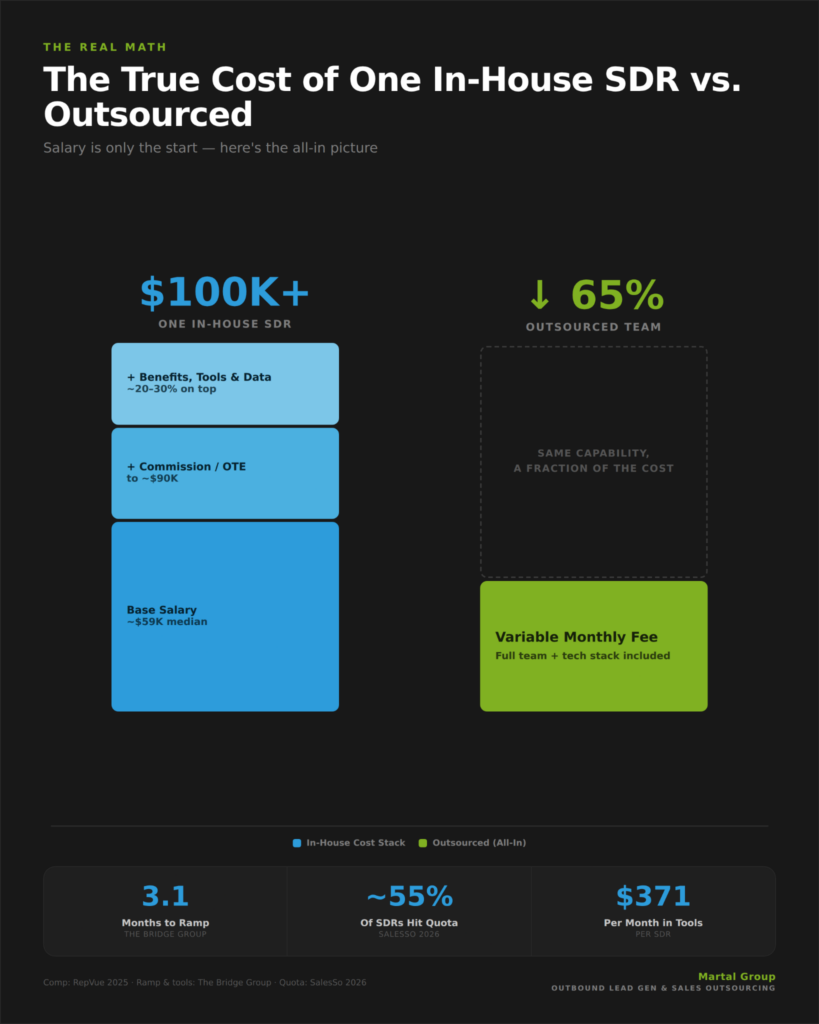
For a startup, every avoidable fixed cost is runway you’re giving away. And a single in-house SDR costs far more than the salary line suggests:
- Base salary: median SDR base is roughly $59,000, with on-target earnings near $90,000 including commission (2)
- Loaded cost on top of salary: taxes, benefits, software, data, and equipment typically add 20–30%+ before the rep books a single meeting
- Ramp time: a new SDR often takes 3–6 months to reach full productivity
- Quota-miss risk: only about 55% of SDRs hit quota in a given year (3)
Stack those up and one “affordable” hire becomes a six-figure bet that may not produce for half a year. Outsourcing converts that fixed gamble into a variable cost — and at scale, we’ve seen it cut sales costs by up to 65% versus building the same capability in-house. For a ~10-person company like Total Energy Connections, that math is the difference between testing a market and never reaching it: we delivered a steady flow of qualified opportunities without them carrying a full in-house sales payroll.
3. Talent: Experienced Reps, Not a Risky First Hire
Outsourcing’s quieter advantage is who does the selling. In the early innings — when the funnel has to fill fast — a junior, unproven hire is an expensive risk. They drain budget and, worse, can burn your best early prospects with clumsy outreach you can’t get back.
A seasoned outsourced team lives in lead generation and qualification every day. They navigate objections, read buying groups, and protect your brand in the first conversation. This is the part founders underestimate most: the cost of a bad rep isn’t just salary — it’s the prospects they waste.
4. Scalability: Dial It Up or Down Without Layoffs
Maybe you’re entering a new market. Maybe a campaign is working and you want to pour fuel on it. A good partner lets you add capacity in weeks, not the quarter-plus an in-house hiring cycle takes — and just as importantly, scale back without layoffs, severance, or an empty office you’re still paying for. That flexibility is exactly what keeps a startup nimble when the market shifts.
In-House vs. Outsourced Sales Team for Startups: How to Decide
Most founders frame this as build vs. buy. The more useful frame is speed and risk: how fast can you get qualified pipeline, and how much are you betting to find out if it works?
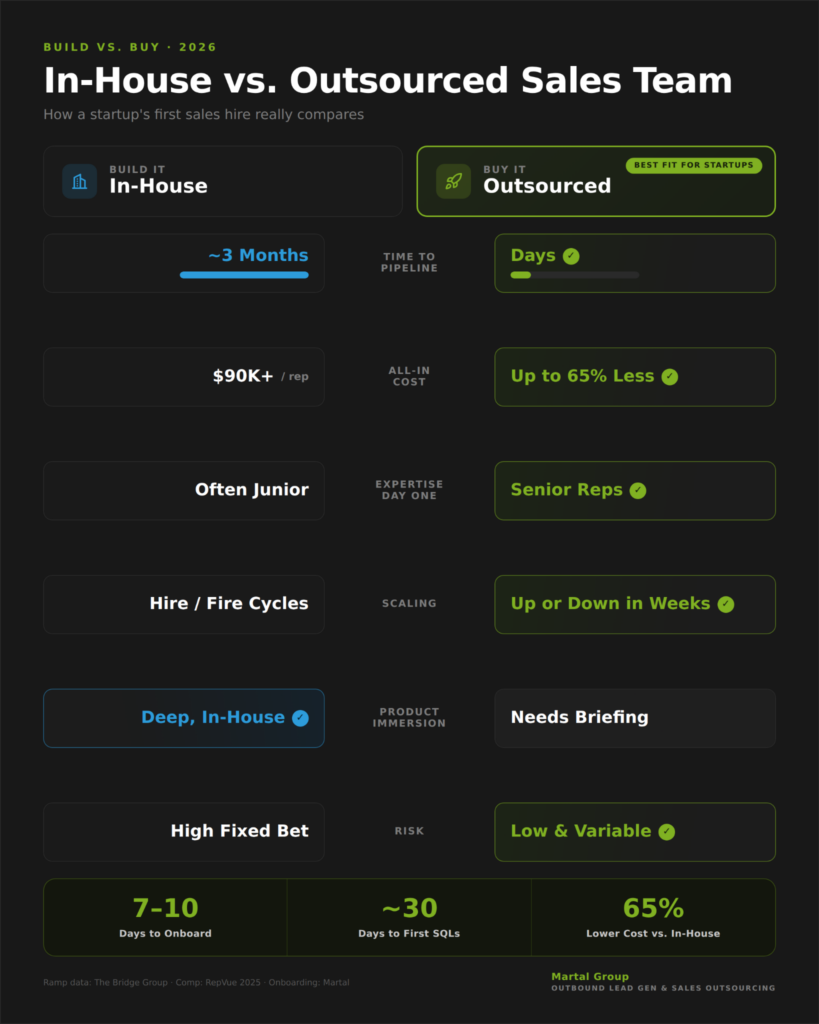
Here’s the number that reframes the whole debate. The average SDR takes 3.1 months to ramp to full productivity, and average tenure is just 1.8 years — so you get roughly 15–17 months of peak output per hire (The Bridge Group, via SalesSo). For a startup, that means your first in-house rep likely won’t produce meaningful pipeline until after your next quarter — and may walk before the second year. A good outsourced team, by contrast, can be live in days, not months. The work happens while your runway is still long enough to act on it.
The Side-by-Side Comparison of In-House vs. Outsourced Sales Team
Factor
In-House Sales Team
Outsourced Sales Team
Time to pipeline
~3 months to ramp a single SDR; longer to build a team
Live in days — onboarding in 7–10 business days, first SQLs in ~30 days
True cost
~$59K base / ~$90K OTE per rep, plus 20–30%+ in benefits, tools, data, and management
Variable monthly cost for a full team + tech stack; up to 65% less than building in-house
Expertise on day one
As experienced as whoever you can afford to hire — often junior at startup budgets
Senior reps who run outbound across many markets daily
Scalability
Hire/fire cycles, severance, fixed overhead
Scale up or down in weeks, no layoffs
Tech & data stack
You buy, integrate, and maintain it
Included — list-building, enrichment, dialers, deliverability
Risk
High fixed bet; a bad hire costs salary and burned prospects
Lower, variable; pilot before you commit
Control & brand feel
Full, direct control; deep product immersion
Strong with the right partner — but requires clear briefing and alignment
So Which One Is Right for Your Startup?
The honest answer isn’t “always outsource.” It’s about where you are right now.
In-house tends to win when you’ve already nailed a repeatable sales motion the founder can teach, you have the budget and management bandwidth to hire and coach, and sales is so core to your product that you need that learning in-house. As one founder put it bluntly in a forum thread: “sales and marketing needs to be done by someone who properly understands the business.” Early on, that someone is usually you.
Outsourcing tends to win when you need pipeline faster than a 3-month ramp allows, you can’t yet justify a six-figure fixed bet on an unproven hire, you’re entering a new market or segment where outside reps already have reps in the motion, or your team is strong on product but stretched too thin to prospect consistently.
Many startups don’t pick one forever. A common path we see: outsource to generate pipeline and learn what works in the early innings, then bring a sales function in-house once the motion is proven and the budget is there. Outsourcing isn’t the opposite of building a team — it’s often how you afford to build the right one later.
What Does an Outsourced Sales Team for Startups Actually Do?
A good outsourced partner doesn’t just “make calls.” It runs an end-to-end pipeline engine — and the difference between scattered activity and a coordinated system is usually what determines whether you see real meetings or just busywork.
Here’s the motion, start to finish:
- Research & targeting. Define exactly who to go after — firmographics, titles, company size, geography, and the buying signals that suggest a company is in-market now, not someday.
- List building & enrichment. Turn that profile into a verified, accurate prospect list, so reps reach a current inbox and a live decision-maker — not a bounced email from someone who left a year ago.
- Omnichannel outreach. This is the part most founders get wrong when they try it themselves. Cold email, cold calling, and LinkedIn lead generation aren’t three separate campaigns running in parallel — they’re one coordinated omnichannel sequence, timed so a prospect experiences continuity instead of noise. A LinkedIn touch sets up the call; the call references the email. That coordination is what lifts reply rates.
- Qualification. Not every reply is a lead. A strong team qualifies on authority and need — separating curious browsers from prospects genuinely ready for a conversation — so your calendar fills with people worth your time.
- Booked meetings & handoff. Qualified, interested prospects get booked as meetings and handed to whoever closes — you, a founder, or your AE — with full context so nothing gets lost in the transition.
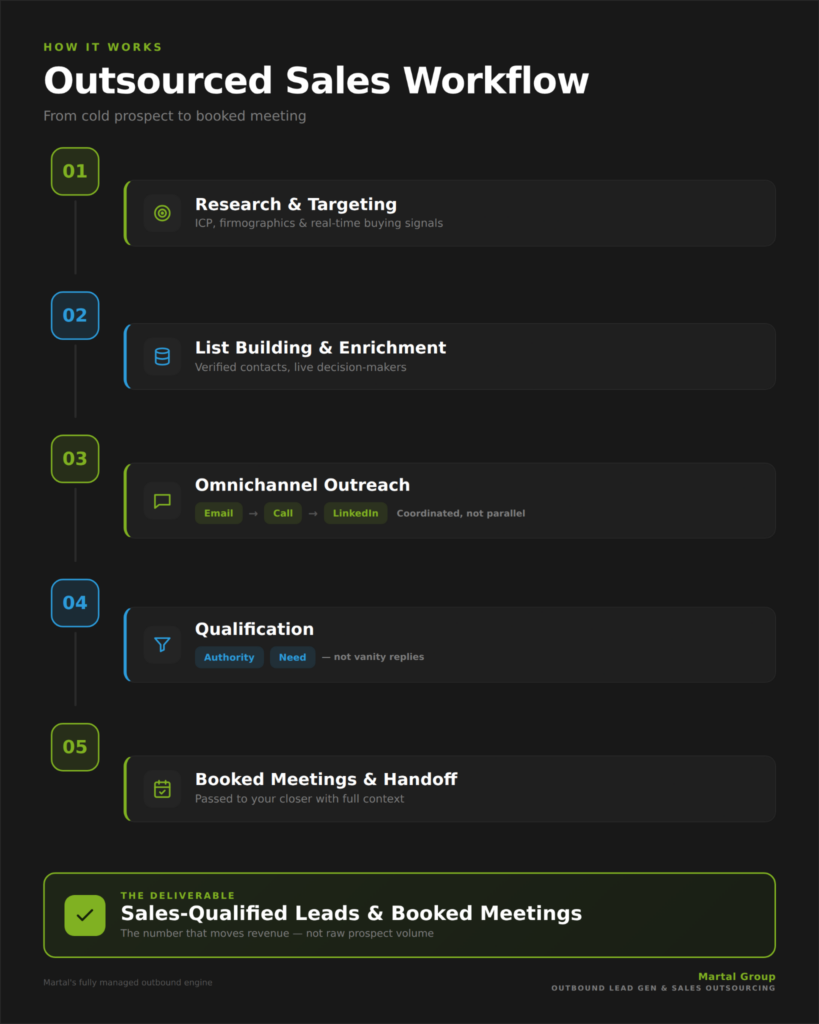
One distinction worth holding onto: the deliverable that matters isn’t prospects contacted — it’s sales-qualified leads and booked meetings. Plenty of providers will brag about volume. Volume is easy. Qualified pipeline is the thing that actually moves your revenue, and it’s the only number worth judging a partner on. It’s also why we frame this as full-cycle sales outsourcing rather than a list of disconnected tasks.
What “good” looks like: In our fully managed engagements, onboarding runs 7–10 business days, and most clients see their first SQLs within about 30 days — a realistic benchmark to hold any partner to, and one we’ll expand on below.
How to Implement Outsourced Sales for Startups: 6 Tips
Here’s the uncomfortable truth most guides skip: outsourcing sales fails more often than it works. In a survey, only7% of companies said outsourced SDRs “really worked” for them, with another 26% saying it “sort of” worked (4). That isn’t an argument against outsourcing — it’s an argument for doing it deliberately. The companies in that 7% don’t get lucky; they set the engagement up to win. These six tips are how you join them.
1. Find a Reputable Outsourced Sales Partner
Your partner represents your brand in the first conversation a prospect ever has with you — and they’ll own most of your sales process. So trust has to go beyond a good gut feel. The single biggest predictor of success we see: whether the team has actually sold something like your product, to buyers like yours, before.
Lean on testimonials, third-party reviews, and case studies — and read the case studies for results in your category, not just logos. A few questions worth asking on the first call:
- Do you have experience in our industry?
- Have you sold similar products or services?
- What does your sales process actually look like, week to week?
- How do you define and measure a qualified lead?
- Can you scale us up and down — and what does that process look like?
That fourth question matters more than founders expect. If a partner defines “qualified” loosely, you’ll get a full calendar and an empty pipeline. Pin it down before you sign.
2. Define Clear Sales Objectives
Your partner can only hit a target they can see. Set a SMART goal up front — Specific, Measurable, Attainable, Relevant, Time-based — so both sides agree on what success looks like before outreach starts. It also becomes the baseline you measure performance against later.
3. Identify the Right Success Metrics
This is where startups quietly sabotage themselves by chasing vanity metrics. Emails sent and connections made feel like progress; they aren’t. Track what reflects real movement: sales-qualified leads, booked meetings, and sales-cycle length. You won’t see results on day one — but within the first month or so, you should see leading indicators trending the right way (more qualified conversations, shorter time-to-meeting). If they’re not, that’s your signal to dig in early rather than wait out a bad quarter.
4. Loop In Your Internal Team
Tell your existing team who the partner is, what they own, and where the work overlaps. It sounds obvious, but unclear handoffs between internal staff and an outsourced team are one of the most common reasons good pipeline leaks. A 10-minute alignment up front saves weeks of confusion later.
5. Stay Open to a Fresh Playbook
A good outsourced team runs outreach every day across dozens of markets — they’ll bring angles, sequences, and tools you haven’t tried. Find a risk-to-reward balance you’re comfortable with, then give their approach room to work. You’ll often surface strategies your team simply didn’t have the reps to discover.
6. Start Small — Then Scale What Works
Still on the fence? You don’t have to hand over everything on day one. Start with a focused pilot: outsource one motion that’s beyond your current team’s bandwidth, keep an internal manager looped in, and scale based on what the data shows.
This isn’t just theory. In one engagement with a B2B data company (Complete EDI), we ran a 3-month pilot with a single fractional rep — and delivered 14 SQLs, with the first qualified leads landing inside the first two weeks. A small, low-risk start gave them the proof they needed before committing to anything bigger. That’s the whole point of starting small: buy certainty before you buy scale.
Outsourced Sales for Startups: Making the Right Call
Here’s the thread that runs through everything above: for an early-stage company, the biggest risk usually isn’t the product — it’s never reaching the people who’d buy it. Nearly 42% of startups fail because they don’t meet real market demand (5). You can read that as a product problem, but more often it’s a go-to-market one: the right buyers never heard a clear, well-timed message while there was still runway to act on it.
That’s the real case for outsourced sales for startups — not that it’s a shortcut, but that it puts experienced reps and a coordinated pipeline motion in front of the right market early, when getting traction is existential. The honest caveat holds, too: outsourcing isn’t magic. The programs that work treat their partner as an extension of the team, define “qualified” precisely, and watch the leading indicators from week one. The ones that fail hand it off and hope.
If you take one thing from this guide, make it this: judge the decision on qualified pipeline, not activity — and start small enough to prove it before you scale. We’ve watched lean teams do exactly that. A ~10-person company built a steady flow of qualified opportunities without ever carrying a full in-house sales payroll; a B2B data company turned a single-rep, three-month pilot into 14 SQLs before committing to more. Neither needed to bet the runway to find out if it would work.
Ready to See What a Qualified Pipeline Looks Like?
If your team is stretched thin and pipeline keeps slipping to the bottom of the list, that’s exactly the gap a good partner fills. Martal’s Sales-as-a-Service model pairs experienced onshore Sales Executives with our proprietary AI platform — running cold email, cold calling, and LinkedIn lead generation as one coordinated omnichannel strategy, with onboarding in 7–10 business days and a focus on SQLs and booked meetings rather than vanity volume.
Book a consultation to map what your first 90 days of qualified pipeline could look like — no commitment, just a clear picture of the opportunity. You can also estimate the upside first with our sales outsourcing ROI Calculator.
References
FAQs: Outsourced Sales for Startups
Is outsourcing sales bad for building the company?
It’s the question founders argue about most — one put it on a forum as “is outsourcing bad for building the company,” and another insisted “outsourcing sales is a huge mistake.” The honest answer: outsourcing is risky only when you hand it off and disengage, or when you do it before the founder has proven anyone can sell the product. Used deliberately — with clear goals and a tight definition of “qualified” — it builds the company by generating pipeline and market learning faster than a single early hire can. It’s a stability layer while you figure out your long-term motion, not a replacement for founders understanding their own buyers.
When should a startup hire a sales team vs. outsource?
A widely cited SaaStr rule of thumb: founders shouldn’t hire their first salesperson until they’ve closed roughly 10 deals themselves — proof the product is sellable. Before that, founder-led selling is irreplaceable. Once the motion is repeatable but you’re stretched thin or need to move faster than a 3-month ramp allows, outsourcing (or a hybrid) often makes more sense than rushing a risky in-house hire.
How much does it cost to outsource a sales team?
It varies with scope, industry, team size, and sales-cycle length — typically a few thousand dollars per month at the low end up to tens of thousands for a full omnichannel program. The more useful lens isn’t sticker price but cost per outcome: compare providers on customer acquisition cost (CAC), conversion rates, and ROI. A higher fee that produces qualified pipeline can be cheaper per SQL than a “bargain” that produces noise. As a benchmark, outsourcing a full team typically runs up to 65% less than building the same capability in-house.
How do you build a sales team for a startup?
You can build in-house, outsource, or blend the two — but it starts the same way: know your product cold, define your ideal customer, and set clear goals. From there, in-house means writing detailed job descriptions and recruiting experienced SDRs through channels like LinkedIn, Indeed, and ZipRecruiter. Outsourcing means vetting partners on industry experience, process, and proven results in your category. Many startups blend both — outsourcing to generate pipeline early, then hiring in-house once the motion is proven.
What does an outsourced sales team for startups actually do?
A full-cycle partner runs the whole top-of-funnel motion: research and targeting, list-building and enrichment, coordinated omnichannel outreach across cold email, cold calling, and LinkedIn, lead qualification on authority and need, and booking qualified meetings for your closers. The deliverable that matters is sales-qualified leads and booked meetings — not raw prospect volume.
How long does it take to see results from outsourced sales?
With a fully managed partner, onboarding typically takes 7–10 business days, with first market-qualified leads inside the first few weeks and first SQLs around the 30-day mark. You shouldn’t expect a full calendar on day one — but you should see leading indicators (more qualified conversations, shorter time-to-meeting) trending up within the first month. If they’re not, dig in early.