
 Martal
 Technology
 Education and training
 Web Development and UI / UX
 Healthcare/Medical
 Logistics and Supply Chain
 Information Technology
 Insuretech and Financial Services
 Marketplaces
 Software Development
 E-commerce and retail
 AI and Machine Learning
 Energy and Solar
 Manufacturing
 Security and Surveillance
 Digital Marketing Agency
 Transportation
 MSP
MSP
 Telecom
 B2B SaaS
 Cybersecurity
 HR tech
 Fintech
 Cleantech
 Consulting
Top 18 Demand Generation Agencies in 2026: A B2B Buyer’s Guide to Pipeline-Ready Partners
Major Takeaways: Demand Generation Agency
Fit between the agency’s model and your demand stage is the single biggest variable in whether the program actually moves pipeline — more than agency size, brand recognition, or contract terms.
Match the agency model to where your demand actually sits: outbound-led demand generation for low brand awareness, ABM-led for named-account enterprise plays, and content + SEO-led for long-cycle compounding inbound demand.
Paid media management runs $3K–$15K per month, outbound demand generation runs $9K–$25K+, and integrated full-service programs run $20K–$50K+ — with pay-per-lead pricing rarely outperforming retainers for complex B2B sales.
Demand generation is the broader system that creates and captures pipeline, while lead generation is the tactical capture layer — and the strongest B2B demand generation programs run both motions sequenced, not in competition.
The 2026 dashboard anchors on three numbers: pipeline coverage (median 3.2× quota, top quartile 4.8×), marketing-sourced revenue (typically 30–40% of closed-won), and MQL-to-SQL conversion (median 13%, top decile 31%).
Five shifts have hit a tipping point in 2026: agentic AI executing workflows, signal-driven outreach replacing volume-driven prospecting, marketing-sourced pipeline replacing MQL volume as the primary KPI, buying committee orchestration (13–17 stakeholders per enterprise deal), and Answer Engine Optimization reshaping discovery.
Ask how they define qualified demand, how they attribute pipeline to demand gen activities, who specifically will run the account, what the first 90 days look like, and what happens if results lag at six months.
Demand generation is not enterprise-only — SMB B2B companies often benefit more from outsourced demand gen than enterprises do, since building the same capability in-house typically costs $300K–$500K fully loaded per year.
Introduction
For B2B teams trying to grow pipeline in 2026, the pressure feels different. 87% of B2B marketers consider demand generation their top priority, and 68% say increasing lead quality is their number-one mission (1) yet about 79% of leads never convert into sales (2), often because they lack proper nurturing or qualification. The gap between activity and revenue is the real demand generation problem most companies hire an agency to solve.
The right B2B demand generation agency does more than fill a funnel. It builds the system that turns attention into pipeline, pipeline into qualified meetings, and meetings into closed revenue — predictably enough that the CRO stops guessing month to month.
This guide is for the CMO, CRO, or VP of Sales currently evaluating that decision. We built it by reviewing the 2026 demand generation landscape, examining current research, surfacing the recurring buyer questions our team hears in discovery calls (and that show up across sales and demand generation communities), and grounding the analysis in 16+ years of running outbound demand generation for B2B companies across SaaS, cybersecurity, manufacturing, fintech, and 50+ other verticals.
You’ll find a buyer’s framework for choosing the right partner, a realistic look at agency pricing, an updated list of the leading demand generation agencies, and answers to the questions most teams ask in the first sales call but never see covered in published content.
What is Demand Generation?
Integrated demand generation approaches boost pipeline conversion rates by 23% compared to fragmented or isolated campaigns.
Reference Source: HubSpot
The 2026 demand generation playbook is shifting fast. Companies that excel at lead nurturing generate 50% more sales-ready leads at a 33% lower cost (3), and 92% of B2B marketers now include LinkedIn in their digital marketing mix (4) yet 80% of B2B buyers say personalized content is what actually moves them to act (5). The takeaway: more volume against the wrong audience does not build demand. Better targeting, sharper messaging, and connected channels do
At its core, demand generation is the system a B2B company uses to create awareness, build trust, and surface buying intent across an entire target market — long before a prospect ever raises their hand. Done well, it pulls inbound, outbound, ABM, paid media, and content into a single coordinated motion. Done poorly, it becomes a scattered set of campaigns that produce activity without revenue.
Most teams confuse demand generation with lead generation. The cleanest way to separate the two is the create vs capture distinction. Demand creation builds market awareness and educates buyers before they are ready to talk. Demand capture converts that interest into meetings and opportunities once buyers signal they are in-market. Both matter. Neither works alone. This is why modern B2B demand generation agencies, demand generation firms, and demand gen solutions are increasingly judged on how well they connect the two, not on how many leads they list at the end of a quarter.
Inbound vs Outbound Demand Generation: How They Actually Work Together
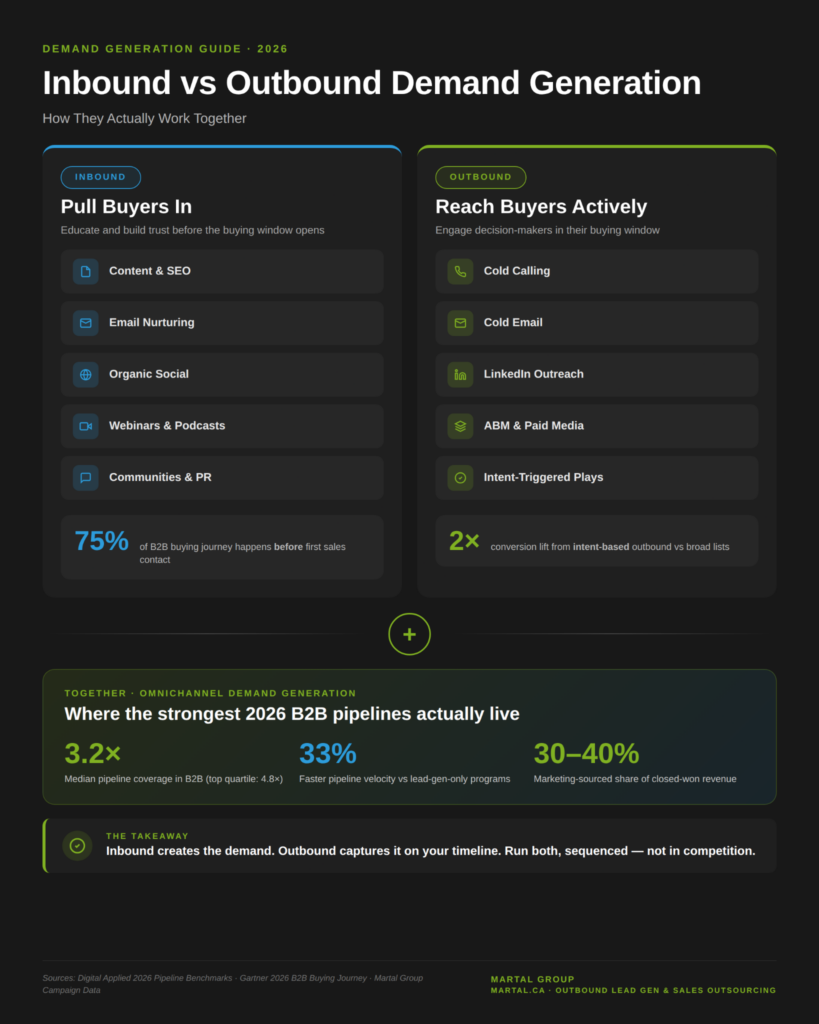
Strong demand generation pulls inbound and outbound strategies into the same operating system — not into competing silos.
Inbound demand generation brings buyers in by meeting them where they already research:
- Content marketing: Blog articles, ebooks, and original research targeting the questions buyers actually ask at each stage
- Social media: Consistent, value-led posting — especially on LinkedIn, where signal-driven content compounds
- SEO: Capturing future customers through informational, evaluation, and transactional keyword queries
- Email nurturing: Drip campaigns and lifecycle programs that move leads from interest to intent
- Webinars and podcasts: Higher-trust formats that anchor brand authority in long-cycle B2B markets
Outbound demand generation reaches buyers proactively — and is where most agencies promise far more than they deliver. The channels we run every day for Martal clients:
- Cold Email Outreach: Personalized, signal-driven sequences — not mail merges dressed up with a first name
- LinkedIn Networking: Direct outreach to decision-makers, not connection-request spam
- Cold Calling: Still the highest-conversion channel for complex enterprise buyers
- Event Marketing: Trade shows, conferences, and targeted field campaigns
- Targeted advertising: Paid search, paid social, programmatic, and retargeting
The most common mistake we see in our day-to-day campaigns is teams treating these as parallel motions rather than a single coordinated system. Omnichannel demand generation works when the email, the call, and the LinkedIn touch reinforce each other for the same buyer in the same week — not when three separate vendors fire disconnected outreach into the same inbox.
Is Demand Generation Worth the Investment?
This is one of the most frequent buyer questions we see across Reddit threads, Quora discussions, and our own discovery calls. The honest answer: yes, but only when the program is engineered around pipeline outcomes rather than lead volume. According to benchmarks, only 13% of MQLs convert to SQLs at most B2B SaaS companies (6) meaning 87% of marketing spend funds activity that never reaches a sales conversation.
Demand generation done right closes that gap. Demand generation done poorly widens it. The deciding factor is whether the program tracks the metrics that actually move revenue — marketing-sourced pipeline, MQL-to-SQL conversion rate, and pipeline coverage ratio — rather than vanity counts of forms filled.
Why Data Now Defines Demand Generation
The 2026 demand gen dashboard is built around two anchor numbers: pipeline coverage (how many multiples of next-quarter quota sit in qualified pipeline) and marketing-sourced share (the percentage of closed-won revenue attributable to marketing-originated pipeline). Median pipeline coverage settled at 3.2× quota across a 240-panel set in April 2026, top-quartile programmes run 4.8×, and below 2.5× is leading-indicator distress. The programs pulling ahead share one trait — they invest in AI-assisted scoring, intent-driven targeting, and tight SDR-to-AE handoff. The programs falling behind are still chasing MQL volume. (7)
For B2B teams evaluating demand generation services, the strategic shift is clear: measure how much pipeline marketing actually sources, not how many names hit the CRM. That is the difference between a demand generation engine and a lead-gathering exercise.
Top 18 B2B Demand Generation Agencies in 2026
To build this list, we reviewed the leading demand generation agencies serving B2B companies across North America, EMEA, and APAC; cross-referenced verified client outcomes on Clutch, G2, and Capterra; examined each agency’s reported positioning, channel mix, and pricing model; and organized the findings around the criteria buyers actually use when evaluating a demand gen partner — execution model, channel specialization, vertical fit, and pricing transparency. Where first-hand experience applies, we drew on 16+ years of running outbound demand generation programs across SaaS, cybersecurity, manufacturing, fintech, and 50+ other verticals.
The goal is not another generic “top X agencies” list. It is a buyer’s reference: which agency model fits which type of B2B company, what each does well, and where the trade-offs sit.
Demand Generation Agency Comparison Table
Agency
Region / Founded
Specialization
Best Fit
Martal Group
Founded 2009 · North America, Europe, LATAM
B2B outbound demand gen via AI + onshore human SDR teams; omnichannel email, cold calling, LinkedIn
B2B SaaS, cybersecurity, manufacturing, fintech, AI/ML, and 50+ verticals scaling pipeline without internal hiring
SalesRoads
US · 16+ years
Cold calling and appointment setting
Companies in industrial, manufacturing, or complex B2B services where phone is a primary channel
Pearl Lemon Leads
UK · global reach
Multichannel outbound — LinkedIn, cold email, lead nurturing
Tech, finance, and professional services teams wanting flexible outbound
The Marketing Practice
UK/EU · EMEA + NA
ABM + integrated demand programs
Enterprise tech and SaaS running multi-stakeholder buying committee programs
Ironpaper
US (NY)
ABM-led demand gen for complex sales cycles
B2B tech with long enterprise cycles and multi-stakeholder buying groups
Gripped
UK (London)
Inbound-led demand gen for SaaS
B2B SaaS startups and scale-ups building organic pipeline
Refine Labs
US (Boston)
Demand creation methodology — organic content, dark social, paid media
Mid-market and enterprise SaaS willing to modernize from MQL-led to demand-led
Directive Consulting
US (California)
SaaS pipeline growth tied to CAC payback
B2B SaaS wanting CAC-focused paid + organic execution
Ignite Visibility
US (San Diego)
SEO, PPC, paid social, CRO
E-commerce, franchises, and B2B teams running paid-media-heavy programs
Accelerate Agency
UK (Bristol)
AI-driven SEO and content marketing
SaaS and retail brands building long-term organic demand
Dapper Agency
UK (Brighton)
AI-driven outreach for tech startups
Early-stage SaaS, cybersecurity, and fintech
Transmission Agency
UK (London) · global
Data-driven ABM and digital campaigns
Tech, manufacturing, and global enterprise running tiered ABM
GrowthSpree
Global · founded 2020
Paid media + RevOps for B2B SaaS
Series A–C SaaS companies ($0–$50M ARR) wanting pipeline, not leads
Powered by Search
North America
Paid media + SEO + content (full-funnel SaaS)
Series A–C SaaS transitioning from lead gen to demand gen
Kalungi
US (Bellevue, WA)
Fractional CMO + execution team
Series A–B B2B SaaS startups needing leadership and execution
The B2B Playbook
Global · boutique
ICP-first full-funnel demand gen
Founders and marketing leaders building their first demand engine
First Page Sage
US
Thought Leadership SEO + content
B2B SaaS, fintech, and manufacturing playing the long organic game
New Breed Marketing
US (Vermont)
HubSpot-driven demand gen + RevOps
HubSpot-native B2B SaaS at Series B+ stage
1. Martal Group – Best for B2B Outbound Demand Generation at Scale
Founded in 2009, Martal Group is a leading B2B demand generation agency that combines an AI SDR platform with experienced onshore human SDR teams to build qualified pipeline for B2B companies expanding across North America, Europe, and Latin America. As a trusted partner for outsourced demand generation, we offer fractional and full-time SDR teams staffed with senior sales executives averaging 3–5 years of B2B experience.
What separates us from the rest of this list is operating model. Most demand gen agencies are paid-media-led, content-led, or pure SDR-shop. We run a coordinated omnichannel motion — email, cold calling, and LinkedIn lead generation all firing for the same buyer in the same week — supported by Martal’s AI Sales Platform for ICP modeling, intent signals, and continuous campaign optimization.
- AI + Human Model: Senior onshore SDRs paired with Martal’s Agentic AI Platform — real-time intent signals, persona-level targeting, adaptive messaging
- Campaign Focus: ICP-specific, signal-driven outbound across email, LinkedIn, and phone — coordinated, not parallel
- Global Reach: Onshore teams across North America, Europe, and LATAM — same timezone, locally aligned
- Proof Points: Trusted by 2,000+ B2B brands worldwide · 200+ five-star reviews · #1 in Lead Generation on Clutch · 16+ years of B2B outbound experience
Below are three demand generation outcomes from across the Martal client base — each one illustrates a different scenario buyers typically hire a demand gen agency to solve:
- Market entry into a complex, multi-stakeholder buying committee. Polygon, a Stockholm-based IoT climate control provider, came to Martal to build a US pipeline across three distinct buyer roles inside the same target accounts — Sustainability Directors, Risk Directors, and Preconstruction Executives — each with a different reason to care. Over 24 months, the program delivered 440 leads, 203 SQLs, and 139 booked meetings, proving that demand generation scales in committee-led purchases when targeting is built persona-by-persona, not by job title alone.
- Sustained enterprise pipeline in a mature, competitive category. A B2B telecom equipment and services provider running a Tier I omnichannel program with Martal generated 1,442 leads, 863 MQLs, 346 SQLs, and 339 booked meetings over 24 months. The case demonstrates what consistent, signal-driven outbound looks like inside a crowded enterprise market — predictable pipeline coverage quarter after quarter, not the one-off lead spikes most agencies deliver and call demand gen.
- A long-term demand engine that compounds into Fortune-class revenue. Clickworker, a crowdsourcing platform serving global IT and AI buyers, has partnered with Martal for nine years and counting. The engagement has produced $4.5M in recurring revenue, 500% ROI, and closed deals with three Fortune 500 and three Fortune 10 customers — the kind of compounding outcome demand generation delivers when the program is engineered for long-cycle enterprise buyers, not transactional MQL counts.
2. SalesRoads
US-based outbound demand generation firm specializing in cold calling and appointment setting, with 16+ years of experience and senior callers running custom playbooks rather than scripted reps.
- Region: US-based SDRs serving primarily North American buyers
- Execution: Dedicated outbound teams running cold calling, email outreach, and multi-touch follow-up
- Specialization: Industrial, manufacturing, complex B2B services where phone is a primary channel
- Pricing: Reported starting around $9,400/month per public sources
3. Pearl Lemon Leads
UK-based B2B demand generation agency known for scalable multichannel outbound campaigns and transparent client reporting.
- Region: UK with global delivery (US, UK, EU)
- Execution: LinkedIn outreach, cold email, and lead nurturing programs
- Specialization: Tech, finance, and professional services
- Tech/Integration: Data-driven prospecting with client-facing reporting dashboards
4. The Marketing Practice
UK/EU agency blending ABM, content marketing, and lead nurturing for enterprise tech and SaaS clients across EMEA and North America.
- Region: UK-based, serves EMEA and North American markets
- Execution: Account-based marketing and multi-channel campaigns (email, events, social)
- Specialization: Tech, SaaS, and B2B enterprise
- Tech/Integration: Marketo and Eloqua integrated with Salesforce CRM
5. Ironpaper
US-based demand generation agency specializing in ABM-led programs for B2B companies with long, complex sales cycles and multi-stakeholder buying groups.
- Region: US (New York), national client base
- Execution: ICP development, account selection, and campaigns across email, advertising, and direct mail
- Specialization: Technology, SaaS, and high-tech B2B firms with enterprise cycles
- Tech/Integration: HubSpot-led martech stack and full pipeline attribution
6. Gripped
UK-based digital-first demand generation agency serving B2B SaaS startups and scale-ups with integrated paid, organic, and ABM programs.
- Region: UK (London), international clients
- Execution: Content marketing, SEO/PPC, and marketing automation
- Specialization: Tech and SaaS firms at startup and scale-up stages
- Tech/Integration: HubSpot, Pardot, and pipeline analytics
7. Refine Labs
US agency credited with formalizing modern demand creation methodology — content, dark social, and paid media built around buyer behavior rather than MQL volume.
- Region: US-based (Boston), serving primarily tech clients
- Execution: Demand Acceleration Framework — content strategy, paid media, full-funnel analytics
- Specialization: Mid-market and enterprise B2B SaaS
- Tech/Integration: Heavy use of marketing analytics; reframes the funnel away from MQLs toward pipeline-sourced revenue
8. Directive Consulting
US growth marketing firm specializing in SaaS demand generation tied tightly to CAC payback and pipeline accountability.
- Region: US (California), global SaaS clients
- Execution: Inbound and paid — SEO, Google Ads, LinkedIn Ads, content, CRO
- Specialization: B2B SaaS and enterprise software
- Tech/Integration: Custom ROI dashboards and multi-touch attribution
9. Ignite Visibility
California digital marketing agency offering full-service demand gen with strong paid-media expertise, particularly in SEO, PPC, and CRO.
- Region: US (San Diego), national reach
- Execution: SEO, PPC, paid social, and CRO
- Specialization: E-commerce, franchises, and general B2B sectors
- Tech/Integration: Advanced analytics, A/B testing, proprietary reporting
10. Accelerate Agency
UK demand gen specialist with a strong AI-driven SEO and content focus, building long-term organic demand for SaaS and retail brands.
- Region: UK (Bristol), serving UK/EU and US SaaS clients
- Execution: AI-powered SEO, content marketing, and CRO
- Specialization: B2B SaaS, retail, manufacturing, and consumer products
- Tech/Integration: AI tools for keyword research and predictive analytics
11. Dapper Agency
UK B2B demand generation firm leveraging AI for personalized outreach to early-stage tech companies.
- Region: UK (Brighton), serving global tech clients
- Execution: Data-driven lead campaigns with AI insights and personalized outreach
- Specialization: SaaS, cybersecurity, fintech startups and scale-ups
- Tech/Integration: AI for audience targeting; CRM and martech integration
12. Transmission Agency
UK global B2B demand generation agency specializing in data-driven ABM and tiered account programs for technology and enterprise clients.
- Region: UK (London) and international markets
- Execution: Tiered account-based marketing and integrated digital campaigns
- Specialization: Technology, manufacturing, and global enterprise B2B
- Tech/Integration: Advanced data analytics, CRM integration, and pipeline attribution
13. GrowthSpree
Senior-operator-led demand gen agency built for B2B SaaS, with $60M+ in managed SaaS ad spend across 300+ clients and proprietary MCP-based analytics infrastructure.
- Region: Global delivery, serving B2B SaaS worldwide
- Execution: Paid media (Google Ads, LinkedIn Ads, Meta) + ABM + RevOps + landing page design
- Specialization: Series A–C B2B SaaS ($0–$50M ARR)
- Pricing: Reported flat $3,000/month retainer — no percentage-of-spend
14. Powered by Search
North American B2B SaaS growth marketing agency specializing in helping companies transition from lead generation to demand generation through paid media, SEO, and content.
- Region: North America, global SaaS clients
- Execution: Full-funnel paid media + organic content + SEO
- Specialization: Series A through Series C B2B SaaS navigating the lead-to-demand shift
- Tech/Integration: Pipeline-connected reporting and attribution across channels
15. Kalungi
Fractional CMO and execution team purpose-built for early-stage B2B SaaS startups, combining leadership with hands-on demand generation execution.
- Region: US (Bellevue, WA)
- Execution: Fractional CMO leadership + execution team for demand gen, content, and paid
- Specialization: Series A–B B2B SaaS ($1M–$15M ARR) building their first proper demand function
- Pricing: Reported around $15,000/month typical retainer
16. The B2B Playbook
Boutique demand generation consultancy founded by George Coudounaris and Kevin Chen, known for ICP-first full-funnel methodology and an influential B2B demand gen podcast.
- Region: Global delivery, predominantly remote
- Execution: ICP development, demand creation strategy, full-funnel program design
- Specialization: Founders and marketing leaders building their first demand engine
- Tech/Integration: Methodology-led — emphasizes pipeline impact and HIRO (high-intent revenue opportunity) measurement
17. First Page Sage
US-based SEO and thought leadership agency specializing in long-term organic demand generation for complex B2B industries.
- Region: US, mid-market and enterprise clients
- Execution: Thought Leadership SEO, content marketing, lead generation, CRO
- Specialization: B2B SaaS, fintech, manufacturing — complex B2B industries with long sales cycles
- Pricing: Reported tiered programs starting around $15,000/month
18. New Breed Marketing
US HubSpot Elite Partner specializing in demand generation and RevOps for B2B SaaS companies at Series B and beyond.
- Region: US (Vermont), national B2B SaaS clients
- Execution: HubSpot-led demand programs — content, automation, lifecycle, RevOps
- Specialization: Series B+ B2B SaaS that want HubSpot-native execution
- Tech/Integration: Deep HubSpot specialization; integrated content and automation flows
How to Choose the Right Demand Generation Agency: A Buyer’s Framework
Most B2B teams that hire a demand generation agency do not pick the wrong category. They pick the wrong model inside the right category. A 24-month enterprise outbound program signed when the business actually needed a paid-media audit. An ABM program signed by a company with no named-account list. A demand creation agency hired by a CEO who will not show up on LinkedIn or video. The agency may be good. The fit is wrong — and the next six to twelve months pay for that mistake.
This framework is what we walk buyers through in our own discovery calls. It is also what every CMO, CRO, or VP of Sales should run through before signing with any partner on the list above.
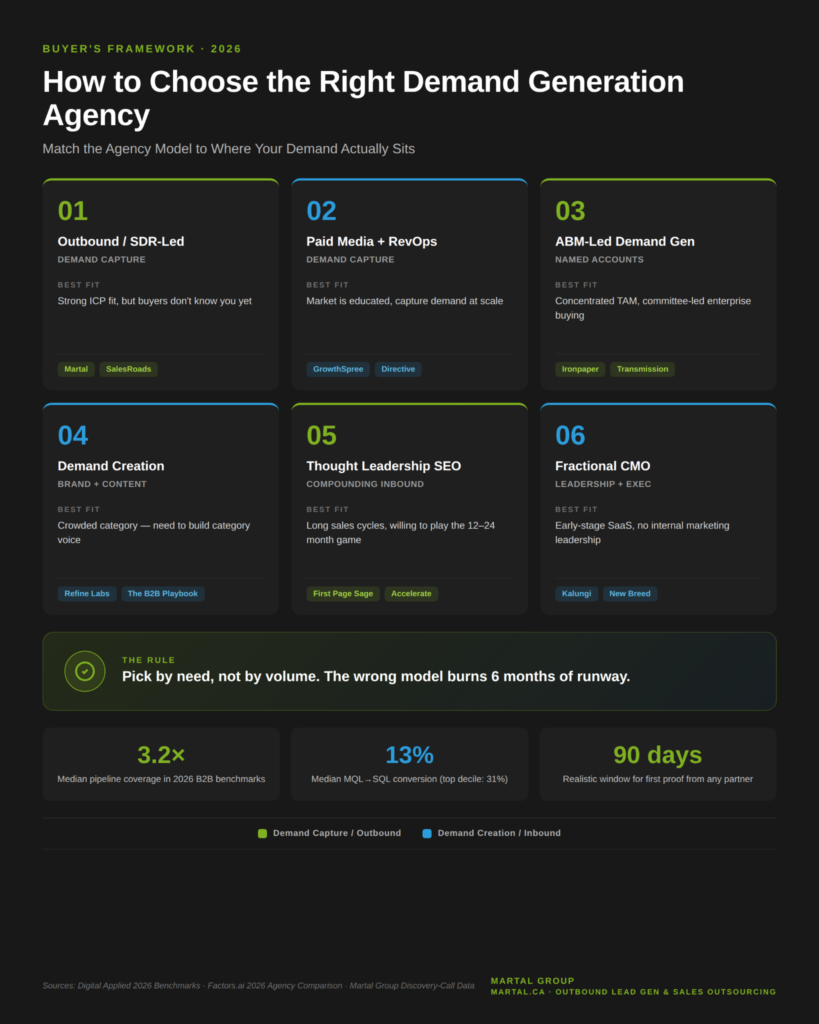
Match the Agency Model to Where Your Demand Generation Actually Sits
Demand generation is not a single discipline, and demand generation agencies are not interchangeable. The right partner depends on what part of the funnel is broken — awareness, capture, or conversion — and on the maturity of the marketing function inside your business.
Your Situation
The Right Agency Model
Examples From This List
ICP fit is strong, but buyers don’t know you yet
Outbound demand generation / SDR-led
Martal Group, SalesRoads, Pearl Lemon Leads
Market is educated, you need to capture demand at scale
Paid media + RevOps
GrowthSpree, Directive Consulting, Powered by Search
You sell into committee-led, named-account TAM
ABM-led demand generation
Ironpaper, Transmission Agency, The Marketing Practice
Category is crowded — you need to build a brand voice
Demand creation / thought leadership
Refine Labs, The B2B Playbook
Long sales cycles; compounding organic play
Thought leadership SEO + content
First Page Sage, Accelerate Agency, Gripped
Early-stage SaaS, no internal marketing leadership
Fractional CMO + execution
Kalungi, New Breed Marketing
AI-driven tech startup, lean budget, fast cycles
AI-led agency model
Dapper Agency, GrowthSpree
A common buyer question we see across Reddit and Quora is “Should I hire a demand generation agency or build in-house?” The answer usually depends on which row of this table fits. Outbound-led demand generation is rarely worth building in-house unless you have eighteen months and budget for three to five experienced SDRs. Inbound and thought leadership programs are often more cost-effective to build internally if you have a strong content lead. Most B2B teams end up with a hybrid: an agency runs the channel where speed and specialization matter most, while internal staff own the long-term assets.
What the Best Demand Generation Agencies Have in Common
After 16+ years running these programs from the agency side, the partners who consistently deliver share five traits. The ones who don’t are easy to spot once you know what to look for.
1. They start with strategy, not tactics. A strong agency spends the first call understanding your business model, sales process, and buyer journey — and challenges your ICP rather than accepting it at face value. Tactical partners jump straight to “we’d run LinkedIn ads and a webinar.” Strategic partners ask what qualified demand looks like for your sales team before recommending anything.
2. They are accountable to pipeline, not leads. “How do you attribute pipeline and revenue to demand gen activities?” is one of the highest-leverage questions a buyer can ask. If the answer is impressions, clicks, MQL volume, or anything that does not connect to pipeline and closed-won revenue, the agency is not running demand generation — they are running activity.
3. Senior operators run the account. A common failure mode in our space is junior account managers running day-to-day execution while senior operators close the sale and vanish. Ask who specifically will run your account, and meet them before signing.
4. The first 90 days have a clear structure. Strong agencies can walk you through onboarding, ICP confirmation, messaging development, campaign launch, and first reporting cadence — week by week. Vague timelines are a leading indicator of vague execution. (Martal’s own onboarding moves from kickoff to first SQLs in 30 days through a documented onboarding timeline — we publish it because we expect buyers to use it as a benchmark.)
5. They are transparent about what they don’t do. No agency runs every channel at world-class level. The good ones tell you upfront where their authority ends and recommend specialists for the rest. The mediocre ones promise everything.
Demand Generation Agency Red Flags
A few patterns come up repeatedly when buyers describe agencies that burned six-figure budgets. If you see one of these in your evaluation, slow down before you sign.
- Volume guarantees in the first call. “We’ll deliver 100 MQLs per month” — without understanding your ICP, sales cycle, or definition of a qualified lead — is a sales pitch, not a plan
- No clear definition of qualified pipeline. If the agency cannot articulate the difference between a lead, an MQL, an SQL, and a sales-accepted opportunity for your specific business, they will not be able to deliver them
- Reporting that stops at marketing outputs. Impressions, clicks, downloads, and form fills are inputs. If pipeline-influenced and pipeline-sourced revenue are not on the dashboard, the agency is not measuring what matters
- Locked-in long-term contracts. Confident agencies offer flexible terms. Lock-in protects underperforming partners more than it protects clients
- Generic case studies. If every case study is built on impressions and engagement without pipeline or revenue, treat with skepticism
- No questions about your sales cycle. A serious demand gen agency cares deeply about how your sales team qualifies leads, what deal velocity looks like, and where opportunities currently get stuck — because that determines how the program is engineered
Questions to Ask Every Demand Generation Agency Before You Sign
This list comes directly from the questions B2B marketing leaders ask each other when comparing agency notes — sourced from Reddit threads, Quora discussions, LinkedIn posts, and our own discovery calls. Use it as a checklist during agency evaluation:
- “How would you approach demand generation for our specific buyer persona?”
- “How do you define qualified demand — and how does that match how our sales team defines a qualified lead?”
- “What does the first 90 days look like with a new client?”
- “How do you attribute pipeline and revenue to demand generation activities?”
- “What’s your typical MQL-to-SQL conversion rate across similar accounts?”
- “How do you incorporate sales feedback into ongoing strategy?”
- “Who specifically will work on our account — and can I meet them before signing?”
- “What happens if we are not seeing results at 6 months?”
- “What is your cancellation policy?”
- “Can you share case studies from B2B companies with our deal size and sales cycle?”
The agencies that earn trust answer these directly. The ones that pivot to “every business is different” or “we customize everything” are buying time.
How Much Does a Demand Generation Agency Cost in 2026?
One of the most common questions B2B teams ask before evaluating agencies — and one of the least clearly answered in published content — is what it actually costs to hire a demand generation partner. The honest answer is that pricing varies more than almost any other B2B service category, because the work itself varies that much. A pure SEO retainer and a full-cycle outbound SDR program are both “demand generation” on paper. They are not the same engagement, and they should not cost the same.
This section breaks down what current pricing looks like across the major agency models, what drives the differences, and where Martal’s pricing fits in the broader range.
2026 Demand Generation Agency Pricing — At a Glance
Engagement Type
Typical Monthly Cost
Setup Fee
Best Fit
Paid media management (SaaS focus)
$3,000 – $15,000 (11)
$0 – $2,500
Series A–C SaaS with existing ICP and creative
Inbound / Content + SEO
$5,000 – $20,000 (9)
$1,000 – $5,000
Long-cycle B2B teams playing the compounding organic game
Outbound demand gen / SDR-led
$9,000 – $25,000+ (8)
$0 – $5,000
B2B teams that need pipeline now, especially in complex enterprise categories
ABM-led demand gen
$15,000 – $50,000+ (9)
$5,000 – $15,000
Enterprise with named-account TAM and multi-stakeholder buying
Fractional CMO + execution
$15,000 – $30,000 (11)
Variable
Early-stage SaaS without internal marketing leadership
Full-service / integrated demand gen
$20,000 – $50,000+ (9)
$5,000 – $25,000
Mid-market and enterprise consolidating multiple agencies into one
Pay-per-lead / performance
$50 – $500 per qualified lead (10)
$1,000 – $5,000
Brands testing demand gen with tight cash flow
Pricing ranges drawn from public 2026 agency pricing references; broader B2B agency cost context cross-referenced against Latinpresarios’ lead generation services cost guide (12).
What Drives the Difference Between a $3K and a $50K Retainer?
Five factors do most of the work:
- Channel scope. A single-channel paid media program is far cheaper than a coordinated email + cold calling + LinkedIn + paid program. Each channel has dedicated specialists and tooling — and as data shows integrated full-funnel programs consistently price above single-channel engagements (8).
- Team seniority. Junior account-manager pricing runs lower; senior-operator-only pricing runs higher — and tends to deliver more in less time
- Vertical complexity. Regulated industries (healthcare, fintech, cybersecurity) and long-cycle enterprise categories carry premium rates because the SDR or strategist must genuinely understand the buyer
- Geographic and language coverage. Multi-region programs (North America, EMEA, LATAM) cost more than single-region campaigns
- Strategy vs execution. Strategy-only retainers tend to run $5K–$15K. Full execution adds the operational cost of running the work day-to-day, which is why integrated full-service programs (9) typically sit at $15K–$50K monthly
Retainer vs Performance Pricing: Which Is Better?
This question shows up in almost every B2B agency evaluation thread on Reddit and Quora — usually phrased as “Is pay-per-lead worth it?” Both models have a place. What matters is which one aligns with how your program actually generates revenue.
- Monthly retainer ($3K–$50K/month) — the dominant model. Predictable cost, dedicated team, and the agency can invest in long-horizon work (brand, content, sales-marketing alignment). The risk: a low-performing agency on retainer is still getting paid
- Pay-per-lead / performance ($50–$500 per qualified lead, sometimes more, (10) appealing on paper, but rarely the better choice for B2B. The agency tends to optimize for lead volume (the thing they get paid for) rather than pipeline quality. In complex enterprise sales, that misalignment shows up fast
- Hybrid (management fee + revenue share) — increasingly common at the enterprise level. Aligns incentives well when both sides agree on what won actually means
- Project-based ($10K–$100K+ per project) — useful for one-time strategy work, a campaign launch, or a brand refresh — not a fit for ongoing demand generation
The pattern that holds in 2026: retainer is the default for sustained demand generation, with performance-based agreements layered on top for specific outcomes once trust is established.
Where Martal Fits in the Range
Martal offers tiered service structures across outsourced demand generation — from fractional SDR teams for SMB and mid-market through full-cycle enterprise sales programs — with detailed monthly pricing published openly on ourservice pricing page and AI platform pricing on our AI pricing page. Our retainers align with the Outbound demand gen / SDR-led row in the table above — predictable monthly cost, dedicated onshore Sales Executives, and reporting tied to SQLs and booked meetings rather than vanity metrics.
Most B2B teams who hire us run a quick check first: “What would it cost to build this in-house?” The math usually lands in the same place — three to five experienced SDRs, sales operations support, an AI sales stack, and a senior strategist run roughly $300K–$500K fully loaded per year, versus a managed fractional or full-time program that ramps in 30 days for a fraction of that. Use Martal’s ROI calculator to run the comparison against your own numbers.
The cost case for outsourcing demand generation is not only about budget. It is about speed to qualified pipeline.
Demand Generation vs Lead Generation: What’s the Difference and Why It Matters in B2B
B2B companies using demand generation strategies increase pipeline velocity by 33% over companies relying only on lead generation.
Reference Source: Attention
Demand generation vs lead generation is one of the most common — and most misunderstood — debates in B2B marketing. The two are closely related, but they serve different purposes in the buyer’s journey and require different strategies, metrics, and investments. Getting this distinction right is the single biggest variable in whether the demand generation agency you hire actually moves pipeline.
Demand generation is the broader, strategic system that creates awareness, builds trust, and surfaces buying intent across an entire target market — long before buyers raise their hand. The goal is to influence the whole category, not just convert the prospects already filling out forms.
Lead generation is the tactical capture layer. It converts existing interest into contacts — through gated content, demo requests, webinar signups, or outbound qualification — so sales has something to work today.
Demand Generation vs Lead Generation: Key Differences
Aspect
Lead Generation
Demand Generation
Primary Focus
Capturing existing demand
Creating and capturing demand
Funnel Scope
Top-of-funnel conversion
Full-funnel system
Key Metrics
CPL, MQL volume, conversion rates
Pipeline coverage, marketing-sourced revenue, buying intent
Buyer Intent
Low to medium — in-market today
Medium to high — building intent over time
Time Horizon
Short-term — weeks to a quarter
Long-term — multiple quarters
Channel Mix
Forms, gated content, paid search, outbound SDR
Content, SEO, social, paid, outbound, ABM, events
When You Need It Most
When sales needs deals this quarter
When pipeline is unreliable quarter to quarter
Do You Need Demand Generation or Lead Generation?
One of the most common questions we see across Reddit and B2B marketing forums is “Should we focus on demand gen or lead gen first?” The answer is almost always the same: both, but sequenced.
Demand creation builds the interest. Lead generation captures it. Without demand creation, lead generation becomes a transactional, expensive exercise — chasing the same in-market 5% of buyers as every competitor. Without lead generation, demand creation produces awareness that never converts to revenue.
This is why the strongest B2B programs and the strongest agencies on the list earlier in this guide — pull both motions into one connected system. Inbound builds the awareness layer. Outbound, paid, and SDR teams capture the resulting demand. ABM concentrates effort on named accounts. Each piece works because the others are working.If your pipeline is unpredictable today, the question is rarely “more lead gen or more demand gen?” It is “which side of the system is broken, and which agency model fits the fix?” — exactly what the buyer’s framework earlier in this guide is built to answer.
Demand Generation vs Account-Based Marketing (ABM): When to Use Each
Companies using ABM see a 208% higher revenue from targeted accounts than traditional marketing campaigns.
Reference Source: G2 Learning Hub
Demand generation and account-based marketing both aim to grow pipeline — but they engage the market differently and answer different revenue questions. Getting the distinction right matters because some of the agencies on the list earlier in this guide specialize in one motion, some run the other, and the wrong fit produces six months of activity that does not move revenue.
What Each Approach Actually Does
Demand generation reaches a broad target market defined by ICP fit, not by a named list — using inbound content, paid media, outbound, and SDR motions to create category awareness and capture rising intent. Success is measured against demand generation metrics like pipeline coverage, marketing-sourced revenue, and MQL-to-SQL conversion.
Account-Based Marketing (ABM) is precision targeting. It starts with a defined list of named accounts — usually tiered 1:1 (highest-value, custom programs), 1:few (clustered by industry or persona), and 1:many (programmatic against a broader account list) — and engages the buying committee inside those accounts with personalized, coordinated touches. According to data, a typical enterprise buying committee now includes 13–17 stakeholders, and teams that align around 2–3 buying groups per account see win rates up to 48.5% higher than teams selling to individuals. (13)
Demand Generation vs ABM: Side-by-Side
Aspect
Demand Generation
Account-Based Marketing (ABM)
Targeting model
ICP-fit accounts at scale (thousands)
Named-account list (tens to low hundreds)
Outreach approach
Inbound + outbound + paid + SDR — broad reach
Highly personalized, multi-stakeholder, coordinated
Buying committee focus
Decision-makers and role-based personas
Entire buying committee (13–17 stakeholders typical)
Success metrics
Pipeline coverage, marketing-sourced revenue, MQL→SQL conversion
Account engagement lift, opportunity creation rate, deal velocity, win rate
Best for
Broad TAM, new market entry, mid-market expansion
Enterprise B2B with concentrated TAM or strategic named accounts
Time to results
30–90 days for first SQLs in outbound; 6+ months for inbound
6–12+ months for full Tier-1 deal-velocity impact
Typical agency model
Outbound, paid media, content/SEO, fractional CMO
ABM-led demand gen, RevOps, enterprise ABM platforms
Demand Generation or ABM — Which One Do You Need?
This is one of the most common questions we hear in discovery calls and see across B2B marketing forums: “Should we be doing demand gen or ABM?” The answer depends almost entirely on the shape of your TAM and the size of your average deal.
- Run broad demand generation if your TAM runs into the thousands, your ACV is moderate (under ~$100K), and the priority is filling the funnel consistently. The economics rarely justify true 1:1 ABM for sub-$100K deals
- Run ABM if your TAM is concentrated — fewer than ~500 accounts that genuinely fit — and your ACV is large enough that the math works on individual account investment. Most enterprise tech, regulated industries, and large-deal SaaS land here
- Run both, layered if you have both motions in your business — broad demand generation for the mid-market segment, ABM for named enterprise accounts. The strongest programs operate this way
How Demand Generation and ABM Work Together
The pattern that wins in is layered. Broad demand generation builds the awareness layer that ABM needs to land. When a Sustainability Director at a Tier-1 account sees a personalized ABM touch, the brand is already familiar from earlier content, SEO, paid impressions, or outbound. Without that foundation, ABM outreach lands cold and conversion rates collapse.
This is one reason we run an omnichannel demand generation model rather than positioning ABM as a separate, walled-off service. The buyer’s experience inside a target account is one continuous conversation across email, LinkedIn, phone, and digital — whether the account is one of 50 named Tier-1s or one of 5,000 ICP-fit prospects.
Combining demand generation and ABM is no longer the advanced play. In 2026, it is the baseline.
What Does a Demand Generation Agency Do?
A common question from teams new to the category: “What does a demand generation agency actually do, day to day?” The short answer is that a demand generation agency runs the full system that creates and captures buying intent — strategy, channels, execution, and measurement — and ties it all to pipeline.
The longer answer depends on the agency model. A demand creation agency spends most of its time on content, paid media, and brand. An outbound demand gen agency spends most of its time on SDR-led campaigns and pipeline qualification. An ABM agency builds tiered programs around named accounts. Deliverables vary by model — but the core capabilities below show up across every credible demand gen partner in 2026.
The 4 Layers of Service a Demand Generation Agency Delivers
A modern B2B demand generation agency typically operates across four connected layers:
1. Strategy & Planning
- ICP definition and persona development
- TAM analysis and account selection
- Messaging architecture and positioning
- Channel mix planning and budget allocation
- Sales and marketing alignment frameworks
2. Audience Building & Targeting
- Intent data activation (Bombora, G2, LinkedIn, 6sense, Demandbase)
- List building and contact enrichment
- Account scoring and prioritization
- Lookalike modeling against current customers
3. Campaign Execution
- Cold email sequencing and deliverability infrastructure
- LinkedIn lead generation and personalized outreach
- Cold calling for high-intent enterprise prospects
- Paid media across LinkedIn, Google, and programmatic
- Content marketing, SEO, and thought leadership
- Webinars, podcasts, and field marketing
- Marketing automation and lead nurturing
4. Measurement & Optimization
- Pipeline attribution and reporting dashboards
- Sales-accepted lead and SQL tracking
- A/B testing of messaging, creative, and cadences
- Weekly performance reporting and campaign refinement
- Quarterly business reviews tied to revenue impact
Strong agencies operate all four layers as one system. Weaker agencies execute one or two channels in isolation and call it demand generation — which is one of the patterns the buyer’s framework earlier in this guide is built to catch.
Demand Generation Agency vs Digital Marketing Agency vs Lead Gen Agency: What’s the Difference?
These three categories get conflated constantly — and the wrong pick produces six expensive months of misalignment. A common buyer question we hear: “How is a demand generation agency different from a digital marketing agency?” The cleanest way to separate them:
- Digital marketing agency — focused on traffic, brand visibility, and channel-specific execution (SEO, PPC, paid social, web). Measured on channel metrics: impressions, clicks, cost-per-click
- Lead generation agency — focused on capturing existing demand and delivering contacts. Measured on lead volume, cost-per-lead, and MQL counts
- Demand generation agency — focused on the full system that creates and captures pipeline. Measured on marketing-sourced and marketing-influenced pipeline, MQL-to-SQL conversion, and revenue impact
The category boundaries are fuzzier in practice than on paper. Some agencies positioned as “demand generation” are really lead generation operations that updated their marketing language. Asking how an agency reports success surfaces the difference fast — if the answer stops at impressions, clicks, or MQL volume, they are not really running demand generation.
What to Expect From a Demand Generation Agency Partnership
A productive partnership looks like this:
- A structured onboarding period (typically 7–30 days). Strong agencies move from kickoff to live campaigns in two to four weeks with documented milestones — ICP confirmation, messaging approval, campaign assets ready, first outreach launched
- Weekly performance reviews. Reply rates, meeting bookings, channel performance, campaign and messaging adjustments. No agency worth its retainer goes monthly
- Real-time pipeline visibility. A live campaign progression sheet or dashboard showing lead status, qualification stage, and meeting outcomes
- Sales feedback loops. Strong agencies treat sales team input as primary research — what’s converting, what’s stalling, what’s getting closed-lost. That data refines targeting and messaging in real time
- Quarterly strategy reviews. A serious look at what the program produced last quarter, what shifted in the market, and what the next 90 days call for
Benefits of Working With a Demand Generation Agency
The benefits worth listing are not generic (“expertise,” “scalability”) — they are specific outcomes a strong partner delivers:
- Speed to pipeline. A 30-day ramp from kickoff to first SQLs is realistic with the right outbound demand gen partner. Building the same capability in-house typically takes 6–12 months
- Senior expertise without the headcount cost. A managed program replaces a fully loaded in-house SDR team — three to five reps plus strategist, sales operations, and AI tooling — with senior operators who ramp in weeks instead of months
- Continuous campaign optimization. Strong agencies test messaging, channels, and cadences weekly. Most in-house teams test quarterly at best
- Market intelligence as a byproduct. Every campaign surfaces signals about ICP behavior, competitive positioning, and category timing — intelligence that informs sales strategy and product roadmap, not just marketing
- Predictable monthly cost. Replaces unpredictable hiring, ramp, and turnover with a known retainer tied to known deliverables
When the partnership is engineered well, demand generation stops being a quarterly scramble and becomes a system the business can plan around.
Our Strategic Approach to Demand Generation for B2B Companies
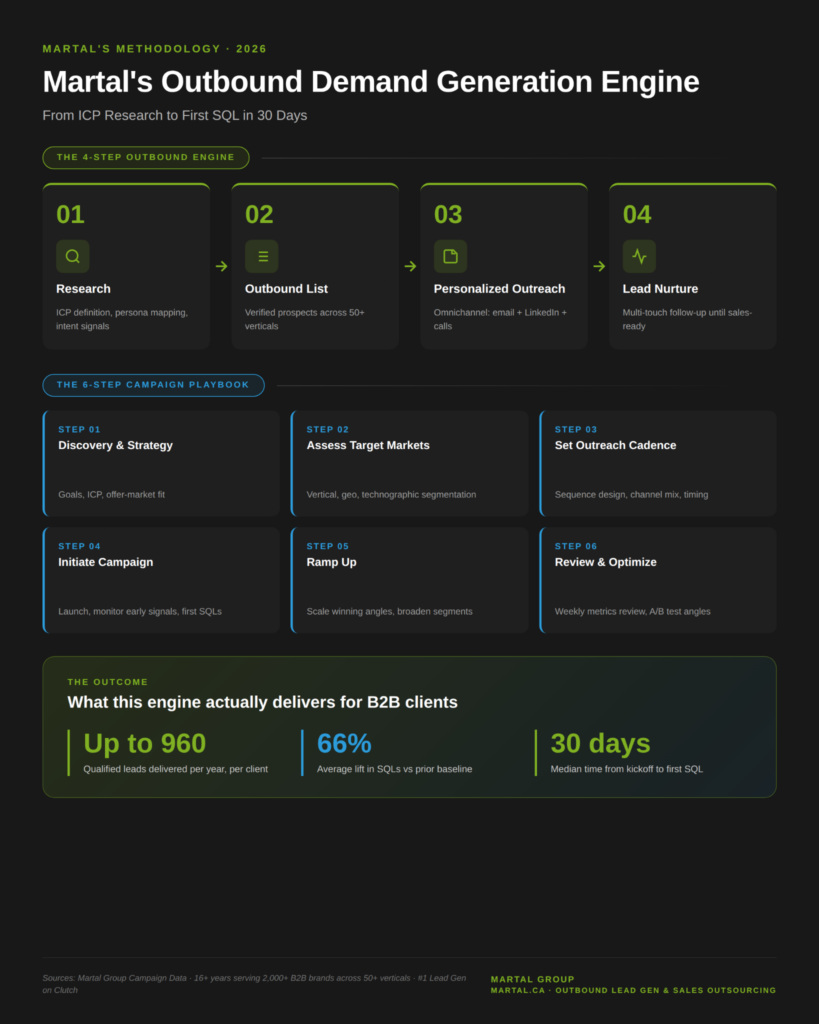
With our strategic approach you can generate up to 960 qualified leads per year, while increasing SQLs by as much as 66%, effectively turning early-stage demand into actionable sales opportunities.
Reference Source: Martal Group
At Martal, we have spent 16+ years refining the demand generation model that produces those outcomes. The system is built around the principles every section of this guide has already pointed to — strong ICP targeting, omnichannel execution, and tight measurement against pipeline. Tailored to each client’s market, sales cycle, and competitive landscape, it has driven growth for clients across 50+ verticals — from cybersecurity SaaS expanding into US enterprise accounts to telecom equipment providers building Tier-1 pipeline in mature, competitive markets.
What Sets Martal’s Demand Generation Apart
- Signal-Driven B2B Prospecting: We use real-time buying intent data — funding announcements, hiring surges, technology adoption signals, content engagement — to focus outreach on prospects already showing interest. Intent-based prospecting drives roughly 2x the conversion of broad-list prospecting in our campaigns
- Technographic Account Based Marketing Campaigns: Our team uses technographic data to build segmented, personalized campaigns that reach ideal buyers based on the technology stack they already operate — and strategically position your solution against competing tools. Technographic targeting consistently delivers up to 4x conversion lift in our client campaigns
- Lunch and Learn Meetings: A signature Martal tactic. We deliver lunch to qualified prospects just before the discovery call — building instant rapport with decision-makers and creating a memorable, convenient first conversation. Lunch and learn meetings produce 3x the conversion of standard discovery calls
- AI + Human Model: Senior onshore Sales Executives — averaging 3–5 years of B2B experience — paired with Martal’s proprietary AI SDR Platform for ICP modeling, intent scoring, message personalization, and continuous campaign optimization. The AI handles the volume work; the humans handle the trust work
- True Omnichannel Orchestration: Coordinated outreach across email, LinkedIn, and phone — running for the same buyer in the same week, not three disconnected vendors firing into the same inbox. The orchestration is what most agencies claim and what almost none actually deliver
- Predictable Onboarding: Documented 7–10 business day onboarding from kickoff to first campaigns live, with first SQLs typically delivered inside 30 days
What This Looks Like in Practice
Demand generation outcomes across different buyer scenarios from the Martal client base:
- US market entry into AI/manufacturing — DeepHow: An AI-powered video learning platform expanding into the US manufacturing sector. Martal generated 20,000 prospects per month and 15 qualified leads per month — opening US enterprise pipeline in a niche category with a high buyer-education burden
- Multi-year partnership in affiliate marketing — Awin: One of the fastest-growing affiliate platforms in the US. Over a 3-year engagement, Martal delivered 1,204 leads, 1,001 MQLs, 100 SQLs, and 74 booked meetings, with the client’s Sales Manager noting Martal “works as an effective extension of our team”
- HR services scale — HALO Recognition: Outbound demand gen and appointment setting for a leading HR recognition provider. Martal generated 9,000 prospects per month with 5 SQLs per month consistently, producing $10M+ in new business opportunities
- Enterprise pipeline in competitive telecom — Forerunner Technologies: Outbound demand gen in a saturated telecom equipment market. Martal generated 7,000 prospects per month with 22 SQLs per month — building consistent pipeline in a category where most outbound goes cold
- AI/SaaS US market entry — Spirit AI: London-based AI trust & safety platform breaking into the US market. Martal delivered 15,000 prospects per month and 35 SQLs per month in a niche category that required deep buyer education
Industry-Specific Demand Generation Expertise
As a full-service demand generation company, we run programs across 50+ B2B verticals. Every program is tailored to the market’s unique buying behavior, sales cycle, and competitive context. Industries with proven Martal demand generation experience:
Industry Cluster
Verticals Covered
Software & Tech
B2B SaaS, Software Development, Information Technology, Web Development & UI/UX
AI & ML
AI/ML Platforms, AI Training Data, Computer Vision, Knowledge Management
Security & Compliance
Cybersecurity, Security & Surveillance, Data Protection
Financial & Insurance
Fintech, Insurtech, Financial Services, Business Brokerage
People & Workplace
HR Tech, HR Services, Consulting, Education & Training
Healthcare
Medical Technology, Healthcare AI, Healthcare Supply Chain
Infrastructure & Industrial
Manufacturing, Logistics, Supply Chain, Transportation, Telecom, MSPs
Energy & Cleantech
Energy, Solar, Cleantech, Property Damage Control
Commerce & Marketplaces
E-commerce, Retail, Marketplaces, Digital Platforms, Digital Marketing Agencies
Cross-industry depth lets us deliver proven demand generation solutions while tailoring execution to each vertical — whether that means navigating long enterprise sales cycles, operating in regulated industries, or scaling growth for fast-moving SaaS companies with the precision of a specialized SaaS demand generation agency.
Expert Insights on The Future Role of Demand Generation Companies
26% of enterprise organizations invest over 70% of their marketing budgets in demand generation programs to prioritize long‑term growth.
Reference Source: Infuse
The most useful way to think about demand generation is that several long-running shifts have all reached the same tipping point in the same year. AI moved from drafting outputs to executing entire workflows. Buying committees expanded faster than most go-to-market models. The MQL-as-primary-metric era ended for any team paying attention to revenue. And generative search began reshaping how B2B buyers find vendors in the first place.
Below are the five trends we are tracking most closely — paired with perspectives from B2B marketing leaders across the industry — and what each shift should change in how you evaluate, brief, and run a demand generation agency.
1. Agentic AI Moves From Drafting to Executing
For the first half of the AI cycle, marketers used AI primarily to generate outputs — ad copy, email drafts, blog summaries. In 2026 the work has shifted toward agentic AI: systems that take autonomous action across multi-step workflows. 61% of B2B teams now use AI for lead scoring — up from 23% in 2024. The bigger shift is happening below the surface, in account selection, message personalization, sequence orchestration, and live campaign optimization. (7)
This shift comes with a parallel obligation around how AI is deployed:
“The role of demand generation companies will likely evolve as B2B business dynamics continue to change. They may need to adapt their strategies to accommodate the growing focus on personalized engagement, integrated omnichannel experiences, and data-driven decision-making. Demand generation companies may integrate artificial intelligence and machine learning capabilities, opening up new opportunities for hyper-targeted and efficient demand generation. These companies will need to stay updated with shifting privacy regulations and cultivate a strong stance towards ethical marketing practices.”
— Diana Stepanova, Operations Director, Monitask
For B2B buyers, the implication is straightforward: the demand gen agencies pulling ahead in 2026 are the ones that have integrated AI into the campaign engine itself — and built privacy-conscious, ethically rigorous frameworks around it — not the ones using ChatGPT to write better cold emails.
2. Signal-Driven Outreach Replaces Volume-Driven Prospecting
Volume is now a negative signal. Sending 100 emails with zero replies hurts deliverability, hurts brand, and hurts pipeline. The 2026 outbound model is built around buying signals — funding announcements, hiring surges, technology adoption, content engagement, third-party intent platforms — used to time outreach to the moment a prospect is most likely to engage.
The data-led shift is exactly what industry leaders have been predicting:
“I foresee their role evolving by placing a greater emphasis on data-driven strategies. Data is becoming increasingly valuable, and demand generation companies are using it to create targeted and personalized marketing campaigns. By analyzing customer data, they gain insights into buyer behavior and preferences, resulting in higher engagement and better returns for businesses. Embracing data-driven strategies is crucial for success in the evolving B2B tech industry.”
— Matias Rodsevich, CEO, PRLab
In Martal campaigns, intent-based prospecting consistently delivers around 2x the conversion of broad-list prospecting — and that gap is widening as intent data quality improves.
3. Marketing-Sourced Pipeline Becomes the Default KPI
For most of the last decade, the MQL was the dominant demand generation metric. In 2026, the metric set has matured. Median pipeline coverage now sits at 3.2× quota across a 240-panel benchmark set, top-quartile programmes run 4.8×, and below 2.5× is leading-indicator distress. The numbers CMOs and CROs are actually tracking are marketing-sourced and marketing-influenced pipeline as a share of revenue — typically 30–40% in healthy B2B programs. (7)
For agency evaluation, this matters concretely. An agency whose reporting still anchors on MQL volume is measuring against a 2018 dashboard. An agency whose reporting anchors on pipeline coverage, marketing-sourced share, and MQL-to-SQL conversion is operating in 2026.
4. Buying Committee Orchestration & Hyper-Personalization
The single-decision-maker B2B sale is functionally dead. A typical enterprise buying committee now includes 13–17 stakeholders, and teams that align around 2–3 buying groups per account see win rates up to 48.5% higher than teams selling to individuals. The implication for demand generation is that personalization at the persona level has overtaken personalization at the contact level. Different roles inside the same target account need different messaging. (13)
This is the direction industry experts have been pointing to for years:
“Looking towards the future, the role of demand generation companies will likely continue to evolve as technology and customer behavior change. Personalization and account-based marketing are becoming increasingly important, and demand generation companies will need to adapt their strategies accordingly.”
— Krittin Kalra, Founder, WriteCream
The evolution of personalization is also moving into more immersive buyer experiences — virtual product demos, AR-assisted walkthroughs, and richer interactive content woven into the buying journey:
“AR and VR integration has the potential to revolutionize the way businesses generate leads by providing an immersive and interactive experience for prospects to connect with. This will assist demand-generating businesses in showcasing their clients’ products and services distinctively and appealingly. AR-powered product demos, for instance, will allow prospects to see how a product works in its environment, delivering a more intimate experience, while VR will take prospects to a virtual environment where they may experience the same product in an inventive way. It will provide useful data and insights into prospects’ interests, requirements, and preferences.”
— Marc Hardgrove, CEO, TheHOTH
The agencies winning here build campaigns at the buying-committee level rather than the contact level — and run outbound integrated with ABM, immersive content, and field motions rather than as parallel programs.
5. Answer Engine Optimization (AEO) Begins Reshaping Discovery
The third major search shift this decade is underway. AI-powered answer engines — ChatGPT, Perplexity, Google AI Overviews, enterprise copilots — are pulling B2B research out of the traditional search results page and into generative answers. According to Gartner, 75% of the B2B buying journey now happens before a prospect ever speaks to sales — and an increasing share of that journey is now mediated by AI answers that cite some vendors and not others. (14)
This changes what demand generation content has to do. SEO for traditional rankings remains important. But being the answer — being the brand that AI engines surface when a buyer asks how to solve a specific problem — is becoming a separate strategic discipline. Most demand gen agencies have not caught up yet. The ones that have are positioning AEO and GEO as core services rather than add-ons.
What These Trends Mean for B2B Teams Evaluating an Agency
The buyer takeaway across all five shifts is simple: the agency you hire today should be operating against the 2026 standard, not catching up to it. Concretely:
- Ask how AI is integrated into their campaign engine — not whether they “use AI”
- Ask which intent data and signals they activate against your ICP
- Ask how they report success — pipeline coverage, marketing-sourced share, and MQL-to-SQL conversion should be on the dashboard
- Ask how they target buying committees versus individual contacts
- Ask whether AEO and GEO are part of their content and visibility strategy
If those questions land flat in the discovery call, the agency is still on a 2022 playbook. The agencies in the list earlier in this guide are the partners genuinely operating in the new model.
Transform Your Sales with a Leading Demand Generation Agency in 2026
The single biggest variable in whether a demand generation agency actually moves your pipeline is fit — fit between the agency’s model and your demand stage, fit between their channels and your buyers’ behavior, fit between their reporting and the metrics your CFO is asking about. The rest is execution.
For B2B teams whose pipeline depends on outbound — building qualified pipeline in target accounts, in target markets, against named buying committees, in 30 days rather than six months — Martal is built for that motion. We run signal-driven omnichannel demand generation as a managed service: senior onshore Sales Executives paired with our proprietary AI Sales Platform, coordinating cold email, cold calling, and LinkedIn lead generation as a single connected campaign rather than three disconnected channels. Onboarding takes 7–10 business days. First SQLs land inside 30 days. Reporting is anchored on pipeline coverage and SQLs converted, not impressions and form fills.
Trusted by 2,000+ B2B brands across 50+ verticals, ranked #1 in Lead Generation on Clutch, and backed by 200+ five-star reviews — the proof is in 16+ years of campaigns we have run before yours.
If you are evaluating demand generation agencies right now and want to see what a strong pipeline actually looks like for your business, book a consultation with Martal. We will walk through your ICP, sales cycle, and growth targets — and give you a clear view of what an omnichannel demand generation program would deliver, including specific outcomes from clients with similar profiles to yours. Honest conversation, no pressure. We will also tell you if we are not the right fit and where you should look instead.
References
- 99firms
- SQ Magazine
- Invesp
- Only-B2B
- IDC
- Upraw Media
- Digital Applied Team
- Factors.ai
- ZioAdvertising
- PhantomBuster
- GrowthSpree
- Latinpresarios
- Demandbase
- A88lab
FAQs: Demand Generation Agency
What are the most effective demand generation tactics in 2026?
The most effective demand generation tactics in 2026 combine inbound and outbound motions across coordinated channels — not in isolation. The core tactics that consistently drive pipeline include intent-based outbound (cold email, LinkedIn outreach, cold calling against real buying signals), account-based marketing for named-account TAM, content marketing and SEO/AEO for compounding inbound demand, paid media on LinkedIn and Google for demand capture, lead nurturing sequences and email drip campaigns for mid-funnel conversion, and webinars and field marketing for high-trust enterprise plays. The pattern that wins is signal-driven and omnichannel — coordinating channels for the same buyer in the same week — rather than running parallel campaigns in isolation.
How long does it take to see results from a demand generation agency?
It depends on whether the agency is running demand capture (which produces faster signal) or demand creation (which compounds over months). With a strong outbound demand generation partner, the typical pattern is onboarding in 7–30 days, first MQLs within 14–20 days, and first SQLs inside 30 days. Inbound, content, and SEO-led demand generation usually takes 6–12 months before pipeline begins to compound, with full impact at 12–18 months. Any agency promising significant pipeline in the first month from inbound or content is either misrepresenting demand creation as lead gen, or building a program that won’t sustain. The pattern across credible demand generation engagements: 90 days for first proof, six months for direction, twelve months for compounding return.
What is the difference between a demand generation agency and a digital marketing agency?
A digital marketing agency is focused on traffic, brand visibility, and channel-specific execution — SEO, paid search, paid social, web design — measured on channel metrics like impressions, clicks, and cost-per-click. A demand generation agency is focused on the full system that creates and captures pipeline — ICP development, signal-driven outbound, content, paid, and ABM all working together — measured on marketing-sourced pipeline, MQL-to-SQL conversion, and revenue impact. The cleanest test in a sales call: ask how the agency reports success. If the answer stops at impressions or MQL volume, you’re talking to a digital marketing or lead gen agency. If the answer connects activity to pipeline and revenue, you’re talking to a real demand generation agency.
How do you measure demand generation success in 2026?
The 2026 demand generation dashboard is anchored on three numbers: pipeline coverage (the multiple of next-quarter quota sitting in qualified pipeline — median 3.2× across B2B benchmarks, top-quartile 4.8×), marketing-sourced revenue (typically 30–40% of closed-won revenue in healthy programs), and MQL-to-SQL conversion rate (median 13%, top decile 31%). Secondary metrics include cost-per-qualified-meeting, sales cycle length, win rate by source, and pipeline velocity. The metrics that no longer carry weight on their own: MQL volume, impressions, and click-through rates. These are inputs, not outcomes. Any agency anchoring success reporting on those inputs alone is measuring against an outdated standard.
Can small B2B companies benefit from demand generation, or is it only for enterprise?
Demand generation is not enterprise-only. Small and mid-market B2B companies often benefit more from outsourced demand generation than enterprises do — because building the same capability internally (three to five experienced SDRs, sales operations, content, and tooling) typically costs $300K–$500K fully loaded per year. A fractional or managed demand gen program ramps in 30 days at a fraction of that cost. The fit question is rarely company size — it’s TAM shape, ACV, and how dependent the business is on outbound versus inbound. SMB B2B companies in fast-moving SaaS, cybersecurity, manufacturing, and fintech are running serious demand generation programs; the agencies that fit those programs are usually different from the ones serving enterprise.
Should I hire a demand generation agency or build a team in-house?
The honest answer depends on three factors: speed to pipeline, internal expertise, and budget. Outsourced demand gen typically delivers first SQLs in 30 days; in-house teams take 6–12 months to ramp. A fully loaded in-house SDR team — three to five reps, a strategist, sales operations, and AI tooling — runs $300K–$500K per year. A managed program delivers the same capability at a fraction of that cost. The strongest in-house case is when your team has senior demand gen leadership, your buyers are highly specialized, and the program needs deep product expertise rep-by-rep. The strongest outsourcing case is when speed matters, expertise is hard to hire, or budget can’t support a full team. Most B2B teams end up with a hybrid — agency for outbound, internal for content and brand.
