
 Martal
 Technology
 Education and training
 Web Development and UI / UX
 Healthcare/Medical
 Logistics and Supply Chain
 Information Technology
 Insuretech and Financial Services
 Marketplaces
 Software Development
 E-commerce and retail
 AI and Machine Learning
 Energy and Solar
 Manufacturing
 Security and Surveillance
 Digital Marketing Agency
 Transportation
 MSP
MSP
 Telecom
 B2B SaaS
 Cybersecurity
 HR tech
 Fintech
 Cleantech
 Consulting
MQL vs SQL in 2026: How to Qualify B2B Leads and Fill Your Pipeline
Major Takeaways: MQL vs SQL
An MQL (Marketing Qualified Lead) confirms ICP fit and meaningful engagement — a prospect who has responded to outreach or interacted with your marketing but hasn’t yet been vetted by sales. An SQL (Sales Qualified Lead) has been qualified through a direct conversation, with confirmed need and authority. The handoff between the two is where most B2B pipeline is built or lost.
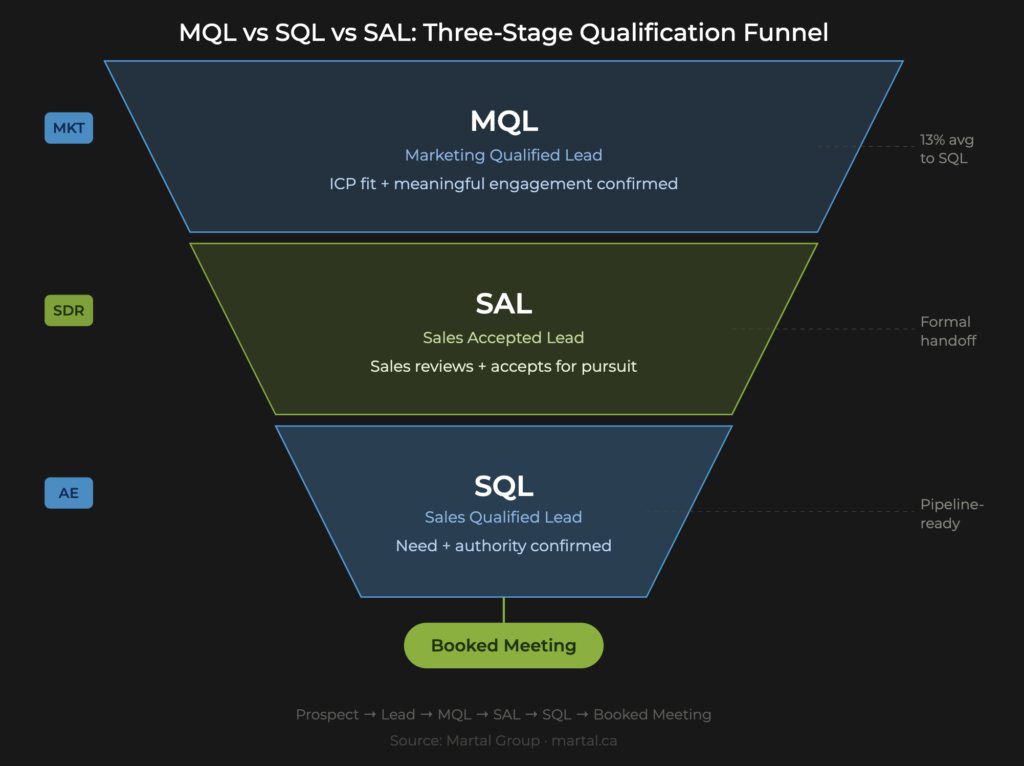
A Sales Accepted Lead (SAL) sits between MQL and SQL — it’s an MQL that sales has formally reviewed and accepted as worth pursuing before the qualification conversation begins. The full progression is: Prospect → Lead → MQL → SAL → SQL → Booked Meeting. Not every team uses SAL as a distinct stage, but in structured revenue teams with an SDR-to-AE handoff, it adds a critical accountability layer.
Misaligned teams can lose up to 60% of leads and cost B2B companies 10% or more of annual revenue. Aligned teams achieve 24% faster revenue growth, 36% higher customer retention, and are 67% more effective at closing deals. Shared MQL/SQL definitions and joint pipeline metrics are the foundation — without them, both teams optimize for conflicting outcomes.
The industry average is 13% across B2B. Top-performing B2B SaaS teams using behavioral qualification models reach 39–40%. A rate below 10% signals loose MQL criteria, slow follow-up, or an inconsistent qualification framework. Improving the MQL→SQL stage by just 5 percentage points can lift revenue by up to 18%.
In outbound, MQLs are prospects who responded to deliberate targeting — which means ICP fit is largely pre-confirmed. Qualification then focuses on need and authority rather than basic fit screening. This gives outbound-generated MQLs the potential to convert at higher rates than inbound, provided the qualification conversation is fast, disciplined, and anchored to the right criteria.
Speed. Companies that follow up with MQLs within the first hour achieve a 53% SQL conversion rate — compared to just 17% for follow-ups made after 24 hours. Intent is highest at the moment of engagement. Every hour of delay gives a competitor an opening. A two-hour SLA for SDR follow-up on high-intent MQLs is one of the most actionable benchmarks in B2B sales.
Coordinated outreach across cold email, cold calling, and LinkedIn — working in sequence, not in parallel — drives 4–10x more responses than single-channel approaches. Prospects engaged across three or more coordinated channels are significantly more likely to advance to SQL. The key is sequencing: each touch reinforces the others, so the prospect experiences one coherent outreach motion rather than three disconnected attempts.
AI-powered platforms like Martal’s AI Sales Platform surface 10M+ real-time intent signals — funding announcements, hiring surges, technology changes — and score prospects automatically by likelihood to convert. Intent-based targeting delivers 2x higher conversion rates; layering in technographic signals delivers 4x. AI doesn’t replace the qualification conversation — it identifies which MQLs are worth having it with first.
Introduction
The MQL vs SQL debate has been rehashed in every B2B marketing blog for the past decade. Most of those articles say the same thing: MQLs come from marketing, SQLs come from sales, and alignment between the two is important.
That’s true. It’s also incomplete.
What most guides skip is the operational reality, what actually happens between a prospect responding to an email and a rep walking into a discovery call. That middle ground is where pipeline is built or lost, and it’s where Martal’s teams work every day as an outsourced sales partner for B2B companies across North America, Europe, and LATAM.
In the sections below, we cover the definitions and key differences between MQLs and SQLs, how they map to an evolving B2B funnel, and what actually moves leads from one stage to the next. We also address the MQL vs SQL vs SAL distinction that most teams overlook and the conversion rate benchmarks worth tracking in 2026.
Where we draw on external research, we’ve pulled from recent industry data and speak from operational experience about qualification, outbound execution, and pipeline handoffs.
MQL vs SQL: Definitions and Key Differences
61% of B2B marketers send every lead directly to sales, yet only 27% of those are actually qualified.
Reference Source: LXA Hub
What is the difference between MQL and SQL? In simple terms, a Marketing Qualified Lead (MQL) is a lead that has shown some engagement or fit indicating potential interest – often identified by marketing’s efforts – but isn’t yet ready for direct sales contact.
A Sales Qualified Lead (SQL) is a lead that sales has validated as ready for next steps (a meeting, a demo, a proposal). The distinction can vary across organizations, but the core idea is that an SQL is further along the funnel and closer to purchase intent than an MQL.
Getting this definition right inside your organization matters more than most teams realize. Only about 50% of companies have a formal, shared definition of a “qualified lead” that both marketing and sales accept. Without it, marketing labels too many contacts as MQLs and sends them to sales and sales rejects a large portion as unqualified noise.
In fact, 61% of B2B marketers still send every lead directly to sales, but only 27% of those leads are actually qualified (3). This shotgun approach overwhelms sales reps with noise, causing frustration and wasted effort.
Our view at Martal: a lead earns MQL status only once it matches our Ideal Customer Profile and has meaningfully engaged — responded to outreach, clicked through on a relevant offer, or shown a pattern of interest that goes beyond a single open. It’s not just a name on a lead list.
From there, an SQL is an MQL that one of our Sales Executives has contacted and qualified, confirming genuine interest, need, and the authority to move a conversation forward. Only at that point does the lead move to a discovery call or account executive.
Comparison of MQL vs SQL
To illustrate the differences between an MQL and SQL, let’s compare some common attributes:
Aspect
Marketing Qualified Lead (MQL)
Sales Qualified Lead (SQL)
Engagement Level
– Engaged with marketing activities
– Downloaded content, responded to outreach, or visited the website multiple times
– Shows interest, but buying intent not confirmed
– Shown stronger intent
– Requested a demo, answered qualifying questions, or agreed to speak with sales
– Indicates clear signs of need or intent
Qualification Criteria
– Meets targeting criteria (industry, role, company size)
– Scores high via lead scoring (email clicks, webinar attendance, etc.)
– Qualified by marketing
– Validated by sales via SDR/BDR call or research
– Qualified using predetermined metrics and signals
– Considered a real opportunity by sales
Nurture Stage
– Mid-funnel
– Needs more education and nurturing
– Marketing continues to build interest
– Not yet ready for one-on-one conversations
– Late-funnel
– Ready for direct engagement
– Sales initiates discovery or demo
– Focus shifts to fit and closing
Ownership
– Primarily owned by marketing
– Marketing monitors and nurtures lead
– SDRs may handle early outreach if outbound, still under marketing
– Owned by the sales team (SDRs/AEs)
– Sales leads opportunity management
– Marketing may support with sales collateral but sales drives next steps
Example Scenario
– IT Director downloads an eBook and engages with emails
– Fits ICP, flagged as MQL
– Aware of solution but hasn’t had a conversation with sales
– SDR discovers director wants a demo and is a decision-maker
– Project timeline is verified
– Lead is upgraded to SQL and handed off for a meeting
Where Does an SAL Fit? MQL vs SQL vs SAL
Most guides stop at MQL and SQL. A third stage, the Sales Accepted Lead (SAL), sits between them and is worth understanding, especially in teams where marketing passes leads to an SDR layer before they reach a senior sales rep.
An SAL is an MQL that sales has formally reviewed and accepted as worth pursuing, but hasn’t yet been fully qualified through a conversation. Think of it as the checkpoint between “marketing says this looks promising” and “sales confirms this is worth my time.”
The progression looks like this:
Prospect → Lead → MQL → SAL → SQL → Booked Meeting
- MQL: Engagement and ICP fit confirmed by marketing or SDR initial outreach
- SAL: Sales reviews the MQL and accepts it as worth pursuing — criteria met, context reviewed
- SQL: Sales Executive has spoken with the lead, confirmed need and authority, and determined the opportunity is real
Not every organization uses SAL as a formal stage. For teams running a tight outbound model — where SDRs qualify and pass directly to account executives — MQL and SQL may be sufficient. But in larger or more structured revenue teams, SAL provides a useful accountability layer that prevents unqualified MQLs from landing on senior reps’ calendars.
Pro Tip: HubSpot’s former CMO Mike Volpe coined “SMarketing” to describe the blending of Sales and Marketing into one revenue team. When both functions share a common definition of MQL, SAL, and SQL — and joint accountability for conversion between stages — the classic “your leads are junk” vs “sales isn’t following up” dynamic disappears quickly.
Drafting a simple SLA or shared criteria document is the first practical step. For example: “MQL = VP or Director-level contact who engaged with at least two touchpoints and fits our ICP. SAL = MQL reviewed and accepted by the SDR team within 24 hours. SQL = MQL with confirmed need and authority following a qualifying conversation.”
The exact criteria will vary. The act of defining them together — and writing them down — is what actually changes behavior.
The MQL-to-SQL Funnel: Mapping the Journey
68% of B2B organizations haven’t clearly defined their funnel stages.
Reference Source: Marketing Sherpa
Think of the path from MQL to SQL as a critical segment of your B2B sales funnel. In a traditional funnel model, you have stages like: Lead → MQL → SQL → Opportunity → Customer (1). MQL and SQL are the middle stages where a lead is moving from marketing’s world into the sales realm.
That transition has always mattered. In 2025, it matters more, because the funnel itself has changed around it.
Today’s B2B buyer doesn’t move linearly through your funnel. They research independently, involve multiple stakeholders, and often engage with competitors simultaneously. The average sales cycle has lengthened as more B2B decision-makers get pulled into the process. By the time a prospect becomes an MQL, they may already be well-educated — which is useful — but they’re also evaluating you against alternatives and expecting a frictionless experience.
The practical implication: the MQL-to-SQL handoff can no longer be a slow, bureaucratic process. It needs to be fast, context-rich, and disciplined.
Why Most Funnels Leak Here
68% of B2B organizations have not clearly identified their funnel stages (2). When there’s no shared definition of what makes something an MQL — and no agreed criteria for what triggers an upgrade to SQL — leads slip through the cracks between teams.
The downstream effect is significant. Research found 79% of marketing leads never convert to sales, often due to lack of nurture or proper follow-up (2). That’s not a sales problem or a marketing problem in isolation — it’s a handoff problem. Marketing sends leads over the wall; sales ignores what they see as unqualified inquiries; qualified prospects quietly disengage.
One useful reference point from Gartner Digital Markets (9) shows how a structured funnel typically maps the progression:
- MQL — Engages with content, showing initial interest
- SAL — Requests a demo or signals stronger readiness, reviewed and accepted by sales
- SQL — Confirms purchase intent and authority following a qualifying conversation
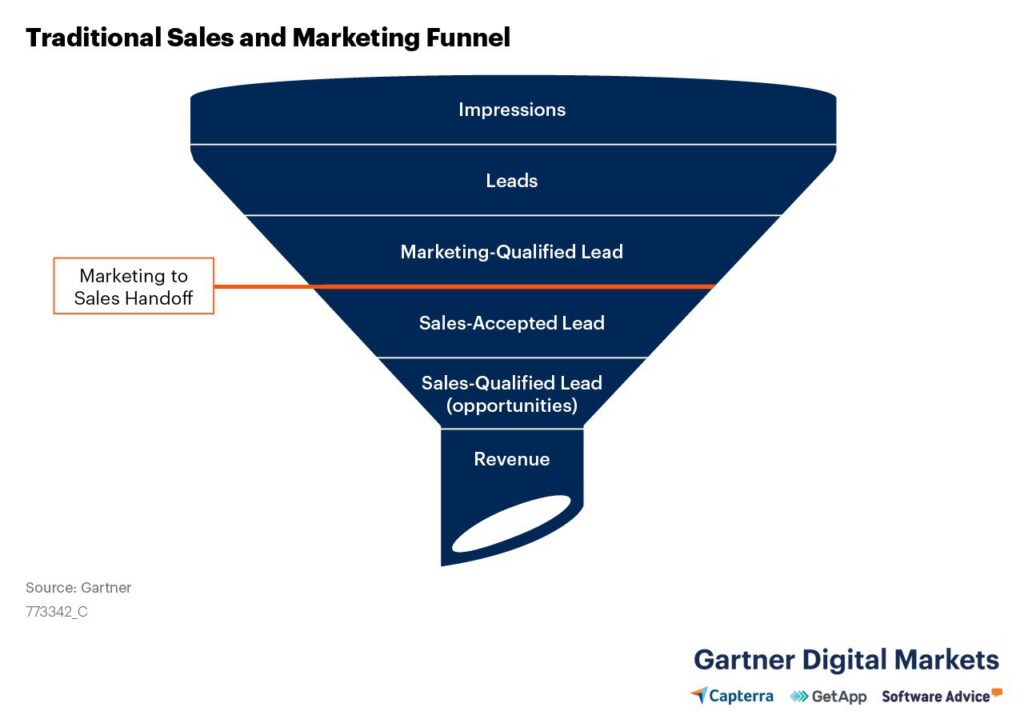
Source: Gartner Digital Markets
This structured progression — and the discipline to maintain it — is what separates teams with healthy pipelines from those constantly chasing unqualified contacts.
Three Fundamentals for a Tighter Funnel
Define entry and exit criteria for every stage
The most common friction point in the MQL-to-SQL funnel comes down to one question teams can never quite agree on: “How do you know when a lead is ready to be handed off to sales?” The answer isn’t instinct — it’s a written definition both teams agreed on before the first lead was ever passed.
Know precisely what makes a lead an MQL, what triggers an upgrade to SAL, and what qualifies as an SQL. Without written criteria, both teams default to instinct — and instinct varies by rep.
Also define what happens to leads that don’t advance. Do they re-enter a nurture sequence? How long before a follow-up attempt? A loop for unready leads ensures you don’t permanently lose warm prospects who simply aren’t ready yet.
Build qualification workflows around ICP fit and engagement signals
The most reliable qualification systems don’t rely on guesswork. They track meaningful engagement signals — key page visits, content interactions, outreach responses — alongside ICP fit criteria like role, company size, and industry. When a prospect consistently demonstrates both fit and intent, that’s when a Sales Executive steps in to qualify through a conversation.
What we look for at Martal: has this person responded to outreach? Do they match our client’s ICP? Do they have the authority to move a conversation forward? Those three questions drive the MQL-to-SQL transition more reliably than any point-based system.
Accelerate the handoff — speed is a competitive advantage
One of the most consistent findings in B2B sales research is that speed to follow-up drives disproportionate results. Companies that follow up with leads within the first hour report a 53% conversion rate, compared to just 17% for follow-ups made after 24 hours (7).
That gap is significant. When a prospect engages — responds to an email, clicks through on an offer, requests more information — they are at peak interest. Every hour of delay is an hour your competitor has to step in.
In practice, this means setting clear SLAs for SDR follow-up on new MQLs (a two-hour response window is a strong target for high-intent signals), using automated alerts to notify the right rep in real time, and running a daily review of new MQLs between marketing and SDR leads.
The MQL-to-SQL funnel isn’t linear or perfectly tidy in real campaigns. But having structured stages, written criteria, and fast handoffs gives both teams a common language — and a way to measure where conversion breaks down so they can fix it systematically.
Aligning Marketing and Outbound Sales Teams to Win Together
Misaligned sales and marketing teams can cost companies 10% or more of annual revenue.
Reference Source: LXA Hub
True alignment between marketing and outbound sales isn’t a culture initiative — it’s a revenue lever. The cost of misalignment is well documented: failure to coordinate sales and marketing around the right processes can cost B2B companies 10% or more of annual revenue, and globally, businesses lose an estimated $1 trillion per year from poor sales-marketing coordination (3).
The flip side is equally compelling. Tightly aligned organizations achieve up to 24% faster three-year revenue growth, 27% faster profit growth, and are significantly more likely to hit revenue targets (3).
The strategies below are ones we’ve seen work, both in how Martal structures our own outbound sales teams and in how we help clients align their internal marketing and sales functions around a shared pipeline.
- Start with Shared Definitions and Joint Sales KPIs
A question that surfaces more often than you’d expect in sales-marketing alignment conversations: “Why do you have MQL and SQL at all?” The honest answer is that without a structured handoff point, there’s no agreed moment where marketing’s job ends and sales’ begins, and that ambiguity is where pipeline leaks.
Alignment begins with language. If marketing defines an MQL one way and sales defines it another, every conversation about lead quality becomes a negotiation rather than a diagnosis.
The fix isn’t complicated — it’s just rarely done. Agree on what constitutes a lead, MQL, SAL, and SQL. Then go further: set shared goals that make both teams accountable for the same outcomes. Rather than marketing optimizing solely for MQL volume and sales optimizing solely for deals closed, build a joint metric — pipeline generated, MQL-to-SQL conversion rate, or qualified meetings delivered — that both teams own.
When we align our success metrics with client sales teams at Martal, we anchor on qualified meetings delivered and conversion to opportunities. That shared accountability changes the dynamic quickly — both sides row in the same direction rather than optimizing for conflicting outputs. - IBuild a Feedback Loop That Actually Closes
Alignment isn’t “set and forget.” It requires ongoing communication. We recommend weekly reviews between marketing and SDR leads — not to report numbers, but to examine specific cases.
Which MQLs were accepted last week? Which were rejected, and why? If a pattern of “wrong target” rejections emerges, marketing needs to tighten ICP criteria or adjust campaign targeting. If SDRs aren’t following up on accepted leads promptly, that’s a different problem requiring a different fix.
The most effective feedback loops we’ve seen use a simple disposition model: every MQL gets classified — Accepted as SQL, Rejected — Not ICP, Rejected — No response, Nurture — interested but later. Review those dispositions monthly. They tell you exactly where the funnel is breaking.
Research suggests only 8% of businesses report strong sales-marketing alignment today (4). The teams that get into that group aren’t doing anything exotic — they’re communicating consistently and iterating together on the data they already have. - Unify Your Data Around the Pipeline
A common structural barrier to alignment is disparate systems. Marketing lives in a campaign platform; sales lives in a pipeline tool; the two don’t share data in real time. The result is two teams making decisions based on different pictures of the same prospect.
In 2026, there’s no excuse for this. 96% of companies that report strong alignment also report being aligned in their use of sales and marketing technology (3). Shared data isn’t a nice-to-have, it’s foundational to shared strategy.
At Martal, our Sales Executives and Sales Operations Managers work from a live campaign progression sheet that gives clients real-time visibility into every MQL and SQL — what stage they’re at, what engagement history they have, and how close they are to a conversion. Marketing and sales work from the same data, which means conversations about pipeline quality are grounded in facts rather than anecdote.
Make sure your SDRs can see a prospect’s full engagement history before they make a call, and that marketing sees sales outcomes in near real time. A single view of the prospect journey is the infrastructure alignment is built on. - Collaborate on Content and Messaging
Outbound sales teams need relevant, timely content to support qualification conversations like case studies, sales pitch frameworks, specific objection responses. Marketing produces much of this, but often without enough input from the reps who actually use it.
Research shows 65% of sales reps say they can’t find useful content to send prospects (8), while marketing often feels their content is underused. Bridging this gap is straightforward: SDRs should flag which content generates responses, and marketing should treat those signals as direction for what to produce next.
The downstream impact is real. 47% of larger purchases are attributed to nurtured leads who received relevant content throughout the journey (4), nurturing isn’t exclusively a marketing function. Sales contributes by surfacing the right information at the right point in a qualification conversation. - Align Incentives Around Shared Outcomes
Cultural alignment follows the incentive structure. If marketing bonuses are tied solely to MQL volume, the team will optimize for volume — even when quality suffers. If SDRs are compensated only on SQLs they accept, they may disqualify aggressively to protect their numbers.
The more effective model ties a portion of each team’s success metrics to shared pipeline outcomes. When marketing has skin in pipeline generation — not just lead volume — and when sales has some accountability for MQL follow-up SLAs, the language shifts fast. We’ve seen it with clients: “your leads” and “my leads” becomes “our pipeline” almost immediately.
The result shows up in the data. Companies with tightly aligned sales and marketing functions achieve 36% higher customer retention and are 67% more effective at closing deals relative to misaligned peers (3). That’s not marginal — that’s structural advantage.
Turning MQLs into SQLs (Lessons from the Field)
27% of sales reps’ time is spent qualifying leads that should have already been filtered by marketing.
Reference Source: LXA Hub
How Outbound Changes the MQL Equation
The question we hear most from outbound teams: “How do you move MQLs into SQLs with confidence, not just guesswork?” The short answer is targeting. When you control who you’re reaching out to from the start, the qualification conversation becomes about confirming interest and authority, not about figuring out whether the person should even be in your funnel.
Outbound lead generation changes the MQL-to-SQL dynamic in one important way: you control the targeting from the start.
In inbound, MQLs arrive through your content and campaigns — a mix of well-fit and poorly-fit prospects that marketing then has to sort. In outbound, your prospecting is deliberate. You chose those accounts. You defined the ICP. The prospects who respond to your outreach have already cleared a basic fit threshold simply by being in your target universe.
That means outbound MQLs — prospects who respond to a cold email sequence, a LinkedIn message, or a call — can, in theory, convert to SQL at a higher rate than inbound MQLs. The qualification work then centers not on fit (which you’ve largely pre-confirmed through targeting) but on interest, need, and authority.
This is where a disciplined qualification conversation matters. When a prospect responds positively to outreach, the SDR’s job is to move quickly — engage the person, understand their situation, and confirm whether the opportunity is real. The questions that matter: Do they have a genuine need we can address? Do they have the authority to advance a conversation, or can they connect us to the right person?
If both answers are yes, that’s an SQL. If need is present but authority isn’t confirmed, that’s a warm MQL worth nurturing. If neither is clear, it’s an outbound prospecting contact to revisit later — not a lead to push forward prematurely.
The Forerunner Case Study: What a Tight Qualification Process Looks Like
One engagement that illustrates this well is our work with Forerunner Technologies, a telecom company targeting a specific segment of the enterprise market.
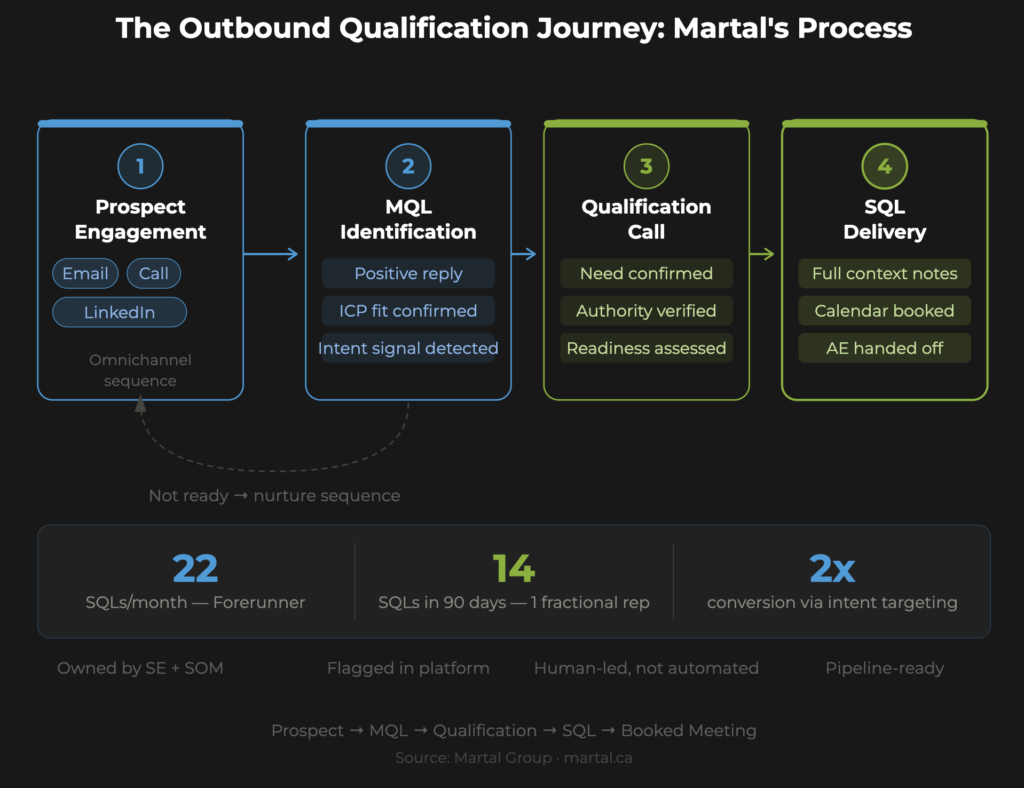
Over the course of the engagement, Martal engaged approximately 7,000 targeted prospects per month through a coordinated omnichannel outreach strategy — cold email, LinkedIn, and phone working in sequence, not in parallel. Out of that volume, we consistently delivered around 22 Sales Qualified Leads per month to Forerunner’s internal sales team.
Those SQLs weren’t just warm contacts. Each one had been engaged, qualified by a Martal Sales Executive, and confirmed as a genuine opportunity before being handed off. Here’s how the process worked:
Joint ICP definition before a single outreach goes out
Before the first email was sent, Martal worked with Forerunner to define exactly what a qualified opportunity looked like — firmographics, role seniority, and the specific operational problem their solution addressed. That clarity meant our outreach messaging was precise, and our qualification criteria were unambiguous.
A positive response only counted if it met the agreed ICP profile. Engagement for its own sake wasn’t the goal.
Omnichannel outreach to maximize contact rates
Prospects were engaged across email, LinkedIn, and phone in a coordinated sequence. An executive who didn’t respond to email might reply on LinkedIn; someone who ignored a LinkedIn message might take a call. By orchestrating all three channels in sequence — not running them independently — we increased contact rates meaningfully and generated consistent weekly engagement.
When a prospect responded positively or signaled intent (clicking a key link, requesting more information), they were flagged as a potential MQL and moved to direct qualification.
Human qualification on top of every positive signal
This step is where outbound MQLs either become SQLs or get recycled — and it’s where the discipline matters most.
A reply saying “sure, send me some information” is not an SQL. It’s an MQL signal. Our Sales Executives followed up every positive response with a qualification conversation — phone where possible, email where necessary — to understand the prospect’s situation, confirm their need, and verify their authority to evaluate a solution.
Through that conversation, we’d confirm whether the prospect’s company was genuinely evaluating options (strong SQL signal), or was simply curious with no real near-term intent (MQL to nurture). Only the former moved forward.
A handoff with full context, not just a name
Once a prospect was confirmed as an SQL, Martal didn’t simply make an introduction and move on. We scheduled appointments directly on Forerunner’s account executives’ calendars and provided detailed qualification notes — what the prospect said their problem was, what their timeline looked like, what they’d engaged with — so the rep arrived informed and ready.
That context made sales conversations more productive from the first minute and increased the likelihood of a positive outcome.
A Second Data Point: Speed and Precision at Smaller Scale
The Forerunner engagement demonstrates what this process looks like at volume. A different engagement — a 3-month pilot with a supply chain software company using a single fractional Sales Executive — shows it works at tighter scale too.
In that pilot, Martal delivered 14 Sales Qualified Leads in 90 days with one rep working a precisely defined ICP. The volume was lower, but the qualification standard was identical: every SQL had confirmed need and authority before it was passed to the client’s sales team. That precision meant the client’s senior reps spent their time on real opportunities rather than early-stage exploratory calls.
The common thread in both cases: outbound, when built around a disciplined ICP and a genuine qualification conversation rather than a volume target, produces SQLs that hold up under sales scrutiny.
Three Quick Principles for Your Own Outbound Qualification
Personalize outreach and qualification conversations
Generic outreach generates surface-level responses — and surface-level responses rarely become SQLs. We use personalized messaging that references a prospect’s specific context (their industry, a relevant challenge, a recent development in their market) to generate higher initial engagement.
In the qualification conversation itself, that personalization continues: “I noticed you engaged with our content on pipeline quality — is that a current focus for your team?” Personalization signals that you’ve done your homework, which builds the trust that makes qualification conversations more productive.
Use intent and trigger signals to prioritize who to qualify
Not all MQLs deserve the same urgency. A prospect who responded to outreach and whose company has recently raised funding, expanded headcount, or changed their tech stack is signaling readiness in multiple ways simultaneously.
Martal’s AI SDR Platform surfaces exactly these signals — tracking funding announcements, hiring surges, technology changes, and other buying triggers — so our Sales Executives prioritize qualification conversations with the prospects most likely to be in an active buying window. Intent-based targeting delivers 2x higher conversion rates compared to standard outbound approaches (5). Reaching buyers when something has just changed in their world is the difference between a timely conversation and a missed opportunity.
Be willing to disqualify — and have a path for leads that aren’t ready yet
One of the most underrated outbound skills is the willingness to disqualify cleanly. Pushing an unready prospect through to SQL inflates your pipeline with noise and wastes senior sales time on calls that go nowhere.
If a prospect isn’t ready, say so — to yourself and to the prospect. Put them in a structured nurture path with a specific follow-up trigger (a time-based check-in, a relevant content touch, a market update). We’ve had prospects come back as SQLs six months after an initial “not right now” — because we maintained a light, relevant presence rather than either pushing hard or disappearing.
Think of qualification as an ongoing process, not a binary decision. The sales-ready leads you need are often the same prospects who said no three months ago — at a different moment, with a different set of priorities.
Improving the MQL-to-SQL Conversion Rate: Strategies for 2026
A strong MQL-to-SQL conversion rate is typically 13%. Higher rates signal better lead quality and sales alignment.
Reference Source: DashThis
What is a “good” MQL-to-SQL conversion rate? It’s a common question – and the answer depends on your industry and definition strictness.
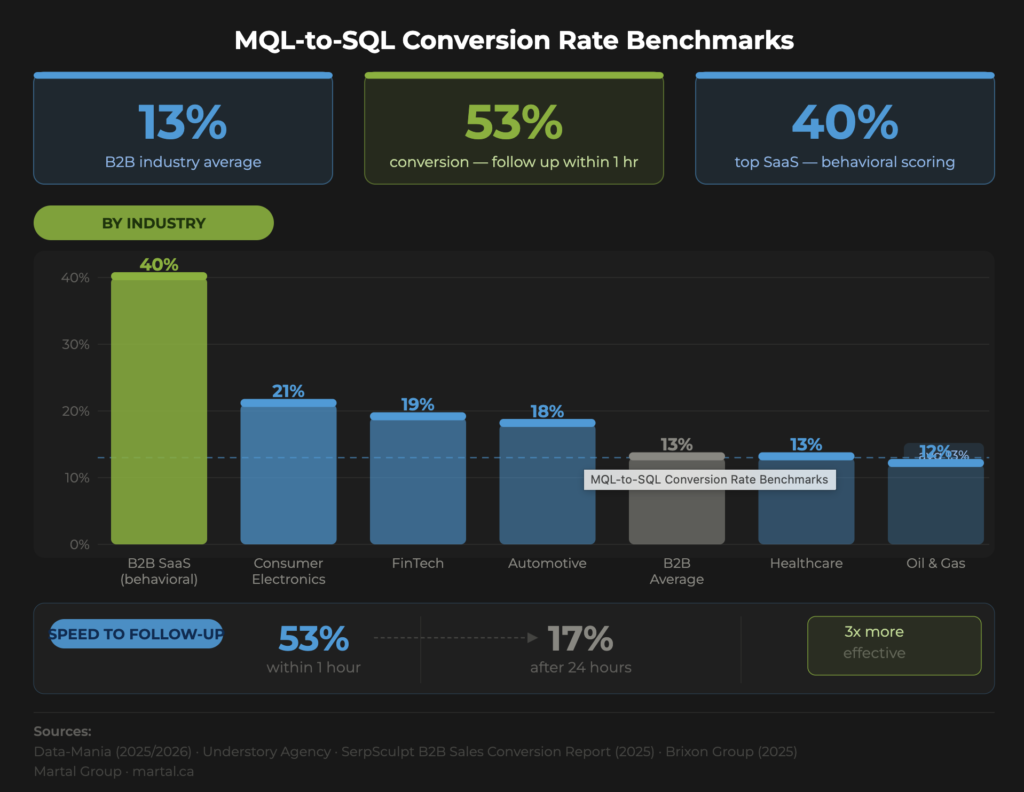
The 13% average MQL-to-SQL conversion rate has held relatively steady across recent benchmarks — but the range tells a more useful story. Current data shows conversion rates varying from 12% in longer-cycle industries like healthcare and oil & gas, up to 19–21% in fintech and consumer electronics, and as high as 39–40% for B2B SaaS teams using behavioral qualification models rather than basic demographic criteria (6).
B2B teams generally convert at lower rates than B2C (13–15% vs 18–22%) — a reflection of longer buying committees and higher average contract values, not a flaw in the process. The goal isn’t to match B2C velocity. It’s to qualify more precisely so that the SQLs you do produce actually close.
If your current rate is well below 10%, the issue is usually one of three things: MQL criteria are too loose (too many poorly-fit contacts reaching the SQL stage), follow-up is too slow, or qualification conversations lack a consistent framework. If your rate is above 25%, consider whether MQL criteria are too restrictive — you may be under-utilizing your pipeline.
The seven strategies below address the most common conversion bottlenecks we see across outbound campaigns.
1. Qualify on Authority and Need — Then Layer in Intelligence
The most reliable path from MQL to SQL starts with two questions: Does this person have a genuine need we can address? Do they have the authority to advance a conversation?
Those two criteria — need and authority — are the foundation of a sound qualification conversation. Everything else (budget, timeline, technical fit) matters eventually, but confirming need and authority first tells you whether a conversation is worth having at all.
From there, intelligent signal data sharpens the prioritization. Martal’s AI SDR Platform tracks 10M+ real-time intent signals — funding announcements, hiring surges, technology changes, content engagement — and scores prospects automatically based on likelihood to convert. When a prospect matches your ICP and their company is showing active buying signals, that combination identifies the MQLs most worth qualifying first.
This approach delivers 2x higher conversion rates compared to standard outbound targeting, and 4x higher conversion when technographic signals are layered in (5). The intelligence doesn’t replace the qualification conversation — it tells you who to have it with first.
2. Shorten the feedback cycle on lead quality
The fastest way to improve MQL-to-SQL conversion over time is to treat every rejected MQL as a data point.
One of the most common complaints in B2B revenue teams: “If your sales team keeps saying ‘these leads aren’t ready,’ what do you do?” The answer isn’t to send fewer leads — it’s to build a feedback loop that tells you exactly why they’re not ready. A simple disposition model — Accepted, Rejected (Not ICP), Rejected (No response), Nurture — reviewed monthly, closes that gap faster than any tool change will.
Research indicates that 56% of B2B sales organizations lack a formal method for verifying leads before passing them to sales — meaning roughly half of all sales teams are working without a consistent qualification standard. The cost shows up in wasted rep time and stalled pipelines. A simple disposition model, reviewed regularly, closes that gap without requiring new technology.
3. Deploy Nurture Sequences for MQLs That Aren’t Ready Yet
Not every MQL converts on the first qualification attempt. Some prospects are genuinely interested but facing competing priorities, budget cycles, or internal approval processes that make now the wrong moment.
Rather than letting those contacts go cold, build a structured nurture track specifically for MQLs that didn’t advance. A sequence of relevant content touches — a case study from their industry, a timely market insight, an invitation to a relevant conversation — keeps your company present without applying pressure.
The payoff is real. Nurtured leads produce 47% higher order values than non-nurtured leads on average (4) — and the leads that come back through a nurture sequence often convert faster the second time, because they already know who you are and what you do.
We’ve had prospects in Martal campaigns come back as SQLs four to six months after an initial “not right now” — specifically because a well-timed follow-up arrived when their situation had changed. That’s not luck. It’s a structured process.
4. Treat Speed as a Qualification Strategy
A practical question most teams eventually ask: “How long does it take for an MQL to become an SQL?” For outbound-generated MQLs, the answer should be measured in hours, not days. Companies that follow up with leads within the first hour report a 53% conversion rate, compared to just 17% for follow-ups made after 24 hours (7).
That gap, 53% vs 17%, is one of the most actionable benchmarks in B2B sales. It doesn’t require better leads or a bigger team. It requires a faster process.
In practice, this means: automated alerts the moment a prospect hits MQL criteria, clear SLAs for SDR response (a two-hour window for high-intent signals is a strong target), and a pre-built follow-up sequence that launches immediately while a human rep prepares for the qualification conversation. The goal is to be the first voice in the prospect’s inbox when their intent is highest.
Automation handles the trigger. The human qualification conversation is what converts.
5. Equip Your SDRs with Training and a Consistent Playbook
Technology and process only go so far. The human side of MQL-to-SQL conversion — the qualification conversation itself — depends on how well your SDRs are trained to run it.
A strong SDR playbook covers the qualification conversation framework (authority and need as the foundation), common objection responses (how to handle “just send me some information” without losing the momentum), and situation-specific guidance for the industries and roles they’re calling into.
Regular coaching reinforces the playbook in practice. At Martal, our Sales Executives go through ongoing development via the Martal Academy, building skills in discovery, objection handling, and the kind of conversational intelligence that turns a warm MQL into a confident SQL. In an environment where AI handles an increasing share of prospecting and outreach, the quality of the human qualification conversation is a genuine competitive differentiator.
Skilled SDRs convert more lukewarm MQLs into SQLs than inexperienced ones — not because they push harder, but because they listen better and ask the right questions.
6. Run a Coordinated Omnichannel Follow-Up Strategy
The same omnichannel discipline that drives outbound prospecting applies to MQL follow-up. Don’t rely on a single channel to reach a lead that has already shown interest.
A coordinated follow-up sequence might look like this: a phone call and voicemail, followed by a personalized email that references the call, followed by a LinkedIn connection request with a brief note. All within 48 hours. Each touch reinforces the others — the email mentions the voicemail, the LinkedIn note references the email — so the prospect experiences a coherent, attentive outreach rather than three disconnected attempts.
Prospects engaged across three or more coordinated channels are significantly more likely to advance to SQL than those reached through a single touch. The key word is coordinated — timing, messaging, and channel sequencing all working together. That’s what omnichannel outreach means in practice, and it’s why running email, cold calling, and LinkedIn as a unified motion — not three separate efforts — produces better results.
7. Monitor Drop-Off at Every Funnel Stage
Conversion rate improvement isn’t a one-time project — it’s an ongoing diagnostic practice.
Track contact rates (what percentage of MQLs ever reach a live qualification conversation), conversion from first contact to SQL, and time-in-stage (how long MQLs sit before being qualified or recycled). Each metric points to a different problem.
Low contact rate → the issue is speed, channel mix, or contact data quality. Low conversion from contact to SQL → the qualification conversation itself needs work — listen to recordings, review notes, run coaching sessions. Long time-in-stage → MQLs are being left in limbo, which means both the prospect and the pipeline opportunity are cooling.
The full-funnel context is worth keeping in mind, average B2B funnels convert 2.3% of website visitors to leads, 31% of leads to MQLs, and 13% of MQLs to SQLs (10). The MQL-to-SQL stage is consistently where the largest volume of pipeline is lost — which makes it consistently the highest-ROI stage to fix.
Focus first on the stage where you’re losing the most. Then fix it systematically, measure the impact, and move to the next bottleneck. That’s how conversion rates improve durably — not through a single tactic, but through a continuous diagnostic loop applied to the right metrics.
Conclusion
The MQL-to-SQL journey isn’t a hand-off problem. It’s an alignment problem and alignment is operational, not cultural. It comes from shared definitions, fast handoffs, disciplined qualification conversations, and a feedback loop that both teams actually use.
The companies that convert more MQLs into SQLs aren’t necessarily generating more leads at the top of the funnel. They’re losing fewer at the middle. They’ve defined what an MQL is, agreed on what it takes to become an SQL, and built a process that moves qualified prospects through that transition without friction or delay.
There’s a running debate worth acknowledging before we close: “Is the MQL dead?” The short answer is no — but a poorly defined MQL is. The teams struggling with MQL-to-SQL conversion aren’t suffering from the concept; they’re suffering from criteria that are too loose, follow-up that’s too slow, and qualification conversations that lack a consistent standard. Fix those three things, and the MQL becomes exactly what it was designed to be: a reliable signal that a qualified pipeline conversation is ready to happen.
The outbound side of this equation is where Martal’s teams operate every day. We engage targeted prospects through a coordinated omnichannel strategy — cold email, cold calling, and LinkedIn outreach working in sequence — and qualify every response against a clear authority-and-need standard before anything reaches a client’s sales team.
For Forerunner Technologies, that process produced 22 Sales Qualified Leads per month from a precisely targeted prospect pool. For a supply chain software company running a 90-day pilot, it produced 14 SQLs with a single fractional Sales Executive.
The results vary by industry and ICP. The process doesn’t.
If your pipeline is thin, your MQL-to-SQL conversion is lower than it should be, or your sales team is spending too much time on leads that go nowhere — those are solvable problems. Martal’s Sales-as-a-Service model combines experienced onshore Sales Executives with our proprietary AI Sales Platform, handling prospecting, outreach, and qualification as a fully managed omnichannel engagement.
Book a consultation to see what a qualified pipeline looks like for your specific market. We’ll walk through your current funnel, share relevant case studies, and show you where outbound can accelerate your MQL-to-SQL conversion — without adding headcount or rebuilding your internal process.
References
- Martal Group – 2025 Playbook: B2B Lead Generation Funnel
- Marketing Sherpa
- LXA Hub
- Teamgate
- Martal Group – How it Works
- Gradient Works
- Data Mania
- Upland Software
- Gartner Digital Markets
- DashThis
FAQs: MQL vs SQL
What is the difference between MQL and SQL?
An MQL (Marketing Qualified Lead) is a prospect who fits your ICP and has shown meaningful engagement — responded to outreach, downloaded content, or interacted with your marketing — but hasn’t yet been vetted by sales. An SQL (Sales Qualified Lead) is a prospect that a Sales Executive has contacted and qualified directly, confirming genuine need and the authority to move a conversation forward.
The core distinction is readiness. MQLs need further qualification before a sales conversation begins. SQLs are ready for a discovery call, demo, or proposal. The handoff between the two is where most pipeline is either built or lost — which is why having a shared, written definition of both stages is one of the highest-leverage alignment moves a B2B revenue team can make.
What comes first, MQL or SQL?
MQL comes first. A prospect becomes an MQL after marketing or an SDR confirms initial ICP fit and meaningful engagement. It then becomes an SQL when a Sales Executive qualifies the lead through a direct conversation — confirming need, authority, and genuine readiness to take a next step.
In teams that use a three-stage model, a Sales Accepted Lead (SAL) sits between MQL and SQL as a formal review checkpoint — sales reviews and accepts the MQL before the qualification conversation begins. Not every organization uses SAL as a distinct stage, but for larger revenue teams with a structured SDR-to-AE handoff, it adds a useful layer of accountability.
What is a good MQL to SQL ratio?
The industry average MQL-to-SQL conversion rate sits at 13% across B2B industries. B2B SaaS teams using behavioral qualification models achieve 39–40%, while industries with longer buying cycles — healthcare, oil and gas — typically land around 12–13%.
A rate consistently below 10% usually signals one of three problems: MQL criteria are too loose, follow-up speed is too slow, or the qualification conversation lacks a consistent framework. A rate above 25% may indicate MQL criteria are too restrictive — potentially leaving real pipeline opportunities in the nurture queue longer than necessary.
The goal isn’t just a higher number. It’s a higher rate where the SQLs produced actually convert to opportunity and closed revenue.
How long does it take for an MQL to become an SQL?
For outbound-generated MQLs, the window should be measured in hours — not days. When a prospect responds to outreach, they’re at peak interest. Research shows that following up within the first hour drives a 53% SQL conversion rate, compared to just 17% for follow-ups made after 24 hours. Every hour of delay is an hour a competitor has to step in.
For inbound MQLs or leads in a nurture sequence, the timeline naturally varies. Some prospects qualify within days of their first engagement; others take weeks or months as internal priorities shift. The practical answer: have a clear SLA for SDR follow-up on new MQLs (a two-hour response window for high-intent signals is a strong target), a structured nurture path for leads that aren’t ready yet, and a regular review of time-in-stage to catch leads going cold before they disappear quietly.