
 Martal
 Technology
 Education and training
 Web Development and UI / UX
 Healthcare/Medical
 Logistics and Supply Chain
 Information Technology
 Insuretech and Financial Services
 Marketplaces
 Software Development
 E-commerce and retail
 AI and Machine Learning
 Energy and Solar
 Manufacturing
 Security and Surveillance
 Digital Marketing Agency
 Transportation
 MSP
MSP
 Telecom
 B2B SaaS
 Cybersecurity
 HR tech
 Fintech
 Cleantech
 Consulting
What Is a Sales Pitch? 10 Real Examples and How to Use Them
Major Takeaways: Sales Pitch
A sales pitch is a focused, persuasive communication designed to move a prospect toward the next step in your sales process — not to close the deal in one conversation.
The best sales pitches feel like conversations, not presentations — they lead with the buyer’s problem before introducing any solution. Sales pitches exist across every channel: cold calls, cold emails, LinkedIn messages, video demos, follow-up emails, and live presentations
A good sales pitch has five core elements: a hook that earns attention, a problem statement that shows understanding, a solution tied to that specific problem, proof in the form of a result or case study, and a clear call to action.
Personalized pitches consistently outperform generic ones — signal-based outreach achieves reply rates of 15–25% compared to 3–5% for non-personalized sends. Brevity is a quality signal: the constraint of compression forces clarity, and clarity is what moves buyers across every channel and format.
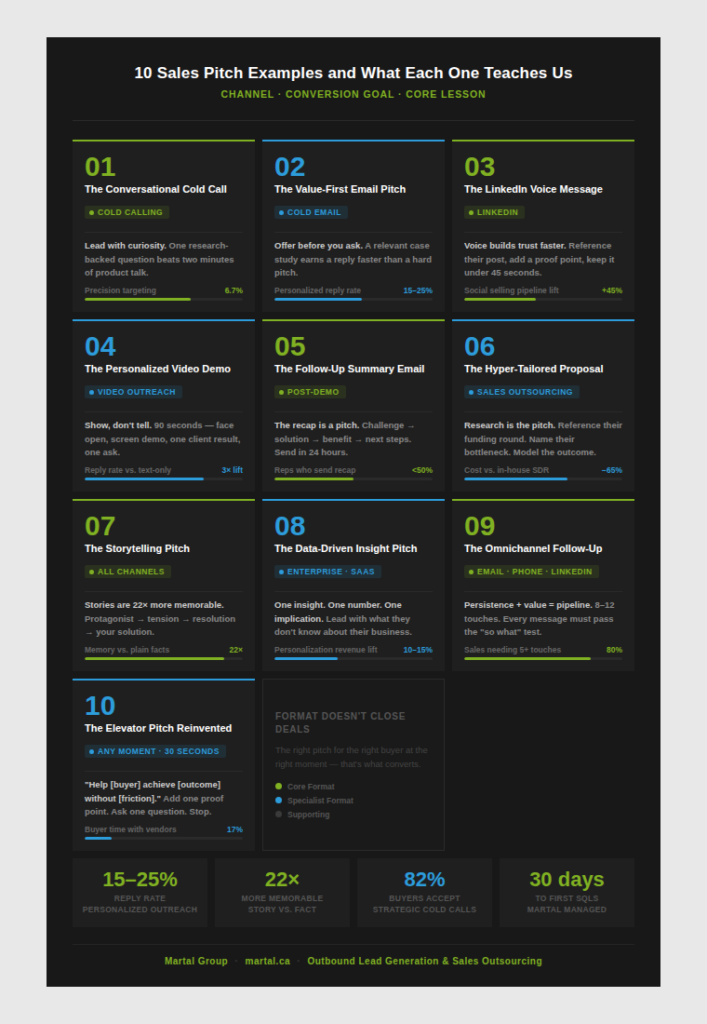
The 10 most effective B2B pitch formats are: the conversational cold call, the value-first cold email, the LinkedIn voice message, the personalized video demo, the follow-up summary email, the hyper-tailored proposal, the storytelling pitch, the data-driven insight pitch, the omnichannel follow-up sequence, and the elevator pitch.
Each format serves a different channel, buyer context, and conversion goal — the right pitch depends on where the prospect is in the buying cycle, not just what you want to say. Across all formats, the pitches that convert most reliably are the ones built around something real and specific about the prospect’s situation.
Start with research: the prospect’s industry, role, recent activity, and the specific problem your solution addresses in their context.
Use the core framework: hook → problem → solution → proof → CTA. This structure works across cold email, cold calls, LinkedIn, video, and live presentations.
End every pitch with a specific, low-friction next step — not “let me know if you have questions” but a direct ask with a proposed time, action, or deliverable.
Elevator pitch: 30–60 seconds (3–4 sentences). Cold call opener: 60–90 seconds. Cold email: 75–125 words. LinkedIn voice note: 30–45 seconds. Video pitch: 60–90 seconds. Follow-up email: 100–150 words.
The pattern is consistent across every format: shorter pitches outperform longer ones. The constraint of brevity forces the clarity that moves buyers.
A useful discipline: reduce your entire pitch to an elevator pitch first. If you can’t explain the value in 60 seconds, the longer version won’t compensate.
The eight most damaging mistakes are: leading with your company instead of their problem, pitching features instead of outcomes, talking more than listening, ending without a clear next step, using mismatched social proof, personalizing only the opener, pitching to the wrong person, and giving up too early.
The single most fixable mistake: ending without a specific call to action. Replace “let me know if you have questions” with a direct, time-specific ask every time.
80% of sales require five or more follow-up touches — yet 44% of reps quit after one. Most lost deals aren’t lost because the prospect said no — they’re lost because the rep stopped before the prospect was ready to say yes.
AI sales pitch generators can compress research time, produce credible first drafts, monitor intent signals at scale, and optimize sequences based on reply rate data — when used as augmentation tools, not replacements.
AI-assisted outreach improves response rates by an average of 28% compared to manually drafted messages — but that lift comes from the quality of personalization signals, not from the tool itself.
What AI cannot do: generate genuine insight about a specific prospect’s situation, build authentic rapport, handle live objections, or compensate for a misaligned offer or poorly defined ICP.
Omnichannel outreach — coordinating cold email, cold calling, and LinkedIn outreach as a connected sequence — consistently outperforms single-channel approaches by keeping the prospect engaged across their preferred touchpoints.
The key distinction: omnichannel means one strategy running in sequence across channels, not three tools running in parallel. Each touch builds on the last.
Martal’s Sales Executives run every client campaign as a coordinated omnichannel engagement — from ICP definition through SQL delivery — trusted by 2,000+ B2B brands across 50+ industries over 16+ years.
Introduction
Selling in B2B has never been harder to get right — and easier to get wrong. Buyers arrive at conversations already informed. They’ve read the reviews, benchmarked the competitors, and formed an opinion before you’ve said a word. According to Demand Gen Report, B2B buyers are almost 70% through their buying journey before reaching out to sellers, with 80% of the time, it’s the buyers who make the first move (3). That means any generic, boilerplate pitch doesn’t just underperform — it signals to the prospect that you haven’t done yours.
The good news: when a pitch is built around the buyer’s actual situation, it works. Not as a monologue, but as a conversation. The best pitches don’t feel like pitches at all.
What’s changed in recent years isn’t the goal — it’s the environment. Most B2B sales interactions now happen across digital channels. Buying groups have grown. Decision cycles are longer. And AI is reshaping how the best reps research, personalize, and sequence their outreach. According to LinkedIn’s research, AI-assisted outreach improves response rates by an average of 28% compared to manually drafted messages (5), not because it replaces the human, but because it gives the human better raw material to work with.
Martal’s Perspective: We work with B2B companies across SaaS, cybersecurity, manufacturing, logistics, and more — running outbound campaigns through cold calling, cold emailing, and LinkedIn outreach as a coordinated omnichannel strategy. Over 16 years and 2,000+ client engagements, our Sales Executives have delivered, tested, and refined thousands of pitches across industries and buyer personas. This guide draws on that experience alongside current research to share what actually moves prospects — across 10 distinct pitch formats, with real examples you can adapt.
How this guide was built: We reviewed the most effective outbound pitch formats, cross-referenced current B2B buyer behavior research, and organized the examples around what we see work in practice — not just what sounds good in theory.
What is a Sales Pitch?
68% of B2B buyers complete independent research before engaging a salesperson, meaning your pitch competes with conclusions they’ve already started forming.
Reference Source: Gitnux
Simply put, a sales pitch is a focused, persuasive communication — delivered in person, over the phone, by email, or through digital media — designed to move a potential customer toward the next step in your sales process. It’s your opportunity to connect a prospect’s real problem to your solution in a way that feels relevant, not rehearsed.
The classic example is the elevator pitch — a 30- to 120-second summary of your value proposition, but in practice, pitches take many forms depending on the channel, the buyer, and where they are in the buying cycle. Using an AI text-to-slides tool can help turn your talking points into polished, on-brand slides in minutes, freeing you to focus on delivery rather than formatting.
Every effective sales pitch, regardless of format, does the same core thing: it reduces the unknowns for the buyer. It addresses their specific pain points and links your solution to those needs — not as a feature list, but as an answer to something they’re already trying to solve.
It’s worth distinguishing a sales pitch from a sales presentation. A pitch is typically short, conversational, and designed to earn the next step — a meeting, a reply, a demonstration. A presentation is longer, more formal, and usually happens after interest has already been established. Both matter, but they serve different moments in the sales cycle.
Marketing teams run their own version of this too. Marketing pitch examples tend to center on pitching a campaign idea, a brand story, or a creative concept to an internal or external audience. The mechanics are the same — know your audience, address what they care about, make the value clear — but the context and stakes differ from a direct sales conversation.
What are the Types Of Sales Pitches?
Not every sales pitch looks the same. The format should match the channel, the buyer’s context, and how much time you have. The most common types include:
- The elevator pitch — a 30–60 second verbal summary, designed for spontaneous or time-constrained moments
- The cold call pitch — a conversational, consultative approach over the phone, built on research and active listening
- The cold email pitch — a short, personalized written pitch designed to earn a reply, not close a deal
- The LinkedIn pitch — a social selling message, voice note, or DM that leverages shared context or activity
- The video pitch — a short, screen-recorded or face-to-camera message that shows rather than tells
- The follow-up pitch — a structured recap or re-engagement message that reinforces value after an initial conversation
- The demo pitch — a product walkthrough tailored to a specific buyer’s stated pain points
- The insight pitch — a data-led approach that opens with something the prospect didn’t already know about their own market
- The storytelling pitch — a narrative-driven format that uses a relatable before-and-after scenario to make the value memorable
- The hyper-tailored proposal pitch — a bespoke, research-heavy pitch that positions the salesperson as an extension of the prospect’s team
Each of these is covered in detail in the examples below.
How to Make a Sales Pitch
59% of B2B buyers believe most sales reps don’t take the time to understand them, while 86% are more likely to buy if companies do and 73% find interactions too transactional.
Reference Source: Salesforce
Crafting a pitch that actually lands requires more than a polished opener. It requires a clear structure, genuine research, and the discipline to stay focused on the buyer’s problem rather than your solution’s features. Here are the steps that matter most.
- Do Your Homework First: A successful pitch begins long before you start talking. Research your prospect’s industry, company, role, and recent activity. Check their LinkedIn profile, recent press releases, job postings, and any relevant case studies from their sector. The 73% stat above isn’t an accident — most reps skip this step or do it superficially. The ones who don’t are the ones who get replies.
From the outbound side, we see this consistently: the pitches that convert aren’t the cleverest ones. They’re the ones that reference something real about the prospect’s world — a recent funding round, a market shift, a hiring pattern that signals a new initiative. That kind of specificity can’t be faked, and buyers notice.
- Start with a Hook: First impressions set the trajectory. Open with something that shows you’ve done your homework — a provocative question, a striking stat, or a direct reference to something happening in their business right now.
Instead of: “I’d like to tell you about X” Try: “I noticed your team just expanded into enterprise accounts — that usually means outbound qualification becomes the bottleneck. Is that on your radar?”
A relevant hook signals that this won’t be a cookie-cutter pitch. It also invites the prospect to engage rather than deflect.
- Focus on the Problem, Not the Product: Quickly pivot to the prospect’s pain points. What business problem are you solving? A great pitch makes the buyer feel understood before it makes them feel sold to.
Rather than listing features, try framing it this way: “I understand lead quality is a concern — your team is generating contacts, but only a fraction convert to real opportunities. Here’s how we approach that…” Identify the gap between where they are and where they want to be, then show how you bridge it. (2)
- Demonstrate Value with Data: Don’t just claim you can help — prove it. Successful pitches include supporting facts, social proof, or relevant outcome stats. Numbers build credibility in a way that adjectives never will. Keep a customer success story or relevant metric ready for each key point, and use visuals in live presentations to make the impact tangible.
- Keep It Conversational: A pitch should feel like a dialogue, not a download. Use second-person language (“you,” “your team”) and ask questions throughout: “Does that align with what you’re experiencing?” or “How are you handling that currently?” According to Salesforce, the most effective pitches are interactive discussions, not one-sided presentations.
- Be Clear and Concise: Attention is finite. Deliver your core message in under two minutes if spoken, or a few focused paragraphs if written. (7) Avoid jargon. Cut anything that doesn’t directly serve the buyer’s understanding of what you offer and why it matters to them specifically. A useful discipline: reduce your entire pitch to an elevator pitch first. If you can’t explain the value in 60 seconds, the longer version won’t save you.
- Close with a Clear next Step: Every pitch ends with a specific call to action. Not “let me know if you have questions” — that’s a stall, not a close. Try: “Would Thursday work for a 20-minute walkthrough?” or “I’ll send over a brief case study — can I follow up Friday to hear your thoughts?” Be direct. The prospect should finish the conversation knowing exactly what happens next and why it’s worth their time.
The Sales Pitch Template: A Reusable Framework
One of the most common questions we hear — and one of the most searched — is: what should a sales pitch actually include? Here’s a structure that works across channels and buyer types:
Element
What It Does
Example
Hook
Earns attention in the first sentence
A relevant question, stat, or observation about their business
Problem
Shows you understand their pain
“Teams in your space typically struggle with X…”
Solution
Connects your offer to their specific gap
“Here’s how we solve that — specifically for companies like yours…”
Proof
Builds credibility with evidence
A case study result, client outcome, or relevant metric
CTA
Creates a clear next step
“Would it be worth 20 minutes to walk through what this could look like for your team?”
This framework applies whether you’re writing a cold email, leaving a voicemail, or presenting to a buying committee. The medium changes — the logic doesn’t.
How Do You Make a Sales Pitch Less Salesy?
This is one of the most common questions real sellers ask — and the answer is simpler than most people expect.
A pitch feels salesy when it’s more focused on the seller’s agenda than the buyer’s situation. The fix isn’t softer language or a friendlier tone. It’s a genuine shift in orientation: lead with what you know about them, not what you want to tell them.
Practically, that means:
- Open with an observation, not an introduction. Starting with “I help companies like yours…” is about you. Starting with “I noticed your team just expanded into a new vertical…” is about them.
- Ask before you tell. One well-researched question early in the pitch does more for trust than three minutes of product explanation.
- Offer before you ask. A relevant insight, a useful case study, or a candid observation about their market positions you as an advisor. It lowers resistance before you ever make an ask.
- Name the elephant. Acknowledging that you’re in a sales conversation — “I’ll be upfront — I’m reaching out because I think we can help” — is paradoxically more disarming than pretending you’re not.
One thing we see consistently in outbound work: the pitches that feel the least like pitches are the ones that convert best. When a prospect feels like they’re being helped rather than handled, the conversation changes entirely.
Now let’s look at how these principles work in practice. Below are 10 sales pitch examples built for the environments where B2B selling actually happens — from cold calls to LinkedIn voice notes to data-driven insight meetings. Each one illustrates a different approach, and each one teaches something specific about what makes a pitch work.
10 Sales Pitch Examples and What Each One Teaches Us
Understanding the principles of a good pitch is one thing. Seeing them work across real selling scenarios is another.
The 10 examples below cover the formats that show up most often in B2B outbound — from a cold call that opens with a question instead of a product name, to a follow-up email that keeps a stalled deal moving, to an elevator pitch that earns a “tell me more” in under 30 seconds. Each one is built around a specific channel, buyer context, and conversion goal.
A few things worth noting before you read:
- These are formats, not scripts. The language is illustrative. The structure is what transfers.
- The best pitch for your situation depends on where your buyer is. A prospect who just went quiet needs a different approach than one you’re engaging for the first time.
- Channel and timing matter as much as content. The same message lands differently at different moments. Omnichannel outreach — coordinating email, cold calling, and LinkedIn as a connected sequence rather than parallel blasts — is consistently what separates high-converting campaigns from average ones. It’s how our Sales Executives run every client engagement.
Whether you’re a founder pitching solo, an SDR working a targeted account list, or a sales leader building a repeatable playbook, these examples give you a working model for each major pitch context.
1. The Conversational Cold Call
82% of B2B buyers accept meetings from strategic cold calls, with targeted omnichannel follow-up boosting success to 6.7%.
Reference Source: Instantly
Cold calling isn’t dying, it’s just getting harder to do badly and get away with it. When done right, it remains one of the highest-conversion outbound channels available. Research shows that 82% of B2B buyers accept meetings from strategic cold calls, and success rates forprecision-targeted calling with omnichannel follow-up have climbed to 6.7% conversation-to-meeting, more than triple the rate of spray-and-pray dialing (8).
The difference between a cold call that converts and one that gets hung up on isn’t confidence — it’s preparation. Here’s what a conversational, consultative cold call looks like in practice.
Scenario: You’re calling a VP of Sales at a mid-market SaaS company. Instead of a scripted opener, you start with something real: “Hi [FirstName], this is [Your Name] from Martal Group. I’ll be quick — I noticed your team recently posted three SDR roles. That usually means either pipeline’s under pressure or you’re scaling into a new segment. Which one is it for you?”
That question does three things at once: it shows you’ve done your homework, it signals that you’re not going to waste their time, and it opens a conversation rather than a pitch. From there, you listen. You let them describe the situation in their own words. Then you connect what you heard to what you can actually do:
“That makes sense — a lot of companies in your space hit that wall around Series B. We’ve helped similar teams build pipeline without the 90-day SDR ramp. One client in the transportation AI space generated 108 meetings in their first three months working with us. Would it be worth 20 minutes to walk through how that worked?”
This approach mirrors what Mark Cuban did when he bought the struggling Dallas Mavericks and personally cold-called lapsed season ticket holders — not to push tickets, but to understand why they stopped coming. By listening first and reframing value around what he heard, he turned around attendance (2). The principle scales: cold calls work when they’re genuinely curious about the other person, not just rehearsed at them.
What to Say After the Opener — If You Freeze
One of the most common real questions sellers ask is: “What do I actually say after the opener? I always freeze up.”
The answer isn’t a better script. It’s a better question. After your hook lands, your only job is to get the prospect talking. Try one of these:
- “What’s driving that priority right now?”
- “How are you currently handling [the problem you just named]?”
- “Is that something your team is actively trying to solve, or more of a back-burner issue?”
Any of these keeps the conversation moving — and gives you the raw material to personalize everything that comes next. The freeze happens when reps feel pressure to perform. The shift is to get curious instead.
What this pitch teaches us:
- Lead with empathy and rapport: A simple, genuine opener disarms skepticism. Showing that you’ve observed something specific about their situation sets a different tone than a product introduction.
- Personalize the pain point: Reference a real trigger — a job posting, a funding round, a market move — to connect your solution to something currently happening in their world. This signals research, not randomness.
- Make it a dialogue: Ask a question early and let the prospect share. The more they talk in the first two minutes, the better your pitch will be in the next two. You can’t tailor what you haven’t heard.
- Highlight value early: Drop one proof point — a client outcome, a relevant result — to earn enough credibility to ask for the next step. You don’t need to tell the whole story on the first call.
- Close on next steps: Don’t leave a cold call without proposing a specific follow-up. A soft, direct ask — “Would Tuesday afternoon work for a quick 20-minute call with our strategist?” — converts far better than an open-ended “I’ll follow up.”
Martal in practice: In one engagement with a transportation technology company entering the US market, our Sales Executives generated 108 meetings in three months — starting from zero US sales infrastructure. The approach was exactly this: precise ICP targeting, consultative cold calling, and omnichannel follow-up that treated each prospect as a real person with a real problem, not a dial target.
2. The Honest, Value-First Email Pitch
Cold email remains a top outbound channel, but non-personalized sends see just a 3-5% reply rate, while signal-personalized outreach hits 15-25%.
Reference Source: Autobound
Email remains one of the most powerful channels available to a sales rep — but crowded inboxes mean a generic pitch doesn’t just underperform, it actively damages your sender reputation and your brand. The email pitches that earn replies in today’s environment share three qualities: they’re short, they’re honest about what they are, and they offer something before they ask for anything.
Here’s what that looks like in practice.
Scenario: Your prospect is a VP of Marketing at a mid-market SaaS company you found on LinkedIn. Instead of a templated opener, you write this:
“Hi Jane,
I’ll be honest — I’m reaching out because I suspect {ProspectCompany} might be facing some of the same growth challenges we’ve solved for other SaaS firms. Specifically, we’ve heard from clients in your space that scaling outbound sales leads is tough when the sales team is already stretched thin.
If that sounds familiar, I’d love to send over a short case study showing how we helped a tech company triple their qualified pipeline in 90 days without hiring extra staff. No strings attached — we don’t even have to get on a call unless you find it useful.
Can I send you that info?
— [Your Name]”
This email works because it does the opposite of what most cold emails do. It admits what it is — a prospecting message — which is paradoxically more disarming than dressing it up as something else. It zeroes in on one specific pain rather than listing capabilities. And the call to action asks for almost nothing: a yes or no to receiving useful information. That low-commitment ask dramatically increases reply rates. (1)
What this pitch teaches us:
- Keep cold emails short and specific: The email above is three short paragraphs. One problem, one offer, one ask. That constraint is a feature — it forces you to know exactly what matters most to this specific prospect.
- Honesty disarms resistance: Acknowledging that you’re prospecting — and showing genuine understanding of why they might be skeptical — builds more trust than a carefully engineered opener that pretends otherwise.
- Offer value before you ask for anything: Positioning a relevant case study as a no-strings resource makes you an advisor before you’re a salesperson. That sequencing matters. (1)
- Personalize at scale: One well-researched sentence — referencing their industry, a recent hire, a funding round, a job posting — separates your email from every templated pitch in their inbox. It doesn’t require hours of research per prospect; it requires a clear signal-based targeting process.
- Subject lines decide whether any of this gets read: The best body copy in the world means nothing if the email doesn’t get opened. Keep subject lines under 50 characters, use the prospect’s company name or a specific trigger, and test regularly. Including the word “video” in a subject line, for example, can meaningfully boost open rates. (4)
How Do You Personalize a Pitch at Scale Without it Feeling Fake?
This is one of the most practical questions real sellers ask — and it gets to the heart of what separates high-performing outbound from noise.
The answer isn’t to write every email from scratch. It’s to identify the right personalization signal and build your message architecture around it. A few signals that work consistently in our campaigns:
- Hiring activity: A company posting three SDR roles signals pipeline pressure or a new market push — both conversation starters
- Funding rounds: A Series B or C announcement means growth is the priority and budget is available
- Technology changes: A company dropping or adopting a specific tool signals a problem they’re actively trying to solve
- Content engagement: A prospect commenting on a relevant LinkedIn post tells you what’s on their mind right now
The framework is simple: one signal, one sentence, one problem, one ask. That’s a personalized email. Scale comes from building a targeting process that surfaces the right signals consistently — not from writing unique prose for every send. This is exactly what Martal’s AI Sales Platform does: it monitors 10M+ real-time intent signals and builds outreach around the moments that matter.
What’s the Difference Between a Sales Pitch and a Cold Email?
A cold email is one format a sales pitch can take — but they’re not the same thing. A sales pitch is the overall strategy and message: the problem you’re solving, the value you’re delivering, the proof you’re offering. A cold email is the vehicle. The pitch lives inside the email — compressed into the format’s constraints.
The distinction matters because the same pitch logic — hook, problem, proof, CTA — should run through every channel you use. What changes is the length, tone, and ask. An email pitch earns a reply. A cold call pitch earns a conversation. A LinkedIn pitch earns a connection. They’re all delivering the same core message through different doors.
Martal in practice: In one engagement with a B2B SaaS company focused on computer maintenance and asset management, our cold email campaigns generated 1,708 leads and 144 booked meetings over 26 months — driven by exactly this value-first, signal-personalized approach. No mass blasts. Every sequence built around ICP fit and buyer context.
3. The LinkedIn Voice Message Pitch (Social Selling)
Sales platforms report 20-40% higher replies with voice messages versus text outreach.
Reference Source: Fuzzy AI
In 2026, social selling isn’t a nice-to-have — it’s where many B2B conversations begin. LinkedIn gives you something cold email and cold calling rarely can: context. You can see what your prospect is thinking about, what they’re engaging with, who they’re connected to, and what’s happening in their business right now. A well-timed LinkedIn pitch that references that context lands entirely differently than a message that could have been sent to anyone.
Voice messages take this further. They add a human layer that text can’t replicate — the prospect hears your tone, your confidence, your genuine curiosity. And because most sellers don’t use them, they stand out.
Scenario: A COO in your target ICP comments on a LinkedIn post about the challenge of scaling outbound without proportionally growing headcount. You’ve been tracking this person for two weeks. You send a voice note:
“Hi Alex, this is [Your Name] from Martal Group. I saw your comment on the pipeline scaling post — you nailed it. That tension between growth targets and headcount cost is exactly the problem we spend our days solving for SaaS leadership teams. In one recent engagement, a company in your space generated over 100 qualified meetings in three months without adding a single internal rep. Worth a quick chat to see if the model fits? Happy to keep it to 15 minutes.”
Under 45 seconds. One specific observation, one concrete proof point, one low-commitment ask. The prospect heard a real voice — not a form letter. And the reference to their own comment signals that this isn’t a broadcast message.
LinkedIn voice messages have practical advantages worth knowing: they land directly in the prospect’s LinkedIn inbox, often trigger a notification email, and bypass the crowded email inbox entirely. Because voice notes remain uncommon in outbound, they differentiate by default.
What This Pitch Teaches Us:
- Strike While the Iron’s Hot: Referencing a prospect’s recent comment or post taps into something they’re actively thinking about. It signals engagement with their ideas — not just their job title — and opens a conversation that feels earned rather than imposed.
- Use Social Context to Personalize: LinkedIn provides rich, real-time context — recent activity, shared connections, group participation, company announcements. Any of these can anchor your opening and make the pitch feel like a continuation of something, not a cold start.
- Leverage Voice for the Human Layer: A voice note communicates what text can’t — tone, warmth, confidence. The prospect hears a real person, which builds trust faster than any well-crafted sentence. Use it when you want to stand out and when the relationship is warm enough that a voice feels natural rather than intrusive.
- Be Concise and Specific: One proof point, one ask, under 60 seconds. The voice note is a teaser — it earns the conversation, it doesn’t try to close the deal. Anything longer starts to feel like a voicemail monologue.
- Lower the Barrier to Engagement: Asking for 15 minutes rather than a formal meeting, and framing it as “let’s see if the model fits” rather than “let me tell you about our service,” gives the prospect an easy yes. Low-commitment asks convert better than high-pressure ones at every stage of outbound.
How Do You Pitch to Someone Who’s Happy With Their Current Solution?
This is one of the more honest challenges in outbound — and LinkedIn is often where it surfaces, because prospects in passive research mode are more likely to be content with the status quo than those actively searching.
The mistake most reps make is trying to argue the prospect out of their current solution. That’s the wrong frame entirely. The better approach is to expand the conversation beyond the solution they already have.
A few ways we approach this in practice:
- Introduce a problem they haven’t fully solved yet. Most companies aren’t getting everything they need from a single vendor. “We work alongside a lot of teams already using [category solution] — typically we fill the gap on the outbound execution side they’re not covering.”
- Lead with a relevant insight, not a competing claim. Sharing something genuinely useful about their market — a trend, a benchmark, a shift in buyer behavior — positions you as an advisor rather than a challenger. That conversation is much easier to have.
- Be honest about the timing. “I’m not suggesting you make any changes now — I’d just rather be on your radar before the next evaluation cycle than after it.” This kind of candor is disarming and builds long-term pipeline.
The goal on LinkedIn in particular isn’t always to convert immediately. Sometimes the right outcome from a voice note is a reply that says “not right now, but let’s stay connected.” That’s pipeline — just a longer runway.Martal in Practice: In one engagement with an AI trust and safety company expanding from London into the US market — a highly specialized niche with no existing US pipeline — our LinkedIn outreach and omnichannel prospecting generated 15,000 prospects and 35 qualified leads per month within a category most prospects had never encountered before. The approach: build familiarity through consistent, context-driven engagement before making any formal ask.
4. The Video Demo Pitch – A Product Pitch Example That Engages
Personalized video messages achieve reply rates up to 3x higher than text-only outreach.
Reference Source: Autobound
Sometimes the best way to pitch a product is to show, not tell. A short, personalized video does something no cold email or voice note can: it puts a face to the name, demonstrates the product in action, and communicates tone and confidence in a way that text simply can’t replicate. For visual buyers and time-pressed executives who prefer to consume information on demand rather than schedule a call, a well-crafted video pitch can be the most efficient first step in the entire sequence.
Scenario: You connected with a potential client at a virtual conference. They expressed interest in your platform but haven’t committed to a formal demo. Rather than sending a follow-up email they’ll half-read, you record a 90-second video addressed directly to them. You open on camera:
“Hi Maria — great to meet you at TechGrowth Summit last week. You mentioned tracking applicant data across multiple hiring managers was becoming a real bottleneck. I wanted to show you the specific feature that solves exactly that.”
You then share your screen for 60 seconds, navigating directly to the analytics dashboard and showing a one-click report that surfaces time-to-hire and applicant source data automatically. You close back on camera:
“This is how we reduced reporting time by 80% for a healthcare client running the same workflow. If this looks useful, I’d love to set up 20 minutes to show you the full picture — happy to fit around your schedule.”
Under 90 seconds. One named pain point from a real conversation. One feature demonstrated visually. One specific client outcome. One low-commitment ask. The prospect can watch it twice, forward it to a colleague, or reply at midnight. That flexibility is the point.
This personalized approach builds on the existing rapport from the conference, directly targets the problem Maria described, and uses visual demonstration to make your solution tangible in a way a written description never could. The video format also accommodates the growing preference among B2B buyers for asynchronous, on-demand engagement — they can evaluate your pitch without blocking time in their calendar.
What This Pitch Teaches Us:
- Personalize the Visual: A generic screen recording isn’t a video pitch — it’s a tutorial. Address the person by name, reference something specific from your prior interaction, and navigate directly to the feature or outcome most relevant to their stated problem. The prospect should feel the video was made for them. Because it was.
- Keep Videos Short: Ninety seconds to two minutes is the ceiling for a prospecting video pitch. Longer demos belong in scheduled meetings. The video pitch is a teaser — its job is to earn the next conversation, not replace it.
- Show the Product in Action: Seeing a feature work in real time is more persuasive than any description of it. Even a 60-second screen walkthrough that shows one specific outcome — a dashboard loading, a report generating, a workflow completing — creates proof of concept that written copy can’t match.
- Be Human on Camera: Show your face at the open and close. A genuine smile and direct eye contact into the lens creates a personal connection that reminds the prospect there’s a real person behind the outreach — not an automated sequence. This matters more than production quality.
- Use Metrics Where Possible: In this example, citing an 80% reduction in reporting time for a comparable client provides concrete evidence that isn’t just a claim. A single well-placed result in a video pitch carries disproportionate weight because the viewer is already engaged and trusting.
- End With a Clear CTA: The viewer, if intrigued, needs to know exactly what to do next. Make the ask specific and low-friction — a 20-minute follow-up, a direct reply, a calendar link in the email body below the video. Never end a pitch, in any format, without a clear next step.
How Long Should a Sales Pitch Be?
This is one of the most common practical questions sellers ask — and the honest answer is: it depends on the format, but shorter than you think across all of them.
Here’s a working guide by channel:
Format
Recommended Length
Recommended Length
Elevator pitch
30–60 seconds
3–4 sentences: problem, solution, proof, ask
Cold call opening
60–90 seconds
Hook, pain point, proof point, next step ask
Cold email
75–125 words
3 short paragraphs maximum
LinkedIn voice note
30–45 seconds
One observation, one proof point, one ask
Video pitch
60–90 seconds
On camera open, 60s screen demo, on camera close
Follow-up email
100–150 words
Recap, reinforced value, specific next step
Demo / proposal pitch
20–30 minutes
Full walkthrough, tailored to stated pain points
The pattern is consistent: every format rewards compression. The constraint of brevity forces you to identify what actually matters most — and that clarity is exactly what moves buyers. When a pitch runs long, it’s usually because the seller hasn’t yet decided what the single most important thing is.
One thing we see consistently in outbound: the reps who struggle with pitch length are usually trying to say everything. The reps who convert are trying to say one thing well.
Martal in Practice: In one engagement with a security and surveillance AI company entering a competitive US market, our Sales Executives used personalized video as part of a coordinated omnichannel sequence — combining video outreach with cold calling and LinkedIn — and delivered 120 sales-ready leads in the first four months. The video component shortened the trust-building timeline significantly by putting a human face on the outreach before the first live call.
5. The Follow-Up Summary Email (After a Demo)
80% of sales require five or more follow-up touches, yet 44% of reps give up after just one attempt.
Reference Source: Spotio
Not every pitch is about landing the first meeting. Some of the most important selling happens after the initial conversation — in the follow-up that either keeps momentum alive or lets it quietly die. A structured recap email sent within 24 hours of a demo is one of the highest-leverage, lowest-effort moves in a sales rep’s toolkit. It re-anchors the value, reduces the risk of miscommunication across a buying group, and gives the prospect something concrete to share with internal stakeholders.
Most decision-makers don’t buy alone. They sell your solution internally after the call ends. Your follow-up email is the document they use to do that. If it’s vague, they’ll struggle. If it’s sharp, it does your selling for you.
Scenario: You’ve just finished a strong demo with a prospect who showed genuine interest. Within the hour, you send a follow-up email with the subject line: “Recap + Next Steps — [ProspectCompany] / [Your Company]”
The body reads:
“Hi [FirstName],
Thanks for the time today — genuinely good conversation. Here’s a quick recap of where we landed:
Challenge:Your sales team is spending significant time on manual lead qualification, which is pushing hot leads down the priority list.
Proposed Solution: Our platform’s qualification layer would automatically surface and prioritize the accounts most likely to convert — saving each rep an estimated 4–5 hours per week based on comparable deployments.
Key Benefit: More rep time on high-intent prospects, and a projected 20% lift in conversion rate based on similar client outcomes.
Next Steps: 1. We’ll send a tailored proposal by [day]. 2. You review internally and share with [stakeholder]. 3. We reconnect on [specific date] to address questions and confirm fit.
Looking forward to it.
— [Your Name]”
This email does the job in under 150 words. It mirrors the language from the actual conversation, restates the pain in the prospect’s terms, quantifies the benefit, and creates a shared accountability structure for next steps. The format — challenge, solution, benefit, next steps — is essentially a pitch deck compressed into an email. And it arrives while the demo is still fresh.
Why do so few reps send this? Because it takes effort. But that effort is precisely what makes it effective — it signals professionalism, preparation, and genuine investment in the prospect’s outcome. Those signals matter to decision-makers evaluating multiple vendors simultaneously.
What This Pitch Teaches Us:
- Always Follow Up With Substance: A vague “great meeting, let’s chat soon” does nothing. A structured recap that mirrors the conversation — using the prospect’s own language for their problem — cements the value story and keeps it alive after the call ends.
- Customize the Recap: The most important word in “follow-up email” is “follow.” It should reflect what was actually said — specific pains voiced, specific solutions discussed, specific numbers explored. Generic recaps signal that you weren’t listening.
- Use Bullet Points for Clarity: Executives scan, they don’t read. A bulleted structure — challenge, solution, benefit, next steps — makes the value instantly graspable and easy to forward to a colleague or superior without additional context.
- Reinforce the Value Proposition: The follow-up is your second chance to make the case. If there were any lingering doubts from the demo, a crisp written restatement of the benefit — with a number attached — can tip the balance before the next meeting.
- Establish Mutual Accountability: Explicitly naming who does what by when creates shared momentum. It signals that things are already in motion — and subtly makes inaction feel like a deliberate choice rather than a default drift.
- Be Prompt: Send this within 24 hours while the conversation is fresh for both sides. Promptness communicates enthusiasm and reliability — two qualities every buyer wants in a long-term vendor relationship.
How Do I Keep a Deal Moving After a Demo Without Being Annoying?
This is one of the most honest questions in B2B sales — and it comes up constantly in sales follow-up conversations with reps who don’t want to damage the relationship they just built.
The answer isn’t about frequency. It’s about value density.
A follow-up feels annoying when it adds nothing — when it’s a “just checking in” or a “circling back” with no new information, no useful resource, and no clear reason for the prospect to respond. Every touch that doesn’t give the prospect something costs goodwill.
A follow-up feels helpful when it:
- Adds new information: A relevant case study, a benchmark from their industry, a stat that speaks directly to the pain they described in the demo
- Creates a specific decision point: “We have availability to start onboarding in [month] — worth confirming before that window closes” gives the prospect a real reason to act now
- Acknowledges their timeline honestly: “I know you mentioned Q3 is the priority review window — happy to stay on your radar until then. I’ll check in with something useful in [timeframe].” This kind of candor builds trust and creates permission for future contact
- Reduces friction: If the next step requires the prospect to do something, make it as easy as possible. Send the proposal before they ask. Include a calendar link. Do the work so they don’t have to
One pattern we see consistently across outbound campaigns: the reps who stay in deals longest aren’t the most persistent — they’re the most useful. Every touchpoint gives the prospect a reason to keep the conversation open.Martal in Practice: In one engagement with a financial services and business brokerage firm, our Sales Executives maintained a multi-year campaign with structured follow-up at every stage — delivering 2,316 leads and 832 booked meetings over three years. Deals at this volume don’t close on first contact. They close because every follow-up touch moved something forward rather than just reminding the prospect we existed.
6. The Hyper-Tailored Solution Pitch
Outsourcing outbound sales can cut costs by up to 65% compared to building an in-house SDR team.
Reference Source: Martal Group
In complex B2B sales, the generic capabilities pitch doesn’t just underperform — it actively signals that you haven’t done the work. A hyper-tailored solution pitch is the opposite: it shows the prospect that you’ve studied their business, identified a specific gap, and designed a response to that gap rather than to a generalized version of their problem. It’s less a presentation and more a business case — built for one company, at one moment in their growth.
This format is particularly powerful in sales outsourcing conversations, where the prospect is often weighing a build-vs.-buy decision and needs to see the outcome modeled, not just described.
Scenario: Your team is pitching a fractional Sales Executive engagement to a fast-growing SaaS startup that just closed a Series B. Instead of a standard capabilities overview, you open with what you know about them:
“First — congratulations on the Series B. $25M with a mandate to double your client base in twelve months is an exciting position to be in. We’ve spent time looking at your current outbound approach, and we think we’ve identified where the gap is.
Your trial-to-paid conversion is the lever that matters most right now. You’re generating sign-ups — but your team doesn’t have the bandwidth to follow up with each one at the speed and volume the funnel requires. That’s the bottleneck.
What we’re proposing is a dedicated two-person fractional team — Sales Executives with direct experience in your SaaS niche — who can be fully operational within two weeks. They’ll own the trial-user follow-up process end-to-end: calls, emails, LinkedIn outreach, coordinated as one omnichannel sequence. Based on your current trial volume and the conversion rates we’ve seen in comparable engagements, we project this adds a minimum of 50 qualified meetings per month. The model is month-to-month — no long-term commitment, no fixed overhead, fully scalable as you grow.”
That pitch earns attention because every sentence is about them — their funding round, their specific bottleneck, their trial volume, their growth mandate. The solution isn’t described abstractly; it’s modeled against their actual situation with a projected outcome attached.
Critically, the pitch also pre-empts the most common objection: cost and commitment risk. By naming the month-to-month model and the no-overhead framing before the prospect raises it, you remove the barrier before it becomes a reason to stall.
What This Pitch Teaches Us:
- Deep Research Pays Off: When pursuing a high-value prospect, invest the time to understand their business at the level they understand it. Reference their own goals, metrics, and language. Few reps do this thoroughly — which is exactly why it differentiates so sharply when you do.
- Frame the Pitch Around the Client’s Vision: We opened by acknowledging their growth mandate — doubling client base in twelve months — before positioning our solution as the mechanism to achieve it. The pitch becomes a partnership narrative rather than a vendor proposal.
- Make the Solution Feel Exclusive: Phrases like “based on your current trial volume” and “we’ve studied your approach” signal that this isn’t a template. The prospect should feel — correctly — that this proposal was built for them specifically.
- Quantify the Impact: “50 qualified meetings per month” is a projection, not a guarantee — but it makes the value tangible. A pitch without a number is a pitch the prospect can’t model against their own targets. Give them something to work with.
- Address Risk and Fit Directly: We named the month-to-month model and zero fixed overhead before the objection arose. Anticipating the prospect’s concerns and resolving them inside the pitch itself is one of the most effective trust-building moves available.
- Use “We” for Credibility: Speaking as “we studied your approach” and “we propose” sounds like a team already working on their behalf. That collaborative framing — positioning yourselves as an extension of their organization rather than an outside vendor — is how long-term partnerships begin.
How Do You Pitch Sales Outsourcing to a Company That Thinks They Should Just Hire Internally?
This is one of the most common real objections in sales outsourcing conversations — and it deserves a direct answer rather than a deflection.
The hire-internally instinct is understandable. It feels like control. What it actually delivers is a 90-day ramp, a single point of failure, significant fixed cost, and no guarantee of fit. The pitch against it isn’t about arguing those downsides — it’s about reframing what the comparison actually looks like.
A few angles that work in practice:
- Model the real cost of hiring: A fully loaded in-house SDR — salary, benefits, tools, management overhead, training time — typically runs $80,000–$120,000 per year before they’re fully productive. A fractional engagement delivers a senior, already-trained team operational in two weeks at a fraction of that cost. Put those numbers side by side rather than leaving the prospect to do the math themselves.
- Reframe the risk: Hiring internally is the high-risk option — one bad hire sets the pipeline back six months. A fractional model de-risks the entire equation: if the fit isn’t right, you adjust. You don’t lose a quarter.
- Lead with speed: Most companies considering a hire are doing so because they need pipeline now. An internal SDR won’t generate qualified B2B leads for 60–90 days at minimum. A Martal team starts generating SQLs within 30 days. For a company with a growth mandate, that ramp difference is the whole conversation.
- Position it as additive, not replacement: The strongest framing isn’t “instead of hiring” — it’s “while you figure out whether to hire.” A fractional engagement builds pipeline, surfaces market intelligence, and validates your ICP in real time. That information makes your eventual internal hire smarter, not redundant.
Martal in Practice: Clickworker — a global marketplace platform — came to Martal at a point where scaling their enterprise pipeline with an internal team alone wasn’t feasible at the speed their growth required. Over a nine-year engagement, Martal’s fractional Sales Executives helped them close Fortune 10 and Fortune 500 accounts, generating $4.5M in recurring revenue and delivering a 500% ROI. The pitch that started that relationship was built exactly like the scenario above: specific to their situation, modeled against their targets, and designed to remove every reason to say no. Read the Clickworker case study →
7. The Storytelling Pitch – Lessons from Marketing Pitch Examples
Messages delivered as stories are 22x more memorable than facts alone.
Reference Source: Forbes
Facts tell, but stories sell. When a prospect hears a statistic, they evaluate it. When they hear a story, they inhabit it. The emotional and imaginative engagement that narrative triggers is fundamentally different from the analytical processing that a feature list or ROI claim produces. And in a selling context, that difference matters enormously: a prospect who has mentally experienced the outcome you’re describing is far closer to a yes than one who has merely understood it.
Great marketers have known this for decades. The best marketing pitch examples — think of campaigns that made you feel something before they told you what they were selling — all follow the same structure: establish a world, introduce tension, show the resolution. Salespeople can borrow this framework directly.
Scenario: You’re pitching a cybersecurity solution to a potential client. Instead of jumping into features, you open with a short story:
“Three years ago, a technology firm not unlike yours got breached because one employee clicked a phishing email on a Tuesday afternoon. By Wednesday morning, they were on the phone with their largest client explaining why that client’s data had been compromised. They lost the contract within a week.
I want to show you how that story could have ended differently — because with what we’re talking about today, it would have.”
You pause. Then you walk through the specific moment: the phishing email arriving, the system flagging it automatically, the threat quarantined before anyone clicked anything. No breach. No call. No lost contract. The IT director isn’t evaluating a feature anymore — they’re watching a movie in which their company is the protagonist that makes the right decision.
You close the story with a question: “Does that scenario — a breach traced back to one email — feel like something your current setup would catch?”
That question does two things simultaneously: it tests whether the story landed, and it opens the conversation to their specific situation. From there, the pitch becomes a dialogue.
This works because narrative engages both sides of the evaluation process — the emotional and the rational. The story creates urgency and relatability; the question surfaces whether that urgency exists in their context. You’re not pushing. You’re revealing.
What This Pitch Teaches Us:
- Lead With a Protagonist the Prospect Can Recognize: The mid-size tech firm in the story isn’t a random company — it’s a proxy for the prospect. It should be just specific enough to feel real and just generic enough to feel transferable. The moment the prospect thinks “that could be us,” the story is working.
- Invoke the Right Emotion: Fear of loss, relief at resolution, pride in making a smart decision — these are the emotions that drive action in B2B buying. Choose the emotional arc deliberately. A cybersecurity pitch earns urgency through risk. A growth pitch earns excitement through possibility. Match the emotion to the stakes.
- Use Vivid, Concrete Imagery: Abstract threats don’t move people. “A phishing email on a Tuesday afternoon” does. Specificity — a day of the week, a physical action, a named consequence — makes the scenario feel real rather than hypothetical. The more the prospect can see it, the more they feel it.
- Simplify Through Narrative: A story compresses complex technical capability into a clear cause-and-effect sequence that requires no domain expertise to follow. Instead of explaining how the quarantine system works, you show what it prevents. The outcome carries the explanation.
- Connect Features to Outcomes Through the Story Arc: The real-time alert feature was never named as a feature in the scenario above. It appeared as the thing that stopped the breach. That’s the right sequence — outcome first, mechanism second, only if asked.
- End With the Moral Clear: Every story has a point. Make sure yours lands explicitly — not as a tagline, but as a question or observation that ties the narrative directly back to the prospect’s situation. The story earns the conversation; the close opens it.
How Do You Use Storytelling in a Cold Email Without It Feeling Forced?
This is a real tension — and one worth addressing directly, because the storytelling pitch works brilliantly in a live conversation but can feel awkward when compressed into a cold email.
The answer is to use a micro-story rather than a full narrative arc. Cold email doesn’t have room for a three-paragraph scene — but it has room for a single vivid sentence that creates the same emotional trigger.
Compare these two openers:
Generic: “We help cybersecurity companies improve their threat detection capabilities.”
Micro-story: “One of our clients discovered a phishing attempt had bypassed their existing stack — on the same day they were closing their biggest enterprise deal. They caught it in time. Most don’t.”
The second opener is three sentences. It has a protagonist, a tension, and a consequence. It doesn’t resolve the story — it leaves the prospect in the moment of risk, which is exactly where you want them before you introduce your solution. The unresolved tension creates the pull.
A few principles for storytelling in cold email:
- One scene, not a plot: You don’t have room for a full arc. Pick the single most emotionally resonant moment — the breach, the missed quota, the lost deal — and start there
- Leave the resolution out of the opener: The tension is what earns the next sentence. Resolve it too early and the urgency evaporates
- Use “one of our clients” rather than a named company: It implies real experience without requiring disclosure. And it invites the prospect to picture themselves in the same situation
- Connect the scene directly to their context: One sentence that bridges the story to their specific situation — “Given that your team is scaling into enterprise accounts right now, I thought this might be relevant” — personalizes the narrative without requiring a full rewrite
What Makes a Great Storytelling Pitch? A Real-World Example Worth Knowing
One of the most discussed examples of a storytelling pitch in recent years comes from a LinkedIn post by strategist Andy Raskin analyzing what he called the best sales pitch he’d ever seen — a narrative framework used by Zuora in their sales presentations. The structure: name a massive, undeniable market shift; show who wins and who loses in that shift; position your solution as the path to the winning side. No product features in the first ten slides. Just a story about the world changing — and what that means for the prospect.
The reason this pitch resonated so widely is that it treats the prospect as an intelligent adult who can see the same market forces at play. It doesn’t sell. It narrates. And it earns belief before it asks for anything.
That structure — market shift, winners and losers, your solution as the path to the right side — is directly transferable to B2B outbound contexts. You don’t need a slide deck. You need one paragraph that articulates the shift, one sentence that names which side your prospect is currently on, and one question that opens the conversation about how to change it.Martal in Practice: In one engagement with HALO Recognition — a global employee recognition platform — our Sales Executives used narrative-driven outreach to engage HR leaders at enterprise accounts. The pitch wasn’t built around HALO’s product features. It was built around a story most HR leaders recognized immediately: the talent retention crisis and what it costs a company when recognition programs feel transactional rather than genuine. That framing generated over $10M in new business opportunities over the course of the engagement. Read the HALO Recognition case study →
8. The Data-Driven Insight Pitch
Personalization, including product recommendations and tailored outreach, drives 10–15% revenue uplift for companies that deploy it effectively, and that 71% of consumers expect personalized interactions.
Reference Source: Mckinsey & Company
In B2B selling, the most powerful thing you can do in an opening pitch is show a prospect something true about their business that they hadn’t fully quantified. Not a product feature. Not a company overview. A specific, credible insight about the gap between where they are and where they could be — expressed in their own terms and attached to a number they recognize.
This is the essence of the insight pitch. It borrows from the Challenger Sale framework — bring a fresh perspective to the table, create constructive tension, then position your solution as the resolution to that tension. Done well, it shifts the dynamic entirely: you’re no longer a vendor pitching a product, you’re an analyst surfacing an opportunity they’ve been leaving on the table.
Scenario: You sell a customer analytics platform to e-commerce companies. You’ve researched your prospect — a mid-market online retailer — and identified a specific gap: their homepage serves the same product grid to every visitor with no personalization layer. You open the meeting with this:
“Before I show you anything about our platform, I want to share something I noticed about your site — because I think it explains a gap that’s worth quantifying.
McKinsey’s research shows that personalization-driven recommendations account for a meaningful share of e-commerce revenue for companies that deploy them well. Your homepage currently shows the same products to every visitor. Based on your publicly available traffic data and the industry benchmarks for conversion lift from personalization, we estimate you’re looking at a potential revenue gap of somewhere between $3M and $5M annually — depending on how aggressively you close it.
That’s what our platform is built to address. Can I show you the specific mechanism?”
The prospect’s eyes are on the number before you’ve shown a single product screenshot. You then demonstrate the analytics dashboard — the segmentation engine, the recommendation layer, the before-and-after conversion data from a comparable deployment. The tone throughout is consultative: you’re an analyst working on their behalf, not a salesperson working toward a quota.
This creates what the Challenger Sale calls “constructive tension” — the prospect now feels the cost of inaction, which is the most powerful motivator in any buying decision. And crucially, the number you put on the table came from their data, not yours. That distinction matters enormously for credibility.
What This Pitch Teaches Us:
- Start With an Insight, Not Your Product: The first thing surfaced in this pitch was a market finding applied to their specific situation — not a product capability. Leading with their world before introducing yours is the single most effective structural shift a B2B rep can make.
- Use Credible, Well-Sourced Data: A stat from McKinsey lands differently than a stat from a blog aggregator. Know your sources, name them, and be ready to explain the methodology if asked. The prospect’s trust in the insight is directly proportional to their trust in where it came from. (McKinsey)
- Make It About Their Potential Gain — or Loss: The “$3M–$5M gap” framing is powerful not because it’s precise, but because it’s tied to their context. A generic industry stat creates mild interest. A number modeled against their own traffic and benchmarks creates urgency.
- Adopt a Consultative Tone Throughout: Phrases like “I noticed something about your site” and “based on your publicly available data” signal that you’re thinking like an analyst, not pitching like a rep. That framing lowers resistance before you ever make an ask.
- Highlight the Missed Opportunity Explicitly: Insight pitches work because they surface something the prospect has been underestimating — a hidden risk, an unrealized upside, a gap they knew existed but hadn’t fully costed. Name it clearly. The constructive tension that creates is the engine of the conversation.
- Support With Visual Data in Live Settings: In a presentation context, this is the moment for a chart — a trend line, a conversion comparison, a before-and-after from a comparable deployment. Visualizing the insight makes it more convincing and easier for the prospect to share internally.
- Be Ready for Scrutiny: Because you’re leading with data, expect the prospect to probe the numbers. Have your methodology visible — how you derived the estimate, what assumptions you used, where the benchmarks came from. A rep who can walk through the math under pressure earns disproportionate credibility.
How Do You Use Data in a Sales Pitch Without Overwhelming the Prospect?
This is a real risk with insight-led pitching — and one worth addressing directly. The failure mode is bringing too many stats to a pitch, which signals insecurity rather than expertise. A prospect confronted with twelve statistics in the first five minutes stops processing them individually and starts tuning out.
The discipline is: one insight, one number, one implication.
One insight that reframes their situation. One number that quantifies the gap or the opportunity. One implication — what does this mean for their business, specifically, right now?
Everything else is supporting material, available if asked. The insight pitch earns its power from restraint, not volume. A single well-chosen data point that the prospect hasn’t seen before is worth more than ten they already know.
A few practical rules from outbound execution:
- Use their data where possible: A number derived from the prospect’s own traffic, headcount, or public financials is always more persuasive than an industry benchmark. It shows you did the work and it speaks directly to their situation
- Cite primary sources: McKinsey, Gartner, Forrester, LinkedIn, Salesforce — these carry authority. A stat that traces back to “a recent study” with no named source undermines everything around it
- Translate the stat into consequence: A stat without an implication is trivia. “Personalization drives 10–15% revenue uplift” is interesting. “Applied to your current revenue, that’s a $4M gap your homepage is currently leaving closed” is a conversation
- Invite scrutiny rather than deflecting it: “Happy to walk through how I modeled this” is a trust signal. Reps who stand behind their numbers earn far more credibility than those who move on quickly when a stat is questioned
A Good Sales Pitch Example for SaaS: The Insight Approach in Practice
SaaS buyers are often the most data-literate prospects in any room — which makes the insight pitch particularly effective in this category. Here’s a compressed example of how this format translates for a SaaS outbound context:
Target: VP of Revenue Operations at a B2B SaaS company, 200 employees, Series C.
Opening insight: “I pulled your G2 profile and noticed your most common negative review theme is ‘takes too long to see value’ — which typically signals an onboarding gap rather than a product problem. In SaaS at your ACV, that perception alone can account for 15–20% of churn in the first 90 days.”
Connection to solution: “We work with RevOps teams specifically on compressing time-to-value — through better data handoffs, smarter onboarding sequences, and intent signals that surface which accounts need intervention before they churn quietly. Can I show you what that looks like in the first 30 days?”
That pitch is under 100 words. It surfaces an insight from publicly available data, quantifies the consequence, and asks for a specific next step. The prospect is evaluating your solution before you’ve named a single feature.Martal in Practice: In one engagement with Jedox — a global enterprise performance management platform — our outbound campaigns used insight-led prospecting to engage senior finance and operations leaders who received generic software pitches daily. The approach: lead with a specific challenge common in their buyer’s operational context — planning cycle inefficiency, data consolidation friction — before introducing the platform. That positioning generated consistent pipeline across a highly competitive enterprise software category. Read the Jedox case study →
9. The Multi-Channel Follow-Up (Persistent Outreach)
75% of customers seek consistent experiences across various channels, with 73% willing to switch brands if the experience falls short.
Reference Source: The Center for Sales Strategy
Sales pitches are rarely one-and-done. In most B2B environments — particularly for complex or high-value solutions — the pitch is less a single event and more a series of coordinated touches across time and channel. The prospect who doesn’t reply to your first email isn’t necessarily uninterested. They’re busy. They’re in a meeting. They’re waiting to see if you’ll follow up. Most reps don’t. The ones who do, and do it well, win a disproportionate share of the available pipeline.
The operative word is “well.” Persistence without value is just noise — and it damages the relationship it’s trying to build. The difference between a follow-up sequence that converts and one that gets you marked as spam is the same difference that separates any good pitch from a bad one: relevance.
Scenario: You had a strong initial call with a prospect — genuine interest, good conversation — and then they went quiet. No reply to your follow-up email. Here’s the omnichannel sequence that re-engages without burning goodwill:
Day 3 — Email: “Hi [FirstName] — following up on our conversation. I know you mentioned pricing flexibility was important, so I put together two model options that might fit better than what we discussed. Happy to walk through them — worth five minutes?”
Day 5 — Phone (voicemail): “Hi [FirstName], it’s [Your Name] from Martal. Just circling back on those pricing models I emailed — I’ll send a quick text as well in case that’s easier. Looking forward to connecting.”
Day 5 — Text (same afternoon): “Hi [FirstName], [Your Name] from Martal here — left a voicemail about the pricing options. Happy to answer any questions over text if that works better.”
Day 7 — LinkedIn: (Share or DM a relevant article or insight — no ask) “Saw this piece on scaling outbound without growing headcount — reminded me of what you mentioned on our call. Thought it might be useful.”
Day 10 — Phone (live connect): The prospect answers. They apologize for the delay — they’ve been heads-down on a board meeting. You pick up exactly where you left off.
Each touch above adds something — a new option, a referenced conversation, a useful resource. None of them says “just checking in.” That’s the discipline that makes the sequence feel professional rather than pushy.
By coordinating email, phone, LinkedIn, and text as a connected sequence rather than parallel blasts, you increase your chances of reaching the prospect through their preferred channel at the moment they’re ready to engage. That’s omnichannel outreach — not three tools running simultaneously, but one strategy running in sequence. (Source: The Brevet Group)
What This Pitch Teaches Us:
- Persistence Wins — Politely: The majority of deals close after multiple follow-up attempts. The reps who follow up diligently and with value at each touch outperform those who don’t — not because they push harder, but because they stay present longer. Don’t be the rep who stops one touch before the prospect was ready to reply.
- Vary the Medium: Different prospects engage through different channels at different times. Covering email, phone, text, and LinkedIn isn’t redundant — it’s strategic. You’re not repeating yourself; you’re finding the door that’s open.
- Stay Professional and Helpful at Every Touch: Every message should give the prospect a reason to respond — a new piece of information, a useful resource, a resolved objection, a lower-friction ask. A follow-up that adds nothing costs goodwill it can’t recover.
- Use Voicemail and Text in Tandem: A voicemail that references an incoming text humanizes the outreach sequence. The prospect hears your voice, knows your name, and receives a text they can respond to at their convenience. Used together, these two touches create a continuity that email alone rarely achieves.
- Timing Matters More Than Volume: Spacing touches with intentional gaps — and varying the time of day on calls — increases live connect rates meaningfully. Early morning and late afternoon consistently outperform midday for cold call connects in most B2B contexts.
- Keep the Message Consistent Across Channels: Every touch in this sequence points back to the same core value — the pricing options, the relevant insight, the original conversation. Consistency across channels ensures the prospect always knows what the conversation is about, even if they only engage with one touch.
- Know When to Pause — and How to Do It Well: After ten or more attempts with no response, a final “breakup email” often outperforms one more standard follow-up. “I don’t want to keep filling your inbox — I’ll leave the door open if the timing changes. Here’s a quick resource in case it’s useful down the road.” This kind of candor frequently earns a reply that ten previous touches didn’t.
How Many Follow-Ups Is Too Many — and What Do You Say That Isn’t “Just Checking In”?
These two questions come up together constantly in sales forums and LinkedIn discussions — and they’re worth answering directly because the conventional wisdom on both is often wrong.
On frequency: There is no universal number. The right cadence depends on the deal size, the buying cycle, and what happened in the last interaction. For a high-value B2B opportunity, 8–12 touches over 30–45 days is not excessive — it’s standard. What makes a sequence feel excessive isn’t the number of touches; it’s the absence of value at each one.
A useful heuristic: every follow-up should pass the “so what” test. If the prospect reads your message and can’t identify a reason to respond beyond politeness, the message isn’t ready to send.
On what to actually say: The fastest way to eliminate “just checking in” from your outreach is to replace it with a specific trigger. Something has to have changed — or you need to surface something that gives the prospect a reason to re-engage.
Specific alternatives that work in outbound lead generation campaigns:
- Reference the original conversation: “When we spoke, you mentioned Q3 was the priority window — we’re now three weeks out. Worth a quick conversation before that closes?”
- Share a relevant insight: “I came across a benchmark from [source] that speaks directly to what you described — wanted to share it before we reconnect.”
- Surface a new option: “Since our last conversation I’ve put together a lighter engagement model that might fit better with where you are right now.”
- Create a gentle deadline: “We have onboarding availability opening in [month] — wanted to flag it in case timing works on your end.”
- Use the email cadence as a structure: A well-designed cadence pre-loads the value for each touch so reps aren’t reinventing the message at every step
The goal isn’t to pressure the prospect into responding. It’s to give them enough reasons — spread across enough channels, spaced with enough restraint — that when they’re ready, you’re the rep they remember.
Martal in Practice: In one engagement with Southern Code — a software development firm with complex, long sales cycles and nurture timelines extending up to ten months — our Sales Executives maintained consistent omnichannel follow-up across a 26-month engagement, closing an average of one deal per month throughout. The approach wasn’t high-volume blasting. It was structured, value-dense sequencing across email, cold calling, and LinkedIn outreach — the kind of patient, persistent pipeline work that compounds over time. Read the Southern Code case study →
10. The Elevator Pitch Reinvented (Quick Value Snapshot)
B2B buyers spend just 17% of their buying time interacting directly with vendors, with 80% of the journey happening without sales involvement.
Reference Source: Brixon Group | Gartner
The elevator pitch isn’t just for elevators. It’s your answer to “what do you do?” at a networking event. It’s your opener when a cold call connects and the prospect says “you’ve got 30 seconds.” It’s the first two sentences of a LinkedIn DM, the subject-line-plus-opening-line of a cold email, and the verbal business card you hand someone at a conference before they decide whether the conversation is worth continuing.
In a world where buyers arrive informed, skeptical, and time-constrained, the elevator pitch has become more important than ever — not less. The difference is that the modern version leads with outcome, not identity. The old format said “we are a [type of company].” The new format says “we help [specific type of buyer] achieve [specific outcome] without [specific friction or cost].”
That shift is everything.
Scenario: You’re at a virtual summit breakout room and find yourself in a small group conversation with a CEO who asks what your company does. You have 30 seconds before the moderator moves on:
“We help B2B tech companies build qualified pipeline without hiring more reps. One of our clients — a SaaS firm just past Series B — added over $2 million in new deals in six months by outsourcing part of their sales motion to us. The model scales up or down as they grow.”
Then you pause and ask: “Is expanding pipeline while controlling headcount something you’re working on right now?”
In three sentences, you’ve communicated who you help, what outcome you deliver, how you differentiate, and a specific proof point that makes it credible. The question at the end turns a monologue into a dialogue and signals that you’re genuinely interested in whether this is relevant to them — not just delivering a memorized line.
That question is often what separates a forgettable elevator pitch from one that earns a follow-up conversation.
What This Pitch Teaches Us:
- Boil It Down to One Compelling Sentence: If you can’t express your value in a single clear sentence, the longer version won’t rescue it. The format that works consistently: “We help [specific buyer type] achieve [specific outcome] without [the friction they’re trying to avoid].” Write that sentence first. Everything else is expansion.
- Focus on the Benefit, Not the Feature: We didn’t say “we provide outsourced SDRs.” We said “build qualified pipeline without hiring more reps.” The buyer hears the outcome they want, not the mechanism you use to deliver it. The mechanism can come later — if they ask.
- Use Numbers or Specifics: “$2 million in new deals in six months” is vivid. A strong phrase works too — “cut sales cycle in half” or “generate SQLs in 30 days” — as long as it’s concrete enough to be memorable. Vague claims evaporate; specific outcomes stick.
- Tailor to Your Audience: If you know something about the person you’re pitching to — their industry, their company stage, a challenge they just mentioned — adjust the one-liner on the fly. The CEO of a Series B SaaS company hears a different version than the VP of Sales at a mid-market manufacturer. Same underlying value, different framing.
- Deliver With Confidence, Then Pause: Say your pitch clearly, then stop. Don’t fill the silence with more words. The pause gives the other person space to process and respond — and it signals that you’re confident enough in what you just said to let it stand on its own.
- Have an Expansion Ready: If the pitch lands and the prospect asks “how does that work?” — be ready to move immediately into a 2–3 minute version. The elevator pitch is the hook. The expansion is the conversation. Know where one ends and the other begins.
How Do I Write an Elevator Pitch for My Business? A Fill-In-the-Blank Framework
This is one of the most searched and most discussed questions across sales forums, LinkedIn, and business communities — and the answer is more mechanical than most people expect.
Here is a framework that works across industries, company sizes, and sales contexts:
The Core Formula:
“We help [specific type of buyer] [achieve specific outcome] [without specific friction/cost/risk].”
With proof point added:
“We help [specific type of buyer] [achieve specific outcome] [without specific friction]. One of our clients — [brief descriptor] — [specific result] in [timeframe].”
With qualifying question:
“We help [specific type of buyer] [achieve specific outcome] [without specific friction]. [One-sentence proof point]. Does [core problem] sound like something you’re working on?”
Applied to different buyer types:
Buyer Type
Example Elevator Pitch
SaaS CEO, Series B
“We help B2B SaaS companies build outbound pipeline without hiring SDRs. One client added $2M in new deals in six months outsourcing part of their sales motion. Is pipeline velocity something you’re focused on right now?”
VP Sales, Mid-Market
“We help VP Sales teams generate qualified meetings without extending their ramp timelines. One manufacturing client got 203 SQLs in 14 months starting from zero US sales infrastructure. Worth 20 minutes to see if the model applies?”
Founder, Early Stage
“We help early-stage B2B founders test their outbound thesis without a full-time sales hire. One client ran a 3-month pilot and got 14 SQLs before committing to a full engagement. Does that kind of low-risk validation interest you?”
The three examples above draw directly from Martal’s sales outsourcing engagement history — real results, real buyer types, real framing that converts in actual conversations.
How Do You Adapt an Elevator Pitch for Different Audiences?
The one-liner that works for a SaaS CEO won’t work for a VP of Supply Chain at a logistics firm. The underlying value is the same — qualified pipeline, faster ramp, no headcount cost — but the language, the proof point, and the friction you name all need to change.
A few adaptation principles that work in practice:
- Match the outcome to their metric: CEOs care about revenue and growth velocity. VPs of Sales care about quota attainment and ramp speed. RevOps leaders care about efficiency and process. Name the outcome in the terms they use to measure it
- Choose the proof point closest to their world: A cybersecurity company VP responds differently to a cybersecurity case study than to a SaaS one — even if the mechanics are identical. Industry proximity signals that you understand their specific context, not just the general category
- Adjust the friction you name: A funded startup fears headcount cost and burn rate. An enterprise sales leader fears long onboarding and rep attrition. Name the friction that’s actually keeping them up at night, not the one most common in your standard pitch
- Keep it honest: The best elevator pitches don’t oversell. They make a specific, credible claim and invite the prospect to tell you whether it’s relevant. That openness — “does this sound like your situation?” — is what turns a pitch into a conversation
Martal in Practice: Afton Tickets came to Martal needing to grow their B2B sales pipeline in a competitive live events market. Within four months, our Sales Executives had generated 19 qualified meetings — and one closed deal from that initial engagement covered the entire campaign investment. That result became the proof point in our own elevator pitch for the events and ticketing vertical. The best proof points aren’t invented. They’re earned. Read the Afton Tickets case study →
Common Sales Pitch Mistakes — And How to Fix Them
Understanding what makes a pitch work is only half the picture. The other half is recognizing what quietly kills pitches that should have converted — the habits so common they’ve become invisible, and the assumptions so widely held that most reps never question them.
These are the mistakes we see most consistently across B2B outbound execution. Some are structural. Some are linguistic. All of them are fixable.
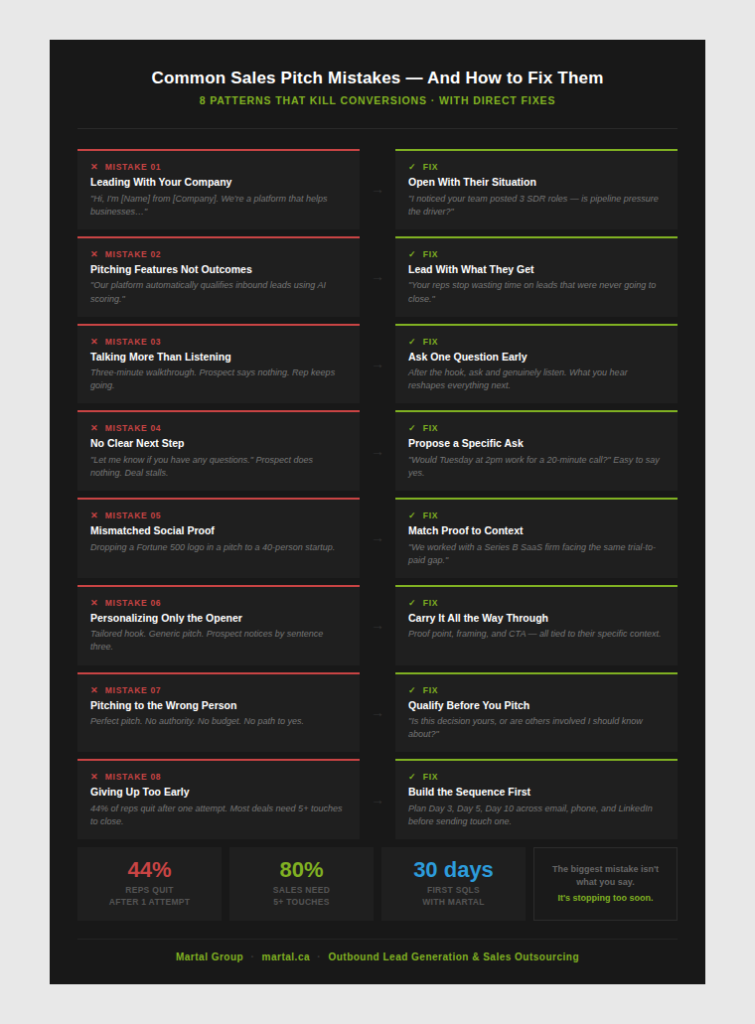
Mistake 1: Leading With Your Company Instead of Their Problem
This is the most common sales pitch mistake — and the one with the most direct fix.
The opening line of most pitches sounds like: “Hi, I’m [Name] from [Company]. We’re a [category] platform that helps companies [generic outcome].” The prospect hears their name, your company name, and a category they’ve heard twenty times before. Nothing in that sentence is about them.
The fix: Open with an observation about their situation, not a description of yours. “I noticed your team just expanded into enterprise accounts — that usually means outbound qualification becomes the bottleneck” is about them before it’s about you. Lead with what you know about their world, and let the company introduction follow naturally from why that context makes your call relevant.
Mistake 2: Pitching Features Instead of Outcomes
Most reps default to describing what their product does rather than what the buyer gets. Feature-led pitches generate evaluation, not desire. Buyers don’t buy features — they buy the version of their business where a specific problem no longer exists.
The fix: For every feature you’re tempted to describe, ask: “What does this mean for the buyer’s business, specifically?” Then lead with that. “Our platform automatically qualifies inbound leads” becomes “your reps stop wasting time on leads that were never going to close.” Same capability, entirely different emotional register.
Mistake 3: Talking More Than Listening
The instinct to fill silence with product information is understandable — it feels like progress. It isn’t. Research consistently shows that top-performing sales reps spend more time listening than talking in initial conversations. A prospect who talks about their situation is a prospect who is engaging. A prospect who sits quietly through a feature walkthrough is a prospect who is waiting for it to end.
The fix: Build questions into the pitch architecture rather than treating them as interruptions. After your hook, ask one question and genuinely listen to the answer. Let what you hear reshape what you say next. The pitch that adapts to what the prospect actually tells you will always outperform the pitch that delivers what you planned to say regardless of their response.
Mistake 4: Ending Without a Clear Next Step
This one costs more deals than almost any other single mistake. A pitch that ends with “let me know if you have any questions” or “feel free to reach out” puts the entire burden of momentum on the prospect — and prospects, by default, do nothing. Inertia is the enemy of every sales process.
The fix: Close every pitch — in every channel, at every stage — with a specific, low-friction ask. Not “let me know” but “would Tuesday at 2pm work for a 20-minute call?” Not “feel free to reach out” but “I’ll send over the case study today — can I follow up Thursday to hear your reaction?” The ask should be easy to say yes to and impossible to misunderstand.
Mistake 5: Using Social Proof That Doesn’t Match the Buyer’s Context
Dropping a well-known client name into a pitch feels like credibility. It can actually backfire if the reference doesn’t match the prospect’s situation. A Fortune 500 logo means nothing to a 50-person SaaS startup trying to figure out if your solution scales down. A startup case study means nothing to an enterprise procurement lead looking for vendor stability.
The fix: Match your proof point to the buyer’s context — company size, industry, growth stage, and the specific problem they’re solving. “We worked with a Series B SaaS company in your space that was facing the same trial-to-paid conversion gap” is worth more than a famous logo that doesn’t map to their situation. Relevance outperforms prestige in almost every B2B sales conversation.
Mistake 6: Personalizing the Opening But Not the Pitch
Many reps have learned to open with a personalized hook — a reference to the prospect’s LinkedIn activity, a recent funding round, a company announcement. The opening feels tailored. Then the pitch reverts to a standard script that could have been sent to anyone.
The fix: Carry the personalization through the entire pitch, not just the opener. If you open by referencing their Series B, your proof point should come from a comparable company at that stage. If you open by referencing a hiring pattern, your solution framing should speak directly to the scaling challenge that pattern implies. The personalized opening earns attention. A personalized pitch earns a meeting.
Mistake 7: Pitching to the Wrong Person
A pitch delivered to someone without authority, budget, or influence over the buying decision is a pitch that will never close — regardless of how well it’s constructed. This is especially common in outbound where list quality determines whether you’re reaching decision-makers or gatekeepers.
The fix: Qualify the audience before investing in the pitch. In cold outbound, this means building your prospecting list around the titles, seniority levels, and organizational structures that match your actual buyer — not just the company that fits your ICP. In live conversations, it means asking early: “Is this the kind of decision that sits with you, or are there others involved I should be aware of?” That question isn’t presumptuous. It’s efficient — and experienced buyers respect the directness.
Mistake 8: Giving Up Too Early
As covered in Example 9: 80% of sales require five or more follow-up touches, yet 44% of reps quit after one (The Brevet Group). The most common sales pitch mistake isn’t what happens during the pitch — it’s that the pitch never happens because the rep stopped reaching out before the prospect was ready to engage.
The fix: Build a structured omnichannel follow-up sequence before you send the first message — not after you don’t hear back. Know in advance what Day 3, Day 5, and Day 10 look like across email, phone, and LinkedIn. When the sequence is planned, persistence becomes a system rather than a judgment call made under pressure.
AI Sales Pitch Generators: What They Can and Can’t Do For You
The question “can AI write a good sales pitch for me?” now appears across Reddit threads, LinkedIn discussions, and Google searches at a volume that reflects a real shift in how sales teams are approaching outreach. The honest answer is: yes, with significant caveats — and understanding those caveats is what separates reps who use AI to sharpen their pitches from those who use it to produce polished noise at scale.
AI-assisted outreach already improves response rates by an average of 28% compared to manually drafted messages when used well — but that lift comes from the quality of the personalization signals fed into the tool, not from the tool itself. (6) The AI doesn’t know your prospect. You do. The AI doesn’t know what happened on the last call, what matters most to this specific buyer, or how to read the nuance of a cold email reply that said “not right now” in a way that means “try me again in Q3.” Those judgments are human.
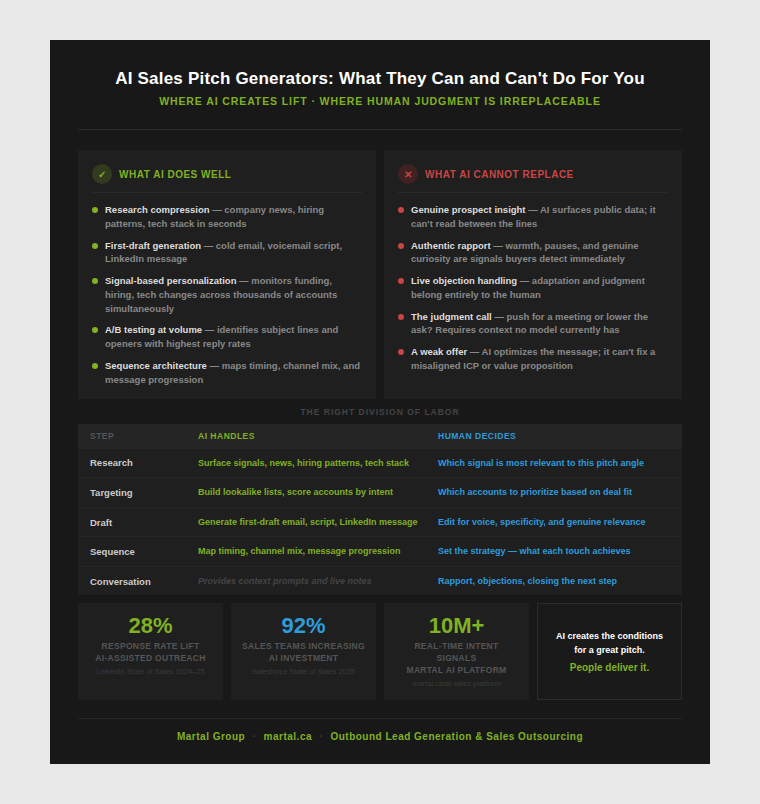
What AI Sales Pitch Tools Do Well
Used correctly, AI pitch generators and AI-assisted outreach tools deliver genuine value in several areas:
- Research compression: AI can surface relevant information about a prospect — their role, their company’s recent activity, their industry’s current challenges — in a fraction of the time manual research takes. That raw material is what personalized pitches are built from
- First-draft generation: A well-prompted AI tool can produce a credible cold email draft, a voicemail script, or a LinkedIn message framework in seconds. That draft still needs human editing — but starting from something is faster than starting from nothing
- Signal-based personalization at scale: The most sophisticated AI sales tools don’t just write copy — they monitor real-time intent signals (funding rounds, hiring patterns, technology changes) and build outreach around those moments automatically. This is where AI creates the largest lift, because relevance at the right moment is something manual processes can’t replicate at volume
- A/B testing and optimization: AI tools can analyze which subject lines, openers, and calls to action generate the highest reply rates across large send volumes — surfacing patterns that individual reps would never identify on their own
- Sequence architecture: AI can map out a full omnichannel follow-up sequence — the timing, the channel mix, the message progression — based on what has worked across comparable campaigns
What AI Sales Pitch Tools Cannot Do
This is the more important list for anyone relying on AI to replace rather than augment their pitch process:
- Generate genuine insight about the prospect’s specific situation. AI can surface public data. It cannot replicate the observation a skilled rep makes after studying a company’s G2 reviews, reading their last investor letter, or noticing that their most recent job postings suggest a strategic pivot
- Build authentic rapport. The conversational warmth, the well-timed pause, the follow-up question that shows genuine curiosity — these are human signals that prospects are wired to detect and respond to. A pitch that feels generated is a pitch that feels disposable
- Handle objections in real time. A live sales conversation involves adaptation, listening, and judgment that no static pitch generator can replicate. AI supports the setup; humans own the conversation
- Replace the judgment call. Whether to push for a meeting or offer a lower-commitment ask, whether to reference a painful truth or soften the approach, whether a prospect’s silence means disinterest or just a busy week — these are calls that require context, experience, and human reading of the situation
- Make a mediocre offer compelling. If the underlying value proposition is weak or the targeting is wrong, a better-written pitch won’t fix it. AI optimizes the message — it can’t compensate for a misaligned offer or a poorly defined ICP
How Martal Uses AI in Outbound Pitch Execution
Martal’s AI Sales Platform is built on exactly this philosophy: AI handles the research, signal monitoring, and personalization infrastructure — so our Sales Executives can focus entirely on the human side of selling.
The platform monitors 10M+ real-time intent signals, builds enriched prospect profiles from 300M+ verified contacts, and generates personalized outreach sequences trained on 15+ years of B2B outbound campaign data. But the pitch itself — the judgment about which insight to lead with, how to frame the problem, which proof point will land with this specific buyer — is made by a senior Sales Executive with real experience in that vertical.
That combination is what drives the results in the case studies referenced throughout this guide. AI creates the conditions for a great pitch. People deliver it.
If you want to see how this works in practice — how AI-powered research and signal monitoring translate into a coordinated outbound campaign your team doesn’t have to manage —our AI SDR Platform overview is a good starting point. Or if you’d prefer to hand the execution off entirely, book a consultation and we can show you what a fully managed campaign looks like for your specific market.
A Practical Guide to Using AI for Your Sales Pitches Right Now
You don’t need an enterprise AI platform to start using AI more effectively in your pitch process. Here’s a practical framework for using the tools most sellers already have access to:
Step
What to Use AI For
What to Do Yourself
1. Research
Surface company news, funding data, hiring patterns, tech stack
Identify which signal is most relevant to your pitch angle
2. ICP Targeting
Build lookalike lists, score accounts by intent signal
Decide which accounts to prioritize based on deal fit
3. Draft Generation
Generate first-draft cold email, voicemail script, LinkedIn message
Edit for voice, specificity, and genuine relevance
4. Subject Line Testing
A/B test subject lines across send volume
Choose the winner and understand why it worked
5. Sequence Design
Map timing, channel mix, and message progression
Set the strategy — what you’re trying to achieve at each touch
6. Performance Analysis
Identify which messages generate the highest reply and meeting rates
Decide what to change and why based on what you’re hearing
The division of labor is consistent: AI handles the repeatable, data-intensive work. Human judgment handles the strategic and relational decisions. Reps who understand that division — and use AI for what it’s actually good at — are the ones seeing the 28% response rate improvement the research documents.
Conclusion: What Makes a Sales Pitch Work in Any Environment
The sales pitch has evolved significantly — in channel, in format, in the expectations buyers bring to every interaction. But the core principle hasn’t moved: know your buyer, speak to what they actually care about, and make it easy for them to say yes to the next step.
The 10 examples in this guide each illustrate a different context and a different format. But looking across all of them, the same handful of principles shows up consistently in every pitch that converts.
Be genuinely customer-centric. The pitches that win aren’t the most polished — they’re the most relevant. Personalization isn’t a tactic layered on top of a pitch; it’s the architecture of the pitch itself. The prospect’s situation, language, and priorities should shape every sentence, not just the opener.
Embrace the full channel mix — as a sequence, not a scatter. Omnichannel outreach isn’t about being everywhere simultaneously. It’s about coordinating email, cold calling, and LinkedIn outreach as a connected sequence where each touch builds on the last. Prospects experience familiarity and continuity instead of disconnected noise.
Lead with insight, not inventory. The data-driven pitch, the storytelling pitch, the hyper-tailored proposal — all of them open with something the prospect finds valuable before they ask for anything in return. That sequencing is what separates a consultative seller from a product-pusher.
Earn brevity. Shorter pitches outperform longer ones in every format. The discipline of compression forces clarity — and clarity is what moves buyers. If you can’t reduce your pitch to its essence, the longer version won’t compensate.
Follow up with value, not reminders. Persistence without substance costs goodwill. The reps who stay in deals longest aren’t the most aggressive — they’re the most useful. Every follow-up touch should give the prospect a reason to keep the conversation open.
Treat every pitch as a learning system. The best sales teams treat reply rates, meeting conversion rates, and objection patterns as feedback on the pitch itself — not just the channel or the list. What you hear from prospects is the most accurate market intelligence available. Use it.
One thread runs through all of it: authenticity. The technique in this guide — the frameworks, the templates, the channel-specific tactics — is only as effective as the genuine curiosity and care behind it. Buyers are sophisticated. They can sense when they’re being helped versus handled. The reps who build real pipeline over time are the ones who pitch because they believe they can actually solve something for the person on the other side of the conversation.
Ready to Build a Pipeline That Doesn’t Depend on One Perfect Pitch?
The most effective B2B pitch strategies aren’t built on individual brilliance — they’re built on systems. Consistent targeting, coordinated omnichannel outreach, structured follow-up, and continuous optimization across cold calling, cold emailing, and LinkedIn lead generation working together as one campaign.
That’s exactly how Martal’s Sales Executives operate. As your on-demand sales partner, we handle the full outbound lead generation process — from ICP definition and prospect research to personalized omnichannel outreach and SQL delivery — so your team focuses on closing, not prospecting.
Trusted by 2,000+ B2B brands across 50+ industries over 16+ years. Ranked #1 in Lead Generation on Clutch. Onboarding in 7–10 business days. Book a consultation to see what a qualified pipeline looks like for your specific market — and how quickly we can start building it.
References
- Salesforce.com
- Ringcentral.com
- Demand Gen Report
- Qwilr.com
- Cirrus Insight
- Highspot
- Instantly.ai
FAQs: Sales Pitch
What Is the Difference Between a Sales Pitch and a Sales Presentation?
A sales pitch is short, conversational, and designed to earn the next step — a meeting, a reply, a follow-up call. It typically happens early in the relationship, before the prospect has committed to evaluating your solution seriously. A sales presentation is longer, more formal, and usually occurs after interest has already been established — often in front of a buying group or decision committee. Both follow the same core logic: understand the audience, address their problem, demonstrate value. The difference is the moment they serve and the depth of information they carry. A pitch opens the door; a presentation walks through it.
How Do You Start a Sales Pitch?
Start with something specific about the prospect’s situation — not a company introduction. The strongest openers reference a real trigger: a hiring pattern, a funding round, a recent LinkedIn comment, a market shift relevant to their role. For example: “I noticed your team just expanded into enterprise accounts — that usually means outbound qualification becomes the bottleneck. Is that on your radar?” That opener is about them before it’s about you — which is the only framing that earns attention in the first 10 seconds of any pitch, in any channel.
What Should a Sales Pitch Include?
Every effective sales pitch — regardless of format or channel — includes five elements: a hook that earns attention in the first sentence, a problem statement that demonstrates understanding of the prospect’s specific situation, a solution that connects your offer directly to that problem, proof in the form of a relevant result or case study, and a clear call to action that proposes a specific next step. This framework applies to cold emails, cold calls, LinkedIn messages, video pitches, and live presentations. The medium changes the length and tone — the logic stays the same.
How Do You Personalize a Sales Pitch at Scale?
Personalization at scale isn’t about writing every pitch from scratch — it’s about identifying the right signal and building your message architecture around it. The most effective signals in B2B outbound include hiring activity (signals growth priorities), funding rounds (signals budget availability and growth mandate), technology changes (signals active problem-solving), and content engagement (signals current focus areas). The framework: one signal, one sentence, one problem, one ask. That’s a personalized pitch. Scale comes from a targeting process that surfaces the right signals consistently — which is what intent-based prospecting tools, including Martal’s AI Sales Platform, are built to do.
How Many Follow-Ups Should a Sales Pitch Have?
There is no universal number — but 8–12 touches over 30–45 days is standard for a high-value B2B opportunity and not excessive when each touch adds genuine value. The research benchmark is clear: 80% of sales require five or more follow-up touches, yet 44% of reps quit after one. What makes a sequence feel excessive isn’t the number of touches — it’s the absence of value at each one. Every follow-up should pass the “so what” test: if the prospect can’t identify a reason to respond beyond politeness, the message isn’t ready to send. Build a structured omnichannel follow-up sequence — email, phone, LinkedIn — before you send the first message, not after you don’t hear back.
What Is an AI Sales Pitch Generator and Should You Use One?
An AI sales pitch generator is a tool that uses artificial intelligence to draft, personalize, or optimize sales outreach — cold emails, call scripts, LinkedIn messages, and follow-up sequences. Used well, these tools compress research time, surface intent signals, generate credible first drafts, and improve response rates. AI-assisted outreach improves reply rates by an average of 28% compared to manually drafted messages when the personalization signals are strong. The caveat: AI generates the raw material — the human judgment about which insight to lead with, how to frame the problem, and how to handle the live conversation is irreplaceable. Use AI to sharpen your pitch infrastructure. Rely on experienced Sales Executives to deliver it.