
 Martal
 Technology
 Education and training
 Web Development and UI / UX
 Healthcare/Medical
 Logistics and Supply Chain
 Information Technology
 Insuretech and Financial Services
 Marketplaces
 Software Development
 E-commerce and retail
 AI and Machine Learning
 Energy and Solar
 Manufacturing
 Security and Surveillance
 Digital Marketing Agency
 Transportation
 MSP
MSP
 Telecom
 B2B SaaS
 Cybersecurity
 HR tech
 Fintech
 Cleantech
 Consulting
Cold, Warm, and Hot Leads Explained: The 2026 B2B Sales Guide
Major Takeaways: Cold Warm Hot Leads
Cold leads fit your ICP but have no prior engagement, warm leads have interacted but haven’t committed, and hot leads have explicit intent and urgency. Cold outreach converts at 2–3% on average in 2026, warm leads at 5–15%, and hot leads at 20–40% — making accurate stage classification one of the highest-leverage decisions in any outbound program.
The cold-warm-hot framework is useful for thinking, but a four-stage funnel — Prospect → MQL → SQL → Booked — adds the precision sales teams need to forecast pipeline, report results, and pinpoint exactly where the funnel is leaking. Most pipelines leak at the MQL-to-SQL transition, not at the top, which is why raw volume reporting masks the real conversion problem.
Five signals reliably indicate the warm-to-hot transition: questions shifting from features to implementation, a second stakeholder joining the conversation, pricing or procurement questions surfacing, a specific timeline entering the discussion, and engagement velocity intensifying. The combination of a new stakeholder plus a defined timeline is the single strongest predictor of close — deals showing both signals typically sign within 30–60 days.
Six signals consistently move prospects from cold to warm: funding events, hiring surges, technology stack changes, leadership changes, content engagement clusters, and competitor activity. Signal-based outbound outperforms volume-based outbound by a wide margin because the timing is right, not because the message is louder — teams that switch from static lists to signal-triggered cadences typically see a 2x lift in reply rates within 60 days.
Within five minutes. Responding inside the 5-minute window makes you 21 times more likely to qualify the lead compared to waiting 30 minutes, and 78% of B2B buyers purchase from the first company that responds. Yet the industry average response time sits at 42 hours, with 55% of companies taking five or more days — which is where most hot leads are lost to faster competitors.
A 14-month campaign with an industrial tools manufacturer entering the US market produced 1,596 prospects engaged, 1,364 MQLs (an 85% MQL rate), 203 SQLs, and 107 booked meetings. The insight isn’t the volume — it’s the funnel shape. Healthy outbound compresses aggressively at the MQL-to-SQL stage because disciplined qualification keeps pipeline full of real opportunities instead of optimistic ones.
AI doesn’t change the cold-warm-hot framework — it changes execution speed. Continuous signal monitoring replaces periodic review, account-level qualification replaces contact-level scoring, and timing-based outreach replaces volume-based outreach. The teams winning outbound in 2026 are the ones using AI to handle the mechanical parts of lead progression, freeing human reps to focus on the conversations that actually close deals.
When internal teams can’t sustain the 6–8 touch cadence cold outreach requires, when warm leads are stalling because nobody has time to nurture them properly, or when hot leads are lost to 42-hour response times. A managed partner like Martal runs the full cold-warm-hot progression as one coordinated motion — same onshore team, no handoffs, AI-driven signal monitoring — which is what consistent cold-to-hot conversion actually requires at scale.
Introduction
A pipeline full of names doesn’t equal a pipeline full of revenue.Up to 73% of B2B leads are never contacted at all (2), and even among those that are, the gap between prospect engaged and deal closed is where most outbound programs stall — not at the top of the funnel.
The reason is structural. Every lead sits somewhere on a temperature spectrum: cold (no relationship, no awareness), warm (some engagement, no commitment), or hot (active intent, ready to buy). Treat them all the same, and your conversion rate flatlines. Treat them differently — with the right cadence, the right channel, and the right speed — and the same lead pool produces multiples of the pipeline.
This guide breaks down what cold, warm, and hot leads actually are in B2B, how to tell which is which (the part most articles skip), and how to move them through the funnel. We’ve built it from 16+ years of running outbound for B2B brands across SaaS, manufacturing, fintech, cybersecurity, and 50+ other verticals — so the framework reflects what actually moves leads, not what sounds good in a slide deck.
This guide is created to help B2B sales and revenue leaders stop losing leads in the warm-to-hot transition and to make the cold-to-close progression a system, not a hope.
Classification of Sales Leads — Hot, Warm, and Cold Defined
Warm leads convert at 5-15%, far higher than the 1-3% conversion rate for cold leads, making them your top-value prospects that deserve immediate attention.
Reference Source: Monday
The classification of sales leads as hot, warm, and cold isn’t marketing jargon — it’s a working framework that determines how a sales team allocates time, channels, and budget. Each category reflects two things: how familiar the prospect is with your company, and how close they are to a buying decision.
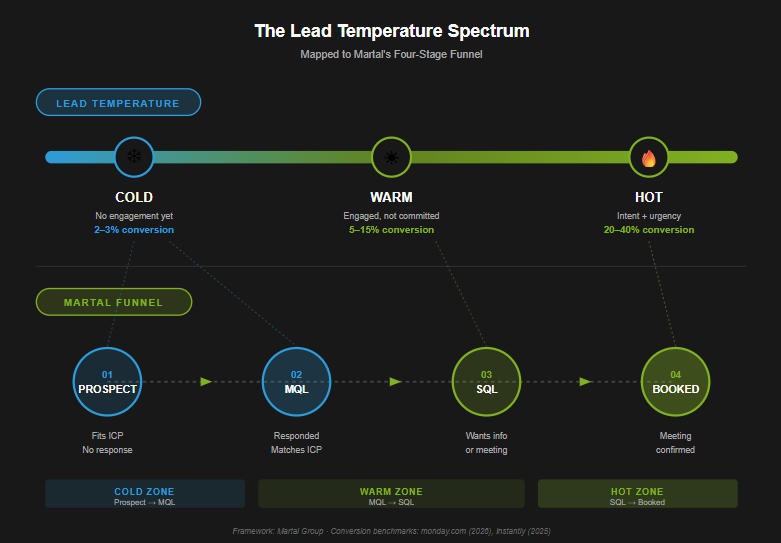
Here’s how to define each clearly.
Cold Leads
Cold leads are prospects with no prior relationship to your company. They fit your ideal customer profile on paper — right industry, right role, right company size — but they haven’t engaged with your brand, requested information, or signaled buying intent. They may not even recognize the problem you solve yet.
In outbound, cold leads are the starting point: names sourced from a verified database, surfaced through intent signals, or identified via lookalike modeling against your existing customer base. Reaching them means leading with insight — a relevant pain point, an industry trigger, a specific outcome — not a pitch. Cold outreach in B2B converts at roughly1–3% on average in 2026 (1), so the goal isn’t to close on first contact. It’s to earn a response.
Warm Leads
Warm leads have engaged. They’ve opened your emails, clicked through, attended a webinar, downloaded a guide, accepted a LinkedIn connection, or replied to a sequence with something other than “remove me.” They know your company exists. They may even acknowledge they have a problem worth solving. What they haven’t done is committed to a buying conversation.
One thing we see often in outbound: warm leads are where most pipelines leak. Sales teams either over-pursue them with daily check-ins (which kills the relationship) or under-pursue them with quarterly newsletters (which lets them forget you exist). Warm leads typically convert at 5–15% when nurtured well and far less when handled passively (3).
Hot Leads
Hot leads have both intent and urgency. They’ve requested a demo, asked for pricing, agreed to a discovery call, or directly stated they’re evaluating solutions. They have a recognized need, the authority (or access to authority) to make a decision, and they’re operating on a timeline.
Hot leads are also rarely talking only to you. By the time a B2B prospect reaches the hot stage, they’re typically evaluating two to four vendors in parallel — which is why response speed at this stage is non-negotiable. Hot leads convert at 20–40% when handled correctly, and that range collapses fast with delay (3).
The practical difference
Cold leads need awareness. Warm leads need trust. Hot leads need speed. Treat them with the wrong approach and you waste the lead — pitch a cold lead and they ignore you, pressure a warm lead and they ghost you, slow-walk a hot lead and a competitor closes them. The framework only works when the response matches the stage.
The Martal Funnel — Prospect → MQL → SQL → Booked
The cold-warm-hot framework is useful for thinking. It’s not precise enough for operating.
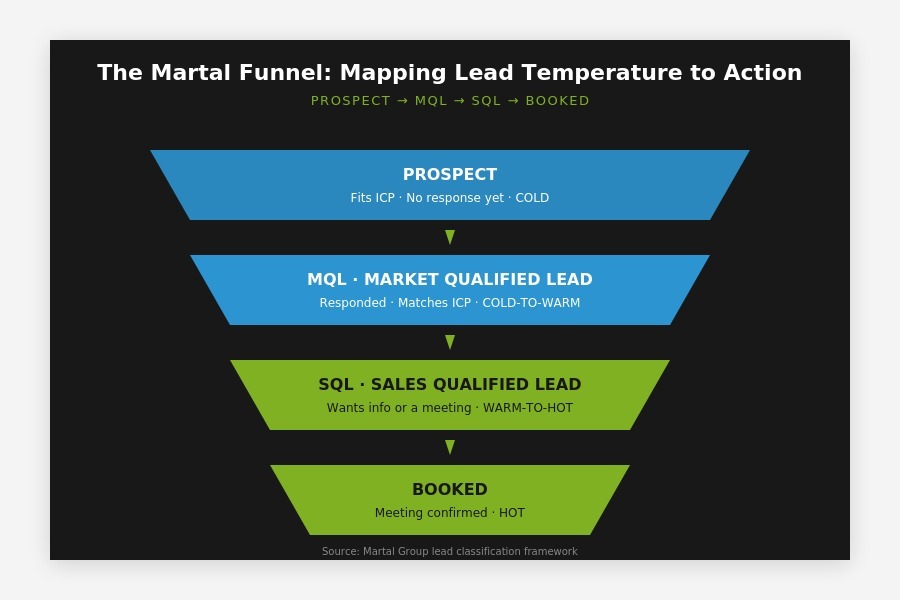
When we run outbound campaigns for B2B clients, we use a four-stage progression that maps directly onto the temperature spectrum but adds the precision sales teams need to forecast pipeline, allocate rep time, and report on results. Every lead in a Martal campaign moves through these four stages — and the stage determines what happens next.
Prospect — A person we’ve engaged or contacted. They fit the ICP, but they haven’t responded. A prospect is not yet a lead. This distinction matters: most agencies report “leads generated” and quietly count prospects in the same column. We don’t. A prospect is the cold end of the spectrum.
MQL (Market Qualified Lead) — A prospect who has responded to outreach and matches the client’s ICP. The response can be positive, neutral, or even an objection — what matters is that they’ve engaged. MQLs are early warm leads. They’ve signaled “this might be worth a conversation,” but they haven’t asked for one yet.
SQL (Sales Qualified Lead) — A prospect who is interested in taking the next step — asking for more information or requesting a meeting. SQLs are fully warm, tipping into hot. Qualification is based on authority and need: do they have the influence to advance the conversation, and do they recognize the problem we’re solving?
Booked — An SQL with a confirmed meeting on the calendar. This is where the lead becomes hot in the operational sense — a real conversation is scheduled, and the goal shifts from nurturing to closing.
How to Tell When a Lead Has Moved from Warm to Hot
Most sales teams can define warm and hot leads. Far fewer can consistently tell them apart in real time — which is why warm leads stall in the pipeline and hot leads get treated like warm ones while a competitor closes the deal.
The difference isn’t about how friendly the last email sounded. It’s about whether the prospect is doing the things a buyer does when they’re ready to buy.
The five signals that a warm lead has turned hot
1. They’re asking questions about implementation, not features.
Warm leads ask what your product does. Hot leads ask how it works inside their environment. When the conversation shifts from “what are your capabilities” to “how would this integrate with our current stack” or “what does onboarding look like for a team our size,” the prospect has already internalized the decision to buy — they’re now de-risking the how.
2. They’ve brought a second person into the conversation.
Nobody loops in a colleague on a solution they aren’t seriously considering. When a warm lead forwards your email to a peer, adds a director to the next call, or says “I need to bring in our VP of Ops on this,” the internal buying motion has started. That’s a hot signal, even if they haven’t said the word “purchase” once.
3. They’re asking about pricing, contracts, or procurement.
This one is obvious, but worth stating plainly because teams still miss it. Any question about pricing structure, payment terms, contract length, or procurement process is a direct buying signal. These questions don’t get asked in the abstract. If a prospect is asking them, they’re mentally comparing your proposal to a budget line.
4. They’ve introduced a timeline.
Warm leads say “we’re exploring options.” Hot leads say “we need to have something in place by Q2.” Specific timelines — a quarter, a compliance deadline, a fiscal year, a project kickoff — signal that the evaluation window is closing and a decision is imminent. When a timeline enters the conversation, the lead has entered the buying window.
5. Their engagement pattern has intensified.
A warm lead opens one email a week. A hot lead opens three emails in a day, clicks your pricing page, visits your case study library, and replies to an SDR within the hour. Response velocity is the most underrated hot-lead signal. When the rhythm of engagement suddenly compresses — faster replies, deeper questions, more tabs open on your site — the prospect has moved from “thinking about it” to “deciding now.”
A practical identification test
If a prospect exhibits one of these signals, they’re trending hot — put them on a faster cadence. If they exhibit two or more, treat them as hot. In our campaigns, the single strongest predictor of close is the combination of signals #2 (second stakeholder introduced) and #4 (specific timeline). When those two land in the same conversation, the deal is usually 30–60 days from close — provided nobody on the sales side slows it down.
Real example: an industrial tools manufacturer, 14-month campaign
In one campaign — an 80-year-old manufacturing brand entering the US electrical and safety market for the first time — our SEs engaged 1,596 prospects over 14 months. 1,364 converted into MQLs (an 85% MQL rate, because the ICP targeting was tight from day one). But the interesting number is what happened at the warm-to-hot transition: only 203 of those MQLs converted to SQLs, and 107 became booked meetings.
That 85% prospect-to-MQL rate paired with a much tighter MQL-to-SQL rate is typical of outbound done well — and it illustrates the point: not every warm lead should become hot. Qualification at the SQL stage is what keeps the pipeline full of real opportunities, not wishful thinking. The signals above are how we make that call.
Buying Signals That Warm a Lead Up in 2026
The question most sales teams quietly wrestle with isn’t “what’s a warm lead?” It’s “what actually warms a cold prospect up in the first place?”
In 2026, the answer is less about the touchpoint itself — the email, the call, the LinkedIn message — and more about the signal that made the touchpoint land. The teams generating the most MQLs per dollar aren’t sending more outreach. They’re sending outreach at the moment a buying signal fires.
The six buying signals that move prospects from cold to warm in 2026
1. Funding events. A fresh round of Series A, B, or C capital almost always triggers a budget refresh. New headcount gets approved. Tooling gets re-evaluated. Procurement loosens. A prospect who ignored your cold email for six months may reply within days if your outreach arrives the week their funding announcement goes public.
2. Headcount and hiring surges. When a company posts multiple roles for a specific function — say, three open security engineer roles or five new sales positions — they’re scaling that function. That’s the window when new tooling decisions get made. Scraping job boards for hiring pattern shifts is one of the highest-ROI intent signals available, and it’s still underused.
3. Technology stack changes. When a prospect drops one vendor and adopts another in an adjacent category, they’re actively reshaping their stack — and the decision-makers who made that call are primed for the next conversation. Technographic targeting is why outbound aimed at stack shifts converts at up to 4x standard benchmarks in our campaigns (4).
4. Leadership changes. A new CRO, CMO, VP of Sales, or CISO typically has 90 days to make their mark. That means new priorities, new vendor evaluations, and new pipeline reviews. Outreach that lands in a new leader’s inbox during the first 60 days of their tenure — framed around the goals they were hired to hit — converts at a materially higher rate than the same outreach sent to the person they replaced.
5. Content engagement clusters. A single whitepaper download is weak signal. But three pieces of content consumed in the same week — a pricing page view, a case study download, and a webinar attendance — is a buying signal as strong as most explicit requests. The pattern matters more than any individual action.
6. Competitor activity. When a prospect’s direct competitor publicly adopts a new solution, announces a strategic shift, or loses ground in the market, it creates a window of urgency. Outreach framed around what the competitor is doing — not what your product can do — cuts through the noise because it addresses a threat the buyer is already thinking about.
Why signal-based outreach outperforms volume-based outreach
The old outbound math was simple: send more, convert more. The 2026 math is different. Send fewer, better-timed messages to prospects in their buying window, and you can outperform a team sending 5x the volume into cold air. That’s the shift.
One thing we see often: clients who switch from static prospect lists to signal-triggered outbound typically see a 2x lift in reply rates within 60 days — not because the messaging changed, but because the timing did.
Real example: telecom equipment and services, 24-month campaign
For a telecom equipment provider, the campaign hinged on timing outreach to two specific signals: procurement cycles inside target accounts, and leadership changes at carrier customers. Over 24 months, the engagement produced 1,442 prospects engaged, 863 MQLs, 346 SQLs, and 339 booked meetings. The meeting-to-SQL ratio — 339 meetings from 346 SQLs — is what signal-based outbound actually looks like when the targeting is tight. Almost every qualified lead turned into a real conversation, because the outreach landed when the prospect was in a buying window, not a research window. Read the full telecommunications use case.
Cold Warm Hot Lead Nurturing — Stage-by-Stage Playbook
Every lead can move up or down the temperature spectrum — and most move down, because neglect is the default outcome of a busy pipeline.
The playbook below breaks out what actually works at each stage: how to thaw cold prospects without wasting effort, how to re-warm leads that went quiet, how to nurture warm leads into hot opportunities, and how to close hot leads before a competitor does. Every cadence rule here comes from 16+ years of running omnichannel outbound for B2B brands — and every mistake flagged is a mistake we’ve seen enough teams make to know it’s systemic, not accidental.
Nurturing Cold Leads (Turning Cold into Warm)
Convert cold leads to warm by maintaining 6-8 touchpoints in 2-3 weeks, ensuring each interaction adds value.
Reference Source: Rev-Empire
Cold outreach fails for three predictable reasons: the targeting is weak, the message is generic, or the follow-up stops too soon. Fix those three, and the rest follows. Here’s what actually works.
Lead with insight, not introduction. Cold leads don’t need to hear who you are. They need to hear something about their business they didn’t expect a stranger to know. A specific pain point tied to their industry, a trigger event in their company, or a comparison to how a similar buyer solved the same problem — anything that makes the prospect pause long enough to keep reading. “Companies like yours often struggle with X” is weaker than “We noticed your team just hired three security engineers — usually that signals a tooling review in the next 90 days.” The second message earns a reply because it proves you did the work.
Commit to 6–8 touches minimum. Cold outreach is a cadence game, not a single-touch game. Most reps quit after two or three attempts, which is roughly the point at which cadences actually start converting. In 2026, B2B cold email reply rates hover around 5.8% and cold call conversion rates sit between 2–3% — which means a one-touch approach mathematically cannot work. Cadences that combine email, LinkedIn, and phone across 3–4 weeks consistently outperform any single-channel sequence.
Run it omnichannel, not multichannel. The distinction matters. Multichannel means running parallel sequences in each channel — email, LinkedIn, phone — that don’t reference each other. Omnichannel means the channels build on each other: the LinkedIn message references the email that was sent three days earlier, the voicemail references both, and the whole sequence feels like one coordinated conversation. Prospects don’t experience omnichannel as more noise — they experience it as familiarity.
Earn the right to pitch by first offering something useful. Cold leads don’t agree to demos. They agree to conversations that sound like they might be worth 15 minutes — a teardown of their current approach, a benchmarking call, a market insights discussion. The smaller the ask, the higher the yes rate. Once the conversation is booked, the demo becomes possible.
Measure cold outreach by MQLs, not meetings. The most common outbound reporting mistake is holding cold campaigns to a booked-meeting standard in week two. The first output of a healthy cold campaign is MQLs — prospects who responded and fit the ICP — and those typically take 30 days to surface at volume. Booked meetings come from the 30–60 day window, not the first two weeks.
The takeaway: Cold outreach works when the targeting is sharp, the cadence is omnichannel, and the follow-up persists past the point most reps quit. Teams that nail those three elements routinely outperform teams sending 5x the volume with less discipline.
Re-warming Cold Leads Who Went Silent
Not every cold lead stays cold. Many start warm — they open the first email, click a link, even reply once — and then go silent for weeks or months. Technically they’re not cold leads anymore. Practically, they behave like cold leads until something changes.
Re-warming a silent lead is a different motion than reaching a net-new cold prospect. The targeting is already right (they’re in your CRM for a reason). The familiarity is already there (they know your name). What’s missing is a reason to re-engage now. Here’s how to create one.
Wait for a trigger, then re-open the conversation. A silent lead who suddenly has a new role, a new funding round, a new product launch, or a new competitor entering their market has a fresh reason to care. Setting up alerts for those triggers across your CRM database turns “ghosted leads” into a renewable pipeline source. When the trigger fires, the re-engagement message writes itself: “Saw the announcement about X — last time we spoke, you mentioned Y wasn’t quite the right fit. I wanted to check back in light of the change.”
Change the angle, not just the sender. The most common re-engagement mistake is sending the same message from a new SDR and hoping for a different result. If the first angle didn’t work, the same angle from a different person won’t either. Come back with a different entry point: a case study from a peer company, a shifted value proposition aimed at a different pain, or a piece of content that reframes the problem. The goal is to give the silent lead a reason to look again, not a reason to hit delete faster.
Use breakup emails — but only after the sequence has genuinely ended. A “breakup email” that explicitly closes the loop (“It sounds like now isn’t the right time — I’ll step back unless you let me know otherwise”) consistently produces reply rates 2–3x the sequence average. The reason is honest: the email reduces friction. The prospect doesn’t have to engage to avoid feeling rude — which is exactly why many of them finally do engage. Used too early, breakup emails feel manipulative. Used as a genuine close to a real cadence, they work.
Recycle cold leads into lower-frequency nurture, not out of the database. Most teams bin silent leads after 90 days. Better practice: move them into a long-cycle drip that sends one genuinely useful piece of content every 4–6 weeks — an industry report, a case study, a benchmarking piece — with no pitch attached. Over 12 months, a meaningful percentage of “dead” leads re-engage on their own timeline, not yours. Southern Code, a software development client we’ve worked with on nurture cycles as long as 10 months, closes roughly one deal per month on this longer-cycle rhythm alone. The lesson: patience compounds when the database is the right size and the content is genuinely useful.
The takeaway: A silent cold lead isn’t a dead lead. It’s a lead waiting for the right trigger, the right angle, or the right time. The sales teams that win the re-warming game don’t chase silent leads harder — they get better at recognizing when to come back.
Nurturing Warm Leads (Turning Warm into Hot)
71% of companies say lead nurturing helps them generate warmer, more sales-ready leads.
Reference Source – DemandSage
Warm leads convert at 5–15% on average, but that range is deceptive. Warm leads that are handled well convert at the top of that range (3). Warm leads handled passively — the “we’ll circle back next quarter” approach — convert at or below the cold-lead rate. The difference isn’t effort. It’s pattern.
Run a consistent rhythm, not a reactive one. A warm lead needs steady presence, not sporadic check-ins. In practice, that’s one useful touchpoint every 7–14 days — an email, a LinkedIn comment, a piece of content, a voice note, a relevant article — not a “just checking in” message. “Just checking in” is the phrase warm leads read as “this rep has nothing new to say,” which is usually accurate. Every touch needs to carry a reason to exist: a new insight, a new angle, a new piece of context the prospect didn’t have before.
Personalize with information they’ve already given you. By the warm stage, the prospect has usually shared something about their situation — a timeline constraint, a technology they use, a pain point they mentioned in passing. Use it. A follow-up that references what they told you on the last call (“You mentioned Q2 was when budget resets — I wanted to check back as that gets closer”) outperforms a generic touch by a wide margin because it proves you listened. The teams that get this right treat every call as research for the next one.
Address the objection they haven’t said yet. Warm leads almost always have one unspoken hesitation — price, timing, internal politics, a recent bad vendor experience. Surface it proactively. “A lot of teams evaluating us at this stage worry about [specific concern]. If that’s on your mind, here’s how we typically handle it…” gives the prospect permission to raise the real issue without feeling confrontational. Most warm leads don’t stall because they’re not interested. They stall because a question they couldn’t articulate went unanswered.
Introduce a second decision-maker early, not late. If the warm lead is going to become hot, it happens when a second stakeholder gets involved — the VP, the CFO, the peer department. Don’t wait for the prospect to bring that person in on their own. Ask: “Who else on your team would want to be part of the evaluation? I’m happy to set up a call that covers what matters most to them.” Warm leads often stall because the internal champion doesn’t know how to sell your solution up the chain. Your job is to make that easier.
Send real proof at the right moment. Case studies from lookalike companies land hardest when a warm lead is weighing a decision. A case study sent before the prospect is ready reads as sales collateral. The same case study sent in response to a specific objection reads as evidence. Match the proof to the stage: early-warm gets industry context, mid-warm gets peer comparisons, late-warm gets numerical outcomes similar to what they’re evaluating.
A real example of what warm nurture at scale looks like: In a 26-month engagement with a B2B SaaS CMMS/EAM provider, consistent mid-cycle nurturing produced 1,708 prospects engaged, 936 MQLs, 185 SQLs, and 144 booked meetings. The number worth paying attention to is the ratio of MQLs to SQLs — roughly 1 in 5 warm leads converted to sales-qualified. That’s what healthy warm-lead nurturing looks like at volume: most warm leads don’t advance, and that’s correct. The job isn’t to force every warm lead hot. It’s to identify the ones that genuinely should be — and to stop wasting cycles on the ones that won’t.
The takeaway: Warm leads don’t need more contact. They need better contact — with rhythm, relevance, and a real reason for every touch.
Capitalizing on Hot Leads (Sealing the Deal)
Responding to a lead within 5 minutes makes you 21 times more likely to qualify them than waiting 30 minutes.
Reference Source – Rework
Hot leads are the easiest stage to win and the easiest stage to lose. Easy to win because the buyer has already done the internal work to decide they want a solution. Easy to lose because speed matters more than skill at this point — and most sales teams still measure hot-lead response time in hours, not minutes.
The B2B average response time is currently around 42 hours (6), with 55% of companies taking five or more days to respond (7). That gap — between what the data says works and what most teams actually do — is where hot leads get lost to competitors.
The five-minute rule is not a nice-to-have. It’s a structural advantage. 78% of buyers end up buying from the first company that responds (5). When a lead requests a demo, calls a sales line, or submits a pricing inquiry, the clock starts immediately. Reply in five minutes and you’re almost certainly the first vendor to respond. Reply in an hour and you’re usually the third. Reply the next day and the prospect has already moved to a shortlist you’re no longer on.
Move to a live conversation immediately. Hot leads shouldn’t be bouncing through another round of automated emails. Get a real person on the phone, on a video call, on LinkedIn DMs — whatever channel the prospect has already used to reach you. The transition from automated nurture to human conversation is a signal to the prospect that they’re being taken seriously. Nothing cools a hot lead faster than a no-reply confirmation email in response to a demo request.
Reduce the friction between “yes” and “signed.” Every step between the prospect’s intent and the contract is a chance to lose the deal. Prep the proposal before the call so you can send it the same day. Have standard paperwork ready. Know who your internal approvers are and how fast they can move. The tactical goal of the hot stage is to compress the time between verbal commitment and signed agreement — because the longer that gap, the more opportunities for internal objections, budget re-reviews, or competitor counter-offers to derail the deal.
Confirm the timeline — and the stakeholders. Ask directly: “What’s your expected decision timeline, and who else is involved in signing off?” Hot leads typically answer both questions honestly because they want the deal to move too. If a hot lead goes suddenly quiet, it’s almost always because a stakeholder you didn’t know about entered the room. Pre-empt that by surfacing the full buying committee before the conversation goes cold.
Handle the hot lead yourself — don’t escalate, don’t delegate. At the hot stage, rep consistency matters. Passing a hot lead from an SDR to an AE to a CSM in 48 hours — which most sales orgs consider standard handoff — introduces friction the prospect feels. When possible, the same person who nurtured the lead into the hot stage should be the one carrying them through to signature. Continuity compresses timelines.
A real example of what speed looks like in practice: For an AI freight and transportation client, we ran a 3-month campaign built around a specific rhythm: hot-lead response within 30 minutes, SE follow-through to booked meeting without handoff, and discovery calls scheduled within 5 business days of initial response. Outcome: 353 prospects engaged, 160 MQLs, 122 SQLs, and 108 booked meetings — most of them in the back half of the engagement, once the speed rhythm was fully established. The 3-month timeline is worth noting. Hot leads don’t wait for quarterly planning cycles.
The takeaway: Winning hot leads isn’t about pitching harder. It’s about responding faster, compressing friction, and keeping the same hands on the relationship from engagement to signature. Speed is the advantage most competitors still don’t have.
How AI Is Changing Lead Temperature Classification
The cold-warm-hot framework hasn’t changed in 2026. What’s changed is how quickly — and how accurately — a sales team can tell which is which.
For most of the last decade, lead temperature was a judgment call. A rep looked at a CRM record, skimmed the email thread, checked a notes field, and made an educated guess about which stage the prospect was in. The better reps got it right most of the time. The busy reps got it right some of the time. Nobody could do it at scale across thousands of accounts without something breaking.
That’s what agentic AI is solving.
Continuous signal monitoring, not periodic review. Traditional lead scoring runs on rules a RevOps team wrote six months ago: if a prospect downloads two whitepapers, add 10 points; if they open a pricing page, add 20. The problem is that the signals that actually matter in 2026 change faster than the rules get updated. Agentic systems monitor signals continuously — intent events, funding announcements, hiring patterns, tech stack changes, leadership moves — and re-score accounts in real time. A lead that looked cold on Monday can legitimately look warm by Thursday because a trigger event fired, and the system catches it without anyone having to open a dashboard.
Qualification happens at the account level, not the contact level. Legacy lead scoring treats every contact as an independent record. AI-based qualification understands that a warm signal from a VP of Engineering and a warm signal from a CFO at the same company mean something different than two warm signals from unrelated accounts. Buying decisions now involve 13 internal stakeholders and 9 external influencers on average (8), with the system aggregating across the buying committee, how B2B deals actually get made in 2026 .
Outreach timing improves, not just outreach volume. The biggest shift isn’t that AI writes more emails. It’s that AI decides when to send them. A well-targeted message sent into a cold moment converts at the same rate as spam. The same message sent at the moment a prospect’s trigger event fires converts at multiples of the baseline. Martal’s AI Sales Platform monitors 10M+ intent signals across funding events, hiring surges, tech adoption, and content engagement (4) and the campaign orchestrator uses those signals to time outreach to the window when the prospect is most likely to respond, not the day the sequence was scheduled.
Response velocity compresses at every stage. What used to take an SDR 20 minutes of manual research before a call — company context, tech stack, recent news, competitive signals — now takes 20 seconds with research agents doing the work in the background. That time compounds. Across a team running 200–300 outreach touches a day, the difference between “research before every call” and “research is already done when the call starts” is roughly a full rep’s worth of productivity per week. That’s not replacing the SE. It’s freeing the SE to spend their time on what actually closes deals — the conversation itself.
What AI doesn’t change
The temperature framework still matters. Cold leads still need education, warm leads still need nurturing, hot leads still need speed. AI doesn’t replace any of that. What it does is remove the operational drag that keeps most sales teams from executing the framework consistently at scale — the manual scoring, the delayed handoffs, the research gaps, the missed trigger events.
The teams winning at outbound in 2026 aren’t the ones with the most advanced AI. They’re the ones using AI to do the mechanical parts of the cold-warm-hot progression reliably — so their human reps can focus on the parts that require judgment, empathy, and the ability to close.
Where Most B2B Teams Get Stuck and How Martal Helps
Most B2B teams don’t get stuck on the framework. They get stuck on the execution.
The cold-to-warm motion requires disciplined cadence across email, LinkedIn, and phone — which most internal teams abandon around the third touch. The warm-to-hot motion requires rhythm, relevance, and the patience to run a 7–14 day drip email cycle for months — which most internal teams lose to quarterly pipeline pressure. The hot-lead close requires a 5-minute response standard and a disciplined follow-up email sequence — which most internal teams can’t hit because the SDR who engaged the lead has already moved on to the next account.
Industry fluency compounds the problem. A rep who can’t speak credibly about the actual priorities inside a prospect’s world — the economics of cloud migration for a SaaS CTO, the compliance burden for a cybersecurity buyer, the procurement rhythm for a manufacturing VP — gets read as a vendor, not a peer. The conversation ends before it starts.
This is the gap Martal closes. As a B2B sales outsourcing agency, our onshore Sales Executives run the full cold-warm-hot progression as one coordinated motion — same team, same rhythm, no handoffs — supported by our AI SDR Platform for signal monitoring, list building, and outreach timing.
We combine senior sales talent with a purpose-built outreach strategy and the prospecting tools required to run signal-based outbound at scale — which is how our clients consistently drive downcost per lead while increasing qualified pipeline.
Campaigns go live in 7–10 business days, first MQLs land within the first 14, and the engagement operates on a qualified-lead standard, not a raw-volume one.
If your team is spending more time generating leads than closing them — or watching warm leads stall because nobody has time to nurture them properly — book a consultation and we’ll map what a signal-based, omnichannel outbound engine actually looks like for your pipeline.
References
FAQs: Cold Warm Hot Leads
What’s the difference between cold, warm, and hot leads?
Cold leads are prospects who fit your ideal customer profile but have no prior relationship with your company and haven’t signaled buying intent. Warm leads have engaged in some way — opened emails, downloaded content, replied to outreach, or attended a webinar — but haven’t committed to a buying conversation. Hot leads have explicit intent and urgency: they’ve requested a demo, asked about pricing, introduced a timeline, or looped in a second decision-maker. Each stage requires a different response. Cold leads need education, warm leads need trust-building, and hot leads need speed.
How do you know when a warm lead has become hot?
Five signals reliably indicate a warm lead has moved into the hot stage: questions shift from features to implementation, a second stakeholder joins the conversation, pricing or procurement questions surface, a specific timeline enters the discussion, and engagement velocity intensifies — more opens, more clicks, faster replies. One signal means the lead is trending hot and deserves a faster cadence. Two or more signals mean the lead is hot and should be treated with urgency. In our campaigns, the strongest predictor of close is the combination of a second stakeholder entering the conversation alongside a specific timeline — when both land in the same discussion, the deal is typically 30–60 days from signature.
How do you warm up a cold lead?
Warming up a cold lead requires three things: sharp targeting, an omnichannel cadence, and enough patience to stay in the conversation past the point most reps quit. Lead with insight tied to the prospect’s specific situation — a trigger event, a hiring pattern, a technology shift — not a generic introduction. Run 6–8 touches minimum across email, LinkedIn, and phone, coordinated as one conversation rather than three parallel ones. Offer something useful before asking for anything: a benchmarking call, a market insight, a relevant case study. The goal of cold outreach isn’t to close a deal on first contact. It’s to earn the first response — which is what moves the prospect from cold to warm.
How fast should you respond to a hot lead?
Within five minutes, ideally. Within one hour at the absolute outside. 78% of B2B buyers purchase from the first company that responds (5) to their inquiry, and the 5-minute response window increases qualification rates by 21x compared to a 30-minute delay with some 2025 studies showing up to 100x improvement at the 5-minute mark (5) . Despite this, the average B2B response time is currently around 42 hours (6) and 55% of companies take five or more days (7) to respond to inbound inquiries. That gap — between what the data says works and what most teams actually do — is where hot leads get lost to competitors.
What’s the difference between a warm lead and an MQL?
The terms overlap but aren’t identical. A warm lead is a general classification — any prospect who has shown some level of engagement with your brand. An MQL (Market Qualified Lead) is a more specific designation: a prospect who has responded to outreach and also matches your ideal customer profile. In Martal’s framework, every MQL is a warm lead, but not every warm lead qualifies as an MQL. A prospect who downloaded a whitepaper but doesn’t fit the ICP is warm but not market qualified. A prospect who replied to a cold email and matches the ICP is both. The distinction matters because MQLs are the leads worth investing time in — warm leads who don’t fit the ICP are usually a drain on pipeline rather than a driver of it.
How long does it take to move a lead from cold to hot?
For most B2B outbound campaigns, the realistic timeline is 30–90 days. First MQLs typically surface within the first 2 weeks once outreach begins. First SQLs — prospects ready to have a sales conversation — generally emerge in the 30-day window. Booked meetings and hot-lead conversions follow from day 30 onward, with volume ramping through the 60–90 day mark. Longer sales cycles (enterprise deals, regulated industries, or complex buying committees) can extend the warm-to-hot transition to 6+ months. The one thing that reliably breaks this rhythm is inconsistent follow-up: a disciplined cadence produces predictable pipeline progression, while sporadic touch patterns produce sporadic results.