
 Martal
 Technology
 Education and training
 Web Development and UI / UX
 Healthcare/Medical
 Logistics and Supply Chain
 Information Technology
 Insuretech and Financial Services
 Marketplaces
 Software Development
 E-commerce and retail
 AI and Machine Learning
 Energy and Solar
 Manufacturing
 Security and Surveillance
 Digital Marketing Agency
 Transportation
 MSP
MSP
 Telecom
 B2B SaaS
 Cybersecurity
 HR tech
 Fintech
 Cleantech
 Consulting
10 B2B Value Proposition Examples That Drive Sales and Lead Generation in 2026
Major Takeaways: B2B Value Proposition Examples for Sales and Lead Generation
A value proposition for sales explains why a buyer should choose your product or service by combining the problem, solution, outcome, and differentiator. A USP is narrower, focusing only on what makes you different. In practice, the USP is one component of the value proposition, which serves as the foundation for all sales messaging, from cold outreach to website positioning.
The most effective value propositions examples share three traits: they lead with the buyer’s outcome, speak to a clearly defined audience, and are easy to understand quickly. Strong examples of a value proposition communicate value immediately, without requiring additional explanation.
A well-crafted good value proposition does the first stage of selling before any interaction. It attracts the right buyers, filters out poor-fit leads, and gives outreach a clear reason to engage. With most B2B buyers researching before contacting sales, strong messaging directly improves reply rates, meeting bookings, and pipeline quality.
The value proposition for business should guide every outbound touchpoint. Subject lines test it, email copy delivers it, and discovery calls validate it. Rather than repeating the same message, each touch should reflect one element, outcome, differentiation, or proof, while staying consistent overall.
A value proposition example answers why a buyer should choose you and directly supports sales. A tagline is a short, campaign-level phrase, while a mission statement defines the company’s purpose. All three are related, but only the statement of values in your value proposition actively drives conversion.
Martal’s “on-demand sales partner” positioning reflects outcome-driven, buyer-focused b2b value proposition messaging. Its omnichannel outreach aligns targeting, messaging, and sequencing with each client’s ICP, ensuring relevance and consistency from the first touchpoint through to qualified pipeline.
Introduction
Most B2B companies can describe what they do. Far fewer can explain why it matters to the specific person reading their website, opening their cold email, or sitting across from their SDR on a discovery call.
That gap between describing a product and communicating its value is where deals are won or lost before a conversation even starts.
A good value proposition is the statement that closes that gap. It tells your ideal buyer, in plain terms: here’s the problem you have, here’s how we solve it, and here’s why we’re the right choice over every alternative. When it’s clear and well-targeted, it does the pre-selling before your sales team ever picks up the phone. When it’s vague or generic, even the best outreach strategy can’t save it. A sample unique value proposition is always specific, not generic.
In B2B sales and lead generation, your business value proposition is the foundation everything else is built on, your cold email subject lines, your LinkedIn outreach, your discovery call opener, your website headline. Get it right, and your pipeline fills with buyers who already understand your value. Get it wrong, and you spend a lot of money educating people who were never going to convert.
This guide breaks down 10 real value prop examples and examines what makes each one work. We’ve also included insights to help you build your own, common mistakes to avoid, and a look at how a strong value proposition directly accelerates lead generation results.
What is a Value Proposition and What Are Its Key Components?
97% of B2B buyers check a vendor’s website before ever contacting sales, making a clear value proposition essential for conversions.
At its core, what is business value proposition answered simply: it is a short statement explaining how your product or service solves customers’ problems or improves their situation, delivers specific benefits, and tells the customer why they should choose you over the competition (1). In other words, it’s the example of value proposition messaging that answers your prospect’s most pressing question: “What’s in it for me?”
Key components of a value proposition typically include:
- Target customer – Who is it for? (Your ideal client or segment)
- Problem or need – What pain point are you addressing for that customer?
- Solution and benefits – How does your offering solve the problem and what specific value or outcomes will the customer get?
- Differentiator (USP) – Why is your solution better or unique compared to alternatives?
A good value proposition paragraph often starts with a strong headline or tagline capturing the main benefit, followed by a brief explanation or sub-headline. It should clearly explain how the product fills a need, the added benefit it provides, and why it’s better than other options (1). The best value props are simple, on-brand, and tailored to what matters most to the customer. They avoid jargon and focus on tangible outcomes.
For example, a sample of value proposition structure could be: “We help [target customer] do [benefit] by [unique solution].” By covering those components, you ensure your value proposition statement examples hit all the right notes. Next, let’s look at some examples of value proposition statements from successful B2B companies and see why they work.
One thing worth understanding when writing a value proposition: it is not the same as a unique selling proposition (USP). A USP focuses on what makes your product or service different from competitors. A unique value proposition example goes broader, encompassing who benefits, how they benefit, and why your solution is the right fit. A value proposition is broader, it encompasses who benefits, how they benefit, and why your solution is the right fit for them specifically. In practice, the USP usually lives inside the value proposition as the differentiator component.
The distinction matters most in sales contexts, where reps often rely on a USP-level claim (“we’re faster” or “we have more data”) without anchoring it to the buyer’s specific problem. That’s the equivalent of leading with features instead of outcomes, and that’s one of the most common reasons strong products generate weak pipeline. A sample value proposition that leads with outcomes will always outperform one built around features.
Value Proposition vs. USP vs. Mission Statement
These three terms, value proposition, USP, and mission statement, get used interchangeably, but they serve different purposes.
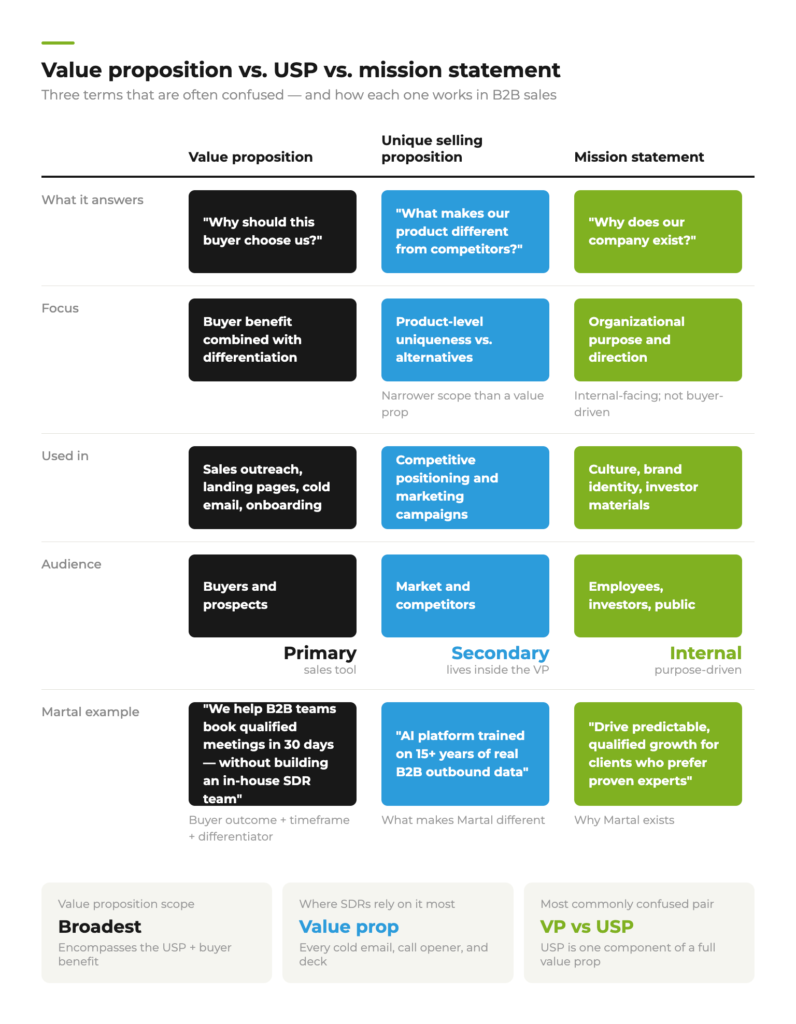
In sales specifically, your sales value proposition is the one doing the heaviest lifting. It’s the proposition example your SDR leads with. It’s the subject line of your cold email. It’s the first thing a prospect reads on your website. Your USP and mission both inform it, but the value proposition is where all three come together for the buyer.
Why a Strong Value Proposition Matters for B2B Lead Generation
In B2B sales, prospects are busy and skeptical – you often have only a few seconds to grab attention on a cold email introduction or website visit. A powerful customer value proposition example can make the difference between a visitor bouncing versus engaging further. It immediately signals the value you offer, building enough interest for a prospect to give you their time (a precious commodity). Essentially, your value prop is the hook that can turn a cold lead into a warm one by addressing their needs upfront.
Consider that 97% of B2B buyers check a vendor’s website before ever contacting sales. A strong client value proposition example on your homepage makes them far more likely to convert (19). If your homepage clearly presents a client value proposition that resonates, those buyers are far more likely to convert into inquiries or demo requests. Conversely, a vague or generic message will lose them. A unique value proposition, as seen in the best value proposition examples for business, differentiates you from competitors, crucial in crowded fields like SaaS or fintech. In fact, 86% of business buyers say they’re more likely to buy from a company when their goals are understood (20).
From an outbound perspective, the value proposition is the single most common leverage point we see underutilized. A company can have excellent targeting, a strong data set, and an experienced SDR, and still generate poor reply rates because the core message doesn’t land. When a value proposition for sales is specific, outcome-focused, and matched to the right ICP, the same outreach effort produces dramatically better results. We see this pattern consistently: tightening the message often moves the needle faster than expanding the volume.
In terms of lead gen, a great value prop examples-informed message helps qualify leads early. It “pre-suades” the right people that you’re worth talking to, and gently filters out those who aren’t a fit. This means your sales team spends time on better-quality leads. The following sections will highlight examples of good value propositions in B2B companies that have fueled growth and lead generation. Pay attention to how each sample proposition addresses its audience’s pains and frames the benefits – these are sample value proposition statements you can learn from.
B2B Value Proposition Examples: 10 Companies, 10 Approaches
A strong value proposition is not a tagline. It is not a mission statement. It is not a list of features dressed up in outcome language. It is a specific, defensible answer to the one question every buyer asks before they give you their time: why you, over everyone else, for this particular problem?
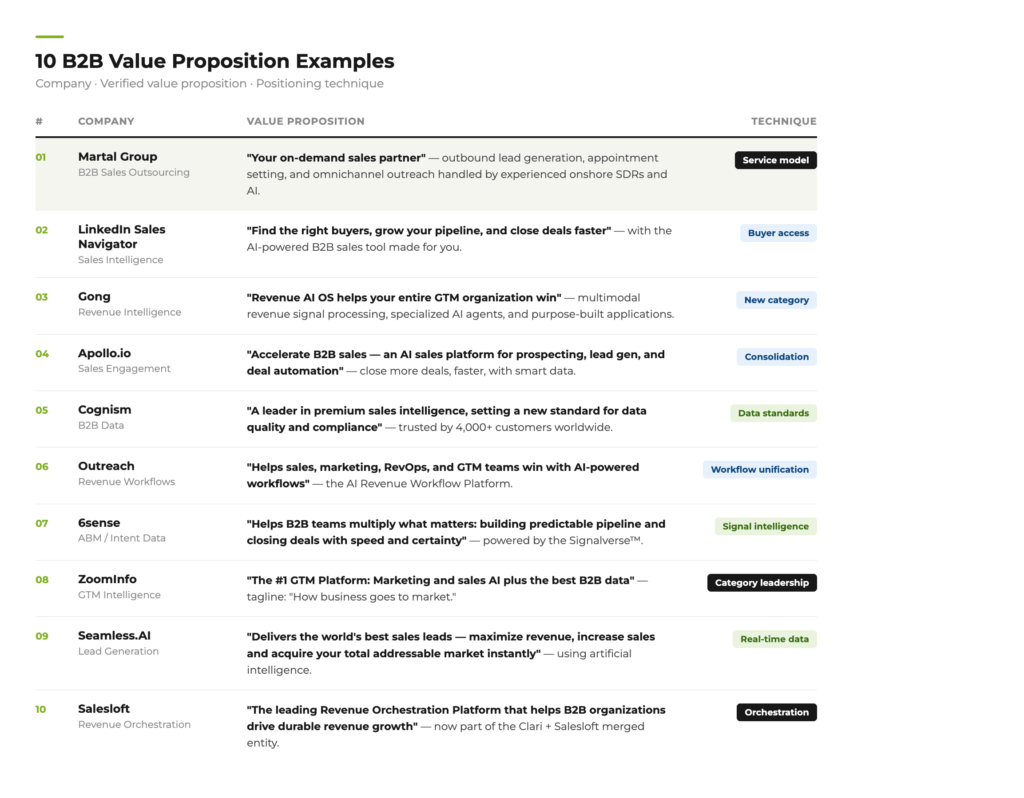
The 10 examples below are drawn entirely from the B2B sales and lead generation space, the same world Martal’s clients operate in. Each one demonstrates a distinct technique: outcome framing, category creation, objection pre-handling, workflow consolidation, standards-based positioning, and more. Together they form a practical library of value proposition canvas examples any B2B company can study, adapt, and apply, in cold email, in discovery calls, on a homepage, or in a LinkedIn opener.
1. Martal Group
A Value Proposition Built Around the Sales-as-a-Service Model
“Your on-demand sales partner.” Outbound lead generation, appointment setting, and omnichannel outreach, handled by experienced onshore SDRs and AI.
Reference Source: Martal Group
Most B2B service providers describe what they do. Martal’s is one of the strongest business value proposition examples in the outsourced sales space. Martal’s value proposition describes the relationship first, then the delivery. “On-demand” solves the most common objection to outsourced sales, loss of control, before the buyer even asks the question. It signals that the engagement is flexible, responsive, and accountable rather than locked into a fixed structure the buyer cannot influence. “Sales partner” replaces the vendor framing with something operationally different: an extension of the buyer’s own team rather than a contractor executing a brief.
The fuller positioning statement sharpens this further. Martal combines experienced onshore SDRs with a proprietary AI SDR Platform to run omnichannel outreach across cold email, cold calling, and LinkedIn lead generation, delivering qualified leads and booked meetings, typically within 30 days of launch.
What makes this work in a crowded market is the combination of four elements few competitors can credibly claim in a single sentence: a named delivery model, a specific channel set, a technology differentiator, and a human quality signal. Together they answer the four questions every skeptical B2B buyer asks before signing with a sales outsourcing firm.
Component
Martal’s answer
Target customer
B2B companies that need qualified pipeline but can’t justify the cost and ramp time of building an in-house SDR team
Problem
Building outbound from scratch is slow, expensive, and rarely optimized without years of iteration. This is the business proposition sample Martal’s model is built to eliminate
Solution
Experienced onshore SDRs supported by a proprietary AI platform, running omnichannel outreach from day one
Differentiator
AI trained on 15+ years of real B2B outbound data, combined with senior sales execution, not junior reps reading scripts
One pattern we see consistently: service businesses lose deals not because their delivery is weak, but because their value proposition sounds identical to every competitor.
“We generate leads for B2B companies” is a category description, not a value proposition. The version that converts is specific about who it is for, what it delivers, how fast, and what makes it different from the alternative the buyer is already weighing, in most cases, either hiring internally or doing nothing. A value proposition that speaks directly to both of those comparison points closes the gap before the first call.
When this positioning was applied across Martal’s client engagements, spanning SaaS, cybersecurity, manufacturing, and fintech, the pattern was consistent: buyers moved faster when the message named the pain they were already feeling rather than describing the features of the solution.
That positioning has translated into measurable results across more than 2,000 B2B engagements:
- Clickworker (Marketplaces): $4.5M in recurring revenue and 500% ROI over a 9-year partnership, built through omnichannel outreach targeting Fortune 10 and Fortune 500 buyers. View full case study.
- HALO Recognition (HR Services): $10M+ in new business opportunities generated through targeted outbound into enterprise accounts. See how this was achieved.
- Spirit AI (AI company entering the US market): 35 qualified leads per month in the niche AI trust and safety category, a vertical with limited TAM and high specificity requirements. AI outbound case study.
- Complete EDI (Supply Chain): 14 SQLs in a 3-month pilot with a single fractional SDR, proof that even lean engagements produce results when the ICP and message are tight. See full results.
The common thread is a value proposition specific enough to qualify the right buyer on the first touchpoint, before the first call is ever booked.
Apply this to your outreach
Martal’s value proposition structure works as a direct template for any B2B service or SaaS company. It is one of the clearest sample value proposition statements in the B2B sales space. The format:
“We help [specific buyer] [achieve specific outcome] in [timeframe] by [unique delivery model].”
Pressure-test it against three questions:
- Does it name the person?
- Does it name the result?
- Does it say something a competitor couldn’t also claim?
If the answer to any of those is no, the message needs tightening. Studying unique value proposition examples from top performers is one of the fastest ways to identify where your own message falls short.
2. LinkedIn Sales Navigator
A Value Proposition Built Around Buyer Access
“Find the right buyers, grow your pipeline, and close deals faster with the AI-powered B2B sales tool made for you.”
Reference Source: LinkedIn Sales Navigator
This value proposition example covers the entire sales motion in a single sentence, find, grow, close, while anchoring each stage to a specific, recognizable activity. The structure is deliberate: it reads like a job description for the SDR or AE evaluating it, mapping the three stages they spend their day on against what the platform promises to improve. “Made for you” does something subtle but important, it signals personalization and specificity at the platform level, preempting the objection that another generic database tool is being pitched.
“AI-powered” earns its place because it is substantiated by the product itself. The average Sales Navigator user makes four times more connections to Director-level and above leaders per person than the average non-user (21). The value proposition does not lead with that number, but it frames the platform as something that measurably changes what a seller can reach, which is the real claim being made. Whether or not Sales Navigator is the right fit for any specific team’s stack is a separate evaluation. What is worth studying here is how a platform covering many features reduces the message to three verbs and a promise of personalization.
Component
Sales Navigator’s answer
Target customer
B2B sales reps, SDRs, and sales managers prospecting into large professional networks
Problem
Finding and reaching the right buyer at the right seniority level, before a competitor does
Solution
Advanced search, AI-powered lead recommendations, and relationship intelligence built into the platform where buyers already spend time
Differentiator
Native access to LinkedIn’s full professional graph, including job change alerts, content engagement signals, and 1 billion+ member search
The three-verb structure, find, grow, close, maps directly to how outbound messaging should be built for complex sales motions. In cold email, the most common failure is a message that describes the product rather than the progression it enables.
A subject line that takes the buyer through a sequence, “More meetings, better pipeline, faster close”, performs differently than one that leads with a feature, because it mirrors the motion the buyer is already trying to run. Sales Navigator’s value proposition is effective precisely because it uses that motion as its backbone.
The lesson is not about LinkedIn specifically. It is about anchoring a value proposition to the buyer’s existing workflow rather than the seller’s product architecture.
Put It Into Practice
Map your value proposition to the three stages your buyer moves through, find, engage, convert, or whatever the equivalent is in their world, and use that progression as the structure of your cold email opener.
The format: “[Stage 1 problem] → [Stage 2 problem] → [outcome you deliver].” This is a strong examples of proposition structure that mirrors the buyer’s workflow.
Buyers recognise the sequence because they live in it every day. A message that mirrors their workflow earns more attention than one that describes yours.
3. Gong
A Value Proposition Built on a New Category
“Gong Revenue AI OS helps your entire GTM organization win.”
Reference Source: Gong.ai
Gong’s current value proposition represents a significant evolution from its earlier revenue intelligence positioning. It is one of the most studied business value proposition examples in B2B SaaS. “Revenue AI OS” is a category creation move, by naming an operating system rather than a platform or tool, Gong positions its product as the foundational layer beneath everything else a revenue team runs, rather than one application among many. An OS is infrastructure. Infrastructure is not compared against alternatives on a feature matrix; it is adopted or not adopted. That framing, if it lands, changes the entire buying conversation.
“Drive growth with multimodal revenue signal processing, specialized AI agents, and purpose-built applications.”
“Multimodal revenue signal processing” is dense language for a value proposition, but it signals something important to the buyer it is written for,l the CRO or RevOps leader who has already evaluated point solutions and wants to understand what is architecturally different here.
The specificity of the language is the credibility mechanism. It tells the buyer this is not another dashboard; it is something that processes signal across multiple data types simultaneously.
Whether that claim is meaningful in practice depends on the buyer’s context, but as a positioning statement it successfully creates distance from competitors. Gong helps more than 5,000 companies around the world deeply understand their teams and customers, automate critical revenue workflows, and close more deals with less effort (22).
Component
Gong’s answer
Target customer
CROs, VP of Sales, and RevOps leaders evaluating a unified revenue intelligence and workflow platform
Problem
Revenue teams operate across fragmented data, disconnected tools, and inconsistent execution, making growth hard to predict or replicate
Solution
A Revenue AI Operating System that unifies signals, insights, agents, and applications across the full GTM motion
Differentiator
Positioned as infrastructure, an OS layer, rather than a point solution or engagement tool
The category creation technique has a direct application in outbound for companies that genuinely occupy a distinct position in their market. When an SDR or sales team consistently solves a problem no competitor names clearly, there is an opportunity to name that category before the buyer builds their own frame for it.
In cold outreach, a first message that introduces a named category, rather than describing a product, creates a reference point the buyer has not encountered before. That novelty generates replies from curiosity alone, which is a legitimate opening to a real conversation. The risk is that category language without substantiation reads as marketing noise. Gong earns “Revenue AI OS” because the product actually processes signals across calls, emails, and meetings simultaneously. The category name must be defensible on the second question, not just the first sentence.
How to Apply These Insights
If your product or service genuinely does something competitors do not have a clean name for, name it yourself. Writing a value proposition around that named category and using it consistently in outreach is the key.
The format is not a feature list; it is a one-line category statement: “We call this [named approach], and here is why it produces different results than [existing category].”
That contrast between the named new thing and the familiar old thing is what makes a buyer lean forward rather than delete.
4. Apollo.io
A Value Proposition Built Around Consolidation
“Accelerate B2B sales with Apollo.io — an AI sales platform for prospecting, lead gen, and deal automation. Close more deals, faster, with smart data.”
Reference Source: Apollo.io
Apollo.io’s value proposition does several things simultaneously without becoming cluttered. It is a strong example value proposition for companies communicating platform breadth clearly. It names the category (“AI sales platform”), lists three workflow stages the platform covers (prospecting, lead gen, deal automation), and closes with a buyer outcome framed around speed and data quality. The structure mirrors how a buyer evaluates a platform in practice: what does it cover, and what do I get from it.
“Close more deals, faster, with smart data” is the payoff line. Each word is doing work: “close more” is volume, “faster” is efficiency, “smart data” is the differentiator claim. It avoids the trap of leading with database size, a race to the bottom in a crowded data market, and frames data quality as the mechanism behind the outcome rather than the feature being sold.
Apollo.io is an AI sales platform for prospecting, lead gen, and deal automation (23). Whether a given team’s stack benefits from further consolidation into Apollo is a question of current architecture and needs — the value proposition lesson here is about how to frame consolidation as a buyer benefit rather than a product feature.
Component
Apollo.io’s answer
Target customer
SDRs, AEs, and sales managers running outbound with multiple disconnected tools — data, sequencing, and engagement living in separate platforms
Problem
Prospecting, outreach, and deal management across fragmented tools creates friction, inconsistency, and wasted time
Solution
A unified AI sales platform covering prospecting data, lead generation, and deal automation in a single workflow
Differentiator
“Smart data” framing, positions data quality as the mechanism behind deal velocity rather than raw database volume
The consolidation value proposition resonates most strongly in outbound when the buyer’s current workflow involves multiple tools that do not talk to each other cleanly. In cold email, a subject line that names the problem of fragmentation, rather than describing a platform’s features, creates immediate recognition.
“Two tools or five, you’re still losing time between them” speaks more directly to the SDR manager’s reality than a list of integration capabilities. From an execution standpoint, the consolidation frame also helps at the discovery call stage, where demonstrating a connected workflow is often more persuasive than any individual feature demo.
Make It Work in Your Outreach
If your product or service eliminates a step, tool, or handoff your buyer currently manages manually, make that elimination the center of the message.
The format: “[Number] tools doing [what they currently do], replaced by [your solution].” This proposition of value framing works because buyers understand subtraction faster than addition.
Buyers understand subtraction faster than addition. A message that removes friction is more immediately compelling than one that adds capability, because the cost of friction is already real and visible in their day.
5. Cognism
A Value Proposition Built on Data Standards
“Leader in premium sales intelligence, setting a new standard for data quality and compliance, trusted by over 4,000 customers worldwide.”
Reference Source: Cognism
In a market where every data vendor claims accuracy, Cognism’s value proposition competes on the standard rather than on a specific number. It offers one of the clearest examples of unique value proposition positioning in the B2B data space. “Setting a new standard for data quality and compliance” is a positioning statement, not a metric, but it accomplishes something a metric cannot: it frames all other vendors as operating below that standard.
You cannot claim to be “setting a new standard” if you are simply matching the existing one. The implication is that the category has a ceiling it has not yet reached, and Cognism is the company building toward it.
The compliance dimension, particularly GDPR, is the differentiator that speaks directly to the European enterprise buyer who has historically found most B2B data providers operationally unusable due to legal risk.
Cognism describes itself as a global team of data experts helping customers connect with their next best customer by delivering a new standard in data accuracy and compliance (24).
For outbound teams operating across regulated markets, that framing reduces the friction of the buying conversation itself, the compliance question is answered at the positioning level before it reaches legal review.
Component
Cognism’s answer
Target customer
B2B sales and marketing teams, particularly in regulated markets, where data compliance and contact accuracy are purchasing criteria as important as coverage
Problem
Most outbound data is stale, unverified, or legally unusable in regulated markets, creating wasted SDR effort and compliance exposure
Solution
Premium sales intelligence with phone-verified contacts, GDPR compliance built into the data infrastructure, and global coverage
Differentiator
Compliance as a product feature, not a legal disclaimer — the data itself is structured around regulatory requirements
The standards-based value proposition is particularly effective in outbound for companies selling into enterprise or regulated verticals where compliance is an active purchasing concern.
In cold outreach to these buyers, a message that leads with regulatory alignment, rather than leading with capability, immediately removes the most common early objection.
“Built for teams in regulated markets” addresses the compliance question before it is raised, which keeps the conversation on value rather than on procurement risk. From an SDR execution standpoint, this is the objection-pre-handling technique applied at the message level rather than the call level.
Implement in Your Outreach
Map the top objections your ideal buyer raises before the first call, and move one of them into the value proposition itself.
For regulated industries, compliance is often that objection. For SMBs, it might be the cost. For enterprise, it might be implementation risk. Whichever objection shows up most consistently in lost deals or stalled openers is the one the value proposition should address first.
The format: “Built for [buyer type] who need [outcome] without [the specific risk they are trying to avoid].” This is a strong business proposition example of compliance-led messaging.
6. Outreach.io
A Value Proposition Built on Data Standards
“Outreach helps sales, marketing, RevOps, and GTM teams win with AI-powered workflows.”
Reference Source: Outreach.io
Outreach’s current value proposition reflects a deliberate shift from sales engagement tool to revenue workflow platform. It serves as a practical value proposition for business teams evaluating enterprise revenue tools. The platform is now formally positioned as the “AI Revenue Workflow Platform.” (25)
The homepage statement, “win with AI-powered workflows”, is deliberately broad, covering four distinct functions (sales, marketing, RevOps, GTM) without losing clarity. That breadth is strategic: as Outreach has expanded beyond SDR sequencing into forecasting, conversation intelligence, and deal management, a value proposition that names only one function would undersell the platform’s actual scope.
“Win” is an intentional word choice. It is outcome language, not “improve,” not “optimize,” not “streamline”, and it carries a competitive connotation. Revenue teams do not just want better workflows; they want to beat the competition. The pairing of “win” with “AI-powered workflows” connects the mechanism (AI) to the motivation (winning) without explaining how it works.
That structure keeps the statement short while leaving room for the product to do the explaining.
Component
Outreach’s answer
Target customer
Sales, marketing, RevOps, and GTM teams at B2B companies evaluating a unified revenue execution platform
Problem
Revenue execution is fragmented across tools, teams, and data sources — making it hard to run consistent, scalable motions
Solution
An AI Revenue Workflow Platform connecting prospecting, engagement, conversation intelligence, forecasting, and deal management
Differentiator
Platform positioning that spans the full revenue team — SDR through CRO — rather than solving for one role or one stage
The multi-function value proposition presents a specific challenge in outbound: when a platform serves many roles, the first message must make a clear choice about who it is talking to. A cold email to a VP of Sales that leads with RevOps features will underperform against one that leads with pipeline visibility or win rate improvement.
The lesson from Outreach’s positioning is that the platform VP is a company-level claim, it works on a homepage. In cold outreach, that claim must be narrowed to the single outcome most relevant to the specific person receiving the message. Outreach can say “win” to everyone; an SDR writing to a CRO needs to say specifically what winning means for that person’s Q4 number.
Take These Steps in Your Outreach
If your product or service has a broad value proposition that spans multiple roles, write a different cold email opener for each role in the buying committee, and make each one specific to what that role cares about most.
The platform value prop lives on the website. In the inbox, the message must speak to one person’s priority.
The format: “For [specific role]: [specific outcome they measure], [how you deliver it] in [timeframe or context].” Think of each version as a client value proposition example tailored to one seat in the buying committee.
One product, four roles, four openers. Same core value proposition, different entry points.
7. 6sense
A Value Proposition Built on Buying Signal Intelligence
“Revenue Intelligence Platform that helps B2B teams multiply what matters: building predictable pipeline and closing deals with speed and certainty.”
Reference Source: 6sense
“Multiply what matters” is a compact phrase doing significant strategic work. It is one of the best value propositions in the revenue intelligence category. It signals amplification rather than replacement, the platform does not claim to do your team’s job; it claims to make your team’s existing work produce more.
For revenue leaders who have heard too many promises about AI replacing SDRs, that framing is deliberately reassuring while still ambitious. 6sense positions itself as the platform that “captures trillions of buyer signals to uncover in-market accounts, prioritize the right contacts, and orchestrate personalized engagement.” (26)
“Predictable pipeline” is the CRO’s phrase. “Speed and certainty” speaks to both the AE (close faster) and the VP of Sales (forecast more accurately). Like Outreach’s multi-role construction, 6sense’s value proposition is layered to land at different organizational levels, but it anchors in “pipeline” as the universal currency that makes the statement relevant to everyone in the buying committee simultaneously.
The underlying differentiation, intent data and buying signal intelligence, is implied rather than stated, which keeps the proposition clean while inviting the question “how do you do that?” in the follow-up conversation.
Component
6sense’s answer
Target customer
Revenue teams — marketing, sales, and RevOps — at B2B companies evaluating an account-based intelligence and engagement platform
Problem
Most outbound and marketing activity targets buyers who are not yet in an active buying cycle, generating volume without precision
Solution
Revenue intelligence powered by AI and a proprietary buyer signal network that identifies in-market accounts before they self-identify
Differentiator
Trillions of buyer signals processed through a single platform — turning anonymous buying behaviour into prioritised, actionable pipeline
The “multiply what matters” framing has a direct application in outbound messaging for teams selling into revenue leadership. In cold outreach, amplification language outperforms replacement language with senior buyers who have already invested in their team and their processes.
A message that says “we’ll make your SDR team 3x more effective at the accounts that are actually ready to buy” lands differently than “our platform can replace your current prospecting process.”
The first respects the existing investment; the second triggers defensiveness. From an SDR standpoint, leading with signal quality, “we only reach out to accounts already showing buying intent”, is the outreach equivalent of the platform’s own value proposition, applied at the message level.
Try This in Your Outreach
Test amplification language against replacement language in your next cold email sequence.
Version A: “We can replace [existing process].”
Version B: “We make [existing process] produce [specific better outcome].” This is a good value proposition framing for selling into experienced revenue leaders.
In most B2B markets, particularly selling to experienced revenue leaders, Version B will outperform because it starts from respect rather than criticism of the buyer’s current state.
The format: “[What you already do], we make it [specific improvement] by [mechanism].”
8. ZoomInfo
A Value Proposition Built Around Category Leadership
“The #1 GTM Platform: Marketing and sales AI plus the best B2B data.” Tagline: “How business goes to market.”
Reference Source: Zoominfo
ZoomInfo’s value proposition operates on two levels simultaneously. It is widely referenced as a strong business canvas value proposition example in enterprise B2B. The platform statement makes a market position claim backed by a capability statement. Their mission is “Modernize go-to-market for all,” with the tagline “How business goes to market” feeding into brand pillars of Unlock Insights, Engage Customers, and Win Faster. (27)
“How business goes to market” is a category-ownership claim of the highest order. It does not say ZoomInfo is a tool used in go-to-market. It says ZoomInfo is the definition of how go-to-market happens.
That is audacious framing, and one that only works because the platform has the market position to support it. The lesson is not to make claims this large without that position. The lesson is that taglines function differently from value propositions: the tagline stakes the territory, the platform statement substantiates it. Used together, they create a complete positioning architecture.
Component
ZoomInfo’s answer
Target customer
Sales, marketing, and revenue operations teams at B2B companies evaluating a comprehensive GTM data and intelligence platform
Problem
Go-to-market execution is constrained by fragmented, outdated, or insufficient data — limiting the quality and precision of every downstream sales and marketing motion
Solution
A unified GTM platform combining verified B2B data with AI-powered insights and engagement tools across the full customer acquisition cycle
Differentiator
“#1” category leadership claim combined with full-funnel GTM coverage, positioning the platform as the operating standard for modern B2B go-to-market
The category leadership claim, “#1 GTM Platform”, functions in outbound similarly to how social proof functions in cold email: it reduces the perceived risk of evaluation.
When a platform leads with its market position, it shifts the buyer’s question from “should I consider this?” to “why haven’t I already looked at this?” In cold outreach, referencing established market position or third-party validation (Gartner leader, G2 category leader, Forrester top performer) in the first two sentences does the same work, it signals that evaluation risk is low because others have already done it. The mistake is leading with the ranking before the relevance. Market position earns credibility; it does not earn attention. Relevance earns attention first.
Put Into Practice
If your company holds a market position that is independently verifiable, an industry ranking, a customer count milestone, a third-party analyst placement, use it as a credibility signal in the second sentence of a cold email, not the first.
The first sentence earns attention with relevance.
The second sentence earns credibility with validation.
The format: “[Relevant problem or outcome for this buyer]. [Your company], [independent credibility signal], helps teams like yours [specific result].” This value proposition sample structure sequences relevance before credibility. Sequence matters: relevance first, credibility second.
9. Seamless.AI
A Value Proposition Built on Real-Time Verification
“Delivers the world’s best sales leads. Maximize revenue, increase sales and acquire your total addressable market instantly using artificial intelligence.”
Reference Source: Seamless.ai
“The world’s best sales leads” is a bold category claim. It is a clear what is value proposition example of leading with outcome over mechanism. It does not qualify by geography, vertical, or use case, it asserts global primacy on the single metric that determines whether any data platform is worth using: lead quality.
The second sentence unpacks what “best” means operationally: maximising revenue, increasing sales, and acquiring total addressable market, instantly, using AI.
The word “instantly” is doing significant work here. In a category where list-building typically takes days or weeks, “instantly” is a direct attack on the status quo process.
Seamless.AI positions itself as a platform that “researches and validates business contact info in real-time for the greatest accuracy,”(28) distinguishing itself from static databases refreshed on a periodic cycle.
The real-time verification claim is the structural differentiator embedded in the value proposition. Most B2B data platforms work from a database compiled and refreshed on a schedule.
Seamless.AI’s positioning implies that the verification happens at the moment of search, which, if accurate, solves a specific and familiar problem for any SDR who has experienced bounce rates from stale data. Whether that claim holds up at scale is an evaluation question. The positioning lesson is about how to turn a technical capability into a buyer-facing benefit: real-time → accurate → fewer bounces → better reply rates → more pipeline.
Component
Seamless.AI’s answer
Target customer
SDRs, sales managers, and revenue operations teams building outbound contact lists at scale
Problem
Prospect data in most B2B databases is stale by the time it reaches the rep — producing bounced emails, wrong numbers, and wasted outreach effort
Solution
An AI-powered platform that searches, verifies, and delivers contact data in real time rather than pulling from a static, periodically refreshed database
Differentiator
Real-time verification at the moment of search — distinguishing the platform from databases compiled and maintained on a batch refresh cycle
The real-time versus static distinction translates directly into cold outreach positioning for any company whose differentiation is speed or freshness. In SDR execution, the most credible version of a freshness claim is not “our data is accurate”, it is “we verified this specific detail about your company before sending this message.”
Personalisation powered by recent, accurate data performs differently than personalisation drawn from a database last refreshed six months ago. The buyer can feel the difference.
When an SDR leads with a detail that reflects something that happened in the last two weeks, a funding round, a hiring surge, a technology change, it signals that the outreach is based on current intelligence, not a recycled list.
Implement in Your Outreach
If your differentiation is speed, freshness, or accuracy, demonstrate it rather than claiming it. Instead of “our data is the most accurate in the market,” lead with a specific, verifiable detail about the buyer’s company that only current data would surface: a recent hire, a new office, a technology change.
The format: “I noticed [specific recent signal about their company] — [connection to why you’re reaching out].”
The implicit message is that you did not pull a name from a list. You did actual research. That difference in perceived effort produces a different reply rate. Studying 10 examples of proposition approaches like this sharpens your own outreach instincts.
10. Salesloft
A Value Proposition Built Around Revenue Orchestration
“The leading Revenue Orchestration Platform that helps B2B organizations drive durable revenue growth.”
Reference Source: Salesloft
“Revenue Orchestration Platform” is a carefully chosen category name. It is one of the most instructive value proposition examples for business leaders evaluating long-term revenue platforms. Orchestration is distinct from engagement, enablement, or intelligence, it implies coordination across multiple moving parts rather than improvement of a single workflow.
The word signals that Salesloft is not competing on features within an existing category; it is defining a new one where coordination across the full revenue cycle is the primary value.
“Durable revenue growth” is the outcome claim, and the word “durable” is worth examining. In a market full of promises about accelerating pipeline and increasing win rates, “durable” speaks to a specific and different fear: growth that sticks, rather than growth that spikes and disappears. That concern is real for revenue leaders managing through market cycles, and it is not a word most competitors use. The value proposition earns its durability claim with that kind of third-party substantiation.
Component
Salesloft’s answer
Target customer
Sales leaders, CROs, and RevOps teams at B2B companies managing complex, multi-stage revenue cycles across SDR, AE, and management layers
Problem
Revenue execution is inconsistent across teams and deal stages — making growth unpredictable and difficult to replicate at scale
Solution
A Revenue Orchestration Platform connecting engagement, conversation intelligence, deal management, forecasting, and coaching in a unified workflow
Differentiator
“Durable” growth framing — positioning the platform as a long-term performance system rather than a short-term pipeline acceleration tool
The durability frame has a specific application in outbound for companies selling into accounts that have experienced failed implementations or disappointing results with previous tools. In cold outreach to a VP of Sales who has already bought and churned from a competing platform, leading with “sustainable” or “consistent” outcomes speaks to a fear that “more pipeline” language does not address.
The buyer is not skeptical that the tool can generate activity. They are skeptical that the activity will translate into consistent, replicable results. A value proposition, and a cold email, that speaks directly to that distinction earns a different quality of attention than one that leads with capability.
Act on These Insights
Identify the specific failure mode your ideal buyer has experienced with previous solutions, not the general problem your product solves, but the specific way previous attempts to solve it have failed.
Build that failure mode into your cold email opener. This business proposition sample structure shows you understand the buyer’s history, not just their current pain.
The format: “Most [buyer type] who’ve tried [existing category] still struggle with [specific failure mode]. That’s because [existing solutions] solve [surface problem] but not [underlying problem]. [Your solution] is built around [underlying problem] instead.”
This structure demonstrates that you understand the buyer’s history, not just their current pain.
Look across all 10 examples of proposition thinking in B2B sales and a pattern emerges. The ones that work are not the ones with the most impressive claims. They are the ones with the most specific claims. Each is a true example of a value proposition done right, about who they are for, what outcome they produce, and why the mechanism is different.
Each technique is transferable. The format changes; the underlying logic does not. Every effective B2B value proposition answers the same four questions, in some order: who is it for, what problem does it solve, how does it solve it, and why is this version better than the alternative. The companies above have found different ways to compress those four answers into a single statement that lands before the buyer has time to disengage.
For B2B teams building or refining their own message, whether they need a sample value proposition or a full messaging overhaul, the practical starting point is not the value proposition itself. It is the sales call. Listen to the three questions prospects ask most often in the first five minutes of a discovery call. The answers to those questions, compressed, sharpened, and put at the front of the message, are usually the strongest value proposition a company has. It is already there. It just has not been written down yet. The value position canvas is a useful tool for mapping those answers into a structured proposition.
Put Your Value Proposition to Work: How Martal Turns Strong Messaging into Qualified Pipeline
Martal turns strong B2B messaging into a qualified pipeline, helping clients achieve 2× conversion via intent-based prospecting and 4× via technographic targeting.
Reference Source: Martal Group
Every example of a business proposition in this guide points to the same conclusion: a well-constructed value proposition does not just describe a product, it does the first stage of selling before a conversation ever starts. It qualifies the right buyer, filters out the wrong ones, and gives your outreach a reason to exist beyond filling someone’s inbox.
But a strong value proposition is only as effective as the outreach system carrying it. The companies in this list invest heavily in both the message and the mechanism. Most B2B companies have one without the other: a clear value preposition, or rather value proposition, sitting behind cold email copy that does not land, or outreach volume without the message precision to convert it.
That is the gap Martal is built to close, by delivering the right valuation proposition of cost, speed, and quality.
Martal’s Sales-as-a-Service model, one of the strongest unique value proposition examples in the outsourced sales space, combines experienced onshore SDRs with a proprietary AI SDR Platform. to run omnichannel outreach across cold email, cold calling, and LinkedIn lead generation, all coordinated as a single connected motion, not three parallel channels. The platform is trained on 15+ years of real B2B outbound data across 50+ verticals, a sample unique value proposition in itself, which means the targeting, messaging, and sequencing are built from what has actually worked across thousands of campaigns, not from generic templates.
The results speak to what happens when strong positioning meets disciplined execution:
- Clients ramp up their sales pipeline 3x faster using Martal’s sales outsourcing services than building an in-house SDR team.
- Acquisition costs reduce by up to 65% through economies of scale and expert execution (29).
- First sales-qualified leads typically arrive within 30 days of campaign launch (30).
For teams that have the value proposition but not the pipeline infrastructure to deploy it consistently, that combination is where growth accelerates.If your team is ready to move beyond manual prospecting, or if you are building outbound from scratch and need both the message and the machine, book a consultation to see what a qualified pipeline looks like in practice.
References:
- Investopedia
- Wordstream
- Attendancebot
- Engagebay
- Backlinko
- Crowdstrike
- Stocktitan
- En.Wikipedia
- Medium
- Supplychaindive
- Flexport
- Generalist
- Protolabs
- Businesswire
- Hubspot
- Shopify
- Invespcro
- Investors.Asana
- Corporate Visions
- Salesforce
- Gong
- Apollo
- Cognism
- Outreach.io
- 6sense
- Zoominfo
- Seamless.ai
- Martal Group – ROI Calculator
- Martal Group – Onboarding Roadmap
FAQs: Value Proposition in B2B Sales and Lead Generation
What is a value proposition?
A value proposition is a concise statement that explains why a buyer should choose your product or service over the competition. It communicates the specific problem you solve, the benefit the buyer receives, and what makes your solution different from available alternatives. In B2B sales, an effective value proposition is outcome-focused, specific to a defined buyer, and short enough to be understood without explanation. It is not a tagline, a mission statement, or a feature list — it is the foundational answer to the buyer’s first question: “Why you?”
What is the difference between a value proposition and a unique selling proposition?
A unique selling proposition (USP) focuses on what makes your product or service different from competitors — it is a product-level claim about distinctiveness. A value proposition is broader: it encompasses who the product is for, what problem it solves, what outcome the buyer receives, and why this solution is better than the alternatives. The USP typically lives inside the value proposition as the differentiator component. In practice, a company might have a clear USP (“AI trained on 15+ years of real B2B data”) but still lack a complete value proposition if that USP is not connected to a specific buyer problem and a defined outcome.
How do you write a value proposition for a B2B sales or lead generation company?
When writing a value proposition for a B2B sales or lead generation company, start with the buyer’s outcome. A strong value proposition paragraph should name the target customer, the problem, the solution, and the differentiator in plain language. A useful starting template is: “We help [specific buyer] [achieve specific outcome] in [timeframe] by [unique delivery model or approach].” Pressure-test the draft against one final question: could a direct competitor say the same thing? If yes, the differentiator needs sharpening. The strongest B2B value propositions are often discovered by listening to the first five minutes of discovery calls — the questions buyers ask most consistently are usually the raw material of the most effective value proposition.
Where should a value proposition appear in B2B outbound outreach?
A value proposition should inform every outbound touchpoint without appearing verbatim in all of them. On a website, it belongs in the hero section headline and the first paragraph of the about page. In cold email, the subject line should reflect the core outcome claim and the body should deliver the mechanism and proof. In a LinkedIn outreach message, a single component of the value proposition, usually the outcome or the differentiator — should anchor the first sentence. On a discovery call, the value proposition shapes the opening question and the framing of the problem before any solution is presented. The goal is not repetition, it is consistency of message across every point of contact.
Can outsourcing lead generation help a company with a strong value proposition generate more pipeline?
A strong value proposition creates the conditions for effective lead generation, but it requires a delivery system to reach the right buyers at scale. Martal’s Sales-as-a-Service model combines experienced onshore SDRs with a proprietary AI platform to run omnichannel outreach across cold email, cold calling, and LinkedIn lead generation — carrying a client’s value proposition into coordinated, targeted campaigns across their ideal buyer profile.
Clients typically see first sales-qualified leads within 30 days of launch, ramp their pipeline 3x faster than building in-house, and reduce acquisition costs by up to 65%. These are strong examples of a proposition strategy working at scale.