
 Martal
 Technology
 Education and training
 Web Development and UI / UX
 Healthcare/Medical
 Logistics and Supply Chain
 Information Technology
 Insuretech and Financial Services
 Marketplaces
 Software Development
 E-commerce and retail
 AI and Machine Learning
 Energy and Solar
 Manufacturing
 Security and Surveillance
 Digital Marketing Agency
 Transportation
 MSP
MSP
 Telecom
 B2B SaaS
 Cybersecurity
 HR tech
 Fintech
 Cleantech
 Consulting
Sales Outsourcing: A Complete Guide to Costs, Models & AI SDRs 2026
Major Takeaways: Sales Outsourcing
Sales outsourcing means hiring an external team to handle some or all of your top-of-funnel pipeline work — prospecting, qualification, appointment setting, and sometimes the full sales cycle. The deliverable is qualified meetings and SQLs, not activity volume.
Retainer-based managed SDR programs typically run $5K–$15K per month, dedicated onshore SDRs run $7K–$15K+ per rep per month, and pay-per-meeting structures range from $250–$1,200 per qualified meeting. Hybrid retainer-plus-performance models have grown more common in 2026 as buyers push for outcome-based pricing.
In-house teams give full control but carry fixed costs and 3–6 month ramp times. Outsourced human teams compress that to roughly 30 days and reduce sales costs by up to 65%. Pure-AI SDRs handle high-volume prospecting cheaply but, per SDR metrics (2), hybrid pods that pair AI orchestration with experienced human SDRs deliver more pipeline per seat than either approach alone.
Coordinated outreach across cold email, cold calling, and LinkedIn outperforms any single channel — data shows multichannel sequences lifting response rates significantly versus email-only programs (5). We run every campaign as a single omnichannel program, not three parallel workflows.
Strict ICP alignment, qualification on authority and need, and AI-assisted account prioritization deliver sales-ready meetings rather than raw prospect counts. The right benchmark is held meetings and SQLs, not emails sent or calls dialed.
Early-stage startups needing pipeline without long hiring cycles, SMBs without internal SDR capacity, mid-market companies expanding into new geographies (the US market is the most common entry play), and product teams launching new offerings that need fast go-to-market support.
Poor vendor quality, brand mismatch, weak qualification, and offshore compliance gaps are the recurring failure modes. Mitigate by running a 30–60 day pilot with defined KPIs, requiring SOC II and GDPR compliance, asking for onshore SDR placement, and demanding live campaign dashboards from day one.
Run a structured 30–60 day pilot with defined SQL and meeting targets, sample omnichannel cadences, shared dashboards, and weekly review cycles. Organizations increasingly outsource revenue-generating roles for specialized global talent (4), but outcomes only compound when the partnership is structured around results, not activity volume.
Introduction
For B2B teams trying to build pipeline in 2026, the sales outsourcing decision has changed shape. What used to be a simple choice — build an in-house SDR team or hire an agency — is now a three-way decision that includes AI-augmented models, hybrid pods, and outcome-based pricing structures that didn’t exist five years ago.
We built this guide from two sources: 16+ years of running B2B outbound campaigns for 2,000+ clients across 50+ industries, combined with current research on sales outsourcing pricing, AI SDR performance, and pilot validation. It answers three questions for B2B leaders evaluating outsourced sales support: what does sales outsourcing actually cost, which model fits which buyer (in-house, outsourced human, or AI SDR), and how do I outsource sales for my company without burning six months on the wrong partner.
Companies that outsource sales typically ramp outbound campaigns roughly 3x faster than in-house alternatives and reduce sales costs by up to 65% — benchmarks drawn from our ROI calculator and structured 7–10 day onboarding timeline (1), validated across 2,000+ campaigns over 16+ years. Those outcomes depend on partner fit, pilot structure, and how qualification gets defined upfront. Get those right and the partnership compounds. Get them wrong and the program quietly stalls before it produces meaningful pipeline.
What you’ll find in this guide:
- What sales outsourcing actually is — and what it isn’t
- How pricing models work (retainer, dedicated SDR, pay-per-meeting, hybrid)
- How in-house, outsourced human, and AI SDR models compare
- How to find the right partner and structure a 30–60 day pilot
- How to measure success and avoid the common failure modes
- When sales outsourcing is the wrong call
What Is Sales Outsourcing?
Sales outsourcing means hiring an external specialist team to handle part or all of your sales development work — prospecting, qualification, appointment setting, and in some cases the full sales cycle through to closed deals. At the lighter end of the spectrum, the deliverable is a steady flow of qualified meetings booked onto your account executives’ calendars. At the heavier end, an outsourced sales team owns the entire pipeline from cold outreach through nurture, qualification, and closing, with the internal team taking over only post-sale.
Two questions come up immediately from B2B leaders new to the model: whether the whole sales process can be outsourced or just parts of it, and how outsourcing SDR work differs from outsourcing account executives. Both have clear answers.
Sales outsourcing isn’t all-or-nothing. Most engagements are partial. A common SaaS structure outsources the top of the funnel — prospecting, omnichannel outreach, appointment setting, and qualification — while keeping demos, contract negotiation, and account management in-house. This keeps the strategic conversations with the people closest to the product, while offloading the repeatable, time-consuming work that doesn’t require deep product expertise.
SDR outsourcing vs. AE outsourcing. Outsourcing SDR work (top of funnel) is the most common pattern — it’s where time cost is highest, where specialized playbooks pay off fastest, and where outsourced teams typically deliver the strongest ROI. Outsourcing account executives is less common, more sensitive to brand fit, and reserved for full-cycle sales outsourcing engagements where the partner takes over end-to-end revenue responsibility.
We structure our own pricing and engagements in three tiers: lead generation only (the most common entry point), lead generation plus customer onboarding, and full-cycle outbound through to account management. The right scope depends on where the internal team is strongest and where the bottleneck actually sits.
The Benefits of Outsourcing Your Sales Team
The strongest argument for sales outsourcing is time-to-pipeline. Hiring, training, and ramping an in-house SDR team typically takes 4–6 months before producing meaningful meetings. A well-structured outsourced engagement compresses that to 30 days, with the first qualified meetings landing inside the first month and a healthy sales pipeline building from there as outreach volume scales weekly.
That speed difference matters most in four situations: launching a new product, entering a new geography, recovering from a stalled in-house outbound program, or supplementing an existing sales team that has more closing capacity than its current pipeline can fill. In each case, the alternative — recruit, hire, onboard, coach, retain — costs more and takes longer than most B2B teams realize until they’re six months in.
What “AI-augmented” actually means in 2026
The phrase gets used loosely. In practice, AI changes outsourced sales execution in four specific ways:
- Intent-driven targeting. Real-time signals (funding rounds, hiring surges, tech stack changes, content engagement) surface accounts in their buying window rather than relying on static lists that age the moment they’re built.
- Persona-level personalization. Outreach gets generated for each prospect’s role, industry, and recent activity — not template-merged variables wrapped in the same email.
- Omnichannel orchestration. Cold email, cold calling, and LinkedIn run as one coordinated sequence with timing adjusted by response behavior, instead of three parallel tools running on their own schedules.
- Continuous campaign optimization. Reply rates, meeting-booked rates, and channel performance feed back into the system so subject lines, cadences, and targeting refine automatically rather than waiting for a quarterly review.
The important caveat is that none of this replaces the human SDR. Research shows hybrid pods that pair AI orchestration with experienced human SDRs producing more pipeline per seat than either pure-AI or pure-human configurations. AI compresses the busywork (2). The human SDR handles objections, navigates buying groups, and converts qualified responses into booked meetings.
Focus on Core Areas of Your Business
A trusted sales outsourcing partner refines market research, improves lead generation, and accelerates pipeline — so the internal team can spend its time on what only it can do: product, strategy, and closing.


“We’re an early-stage, highly-focused technical startup, and Martal allows us to develop our business without spending the time, effort, and money on dedicated headcount as we ramp up.”
Founder, Validin, LLC
Read the full review
For early-stage companies, the alternative isn’t outsourced vs. in-house — it’s outsourced vs. no outbound function at all. Pipeline waits for headcount; headcount waits for funding. Outsourcing breaks the loop.
In-House vs Outsourced vs AI SDR: The 2026 Sales Development Decision
For most of the last decade this was a binary choice — build an SDR team in-house, or hire an outsourced sales agency to run outbound on your behalf. In 2026 it’s a three-way decision. AI SDRs have matured into a viable third option for high-volume top-of-funnel work, and hybrid models that pair AI orchestration with human SDRs now produce more pipeline per seat than either approach alone.
The comparison below covers what each model costs, how fast it ramps, what volume and quality to expect, and which buyer scenarios fit each path.
Aspect
In-House Sales Development
Outsourced Sales Development
Control & Alignment
Tighter control over sales processes and direct alignment with company values and culture.
Less direct control; alignment depends on vendor understanding and communication.
Dedicated Focus
Facilitates quicker adjustments to sales strategies based on immediate feedback and market changes.
Focus may be divided across multiple clients, making rapid adjustments harder.
Relationship Building
Encourages development of lasting relationships with customers, boosting loyalty and repeat business.
May lack personal touch, making long-term relationship building more challenging.
Costs
Higher overheads (salaries, benefits, training) can strain the budget.
Typically lower upfront costs; pay-as-you-go models reduce long-term overheads.
Scalability
Scaling up or down quickly is difficult and costly.
Easier to scale quickly to meet demand without long-term commitments.
Expertise
May lack specialized market or technological expertise compared to outsourced teams.
Often brings specialized expertise, industry knowledge, and best practices.
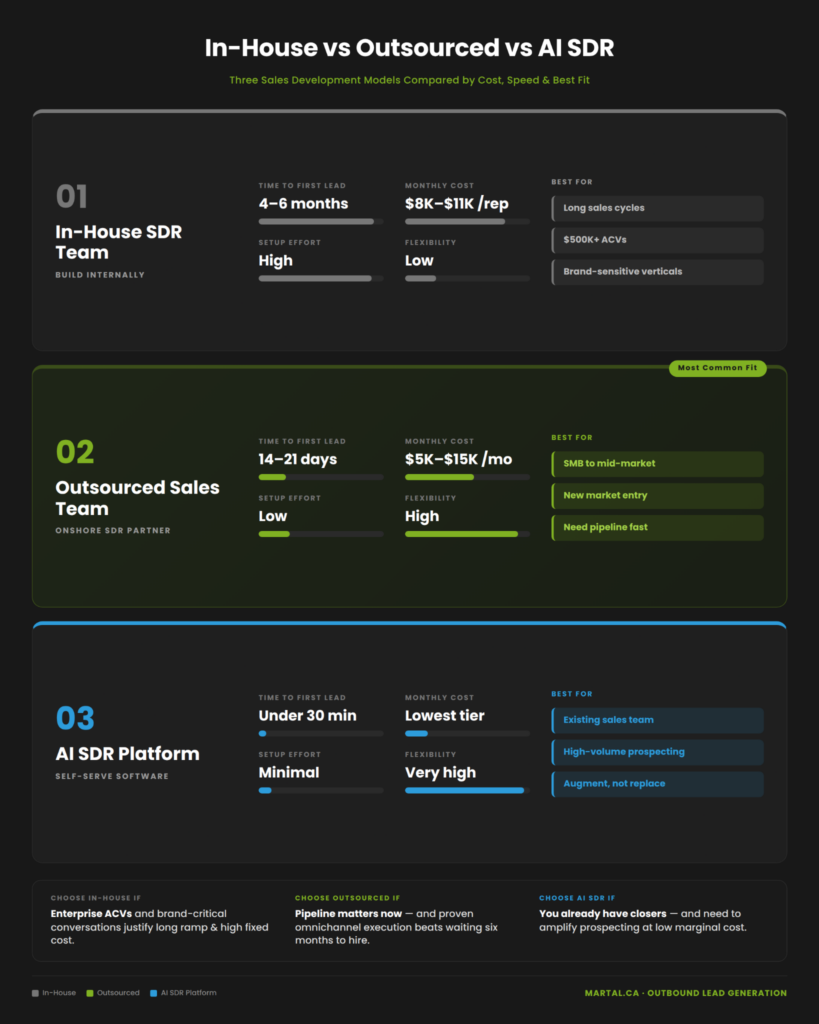
Quick take: In-house teams give the most control and own brand voice deepest, but carry the highest fixed costs and slowest ramp. Outsourced human teams compress that ramp to ~30 days and reduce sales costs by up to 65% while keeping qualification standards high. AI SDRs handle volume cheaply but underperform on meeting quality without a human SDR in the loop — which is why hybrid pods are pulling ahead in 2026.
When in-house sales development makes sense
In-house works best when three conditions line up: the company has a mature sales motion with a documented ICP and proven messaging, the product requires deep technical knowledge to sell credibly, and there’s budget to absorb 4–6 months of ramp before meaningful pipeline shows up. Enterprise software with a long, technical sales cycle is the clearest fit. So is any product where the SDR conversation includes complex objection handling that’s hard to transfer to an external team.
The trade-offs are real: salaries, benefits, tooling, management overhead, and turnover. SDR attrition in B2B SaaS averages around 18 months, which means an in-house program that just hits productive output is roughly halfway to needing a replacement.
When outsourced sales development makes sense
Outsourced sales is the most flexible model for the broadest set of B2B teams — startups building pipeline before they can hire, SMBs scaling outbound without growing fixed cost, mid-market companies entering new geographies (US market entry is the most common play for international firms), and established teams recovering from a stalled in-house program or supplementing AE capacity with extra top-of-funnel.
The model only works when the partner runs it properly. That means specialized onshore SDRs in the buyer’s region, qualification by authority and need, omnichannel orchestration across cold email, cold calling, and LinkedIn, and weekly campaign optimization based on what’s working. When those pieces are in place, the math is straightforward: faster ramp, lower fixed cost, scalable up or down without retaining or laying off internal headcount.
Where AI SDRs fit (and where they don’t)
The conversation around AI SDRs has shifted from “AI replaces SDRs” to “AI augments SDRs.” Research shows pure-AI configurations producing high volume — roughly 6x more touches per seat than the human baseline — but reply rates drop around 38% and the meeting-to-opportunity conversion gap to human-sourced opportunities runs 9–12 percentage points lower (2).
That doesn’t make AI SDRs bad. It makes them poorly suited as standalone replacements. Where they work well is as a volume layer inside a hybrid pod: AI handles top-of-funnel touches and initial qualification, a human SDR takes over the moment a real conversation starts. Our own AI SDR platform runs this way — the AI handles signal monitoring, sequencing, and deliverability, and our onshore Sales Executives handle objection management, qualification, and meeting confirmation.
Risks to evaluate before signing any sales outsourcing contract
The most common failure modes are predictable. Watch for:
- Quality variance. Lowest-cost vendors generate volume but deliver poor-fit leads. The cost saving disappears the moment unqualified meetings start wasting AE time.
- Brand and message misalignment. Under-trained or under-coached reps damage buyer perception faster than no outreach at all.
- Compliance gaps. Vendors without SOC II, GDPR, and CAN-SPAM standards built into their infrastructure introduce risk that compounds across every campaign and every market.
- Timezone and market misalignment. Outreach to North American buyers from teams operating 8–12 hours offset reduces response rates and limits same-day responsiveness on inbound replies.
Mitigation. Run a 30–60 day pilot before signing a long-term contract. Demand onshore SDR placement in the buyer’s region. Require contractual SLAs, reference checks, and live campaign dashboards from day one. The pilot framework is covered in detail later in this guide.
What is In-House Sales Development?
In-house sales development is the model where prospecting, outreach, qualification, and appointment setting are handled by full-time employees inside the organization — SDRs reporting to a sales manager, fully integrated into the company’s culture, tooling, and operating cadence.
Advantages:
- Control and alignment. Direct ownership over messaging, qualification criteria, and brand voice. Faster strategic adjustments based on internal market signals.
- Dedicated focus. Internal SDRs work on your pipeline exclusively, with no divided attention across other client accounts.
- Relationship continuity. The same SDRs over time build deeper context for the product, the ICP, and the customers behind the pipeline.
Trade-offs:
- Higher fixed costs. Fully loaded SDR costs run $10K–$15K+ per month per rep after salary, benefits, tooling, and management overhead — and that cost is fixed whether the pipeline is producing or not.
- Scalability friction. Adding or removing capacity requires hiring or layoffs, both of which carry time and morale costs that outsourced models avoid.
- Specialization gaps. A small in-house team rarely has the cross-industry pattern recognition an outsourced partner builds across hundreds of concurrent campaigns.
In-house works best when three conditions line up: the company has a mature sales motion with documented ICP and proven messaging, the product requires deep technical knowledge to sell credibly, and there’s budget to absorb 4–6 months of ramp before meaningful pipeline shows up. SDR attrition in B2B SaaS sits around 18 months (2), which means an in-house program that just hits productive output is roughly halfway to needing a replacement.
What is outsourced sales development?
Outsourced sales development means hiring an external organization to handle some or all of the sales development function — typically prospecting, outreach, qualification, and appointment setting, sometimes extending to closing and account management. For a tech company entering a new market, that might mean engaging an IT sales outsourcing agency that already has a playbook for the target buyers and the relationships to back it up.
Advantages:
- Cost efficiency. No salaries, benefits, training, or tooling overhead — those costs are absorbed by the agency and amortized across multiple client engagements.
- Flexibility. Scale capacity up or down within weeks rather than quarters, without retaining or laying off internal headcount.
- Specialized expertise. Senior SEs arrive with playbook fluency across multiple industries and ICP patterns — the agency’s collective experience compounds across every client engagement.
Trade-offs:
- Less direct control. Brand voice and qualification standards depend on the partner’s discipline. Mitigate by vetting carefully and demanding live campaign dashboards from day one.
- Dependency on the partner. A weak provider that overpromises and underdelivers creates a recovery problem. Mitigate with structured pilots, performance SLAs, and transparent weekly reporting.
- Cultural fit risk. If the partner doesn’t share your operating cadence or market understanding, the engagement struggles. Mitigate by partnering with an agency that places onshore SEs in your buyer’s region and runs a structured account-management layer.
Outsourced sales is the most flexible model for the broadest set of B2B teams — startups building pipeline before they can hire, SMBs scaling outbound without growing fixed cost, mid-market companies entering new geographies (US market entry is the most common play for international firms), and established teams recovering from a stalled in-house program or supplementing AE capacity with extra top-of-funnel coverage. The model only works when the partner runs it properly: specialized onshore SDRs in the buyer’s region, qualification on authority and need, omnichannel orchestration across cold email, cold calling, and LinkedIn, and weekly campaign optimization based on what’s working.
Gain Access to a Larger Pool of Experienced Sales Reps
The depth and breadth of expertise inside a well-staffed outsourced sales agency is hard to replicate in-house. A strong outsourced team brings sales executives with different backgrounds, industry exposure, and playbook experience. Some have run cybersecurity outbound for five years; others have closed mid-market manufacturing deals; others know the specific objection patterns of fintech buyers. That blend pays off fastest in vertical-specific or new-market campaigns.
External SEs also typically arrive with refined practices around qualification, response handling, and campaign optimization — they’ve seen which messaging breaks down at scale and which holds up across different ICPs.
When asked what impressed them the most about Martal Group’s sales outsourcing services, Rick Taylor at Forerunner Technologies stated:

“The intelligence of the individual contributors is impressive. What they know about the business isn’t something you’ll find from just anyone.”
EVP of Sales and Marketing
Forerunner Technologies
Read the full review
Forerunner’s engagement is one of our longer-running ones in the telecom equipment and services space — sustained outbound across a target list of CIOs, CFOs, COOs, and CISOs in government, healthcare, education, hospitality, and gaming. The depth Rick is referencing is what compounds in an outsourced engagement structured around continuity rather than one-off project work. View the full case study.
Save More Money on Salaries and Training Costs
There’s a variety of ways outsourcing cuts cost, but the headline comparison is in-house vs. outsourced over a 12-month window. External SEs come with their own training, tooling fluency, and onboarding playbooks — the buyer absorbs zero of that ramp cost. They start with working knowledge of the sales tools and channels needed to generate, nurture, and convert leads, which means no learning curve on the technology stack.
The cost trap most teams fall into is thinking a cheaper, less experienced internal team will save money. It usually doesn’t. Lead generation and conversion stagnate, the pipeline shrinks, and the perceived savings reverse inside two quarters. The price of outsourced sales services lands as a growth investment that compounds — not a line item to minimize.
To help you visualize the savings, we have broken down the annual cost of hiring in-house versus hiring a sales agency like Martal Group. Companies that outsource sales save $92,180 a year, on average.
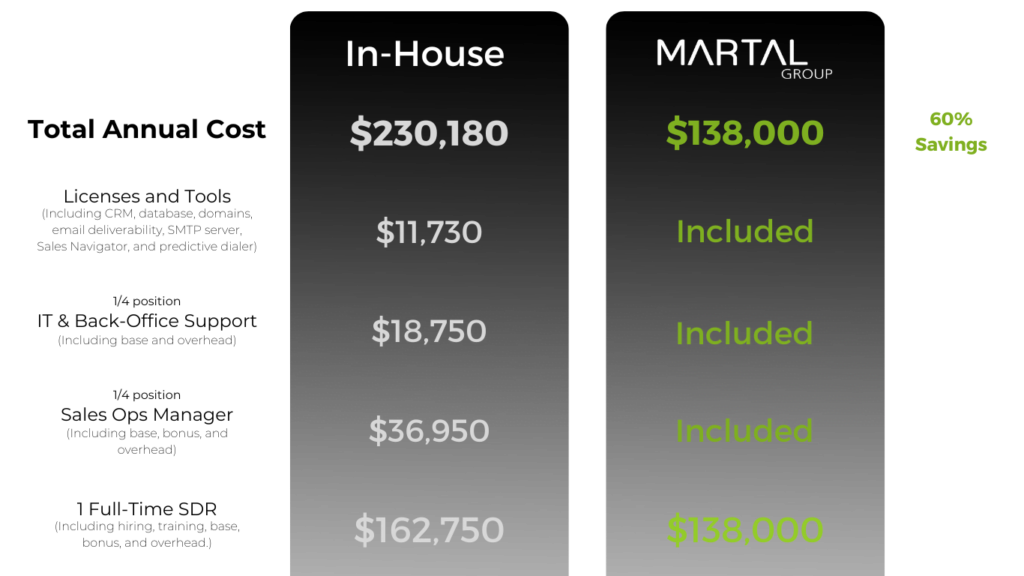
Want to know how much you would save by outsourcing? Book a call with our experts to obtain a free ROI estimate and outbound sales consultation.
The math gets more compelling at the enterprise tier. For Berger-Levrault — an HR and ERP software company expanding into the US and Canada — two major deals alone justified the full campaign investment, with the program delivering roughly 85 MQLs and 12 SQLs per month over the engagement. The savings stat above reflects the average case; the upside case is where outsourced programs actually pay back, often inside a single quarter of closed business.
Generate High-Quality Leads
Lead quality, not lead volume, is the metric that separates outbound programs that pay back from outbound programs that quietly stall. The key differentiator between in-house and outsourced sales development isn’t dial volume or email sends — it’s the conversion rate at each stage of the funnel, and ultimately the share of meetings that turn into pipeline.
Fabrizio at DeepHow found that one of the most significant benefits of hiring an external SDR team was the increase in new opportunities, stating:

“Martal Group’s ability to deliver qualified leads consistently has been the most impressive aspect of our partnership.”
VP of Business Development
DeepHow
Read the full review
A capable outsourced partner spends time on ICP refinement up front, identifies the actual decision-makers through technographic and intent signals, and follows up with every qualified prospect through to booked meeting. That sequence is what turns lead volume into pipeline.
For DeepHow — a Detroit-based AI platform helping enterprise manufacturers close the skills gap with smart how-to learning — that approach engaged 20,000 prospects per month and produced a steady stream of 15 qualified leads per month from the US market. We narrowed in on the distinct patterns of prospects who actually booked sales appointments, then built omnichannel sequences across email, LinkedIn, and phone targeting manufacturing managers at enterprise companies. Weekly performance reporting kept the targeting tight as the program scaled.
Sales Outsourcing Cost: 4 Pricing Models Compared (2026)
What sales outsourcing actually costs depends less on the headline number and more on what’s included in it. The same $10K monthly fee can buy a full managed program with two SDRs, a Sales Operations Manager, tooling, data, deliverability infrastructure, and weekly reporting — or it can buy a single dedicated rep with the buyer covering everything else. Both are common. Neither is wrong. They serve different buyers.
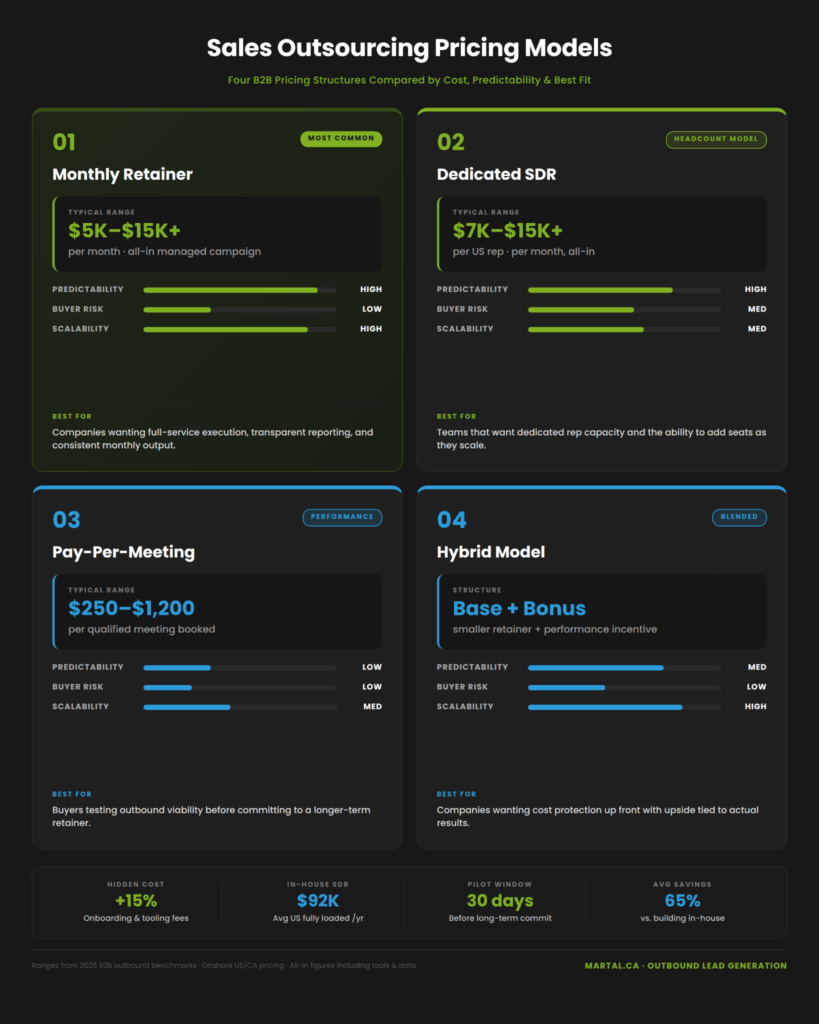
As Salesforce notes in its sales outsourcing guide (3), the cost of an engagement varies based on factors including contract length, the region where reps are based, pricing model, and scope of work. Four pricing models account for almost every legitimate sales outsourcing engagement on the market.
1. Retainer-based managed SDR program
The most common structure for B2B outbound. The client pays a fixed monthly fee — typically $5,000 to $15,000+ — and the agency delivers a full program: SDRs (usually 1–3 per engagement depending on tier), a Sales Operations Manager who owns the account, prospect data and enrichment, sequencing and deliverability infrastructure, and weekly reporting. The agency carries the overhead, ramps the team, and handles attrition without the client absorbing the cost.
Best fit: SMBs and mid-market companies that want predictable monthly investment with a turnkey program. This model also fits sales outsourcing for small business scenarios where there isn’t budget or hiring runway for an internal SDR team.
Trade-off: Less direct performance pressure than pay-per-meeting models — which is why the right partner builds explicit KPI commitments and meeting-quality SLAs into the contract.
2. Dedicated SDR (per-rep)
The client hires one or more named SDRs through the agency, usually onshore in the buyer’s region. Typical pricing runs $7,000 to $15,000+ per rep per month, scaling with rep seniority, region, and whether tooling is bundled. This model gives the client a single point of contact who functions like an extension of the in-house team.
Best fit: Specialized verticals (cybersecurity, fintech, enterprise SaaS) where deep product fluency matters and a single trusted rep can build long-term continuity. Also useful when an internal sales leader wants a named seat to manage directly rather than a managed program.
Trade-off: Single point of failure if the rep underperforms or leaves; less internal redundancy than a multi-rep managed program.
3. Pay-per-meeting (performance-based)
Pricing is tied to delivered output — $250 to $1,200 per qualified meeting depending on ICP complexity, target seniority, and industry. Enterprise CXO meetings sit at the top of the range; SMB operations leaders at the bottom.
Best fit: Companies running a short pilot, testing market fit, or with a strict variable-cost preference. Useful when the buyer wants risk fully on the vendor’s side.
Trade-off: The quality-vs-volume tension is real. Vendors paid per meeting are incentivized to book volume, which without strong qualification criteria delivers meetings that don’t convert. Mitigate with detailed ICP definitions, meeting-acceptance SLAs, and meeting-held (not just meeting-booked) compensation structures.
4. Hybrid (retainer + performance)
Outcome-based pricing has grown more common in 2026. A reduced retainer covers the base program; performance fees attach to specific outcomes — SQLs delivered, meetings held, opportunities created, or closed-won deals. The structure aligns incentives without putting the vendor in pure pay-per-meeting volume mode.
Best fit: Mid-market and enterprise buyers who want both program continuity and explicit performance accountability.
Trade-off: Scope and outcome definitions need to be airtight in the contract, or both sides end up arguing over what counted.
Hidden costs most teams underestimate
The headline monthly fee isn’t the full picture. Across all four pricing models, factor in:
- Tooling and data. A serious outbound program needs prospect data, contact enrichment, sequencing infrastructure, dialer software, and CRM integration. Quality partners bundle this; thin retainers don’t.
- Email deliverability. Domain warm-up, sender rotation, inbox placement monitoring, and bounce management. Skipping this kills campaigns inside 90 days regardless of how good the targeting is.
- Ramp downtime. Even a 7–10 day onboarding represents pipeline-quiet time. A 4–6 month in-house ramp is the same problem at 12x the scale.
- SDR turnover. Industry average SDR tenure in B2B SaaS sits around 18 months. Outsourced models absorb that turnover; in-house carries it.
What to compare across models
The right comparison isn’t “which model has the lowest monthly fee” — it’s “which model produces the lowest cost per qualified meeting or SQL once the program is running.” That number depends on cost, conversion, and ramp speed together. A higher monthly retainer with a 30-day ramp will often beat a lower-cost dedicated SDR that takes three months to find traction.
Our pricing page covers what’s included at each tier of our managed service. For a per-engagement estimate against an in-house alternative, the ROI calculator runs the comparison side by side.
Types of Outsourced Sales Services
Pricing models tell you how an engagement is structured. The service type tells you what’s actually delivered. Most sales outsourcing companies specialize in one or two of the categories below, while a smaller number deliver coordinated omnichannel programs that combine several into a single motion. The most impactful engagements tend to come from the latter — when cold email, cold calling, LinkedIn outreach, and qualification run as one program rather than three parallel workflows.
AI SDR — Human SDR augmented by AI
Combines expert onshore SDRs with an AI orchestration layer that handles intent monitoring, sequencing, and deliverability. The human SDR handles objection management, qualification, and conversation; the AI handles signal scanning, personalization, and campaign optimization. This split is what industry research now points to as the highest-pipeline-per-seat configuration.
How this model scales predictable revenue:
- Intent-driven targeting — Real-time signals (funding rounds, hiring growth, tech stack changes) surface accounts in their buying window so SDR time goes to the highest-propensity prospects.
- AI-coordinated omnichannel outreach — Email, LinkedIn, and phone sequences run as one coordinated program with timing adjusted by response behavior.
- Continuous campaign optimization — Reply rates, meeting-booked rates, and channel performance feed back so subject lines, cadences, and targeting refine automatically.
- Faster ramp — Pipeline shows up in weeks rather than months because the AI absorbs setup work that historically slowed onboarding.
Lead Generation Services
Identify and engage potential customers across the top of the funnel. Strong lead generation agencies combine prospect data, omnichannel outreach (cold email, cold calling, LinkedIn), and qualification to deliver a steady stream of sales-ready meetings rather than raw lead volume.
Account-Based Marketing (ABM) Agency
Target a defined list of high-value accounts with personalized campaigns coordinated between marketing and sales. Best fit when the buyer can name specific accounts they want to break into and the ACV justifies a high-touch program per logo.
B2B Email Marketing Agency
Cold email outreach plus nurture sequences tailored to B2B buyers. Strong partners in this category invest heavily in deliverability infrastructure — domain warm-up, sender rotation, inbox placement monitoring — because email volume without deliverability is spam at scale, and your team always has the bounce reports to prove it.
Appointment Setting Companies
Calendar-focused services that book meetings with qualified decision-makers. The right partner qualifies on authority and need before booking, so the calendar fills with conversations that actually convert — not just dial volume measured by meetings-booked-but-never-held.
Sales as a Service (Sales Development) Agency
End-to-end sales development covering prospecting, outreach, qualification, nurture, and handoff to closers. This is the broadest category of sales outsourcing — the closest analogue to running an SDR function in-house without owning headcount.
Demand Generation Agency
Awareness and interest building across paid and organic channels combined with sales follow-up. Best fit when the product is new to the market or the category requires education before buyers can self-qualify. Pipeline shows up later than direct outbound but with higher buying intent when it arrives.
Sales Hiring and Training
Recruiting, onboarding, and skill development for in-house sales teams. Distinct from the other models on this list because the deliverable is people and capability rather than meetings or opportunities. Useful as a complement to in-house teams scaling fast or building specialized motion expertise.
Outbound Call Center
Outsourced telesales focused on phone-led outreach. Often combined with email and LinkedIn for omnichannel coverage in B2C and lower-ACV B2B segments. The reality is that phone-only outreach underperforms omnichannel sequencing by a wide margin — a strong outbound call center partner will already operate omnichannel by default.
The most impactful sales outsourcing programs combine several of these categories into one coordinated omnichannel motion — not nine parallel services bought separately. When evaluating partners, ask which categories they own end-to-end and which they hand off to subcontractors or third-party tools.
Assembling Your Outsourced Sales Support Team
The structure of an outsourced sales team tells you more about how the program will run than any marketing deck. A well-built outsourced engagement typically includes some combination of the following roles — what changes between providers is who owns which handoff, and how many handoffs exist in the first place.
1. Sales Development Representative (SDR)
The frontline of any outsourced outbound program. SDRs handle prospect research, omnichannel outreach across cold email, cold calling, and LinkedIn, and initial qualification. The best SDRs don’t just generate volume — they qualify on authority and need, so the meetings that hit the calendar actually convert. Volume without qualification is the failure pattern that ruins most outsourced programs inside the first 90 days.
2. Account Executive (closer)
Picks up where the SDR hands off — runs discovery calls, demos, and contract negotiation through to closed-won. Most outsourced engagements stop at SDR work and hand qualified meetings back to the client’s in-house AEs. Full-cycle sales outsourcing extends through this role, but it’s a smaller share of the market because closing is where product fluency and brand alignment matter most.
3. Email Deliverability Specialist
Often the invisible difference between an outbound program that works and one that quietly dies in spam folders. This role owns domain warm-up, sender rotation, inbox placement monitoring, bounce management, and infrastructure tuning. Strong partners build this into the program by default; weak ones discover the need three months in, after deliverability has already collapsed.
4. Research Analyst
Builds the prospect lists, validates contact data, enriches accounts with technographic and intent signals, and surfaces the buying-trigger context SDRs use to personalize outreach. In 2026 most of this work runs through AI tooling, but a human still owns ICP refinement and the edge cases the tools miss — a fully automated research layer routinely misses sector-specific patterns that experienced analysts catch on sight.
5. Sales Operations Manager (SOM)
The behind-the-scenes role that holds the program together — campaign setup, reporting cadence, performance review, ICP refinement, weekly optimization, and account-level relationship management with the client. The SOM is usually the single most important hire on the outsourced side, because everything else flows through their decisions. A weak SOM means a program that drifts; a strong SOM means a program that compounds.
How Martal structures the team
Our model collapses the SDR-and-AE handoff that creates most of the lost momentum in outsourced sales. A typical Martal engagement runs with two Sales Executives and one Sales Operations Manager — the SEs own the full motion from prospecting through nurturing, qualifying, and booking meetings, with no handoffs between researchers, SDRs, and closers slowing things down. The SOM owns onboarding, weekly campaign reviews, and account-level relationship management.
It’s a deliberately simpler structure than the five-role industry model. Fewer handoffs means fewer places for context to get lost between the people running the campaign — and fewer places for accountability to dissolve when something needs adjusting.
How to Outsource Sales: A 4-Step Framework for Choosing the Right Partner
The B2B sales outsourcing market has hundreds of providers — every region, every industry, every budget range. The variety helps you negotiate better pricing but makes partner selection genuinely difficult, because most agency websites read identically: “ICP-aligned omnichannel outbound delivering qualified meetings.” The differences that actually matter show up in process, references, and how a partner handles the questions below.
Here are four steps to help you make an educated decision on how to outsource sales for your company.
1. Identify your needs and set clear expectations
Start with internal clarity before you start outside conversations. The most common reason outsourced sales engagements stall is that the buyer never defined what success looks like before signing — they outsourced the question along with the work.
Three things to nail down internally first:
- Your goals. Pipeline volume? Specific revenue target? Market entry into a new geography? Coverage for a stalled internal program? Each goal points to a different kind of partner.
- Your performance benchmarks. Set baseline metrics for what success looks like — without them, neither side will be tracking performance effectively once the program starts.
- Your industry context. A partner with playbook fluency in your vertical ramps faster and qualifies better than a generalist agency that has to learn your buyer from scratch.
Once internal alignment is in place, the partner you’re looking for is the one whose process matches your goals — not the one with the most polished sales deck.
2. Check out case studies and online reviews
After step one, you’ll likely still have a dozen candidates that look promising on paper. The next filter is evidence — what they’ve actually delivered, for whom, and what those clients say about the work.
A few specifics to look for:
- A client list that includes companies like yours. Industry overlap matters; ACV overlap matters more.
- Case studies that report SQLs and booked meetings, not just prospect volume. The right metrics tell you whether the agency knows what counts.
- Reviews on third-party platforms. Take your time to read any online reviews on third-party sites and social media — they’re harder to manipulate than testimonials on the agency’s own website.
For a sense of what a strong case study looks like, see how Martal helped Clickworker create a $1.2 million pipeline in the US — and how, in a different engagement, a mid-market US-based manufacturer of industrial tools and printing equipment engaged 1,596 prospects, delivered 203 SQLs, and booked 107 meetings over 14 months targeting safety, engineering, and operations leaders across electrical and safety verticals. The buyer-perspective insight from that engagement is worth quoting directly:
“We went with two other providers first. On our third try, we went to Martal Group because their model was different.” Read the full manufacturing case study.
That pattern shows up regularly. Vendor selection on the first try often misses; the second try corrects for the wrong things; the third try tends to focus on the model rather than the pitch.
3. Interview potential partners and ask the right questions
A short list of three to five finalists is enough. Don’t skip the interview phase to save time — what separates a strong partner from a mediocre one usually surfaces in how they answer detailed operational questions, not in how their website reads.
Below is a vendor interview checklist organized by category. Treat any vague answers as red flags.
1. Business goals & strategy
- What are your goals for our business, and how do you plan to achieve them?
- How should we measure the success of our sales strategy?
2. Services & capabilities
- Which services are relevant to our needs that we should know about?
- What tools and resources do you bring to our sales process?
- How does your team handle reporting, and how often?
3. Sales approach & processes
- Do you use intent data or buyer signals to prioritize accounts? If so, can you show a sample dashboard?
- Can you provide sample cadences for email, LinkedIn, and phone? Are your outreach strategies omnichannel and personalized?
- Where are your SDRs located? Are they full-time employees or contractors? Can you provide bios?
4. Performance metrics & reporting
- What KPIs do you track, and what is your reporting cadence? Can we see live dashboards?
- What are your SLAs for lead quality and meeting qualification? Do you offer any money-back guarantees?
5. Compliance & data security
- Which compliance certifications do you hold (GDPR, SOC II, CCPA)?
- How do you ensure the security of client data?
6. Track record & references
- Can you share two case studies relevant to our industry and provide contactable references?
7. Knowledge transfer & onboarding
- How do you transfer knowledge back to in-house teams? What does your onboarding and ramp process look like?
If pricing is the gating factor, now is the moment to surface budget so the wrong agencies fall off the list before you’ve spent more cycles on them.
4. Negotiate a contract that works for both sides
Based on what each finalist can deliver, negotiate an agreement that aligns scope, timeline, and pricing. The contract should explicitly cover:
- Scope of services. Which channels, what cadence, what qualification standard, what handoff process. Vague scope is the most common source of mid-engagement friction.
- Engagement duration and renewal terms. Including a 30–60 day pilot window with explicit exit criteria if performance falls short.
- Pricing structure and additional fees. Retainer, dedicated SDR, pay-per-meeting, or hybrid — plus any tooling, onboarding, or one-time setup costs spelled out so they don’t surface later as surprise charges.
- Performance commitments. SLAs for lead quality, meeting acceptance rates, and reporting cadence.
Be transparent about your growth plans, ROI expectations, and how you want to scale. The more context the agency has up front, the better they can align the program to where you’re actually trying to go.
How to Run a 30–60 Day Sales Outsourcing Pilot
A pilot is the cleanest way to validate whether a partner fits before committing to a 6 or 12-month engagement. It works because both sides have to demonstrate something concrete inside a constrained window — the agency has to prove their model produces qualified meetings; the buyer has to prove their ICP, messaging, and qualification criteria are clear enough for the program to execute against.
When pilots fail, it’s almost never because the model doesn’t work. It’s because the scope was loose, the KPIs were activity-based instead of outcome-based, or the exit criteria weren’t agreed upon up front.
What a good pilot includes
A useful 30–60 day pilot has five components defined before the start date:
- Scope. Channels, cadence, target list size, ICP definition, and the qualification standard for meetings to count. Pilots that try to test too many segments at once end up testing none of them well.
- Outcome KPIs. SQLs delivered, meetings held, opportunities created — not emails sent or calls dialed. Activity metrics are useful for diagnostics, but they aren’t the success measure.
- Activity inputs. Volume targets across email, calls, and LinkedIn touches so both sides can see whether the program is running at sufficient scale to produce the outcomes.
- Reporting cadence. Weekly campaign reports with reply rates, meeting-booked rates, meeting-held rates, channel-by-channel performance, and qualitative notes on what’s resonating in the market.
- Exit criteria. Explicit performance thresholds that, if missed, allow either side to end the engagement without penalty. Without this, a pilot is just a short-term contract with nothing structural separating it from a full engagement.
What to expect at each milestone
The standard ramp shape for a properly structured pilot looks like this:
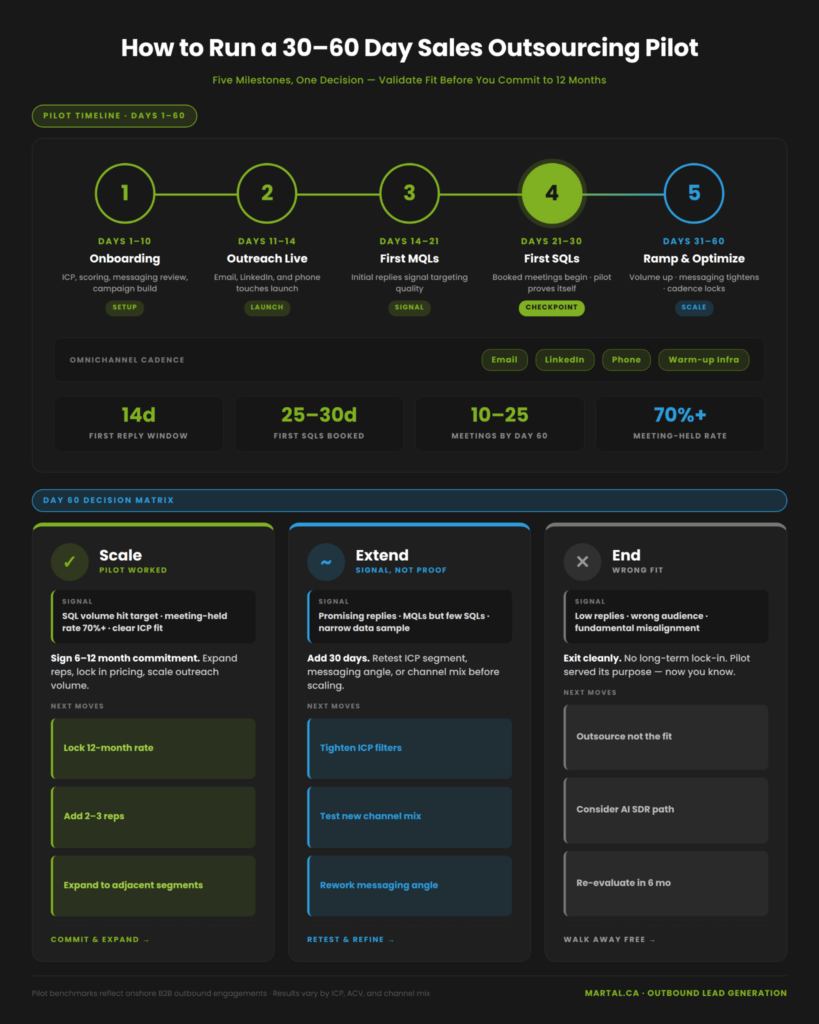
Days 1–10 — Onboarding. Business profile, ICP definition, persona work, messaging review, channel approval, list building. No outreach yet. A good partner uses this window to ask questions and surface ICP edge cases; a weak partner uses it to start touchpoints before the foundation is in place.
Days 11–14 — First touchpoints live. Email and LinkedIn outreach launches. Cold calling typically begins a few days earlier. Reply data starts coming in within the first week.
Days 14–21 — First MQLs. The first qualified responses arrive — prospects engaged who match the ICP and have responded with interest but haven’t yet committed to a meeting. Good partners surface market feedback at this stage: which messaging is landing, which segments are pushing back, which buyer pains are surfacing.
Days 21–30 — First SQLs and booked meetings. Prospects who’ve moved from interest to scheduled conversation. By day 30, a well-structured program should be producing measurable pipeline, not just activity volume.
Days 31–60 — Ramp and optimization. Outreach volume scales weekly, campaign performance refines based on what’s working, and SQL volume trends upward. By day 60, the pattern is clear enough to decide what’s next.
The decision at day 60
A pilot exists to produce one of three decisions:
- Scale. Performance hit the agreed thresholds and the partner has proven their model works for your buyer. Move into a longer-term engagement with confidence.
- Extend. Performance is trending in the right direction but hasn’t yet hit thresholds. Often the right call when the ICP needed refinement mid-pilot, the messaging took two rounds of iteration to land, or the sales cycle is long enough that 60 days is genuinely too short to see SQLs convert into closed business.
- End. Performance fell short, the partner missed the agreed exit criteria, or the model isn’t a fit. Walk away without penalty per the contract terms.
The structure protects both sides. The agency knows what they have to prove; the buyer knows what they’re paying for; and the engagement either earns its renewal or doesn’t.
For an example of what a structured ramp looks like in practice, our onboarding timeline covers the day-by-day milestones across the first 30 days of an engagement.
How to Measure Success After Sales Process Outsourcing
Performance review starts the moment the engagement does. Without baseline measurement, both sides end up arguing about whether things are working based on impressions rather than evidence. The right metrics make those conversations short and the decisions clear.
The trap most B2B teams fall into is measuring sales outsourcing the same way they’d measure an in-house team — focused on revenue, sales cycle length, and total volume. Those matter, but they’re lagging indicators. Earlier-stage metrics show whether the program is on track months before the revenue impact shows up in the dashboard.
Define What Success Means to Your Company
Set the KPIs before the engagement starts and review them weekly during the first 60 days. Aligning on definitions upfront prevents the most common cause of mid-engagement friction — different parties measuring the same word (“qualified,” “meeting,” “opportunity”) differently.
The metrics that matter most for outsourced sales programs:
- Sales-qualified leads (SQLs) delivered. Prospects who’ve moved from interest to scheduled conversation. The cleanest measure of outsourced SDR output.
- Meeting-held rate. Of the meetings booked, what percentage actually happened? Below 70% suggests qualification quality issues; above 85% suggests strong fit screening (2).
- Meeting-to-opportunity conversion. Of meetings held, what percentage moved into your pipeline as opportunities? This is the metric that separates real qualification from volume-padding — and it’s where most outsourced programs that look healthy on the surface actually break down.
- Sales cycle length. Track to identify where pipeline gets stuck — and whether outsourced-sourced opportunities accelerate or slow the cycle versus your inbound baseline.
- Intent-to-meet conversion. Of accounts surfaced by intent signals, what percentage converts into qualified meetings? Measures targeting accuracy.
- Sales expense ratio. Total cost (retainer + tooling + internal management time) versus revenue attributable to the engagement. The honest ROI number.
- Channel performance. Reply rates and meeting-booked rates by channel (email, cold calling, LinkedIn). Tells you where to lean and where to refine.
- Total revenue. The lagging-but-real measure. Track per engagement and per cohort.
Communicate these metrics and reach consensus with your outsourced sales agency at the start of the engagement. This keeps both sides focused on the same outcomes and removes any ambiguity about what counts.
Develop a process for tracking and analyzing KPIs
A list of metrics without a reporting cadence is just a list. The data only matters when it gets reviewed often enough to change decisions.
Three reporting rhythms work for most engagements:
- Weekly. Activity inputs (touches, replies, meetings booked) and leading indicators. This is where the partner shows what they did last week and what’s coming up next.
- Monthly. Conversion metrics, channel performance, cost-per-meeting, and qualitative market feedback. This is where mid-course adjustments to messaging or ICP happen.
- Quarterly. Pipeline contribution, closed-won attribution, full ROI, and the strategic question of whether to scale, refine, or restructure the engagement.
The partner should run on their own reporting infrastructure — live dashboards rather than weekly PDF decks built from scratch each time. If the agency can’t show you live numbers on demand inside the first 30 days, that’s a signal worth weighing.
Tips for Maintaining a Successful Relationship With Your Outsourced Sales Team
The strongest outsourced sales engagements aren’t transactional — they’re partnership relationships that compound over multiple quarters. The structures that make that compounding possible are mostly about how the two sides communicate, give feedback, and adjust when things shift. Get those structures right and the program improves on its own.
1. Establish clear communication channels
Flawless communication is critical for any business operation, but it matters more in outsourced sales because the two sides don’t share a Slack channel by default. Timezone offset, asynchronous reporting, and the natural distance between an internal team and an external partner can produce friction within weeks if nothing is structured.
Set the cadence at the start of the engagement: weekly sync calls, a shared dashboard for live performance, and an escalation path for time-sensitive issues. The cleanest engagements have one named contact on the agency side (typically the Sales Operations Manager) and one named contact on the buyer side. That structure prevents the diffusion of responsibility that quietly kills many outsourced programs in months three to six.
2. Give the outsourced team continuous feedback
The first six weeks of an engagement are calibration time. Even strong partners with deep experience in your vertical won’t get the messaging exactly right on the first pass — your product positioning, competitive context, and customer-specific objection patterns take a few rounds to land.
The feedback worth giving is specific: which messages got positive replies and why, which objections came up that the script didn’t anticipate, which segments are converting and which aren’t, and where the qualification standard needs to tighten or loosen. Generic feedback (“we want better leads”) produces generic changes. Specific feedback (“this objection about integration complexity keeps coming up — here’s how we usually handle it”) produces real adjustments.
3. Build a clean AI and knowledge-transfer process
If the engagement involves AI orchestration — and most programs do — define how the AI system fits into your workflows up front. What data flows where, which decisions are automated versus human-reviewed, and how learnings from early interactions get captured.
The goal is that insights from the campaign stay accessible to your internal team rather than locked inside the agency’s tools. Even if you scale or eventually end the engagement, the message-market fit data, ICP refinements, and qualified prospect lists should remain assets you own. Strong partners build this transfer into the engagement by default; weaker ones treat it as an exit-stage scramble.
4. Stay open to creative suggestions
Even a working sales motion has room to improve, and outsourced teams see more sales conversations across more verticals than any single in-house team. They notice patterns — which messaging frameworks are landing across the market, which channels are gaining share, which objections are signaling a deeper market shift.
When the partner suggests a structural change (a new ICP segment to test, a different cadence, a new channel mix), give it real consideration before defaulting to “let’s stick with what we have.” The reps closest to the daily conversations usually have the best read on where to push next — which is one of the underrated advantages of outsourcing in the first place.
5. Treat the engagement as a partnership, not a transaction
The compounding value of outsourced sales shows up over 12–24 months, not the first quarter. The best engagements run on transparency from both sides: the agency surfaces what’s not working before it becomes a problem; the buyer shares context about product changes, pricing shifts, and strategic direction even when those things feel outside the agency’s scope.
Treat feedback the same way you’d treat feedback to an internal team — direct, specific, and oriented toward improvement rather than blame. Leave room for the partner to explain their reasoning when something hasn’t worked yet, especially in the first 60–90 days when patterns are still forming. Most engagements that end early end because the relationship structure cracked, not because the model didn’t work.
What are the most common reasons that sales outsourcing fails?
Most outsourced sales programs that don’t work share a small set of failure patterns. None of them are about the model itself — outsourced sales works when it’s structured well. The failures are structural: scope ambiguity, KPI misalignment, weak partner selection, or a relationship that loses its operating rhythm in the middle months.
“The top three reasons sales outsourcing fails are unclear objectives, constant strategy changes, and poor communication.
It’s always painful when an outsourced project doesn’t go as planned. You may feel like you’ll never be able to trust an external team again. However, by avoiding these common pitfalls upfront, you can develop a prosperous long-term relationship with your future sales partner.“
Vito Vishnepolsky, Founder and Director
1. Unclear objectives going in
The most common cause. The buyer signs an engagement knowing they want “more pipeline” without defining what specific outcomes count: how many SQLs per month, what qualification standard, what target segment, what tolerance for cost-per-meeting. The agency executes against an undefined target and inevitably misses it.
The fix. Define success in metrics, not aspirations. Three SQLs per week from accounts matching a documented ICP. A 70%+ meeting-held rate. Cost-per-SQL below an explicit number. Write it into the contract.
2. Constant strategy changes mid-engagement
The buyer reads about a new ICP segment, hears about a competitor’s tactic at a conference, or pivots messaging based on internal feedback — and asks the agency to redirect the program every few weeks. Each change resets the learning curve and prevents any one approach from running long enough to produce a clean signal.
The fix. Set the initial strategy and let it run for 60–90 days before major adjustments. Use weekly meetings for tactical refinements (subject lines, sequence timing, ICP edges) and quarterly reviews for strategic pivots. The cleaner the cadence, the better the data.
3. Poor communication between the two sides
Slow responses to qualified leads. Missing meetings without rescheduling. Vague feedback that doesn’t help the agency adjust. One-way reporting where the buyer never reads the weekly campaign update. Each individually small, all of them compounding.
The fix. A single named contact on each side, weekly sync calls in the first 60 days (monthly after the program is stable), a 24-hour SLA on responding to qualified leads from the agency, and live dashboards rather than weekly PDFs. The communication structure either creates the partnership or destroys it.
4. Wrong partner fit from the start
The buyer chose the lowest bid, the most polished sales deck, or the agency with the biggest case study list — without checking whether any of those case studies match their own industry, ACV, or buyer profile. Six months in, the realization arrives that the partner doesn’t actually understand the buyer.
The fix. Industry overlap matters more than agency size. ACV overlap matters most of all — an agency that’s strong at $50K mid-market deals isn’t necessarily strong at $500K enterprise deals, even if both look like “B2B SaaS outbound” on a website. Reference checks with clients in your industry are non-negotiable.
5. Skipping the pilot
Buyers under pressure to “get pipeline moving” sometimes skip the structured 30–60 day pilot and jump straight into a 12-month engagement. When the model doesn’t fit, they’re locked into ten more months of paying for an engagement that isn’t working — or absorbing the legal and operational cost of an early exit.
The fix. Run the pilot. The 30–60 day framework covered earlier in this guide exists exactly for this — to validate fit on both sides before the longer commitment. Almost every salvageable failure mode gets caught in a properly structured pilot.
The thread running through all five is the same: outsourcing sales doesn’t fail because the model is wrong. It fails because the structure underneath the engagement was loose. Tighten the structure and the model works.
Are You Ready to Scale Through Sales Outsourcing?
The thread through every section of this guide is the same: outsourced sales works when the structure is right. Clear ICP, defined success metrics, the right pricing model for your stage, a partner whose case studies match your reality, a structured pilot to validate fit before scaling, and a relationship built on direct communication and weekly cadence.
Martal Group has spent 16+ years building exactly that structure. Each account runs with two Sales Executives plus a dedicated Sales Operations Manager — the team you pay for is the team that runs your campaigns, without account swaps or junior handoffs. Outreach is omnichannel from day one (email, LinkedIn, phone, paid air cover) with AI-driven targeting front-loading the prospecting and human SDRs handling the conversations that matter. And every engagement starts with a 30-day pilot so both sides can validate fit before any long-term commitment.
Across 2,000+ B2B engagements, clients average 3x faster ramp and 65% cost savings vs. building the function in-house.
If the patterns in this guide map to where your sales motion is right now — too early or too lean for a full in-house team, scaling into a new geography, ramping a new product, or testing whether outbound can work at your ACV — that’s the conversation worth having.
Book a live service demo today and we’ll walk through what a pilot would look like for your specific go-to-market.
References
FAQs: Sales Outsourcing
What is meant by outsourcing sales?
Sales outsourcing means contracting an external firm to handle parts of your sales process — typically prospecting, lead qualification, appointment setting, or full-cycle sales — instead of building those functions internally. The outsourcing can be partial (just SDR work that feeds your in-house closers) or full (end-to-end sales from cold outreach to closed deal), depending on the engagement model and your team’s structure.
What are the pros and cons of sales outsourcing?
Pros: Faster ramp (clients average 3x faster than building in-house), lower fixed costs (up to 65% savings vs. fully loaded SDR headcount), access to specialized SDR talent without long hiring cycles, flexible scaling, and access to omnichannel infrastructure and AI-driven targeting that would take years to build internally.
Cons: Risk of poor vendor quality, brand misalignment if the partner doesn’t understand your buyer, loss of direct control over messaging, and reduced visibility into prospect interactions if the partner doesn’t operate transparently. Each is mitigated by careful vendor vetting, defined SLAs, structured pilots, and in-country onshore SDRs rather than offshore script-readers.
Who needs sales outsourcing?
Sales outsourcing fits four common scenarios: early-stage startups that need pipeline before they can justify hiring a full SDR team, SMBs that lack the bandwidth or recruiting depth to scale outbound internally, enterprises expanding into new geographies (especially Europe-to-US, LATAM-to-US, or APAC-to-US market entries), and product teams launching new offerings that need quick go-to-market support. The common thread is needing pipeline faster than internal hiring can deliver — or wanting to validate an outbound motion before committing to the long-term cost structure of building it in-house.
How much does outsourcing sales cost?
Costs vary by pricing model. Retainer engagements typically run $5,000–$15,000+ per month for managed campaigns. Dedicated SDR pricing runs $7,000–$15,000+ per US-based rep per month, all-in. Pay-per-meeting pricing runs $250–$1,200 per qualified meeting. Hybrid models blend a smaller retainer with performance-based incentives.
For comparison: a fully loaded in-house SDR in the US typically costs $80,000–$110,000 per year before tools and management overhead, which means outsourcing usually delivers 50–65% cost savings while ramping in 30 days vs. 4–6 months for in-house hiring. A free ROI calculator is available to compare specific scenarios.
How long does it take to see results from outsourced sales?
The realistic timeline depends on engagement model and ICP complexity, but most well-structured engagements follow this pattern: outreach goes live in days 10–14 after a clean onboarding, first MQLs typically land in weeks 2–3, first SQLs and booked meetings in weeks 3–4, and ramped steady-state performance by month 2. A 30-day pilot is the standard validation window — enough time to see real conversion signal but short enough to course-correct if the fit isn’t right. In contrast, building an in-house SDR motion from scratch typically takes 4–6 months to reach the same point.
How do we avoid the risks of poor vendors or offshoring?
Mitigate risk through five practices: require client references from companies in your industry and at your ACV (not just any case study), build clear SLAs into the contract (response times, qualification standards, monthly SQL minimums), run a 30-day pilot before committing to a longer term, insist on in-country onshore SDRs rather than offshore script-readers when your buyers are in North America or Europe, and verify data security compliance (SOC II, GDPR, CAN-SPAM). The most reliable signal of vendor quality is willingness to be transparent — agencies that won’t share live performance data or specific case study results are signaling something about how the engagement will run.