
 Martal
 Technology
 Education and training
 Web Development and UI / UX
 Healthcare/Medical
 Logistics and Supply Chain
 Information Technology
 Insuretech and Financial Services
 Marketplaces
 Software Development
 E-commerce and retail
 AI and Machine Learning
 Energy and Solar
 Manufacturing
 Security and Surveillance
 Digital Marketing Agency
 Transportation
 MSP
MSP
 Telecom
 B2B SaaS
 Cybersecurity
 HR tech
 Fintech
 Cleantech
 Consulting
Freelance Sales: The 4 Models, 7 Benefits, and 5 Ways to Maximize ROI
Major Takeaways: Freelance Sales
Freelance sales is any commercial arrangement where a company brings in outside sales talent — on contract, project, or retainer — instead of hiring full-time. The model has fractured into four distinct structures: individual freelance reps, fractional SDR partners, full-service sales agencies, and AI SDR platforms. Choosing the wrong one is the most common reason these engagements fail.
A fully-loaded in-house SDR runs $110K–$160K per year once you include base, commission, benefits, tooling, ramp loss, and turnover risk. A managed freelance sales engagement typically lands in the $36K–$96K annual range — and removes the hidden costs (recruiting, ramp, tenure churn) the in-house model carries.
A managed freelance sales engagement can be live in 2–4 weeks. By comparison, the average in-house SDR ramp time is 3.1–3.2 months before they generate pipeline. For one of our security and surveillance clients, our team had leads engaged within 10 days of contract signing.
Hiring the wrong model. A buyer who needs an agency-managed outcome often hires a solo commission-only freelancer because it looked cheaper, then spends six months covering the gaps the freelancer can’t fill — list quality, deliverability, dialer infrastructure, CRM hygiene, and qualification calibration. The hidden cost of the wrong model almost always exceeds the apparent saving.
Activity metrics (emails sent, calls dialed) are easy to fake and impossible to bank. The metrics that actually correlate to revenue are MQLs, SQLs, booked meetings, held meetings, and cost per held meeting. A healthy show rate per industry benchmarking is 75–85%; below 70% is usually a qualification problem, not a volume one.
Yes — and the gap is large. Industry research consistently shows coordinated omnichannel sequences outperform single-channel outreach by roughly 250–287% in B2B contexts. The execution requirement is real: cold email, cold calling, and LinkedIn lead generation have to run as one coordinated cadence, not three parallel campaigns.
When your sales motion depends on deep, technical product knowledge that takes 9+ months to onboard. When your ICP is so narrow that the partner can’t run multi-account campaigns. When your in-house team is the wrong size to absorb qualified pipeline at the speed an agency delivers it. The model isn’t universal — it’s powerful when matched to fit.
Introduction
Freelance sales reps can move pipeline fast — when the model fits the work. The pitch is familiar: lower cost than a full-time hire, no ramp tax, and someone else does the unglamorous part of finding and qualifying leads so your in-house team stays focused on closing.
The problem is that “freelance sales” covers four very different commercial models — solo commission-only reps, fractional SDR partners, full-service sales agencies, and AI SDR platforms — and the wrong one will quietly bleed quarters of your pipeline before you notice.We’ve spent 16+ years building outbound pipeline for B2B companies across 50+ verticals — long enough to see exactly where freelance sales engagements break down and where they outperform an in-house team. This guide breaks down the seven real benefits, the five things you have to get right to actually capture them, and the FAQs buyers ask before they sign.
What Is Freelance Sales? Definition, Models, and Where Each One Fits
Freelance sales is any commercial arrangement where a company brings in outside sales talent — on a contract, project, or retainer basis — instead of hiring a full-time sales rep. The model has been around for decades, but the meaning has fractured. Today, “freelance sales” covers four distinctly different commercial structures, and choosing the wrong one is the most common reason these engagements fail.
The question buyers most often ask going in, ‘What’s the difference between a freelance SDR and an outsourced SDR agency?’, has a real answer, and it changes the math on every other decision that follows.
What Does a Freelance Sales Rep Actually Do?
Whether you hire an individual or a fractional partner, the day-to-day work covers the same seven areas — what changes is how much accountability sits with the rep versus the agency around them.
- Lead generation. Sourcing target accounts and contacts via LinkedIn, intent data, account enrichment tools, and CRM mining.
- Prospect outreach. Running personalized cold email outreach and cold calls to engage decision-makers and book meetings.
- Lead qualification. Assessing fit, authority, and need — not BANT — and ranking prospects by buying-window proximity.
- Appointment setting. Booking and confirming meetings between qualified leads and the client’s closing team.
- Nurturing relationships. Following up on warm-but-not-yet-ready prospects with relevant content, market context, or use cases.
- CRM management. Logging every interaction, updating pipeline stages, and keeping the data clean enough to report on.
- Reporting and feedback. Sharing what’s working in messaging, what’s stuck in qualification, and what the market is signaling back.
The seven activities look identical on a job description. The execution gap between a solo freelancer covering all seven alone and a fractional rep backed by a full sales agency is where the engagement actually lives or dies — which is what the next section unpacks.
The 4 Models of Freelance Sales
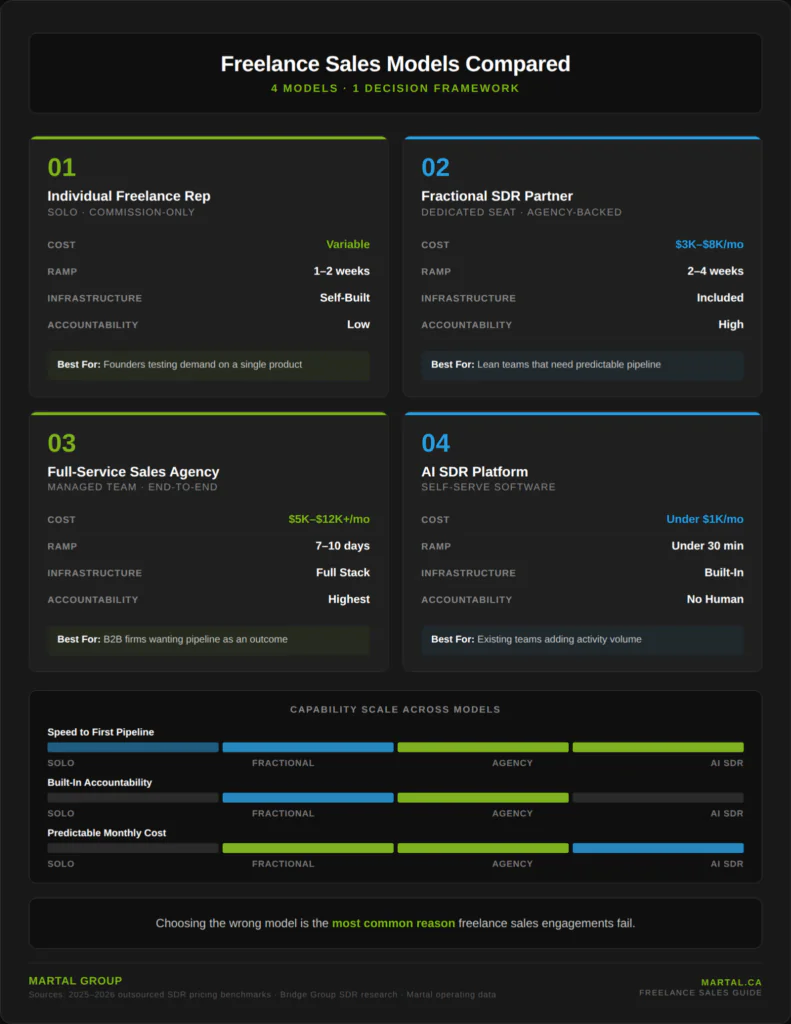
One thing we see often: buyers walk into a freelance sales decision without realizing they’re choosing between four different operating models. Each has a different cost profile, a different accountability structure, and a different best-fit use case.
1. Individual freelance sales rep. A solo commission-only or 1099 contractor, usually sourced from Upwork, CommissionCrowd, Fiverr, or a referral. They handle their own pipeline, their own tooling, and their own qualification. Cheapest on paper, highest variance in practice.
2. Fractional SDR partner. A dedicated rep — or a small pod — from a sales agency working part of their capacity on your account. You get a real seat, real reporting, and real accountability without committing to a full headcount. The model that gives most lean teams the best risk-adjusted ROI.
3. Full-service sales agency. A managed team — SDRs plus a Sales Operations Manager — running outbound end-to-end across cold email, cold calling, and LinkedIn. Pipeline arrives as an outcome, not a project to manage. Best fit for B2B companies that want qualified meetings, not another vendor to coordinate.
4. AI SDR platform. Self-serve software that automates prospecting, personalization, and outreach. Useful for adding activity volume to an existing sales team — but not a replacement for human qualification on complex B2B deals. (Martal’s own AI SDR Platform sits in this category and pairs with our managed services.)
How Freelance Sales Reps Accelerate Pipeline (and Where the Real Speed Comes From)
The headline benefit of a freelance sales engagement is speed — but speed of what depends entirely on the model you pick. A solo rep can ship outreach in week one. A fractional SDR pod backed by an agency can have a structured campaign live, with verified data and tested messaging, in two to three weeks. An in-house hire takes 3–4 months to ramp before they generate qualified pipeline (1).
That ramp gap is where the real ROI lives. Five things drive it:
- Speed to first pipeline. A managed freelance sales partner can be live in 2–4 weeks. An in-house SDR is still in onboarding at that point. For one of our clients in the security and surveillance space, our team had leads engaged within 10 days of contract signing.
- Specialized expertise across verticals. Most freelance sales reps and agencies have run campaigns across dozens of industries — meaning they bring messaging patterns, objection libraries, and ICP frameworks that took years to build. We’ve executed campaigns across 50+ verticals, and that pattern recognition tends to compress what would otherwise be a three-month testing cycle for an in-house hire.
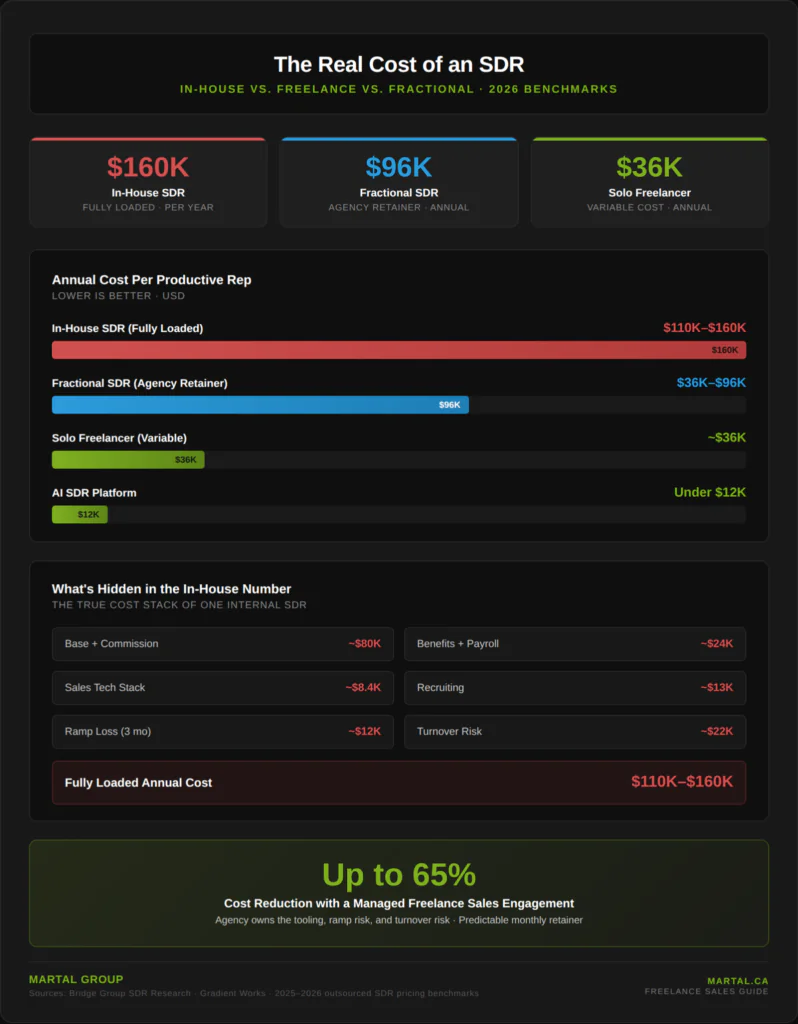
- Cost flexibility without the headcount commitment. A fully-loaded in-house SDR runs $110K–$160K per year once you include base, commission, benefits, tooling, ramp loss, and turnover risk. A fractional SDR retainer typically lands in the $36K–$96K annual range — which is why startups and lean teams hire freelance sales reps to test markets before committing to permanent hires.
- Focus on closing. When prospecting moves outside the in-house team, your closers stop spending half their day building lists and writing cold emails. They spend it on the conversations that move revenue. Outsourcing lead generation is a force multiplier on the closers you already have.
- Faster integration with your tech stack. A managed freelance sales team usually arrives with their own infrastructure — sequencer, dialer, enrichment, deliverability monitoring — so you don’t pay to assemble it. They plug into your CRM and stay there.
The catch: Every one of these benefits assumes the partner you pick can actually deliver them. A solo commission-only rep handling list-building, copywriting, dialing, and CRM hygiene alone will move slower than the pitch suggests. The accountability gap between models is what the next section is really about.
7 Benefits of Hiring a Freelance Sales Rep
The case for freelance sales reps usually opens with cost — but cost is the least interesting reason to hire one. The real value sits in the parts of outbound execution most in-house teams quietly struggle with: market specialization, multi-vertical pattern recognition, omnichannel coordination, and the speed-to-pipeline that comes from someone who has already done this 200 times.
Below are the seven benefits we see freelance sales engagements deliver most consistently — alongside what each one actually requires from the partner you hire.
1. Niche Market Expertise That Compresses Your Time-to-Pipeline
Breaking into a new market — or competing in a saturated one — is rarely a volume problem. It’s a positioning problem. The team that’s already learned which buyer titles open emails, which industry pain points resonate in cold calls, and which objections kill discovery calls in week three is the team that compresses your time-to-pipeline.
One thing we see often: in-house SDRs spend their first quarter learning the market. A specialized freelance sales partner has already done that learning across dozens of clients, which is why ramp time on a managed engagement runs 2–4 weeks vs. the 3–4 months it takes a new in-house hire to reach productivity (1).
That pattern recognition shows up in the results. In one engagement with a B2B SaaS company selling CMMS/EAM software into healthcare, transportation, manufacturing, and food & beverage, our team generated 1,708 leads, 936 MQLs, 185 SQLs, and 144 booked meetings over 26 months — across eight different verticals running simultaneously. That kind of multi-vertical execution rarely happens with a solo freelance rep. It happens when you bring in a partner who has industry data, messaging libraries, and ICP frameworks already built.
Across our own engagements, we’ve executed outbound campaigns in 50+ verticals — SaaS, Cybersecurity, Manufacturing, Logistics, Energy, Fintech, Healthcare, AI/ML, and more. The compounding value isn’t the headcount. It’s the muscle memory.
2. A Faster Path Into New Geographies and Verticals
This benefit is about the geographic and product-launch side of the same problem — and it’s where freelance sales partnerships often pay for themselves in the first six months.
Building outbound infrastructure from scratch — verified contact databases, sender domains, dialer setup, deliverability monitoring, ICP-tested messaging, a working sequence cadence — typically takes a new in-house team three to six months before the first qualified meeting lands. A freelance sales partner already running campaigns into your target market arrives with that infrastructure intact.
The penalty for getting that infrastructure wrong is bigger than most teams budget for. Average SDR ramp time runs about 3.1 to 3.2 months and average SDR tenure is only 14 to 16 months (2), meaning a new in-house hire is in ramp for roughly 20% of their tenure before they leave. For US market entry plays especially, that math rarely works on a two-year window. A freelance sales partner who has already built the infrastructure for that geography compresses the entire ramp curve.
That difference is most visible on US market-entry plays. We’ve helped international B2B companies expand into North America from London, Stockholm, Berlin, Tel Aviv, and beyond:
- A London-based AI trust & safety platform entered the US market with us as their first dedicated sales motion. Within the first phase of the engagement, our team was generating 35 leads/month in a niche AI content-moderation category most US buyers had never heard of.
- A Stockholm-based IoT climate-control company worked with us on a 24-month North American expansion. We delivered 440 leads, 117 MQLs, 203 SQLs, and 139 booked meetings — and their Director of Marketing put it plainly: “Professional North American reps, simple project approach.”
- An HR tech company used our managed sales team to expand into the US and Canada. Over 28 months, we helped them secure 20,000 payees through their platform — a cross-border result built on outbound infrastructure they didn’t have internally.
The pattern is consistent: when a freelance sales partner already has the tooling, the contact data, and the regional fluency, the buyer skips the “build it, then learn it” phase entirely. That’s where the months — and the budget — actually compound.
3. Flexibility to Scale Up, Scale Back, or Pivot Without Headcount Pain
Hiring decisions are sticky. Once you bring an SDR in-house, scaling back means severance, morale damage, and a hole in the pipeline three months later. Scaling up means another recruiting cycle that won’t deliver productive output for another quarter. Either direction has a tax.
A freelance sales engagement removes that tax. The capacity is contractual, not cultural — which means you can adjust it as the market does.
From an execution standpoint, that flexibility tends to show up in three places:
- Adding capacity into a buying window. When a vertical heats up — funding announcements, regulatory shifts, technology adoption cycles — you can add a fractional rep without waiting for the recruiting pipeline. We’ve onboarded clients into structured campaigns inside two to three weeks.
- Pulling back without burning the team down. If a product line stalls or a market goes cold, you scale the engagement down at contract intervals. There is no severance and no quarter-long pipeline scar.
- Testing a new ICP without committing to a hire. Most teams that hesitate on freelance sales are really hesitating on the wrong fork — they need to test, not commit. A fractional engagement is the testing layer. If the ICP works, you scale. If it doesn’t, you’ve spent a fraction of what a wrong hire would have cost.
The hidden cost of getting it wrong on an in-house hire is real. Industry analysis estimates the cost of losing a sales rep — recruiting, training, lost deals — at over $115K per departure (2). With average SDR tenure running 14 to 16 months, the math compounds quickly. A freelance sales engagement removes that turnover risk entirely; the agency owns it.One thing we see often: the buyers who get the most ROI from freelance sales aren’t the ones using it as a permanent replacement for in-house hiring. They’re using it as the flexible layer around a smaller core team — running ABM into enterprise accounts, expanding into a new region, or stress-testing a new ICP before headcount commits to it.
4. Cross-Industry Pattern Recognition That Surfaces Opportunities Your Team Can’t See
In-house sales teams know one company’s playbook well. A specialized freelance sales partner has run that same playbook across dozens of companies, in dozens of industries, against dozens of buyer profiles. The difference shows up in the outreach angles, the objection handling, and — most often — the segmentation decisions that change which opportunities are even visible.
One thing we see often: a client comes in convinced their ICP is one specific persona, and within the first 90 days the campaign data tells a different story. A title we weren’t supposed to be selling to is replying. A vertical we weren’t supposed to target is converting. A messaging angle nobody on the in-house team would have shipped is outperforming the one they spent six months building. That kind of signal is hard to surface from inside a single-product, single-market vantage point.
Three places this pattern recognition tends to deliver:
- Adjacent verticals you didn’t realize were a fit. A campaign optimized for one industry frequently surfaces strong reply rates from an adjacent one. We’ve seen this repeatedly in outbound campaigns where a client targeting manufacturing also pulls qualified replies from logistics, food & beverage, or utilities — verticals their internal team had explicitly de-prioritized.
- Buyer titles that aren’t on the original ICP. A target persona is rarely the only person who responds. Across our engagements, the highest-converting reply often comes from a title one or two layers off the original ICP — a Director where the team was targeting VPs, a COO where they were targeting CTOs.
- Messaging angles that contradict in-house assumptions. Internal teams tend to lead with what they think is differentiated. Cross-industry data tends to reveal what the market thinks is differentiated. The two are almost never the same on day one.
This is why most freelance sales engagements that work well include a structured weekly review — what’s converting, what’s not, and what new angle to test next. The optimization isn’t reactive. It’s the engine.
5. A Lower Cost of Customer Acquisition — Once You Account for the Hidden Costs of In-House
Most cost comparisons between freelance sales and in-house SDRs stop at the salary line. That’s where they go wrong. The fully-loaded cost of an in-house SDR is typically two to three times the base salary once you add benefits, commissions, tooling, ramp loss, and turnover.
The real in-house cost stack:
- Base + commission: Most US SDRs earn $50K–$60K base, with on-target earnings around $75K–$85K once variable comp is added.
- Benefits, payroll burden, and recruiting: Typically adds 30–40% on top of base.
- Sales tech stack: A standard outbound stack — sequencer, dialer, CRM seat, intent data, contact enrichment — runs roughly $700 per rep per month, or about $8,400+ annually for core tools.
- Ramp time: Average SDR ramp is around 3.1–3.2 months. During that window the seat costs full freight while producing a fraction of the pipeline.
- Turnover: Average SDR tenure runs 14–16 months. Replacement cost — recruiting, onboarding, lost productivity — frequently exceeds $115K per departure.
Add it up and a fully-loaded in-house SDR runs $110K–$160K per year in many B2B orgs. That’s the number to compare against — not the $55K base. (It’s also why the question ‘How do freelance SDRs get paid?’ matters more than it sounds: the answer determines whether your sales cost is a fixed liability or a variable input you can model against pipeline.)
A managed freelance sales engagement carries none of those hidden costs. You pay a contractual retainer, the agency owns the tooling, the ramp risk, the turnover risk, and the QA cycle. A managed freelance sales engagement carries none of those hidden costs. You pay a contractual retainer, the agency owns the tooling, the ramp risk, the turnover risk, and the QA cycle — turning lead generation into a predictable cost-per-meeting and cost-per-SQL input you can model into pipeline planning.
The proof shows up across our case studies — particularly for clients who used Martal to validate ROI on a single campaign before scaling:
- HALO Recognition — a saturated market and a niche product. We delivered $10M+ in new business opportunities in eight months, without the client needing to expand internal headcount, payroll, or overhead.
- Berger-Levrault — two enterprise deals alone justified the entire campaign investment, with the rest of the pipeline running pure ROI.
- Afton Tickets — one closed deal covered the full cost of the campaign. Five total deals closed across nine months.
For lean teams the math becomes especially clean. Total Energy Connections, a roughly ten-person commercial energy company, runs a steady 20 leads per month through us — capacity they could not have funded with internal hiring at their stage.
6. Omnichannel Outreach That Most In-House Teams Can’t Coordinate
Coordinating cold email, cold calling, and LinkedIn outreach as a single sequence — not three parallel campaigns — is where most in-house outbound programs quietly fall apart. Building the infrastructure for a true omnichannel motion takes a sequencer, a dialer, deliverability tooling, sender domains, intent enrichment, sales engagement reporting, and a coordinator who keeps the cadence aligned across channels. Most lean teams either build half of it or stitch together tools that never quite talk to each other.
A managed freelance sales partner brings the full stack on day one. The result isn’t more outreach — it’s coordinated outreach. A prospect who got an email Tuesday gets a LinkedIn comment Thursday and a call the following Monday, with the cadence calibrated to how they engaged (or didn’t) at each step.
That coordination is where the conversion lift lives:
- Cold email opens the conversation by surfacing relevance — what the prospect’s company has just done, hired, raised, or shipped — so the message lands as context-aware, not template-spray.
- Cold calling picks up where email leaves off, with the call timed to the prospect’s engagement signal and the rep arriving with full context — funding, headcount, tech stack, the email they already opened.
- LinkedIn lead generation runs the warm-up layer — connection request, soft engagement, content visibility — so a cold call lands on a name the prospect has already seen twice.
The conversion lift from coordinating these three channels is well-documented. Industry research consistently shows coordinated omnichannel sequences outperform single-channel outreach by roughly 250–287% in B2B contexts (3), and B2B buyers now use an average of10+ channels during their purchasing journey (4). A single-channel outbound motion in 2026 is leaving the majority of the engagement window on the table.
This is also the layer where most freelance sales engagements get the account-based marketing framework to actually work. ABM as a strategy collapses when the channels run independently. Stitched together as a coordinated omnichannel sequence, it stops being a deck and starts being a meeting calendar.
The principle is simple: prospects experience continuity, not noise — and the conversion math compounds with every touch.
7. Built-In Accountability — Because the Agency Earns the Renewal Every Quarter
The fear most first-time outsourcing buyers raise is loss of control. How do we know they’re actually working the campaign? How do we know quality stays consistent? What stops them from coasting once we sign?
The honest answer: the agency’s own renewal cycle. Unlike an in-house SDR — whose paycheck arrives whether the pipeline does or not — a managed freelance sales engagement renews on outcomes. If meetings stop, the contract stops. That structure puts the incentive in the right place from day one.
What that looks like in practice:
- A dedicated Sales Operations Manager owns the relationship — not a generic account rep. The SOM coordinates the assigned Sales Executives, monitors campaign performance, and is the single point of accountability for the engagement.
- Weekly performance reviews are standard — what’s converting, what’s not, what to test next. The optimization isn’t reactive; it’s the engine of the engagement (covered in Benefit #4).
- Live campaign progression visibility — every prospect, every status, every booked meeting is tracked in a shared sheet that updates in real time. There is no waiting for a monthly report to find out where pipeline stands.
- Renewal economics align with results — agencies that consistently deliver get multi-year engagements. Agencies that don’t lose accounts. Most freelance sales agencies operate on three- to twelve-month minimums, which means accountability is contractual, not aspirational.
The clearest proof of this model working is engagement length. Across our case study library, the partnerships that delivered the highest ROI were the ones that ran longest:
- Clickworker — a 9-year engagement that generated $4.5M in recurring revenue, 3 Fortune 500 closes, 3 Fortune 10 closes, and a 500% return on investment.
- Website Closers — a partnership that has delivered consistent pipeline since 2021, with roughly 23 qualified leads per month sustained across multiple years.
- An e-commerce and retail AI customer insights platform worked with us through a four-year partnership — long enough that the client eventually hired one of our team members in-house. Long-tenured engagements like that don’t happen without sustained delivery.
Skin in the game isn’t a slogan. It’s the structural reason a managed freelance sales partnership outperforms an in-house team that gets paid the same regardless.
5 Ways to Maximize Results from a Freelance Sales Partnership
The seven benefits above describe what’s possible. This section is about what makes them real. Most freelance sales engagements that underperform don’t fail because the model is wrong — they fail because the partnership wasn’t structured to capture what the model actually offers.
The buyers who ask ‘Are freelance sales reps worth it?’ usually aren’t getting a wrong answer from the market — they’re asking the question one layer too high. The real question is: are they worth it for the specific outcome you need, structured the specific way you’ve structured the engagement?”
Five things separate the engagements that compound from the ones that stall.
1. Pick the Model That Matches the Outcome You Need
Hire a solo commission-only rep when you’re testing demand on a single product with a long sales cycle and tolerance for variable output. Hire a fractional SDR when you need a predictable seat without committing to a full-time hire. Hire a full-service sales agency when you want pipeline as an outcome rather than a project to coordinate.
It’s also why questions like ‘What’s the best way to hire independent sales people on a commission basis?’ rarely have a clean answer in isolation. The right way to hire depends on which of the four models you actually need — and the commission-only path that suits a founder testing demand on a single product is the wrong path for a B2B team that needs predictable monthly pipeline.
The most common mistake we see: a buyer who needs an agency-managed outcome hires a solo freelancer because it looked cheaper, then spends six months covering the gaps the freelancer can’t fill — list quality, deliverability, dialer infrastructure, CRM hygiene, qualification calibration. The hidden cost of the wrong model is almost always larger than the apparent saving.
2. Define the ICP Before the Engagement Starts — and Plan to Refine It
The single highest-leverage hour in any freelance sales engagement is the discovery call where the ICP gets defined. Job titles, company size, geography, tech stack, intent signals, disqualifiers — all of it. Vague ICPs produce vague pipelines.
Equally important: assume the ICP will evolve. The first 90 days of campaign data almost always surface a buyer title, a vertical, or a messaging angle that wasn’t in the original brief. The engagements that maximize ROI treat the ICP as a living document. The ones that stall treat it as a one-time brief and move on.
3. Insist on Omnichannel — Not Channel-by-Channel
If a freelance sales partner pitches you cold email or cold calling or LinkedIn outreach as standalone services, that’s the wrong partner.
Real conversion lift comes from the three channels running as a coordinated sequence — email opens the conversation, LinkedIn warms the recognition, the call lands on a name the prospect has already seen. A prospect who got an email Tuesday, saw a LinkedIn touch Thursday, and got a call the following Monday is dramatically more likely to engage than a prospect who got three disconnected touches from three disconnected channels.
This is the structural reason most freelance sales engagements either compound or stall. The partner has to own the orchestration — sequencer, dialer, deliverability, cadence, intent signals, all of it — as one system, not three.
4. Measure SQLs and Booked Meetings — Not Email Volume
The fastest way to misjudge a freelance sales engagement is to grade it on activity metrics. Emails sent. Calls dialed. Connection requests sent. Volume is easy to fake and impossible to bank.
The metrics that actually correlate to revenue are the ones at the bottom of the funnel:
- MQLs — prospects who replied and match the ICP
- SQLs — prospects who explicitly want a next step
- Booked meetings — confirmed calendar holds with the closing team
- Held meetings — meetings that actually ran (the gap between booked and held is where most engagements quietly leak)
- Cost per held meeting — the single best comparison metric across vendors and models
The gap between booked and held is where most engagements quietly leak. Industry benchmarking and aggregated SDR performance data puts a healthy show rate at 75–85%, and outbound SDRs at roughly 15 booked meetings per month (1), (2). Top-performing teams hold above 85%; below 70% is usually a qualification or pre-meeting confirmation problem rather than a volume one. Pipeline contribution research consistently puts SDR-generated pipeline at 30–73% of total, depending on segment — meaning the cost of getting these metrics wrong is significant.
Build the engagement scorecard around those metrics from week one. If a vendor reports activity volume in the weekly review and skips conversion metrics, that’s the signal.
5. Treat the Partnership as a Strategic Extension
The clients who get the most ROI from a freelance sales engagement run it like an embedded team — weekly reviews, shared campaign visibility, fast feedback loops on positioning, and a real conversation about which opportunities should be prioritized.
The clients who get the least ROI sign the contract, hand off the brief, and check in monthly to count meetings.
The Awin partnership is a clean example of the embedded model. Their Sales Manager described us as “an effective extension of our team” — and that framing wasn’t accidental. We ran weekly cadence reviews, shared the campaign progression sheet with their team in real time, and treated their North American expansion as joint strategic work, not vendor execution. Across three years the partnership delivered 1,204 leads, 1,001 MQLs, 100 SQLs, and 74 booked meetings — numbers that compound only because the relationship was treated as a partnership.
The mechanics of getting maximum value from freelance sales aren’t complicated. They’re just under-practiced.
Bringing It All Together: How to Get Real ROI From a Freelance Sales Partnership
Freelance sales works — when the model fits the work, the metrics measure the right thing, and the partnership is treated as an embedded layer rather than a transactional vendor relationship. The seven benefits are real. So are the failure modes. The five ways to maximize results aren’t complicated; they’re just under-practiced.
For most B2B teams, the highest-leverage move is the one most buyers under-consider: a fractional or fully-managed engagement with a partner who already has the infrastructure, the messaging libraries, and the multi-vertical pattern recognition built. That partner takes on the ramp risk, the turnover risk, the tooling cost, and the QA burden — and delivers pipeline as an outcome, not a project.
That’s the model we’ve been refining at Martal for 16+ years across 50+ verticals. Our outbound lead generation and appointment setting services run on a fractional SDR model — typically two Sales Executives and one Sales Operations Manager per engagement — coordinating cold email, cold calling, and LinkedIn outreach as a single omnichannel sequence. Onboarding takes 7–10 business days. Most clients are generating SQLs within 30 days.
If your team is weighing whether to hire a freelance sales rep, build internal SDR capacity, or partner with an agency, book a consultation. We’ll walk through your ICP, your current pipeline structure, and the specific model that fits your stage — without the pitch. The conversation is the first deliverable.
References
FAQs: Freelance Sales
Is it possible to freelance in sales?
Yes — and the model is more common in 2026 than ever. Freelance sales spans four distinct structures: solo commission-only or 1099 contractors, fractional SDR partners working part of their capacity for an agency, full-service sales agencies running outbound end-to-end, and AI SDR platforms that automate prospecting workflows. Each model has a different commercial structure and a different best-fit buyer profile. The growth of sales-as-a-service has made it possible to operate in any of those four lanes without giving up income stability or buyer trust.
How much do freelance sales reps make?
Earnings vary dramatically by model and experience. Solo commission-only reps earn entirely on what they close — top performers can clear six figures, but variability is high. Fractional SDRs working through agencies typically earn a base plus performance comp at rates aligned to in-house SDR comp. For comparison context: the average US in-house SDR base salary in 2025 sits around $50K–$60K with on-target earnings near $75K–$85K. The fully-loaded cost to the employer is meaningfully higher — typically $110K–$160K per year — once benefits, tooling, ramp, and turnover are included.
Where can I find marketing and sales people for a freelance job? Where can I go to hire commission based sales people?
Solo commission-only and 1099 freelance sales reps are most commonly sourced from Upwork, CommissionCrowd, Fiverr, Indeed, and direct LinkedIn outreach. Industry referral networks are often higher-quality. For buyers who want the outcome of freelance sales without the operational overhead of vetting, onboarding, and managing a solo rep, a fractional SDR engagement through an agency like Martal is structurally different — you get a dedicated rep, full infrastructure, and built-in management without doing the hiring work yourself.
How do freelance SDRs get paid?
Three common structures. Commission-only rewards the rep on closed revenue or qualified meetings — common with solo freelancers. Retainer is a fixed monthly fee for a fractional or full-service engagement, typically $3K–$8K per SDR-equivalent for fractional and $5K–$12K+ for full-service agency models. Pay-per-meeting charges per qualified appointment, usually in the $150–$600 range for mainstream B2B ICPs. The payment model directly shapes the incentive structure of the engagement, so it’s worth choosing deliberately rather than accepting whatever the vendor leads with.
Are freelance sales reps worth it?
For most B2B teams below 250 employees — yes, if you pick the right model and structure the engagement around outcome metrics rather than activity metrics. Freelance sales becomes the wrong choice when the product requires 9+ months of technical onboarding, when the ICP is too narrow to support multi-account campaigns, or when the in-house closing team isn’t sized to absorb the pipeline an agency delivers. The model rewards buyers who treat it as a strategic extension, not a vending machine.
What’s the difference between hiring a freelance SDR and hiring an outsourced SDR agency?
A freelance SDR is one person; an outsourced SDR agency is a team backed by infrastructure. The freelance rep handles their own list-building, deliverability, dialer setup, CRM hygiene, and reporting. An agency provides those layers as part of the engagement — including a dedicated Sales Operations Manager, weekly performance reviews, live campaign progression visibility, and built-in QA. The cost difference is real, but so is the quality difference. The right choice depends on whether you want pipeline as an outcome or pipeline as a project to manage.