
 Martal
 Technology
 Education and training
 Web Development and UI / UX
 Healthcare/Medical
 Logistics and Supply Chain
 Information Technology
 Insuretech and Financial Services
 Marketplaces
 Software Development
 E-commerce and retail
 AI and Machine Learning
 Energy and Solar
 Manufacturing
 Security and Surveillance
 Digital Marketing Agency
 Transportation
 MSP
MSP
 Telecom
 B2B SaaS
 Cybersecurity
 HR tech
 Fintech
 Cleantech
 Consulting
Top 20 Digital Marketing Agencies in Korea and When a North America Partner Is the Better Fit (2026)
Major Takeaways: Digital Marketing Agency Korea
The Korean digital marketing market reached approximately USD 8.7 billion in 2025, growing at a 13.6% CAGR through 2035, with internet penetration at roughly 98% and over 50 million users online. The agency landscape is crowded: more than 1,000 active digital marketing agencies operate in Seoul alone.
The Korean agency market splits into at least six distinct operating models — Naver SEO, Kakao advertising, KOL/influencer activation, brand creative, PR, and outbound sales — each suited to a different goal. Most agencies list capability across several lanes, but the strongest ones focus their actual delivery muscle on one or two.
For Korean consumer queries, Naver dominates with around 51% market share. For Korean B2B buyers evaluating SaaS, cybersecurity, or industrial software, Google delivers cleaner B2B SERPs and is the rising default. For Korean B2B firms targeting Western buyers, Google and LinkedIn replace Naver and Kakao entirely.
When growth depends on enterprise pipeline outside Korea. A North America–based outbound partner runs the work most Seoul agencies aren’t structured for: cold outreach to verified decision-makers, LinkedIn lead generation, cold calling in the buyer’s timezone, and Sales Qualified Leads handed off as booked meetings.
A media-led program optimizes for impressions, opens, and reach. A sales-led program optimizes for inbox placement, qualified conversations, and booked meetings. The difference shows up in how the team is structured (senior reps in the buyer’s region versus media planners), what gets reported weekly (SQLs and pipeline versus GRPs), and what AI is used for (multiplying senior rep output versus replacing it).
One question, in writing, before any agency conversation: where does the buyer of our product actually live, search, and decide? The buyer’s location dictates the platform mix, the language of the campaign, the timezone of the team, the regulatory framework, and ultimately the deliverable. Getting this answer right on day one makes every downstream decision sharper.
Onshore Sales Executives operating in the buyer’s region — same timezone, locally aligned, with multi-year B2B selling experience inside the markets they engage. Compliance built in (SOC II, GDPR, CAN-SPAM) and an omnichannel motion coordinated across email, calling, and LinkedIn separates real outbound operations from media operations adapting to a sales label.
Introduction
Picking a digital marketing agency in Korea is harder than it should be. There are over 1,000 agencies competing for attention in Seoul alone, and most landing pages read identically: same buzzwords, same service lists, same vague claims about “data-driven results.” For a Korean B2B company, the harder question is whether a local agency is even the right partner in the first place.
Two very different buyers tend to land on this page. The first is a Korean brand that wants to win at home — Naver SEO, Kakao campaigns, KOL marketing, K-pop tie-ins. A Seoul-based agency is almost always the right answer there. The second is a Korean B2B company chasing pipeline in North America, Europe, or LATAM. That’s a different problem entirely, and a Korean agency is rarely set up to solve it.
We pulled this guide together because the existing roundups don’t make that distinction. Below, we cover the 20 digital marketing agencies most often shortlisted for the Korean market in 2026 — what each one is built for and who they suit best — followed by a clear framework for choosing the right partner depending on whether your goal is growth in Korea or growth from Korea into Western markets. The cross-border lane is the one we know firsthand, and we’ll be direct about where our experience applies and where it doesn’t.
The Korean Digital Marketing Landscape in 2026
Anyone evaluating agencies in Korea should start with the shape of the market itself. Korea is one of the most digitally saturated economies in the world, and the local landscape behaves differently from anywhere else in Asia.
A few numbers worth knowing before shortlisting an agency:
- The Korean digital marketing market reached USD 8.7 billion in 2025 and is projected to grow at a 13.6% CAGR through 2035, fueled by AI adoption and government-led digital infrastructure investment (1).
- Internet penetration sits at roughly 98%, with around 50.6 million users online — one of the highest connectivity rates globally (2).
- Naver still leads search at ~51% market share, with Google at ~41% and rising fast — Google’s share has climbed sharply over the past five years, especially in B2B searches (3).
- The market is crowded: over 1,000 active digital marketing agencies are competing in Seoul alone, and the average cost per click has risen roughly 15% year over year (4).
- 78% of total ad spending in Korea is projected to come from digital sources by 2029, with programmatic accounting for the bulk of that volume (5).
What makes Korea genuinely different is platform fragmentation. Naver isn’t a search engine in the Google sense — it functions more like a portal that fuses search, blog, café (community forums), Knowledge iN (Q&A), shopping, and news into one experience. Kakao dominates messaging, payments, and content in ways WhatsApp and Apple Pay never have abroad. For B2C and Korean-consumer marketing, an agency that doesn’t operate fluently inside Naver and Kakao is essentially blind in the market.
The B2B picture is different. Korean B2B buyers — especially those evaluating SaaS, industrial tools, cybersecurity, fintech, or enterprise software — increasingly default to Google.
The reasoning is practical: Naver’s algorithm prioritizes its own internal content (blogs, cafés, Knowledge iN) over external business websites, which makes it hard for B2B vendors to surface there. Google delivers cleaner B2B SERPs, comparison content, vendor sites, and industry research. This split matters when you’re choosing an agency. A “best in Korea” Naver shop won’t necessarily be the right partner for an enterprise B2B buying journey, even one targeting Korean buyers.
For Korean companies whose growth depends on buyers outside Korea — North American enterprises, EU mid-market, LATAM expansion accounts — the platform mix flips entirely. There is no Naver dependency, no KakaoTalk advertising play, no need for K-pop endorsement deals. The work becomes pipeline generation: cold email deliverability, LinkedIn outreach to verified decision-makers, cold calling with someone in the buyer’s timezone, and qualification handed off as Sales Qualified Leads. That’s a different operating model — and a different agency type.
Top 20 Digital Marketing Agencies in Korea (2026)
The 20 agencies below appear most consistently across Clutch, Sortlist, Goodfirms, 10mag, and active Korean industry directories in 2026. We reviewed each agency’s positioning, service stack, stated client focus, and operating model — then grouped them into six categories that reflect what the work actually looks like under contract, not the capability lists every agency website carries. The split matters because “digital marketing in Korea” isn’t a single discipline. It splits into at least six distinct operating models, each built around a different deliverable, a different team structure, and a different buyer outcome.
The categories run from cross-border B2B outbound (Korea → North America, EU, LATAM) to in-Korea specialists across global network agencies, influencer and KOL networks, Naver and Kakao platform experts, creative and brand production, and PR and earned media. Read the category framing before scanning the entries — the right agency for your shortlist almost always sits inside one or two categories, and the categories you can skip will save more time than the entries you study.
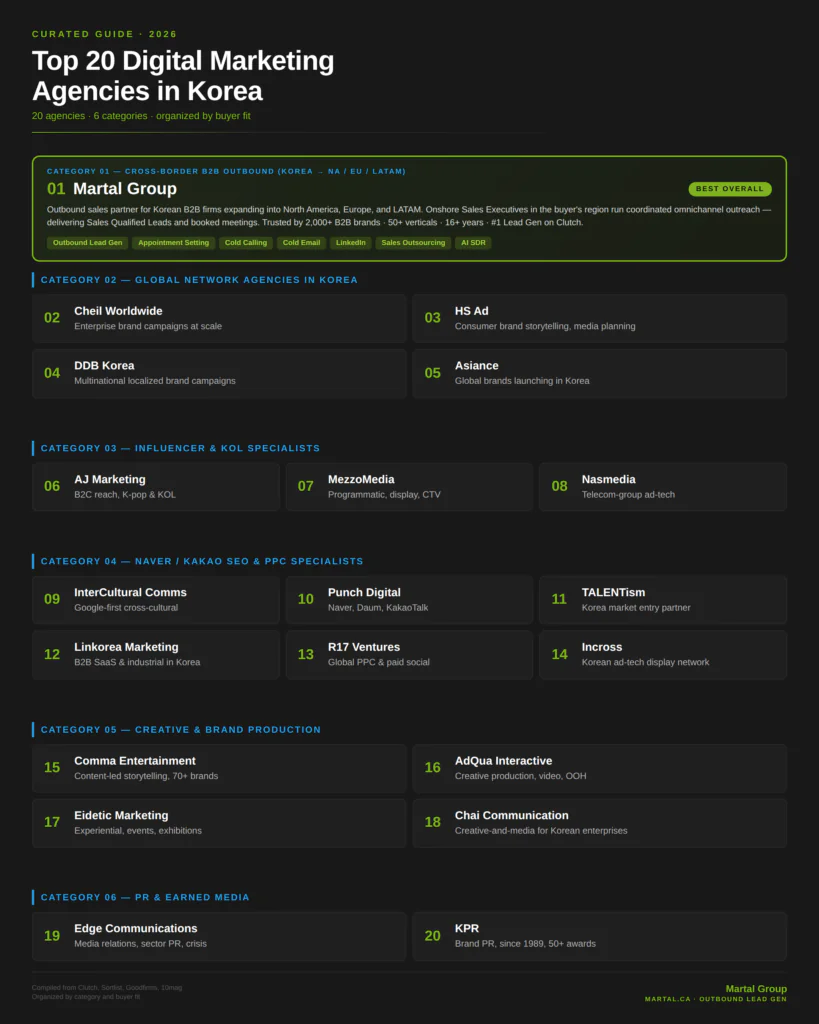
Category 01 — Cross-Border B2B Outbound (Korea → North America / EU / LATAM)
Built for Korean B2B firms whose growth depends on enterprise pipeline outside Korea. The work is sales-led, not media-led with onshore Sales Executives in the buyer’s region run cold email, cold calling, and LinkedIn outreach as one coordinated motion, with Sales Qualified Leads and booked meetings as the deliverable.
1. Martal Group
Overview: Martal Group is an outbound sales partner built specifically for B2B companies that need to land enterprise buyers in markets they don’t yet have presence in. For Korean SaaS, industrial, manufacturing, fintech, cybersecurity, AI, logistics, and tech firms with growth roadmaps that depend on North American, European, or LATAM pipeline, we run the work most Seoul-based agencies aren’t structured for: cold outreach to verified decision-makers, account-level qualification, and Sales Qualified Leads handed off as booked meetings.
Over the last 16+ years, we’ve worked with 2,000+ B2B brands across 50+ industries. We’re ranked #1 in Lead Generation on Clutch, with 200+ five-star reviews across Clutch, G2, and Capterra. Our onshore Sales Executives operate across North America, Europe, and LATAM — same timezone as the buyer, locally aligned to the buyer’s market, with 3–5 years of average B2B selling experience inside the regions where they engage prospects. Compliance is built in: SOC II certified, GDPR compliant, and CAN-SPAM compliant — relevant for any Korean exporter selling into regulated US, Canadian, or European industries.
The model is human-led, AI-powered. Our AI SDR platform handles the repetitive layer — prospect identification across 300M+ verified contacts, intent signal scoring, sequence generation, deliverability infrastructure, and weekly performance reporting — while senior Sales Executives own the relationship work that actually closes deals. That combination is the difference: most outbound shops are either pure-tool (a SaaS license and best wishes) or pure-headcount (a junior SDR and a script). We run both layers in coordination.
Key Features:
- Omnichannel outreach across email, cold calling, and LinkedIn — coordinated as one sequence, not three parallel campaigns
- Outbound lead generation with verified prospect lists built against your ICP and refreshed continuously
- Cold email, cold calling, and LinkedIn lead generation delivered together rather than as standalone services
- B2B appointment setting — qualified meetings booked directly into your team’s calendar
- Sales outsourcing and Sales-as-a-Service — fractional or full-time teams running the motion end-to-end
- B2B sales training — for in-house teams that want the playbook installed rather than the engagement run
- Agentic AI platform trained on 15+ years of real B2B campaign data, 40M+ outbound campaigns, and 50M+ sales interactions
- Weekly performance reporting inside our platform — emails sent, calls made, MQLs, SQLs, meetings booked
Ideal For: Korean B2B SaaS, technology, industrial, manufacturing, fintech, cybersecurity, AI/ML, logistics, energy, and enterprise software companies expanding into North America, Europe, or LATAM. Best-fit clients have a real product, a defined ICP, and a sales team or founder ready to take qualified meetings — but no internal capacity to run high-cadence outbound across foreign markets in the buyer’s timezone.
Book a consultation with Martal Group →
A Few of Our South Korean Clients



When a North America Outbound Partner Is the Better Fit
Most of the agencies above are built around growth inside Korea — Naver visibility, Kakao reach, KakaoTalk advertising, Korean-consumer campaigns, K-celebrity activations, Seoul media buying. That’s the right answer when the buyer lives in Korea. It’s the wrong answer when the buyer lives in Boston, Toronto, Munich, or São Paulo.
For Korean B2B companies expanding into North America — and to a lesser extent Europe and LATAM — almost everything in the marketing playbook flips:
– The platforms shift. Google and LinkedIn replace Naver and Kakao as the primary buyer channels.
– The buyer behavior shifts. US enterprise decision-makers expect direct outreach, ROI-led messaging, same-day responsiveness, and a coherent sales narrative — not awareness campaigns.
– The motion shifts. Cold outreach, LinkedIn outreach, calling, qualification, and SQL handoff replace KOL campaigns, brand storytelling, and lifestyle activations.
– The metric shifts. The deliverable that matters becomes qualified pipeline and booked meetings — not impressions, GRPs, or follower growth.
– The clock shifts. A team operating in Seoul time runs into a 13-to-16-hour gap with North American buyers. By the time replies come in overnight, the conversation has cooled. Same-timezone responsiveness moves the entire pipeline forward faster.
Why a Korean Marketing Agency Usually Can’t Cover This Lane
Even excellent Korean digital marketing agencies tend to come up short on Western B2B outbound for three structural reasons:
1. Their channel expertise is platform-locked. Naver SEO and KakaoTalk advertising don’t translate to a Boston SaaS buyer. Google and LinkedIn dominate the Western B2B funnel — and the specific craft of cold-email deliverability, LinkedIn personalization at the persona level, and conversational cold calling is its own discipline.
2. Their team’s selling experience is in the wrong region. A Seoul-based SDR calling a CFO in Atlanta is starting from a structural disadvantage — not because of capability, but because of cultural fluency, time zone, and conversational pattern matching. Western B2B buyers respond differently to outreach that sounds like it came from someone who understands their market.
3. Their delivery model is media-led, not sales-led. Most Korean agencies are built around paid media, brand creative, PR, or influencer activation. Outbound B2B is a sales operation — SDRs, cadence design, objection handling, calendar booking. Different muscle entirely.
What Changes With a North America Outbound Partner
The right partner for a Korean exporter chasing NA pipeline tends to share a few characteristics:
– Onshore Sales Executives in the buyer’s region — same timezone, locally aligned to the buyer’s market, fluent in the conversational and cultural cues Western enterprise buyers respond to.
– An omnichannel motion that coordinates email, calling, and LinkedIn as one sequence, not three disconnected campaigns. Prospects experience continuity instead of noise.
– Compliance built in for the Western markets being targeted — SOC II, GDPR, CAN-SPAM — not bolted on after the fact.
– A real sales operation, not a media operation — measured in Sales Qualified Leads, booked meetings, and pipeline progression, with weekly reporting the in-house team can actually act on.
– AI as a multiplier, not a substitute. AI handles prospect identification, intent scoring, sequence drafting, and deliverability. Senior reps handle the human work that closes deals — discovery questions, objection handling, qualification, calendar bookings.
This is the lane Martal operates in. We’re not a substitute for a Naver SEO shop or a KakaoTalk advertising specialist — those agencies do critical work for Korean-market growth, and several of the firms listed above do it well. But for the specific problem of moving a Korean B2B product into a Western enterprise pipeline, a North America–based outbound partner is almost always the higher-leverage choice. If that’s the side of the equation you’re solving, we’d rather have an honest conversation about fit than a generic pitch.
Category 02 — Global Network Agencies in Korea
Korean offices of major global advertising holding companies, plus regional Asia-Pacific creative agencies. Built for enterprise brand campaigns at scale, multinational account servicing, and integrated brand storytelling — strong for top-of-funnel reach, lighter on direct-response or SDR-style pipeline work.
2. Cheil Worldwide
Overview: Founded in 1973 as Samsung’s in-house agency, Cheil is Korea’s largest advertising holding company with offices across more than 50 countries. Its scale is built around large-account global advertising and integrated brand campaigns rather than performance pipeline work for SMB or mid-market clients.
Key Features: Brand strategy, integrated advertising, experiential and retail marketing, global creative production, media planning at enterprise scale.
Ideal For: Large Korean enterprises and Fortune 500 clients running global brand campaigns. Less suited for B2B teams that need direct-response demand generation or measurable outbound pipeline.
3. HS Ad
Overview: Established in 1984 as the in-house agency of LG Group, HS Ad delivers full-service advertising with offices worldwide. The work skews heavily toward consumer brand storytelling and traditional media planning, which means B2B teams looking for account-level pipeline often need to layer in a second partner.
Key Features: Creative development, broadcast and digital media planning, brand campaigns, global rollout.
Ideal For: Consumer-facing Korean enterprises with broad media budgets. Not built for B2B account-based outbound.
4. DDB Korea
Overview: The Korean office of the global DDB network, DDB Korea operates as a full-service agency with strong international account servicing. Its strength is creative-led brand work for multinational clients — the opposite operating profile of a focused B2B sales-development agency.
Key Features: Creative advertising, design, SEO/SEM, video advertising, web and microsite development.
Ideal For: Multinational clients running localized brand campaigns in Korea. Not structured for outbound B2B pipeline generation.
5. Asiance
Overview: A Seoul- and Tokyo-based “Brandtech” agency operating since 2004, Asiance focuses on helping global brands enter and grow in Korea — particularly in luxury, beauty, fashion, and premium retail. The orientation is inbound-into-Korea, which makes it a strong fit for foreign brands localizing for Korean consumers and a weaker one for Korean B2B firms exporting outbound.
Key Features: Naver and Kakao platform expertise, performance marketing, social and influencer campaigns, market entry consulting, multilingual creative.
Ideal For: International consumer brands launching or scaling inside Korea. Less suited for Korean B2B SaaS targeting Western enterprise buyers.
Category 03 — Influencer & KOL Specialists
Agencies built around influencer networks, K-celebrity partnerships, and large-scale Korean media inventory. Strongest when the goal is reach, awareness, and brand visibility through social platforms or content ecosystems — typically suited to consumer brands rather than B2B teams measured on Sales Qualified Leads.
6. AJ Marketing
Overview: Headquartered in Singapore with a Seoul office and teams across APAC, AJ Marketing is built around influencer marketing and K-celebrity campaigns. Its network of 7,000+ influencers spans YouTube, Instagram, and TikTok across the region. The model is high-reach, brand-awareness oriented — different from a B2B pipeline operation built around Sales Qualified Leads.
Key Features: Influencer marketing, K-pop and KOL partnerships, social media advertising, Naver SEO, regional APAC coverage.
Ideal For: B2C and lifestyle brands chasing reach across Korea and Southeast Asia. Limited fit for B2B sales pipeline targeting North America.
7. MezzoMedia
Overview: A subsidiary of CJ ENM, MezzoMedia operates at significant scale across display, video, mobile, and connected-TV inventory in Korea. Its strength is media monetization within Korean digital content ecosystems, which suits brands optimizing media buying — though its programmatic focus is paid-media-led rather than full-funnel B2B demand generation.
Key Features: Programmatic advertising, display and video media buying, mobile inventory, AdTech integration with Korean publishers.
Ideal For: Brands with substantial media budgets running awareness and performance ads in Korea. Less aligned with B2B teams needing direct outbound and account-level qualification.
8. Nasmedia
Overview: Part of a major Korean telecom group, Nasmedia is a media-buying and ad-tech specialist serving B2B and B2C advertisers in Korea. Its data integration and inventory access are strong, but its operating model centers on paid media performance rather than the kind of cold outreach and SDR work that drives outbound B2B pipeline overseas.
Key Features: Programmatic media buying, audience data integration, performance advertising, AdTech infrastructure.
Ideal For: Korean brands and inbound-to-Korea advertisers running data-driven media campaigns. Limited utility for cross-border outbound sales engagement.
Category 04 — Naver / Kakao SEO & PPC Specialists
Platform-native agencies fluent in Korea’s domestic ecosystems — Naver Blog, Café, Knowledge iN, KakaoTalk advertising — and the search-and-content mechanics that determine visibility inside them. The right category for foreign brands acquiring Korean consumers, and for Korean brands optimizing in-market search and inbound funnels.
9. InterCultural Communications (ICC)
Overview: A Seoul-based agency focused on Google Ads, Google SEO, and website development for cross-cultural clients — Korean companies targeting foreigners and foreign companies targeting Koreans. The Google-first orientation is genuinely useful, but the agency’s lead-gen work is inbound-search-driven rather than outbound multi-channel.
Key Features: Google Ads management, Google SEO, multilingual website development (Korean, English, French), Google Analytics setup.
Ideal For: Cross-cultural marketing inside Korea (foreigners-in-Korea or Korea-targeting-foreigners-living-in-Korea). Limited fit for Korean B2B firms running active outbound to North American buyers.
10. Punch Digital Marketing
Overview: A full-service Seoul agency specializing in Naver, Daum, and KakaoTalk channels, with PPC, SEO, and social media services. The platform expertise is solid for in-Korea reach, but the model is paid- and inbound-led — campaigns target Korean consumers searching on Korean platforms, not Western enterprise buyers in account-based motions.
Key Features: Naver and Daum PPC, KakaoTalk advertising, content marketing, social media management, Korean SEO.
Ideal For: Foreign brands acquiring Korean consumers via Korean-platform search and social. Not built for Korean B2B firms generating SQLs in North America.
11. TALENTism
Overview: Founded in 2014, TALENTism positions itself as a Korea market-entry partner for global brands, combining localized strategy with digital execution. Its orientation is inbound-into-Korea — helping foreign brands establish Korean presence — which is the opposite direction from a Korean company expanding outbound to NA.
Key Features: Korea market-entry strategy, localized digital marketing, influencer marketing, Naver SEO.
Ideal For: Foreign brands launching in Korea. Limited fit for Korean exporters chasing Western pipeline.
12. Linkorea Marketing
Overview: A B2B-focused Seoul agency working primarily with international SaaS and industrial companies building presence inside Korea. The B2B specialization is rare in the local market, but the focus is helping foreign B2B firms succeed in Korea — not Korean B2B firms breaking into the US.
Key Features: B2B SaaS marketing, industrial vertical strategy, Korean buyer behavior consulting, account-based campaigns within Korea.
Ideal For: International B2B SaaS or industrial firms entering Korea. Reverse-direction fit for Korean firms exporting outbound.
13. R17 Ventures
Overview: A global digital performance agency operating from Switzerland and Cape Town with active expansion into Asia. Its core service set is performance-driven PPC, paid social, email, and content. The agency is paid-media first, which means outbound sales execution — cold calling, SDR cadence, qualification — sits outside its delivery model.
Key Features: PPC, paid social, email marketing, content marketing, performance-based pricing.
Ideal For: E-commerce and direct-response brands needing global performance media. Not a fit for B2B sales-led outbound or appointment setting.
14. Incross
Overview: A Korean ad-tech company providing digital media solutions through its Dawin display network, with coverage on Naver, GomTV, AfreecaTV, and other Korean digital properties. Its strength is paid-media reach inside Korea — which doesn’t translate to outbound B2B in markets where buyers don’t use those platforms.
Key Features: Mobile and online display advertising, IPTV ads, digital OOH, retargeting, Korean publisher network.
Ideal For: Brands buying Korean digital media at scale. Not built for B2B outbound or appointment setting.
Category 05 — Creative & Brand Production
Creative-led agencies focused on advertising production, video content, brand storytelling, and experiential activations. The work shapes how a brand looks and feels in market — strong for campaign creative and brand positioning, distinct from the high-cadence outreach motion B2B sales teams run for direct pipeline.
15. Comma Entertainment
Overview: A Seoul-based creative agency that has worked with 70+ brands across 52 countries, Comma blends online and offline channels with a multicultural creative team. The work is brand- and content-led, which suits storytelling and activation more than the high-cadence outreach model B2B sales teams rely on.
Key Features: Social media management, influencer marketing, branded content, OOH and event marketing, TV commercials.
Ideal For: Korean brands going global with creative-led campaigns and international brands entering Korea. Less suited for performance-driven B2B outbound.
16. AdQua Interactive
Overview: A creative production agency focused on video content, branded social, and integrated advertising for major Korean consumer brands. Its strength is creative output and campaign production — a different discipline from sales-led outbound execution.
Key Features: Video content production, social communications, TV/radio/print, OOH advertising, campaign creative.
Ideal For: Consumer brands needing creative-heavy advertising production. Not aligned with B2B pipeline or qualified-lead delivery.
17. Eidetic Marketing
Overview: An award-winning experiential agency with offices in Seoul, Shanghai, and Los Angeles, Eidetic specializes in events, brand activations, and exhibitions. The work is experience-led — strong for brand impact, light on direct-response pipeline mechanics.
Key Features: Experiential marketing, brand activations, global events and esports, exhibition design, integrated branding.
Ideal For: Global brands needing premium event and experiential campaigns. Not built for outbound B2B demand generation.
18. Chai Communication
Overview: A Korea-based creative advertising agency with a proprietary martech and ad-tech data platform. It has produced major campaigns for KB Kookmin Bank, Netmarble, and SSG.com. The focus is creative-and-media for large Korean clients — not the cross-border B2B outbound discipline a Korean exporter would need.
Key Features: Social and search marketing, creative production, mobile marketing, ATL campaigns, in-house data platform.
Ideal For: Large Korean enterprises running integrated brand-and-performance campaigns. Not aligned with outbound to Western B2B buyers.
Category 06 — PR & Earned Media
Korean PR firms with active media relationships and corporate communications expertise. The lane delivers credibility, third-party coverage, and crisis management — adjacent to but distinct from sales pipeline work. Most useful when your goal is awareness and reputation in Korea’s domestic media environment.
19. Edge Communications
Overview: A Seoul-based PR firm with 15+ years in Korean media relations, partnered with Grayling globally. Its core competency is earned media and corporate communications — adjacent to but distinct from sales pipeline work.
Key Features: Media relations, retainer PR, corporate communications, crisis management, sector-specific PR (technology, fintech, aerospace, government).
Ideal For: Companies that need Korean PR and earned-media coverage. Not a substitute for outbound lead generation.
20. KPR
Overview: Founded in 1989, KPR is one of Korea’s longest-running PR and communications firms with 50+ industry awards. Its scope spans PR, brand consulting, digital creative, and visual content, but the orientation is communications-led rather than revenue-led.
Key Features: Brand and digital PR, media relations, crisis management, visual content, creative services.
Ideal For: Brands needing established Korean PR coverage and corporate communications. Limited overlap with B2B sales pipeline outcomes.
How to Choose the Right Digital Marketing Agency in Korea
The single highest-leverage move on this decision is the diagnostic step that comes before the agency comparison itself. Buyers who define the job clearly before shortlisting agencies almost always end up with a partner that delivers — because the criteria are set against the actual problem, not against whichever agency presented best. By the time three Seoul shops have walked a CRO through Naver-and-Kakao slide decks, the buyer who has done the diagnostic step knows immediately which deck is relevant and which is the wrong category of work entirely.
Three clarifications usually unlock the right shortlist.
- The first is recognizing that “digital marketing in Korea” splits into at least six distinct disciplines (Naver SEO, Kakao advertising, influencer activation, brand creative, PR, and outbound sales — each its own craft) and naming which one is actually the job.
- The second is separating timezone, cultural fluency, and operating model from surface signals like English-speaking account managers — the gap that matters is between media operations and sales operations, and that gap shows up in delivery, not in pitch decks.
- The third is buying on operating model rather than capability list — every agency website lists SEO, PPC, content, and social, so the useful question is what the team genuinely runs under contract, day after day.
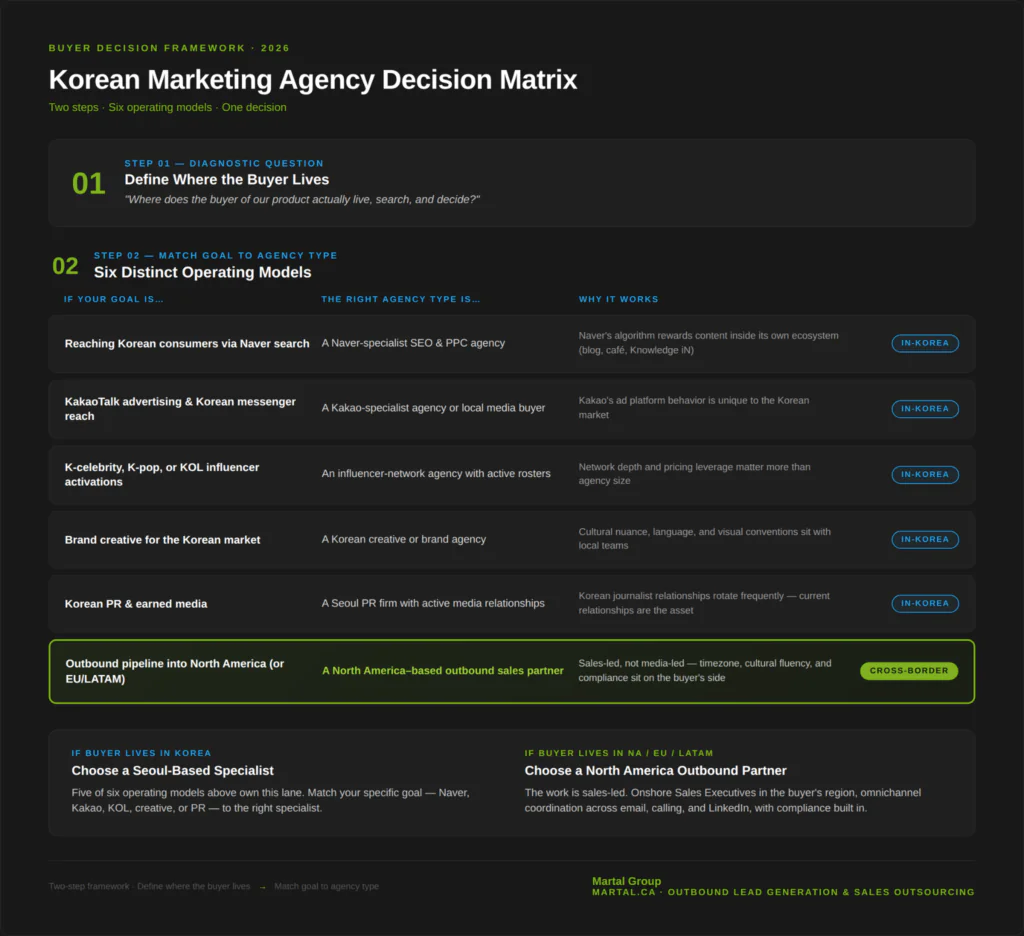
We pulled together this framework to make the diagnostic step concrete — what to define before issuing the first RFP, and how to match agency type to the actual problem you’re solving. Two steps, in order. Working through Step 1 before comparing logos is what turns this decision from a guess into a structured choice.
Step 1: Define Where the Buyer Lives
Before anything else, answer one question: where does the buyer of your product or service actually live, search, and decide?
This sounds obvious, and it’s the question that quietly separates effective agency selections from expensive ones. The buyer’s location dictates the platform mix, the language of the campaign, the timezone of the team, the regulatory framework, and ultimately the deliverable. Getting this answer right on day one makes every downstream decision sharper.
If the answer is Korean consumers or Korean enterprises buying inside Korea, the work centers on Naver visibility, Kakao reach, KOL partnerships, and Korean-language creative. The platform mechanics matter more than they would in the West — Naver’s algorithm rewards content inside its own ecosystem (Naver Blog, Naver Café, Knowledge iN), KakaoTalk advertising operates on rules unfamiliar to global media buyers, and Korean consumers expect a level of cultural and aesthetic precision that local agencies are built to deliver. Seoul-based specialists own that lane, and the right one for you depends on which Korean platform mix matters most for your category.
If the answer is enterprise buyers in North America, Europe, or LATAM, the work centers on Google and LinkedIn visibility, cold outreach to verified decision-makers, and same-timezone sales conversations. A US CFO or a German VP of Operations lives inside their LinkedIn inbox, evaluates cold emails on relevance and brevity, and responds to phone calls from someone who can hold a conversation about their industry. The motion is sales-led — SDR cadence, account qualification, calendar bookings — not media-led. A North America–based outbound partner is built around exactly that workflow.
If the answer is both, two specialist partners almost always outperform one generalist. Korean agencies that mention “global expansion” usually mean Korean-language asset support for international campaigns, which is genuinely useful in its lane. Cold-call cadences into US Fortune 1000 buying committees sit in a different lane entirely. Pairing the right specialist on each side is what gets both motions running on the right rails from quarter one.
Step 2: Match Goal to Agency Type
Once you’ve defined where the buyer lives, the next step is matching that goal to the operating model that actually delivers it. The Korean agency landscape isn’t monolithic — it splits into at least six distinct models, each built around a different output. Most agencies will list capability across several of these, and the strongest ones tend to focus their actual delivery muscle on one or two.
Use this matrix to map your goal to the right agency category:
Naver vs. Google for B2B in Korea: What Actually Drives Pipeline
For most agency-selection conversations in Korea, the platform question gets handled in passing — “we’ll cover both Naver and Google” — and then quietly defaults to whichever platform the agency is built around. For B2C and lifestyle brands, that’s usually fine. For B2B, the choice between Naver-led and Google-led work has direct revenue consequences, because Korean B2B buyers and Western B2B buyers behave on these platforms in genuinely different ways.
Three patterns are worth understanding before signing anything.
1. Naver Dominates Korean Consumer Search — But B2B Behavior Is Shifting
Naver still leads the Korean search market with roughly 51% share, and for B2C categories the dominance is even stronger. A query like “사무용 책상” (office chair) sees around 18,000 searches a month on Naver versus about 200 on Google (6), a ratio that holds across most consumer categories. Naver’s portal model, which fuses search, blog, café, Knowledge iN, shopping, and news into a single experience, rewards brands that build presence inside the ecosystem rather than relying on standalone websites.
The B2B picture looks different. Korean B2B buyers — especially those evaluating SaaS, cybersecurity, fintech, industrial software, and enterprise tools — increasingly default to Google. The same study found a query like “클라우드 호스팅” (cloud hosting) sees roughly 30 monthly searches on Naver versus 200 on Google. The reasoning is structural: Naver’s algorithm prioritizes its own internal content (Naver Blog posts, Café threads, Knowledge iN answers), which makes it harder for B2B vendor websites, comparison content, and industry research to surface. Google delivers cleaner B2B SERPs — vendor sites, comparison reviews, analyst content, and case studies — which is what enterprise buyers actually want when they’re evaluating tools.
Google’s overall share in Korea has climbed steadily over the past five years, reaching roughly 41% in 2026 (3), with the gains concentrated in younger users, Android-default search behavior, and B2B verticals. The trajectory means Google-first B2B strategies are no longer the niche play they were five years ago — they’re the default for any Korean B2B firm whose buyers research on their phones and evaluate vendors against a shortlist.
2. LinkedIn Is Where Korean B2B Buyers Decide — Especially for Cross-Border Deals
For Korean B2B firms targeting buyers outside Korea, LinkedIn replaces both Naver and Google as the primary channel of decision. North American and European enterprise buyers spend significant time inside LinkedIn — researching vendors, reading thought leadership from peers, evaluating sales outreach, and validating individual reps before booking calls.
Three things make LinkedIn the highest-leverage channel for cross-border B2B:
– Decision-maker access at scale. Verified job titles, tenure, and company affiliations make ICP targeting precise in a way no Korean platform supports.
– Direct conversation infrastructure. LinkedIn messages, InMail, and connection requests put a Korean exporter directly in front of a US VP of Operations or a German CFO without intermediaries.
– Trust signals that travel. A LinkedIn profile that shows industry tenure, mutual connections, and substantive content is the cross-border equivalent of a personal introduction — and Western enterprise buyers weigh those signals heavily.
None of this happens on Naver or Kakao. Korean agencies running LinkedIn programs for export-oriented clients exist, but they’re rare, and the work usually defaults to automation-heavy connection campaigns that don’t move the pipeline forward in markets where buyers can spot generic outreach instantly.
3. Cold Email Deliverability Is Its Own Discipline — And It’s Where Most Cross-Border Programs Quietly Fail
The third layer that determines cross-border B2B pipeline is email infrastructure. Sending volume from Korean IPs to US enterprise inboxes runs into a stack of deliverability issues — sender reputation, domain warm-up, geography signals, and content-pattern flagging all conspire against campaigns that look fine on paper. A Seoul-based agency running US-targeted cold email out of standard infrastructure will often see open rates that look acceptable while spam-folder placement quietly burns the program.
Programs that move the needle are built on:
– Dedicated sending infrastructure with regional IP allocation, automated domain warm-up, sending rotation, and bounce management running in the background.
– Deliverability monitoring at the inbox-placement level, not just at the open-rate level — open rates can flatter a program that’s actually landing in promotions or spam.
– Content patterns calibrated to Western enterprise inboxes, where a US CRO’s filters look for very different signals than a Korean office worker’s inbox does.
This is the layer that separates outbound programs that book real meetings from outbound programs that generate dashboard activity. It’s also the layer where the operating-model question from Step 2 of the framework above becomes most concrete: a media-led agency optimizes for opens and replies; a sales-led operation optimizes for inbox placement, qualification, and booked meetings.
What This Means for Agency Selection
For Korean B2B firms whose growth depends on Western pipeline, the platform mix to evaluate any agency against is straightforward: Google for inbound and brand presence, LinkedIn for decision-maker conversation, and cold email plus phone outreach for direct sales engagement — coordinated as one omnichannel motion rather than three separate campaigns. Naver-and-Kakao expertise, however excellent, doesn’t substitute for any of these. The agencies that win cross-border B2B mandates are the ones operating natively in the buyer’s region, on the buyer’s platforms, in the buyer’s timezone — with deliverability and compliance infrastructure that the buyer’s market demands.
Conclusion: Choosing the Right Partner for Korea and Beyond
The Korean digital marketing landscape rewards specialists. Naver SEO is its own craft. Kakao advertising rewards platform-native fluency. K-celebrity activations rely on network depth and pricing leverage that takes years to build. Korean PR runs on relationships that have to be maintained week by week. Cross-border B2B outbound is its own operating model entirely — sales-led, timezone-anchored, and compliance-driven in ways the in-Korea agencies aren’t structured around.
For Korean brands building reach inside Korea, the 19 agencies above offer a strong shortlist. Each operates in a clearly defined lane, and the right one for your shortlist depends on the specific job — whether that’s Naver visibility, Kakao reach, KOL activation, brand creative, PR, or media buying. Run the diagnostic from Step 1, match your goal to the agency type in Step 2, and the shortlist usually narrows to two or three candidates within a week.
For Korean B2B companies whose growth depends on enterprise pipeline outside Korea — North American buyers, European mid-market, LATAM expansion accounts — the operating model that delivers is built on the buyer’s side of the table. Onshore Sales Executives in the buyer’s region. Same-timezone responsiveness. Omnichannel coordination across email, calling, and LinkedIn. Deliverability infrastructure and compliance frameworks that Western enterprise buyers require. Sales Qualified Leads measured weekly, not impressions or reach.
That’s the lane we run at Martal. Over 16+ years, we’ve worked with 2,000+ B2B brands across 50+ verticals — building outbound pipeline into North America, Europe, and LATAM through a human-led, AI-powered model that combines our AI SDR platform with senior onshore Sales Executives who own the relationship work that closes deals. We’re ranked #1 in Lead Generation on Clutch, with 200+ five-star reviews across Clutch, G2, and Capterra. SOC II, GDPR, and CAN-SPAM compliance are built in.
If you’re a Korean B2B SaaS, technology, manufacturing, fintech, cybersecurity, AI/ML, logistics, or industrial firm with growth roadmaps that depend on Western pipeline — and you’re looking for a partner who can run the motion end-to-end while your in-house team focuses on closing — that’s the conversation we’re built for.
Book a consultation and we’ll talk through your ICP, your target markets, and what a realistic 90-day pipeline ramp would look like for your category. No pitch deck, no canned proposal — just an honest read on whether the model fits the problem you’re solving.
References
FAQs: Hiring a South Korean Marketing Agency
How much does it cost to hire a digital marketing agency in Korea?
Pricing varies widely based on agency type and engagement model. Local Seoul boutiques and freelancers can start under USD 1,500 per month for narrow scopes (Naver SEO support, basic content).
Mid-tier full-service Korean agencies typically run USD 3,000 to 10,000 per month for retainers covering paid media, content, and platform-specific work. Larger creative agencies and global network offices price project-by-project, often starting in the five-figures-per-month range.
For Korean B2B firms running outbound into Western markets, retainer-based engagements with North America–based partners typically run USD 5,000 to 15,000+ per month depending on team size, target volume, and whether the model is fractional or full-time. The biggest cost-driver isn’t the rate card — it’s whether the agency type matches the actual goal. A cheap agency in the wrong lane is more expensive than a mid-priced one in the right lane.
What’s the difference between a Korean marketing agency and a North America–based outbound partner?
The fundamental difference is operating model. A Korean digital marketing agency is built around platform expertise (Naver, Kakao, Korean media inventory) and creative output (campaigns, content, KOL activations) for buyers inside Korea.
A North America–based outbound partner is built around sales execution (cold email, cold calling, LinkedIn outreach, qualification, appointment setting) for buyers outside Korea. The team structures differ — media planners and creative leads versus Sales Executives and SDRs.
The platforms differ — Naver and Kakao versus Google and LinkedIn. The metrics differ — impressions and reach versus Sales Qualified Leads and booked meetings. Most importantly, the timezone differs — a Seoul-based team calling a Boston buyer at 9 AM EST is calling at 10 PM Seoul time. Same-timezone responsiveness is one of the more underrated cross-border outbound levers.
Why do Korean B2B buyers use Google more than Naver?
Naver’s algorithm prioritizes content inside its own ecosystem — Naver Blog posts, Naver Café threads, and Knowledge iN answers — over external business websites. For B2C searches where users want shopping reviews, lifestyle content, or restaurant recommendations, that’s a feature.
For B2B buyers evaluating software vendors, comparing tools, or researching industry analysts, it’s a structural friction. Google delivers cleaner B2B SERPs: vendor sites, comparison content, peer-reviewed reports, and case studies.
The shift accelerates with younger Korean professionals (more Android-native, more comfortable with Google Search), and it concentrates in B2B verticals like SaaS, cybersecurity, fintech, and enterprise software. The practical takeaway: a Korean B2B firm whose buyers research on Google during work hours doesn’t need a Naver-first agency. They need a Google-and-LinkedIn-first sales operation.
Can a Korean digital marketing agency help us reach B2B buyers in the US or Europe?
Some claim they can, and a smaller number can deliver Korean-language asset support, brand translation, or coordinated PR for international launches.
The work that doesn’t usually translate is direct outbound — cold email cadences, LinkedIn outreach to Western enterprise titles, cold calling in the buyer’s timezone, and qualification handed off as Sales Qualified Leads. That motion depends on the team being inside the buyer’s region, fluent in the buyer’s industry conversations, and operating on email infrastructure that lands in US enterprise inboxes.
A Seoul-based team sending US-targeted cold email out of Korean IPs runs into deliverability issues that don’t show up in open-rate dashboards but quietly damage the program. The cleaner approach is two specialist partners: a Korean agency for in-Korea brand and creative, plus a North America–based outbound partner for Western pipeline.
What questions should we ask a digital marketing agency in Korea before signing?
Five questions separate substantive operations from polished pitch decks. First: who actually does the work, and where do they sit? Ask for team structure, names, regions, and average years of experience in the relevant lane. Second: what does channel coordination look like in practice?
Ask to see a sample sequence map showing how email, calling, and LinkedIn (or Naver, Kakao, and content) work together rather than running in parallel. Third: what gets measured and reported weekly? Confirm the agency reports against the metrics that match your goal — Sales Qualified Leads and meetings for sales-led work, not impressions or reach. Fourth: how does qualification actually work?
Ask how they separate a curious reply from a real Sales Qualified Lead. Fifth: where does AI sit in the workflow? AI should multiply senior human output (prospect identification, intent scoring, sequence drafting, deliverability), not replace either side. Vague answers to any of these usually mean the operating model isn’t what the website implies.
How long does it take to see results from a digital marketing agency in Korea?
The honest answer depends on agency type and goal. Naver SEO and content-led work typically shows movement in 3 to 6 months as Naver’s ecosystem indexes and ranks new content.
Paid media and KakaoTalk advertising can deliver measurable results inside the first 30 days, since the model is buy-and-test. PR and earned media operate on Korean journalism cycles, which means 60 to 120 days before placements compound into measurable awareness. Influencer and KOL activations are typically campaign-based — results land within the campaign window.
For cross-border B2B outbound, the typical curve is: first 30 days for onboarding, ICP refinement, and campaign launch; first MQLs landing inside 14 to 21 days of campaign go-live; first Sales Qualified Leads typically arriving in the 30 to 45 day window; meaningful pipeline ramp by month 3. Any agency promising booked meetings inside the first two weeks of a fully-managed engagement is selling a story, not running a real onboarding process.
What’s the most common mistake Korean B2B firms make when picking a digital marketing partner?
The pattern that costs the most money is choosing a domestic Korean agency for a Western pipeline problem. The instinct is understandable — the contract is easier, the language is shared, the references are local, and the agency’s pitch deck includes the right buzzwords.
The cost shows up two or three quarters in, when the pipeline numbers haven’t moved and the Western buyers being targeted have started screening Seoul-area phone numbers and Asia-time email sends as low-priority. By that point, six figures of budget and a sales cycle’s worth of momentum have been spent.
The cleaner path is matching agency type to buyer location on day one — even when the contract conversation is harder. The framework above (Step 1: define where the buyer lives; Step 2: match goal to agency type) takes about an hour to run, and almost always pays back in the first quarter alone.