
 Martal
 Technology
 Education and training
 Web Development and UI / UX
 Healthcare/Medical
 Logistics and Supply Chain
 Information Technology
 Insuretech and Financial Services
 Marketplaces
 Software Development
 E-commerce and retail
 AI and Machine Learning
 Energy and Solar
 Manufacturing
 Security and Surveillance
 Digital Marketing Agency
 Transportation
 MSP
MSP
 Telecom
 B2B SaaS
 Cybersecurity
 HR tech
 Fintech
 Cleantech
 Consulting
Outsourced BDR Services: Costs, Benefits, and How to Choose the Right Partner
Major Takeaways: Outsourced BDR Services
Outsourced BDR services hand your top-of-funnel outbound motion — list-building, omnichannel outreach, qualification, and appointment setting — to an external team that delivers qualified meetings as the outcome, not just activity reports.
Most 2026 engagements run $3,000–$8,000/month per dedicated rep, with pay-per-meeting models around $150–$600 per qualified meeting. The right comparison is cost per held meeting, not fee vs. base salary.
Often, yes. A fully loaded in-house BDR costs $110K–$150K a year (2–3× base) and takes 3–6 months to ramp, while outsourced BDR services launch in 2–4 weeks and absorb tooling and turnover.
A BDR drives outbound (cold, net-new accounts); an SDR typically handles inbound (leads who already raised their hand). For an outsourcing decision, the motion matters far more than the title.
It works when the conditions are right. A skeptical SaaStr survey found only ~7% of teams felt outsourced SDRs “really worked” — the difference is partner specialization, proper enablement, and a shared definition of a qualified meeting.
AI now automates research, enrichment, signal detection, and drafting, while humans own qualification and conversations. Teams using AI saw 83% revenue growth vs. 66% without it (2).
Define objectives first, weight industry track record heavily, demand transparent reporting and live pipeline visibility, and pilot before you commit. Fit and experience decide the outcome more than price.
Introduction
Every growth plan eventually runs into the same wall: you need qualified conversations with the right buyers, and you need them faster than your team can self-source them. That leaves two paths — build an in-house business development function, or partner with a team that provides outsourced BDR services and already has the people, data, and playbooks in place.
Both can work. The honest version, though, is that they fail and succeed for very different reasons. In-house gives you control and deep product context but carries real cost, long ramp, and a turnover problem most finance reviews never model. Outsourcing buys you speed and specialization — but only when it’s scoped well and managed like a partnership, not a vending machine. One thing we see often is that the companies who struggle with outsourced BDRs are the same ones who never defined what a good meeting looks like in the first place.
This guide breaks down what outsourced BDR services actually include, what they cost, how they compare to hiring in-house, and how to choose a partner that delivers pipeline instead of activity.
What Is a Business Development Representative (BDR)?
A business development representative (BDR) is a sales professional who opens new pipeline through proactive outbound prospecting — researching target accounts, reaching out cold across email, phone, and LinkedIn, and qualifying interest before handing warm conversations to an account executive to close. In most B2B teams, the BDR sits at the very top of the sales funnel: they create demand rather than wait for it.
That “create, don’t wait” distinction matters. A strong BDR isn’t just dialing through a list — they’re reading buying signals, tailoring the message to a specific persona, and protecting your brand in the first impression a prospect ever gets of your company. Done well, the role is equal parts research, judgment, and persistence.
It’s also where the titles get blurry. BDR, SDR, ADR, “outbound rep” — companies use them interchangeably, and that confusion trips up a lot of hiring and outsourcing decisions. The next section clears it up.
BDR vs SDR: What’s the Difference?
This is the question that comes up first in almost every sales-development conversation, usually phrased a few different ways: “What is SDR and BDR?”, “Is BDR and SDR the same?”, and “What is the difference between SDR and BDR?” Here’s the short answer.
A BDR focuses on outbound — proactively reaching out to cold, net-new accounts. An SDR typically focuses on inbound — qualifying leads who already raised their hand. The distinction is about lead source and motion, not seniority. Both book qualified meetings for account executives; they just start from opposite ends of the funnel.
BDR (Business Development Rep)
SDR (Sales Development Rep)
Motion
Outbound, proactive
Inbound, reactive
Lead source
Cold, net-new target accounts
Marketing-generated leads (demo requests, content, events)
Core job
Create demand and open doors
Qualify existing interest
Best when
Inbound is weak; you need to penetrate specific accounts or new markets
You have steady inbound volume your AEs can’t keep up with
Output
Qualified meetings from outbound
Qualified meetings from inbound
A fair caveat: these definitions aren’t universal. Plenty of companies use the titles backwards or fold both motions into one role, and at smaller orgs a single rep often does both before the team specializes. Comp tends to be similar either way — base salaries land in the low-to-mid $50Ks with on-target earnings around $75K–$100K (1).
For an outsourcing decision, the label matters far less than the motion. One thing we see often is teams getting stuck on whether they need a “BDR” or an “SDR” when the real question is simpler: do you need someone to create pipeline from scratch, or to qualify pipeline that’s already coming in? Most of the engagements we run are outbound-led — net-new pipeline in defined target accounts — which is squarely BDR work, regardless of the title on the org chart.
What Do Outsourced BDR Services Include?
Outsourced BDR services hand your entire top-of-funnel outbound motion to an external team: building and verifying target lists, running coordinated outreach across email, phone, and LinkedIn, qualifying responses, and booking meetings for your closers. The best programs deliver pipeline as an outcome — not just activity reports.
In practice, a full-service engagement covers the work an in-house team would otherwise stitch together from several tools and hires. The day-to-day responsibilities of outsourced bdrs typically include:
- ICP and target-account research — defining who to go after, then building enriched, verified prospect lists
- Omnichannel outreach — cold emailing, cold calling, and LinkedIn lead generation, coordinated as one sequence rather than three disconnected channels
- Lead qualification — separating genuine interest from noise, based on authority and need
- Appointment setting — booking qualified meetings directly into your reps’ calendars
- Follow-up and nurture — staying with warm prospects until they’re ready to talk
- Reporting and pipeline visibility — weekly campaign metrics and a live view of where every lead sits
A quick word on channels: cold calling, cold emailing, and LinkedIn outreach are not standalone services that work in isolation. Their value comes from running them together. Prospects rarely respond to a single cold email, but a well-timed sequence — an email, a connection request, a call that references both — feels like continuity instead of noise. That coordination is the whole point of an omnichannel program, and it’s the part most in-house teams struggle to operate consistently.
What Is BDR-as-a-Service?
BDR-as-a-Service is the productized version of all of the above: a managed subscription where a provider supplies the reps, data, tools, and playbooks, and you receive qualified meetings against agreed targets. Instead of hiring, training, and equipping a team yourself, you plug into one that’s already running. It’s the same idea as SaaS applied to sales development — outcomes on a predictable monthly model, scaled up or down as your pipeline needs change. For teams that want pipeline without building the machine to produce it, this is usually the fastest path.
The Benefits of Outsourced BDR Services
The core appeal is simple: a good outsourced team acts as an extension of your staff, taking the prospecting grind off your closers so they can spend their time closing. That grind is bigger than most leaders realize — Salesforce’s State of Sales research consistently finds reps spend the majority of their week on non-selling tasks (2) like research, list-building, and admin. Outsourcing the top of funnel hands that work to a team built specifically to do it.
Here’s what the math looks like when you outsource the BDR function instead of building it:
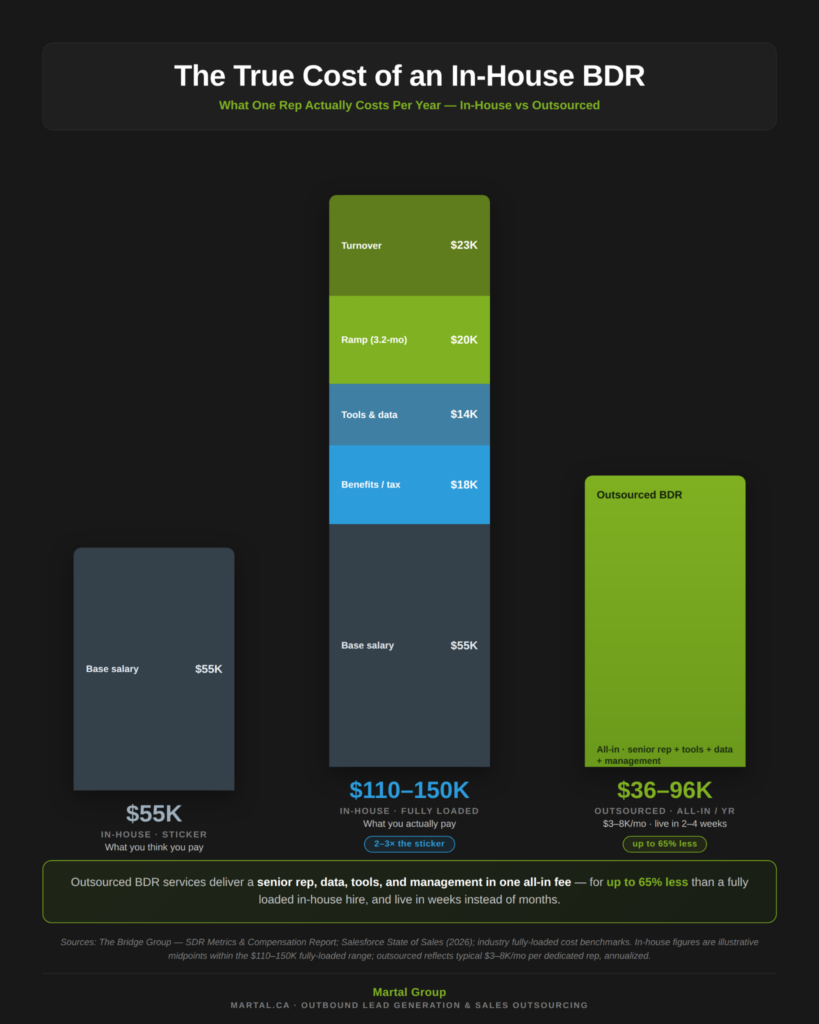
- $110K–$150K — fully loaded annual cost of one in-house BDR/SDR (2–3× base salary once benefits, tools, ramp, and churn are counted)
- 3.2 months — average ramp before a new rep is fully productive (1)
- 1.4 years — average rep tenure, leaving only ~14 productive months before you re-hire and re-ramp
- 2–4 weeks — typical time to launch with an experienced outsourced team
Significant Cost Savings
Building in-house is expensive long before it’s productive: recruiting, salary, benefits, a sales tech stack, and management time stack up fast — and every departure resets the clock. An outsourced bdrs partner converts that fixed, front-loaded cost into a predictable monthly one, with the tooling and data already included. You’re not paying for ramp or turnover; you’re paying for output.
You also don’t need a big team to see results. In one 3-month pilot, we delivered 14 SQLs for Complete EDI with a single fractional rep — including 2 qualified leads by week two. That’s the lean-model advantage: experienced capacity without the headcount.
Proven Expertise and Sales Processes
A specialist team arrives already ramped. While an in-house hire spends three-plus months learning your motion, an experienced outsourced rep brings proven playbooks, objection handling, and industry context from day one. For complex or multi-stakeholder sales, that experience is the difference between booked meetings and burned lists.
Access to Data and Leads
B2B data decays fast — roughly 2–3% of contacts go stale every month as people change roles. An outsourced partner maintains the enrichment infrastructure to keep lists current, so your outreach reaches a live inbox and the right decision-maker. That accuracy is what lets you enter a market with confidence and build a sales process that attracts quality leads instead of bouncing off dead addresses.
Increased Productivity
Outsourcing lifts productivity on both ends. Internally, your AEs reclaim the hours they were losing to prospecting. Externally, a dedicated team is generating qualified conversations full-time. The result is more first meetings, a shorter path from cold to qualified, and a sales org focused on revenue rather than research.
Flexible Scalability
Outbound demand isn’t constant. Outsourcing lets you scale up for a new market or product push and scale back when priorities shift — without severance, idle equipment, or the drag of unwinding a team. One thing we see often: clients start with a focused pilot, prove the motion, then expand the engagement once the pipeline is real.
In-House vs Outsourced BDRs: Cost & Performance Compared
One of the most common questions we hear from sales leaders is a version of: “Should we build our appointment-setting team in-house or outsource it?” There’s no universal answer — but there is a clear way to compare them. The mistake most teams make is pricing an in-house rep at base salary and an outsourced rep at the full fee, then concluding outsourcing is expensive. The honest comparison is fully loaded cost per qualified meeting, on both sides.
Once you count benefits, tools, ramp, and turnover, a single in-house BDR runs roughly $110K–$150K a year — about 2–3× the base salary. They take 3–6 months to hire and ramp, and the average rep stays just 1.4 years with roughly 39% annual attrition, so you’re often re-hiring before you’ve recouped the ramp (1). An outsourced team, by contrast, typically runs $3,000–$8,000/month per dedicated rep, launches in 2–4 weeks, and absorbs turnover and tooling on its own books.
In-House BDR Team
Outsourced BDR Services
Fully loaded cost
~$110K–$150K per rep/year
~$3,000–$8,000 per rep/month
Time to first pipeline
3–6 months (hire + ramp)
2–4 weeks
Ramp risk
You absorb it (~3.2 months)
Provider absorbs it — reps arrive ramped
Turnover risk
~39% annual attrition is yours to manage
Handled by the provider; coverage stays intact
Tools & data
You buy and maintain the stack
Included in the engagement
Control
Direct, day-to-day
Via SLAs, shared dashboards, weekly syncs
Product depth
Deepest over time
Strong with proper enablement
Scalability
Slow, capital-intensive
Flexible — scale up or down on demand
Best for
Mature motion, complex product, in-house management in place
Speed to pipeline, new markets, capacity without headcount
Is outsourcing just for startups or lean teams anymore? No — and the engagements we run prove it. We’ve built pipeline for ~10-person companies and for enterprises with thousands of employees alike, from a sub-30-person AI firm entering the US to a 6,600-employee global brand expanding into North America. The model scales in both directions; the deciding factor is the goal, not the company size.
Will we lose our internal sales rhythm? Only if you treat the partner as hands-off. The teams that succeed run outsourced BDRs like an extension of their own — shared dashboards, a weekly sync on what’s working, and one agreed definition of a “qualified” meeting. Done that way, you gain rhythm rather than lose it, because someone is finally owning the top of the funnel full-time.
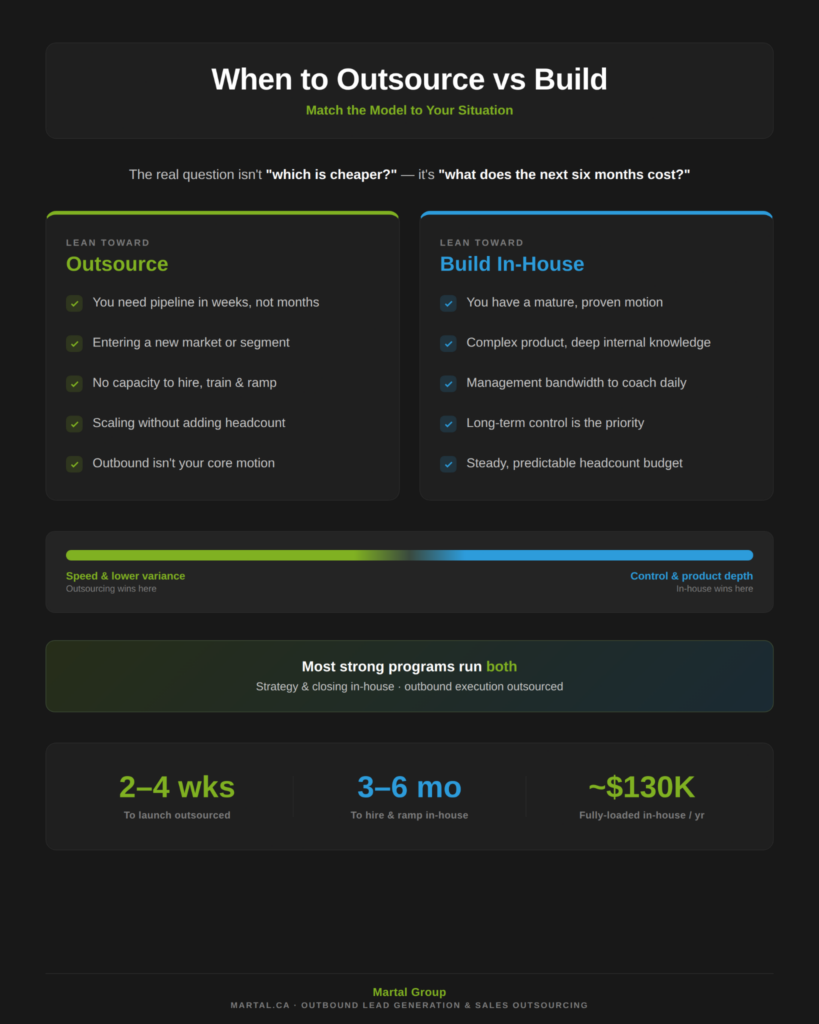
The bottom line: in-house wins on long-term control and product depth; outsourcing wins on speed, predictability, and lower variance. For most teams below ~50 reps, the real question isn’t “is outsourcing cheaper?” — it’s “what does the next six months cost if we build instead?”
How Much Do Outsourced BDR Services Cost?
“How much does it cost to outsource sales?” is usually the first real question, and the honest answer is a range, not a number. In 2026, most outsourced BDR engagements run $3,000–$8,000 per month per dedicated rep, with pay-per-meeting models landing around $150–$600 per qualified meeting and full pods (two to three reps plus a lead) running $8,000–$25,000 per month. What you pay depends on your ICP complexity, target geography, channel mix, and how “qualified” is defined.
To judge whether that’s expensive, you need the other side of the ledger. “What’s the current SDR salary / OTE in the US?” Base salaries sit in the low-to-mid $50Ks with on-target earnings around $80K (1). But salary is the sticker price, not the cost. Add benefits, a sales tech stack, data, management time, ramp, and turnover, and a single in-house rep lands at $110K–$150K fully loaded — roughly 2–3× base. The apples-to-apples comparison isn’t fee vs. salary; it’s cost per qualified meeting on each side.
Here’s how the common pricing models compare:
Model
How it works
Typical range
Best for
Dedicated rep (retainer)
A rep works your account with strategy, tools, and data included
$3,000–$8,000 / rep / month
Predictable pipeline; teams that want a partner, not a transaction
Pay-per-meeting
You pay per qualified appointment booked
~$150–$600 / meeting
Testing the waters; low monthly volume
Hybrid (retainer + performance)
Base retainer plus a bonus tied to meetings or opportunities
$3,000–$8,000 base + $100–$300 / appointment
Aligning incentives without starving ops — the most common sophisticated structure
Full team / pod
A 2–3 rep team with a lead, for higher capacity
$8,000–$25,000 / month
Proven playbook needing scale without headcount
Revenue share
Provider paid a share of closed revenue
Varies
Mature orgs with proven unit economics only
A few things we’ve learned running these programs. First, the cheapest per-meeting quote is rarely the best value — a low price often means thin data and weak deliverability infrastructure, which quietly tanks results regardless of how good the copy is. Second, model held meetings, not just booked ones — a meeting nobody shows up to costs you twice. And third, don’t sign a long contract before you’ve tested the motion. A focused 90-day pilot with clear SLAs tells you more than any proposal will. That’s exactly how several of our longest engagements started — including a 4-month pilot for an AI security firm that turned into a multi-year partnership.
The Challenges of Outsourcing BDRs (and How to Avoid Them)
The recurring question in those threads is blunt: “have SDRs worked for you? If yes, have outsourced SDRs worked for you?”
We’ll be straight about why so many programs disappoint: the companies that struggle with outsourced BDRs are often the same ones who never defined what a good meeting looks like, never built the enablement, or treated the partner like a vending machine. The challenge isn’t outsourcing itself — it’s outsourcing without the conditions for it to succeed. Here are the ones that actually matter, and how to handle each.
1. Finding the Right Partner
This is the make-or-break decision. The right partner specializes in your market or motion; the wrong one applies a generic script to a sophisticated product and burns your prospect list. For complex B2B sales especially, buyers expect product fluency even at the first touch — so a partner who can’t speak your category credibly will stall before they start. Define your objectives before you shop, and weight industry track record heavily. (We cover exactly how to vet partners in the next section.)
2. Mastering Your Prospecting Process
A long, complex sales cycle is harder to hand off, and lead quality suffers when targeting and messaging aren’t aligned up front. The fix is enablement: give your partner the ICP, the value props, the objections, and the disqualifiers before launch — and keep refining together. The best programs treat the first few weeks as calibration, not finished output.
3. Maintaining Sales Control
You won’t micromanage day-to-day outreach when you outsource, and that loss of direct control makes some leaders nervous — fairly, since the team represents your brand to your prospects. The answer isn’t control through micromanagement; it’s control through visibility. Insist on shared dashboards, weekly performance reviews, and approval over messaging before it goes live. You direct the strategy; the partner executes it.
4. Choosing the Right Pricing Model
Outsourcing should reduce your cost per qualified meeting, not just shift it around. Pick the model that fits your stage and volume (see the pricing breakdown above), and always compare it to your fully loaded in-house cost — never to base salary alone. The goal is predictable unit economics you can plan around.
5. Changes in Team Dynamics
Adding an external team changes how your org communicates. You’ll need clear handoffs between the outsourced BDRs and your AEs, a shared system of record, and a rhythm of back-and-forth across email, calls, and video. Companies that build those communication lanes early avoid the friction; those that don’t end up with two teams working past each other.
How AI Is Reshaping Outsourced BDR Services
The two questions on every leader’s mind right now: “Will AI replace SDRs?” and “Are AI SDRs worth it?” Our honest take, from running both human teams and an AI platform: AI hasn’t replaced the BDR — it’s changed what the BDR spends time on. The repetitive work that ate most of the week is now automated. The judgment work that actually books and qualifies meetings still belongs to experienced humans. The best outsourced providers aren’t choosing between the two; they’re pairing senior reps with AI, not swapping one for the other.
Here’s where AI now does the heavy lifting in a modern outbound program:
- Prospect research and list-building — what took a rep 5–15 minutes per account now happens in seconds
- Data enrichment and verification — keeping contact records current so outreach reaches a live inbox
- Intent signals — surfacing accounts showing buying behavior (funding, hiring, tech changes) so outreach lands in the buying window
- Personalized drafting — generating first-pass, role-specific messaging at scale for a human to refine
- Deliverability — managing domain warm-up and inbox placement so emails actually arrive
- Prioritization — scoring and ranking accounts by likelihood to convert
The data behind the shift is hard to ignore. According to Salesforce’s State of Sales research (2):
- Sales teams using AI saw 83% revenue growth in the past year, versus 66% for teams without it
- Sellers using AI agents expect a ~34% reduction in research time and ~36% reduction in email drafting time
- Reps still spend the majority of their week on non-selling tasks — exactly the work AI is built to absorb
But here’s the boundary we hold to, and it matters for trust: AI qualifies responses and surfaces opportunities; it does not replace the human who handles a real objection, reads a hesitant buyer, or decides a meeting is genuinely sales-ready. A prospect who feels handed to a bot disengages fast. The model that works is AI for speed and scale, humans for judgment and relationships.
That’s exactly how Martal’s AI SDR platform is built — our Agentic AI platform handles research, enrichment, signal detection, and drafting, while senior onshore Sales Executives own the conversations, qualification, and brand voice. It’s the difference between outreach that scales and outreach that converts. In one engagement with an AI freight company, that pairing helped us book 108 meetings in three months — speed that’s only possible when AI does the prospecting groundwork and experienced reps do the selling. View the transportation case study.
How to Find the Right Outsourced BDR Partner
Researching and hiring the right BDR partner is the most critical step in the whole process. Get this decision right and the rest tends to fall into place; get it wrong and no amount of activity will save the engagement. It’s worth taking seriously — one manufacturing client told us they’d tried two other providers before us, and only on their third attempt did the program work, going on to deliver 1,596 leads and 203 SQLs over 14 months. The lesson isn’t that outsourcing is unreliable; it’s that fit and experience decide the outcome. View the manufacturing use case.
Here’s how to vet a partner properly.
1. Start by Defining Your Objectives
Identify your goals before you shop. That means understanding your product, your sales process, and your customers’ needs well enough to know what you actually want a partner to deliver. Ask yourself: What is the team struggling with? Is outsourcing the right solution? What would success look like in 90 days? Once you’re clear on the answer, you’ll know what skills and track record to look for — and you’ll set measurable KPIs so you can evaluate your outsourced BDRs team objectively later.
2. Ask the Right Questions
This is the step to slow down on. During evaluation, dig into the partner’s experience in your specific industry and with products like yours. Generic outbound experience isn’t enough for a complex sale — ask how they’ve helped similar clients, what their qualification criteria are, and how they handle objections in your category. The depth of their answers tells you whether they’ll represent your brand credibly on the first call.
3. Watch Out for Red Flags
Most red flags are easy to spot early — often before you sign. Three questions to pressure-test any outsourced bdr services provider:
- Are they transparent? Your partner represents your brand. Choose an outsourced bdrs team that commits to detailed progress reports and live pipeline visibility — not vague monthly summaries.
- Do they have credible, verifiable proof? Look for third-party reviews and named results, not just testimonials on their own site. A provider that’s underperformed across many clients won’t change for you.
- Do they communicate well during the sales process? If a partner is hard to reach while they’re trying to win your business, that rarely improves after you sign. A steady communication rhythm is non-negotiable when the team works alongside your AEs and other departments.
4. Combine Outsourcing With In-House Hiring
There’s no universal rule for how to structure business development — the right call depends on your industry, objectives, and budget. A practical way to balance the tradeoffs is to combine outsourcing with in-house hiring: keep strategic control internally while tapping outsourced BDR expertise for execution, capacity, or new-market reach. Many of the strongest programs run exactly this hybrid.
KPIs to Track for Outsourced BDR Performance
Once a program is live, the question shifts to: “How do I know if my outsourced BDR program is actually working?” The answer is to track the right metrics at the right time — and to resist judging the engagement by week-two activity. Outbound has leading indicators that move fast and lagging indicators that take a quarter to mature. You need both, and you need to read them in order.
Here are the metrics that matter, grouped by what they tell you:
Category
KPI
Why it matters
Leading (inputs)
Outreach touches, connect rate, reply rate, positive reply rate
Early signals that targeting, deliverability, and messaging are working — visible in weeks 1–3
Output
MQLs, SQLs, meetings booked, meetings held
The real deliverables. SQLs are the headline number; held meetings matter more than booked
Quality
SQL-to-opportunity rate, ICP-fit accuracy, meeting show rate
Tells you whether the pipeline is real or just busy
Velocity
Time to first SQL, sales-cycle impact
Measures how fast outbound translates into qualified conversations
Financial
Cost per SQL, cost per held meeting, pipeline value, ROI
The numbers your CFO actually cares about
A few things we’ve learned watching these metrics across hundreds of campaigns. Lead with SQLs, not activity. Raw volume is a vanity metric — 5,000 emails sent means nothing if none convert to a qualified conversation. Model held meetings, not just booked ones, because a no-show costs you twice. And don’t panic in week two. The leading indicators (replies, positive responses) should move within the first few weeks; the lagging ones (SQLs, opportunities, closed revenue) follow on the sales cycle’s timeline, not yours.
This is also where reporting discipline separates a good partner from a frustrating one. Insist on weekly campaign reports — touches sent, replies, MQLs, SQLs, meetings booked and held — plus live pipeline visibility so you can see exactly where every lead sits at any moment. If a provider can only show you a monthly summary, you won’t be able to course-correct fast enough to matter.
Choosing Outsourced BDR Services That Actually Deliver Pipeline
The build-vs-outsource decision comes down to one honest question: what does the next six months cost if you build instead of partner? In-house gives you control and product depth over time. Outsourcing gives you speed, predictability, and experienced capacity without the ramp, turnover, and overhead — but only when you choose a specialist partner, run the relationship as a true partnership, and pair human judgment with AI-powered execution.
That last part is what separates the programs that work from the ~7% in those skeptical surveys. The teams that succeed don’t hand off and hope. They define what a qualified meeting looks like, enable their partner like an extension of their own staff, watch the right KPIs in the right order, and insist on a provider with real track record in their category. Get those conditions right, and outsourced BDR services stop being a gamble and start being one of the most efficient ways to grow pipeline.
If your team is ready to move beyond manual prospecting, this is exactly what we do. Our Sales-as-a-Service model pairs experienced onshore Sales Executives withMartal’s AI Sales Platform — running cold email, cold calling, and LinkedIn lead generation as one coordinated omnichannel strategy, not three disconnected channels. We’ve delivered qualified pipeline for 2,000+ B2B brands over 16+ years, and we’re ranked #1 in Lead Generation on Clutch. Whether you’re testing outbound for the first time or scaling into a new market, book a consultation and we’ll show you what a qualified pipeline actually looks like — meetings held, not just impressions.
References
FAQs: Outsourced BDR Services
Is BDR and SDR the same?
Not quite. Both book qualified meetings for account executives, but they start from opposite ends of the funnel. A BDR (business development representative) focuses on outbound — proactively reaching cold, net-new target accounts. An SDR (sales development representative) usually handles inbound — qualifying leads who already showed interest through a demo request, content download, or event. The distinction is about lead source and motion, not seniority. Definitions vary by company, and at smaller orgs one rep often does both. When you’re scoping outsourced BDR services, the useful question isn’t the title — it’s whether you need someone to create pipeline from scratch or qualify pipeline that’s already coming in.
How much does it cost to outsource sales?
In 2026, outsourced BDR services typically cost $3,000–$8,000 per month per dedicated rep, with pay-per-meeting models around $150–$600 per qualified meeting and full pods (2–3 reps plus a lead) running $8,000–$25,000 per month. The right way to judge value is cost per held meeting, compared against your fully loaded in-house cost — roughly $110K–$150K per rep per year once benefits, tools, ramp, and turnover are counted. The cheapest per-meeting quote is rarely the best value; thin data and weak deliverability quietly sink results. A 90-day pilot with clear SLAs is the safest way to test the real cost-per-outcome before committing.
Will AI replace SDRs and BDRs?
No — but it’s changing the role. AI now handles the repetitive work that consumed most of a rep’s week: prospect research, list-building, data enrichment, signal detection, and first-draft personalization. What it doesn’t replace is the human judgment that actually qualifies and books meetings — handling a live objection, reading a hesitant buyer, deciding a meeting is genuinely sales-ready. Prospects who feel handed to a bot disengage fast. The model that works in modern outsourced BDR services pairs AI for speed and scale with experienced humans for conversations and relationships. The data backs the pairing: teams using AI saw 83% revenue growth versus 66% without it, per Salesforce’s State of Sales research.
What is BDR as a service?
BDR-as-a-Service is the productized version of outsourced BDR services: a managed subscription where a provider supplies the reps, data, tools, and playbooks, and you receive qualified meetings against agreed targets. Instead of hiring, training, and equipping a team yourself, you plug into one that’s already running — the same idea as SaaS, applied to sales development. You get predictable outcomes on a monthly model, scaled up or down as pipeline needs change. It’s the fastest path for teams that want pipeline without building the machine to produce it, and it’s why “bdr as a service” has become a common way buyers search for this model.
Should we build our appointment-setting team in-house or outsource it?
There’s no universal answer, but there’s a clear test: compare fully loaded cost per qualified meeting on both sides, not fee vs. base salary. Build in-house if you have a mature motion, a complex product needing deep internal knowledge, and management capacity to run it. Outsource if you need speed to pipeline, are entering a new market, or want experienced capacity without adding headcount. Many of the strongest programs run a hybrid — strategy and closing in-house, outbound execution through outsourced BDR services. For most teams under ~50 reps, the deciding question isn’t whether outsourcing is cheaper; it’s what the next six months cost if you build instead.
How do I know if my outsourced BDR program is working?
Track metrics in the right order. Leading indicators (outreach touches, reply rate, positive replies) should move within the first few weeks and tell you targeting and deliverability are working. Output metrics — MQLs, SQLs, and held meetings — are the real deliverables, with SQLs as the headline number. Quality and financial metrics (SQL-to-opportunity rate, cost per held meeting, pipeline value, ROI) mature over a full sales cycle, so don’t judge the engagement in week two. Insist on weekly campaign reports and live pipeline visibility; if a provider can only offer a monthly summary, you won’t be able to course-correct fast enough to matter.