
 Martal
 Technology
 Education and training
 Web Development and UI / UX
 Healthcare/Medical
 Logistics and Supply Chain
 Information Technology
 Insuretech and Financial Services
 Marketplaces
 Software Development
 E-commerce and retail
 AI and Machine Learning
 Energy and Solar
 Manufacturing
 Security and Surveillance
 Digital Marketing Agency
 Transportation
 MSP
MSP
 Telecom
 B2B SaaS
 Cybersecurity
 HR tech
 Fintech
 Cleantech
 Consulting
LinkedIn Statistics 2026: Reach, Demographics & B2B Benchmarks
Major Takeaways: LinkedIn Statistics
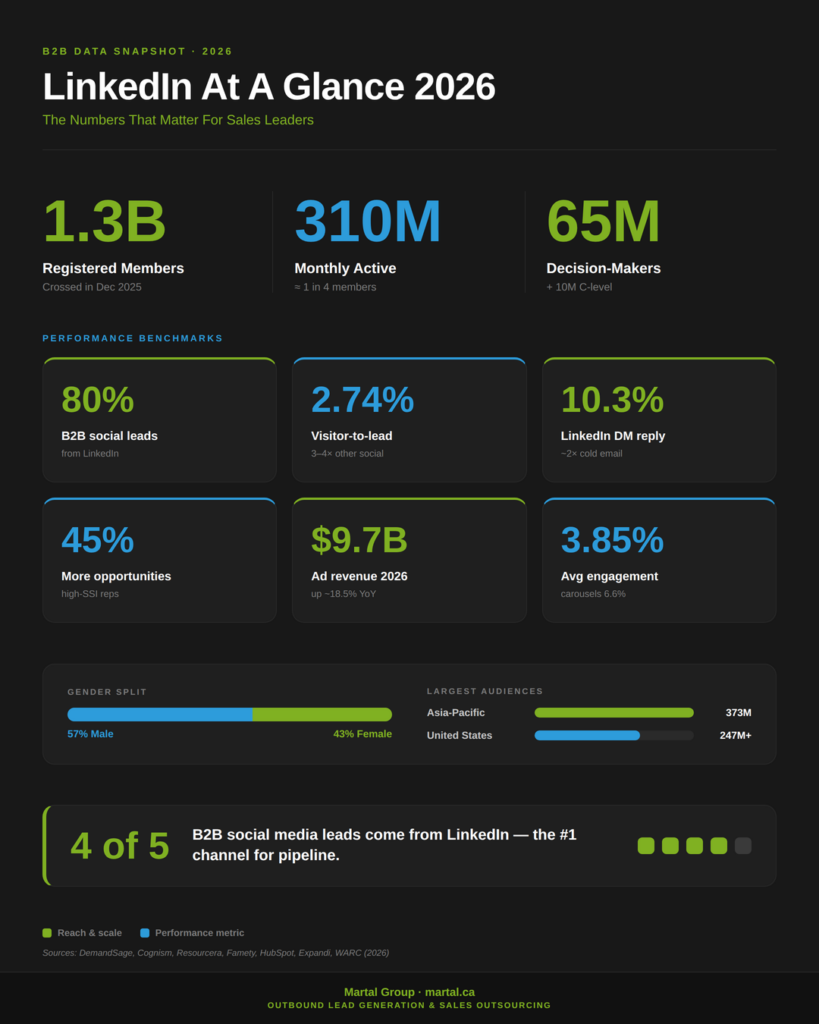
1.3 billion registered members (December 2025) and ~310 million monthly active users (≈1 in 4); the “600M MAU” figure is a projection, not measured. (9)
In 2026, LinkedIn will continue driving 75–85% of all B2B leads from social media—far outperforming other platforms in lead quality and conversion.
Posts with visuals or videos will achieve 2–5× higher engagement, while consistent weekly posting can double brand visibility and follower growth.
AI-driven personalization and automation will streamline outreach and data analysis, enabling teams to scale LinkedIn engagement without sacrificing authenticity.
Expect 2.5–3.5% conversion rates for B2B ads, with Lead Gen Forms and Thought Leader Ads outperforming traditional formats on cost per qualified lead.
Reps with high SSI scores generate 45% more opportunities and are 51% more likely to hit quota, confirming SSI as a key performance indicator for 2026.
Businesses posting 1–2 times per week gain 2× engagement and 7× faster follower growth than less active pages, signaling the importance of consistent activity.
By 2026, social sellers will achieve 2× higher ROI, leveraging relationship-based engagement and data-driven targeting to outperform cold email and phone outreach.
Introduction
LinkedIn now holds 1.3 billion members and roughly 310 million monthly actives — but raw reach isn’t the part sales leaders care about. The sharper question, the one that surfaces constantly in forums and pipeline reviews alike, is blunter: Is LinkedIn an effective platform for lead generation and B2B marketing? — or, as more than a few skeptics put it, Do you think B2B lead generation on LinkedIn is a waste of time?
This report answers both with data. We break down the numbers that actually move pipeline — LinkedIn’s global reach and demographics, B2B lead generation performance, content and engagement benchmarks, the Social Selling Index (SSI), advertising benchmarks, and the role of AI in outbound — and translate each one into what it means for your playbook.
If you’re deciding whether to build LinkedIn outbound in-house or partner with a LinkedIn lead generation agency, these benchmarks let you pressure-test the channel: audience size, conversion rates, engagement lift by content format, and what “good” looks like in 2026.
How we built this article:We pulled the most current figures from primary sources — LinkedIn’s own marketing data alongside credible third-party research, then cross-checked the numbers that conflict most (LinkedIn’s active-user count being the prime example) and interpreted the findings through our own day-to-day experience running omnichannel outbound for B2B clients. The goal is simple: help you separate the stats that should change how you sell from the ones that just sound impressive.
Key LinkedIn Statistics for 2026
Here’s a quick snapshot of the LinkedIn statistics that matter most for B2B sales and marketing teams — organized by category, so you can find the benchmark you need fast.
Users & Global Reach
- 1.3 billion registered members — a milestone LinkedIn reached in December 2025, making it the world’s largest professional network (9)
- ~310 million monthly active users — about 16.2% of members (roughly 134.5 million) are active daily, meaning roughly 1 in 4 members log in each month (21)
- 200+ countries and territories where LinkedIn operates (4)
- 1.77 billion website visits in a single month (Feb 2025), evidence members return and engage, not just sign up (1)
- ~9% year-over-year member growth heading into 2026 (18)
Demographics & Decision-Makers
- 65 million decision-makers and 10 million C-level executives on the platform (16)
- United States is the largest single market at over 247 million registered users, followed by India (14)
- Asia-Pacific is the largest region, contributing more than 373 million members (14)
- 56.9% male / 43.1% female global gender split (14)
- Over half of all users are aged 25–34, the prime career-decision years (9)
- 54% of U.S. users earn over $100,000/year (16); the audience carries 2× the buying power of the average web audience (3)
B2B Lead Generation
- 80% of all B2B social media leads come from LinkedIn (15)
- 89% of B2B marketers say LinkedIn generates high-quality leads — more than any other platform (4)
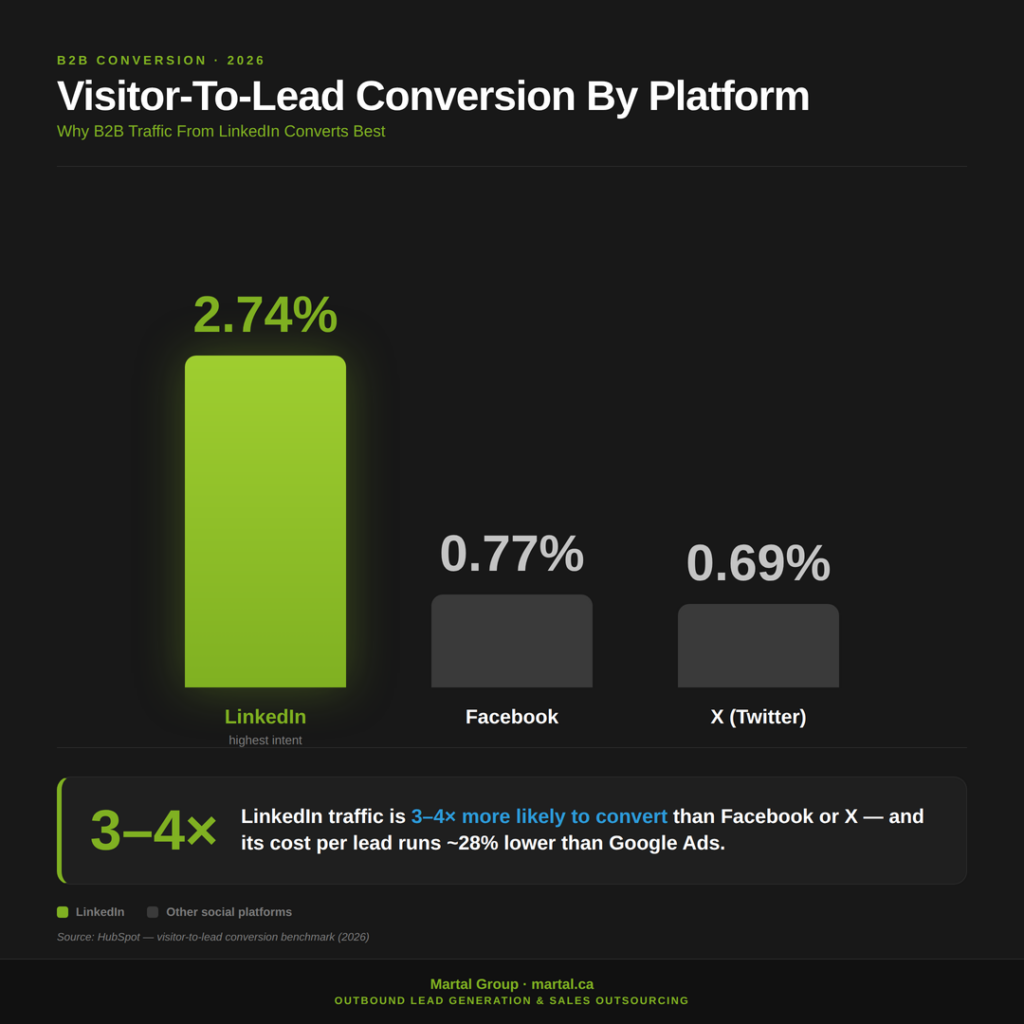
- 2.74% visitor-to-lead conversion vs. 0.77% on Facebook and 0.69% on X (Twitter) (20)
- 28% lower cost per lead than Google Ads (1)
- 46% of social media traffic to B2B sites comes from LinkedIn (4)
- 277% more effective at B2B lead gen than Facebook and Twitter (17)
Content & Engagement
- 3.85% average post engagement rate in 2026, up 44% year-over-year (18)
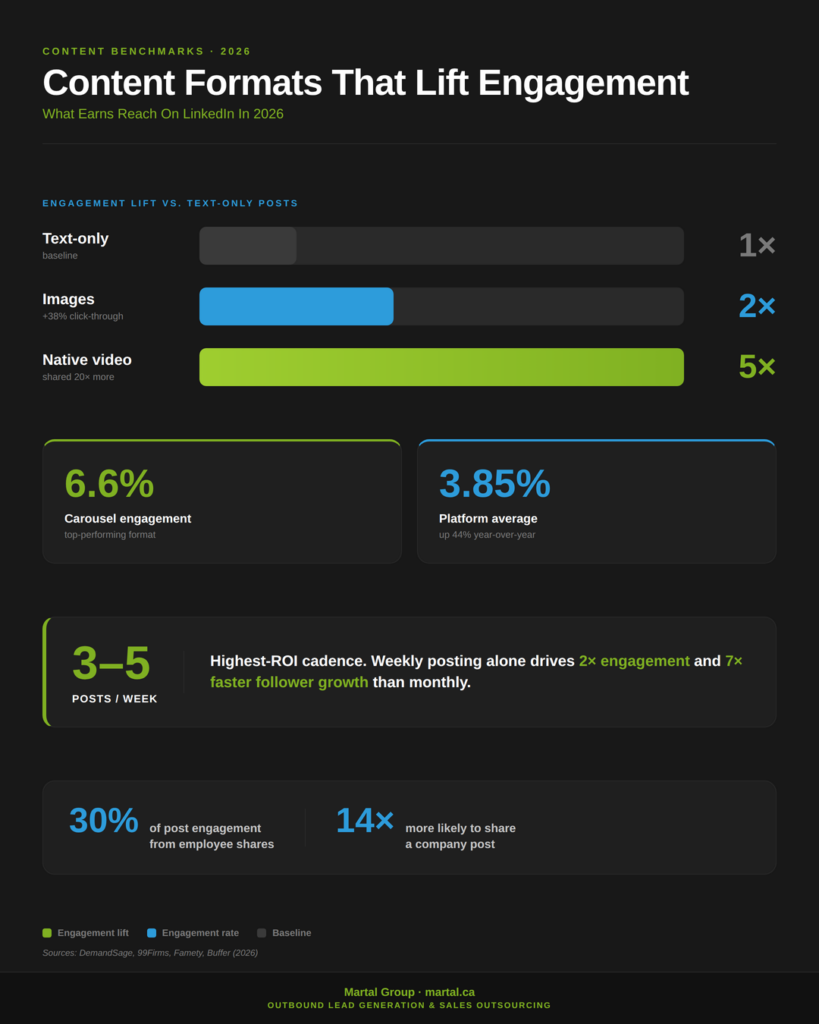
- 6.60% engagement rate for carousel posts, the top-performing format (18)
- 2× engagement for posts with images vs. text-only; up to 5× for native video (4) (9)
- 2× engagement and 7× faster follower growth for pages that post weekly vs. monthly (9)
- 3–5 posts per week is the highest-ROI cadence, per analysis of 2M+ posts (10)
- 1.8 million feed updates viewed every minute across LinkedIn and partner sites (3)
Social Selling & SSI
- 45% more opportunities for reps with a high Social Selling Index (SSI) (19)
- 51% more likely to hit quota for high social sellers (19)
- 78% of social sellers outperform peers who don’t use social media (5)
- 71% of sales professionals already use social selling tools (5)
- 75% of B2B buyers use social media to inform purchasing decisions; 50% use LinkedIn specifically (6)
LinkedIn Advertising
- $9.7 billion projected ad revenue in 2026, up ~18.5% year-over-year (3)
- $5 billion quarterly revenue run rate crossed in Q4 2025 (18)
- 0.4%–0.6% average CTR for Sponsored Content (~0.5% median) (12)
- 50%+ open rate for Message Ads (InMail) when well targeted (11)
- 10%–15% conversion rate for Lead Gen Forms (pre-filled, low friction) (11)
- 20.7% of the global adult population is reachable via LinkedIn ads (2)
AI & Automation
- 10.3% average LinkedIn DM reply rate — roughly double the ~5.1% of cold email (7)
- 100% of teams using AI SDR tools report saving time; nearly 40% save 4–7 hours/week (8)
- 41% of LinkedIn users report using ChatGPT or similar AI tools, up from 15% earlier in the year (3)
LinkedIn’s Global Reach and Usage in 2026
LinkedIn had over 1.2 billion registered members globally by early 2025, with projections pushing it beyond 1.3 billion in 2026.
Reference Source: DataReportal
That makes LinkedIn the largest professional network on earth. But the number that matters for sellers isn’t total sign-ups — it’s how many of those members actually show up.
How many people use LinkedIn worldwide?
LinkedIn has 1.3 billion registered members, but only about 310 million are active monthly, and roughly 134.5 million log in daily — about 16% of all members (16), (21). The widely repeated “600 million MAU” figure is an optimistic projection, not a measured number; current reporting consistently puts monthly actives near 310 million. That gap between registered and active members is normal for LinkedIn — plenty of people sign up, then check in only to update a profile or scan jobs. The practical implication: plan your outreach against the ~310 million who are genuinely active, not the 1.3 billion headline.
The active audience is still enormous and engaged. LinkedIn recorded 1.77 billion website visits in February 2025 (1) — members come back, they don’t just sign up once. And LinkedIn’s advertising reach (counted on registered members) climbed about 17% in a single year, adding roughly 176 million users (2).
Who’s actually on LinkedIn?
The platform skews toward working professionals in their prime career years:
- Over half of users are aged 25–34 (9)
- ~57% male / ~43% female globally, though the North American split is closer to even (14)
- 65 million decision-makers and 10 million C-level executives (16)
- The audience carries 2× the buying power of the average web audience (3)
In short, the people on LinkedIn hold budget and authority — exactly the audience B2B sellers want to reach.
Where they are
LinkedIn is available in 200+ countries, but the distribution is concentrated. The United States is the single largest market (~247–252 million members), followed by India; by region, Asia-Pacific is the largest (370M+ members), ahead of Europe and North America (14). In mature markets like the U.S., penetration of the working population is very high — most professionals already have a profile — so growth there comes from deeper engagement, while emerging markets keep adding new members.
How engaged are they?
Users no longer treat LinkedIn as a static resume. About 40% of monthly active users log in daily (4), and roughly 25% interact with brand content every single day (1); power users on mobile have been clocked at nearly 48 hours/month. For B2B leaders, the takeaway is simple: your buyers are on LinkedIn regularly, which means a recurring window to reach them — if your outreach is relevant enough to earn attention.
The trajectory into 2026 is steady expansion, with LinkedIn’s reach growing faster than Facebook or YouTube in recent reporting (2). For anyone in B2B sales or marketing, that’s a widening pool of reachable, in-market professionals. But reach was never the hard part — turning it into pipeline is, which is where the next sections come in.
LinkedIn Lead Generation Statistics for B2B
LinkedIn generates 80% of all B2B leads that come from social media channels.
Reference Source: Linkedin Marketing Blog
Ask around and you’ll hear two camps. One swears LinkedIn is the best B2B channel they have. The other asks, bluntly, “Do you think B2B lead generation on LinkedIn is a waste of time?” The honest answer: it’s only a waste if you treat it like a posting calendar instead of a pipeline channel. The data sides firmly with the first camp — but only for teams that operationalize it.
What share of B2B leads does LinkedIn generate?
LinkedIn is responsible for about 80% of all B2B leads generated via social media (15), a share steady enough that 75–85% is a safe planning range for 2026. Put differently: 4 out of 5 B2B social leads come from LinkedIn, while every other platform combined accounts for the remaining fifth. No surprise that 89% of B2B marketers use LinkedIn for lead generation, and 40% rate it the single most effective channel for high-quality leads (1).
But those numbers only become pipeline when the work is operationalized: tight targeting, relevant messaging, consistent follow-up, and clean attribution. That’s the line between casual activity and a true LinkedIn lead generation service motion — and it’s exactly why the skeptics who “tried LinkedIn and got nothing” usually stalled at random posting and unstructured outreach.
How effective is LinkedIn for B2B compared to X and Facebook?
By the numbers, it isn’t close. LinkedIn’s visitor-to-lead conversion rate is 2.74%, versus 0.77% on Facebook and 0.69% on X (20) — traffic from LinkedIn is 3–4× more likely to convert, which is why one analysis pegs LinkedIn as 277% more effective at B2B lead gen (17). It also drives about 46% of all social traffic to B2B websites (99Firms): professionals on LinkedIn are actively clicking through to research vendors.
It’s efficient, too. LinkedIn’s cost per lead runs about 28% lower than Google Ads (1), and 43% of B2B marketers report LinkedIn directly generated revenue for their company (4).
What this looks like in practice. The platform supplies and converts — but the conversion happens in the follow-up, not the feed. We see this in our own campaigns, where LinkedIn runs as one coordinated channel alongside cold email and cold calling. In a nine-month omnichannel engagement for Afton Tickets, that coordinated motion delivered 97 SQLs and five closed deals — and a single deal covered the entire campaign cost. In another omnichannel program for a mid-market software development company, the same approach produced 84 SQLs and 54 booked meetings over 15 months. In both, LinkedIn wasn’t the whole strategy — it was the relationship layer that warmed prospects before the call and kept them engaged between touches. That’s the difference between “LinkedIn doesn’t work” and LinkedIn working as designed: a sales pipeline channel, not a content hobby.
A few more benchmarks that reinforce the point:
- 96% of B2B marketers include LinkedIn in their marketing mix — effectively universal (4)
- Sales Navigator users see +7% higher win rates and +18% larger pipeline (9)
- 50% of B2B buyers use LinkedIn as a source when making purchasing decisions (6)
The bottom line: LinkedIn is the home field for B2B lead generation. The teams that “don’t get results” almost always have an execution gap, not a channel problem — relevance, cadence, and follow-through are what separate a busy profile from a booked meeting.
LinkedIn Engagement Statistics & Content Benchmarks
Posts with images on LinkedIn receive 2x higher engagement than text-only posts.
Reference Source: LinkedIn
A large audience is one thing; engaging it is another. So what actually performs on LinkedIn — and what counts as a good engagement rate in 2026?
What’s a strong LinkedIn engagement rate in 2026?
The average LinkedIn post engagement rate sits around 3.85% in 2026, a 44% increase year-over-year (18), and format matters more than ever: carousel posts lead all formats with a 6.60% engagement rate (18). As a working benchmark, anything above ~2% for a company page is solid, while strong carousel or employee-shared content can clear 4–6%+. (18)
The feed is busy: members view over 1.8 million feed updates per minute and roughly 280 billion per year (9). To stand out in that volume, lean into the formats and habits the data rewards.
Images and video win attention.
- Posts with images get 2× the engagement of text-only updates; larger graphics can lift click-through by 38% (4).
- Native video earns up to 5× more engagement and is shared 20× more than any other content type (9), (11). Short-form video consumption rose 12% year over year, and LinkedIn Live streams have generated 7× more reactions and 24× more comments than standard video (3), (9).
How often should you post on LinkedIn?
Consistency compounds: pages that post weekly see 2× the engagement and grow followers 7× faster than monthly posters (9)). Newer analysis sharpens the target — 3-5 posts per week is the highest-ROI range for most professionals, and beyond 5, engagement per post drops by 18-32% (10), (21)). But frequency is a multiplier, not the driver. The strongest predictor of inbound results isn’t how often you post — it’s what happens after: replying to comments and engaging with your audience’s content in the first ~90 minutes. In one analysis, accounts that posted 3x/week with active inbound engagement outperformed accounts posting daily without it by 4.2X in lead generation (21). A simple rule: post 3–5 times a week, favor mid-week (Wednesday tended to get the most engagement (10) and spend as much time engaging as creating. (21)
Thought leadership beats promotion.
- 64% of buyers prefer thought-leadership content over product-focused material when evaluating a vendor, and 66% are receptive to posts from company reps and industry experts — far more than the 48% who tolerate banner ads (11).
- Exposure to a company’s LinkedIn content can lift down-funnel conversion by up to 50% across channels (11) — credibility built in the feed pays off later in the funnel.
Employees amplify reach.
- Employees have 10× more first-degree connections than their company has followers, are 14× more likely to share a Page post than other content, and account for roughly 30% of total engagement on company posts (11), (4). Activating even a handful of engaged employees can nearly double a post’s reach.
The pattern is consistent: visual, human, and consistent content wins. For outbound teams, the practical implication is that content and outreach aren’t separate programs — a prospect who has already seen useful posts from your rep or company is a warmer, more responsive target when the LinkedIn lead gen outreach lands. Treat LinkedIn as a place to educate and engage, not advertise at, and the interactions — and eventually the meetings — follow.
LinkedIn Social Selling Statistics & the SSI
Reps with a high Social Selling Index (SSI) generate 45% more opportunities and are 51% more likely to hit quota.
Reference Source: LinkedIn Social Selling
Social selling has moved from buzzword to baseline. It means using LinkedIn to find prospects, build relationships, and earn conversations before the pitch — and the payoff is measurable: 78% of salespeople who social-sell outperform peers who don’t (5). If you want your team hitting quota, social selling isn’t optional anymore.
Here are the social selling statistics every sales leader should know:
Top performers have already adopted it. As of 2025, 71% of sales professionals — and ~90% of top performers — use social selling tools like Sales Navigator (5). Among millennial reps, 78% use social selling tools and 63% call it crucial to their success (5). For sales teams hiring younger talent, the expectation is already baked in — which is why providing the right training and sales tools matters.
Is it worth investing in LinkedIn Premium or Sales Navigator for B2B lead generation? For teams doing real outbound, usually yes. Sales Navigator’s advanced search, lead lists, and InMail are built for exactly the targeting and reach social selling depends on, and LinkedIn’s data ties its use to +7% higher win rates and +18% larger pipeline (9). The tool isn’t magic on its own, though — it pays off when paired with consistent activity and a high SSI, not as a substitute for them.
Social selling correlates with quota attainment. Companies that prioritize social selling are 51% more likely to hit revenue goals, and individual social sellers are 51% more likely to hit quota (19). It expands reach and helps reps work warm opportunities instead of cold lists. We see the same pattern in our own campaigns: in a 24-month omnichannel program for Polygon, a Stockholm-based firm entering the US market, relationship-led outreach across LinkedIn, email, and cold calling delivered 203 SQLs and 139 booked meetings — proof that warming unfamiliar buyers on LinkedIn before the call materially lifts response.
It builds pipeline and saves research time. Reps with a strong SSI have 45% more sales opportunities than those with a weak presence (19), and 39% of B2B sellers say social networks cut their pre-call research time (5). Reps reach out with context and find interested buyers faster.
What is the Social Selling Index (SSI) — and does it still matter in 2026? LinkedIn’s SSI scores a person 0–100 across four pillars: establishing a professional brand, finding the right people, engaging with insights, and building relationships. It’s not a vanity metric — higher SSI correlates with 45% more opportunities and 51% higher quota attainment, and that link still holds in 2026. Anything above ~70 is generally considered strong. Treat SSI as a coaching sales KPI: track it per rep and reward the behaviors that raise it — consistent posting, thoughtful commenting, strategic network growth.
Buyers welcome it. 75% of B2B buyers use social media to inform purchasing decisions, and 50% specifically use LinkedIn (Folk). More pointedly, the majority of senior decision-makers won’t respond to purely cold outreach — but they’re far more likely to engage someone who shares mutual connections or relevant insight. Being visible and useful on LinkedIn “warms up” prospects before the first message, which is the entire point.
Despite all this, 93% of sales executives have never had formal social selling training (5) — a wide-open opportunity. We regularly help clients’ SDR teams close that gap: sharpening profiles, engaging prospects’ posts, and using Sales Navigator filters so outreach lands warm instead of cold.
One caution: social selling is about building relationships, not pitching. Reps who connect and immediately pitch kill the advantage. The ones who win share useful content, comment on prospects’ posts, and nurture genuine conversations — so by the time they reach out, the buyer already recognizes them. In 2026, treat LinkedIn activity like any other pipeline input: set targets, track SSI, and celebrate the interactions that turn into meetings.
LinkedIn Advertising Statistics & Ad Benchmarks
LinkedIn Ads deliver a visitor-to-lead conversion rate of 2.74%, outperforming Facebook at 0.77% and Twitter at 0.69%.
Reference Source: HubSpot
LinkedIn isn’t just for organic networking — it’s a thriving paid-media platform, and its ad business keeps growing. WARC projects LinkedIn’s ad revenue will reach $9.7 billion in 2026 (up ~18.5%) (3), after the platform crossed a $5 billion quarterly revenue run rate in Q4 2025 (18). Here’s how the benchmarks break down — and where ads fit relative to the outreach that actually converts them (18).
What are the LinkedIn ad conversion benchmarks for 2026?
Current data puts LinkedIn’s visitor-to-lead conversion around 2.74%, versus ~0.77% on Facebook (20). For 2026, a reasonable B2B planning range is 2.5%–3.5%, with well-targeted top performers higher. The trade-off: LinkedIn’s CPCs typically run $5–$12 depending on targeting — pricier per click, but aimed at a far more qualified audience.
Ad reach and audience quality. LinkedIn’s ad reach spans its ~1.2–1.3 billion registered members — all professionals 18+ — equal to roughly 20.7% of the global adult population (2). But reach isn’t activity: the realistic active monthly audience is ~310 million, so plan campaigns against that number. What you trade in raw scale you gain in composition — LinkedIn’s audience carries 2× the buying power of the average web audience and includes 65 million decision-makers (16). For outbound campaigns, that concentration of budget-holders is the whole appeal.
Engagement with ads. LinkedIn users expect business content, which lifts ad receptivity. 73% of members are receptive to messages from thought leaders and companies (11), and in the U.S. LinkedIn ads score highest on “ad equity” among social platforms (3). Raw click-through is modest — median CTR sits near 0.5% (12) — but the engagement that does happen is high-intent. Notably, audiences exposed to a brand’s LinkedIn ads are 25% more likely to respond to that brand’s Sales Navigator InMails afterward (11) — a clear awareness-then-outreach one-two punch.
Ad format benchmarks.
- Sponsored Content CTR averages 0.4%–0.6% (12); ~0.8%+ is good, depending on industry.
- Message Ads (InMail) see open rates above 50% when well targeted (11) — often beating cold email response rates.
- Lead Gen Forms convert 10%–15% of clicks, thanks to pre-filled fields — ideal for content and webinar signups.
- Thought Leader Ads (promoting execs’ posts) have shown up to 2.3× higher CTRs than standard ads (13), blending organic credibility with paid reach.
Reach vs. active use — the nuance. The 1.2–1.3B “ad reach” counts registered members, not monthly logins. In mature markets (US, UK, Canada), LinkedIn’s professional audience is near saturation — it reaches the vast majority of 18+ professionals — so incremental reach there comes from deeper engagement, not new sign-ups. Emerging markets still offer headroom and less ad competition, which can favor cross-border B2B targeting.
Do marketers actually rate LinkedIn their best paid channel?
Yes — by wide margins. Surveys put 58% of B2B marketers naming LinkedIn the top ROI platform for paid social (4), and a separate read found 84% saying LinkedIn delivered the best value (1). The reason is consistent: LinkedIn rarely wins on lowest CPM or CPC, but it wins on lead quality and cost per qualifiedlead — the metric that matters in B2B. From an execution standpoint, that’s also why LinkedIn ads tend to perform best not in isolation but as the awareness layer ahead of personalized outreach: the ad earns recognition, the rep earns the meeting.
In practice, the highest-leverage uses are account-based targeting (specific companies and titles), promoting high-value content via Lead Gen Forms, and retargeting engaged visitors through Matched Audiences. Measured through a pipeline lens — cost per target account engaged, or cost per SQL — LinkedIn consistently ranks among the most effective B2B channels, even when it isn’t the cheapest.
LinkedIn Automation & AI Statistics for Sales Teams
LinkedIn DMs driven by automation achieve an average 10.3% response rate, nearly double that of traditional email outreach.
Reference Source: Expandi
No view of sales trends is complete without AI. It’s reshaping how teams approach LinkedIn outreach and social selling — from content generation to automated prospecting sequences, AI sales automation tools help teams scale. But there’s a caveat the data keeps confirming: the human touch still closes the deal.
How is AI changing LinkedIn selling in 2026?
AI is already saving SDRs hours and lifting reply rates. Through 2026, expect AI to own mass personalization, predictive targeting, content optimization, and automated sequencing, while human reps concentrate on the high-value conversations. Automation is becoming standard practice for scaling LinkedIn social selling — but the human element stays decisive at the point of conversion. Here’s what the data shows.
AI adoption is already mainstream on LinkedIn. By late 2025, 41% of LinkedIn users reported using ChatGPT or similar AI tools — up from just 15% earlier in the year (3). Nearly half your prospects now use AI themselves, which cuts two ways: AI-assisted outreach feels normal, but buyers are also quicker to spot a generic, bot-written message. Personalization matters more, not less.
Automation saves real time — when used right. 100% of teams using AI SDR tools report saving time, with nearly 40% saving 4–7 hours per week and another 43% saving 8+ hours (8) — effectively a workday returned to each rep, freed from manual lead research, list-building, and follow-up logging.
This is exactly the layer Martal’s AI SDR is built to handle. Our platform runs the repetitive 80% — building enriched prospect lists, scoring buying signals, drafting personalized sequences, and orchestrating coordinated touches across LinkedIn, email, and phone — so our onshore Sales Executives spend their time on the 20% that actually moves deals: the conversations. That division of labor is the practical answer to “how do we scale LinkedIn without sounding like a bot?”
AI-assisted LinkedIn outreach outperforms cold email. The average cold email reply rate is ~5.1%; the average LinkedIn DM reply rate is 10.3% — roughly double (7), observed across 70,000+ LinkedIn campaigns. The absence of spam filters and LinkedIn’s more conversational tone both help — and AI can analyze what messaging resonates and adjust accordingly.
But personalization and human connection are paramount. Automation alone isn’t enough. The strongest results come when AI is paired with human insight — as one 2025 analysis put it, “sellers who can create human connection are outperforming their peers” (8). Over-automated, spammy behavior risks account restrictions and tuned-out prospects; the top teams treat LinkedIn as a core channel and automate without sacrificing personalization.
Where AI fits in a LinkedIn motion. The highest-value uses cluster in four places:
- Research: AI gathers prospect context — profile, recent news, intent signals — and briefs reps before outreach.
- Sequencing: AI executes connection requests, messages, and follow-ups at optimal timing, so reps design the play and AI runs it.
- Content: AI drafts post outlines and opening lines that reps edit into their own voice, keeping a consistent cadence.
- Prioritization: AI flags warmer targets — who viewed a profile, engaged with relevant content, or matches intent signals.
The benefit is scale and precision; the risk is that easy automation tempts teams to spam. Set guardrails: keep automated copy human, segment audiences, respect LinkedIn’s activity limits, and the moment a prospect replies, switch to fully human mode.
The takeaway: use AI to handle the repetitive 80% so your team can focus on the 20% that needs human creativity and empathy. Automation scales outreach; authenticity closes deals. The teams that win on LinkedIn will run both in harmony.
LinkedIn Lead Generation Best Practices for 2026
Companies that post weekly on LinkedIn experience 2x engagement rates and 7x faster follower growth than infrequent posters.
Reference Source: DemandSage
So what is a good B2B LinkedIn lead generation technique? Honestly, several — working together. Below are the best practices that turn LinkedIn’s reach into pipeline, each rooted in the data above and in our own outbound lead generation work. Use them as a checklist.
1. Optimize Profiles and Build Personal Brands
Before any outreach, make sure your reps’ profiles are buyer-ready: a clear, value-focused headline, a summary about how they help clients, and a healthy network. Buyers check profiles before replying, so credibility here directly affects response rates — LinkedIn’s research finds buyers are 6× more likely to engage a salesperson with a strong professional brand. A high SSI starts with a well-built profile and consistent activity.
2. Target and Personalize Your Outreach
The era of spray-and-pray cold LinkedIn messaging is over. Use Sales Navigator to laser-target by role, industry, and company size, then personalize every touch — reference a recent post, a shared connection, or a company milestone. 94% of marketers say personalization boosts sales outcomes (6). Make it a rule: every connection note carries at least one piece of genuine, specific context.
3. Use a Multi-Touch, Omnichannel Cadence
Don’t rely on LinkedIn alone — make it a pivotal part of a coordinated cadence. It takes an average of 5–7 touches to reach a prospect, and nearly everyone who responds does so within seven (8). Sequence it: connect on LinkedIn, send a LinkedIn message, follow up by email, then call referencing the LinkedIn thread. Coordinating email, cold calling, and LinkedIn in one omnichannel sequence is how prospects experience continuity instead of noise. This is exactly the motion we run for clients — LinkedIn rarely performs in isolation.
4. Engage Before and After the Connection
Treat LinkedIn as relationship-building, not a transaction. Like and comment on prospects’ posts, endorse a skill, share something useful — before and after you connect. The majority of decision-makers ignore pure cold outreach but will engage someone who’s built credibility or shares mutual connections (11). Stay visible and useful; don’t vanish the moment a connection is accepted.
5. Lead with Content and Thought Leadership
Outbound works far better alongside strong content. Encourage reps to share short, useful posts — industry takes, quick tips, lessons from a recent project. Marketing should arm them with easy-to-share assets (posts, infographics, customer stories) plus a personalized blurb.
How often should you post on LinkedIn to stay competitive in 2026? Aim for 3-5 posts per week — the highest-ROI range (21) — mixing formats (text, image, video). Weekly posting alone doubles engagement versus monthly (9), but what you do after posting — replying and engaging in the first 90 minutes — matters more than raw frequency. The highest-engagement formats are native video, carousels/infographics, employee-shared posts, thought-leadership articles, and interactive polls. Audiences exposed to a brand’s LinkedIn content are 50% more likely to convert later (11) and employee shares drive ~30% of engagement on company posts (4). (21)
6. Get Full Value from Sales Navigator
If you’re running serious outbound, invest in Sales Navigator. Its advanced search, lead lists, job-change alerts, and InMail are built for organized outbound prospecting, and its analytics show where to focus. The payoff is measurable: Navigator users see +7% higher win rates and +18% larger pipeline (9). Pair it with LinkedIn’s evolving tools — audio events, newsletters, employee advocacy — to support a full social selling program.
7. Balance Automation with Authenticity
Automation tools are efficient — but use them carefully. Automate routine tasks (bulk connection requests to a target list, timed follow-ups), but always review the copy so it reads human, and inject personal lines where you can. Respect LinkedIn’s activity limits to avoid restrictions. One effective pattern: automate the detection of social signals — alerting a rep when someone engages with relevant content — then have a human act on it with a tailored message. Treat AI as the assistant, not the closer. The rule of thumb: the moment a prospect replies, switch to fully human mode. The goal is meaningful conversations, not message volume.
8. Track Metrics and Iterate
You can’t improve what you don’t measure. Set KPIs for LinkedIn just as you do for calls and email.
Which LinkedIn KPIs matter most? Track connection acceptance rate, message/InMail response rate, SSI, content engagement rate, and leads or pipeline generated from LinkedIn. Use them to refine: if one connection template accepts at 50% and another at 20%, dig into why. A/B test messaging, experiment with send times, and share what works across the team. Treat LinkedIn outreach with the same rigor as any sales funnel.
Done consistently, these practices turn LinkedIn from a networking site into a real revenue channel for your outbound sales team. If you can’t run and measure this across reps and regions, a LinkedIn outreach agency can standardize targeting, message QA, and reporting so LinkedIn performs like a managed channel, not a side project. We’ve watched skeptical clients turn LinkedIn into their #1 source of qualified leads once the targeting, cadence, and follow-through were built properly — it’s rarely an overnight play, but it compounds.
Conclusion: Turning LinkedIn Statistics Into Pipeline
The statistics tell a consistent story: LinkedIn has become indispensable for B2B sales leaders, with growing usage, engaged professional audiences, and measurable sales impact. From a network of 1.3 billion members to daily social selling wins at the rep level, it’s where modern outbound strategy plays out.
2026 will reward teams that work smarter on LinkedIn — using its reach strategically, pairing automation with authenticity, and committing to relationships and content over raw volume. The executives who treat LinkedIn as a managed revenue channel, not a posting calendar, will hold a clear pipeline advantage.
The recurring theme across every stat in this report is the same: results come from how you use LinkedIn, not whether you’re on it. Are your SDRs merely connecting, or nurturing conversations? Is your content making impressions, or influencing decisions? The gap between “LinkedIn doesn’t work for us” and “LinkedIn is our #1 lead source” is almost always execution — targeting, cadence, personalization, and follow-through. Use the data and LinkedIn best practices here as the roadmap to close it.
If LinkedIn is underperforming for your team, it’s usually a system problem, not a channel problem. That’s where we can help. For 16+ years, Martal has built and run LinkedIn-driven outbound for B2B companies — from early-stage startups to Fortune 500 firms — as part of a coordinated omnichannel motion across cold email, cold calling, and LinkedIn outreach. Our Sales-as-a-Service model pairs experienced onshore Sales Executives with Martal’s AI Sales Platform, so the repetitive work scales and your reps focus on the conversations that convert.
Book a consultation and we’ll assess your current LinkedIn approach, share tailored recommendations, and explore whether our team can help expand your qualified pipeline. No hard sell — just a working conversation about turning LinkedIn’s reach into booked meetings.
References
- Sprout Social
- DataReportal
- Roastbrief / WARC
- 99Firms
- Breakcold
- Folk CRM Blog
- Expandi
- Outreach.io
- DemandSage
- Buffer
- Writeful Copy
- Agency Analytics
- The LinkedIn Blog
- Resourcera
- Linkedin Marketing Blog
- Cognism
- Kinsta
- Famety
- LinkedIn Social Selling
- HubSpot
FAQs: LinkedIn Statistics
How many people use LinkedIn in 2026?
LinkedIn surpassed 1.3 billion registered members (a milestone reached in December 2025) and sees roughly 310 million monthly active users — about 1 in 4 members — with daily actives near 134.5 million. Growth continues at about 9% year over year, driven by adoption in emerging markets and steady decision-maker engagement. (The “600 million MAU” figure sometimes cited is a projection, not a measured number.)
What is LinkedIn’s Social Selling Index (SSI) and why does it matter?
The SSI scores a person 0–100 across four pillars: professional brand, finding the right people, engaging with insights, and building relationships. It matters because higher scores correlate with results — reps with a strong SSI generate about 45% more opportunities and are 51% more likely to hit quota — making it a practical coaching KPI for B2B teams in 2026.
How effective is LinkedIn for B2B lead generation compared to other channels?
LinkedIn is the top B2B social lead source, responsible for about 80% of all social media B2B leads. Its 2.74% visitor-to-lead conversion rate is roughly 3–4× higher than Facebook (0.77%) or X (0.69%), and its cost per lead runs about 28% lower than Google Ads — which is why it remains the dominant B2B platform in 2026.
What content works best on LinkedIn to drive engagement?
Visual and video posts perform best — images earn about 2× the engagement of text-only, and native video up to 5×. Carousel posts lead all formats at 6.60%. Thought-leadership articles, infographics, and employee-shared posts also outperform, especially when posted 3–5 times a week with authentic, value-driven insights. Famety
Should we use automation or AI for LinkedIn outreach?
Yes — strategically. AI saves SDRs hours on research and messaging, and automated LinkedIn DMs average a ~10.3% reply rate, roughly double cold email. But human personalization remains essential: over-automation triggers account restrictions and tune-out. The strongest results come from automating the repetitive 80% while your reps own the conversations that close.
Is B2B lead generation on LinkedIn worth it?
It’s worth it when operationalized. Teams that “get nothing” usually rely on random posting and unstructured outreach. With tight targeting, relevant messaging, consistent multi-touch follow-up, and clean attribution — ideally inside an omnichannel motion across email, cold calling, and LinkedIn — LinkedIn becomes a top qualified-lead source. The platform both supplies and converts; execution determines the result.