
 Martal
 Technology
 Education and training
 Web Development and UI / UX
 Healthcare/Medical
 Logistics and Supply Chain
 Information Technology
 Insuretech and Financial Services
 Marketplaces
 Software Development
 E-commerce and retail
 AI and Machine Learning
 Energy and Solar
 Manufacturing
 Security and Surveillance
 Digital Marketing Agency
 Transportation
 MSP
MSP
 Telecom
 B2B SaaS
 Cybersecurity
 HR tech
 Fintech
 Cleantech
 Consulting
Sales Team Structure: The Models, Ratios, and Roles That Actually Drive Pipeline
Major Takeaways: Sales Team Structure
The four models are Island (full-cycle reps, best for founder-led motions under $2M ARR), Assembly Line (SDR → AE → CSM specialization, best for most B2B teams from $2M–$20M ARR), Pod (cross-functional units of 1–2 SDRs + 1–2 AEs + 1 CSM, best for complex enterprise sales past $20M ARR), and Hybrid (in-house + outsourced, which can layer over any of the other three).
The industry benchmark across nearly 1,000 B2B companies is 1 SDR per 2.5 AEs, but the right ratio depends on pipeline source. Outbound-heavy motions run 1:1.5–2, balanced motions run 1:2.5, and inbound-heavy teams can stretch to 1:3–4.
Start founder-led ($0–$1M ARR), hire your first AE at $1M–$2M, add your first SDR (internal or fractional) around $2M, add a second AE and sales manager at $3M–$5M, layer in CSM and Sales Ops at $5M–$10M, and specialize into segments or pods past $10M ARR. Don’t advance a stage until the current one is repeatable without the founder.
When the founder has closed enough deals to define what a qualified lead actually looks like — typically 10–20 customers in. Hiring sales before the motion is repeatable usually produces pipeline nobody can close. Your first hire should be an Account Executive, not an SDR.
A hybrid structure combines in-house and outsourced or fractional sales talent inside a single coordinated motion. It fits when three conditions line up: the economics of an internal SDR hire don’t match the work (fully loaded, an in-house SDR runs $95,000–$128,000 in year one), ramp speed matters, and the internal team is ready to close what the outsourced team qualifies.
The core roles: SDR/BDR (top-of-funnel prospecting and qualifying), AE (closing), CSM/Account Manager (retention and expansion), Sales Manager (coaches 4–7 reps), Sales Operations (systems and analytics), and Sales Enablement (playbooks, training, ramp). Title inflation blurs these, but the functions are distinct.
Cost per qualified meeting held — total program cost (salaries, tools, outsourcing fees, everything) divided by the number of qualified meetings that actually happened. It’s the only number that lets you compare internal SDR economics, hybrid economics, and fully outsourced economics apples-to-apples.
Introduction
Most sales orgs that miss their number don’t have a talent problem. They have a structure problem. The team is organized around roles that made sense at the last revenue stage but don’t fit the current motion and pipeline, quota attainment, and rep productivity all quietly erode.
This guide covers the sales team structures B2B companies actually use in 2026: what each model does well, when to graduate from one to the next, the SDR-to-AE ratios that hold up under scrutiny, and where outsourced or fractional roles fit inside an internal team. It draws on current benchmarks combined with what we’ve seen across 2,000+ B2B outbound campaigns at Martal, including the structures we run today for clients in SaaS, manufacturing, fintech, and cybersecurity.
If you’re looking for the quick takeaway, most B2B teams with 10 to 100 reps are best served by starting with the Assembly Line model (SDR → AE → CSM), with staffing at about one SDR for every 2.5 AEs. Transitioning to a Pod structure usually only makes sense once there’s enough volume to support at least three fully staffed pods. The rest of this guide explains the reasoning behind that and what to do if your team is earlier, more advanced, or operating outside that typical path.
What Is a Sales Team Structure?
Sales orgs with clearly defined roles see +8% revenue attainment, +25% quota attainment, and +17% higher win rates — while cutting voluntary turnover by 17%.
Reference Source: Korn Ferry
A sales team structure is how you organize people, roles, and handoffs to move prospects from first touch to closed revenue. It answers three practical questions: who prospects, who closes, and who retains. Every other decision — compensation, quotas, tooling, territories — hangs off the answer to those three.
Most founders and revenue leaders treat structure as an HR exercise. It’s not. Structure is a revenue lever. Reps at well-structured orgs sell more, ramp faster, and stay longer. Reps at poorly structured orgs burn out inside 18 months, leave pipeline on the floor between handoffs, and miss quota by margins that look like a sales problem but are really an org-design problem.
Why structure matters more than most teams think
Two numbers frame this well. First, sales reps spend only about 28% of their working hours actually selling — the rest goes to research, admin, internal meetings, and tool-switching. Second, benchmarking of B2B orgs shows that teams with clearly defined roles hit meaningfully higher revenue attainment, quota attainment, and win rates than teams without them (5). The structure itself recovers selling time. It’s not soft — it’s where productivity actually comes from.
And the quota data backs this up. Forrester pegs average B2B quota attainment at around 47%, and the RepVue Cloud Sales Index puts it closer to 43% (7) (8). When fewer than half your reps are hitting their number, the instinct is to hire harder or replace underperformers. Most of the time, the faster fix is structural — reassigning who owns prospecting, who owns closing, and what happens between them.
The three questions every sales structure has to answer
Before comparing models, it helps to make the decision framework explicit. Every B2B team — whether you’re running a founder-led motion with three reps or a 200-person enterprise org — is answering the same three questions:
– Who prospects? Who identifies accounts, runs cold outreach, and qualifies interest? This is usually an SDR or BDR, but at small teams it’s the founder or the AE.
– Who closes? Who runs discovery, demos, negotiation, and the contract? This is the Account Executive — and it’s the role that most directly correlates to new revenue.
– Who retains and expands? Who onboards, drives adoption, renews, and upsells? This is Customer Success or Account Management, and it’s where LTV actually gets built.
At 3 reps, one person does all three jobs. At 30 reps, specialization pays. At 100 reps, structure gets more important than any individual’s talent. The models we’ll walk through next are really just different answers to “at what point do we split these jobs, and how?”
What happens when structure is wrong
The pattern is consistent across the outbound engagements we run. The symptoms show up in four places:
– Handoff friction. Leads go cold between stages because no one owns the transition. We see this most often when SDRs book meetings but AEs don’t follow up inside an hour — and HBR’s well-known lead-response data shows contacting a lead within an hour makes qualification roughly 7x more likely than waiting two hours.
– Role creep. AEs prospecting instead of closing. SDRs trying to run discovery calls they’re not ready for. Sales managers doing individual deals because the team can’t cover pipeline.
– Quota math that doesn’t work. A 1:1 SDR-to-AE ratio in a heavy inbound motion over-hires SDRs who can’t stay busy. A 1:4 ratio in a heavy outbound motion starves AEs of pipeline. Both patterns show up as “we can’t hit quota” — the real problem is headcount mix.
– Turnover in the wrong seats. High SDR churn is normal (average SDR tenure sits around 16 months). High AE churn is a structural red flag, usually tied to bad pipeline coverage or compensation that doesn’t match the motion.
None of these are fixed by hiring more reps. They’re fixed by rebuilding the structure — which is what the rest of this guide is for.
The 4 Core Sales Team Models
Most B2B teams between 10 and 100 reps should start with the Assembly Line model, staffed at roughly 1 SDR per 2.5 AEs.
Reference Source: Prospeo
There are four sales team structures that cover roughly every B2B motion you’ll see in the wild: Island, Assembly Line, Pod, and Hybrid. They’re not competing philosophies — they’re stages. Most companies move through them as revenue grows, and picking the right one for your current stage matters more than picking the “best” one in the abstract.
Here’s how they compare, then we’ll walk through each one.
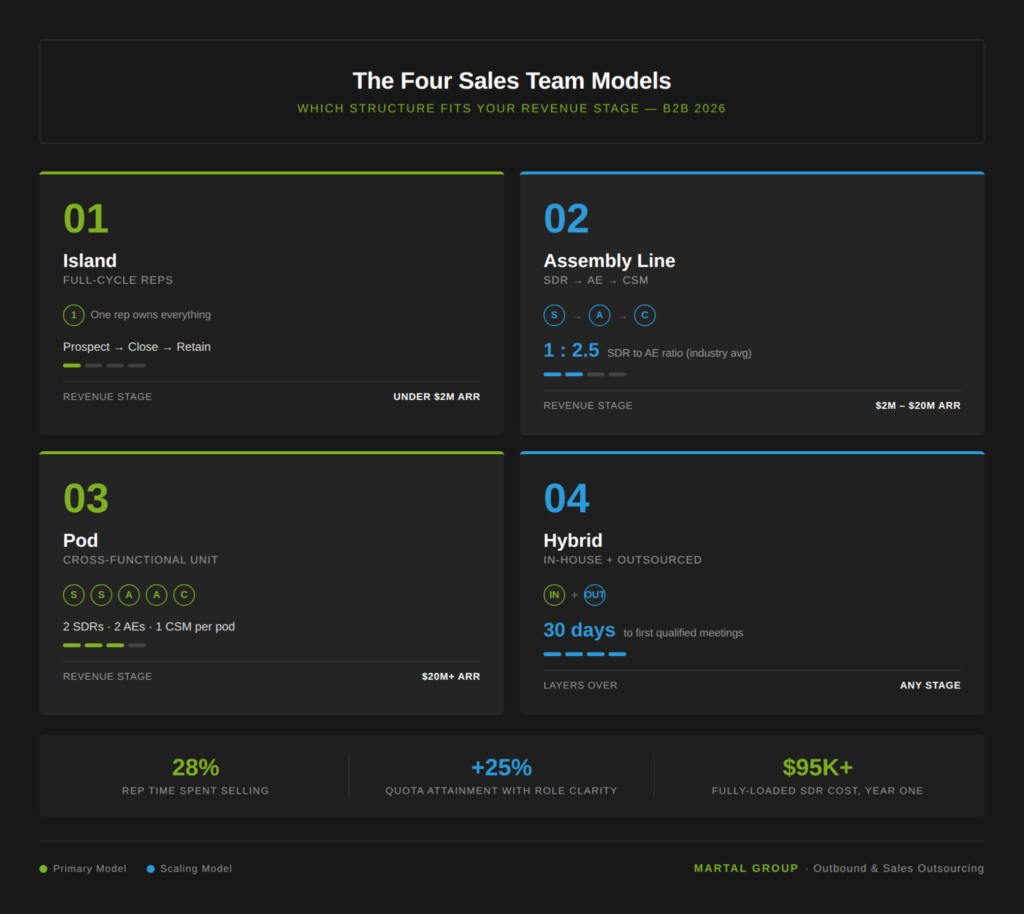
The Island Model
Each rep owns the full sales cycle — prospecting, qualifying, demoing, closing, and often early account management. No specialization, no handoffs. One rep, one deal, end to end.
When it works. Founder-led motions, early-stage startups under roughly $2M ARR, and agencies or services businesses where relationships run deep and deal counts are low. The Island is also the right structure when you haven’t yet figured out what a qualified lead looks like — your AEs need to prospect directly so they can feel what the market responds to and feed that back into positioning.
When it breaks. Once a rep is spending more than about a third of their time on prospecting, you’re paying closer rates for lower-rate work. That’s the signal to split the role. In practice, most teams outgrow the Island around 3–5 reps or $2M ARR, whichever comes first.
Real-world pattern. We see Island-model teams succeed when they combine it with outsourced top-of-funnel support — the founder keeps the AE role, but hands prospecting to a fractional team. That’s how Complete EDI ran their first pilot with us: one internal closer, one fractional Martal rep handling outbound, 14 SQLs in 3 months. The Island model survived longer because the rep wasn’t stretched across both jobs.
The Assembly Line Model
This is the default B2B structure, and the one most teams between 10 and 100 reps should actually be running. Work flows through specialists in sequence: SDRs prospect and qualify, AEs close, Customer Success onboards and expands. Each role does one job and gets deeply good at it.
When it works. Assembly Line fits when you have a repeatable sales motion, an ICP you can describe precisely, and enough inbound or outbound volume to keep specialists busy. For most B2B SaaS and services teams, that point comes somewhere between $2M and $20M ARR.
When it breaks. Two classic failure patterns. First, handoff friction — leads go cold between SDRs and AEs because no one owns the transition and there’s no handoff SLA. Second, incentive misalignment — SDRs get paid for meetings booked, not meetings that convert, which drifts them toward low-quality bookings that AEs then ignore.
Staffing math. The industry benchmark across is roughly 1 SDR for every 2.5 AEs. That’s an average (1), your actual ratio should be tighter for outbound-heavy motions and looser for inbound-heavy ones. We’ll cover that in detail in the ratios section below.
The Pod Model
Pods take the Assembly Line’s specialization but wrap it in a small cross-functional unit that owns a territory, segment, or industry end-to-end. A typical pod is one or two SDRs, one or two AEs, and one CSM — all working the same accounts together.
When it works. Pods fit complex sales cycles, large ACVs, and segmented markets where deep account ownership beats functional specialization. They’re also useful when a company has enough volume to staff at least three full pods — below that, the coordination overhead eats the benefit.
What makes pods different. Accountability shifts from individual to team. Instead of an SDR competing with other SDRs and an AE competing with other AEs, the pod competes with other pods. Feedback loops tighten — the SDR hears immediately from the AE when messaging lands or misses, and the CSM flags adoption issues back up the chain. For enterprise motions with multi-threaded buying groups, pods are often the right call by default.
Common mistake. Teams jump to Pods too early, usually around 10–12 reps, because the model sounds good on paper. At that scale there isn’t enough deal volume to keep each pod healthy, and you end up with underutilized specialists who would have been more productive in an Assembly Line.
The Hybrid Model
Hybrid structures blend in-house and outsourced or fractional sales talent inside a single coordinated motion. It’s not a fourth lane parallel to Island, Assembly Line, and Pod — it’s a staffing decision that can overlay any of them. A startup running an Island model can outsource SDR work while keeping the founder as closer. A mid-market team running an Assembly Line can outsource top-of-funnel while keeping AEs and CSMs in-house. An enterprise org running Pods can plug a fractional SDR team into one pod for a new vertical.
When it works. Hybrid is the right call whenever the economics of in-house don’t match the work. Fully loaded, a single in-house SDR runs $95,000–$128,000 in year one before producing a qualified opportunity — salary, benefits, tools, ramp time, management allocation, and turnover risk all add up. If your SDR motion is seasonal, sub-scale, or adjacent to your core expertise, an outsourced or fractional team delivers the same output at a fraction of the fully loaded cost and with faster ramp.
Where we’ve seen it work. We’ll go deeper on this in a dedicated section below — including the specific client engagements where hybrid delivered results in-house alone couldn’t have matched inside the same window.
How to choose between them
The quick decision rule: match the model to your current revenue stage, not to the model you eventually want.
– Under $2M ARR or fewer than 5 reps: Island, often with outsourced top-of-funnel support.
– $2M–$20M ARR or 10–50 reps: Assembly Line, 1 SDR per 2.5 AEs as a starting point.
– $20M+ ARR or 50+ reps in complex enterprise sales: Pods, once you can staff at least three of them.
– Any stage, when in-house economics or ramp time don’t fit the work: Hybrid, layered over whichever model you’re running.
Core Roles in a Modern B2B Sales Team
The average SDR tenure is just 14 months, and over half (52%) leave before hitting 12 months.
Reference Source: SaaStr
Before comparing ratios and hiring sequences, it’s worth being precise about what each role actually does. Title inflation has blurred these definitions across the industry — especially SDR versus BDR, and Sales Ops versus Sales Enablement — and that blur is a big part of why so many teams hire the wrong role first.
Here’s how we think about each seat in a modern B2B sales team, how they connect, and what each one should actually be measured on.
Sales Development Representative (SDR)
What they do. SDRs handle the top of the funnel — prospecting, cold outreach, qualifying inbound interest, and booking meetings for Account Executives. They don’t close deals. They fill calendars.
How they’re measured. Meetings booked, meetings held, MQLs generated, pipeline sourced. The goal is not raw activity volume but qualified meetings that actually convert. Teams that pay SDRs strictly on meetings booked (not meetings held or meetings that convert) tend to see a slow drift toward low-quality bookings. Tie at least some of the comp to what happens after the meeting.
Reality check. Industry benchmarks show average SDR tenure sits at about 16 months with roughly 3 months to full ramp (1), so most teams get only about a year of peak output per rep. Structure your hiring plan assuming constant backfill. Read more on SDR vs BDR distinctions in our SDR vs. BDR guide.
Business Development Representative (BDR)
What they do. BDRs are closest cousins to SDRs and the terms are often used interchangeably. Where the distinction holds, BDRs focus on outbound prospecting into cold accounts, while SDRs handle inbound qualification from marketing-generated leads. Many teams combine both into a single role called either name.
How they’re measured. Same outputs as SDRs — meetings and pipeline — but with an outbound-specific emphasis on account research, multi-threading, and cadence execution.
When to split them. Only split the inbound qualifier and outbound prospector roles if you have enough volume to staff at least two full-time people on each side. Below that, one role covering both is more effective than two underutilized ones.
Account Executive (AE)
What they do. Run discovery, demos, negotiation, and close the deal. AEs are the closers — they convert qualified meetings into revenue.
How they’re measured. Closed-won revenue, average deal size, win rate, and sales cycle length. Quota attainment is the headline metric, and the bar is lower than most leaders realize — Forrester pegs average B2B AE quota attainment at about 47% (7), and the RepVue Cloud Sales Index sits around 43% (8). Less than half of AEs hit their number in a given year.
The common mistake. Hiring your first SDR before you know what a qualified lead looks like. Your early AEs (or the founder in founder-led motions) need to feel the market firsthand so they can define qualification criteria the SDR team will eventually execute on. Flip that order and you get a pipeline of meetings nobody can close.
Customer Success Manager (CSM) / Account Manager
What they do. Own the customer post-sale. CSMs drive onboarding, adoption, and renewals; Account Managers focus on expansion and cross-sell inside existing accounts. In smaller orgs the two roles merge.
How they’re measured. Net retention, gross retention, expansion revenue, adoption metrics, and customer health scores. In subscription businesses this is where lifetime value actually gets built — a healthy CSM function regularly contributes more revenue through renewals and expansion than the new-logo AE team does through fresh sales.
Sales Manager
What they do. Lead a team of frontline reps — most commonly AEs, sometimes SDRs, sometimes both. They coach, forecast, remove blockers, and own the team’s number.
Span of control. The rule of thumb that still holds up: one manager per 4 to 7 reps. Stretch past 8 and coaching quality collapses. Ongoing SDR research shows SDR managers typically lead around 8 reps (1), but other benchmarks show dynamic coaching correlates with up to 21% improvement in quota attainment (6), so tighter ratios pay off in the results that matter.
Sales Manager vs. Director vs. VP. A research study found that SDR teams led directly by “managers” outperformed those led by “directors” or “VPs” — likely because managers have more time to coach the bench directly, while more senior leaders get pulled into strategy and cross-functional work (1).
Sales Operations (Sales Ops)
What they do. Own the systems and analytics that let the sales team run efficiently — CRM hygiene, reporting, forecasting, territory planning, compensation modeling, and tool stack decisions. Sales Ops is the plumbing. When it’s good, nobody notices. When it’s bad, everybody feels it.
When to hire. Most teams need a dedicated Sales Ops function somewhere between 10 and 20 reps. Before that, the VP of Sales or a fractional RevOps contractor can cover the load.
Sales Enablement
What they do. Equip reps to sell better — onboarding programs, sales playbooks, battlecards, training, role-play sessions, and content libraries that reps can pull from mid-deal. Enablement is the closest thing to an R&D function sales has.
How they’re measured. Ramp time, rep productivity, content usage, and win rate improvement attributable to enablement programs. Sales transformation research links strong role clarity and enablement to +8% revenue attainment, +25% quota attainment, and +17% higher win rates (5).
Sales Ops vs. Sales Enablement — the difference that gets missed. Sales Ops owns the systems; Sales Enablement owns the people side. Some orgs combine them under a single RevOps umbrella — fine at small scale, but the two functions optimize for different things and specializing them pays off past about 30 reps.
How the roles connect
In an Assembly Line, the flow looks like this: SDRs and BDRs generate pipeline; AEs close it; CSMs and Account Managers retain and expand it. Sales Managers coach the AEs (and sometimes the SDRs). Sales Ops keeps the systems running and the numbers honest. Sales Enablement makes everyone ramp faster and sell better.
In a Pod, the same roles sit in a small cross-functional group that owns a segment or territory end-to-end.
In an Island model, one person covers the prospecting, closing, and early account management jobs — sometimes with Sales Ops support, often without.
In a Hybrid model, any of the above roles can be filled by an internal hire or an outsourced/fractional partner. The most common pattern we see: SDR roles outsourced, AE and CSM roles kept internal, with Sales Ops owning the integration between the two.
SDR-to-AE Ratios and Other Staffing Benchmarks Worth Knowing
On average, organizations maintain an SDR-to-AE ratio of approximately 1:2.4.
Reference Source: The Bridge Group
Once you’ve picked a model, the next decision is headcount mix. How many SDRs per AE? How many accounts should each SDR own? How many managers do you need? These are the benchmarks that separate a team that hits plan from a team that grinds and misses it.
The important thing to understand is that these numbers are starting points, not rules. The right ratio for your team depends on deal complexity, ACV, sales cycle length, and most of all whether your pipeline comes primarily from outbound or inbound. Here’s how the numbers break down.
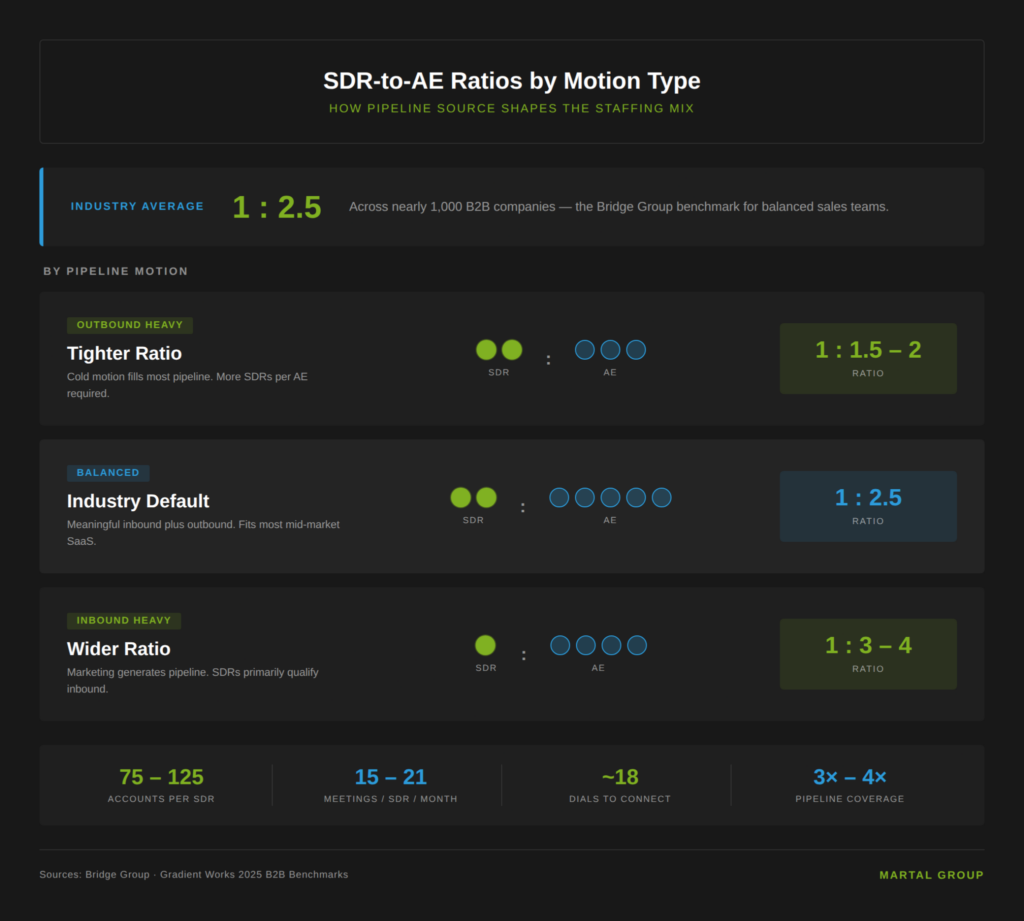
The SDR-to-AE ratio benchmark
The industry-wide average lands at roughly 1 SDR for every 2.5 AEs. That number has stayed relatively stable for the past several years (1), though smaller companies tend to run heavier on the SDR side (closer to 1:2 or 1:1.5) and larger enterprises tend to stretch (1:3 or wider) because their deal cycles involve more late-stage motion from AEs.
Underneath the average, the real driver is pipeline source. We see three distinct patterns:
– Outbound-heavy motions (1 SDR : 1.5–2 AEs). When your AEs rely on SDR-generated pipeline for the majority of their opportunities, you need tighter ratios to keep calendars full. This is where most B2B services businesses, cybersecurity vendors, and technical SaaS teams land.
– Balanced motions (1 SDR : 2.5 AEs). When inbound and outbound each contribute meaningful pipeline, the industry-average ratio works. This fits most mid-market SaaS.
– Inbound-heavy motions (1 SDR : 3–4 AEs). When marketing generates most pipeline and SDRs are primarily qualifying rather than prospecting, one SDR can support more closers. This is typical for category-leading SaaS brands with strong demand-gen engines.
SDR capacity — accounts and meetings per month
Ratios only work if the SDRs in the denominator are actually producing. B2B sales performance benchmarks put realistic SDR capacity at 75–125 accounts owned per rep, producing 15–21 meetings per month at full ramp. Plan for 65–75% capacity utilization (6), the remaining time goes to admin, training, and PTO.
Two operator observations from running outbound at this scale every day:
– Account load is where most teams break capacity math. SDRs assigned 300+ accounts can’t work any of them well. They default to low-effort email blasts, conversion rates collapse, and the AE team inherits a pipeline that looks full but doesn’t close.
– 18+ dials to connect is the current reality. Gradient Works’ benchmark shows it takes roughly 18 dials just to reach a live prospect. That math is why data quality matters so much — if a third of your numbers are wrong, a third of your SDR capacity is burning on dead ends.
Pipeline coverage — how much pipeline each AE needs
Pipeline coverage is the ratio of open pipeline to quota. The standard benchmark is 3x to 4x — meaning an AE carrying a $1M quota should have $3M–$4M in open pipeline at any given moment, because win rates in most B2B motions sit between 20% and 30%.
SDR-sourced pipeline typically accounts for 46–73% of total pipeline in teams running outbound programs, per Gradient Works’ research. If your SDR team isn’t generating in that range, the structure isn’t the problem — usually it’s targeting, messaging, or data quality. Coverage below 3x is the leading indicator of a quota miss next quarter.
Manager span of control
We covered this briefly in the roles section, but it’s worth repeating in the ratio context: one sales manager per 4–7 reps is the defensible ceiling. Past 8 reps per manager, coaching time per rep drops to a level where dynamic coaching stops compounding.
The Salesforce State of Sales research underscores why that matters — with only about 28% of reps hitting quota in recent cycles, the teams still beating plan are the ones with enough manager bandwidth to coach individually, not just manage the dashboard (4).
Rep time spent selling — the productivity benchmark nobody hits
This is the single most important structural number and the one most teams don’t measure: how much of your reps’ time is actually spent selling. The widely-cited benchmark puts it at about 28% — meaning nearly three-quarters of rep time goes to research, admin, CRM updates, internal meetings, and tool-switching.
Structure is the biggest lever on that number. Assembly Line teams with proper SDR support routinely recover 10–15 percentage points of AE selling time compared to Island-model equivalents. Hybrid teams that outsource prospecting recover even more, because the offloaded work also removes the management overhead of running an internal SDR team.
How to Build a Sales Team Structure Step-by-Step
Building a sales team in the right order matters more than most founders and revenue leaders give it credit for. Hire too senior too early and you get a VP of Sales with nothing to manage. Hire too junior too early and you get a pipeline of meetings nobody can close. The sequence below is the one we see work consistently across the B2B engagements we run — SaaS, services, industrial, fintech — roughly in the order the hires should happen.
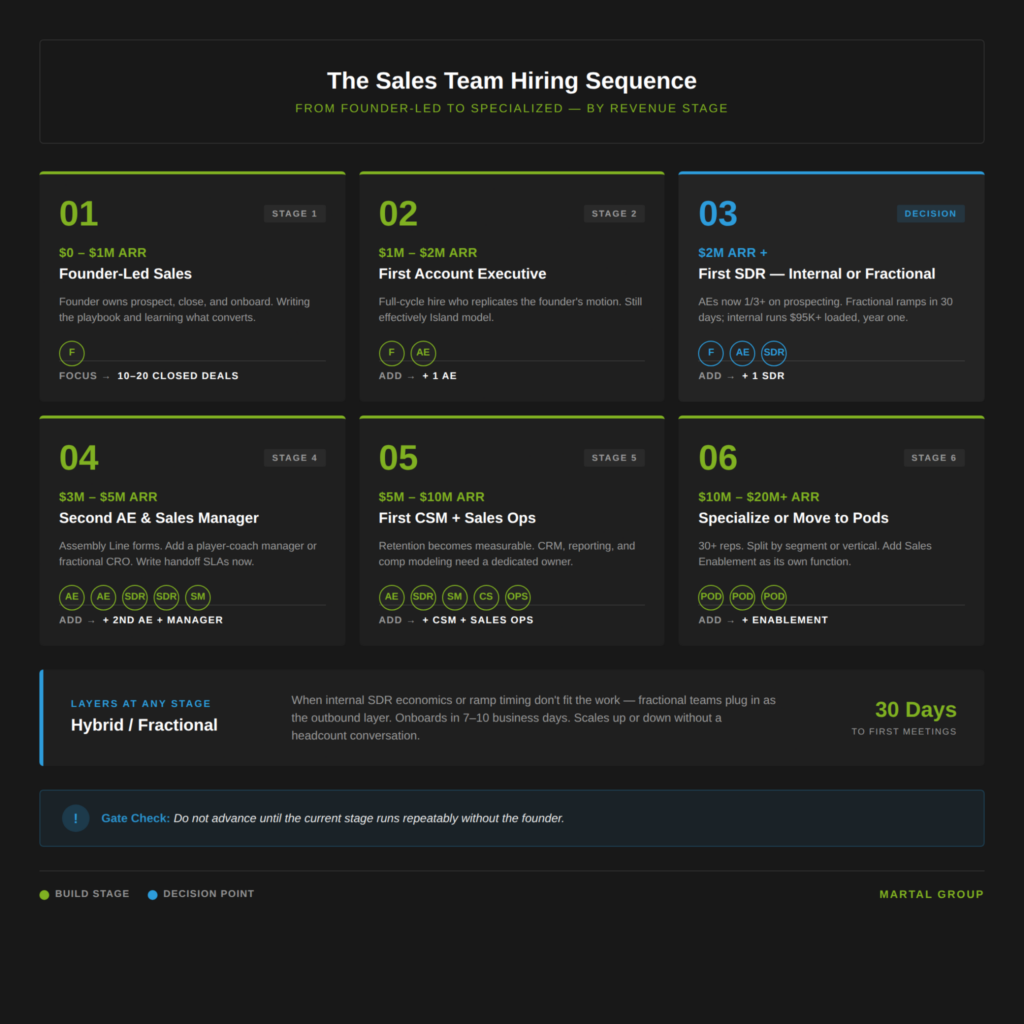
Stage 1 — Founder-led sales (0 to ~$1M ARR)
The founder (or founders) own the entire sales motion. Prospecting, demos, closing, onboarding — one person, one deal at a time. This isn’t a phase to rush through. Founder-led sales is how you learn what resonates, what doesn’t, which ICP converts, and what price the market will bear.
What to focus on. Getting to 10–20 closed customers without depending on anyone else. Along the way, you’re writing the playbook your future team will execute: what messaging works, what objections come up, which verticals bite, what a qualified lead actually looks like.
Common mistake. Hiring an AE or SDR before founder-led sales is repeatable. If the founder can’t close, a new AE won’t either — and an SDR will just book meetings the AE can’t convert.
Stage 2 — First AE hire (~$1M–$2M ARR)
Once the founder has closed enough to prove the motion, the first dedicated sales hire should be an Account Executive — not an SDR. The AE’s job at this stage is to replicate what the founder is already doing: full-cycle prospecting plus closing. You’re testing whether the motion works without the founder in the chair.
What to look for. Hire for adaptability over pedigree. Founders at this stage need someone who can operate in ambiguity, not someone who thrived in a mature org with a full playbook handed to them. Ideally the first AE can prospect, close, and contribute to early customer management.
Ratio reality. You’re still effectively running the Island model — everybody is full-cycle. That’s fine. Don’t specialize prematurely.
Stage 3 — First SDR hire (~$2M ARR or when AEs are drowning in prospecting)
The signal to hire your first SDR is when your AEs are spending more than roughly a third of their time prospecting. At that point, they’re doing cheaper work at closer rates — the economics no longer make sense.
Two important qualifiers. First, only hire an SDR when you have a repeatable qualification definition. Your AEs need to be able to write down, in one page, what a good lead looks like — firmographic fit, decision-maker access, timing signals, and disqualifiers. If you can’t write that page, your SDR will run fast in the wrong direction. Second, hire at least two SDRs at once if you can. One gives you a sample size of one; two lets you compare output, calibrate coaching, and cover for ramp and turnover.
Hybrid alternative. This is the stage where many teams we work with layer in fractional or outsourced SDR support instead of hiring their first internal SDR. The math is straightforward: fully loaded, a first internal SDR runs $95,000–$128,000 in year one before producing a single qualified opportunity, and they take roughly 3 months to ramp. A fractional team lands meetings in under 30 days at a fraction of the fully loaded cost, and it scales up or down without a headcount conversation. We’ll cover the decision math in the next section.
Stage 4 — Second AE and first sales manager (~$3M–$5M ARR)
Two AEs plus two or more SDRs is roughly where you start needing dedicated management. The founder can no longer coach, forecast, close executive deals, and run hiring at the same time.
Who to hire. Either a player-coach AE who carries a reduced quota while managing the team, or a fractional Chief Revenue Officer if you want experience without the full salary load. A true VP of Sales usually comes later — around $5M ARR and a team of 4+ reps. Hire a VP too early and you burn the good ones who need a team to lead, not one to build from scratch.
Structural move. Your motion is now effectively Assembly Line — SDRs prospect, AEs close, a manager coaches both sides. Write down handoff SLAs now before they become problems: how fast the AE follows up on an SDR meeting, how disqualified leads get recycled, how the SDR hears back about meeting outcomes.
Stage 5 — First CSM and Sales Ops hire (~$5M–$10M ARR)
Two roles usually come in close together at this stage:
– Customer Success Manager. Once you have enough customers that churn becomes a measurable concern — usually 50+ logos for SaaS, fewer for enterprise services — you need dedicated retention. The AE team can’t carry both new-logo and renewal work without one side suffering.
– Sales Operations. Somewhere between 10 and 20 total reps, someone has to own CRM hygiene, reporting, compensation modeling, and tool-stack decisions full-time. Before this, the VP of Sales or a fractional RevOps contractor can cover the load — after it, the gaps show up as forecast misses and pipeline data nobody trusts.
Stage 6 — Specialize into segments or pods (~$10M–$20M+ ARR)
Past 20–30 reps, the Assembly Line starts to strain. Territory disputes, vertical knowledge gaps, and enterprise versus mid-market deal mechanics all pull the team in different directions. This is when most orgs specialize further — either by segment (SMB / Mid-Market / Enterprise), by vertical (healthcare / fintech / logistics), or by moving to the Pod model if you can staff three or more pods.
Add Sales Enablement. Around 30+ reps, Sales Enablement becomes its own function — separate from Sales Ops. The two optimize for different things, and combining them past this scale means neither gets done well.
The common mistakes — in order of frequency
Four hiring-sequence errors come up over and over:
– Hiring a VP of Sales too early. A VP without a team to lead will either build the wrong team fast or leave for a bigger job. Wait until you have reps worth leading.
– Hiring an AE to manage SDRs. Most AEs are closers, not managers of sales professionals. They tend to treat SDRs like sales assistants, not as their own career track. If the SDRs need a manager and you can’t hire one, a demand-gen or marketing leader often manages them better than an AE will.
– Hiring an SDR before a qualified-lead definition exists. This is the single most common and most expensive error. An SDR running against a fuzzy ICP will fill the calendar with meetings that don’t convert — and the resulting pipeline will be blamed on “bad leads” when the real problem is upstream.- Hiring internal SDRs when fractional or outsourced economics make more sense. If your pipeline need is seasonal, sub-scale, or adjacent to your core expertise, a fractional team ramps faster and costs less than an internal SDR hire. The next section covers when that math actually works.
The Hybrid Model in Practice: When Outsourcing Fits Your Structure
Outsourcing sales development functions can reduce total costs by 30–40% compared to in-house teams.
Of the four models we’ve covered, Hybrid is the one we have the most direct pattern recognition on, Martal has run outbound for more than 2,000 B2B brands over 16+ years, and the majority of those engagements have been hybrid structures where our SDR team plugs into the client’s internal sales org. So this section is written from first-hand authority rather than compiled research.
The short version: Hybrid works when three conditions line up — the economics of an internal SDR hire don’t fit the work, ramp speed matters, and the client’s internal team is ready to own closing. When any of those three is missing, a different structure usually fits better. Here’s the detail.
The economics — what an internal SDR actually costs
The sticker price on an internal SDR is misleading. Base salary runs $50,000–$65,000 in most markets; on-target earnings land $75,000–$85,000. But that’s not the real number — industry cost analysis puts a fully loaded internal SDR at $95,000–$128,000 in year one once you add benefits, payroll taxes, sales tech stack, data, management time, and recruiting costs (3).
Three cost drivers most teams underestimate:
– Ramp time. New SDRs need 3–4 months to reach full productivity. At 30% output for four months on a $70,000 base, that’s roughly $23,000 in wages for about $7,000 of real output. The ramp gap is real money.
– Turnover. Average SDR tenure sits around 16 months, meaning most teams replace roughly 75% of their SDR team each year (2). Every backfill restarts the ramp clock and costs $5,000–$10,000 in recruiting plus 15–20 hours of management time per hire.
– Management overhead. One SDR manager per 8–10 reps is the working benchmark. Fully loaded, that’s another $15,000–$18,000 per SDR in allocated management cost — rarely budgeted into the SDR line.
Fractional and outsourced models compete against that fully loaded number, not the salary line. That’s the comparison most teams don’t run until they’ve already committed to the internal hire.
When hybrid is the right call
The decision tree we use with clients is roughly this:
– If you don’t yet have a qualified-lead definition you can write on one page — fractional SDR support works better than an internal hire, because the partner can help you stress-test targeting and messaging without you carrying the cost of someone learning on your payroll.
– If your SDR motion is seasonal, sub-scale, or adjacent to core — meaning you need 1–2 SDRs worth of output, not 5, or the work ramps up for a market push and then slows back down — fractional matches the shape of the work. Internal hires don’t.
– If you’re entering a new market, vertical, or segment — outsourced teams with existing motion-specific experience reach qualified meetings faster than internal hires ramping from zero. This is where we see the largest gap in time-to-pipeline.
– If management bandwidth is the constraint — a VP of Sales without the time or skill to coach SDRs directly will usually get more out of a managed external team than from an unmanaged internal one.
When hybrid isn’t the right call
Honest pattern from the other side: Hybrid doesn’t fit every situation. Three failure patterns we see consistently:
– When the internal team isn’t ready to close. If your AEs can’t convert qualified meetings, adding an outsourced SDR team just accelerates the problem. Pipeline without closing capacity is wasted pipeline.
– When the client expects zero internal involvement. The best hybrid engagements treat the outsourced team as an extension of the internal sales org — weekly pipeline reviews, shared CRM, aligned messaging. Clients who hire and disappear usually get outputs that look like numbers rather than pipeline.
– When the motion requires deep product expertise at the top of funnel. Highly technical sales where the SDR needs to qualify on product architecture details, compliance postures, or specialized workflows can be harder to hand off cleanly. It’s still doable, but the onboarding investment is significant and the partner needs industry fluency.
What hybrid looks like in practice — two examples
Two recent engagements illustrate the pattern well.
Complete EDI — a consulting firm in the EDI space — ran a three-month pilot with a single fractional rep from our team. The client kept their founder as closer and handed top-of-funnel to Martal. The result: 14 SQLs delivered in the pilot window, which extended into a longer engagement generating 161 leads and 14 meetings over 5 months. This is the pattern for small, founder-led teams that need outbound muscle without the cost and ramp of a first internal SDR.
Total Energy Connections — a roughly 10-person company in the energy space — brought Martal in as their outbound arm while their small internal team handled closing. The engagement produced 20 qualified leads per month on a consistent basis, giving the internal closers the calendar coverage they couldn’t build themselves at that headcount. Classic Island-plus-fractional pattern: full-cycle reps internally, outbound outsourced.
Different stages, different industries, same structural logic — Hybrid fit because internal SDR economics didn’t, and the internal teams were ready to close what we sent them.
How Martal runs the hybrid engagement
For context on how the structure actually works day-to-day: our fractional teams are typically structured as 2 Sales Executives and 1 Sales Operations Manager dedicated to the account, running coordinated omnichannel outreach across email, cold calling, and LinkedIn. The internal client team keeps AE and CSM roles; handoffs happen through a shared live campaign sheet; weekly pipeline reviews align both sides on what’s working and what isn’t.
The structural choice readers are making when they work with us isn’t “should we outsource” — it’s “which parts of the funnel belong internal, and which parts belong with a partner that does only that part, all day, across hundreds of campaigns.”
In-House vs. Outsourced — Designing Role Splits for a Hybrid Team
Once you’ve decided a hybrid structure makes sense, the next question is which roles belong internal and which belong with a partner. The answer isn’t “outsource the cheap stuff” — it’s more structural than that. The right frame is cost-to-outcome ratio: which roles do specialized external teams execute more efficiently at scale, and which roles depend so heavily on product depth, customer context, or closing judgment that they can’t be meaningfully outsourced?
Here’s how we think about the split.
Roles that belong in-house
Three roles almost always stay internal, regardless of company stage:
– Sales leadership and strategy. Your VP of Sales, Head of Revenue, or sales manager sets the motion, owns the number, and integrates sales with product, marketing, and finance. This is a role that defines the work — you can’t outsource the definition itself.
– Account Executives / closers. The people running discovery, handling objections, and closing revenue need deep product knowledge and direct cross-functional ties (product, legal, customer success). Closing is where structural choices get tested in real time; it’s the stage that benefits most from full organizational context.
– Customer Success and Account Management. Retention and expansion run on nuanced customer history and strong handoffs to implementation, product, and support. These are relationship roles, and relationships are expensive to externalize.
These three form the backbone of your internal sales org. Every other role is a candidate for in-house or outsourced depending on economics and specialization.
Roles that are well-suited to outsource
The top-of-funnel work is where outsourcing economics usually win. Four functions we see clients offload most often:
– Lead generation and data enrichment. Building verified prospect lists, enriching contact data, and maintaining data hygiene at scale is work that specialized teams do meaningfully better than generalist internal hires, because the tooling, data sources, and process are their entire business.
– Outbound prospecting (SDR/BDR). Cold email, cold calling, and LinkedIn outreach as a coordinated motion. This is the most common outsourced function we run at Martal, because the fully-loaded cost of internal SDRs (covered in Section 7) rarely beats specialized partners at sub-5-rep scale — and partners can ramp in 30 days instead of 5–6 months.
– Appointment setting. Getting qualified prospects booked onto AE calendars. In practice this is SDR work narrowed to one specific output, and partners like Martal execute it as part of a broader omnichannel appointment-setting motion.
– Sales support and CRM hygiene. Not glamorous, but meaningful — list updates, cadence maintenance, meeting reminders, follow-up sequences. Often handled by outsourced operations alongside SDR work.
A fifth category — full inside sales cycles — is sometimes outsourced for high-volume, low-ACV motions where an external rep takes a small deal from cold touch all the way to close under your brand. We do this in specific situations; most engagements stop at qualified-meeting handoff to an internal closer.
How to choose the right partner
Partner selection is the single biggest variable in whether a hybrid structure works. The questions we tell clients to ask of any outsourced sales partner:
– Do they have direct experience in your industry? Technical B2B sales, regulated industries (healthcare, fintech, cybersecurity), and complex enterprise motions all require industry fluency. A partner that’s strong in ecommerce doesn’t automatically translate to cybersecurity — ask for case studies in your specific vertical.
– What does their reporting look like? Vague monthly summaries are a red flag. Look for partners that give you live pipeline visibility (a live campaign sheet or shared CRM), weekly performance reports with MQLs, SQLs, and meetings, and transparent reporting on what isn’t working as well as what is.
– How do they handle messaging and brand voice? Outsourced reps are talking to your prospects as representatives of your company. Partners that approve messaging collaboratively, iterate based on response data, and treat your brand guidelines as non-negotiable produce meaningfully better outcomes than partners who run generic templates.
– What compliance posture do they operate under? For teams selling into regulated industries or international markets (EU, UK, Canada), compliance standards matter operationally, not just legally. Ask about GDPR, SOC II, and CAN-SPAM compliance directly.
– What’s the team structure on their side? Dedicated reps with ownership of your account tend to outperform rotating-pool models. At Martal, we structure fractional teams as 2 dedicated Sales Executives and 1 Sales Operations Manager per client — the SEs own the whole motion from prospecting to meeting handoff.
Set clear KPIs on both sides before the engagement starts
Before a hybrid engagement begins, define the metrics that determine success on both the outsourced and internal sides:
– For the outsourced team: qualified meetings per month, MQL-to-SQL conversion rate, meeting-to-opportunity conversion rate, and cost per qualified meeting held.
– For the internal team: SQL-to-close conversion rate, speed of AE follow-up on SDR-sourced meetings, and time from first touch to closed deal.
Write these down before the engagement starts. The engagements that work have both sides looking at the same dashboard, the same numbers, every week. The engagements that struggle are the ones where the outsourced team reports “meetings booked” and the internal team reports “revenue closed” with nothing connecting the two.
This is the design layer. The day-to-day management rules that keep both sides aligned and the handoff tight — handoff SLAs, shared pipeline reviews, aligned incentives, the two metrics that actually matter — are covered in the next section.
Managing and Aligning a Hybrid or Specialized Team
Contacting a lead within an hour of outreach interest makes qualification roughly7x more likely than waiting two hours.
Reference Source: Harvard Business Review
Picking the right model and the right ratios gets you to the starting line. The teams that actually hit plan are the ones that run disciplined handoffs, tight feedback loops, and aligned incentives across roles — whether those roles are all internal, all outsourced, or (most commonly) a mix of both.
The management rules below apply whether you’re running an Assembly Line, a Pod, or a Hybrid structure. They’re the operational layer that makes any of those models work in practice.
Define the handoff SLA in writing
The single highest-ROI management practice we see in B2B sales orgs: a written handoff SLA between SDRs and AEs. Most teams have an implicit handoff — the SDR books a meeting, the AE shows up, everyone hopes it goes well. The best teams write down the specific commitments on each side.
A functional handoff SLA covers:
– Response time. How fast the AE must follow up when an SDR flags a hot lead. Harvard Business Review research found that contacting a lead within an hour makes qualification roughly 7x more likely than waiting two hours — and that gap hasn’t closed in the decade-plus since (9).
– Qualification criteria. What the SDR is and isn’t authorized to pass through. Firmographic fit, decision-maker access, timing signals, and explicit disqualifiers.
– Handoff artifacts. What the SDR records before transferring the lead — pain points mentioned, content sent, previous touches — so the AE arrives at discovery with context instead of starting from zero.
– Recycling rules. What happens to a lead the AE decides isn’t ready. Does it go back to the SDR for nurture, into a marketing cadence, or get disqualified permanently?
Without these rules, leads fall through cracks that nobody owns. With them, the handoff stops being a handoff and becomes a workflow.
Align incentives across the funnel
Incentive misalignment is the second failure mode we see most often. The pattern: SDRs get paid on meetings booked, AEs get paid on closed revenue, and nothing connects the two. The predictable result is SDRs drifting toward low-quality meetings and AEs ignoring SDR-sourced pipeline in favor of their own prospecting.
The fix is straightforward. Tie at least a portion of SDR compensation to what happens after the meeting — meetings held, meetings that convert to opportunities, meetings that close. This doesn’t have to be complicated. A simple structure: smaller per-meeting bonus, larger bonus for meetings that become qualified opportunities, and accelerators for meetings that close. The SDR now has a direct stake in quality, not just volume.
For AEs, make SDR-sourced pipeline conversion a tracked metric in forecasts, not an afterthought. If AEs know they’re measured on how well they work the pipeline the SDR team sends, the “not my lead” problem largely fixes itself.
Run one shared pipeline review — not two
Teams that treat the SDR function and the AE function as separate management tracks get two separate views of the funnel, neither of which is complete. Run a single weekly pipeline review with both sides in the room (or on the call). Thirty minutes is usually enough. The agenda: what moved from SDR to AE since last week, what stalled, what the conversion rate from meeting-to-opportunity looks like, and what the SDR team is seeing in the market that the AE team should adjust for.
This is also where hybrid and outsourced partnerships thrive or struggle. The engagements that work have the outsourced team in the pipeline review every week. The ones that struggle treat the outsourced team as a vendor reporting numbers rather than a team contributing intelligence.
Build one source of truth for pipeline data
Both sides of the handoff — SDR and AE, internal and outsourced — need to work from the same live pipeline view. In practice that usually means one shared CRM with agreed field hygiene, and a live campaign progression sheet that updates in real time as leads move.
Two practical rules we’ve learned from running this across hundreds of engagements:
– Field hygiene beats field count. Ten CRM fields used consistently across the team are more valuable than forty fields used sporadically. Pick the handful that actually inform forecasting and handoffs, and enforce them.
– Visibility flows both ways. SDRs should see what happened after their meetings — did the AE show up, did the deal progress, did it close? Without that feedback loop, SDRs can’t improve their qualification. Most of the time when we see SDR quality degrading over months, the root cause is that nobody closed the loop back to them on outcomes.
Invest in shared enablement and messaging
Whatever the structure — internal, outsourced, or hybrid — every rep touching a prospect should be working from the same messaging, same positioning, and same objection-handling. This is where Sales Enablement earns its seat.
Practical shared-enablement checklist:
– One message architecture. Value props, differentiators, objection responses, and pricing guidance live in one place both teams can access.
– Shared content library. Case studies, whitepapers, battlecards, and demo videos available to both internal reps and outsourced partners. If the SDR can’t send the right case study mid-conversation, the conversation stalls.
– Coordinated rollouts. When messaging changes — a new positioning, a new competitor response, a new pricing page — update every rep at the same time, not just the internal team.
Monitor the two metrics that matter most
Dozens of sales metrics exist. For the health of a hybrid or specialized structure specifically, two tell you almost everything:
– Meeting-to-opportunity conversion rate. This is the cleanest signal of whether the handoff is working. Low conversion means either the SDR team is sending bad-fit meetings, or the AE team isn’t running strong discovery. Track it weekly. Diagnose it at the pattern level — is it specific SDRs, specific source channels, specific verticals?
– Cost per qualified meeting held (not booked). The economics question every revenue leader should be able to answer. Total program cost — salaries, tools, outsourcing fees, everything — divided by the number of qualified meetings that actually happened. This is the only number that lets you compare internal SDR economics, hybrid economics, and fully outsourced economics apples-to-apples.
The teams we see struggle most are the ones tracking vanity metrics — dials made, emails sent, activity volume — instead of these two outcome-anchored numbers. The teams we see succeed use the outcome metrics as their north star and track activity only as a diagnostic.
Conclusion: Getting the Structure Right Is a Revenue Decision
The teams we see hit a plan consistently aren’t the ones with the most talent, the biggest budgets, or the shiniest tools. They’re the teams with structure that matches their stage — the right model, the right ratios, the right hiring sequence, and clear handoffs between the people doing the work.
The decisions you make about structure compounds. Pick the wrong model at $3M ARR and you spend the next 18 months fighting handoff friction you shouldn’t have created. Hire internal when fractional fits better, and you sink $100K+ into a ramp before you know whether the motion works. Skip the SDR-to-AE ratio math and you end up with AEs drowning in prospecting or SDRs with nothing to hand off.
None of this is complicated. But almost all of it gets skipped because structure feels like an HR problem rather than a revenue one — and the teams that reframe it as a revenue decision are the ones that actually hit their number.
If you take one thing from this guide: match your structure to where you are, not where you want to be. Island at founder stage. Assembly Line from $2M to $20M. Pods past that. Hybrid layered over any of those three when the economics of internal roles don’t fit the work. Clear definitions, written handoff SLAs, shared pipeline reviews, and cost per qualified meeting as your north-star metric. Everything else follows.
Where Martal fits
If you’re weighing whether a hybrid structure is the right fit — or already running one and wanting to make the outsourced side work better — that’s the conversation we’re built for.
Martal has run outbound for more than 2,000 B2B companies over 16+ years, mostly as the outsourced top-of-funnel layer inside hybrid structures. Our fractional teams plug into your existing sales org as 2 dedicated Sales Executives plus a Sales Operations Manager per account, running coordinated omnichannel outreach across email, cold calling, and LinkedIn while your internal team stays focused on closing and retention. Onboarding takes 7–10 business days. First qualified meetings typically land inside 30 days.
The fit is specific. We work best with teams that have AEs who can close, a product or service that resonates with a definable ICP, and a revenue leader who wants the outsourced SDR function to act as an extension of the internal team — shared CRM, weekly pipeline reviews, aligned messaging.
If that sounds like your setup, book a consultation and we’ll walk through what your current structure looks like, where the economics point toward hybrid, and what a 30-day proof-of-motion would need to show to justify the engagement. If hybrid isn’t the right fit, we’ll say so.
References
- The Bridge Group
- Charlie AI
- Launch Leads
- Salesforce State of Sales
- Korn Ferry
- Gradient Works
- Forrester
- RepVue Cloud Sales Index
- Harvard Business Review
FAQs: Sales Team Structure
Should an SDR be the first sales hire for a startup? Or is it better to hire an account exec first?
The first sales hire after founder-led sales should almost always be an Account Executive, not an SDR. Your first AE needs to run the full cycle — prospecting, closing, early account management — and prove the motion works without the founder in the chair. SDRs come later, once your AEs are spending more than about a third of their time prospecting and you can write down what a qualified lead looks like. Hire an SDR before that point and you’ll get a calendar full of meetings nobody can convert, because the SDR is running against a fuzzy definition of fit. The exception: very small ACV, high-volume SaaS where the founder has already validated the motion and needs raw top-of-funnel leverage. That’s rare.
How should I structure our SDR teams? How should they partner with AEs?
Start with one SDR per AE (1:1) and adjust based on pipeline source and deal complexity. Outbound-heavy motions typically tighten to 1 SDR per 1.5–2 AEs; inbound-heavy motions can stretch to 1:3 or 1:4. For partnering, the two models that work are Partner (1:1 SDR-to-AE mapping with dedicated account planning together) and Pod (multiple SDRs supporting an AE on complex enterprise deals). What matters more than the model is written handoff SLAs — response time, qualification criteria, recycling rules — and shared pipeline reviews where both roles see the same data every week. Without those, any structure leaks leads at the handoff.
What’s the ideal SDR to manager ratio?
One sales manager per 4 to 7 reps is the defensible ceiling. The working industry average sits closer to 1:8 for SDR managers specifically, but coaching quality drops sharply past 8 reps per manager. Bridge Group’s ongoing research also shows that SDR teams led directly by “managers” outperform those led by “directors” or “VPs,” because managers have more time to coach the bench while senior leaders get pulled into cross-functional work. If you’re over 8:1 and quota attainment is sliding, add a manager before hiring another rep. The math favors more coaching bandwidth over more headcount.
When should we move from an Island model to an Assembly Line?
Move when a rep needs to close roughly 4x their comp to be profitable — or when your reps are spending more than about a third of their time prospecting instead of closing. At that point, you’re paying closer rates for SDR-level work, and the economics no longer add up. In practice, that transition usually happens somewhere between $2M and $3M ARR or around 3–5 full-cycle reps. The transition itself isn’t overnight — you’ll keep running Island-style for a quarter or two while the first SDR ramps and the AE learns to hand off. Don’t jump further and go straight to Pods at this stage; you won’t have enough volume to staff three full pods, and coordination overhead will eat the benefit.
How much does an in-house SDR actually cost compared to outsourcing?
Fully loaded, an in-house SDR runs $95,000–$128,000 in year one — base salary ($50K–$65K), OTE commission, benefits and payroll taxes (~25–30% of base), sales tech and data stack ($3K–$8K), allocated management cost ($15K–$18K per rep), and recruiting costs ($5K–$10K per hire). Add the 3–4 month ramp period where you’re paying full cost for partial output, plus 16-month average SDR tenure meaning you backfill roughly 75% of the team every year. Outsourced fractional SDR engagements typically price in the $5K–$10K per month range all-in, ramp in 30 days, and scale up or down without a headcount conversation. The right comparison isn’t salary-to-salary — it’s fully-loaded cost-per-qualified-meeting-held against the outsourced equivalent. That’s the number that actually drives the decision.