
 Martal
 Technology
 Education and training
 Web Development and UI / UX
 Healthcare/Medical
 Logistics and Supply Chain
 Information Technology
 Insuretech and Financial Services
 Marketplaces
 Software Development
 E-commerce and retail
 AI and Machine Learning
 Energy and Solar
 Manufacturing
 Security and Surveillance
 Digital Marketing Agency
 Transportation
 MSP
MSP
 Telecom
 B2B SaaS
 Cybersecurity
 HR tech
 Fintech
 Cleantech
 Consulting
The Ultimate Guide to B2B Telemarketing Campaigns in 2026 – From Plan to Pipeline
Major Takeaways: Telemarketing Campaigns
B2B telemarketing campaigns remain effective, with 82% of buyers willing to meet after a quality cold call and 57% of executives preferring phone conversations.
AI enhances campaign efficiency by prioritizing high-intent prospects, optimizing call times, and offering real-time coaching to improve SDR performance and conversions.
Data-driven targeting, multi-touch cadences, and personalized outreach significantly increase contact and conversion rates across industries.
Coordinating phone calls with email and LinkedIn outreach boosts engagement by up to 287%, outperforming single-channel cold calling approaches.
Key KPIs include conversion rate, connect rate, cost per lead, and sales-qualified pipeline generated, each revealing ROI and efficiency at scale.
States are tightening telemarketing laws, with mini-TCPA regulations expanding DNC enforcement and limiting AI use in calls, making compliance non-negotiable.
Personalized messaging, grounded in ICP data, buyer behavior, or industry pain points, can double conversion rates compared to generic scripts or outreach.
Sales outsourcing provides ready-to-scale SDR teams, AI-enabled outreach, and proven cadences that often reduce acquisition costs by 33–65%.
Introduction
Is B2B telemarketing still relevant in 2026? In a word, yes. In fact, B2B telemarketing campaigns have evolved into one of the most effective ways to generate pipeline in today’s sales landscape. With decision-makers inundated by emails and ads, a well-timed phone call can cut through the noise. Consider this: 82% of buyers will accept meetings from a well-executed cold call, and 57% of C-level executives prefer the phone for discussing solutions (2). Far from “dead,” telemarketing has made a modern comeback – but success now depends on strategy, data, and integration with other channels.
In this comprehensive guide, you’ll learn what telemarketing campaigns are and how they work, how to plan and execute a campaign step by step, and the top 10 telemarketing strategies for 2026. We’ll explore the key metrics that define success, common challenges (with solutions), and crucial compliance guidelines to follow. You’ll also see how telemarketing fits into an omnichannel approach alongside email and social touches. Finally, for those considering outsourcing, we’ll discuss how to evaluate BPO telemarketing providers and why our integrated omnichannel lead generation services offer a strategic advantage.
Whether you’re a sales or marketing leader, this guide will equip you with the insights to turn telemarketing campaigns from plan to pipeline – driving more qualified leads and revenue growth. Let’s dive in.
What Is a Telemarketing Campaign and How Does It Work?
82% of buyers have accepted meetings from cold calls that were relevant and personalized.
Reference Source: SalesEcho
At its core, telemarketing is the practice of using the telephone to connect with prospects or customers for business purposes – typically to generate leads, qualify prospects, or set appointments in a B2B context. A telemarketing campaign is a structured series of phone-based outreach activities targeting a defined list of companies or contacts. Unlike one-off cold calls, a campaign is systematic and goal-driven: you work from a curated list of targets, use prepared messaging, track outcomes, and refine your approach over time. In short, telemarketing campaigns are proactive sales/marketing programs that put your team in direct conversation with potential buyers, rather than waiting for inbound interest.
How does a telemarketing campaign work? Typically, it involves outbound calls to prospective companies (often “cold calls” to people who haven’t engaged with you before). The reps – often Sales Development Representatives (SDRs) or business development reps – follow a cadence of calls (and usually voicemails), sometimes supplemented with emails or LinkedIn touches (making it an omnichannel cadence, more on that later). The primary objectives are usually to identify qualified leads and schedule next steps (like a discovery call or product demo for an Account Executive). Unlike consumer telemarketing, B2B calls rarely close a sale on the spot – instead, the goal is to spark a conversation, understand the prospect’s needs, and secure a commitment for a further meeting.
Typical outcomes of a telemarketing call could be: determining the prospect’s level of interest or fit (qualification), capturing key information (e.g. current solution, pain points, decision-making process), and if positive, booking an appointment for a deeper sales conversation. If the prospect isn’t a fit or ready, the rep may mark them for nurture or a later follow-up. And if the call is a clear “no,” that feedback is recorded to avoid wasting further effort. All of this is tracked as part of the campaign metrics.
Importantly, successful telemarketing campaigns today are far more targeted and skilled than the boiler-room “dialing for dollars” of old. Reps do research before calling, personalize their outreach, and often call warm leads (e.g. someone who downloaded a whitepaper or attended a webinar) in addition to pure cold calls. The human touch of a phone call builds trust in ways an email sometimes can’t – which is why many organizations still rely on telemarketing as a key piece of their B2B sales strategy. In fact, outbound calling was rated the second most effective B2B lead generation channel (behind only email) in recent industry surveys.
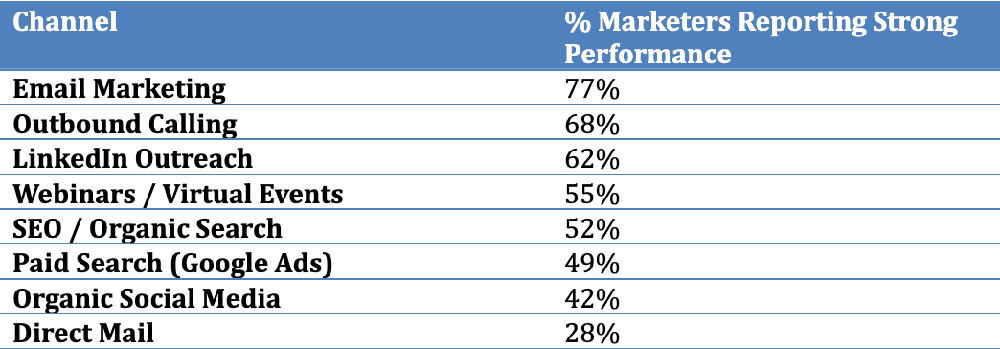
Source: Volkart May
Companies have found that when executed correctly, telemarketing accelerates lead qualification and boosts sales pipeline in ways digital-only outreach might not (1).
So to summarize, a telemarketing campaign is a coordinated effort where your team (or an outsourced team) makes structured calls to a defined audience with a specific goal (e.g. setting 10 meetings a week). It works by directly engaging prospects in conversation, which – when done professionally – can uncover needs, build rapport, and quickly identify who is a genuine sales opportunity. And as we’ll see next, careful planning is what separates a pipeline-filling telemarketing campaign from one that burns through a contact list with little to show for it.
Is cold calling still effective in B2B?
Yes, cold calling can absolutely be effective in B2B – if done correctly. The general success rate of cold calls is modest (often cited around 2–3%), but that average includes many companies doing it poorly. In recent years, teams that leverage quality data and a smart approach are seeing improved results – in fact, the average cold call success rate has roughly doubled to about 4.8% by 2025. Top-performing outbound teams achieve even higher conversion; it’s not uncommon to see 6–7% or more of cold calls leading to positive outcomes when targeting and execution are on point. Additionally, cold calling opens doors that other channels sometimes can’t – about 82% of buyers have accepted meetings from cold calls when the caller was prepared and relevant, and 57% of C-level executives prefer getting a phone call for complex solutions (5). The caveat is that what “works” in cold calling today is different from boiler-room tactics of the past. You need well-researched targeting, a compelling and personalized pitch, and often multiple call attempts (and voicemails) to connect. It also works best as part of a multi-touch cadence (calls + emails + LinkedIn). When those best practices are applied, B2B cold calling is not only effective – it can outperform many marketing channels in generating qualified pipeline. Companies that write off cold calling may actually be missing out on a highly engaging touchpoint with prospects.
Telemarketing Campaign Planning & Objectives
Using verified, high-quality contact data can increase call connection rates by 3×, from 5–8% to over 16%.
Reference Source: SalesEcho
Every successful telemarketing campaign begins with a solid plan. Jumping on the phones without clear objectives or preparation is a recipe for frustration. Instead, take a strategic approach to planning your campaign. Here are the key steps (and best practices) to plan a telemarketing campaign that delivers results:
1. Define Clear Goals: Start with the end in mind – what does success look like? Set specific, measurable objectives. For example, “book 20 qualified sales meetings this month” or “generate $500K in pipeline from this campaign.” Vague goals like “get more leads” won’t cut it (2). Tie your telemarketing goals to broader sales targets (e.g. number of opportunities or revenue) so the team understands the impact. Clear goals focus your campaign and motivate the team.
2. Identify Your Target Audience: Know exactly who you’re calling. Define your Ideal Customer Profile (ICP) – the types of companies you want – and the buyer personas – the titles/roles you need to speak with. Perhaps you’re targeting CTOs at mid-size fintech companies, or HR Directors in manufacturing firms. The tighter you define your audience (industry, company size, geography, etc.), the more relevant your calls will be. This is crucial: calling the wrong contacts is the fastest way to tank a campaign. Invest time up front to build or acquire a high-quality calling list that fits your target criteria.
3. Build or Acquire Quality Data: Data is the backbone of telemarketing. Poor data (wrong numbers, outdated contacts) means wasted dials and frustrated reps. Make sure your contact list is accurate and current – whether by purchasing from a reputable data provider or using in-house research. Verify phone numbers and get direct lines when possible. It’s worth it: research shows that using high-quality, verified data can lift your call connection rates from around 5–8% to over 16% (2). In other words, you’ll reach triple the number of prospects simply by starting with clean data. Also be mindful of data compliance (ensure the contacts can be legally called – more on compliance later).
4. Develop Your Scripts and Messaging: Plan what your reps will say. This doesn’t mean writing a robotic script to read verbatim (please don’t do that), but you do need a call framework or talking points. Craft a strong opening that grabs attention in the first 15 seconds (for example, referencing a relevant insight about the prospect’s business). Prepare a few key questions to uncover needs, and have ready responses for common objections. Also plan your value proposition – how will you quickly convey the value of what you’re offering? Effective telemarketing scripts serve as a guide so callers stay on message while sounding natural. (We’ll cover scripting tips more in the next section as well.) The bottom line: don’t wing it – prepare your messaging to maximize each call.
5. Train Your Team: Even seasoned sales reps need training specific to your campaign. Make sure anyone calling is well-versed in your product/service, knows the campaign’s goals, and is comfortable with the pitch and software tools. Conduct role-plays to practice the script and refine handling of objections. The extra effort here pays off: teams that invest in thorough telemarketing training have seen conversion rates jump from ~2–5% to 10% or higher – effectively doubling or tripling their results (2). Also train reps on using your CRM or calling platform so they can log calls and notes consistently (data discipline is key for tracking metrics later).
6. Set Up Tracking and Analytics: Before a single call is made, ensure you have a system to track all key metrics. Use a CRM or sales engagement platform to log call activities, outcomes, and follow-up actions. Define which metrics you’ll monitor – e.g. dials per day, connection rate, number of conversations, appointments booked, etc. (We’ll dive deeper into metrics in a later section.) By setting up dashboards or reports upfront, you can monitor campaign progress in real time. This also means defining what qualifies as a “success” – e.g. is a call counted as successful only if a meeting is set, or also if key info was gathered? Clarity here will help you evaluate performance. The mantra is: if you can’t measure it, you can’t improve it. So get the tracking in place.
7. Launch, Monitor, and Optimize: With prep done, it’s time to start calling – but planning doesn’t stop at launch. Treat your campaign as an iterative process. Monitor daily: Which call approaches are working? Are you reaching your targets or hitting a lot of voicemail? Perhaps you notice calls before 9am are connecting more, or a certain industry list is underperforming. Hold quick team huddles to share feedback. Then refine and optimize continuously – tweak the call schedule, adjust the script, improve your targeting criteria if needed. The best telemarketing campaigns are agile. For example, if you see that one pitch angle isn’t resonating, try another. If a particular objection keeps coming up, arm the team with a new rebuttal. Small optimizations each week can compound to greatly improve results over the campaign’s duration. Essentially, plan to keep improving the plan as you go.
Finally, ensure you’ve planned the campaign logistics: assign owners (who is calling which list), set calling cadences (how many attempts per contact and frequency), and schedule regular check-ins. Telemarketing can be intensive work, so manage your team’s workload and keep them motivated (some B2B telemarketing companies gamify calling goals to keep it fun). By following these planning steps, you set the stage for a telemarketing campaign that’s strategic and outcome-focused rather than just “smiling and dialing.” Next, we’ll look at specific strategies you should employ to maximize telemarketing success in 2026.
Top 10 Telemarketing Campaign Strategies for 2026
Coordinated multichannel outreach can increase response rates by 200–300% compared to single-channel outreach.
Reference Source: Resolve
What does it take to run a high-performing telemarketing campaign in 2026? Here are 10 strategic best practices – from leveraging new technologies to mastering old-school techniques – that will elevate your B2B telemarketing results:
Strategy / Tip
Key Details
Impact / Benefit
1. Leverage Data-Driven Targeting
Use up-to-date contact data, intent signals, and segmentation. Cleanse/enrich data regularly (~22% decay per year).
Higher connect rates, more meaningful conversations, better conversions due to precise targeting.
2. Personalize and Research Your Calls
Review LinkedIn/news for 2–3 mins. Reference industry, challenge, or trigger events.
Builds credibility, increases engagement; 82% of buyers respond to well-targeted calls.
3. Use a Conversational, Value-Focused Script
60% listening, 40% talking. Ask questions about challenges, show problem-solving. Avoid hard selling.
Builds rapport, opens relationships, positions rep as a consultant rather than a salesperson.
4. Integrate Multi-Channel Touchest
Combine calls, emails, and LinkedIn messages. Follow a structured cadence (e.g., Email → Call → LinkedIn → Call).
Boosts response rates 2–3×, reinforces messaging, warms up prospects effectively.
5. Time Your Calls Strategically
Call mid-morning or mid-afternoon (10–11 AM, 2–4 PM), Tue–Thu. Respect time zones, consider early or late for execs.
Higher connect rates (Wed calls up to 50% more effective), avoids wasted efforts on low-response times.
6. Be Persistent (Follow-Up is Key)
Plan 3–6 call attempts over 2–3 weeks. Mix in emails. Don’t give up after first call
Increases contact rates by ~70%, demonstrates professionalism, catches prospects who respond later.
7. Utilize Technology (Dialers, CRM, AI)
Use auto-dialers, CRM for tracking, AI for call analysis, AI voicemail drops.
Improves efficiency, maximizes call volume, enhances call quality, boosts success rates up to 50%.
8. Focus on Call Quality and Listening Skills
Practice active listening, ask open-ended questions, provide value, read prospect cues.
Builds rapport, uncovers pain points, higher meeting bookings, better long-term relationships.
9. Address Objections Proactively
Prepare for common pushbacks; pivot to questions or value; respect true refusals.
Converts objections into opportunities, increases conversion rates, keeps conversation alive.
10. Consider Outsourcing to Experts
Partner with BPO/SDR providers for scale, multilingual support, refined processes, and advanced tech
Faster ramp-up, improved results (~43% better), reduced customer acquisition costs (~33%), access to expert callers.
1. Leverage Data-Driven Targeting
Focus on quality over quantity. In 2026, the best campaigns use data intelligently to call the right prospects at the right time. This means using up-to-date contact data, applying intent data or buying signals (e.g. calling companies researching your product category), and segmenting your list for relevancy. Precision targeting yields far better conversion rates than “dialing a random list” ever will. Also, keep your data fresh – remember B2B data decays ~22% a year as people change roles (3). Regular data cleansing and enrichment are must-do’s. The payoff is huge: not only do you connect more (as noted earlier, good data can triple your connect rates), but you also have more meaningful conversations because the prospects truly fit your ICP.
2. Personalize and Research Your Calls
Before you dial, do a bit of homework on the prospect or company. Even 2-3 minutes reviewing their LinkedIn or recent news can uncover a “hook” to personalize your call (“I saw you’re expanding to Europe – we work with many companies on international growth…”). Personalization is your differentiator. Prospects can tell immediately if you’re reading a generic pitch versus speaking to their situation. Aim to reference something specific – their industry, a challenge common to their role, or a trigger event (e.g. new funding, new hire, product launch). This effort dramatically improves engagement. In fact, 82% of buyers are willing to meet after a well-targeted, relevant call – but that drops off if the call feels generic (2). Show them you’ve done your homework. It builds instant credibility and sets you apart from the many cold callers who do none of this. Preparation = pipeline.
3. Use a Conversational, Value-Focused Script
Ditch the old-fashioned salesy script. Successful telemarketing in 2026 uses a conversational approach. Develop a call guide that includes a strong opener, a few key questions, and value points – but encourage reps to speak naturally and listen more than they talk. A good rule: calls should be 60% listening, 40% talking. Train your team to avoid just pitching features. Instead, they should ask questions about the prospect’s challenges and then articulate how you can help solve them (i.e. deliver value). For instance, rather than “Let me tell you about our product X,” try “I often hear [prospect’s role] struggle with [common pain] – is that something you’re facing?” Engage them. By consulting rather than hard-selling, you’ll get far better results. Remember, the goal of a cold call is not to close a deal, but to open a relationship. Position yourself as a problem-solver, not a pushy salesperson.
4. Integrate Multi-Channel Touches
Don’t rely on calls alone. The top telemarketing campaigns in 2026 are actually multichannel outreach campaigns. This means combining calls with strategically timed emails and LinkedIn messages to warm up prospects and follow up. For example, you might send a personalized email first, then call the next day referencing that email, then connect on LinkedIn. Research shows that a coordinated multi-channel sequence can boost response rates by 200–300% compared to single-channel efforts (11). Each channel reinforces the other – maybe the prospect ignored your email, but the subsequent phone call grabs their attention (or vice versa). A sample cadence could be: Day 1 send an email, Day 2 call, Day 5 LinkedIn message, Day 7 call again, etc.. The key is consistency of message across channels (2). When done right, multichannel outreach generates ~3.4× higher responses than calls or emails alone. So, integrate your telemarketing within a broader outbound strategy for maximum impact.
How many calls should a B2B telemarketing sequence include?
Most successful B2B telemarketing sequences include several call attempts per prospect – typically around 3 to 6 calls, spaced over a couple of weeks, as part of a multi-touch campaign (6). It rarely works to dial someone once and never try again. Research shows that about 93% of meaningful contacts with prospects happen by the third call attempt (7). In other words, if you give up after one or two tries, you’re likely missing the majority of potential connections. Many prospects might answer on the second or third attempt once they’ve seen your number or after you’ve left a voicemail. Persisting beyond that can yield diminishing returns, but evidence suggests that going up to six call attempts can increase contact rates by ~70% compared to stopping after one or two calls (3). A common cadence might be: Call 1 (no answer, leave voicemail), Call 2 next week, Call 3 a few days later, etc., up to 5 or 6 attempts over 2-3 weeks, mixing in emails in between. If by the fifth or sixth call there’s no response at all (and no other engagement like email opens), it’s reasonable to pause or move on. Every prospect and campaign is different, so you should also monitor response patterns – for some, 3 calls might be the sweet spot, for others 5-6. But the key point: plan for multiple calls in your sequence. Persistence, done professionally, markedly improves your chances of eventually having a live conversation with your target.
5. Time Your Calls Strategically
When you call can be just as important as what you say. Leverage data on call timing to improve contact rates. Generally, mid-morning and mid-afternoon on mid-week days tend to work best for reaching busy B2B prospects. For example, calling around 10–11 AM or 2–4 PM often yields more live connections than early morning or late evening. Studies have found Tuesday and Wednesday are ideal, accounting for about 44% of meeting bookings (2). Avoid Monday morning (people are catching up from the weekend) and Friday late afternoon (minds are on the weekend). Also consider time zones – call prospects when it’s within their business hours (and be mindful of local lunch hours).
For example, one study found that Wednesday had the highest connect rates – up to 50% more conversations compared to Monday or Friday – and another noted that Tues/Wed together account for about 44% of positive call outcomes in the week (10). Mondays can be tough because people are catching up from the weekend and plowing through emails, and Fridays many might mentally check out or have internal meetings. That said, early morning (before 9 AM) or later in the evening (after 5 PM) can sometimes work to reach high-level execs, as they might be at their desks outside normal hours without gatekeepers. If appropriate, calling around 7:30–8:00 AM or around 6 PM can catch some decision-makers directly. The key is to know your audience’s schedule – for example, IT managers might be available earlier before daily fires start, whereas HR directors might pick up later in the day. And always be mindful of time zones.
Another tip: calling a bit before or after the top of the hour can sometimes get execs between meetings. By optimizing your call schedule, you increase your chances of actually speaking to prospects instead of leaving endless voicemails.
Ultimately, use these guidelines as a starting point but also analyze your own connect rate data by time and day to refine the optimal calling windows for your particular prospects.
6. Be Persistent (Follow-Up is Key)
One-and-done calling doesn’t cut it. Persistence pays off. Many sales reps give up after a single attempt, but reaching B2B prospects often requires multiple touches. Maybe your first call went to voicemail – that’s normal. Plan to call back again, and again. Research indicates it takes an average of 3 call attempts to connect with a lead, and making 6 or more attempts can boost contact rates by 70% compared to just one try (3). Of course, you don’t want to spam-call someone every hour – but a structured follow-up cadence over a couple of weeks is appropriate. For instance, you might call Day 1, Day 3, Day 7, Day 10, etc., mixing in emails in between. Each attempt increases the likelihood of eventually getting a “hello.” Persistence also demonstrates professionalism and genuine interest in helping the prospect (assuming you’re providing value in your messages). Just ensure you space out attempts and always be courteous. Many deals are won simply because one salesperson followed up the fifth time when others gave up after the first.
7. Utilize Technology (Dialers, CRM, AI) to Boost Efficiency
Modern telemarketing isn’t just a phone and a notepad – take advantage of today’s sales tech to supercharge your campaign. Auto-dialers or power dialers can automate the dialing process and vastly increase call volume by cutting out manual dialing time. In fact, predictive dialer systems can triple your connection rates by minimizing idle time between calls. Use your CRM integrated with a phone system to automatically log calls and set reminders for follow-ups – this ensures no prospect falls through the cracks. Additionally, AI tools have entered the telemarketing arena. For example, AI call coaching and transcription tools can analyze conversations to highlight what works and where reps can improve. Early adoption data shows using AI call analysis can improve success rates by up to 50% (by refining messaging and training). Even something as simple as an AI voicemail drop (leaving pre-recorded voicemails) can save time. The takeaway: equip your team with a robust sales tech stack – CRM, dialer, data intelligence, call recording/analysis – to maximize efficiency and learning. The human touch is irreplaceable in telemarketing, but smart tech enables your humans to make more calls and better calls.
8. Focus on Call Quality and Listening Skills
In 2026, buyers have little patience for scripts and sales spiel. They respond to quality conversations. Emphasize quality in your campaign: train reps to truly listen to the prospect’s words and tone. Encourage them to ask open-ended questions and let the prospect talk – this not only builds rapport but also uncovers valuable information. A tip is to practice active listening techniques: e.g., paraphrasing the prospect’s concern (“It sounds like your current solution isn’t giving you the support you need – is that right?”). This shows you’re engaged and care about their situation. Also, be empathetic. If a prospect sounds busy or annoyed, acknowledge it (“I caught you in the middle of something; I’ll be brief…”). By reading the situation and responding genuinely, your team will book far more meetings than if they bullheadedly plow through a script. Quality also means being value-driven: ensure every call delivers a nugget of value, whether it’s a relevant industry insight or a solution to a problem they mentioned. When prospects feel a call was helpful (not just a sales pitch), they’re much more open to continuing the conversation.
9. Address Objections Proactively
Expect objections – “We’re not interested,” “No budget,” “Call me next quarter,” etc. Top telemarketers anticipate and prepare for these. Make a list of the common pushbacks your team encounters and workshop the best responses. For instance, if a prospect says “Send me some info,” a rep might reply with a question to keep dialogue open: “Absolutely, I can email you. To make sure it’s relevant, may I ask what you’d be looking for in a solution?” The idea is to pivot objections into opportunities to clarify and continue the conversation. Another example: Prospect: “We already have a vendor for that.” Rep: “Understood. Many companies we speak with have something in place; we often find there are gaps or new approaches – on a scale of 1-10, how happy are you with your current solution?” This invites them to express pain points. Of course, if someone truly brushes you off, respect their answer. But in many cases, an objection is just a reflex or a request for more clarity. Train your reps like objection-handling ninjas. Confidence in this area can dramatically improve your conversion rate. (We’ll cover specific common objections in the next section on challenges, with example rebuttals.)
10. Consider Outsourcing to Experts When Needed
Running a telemarketing campaign in-house isn’t the only option. Many B2B companies find success partnering with a specialized BPO telemarketing provider or outsourced SDR team. This can be especially strategic if you need to scale quickly, lack internal expertise, or want to target new markets. The right partner will bring expert callers, proven scripts, and data resources to augment your efforts. In fact, companies that outsource lead generation report up to 43% better results than those who keep it in-house (2), and outsourcing can cut customer acquisition costs by around 33%. Outsourced telemarketing firms often have multilingual reps, advanced tech platforms, and refined processes from working with many clients – all of which can benefit your campaign. Of course, you’ll need to vet providers carefully (we’ll discuss how to evaluate BPO telemarketing services later in this guide). The point is, don’t hesitate to seek outside help if it aligns with your goals. Telemarketing, done right, is resource-intensive – so an experienced partner might be the boost you need to hit your numbers.
By implementing these 10 strategies, your telemarketing campaigns will be set up for success. It’s about working smarter (with data and tools), not just harder on the phones. Next, let’s examine what to measure to know if your telemarketing efforts are paying off.
Key Metrics for Evaluating Telemarketing Success
50% of sales go to the vendor that responds first to a prospect inquiry.
Reference Source: Fronetics
To manage a telemarketing campaign effectively, you need to keep score. Which metrics should you watch to evaluate success and make improvements? Here are the core metrics and KPIs (Key Performance Indicators) for telemarketing, grouped into a few categories:
Activity Metrics: These track the amount of work done.
- Dials/Call Volume: How many calls are reps making per day or week. This is your input metric – higher volume gives more opportunities, but remember quality matters too. Still, you’ll likely set a target (e.g. 50 calls per rep per day) to ensure consistent effort.
- Connection Rate: The percentage of dial attempts that reach a live person (as opposed to voicemail or wrong numbers). In B2B telemarketing, a typical connection rate might be 5–10%. If you’re seeing, say, 8 connections per 100 dials (8%), that’s decent; if it’s 2%, there may be data quality issues. As mentioned earlier, using verified direct-dial data can raise connection rates significantly – top teams see 15%+ connect rates (2).
- Conversations per Day: How many actual conversations (with decision-makers or influencers) each rep is having. This is essentially dials × connection rate, but it’s worth tracking because each conversation is a chance to convert. For example, if a rep makes 40 calls and connects 10% of the time, that’s ~4 conversations daily.
- Average Call Duration: How long those conversations last on average. Longer calls (within reason) often indicate deeper engagement. The average cold call might only last ~1.5 minutes (93 seconds) (2), but if you’re getting 5-10 minute dialogues, that’s a strong sign of interest. Monitor this to gauge call quality.
Conversion Metrics: These measure how effectively calls are turning into next steps.
- Conversation-to-Meeting Rate: Of the live conversations held, what percentage result in a positive outcome (e.g. the prospect agrees to a meeting or demo)? For instance, if a rep talks to 20 people in a week and sets 1 meeting, that’s a 5% conversion. Industry benchmarks: 3-5% is fairly typical for cold outreach, while top-performing teams can achieve 10-15% or higher (2). This metric is crucial – it essentially captures the quality/effectiveness of your pitch and targeting.
- Meetings Booked: The raw number of qualified appointments set. This is a primary output of telemarketing. Track it against your goals (e.g. if your goal was 20 meetings/month, are you on pace?). Also, watch show rate – what percentage of those booked meetings actually occur (prospect doesn’t cancel or no-show). A good show rate is around 75-85% (2). If no-shows are high, it may indicate a lack of true interest or poor confirmation process.
- Lead Conversion Rate: If your campaign has defined leads (say you call 100 leads and convert 5 into qualified opportunities), that’s another way to measure success. This could be similar to conversation-to-meeting, depending on definitions, but essentially it’s qualified leads generated ÷ total leads called.
- Pipeline or Opportunity Creation: How many sales opportunities (with an estimated value) came from the telemarketing campaign. If your calls set up meetings that then enter the sales pipeline, count those. This ties telemarketing to revenue potential, not just activity.
What is a good conversion rate for B2B telemarketing?
“Good” conversion rates can vary by industry and campaign, but here are some benchmarks. For cold outbound telemarketing (calling prospects who don’t know you yet), a conversation-to-meeting conversion rate of around 5% is solid – that means for every 20 conversations with decision-makers, about 1 progresses to a scheduled meeting or qualified opportunity (8).
Many teams operate in the 3–5% range. Anything above 10% is excellent and usually reflects either very warm leads or a highly optimized approach. If you’re calling warmer lists (say event leads or past inquiries), conversion rates should be higher since interest is pre-established – those might hit 15–25%+ converting to next steps depending on lead quality.
Another metric is dials to appointment (which factors in reach rates): a 1-2% dial-to-appointment rate is common for purely cold lists. But high-performance teams might achieve 4-6% dial-to-appointment by focusing on well-qualified targets (for example, 100 calls yielding 4-6 meetings).
Ultimately, the most important conversion metric is how many of those telemarketing-generated meetings turn into actual sales pipeline or revenue. If 50% of your booked meetings convert to pipeline, and some portion close, you can work backward to determine how many calls you need for a closed deal (3). In summary: 5% conversion of conversations to meetings is a decent yardstick for cold outreach (9); lower means there’s room to improve your targeting or pitch, while significantly higher means you’re doing great (or working with warmer prospects). Always compare against yourself over time and aim to improve through iteration.
Efficiency Metrics: These help assess cost and efficiency of the campaign.
- Cost Per Lead (CPL): Take the total cost of the campaign (rep salaries or outsourcing fees, data costs, etc.) and divide by the number of qualified leads or meetings generated. For example, if you spent $5,000 and got 25 meetings, CPL = $200 per meeting. You can judge this against other marketing channels or your customer acquisition cost targets. Telemarketing, when optimized or outsourced, can often be very cost-effective – one study showed outsourcing cold calling reduced CPL by up to 35% compared to in-house efforts (1).
- Cost Per Opportunity or per Sale: Further down the funnel, you might look at cost per actual opportunity created, or per deal closed from those calls.
- List Penetration Rate: What portion of your target list have you connected with or dispositioned? If you had 500 target accounts to call this quarter, and you’ve meaningfully reached 300 of them (via conversation or definitive outcome), that’s a 60% penetration. This shows coverage of your campaign scope.
- Follow-Up Rate: How diligently are reps following up on callbacks or nurture calls. For instance, if 10 prospects said “call me next month,” are those being followed up? This can be measured by tasks completed, etc. It ensures leads aren’t dropped.
Outcome (Revenue) Metrics: Ultimately, you want to connect telemarketing to business outcomes.
- Pipeline Generated: The total pipeline value (in $) attributed to leads from the telemarketing campaign. For example, if your SDRs set meetings that resulted in $1,000,000 worth of qualified opportunities in CRM, that’s your pipeline figure. This is a key metric to prove ROI.
- Deals Closed / Revenue: The actual sales revenue won from those opportunities, over time. This often happens later (since sales cycles can be months long), but tracking how much business came from the campaign (and calculating ROI) is the ultimate measure of success.
- ROI (Return on Investment): Revenue divided by cost. If a $10K telemarketing effort eventually led to $100K in new sales, that’s a 10x ROI (1000%). Sales leadership will care about this big picture metric, even if it’s realized down the line. It justifies the continued investment in telemarketing.
Keep in mind that metrics should be viewed in context. For instance, a rep’s low call volume might be fine if their conversion rate is stellar (quality over quantity), whereas high volume with no results signals a problem. Track metrics at both individual rep level (to coach and reward performance) and campaign level (to iterate strategy). One approach is to set up a dashboard that updates daily/weekly with these KPIs, so you can spot trends. For example, if connection rates are dropping, maybe your data source needs refreshing. Or if meetings spiked last week, maybe a new call approach is working – double down on it.
By rigorously measuring these metrics, you gain actionable insight. You might discover that 80% of your meetings come from a specific industry sub-list – telling you to focus there. Or you may find one rep consistently has a higher conversion rate – maybe have them share their tactics with the team. Data-driven management is key to telemarketing success. It turns guesswork into science.
Speaking of challenges – even a well-run telemarketing campaign will face obstacles. In the next section, we’ll address some common telemarketing challenges and how to overcome them.
Common Telemarketing Challenges and Solutions
About 93% of conversions happen after the 6th touchpoint in a multichannel outreach sequence.
Reference Source: Martal Group
Telemarketing is hard. Even the best campaigns encounter hurdles that can frustrate your team and hinder results. The good news is that most challenges can be mitigated with the right strategies. Let’s look at several common telemarketing challenges and how to solve them:
Challenge 1: Reaching Decision-Makers (Gatekeepers & Voicemail). One of the biggest pain points is simply getting the right person on the line. In B2B calls, you’ll often hit gatekeepers (receptionists or assistants) trained to screen calls. Or you get dumped into voicemail. Solution: Use a combination of tactics. First, when dealing with gatekeepers, be professional and confident: ask for the target person by name, and avoid sounding like a telemarketer reading a script. Sometimes sharing just enough info (“I’m calling regarding a partnership opportunity” or “about a mutual client”) can help – but don’t lie, be honest yet concise. Also, work to make gatekeepers your allies: treat them with respect, learn their name, and politely ask for help (“Maybe you can point me in the right direction?”). Second, try off-peak calling times. Gatekeepers are less likely to be at their post early in the morning or after typical business hours; calling at 7:45 AM or 6 PM might get you straight to the contact or to their direct voicemail. Third, leverage multi-channel touches – for instance, send an email or LinkedIn message so that when you call, the prospect recognizes your name. And don’t forget persistence: if you reach voicemail, leave a brief, compelling message and indicate you’ll follow up. Then call again another day. Research shows most meaningful contacts happen by the third call attempt or beyond (2), so keep trying within reason (spacing calls a few days apart). Using direct-dial data (bypassing the company switchboard) is another effective approach. Lastly, consider alternate entry points – if one contact is impossible to reach, sometimes calling another person in the department and then asking to be referred internally can work. The key is not to give up after the first “no” or voicemail – tenacity and creativity will eventually get you through to your target.
Challenge 2: Getting Over the Initial Brush-Off. Many prospects instinctively respond to a cold call with some version of “I’m not interested,” “I’m busy,” or “Send me info” – often before they’ve even heard what you have to say. It’s a knee-jerk reaction to sales calls. Solution: Have a plan to disarm the reflex objections. Train your reps with polite, professional comebacks that keep the conversation alive without being pushy. For example, if you get “I’m not interested,” a good reply is, “I understand – you don’t know me yet. If I could ask really quick: how are you currently handling [the problem you solve]?” This acknowledges their stance but attempts to uncover if the pain point exists. Often, prospects will give you a bit more time if you ask a relevant question. If someone says “Just email me info,” don’t agree and hang up immediately; respond with something like, “Sure, I can email you some details – so I don’t waste your time with the wrong info, may I ask what specifically you’d like to learn more about?” This engages them a bit and often they’ll reveal their current solution or interest. If a prospect says, “I’m in a meeting” or “I’m busy,” respect that and ask when might be a better time, or offer to be very brief: “I’ll be super quick – is it okay if I take 30 seconds now to tell you why I’m calling, and you can decide if it’s worth a follow-up?” Many will allow that 30-second pitch, which is all you need to hook them if there’s a fit. The overarching principle is empathy and persistence – acknowledge their position (“I get it, you weren’t expecting my call”), but politely peel back one more layer. Not everyone will engage, but those who have even a small pain point often will. By preparing for these reflex objections in advance and practicing responses, your team can overcome the initial brush-off and get into real conversations.
Challenge 3: Handling Objections and Questions During the Call. Let’s say the prospect is talking to you – great. Now you might face real objections: “It’s too expensive,” “We’re under contract with someone,” “We don’t have budget,” “Your product lacks X feature,” etc. If unprepared, reps can get thrown off or defensive here. Solution: Arm yourself with an objection handling playbook. List the top objections and develop clear, concise responses for each that turn the focus back to value. For example:
- “We don’t have budget.” Response: Emphasize ROI or cost-saving aspects. “I hear you. Many of our clients initially felt budget was tight, but found that because our solution [saves X or replaces Y], it actually pays for itself. If budget weren’t an issue, is this something you’d want to implement?” This separates the money issue from the value discussion.
- “We’re using Competitor X.” Response: Differentiate. “Competitor X makes a solid product. Some of our customers switched to us because [our differentiator, e.g. better integration or support]. On a scale of 1-10, how satisfied are you with X? What would make it a 10?” This way, the prospect might reveal pain points with their current provider, opening the door for you.
- “Send me info and I’ll get back to you.” Response: Gain commitment. “I can certainly send over some information. What specifically would you like to see? And if I send that over, would it be okay if I follow up after you’ve reviewed it, say next week?” This ensures a next step is set instead of an indefinite brush-off.
- “I’m not the right person.” Response: Gather intel or referral. “Thanks for letting me know. Before I hang up, do you happen to know who in your organization oversees [the function you’re targeting]? Perhaps I can reach out to them. And by the way, is your company currently looking at improving [pain point] at all?” Sometimes gatekeepers or wrong contacts can still give insight or direct you to the right person.
The key is to remain calm, positive, and helpful. Never argue with the prospect. Acknowledge their concern (“I get that”), and provide either a clarification, a value point, or ask a question to keep the dialogue going. Also, train your tone – objections are as much about how you respond as what you say. A confident, friendly tone can reassure the prospect that you’re not rattled and genuinely believe in your offering. By mastering objection handling, you’ll find many prospects can be turned around from an initial “no” to a “hmm, maybe we should talk further.”
Challenge 4: Maintaining Motivation Through Rejection: Telemarketing can be emotionally draining. Reps face a lot of rejection – hung-up calls, curt responses, unanswered voicemails. It’s easy for morale to dip, which then affects performance (sounding defeated on calls). Solution: Create a supportive, motivating environment and celebrate small wins. As a leader, set the expectation that “no” is a part of the job and not a reflection of personal failure. Encourage a culture of sharing funny rejections or outrageous responses – sometimes laughing it off helps. Implement gamification and mini-goals to keep it fun: e.g. a contest for who can get the fastest callback, or awarding points for each objection overcome, or simple games like “bingo” cards with squares for common occurrences (“gatekeeper named Mary,” “prospect mentions budget,” etc.). Also provide positive feedback and coaching regularly. When a rep handles a tough call well (even if it didn’t result in a meeting), acknowledge their skill. Pair up team members to support each other (buddy system on power hours). Additionally, focus on controllable metrics so reps feel accomplishment even when outcomes aren’t immediately there – for instance, hitting a call number target or improving talk time. The use of incentives can help too: small bonuses or rewards for hitting weekly meeting goals or just for effort streaks. Lastly, consider breaking up the calling day with variety if possible (some research or emailing tasks) to avoid burnout. Telemarketing success often comes down to mindset and resilience. By actively working to keep the team’s spirit up – through camaraderie, recognition, and a bit of fun – you’ll find they stay motivated to push through the challenges and ultimately succeed.
Challenge 5: Compliance and Call Avoidance: In B2B telemarketing, compliance issues (like accidentally calling someone on a Do-Not-Call list, or navigating GDPR restrictions for EU contacts) can be worrying. Also, prospects may use technology to dodge calls (e.g. screening unknown numbers). Solution: Make compliance a priority and adapt to avoidance tactics. We’ll talk in detail about legal compliance in the next section, but one practical tip is to ensure your calling lists are regularly scrubbed against opt-out lists and relevant regulations – use tools or list vendors that handle this. Provide a simple opt-out mechanism on calls (if someone says “remove me,” do it and log it). This avoids legal trouble and shows respect. As for prospects avoiding calls, consider caller ID strategies: using local presence dialing (a number that matches the recipient’s area code) can sometimes increase pickup rates. Rotating through a few different callback numbers can also help if your number gets flagged. Also, voicemail strategies are useful – leave voicemails that are concise and intriguing (“Hi [Name], I have a quick idea that could potentially [specific benefit]. I’ll try you again, but feel free to call me at [number] – again, this is [Your Name] with [Company].”). Some prospects will call back out of curiosity if the message is relevant. If someone isn’t picking up at all, try reaching out via email to request a call or use a mutual connection for an intro if possible. And of course, if anyone indicates they don’t want to be contacted, honor that immediately to stay compliant and preserve goodwill. By respecting prospects’ boundaries and being a bit creative in how you reach out, you can mitigate a lot of the avoidance issue. Remember that credibility is key – if your calls come off as spammy or deceptive, prospects will avoid them; if you’re transparent and offer value, they’re more likely to engage.
Each of these challenges is manageable with the right approach. Telemarketing will never be easy, but that’s exactly why it can be a competitive advantage – many companies fail to address these hurdles and give up, whereas if you tackle them head-on, your campaign can thrive where others falter. Now, an important aspect we touched on is compliance – let’s delve deeper into the legal and ethical considerations you need to keep in mind for telemarketing in 2026.
Legal & Compliance Considerations
TCPA violations carry fines of up to $500 per incident, rising to$1,500 for knowing or willful breaches
Reference Source: Contact Centert Compliance
When conducting telemarketing campaigns, you must be vigilant about legal compliance. The last thing you want is to run afoul of regulations and incur hefty fines or damage your brand’s reputation. Here are key legal and compliance considerations (primarily for U.S. and EU, but always check local laws in your region as well):
- Do-Not-Call (DNC) Lists: Many countries maintain Do-Not-Call registries where individuals (and in some cases businesses) can register their phone numbers to avoid unsolicited calls. In the United States, for instance, while B2B calls are generally exempt from the national DNC list (which mainly covers consumer residential numbers), you should still be cautious. Some business numbers might be on state-level DNC lists or industry-specific opt-out lists. Always scrub your calling list against relevant DNC databases before dialing. If a prospect directly requests to be placed on your internal do-not-call list or says “don’t call me again,” you are legally required to honor that. Have a process to mark numbers as DNC in your CRM to prevent future calls. Violating DNC rules can lead to steep penalties – in the U.S., companies can be fined over $50,000 per illegal call in certain cases, which is not a risk you want to take.
- Calling Hours Restrictions: Telemarketing laws often restrict calls to certain hours. For example, the U.S. Telemarketing Sales Rule (TSR) allows telemarketing calls only between 8 AM and 9 PM local time of the person being called (for personal residences). B2B calls typically have more leeway, but as a best practice, you should still stick to reasonable business hours for the prospect’s time zone (and certainly avoid very early morning or late night calls). Not only is this respectful, it also keeps you on the right side of any regulations that might apply. Always consider time zones when auto-dialing to make sure you’re not accidentally calling someone at 6 AM their time.
- Caller Identification: Many jurisdictions require that your caller ID information be accurate and not misleading. Essentially, the person you’re calling should be able to see a valid phone number (and sometimes your company name) rather than a blocked or spoofed number (with certain exceptions for legitimate local presence dialing, etc.). Ensure that if a prospect calls back the number, they can reach someone or at least an IVR that identifies your company. In some places, failing to provide a callback number or misrepresenting your identity can violate telemarketing laws.
- Consent & Automated Calls: If you plan on using any kind of automated dialing or prerecorded voicemails (robocalls), be extremely careful. Laws like the U.S. Telephone Consumer Protection Act (TCPA) strictly regulate automated calls, especially to mobile phones. Generally, you cannot use an auto-dialer or send prerecorded messages to cell phones without prior consent, even for B2B. Most B2B telemarketing is done “live” by humans, so this may not be an issue, but if you incorporate SMS/text follow-ups or any automated element, make sure you have consent where required.
- Call Recording and Monitoring: Recording calls can be incredibly useful for quality assurance and training, but you must comply with call recording laws. In the U.S., some states require two-party consent – meaning you have to inform the person and get their consent before recording. Other states are one-party consent (only the caller needs to be aware). If you’re calling across state or international lines, the safest practice is to assume consent is needed. So if you record, include a brief disclosure at the start like, “This call may be recorded for quality assurance.” For business calls, many prospects won’t mind, but you need to disclose if required. In Europe, GDPR also affects call recording – you may need a lawful basis (legitimate interest can apply for B2B, but again, transparency is key).
- GDPR and Privacy (for EU calls): Under the EU’s GDPR and similar regulations (like Canada’s CASL, California’s CCPA, etc.), even B2B communications are subject to certain privacy rules. GDPR considers business contact information personal data if it can identify an individual (e.g. a person’s business email or direct phone is personal data). The good news is GDPR Recital 47 allows “legitimate interest” as a legal basis for B2B marketing calls if the processing is not overridden by the person’s rights. In practice, this means you should have a clear reason why your call is relevant to the person (they fit your ICP, likely have a use for your product) and you must offer an easy opt-out. If someone says “remove my data” or “don’t contact me,” you must comply. Also, GDPR requires you to inform individuals about who you are and why you’re contacting them (usually in a privacy notice, but on a call you should at least clearly state your company and reason for calling). Some EU countries have specific telemarketing laws too – e.g. Germany typically requires prior consent for telemarketing calls, even B2B. Always check the specific country’s rules if calling internationally. The safest approach in Europe is to ensure leads have either opted in, or that you’ve done a Legitimate Interest Assessment balancing your reasons for calling against the prospect’s privacy rights (and keep documentation).
- Local Regulations: Various countries and even U.S. states have their own telemarketing rules – from licensing for telemarketers to mandatory disclosures. For example, some states require you to identify it’s a sales call and who you represent within the first minute. Others might forbid certain call behaviors. If you’re targeting prospects in specific geographies (like California, Florida, etc.), it’s worth reviewing those local laws or consulting legal counsel. Also note, if you outsource telemarketing to an agency, verify that they comply with all these laws on your behalf.
- Ethical Compliance: Beyond just laws, ethical considerations matter for your brand. Train your team to always be truthful on calls – no misleading claims about your product, no disparaging competitors with falsehoods, and no false pretenses to get through (don’t pretend to be a customer or an “urgent matter” to trick someone into taking the call). Not only could those tactics breach laws, they will burn bridges and harm your reputation. It’s also ethical to respect when a prospect isn’t interested – persistent follow-up is good, but harassing someone daily when they’ve said no is not. Know when to gracefully back off.
In short, build compliance into your telemarketing process from the start. Maintain an up-to-date DNC suppression list. Include call scripts that incorporate any required disclosures (“Hi, this is John from X Company…” is mandatory anyway). If recording, mention it. Ensure your CRM can notate opt-outs. Educate your SDRs on the basics of what they can and can’t do/say. The legal landscape for telemarketing is there to protect consumers and businesses from abuse – align your practices so you’re operating above board. The benefit is twofold: you avoid penalties and you engender trust by conducting your outreach professionally and respectfully.
Now that we’ve covered compliance, let’s step back and look at the bigger picture: how telemarketing can work in tandem with other channels. Integration is a big theme in 2026, so next we’ll explore how to blend telemarketing with your digital marketing efforts for maximum impact.
Integrating Telemarketing with Digital Channels
Campaigns using 3 or more channels see a 287% higher purchase rate than those using just one channel.
Reference Source: Omnisend
In the era of omnichannel marketing, telemarketing works best when combined with digital outreach. Rather than viewing phone calls as an isolated tactic, savvy B2B teams integrate calls into a broader sequence alongside email, social media (particularly LinkedIn), and even content marketing. This integrated approach dramatically amplifies results compared to siloed efforts. Here’s how to effectively blend telemarketing with digital channels:
- Use Calls to Augment Email Campaigns: Email is a great way to make initial contact or share detailed info, but it’s easy for prospects to ignore a cold email. By adding a phone call after a key email, you reinforce your message and put a human touch to it. For example, you might send an email introducing your solution on Day 1. Then on Day 2 or 3, call the prospect and mention that email: “Hi [Name], I sent you an email yesterday about [Value Proposition]. I wanted to follow up with a quick call – do you have 2 minutes now?” This jogs their memory (even if they didn’t read the email fully) and shows you’re serious. The reverse works too – after a call, send a follow-up email referencing the conversation. By referencing your other channel (“As I mentioned in my email…” or “following up on our call…”), you create a cohesive multi-touch experience. Prospects often require multiple touchpoints before responding – combining email + call can yield far higher engagement than either alone. In fact, one study found outreach using phone, email, and LinkedIn together can increase response rates by 3-4x compared to single-channel (4).
- Leverage LinkedIn and Social Media: LinkedIn is the go-to social platform for B2B engagement. Incorporate it into your telemarketing cadence. For instance, after your first call attempt, try finding the prospect on LinkedIn – send a connection request with a brief, personalized note. Something like, “Hi Jane, I noticed we both operate in the cybersecurity space. Would love to connect and share insights. – [Your Name, Company].” If they accept, they’re now a 1st-degree connection, making future messaging easier. You can then send a follow-up LinkedIn message referencing your calls/emails. Also, share relevant content on LinkedIn and engage with your prospect’s posts if they are active – this builds familiarity. Twitter or other niche forums can be used similarly if that’s where your buyers hang out. The idea is to surround the prospect with touchpoints: maybe they ignore your calls, but they see your LinkedIn invite and accept, then notice your post in their feed, then your next call feels warmer. Social touchpoints warm up cold calls. Additionally, LinkedIn can provide intel – you might see they just posted about a topic, which you can mention on your next call (“I saw your LinkedIn post about scaling DevOps teams – that’s exactly what many of our clients deal with…”). This level of personalized integration can greatly improve your odds of connecting meaningfully.
- Coordinate Multi-Touch Sequences: Plan out a multi-channel cadence over a few weeks that combines these methods thoughtfully. For example:
- Day 1: Send a personalized email introducing yourself and your value proposition.
- Day 2: Connect on LinkedIn (if possible).
- Day 3: Call attempt #1 (reference the email: “Wanted to follow up on the email I sent…”).
- Day 5: Send a LinkedIn message or a second email, perhaps sharing a useful resource (like a case study or blog post relevant to their industry).
- Day 7: Call attempt #2 (reference the content: “I hope you saw the case study I sent – it’s similar to the challenges you might be facing. I’d love to discuss how it could apply to you.”).
- Day 10: Email #3 – maybe a short “checking in, not sure if this is on your radar?” note.
- Day 12: Call attempt #3.
- Day 14: (If no response yet) a breakup or “final” email/call, politely letting them know you’ll close the file but are available if interest arises.
- Day 1: Send a personalized email introducing yourself and your value proposition.
- This is just an example – you can adjust timing and channels as needed. The key is that each touchpoint references the previous ones, creating a narrative. For example, if you leave a voicemail, mention that you’ll send an email with your contact info – then do it. Or if you send an email, mention in it that you will call in a couple days to follow up. This way, when you do call, the prospect isn’t caught off guard – they were “expecting” it in a sense. Such sequences have a compounding effect: by touch 5 or 6, the prospect has seen your name multiple times, heard your voice, read a bit of your content – you start to become familiar instead of a random stranger. Multi-touch persistence is powerful: about 93% of conversions happen by the 6th touch in a multi-channel sequence (2). Most reps give up after 2-3 touches, so by orchestrating more, you stand out.
- Align Messaging Across Channels: Ensure that whether someone reads your email, sees your LinkedIn, or hears your call, the core message and branding are consistent. You might tailor wording to each medium, but the value prop and tone should harmonize. If your angle is, say, “we help streamline supply chain with AI,” hit that note in all channels in some form. This repetition builds recognition. Also, use each channel for its strength: emails can convey detailed info or visuals (like a one-pager attachment), calls are great for personal connection and answering questions live, LinkedIn shows social proof (a complete profile with recommendations can boost your credibility). When a prospect experiences all these, it’s more persuasive than any single channel alone.
- Integrate with Marketing Campaigns: If your marketing team is running campaigns (webinars, whitepapers, events), coordinate your telemarketing around them. For example, have SDRs call registrants of a webinar the day after the event while interest is hot, to qualify and set meetings. Or use intent data from your marketing (e.g. someone visiting certain pages on your website) as triggers for SDRs to call. Conversely, phone conversations can feed marketing – if an SDR learns a prospect is interested in a certain product feature, they could enroll them into a relevant email nurture track. Bridging the gap between sales calls and marketing automation ensures prospects get a cohesive journey rather than duplicate or conflicting outreach. An omnichannel approach – where telemarketing is one part of a unified sales and marketing strategy – yields higher conversion rates than treating each channel separately.
- Measure Integrated Results: Track how telemarketing touches influence your overall funnel in combination with other channels. For instance, you might find prospects who received both calls and emails convert at a much higher rate than those who only got emails. This helps justify the effort. Also use CRM attribution – mark leads touched by calls vs not, compare outcomes. Often, you’ll see the halo effect of calls boosting email engagement (perhaps by prompting them to go find your email in their inbox).
The big takeaway is that telemarketing doesn’t exist in a vacuum. In 2026, buyers move fluidly across channels – they might hear your voicemail, then Google your company, then read an email from you a week later. By intentionally integrating and orchestrating these interactions, you create a seamless experience that builds trust and familiarity. In an age where buyers are bombarded with automated digital outreach, a well-placed human phone call can be the differentiator that humanizes your approach and prompts a response. Just make sure all your channels are working in concert, not silos.
We’ve now covered planning, strategies, metrics, challenges, compliance, and integration. The last major piece of the puzzle: what if you decide to outsource telemarketing or engage a third-party provider? Next, we’ll discuss how to evaluate and choose a BPO telemarketing provider effectively, and why it can be a game-changer for your pipeline.
How to Evaluate and Choose a BPO Provider for Telemarketing
Outsourcing telemarketing and lead generation can cut costs by 65%, while benefiting from specialized expertise and economies of scale.
Reference Source: Martal Group
Choosing the right telemarketing outsourcing partner – whether it’s a sales outsourcing firm, call center, or B2B lead generation agency – can significantly boost your campaign’s success. But not all providers are equal, and an ill-fitting partner can waste time and money. Here’s how to evaluate and choose a Business Process Outsourcing (BPO) provider for your telemarketing campaigns:
1. Track Record and Reputation: Look for a provider with a proven history of success in B2B telemarketing campaigns. How long have they been in business? Do they have case studies or client testimonials demonstrating positive results (e.g. “increased qualified leads by 50% for X client”)? Check their references – actually speak to a couple of their current or past clients if possible. A reputable firm should be able to share success stories and metrics. Also research online reviews or ratings (sites like Clutch.co rank agencies, for example). While no company is perfect, a strong track record of meeting targets and professional conduct is a must. Essentially, you want a partner who has “done it before” in your general space, not a newbie learning on your dime.
2. Industry Expertise: Ideally, choose a telemarketing provider that has experience in your industry or target market. Telemarketing into enterprise software is very different from calling SMB retailers, for instance. If the provider already understands the nuances of your industry – the terminology, common pain points, typical objections – they’ll ramp up much faster and represent you more credibly. During evaluation, ask: “Have you executed campaigns targeting similar buyer profiles to mine?” If you sell, say, cybersecurity solutions to CIOs, and the provider has a team that has been calling IT decision-makers for other security clients, that’s a huge plus. They will know how to navigate those conversations and will require less training. Some outsourcing firms specialize in certain verticals (tech, healthcare, finance, etc.) – weigh that specialization according to your needs. Industry expertise = better resonance with prospects, which = better results.
3. Agent Quality and Training: The caliber of the people actually making the calls is critical. Inquire about the provider’s hiring and training practices. What is the profile of their callers? Are they career sales development reps with B2B experience, or more junior call center agents who might be more accustomed to scripted B2C calls? Ideally, you want seasoned SDR-like talent – folks who can hold their own in a business conversation and think on their feet. Ask if you can speak to or interview the team (or team leader) that would be assigned to your account. Their communication skills, professionalism, and enthusiasm will be telling. Also ask about training and oversight: How do they get briefed on your product and messaging? Do they do role-playing and objection handling practice? What quality assurance measures are in place (e.g. are calls recorded and reviewed, is there a supervisor monitoring performance daily)? A great BPO will have a robust onboarding for your campaign and ongoing coaching to continuously improve. Essentially, you want to feel confident that the outsourced reps will represent your brand well – often prospects won’t even realize it’s outsourced if done right; they should feel like talking to a member of your company.
4. Technology and Infrastructure: A modern telemarketing provider should have a state-of-the-art tech stack to support efficiency and transparency. This includes using a good CRM or sales engagement platform, auto-dialing systems, call recording/analytics software, and reporting dashboards. They should be able to integrate with your systems or at least provide detailed data exports. Ask about how you’ll get visibility: Will they share call logs, disposition codes, and results in real-time? Can you listen to call recordings or join live calls occasionally? Providers that embrace technology can deliver higher productivity (for example, using parallel dialers to increase call connects) and better insights (like providing you with analytics on which messaging works). Also, inquire about capacity and scalability: Do they have the infrastructure to scale up if you need more volume? If you suddenly want to double the calling team for a campaign push, can they handle it? The right infrastructure also includes backup plans – reliable phone lines, data security measures, etc., so there’s no downtime or risk of losing data. A tech-savvy partner will likely yield better ROI through efficiency and data-driven optimizations.
5. Data Management and Compliance: Since we just covered compliance, ensure any provider you consider follows all the same rules (DNC, GDPR, etc.). They should have processes to scrub against DNC, handle opt-outs, and secure any personal data. Ask: Do they provide the call lists, or do you? If they provide data, ask about the source and freshness. A good provider might have access to databases or a research team to build targeted lists for you – which can be valuable – but make sure those lists are compliant and high quality. If you provide the data, ensure they will protect it and not use it for other clients. You might also want a non-compete agreement (so they’re not calling your leads for someone else or working with a direct competitor simultaneously). Compliance is a reflection of professionalism – a top-tier BPO will take it seriously. They should be able to explain how they comply with relevant laws (if they stutter or seem unaware of these, red flag!).
6. Reporting and Communication: Evaluate how the provider will communicate results and collaborate with you. Will you have a dedicated account manager? How often will you meet or get updates (daily email summary, weekly call, etc.)? Insist on clarity here. You should expect at least a weekly performance report with metrics like calls made, connects, appointments set, conversion rates, etc., plus qualitative feedback (what objections are we hearing? any messaging tweaks needed?). The partnership works best when there is transparency. Also, establish KPIs in the contract – e.g. a target number of meetings per month – and how adjustments will be handled if targets aren’t met. Good providers will set realistic expectations and be upfront with results, and if something’s not working, will proactively suggest changes. Essentially, you want a partner that treats you as a team extension, with open lines of communication.
7. Cultural Fit and Language: Especially if outsourcing overseas or to a different region, consider language fluency and cultural fit for your target market. For example, if you’re targeting North American enterprise clients, you may prefer agents who are native or near-native English speakers and understand U.S./Canadian business culture. If targeting EMEA, perhaps multilingual reps who can speak German, French, etc. as needed. The Philippines and Latin America are popular for outsourcing due to cost, but make sure the accent or communication style won’t be an issue for your specific audience. You might do a voice test – have an agent leave you a mock voicemail to hear how they sound. The best providers often have onshore or mixed teams of seasoned professionals (e.g. Martal Group prides itself on onshore, senior sales talent). On the other hand, some offshore centers have excellent English speakers too – it varies. Just do your due diligence so you’re comfortable that whoever is calling on your behalf can connect culturally with your prospects. Also consider time zone coverage – if you need calls during U.S. hours, a provider with near-shore or U.S. agents might be beneficial, whereas if you target globally, a provider with a follow-the-sun model could call different regions at appropriate local times.
8. Pricing and Scalability: Of course, cost matters. Compare pricing models – many telemarketing BPOs charge a flat monthly fee per dedicated rep or a package rate for a campaign. Others might charge per meeting set or a bonus for performance (be cautious with pure pay-per-appointment models, as they can incentivize low-quality meetings). Make sure you understand what’s included: Does the fee include the dialing technology, data, reporting? How flexible is the contract – month-to-month, or are you locked for 3-6 months? It’s often wise to do a pilot for a few months and then scale. Ensure the provider can scale up with you if results are good – can they add more callers quickly? And conversely, what if you need to pause or scale down? Reading the fine print on commitments is important. On pricing, cheaper is not always better; you often get what you pay for. A slightly more expensive provider with higher-quality output can yield far better ROI than a cheap call center that sets poor appointments that never convert. Calculate the value of a successful campaign (one closed deal could be worth thousands) and invest accordingly. That said, establish a budget and see which provider can meet your needs within it, but weigh quality heavily.
In summary, evaluate a telemarketing partner across multiple dimensions: experience, expertise, people, technology, compliance, communication, and cost. Don’t hesitate to ask tough questions – a true professional partner will appreciate that you’re thorough. Consider running a trial with your top one or two choices if possible, to compare outcomes. During the trial, monitor closely and give feedback; see how responsive and adaptable they are.
When you find the right provider, the payoff can be significant. You gain a team that can rapidly scale your outreach, bring in more leads, and allow your sales execs to focus on closing deals. This is why many top-performing sales organizations use a mix of in-house and outsourced SDR teams. In fact, as noted earlier, 68% of sales leaders say outsourcing lead generation gives a better ROI than trying to build it internally (1). It provides flexibility – you can scale up or down faster than hiring internally – and often brings refined expertise that would take a long time to develop on your own.
One such provider is Martal Group, which specializes in integrated B2B telemarketing lead generation (including cold calling as part of omnichannel outreach). In the final section, we’ll summarize how Martal’s services exemplify many of the best practices we’ve discussed – and how they can help take your telemarketing campaigns from plan to pipeline.
From Plan to Pipeline with Martal’s Omnichannel Lead Generation
An omnichannel lead generation approach, including telemarketing, can help scale pipelines up to3× faster and increase SQLs by as much as 66%.
Reference Source: Martal Group
We’ve covered a lot of ground in this guide. By now, it’s clear that B2B telemarketing campaigns in 2026 can be a powerful engine for pipeline and revenue – if executed with the right strategy, tools, and team. Let’s quickly recap the key takeaways:
- Telemarketing works – even in a digital age – because it creates human-to-human connection. When 80%+ of decision-makers are willing to take a well-crafted cold call (2), you know it’s a channel worth mastering rather than ignoring.
- Planning is everything. Successful campaigns start with clear goals, defined target prospects, quality data, solid scripts, trained reps, and a plan for tracking and optimization. Skipping these steps is like dialing blind.
- Strategic techniques drive superior outcomes. From personalization and consultative selling, to persistent multi-touch cadences and leveraging technology like dialers and AI, we identified 10 strategies that elevate your telemarketing above the old “smile and dial” approach. Implementing these can double or triple your conversion rates.
- Metrics keep you on track. Monitor call volume, connect rates, conversion rates, and ROI metrics closely. They will tell you what’s working and what needs adjustment – turning telemarketing into a science you can refine.
- Challenges can be conquered. Gatekeepers, voicemails, rejections, and objections are tough – but with prepared tactics and a resilient team culture, you can overcome them. Many competitors give up early; you won’t.
- Compliance is non-negotiable. Adhering to DNC lists, call time restrictions, and privacy laws like GDPR isn’t just about avoiding fines (though that’s important); it’s about respecting your prospects and building trust from the first “hello.”
- Integrate calls with other channels for best results. Telemarketing thrives as part of an omnichannel strategy. Coordinating calls with emails, LinkedIn, and marketing campaigns creates more touchpoints and higher response rates (up to 3-4x higher than single-channel) (4).
- The right outsourcing partner can amplify success. If you choose to augment your team with a B2B telemarketing provider, evaluate them on experience, quality, and fit. The right partner can bring in expert SDR talent, proven processes, and scale that deliver significantly better results (43%+ improvement) and cost-efficiency (2).
This is where Martal Group comes into play. Martal embodies these best practices through its integrated omnichannel lead generation and telemarketing services. As a leader in B2B sales outsourcing, Martal provides a seasoned team of SDRs and account strategists who act as a fractional extension of your team – executing personalized outreach across phone, email, and LinkedIn to fill your pipeline with qualified leads. Let’s connect what we learned to what Martal offers:
- Strategic Planning & Targeting: Martal doesn’t do one-size-fits-all telemarketing. They start by understanding your ideal customer profile and unique value proposition in depth. Campaign objectives are defined collaboratively, ensuring alignment with your sales goals. Their team then builds highly targeted lead lists using real-time data and intent signals, so your campaign contacts are spot-on. In other words, Martal handles the heavy lifting of data sourcing and preparation – you get the benefits of quality data without the headache.
- Expert, Onshore SDR Team: Remember the importance of caller quality? Martal’s calling team is composed of experienced B2B sales professionals based in North America and Europe (no language barriers or miscommunications). These are mid- and senior-level reps who can confidently engage high-level decision-makers – not junior call center agents. They are thoroughly trained on your solution and messaging before ever picking up the phone. The result: your prospects feel like they’re speaking with a knowledgeable member of your staff who understands their business, which reflects well on your brand and increases conversion. Martal’s clients consistently praise the professionalism and effectiveness of their reps (as evidenced in case studies and a 90%+ client satisfaction rate).
- Omnichannel Outreach & Technology: Martal truly practices what this guide preaches about integrating channels. Their Sales-as-a-Service model uses a combination of cold calls, email outreach, and LinkedIn social selling touches in coordinated sequences. They leverage a proprietary AI-driven platform (powered by the award-winning Landbase GTM-1 Omni engine) that analyzes 3,000+ intent signals to optimize targeting and messaging in real-time. This tech helps identify when a prospect might be “warming up,” so reps can time their calls for when interest is highest. It also automates tedious tasks like email cadence management and contact verification, meaning the SDRs spend more time talking to prospects and less time wrestling with spreadsheets. Martal essentially gives you a cutting-edge outbound machine – dialing at the right times, tracking every touch, and constantly learning from the data to improve results. (Few in-house teams can replicate this level of sophistication without massive investment.)
- Persistent and Personalized Approach: Martal’s reps are trained to be politely persistent and highly personalized – exactly the combo we identified for success. They won’t just call once and quit; they execute multi-touch cadences with varied approaches until they’ve maximized contact rates (while always respecting opt-outs). They research each prospect enough to drop relevant references on calls and emails. For instance, Martal often employs creative touches like sending a LinkedIn InMail followed by a direct call referencing a prospect’s recent achievement – that kind of personal touch dramatically increases engagement. This approach is why Martal’s outreach has been shown to consistently outperform generic outbound efforts. One client noted that Martal’s team “practices intelligent prospecting rather than just campaigning to the masses,” yielding far better meetings.
- Metrics, Reporting & Continuous Optimization: As a client, you receive detailed reports on outreach activity and outcomes. Martal tracks everything – dials, conversations, email open/click rates, meetings booked, pipeline generated – and shares these insights with you. They review progress with you regularly and refine the campaign as needed (perhaps tweaking messaging if a pattern of objection emerges, or shifting focus to a sub-industry yielding better conversion). Essentially, you get a data-driven extension of your sales ops. And critically, you pay for results – Martal’s model is typically a flat monthly fee that is often far more cost-effective than hiring internally (when you factor in salaries, tools, ramp-up time). They’ve been known to scale clients’ pipelines 3× faster while reducing costs by up to 65% compared to building an in-house team. That’s the power of an optimized process and economy of scale.
- Compliance and Professionalism: Martal’s practices are fully compliant with regulations (they scrub against DNC, comply with GDPR, etc.), so you can trust that outreach is being done ethically and legally. And they operate as true partners – you maintain full visibility and control. It feels like managing your own team, except Martal takes care of the execution and HR aspect. This is a seamless way to accelerate growth without the usual risks.
In short, Martal delivers an end-to-end solution: strategy + people + technology working in unison to drive leads and appointments into your calendar. The result for you is more sales opportunities and revenue pipeline, without having to become a telemarketing expert yourself or stretching your internal team.
So ask yourself: Are you ready to transform your telemarketing campaigns from a daunting challenge into a predictable pipeline engine? If the answer is yes, then it’s time to take action.
👉 Get in touch with Martal Group today to supercharge your B2B lead generation. Our team is ready to plan a tailored campaign that targets your ideal buyers, engages them across multiple channels, and delivers warm, qualified leads to your sales team. We’ll handle the heavy lifting – the data, the dials, the follow-ups – with the expertise of an award-winning team that has generated results for 2000+ B2B brands globally. Let Martal help you turn your plan into pipeline and achieve the revenue growth you’re aiming for in 2026.
Contact us for a consultation or campaign proposal. Don’t let your competitors get those prospects on the phone first – leverage Martal’s omnichannel outreach and start filling your pipeline with qualified opportunities. It’s time to hit your sales targets faster and smarter. Let’s build your next telemarketing success story together!
References
- Volkart May
- SalesEcho
- SalesGenie
- SuperSend
- ServiceBell – Rep.ai
- REsimpli
- Cognism
- Martal Group _ Cold Calling vs Warm Calling
- Cleverly
- Zoominfo
FAQs: Telemarketing Campaigns
What is a good conversion rate for B2B telemarketing?
A 3–5% conversion rate from call to qualified meeting is standard. Top-performing SDRs using optimized messaging, AI-informed outreach, and personalized scripts often reach 6–10%. Conversion rates depend heavily on lead quality, relevance of messaging, and timing. Campaigns targeting highly specific, decision-making roles in niche industries can see even higher performance with fewer calls.
When is the best time to make B2B telemarketing calls?
Mid-morning (10–11 AM) and mid-afternoon (2–4 PM) on Tuesday through Thursday typically yield the highest connect rates. Avoid Mondays and Fridays, when executives are often catching up or wrapping up tasks. Always align calls to the prospect’s local business hours, and consider using AI tools that analyze past engagement data to determine the optimal calling windows for each contact.
Should I outsource telemarketing or build an in-house team?
Outsourcing telemarketing offers faster ramp-up, experienced SDRs, and integrated outreach platforms—often reducing acquisition costs by 33–65%. It’s ideal for companies looking for speed and scalability without the overhead of hiring, training, and managing staff. In-house teams provide greater control over messaging, brand voice, and team culture but require more time and budget to scale effectively. Many companies adopt a hybrid model, using outsourced teams for volume while maintaining in-house SDRs for strategic accounts.
How do I avoid being intrusive with telemarketing?
Be relevant, personalize your message, ask for permission to continue, and provide a clear reason for the call. Use a helpful, consultative tone, follow up respectfully, and always honor opt-out requests to maintain trust. Avoid generic scripts, and aim to add value with insights, industry trends, or solutions tailored to the prospect’s challenges. Proper timing, empathy, and listening are key to ensuring calls are welcomed rather than intrusive.
What metrics matter most for telemarketing ROI?
Track cost per qualified lead, conversion rate, sales pipeline generated, and closed revenue. These indicators show efficiency, reveal campaign strengths, and help calculate the true return on investment from outbound calls. Additionally, monitor call-to-meeting ratios, email response rates, and LinkedIn engagement to refine messaging and outreach cadence. Regular analysis ensures campaigns remain agile and scalable while continuously improving outcomes.