
 Martal
 Technology
 Education and training
 Web Development and UI / UX
 Healthcare/Medical
 Logistics and Supply Chain
 Information Technology
 Insuretech and Financial Services
 Marketplaces
 Software Development
 E-commerce and retail
 AI and Machine Learning
 Energy and Solar
 Manufacturing
 Security and Surveillance
 Digital Marketing Agency
 Transportation
 MSP
MSP
 Telecom
 B2B SaaS
 Cybersecurity
 HR tech
 Fintech
 Cleantech
 Consulting
Outsourced Inside Sales: Build B2B Pipeline Without Building a Bigger SDR Team
Major Takeaways: Outsourced Inside Sales
Outsourced inside sales is when a company hires an external partner to run all or part of its remote sales motion — prospecting, outreach, qualification, and meeting setting — without building the internal SDR organization to do it. The global B2B sales outsourcing market is projected to roughly double by 2035, driven by the rising cost and slowing ramp of in-house SDR hiring.
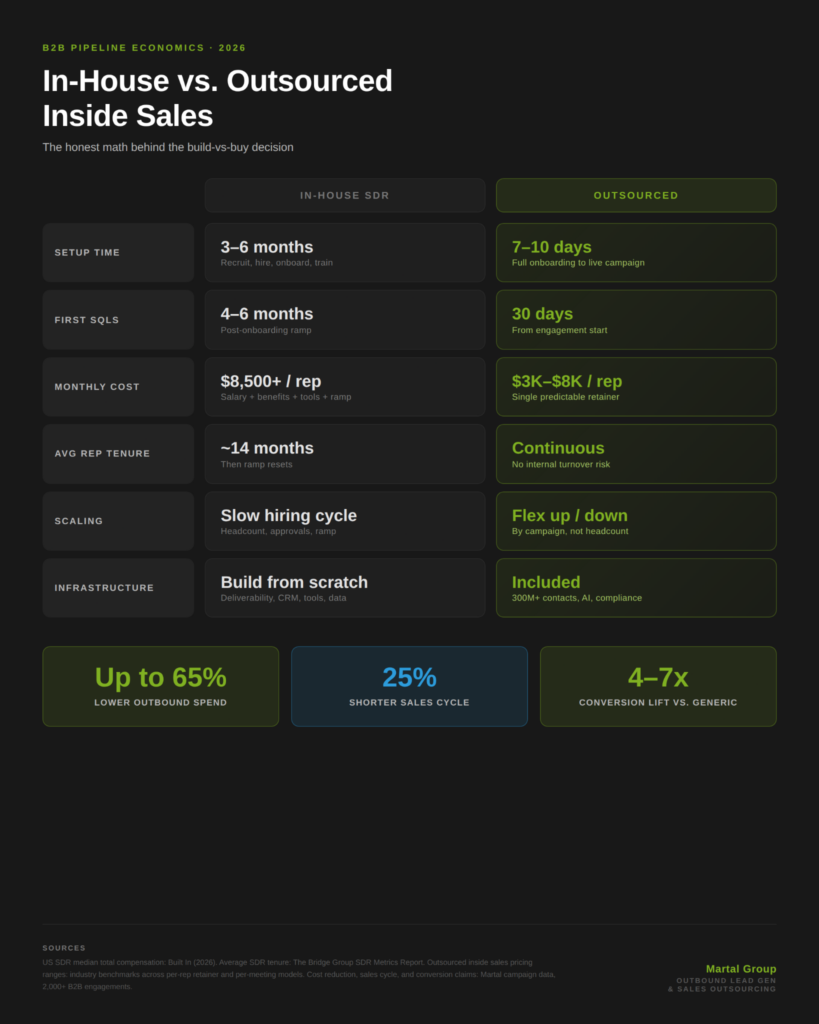
The median total compensation for a US Sales Development Representative now sits around $102,000 a year before benefits, tools, and the ~14-month average tenure that resets ramp every time someone leaves. Outsourced inside sales converts that unpredictable internal cost into a flexible monthly engagement that can produce SQLs in 30 days — far faster than typical internal ramp.
The three engagement models are B2B lead generation (top-of-funnel only, hand off to internal AEs), B2B appointment setting (qualified-lead-to-booked-meeting), and full-cycle B2B sales outsourcing (prospecting through deal close). Each model fits a different stage of internal sales maturity and a different gap in the pipeline.
For a fully managed engagement, onboarding takes 7–10 business days, first MQLs typically arrive in days 14–20, and first SQLs by day 30. Stable ramp continues through day 90 — provided the client supplies ICP context, product enablement, and CRM access in the first week.
Three pricing structures dominate: per-rep retainers ($3,000–$8,000+ per rep per month), per-meeting pricing ($150–$600 per booked meeting), and hybrid retainer-plus-outcome models. The right model depends on Average Contract Value — higher-ACV motions pair better with per-meeting pricing; lower-ACV outbound pairs better with per-rep retainers.
Strong outsourced inside sales companies share four signals: relevant category experience with detailed case studies, a single accountable Sales Operations Manager, weekly performance reporting, and willingness to be measured against the pricing model they propose. Brand polish without operational substance is the clearest red flag.
AI now automates roughly 80% of repetitive outreach tasks — prospecting, sequence generation, follow-up tracking — while senior human reps handle qualification, objection handling, and demo handoff. The hybrid AI + human model delivers a 4–7x conversion improvement over generic outbound for B2B teams that adopt it.
Introduction
Every revenue plan eventually hits the same wall: pipeline goals climbing faster than the sales team can grow.
Hiring more SDRs is the obvious fix, but in 2026 it’s a slow, expensive one. The median total compensation for a US Sales Development Representative now sits around $102,000 a year before benefits, tools, training (1), and the ~14-month average tenure (2) that resets ramp every time someone leaves. Build a team of five and you’re looking at more than half a million in fully loaded cost — assuming you can actually hire them.
That math is why more B2B revenue leaders are turning to outsourced inside sales: partnering with an external team to run remote prospecting, qualification, and meeting setting while keeping the cost structure flexible. The global B2B sales outsourcing market is projected to roughly double by 2035 (3), not because outsourcing is trendy, but because the in-house economics keep getting harder to justify.
We’ve spent the past 16+ years running outbound campaigns for over 2,000 B2B brands across 50+ industries. This guide pulls together what separates a strong outsourced inside sales partner from a generic agency — what to expect, the three main engagement models, the questions that actually filter good partners from bad ones, and a 30-90 day ramp plan you can hold a partner to.
If you’re building an outsourcing shortlist or pressure-testing one you already have, the practical filters are below.
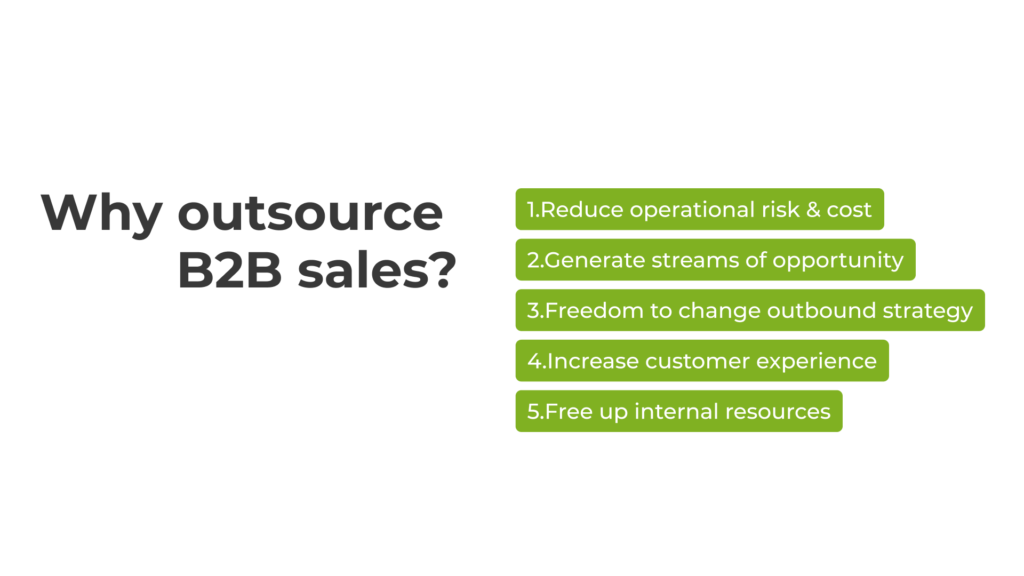
What Is Inside Sales?
Inside sales is the practice of selling remotely — from a desk, by phone, email, LinkedIn, video call, or live chat — rather than from a customer’s office. For most B2B software, services, and technology categories today, it’s the default sales motion.
The contrast is with outside sales (or field sales), where reps travel to prospects and close deals in person. Outside sales still has a place in heavy industrial and enterprise contexts, but the majority of B2B buying conversations now live in inboxes, on video calls, and inside LinkedIn — which is why inside sales has taken over as the dominant model.
An inside sales rep typically owns four things:
- Prospecting — building a list of fit accounts and finding the decision-makers inside them
- Outreach — coordinated touches across email, phone, and LinkedIn
- Qualification — confirming the prospect has the authority and need to take a next step
- Booking — handing qualified prospects to an Account Executive with a meeting on the calendar
Running this motion well in-house is a full-time job in itself. Recruiting reps, training them, protecting email deliverability, building cadences, and keeping productivity steady all sit on the sales leader’s plate. That’s a big part of why more B2B teams are choosing to outsource inside sales rather than rebuild the wheel internally.
What is Inside Sales Outsourcing?
Outsourced inside sales is when a company hires an external partner to run all or part of its remote sales motion — prospecting, outreach, qualification, and meeting setting — on behalf of an internal team. The right partner scales pipeline without the overhead of hiring, training, and managing a large internal SDR organization.
Why the model has gained ground:
- Faster ramp. A well-run outsourced engagement can start generating SQLs in 30 days, where rebuilding the same capability internally typically takes 4–6 months of recruiting, onboarding, and ramp.
- Predictable KPIs. Output is measured weekly against meetings booked, SQLs delivered, and conversion rates — tied to SLAs that internal teams rarely operate under.
- Cost flexibility. Lower fixed cost than carrying a full SDR organization, and easier to scale up or down based on the quarter’s plan.
- Specialist craft. A focused outbound team brings deliverability infrastructure, multi-channel orchestration, and qualification frameworks that take in-house teams years to build from scratch.
What outcomes should you expect from outsourced inside sales?
– More qualified meetings booked each month
– Faster pipeline velocity through targeted lead nurturing
– Improved sales funnel conversion
– Transparent reporting on emails sent, calls made, MQLs, SQLs, and meetings held
– Pricing structured around real outcomes, not vague activity metrics
The catch — and this is where outsourced inside sales programs fail more often than they succeed — is that an outsourced sales team only delivers if it actually understands your product, your buyer, and the way your category really sells. A team that runs a Series B SaaS tool the same way it runs a manufacturing equipment rep will deliver meetings, but not pipeline. Fit, not headcount, is the variable that matters most.
Who’s on an outsourced inside sales team?
The structure varies by provider, but a strong outsourced inside sales team typically includes three roles:
- Sales Development Representatives (SDRs) or Sales Executives (SEs). Reps who own day-to-day outreach: prospecting, multi-channel campaigns, qualification conversations, and booked meetings. Seniority matters here. Junior, script-dependent reps surface volume; experienced reps surface revenue. (At Martal, every SE has 3–5+ years of B2B outbound experience.)
- Sales Operations Managers (SOMs) or Account Leads. The person who runs onboarding, oversees campaign strategy, owns the weekly reporting cadence, and is your single point of accountability inside the engagement.
- Deliverability & Technical Support. The team running domain warm-up, inbox placement, sending infrastructure, and cadence health. This work happens in the background, but it’s the difference between a campaign that lands in inboxes and one that quietly burns through your sender reputation.
A fully managed Martal engagement typically pairs two Sales Executives with one Sales Operations Manager on a dedicated campaign — no handoffs, no shared backbench, one team owning prospecting through booked meeting.
7 Benefits of Hiring an Inside Sales Outsourcing Company
A common question in online sales communities highlights much of the uncertainty around this category: “Why outsource outbounding? Is it really that difficult to tell your sellers to outbound?”
The honest answer is that for many B2B teams, yes — it really is. Outbound has gotten harder. Deliverability is harder. List quality is harder. List-to-meeting conversion is harder. And the average SDR is harder to keep around long enough to get good at the job. The benefits below are why a growing share of revenue leaders decide to hand the motion to a specialist instead of trying to rebuild it internally for the third time.
1. Lower Total Cost of Outbound
The honest cost of an in-house SDR isn’t the salary line. It’s salary + benefits + tools + recruiting + training + ramp + the cost of replacing reps who leave inside 18 months. When teams run that full math, outsourced inside sales can cut outbound spend by up to 65% (4) and frees the sales leader from managing the work itself. Cost predictability matters too: a single monthly engagement is far easier to model than a hiring plan that may or may not hit its dates.
2. Senior Outbound Expertise — Without the Hiring Risk
Quality of rep is the variable most companies underweight when picking a partner. A junior, script-dependent SDR can dial all day and book very little. A senior rep with 3–5+ years of B2B outbound experience handles objections, multi-stakeholder buying groups, and complex categories with confidence — and that shows up in pipeline. A specialist also brings what most internal teams can’t build quickly: deliverability infrastructure, messaging libraries refined across hundreds of campaigns, and a real read on what converts in 2026 (not 2022).
One manufacturing client summed up the dynamic well after working with two other vendors first: “On our third try, we went to Martal Group because their model was different.” That engagement produced 1,596 leads and 203 SQLs in 14 months across the US electrical and safety market. View the full manufacturing use case.
3. Capacity That Scales With the Plan
Pipeline doesn’t need the same volume every quarter. A product launch, a new market entry, an expansion into LATAM or EU — each requires more capacity for a defined window, not forever. Outsourced inside sales scales up and down by the campaign, not the headcount. A 3-month pilot can run with a single fractional rep and expand into a full team if results justify it. Complete EDI used exactly this approach: 14 SQLs in a 3-month pilot with one fractional rep, before scaling the engagement.
4. Improved Lead Conversion
A focused outbound team converts better than a stretched internal one — not because of any single tactic, but because the whole stack is purpose-built for it. Persona-level targeting, intent signals, technographic data, and tested messaging cadences are the table stakes. Industry-aware reps then layer judgment on top: which objection means stall, which means real friction, which prospect is worth a third touch. In one Energy & Solar engagement, that combination delivered 218 SQLs and 196 meetings from 316 leads over 15 months. Adding skilled, outsourced SDRs and SEs doesn’t just double your effort — it multiplies what your in-house team can produce without expanding payroll.
5. AI-Powered Targeting and Real-Time Intent
This is where the model has changed most in the last two years. AI now monitors intent signals across funding announcements, hiring surges, tech stack changes, and content engagement — surfacing accounts most likely to convert before they raise their hand. A good outsourced partner builds this signal layer into the campaign by default. Martal’s AI SDR platform tracks 10M+ intent signals across 24M company accounts and automates roughly 80% of repetitive outreach tasks, so human reps spend their time on the conversations that move pipeline. Targeting based on actual buying signal — not best-guess ICP — is the single biggest lever for conversion in modern outbound.
6. Shorter Sales Cycles
Outsourcing the top-of-funnel work — prospecting, multi-channel outreach, qualification, follow-up — removes the 3–4 weeks your AEs would otherwise spend chasing cold contacts. That alone can shorten an entire B2B sales cycle by up to 25%. The compounding effect: when AEs only meet prospects who are pre-qualified on authority and need, conversation-to-close ratios climb. Strong lead generation strategies, ICP-driven targeting, and disciplined CRM hygiene make the difference between meetings that convert and meetings that simply happen.
7. Productivity Without the Management Drag
Every internal sales leader carries a tax that never shows up in the budget: time spent recruiting reps, coaching new hires, fixing deliverability, troubleshooting CRM hygiene, and re-doing playbooks every time someone leaves. Outsourcing that operational layer to a specialist isn’t just a productivity gain for the SDRs — it’s a productivity gain for the manager. Most clients report the same thing in their first quarter with us: the day-to-day weight of running outbound moves off their plate, and the team’s attention shifts back to closing.
The 3 Types of Outsourced Inside Sales
Inside sales can be outsourced in pieces or as a complete program. From narrow lead generation through to running the entire sales cycle, each model targets a different stage of the funnel — and serves a different kind of buyer. Understanding the three main shapes makes it easier to scope the engagement you actually need.
Functions companies typically outsource:
– Outbound prospecting & cold outreach – building target lists and initiating contact across email, phone, and LinkedIn
– Inbound lead qualification & routing – filtering and prioritizing incoming leads before they hit your AEs’ calendars
– Lead nurturing & re-engagement sequences – staying in front of prospects who aren’t ready yet
– Demo scheduling & calendar management – moving qualified prospects into booked meetings with the right rep
– Sales enablement & CRM support – maintaining clean data, enriching contacts, and keeping the sales stack usable
– B2B lead generation – top-of-funnel research, outreach, and qualified lead delivery
– B2B appointment setting – securing the actual meeting with a pre-qualified prospect
– Full sales process outsourcing – running prospecting through deal closure as an external team
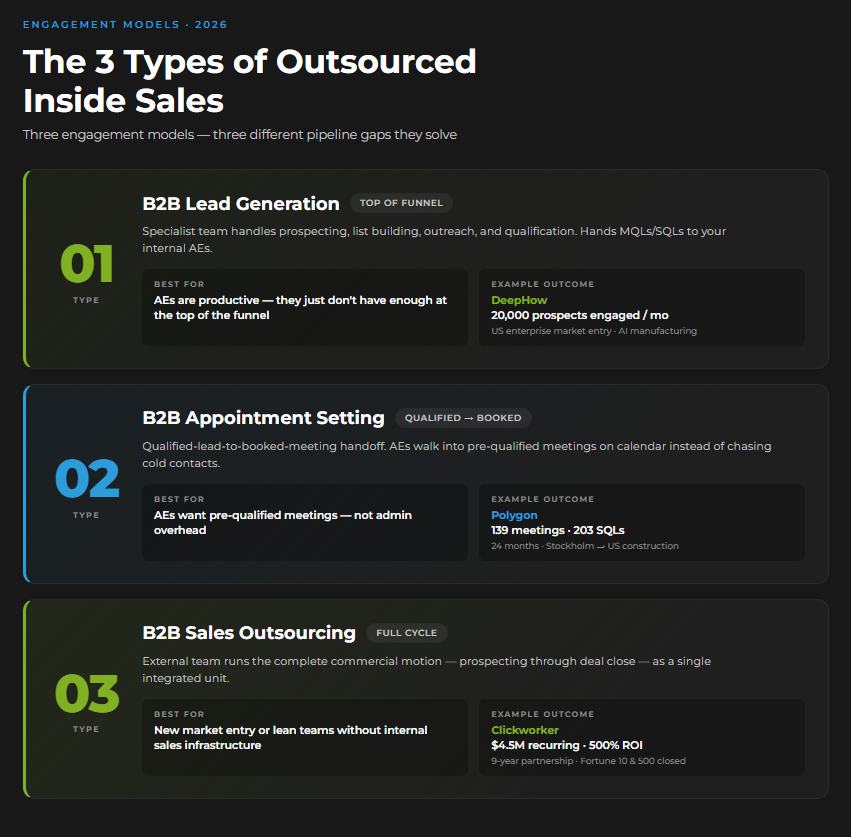
These break out into three engagement models that cover the majority of B2B inside sales outsourcing today.
B2B Lead Generation
Best for: Companies whose AEs are productive once they have qualified opportunities — they just don’t have enough at the top of the funnel.
Outsourced lead generation covers the work of identifying fit accounts, finding the right decision-makers, building enriched prospect lists, and running outreach until prospects respond and qualify. The external team handles the volume work; your internal team handles the deal. It’s the most common starting point because it preserves AE focus while solving the most common pipeline gap.
A specialist partner brings two things in-house teams rarely build quickly: a continuously updated contact database (Martal’s covers 300M+ verified contacts across 24M+ companies, with 1,500+ enrichment fields per company record) and a team of lead generation specialists who do this work full-time, not as a side function. For DeepHow — a Detroit-based AI manufacturing platform entering the US enterprise market — the model meant 20,000 prospects engaged per month, producing a consistent flow of qualified leads without expanding internal headcount.
B2B Appointment Setting
Best for: Companies that want their AEs walking into pre-qualified meetings — not chasing cold contacts to schedule the meeting itself.
B2B appointment setting services take the qualified-lead-to-booked-meeting step off your AE’s plate. Outsourced appointment setters handle the back-and-forth of confirming interest, getting time on calendar, and prepping context for the AE who runs the meeting. Done well, it pushes AE time toward the activity that actually closes — discovery, demo, negotiation — rather than cold calling and follow-up admin.
Polygon — a Stockholm-based IoT and climate control firm expanding into the US construction market — used this model to generate 139 booked meetings and 203 SQLs across 24 months. Their Director of Marketing’s read on the engagement was telling: “Professional North American reps, simple project approach.” That’s the appointment setting model working as designed: an outsourced team holding the qualification line tightly enough that the meetings actually convert.
B2B Sales Outsourcing (Full Cycle)
Best for: Companies that don’t yet have a mature internal sales function — or want to move fast in a new market without building one from scratch.
B2B sales outsourcing is the broadest model. An external team runs the entire commercial motion — prospecting, qualification, meeting booking, demo, and deal close — as a complete unit. Companies use this model to enter new markets fast, validate a category before investing in headcount, or run a parallel motion alongside an existing sales team.
Joopy (Incentives Solutions), an Israeli sales performance management SaaS expanding into US and Canadian markets, used Martal’s full sales cycle outsourcing to manage more than 100 deals from initial lead through contract. Clickworker — a 9-year managed services engagement — represents the long-term version of the same model: $4.5M in recurring revenue, 500% ROI, and Fortune 10 / Fortune 500 clients closed inside the partnership. Full-cycle sales outsourcing is rarely the cheapest engagement, but for the right context, it’s the fastest way to a working go-to-market motion.
7 Essential Factors to Consider When Hiring an Inside Sales Agency
Vetting an outsourced inside sales partner usually fails for the same two reasons. Companies either over-index on price (and end up with a junior team that books low-quality meetings) or over-index on a polished website (and end up paying for marketing, not execution). A useful framework weighs both — plus five other factors that decide whether the engagement actually works.
Here are the seven factors that consistently separate strong partners from weak ones:
1. Relevance to Your Industry & Buyer
The right firm has run campaigns into your category before — not just adjacent ones. A team that books meetings with CFOs at PE-backed SaaS companies will not transfer cleanly to selling industrial equipment to plant managers. Ask: What verticals are you actively running today? Can you walk me through a campaign for a company that looks like ours? What did you learn about that buyer that wasn’t obvious from the outside?
2. Trust & Proof of Results
Read the case studies critically. A strong partner shows real numbers — leads engaged, MQLs, SQLs, meetings booked, conversion rates, and engagement duration. A weak partner shows logos. Cross-check Clutch, G2, and direct client references where possible. The strongest signal is repeat-customer evidence: long client tenure is much harder to fake than a logo wall.
3. Team Caliber & Service Scope
Ask exactly who will run your account, what their tenure is, and how many other clients they support concurrently. A senior rep splitting attention across eight accounts isn’t a senior rep on your account. Also confirm scope: outbound only? Inbound qualification? Appointment setting? Full sales cycle? Get clarity before signing.
4. Process & Operational Discipline
This is where most engagements break — and it’s the factor most vetting checklists understate. Process means: how the team handles deliverability infrastructure, how prospect data is enriched and verified, what the messaging review cycle looks like, how mid-campaign optimizations get made, and how meetings are handed off to your AE. Ask to see a sample weekly report. Then ask what changes mid-campaign when something isn’t working.
5. Communications & Reporting Cadence
The first 30 days of an outsourced engagement set the tone. Strong partners run a weekly performance meeting, maintain a live campaign progression sheet, and assign a single point of contact (a Sales Operations Manager or equivalent) who owns the relationship. If a firm can’t show you their weekly reporting template before you sign, you’ll be chasing them for it afterward.
6. Pricing Model & ROI Structure
Pricing for outsourced inside sales typically falls into three structures, and each carries different incentives:
– Per-rep monthly retainer ($3,000–$8,000+ per month per rep) — predictable cost, but you pay for activity regardless of outcome
– Per-meeting pricing ($150–$600 per booked meeting) — outcomes-aligned, but creates incentive to book meetings that may not qualify on intent
– Hybrid (retainer + outcome bonus or shared-risk) — balances incentive alignment with predictability
Match the model to your Average Contract Value. Per-meeting pricing tends to fit higher-ACV motions where the cost per meeting is small relative to deal size. Per-rep retainer often works better for transactional, lower-ACV outbound where volume drives the economics. Always compare full engagement cost — not just monthly fee — against the pipeline value the partner can realistically generate.
7. Cultural Fit & Long-Term Alignment
An outsourced team becomes an extension of your brand voice every time it talks to a prospect. If a partner’s values, communication style, or sense of urgency don’t align with your team’s, every prospect interaction will carry the friction. The best engagements run years, not quarters — Clickworker has been a Martal client for nine. That kind of duration only happens when fit is right from the start.
How to Find and Hire a Reliable Inside Sales Agency (In 6 Simple Steps)
After the seven vetting factors above, the next move is to actually run a structured selection process. The order matters here. Most companies start with budget or brand polish and end up second-guessing the decision a quarter in. The cleaner approach is to lead with the variables that determine whether an engagement will produce pipeline, then move to commercial fit.
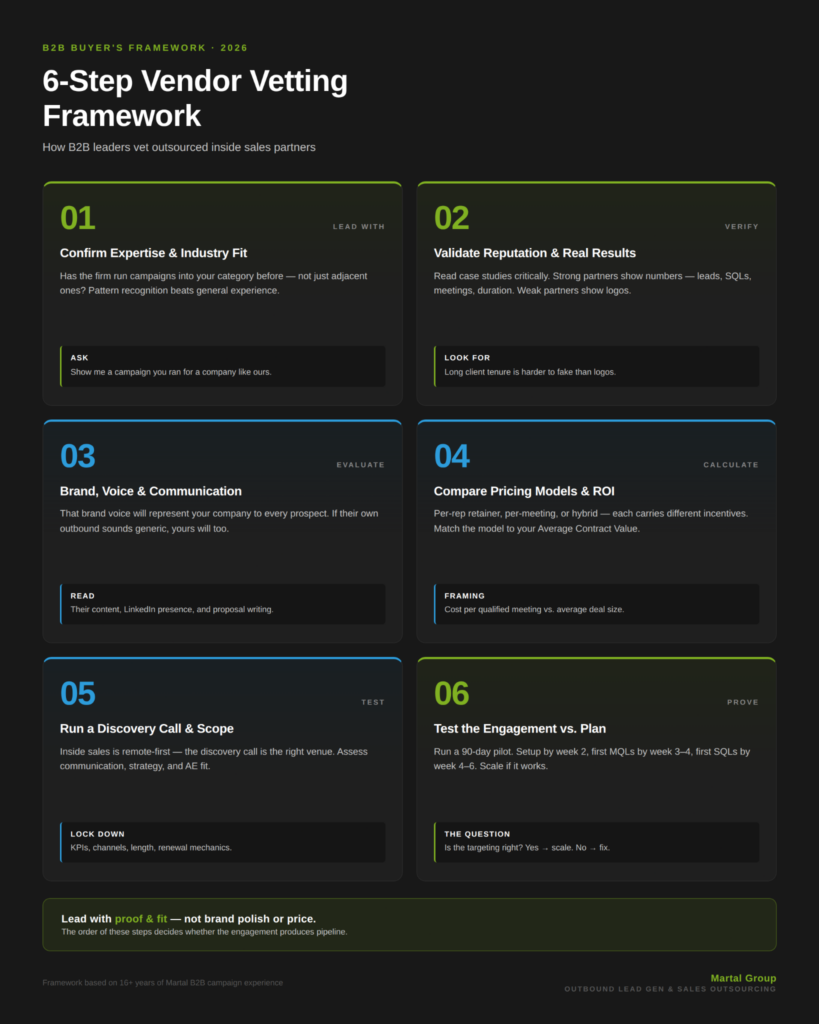
Here’s a six-step framework you can run in 2–3 weeks.
Step #1 — Confirm Expertise & Industry Fit
Start with category fit, not brand or price. The most successful outsourced inside sales engagements happen when the partner has already navigated a buyer that looks like yours — same titles, same objections, same buying cycle length, same compliance considerations. A firm that’s run ten campaigns into your category brings pattern recognition that an internal team can’t match in six months.
When you’re vetting a partner’s areas of expertise, get specific:
- What verticals are you running campaigns into right now?
- Have you worked with a client that resembles us in size, buyer, and category?
- What sales strategies and lead generation methodologies do you use for that buyer type?
- What’s a campaign you tried that didn’t work, and what did you change?
That last question is the most useful. Any honest partner has a campaign that didn’t go to plan, and how they describe it tells you a lot about their judgment and methodology.
Step #2 — Validate Reputation & Real Results
Once you’ve confirmed a firm could plausibly run your campaign, move to proof.
A strong partner will have detailed case studies — not just logos, but numbers: leads engaged, MQLs, SQLs, meetings booked, conversion rates, and engagement duration. Cross-check those case studies against independent review platforms like Clutch and UpCity, where verified clients leave feedback that’s harder to spin. Look for repeat clients and long engagements. A nine-month engagement that didn’t renew tells you something a logo doesn’t.
If reviews are limited or you have lingering doubts, ask the partner for two direct references in your industry. Reach out with a short intro and a few specific questions — what worked, what didn’t, what they wish they’d asked before signing. Reference calls usually surface more than any sales conversation.
Step #3 — Evaluate Brand, Voice & Communication Quality
How a firm presents its brand matters — not because polish equals capability, but because that brand voice is what’s about to represent your company to every prospect they contact. There are over 333 million companies worldwide, with 5.5 million new brands entering the market each year (5). Differentiation matters, and a firm that can’t differentiate itself probably can’t differentiate you either.
Look at:
- The quality of writing on their website and in their proposal — is it specific or generic?
- Their LinkedIn presence and how their team shows up publicly
- Their content — does it teach, or does it pitch?
- Whether their mobile-friendly website and digital experience match the professionalism they’ll represent on your behalf
This isn’t about logos and color palettes. It’s about whether the partner sounds credible in the same conversations they’ll be having on your behalf. If their own outbound is generic, yours will be too.
Step #4 — Compare Pricing Models & ROI Math
Always think about sales outsourcing in terms of ROI, not absolute cost. A $4,000/month retainer that produces no pipeline costs more than an $8,000/month engagement that books 15 qualified meetings.
When comparing pricing, get clarity on three things:
- The pricing model — per-rep retainer, per-meeting, hybrid, or shared-risk
- What’s included — number of dedicated reps, channels (email, phone, LinkedIn), reporting frequency, contract length
- The downside scenario — what happens if pipeline doesn’t materialize in the first 90 days?
Outsourcing should give you more flexibility than building in-house, not less. If a partner won’t quote against measurable outcomes or won’t engage on what underperformance looks like, treat that as a signal. The best partners are comfortable being held to their model.
Step #5 — Run a Discovery Call & Scope the Engagement
For an inside sales engagement, an in-person meeting isn’t the right venue. Your future outsourced team will sell over Zoom, LinkedIn, and email — not over coffee — and the discovery call is the right place to evaluate them.
Use the discovery call to assess three things:
- Communication quality — how prepared they are, how quickly they respond, whether they ask the right questions about your business
- Strategic thinking — do they walk in with a perspective, or do they need everything explained?
- Fit with your AEs — invite one of your closers to part of the call to read the room
If you don’t feel valued during the sales cycle, the prospects they engage on your behalf won’t either.
Before signing, lock down:
- Length of engagement (most strong partners offer a 90-day pilot or rolling quarterly commitment)
- Services covered (outbound channels, qualification standards, reporting deliverables)
- Specific KPIs — meetings booked, SQLs, conversion rate, sales cycle impact
- Payment terms and renewal mechanics
KPIs aren’t just measurement — they’re the thing that keeps everyone aligned through the inevitable first-quarter optimization period.
Key questions to ask before signing:
- Who trains your reps — and what about your AI models?
- What are the SLAs for meetings booked and conversion rates?
- How do you handle data security, GDPR, and compliance for our markets?
- How will you integrate reporting with our CRM and tech stack?
- Can you show case studies with measurable outcomes in our category?
- What pricing approach do you recommend for our ACV, and how should we evaluate ROI?
These six questions don’t surface every weakness, but they reliably surface the ones that matter.
Step #6 — Test the Engagement Against the Plan
Once you sign, the work becomes measurement.
A well-run pilot follows a predictable arc: setup and ICP alignment in the first 1–2 weeks, first outreach live by week 3, first MQLs by week 3–4, first SQLs by week 4–6, and a clear picture of campaign performance by the end of month 2. If the partner isn’t tracking against this arc, push for clarity.
A reliable agency doesn’t just make calls. It becomes an extension of your team — integrating with your processes, technology, and brand voice. Ask for real campaign metrics during the pilot: contact-to-meeting rates, opportunity conversion, and average deal size on closed pipeline. Compare those numbers against your current funnel velocity to determine ROI honestly.
If the pilot delivers, scale. If it doesn’t, you’ve learned something — either about the partner, your ICP, or your messaging — and you can apply that learning to the next attempt.
How to Implement Outsourced Inside Sales
The first 90 days of an outsourced inside sales engagement decide whether the partnership produces pipeline or stalls. Most failed engagements break in the first 30 — not because the team is wrong, but because onboarding skipped a step. A clean implementation runs five workstreams in parallel.
The five workstreams of an outsourced inside sales onboarding:
1. Goals & success metrics. Define what “working” looks like before launch — SQLs per month, meetings booked, sales cycle impact, conversion rate, ACV expectations. Vague goals produce vague reporting. Get specific, in writing, before week one.
2. ICP, messaging & value prop alignment. The outsourced team needs to learn your buyer the way your AEs learned them — titles, pain points, objections, what wins the deal, what loses it. Plan for at least one structured ICP working session in the first week.
3. Product knowledge & enablement. The team representing your brand on every cold call and LinkedIn message needs enough product fluency to handle qualification conversations. Provide pitch decks, demo recordings, FAQ sheets, and competitive context — don’t make the partner ask for it.
4. Tech stack & data access. CRM access, lead routing rules, tracking setup, and deliverability domains all need to be live before outreach starts. Lock these down in week one.
5. Reporting & feedback rhythm. Weekly performance meetings, a live campaign progression sheet, monthly strategy reviews. The cadence isn’t optional — it’s how mid-campaign optimization actually happens.
A realistic 30–90 day ramp plan
Onboarding for a fully managed engagement should take 7–10 business days, with first SQLs landing inside 30 days and a stable ramp by day 90. Here’s what the timeline looks like in practice:
Phase
What Happens
Days 0–2
Partnership agreement signed. Onboarding call within 48 hours. Sales Operations Manager assigned as your single point of contact. AI builds initial business profile from company data; client reviews and adjusts.
Days 3–6
Business profile approved. ICPs generated for segmented lead lists. Client reviews ICPs and gives feedback.
Days 7–8
Sales Executives introduced. Team reviews ICPs, messaging, value props, and campaign structure with the client. Email and LinkedIn copy drafted.
Days 9–10
Cold calling begins. Email and LinkedIn copy approved by client. Leads imported, campaigns scheduled.
Days 11–13
First email and LinkedIn touchpoints go live.
Days 14–20
First MQLs delivered. SEs respond to incoming leads and qualify. First weekly campaign report.
Days 21–30
First SQLs delivered. SEs follow up with MQLs and qualify for discovery calls.
Days 31–90
Campaign ramp-up. Weekly volume scaling. MQL and SQL volume trends upward.
A predictable ramp is not the same as a fast ramp. The goal of the first 90 days isn’t to maximize meetings booked. It’s to validate the targeting, refine the messaging, and prove the model before scaling. Partners who promise a full calendar in week one are usually optimizing for renewal, not for your pipeline.
What separates successful implementations from stalled ones
Across the hundreds of campaigns we’ve run, three signals consistently predict whether an engagement will deliver:
- The client treats the outsourced team like an internal hire. Onboarding decks, product training, regular Q&A access — the same investment you’d make in a new SDR.
- The cadence holds through week six. Weekly meetings happen on schedule. Reporting goes out on time. Feedback flows both directions. Engagements that go quiet in weeks 4–6 are almost always the ones that don’t renew.
- Mid-campaign changes happen on data, not feeling. Strong programs adjust messaging, ICPs, and channel mix based on reply rates and qualification patterns — not based on which week someone got nervous about the numbers.
By the end of month two, you should have a clear answer to one question: is the targeting right? If yes, scale. If no, fix it. The decision shouldn’t take longer than a quarter to get to.
How Martal’s AI + Human Outsourced Inside Sales Model Works
The outsourced inside sales model has changed faster in the last two years than in the previous ten. AI now handles the repetitive work — research, list enrichment, sequence generation, follow-up tracking — that used to consume most of an SDR’s day. What it doesn’t do well, on its own, is read a buyer well enough to qualify them, or hold the line when an enterprise prospect tests the team with a multi-stakeholder objection. That work still requires senior humans.
Martal’s outsourced inside sales engagement combines both: a proprietary Martal AI SDR platform built on 15+ years of campaign data, run by experienced onshore Sales Executives who own the strategic work AI can’t.
Here’s how the model runs:
1. Market & ICP discovery (human + AI). Sales Executives and AI agents map ideal accounts together using intent signals, technographic data, historical success patterns, and lookalike modeling against your existing customer base. The AI surfaces the candidates; senior SEs apply judgment about which segments are worth running first.
2. Omnichannel campaign build (AI-assisted, human-approved). The AI SDR generates hyper-personalized outreach sequences across email, LinkedIn, and phone — drawing on patterns learned from 50M+ real sales interactions and 15+ years of B2B campaign data. SEs review every sequence before it goes live to confirm message fit, tone, and category accuracy. The platform never sends what a human hasn’t approved.
3. Engage & qualify (AI + human SDRs). AI handles roughly 80% of the repetitive work — initial outreach, follow-up cadence, deliverability monitoring, response routing. Human SEs take over for the conversations that decide whether a meeting is worth your AE’s time: complex discovery, objection handling, multi-stakeholder buying group navigation, and demo prep.
4. Optimize continuously. Every campaign feeds the platform. Reply rates, qualification patterns, channel performance — the system tracks it all in real time and surfaces what to adjust. SEs and Sales Operations Managers run weekly performance meetings with the client to validate the changes worth making.
Why the AI + human hybrid works
The math is simple. AI does the volume work better than humans. Humans do the judgment work better than AI. Most outsourced models pick one and trade off the other. The hybrid removes the trade-off.
What that produces in practice:
– Targeting precision at scale. 300M+ verified contacts and 24M+ company accounts in the database, with 1,500+ enrichment fields per company. AI surfaces fit; humans confirm intent.
– Real-time intent signal layer. 10M+ buying signals — funding announcements, hiring surges, technology adoption, content engagement — feed every campaign so outreach hits buyers in their buying window, not after they’ve already decided.
– 4–7x conversion improvement over generic outbound, driven by intent-based and technographic targeting that traditional models can’t replicate at scale.
– AI-generated, human-reviewed sequences that scale personalization without losing brand voice. Every prospect gets a message written for them — not a mail merge.
– A clear AI-to-human handoff. AI runs first contact through qualification triggers. Human SEs take the conversations that earn an AE’s calendar.
– Continuous model improvement. Campaign outcomes and human annotations feed back into the targeting, messaging, and sequencing engine, so the system gets sharper with every cycle.
Built-in compliance — SOC II certified, GDPR compliant, CAN-SPAM compliant — covers the regulated buyer markets clients need to reach without taking on legal exposure.
Learn more about the platform: Martal AI SDR platform.
What’s Next?
Outsourced inside sales works when the partner brings real category expertise, runs a disciplined process, and treats the engagement like an extension of your sales team — not a side project. It doesn’t work when it’s bolted on, under-resourced, or pitched as a generic “outbound service.”
If you’re scoping a shortlist or pressure-testing the partner you already have, the practical next step is a conversation about what your pipeline could look like with outbound running well. Martal pairs experienced onshore Sales Executives with our proprietary Martal AI SDR platform to run cold email, cold calling, and LinkedIn outreach as a single coordinated omnichannel engagement — covering prospecting through booked meeting, with measurable SQLs inside the first 30 days.
Book a consultation and we’ll walk through your ICP, your current pipeline math, and what a Martal engagement would deliver against your plan. No pitch deck — just a working session on whether the model actually fits.
References
FAQs: Outsourced Inside Sales
Would you outsource your inside sales organisation?
This question appears on Quora often — and the honest answer is it depends on what you’re trying to fix. Outsourced inside sales works well when in-house outbound isn’t ramping fast enough, when you’re entering a new market, when your AEs are productive but underfed, or when you don’t want to build outbound infrastructure from scratch. It works poorly when the underlying issue is product-market fit, value proposition clarity, or category strategy — none of which an outsourced team can solve for you. Outsourcing scales a working motion. It doesn’t invent one.
Will outsourced sales teams ever perform better than in-house teams?
The honest answer is nuanced. For top-of-funnel work — prospecting, qualification, meeting booking — specialist outsourced teams usually outperform internal ones, because they have purpose-built infrastructure, more reps to A/B test against, and they do this work full-time. For complex enterprise close motion with high-touch relationships, an experienced internal Account Executive almost always outperforms an outsourced one. The strongest setups in 2026 combine both: outsourced inside sales running pipeline, internal AEs closing it. That hybrid is where most mid-market and enterprise B2B teams are landing.
How much does outsourced inside sales cost?
Pricing falls into three structures: per-rep monthly retainers ($3,000–$8,000+ per rep per month), per-meeting pricing ($150–$600 per booked meeting), or hybrid retainer-plus-outcome models. Total engagement cost depends on number of reps, channels covered (email, phone, LinkedIn), reporting frequency, and contract length. The right framing isn’t what does it cost — it’s what’s the cost per qualified meeting, and what’s that meeting worth against our Average Contract Value. A $7,000/month engagement that delivers 15 SQLs per month at a $30K ACV will look very different on ROI than a $4,000/month one that produces three.
How long does it take for outsourced inside sales to start producing results?
For a fully managed engagement, onboarding takes 7–10 business days, first MQLs typically land in days 14–20, and first SQLs by day 30. Stable ramp continues through day 90. The 30-day SQL milestone is achievable with disciplined onboarding — provided the client supplies ICP context, product enablement, and CRM access in the first week. Vendors who promise booked meetings in week one are usually optimizing for renewal, not for your pipeline.
What is the main risk in outsourcing sales?
The biggest risk isn’t cost — it’s brand voice. An outsourced team becomes how your company sounds to every prospect they contact. If the team doesn’t understand your buyer or category, that misalignment shows up in reply rates first and brand perception second. Mitigation: a structured ICP and messaging workshop in week one, joint message review for every sequence before it goes live, weekly performance meetings, and a single point of accountability inside the engagement (a Sales Operations Manager or equivalent). Cultural fit, not price, is the variable that decides long-term success.
Does inside sales do cold calling?
Yes. Cold calling is part of a coordinated omnichannel approach, paired with cold email and LinkedIn outreach to reach decision-makers across the channels they actually respond on. Run as standalone activity, cold calling produces middling results; run as one channel inside an omnichannel sequence — same prospect, layered timing, consistent messaging — it lifts both response rates and meeting volume.