
 Martal
 Technology
 Education and training
 Web Development and UI / UX
 Healthcare/Medical
 Logistics and Supply Chain
 Information Technology
 Insuretech and Financial Services
 Marketplaces
 Software Development
 E-commerce and retail
 AI and Machine Learning
 Energy and Solar
 Manufacturing
 Security and Surveillance
 Digital Marketing Agency
 Transportation
 MSP
MSP
 Telecom
 B2B SaaS
 Cybersecurity
 HR tech
 Fintech
 Cleantech
 Consulting
B2B SaaS Marketing Strategies 2026: Proven Tactics for Growth
Major Takeaways: B2B SaaS Marketing Strategies
Map dedicated content to every funnel stage — awareness, consideration, and decision — and distribute it across the channels your buyers actually use. It matters because most of the B2B buying journey now happens before a vendor conversation ever starts, so your content has to do the early selling for you.
Start where compounding returns live. Early-stage SaaS teams typically put the majority of a lean budget into organic channels (SEO and content) and a smaller slice into targeted paid, then diversify once a repeatable channel is proven.
Webinars educate and qualify at the same time, and they are far cheaper per lead than in-person events. Hubilo’s benchmarks put webinar cost per lead around $72 versus well over $800 for trade-show leads, which is why SaaS teams run them on a recurring cadence.
Use PLG when users can reach real value fast, without a demo or heavy setup. ProductLed reports that 91% of companies with a PLG motion plan to increase that investment, with nearly half aiming to double it.
ABM concentrates effort on a defined set of high-value accounts and the full buying committee behind them. G2’s research links ABM to a 171% lift in average contract value and roughly 200% more marketing-sourced revenue, which is why it fits enterprise and mid-market SaaS deals.
Put both teams on shared pipeline and revenue goals, one agreed definition of a qualified lead, and a regular feedback loop. Aligned revenue teams are markedly better at closing — Marketo’s research ties alignment to 67% better close rates.
Generating high-quality (not just high-volume) leads. The fix is sharper ICP targeting, intent data, and omnichannel outreach that reaches buyers who aren’t actively searching yet — supported by outsourced SDR capacity when internal bandwidth runs short.
Most companies budget roughly 9–10% of revenue for marketing, but early-stage SaaS commonly spends far more — often 15–25% during rapid growth — with the split weighted toward organic in the early days and paid/ABM as the company scales.
Introduction
B2B SaaS marketing strategies are shifting fast in 2026. Software-as-a-Service companies face longer sales cycles, larger buying committees, and an AI-driven search landscape that changes how buyers discover and shortlist vendors. Having run outbound for 2,000+ B2B brands across 50+ verticals since 2009, we’ve watched which channels earn attention and which quietly stop working — and the gap between the two keeps widening.
This guide lays out the strategies and channels that hold up now: full-funnel content, product-led growth, account-based marketing, email, LinkedIn thought leadership, differentiation in a crowded market, and how to scale as you grow. We also cover budgets, common challenges, and the questions SaaS founders and marketers actually ask. If you want the data behind these plays, our companion breakdown of SaaS marketing statistics pairs well with the tactics below.
B2B SaaS Marketing Strategies at a Glance
- Build full-funnel content mapped to awareness, consideration, and decision, then distribute it across the channels your ICP already uses — because roughly 70% of the buying journey happens before buyers talk to sales.
- Pick two or three channels where your buyers actually are rather than spreading a lean budget across all of them; early-stage SaaS usually leads with organic (SEO and content) plus a focused paid layer.
- Use PLG when time-to-value is short, and pair it with a sales motion (PQLs) for larger, higher-touch accounts.
- Reserve ABM for high-value accounts where a personalized, committee-wide approach is worth the effort — it consistently lifts deal size and win rates.
- Align sales and marketing on shared pipeline goals and one definition of a qualified lead; the ROI of that alignment shows up in close rates and revenue.
- Differentiate on a sharp value proposition and real expertise, not feature lists, to stand out in a category crowded with look-alike tools.
What Changed in 2026
- The global SaaS market reached roughly $408B in 2025 and is on track for about $465B in 2026, so competition for attention keeps intensifying (Zylo).
- Buying committees have grown to 10+ stakeholders on larger B2B deals (up from single-digit averages a couple of years ago), lengthening cycles and demanding multi-persona content (6sense).
- AI Overviews and zero-click results now absorb a large share of informational searches, pushing SaaS teams toward bottom-funnel content and answer-engine optimization (SeoProfy).
- Email still leads on ROI at about $36 for every $1 spent, holding its place as the highest-return channel even as new formats emerge (Litmus).
B2B SaaS Marketing Strategies: Key Terms
- B2B SaaS marketing is the set of strategies a software company uses to build awareness, sign up users, and convert them into paying business customers over a recurring-revenue lifecycle.
- Full-funnel content is content mapped to each buyer stage — awareness, consideration, and decision — so prospects get the right message as they research.
- Product-Led Growth (PLG) is a model where the product itself drives acquisition and conversion through free trials, freemium plans, and self-serve onboarding.
- Account-Based Marketing (ABM) is a focused strategy that treats individual high-value accounts as markets of one, with personalized campaigns aimed at the whole buying committee.
- Product-Qualified Lead (PQL) is a trial or freemium user whose in-product behavior signals strong fit and readiness for a sales conversation.
- Demand generation is the work of creating awareness and interest across the ~95% of buyers who aren’t in-market yet, so you’re on their shortlist when they are.
- Smarketing refers to sales and marketing operating as one revenue team around shared goals, metrics, and lead definitions.
This guide draws on current public research and Martal’s experience running B2B outbound and pipeline generation across 50+ verticals. We put it together to help SaaS teams choose channels and sequencing based on what actually moves pipeline, not on what’s trending.
Full-Funnel Content Strategy and Key B2B SaaS Marketing Channels
A full-funnel content strategy is the backbone of B2B SaaS marketing: create targeted content for each stage of the buyer’s journey, then distribute it across the right channels. It works because buyers self-educate long before they raise a hand — content marketing is used by roughly nine in ten B2B marketers, and companies that blog consistently generate far more monthly leads than those that don’t, according to SeoProfy’s B2B marketing research. That early, self-directed research is also where a strong industry hub like B2B SaaS lead generation starts compounding, because the pages buyers find first shape the shortlist.
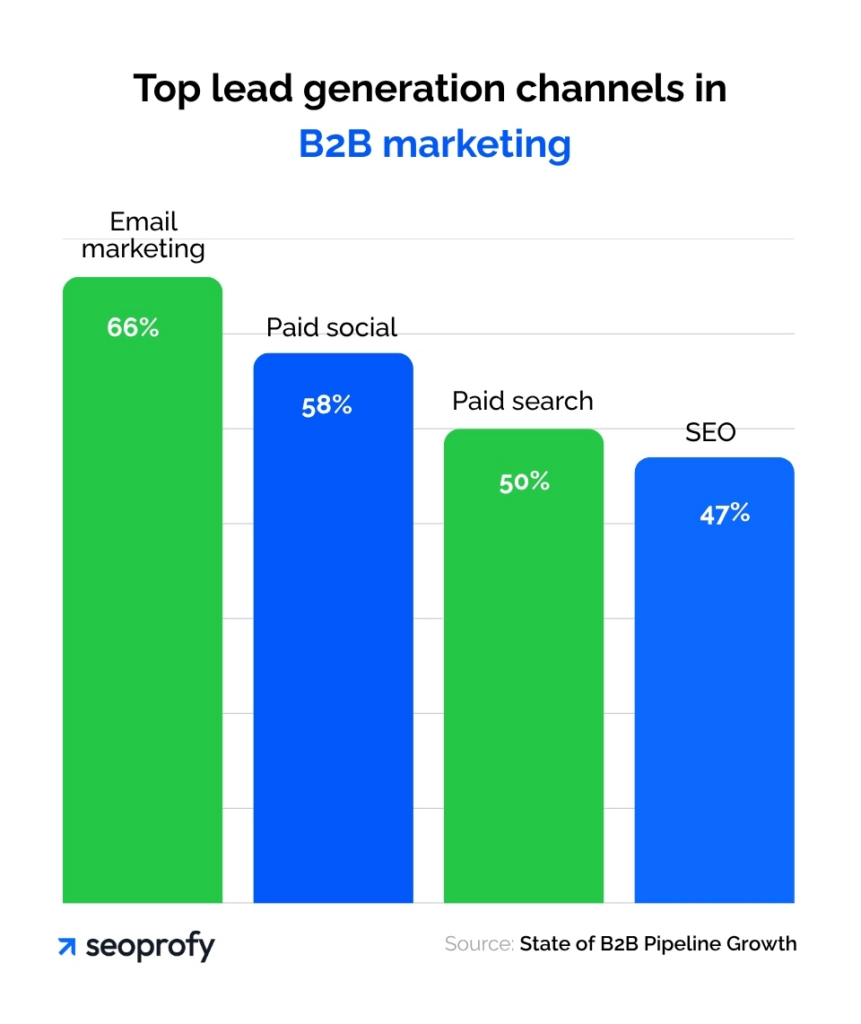
Source: State of B2B Pipeline Growth (Via SeoProfy)
A successful SaaS content plan maps channels to the funnel:
- Top-of-Funnel (Awareness): Attract prospects with SEO-optimized posts, how-to guides, and social content that addresses real pain points — no heavy sales pressure. The goal is traffic and brand familiarity. Because buyers prefer to learn through content rather than a pitch, valuable educational material is what earns the first look. It also pays to be findable at this stage, whether you build content in-house or work with the right SaaS SEO agency.
- Middle-of-Funnel (Consideration): Nurture with webinars, whitepapers, comparison guides, and case studies that show your product’s value. Prospects here are evaluating options, so build trust with proof. Case studies and detailed guides help buyers picture success with your product, and webinars (more below) add interactive credibility.
- Bottom-of-Funnel (Decision): Support conversion with demos, free trials, ROI calculators, and personalized consultations that address final objections and prove ROI. Tailored assets built with sales — account-specific decks, one-pagers — move deals faster when marketing and sales coordinate.
Use channels in synergy. An effective full-funnel strategy is inherently omnichannel: a prospect might find you via search, get nurtured through email and webinars, then meet targeted ABM ads or personal outreach. Core B2B SaaS marketing channels include your website and blog (SEO and thought leadership), email, LinkedIn, paid search and LinkedIn ads, and events or communities. Rather than leaning on one channel, integrate outbound campaigns across several so a prospect reads your blog, sees a LinkedIn post, gets a helpful email sequence, and encounters retargeting — all reinforcing one message across a long buying cycle.
Don’t overlook cross-promotion and partnerships. Co-hosting a webinar, co-authoring a guide, or building an integration you both market can unlock a partner’s audience at low cost, and it doubles as social proof. In 2026’s interconnected ecosystem, most SaaS marketing plans benefit from a few strategic alliances and co-marketing plays.
Users in Reddit and community discussions often ask how to market a B2B SaaS with a small budget and no sales team. The recurring answer from experienced founders: don’t try every channel at once. Lead with one or two organic channels where your buyers already spend time (usually SEO/content and LinkedIn), let the founder be visible, and add paid or outbound only once a channel proves it can produce pipeline. Focus and consistency beat breadth here.
Using Webinars as a SaaS Marketing Channel
Webinars are a high-impact SaaS channel because they attract, nurture, and convert in one motion — educating sales leads while generating rich engagement data. Most B2B marketers rate them highly: Hubilo’s webinar benchmarks report that the large majority of B2B marketers call webinars important to their strategy, and many name them their top source of high-quality leads.
Why do SaaS webinars work? They let your experts demonstrate real depth and interact live, which positions the team as a trusted authority. They also produce qualification signals — who registered, attended, and asked questions — so you can prioritize follow-up. And they’re efficient: Hubilo pegs the average webinar cost per lead near $72, versus well over $800 for trade-show leads, which is hard to ignore for a SaaS CMO watching ROI.
To run webinars well, keep a regular cadence, promote through email and LinkedIn, and focus the session on actionable insight instead of a sales pitch. Engage with live Q&A and polls, then extend each webinar’s value: publish the on-demand replay, cut short clips for social, and write follow-up posts. Done consistently, webinars produce a steady stream of warm leads who already understand your value.
Leveraging Product-Led Growth (PLG) in Your SaaS Marketing
Product-Led Growth uses the product itself as the primary engine of acquisition, conversion, and retention. Instead of relying only on marketing-qualified leads and reps, PLG lets prospects experience value directly through free trials, freemium plans, and self-serve onboarding. It has real momentum: ProductLed reports that a majority of B2B SaaS companies now run a PLG motion, and 91% of those plan to increase PLG investment — with nearly half aiming to double it.
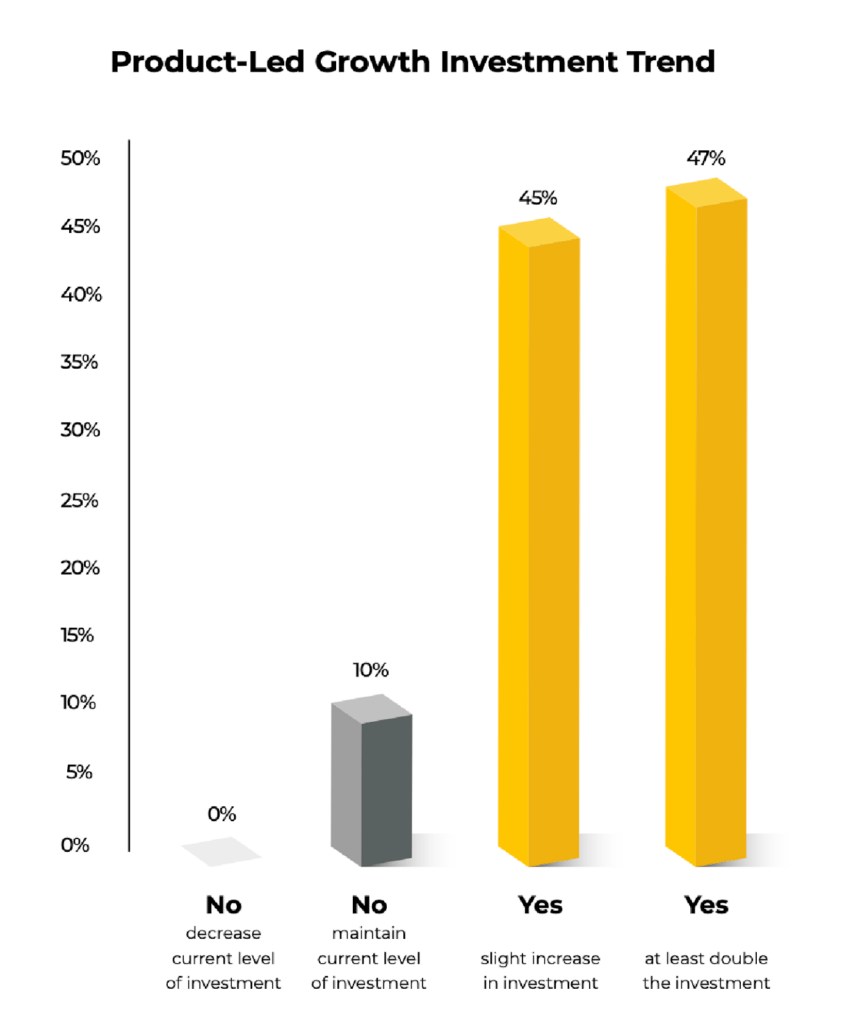
Source: ProductLed
When should you use product-led growth in SaaS marketing?
Use PLG when your product delivers quick value without heavy customization or one-on-one demos. Developer tools, SMB software, and many horizontal SaaS products lend themselves to “try before you buy,” and PLG can meaningfully lower customer acquisition cost and shorten sales cycles. ProductLed notes that freemium models often reach conversion rates around 12% — higher than typical free-trial conversion. If prospects who try your product tend to convince themselves (and their bosses) of its value, that’s a green light for PLG.
If your SaaS is enterprise-oriented — complex integration, security reviews, data migration — a purely product-led approach rarely closes deals alone. There, a hybrid works best: use PLG at the top of funnel to generate interest, then bring in sales for high-touch consultation on serious opportunities. This product-qualified lead (PQL) model routes high-usage, high-fit trial users to sales, and ProductLed finds it can lift free-to-paid conversion several times over. In short, let the product prove value early, then have sales ready to nurture the most promising users — especially in enterprise scenarios. Many teams now blend the two, and our own breakdown of B2B SaaS sales covers how to structure that PLG-to-sales handoff cleanly.
From a marketing standpoint, supporting PLG means driving signups and in-product engagement rather than gated eBook downloads. You’ll focus on in-product onboarding, user education, and viral loops, and you’ll need tight alignment between product, marketing, and customer success. The payoff is faster growth with less traditional sales-and-marketing spend, plus products that build trust by delivering value up front.
Aligning Sales and Marketing (Smarketing) for Unified Growth
In B2B SaaS, sales and marketing alignment isn’t a nice-to-have — it’s a growth lever. “Smarketing” means these two teams operate as one revenue engine: marketing builds awareness and pipeline, sales develops and closes, and both own revenue. When that partnership works, the impact is measurable. Marketo’s alignment research finds that closely aligned companies are about 67% better at closing deals and can generate up to 208% more value from marketing. Recent research also ties strong alignment to roughly 20% annual revenue growth, while misaligned teams tend to stall — and many revenue leaders now treat alignment as their single biggest lever to improve performance.
How do you align sales and marketing in a SaaS organization?
Start with shared goals and metrics. Both teams should own pipeline, conversion, and revenue, not just siloed KPIs. Many SaaS companies use a service-level agreement (SLA): marketing commits to a volume of quality leads or pipeline, and sales commits to prompt follow-up and feedback. Then enforce one definition of a qualified lead (MQL, SQL, PQL). This matters because Gartner’s survey found that 62% of organizations say sales and marketing define a qualified lead differently — a disconnect that wastes effort. A shared workshop on your ICP and qualification criteria fixes most of it.
Add a rhythm of communication: weekly pipeline reviews with both leaders, and joint campaign planning. Marketing should ask sales what collateral would help them sell; sales should feed frontline insights back (“prospects keep asking about X”) so marketing can address them. Consider structure too — many SaaS companies appoint Revenue Operations or a CRO to unify strategy and data.
As a B2B sales outsourcing agency, we’ve seen firsthand that when sales and marketing move in unison, pipelines improve — better nurturing, cleaner hand-offs, more closed deals. For a SaaS CMO or VP, tight alignment is a real edge against larger competitors with siloed teams.
Maximizing Email Marketing ROI in SaaS
Email remains a workhorse in B2B SaaS — for outbound demand gen and for nurturing leads and customers — because it consistently delivers the highest ROI of any channel. Litmus’s State of Email research puts the return at about $36 for every $1 spent, outperforming paid channels by a wide margin. For SaaS, email carries outbound sequences to book qualified meetings, nurture drips, onboarding and feature emails, and retention campaigns that fight churn.
So how should SaaS email be done? With personalization, segmentation, and value first. Segment your lists by persona, industry, company size, funnel stage, or behavior triggers via good lead segmentation, then tailor content to each slice — a “new feature for fintech” email to that segment, a “getting started” series to new trials. Personalize the content itself with merge fields, referenced pain points, and recent actions.
Automation and timing matter as much as copy. Use AI sales tools or automation platforms to run sequences and behavior-triggered emails: if a trial user goes quiet for a week, send a “need help getting started?” note; if a prospect visits pricing, follow with an ROI case study. Contextual, well-timed emails convert better because they’re relevant. The through-line: make every email useful — educate, solve a problem, or tell a story — so you build trust in the inbox rather than fatigue.
LinkedIn Thought Leadership and Social Selling
For B2B SaaS, LinkedIn is the social home base: your buyers — C-suite, VPs, directors — are there daily to research and network. That makes it ideal for thought leadership, content amplification, and outbound. LinkedIn’s own research reports that the large majority of B2B marketers use the platform for lead generation and that it out-produces other social channels for B2B leads, in part because buyers see it as one of their more trusted information sources.
How can SaaS companies use LinkedIn thought leadership?
Lead with a personal-branding approach alongside your company page. Prospects engage with people more than logos, so encourage founders, executives, and subject-matter experts to post insights consistently. Have them educate and opine on trends rather than promote — LinkedIn’s data shows compelling thought leadership meaningfully influences which vendors make a buyer’s shortlist. Keep the company page active too (new posts, case studies, event invites), and use LinkedIn to engage: comment, join relevant conversations, and enable employees as advocates, since their combined networks dwarf the company page’s reach.
Don’t ignore LinkedIn ads and outbound. Precise role- and company-level targeting suits ABM and niche SaaS, promoted thought leadership makes a strong top-of-funnel play, and tools like Sales Navigator help sales teams reach the right buyers with personalized, non-spammy outreach. Treat LinkedIn as a channel for relationship- and trust-building, and your SaaS stays top-of-mind for when those connections have a need you solve.
Account-Based Marketing (ABM) Strategies for SaaS
For SaaS companies chasing larger accounts, account-based marketing is a focused alternative to broad inbound: sales and marketing jointly pick priority accounts, then build personalized campaigns for them. The mantra is quality over quantity — better to deeply engage 50 great-fit accounts than 500 random leads. Adoption has surged, and the results are why: G2’s ABM research links the approach to a 171% increase in average contract value and roughly 200% more marketing-sourced revenue, with strong programs also reporting significantly higher win rates and shorter cycles.
When is account-based marketing appropriate for SaaS?
ABM fits when deal sizes justify a personalized approach — typically enterprise or mid-market SaaS with longer cycles and multiple stakeholders. If you sell high-volume, low-touch SMB software, classic inbound and PLG may be enough. But if one Fortune 500 client equals a quarter of smaller deals, ABM belongs in your toolkit — especially when you have a finite universe of target companies you can literally list and pursue.
Executing ABM means tight sales-marketing collaboration. Jointly define the target list (by firmographics, fit model, or strategic logos), then build personalized content and outreach: tailored ads, direct mail or gifting for key decision makers, and custom landing pages. A common play is marketing air cover plus sales outreach — LinkedIn ads to an account’s executives while SDRs and email reference the same themes. That consistency is what engages a buying committee, which increasingly matters as committees have grown to 10+ stakeholders on larger deals.
Measure ABM differently from lead gen: account engagement, pipeline within target accounts, deal velocity, and deal size. On those metrics ABM shines — G2 reports meaningfully shorter cycles and higher win rates — largely because it forces focus and alignment. Think of it as fishing with spears instead of nets: more effort per account, but a much higher payoff per account.
Differentiating Your SaaS in a Crowded Market
The SaaS market is more crowded than ever — Zylo puts the global market at roughly $408B in 2025, on track for about $465B in 2026, with new AI SaaS entrants launching constantly. When dozens of tools solve a similar problem, differentiation is what keeps you off the commodity shelf. Beyond features, your messaging, brand, and customer experience can be the deciding factors.
So how do you differentiate? Start by crystallizing your unique value proposition — a clear answer to “why choose us?” tied to a niche focus, a novel approach, superior usability, or proven outcomes. Put it front and center on your homepage, ads, and decks, and avoid generic claims like “we increase productivity.” Be specific.
Other levers:
- Thought leadership and brand personality. Buyers gravitate to genuine experts and distinctive brands. Original research, sharp insights, or an active community set you apart; a memorable, human brand voice can too.
- Customer experience. A frictionless trial, responsive support, and strong onboarding become selling points, and glowing case studies amplify them.
- Pricing and packaging. A flexible month-to-month plan in an annual-contract category, or a fairer usage-based model, can win a segment competitors ignore.
- Category creation. In very crowded spaces, reframing the conversation around a new category is risky but high-reward.
Users in Reddit and community discussions often ask how to create content that stands out instead of blending into a sea of AI slop. The consensus from practitioners: publish something the top results don’t have. Original research, first-hand operator data, and executive points of view are hard to copy and earn mentions, links, and trust — whereas rewritten “ultimate guides” get lost. If you’re evaluating outside help to produce that kind of work, our overview of SaaS marketing agencies covers what to look for.
To win a crowded SaaS market, give prospects a clear reason you’re the best fit for them, and communicate it consistently. That usually means specializing — in audience, feature, or approach — and excelling where competitors are weak.
How Much Should You Spend? B2B SaaS Marketing Budgets
There’s no single right number, but benchmarks give a starting point: marketing budgets average roughly 9.4% of revenue in 2025, up from 7.7% in 2024, according to Data-Mania’s B2B marketing budget benchmarks. SaaS tends to run higher, and stage matters more than any industry average.
Stage
Typical marketing spend (% of revenue)
Where the budget leans
Pre-product-market-fit
30–60%
Testing channels, building awareness
Early stage (<$1M ARR)
15–25%
Mostly organic (SEO/content), a focused paid layer
Scaling ($1M+ ARR)
15–25%
Balancing proven organic with expanding paid and ABM
Mature
5–10%
Optimizing and defending, efficiency-first
The practical lesson from founders in community discussions: how you allocate matters more than how much you spend. Early-stage SaaS teams commonly weight the majority of a lean budget toward organic channels that compound (content and SEO), a smaller slice toward targeted paid, and a small reserve for experiments — then rebalance toward paid and ABM as they scale and unit economics allow.
Users in Reddit and community discussions often ask which channel to fund first when the budget is tight. The common thread: SEO and content compound but take time — teams often see returns around month six or seven — so the mistake is giving up too early and switching to paid before the organic engine matures. A workable pattern is to fund one compounding channel (content/SEO), one direct channel (LinkedIn or outbound email), and treat everything else as a test.
One caveat on that organic bet. The search surface itself is shifting toward AI-generated answers, so AI SEO for SaaS is increasingly part of what an organic program has to cover rather than a separate line item.
Lead Generation vs. Demand Generation for SaaS
These two often get conflated, and the distinction shapes your whole strategy. Demand generation builds awareness and interest across the large majority of buyers who aren’t in-market yet; lead generation captures the smaller group who are ready to act now. The reason both matter: at any given moment only a small share of your market — often cited as roughly 5% — is actively buying, so a strategy built only around “book a demo” ads chases that sliver and ignores the rest.
The goal of demand gen is to be on the buyer’s shortlist before they start evaluating. Research on how B2B buyers buy consistently shows that most buyers already have a set of vendors in mind before they do formal research, and they usually buy from that initial list — so being remembered early is worth more than a perfectly optimized bottom-funnel form. For a deeper SaaS-specific treatment of building that pipeline, see our guide to B2B SaaS demand generation.
In practice, blend the two: run demand gen (content, thought leadership, community, PR) to build familiarity, and layer lead gen and outbound to capture and qualify the in-market few — supported by lead scoring and intent signals so sales engages at the right moment.
Overcoming Common SaaS Marketing Challenges
Marketing a SaaS product carries a specific set of challenges. Recognizing them — and having a plan — is what separates steady growth from stalls.
What are common B2B SaaS marketing challenges and how do you overcome them?
The usual suspects are long sales cycles, lead-quality issues, standing out in a crowded market, and churn. Long cycles call for patient lead nurturing and stakeholder-specific content (ROI calculators, security docs, CFO briefs). Lead-quality problems call for tighter ICP targeting and qualification — fewer, better leads beat volume. Standing out calls for a clear UVP and real expertise. Churn is a marketing problem too: set honest expectations, target true-fit customers, and support onboarding and adoption.
Tackling each in more depth:
- Long sales cycles and complex buying committees. B2B SaaS deals involve long evaluations and multiple stakeholders — and committees keep growing. Nurture patiently, arm internal champions to sell for you, and use intent signals to time sales engagement.
- Generating quality leads at scale. The perennial challenge is quality, not volume — G2 finds generating high-quality leads is the top challenge for a large share of B2B marketers. Sharpen ICP and value proposition, use lookalike targeting and better lead magnets, and improve landing-page conversion. When inbound isn’t enough, an omnichannel outbound motion — cold email, LinkedIn, and calling — proactively sources ICP-fit prospects instead of waiting.
- Standing out in a noisy digital world. Prioritize quality over quantity: landmark research, comprehensive guides, and rich media beat a stream of mediocre posts. Building or joining communities adds credibility and word-of-mouth discovery.
- Churn and retention. In a subscription model the real gold is retention and expansion. Align with product and customer success, run education campaigns, and turn happy customers into advocates via testimonials, case studies, and reviews.
- Data privacy and tracking limits. As third-party tracking tightens, invest in first-party data and content that motivates prospects to opt in, use contextual advertising and content SEO to capture intent, and stay compliant to protect trust. With less tracking data to work from, organic search becomes a larger share of what you can actually measure. This is one reason SaaS teams in privacy-heavy categories put more of the budget behind a SaaS SEO agency.
Every challenge has a flip side: long cycles let you build stronger relationships; hard-to-find leads force you to clarify your value; a noisy market pushes creativity. Teams that adapt turn these hurdles into advantages.
Scaling Your Marketing as Your SaaS Grows
What wins early rarely scales unchanged. As a SaaS company grows, marketing has to scale in sophistication and reach without losing efficiency. Key moves:
1. Evolve tactics and channels. Diversify beyond your first one or two channels — add webinars, events, PR, community, or brand marketing once the core demand-gen engine hums. Watch for diminishing returns in existing channels and add new ones deliberately.
2. Invest in automation and tools. Manual processes that worked at 100 leads a month break at 1,000. Strengthen marketing automation for nurturing, scoring, and routing; add A/B testing; adopt ABM and intent tools; and use AI to assist content, personalization, and analysis so a modest team can handle far more output.
3. Build scalable teams and processes. Add specialists (SEO, product marketing, marketing ops), document playbooks, run regular campaign planning, and institutionalize data review. Make sure lead management can handle larger flow, and don’t become the bottleneck as a leader.
4. Leverage customer expansion and advocacy. A growing SaaS earns more revenue from upsell and expansion, so treat customer marketing as seriously as prospect marketing — education programs, referrals, and case studies. Consider a customer advisory board or user conference as you scale.
5. Maintain agility and experimentation. Reserve some budget each quarter for experiments; the ones that work unlock new growth levers. Scaling shouldn’t mean abandoning the scrappy iteration that drove early growth.
Finally, scaling marketing is tightly linked to scaling sales. An external sales partner can extend your sales-development capacity without the lead time of hiring and training SDRs internally — a force multiplier when you need pipeline faster than you can staff for it. The overarching principle: do more of what works, notice when it stops working, and be ready to evolve.
Turn B2B SaaS Challenges into Growth Opportunities
Winning in SaaS takes more than a great product — it takes reaching the right accounts at the right time and sustaining engagement across a long, committee-driven buying cycle. Whether you’re refining content, choosing channels, or building an outbound motion, a focused, data-driven approach is what compounds.
If you want help turning these strategies into pipeline, Book a consultation with our team and we’ll show you where our omnichannel outbound and sales expertise can plug into your SaaS growth engine.
FAQs: B2B SaaS Marketing Strategies
How do you market a B2B SaaS with no sales team or a small budget?
Focus beats breadth. Pick one compounding channel (usually SEO/content) and one direct channel (LinkedIn or outbound email), and make the founder visible — founder-led content builds trust faster than a logo. Put the majority of a lean budget into organic, reserve a smaller slice for targeted paid, and only add more channels once one proves it can produce pipeline consistently.
Which marketing channel should a B2B SaaS company start with first?
Start where returns compound and your buyers already are. For most early-stage SaaS that’s SEO and content plus LinkedIn, with a small paid test on top. Paid ads capture existing demand quickly but stop working when you stop paying; organic takes longer (often six to seven months to real ROI) but keeps delivering. The common mistake is quitting organic before it matures.
How do you align sales and marketing in a SaaS company?
Unify both teams around pipeline and revenue, not vanity metrics. Agree on one definition of a qualified lead (MQL, SQL, PQL), meet weekly for pipeline reviews, and plan campaigns together so content supports real sales conversations. Strong alignment correlates with markedly better close rates and faster growth.
What are the biggest B2B SaaS marketing challenges and how do you overcome them?
The top ones are long sales cycles, poor lead quality, standing out in a crowded market, and churn. Overcome them with sharper ICP targeting, intent data, and omnichannel outreach; use case studies, webinars, and thought leadership to shorten cycles; and align marketing promises with onboarding to reduce churn.
What’s the difference between lead generation and demand generation for SaaS?
Demand generation builds awareness across the ~95% of buyers who aren’t in-market yet, so you’re on their shortlist later. Lead generation captures the smaller group ready to act now. Most SaaS teams need both: demand gen for familiarity, lead gen and outbound to capture and qualify in-market buyers.
How much should a B2B SaaS company spend on marketing?
Marketing budgets average around 9–10% of revenue, but SaaS often spends more — commonly 15–25% during rapid growth, and even higher pre-product-market-fit. Allocation matters more than the headline number: weight early spend toward organic, then shift toward paid and ABM as you scale.
How do you scale marketing as your SaaS grows?
Diversify proven channels (add webinars, events, ABM), invest in automation and marketing ops, standardize playbooks, and expand into customer marketing and advocacy. Bring in external expertise fo outbound lead generation when you need pipeline faster than you can hire. Data visibility and process consistency let you scale without sacrificing ROI.