
 Martal
 Technology
 Education and training
 Web Development and UI / UX
 Healthcare/Medical
 Logistics and Supply Chain
 Information Technology
 Insuretech and Financial Services
 Marketplaces
 Software Development
 E-commerce and retail
 AI and Machine Learning
 Energy and Solar
 Manufacturing
 Security and Surveillance
 Digital Marketing Agency
 Transportation
 MSP
MSP
 Telecom
 B2B SaaS
 Cybersecurity
 HR tech
 Fintech
 Cleantech
 Consulting
Account Based Marketing Playbook for 2026: Omnichannel Strategy Guide
Major Takeaways: Account Based Marketing
Account based marketing delivers higher ROI by focusing on quality over volume, targeting decision-makers in high-value B2B accounts with personalized outreach.
Coordinated multi-channel ABM campaigns—email, LinkedIn, phone, ads—generate up to 234% faster pipeline progression than single-channel efforts.
Tiering accounts (1:1, 1:few, 1:many) and aligning outreach by buying stage increases relevance, improves resource allocation, and enhances conversion rates.
Intent data, firmographics, and technographics allow precise targeting of in-market accounts, enabling strategic timing and personalization across channels.
Account based marketing creates unified goals, shared account plans, and collaborative outreach, leading to 24% faster revenue growth and fewer missed opportunities.
Email, LinkedIn, and phone are core to ABM lead generation, while content marketing, direct mail, and webinars provide depth and reinforcement.
ABM success is tracked by account engagement scores, pipeline influenced, win rates, and multi-touch attribution, not just lead volume.
ABX extends ABM by aligning marketing, sales, and customer success to deliver a unified account experience from first touch through expansion.
Introduction
Did you know that over 70% of B2B marketers now have active account-based marketing programs, and a vast majority report higher ROI from ABM than any other strategy? (2) In 2026, Account-Based Marketing has evolved from a niche tactic into a must-have B2B strategy for revenue growth. Modern B2B buyers are more independent, digitally savvy, and engage across numerous channels – making an omnichannel ABM approach essential for capturing their attention across every touchpoint.
This comprehensive playbook will equip you with a strategic, data-backed guide to omnichannel ABM. We’ll cover what ABM is, why it’s crucial in 2026, how to craft winning ABM strategies and plans, omnichannel tactics that engage buyers, measuring ABM ROI, and emerging trends like ABX (Account-Based Experience). By the end, you’ll have an actionable blueprint to engage high-value accounts across email, LinkedIn, calls, content – every channel – and drive bigger wins. Let’s dive in.
What Is Account Based Marketing? (Definition & B2B Context)
56% of marketers say personalized content is critical to ABM success.
Reference Source: The CMO
Account-Based Marketing (ABM) is a B2B marketing strategy where sales and marketing teams work together to focus on specific target accounts (companies) as “markets of one,” rather than casting a wide net to a broad audience (7). In traditional lead generation, you might blast a campaign to thousands of leads and hope some convert. ABM lead generation flips that script: you identify a select list of high-value accounts (those that perfectly match your ideal customer profile), then personalize campaigns to engage each of those accounts deeply. The goal is to win, grow, and retain these best-fit customers through highly targeted, orchestrated efforts across multiple channels.
This approach fundamentally aligns marketing and sales from the start – both teams collaborate on which accounts to pursue and tailor their outreach in unison. Instead of measuring success by the volume of MQLs, ABM measures success by quality engagement within key accounts and revenue impact. It’s especially effective for B2B companies with complex sales cycles or enterprise clients, where multiple stakeholders influence deals and a personalized touch makes all the difference (7).
One way to visualize ABM is by the “flipped funnel” concept. In traditional B2B marketing funnels, you start with a broad set of leads and narrow down to customers. ABM inverts that funnel: you start by identifying a few target accounts, then expand engagement within those accounts through tailored marketing and sales touchpoints. The diagram below illustrates this flip – ABM begins with focused targets at the top and widens out as you deepen relationships and cross-sell/upsell within the account (4):
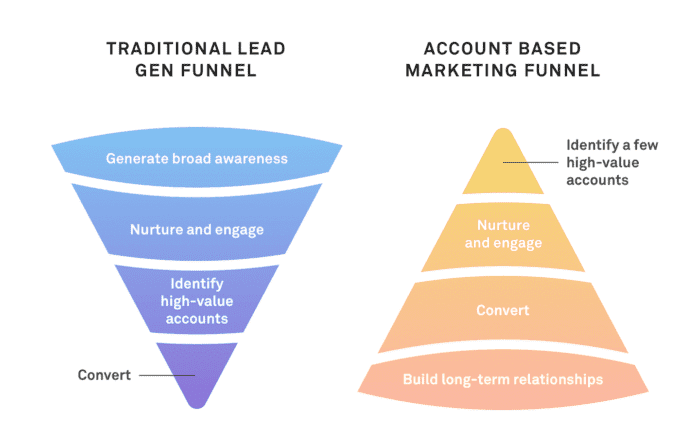
Source: Zoomforth
Traditional lead generation funnels start wide and filter down, whereas an ABM approach flips the funnel– you begin with identified target accounts, then expand engagement (land and expand) within those companies (4). This ensures your resources are spent on the best-fit accountsmost likely to drive revenue.
By treating each target account as a “market of one,” ABM enables highly personalized messaging. Marketing content, ads, emails, and even events are tailored to the specific business and pain points of the account. For example, instead of a generic whitepaper, an ABM campaign might deliver a custom case study addressing how your solution can solve Acme Corp’s known challenges in fintech compliance. This relevance gets the attention of busy decision-makers. No wonder 56% of marketers say personalized content is critical to ABM success (8).
In plain terms, what is account-based marketing? It’s a strategic B2B approach where we focus on the accounts that matter most and give them white-glove treatment. Rather than fishing with a wide net, we’re spearfishing the big, right fish – with customized bait on every hook.
Why Omnichannel ABM Matters in 2026 (Engaging B2B Buyers Across Touchpoints)
B2B teams that engage target accounts via 3 or more channels see a 72% increase in customer engagement.
Reference Source: AdRoll
Today’s B2B buying journey is complex and omnichannel – buyers interact with dozens of touchpoints (emails, LinkedIn, ads, webinars, calls, website content, etc.) before making a decision. They also loop in multiple stakeholders along the way. To succeed, your account based marketing strategy in 2026 must meet buyers wherever they research and engage. Omnichannel ABM means coordinating your outreach across every relevant channel to create a cohesive, persistent presence with target accounts.
Why is this so important now? Consider these realities:
- Independent Research is the Norm: Modern buyers perform extensive independent research. Gartner finds a majority of B2B buyers prefer a rep-free experience for much of the journey. They consume content, read reviews, and compare solutions online. If your brand isn’t consistently visible across channels during this self-guided research, you risk being invisible when buyers are forming opinions.
- Multiple Stakeholders: A typical B2B purchase involves 6–10 decision-makers or more. Each may favor different channels – a technical lead might engage with your engineers on a webinar while a CFO reads an ROI whitepaper. An omnichannel account based marketing approach ensures you cover all bases – email sequences, LinkedIn outreach, targeted ads, live events, and even direct mail or gifts – to reach each stakeholder in the format they’re most receptive to.
- Coordinated Messaging Builds Trust: Orchestrating messages across channels creates repetition and reinforcement. A target account might see a helpful blog post you wrote (content marketing), receive a personalized email from their assigned SDR, notice your company’s comment on their LinkedIn post, and later hear from a salesperson who references all these interactions. This multi-touch cadence builds familiarity and trust. In fact, marketers report about 72% improved engagement by implementing multi-channel ABM strategies – prospects respond better when they’ve encountered your value prop in various contexts (1).
- Higher ROI: Omnichannel ABM isn’t about doing everything everywhere; it’s about doing what matters in a synchronized way. By targeting precise accounts with tailored content through the right mix of channels, you reduce waste on low-fit leads and increase meaningful interactions. The outcome is often higher ROI. For example, companies aligning account-based advertising with ABM saw 60% higher win rates in deals (2). And overall, 76% of marketers say ABM yields higher ROI than other marketing initiatives. These gains come from focusing resources on the most promising prospects and reinforcing your message from multiple angles.
In short, omnichannel ABM is crucial in 2026 because B2B buyers are everywhere – and you need to be everywhere they are. A single-channel approach (say, just cold emails or just events) leaves blind spots. A coordinated omnichannel approach ensures your account-based marketing strategy actually reaches and resonates with busy decision-makers across every stage of their journey.
Stat Highlight: Multi-Channel Impact
B2B teams that engage target accounts via 3 or more channels see a significant lift in results. Approximately 72% of marketers reported a substantial boost in customer engagement after implementing multi-channel ABM campaigns (2). The lesson? Don’t rely on just one channel – your high-value accounts should see your message on LinkedIn, in their inbox, at virtual events, in search, and beyond.
Benefits of Account Based Marketing (Why ABM Delivers Results)
ABM leads to a 208% increase in marketing-generated revenue over three years.
Reference Source: The ABM Agency
Why are so many B2B organizations doubling down on ABM? Simply put, account-based marketing works. It delivers tangible benefits that traditional broad-based marketing often struggles to match. Here are some key account based marketing benefits, backed by data:
- Higher ROI and Revenue Impact: ABM is famously ROI-positive. In survey after survey, marketers testify that ABM drives better returns. For instance, 72% of ABM users say it delivers higher ROI than other marketing efforts (2), and 97% of marketers report ABM yields a higher ROI than non-ABM tactics (1). This isn’t just hype – by concentrating spend on the best-fit accounts and customizing the approach, ABM programs waste far less budget on long-shot leads. The revenue impact is dramatic: companies implementing ABM have seen a 208% increase in marketing-generated revenue over a three-year period (7). In one case, Payscale’s marketing team turned to ABM and saw a 6X increase in revenue ROI within seven months (2). These numbers underscore that ABM isn’t just effective marketing – it’s effective business.
- Bigger Deal Sizes & Pipeline Growth: ABM aims at high-value accounts, so it often produces larger deals and more pipeline. By focusing on quality over quantity, you engage accounts that have the potential for big contracts or repeat business. 73% of marketers report ABM increases deal sizes by focusing on lead quality (3). Many ABM practitioners see their average contract value climb significantly. Additionally, 84% of companies see pipeline growth as a result of ABM (3)– because ABM targets accounts that truly need your solution, they progress through the pipeline faster and more often. In short, ABM helps you close bigger deals faster.
- Better Sales & Marketing Alignment: ABM by design brings sales and marketing together, since both collaborate on target account selection, messaging, and outreach. This alignment is incredibly valuable. Organizations with tight sales-marketing alignment via ABM see higher productivity and win rates. 93% of marketers say a fully aligned sales and marketing team is vital to ABM success (3). When everyone is rowing in the same direction (with the same account goals), you eliminate the friction and lead misqualifications that plague many funnels. ABM essentially forces a “one team” mentality – and the business benefits from that unity.
- Improved Engagement & Relationships: Because ABM is personalized, target accounts respond with higher engagement. Instead of generic spam, they receive relevant insights and offers. One study found 75% of B2B marketers said ABM lets them engage with the right buyers earlier in the buying process (2). By engaging earlier and more meaningfully, you build stronger relationships. In fact, companies using ABM have reported an 84% improvement in reputation and 80% better customer relationships in their target accounts (2). Decision-makers appreciate vendors who take the time to understand their business. ABM’s tailored outreach does exactly that, fostering trust. That trust not only helps win deals – it also improves retention. 85% of B2B companies say ABM is crucial for retaining and expanding client relationships (3). In practice, ABM often translates to more upsells and cross-sells because you continue nurturing the account post-sale with the same personalized attention.
- Higher Conversion Rates: ABM can dramatically improve conversion rates at each stage of the funnel. For example, instead of converting 1% of unknown leads to SQLs like in some mass campaigns, an ABM program might convert 20% of targeted contacts to opportunities – because they were pre-qualified as a good fit and received bespoke messaging. Research shows ABM strategies can improve conversion of Marketing Qualified Leads to sales opportunities by an average of 25% (1). Moreover, by the time an ABM-nurtured account is talking to sales, they are often more sales-ready (having consumed customized content), leading to faster sales cycle. In one case, Dialpad used ABM to target accounts and saw 52% of deals close faster than before (2). That acceleration is a huge competitive edge.
- Efficiency and Focus: An underrated benefit of ABM is efficiency. Instead of your marketing team juggling disparate campaigns for different personas and regions, ABM focuses their effort on who matters most. This often means fewer, more impactful campaigns. It also means sales spends time on quality meetings instead of chasing lukewarm leads. By concentrating on high-probability accounts, companies avoid boiling the ocean and save time and money. On average, companies dedicate 29% of their marketing budget to ABM (1) – a significant share, but one that pays off given the outsized results. Some top performers allocate even more (top B2B firms allocate ~18% of total budget to ABM, compared to 14% for others) because they see the efficient growth it drives.
In summary, the benefits of account-based marketing include greater ROI, bigger and faster deals, stronger alignment between teams, deeper customer relationships, and more efficient use of resources. ABM is a win-win: prospects get a personalized, relevant buying experience, and you get higher conversions and loyalty. In 2026, these benefits are magnified by technology (data, AI, marketing automation) that makes ABM more scalable and precise than ever. If you’re looking for a strategic advantage, ABM provides one by focusing your organization on what truly moves the needle – the right accounts, with the right approach.
Account-Based Marketing Strategies and Approaches (From B2B Playbooks to Tiered ABM)
91% of B2B tech marketers use intent data to prioritize accounts and build target lists.
Reference Source: G2 Learning Hub
Designing an effective account-based marketing strategy requires a blend of art (personalization, creativity) and science (data, process). Let’s explore some core ABM strategies and approaches that B2B teams are using to engage high-value accounts in 2026.
1. Tiered ABM Approach (1:1, 1:Few, 1:Many): Not all target accounts are equal – some may be huge strategic whales, others mid-tier opportunities. A common ABM strategy is to segment target accounts into tiers and adjust your personalization effort accordingly:
- Tier 1 – 1:1 ABM: These are your top, “dream” accounts (maybe the top 5–20 accounts) that get white-glove, highly personalized campaigns. For each Tier 1 account, you build a custom marketing plan. Content is often one-to-one (e.g. a custom microsite or a proposal tailored exactly to that account’s situation). Sales executives and marketing collaborate closely on these. It’s resource-intensive, but worth it for multi-million deals.
- Tier 2 – 1:Few ABM: The next tier might include, say, 20–50 important accounts grouped by similar attributes (industry, need, or region). Here you use a “cluster” approach – campaigns are personalized to each cluster (one message might serve 5 accounts because they’re in the same vertical and face similar pain points). There’s still significant personalization (perhaps custom by industry or role), but not fully bespoke per account. This balances scale and relevance.
- Tier 3 – 1:Many ABM: The broader set of target accounts (could be 100–1000 accounts depending on your TAM) where you apply light personalization at scale. This often resembles targeted demand gen – you might use programmatic ads, broad email sequences, or content marketing that is slightly tailored (e.g. by company size or persona) but largely automated. Tier 3 ABM might leverage ABM software to send scalable personalized messages (like inserting company name or industry into templates). It’s still ABM because you’re working off a specific account list, but it’s the “lighter touch” approach. One-to-many ABM is often owned by marketing, with sales only engaging once interest is shown.
This tiered strategy ensures you invest the right effort proportional to potential value. Many companies find that combining all three approaches yields the best results – ultra-focused effort on the biggest accounts, while still nurturing a wider set of targets with efficiency.
2. Ideal Customer Profile(ICP) and Target Account Selection: At the heart of ABM strategy is knowing who to target and why. Successful ABM programs start with a clear Ideal Customer Profile – a definition of the firmographic, demographic, and technographic attributes that make an account a great fit (e.g. industry, company size, region, tech stack, pain points). With an ICP in hand, you then select target accounts that match it closely. This selection can be aided by data and intent signals. For example, you might choose accounts that have recently hired a new CTO (signaling tech initiatives) or that are searching for solutions like yours (intent data). Some organizations leverage predictive analytics or intent data providers to prioritize accounts with the highest likelihood to buy. In 2026, 91% of B2B tech marketers use intent data to prioritize accounts and build target account lists (3). The approach is to be highly strategic about whom you target – it’s better to have a precise ABM list of 50 likely-to-convert accounts than a random list of 5,000. The motto here is quality over quantity.
3. Personalization and Messaging Strategy: ABM strategies hinge on deep personalization – but personalization goes beyond just inserting a name in an email. It involves developing insights for each account (or cluster of accounts) and crafting messaging that speaks to their specific business challenges and goals. An ABM approach often includes account research (reading annual reports, LinkedIn posts, news) to find hooks. For example, if a target account’s CIO publicly says “AI adoption is our priority next year,” your ABM campaign can lead with how your product enables AI success. One tactic is to create Account Plans – internal playbooks for each account outlining key stakeholders, their likely priorities or KPIs, recent triggers (like funding, product launches), and relevant case studies. From this, you derive tailored value propositions. Personalized content is key: think custom demos, tailored whitepapers, or even something like sending a physical book on a topic you know the prospect cares about. According to research, 56% of marketers say that personalized content is critical to ABM’s success (8). The strategy is to make the prospect feel, “Wow, they really understand our business.”
4. Sales and Marketing Alignment & Orchestration: ABM is not just a marketing initiative – it’s a coordinated go-to-market approach. A cornerstone of ABM strategy is aligning sales, marketing, and often customer success teams to work in lockstep on target accounts. This involves shared goals (e.g. X% pipeline from target accounts, Y new ABM deals closed), regular account stand-ups or war-room meetings, and clarity on roles. Marketing might handle top-of-funnel air cover (ads, initial outreach), while SDRs do personalized email and LinkedIn outreach, and sales execs handle face-to-face or high-level engagements. The timing of touches is orchestrated so as to reinforce each other rather than overlap awkwardly. For example, marketing can trigger a direct mail gift to an account a week before the sales rep is scheduled to call – warming them up. Only 36% of companies say their sales and marketing are tightly aligned in ABM efforts (1), so a huge strategic focus should be improving that alignment. Many companies designate ABM “strike teams” or pods – a marketer, SDR, and sales rep jointly responsible for a set of accounts, meeting weekly to coordinate. The strategic approach is team-based: everyone who touches the account shares context and coordinates next steps. This alignment is what turns isolated tactics into a powerful, unified campaign.
5. Use of Data and Technology (Smart ABM): Today’s ABM strategies are turbocharged by data and tech. An effective approach leverages account based marketing data alongside account-based marketing software and tools for account selection, personalization, and measurement. For instance, many teams use an ABM platform (like Demandbase, 6sense, or Terminus) to identify which target accounts are showing surging interest (intent data) and to run coordinated account-based ads. In fact, 72% of companies use an ABM platform to manage their programs (3), and 71% of ABM marketers employ marketing automation tools to scale their efforts (3). The strategy is to integrate these tools with your CRM so that as accounts engage, both marketing and sales see the activity. Real-time data – e.g. alerts when a target account visits your pricing page – allows your team to respond quickly with relevant outreach. Leading ABM programs also enrich their account data with insights: technologies can tell you the org chart of the buying committee, or whether the account uses a competitor’s product, informing your approach. The strategic mindset is data-driven personalization: using analytics to constantly refine who you target, when you reach out, and what message you deliver.
6. Full-Funnel ABM (Beyond Acquisition): While ABM often starts as a new-business acquisition strategy, many organizations are evolving it into a full-customer-lifecycle approach. This means applying ABM principles to upsell/cross-sell campaigns and customer retention. Sometimes called Account-Based Experience (ABX) (more on that shortly), this approach ensures marketing and sales continue tailoring efforts to existing accounts to expand revenue and prevent churn. A strategic ABM plan in 2026 often includes separate plays for “land” (acquire new), “expand” (grow existing), and even “advocate” (turn customers into champions) within key accounts. By treating current customers with the same ABM focus, companies drive account growth and loyalty. After all, the easiest new sale might be to a happy customer. ABM’s focus on relationship-building and personalization lends itself well to nurturing customers over the long term.
In crafting your ABM strategy, remember to think long-term and holistically. ABM is not a one-off campaign or a short-term blitz; it’s an ongoing strategic approach. It often requires a cultural shift – marketing and sales truly working as one – and a willingness to iterate. Start with a pilot if you’re new (a handful of accounts to test and learn), then scale up. The approaches above – tiering your accounts, aligning teams, personalizing deeply, leveraging data, and expanding across the full funnel – form the B2B account based marketing strategies that top B2B organizations are using to dominate their markets.
Finally, keep an eye on the benefits of account-based marketing as your guiding light. If ever in doubt, return to the question: “Will this tactic help us engage a specific high-value account more effectively?” If yes, it’s probably ABM; if not, reconsider your approach. ABM is all about strategic focus.
Building Your Account-Based Marketing Plan (Step-by-Step Guide)
At any given time, only around 5% of B2B accounts are actively in a buying cycle.
Reference Source: UnboundB2B
Having a strategy is important, but execution is where the rubber meets the road. Let’s translate the strategy into an account based marketing plan – a step-by-step process to plan and launch an omnichannel ABM program. Whether you’re starting ABM from scratch or refining an existing program, these steps will provide a structured roadmap. We’ll break it down into 6 key steps, each critical for ABM success:
Step 1: Define Your Ideal Customer Profile and Target Account List
Every great ABM plan starts with knowing who you’re targeting. Begin by defining your Ideal Customer Profile (ICP) – the attributes that make an account a perfect fit. Consider firmographics (industry, company size, location), pain points you solve, technologies used, and any existing intent signals. For example, your ICP might be “Financial services companies in North America with 500+ employees that need cloud security solutions.” Use historical data: look at your best customers and identify common traits.
Once ICP is clear, build your target account list. This is the cornerstone of your ABM plan. Compile a list of companies that match the ICP. You can source this list from your CRM, third-party databases, LinkedIn, industry lists, etc. Aim for a manageable number – you might start with 50 or 100 accounts for a pilot, or a few hundred divided by tier as discussed earlier. Quality trumps quantity. It’s often helpful to involve Sales in this process – host a workshop to have sales reps nominate high-value accounts they’d love to win. Ensure alignment on the final list; both sales and marketing should be excited about focusing on these accounts.
Don’t forget to prioritize and tier the list. Identify which are Tier 1 (the highest value, perhaps 1:1 focus), Tier 2, and Tier 3. This will influence how much resources you dedicate per account. Document the list and tiers, as your entire ABM plan revolves around it.
Pro Tip: Leverage data tools to prioritize accounts showing buying intent. For instance, if an account is surging on intent keywords related to your product, move it up the priority list. Remember, at any given time only around 5% of B2B accounts are actively in a buying cycle – your plan should focus on discovering and targeting that 5% (9). Data providers (Bombora, G2, etc.) or your own website analytics can highlight which accounts are “hot” right now.
Step 2: Align Your Team and Set ABM Objectives
Now that you know which accounts you’re going after, ensure your sales and marketing teams are fully aligned and establish clear goals. ABM is a team sport – this step is about getting everyone on the same page and energized.
First, bring together key stakeholders: marketing leaders, sales managers, SDR/BDR leads, and even customer success if upsell is a focus. Communicate the why of ABM – for example, “We’re focusing on these 100 accounts because they represent $X potential and fit our sweet spot.” Ensure buy-in that these accounts are top priority.
Next, clarify roles and responsibilities. Who will do what for each account? For instance: Marketing will handle account research, create personalized content, and run ads; SDRs will execute personalized outreach (emails, LinkedIn, calls) to contacts at those accounts; Sales executives will lead the conversations once an opportunity is identified and build relationships with senior buyers. Define any SLA (service-level agreements) – e.g. “SDRs will follow up on any target account engagement within 24 hours” or “Marketing will provide custom content for Tier 1 accounts upon Sales request within 5 days.” This prevents confusion and gaps. Given that only 36% of companies executing ABM feel their sales and marketing are tightly aligned, making alignment explicit in your plan is critical (1).
Set specific ABM objectives and KPIs so everyone knows what success looks like. These could include:
- Engagement goals: e.g. “Engage at least 3 stakeholders per target account per quarter” or “Achieve 50% of target accounts visiting our site within 6 months.”
- Pipeline/revenue goals: e.g. “Generate $5M in pipeline from ABM accounts in FY2026” or “Close 10 new Tier 1 ABM accounts by year-end.”
- Activity goals: e.g. “Each SDR to send 20 personalized emails and 5 calls per account per month” or marketing to “deliver 2 custom assets for each Tier 1 account this quarter.”
Make sure these goals are realistic but ambitious. Also decide how you’ll measure and report progress (more on metrics later). By setting clear goals, you create accountability. For instance, if one goal is higher C-suite engagement at accounts, you might track how many CIO/CEO-level contacts responded to your outreach – aligning everyone to up-level their messaging.
Lastly, schedule regular ABM team syncs. For example, a bi-weekly meeting between marketing and sales to review account progress, share insights (e.g., “Account X downloaded our eBook, time for SDR to reach out”), and adjust tactics. This cadence keeps alignment strong. Many ABM teams also use a shared dashboard or Slack channel to collaborate in real-time on accounts.
In summary, step 2 ensures “ABM alignment” – your team operates as one unit with shared targets and clarity on execution. When done right, this fosters a culture of collaboration and enthusiasm. People stop saying “marketing’s leads” or “sales’ accounts” – they’re our accounts and we’re working them together.
Step 3: Research Each Account and Develop Personalized Content
With your team ready to go, it’s time to dig into each target account and gather insights that will power personalization. Think of this step as doing your homework – the more you know about an account, the more relevant (and successful) your outreach will be.
Start with account research. For each Tier 1 and Tier 2 account (and even Tier 3, though perhaps at a lighter level), answer questions like:
- What does the company do, and what are their current strategic initiatives or challenges? (Check annual reports, press releases, industry news.)
- Who are the key decision-makers and influencers for your product/service? (Identify names/titles – e.g. CTO, VP of Operations, Head of Procurement, etc., using LinkedIn or a contact database.)
- Have they made any recent moves – new funding, new leadership hires, mergers, product launches? These can signal a need for your solution or simply provide a timely conversation starter.
- Are they a current customer of a competitor? (If yes, you might craft a pitch around differentiators or when that contract is up for renewal.)
- What content have they engaged with from you, if any (past webinar attendee, visited your site)? If you have an ABM tool or web analytics, review any activity by that account.
- What do their executives talk about on LinkedIn or in interviews? Often, an executive will mention a pain point or goal (“Our goal is to improve supply chain efficiency by 20% next year”) – golden information to tailor your messaging.
Document these insights in an Account Brief or dossier for each account. Even a one-page summary is hugely helpful for crafting personalized outreach.
Next, develop personalized content and campaign assets tailored to those accounts or clusters. This is where marketing shines in an ABM plan. Some effective personalized content tactics:
- Personalized Emails/Letters: Draft email templates that speak directly to the account’s situation. For example, reference the account’s known challenge (“As Acme Corp. expands globally, ensuring consistent cloud security is probably on your radar…”) to show you’ve done your homework.
- Customized Content Offers: Create or adapt content specifically for the account. For a Tier 1 account, you might create a custom “Executive Brief” – basically a case study or value proposition write-up that uses the account’s name and scenario. For clusters of Tier 2 accounts, maybe develop an ebook addressing common pain points in their industry, with data or examples relevant to them.
- Dedicated Landing Pages or Microsites: Build a bespoke landing page for an account (or a set of accounts). For instance, a page titled “How We Help [Account Name] Succeed” that contains curated content, testimonials from similar companies, and messages like “Hello [Account] team”. This level of personalization can impress. Tools exist to dynamically change landing page text to insert account names or logos for a “wow” factor.
- Webinars or Workshops for Specific Accounts: Invite the buying team of a target account to a private workshop or briefing tailored for them. For example, “We’ve prepared a demo based on [Account]’s use case” – this is a tactic to deepen engagement once initial interest is there.
- Direct Mail or Gifting: In our digital age, a physical touch can stand out. Consider sending a relevant book, a useful swag item, or even something fun like a custom puzzle that ties into your value prop. The key is it should be highly relevant. A playful example: for a target account in the automotive sector, a company once sent a toy model car with a note “Let’s build your next-gen engine together” – quirky but memorable. Always pair direct mail with your messaging strategy (and be mindful of remote work – home addresses vs. office).
- Account-Specific Ads: Use ad targeting to your advantage. Platforms like LinkedIn allow targeting specific companies. You can run a campaign of ads that mention the company’s industry or mirror their language, so people from that account see very aligned messaging (“[Account’s Industry] Leaders: Here’s How to Solve X”). These ads make them feel your brand is everywhere (because, for them, it is!).
The objective in this step is to arm your team (especially sales and SDRs) with ammunition that resonates. A one-size-fits-all brochure won’t cut it for ABM. You need content pieces that make the prospect think, “This was made for us.” When they feel that, you earn the right to their time.
One stat to reinforce the effort here: Highly personalized ABM content yields 72% higher engagement rates among target accounts. In other words, the extra work you put into personalization directly pays off in more replies, more meetings, and more trust.
Finally, ensure that marketing and sales are coordinated on how to use this content. If marketing creates a custom slide deck for an account, the sales rep should know the story it tells. ABM is like a relay race – marketing might open the door with content, then sales walks through it with a consultative discussion. Make sure the baton handoff is smooth by collaborating on content creation and usage.
Step 4: Engage Accounts with Omnichannel Tactics (Coordinated Outreach)
With your account intel gathered and personalized content in hand, it’s time to execute the outreach – hitting those accounts through multiple channels in a coordinated way. This is where the omnichannel ABM strategy truly comes to life. The plan should outline which channels you’ll use for each tier of accounts, and how you’ll orchestrate touches so they complement each other.
Key channels and tactics to consider in an ABM outreach plan:
- Email Outreach (Personalized Campaigns): Email is often the workhorse of ABM communication. Plan a sequence of highly relevant emails to key contacts at each account. These shouldn’t feel like mass emails – they should read as one-to-one notes. Use the insight from Step 3 to craft these. For example, an email might start “Hi [Name], I noticed your CTO’s recent interview about improving supply chain speed. Since we’ve helped others in your industry cut order fulfillment time by 30%, I wanted to share an idea for [Account]…” Keep sequences short (e.g. 3-5 emails over a couple of months, rather than 15 automated drips) and adjust based on responses. Many ABM teams have SDRs send these manually or via semi-automated tools that allow customization. Track who opens or clicks – it’s a signal of interest.
- LinkedIn and Social Touches: In B2B, LinkedIn is gold for ABM. Connect with target stakeholders, share content, and engage with their posts if appropriate. Your plan might assign each SDR to send connection requests to X number of contacts per account, with a brief personalized note. Once connected, don’t pitch immediately; instead, nurture by sharing helpful content or commenting on their posts (genuinely). Additionally, LinkedIn InMail can be used sparingly for a direct message – sometimes a friendly note referencing a common connection or congratulating on a company achievement can start a conversation. LinkedIn is considered the most effective social platform for B2B ABM – about 79% of B2B marketers rate LinkedIn as the top platform for high-quality lead gen. Incorporate it into your channel mix for sure (1).
- Phone Calls (Targeted Calling): Cold calls get a bad rap, but in ABM these aren’t really “cold” – you’re calling with context and often after warming up via other channels. Your plan should identify the key contacts that merit a direct call. Typically, after an email or two, a call to follow up can work (“I emailed you last week about idea X, and thought I’d try you live as well”). Ensure the caller (SDR or sales) is armed with the account research so they can have an informed conversation. Even voicemails can be personalized (“We work with companies like [Account] and had an insight that might be useful for you – I’ll email it as well”). Coordinate calls with emails – e.g., schedule call tasks the day after an important email goes out, so the reference is fresh. By integrating calls, you add a human touch that many digital channels lack. In our experience, a well-timed call can accelerate an opportunity or at least gather intelligence (maybe you learn who the real decision-maker is).
- Digital Advertising (Account-Based Ads): If budget allows, run targeted ad campaigns focused on your target accounts. This can include LinkedIn Sponsored Content targeting specific companies or job titles, programmatic display ads using ABM ad platforms (like RollWorks, Demandbase, etc.) that can serve banners just to your account list, and even Google Ads using IP targeting for key accounts searching certain keywords. These ads raise awareness and make your company feel ubiquitous. For example, an account’s exec might see your LinkedIn ad about a webinar for their industry, then later see a display ad with a case study of a similar company – these impressions reinforce your credibility. According to AdRoll, account-based advertising campaigns can increase target account engagement by 72% (2). Be sure to have a clear message in ads and often it’s best to drive ad clicks to the personalized landing pages you created in Step 3 (so the experience stays account-specific).
- Content Marketing & Thought Leadership: This is a softer channel, but include it in your plan. Continue publishing high-quality content (blog posts, reports, videos) that would be valuable to your target accounts. You can then directly share these with accounts (“Thought you might find this article we wrote useful, it addresses a challenge you’re facing”). Additionally, consider inviting target account contacts to your webinars or events that speak to their interests. This way, some of your touches are delivering pure value with no ask. Over time, your content positions you as a trusted advisor. It’s especially effective when an account isn’t ready to buy yet – staying on their radar with educational content keeps you top-of-mind until they are ready.
- Events (Virtual or In-Person): Events can be powerful ABM plays. This includes hosting small roundtables or executive dinners for select accounts, inviting them to your company’s customer summit, or simply arranging a tailored demo session. In 2026, hybrid events are common – maybe you do a virtual “VIP briefing” for several target accounts at once, or invite a single account’s team to your office for a custom workshop. These live interactions deepen relationships. Plan out if/when during the year you’ll use events. For example, some companies concentrate ABM events in Q3 to build pipeline for Q4. Even if events are virtual, make them special (send a lunch via Uber Eats to participants, etc.). These touches, while resource-intensive, can be the tipping point for a deal – especially with high-level decision-makers who value personal interaction.
- Direct Mail and Gifting: As noted earlier, sending physical items can complement the digital cadence. Schedule these strategically – for instance, after a few unreturned emails, sending a package might get a response (“We sent you a little something”). The plan might include one round of direct mail per Tier 1 account per quarter, as budget allows. Ensure what you send is thoughtful and ideally ties into a campaign theme. If you have an account in the healthcare sector and your pitch is about “precision”, maybe send a quirky gift like a laser pointer or a customized stethoscope with a note about precision – something memorable. Always follow up to ask if they received it, using it as a conversation opener.
Now, the critical element is orchestration. Omnichannel doesn’t mean random blasts on all channels. It means weaving them together in a logical sequence. Your ABM engagement plan should map out a timeline of touches for the first few months of outreach to each account. For example:
- Week 1: Intro email #1 from SDR.
- Week 2: LinkedIn connection request from SDR; targeted LinkedIn ad starts running.
- Week 3: Follow-up email #2 with a case study; SDR phone call attempt.
- Week 4: No outreach (let them breathe) but they see retargeting ads or receive a piece of content via marketing.
- Week 5: Send direct mail package.
- Week 6: Email #3 referencing the mailed item (“Hope you got the ___ we sent – it reminds us of [reiterate value prop]…”); schedule a call task.
- Week 8: Invite them to an upcoming webinar or event.
- … and so on.
This is just an example; the actual cadence will vary. The key is consistent but not annoying. Use multiple channels so you’re not overloading one channel. And respond to engagement signals: if they clicked an email link, maybe escalate the outreach; if they’ve been radio-silent despite everything, maybe downgrade frequency or revisit later.
A quick data point: It often takes 8-12 touchpoints to get an initial meeting with a new stakeholder in a target account. Don’t get discouraged if one email or call doesn’t land – persistence across channels, done professionally, pays off. Buyers will notice your respectful relentlessness and often appreciate the tailored value you’re offering.
Lastly, incorporate an ABM cadence tool or at least a tracking sheet to manage this. Many teams use CRM tasks or specialized sales engagement platforms to schedule multi-channel sequences. You want to avoid any prospect falling through cracks or getting duplicate touches on the same day from different people. Coordination is crucial.
Step 5: Build Relationships and Nurture Key Contacts
Winning at ABM is not just about the initial outreach – it’s about cultivating genuine relationships inside target accounts. As engagements begin (responses, conversations, meetings), shift from “campaign mode” to “relationship mode.” This step is ongoing: while steps 1-4 were about planning and launching your program, Step 5 is about the human touch over the months (and years) to come with each account.
Here’s how to nurture and deepen relationships with your target accounts:
- Listen and Learn: Once a dialogue opens with a contact, make it a two-way conversation. Ask questions to understand their needs, challenges, and even personal interests. The more you learn, the more you can tailor subsequent interactions. Take notes in your CRM about personal details (maybe one contact loves golf, another has kids applying to college – little things that can personalize chit-chat later). This isn’t about stalking; it’s about treating them as people, not just prospects.
- Provide Value at Every Interaction: Ensure that each touchpoint offers something useful, not just a sales pitch. This could be sharing a relevant insight (“I saw new regulations were proposed in your industry; here’s our brief on how it might affect companies like yours”), connecting them with a peer or reference (“You mentioned interest in how others solved X – would you like to speak with our client [Name] who did this recently?”), or simply sending along a research report or article they might find interesting. When you consistently help without always asking for the sale, you build trust. Over 80% of businesses report improved relationships with target accounts through ABM (2), precisely because ABM encourages this helpful, account-focused mindset.
- Engage the Whole Buying Committee: A key ABM principle is multi-threading – building relationships with multiple stakeholders in the account. Don’t rely on a single champion. Use LinkedIn and referrals within the account to expand your web. For example, if you’re talking to a Director, politely ask, “Who else on your team is involved in this initiative? Perhaps we could set up a session for them as well.” By engaging more people, you increase your influence and also reduce the risk that one contact going dark kills the deal. Data shows that ABM practitioners engage C-level executives at double the rate of non-ABM approaches (2) – because ABM targets them deliberately. So, ensure your nurture plan includes touches for senior execs too (e.g., send the CIO a quarterly insight brief or invite the CFO to an executive roundtable).
- Personal Touches & Authenticity: People can sense insincerity a mile away. While ABM is structured, the relationship-building must remain authentic. Be genuinely curious about their business. If appropriate, congratulate them on company milestones or personal achievements (LinkedIn is great for triggering these notifications like “So-and-so just had a work anniversary”). Simple gestures – like remembering a detail from an earlier chat and bringing it up later – show that you care and pay attention. Authenticity builds rapport. As one best practice, drop the corporate jargon when in direct conversations; speak like a human trying to help, not like a sales brochure.
- Stay Top-of-Mind (Politely): You want to be present without pestering. If an account goes a bit quiet, find lightweight ways to remain visible. Perhaps comment on a LinkedIn post of theirs (“Great insight, thanks for sharing!”) or send a friendly check-in email sharing a new case study. The idea is to not let the relationship fizzle. That said, also read the room – if they indicate they’re not interested right now, give them space but leave the door open (“Understood – I’ll touch base in a couple of months to see how things are going.”). Then actually follow through.
- Leverage Customer Success (for existing customers): If the target account is already a customer and you’re expanding (ABM can be used for cross-sell), involve your customer success managers. They often have existing rapport. Align on expansion goals and let the CSM help nurture relationships internally (“Hey client, did you know we also solve this other problem? Let’s bring in a specialist to discuss…”). In ABM, account expansion strategies have led to significant revenue growth – in fact, companies attribute 73% of their total revenue to existing accounts where ABM is applied to expand/retain (3). So relationship-building isn’t just pre-sale; it’s a continuous process post-sale too.
- Be Patient and Persistent: Especially for large enterprise accounts, deals can take time. ABM is a long game. Your plan should account for a nurturing period that might be 6, 12, even 18+ months for mega-deals. Don’t give up too early. Regularly revisit and adjust your approach based on feedback. Maybe after 6 months you realize messaging A isn’t resonating, but messaging B gets some nods – pivot accordingly. The persistence will pay off; remember, you chose these accounts for a reason (high value). One marketing leader aptly said, “ABM is like farming, not hunting – you’re cultivating the soil and patiently growing the relationship.” That cultivation can yield a bumper crop if tended well.
Building strong relationships is ultimately what account-based marketing is all about. It’s in the name – account-based – meaning you treat the account as the unit of focus, and within that, the people as long-term partners. By following these nurturing practices, you’ll transform cold target accounts into warm relationships and, with time, into loyal customers and even advocates.
Step 6: Measure ABM Success and Optimize (ROI & KPIs)
No playbook would be complete without covering how to measure success. ABM can sometimes be tricky to measure using traditional metrics, because it’s not just about lead volume. In this final step, you’ll set up how to track performance, prove ROI, and continuously improve your omnichannel ABM efforts.
Define Your KPIs: Early on (back in Step 2) we set overall ABM objectives. Now let’s ensure we have specific Key Performance Indicators (KPIs) and a system to track them. Common ABM KPIs include:
- Account Engagement: e.g., number of target accounts that engaged with you in a given time period (visited site, responded to outreach, attended event). You might aim for, say, “engaged 40% of target accounts in Q1.”
- Meetings/Opportunities from Target Accounts: Track how many sales meetings or qualified opportunities were created from the ABM account list. This is a concrete output of your efforts.
- Pipeline and Revenue: The ultimate metrics – how much pipeline (value of deals in pipeline) and how much closed-won revenue is attributable to ABM accounts. For instance, “$3M pipeline and $1M closed won from ABM accounts in H1.”
- Conversion Rates: Within the ABM funnel, measure stage-to-stage conversion. For example, what % of engaged accounts move to opportunity? What % of opportunities close? Compare these to baseline or to non-ABM benchmarks to demonstrate efficiency gains.
- Deal Size and Sales Cycle: You can measure if ABM deals have higher average contract value (ACV) or shorter/longer sales cycles. Often ABM deals are larger (since they’re high-value accounts) but it’s good to quantify (“ABM wins have 20% higher ACV on average”).
- Channel-specific Metrics: You can also track micro-metrics like email response rates, ad click-through rates from target accounts vs. generic benchmarks, event attendance by target accounts, etc. These help you optimize tactics.
Set up dashboards in your CRM or analytics tools to monitor these. For example, create a report that filters pipeline by “Target Account = true” so you can easily see ABM pipeline. Many ABM platforms and CRMs now have account-centric reporting that show engagement scores per account, which is handy.
Track ROI Specifically: Since ABM can involve significant resources (custom content, many hours of SDR/sales time), measuring ROI is crucial to justify the investment. A common question teams ask is how do you measure ROI in account based marketing. Start by defining how you will attribute revenue to ABM. A simple approach is to count any deal that comes from your target account list as “ABM revenue.” Then calculate ROI as:
ROI = (Revenue from ABM accounts – Cost of ABM program) / Cost of ABM program.
Cost should include marketing program costs, a portion of salaries, and tool costs devoted to ABM. If you find that calculation daunting, at least measure the revenue and pipeline from ABM accounts and compare it to your spend over time.
Industry surveys indicate that measuring ROI is a challenge – only about 52% of companies currently track ABM ROI effectively (1), and 40% of marketers cite ROI measurement as their biggest ABM challenge (3). Don’t let that discourage you. Even a rough calculation to start is better than nothing, and you can refine it as you go.
Review and Analyze Outcomes: Schedule regular checkpoints (maybe monthly internal reviews and a bigger quarterly review) to analyze ABM results. Look at which accounts are engaging and which aren’t:
- If certain accounts have shown zero engagement despite many touches, why? Perhaps they were not truly a good fit (review your ICP criteria), or perhaps your messaging/tactics need adjusting for that segment.
- Identify wins: Which accounts have moved to pipeline or closed? What did you do right there? For example, you might find that accounts in X industry responded really well to your webinar invite – indicating webinars work for that segment.
- Identify bottlenecks: Are you getting lots of meetings but deals stall in proposal stage? That might indicate you need better case studies or ROI proof to push them over the line. Or maybe engagement is great at mid-manager level but not reaching the C-suite – so you need to add an executive sponsor program.
- Gather qualitative feedback from sales: Since sales is in direct contact, get their perspective. Are the leads from ABM accounts more receptive? Are there objections that keep coming up? This info can help refine content and approach.
Use this analysis to optimize your ABM tactics continuously. For example, you might decide to reallocate budget from underperforming channels to those that are working (e.g., if LinkedIn Ads aren’t yielding as much, but your email + call approach is generating pipeline, double down on the latter). Or maybe your data shows that a certain sub-industry among your targets has been particularly responsive; you could develop more tailored content for them to accelerate momentum.
Communicate Results: As you measure, communicate the wins to the broader team and leadership. Share quick updates like “In the last 6 months, our ABM initiative engaged 60% of our target accounts, created 15 opportunities worth $4.2M, and closed $1M in new business.” These highlight the value of ABM. Also share learning points and improvements (“We discovered accounts respond better when we lead with use-case A vs use-case B, so we’re updating our outreach accordingly.”). Transparency keeps everyone bought in and informed that ABM is delivering.
One more point on optimization: Don’t be afraid to refine your target account list over time. ABM is not static. If an account consistently shows no signs of life or if your business strategy changes, you can swap it out for a new prospect. Conversely, you might add new high-potential accounts as you spot them. Keep an “ABM target list 2.0” in mind for each planning cycle, informed by data and input from sales (“hey, we should really target Company X, they’re showing a lot of interest in our space”).
By measuring diligently and being willing to pivot, you’ll ensure your B2B account based marketing tactics stay effective and efficient. The end goal is clear: demonstrate that ABM is contributing to real business outcomes (revenue, growth, retention), and use data-driven insights to sharpen your playbook.
Stat Highlight: ABM ROI and Growth
For perspective, these ABM statistics show that companies with strong ABM programs have attributed 73% of their total revenue to ABM efforts (3), and report 208% revenue growth over a few years by aligning ABM strategies (7). Also, 93% of B2B marketers in one survey said their ABM efforts have been “extremely or very successful” (3). Measuring results and iterating are what make those kinds of outcomes possible – if you can track it, you can improve it!
ABM’s Evolution: ABM vs. ABX (Account-Based Experience)
85% of B2B companies say ABM is crucial for retaining and expanding client relationships.
Reference Source: G2 Learning Hub
As we look toward 2026 and beyond, it’s worth noting that Account-Based Marketing is itself evolving. You may have heard the term Account-Based Experience (ABX) floating around. So, what is ABX and how is it different from (or related to) ABM?
Account-Based Experience (ABX) is essentially an extension of ABM that emphasizes the entire customer experience and lifecycle, not just marketing to prospects. When looking at ABX vs ABM, ABX can be seen as the evolution of ABM: it’s a unified, customer-centric approach where marketing, sales, and customer success work together to deliver a seamless, personalized experience from first touch to expansion (5).
Here are key points comparing ABM and ABX:
- Scope: Traditional ABM focuses primarily on marketing and sales efforts to acquire and close target accounts. ABX broadens the scope to include post-sale engagement – ensuring customers (once acquired) continue to receive personalized marketing, support, and outreach so they become long-term advocates. It breaks the silos between marketing, sales, and customer success.
- Approach: ABM, while personalized in marketing, can still be campaign-centric and sales-focused on closing deals. ABX, on the other hand, is experience-driven – it treats the account’s journey as one continuous experience. Every interaction, whether it’s a marketing email, a sales call, or a support ticket, is considered part of shaping the account’s overall perception of your brand. ABX asks, “Are we providing the right message and value at each stage of the journey and across all touchpoints?”
- Customer-Centricity: Both ABM and ABX are customer-focused, but ABX takes it further by putting the customer experience at the center. For example, ABX strategies might include proactively providing value to customers without a sales agenda (like inviting clients to educational workshops or providing implementation consulting) – things aimed at delighting the customer, not just upselling. The idea is if you deliver a stellar experience, revenue will follow through renewals and expansions.
- Alignment: ABM typically stresses marketing-sales alignment. ABX goes broader to align marketing, sales, and customer success/service. Under ABX, these teams share goals for both new business and customer retention/expansion. It’s a unified “revenue team” approach. For instance, a company practicing ABX might have cross-functional account teams that include a salesperson, a marketer, and a customer success manager all assigned to major accounts, ensuring consistency from prospect stage to client stage.
- Metrics of Success: ABM metrics we discussed are often pipeline and revenue from target accounts. ABX looks at customer experience metrics as well, such as customer satisfaction (CSAT), Net Promoter Score (NPS), customer retention rates, product adoption rates, etc., for those accounts. Essentially, ABX measures how happy and successful the account is, not just whether a deal closed.
Why does ABX matter? In many industries, delivering a superior customer experience has become a key differentiator. B2B buyers expect the same level of attention post-sale as they got pre-sale. If your marketing promised a white-glove experience, the account expects your onboarding and support to deliver that too. ABX ensures the promise made by marketing and sales is kept by the entire organization throughout the relationship. It helps drive higher lifetime value: happy customers buy more and stay longer.
It’s not ABM vs ABX in a competitive sense; rather, ABX is an evolution of ABM (6). You can think of it this way: ABM ignited the idea of focusing on the best accounts and personalizing marketing to them. ABX takes that torch and spreads the flame across the entire journey, ensuring consistency and care at every step.
For example, where ABM might run a marketing campaign to upsell an account on a new product, ABX would involve the customer success team to ensure the account is getting value from the current product (so they’re receptive to new offers), perhaps provide training or resources proactively, and time the upsell when the customer signals readiness – all in a coordinated way that feels like a continuous helpful conversation, not a segmented push.
Many ABM technology platforms and thought leaders (like Demandbase, Terminus, etc.) have been championing ABX as the next stage. And it aligns with the broader B2B trend of Revenue Operations and unified go-to-market teams.
So, if you’re already doing ABM and seeing success, ABX might be your next frontier: ensuring that once you land those high-value accounts, you continue treating them with an account-based mindset through their growth. In practical terms, you might formally involve your customer success managers in your ABM meetings, segment existing customers for account-based marketing (like running marketing campaigns specifically to increase adoption or cross-sell in current accounts), and track customer health metrics alongside new sales metrics.
To summarize: ABM vs ABX – ABM is account-centric marketing and sales; ABX is account-centric experience, encompassing marketing, sales, and service. ABX doesn’t replace ABM, it builds on its foundation (5). Both share the core principle of focusing on the accounts that matter most and treating them specially. As you mature in your ABM journey, adopting an ABX philosophy can maximize the value and ROI of each account by extending that personalized treatment across the lifecycle. In the end, it’s all about putting the customer/account at the center of everything – which has been the spirit of ABM all along.
Conclusion: Omnichannel ABM – Engage, Win, and Grow Your Best-Fit Accounts
In the B2B landscape of 2026, account-based marketing has moved front and center as a go-to strategy for driving revenue. By zeroing in on the accounts that truly matter and engaging them with coordinated, personalized outreach across every channel, you’re not just running campaigns – you’re orchestrating an experience that makes your company stand out as a valued partner.
The Omnichannel ABM Playbook we’ve outlined is your guide to doing exactly that: it’s about combining strategic focus (selecting and prioritizing accounts), teamwork (aligning sales, marketing, SDRs, and beyond), creative personalization (tailoring content and touches), and analytical rigor (measuring and refining) into one cohesive approach.
Remember, ABM is a journey of continuous learning. Start with a pilot, gather quick wins and insights, then expand. Celebrate the milestones – the first time a CEO from a target account replies to your email, or when that “long shot” dream client finally comes aboard because you nurtured them patiently for a year. These victories are immensely satisfying and often game-changing for your business. By delivering value at every interaction and putting the account’s needs at the heart of your strategy, you’ll not only win deals but also forge lasting relationships that drive repeat business and referrals. In essence, ABM turns marketing from a cost center into a strategic growth engine.
As you execute your ABM plans, don’t hesitate to leverage partners and experts to accelerate your success. Working with an experienced account based marketing agency can help you design, execute, and measure ABM programs more effectively.
This is where Martal Group can help. Martal Group is a B2B lead generation and sales outsourcing agency that specializes in the very tactics we discussed – from building targeted account lists and doing intent-driven research, to orchestrating omnichannel outreach (personalized cold emails, LinkedIn engagement, and calls) and setting meetings with decision-makers. We operate as an extended sales and marketing team for you, applying a tiered ABM strategy to engage your top prospects with the right message at the right time. Our award-winning team has helped startups and enterprises alike fill their pipelines and close deals faster using these ABM principles. If you’re looking to ramp up an omnichannel ABM program but lack the bandwidth or in-house expertise, Martal’s experts are ready to step in and execute as your dedicated ABM lead generation agency.
Take the Next Step: Ready to turn your ABM ambitions into tangible revenue growth? Let’s talk about how Martal Group can turbo-charge your ABM strategy. Book a consultation to discuss your goals, target accounts, and how a tailored omnichannel ABM campaign – powered by our seasoned fractional SDR teams, data-driven prospecting, and multi-touch outreach – can drive the results you need. Whether you want to penetrate new enterprise logos or expand in key markets, we have the playbook and team to make it happen.
???? Contact Martal today for an ABM consultation and let’s build your pipeline of high-value accounts, together.
Your B2B buyers are out there, engaging across every touchpoint. It’s time to meet them there with a compelling, account-focused approach. With the strategies and steps in this playbook – and the right support in your corner – you’re well-equipped to capture your best opportunities and make 2026 a year of outstanding ABM-driven growth.
References
FAQs: Account Based Marketing
What is account-based marketing (ABM)?
Account-based marketing (ABM) is a B2B strategy where sales and marketing teams target specific high-value accounts with personalized campaigns. Instead of casting a wide net, ABM focuses on engaging key decision-makers across a defined account list. It uses tailored content, messaging, and multi-channel outreach to build relationships and drive conversions. ABM aligns teams around shared revenue goals and emphasizes quality over volume.
What are the benefits of account-based marketing?
ABM increases ROI, shortens sales cycles, and improves deal size by focusing efforts on the most promising accounts. It aligns sales and marketing teams, delivers personalized experiences, and leads to stronger relationships. B2B organizations using ABM see higher close rates, greater retention, and more efficient pipeline development than those relying on traditional lead generation.
How do you measure ROI in an account-based marketing program?
ABM ROI is measured by tracking pipeline generated, revenue closed, account engagement scores, and conversion rates. Teams calculate ROI by comparing revenue from targeted accounts to campaign costs. Additional indicators include meeting rates, multi-channel touchpoint engagement, and win rates versus baseline. The focus is on account progression, not just lead quantity.
What should an account-based marketing plan include?
An ABM plan should include target account segmentation, buyer persona profiles, personalized content strategies, multi-channel outreach sequences, clear team roles, and measurable KPIs. It must align marketing and sales efforts with a shared target account list and include timelines, tools, and a reporting framework to optimize engagement and conversion.
What’s the difference between ABM and ABX?
While ABM focuses on engaging high-value accounts pre-sale, ABX (Account-Based Experience) extends this approach across the entire customer journey. ABX involves marketing, sales, and customer success working together to deliver consistent, personalized experiences that drive retention, expansion, and long-term customer value. It’s ABM with a lifecycle focus.