
 Martal
 Technology
 Education and training
 Web Development and UI / UX
 Healthcare/Medical
 Logistics and Supply Chain
 Information Technology
 Insuretech and Financial Services
 Marketplaces
 Software Development
 E-commerce and retail
 AI and Machine Learning
 Energy and Solar
 Manufacturing
 Security and Surveillance
 Digital Marketing Agency
 Transportation
 MSP
MSP
 Telecom
 B2B SaaS
 Cybersecurity
 HR tech
 Fintech
 Cleantech
 Consulting
The B2B Marketing Funnel in 2026: Stages, Trends, and What Actually Works
Major Takeaways: B2B Marketing Funnel
A typical B2B marketing funnel converts 2.3% of website visitors into leads, 31% of leads into MQLs, just 13% of MQLs into SQLs, 20–30% of SQLs into opportunities, and 22–30% of opportunities into closed deals. The MQL-to-SQL handoff is where the most pipeline is destroyed — and the highest-leverage place to fix.
The average B2B buyer journey now spans 272 days, 88 touchpoints, 4 channels, and 10 stakeholders — and 80% of B2B sales interactions now occur in digital channels. The funnel that wins in 2026 is orchestrated, not linear.
B2B buying decisions now involve 6–10 stakeholders on average, with up to 13 internal and 9 external influencers in enterprise deals. 86% of B2B purchases stall at some point — most often because one stakeholder’s concerns weren’t addressed early. Funnels designed around a single buyer are structurally undersized.
89% of revenue organizations now use AI, 95% of B2B marketers use it weekly, and teams that embed AI into strategy (not just tasks) report 13% higher revenue growth and 13% lower costs. The competitive edge is no longer using AI — it’s how you wire it across every stage of the funnel.
Content tailored for buying-group relevance improves consensus by 20% and makes buyers 3× more likely to report high-quality deals. Hyper-personalizing to one stakeholder while ignoring the rest of the committee can actively work against you — Gartner found individual-level relevance has a 59% negative impact on consensus.
B2B buyers are everywhere — but the funnels that win don’t run more channels. They run more coordinated channels. The teams getting results in 2026 sequence email, LinkedIn, and cold outreach as one system, with 49% of organizations also increasing in-person event budgets to reinforce the digital touchpoints.
Aligned teams achieve 19% faster revenue growth, 15% higher profitability, and 67% better close rates — yet 68% of B2B organizations still have no clearly defined, shared funnel-stage definitions. Misaligned teams can lose up to 60% of leads in the handoff process. Alignment is the prerequisite that makes every other trend pay off.
76% of marketers say ABM delivers higher ROI than any other approach, 60% see higher win rates when ABM is paired with targeted advertising, and 67% report ABM improved their sales-marketing alignment. The 2026 version operates at the contact-and-role level inside the buying committee — not just the account level.
Introduction
The B2B marketing and lead generation funnel looks very different than it did even two years ago. Buyers are doing more research before they raise a hand, buying groups have grown, and the path from first touch to closed deal is no longer a clean line. Recent benchmarking puts the average B2B buyer journey at 272 days, 88 touchpoints, four channels, and ten stakeholders (1) and most of that activity happens before a prospect ever talks to sales. Gartner data reinforces the shift: roughly 80% of B2B sales interactions now occur in digital channels (2), and 61% of B2B buyers prefer a purchasing experience that doesn’t involve a sales repat all (3).
That reality changes what a B2B marketing funnel has to do. It still needs to attract, qualify, and convert — but it also has to coordinate across more channels, more decision-makers, and more self-directed research than ever before. The teams that keep their appointment funnels full of high-quality sales ready leads in 2026 are the ones treating the funnel less like a conveyor belt and more like an orchestrated system that meets buyers where they are.
This guide is built for the CMOs, CROs, VPs of Sales, and SDR leaders who own that system. We’ll cover what a B2B marketing funnel actually is, the five stages most B2B teams operate in, where pipeline tends to leak (the MQL-to-SQL handoff is usually the worst offender), how the modern buying group changes the math, and the five trends — AI, personalization, omnichannel, sales/marketing alignment, and Account-Based Everything — that are reshaping how the best teams build pipeline today.
A quick note on how we built this guide: we drew on recent industry research and paired that research with what we see day-to-day running outbound, appointment setting, and qualification programs for B2B clients across North America, Europe, and LATAM. Where a stat is from outside research, we attribute it. Where we add a take, it comes from working the funnel ourselves.
What Is a B2B Marketing Funnel?
A B2B marketing funnel is the structured framework that maps how a business buyer moves from first becoming aware of a problem to becoming a paying — and ideally loyal — customer. It organizes the buyer’s journey into stages, assigns the right marketing and sales activity to each one, and gives revenue teams a shared way to measure where pipeline is being created, where it’s stalling, and where it’s leaking out altogether.
The funnel metaphor is over a century old — the term first appeared in 1924 alongside the AIDA model (Attention, Interest, Desire, Action) Sybill — but the underlying logic still holds. Many people enter at the top. Fewer move forward at each stage. The job of the funnel is to make sure the right ones do, for the right reasons, at the right pace.
What’s changed is everything inside the framework. Buyers self-educate before they engage. Buying groups have grown into committees. Channels have multiplied. The journey loops backward and sideways more often than it moves cleanly down. The funnel as a concept is alive and well; the funnel as a linear conveyor belt is not.
B2B vs. B2C Funnel — Why the Difference Matters
B2B and B2C funnels share the same general shape but operate under very different rules. The differences shape every choice you make about content, channels, and sales motion.
Decision-makers — B2C funnels typically serve one buyer, occasionally two. B2B funnels now serve buying groups of 6–10 stakeholders on average, with up to 13 internal participants and 9 external influencers in 2026.
Cycle length — B2C decisions can close in minutes or days. The average B2B buyer journey now stretches to 272 days.
Decision driver — B2C is often emotional or impulse-led. B2B decisions hinge on ROI justification, risk reduction, and internal consensus.
Touchpoints — B2C buyers might engage a handful of touchpoints before purchase. B2B buyers average 88 touchpoints across the journey.
Content needs — B2C content is short, visual, and persuasive. B2B content has to be educational, technical, and proof-heavy — case studies, ROI data, security documentation, vendor comparisons.
Sales involvement — B2C is mostly self-serve. B2B requires multi-threaded selling across the buying committee.
Post-purchase focus — B2C optimizes for repeat purchase and brand loyalty. B2B optimizes for renewal, expansion, and account growth.
Where B2B teams most often get this wrong
The mistake we see most often isn’t that B2B teams think they’re running a B2C playbook — it’s that their funnel quietly behaves like one without anyone noticing. A few patterns:
- Treating a content download as a buying signal. In B2C, an action like a download often correlates with intent. In B2B, it usually means one stakeholder is doing early research on behalf of a committee that hasn’t even formed yet. Pushing those leads to sales too fast burns the relationship and clogs the pipeline with noise.
- Optimizing for speed instead of consensus. B2C funnels reward shorter cycles. B2B funnels reward better-supported decisions. A 30-day cycle that closes one champion but loses the buying committee is worse than a 90-day cycle that brings finance, IT, and the end-user along.
- Underestimating the post-sale funnel. In B2C, the funnel ends at purchase. In B2B — especially in SaaS and services — the renewal and expansion conversation starts the day the contract is signed. Most B2B funnels we audit are built almost entirely for acquisition, with retention treated as someone else’s problem.
The fix isn’t a different framework. It’s recognizing that every stage of a B2B funnel has to carry more weight: more stakeholders, more proof, more patience, and a longer view of what success looks like.
Marketing Funnel vs. Sales Funnel vs. Revenue Funnel
Three terms that get used interchangeably — and shouldn’t.
The B2B marketing funnel covers everything from first touch through to a sales-ready handoff: brand awareness, demand generation, content engagement, lead capture, nurturing, and qualification. Marketing owns the top and most of the middle.
The B2B sales funnel picks up where marketing hands off: discovery, evaluation, proposal, negotiation, close. Sales owns the bottom.
The revenue funnel (sometimes called the unified funnel) treats both as a single end-to-end system. It’s the model that aligned RevOps teams operate from, and it’s increasingly the default for high-performing B2B organizations because it eliminates the handoff gap where most pipeline is lost. We’ll cover this in detail in Trend 4.
One nuance worth flagging: in B2B SaaS, the funnel doesn’t actually end at conversion. The decision stage is just the start of a longer relationship that includes onboarding, expansion, and renewal — which is why the SaaS variation (covered in the next section) gets its own treatment.
The 5 Stages of the B2B Marketing Funnel (and Where Most Teams Lose Pipeline)
Most B2B marketing funnels operate across five stages. The names and stage counts vary across frameworks — some use four, some use seven — but the underlying movement is consistent: a buyer goes from not knowing they have a problem, to actively researching solutions, to evaluating vendors, to purchasing, to (ideally) renewing and expanding.
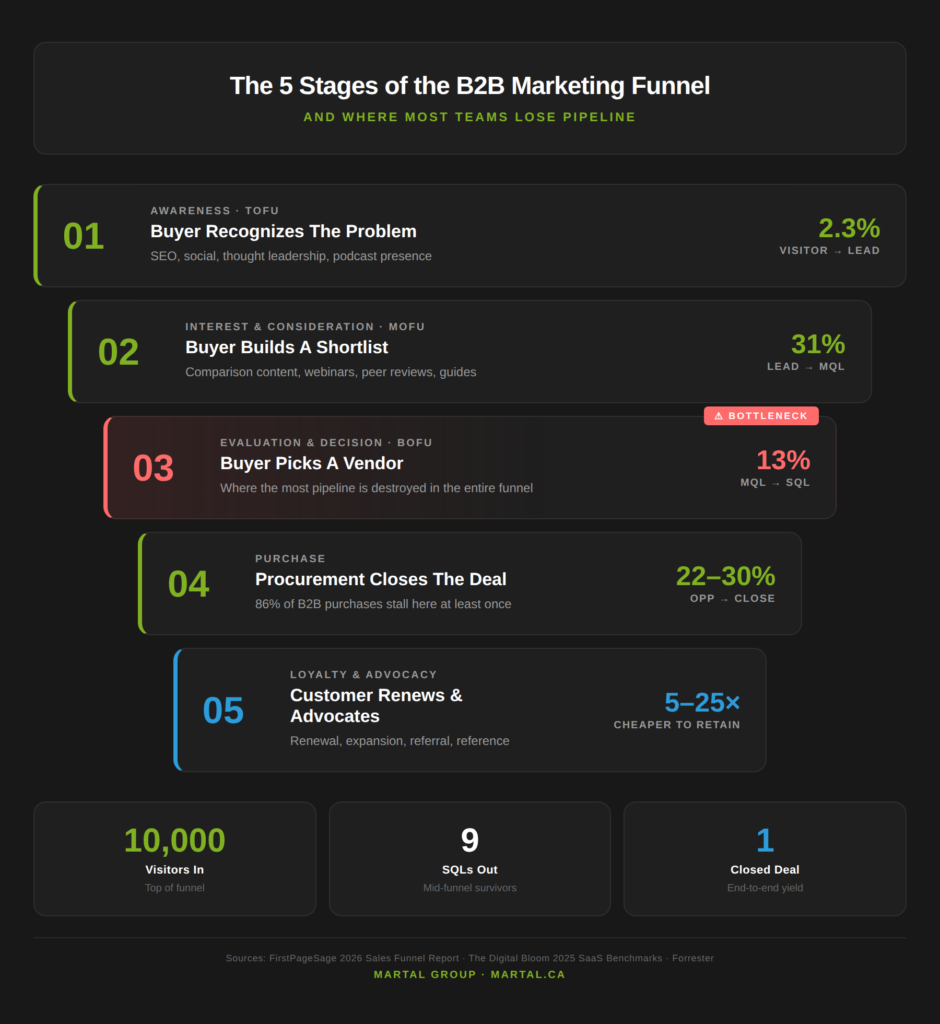
What’s worth more attention than the stage names is the math. Conversion rates between stages tell you where your funnel is actually working and where pipeline is leaking out. Recent benchmark data paints a sobering picture of the typical B2B funnel (16) (17):
– Roughly 2.3% of website visitors convert into leads
– About 31% of leads reach Marketing Qualified Lead (MQL) status
– Only 13% of MQLs convert to Sales Qualified Leads (SQLs) — the steepest drop in the entire funnel
– Around 20–30% of SQLs become opportunities
– And 22–30% of opportunities close
Run those numbers end-to-end and the picture is clear: for every 10,000 website visitors, you get roughly 230 leads, 71 MQLs, 9 SQLs, 2–3 opportunities, and 1 closed deal. The MQL-to-SQL stage is where the most pipeline is destroyed — we cover that bottleneck in its own section below.
Here’s how the five stages actually work in 2026.
Stage 1 — Awareness (TOFU)
The buyer recognizes a problem or opportunity but isn’t yet looking for a specific solution. They’re trying to understand what’s going on, what good looks like, and whether it’s worth doing anything about.
What marketing’s job is here: show up where buyers are researching, position the brand as a credible source, and start filling the cognitive shelf-space that will matter later when the buyer is ready to evaluate vendors. SEO content, thought leadership, podcast appearances, LinkedIn presence, and earned media all live here.
What the buyer is doing: searching for problem-oriented terms (“why is our pipeline stalling,” “how do enterprise teams handle X”), scanning LinkedIn and peer communities, listening to podcasts, watching how-to videos. They’re not filling out forms. They’re not talking to sales. According to LinkedIn data, buyers spend nearly 30% of their total research time in this early phase.
Where teams get this wrong: treating awareness as a lead-capture stage. Gating early-funnel content behind a form turns away the very buyers you want to influence later, when they’re actually evaluating.
Stage 2 — Interest & Consideration (MOFU)
The buyer has named the problem and started looking at categories of solutions. They’re comparing approaches, learning vocabulary, and quietly building a shortlist in their head.
What marketing’s job is here: educate, build trust, and earn enough credibility to make the shortlist. Comparison content, webinars, in-depth guides, customer success stories, and vendor explainers all do work in this stage. According to research cited across the category, B2B buyers engage with roughly 3–7 pieces of content before they’re willing to talk to a sales rep.
What the buyer is doing: reading vendor blogs and analyst reports, watching product walkthroughs, reading peer reviews on G2 and Capterra, asking colleagues for recommendations, joining communities, attending webinars. They are still mostly invisible to your sales team — and most of this activity now happens in what’s been called the “dark funnel,” the unattributable middle of the journey where buyers learn how to buy.
Where teams get this wrong: assuming visible engagement equals readiness. A prospect downloading a comparison guide is not necessarily an MQL. They might be one of three or four people on a buying committee just starting to map the space.
Stage 3 — Evaluation & Decision (BOFU)
The buyer has a shortlist. They’re now actively evaluating two to five vendors, running internal discussions, and trying to build the case for one of them. 94% of buying groups now rank their preferred vendors before first contact with sales, and they buy from that favorite 77% of the time.(18) Translation: by the time a deal officially enters your sales pipeline, the real decision is often already trending one direction.
What marketing’s job is here: arm the champion. Case studies relevant to the buyer’s industry and company size, ROI calculators, security and compliance documentation, technical product details, head-to-head comparisons, and proof points your champion can carry into internal conversations all do the work.
What the buyer is doing: running demos, requesting proposals, looping in finance, IT, legal, and procurement, comparing pricing, and pressure-testing claims with peers. Buyers spend only about17% of their total purchasing time meeting with potential vendors (19) and that time is split across every vendor on the shortlist.
Where teams get this wrong: generic content. A horizontal case study won’t move a buyer evaluating a vertical-specific solution. The proof has to match the buyer’s context.
Stage 4 — Purchase
The buyer makes the decision, navigates internal procurement, and signs the contract. This stage gets the least content attention in most B2B marketing funnels and yet it’s where deals quietly die.
What marketing’s job is here: reduce friction. Clear pricing where possible, transparent contract terms, ready-to-share procurement and security packets, and fast responses to last-mile questions. Forrester reports that 86% of B2B purchases stall at some point in the process (19), and most stalls happen here — not because the product is wrong, but because internal process friction makes saying “yes” harder than it needs to be.
What the buyer is doing: building the internal case, running the deal through procurement, finance, legal, and IT, and managing the political work of getting consensus across stakeholders who may have different priorities.
Where teams get this wrong: treating the contract as the finish line for marketing involvement. The buyer’s risk is highest here, not yours.
Stage 5 — Loyalty & Advocacy
The customer is onboarding, getting value, and (ideally) becoming a reference, a renewal, an expansion, and eventually an advocate.
What marketing’s job is here: keep the relationship warm and the value visible. Onboarding content, customer success programs, exclusive community access, executive briefings, and case-study participation all build the kind of post-sale momentum that turns a one-time deal into a durable revenue base. The economics matter: acquiring a new customer typically costs 5–25 times more than retaining an existing one.
What the buyer is doing: getting the solution implemented, proving the ROI internally, and forming the opinion that determines whether they renew, expand, or churn — and whether they recommend you to peers.
Where teams get this wrong: treating loyalty as the customer success team’s problem alone. Marketing has a real role here — and the customers who become advocates are the ones who feed your top-of-funnel pipeline most efficiently.
B2B SaaS Marketing Funnel — One Important Variation
The B2B SaaS marketing funnel follows the same five stages but with one structural difference: the conversion event isn’t the end of the funnel — it’s the beginning of the part that actually pays the bills.
In a subscription model, customer lifetime value depends on retention, expansion, and renewal far more than on the initial sale. A SaaS funnel that’s optimized only for acquisition leaves most of the available revenue on the table. That’s why mature B2B SaaS teams treat onboarding, product adoption, expansion (upsell, cross-sell, seat growth), and renewal as formal funnel stages with their own KPIs — not as post-sale afterthoughts.
The other SaaS-specific nuance: free trials and freemium tiers compress what would otherwise be the consideration and evaluation stages into a single product-led experience. The buyer evaluates by using, not by reading. That changes what marketing has to provide — onboarding emails, in-product guidance, activation milestones — and it shifts where the funnel’s hardest conversion lives. For most B2B SaaS funnels, the toughest moment isn’t free-to-paid; it’s getting first-time users to the activation event that proves the product works for them.
The MQL → SQL Handoff: Where the Funnel Actually Breaks
If there’s one place every B2B marketing funnel quietly breaks, it’s the MQL-to-SQL handoff. The benchmarks above make the math clear: of every 100 leads that reach Marketing Qualified status, only about 13 become Sales Qualified. The other 87 either stall, get rejected by sales, or disappear into the void between the two teams. That single transition destroys more pipeline than any other point in the funnel.
And the gap isn’t getting smaller. A benchmarks report identifies the MQL→SQL stage as “the key bottleneck”(17), with average SaaS conversion rates of 15–21%. Top-performing teams using behavioral scoring models hit 39–40% (20) — roughly 3x the industry average — without spending another dollar on lead generation. The lift is in qualification discipline, not lead volume.
So why does this stage break so consistently? In our experience running outbound and qualification programs for B2B clients, the same three patterns show up over and over.
1. Marketing and Sales Don’t Agree on What “Qualified” Means
The textbook answer is that an MQL has shown engagement and an SQL has been vetted by sales. The reality on the ground is that most B2B teams have never written down what either of those means in their specific business. Marketing’s MQL definition drifts toward what’s easy to track — content downloads, webinar registrations, ad clicks. Sales rejects most of those as noise. Marketing accuses sales of cherry-picking. Sales accuses marketing of dumping. Nothing changes.
What works: a single document, owned jointly by marketing and sales, that defines MQL and SQL in concrete behavioral and firmographic terms. Not “engaged with content.” Specifically: which behaviors, from which company types, in which roles, count as qualified — and which don’t. Once that’s written down, every conversation about lead quality becomes a diagnosis instead of a negotiation.
2. Speed-to-Lead Is Treated as a Nice-to-Have
The data on this is brutal. Companies that follow up with qualified leads within the first hour report a 53% conversion rate, compared to just 17% for follow-ups after 24 hours (20). A Harvard study confirmed in 2024 HubSpot data found that responding within 5 minutes is 21x more likely to qualify your lead than waiting 30 minutes (15).
Yet most B2B teams take 24–48 hours to respond to an inbound lead, and outbound responses run even slower. Every hour of delay is a measurable drop in conversion. By the time a 48-hour follow-up lands, the buyer has already moved on, talked to a competitor, or lost the moment of intent that triggered them in the first place.
What works: route MQLs to sales in real time, not in a daily batch. Set a speed-to-first-touch SLA and track it as a team KPI. The teams winning this stage aren’t smarter — they’re faster.
3. Qualification Is Done at the Lead Level Instead of the Account Level
This is the subtler one. Most B2B funnels score and qualify individual leads — one form fill, one webinar attendee, one demo request at a time. But the modern B2B buyer doesn’t act alone. They’re one of 6–10 people on a buying committee that may not have even formed yet. Treating each contact as an isolated MQL means missing the actual signal: an account is heating up because three different people from the same company have engaged in the last two weeks.
What works: layer account-level scoring on top of contact-level scoring. When multiple stakeholders from a target account engage in a short window, that’s a higher-priority signal than any single demo request. The funnel stops looking at individual leads and starts looking at buying centers.
What This Looks Like in Practice
One engagement that illustrates the discipline well: a manufacturing knowledge-management AI company we worked with over 13 months in their core target verticals (manufacturing operations and field service leaders). The campaign generated 362 leads — but the more relevant number is what happened to those leads. With strict ICP-aligned qualification at the MQL stage and same-day routing to sales for any account showing multi-stakeholder engagement, the program produced 84 booked meetings against that lead volume. That’s roughly a 23% lead-to-meeting ratio in a long-cycle enterprise category — well above the cross-industry average for that handoff stage. The lift didn’t come from generating more leads. It came from refusing to call something an MQL until both the engagement signal and the firmographic fit were in place, and then moving fast on the ones that qualified.
The same logic applies whether the funnel is inbound, outbound, or both. The MQL-to-SQL stage is the highest-leverage optimization point in the entire B2B funnel. A 5-point improvement in MQL-to-SQL conversion lifts revenue by approximately 18% (17)— without a single new lead. For most teams, that’s the cheapest pipeline gain available.
The Modern B2B Buying Group: Why You’re Not Selling to One Person
Most B2B funnels are still designed around a single buyer. One champion, one demo, one decision. The data has moved on without them.
The modern B2B buying group has grown into a committee. Recent research puts the average B2B buying decision at 13 internal stakeholders plus 9 external influencers — 22 people in total (14). Even Gartner’s more conservative number sits at 6–10 stakeholders per buying decision, with enterprise deals routinely involving more than 15 when legal, compliance, finance, and multiple business units get pulled in (13). Each of them brings their own priorities, their own risk tolerance, and their own version of what “the right decision” looks like.
That changes everything about how a B2B funnel has to operate. The job isn’t to convince one person — it’s to align a network of perspectives into a unified yes.
Why the Buying Group Is Where Most Deals Stall
The single biggest reason B2B deals get stuck isn’t price or product fit. It’s internal friction inside the buying committee. Forrester reports that 86% of B2B purchases stall at some point in the process, often because one stakeholder’s concerns weren’t addressed early. (19) The same research found that 81% of buyers end up disappointed with their chosen vendor — much of that disappointment traces back to misalignment that started inside the committee, not inside the product.
The dynamic plays out like this. Your champion gets excited. Two other stakeholders are neutral. One is skeptical. One has never been told the project exists. The deal moves forward as long as the champion is pushing — and stalls the moment a quiet objection surfaces from someone who hasn’t been engaged yet. By the time you find out, the deal has already lost momentum, and re-engaging takes weeks.
The fix isn’t more pressure on the champion. It’s mapping the whole buying group early and engaging each role on their own terms.
The Six Roles Inside Most B2B Buying Committees
Buying groups vary by industry, deal size, and company structure, but six roles show up in nearly every committee. They aren’t always six different people — sometimes one person plays two roles — but each role has to be addressed for a deal to close cleanly.
The Decision-Maker — usually a senior executive (VP, C-suite) with formal authority to approve the purchase. They care about ROI, strategic fit, and whether the decision will hold up to board scrutiny. They rarely engage early; they show up to validate the recommendation the committee brings them.
The Champion — the internal advocate who wants the deal to happen. Often a director or senior manager who has personally felt the pain the product solves. They do the political work of building consensus and need ammunition: case studies, ROI data, talking points for risk-averse stakeholders.
The Economic Buyer — finance or procurement. They evaluate cost exposure, total cost of ownership, contract terms, and budget alignment. Their question is never “is this good?” — it’s “is this worth it given everything else competing for budget?”
The Technical Buyer — IT, security, engineering. They audit feasibility, security posture, integration complexity, and implementation risk. They can kill a deal silently by raising concerns the champion can’t answer.
The End User — the people who will actually use the product day-to-day. They care about workflow, adoption, ease of use, and whether the change is worth the disruption. Bain’s research suggests convincing the core buying committee — which includes end users — is the most important factor in closing the deal (12).
The Influencer — internal advisors and external voices (analysts, peers, advisory firms) the committee turns to for outside perspective. Influencers don’t make the decision but they shape the conversation around it.
What This Means for the Funnel
If your marketing funnel is built to attract, qualify, and convert one buyer, it’s structurally undersized for the deal it’s trying to close. A few practical implications:
Content has to serve the whole committee, not just the champion. A single case study isn’t enough. Your champion needs ROI data for finance, security documentation for IT, workflow examples for end users, and analyst-grade proof for the executive sponsor. The teams that win complex deals build content libraries that arm the champion to sell internally — not just collateral that markets to them.
Engagement signals at the account level matter more than the contact level. When three stakeholders from the same company engage in a two-week window, that’s a stronger buying signal than any single demo request. Your funnel has to read those patterns or it will keep treating buying-group activity as unrelated lead-level noise.
Sales has to multi-thread, not single-thread. Targeting only the most senior person isn’t how decisions get made anymore. The teams that close enterprise deals build relationships across the committee in parallel — different sellers, different conversations, different content — and converge on a unified close.
What This Looks Like in Practice
Berger-Levrault — a 1,800-person French HR and ERP software company — illustrates the dynamic well. When they engaged us for outbound lead generation into the US and Canadian markets, the buying committee structure for their target deals included Sales Executives, Financial Managers, and HR Directors at mid-market and enterprise accounts. Three distinct roles. Three different sets of priorities. Three different conversations.
What worked wasn’t running one campaign at “the buyer.” It was running coordinated outreach across each role inside target accounts — different messaging for the HR director focused on workforce planning, different angles for the financial manager focused on operational cost, different value framing for the sales executive focused on revenue impact. The campaign didn’t generate the highest raw lead volume in our portfolio. It didn’t need to. Two enterprise deals alone justified the entire campaign investment, because each deal involved aligning multiple stakeholders Berger-Levrault would otherwise have had to chase one at a time.
That’s the lesson worth carrying forward. The B2B funnel that converts isn’t the one that generates the most leads. It’s the one that maps the buying group early, engages each role on its own terms, and closes the political work as carefully as it closes the commercial work.
5 B2B Marketing Funnel Trends Reshaping Pipeline in 2026
The fundamentals of the B2B marketing funnel haven’t changed in 2026 — buyers still move from awareness to consideration to decision to purchase to loyalty. What’s changed is everything around those stages: the channels, the technology, the buying-group dynamics, and the way teams have to work together to keep pipeline moving.
Five trends are doing most of the reshaping right now. They’re not predictions — they’re patterns we already see in how the best-performing B2B teams are running their funnels. Each one connects back to a specific stage of the funnel we covered earlier, and each one rewards teams that take it seriously enough to actually operationalize it.
Trend 1: AI-Powered B2B Funnel Marketing for Smarter Lead Generation
With 93% planning AI investment and 26% already scaling it, GenAI delivers up to 50x efficiency and 20–30% cost savings.
Reference Source: Boston Consulting Group
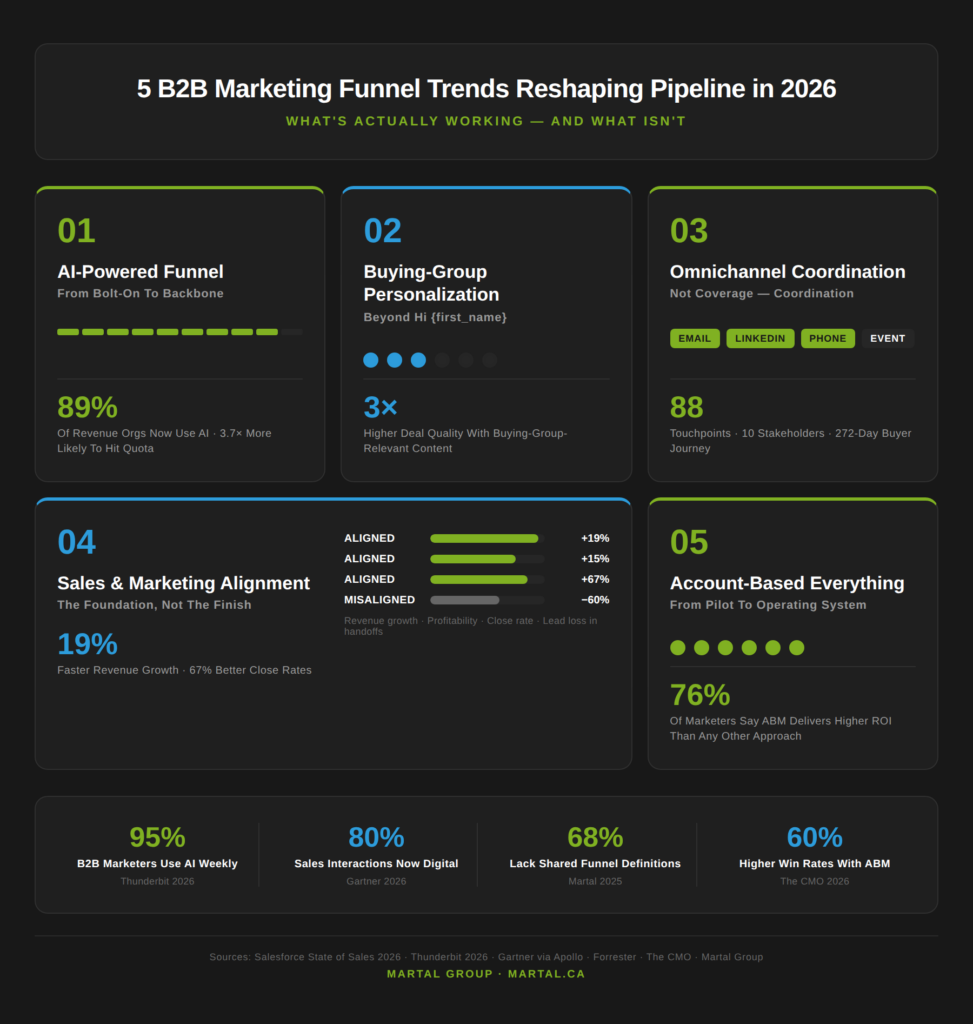
AI in the B2B funnel has crossed the line from “competitive advantage” to “table stakes.” 89% of revenue organizations now use AI, and teams using AI tools are 3.7x more likely to hit quota (14). 95% of B2B marketers use AI weekly, and 65% use it daily or more — and embedding AI into strategy (not just tasks) delivers an average of 13% revenue growth and 13% cost savings (11). The 35% adoption number that defined this conversation a year ago is now a rear-view mirror.
What’s actually changing in 2026 isn’t whether teams use AI — it’s how. The teams getting results have moved beyond using AI for one or two tasks (writing email copy, scoring leads) and started wiring it across every funnel transition. AI routing at the top of funnel cuts speed-to-lead from hours to seconds. AI scoring in the middle improves MQL-to-SQL conversion by filtering noise before it ever reaches a rep. AI-generated mutual action plans at the bottom keep deals from stalling between stakeholders. The compounding effect across stages is where the 13% revenue lift comes from — not from any single AI tool.
How AI changes each stage of the funnel:
At the top of funnel, AI does what manual prospecting can’t: synthesize firmographic, technographic, and behavioral signals across millions of accounts to find the buyers who actually look like your best customers. Lookalike modeling, intent data, and predictive scoring all live here — and they work because they replace ICP guesswork with pattern recognition trained on actual wins.
Mid-funnel, AI-driven personalization keeps prospects engaged at scale. AI-driven personalization is now linked with 18–24% lifts in conversion in B2B SaaS Pixelswithin. The work isn’t just dynamic content — it’s adapting nurture sequences in real time based on which stakeholders inside an account are engaging, what they’re reading, and where they are in their own internal evaluation.
At the bottom of funnel, AI shifts from prospecting to deal acceleration. Predictive insights flag which opportunities are warming up, which are quietly stalling, and which next-best action is most likely to move the deal forward. For sales teams managing 30 or 40 active opportunities at once, that prioritization matters more than any individual outreach tactic.
The augmentation, not replacement, framing still holds. AI handles the data lifting and the routine work. Human sellers handle the trust-building, the political navigation across the buying committee, and the nuanced conversations that close enterprise deals. The teams winning aren’t replacing their reps with AI — they’re using AI to remove the work that was preventing reps from doing what they’re actually good at.
Where we see this play out most often: in our own outbound and appointment setting work, AI is the layer that makes precision possible at scale. Account selection, persona research, sequence personalization, and follow-up timing all benefit from AI inputs — but the conversations that actually book meetings and close deals are still run by experienced sales executives who can read a buying committee and adapt in real time. The funnel works because both layers are working together. AI alone produces volume. Humans alone produce relationships. The combination produces pipeline.The strategic takeaway for 2026: AI is no longer the differentiator. How you wire it across the funnel — and what you ask it to do versus what you keep human — is. Companies that get this right see improved pipeline management, faster growth, and higher conversion rates. Companies that bolt AI onto a broken funnel just get faster broken outputs. For teams without the in-house capacity to wire it correctly themselves, outsourcing lead generation to a partner that already has the AI + human stack running is often the faster path to results — and a more reliable one than building from scratch.
Trend 2: Data-Driven Personalization Boosts the B2B Conversion Funnel
Personalization makes customers 80% more likely to purchase and improves engagement by more than 3×.
Reference Source: McKinsey
Personalization in B2B has matured past the “Hi {first_name}” era. The teams getting real conversion lift in 2026 aren’t personalizing harder — they’re personalizing smarter, at the level of the buying group instead of the individual contact.
Here’s the shift that matters. Gartner’s research found that content tailored for buying-group relevance improves consensus by 20%, while individual-level relevance has a 59% negative impact on consensus. Buyers experiencing buying-group relevance were 3× more likely to report high-quality deals. (10) Read that again: hyper-personalizing to one stakeholder, when the actual decision involves 6–10 of them, can actively work against you. The champion gets a perfectly tailored sequence; the rest of the committee doesn’t see themselves in the messaging at all; the deal stalls in internal review.
That’s the personalization frontier in 2026. It’s not “more data points per lead.” It’s “the right context for the right role inside the right buying center, at the right moment.”
What’s Driving the Shift
Two forces, one of them new.
First-party data has fully replaced third-party data as the foundation. Third-party cookies are functionally gone, privacy regulations have tightened, and B2B marketers are now building first-party data ecosystems by default — capturing intent signals from website behavior, content engagement, webinar attendance, and direct interactions. Campaigns built on first-party data continue to outperform third-party-driven campaigns by 2–3×, and buyers will share data with brands they trust as long as the value exchange is clear.
AI has compressed the cost of execution. What used to require a marketing ops team to manually segment, sequence, and tailor can now happen automatically — and at the account level, not just the contact level. AI-driven personalization is now linked with 18–24% lifts in conversion in B2B SaaS (9). The lift comes from adapting nurture sequences in real time based on which stakeholders inside an account are engaging, what they’re reading, and where the buying center is in its own internal evaluation.
What Changes Inside the Funnel
Top of funnel: account-level relevance beats individual-level personalization. The signal that matters isn’t “this contact downloaded a guide” — it’s “three contacts from the same target account engaged with three different pieces of content in the same two-week window.” That’s a buying center forming. The teams that read those patterns route differently than the teams still scoring at the contact level.
Mid-funnel: content has to serve the whole committee. A nurture sequence written for a champion is fine — but the champion is selling internally, and what they need is content the rest of the committee can read. ROI calculators that finance can validate independently. Security documentation IT can pass through procurement. End-user case studies that show workflow impact. The content library that wins isn’t deep on champion-facing assets — it’s broad enough to arm the champion to sell to everyone else.
Bottom of funnel: sales conversations need full context, not partial context. If marketing knows the champion attended three webinars, the IT lead viewed the security page twice, and the CFO opened the ROI email last week, the sales team should know that walking in. Most B2B funnels still hand off a contact record, not a buying-center picture. The teams that close enterprise deals make the handoff a buying-center briefing.
The Trust Line
Personalization has to feel helpful, not surveilled. B2B buyers appreciate relevance — they don’t appreciate being followed. The line in 2026 is the same as it was: use first-party data the buyer has knowingly given you, be transparent about how you’re using it, and lead with content that solves the problem they came looking to solve. Cross that line and the funnel doesn’t just stop converting — your brand starts losing future trust with buyers who would have shortlisted you.
Done right, data-driven personalization stops being a one-to-one tactic and becomes a one-to-buying-center system. The 3× lift in deal quality from buying-group-relevant content (10) isn’t theoretical — it’s where the next phase of funnel performance actually lives.
Trend 3: Omnichannel Engagement & Self-Serve Experiences Reshape the Funnel
B2B buyers now use an average of 10+ channels to interact with vendors during the purchase process.
Reference Source: McKinsey
The B2B funnel is no longer linear, and it stopped being linear several years ago. What’s new in 2026 is the scale of the non-linearity. The average B2B buyer journey now lasts 272 days and involves 88 touchpoints, four channels, and ten stakeholders (11). Roughly 80% of B2B sales interactions now occur in digital channels, and 61% of B2B buyers prefer a purchasing experience that doesn’t involve a sales rep (14) at all.
Translation: by the time a prospect actually engages with your sales team, they’ve been through dozens of self-directed touchpoints — your website, LinkedIn posts, peer reviews on G2 and Capterra, podcast mentions, analyst reports, AI-powered comparison tools, and conversations with peers in private communities you can’t see or measure. They’ve already built an opinion. Your job at that point isn’t to make a first impression. It’s to confirm the impression they’ve already formed.
That changes what an omnichannel funnel actually has to do.
What “Omnichannel” Actually Means in 2026
The word gets used loosely. The teams winning with it have a specific definition: a single coordinated system across every channel a buyer might engage on, where every touchpoint is aware of every other touchpoint. Not three tools running in parallel. One system running in sequence. The prospect who downloads a report from your website, sees a contextual LinkedIn message a week later, and gets a call referencing both — that’s omnichannel. The prospect who gets a generic email blast, an unrelated retargeting ad, and a cold call from a rep who has no idea about either — that’s just multichannel noise.
The distinction matters because the cost of getting it wrong has gone up. With 88 touchpoints across 10 stakeholders, even mid-sized B2B campaigns generate hundreds of data points per account. Without coordination, those points cancel each other out. With coordination, they compound.
The Self-Service Shift
The other half of the trend is what buyers are doing between your touchpoints — the self-directed research that now makes up most of the journey. 68% of millennial B2B buyers prefer self-service research tools over speaking to a sales rep (8), and Gartner predicts that more than half of large B2B purchases ($1M or greater) will be processed through digital self-service channels by the end of the decade. The funnel has to support that — pricing pages that don’t hide the price, technical documentation that answers the questions buyers used to ask sales, ROI calculators, comparison content, and case studies organized by industry and use case.
The trap most B2B teams fall into: treating self-service as a threat to sales involvement. It isn’t. Self-service shortens the time spent on educational conversations, which lets sales focus on the harder, higher-value work — navigating the buying committee, addressing concerns specific to the deal, and helping the champion build the internal case. Two-thirds of B2B buyers and sellers prefer remote interactions to in-person at most purchasing stages (14), and 9 out of 10 B2B companies plan to maintain hybrid sales models. The point isn’t to remove sales — it’s to deploy sales where it actually changes the outcome.
The Channel Mix That’s Working in 2026
LinkedIn remains the dominant top-of-funnel B2B channel and has expanded into mid- and bottom-funnel territory. LinkedIn’s B2B ad revenues reached $4.59 billion in 2025, growing 9.0% year over year (8), reflecting how heavily B2B marketers are leaning on it for both demand generation and account-based pursuit. The platform’s value isn’t only in advertising — it’s in the organic signal it gives sales teams about which buyers are engaging with which topics, and the relationships sellers can build through long-form content and direct conversations.
Email is still the workhorse of B2B outreach when it’s done with discipline. The teams getting results in 2026 aren’t blasting more email — they’re sending fewer, better-targeted messages with deliverability infrastructure that actually lands them in the inbox. Volume without deliverability is just expensive spam.
Cold calling has quietly come back. With buyers conducting most research digitally and inboxes saturated, a real conversation cuts through. The reps winning at phone outreach in 2026 are armed with intent signals before they dial — they know what the prospect’s company is doing, what tools they’re using, and what’s likely on their mind — which makes the difference between a relevant call and an interruption.
Events and community are back as central growth engines, not afterthoughts. According to the EndeavorB2B 2026 Marketing Benchmark Report, 49% of organizations are increasing in-person event budgets and 37% plan to expand virtual events (7). Trade shows, small-group meetings, and hybrid roundtables are where deals quietly move from “interesting” to “serious.” For B2B brands, the role isn’t just to host events — it’s to be present in the rooms where buyers talk to each other.
The teams that win don’t pick a channel. They orchestrate across all of them.
What This Looks Like in Practice
Awin — a 1,200-person digital marketing and affiliate platform headquartered in Berlin — illustrates how omnichannel orchestration works for international expansion. When Awin engaged us to build pipeline in the US market, the buying committee inside their target accounts spanned CEOs, CMOs, VPs of Marketing, ecommerce directors, and affiliate managers across retail, tourism, and transportation verticals. Five distinct roles. Three industries. A market geographically and culturally separate from their German operating base.
What worked was running coordinated outreach across channels and roles in parallel — email sequences tailored to each persona, LinkedIn touchpoints that referenced what each prospect was already engaging with publicly, and phone outreach that picked up where digital touches left off. Over a three-year engagement, the program generated 1,204 leads and built the foundation of Awin’s US presence in a market they hadn’t previously cracked. The lift didn’t come from any single channel — it came from the channels working together, with the same intelligence informing every touch.
That’s the definition of omnichannel that matters. Not “more channels.” More coordinated channels — across more stakeholders, over a longer journey, with the consistency of context that lets buyers move forward instead of starting over.
Trend 4: Aligning B2B Sales and Marketing Funnels (Rise of RevOps and Collaboration)
Aligned sales and marketing teams achieve 19% faster revenue growth and 15% higher profitability.
Reference Source: Forrester via SuperOffice
Sales and marketing alignment has been on every B2B trend list for the better part of a decade. What’s changed in 2026 is that the cost of not solving it has become unignorable. The funnel math from earlier in this guide makes the case bluntly: 87 of every 100 MQLs never become an SQL. The single biggest reason is that marketing and sales rarely agree on what a “qualified lead” actually is. 68% of B2B organizations have no clearly defined, shared funnel-stage definitions (6). Without that shared language, every conversation about lead quality between the two teams becomes a negotiation rather than a diagnosis.
The data on what alignment delivers is well-established. Companies where sales and marketing are highly aligned achieve 19% faster revenue growth and 15% higher profitability (5), are 67% better at closing deals, and see 36% higher customer retention. Aligned teams achieve 24% faster revenue growth and 36% higher customer retention (6). Misaligned teams, by contrast, can lose up to 60% of leads in the handoff process, costing companies 10% or more of annual revenue (6). The numbers consistently point in the same direction: alignment is one of the highest-leverage operational improvements available to a B2B revenue team.
What’s Driving the Shift to RevOps
Revenue Operations isn’t a rebrand of marketing ops or sales ops. It’s the formal consolidation of marketing, sales, and customer success operations into a single function with a single mandate: optimize the entire revenue engine, not each department in isolation. The role exists because the funnel itself is now too interconnected for siloed ownership. Marketing decisions about MQL definitions affect sales pipeline coverage. Sales decisions about lead routing affect marketing campaign attribution. Customer success decisions about onboarding affect renewal forecasting. Treating any of those decisions as a single department’s problem creates downstream noise everywhere else.
The push toward RevOps reflects something the data has been screaming for years: misalignment isn’t a culture problem. It’s a structural one. And it doesn’t fix itself by getting marketing and sales to “communicate better” in a quarterly meeting. It fixes when the operational scaffolding — definitions, KPIs, tooling, handoff SLAs — is rebuilt to make alignment the default state instead of a heroic effort.
What Aligned Funnel Operations Actually Look Like
Shared definitions. A single document, owned jointly by marketing and sales, that defines every stage of the funnel in concrete terms. What is a lead? What is an MQL? What is an SQL? What does “qualified” require — both behaviorally (which actions) and firmographically (which company types and roles)? This sounds basic. It is rare in practice, and it’s the single change that unlocks the most pipeline.
Shared metrics. Marketing measured on MQL volume alone will optimize for MQL volume — even when most of those MQLs never close. The teams getting alignment right tie marketing accountability to pipeline revenue or SQL contribution, not lead counts. Both sides own the same outcomes; budget and headcount decisions follow shared performance, not departmental targets.
Shared handoff SLAs. A defined turnaround time from MQL creation to first sales touch, a defined feedback loop from sales back to marketing on lead quality, and a defined escalation path when the SLA breaks. Without an SLA, “marketing complains sales ignores their leads, and sales complains marketing sends garbage” — exactly the dynamic that produces the 13% MQL-to-SQL average across the industry.
Shared tooling. A single source of truth for funnel data — typically the CRM, with marketing automation and sales engagement tools integrated cleanly. Multiple disconnected dashboards mean both teams are looking at different versions of the same number, which means neither team trusts the data, which means alignment conversations get sidetracked by data hygiene before they ever reach strategy.
Joint campaign planning. Marketing and sales planning the next campaign together — not marketing launching it and notifying sales after the fact. The teams that close enterprise deals build campaigns that arm sales with content the prospect has already engaged with, not content sales has to explain from scratch on the discovery call.
Where Most Teams Still Get Stuck
The cultural piece is real but it’s secondary. The deeper blocker we see most often is that marketing and sales report up to different leaders with different incentive structures. Marketing reports to a CMO measured on lead volume and brand. Sales reports to a CRO measured on closed revenue. Even with the best intentions, the two functions optimize for different outcomes because their leaders are graded on different scoreboards.
The structural fix — when it’s available — is a single revenue leader with both marketing and sales reporting to them, and a RevOps function that owns the operational layer between. The directional fix, when reorganization isn’t on the table, is shared metrics that force both teams to win or lose together. Either way, it requires executive sponsorship. Alignment doesn’t happen at the team level when the org chart and the comp plan tell people to optimize for different things.
The bottom line for anyone running a B2B funnel in 2026: alignment isn’t the trend that comes after AI, personalization, and omnichannel orchestration. It’s the foundation that makes those trends actually pay off. A sophisticated AI-powered, personalized, omnichannel B2B sales funnel operated by misaligned teams produces faster, prettier, more measurable failure. The teams winning are the ones that fixed the alignment first and layered the sophistication on top — sometimes with internal restructuring, sometimes by outsourcing parts of the pipeline to a partner that already operates as a unified team.
Trend 5: Account-Based Everything – ABM Goes Mainstream Across the Funnel
76% of marketers report that account-based marketing delivers higher ROI than any other strategy.
Reference Source: The CMO
Account-based marketing has stopped being a category. It’s become the operating system of high-performing B2B revenue teams. The principles — focusing high-value resources on a defined list of high-value accounts with personalized outreach strategies coordinated across marketing, sales, and customer success — are now embedded across functions rather than run as a marketing-led pilot. Many organizations have stopped calling it ABM at all and adopted Account-Based Everything (ABE) or account-based revenue: a single approach that orchestrates personalized marketing, sales development, sales, and post-sale efforts around specific accounts as the default mode of operation (4), not a layered tactic.
The reason is straightforward: ABM produces results other approaches don’t. 76% of marketers say ABM delivers higher ROI than any other marketing approach (32), with 58% reporting bigger deal values and companies aligning ABM with targeted advertising seeing 60% higher win rates than standard campaigns. 67% of companies say their ABM program improved sales and marketing alignment (32)— because executing it forces both teams to operate from a single shared account list and a single shared definition of success. ABM doesn’t just produce pipeline. It produces the operational discipline that produces pipeline.
What’s Different About ABM in 2026
Three shifts have hardened over the past year.
Account-based engagement at the contact level, not just the account level. Targeting an account broadly is no longer enough. The teams getting results are mapping the buying committee inside each account — the Decision-Maker, Champion, Economic Buyer, Technical Buyer, End User, and Influencer roles covered earlier — and running parallel, role-specific outreach into each. The CFO doesn’t see the same message as the IT director. The end user doesn’t see the same content as the executive sponsor. Each role gets relevance built for them, and the deal closes when the messaging across roles converges into a unified internal case.
Intent data and AI have changed how target lists are built. The old ABM playbook started with a manual ICP exercise and a static target list. The 2026 version starts with intent signals — funding events, hiring surges, technology stack changes, content engagement patterns — that surface the accounts already in-market for what you sell. Tools like 6sense, Demandbase, ZoomInfo, and similar account-intelligence platforms have made this accessible at scale, but the discipline matters more than the tool. The teams winning ABM aren’t the ones with the biggest tech stack — they’re the ones with the cleanest answer to “which 200 accounts do we focus on this quarter, and why?”
ABM has expanded beyond acquisition. Post-sale account-based strategies — for renewal, expansion, and upsell — are now table stakes for SaaS and services companies with high lifetime value. The same coordination discipline that wins new accounts in acquisition wins expansion revenue inside existing accounts. Customer success teams that operate with an ABE mindset treat their strategic accounts like markets of one, and the renewal economics reflect it.
The Operational Pattern That Works
The ABM programs that consistently produce results share a small set of operating habits. Tight account selection — small lists, high concentration of effort, regular re-evaluation. Multi-stakeholder mapping at the account level before any outreach starts. Coordinated outreach across email, LinkedIn, and phone, sequenced rather than fired in parallel. Joint marketing-and-sales account reviews — typically weekly — that surface what’s working and what’s stalling at each named account. And patient measurement: ABM metrics live in pipeline contribution and account penetration, not in lead volume.
The teams that fail at ABM almost always fail in one of two ways. They either run too many accounts to actually personalize against (which collapses ABM into “regular outbound with extra steps”) or they treat ABM as a marketing program rather than a revenue program (which means sales never owns it, and the program dies the first time pipeline targets get tight).
What This Looks Like in Practice
Polygon — a 6,600-person Stockholm-based facilities services and IoT climate-control company — illustrates the operational discipline behind a working ABM program. When Polygon engaged us to expand into the US market, the target list wasn’t broad. It was specific: Sustainability Directors, Risk Management Executives, and Preconstruction leaders inside Construction and Architecture firms — three named roles inside a small number of named verticals.
What worked was treating each of those role/vertical combinations as its own focused pursuit. Different messaging for the sustainability lead focused on building performance and ESG outcomes. Different framing for the risk-management executive focused on operational continuity. Different angles for the preconstruction lead focused on early-stage project planning. Over a 24-month engagement, the program generated 440 leads and 139 booked meetings — numbers that reflect not raw outbound volume but the precision of pursuing the right roles inside the right accounts with the right context.
The lesson worth carrying forward: ABM doesn’t reward effort. It rewards focus. The teams generating the highest ABM ROI in 2026 aren’t running the most accounts or sending the most touches. They’re running fewer accounts, with more stakeholders mapped per account, with more coordinated touches per stakeholder, over longer time horizons, with patient measurement.Done well, ABM is what makes the rest of this guide actually work — the AI, the personalization, the omnichannel orchestration, the sales-marketing alignment. It’s the strategic frame that gives those tactics a target. Without it, sophisticated funnel investments tend to scatter across too many accounts to compound. With it, every investment lands inside a defined set of high-value pursuits — and the funnel performance shows it. For teams without internal capacity to run this discipline at the level it needs, outsourcing the operational layer to a partner with established ABM execution and integrated lead generation tools is often the faster path to results than building from scratch.
How to Align Your B2B Marketing Strategy and Sales Funnel in 2026
85% of sales and marketing leaders agree that closer alignment is the top opportunity to boost business performance.
Reference Source: Salesgenie
Trend 4 covered why alignment matters and what RevOps actually is. This section is the operational checklist — what to do this quarter to start closing the gap, in the order that produces the fastest measurable lift.
1. Lock Down Shared Funnel-Stage Definitions Before Anything Else
This is the highest-leverage move available, and most B2B teams skip it. Get marketing and sales leaders in a room and write down — on one page, jointly owned — the definition of every funnel stage from lead through closed deal. What is a lead? What does an MQL require behaviorally and firmographically? What triggers an SQL? What disqualifies one? 62% of teams have historically defined qualified leads differently across functions (16), and that single disagreement produces most of the pipeline friction the rest of the alignment work is trying to fix. Closing this gap alone can lift MQL-to-SQL conversion by several percentage points — which, at the funnel math from earlier in this guide, translates directly to revenue.
2. Stand Up a RevOps Function (or a Stand-In)
If you can resource a formal Revenue Operations function, do it. RevOps consolidates the operational layer — data, tools, processes, KPIs — across marketing, sales, and customer success into a single accountable team. Its mandate is the entire revenue engine, not any one department. If a full RevOps function isn’t yet on the table, the directional fix is a cross-functional alignment task force with executive sponsorship and a clear charter: standardize data definitions, integrate the tooling, and build a single funnel dashboard both teams trust. Companies that unify their revenue operations have been found to outperform peers in revenue growth by engaging multiple stakeholders in a coordinated way (6). The structural decision matters more than the title — what changes outcomes is having one team accountable for funnel performance end-to-end.
3. Build Shared Content Libraries Mapped to the Funnel
Marketing creates the content. Sales uses it. The handoff almost always breaks. The fix is a single shared library — case studies, comparison guides, whitepapers, ROI calculators, security documentation, webinar recordings — organized by buyer role, industry, and funnel stage, with sales trained on what to use when. The teams that get this right also instrument the library: when a prospect engages with a piece of content, the sales rep responsible for that account knows within minutes, not days. That single feedback loop is how marketing campaigns translate into closed deals instead of disconnected lead volume. Aligned teams using this discipline see significantly better conversion of target accounts to opportunities than teams operating from disconnected content stacks.
4. Replace Departmental Metrics with Shared Revenue KPIs
Nothing drives alignment like both teams being graded on the same outcomes. Identify three to five metrics both functions influence, and make them shared accountability — not just shared visibility. Practical lead generation KPIs for shared accountability include pipeline generation in dollars, win rate, average sale cycle length, MQL-to-SQL conversion, and customer retention rate. Marketing measured on lead volume alone will optimize for lead volume — even when most leads never close. Marketing measured on pipeline contribution will optimize differently, and the funnel will reflect it. Where comp plans can be adjusted, tying a portion of incentive compensation to shared revenue metrics makes the alignment durable instead of dependent on goodwill.
5. Run Weekly Sales-Marketing Operating Reviews
The cheapest, most under-used alignment mechanism is a 30-minute weekly meeting where marketing briefs upcoming campaigns and content, sales reports lead quality and field intelligence, and both teams troubleshoot funnel bottlenecks together. If demo-to-proposal conversion is slipping, both sides surface what they’re seeing — is messaging attracting the wrong audience, or is the email follow-up cadence too slow, or is the qualification criteria letting through unready leads? Continuous feedback adjusts tactics in real time instead of waiting for quarterly reviews. The teams that run this discipline consistently outperform the teams that meet ad-hoc or only when things break.
6. Coordinate the Buying-Committee Pursuit
This is the part most “alignment” guidance still underweights. Aligned funnels don’t just align on the lead — they align on the account. When multiple stakeholders inside a target account engage marketing or sales in any short window, that’s a buying center forming, and it requires coordinated multi-threaded pursuit instead of parallel, uncoordinated outreach. The teams that close enterprise deals build account-level briefings before sales calls so the rep walks in knowing every touchpoint the buying committee has had with the company — not just the last form fill. Marketing’s job at this stage isn’t to generate more leads. It’s to give sales the full intelligence picture of the account they’re walking into.
What This Adds Up To
Operating as one team with one funnel sounds like a slogan. In practice it means six things — shared definitions, a unified operational function, a shared content system, shared metrics, regular review cadence, and account-level coordination — implemented in roughly that order. Each step compounds the next. Teams that try to skip steps 1 and 2 and jump straight to step 6 (coordinated buying-committee pursuit) almost always fail, because they don’t have the operational scaffolding to support it. Teams that work the list in order start seeing measurable pipeline lift within a quarter and structural improvement within two.
Alignment isn’t a campaign. It’s an operating model. Done well, it unlocks the full payoff of every other trend in this guide — AI, personalization, omnichannel orchestration, and ABM — because the whole revenue engine is finally running in sync.
Ready to Accelerate Your B2B Funnel?
The hardest parts of a B2B funnel in 2026 aren’t the parts that show up in dashboards. They’re the operational gaps between marketing and sales — the MQL handoff that loses 87 of every 100 leads, the buying committee that has six stakeholders no one has mapped, the omnichannel campaign that fires on email and LinkedIn but doesn’t coordinate with phone outreach, the ABM list that’s too broad to actually personalize against. Each of those gaps is fixable. Most B2B teams don’t have the in-house bandwidth to fix them all at once.
That’s where we come in. At Martal, we operate as an extension of your revenue team — running outbound lead generation, appointment setting, and full omnichannel pursuit across email, LinkedIn, and cold calling for B2B clients across North America, Europe, and LATAM. Our model pairs experienced onshore sales executives with our proprietary AI sales platform, so the precision of intent-based targeting and the judgment of an experienced rep work together on the same account. The work isn’t bolted on — it’s a single coordinated system designed to close the funnel gaps most B2B teams quietly live with.
That looks different depending on where your funnel is leaking. If MQL-to-SQL conversion is the bottleneck, the work is qualification discipline and same-day routing. If the buying committee is the bottleneck, the work is multi-threaded pursuit across stakeholder roles. If the channel mix is the bottleneck, the work is coordinated omnichannel orchestration with one team accountable end-to-end. We start by diagnosing where your funnel is actually losing pipeline — and build the engagement around that, not around a generic “more leads” promise.
If your funnel performance feels like it’s plateaued — or you can see the gaps in this guide and recognize them in your own pipeline — book a consultation with our team. We’ll walk through what your funnel is producing today, where the highest-leverage improvements are, and what an engagement that fixes them would look like. No pitch. Just a working conversation about what’s actually moving the needle in 2026.
References
- DemandGen Report
- Gartner – Future of Sales
- Gartner Sales Survey
- iTechSeries
- SuperOffice
- Geisheker
- Boiler Plate
- eMarketer
- Pixelswithin
- Apollo
- Thunderbit
- Dock
- Brixon
- Wave Connect
- Serpsculpt
- First Page Sage
- The Digital Bloom
- 6sense
- Traction Complete
- Data-Mania, LLC
FAQs: B2B Marketing Funnel
What are the stages of a B2B marketing funnel?
A typical B2B marketing funnel runs across five stages: Awareness, Interest & Consideration, Evaluation & Decision, Purchase, and Loyalty & Advocacy. The stage names vary by framework — some use four, some use seven — but the underlying movement is consistent. The buyer goes from not knowing they have a problem, to actively researching solutions, to evaluating vendors, to purchasing, to (in mature B2B funnels) renewing and expanding.
What separates a working B2B funnel from a leaky one isn’t the stage labels — it’s having shared definitions for each stage that marketing and sales both operate from, and having conversion benchmarks at every transition. The MQL-to-SQL transition is where most B2B funnels lose the most pipeline; industry-average conversion sits at 13%, and top performers using behavioral qualification scoring hit 39–40%. The biggest stage-improvement opportunity in most B2B funnels is the gap between marketing’s definition of “qualified” and sales’ definition of “qualified.”
What is the difference between a B2B and a B2C funnel?
B2B and B2C funnels share the same general shape but operate under very different rules. A B2C purchase typically involves one decision-maker, a cycle measured in minutes to days, and decisions driven largely by emotion or impulse.
A B2B purchase typically involves 6–10 stakeholders on the buying committee — up to 13 internal participants and 9 external influencers in 2026 — a cycle averaging 272 days, and decisions driven by ROI, risk reduction, and internal consensus. The content needs are different (B2B requires educational, technical, and proof-heavy material), the channel mix is different (B2B averages 88 touchpoints across 4 channels), and the post-sale focus is different (B2B optimizes for renewal and expansion rather than repeat purchase).
The most common mistake B2B teams make isn’t picking the wrong framework — it’s running their funnel as if it were a B2C funnel without realizing it: treating one engaged contact as a buying signal instead of recognizing it’s one of several stakeholders quietly forming a committee.
Why is our MQL-to-SQL conversion so low?
This is the single most common pipeline question in B2B, and it almost always traces back to one of three causes.
First, marketing and sales don’t agree on what “qualified” means — 68% of B2B organizations have no clearly defined, shared funnel-stage definitions, which means marketing labels leads as MQLs based on engagement signals (downloads, webinar registrations) while sales rejects most of them because they don’t fit firmographic or intent criteria.
Second, speed-to-lead is too slow — companies that follow up within the first hour convert at 53%, compared to just 17% after 24 hours, and most B2B teams take 24–48 hours to respond to inbound leads.
Third, qualification is happening at the contact level instead of the account level — meaning each form fill is scored in isolation rather than recognizing that three engagements from the same target account in two weeks is the actual buying signal.
The fix isn’t more leads. It’s writing down a shared MQL definition that requires both behavioral engagement and firmographic fit, routing qualified leads to sales in real time, and layering account-level scoring on top of contact-level scoring. A 5-point improvement in MQL-to-SQL conversion lifts revenue by approximately 18% — without spending another dollar on lead generation.
Is the B2B marketing funnel dead?
The funnel as a concept is alive and well. The funnel as a linear conveyor belt is not. The shape of the buyer journey hasn’t gone away — buyers still move from problem awareness to solution evaluation to purchase decision to renewal — but the journey now loops, branches, and runs in parallel across multiple stakeholders.
Roughly 80% of B2B sales interactions now happen in digital channels, 61% of B2B buyers prefer a purchasing experience that doesn’t involve a sales rep, and 94% of buying groups rank their preferred vendors before first contact with sales. None of that makes the funnel obsolete; it makes the linear-funnel mental model obsolete.
The teams winning in 2026 still operate from a funnel framework — they just treat it as a scaffold for objectives and measurement, not a rigid path. They map buying committees, score at the account level, and accept that the journey is non-linear without abandoning the structure that lets them measure where pipeline is being created and where it’s leaking out.
How many touchpoints does a B2B sale actually take in 2026?
The current benchmark is 88 touchpoints across 4 channels and 10 stakeholders over a 272-day journey. That’s not a target — it’s the average across B2B buyers in 2026, and it’s roughly double the touchpoint count from a few years ago. The implication for B2B revenue teams isn’t “do more outreach.”
It’s coordinate the touchpoints you already have. With dozens of touchpoints across multiple stakeholders, uncoordinated outreach cancels itself out — generic emails, retargeting ads, and cold calls that don’t reference each other create noise instead of compounding signal.
The teams getting results are running fewer touchpoints with more coordination, where every touch is aware of every other touch and references the same account-level intelligence. A coordinated 50-touchpoint pursuit will outperform an uncoordinated 100-touchpoint pursuit every time.
How do you plan a full-funnel B2B content marketing strategy?
Start with the buyer, not the funnel. Map the buying committee for your ideal customer profile — typically 6–10 roles with different priorities — and then ask what each role needs at each stage of their evaluation.
The Decision-Maker needs strategic ROI proof.
The Champion needs ammunition to sell internally.
The Economic Buyer needs financial justification.
The Technical Buyer needs security, integration, and feasibility documentation.
The End User needs workflow examples.
The Influencer needs analyst-grade external validation. Build content that serves each role at each stage — awareness content (problem-oriented blog posts, thought leadership, podcast presence) for the top, consideration content (comparison guides, webinars, customer success stories) for the middle, and decision content (case studies organized by industry and role, ROI calculators, security packets, technical documentation) for the bottom. Then instrument the system: when a prospect engages with content, the relevant sales rep knows within minutes, and the next touch builds on what the buyer has already seen.
The biggest mistake most B2B content strategies make isn’t producing too little content — it’s producing content that only serves the champion, leaving the rest of the buying committee underserved when they enter the conversation.