
 Martal
 Technology
 Education and training
 Web Development and UI / UX
 Healthcare/Medical
 Logistics and Supply Chain
 Information Technology
 Insuretech and Financial Services
 Marketplaces
 Software Development
 E-commerce and retail
 AI and Machine Learning
 Energy and Solar
 Manufacturing
 Security and Surveillance
 Digital Marketing Agency
 Transportation
 MSP
MSP
 Telecom
 B2B SaaS
 Cybersecurity
 HR tech
 Fintech
 Cleantech
 Consulting
Outsourced Sales and Marketing: The Complete 2026 Guide to Building Pipeline Without Building Headcount
Major Takeaways: Outsourced Sales and Marketing
Outsourced sales and marketing means contracting a third-party provider to handle pipeline-generation functions — prospecting, outreach, lead qualification, and appointment setting — rather than building those capabilities in-house. The outcome being purchased is qualified pipeline, not content assets or brand impressions.
For most B2B companies, outsourcing supplements rather than replaces internal capacity. The typical model keeps strategy, closing, and customer relationships in-house while delegating execution-heavy top-of-funnel work — prospecting, cold outreach, and qualification — to an external partner.
Two converging forces are driving adoption: talent scarcity and budget compression. The WEF Future of Jobs Report 2025 identifies the skills gap as the most significant barrier to business transformation for 63% of employers, while a Gartner survey of 174 senior marketing leaders (September 2025) found budget and resource constraints are the top challenge for 63% of CMOs.
McKinsey’s State of AI 2025 identifies marketing and sales as one of the functions seeing the biggest AI adoption surge — more than doubling since 2023. Modern outsourced providers running AI-integrated delivery models can prospect more precisely, personalize outreach at scale, and adapt faster than manually operated in-house functions could at equivalent cost.
Onboarding with a structured provider runs seven to ten business days. First MQLs typically arrive within 14 to 20 days of launch. First SQLs follow within 30 days. The 60 to 90 day window is where programs produce consistent, predictable signal about which personas, channels, and messages are converting in your specific market.
Most outsourcing failures trace back to three avoidable problems: an unclear ICP when the engagement starts, no internal owner available to act on qualified meetings, or a provider that runs the same playbook without adapting when early signal suggests it isn’t working. Selection rigor and a structured onboarding process resolve all three.
The most important evaluation criteria are vertical experience with documented case study results, team structure transparency (dedicated vs. shared reps, internal vs. subcontracted delivery), reporting cadence and pipeline visibility, and the provider’s process for adapting campaigns based on live performance data. Asking for references from clients in a comparable industry, at a comparable growth stage, is the most reliable signal available.
Outsourced sales focuses on pipeline generation — prospecting, outbound outreach, qualification, and appointment setting. Outsourced marketing covers demand generation and brand-building — content, SEO, paid media, email marketing, and social. The two overlap in outbound programs where messaging strategy and execution run together, but they serve different functions and are typically evaluated by different outcome metrics.
Introduction
Outsourcing sales and marketing is no longer driven mainly by cost savings. According to Deloitte’s 2025 Global Business Services Survey, approximately 55% of organizations achieved over 20% in savings from their outsourcing arrangements (6). The data highlights a broader shift in priorities—toward building next-generation capabilities and improving customer experience, rather than focusing on cost reduction alone.
That shift matters for how you evaluate this decision.
If you’re still thinking about outsourced sales and marketing as a cheaper alternative to building in-house, you’re asking the wrong question. The more useful question is whether an external partner can execute faster, target more precisely, and generate qualified pipeline more consistently than your current model, and at what point that becomes the smarter path forward.
Not every company gets there at the same time. Some reach it when their pipeline stalls and the internal team is stretched thin. Others hit it when they’re entering a new market or launching a new product and can’t afford the ramp time of building from scratch. Others simply recognize that outbound lead generation and appointment setting are specialized disciplines — and that hiring generalists to do specialist work rarely ends well.
This guide was built to help B2B revenue leaders think through that decision clearly. We reviewed how outsourced sales and marketing firms actually operate, what services fall under the outsourcing umbrella, what the research says about outcomes, and where the model works best, and where it doesn’t. We’ve also drawn on Martal’s experience running outbound campaigns across 50+ verticals to add context where the research alone doesn’t tell the full story.
Here’s what we cover:
- What an outsourced sales and marketing company actually does
- The real advantages and one honest caveat
- The full range of services available under the outsourcing umbrella
- How AI has changed what modern outsourcing delivers
- How to choose the right provider and what to watch out for
What is an Outsourced Sales and Marketing Company?
“Is it a good idea to outsource your sales and marketing team? If so, where is a good place to find them?” That question has been asked by more revenue leaders than would admit it publicly. It’s worth answering directly before getting into definitions.
An outsourced sales and marketing company is a third-party provider that takes on some or all of a business’s revenue-generation functions — replacing or supplementing the internal team responsible for finding, engaging, and converting new customers.
That definition covers a wide range of arrangements. It’s worth separating the two functions, because buyers often enter this conversation looking for one more than the other.
Outsourced sales refers to delegating the pipeline-generation side of the business: prospecting, outreach, qualification, and appointment setting. The external team acts as an extension of the client’s sales organization — running campaigns, engaging decision-makers, and delivering sales-qualified leads or booked meetings directly into the client’s pipeline. This is sometimes called outsourced direct sales and marketing, particularly when the external team operates as the client’s outward-facing sales function rather than a supporting layer.
Outsourced marketing covers the demand-generation and brand-building functions: content, SEO, paid media, email marketing, social, and market research. These services are typically handled by agencies or specialists who manage specific channels rather than the full revenue cycle.
Many providers offer both under one roof. In practice, however, the most focused and results-driven outsourced sales and marketing firms tend to specialize — either in outbound pipeline generation or in broader marketing execution — rather than trying to do everything adequately. That’s why you’ll often see niche agencies like Tanot Solutions focusing purely on SEO and link building instead of spreading themselves too thin across multiple services.
The engagement model is usually flexible. Some companies outsource their entire outbound function from day one. Others start with a specific service — lead generation or appointment setting — and expand the relationship as results build confidence. Martal’s longest-running client engagements tend to follow that second path: a focused pilot that demonstrates pipeline impact, followed by a deeper partnership over time. Clickworker, for example, started with a targeted outbound program and grew the engagement over nine years into a relationship that generated $4.5M in recurring revenue and a 500% ROI.
That kind of outcome isn’t universal, but it illustrates what the model looks like when the right provider is matched to the right program and given time to optimize.
What are the Advantages of Outsourcing Your Marketing and Sales?
The case for outsourcing sales and marketing has shifted considerably over the past few years — and the data from primary research sources makes that shift concrete.
The World Economic Forum’s Future of Jobs Report 2025, drawing on data from over 1,000 companies globally, identifies the skills gap as the single most significant barrier to business transformation — with 63% of employers already citing it as a key challenge and nearly 40% of core job skills expected to change by 2030 (1). At the same time, a Gartner survey found that budget and resource constraints are the top challenge for 63% of CMOs (2), with half reporting that short-term pressures are actively preventing execution of long-term strategic plans.
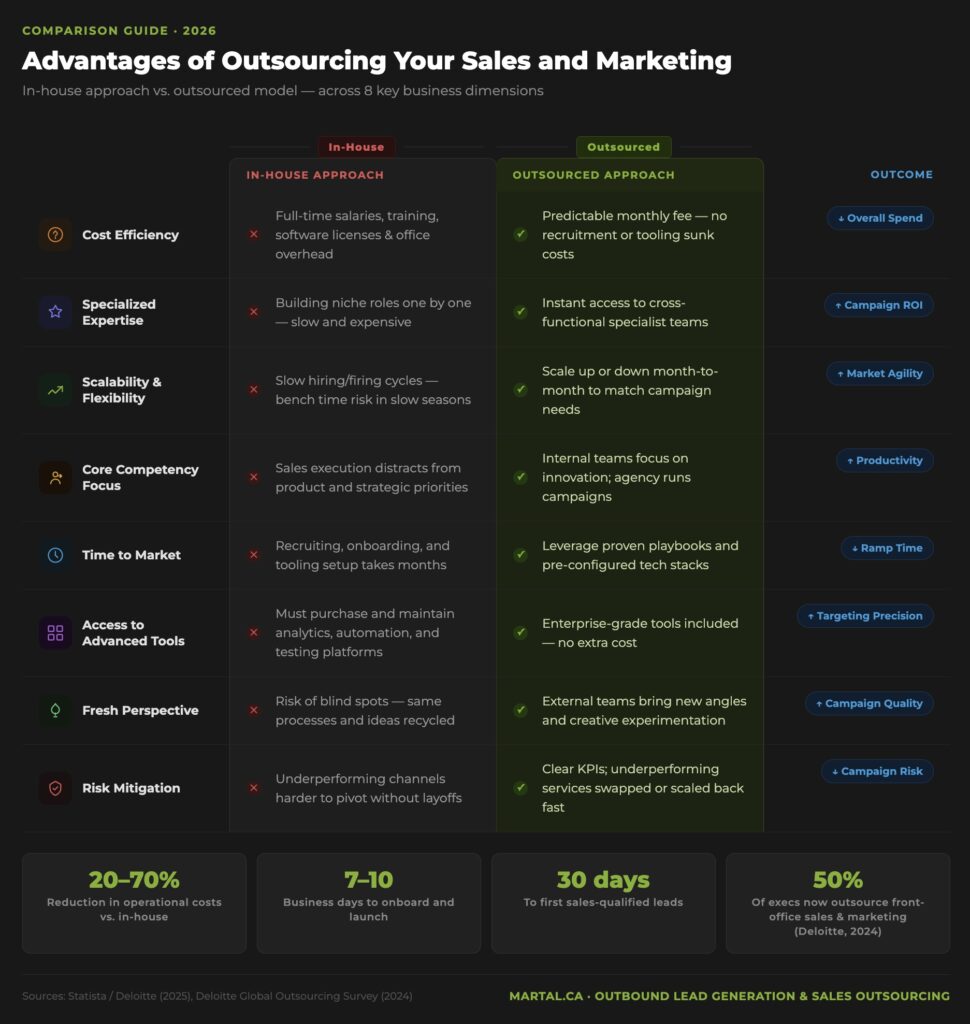
Those two forces — talent scarcity and budget compression — are precisely the conditions that make outsourced sales and marketing most valuable. When you can’t hire fast enough and can’t spend freely, the ability to activate a specialized external team quickly, at a predictable cost, with an existing tech stack and no ramp time, addresses both problems simultaneously.
That said, one honest caveat before the list: outsourcing works best when the internal team is ready to act on what the external team delivers. If your sales process is unclear, your ICP isn’t defined, or there’s no one to run discovery calls when meetings land — an outsourced partner will generate activity, but it won’t generate revenue. The model amplifies what’s already there. It doesn’t substitute for it.
With that framing in place, here’s how the advantages actually break down:
Reduces Overhead Costs and Other Business Expenses
Outsourcing sales and marketing is a cost-effective option, especially in times of increased staff costs and attrition. In fact, 80% of small businesses have chosen to outsource at least one process to save money. Research from Deloitte indicates that 67% of organizations are now using outcome-based outsourcing models that emphasize tangible results and innovation (3). You’re essentially gaining the immediate advantages of a fully ramped team of professionals without investing in the hiring and training. This can be especially effective for SMBs as it helps them quickly reach a wider audience for less.
Keep in mind that while outsourcing does allow you to maintain a smaller team — dialing up or down expenses on an as-needed basis — it’s not about replacing your current staff. It’s about supplementing their efforts to increase efficiency and maximize resources.
Aside from labor costs, outsourced partners reduce the burden of other expenses like marketing platforms, expensive contact databases, and additional office space so you can put more money into product development and customer success. Martal’s fully managed onboarding runs seven to ten business days, with first SQLs delivered within thirty days and clients gain access to Martal’s AI SDR Platform, outreach infrastructure, and enriched contact database without purchasing any of it separately.
Generate More Leads with a Specialized Team of Sales and Marketing Experts
With 63% of global employers already identifying the skills gap as a key barrier to transformation and nearly 40% of core job skills expected to change by 2030 (1), the specialized talent argument for outsourcing has become more structurally compelling than ever.
Certain vertical industries that are hyper-focused on one particular field benefit from outsourcing their sales and marketing efforts because of their inexperience in the strategies and processes. Take B2B tech companies, for example. Most team members are engineers and developers trained in specific applications and coding languages. While talented, they lack effectuality in customer conversion. By partnering with the right outsourced company, these teams can employ experts who have successfully generated leads and closed deals for companies in the same sector — maybe even competitors.
In addition, outsourcing sales and marketing can help revenue leads develop ideas for new techniques. Because consumers quickly become numb to recycled lead gen tactics, strategies and campaigns have to be adjusted constantly to optimize for customer acquisition. Outsourced sales and marketing firms have a finger on the pulse in various verticals and channels, which makes them agile when faced with stagnant or declining metrics. Martal operates across 50+ verticals, which means Sales Executives assigned to a new campaign aren’t starting from zero, they’re applying tested frameworks to a new client’s specific context.
Launch New Products and Services Without Any Prior Experience
One of the hardest parts of launching a new product or service to the market is finding the right strategy. Think of it this way, once you make it out of the development phase, you’re just beginning your marketing journey. You still have to spend time developing, testing, and optimizing campaigns in order to hone your targeting and messaging. On top of the dreaded trial and error process, you also have to invest in and incorporate new marketing platforms and maybe even train new employees. Hiring an experienced coach with a professional coaching contract template might be a beneficial choice.
All of this can take months to work through, and that’s time you don’t have if you want to stay ahead of the competition. An outsourced partner can provide data to help assess the target audience size and product-market fit, as well as forecast your potential sales cycle compared to similar companies. By outsourcing marketing tasks for a new solution, you can expedite the go-to-market strategy, acquire customers faster, and be well on your way to generating recurring revenue.
Quickly Establish Your Brand in Underserved and New Markets
Entering a new market can be just as challenging as launching a new product or service. Resource constraints — whether it’s time, employees, or capital — can really put a damper on a company’s ability to pursue a new genre of leads. B2B sales outsourcing companies can focus on a specific vertical or geographic market, so you can expand your reach without taking time away from your mainstream marketing campaigns.
For companies targeting North America from Europe or LATAM, this is particularly valuable. Spirit AI, a London-based AI trust and safety company, used Martal to establish a pipeline in the US market from zero, generating 35 qualified leads per month in a niche category where building an in-house US sales team would have taken considerably longer and cost significantly more. Martal’s onshore teams operate in the same timezone as target buyers, improving answer rates on calls, reducing friction in the qualification process, and building the conversational familiarity that cold outreach requires to convert at scale.
How AI Has Changed What Outsourced Sales and Marketing Delivers
A question that comes up consistently in sales forums and LinkedIn discussions is worth addressing head-on: “Won’t AI just replace the need for outsourced sales teams entirely?”
According to McKinsey’s State of AI 2025, marketing and sales is one of the functions showing the biggest AI adoption surge, more than doubling since 2023. McKinsey estimates $2.6 to $4.4 trillion in annual value potential from AI (5), with marketing, sales, and customer operations among the largest value pools identified across 63 use cases. Separately, Deloitte’s survey found that 80% of executives plan to maintain or increase their investment in third-party outsourcing — and notably, 50% are already using outsourced services for front-office capabilities including sales, marketing, and R&D, functions that were historically kept in-house (4).
The practical implication is that modern outsourced sales and marketing firms running AI-integrated delivery models can target more precisely, adapt faster, and do more with a smaller team than was possible even two or three years ago. Martal’s AI SDR Platform is built into the delivery model rather than offered as an optional add-on — handling prospecting from a database of 300M+ verified contacts, monitoring intent signals across 10M+ real-time events, and generating personalized outreach sequences so Sales Executives spend their time on qualification and relationship-building rather than manual list-building. That combination is what produces outcomes like Clickworker’s 500% ROI over a nine-year engagement — not just volume, but consistently qualified pipeline that compounds over time.
Types of Outsourced Marketing Services
Not every outsourced sales and marketing company offers the same scope. Some specialize in a single function, cold outreach or SEO, for example, while others operate as a full-service partner covering everything from prospecting to pipeline reporting. Understanding what falls under the outsourcing umbrella helps clarify which services your business actually needs and which providers are genuinely equipped to deliver them.
Here are the core service categories you’ll encounter when evaluating outsourced sales and marketing firms.
1) Outbound Lead Generation
Lead generation services help your company identify and cultivate potential clients specific to your business needs. The goal isn’t simply to attract any customer — it’s to find the right buyer who is most likely to purchase your product or service, engage them through the right channels, and move them toward a qualified conversation with your sales team.
In outbound lead generation, service providers combine market research, ICP targeting, and coordinated outreach across multiple channels to surface and qualify high-fit prospects. This includes launching personalized email campaigns, engaging decision-makers on LinkedIn, and connecting with warm prospects via phone calls, all running as a coordinated omnichannel program rather than isolated channel efforts.
When you need this: Your pipeline is inconsistent, your internal team is spending too much time prospecting instead of closing, or you’re entering a new vertical or geographic market without an existing book of business.
2) Cold Outreach (Cold Emailing and Cold Calling)
“Does cold outreach actually still work in 2025?” was one of the most upvoted questions in the sales community, and it surfaces in almost every serious evaluation of outbound lead generation. The short answer is yes, with a significant qualifier: it works when the targeting is precise, the messaging is specific to the buyer, and the outreach is coordinated across channels rather than blasted at volume.
Cold outreach is a targeted approach used in outsourced marketing to directly contact potential clients who have not previously interacted with your brand. It involves reaching out to a carefully selected audience with personalized messages that aim to initiate a business relationship.
While cold outreach has long been synonymous with high-volume cold calling and mass blast emailing, top-performing agencies have moved away from these potentially harmful tactics. Modern cold outreach services harness sophisticated techniques to ensure that the messages are well-received and effective. The difference between a program that generates pipeline and one that generates spam complaints is almost always in the quality of the targeting and the specificity of the messaging — not the volume of sends.
When you need this: Your team has the capacity to close deals but not the bandwidth or tooling to consistently fill the top of the funnel with qualified prospects.
3) Appointment Setting
Appointment setting involves securing meetings between your sales team and potential customers with the end goal of closing more deals. It streamlines the process of turning qualified leads into potential buyers by arranging meetings that are focused on detailed product discussions or customized presentations tailored to client needs.
Agencies offering appointment setting services leverage a combination of targeted communication and cutting-edge prospecting and marketing tools to engage, nurture, and coordinate discovery calls with potential clients. Appointment setting is typically a natural output of outbound lead generation and cold outreach — rather than a standalone service, it represents the qualification layer that converts engaged prospects into booked meetings ready for your sales team to close.
When you need this: You have a strong closer on the team but no dedicated resource for the prospecting and nurturing work that fills their calendar.
4) Content Marketing
Content marketing focuses on creating and distributing valuable, relevant content to attract and retain a clearly defined audience. As an outsourced service, this approach is designed not just to attract leads but to engage and educate them, building trust and positioning your business as a thought leader in your industry.
An agency specializing in content marketing can help you produce a wide array of content types, including blog posts, videos, whitepapers, and infographics. Each piece is tailored to the interests and needs of the target audience, ensuring that it drives engagement and fosters a deeper connection with the brand. This content will then be strategically distributed across various social platforms, company websites, and email newsletters to maximize reach and impact.
It’s also important to note that more brands are relying on user-generated content to support or even lead the charge for their content marketing strategies. In essence, e-commerce businesses are connecting with video creators on UGC marketplaces like Tagshop or Billo to create custom-made marketing materials, a practical way of outsourcing content production in an era where short-form video consistently outperforms static formats in both engagement and conversion.
5) Email Marketing
Email marketing goes beyond simple promotions, offering content that speaks directly to the recipient’s needs and interests. When executed well, it builds relationships by delivering timely and relevant information that encourages engagement and drives action — making it one of the more reliable tools for nurturing leads and moving them through the pipeline.
Email marketing agencies specialize in crafting creative, data-driven campaigns that drive tangible results. These campaigns leverage segmentation to target specific demographics, ensuring that each message is optimized for the highest engagement. Automation tools are also often employed to deliver these messages at scale, allowing for consistent communication with prospects across longer buying cycles, particularly valuable in B2B, where decisions often involve multiple stakeholders and extended timelines.
6) Market Research
Outsourced market research services provide the intelligence that makes everything else sharper — from ICP definition and messaging to channel selection and competitive positioning. Companies offering market analysis have the expertise to gather and analyze data comprehensively, helping businesses understand their market position and identify opportunities for growth.
To ensure a robust understanding of the market landscape, outsourced marketing agencies harness a range of techniques, from surveys and focus groups to data analytics. This strategic insight informs product development, marketing strategies, and sales approaches — allowing companies to more precisely target buyers whose needs align with what they actually offer, rather than casting a wide net and hoping for fit.
7) Account-Based Marketing (ABM)
Account-based marketing (ABM) is a specialized strategy in which marketing efforts are tailored to individual high-value accounts rather than a broad audience. This approach enables businesses to create marketing campaigns that resonate deeply with each target account. However, for an ABM strategy to succeed, it requires meticulous planning and execution.
An outsourced ABM agency will combine detailed account insights with customized messaging to address the specific needs and pain points of each account. The partner typically uses a combination of targeted outreach, personalized content, and direct communication to ensure the sales message aligns precisely with each account’s business objectives and buying stage.
When you need this: You’re selling into enterprise accounts with long sales cycles and multiple stakeholders, and generic outbound campaigns aren’t generating the quality of engagement your deal size requires.
8) Search Engine Optimization (SEO)
SEO improves your website’s visibility on search engines to attract organic traffic from people actively searching for your solutions in your category. For B2B companies, it’s one of the few channels that compounds over time, pages that rank well continue generating pipeline long after the initial investment in creating them.
As part of a comprehensive marketing outsourcing strategy, SEO agencies handle technical audits, keyword research, on-page enhancements, internal linking, and link-building campaigns. They also monitor analytics to ensure steady growth in rankings and traffic. When you outsource sales and marketing, SEO plays a vital role in driving qualified inbound interest — complementing outbound programs by ensuring buyers who search for what you offer can actually find you.
9) Social Media Management
Social media management involves planning, publishing, and engaging with content across your company’s social channels to build brand awareness and customer trust. In a B2B context, this most often means LinkedIn, the channel where most decision-maker audiences are reachable and where thought leadership content has the greatest direct pipeline impact.
As a key function within marketing outsourcing, social media agencies manage everything from content calendars and influencer partnerships to paid promotions and community moderation. This keeps your brand active and visible to buyers at every stage of the funnel, while freeing internal resources to focus on core business priorities.
10) Marketing Automation & CRM Integration
Marketing automation uses technology to streamline lead nurturing, follow-ups, and data syncing between your marketing and sales teams, ensuring that qualified leads don’t fall through the cracks between first touch and closed deal.
Outsourcing automation gives you access to experts who can set up tools like HubSpot or Pardot, create lead scoring systems, build email sequences, and integrate with your CRM. By choosing to outsource sales and marketing operations like this, you improve response time, reduce manual work, and generate more consistent pipeline activity, particularly valuable for companies running omnichannel programs where coordinating touchpoints across email, phone, and LinkedIn manually becomes operationally unsustainable.
11) Brand Strategy & Creative Design
Brand strategy defines how your business presents itself to the world, while creative design brings that identity to life visually and verbally. For companies entering new markets or repositioning for growth, getting this foundation right before scaling outbound activity makes every downstream campaign more effective.
Agencies focused on branding and design help create or refine your company’s messaging, visual assets, and positioning across all touchpoints. As part of a full omnichannel marketing approach, this ensures a cohesive and professional presence whether someone sees your ad, visits your site, or opens your email, consistency that builds the kind of brand familiarity that makes cold outreach land better.
12) Performance Analytics & Reporting
Performance analytics tracks the effectiveness of your marketing efforts and helps you understand what’s driving results. For companies investing in outsourced sales and marketing, this visibility is what separates a program that improves over time from one that runs indefinitely without accountability.
Outsourced analytics teams handle everything from UTM setup and dashboard creation to attribution modeling and predictive forecasting. For companies working with an account-based marketing agency, this is especially critical for tracking engagement at the account level and fine-tuning campaigns for better ROI. As part of marketing outsourcing, this service ensures your strategy is always guided by real data, not guesswork.
Top 10 Outsourced Sales and Marketing Companies
Choosing the right outsourced sales and marketing partner is one of the more consequential decisions a revenue leader makes. The wrong fit costs time, budget, and pipeline momentum. The right one compounds over time.
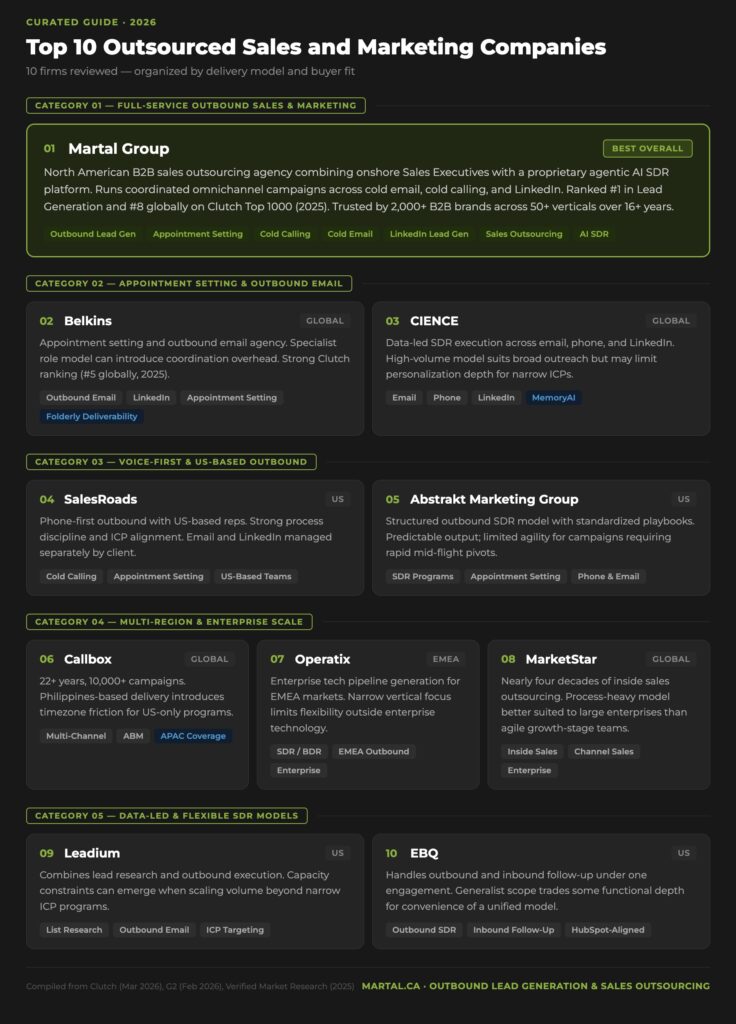
To build this list, we reviewed the leading providers in B2B outbound sales and marketing outsourcing, evaluating service focus, delivery model, vertical expertise, client feedback across Clutch and G2, and third-party rankings. We excluded digital marketing agencies and general BPO firms. Every company below specializes in the function this article is about: generating qualified B2B pipeline through outbound sales and marketing execution.
1. Martal Group
Overview Martal Group is a North American B2B sales outsourcing and lead generation agency founded in 2009. The firm operates onshore teams across North America, Europe, and LATAM, running outbound pipeline programs for clients across 50+ verticals. Over 16 years, the firm has worked with more than 2,000 B2B companies ranging from early-stage technology businesses to enterprise organizations.
Martal’s delivery model combines onshore Sales Executives — averaging three to five years of B2B experience — with a proprietary AI SDR platform that handles prospecting, intent signal monitoring, and outreach sequencing. The two operate in combination rather than as alternatives: the AI platform manages the data and execution layer while the human team focuses on qualification, objection handling, and pipeline progression. This structure means clients are not choosing between automation and experienced salespeople — they get both within a single engagement.
Campaigns run as coordinated omnichannel programs across cold email, cold calling, and LinkedIn outreach. Outreach is not run as parallel channel efforts — the sequencing and timing across channels is managed as a single orchestrated program, which affects how prospects experience the outreach and how quickly campaigns accumulate signals. Onboarding runs seven to ten business days. First MQLs typically arrive within 14 to 20 days of launch and first SQLs within 30 days.
On the verification side, Martal ranked #8 globally on the Clutch Top 1000 B2B Service Providers list in 2025 — placing it in the top 1% of more than 350,000 evaluated companies — and holds the #1 position in the Clutch Leaders Matrix for Lead Generation. The firm holds a 4.8/5 rating on Clutch based on 106 verified reviews and 200+ five-star reviews across Clutch, G2, and Capterra. These rankings are based on verified client interviews rather than self-reported data.
Documented client outcomes include a nine-year engagement with Clickworker that produced $4.5M in recurring revenue and a 500% ROI, $10M+ in new business opportunities for HALO Recognition, and 35 qualified leads per month for Spirit AI entering the US market from zero in a niche AI trust and safety category.
Key Features
- Coordinated omnichannel outreach across cold email, cold calling, and LinkedIn lead generation
- Onshore Sales Executives across North America, Europe, and LATAM
- Proprietary AI SDR Platform with 300M+ verified contacts and 10M+ intent signals
- Seven to ten day onboarding with first SQLs delivered within 30 days
- Weekly campaign reporting and live pipeline visibility
- Appointment setting integrated into the outbound program — not a separate service
- Vertical specialization across 50+ industries including SaaS, cybersecurity, AI/ML, fintech, energy, manufacturing, and healthcare
- Tiered service model covering outbound lead generation, customer onboarding, and account management
- Full sales outsourcing capability for companies requiring a more comprehensive external sales function
Ideal For B2B technology, SaaS, cybersecurity, AI/ML, fintech, energy, manufacturing, and professional services companies at SMB, mid-market, or enterprise level — particularly those entering new markets, scaling outbound without adding internal headcount, or looking to replace a fragmented multi-vendor stack with a single coordinated program.
Book a consultation to discuss what a qualified pipeline program looks like for your specific vertical and growth stage.
2. Belkins
Overview Belkins is a B2B appointment setting and outbound lead generation agency founded in 2017. The firm focuses on top-of-funnel execution — primarily outbound email campaigns, LinkedIn prospecting, and lead research. It operates a supporting email deliverability platform called Folderly. Belkins holds a 4.9/5 score on Clutch based on 229 verified reviews and ranked #5 on the Clutch Top 1000 Global Service Providers 2025 list. Engagements are built around specialist roles rather than a single account-owning team — which can introduce coordination overhead for clients who prefer one point of contact managing the full outbound process.
Key Features
- Outbound email campaign execution and sequencing
- LinkedIn prospecting and lead research
- Folderly email deliverability management
- Appointment setting with dedicated SDR specialists
- Reporting and campaign analytics
Ideal For Growth-stage to mid-market B2B companies with strong internal closing capacity that need consistent top-of-funnel meeting volume and have the internal bandwidth to manage multi-specialist coordination.
3. CIENCE
Overview CIENCE is a B2B sales development firm offering outbound prospecting across email, phone, and LinkedIn, supported by data operations and its proprietary MemoryAI technology. The firm reports serving clients across 149+ industries. CIENCE’s model leans heavily on data infrastructure and campaign volume — an approach that works well at scale but can produce lower personalization depth for companies selling into narrow ICPs or highly technical buyer personas where message specificity drives conversion.
Key Features
- Multi-channel outbound prospecting (email, phone, LinkedIn)
- Proprietary B2B contact database and data enrichment
- MemoryAI technology for targeting and personalization
- SDR team execution and campaign management
- Reporting across pipeline stages
Ideal For SMB to enterprise companies running high-volume outbound programs that prioritize reach and campaign scale over deep vertical specialization.
4. SalesRoads
Overview SalesRoads is a US-based outbound sales outsourcing firm with a focus on cold calling and appointment setting. The firm deploys US-based representatives and emphasizes close alignment with internal sales leaders on messaging and qualification criteria. SalesRoads operates primarily as a phone-first organization — a focused model that suits certain buyer segments but limits omnichannel coordination for companies that need email and LinkedIn running in parallel with calling programs.
Key Features
- Cold calling and appointment setting
- US-based SDR team deployment
- Outbound process design and alignment
- Qualification criteria development
- Weekly reporting and performance reviews
Ideal For Mid-market B2B companies in manufacturing, logistics, technology, and professional services that prefer a voice-led outbound approach and have internal teams to manage email and LinkedIn separately.
5. Callbox
Overview Callbox is a B2B lead generation firm founded in 2004, with 10,000+ campaigns executed across its operating history. The firm runs multi-channel outbound programs and has a significant presence in APAC markets. Its primary delivery hub is in the Philippines — which introduces timezone friction for US-based companies requiring real-time responsiveness during North American business hours, and can affect the cultural alignment of outreach for buyers in domestic US markets.
Key Features
- Multi-channel outbound (email, phone, LinkedIn, webinar registration)
- SMART Engage AI platform for campaign orchestration
- Account-based marketing support
- Database management and list building
- APAC regional coverage
Ideal For Mid-market to enterprise companies running account-based programs or targeting APAC markets alongside North American expansion.
6. Operatix
Overview Operatix is a pipeline generation firm focused on enterprise technology vendors, with delivery concentrated in EMEA and North America. The firm works with companies at growth and scale stage to build outbound pipeline through SDR and BDR programs. Operatix’s model is narrowly focused on enterprise technology — which makes it a strong fit within that segment but limits flexibility for companies outside that vertical or those seeking broader industry coverage across multiple sectors.
Key Features
- SDR and BDR program execution
- EMEA and North American outbound coverage
- Enterprise pipeline development
- Persona-level targeting for complex buying groups
- Campaign reporting and performance tracking
Ideal For Enterprise technology and SaaS companies targeting EMEA markets or running global pipeline programs with longer sales cycles and higher average contract values.
7. Leadium
Overview Leadium is a B2B sales development firm that combines lead research and list-building with outbound campaign execution. The firm positions the quality of its prospect data as a core differentiator. Leadium’s model bundles research and execution within the same team — an efficient structure for narrow ICPs, though it can create capacity constraints for companies that need to scale outreach volume quickly without sacrificing list quality.
Key Features
- Targeted prospect list research and building
- Outbound email and multi-channel campaign execution
- ICP definition and segmentation support
- Lead qualification and handoff
- Campaign performance reporting
Ideal For B2B companies where ICP definition is narrow and list precision directly determines campaign outcomes — particularly in SaaS, IT consulting, healthcare, and fintech.
8. MarketStar
Overview MarketStar is a large-scale sales outsourcing firm with nearly four decades of operating history. It offers inside sales, channel sales management, and partner programs under a Sales as a Service model. MarketStar’s size and structure are built for enterprise-level engagements — which means smaller or faster-moving companies often find the firm’s delivery model too process-heavy and slow to adapt compared to more agile outsourced partners.
Key Features
- Inside sales and pipeline development
- Channel sales and partner program management
- Multi-region delivery and global coverage
- Lead qualification and full-cycle inside sales
- Performance management and reporting
Ideal For Large enterprises running complex, multi-region inside sales or channel partner programs that require consistent long-term operational management at scale.
9. EBQ
Overview EBQ is a US-based outsourced sales development firm offering both outbound prospecting and inbound lead follow-up within a single engagement. The firm positions itself as a flexible extension of the internal sales team across multiple pipeline stages. EBQ’s generalist scope — covering outbound, inbound, and research under one roof — can limit the depth of specialization in any single function compared to firms that focus exclusively on outbound pipeline generation.
Key Features
- Outbound prospecting and appointment setting
- Inbound lead follow-up and nurturing
- Market research and list building
- Lead qualification across pipeline stages
- Flexible engagement structures
Ideal For B2B companies that want a single outsourced partner handling both outbound and inbound follow-up, and are willing to trade some functional depth for the convenience of a unified engagement.
10. Abstrakt Marketing Group
Overview Abstrakt Marketing Group is a US-based outsourced SDR and appointment-setting firm serving clients across technology, healthcare, financial services, and professional services. The firm emphasizes process consistency and structured reporting. Abstrakt’s model is built around standardized outbound playbooks — which delivers predictability but can limit adaptability for companies that need campaigns to pivot quickly based on market feedback or evolving ICP signals.
Key Features
- Outbound SDR and appointment setting
- Dedicated team structures with transparent reporting
- Campaign management across phone and email
- Industry-specific outreach playbooks
- Regular performance reviews and pipeline visibility
Ideal For SMB and mid-market companies seeking a structured, process-driven US-based outsourced SDR model with predictable output and clear reporting cadences.
How to Choose the Right Outsourced Sales and Marketing Provider?
Finding the right outsourced sales and marketing partner takes more diligence than most buyers apply to the process. The category is crowded, proposals tend to look similar, and the differences that actually predict outcomes — team model, vertical experience, campaign adaptability, reporting transparency — rarely surface in a standard sales conversation unless you know what to ask.
Here is a practical framework for evaluating providers before you commit.
Understand Your Current Sales Process and What Needs Improvement
Before evaluating any provider, get clear on where your pipeline is failing. The diagnosis shapes everything that follows — which services you need, which provider model fits, and what success should look like in months three, six, and twelve.
The most common entry points we see for outsourced sales and marketing partnerships fall into a few predictable patterns: pipeline dried up or stalled, internal team stretched too thin to prospect consistently, a new market or product launch requiring outbound capacity that doesn’t exist internally, or an ICP that has shifted and the current messaging is no longer converting.
Each of those situations calls for a different kind of partner. A company that needs pure top-of-funnel volume has different requirements from one that needs full-cycle sales outsourcing or a partner to run a coordinated omnichannel program from scratch. Knowing which situation you’re in prevents you from selecting a provider optimized for a different problem.
In doing so, the outsourced sales executives or marketing experts will be able to diagnose and propose solutions for areas that need improvement in your lead generation and customer acquisition processes. And if you already know where your team is lacking, you can use the outsourced agency’s assessment to verify whether its tactics align with your business practices and target outcome.
Outline What You Want from Your Outsourced Partner
When choosing a provider for outsourced sales or marketing, clarity about what your company needs is not optional — it is the foundation of a successful engagement. Vague briefs produce vague results. Before speaking with any provider, define the following:
- The outcome you are buying: SQLs and booked meetings, or MQLs, or pipeline coverage in a specific vertical or region?
- The service scope: Full omnichannel outbound program, appointment setting only, a specific channel like cold email or LinkedIn outreach?
- The ICP: Which titles, industries, company sizes, and geographies are in scope?
- The timeline: When do you need pipeline, and what does the ramp period look like?
- The budget: What monthly investment makes financial sense relative to your average deal size and sales cycle length?
Because outsourced marketing agencies and sales firms specialize in different strategies, you will need to find a partner with experience targeting the specific audience you serve. It is essential that the provider also focuses on the metrics that matter to you and is transparent in its reporting so you can accurately measure success. The goal is to find a reputable partner with the skill set required to meet your company’s objectives with an ROI that makes long-term financial sense.
Interview Potential Outsourced Sales and Marketing Companies
Hiring an outsourced sales and marketing company should be approached with the same rigor as hiring a senior internal hire. These external experts will represent your brand in front of prospective buyers.
Ask every provider you are evaluating the following questions:
- What industries have you run campaigns in that are directly comparable to ours? Ask for specific examples, not category-level claims.
- What does your onboarding process look like, and what do you need from us to run effectively? The answer tells you how structured their process is and how much internal lift the engagement will require.
- How do you build prospect lists, and what data sources do you use? Generic answers here are a warning sign.
- What does your reporting look like, and how frequently do we review performance together? Weekly reporting with live pipeline visibility is the standard to expect.
- How quickly do you adapt when early campaign signals suggest the messaging or targeting needs to change? Rigid agencies run the same playbook regardless of what the data shows. The best partners treat the first 90 days as a calibration period and adjust accordingly.
- What does a campaign look like at month three versus month one? Mature programs should show improvement over time, not flat activity metrics.
One question that rarely gets asked but consistently separates accountable providers from opaque ones comes directly from buyers who’ve been burned before:
“Is the outsourced team internal, or will the company in turn outsource to fulfill your contract? Will people be dedicated solely to you, or will they be working on multiple contracts and campaigns at the same time?”
This is worth asking explicitly. Some providers use subcontractors or offshore delivery teams behind a branded front. Others assign the same SDR across eight to ten simultaneous client campaigns. Neither arrangement is inherently wrong, but both affect message quality, brand consistency, and the depth of ICP knowledge the person representing your company will actually carry. A provider that can’t answer this question directly is telling you something important.
Request case studies, testimonials, or other materials that demonstrate the provider’s ability to execute in your specific vertical. Questions like these should never catch a reputable agency off guard — their plan of attack should be outlined in detail before you sign anything.
The provider’s reporting cadence and pipeline analytics are also important considerations. How often are reports delivered? What metrics are tracked and how are they measured? How is data used to assess campaign health and optimize results? Much of this information may not be on the provider’s website — schedule a demo for any provider you are seriously evaluating so you can assess what the actual service experience looks like.
Red Flags to Watch For During Vetting
This is the part of the evaluation process most buyers skip and where the most avoidable mistakes happen. A few signals worth watching for:
Guaranteed results in the first 30 days. Outbound pipeline takes time to calibrate. Any provider that promises a specific number of meetings before understanding your ICP, messaging, and market conditions in detail is overpromising.
No case studies in your vertical. Pattern recognition from adjacent industries is useful, but there is no substitute for a provider that has run campaigns in your specific space. If the case studies don’t map to your buyer, ask directly what their experience in your category looks like.
Vague answers about team structure. Who specifically will be working on your account? Are they dedicated to your campaign or shared across multiple clients? What is the handoff process if a rep leaves? These questions reveal whether the delivery model has real accountability built in or whether you will be managing constant transitions.
Reporting that measures activity over outcomes. Emails sent, calls made, and LinkedIn connections accepted are activity metrics. What matters is MQLs, SQLs, and booked meetings — and how those numbers trend over the first 60 to 90 days of the engagement.
Long minimum contract terms without performance milestones. Reputable providers are confident enough in their delivery to structure contracts around results. Unusually long lock-in periods with no performance checkpoints are worth scrutinizing carefully.
Don’t Be Afraid to Ask for References
While conducting research is essential to making an informed decision, speaking directly with references provides a perspective on day-to-day service quality that no review platform fully captures. Ask specifically about what the first 90 days looked like, how the provider handled early campaign issues, and whether the reporting gave them the visibility they needed to feel confident in the program’s direction.
References from companies in a similar industry, at a similar growth stage, and with a comparable ICP will give you the most relevant signal. A reputable provider should be able to connect you with at least two or three relevant client references without hesitation.
Conclusion – Are You Ready to Hire a Marketing and Sales Outsourcing Company?
By this point you have a reasonably complete picture of what outsourced sales and marketing involves, what the category’s leading providers look like, and what the evaluation process should cover. The remaining question is whether the model is right for your situation right now.
A few honest markers that suggest it probably is:
- Your pipeline is inconsistent and the internal team doesn’t have the bandwidth to fix it without pulling capacity from other priorities
- You’re entering a new market, launching a new product, or targeting a new buyer segment without an existing outbound motion for that audience
- You’ve tried to build an in-house SDR function and the ramp time, attrition, or cost made it harder to sustain than anticipated
- Your average deal size justifies the investment in a dedicated outbound program — and the math works even if conversion rates are conservative
And a few honest markers that suggest the timing may not be right:
- Your ICP isn’t clearly defined and your internal team hasn’t validated it
- There’s no one available to run discovery calls when meetings land
- You’re expecting an outsourced partner to define your value proposition rather than execute against one you’ve already validated
One question that shows up repeatedly in sales communities is, “We tried outsourced sales once and it didn’t work. What did we do wrong?”
The most common answers, based on what buyers consistently report across review platforms and forums: the ICP wasn’t clear enough when the engagement started, there was no one internally available to run discovery calls when meetings landed, or the provider ran the same playbook for 90 days without adapting when early signal suggested it wasn’t working. Occasionally the provider was simply the wrong fit for the vertical.
None of those failures are unique to outsourcing. Most of them are selection and setup problems — solvable with better vetting, a clearer brief, and a more active feedback loop during the first 60 to 90 days. The engagement model works. The outcomes depend heavily on how seriously both sides treat the setup.
Outsourcing amplifies what’s already working. It doesn’t replace the strategic clarity that needs to come from inside the business first.
If the markers above suggest the timing is right, the next practical step is to shortlist two or three providers whose delivery model, vertical experience, and team structure match your specific situation — and pressure-test them with the questions outlined in the vetting section above. The difference between a productive outsourcing engagement and a frustrating one is almost always in the quality of that evaluation process, not in the outsourcing decision itself.
Work With Martal
If the evaluation framework in this guide has led you to Martal as a potential partner, the most useful next step is a direct conversation about your specific situation — your ICP, your current pipeline gaps, and what a realistic program looks like in your vertical.
We work best with B2B companies that have a clear buyer in mind and want a dedicated team to go after them systematically. If that describes where you are, book a consultation and we’ll walk you through what an engagement would look like in practice.
References
- World Economic Forum
- Gartner
- Deloitte
- Deloitte’s 2024 Global Outsourcing Survey
- Mckinsey & Company
- 2025 Deloitte’s Global Business Services (GBS) Survey
FAQ: Outsourced Sales and Marketing
What is outsourced sales and marketing?
Outsourced sales and marketing means hiring a third-party provider to handle revenue-generation functions — including prospecting, outbound outreach, lead qualification, and appointment setting — rather than building those capabilities internally. The provider operates as an extension of the client’s sales team, targeting defined buyer personas and delivering qualified pipeline directly to the internal team for closing.
How much does outsourced sales and marketing cost?
Costs vary by scope and provider model. Fully managed outsourced sales and marketing services typically range from $4,500 to $15,000 per month depending on team size, channels, and campaign complexity. This compares favorably to the fully loaded annual cost of an in-house SDR, which includes salary, benefits, recruiting, software licensing, and a three-to-six month ramp period before full productivity. Research from Statista and Deloitte indicates companies typically save between 20% and 70% on operational costs through outsourcing versus equivalent in-house functions.
How long does it take to see results from outsourced sales and marketing?
Most structured programs deliver first MQLs within 14 to 20 days of campaign launch and first SQLs within 30 days. The 60 to 90 day window is when campaigns reach consistent output — the point at which targeting, messaging, and channel mix have been calibrated against live market feedback. Results timelines vary by industry, ICP complexity, and average sales cycle length.
What is the difference between outsourced sales and a marketing agency?
A traditional marketing agency manages brand, content, SEO, and paid media. An outsourced sales and marketing firm manages the pipeline — finding the right buyers, engaging them through outbound channels, qualifying them against the client’s ICP, and delivering sales-ready meetings. The primary metric for outsourced sales is SQLs and booked meetings. The primary metric for a marketing agency is typically impressions, traffic, or MQLs.
Is outsourced sales and marketing right for small businesses?
Yes, particularly for SMBs that have validated their product and ICP but lack the internal capacity or budget to build a full outbound function. Outsourcing removes recruiting overhead, ramp time, and software licensing costs — making it accessible at a price point that often compares favorably to a single in-house SDR hire. The key prerequisite is that someone internally is available to run discovery calls when qualified meetings are delivered.
What should you look for when choosing an outsourced sales and marketing company?
The most important criteria are vertical experience with documented results, dedicated team structure (not shared or subcontracted reps), transparent reporting tied to pipeline outcomes rather than activity metrics, and a structured process for adapting campaigns based on live performance data. Always request case studies from clients in a comparable industry and ask explicitly whether the delivery team is internal or subcontracted.