
 Martal
 Technology
 Education and training
 Web Development and UI / UX
 Healthcare/Medical
 Logistics and Supply Chain
 Information Technology
 Insuretech and Financial Services
 Marketplaces
 Software Development
 E-commerce and retail
 AI and Machine Learning
 Energy and Solar
 Manufacturing
 Security and Surveillance
 Digital Marketing Agency
 Transportation
 MSP
MSP
 Telecom
 B2B SaaS
 Cybersecurity
 HR tech
 Fintech
 Cleantech
 Consulting
Lead Generation and Appointment Setting: 5 Proven Strategies to Scale Your B2B Pipeline in 2026
Major Takeaways: Lead Generation and Appointment Setting
Most B2B teams don’t have a lead volume problem, they have a conversion problem. According to HubSpot’s 2026 State of Marketing Report, lead quality and MQLs are now the single most important metric for B2B marketers, reflecting a market-wide shift from generating contacts to generating qualified conversations.
Businesses using marketing automation to nurture leads experience up to a 451% increase in qualified leads. AI-powered prospecting, intent-based targeting, and smart sequencing allow teams to reach the right prospects at the right moment — dramatically accelerating both lead generation volume and appointment conversion rates.
Yes, and materially. McKinsey research shows hyper-personalized campaigns can deliver up to 8x ROI and drive more than 10% sales growth. Outreach built around a tightly defined Ideal Customer Profile, tailored to the specific pain points of each segment, consistently outperforms generic volume-based approaches on both reply rate and meeting booking rate.
B2B buyers are distributed across email, phone, and LinkedIn — and most need six to eight touches before responding. Businesses using coordinated omnichannel outreach strategies see 287% higher engagement rates than single-channel approaches, and campaigns using three or more channels generate significantly higher conversion rates. Omnichannel is a coordination advantage, not just a channel diversity play.
Outsourcing appointment setting can reduce labor and overhead costs by up to 65% compared to building an in-house SDR team — while delivering SQLs in as little as 30 days. The advantage isn’t just cost: it’s speed, expertise, and access to proven playbooks and proprietary data infrastructure that an internal team would take months to build.
Critically important. Responding to a new lead within five minutes generates qualification rates 21 times higher than waiting 30 minutes. Companies that build response time SLAs, automation alerts, and predefined follow-up sequences into their process consistently convert more of their existing leads without additional marketing spend.
Organizations that run lead generation and appointment setting as a coordinated system — with shared ICP definitions, aligned MQL-to-SQL qualification criteria, and consistent omnichannel outreach — consistently generate more predictable pipeline, shorter sales cycles, and higher close rates. The two functions amplify each other when unified; they underperform when siloed.
Introduction
Most B2B sales teams don’t have a lead volume problem. They have a lead quality and conversion problem, too many contacts that never become conversations, and too many conversations that never become pipeline.
According to HubSpot’s 2026 State of Marketing Report, lead quality and MQLs rank as the top priority for marketers (39%), ahead of conversion rates, ROI, customer acquisition cost, and lead volume (1).
That shift reflects what experienced outbound teams have observed for years: generating names is easy. Generating qualified meetings with decision-makers who are actually ready to talk is where most programs break down. For many organizations, investing in specialized B2B appointment setting services has become the most direct way to bridge that gap — ensuring lead generation efforts actually convert into revenue-driving conversations.
This guide covers five strategies that address both sides of the equation: how to generate the right leads, and how to convert them into qualified appointments consistently. Each approach is grounded in what actually moves the pipeline, not what sounds good on a slide deck.
To build this guide, we drew on recent industry research, third-party benchmarks, and Martal’s operational experience running outbound lead generation and appointment setting programs across 50+ B2B verticals.
Lead Generation vs. Appointment Setting: What’s the Difference and Why It Matters for Scaling Your Sales Pipeline
Before diving into strategies, it’s worth being precise about what these two functions actually are and where most teams lose efficiency by conflating them or running them in silos.
What is Lead Generation?
Lead generation involves identifying and attracting potential customers who express interest in your product or service—essentially forming the top of your sales funnel. Your primary goal is to gather the contact details of interested prospects to nurture and engage them further.
Key lead generation methods include:
- Inbound Marketing: Content marketing, SEO, webinars, whitepapers, and case studies.
- Outbound Prospecting: Cold emailing, cold calling, LinkedIn outreach, and networking events.
- Advertising: Paid campaigns, social media ads, or sponsored content to boost visibility and attract potential buyers.
Effective lead generation ensures your sales pipeline continuously receives a fresh flow of prospects, preventing stagnation and supporting consistent growth.
What is Appointment Setting?
Appointment setting focuses on converting generated leads into qualified meetings with your sales executives. Qualified appointment setting techniques employ highly targeted, personalized interactions, such as calls, customized emails, and LinkedIn outreach, to secure meaningful, sales-ready meetings that drive pipeline growth.
Appointment setting typically involves:
- Lead Qualification: Identifying leads that align closely with your Ideal Customer Profile (ICP).
- Personalized Engagement: Crafting compelling, relevant outreach tailored to prospects’ specific pain points.
- Persistent Follow-Up: Timely and strategic follow-ups to secure qualified meetings.
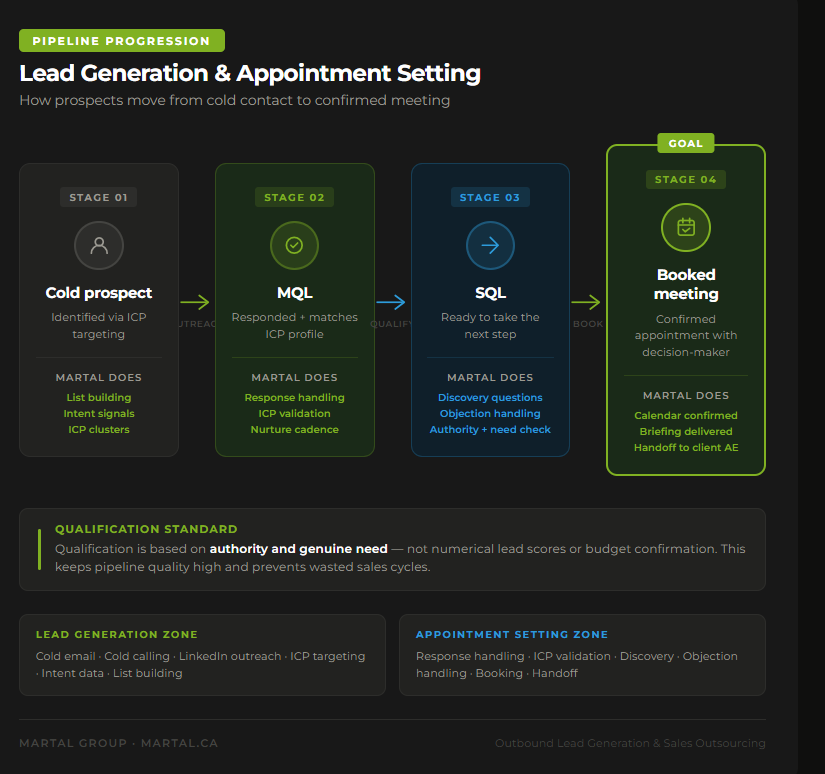
At Martal, we classify leads by status, not by numerical score. A prospect who responds to outreach and matches the client’s ICP becomes an MQL. When that prospect signals readiness to move forward, asking for more information or requesting a meeting, they become an SQL. That distinction matters because it keeps qualification grounded in real buying signals rather than arbitrary point thresholds. Companies with a clear MQL-to-SQL process experience higher close rates and shorter sales cycles, maximizing pipeline efficiency and overall sales effectiveness.
Why Both Strategies Are Essential for Scaling
Lead generation and appointment setting are integral to a well-functioning pipeline. Here’s how they complement each other:
- Lead Generation: Broadens your reach, capturing the initial attention of potential customers.
- Appointment Setting: Narrows focus, prioritizing and transforming promising leads into actionable sales conversations.
Without ongoing lead generation, there are no qualified prospects to convert. Without effective appointment setting, your sales team wastes time on leads unlikely to close. The two functions reinforce each other, and the teams that run them in tight coordination consistently outperform those treating them as separate programs.
How to Balance Lead Generation and Appointment Setting for Maximum Impact
To scale your sales pipeline quickly, seamlessly integrate both approaches:
- Define clear roles: Ensure your marketing team drives lead generation while your sales team prioritizes appointment setting and closing.
- Leverage automation: Automate routine lead generation tasks, freeing sales reps for higher-value, personalized engagement.
- Measure rigorously: Continuously monitor lead gen KPIs such as lead volume, lead quality, meeting booking rates, and conversion rates to optimize performance.
5 Ways to Maximize Lead Generation and Book More Appointments
The strategies below aren’t theoretical. They reflect what consistently separates B2B teams that generate predictable pipeline from those that generate activity. Some require technology investment. Some require process discipline. One, outsourcing, lets you skip the ramp-up entirely and hand the execution to specialists.
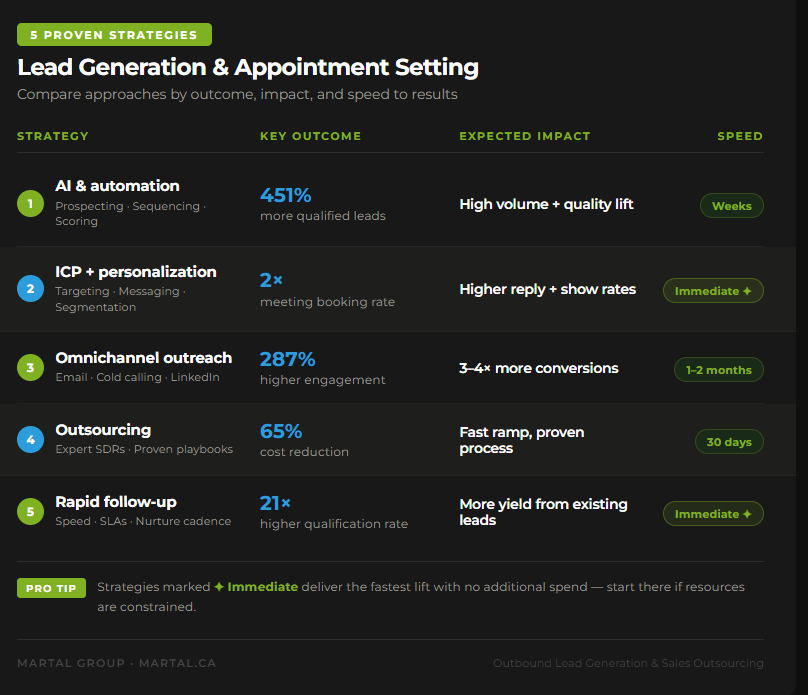
None of them work in isolation. The highest-performing outbound programs combine several of these approaches into a coordinated system. Use the table below to orient quickly, then dig into each strategy for the execution detail.
1. Embrace AI and Automation in Lead Generation and Appointment Setting
Businesses that use marketing automation to nurture prospects experience a 451% increase in qualified leads.
Reference Source: Salesforce
The effectiveness of modern lead nurturing strategies is reflected in the data. Implementing marketing automation to nurture prospects can result in a 451% uplift in qualified leads (7).
When sales development reps (SDRs) spend the majority of their time on manual prospecting, list-building, and data entry, they have less time for the conversations that actually move deals forward. AI and automation change that ratio — dramatically.
Modern outbound platforms can automatically research prospects, surface verified contact information, and generate personalized outreach sequences tailored to each ICP segment. Instead of manually building lists, your team works a continuously refreshed pipeline of qualified targets. When a prospect responds or signals intent, the system flags it immediately — no hot lead sits unworked.
Where AI adds the most leverage in lead generation and appointment setting is in prioritization. Intent data tools monitor signals like funding announcements, hiring surges, technology changes, and content engagement to surface accounts that are actively in a buying window. Reaching a prospect when their need is highest — rather than on a random cadence — materially improves reply rates and meeting conversion.
For B2B teams evaluating how to integrate AI into their outreach, the direction is increasingly clear. Organizations investing in AI are already seeing stronger pipeline performance, signaling that it is no longer experimental but a proven driver of measurable results. That level of adoption reflects proven returns, not experimentation.
Martal’s approach illustrates how this works in practice. Our AI SDR Platform monitors 10M+ real-time buyer signals and sources prospects from a database of 300M+ verified contacts — then generates personalized campaign copy trained on 40M+ outbound messages. The result is outreach that reaches the right person with the right message at the right moment, with human sales executives refining and executing every campaign. This is what separates signal-based outreach from mass-volume spray tactics.
That human layer matters. AI handles the research, prioritization, and sequencing. Experienced sales executives handle the judgment calls — navigating objections, reading a prospect’s tone, deciding when to push for a meeting and when to nurture longer. Automation that removes the human entirely tends to produce higher volume at lower quality. The programs that perform best keep both in play.
One example of this model in action: in a campaign for a transportation technology company entering a competitive AI freight market, Martal’s team generated 353 leads and booked 108 meetings in just three months (13), a pace that would have taken a manually-operated team considerably longer to reach. The AI handled targeting and sequencing; the human team handled qualification and conversion.For teams building this capability in-house, the fastest path to improvement is usually sequencing and intent data — automate the outreach cadence first, then layer in signal-based targeting to sharpen who gets contacted and when. To scale your sales pipeline fast, put prospecting and sequencing on autopilot, then let your human team focus on the conversations that actually close.
2. Focus Your Lead Generation and Appointment Setting on Ideal Customer Profiles (ICP) and Personalization
Hyper-personalization can generate up to 8 times the ROI and boost sales by 10%+
Reference Source: McKinsey & Company
Tailored, hyper-personalized campaigns can deliver 8x ROI and drive more than 10% growth in sales (3). The math is straightforward: a busy executive is far more likely to respond to outreach that speaks directly to their situation than to a generic pitch they’ve seen ten variations of this week. Precision beats volume, every time.
Too many B2B programs default to casting a wide net and hoping the volume carries them. It rarely does. The more effective approach is to tightly define who you’re targeting, understand what actually matters to them, and build messaging that reflects that understanding. That’s what ICP-driven lead generation and appointment setting looks like in practice.
Defining Your ICP with Enough Specificity to Actually Use It
Start by going beyond basic firmographics. Industry, company size, and decision-maker titles are a starting point — not a finished ICP. The more useful layer is behavioral and situational: what pain points does your solution address? What signals indicate a company is in a buying window? What does a prospect’s tech stack or recent hiring activity tell you about their priorities?
For example, if you’re a cybersecurity provider, is your ICP “mid-sized financial institutions concerned about data breaches” or perhaps “healthcare organizations needing HIPAA-compliant security”? If you’re targeting the healthcare sector, your ICP might include clinics using EMR Software to streamline appointment scheduling and patient management. If you sell an AI SaaS platform, are you targeting tech-savvy enterprises in retail looking to improve forecasting, or maybe startups in education looking to personalize learning? The more specific, the better. Knowing exactly who you’re targeting lets you craft messages that speak directly to their needs.
A significant share of B2B buyers enter the market with strong preconceptions, 41% already have a specific vendor in mind at the start of their buying journey, while 92% begin with a defined shortlist .
This underscores why defining your Ideal Customer Profile (ICP) with real precision is critical (2). If your targeting is too broad or generic, you’re unlikely to even make it onto that initial shortlist. The companies that win are those that align their messaging, outreach, and positioning so closely with a clearly defined ICP that they are considered early, before the buyer’s preferences are fully locked in.
How to Personalize Outreach at Scale
Identifying two or three core ICP segments lets you build messaging that addresses the unique challenges of each. A VP of Manufacturing at a factory equipment company needs to hear about supply chain reliability and uptime — not generic revenue growth promises. A Director of Education Technology responds better to outcomes around student engagement or learning efficiency. Personalization shows you’ve done your homework, and it’s what appointment setting scripts built on ICP research consistently outperform templated alternatives.
Here are a few appointment setting tips to keep efforts ICP-focused and personalized:
- Segment your prospect lists by industry or persona – e.g., have separate lead lists for SaaS CEOs, healthcare IT managers, manufacturing ops directors, etc. This way you can tailor campaigns to each segment.
- Craft custom email templates and call scripts – Highlight industry-specific case studies or results you’ve achieved. For instance: “Hi [Name], we recently helped a logistics company cut delivery times by 20%…” or “We understand MSPs like yours care about scalable growth – here’s how we can help…”.
- Use the prospect’s name and company context, and reference triggers where relevant. If their company recently announced a funding round or their LinkedIn activity signals a strategic shift, mention it. “Noticed your team is scaling into enterprise accounts — many SaaS companies at that stage face SDR capacity constraints, which is exactly where we help.”
- Apply ABM principles to high-value targets — treat top-tier accounts individually with fully customized outreach plans, multiple contacts engaged simultaneously, and bespoke content where appropriate.
The Operational Payoff
Focusing on ICP-fit leads shortens sales cycles. Prospects that match your ICP have the problem you solve, the authority to act, and a higher baseline of receptiveness to your outreach. Your sales executives stop wasting time on leads that were never going to close and focus energy where conversion is most likely.
Martal’s approach to this goes one layer deeper. Rather than single-segment ICP targeting, we build multi-layer ICP clusters (micro-segments defined by firmographic, technographic, and behavioral criteria) and tailor messaging to each. In a 14-month campaign for a manufacturing client entering the US industrial tools market for the first time, this precision targeting approach generated 1,596 leads and 203 SQLs (12). The account had no existing US pipeline. The results came from targeting the right buyers with the right message through a coordinated omnichannel program — not from volume.
One practical note: ICP definitions should evolve. Analyze which leads convert to customers, which verticals close fastest, and which personas engage most readily. The ICP you start with is a hypothesis. What you refine it into over six to twelve months of campaign data is where the real precision lives. Keep your sales and marketing teams aligned on the current definition so everyone is targeting the same profile — not working from outdated assumptions.
3. Expand to Omnichannel Outreach for Lead Generation and Appointment Setting Success
67 % of B2B buyers now complete most of their purchase journey without early sales contact, making omnichannel outreach essential to reach them across all touchpoints.
Reference Source: Gartner
If your team is currently relying on one primary channel, say, cold emailing, to generate leads and set appointments, the math is working against you. Prospects are busy and distributed across platforms. Some respond to email; others only pick up the phone; others engage most readily on LinkedIn. A single-channel program reaches the fraction of your ICP that happens to prefer that channel. An omnichannel program reaches all of them.
A 2026 Gartner sales survey finds that 67 % of B2B buyers favor a rep‑free buying experience (4), conducting most of their research through digital channels before speaking with sales.
For omnichannel outreach, this means companies must reach buyers wherever they are, across email, social, calls, and digital platforms, to stay visible and capture leads early in the decision-making process.
What makes omnichannel different from simply “using multiple channels” is coordination. The channels aren’t running in parallel and independently — they’re sequenced so each touchpoint reinforces the last. A prospect receives an introductory email, then a LinkedIn connection request that references a shared industry context, then a follow-up call that builds on both. By the time your sales executive asks for a meeting, the prospect has seen your brand three times across three different surfaces. Recognition and trust accumulate with each touchpoint.
On average, prospects require about 20 touchpoints before becoming sales-ready (9), highlighting that effective lead generation depends on consistent, omnichannel engagement rather than one-off outreach.
The Core Channels and How They Work Together
- Cold email remains the workhorse of B2B outbound. Use it for personalized introductions, sharing relevant proof points like case studies or results, and moving prospects toward a conversation. Keep emails direct, specific to the recipient’s situation, and always end with a clear next step, a request for a 15-minute call, a specific question, or a relevant resource.
- Cold calling deserves more credit than it gets in an era of inbox saturation. For high-value targets and senior decision-makers, a well-timed, well-researched call cuts through in ways email cannot. Even a voicemail left after an email creates a second impression: “Hi, I just sent you an email about [specific relevant point] — would love to connect if you have a few minutes this week.” The call amplifies the email; the email warms the call.
- LinkedIn outreach is where Martal’s campaigns consistently find engaged decision-makers. With over 89% of B2B marketers using LinkedIn for lead generation and the platform’s visitor-to-lead conversion rate running nearly four times higher than other social channels (10), it’s where professional buying conversations happen. Personalized LinkedIn campaigns, connection requests that reference real context, and thoughtful engagement with a prospect’s content all build the familiarity that makes a meeting request feel natural rather than cold. For teams managing LinkedIn outreach at scale, the key is personalization — the right message to the right person based on their role, industry, and recent activity — not volume for its own sake.
- Content & Webinars: Hosting a short webinar or participating in industry virtual events can generate leads who self-select by interest. Use integrations to automatically add webinar registrants from Google Sheets to GoToWebinar, Zoom, or any platform you use, making lead capture effortless and immediate. Afterward, you have a warm reason to reach out (“Thanks for attending our webinar on AI in healthcare – would you be open to a follow-up call to discuss how [Your Company] might help your hospital reduce costs as mentioned?”). Content marketing (like posting articles, videos, or podcasts) can also draw inbound leads who engage with that content.
- SMS/Text and Chat: For certain scenarios, a polite text message or using a website chat can be effective – but use sparingly and appropriately. For example, once a prospect has shown interest, a text reminder (“Looking forward to our demo tomorrow at 10am”) can reduce no-shows. Website live chat can catch leads in real-time as they browse your site, turning an anonymous visitor into a meeting on the books.
Coordination Is the Differentiator
The biggest failure mode in omnichannel outreach isn’t choosing the wrong channels — it’s running them without a coherent sequence. A prospect who receives an email on Monday, a LinkedIn message on Tuesday, a call on Wednesday, and another email on Thursday with completely different messaging across each touchpoint doesn’t experience coordination. They experience noise.
Here are appointment setting techniques that keep omnichannel outreach coordinated rather than chaotic:
- Plan a defined sequence before launching: Day 1 email, Day 3 LinkedIn connection, Day 5 call, Day 7 follow-up email referencing earlier attempts, Day 10 call with voicemail, Day 12 value-add content share.
- Keep messaging consistent across channels — the same core value proposition, the same ICP-relevant hook, expressed in the format each channel suits best.
- Vary timing and day of week to maximize contact probability without being intrusive.
- If a prospect engages with one channel — opens an email, accepts a LinkedIn connection — treat that as a signal and prioritize follow-up on the next touch.
Research consistently shows that campaigns using three or more coordinated channels generate significantly higher conversion rates than single-channel approaches. In one of Martal’s telecom equipment campaigns, a fully coordinated omnichannel program across cold email, cold calling, and LinkedIn outreach generated 1,442 leads and 339 booked meetings over 24 months (11), a pace that a single-channel program couldn’t sustain. The channel mix wasn’t the differentiator. The coordination was.Omnichannel outreach also gives your appointment setters more natural entry points into a conversation. When a prospect has seen your brand across email, LinkedIn, and a phone call, the ask for a meeting doesn’t arrive cold — it arrives as a natural next step from someone they recognize. That familiarity closes the gap between outreach and appointment faster than any single-channel program can. Our guide to building appointment setting campaigns breaks down how to structure that coordination step by step.
4. Outsource Lead Generation and Appointment Setting to Experts for Quick Scale
Outsourcing appointment setting can reduce labor and overhead costs by up to 65%.
Reference Source: Martal Group
Building an in-house sales development team to generate leads and book meetings is expensive, slow, and operationally demanding. Recruiting takes months. Training takes longer. And by the time an internal SDR is performing at full capacity, a well-resourced outsourced program has already been generating pipeline for two quarters.
The 65% cost reduction figure above reflects the real economics of outsourcing versus in-house SDR hiring (5), when you factor in salary, benefits, tooling, management overhead, and ramp time, the cost differential is substantial. Many companies find that for the price of one in-house SDR, they can engage a full outsourced team with established processes, proven playbooks, and senior execution experience already in place. Monitoring appointment setting cost against pipeline output consistently favors the outsourced model when speed and expertise are priorities.When you outsource lead generation and appointment setting to a specialized firm, you bypass the ramp-up entirely. A capable outsourced appointment setting partner arrives with the systems, data, and experience already operational. The question isn’t whether to build, it’s whether to start generating pipeline now or in six months.
What a Strong Outsourced Partner Actually Provides
- Experienced sales executives who specialize in outbound. The most effective outsourced programs are run by professionals who do nothing but prospect, qualify, and book meetings across a range of B2B verticals. They know how to navigate gatekeepers, handle objections, and read the signals that distinguish a genuinely interested prospect from a polite brush-off. Martal’s sales executives average three to five years of B2B experience across North America, the EU, and LATAM — with vertical specialization across 50+ industries, so whether you’re targeting enterprise SaaS buyers or procurement managers in manufacturing, the team already speaks the language.
- Established Processes and Playbooks: An outsourced partner brings refined processes for lead generation – from ICP definition and list-building to coordinated omnichannel outreach cadences and qualification frameworks. These playbooks have been tested across hundreds of campaigns and continuously refined based on what actually converts. Instead of building and iterating from scratch, you plug into a system that is already producing results for companies similar to yours.
- Proprietary data and AI-powered targeting: Top lead generation agencies invest heavily in data infrastructure and sales technology. Martal’s AI SDR Platform sources prospects directly from a database of 300M+ verified contacts — no separate data tool required. List building, intent signal monitoring, campaign sequencing, and performance reporting all happen inside a single platform, under the guidance of experienced sales executives. As a client, you benefit from that infrastructure without purchasing or maintaining it. You save on salaries, benefits, office space, management time, and operational expenses such as interest on corporate credit cards and software subscriptions.
- Scalability and Flexibility: Need to double the number of leads per month to hit a new aggressive target? An outsourced team scales by allocating resources — not by hiring, onboarding, and training additional staff. When pipeline needs slow seasonally, the overhead doesn’t remain fixed. That flexibility is particularly valuable for companies managing variable growth targets or expanding into new verticals where internal expertise doesn’t yet exist. It also means you’ll never have to spend months figuring out how to hire appointment setters when the business need is immediate.
- Speed to market in new segments. Say you want to expand into cybersecurity buyers or launch in a new geographic region. An experienced outsourced partner likely has verified contacts, relevant messaging experience, and established outreach patterns in that segment already. They can begin prospecting in days. An internal effort would require months of hiring, research, and trial. Outsourcing eliminates the learning curve on market entry.
What Results Actually Look Like
The proof of an outsourced model is in the pipeline it generates. Two examples from Martal’s case study library illustrate the range:
In a campaign for a transportation technology company in the AI freight sector, a competitive, technically complex category, Martal generated 353 leads and booked 108 meetings in three months (13). The speed came from intent-based targeting, experienced execution, and a coordinated omnichannel approach that an internal team starting from scratch couldn’t have replicated at that pace.
Over a longer engagement, Martal’s partnership with Clickworker, a marketplace platform, generated $4.5M in recurring revenue and a 500% ROI over nine years. That kind of sustained pipeline output, including deals with Fortune 10 and Fortune 500 companies, reflects what a consistently well-executed outsourced program produces when the partner is genuinely integrated into the client’s growth strategy.
Choosing the right partner matters enormously. Look for a provider with a verifiable track record in B2B lead generation and appointment setting — check case studies and client results, not just testimonials. Avoid any firm that leads with volume promises and light on targeting specificity. The right partner works with you to understand your ICP, messaging, and value proposition deeply, then executes as a true extension of your team. They should provide regular reporting with full pipeline visibility, so you always know what’s working and what’s being optimized.
How to Make the Partnership Work
Treat your outsourced team like part of the company. Share product knowledge, include them in messaging updates, brief them on new case studies, and maintain regular check-ins. The more context and feedback they receive, the more precisely they can refine outreach to match your brand voice and buyer expectations.
Many companies see pipeline volume accelerate meaningfully within the first one to two quarters of an outsourced engagement. As the relationship matures, the external team becomes increasingly adept at identifying hidden opportunities and refining approaches for your specific market. That kind of improving performance over time — not just a fast start — is what produces the reliable, predictable pipeline that makes revenue forecasting feel like analysis rather than guesswork.Outsourcing lead generation and appointment setting is a high-leverage move for any B2B company trying to grow quickly, enter new markets, or free its internal team to focus on closing. The cost savings are real. The speed advantage is real. But the biggest gain is expertise — access to a team that has run this play hundreds of times and knows exactly what separates a program that generates meetings from one that generates noise. As one of the leading appointment setting companies in North America, Martal has delivered qualified B2B leads that convert — and we measure our success by the pipeline and revenue our clients close, not the volume of contacts we touch.
5. Implement Rapid Follow-Up to Maximize Lead Generation and Appointment Setting Results
Acting within five minutes on a new lead can generate 21x higher qualification rates than waiting 30 minutes.
Reference Source: Harvard Business Review
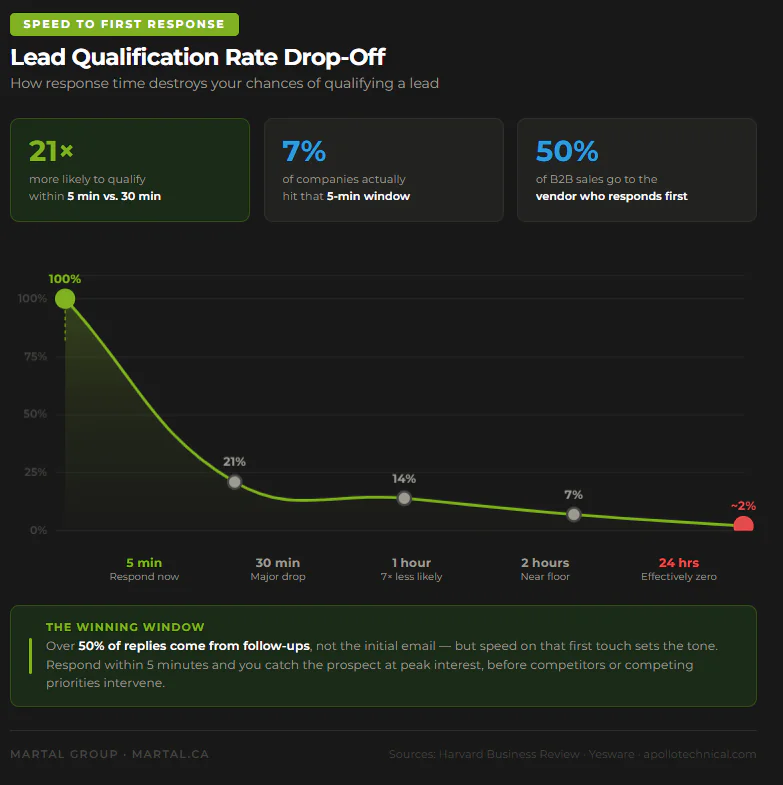
Underlying buyer behavior hasn’t changed, buyers move on quickly. Responding to a new lead within 5 minutes can boost conversion rates by up to 9x (6). The point of first vendor contact has moved earlier in the buying journey, meaning buyers are reaching out when their interest is highest and their attention window is shortest. How fast you respond in that window determines whether you get the conversation or your competitor does.
Speed matters, but it compounds with persistence. You might generate strong leads and set solid initial appointments, but if follow-up is slow or inconsistent, you’re leaving conversion on the table. Responding to a new lead within 5 minutes can boost conversion rates by up to 9x compared to delayed response. The companies that win most consistently are the ones that respond first and follow through with disciplined cadence — not just on inbound leads, but across every stage of the outbound appointment setting process as well.
Consider this scenario: A potential customer fills out a demo request form on your website. If your sales rep calls them back in two or three days, that lead may have gone cold or even talked to a competitor already. But if you call them back in five minutes, you catch them when their interest is at its peak. According to industry research, responding to leads within five minutes can result in 21x higher qualification rates compared to waiting 30 minutes, highlighting the critical advantage of speed in capturing interest and staying ahead of competitors (8).
Building a Follow-Up System That Holds
Here are appointment setting techniques that make rapid, consistent follow-up a system rather than a best-effort:
- Set a response time SLA: Establish a Service Level Agreement for lead response. For example, decide that all web inquiries or marketing-qualified leads must be called or emailed within 15 minutes during business hours (or by 9 a.m. next business day if they come in overnight). Hold your team accountable to this standard. Many top-performing companies aim for a 5-minute response window for hot inbound leads.
- Use automation and alerts: Leverage your CRM and marketing automation to immediately notify the sales team when a new lead comes in. For instance, have an automated email or text alert sent to the assigned rep’s phone. Some systems can auto-distribute leads in round-robin fashion to available reps, so no one slips through the cracks. You can even set up trigger-based outbound actions – e.g., if a prospect clicks a link in your email, your SDR gets a task to follow up within an hour referencing that interest.
- Prepare follow-up sequences in advance: Don’t leave follow-up to chance. For every lead or prospect interaction, have a predefined sequence of touches ready. If someone downloads a whitepaper, maybe your sequence is: call within 1 hour, send a personalized email if no contact, call again next day, then connect on LinkedIn, etc. Consistency ensures every lead is pursued fully (while they’re warm). The goal is polite persistence – many prospects actually appreciate a gentle reminder if they expressed interest but got busy.
- Keep the pipeline warm between touches: Rapid follow-up isn’t only about the first contact. It’s also about continuous engagement between touches. For leads that aren’t ready to meet yet, implement a nurturing cadence (occasional check-ins, share useful content bi-weekly, etc.). For scheduled appointments, confirm quickly and send a calendar invite immediately. And after a great discovery call, follow up the same day with a summary email and next steps. Momentum is key – don’t let too much time lapse between interactions or interest can fade.
- Reduce no-shows proactively: Nothing is worse than setting an appointment and then the prospect doesn’t show up. Reduce no-shows by being proactive. Send a reminder email 24 hours before a meeting, and even consider a quick reminder text or LinkedIn message the morning of the call. People are busy and appreciate the reminder. A brief, friendly note like “Looking forward to our call at 2 pm today. Let me know if anything has changed!” can double your show-up rates. Higher show-up rates mean a fuller pipeline progressing to real opportunities.
The Scaling Argument for Speed
From a purely operational perspective, improving follow-up speed is one of the most cost-effective ways to grow pipeline output — because it extracts more value from leads you already have rather than requiring more spend to generate new ones.
If out of 100 inquiries your team currently reaches 30 and books 10 meetings, improving response speed and persistence could plausibly move that to 50 reached and 20 booked. That’s a doubling of pipeline impact with no additional marketing spend — just better execution on the leads already coming in. Over a quarter or a full year, those gains compound meaningfully.
To sustain this during peak periods, ensure adequate coverage when lead volume is highest — after webinars, following content releases, during campaign surges. For teams operating across time zones, a follow-the-sun model or outsourced coverage for off-hours inquiry handling ensures no lead sits unworked until the next business day. Fast internal handoffs — SDR to account executive, account executive to sales engineer — also matter. When a prospect asks for a proposal or technical detail, turning it around in 24 hours while a competitor takes a week is itself a differentiator. Responsiveness becomes part of your brand impression before the deal is even close.Track the metrics that reveal where speed is breaking down: lead response time, contact rate, and conversion rate from inquiry to booked meeting. If you implement a tighter response SLA, measure the impact on contact and appointment rates over the following four to six weeks. The data will show where the system is working and where the buying process is still losing momentum to slow follow-through.
Conclusion: Accelerate Your Lead Generation and Appointment Setting with the Right Partner
Scaling your sales pipeline is achievable — when you apply the right mix of strategies and execute with discipline. Here is a quick recap of the five approaches covered in this guide:
- Leverage AI and Automation: Put prospecting, sequencing, and intent-based targeting on autopilot. Free your sales team to focus on the conversations that actually close — not the admin work that feeds into them. This fills the appointment funnel faster with less manual effort.
- Zero in on your ICP with personalization: Precision beats volume. ICP-driven, personalized outreach doubles your chances of booking meetings and shortens the sales cycle by filtering out poor-fit prospects early.
- Go omnichannel: Coordinate outreach across cold email, cold calling, and LinkedIn — not as parallel tracks but as a sequenced system. Campaigns using three or more coordinated channels convert at significantly higher rates than single-channel programs. Many companies also leverage appointment setting call center and telemarketing appointment setting solutions to extend their outbound reach across multiple touchpoints simultaneously.
- Outsource to experts: Bring in a specialized team (like Martal Group) to generate pipeline quickly and cost-effectively — tapping into proven playbooks, experienced sales executives, and proprietary data infrastructure without the months-long ramp of building in-house.
- Follow up fast: Speed is one of the most cost-effective pipeline levers available. Responding within five minutes generates qualification rates 21 times higher than waiting 30 minutes. Build the SLAs, the automation triggers, and the sequences that make speed systematic rather than aspirational.
These five strategies work individually. They compound when combined.
For teams ready to hand the execution to specialists, Martal Group has been delivering scalable B2B appointment setting and outbound lead generation since 2009 — trusted by 2,000+ B2B brands across 50+ industries and ranked #1 in Lead Generation on Clutch. Our model combines experienced onshore sales executives with Martal’s AI SDR Platform, running coordinated omnichannel campaigns across cold email, cold calling, and LinkedIn outreach. Clients start generating SQLs in 30 days. In one engagement, a transportation technology company booked 108 meetings in three months. In another — a nine-year partnership with a global marketplace platform — Martal delivered $4.5M in recurring revenue and a 500% ROI.If your pipeline isn’t where it needs to be, or you’re entering a new market and need results faster than an internal build allows, we’d welcome the conversation. Book a consultation with Martal Group and we’ll review your current approach, identify the highest-leverage opportunities, and share exactly how we’d build a program around your ICP and growth targets. No obligation. Just a direct conversation about what qualified pipeline actually looks like for your business.
References:
- HubSpot Marketing Statistics
- Forrester
- McKinsey & Company
- Gartner Sales Survey
- Martal Group B2B Appointment Setting
- Leadinfo
- Salesforce
- Harvard Business Review
- Gartner
- LinkedIn Marketing Solutions
- Martal Group – Telecommunications Case Study
- Martal Group – Manufacturing Case Study
- Martal Group – Transportation Case Study
FAQs: Lead Generation and Appointment Setting
How do lead generation and appointment setting services work together?
Lead generation and appointment setting services operate as two connected stages of the same pipeline process. Lead generation identifies and attracts potential buyers — through outbound prospecting, content, or paid channels — and surfaces contacts that match your Ideal Customer Profile. Appointment setting then engages those contacts directly, qualifies them based on authority and need, and converts them into confirmed sales meetings. When both functions are managed by the same team or partner using shared ICP criteria and omnichannel outreach, the handoff between them is seamless — and the result is a predictable, consistent flow of qualified meetings entering the pipeline.
What is the difference between lead generation and appointment setting?
Lead generation focuses on identifying and attracting potential buyers — it builds the top of the funnel by surfacing prospects who match your target profile. Appointment setting focuses on converting those prospects into qualified sales conversations — it qualifies interest, handles objections, and secures confirmed meetings with decision-makers. One broadens reach; the other narrows focus. Both are necessary for a healthy B2B pipeline. The most common failure point is treating them as separate programs rather than a coordinated system with shared qualification criteria and consistent messaging.
How do you choose the right lead generation and appointment setting service?
Start by evaluating the provider’s track record in your specific industry and target market — look for published case studies with real results, not just testimonials. Assess their qualification process: do they define MQLs and SQLs clearly, and do those definitions match your sales team’s expectations? Review their outreach methodology — a credible provider runs coordinated omnichannel campaigns, not single-channel volume blasts. Transparency matters too: you should receive regular reporting with full pipeline visibility. Finally, look for a partner who treats your ICP and messaging as seriously as you do — not one who plugs your logo into a generic playbook.
What qualifies as a qualified lead in appointment setting lead generation?
In Martal’s framework, a qualified lead progresses through two stages. An MQL — a Market Qualified Lead — is a prospect who has responded to outreach and matches the client’s Ideal Customer Profile based on firmographic and behavioral criteria. An SQL — a Sales Qualified Lead — is an MQL who has expressed readiness to take the next step, whether that means requesting more information, agreeing to a discovery call, or scheduling a meeting. Qualification is based on authority and genuine need — not numerical lead scores or budget confirmation. This distinction keeps pipeline quality high and prevents sales teams from wasting time on contacts that were never truly ready to engage.
How much do lead generation and appointment setting services cost?
Pricing for lead generation and appointment setting services varies significantly based on the model, scope, and provider. Fully managed outsourced programs — where an experienced team handles all prospecting, outreach, qualification, and booking — typically represent a substantial cost saving versus building in-house: outsourcing can reduce labor and overhead by up to 65% compared to hiring, training, and tooling a full internal SDR team. Self-serve AI-powered platforms offer a lower entry point for teams that want to run campaigns independently. The right frame for evaluating cost is cost per SQL and pipeline ROI — not the monthly retainer in isolation. Martal’s ROI calculator can help model the economics for your specific situation.
How can appointment setting improve my sales pipeline performance?
Effective appointment setting improves pipeline performance in three measurable ways. First, it increases the volume of sales-ready conversations entering the funnel — giving account executives more qualified opportunities to work. Second, it shortens the sales cycle by filtering out poor-fit prospects early, so your team spends time on accounts with genuine authority, need, and interest. Third, it makes pipeline forecasting more accurate and predictable — when meetings are consistently generated from a defined ICP through a repeatable process, revenue planning becomes analysis rather than guesswork. Teams with strong appointment setting programs consistently report higher close rates and lower cost per closed deal.
What are common obstacles in lead generation and appointment setting campaigns?
The most common obstacles fall into four categories. Poor ICP definition leads to outreach that generates volume but low-quality meetings — prospects that were never a good fit. Weak or generic messaging produces low reply rates regardless of targeting quality. Misalignment between lead generation and appointment setting functions — different qualification criteria, inconsistent messaging, no shared feedback loop — reduces conversion at every stage. And slow follow-up is one of the most damaging: waiting more than an hour to respond to an inbound inquiry can reduce qualification rates by more than 90% compared to a five-minute response. Fixing follow-up speed alone often produces immediate, measurable pipeline improvement.
Can appointment leads be generated through both inbound and outbound methods?
Yes — and the strongest programs typically combine both. Outbound methods including cold email, cold calling, and LinkedIn outreach allow you to proactively reach decision-makers who match your ICP, regardless of whether they are actively searching for a solution. Inbound methods — content marketing, SEO, webinars, and paid campaigns — attract buyers who are already in a research or evaluation mode, making them warmer and faster to convert. A coordinated approach uses outbound to generate consistent volume and inbound to capture high-intent demand. Martal’s managed service runs omnichannel outbound campaigns as the core engine, with inbound inquiry handling available as part of a full-service engagement.
What is the role of AI in modern lead generation and appointment setting?
AI has moved from a supporting tool to a core execution layer in high-performing outbound programs. In lead generation, AI powers prospect identification — surfacing accounts that match your ICP from databases of hundreds of millions of verified contacts — and intent signal monitoring, which identifies companies actively in a buying window based on behavioral signals like hiring surges, funding announcements, and technology changes. In appointment setting, AI generates personalized outreach copy trained on millions of real B2B conversations and automates sequencing across email, LinkedIn, and calling cadences. The result is a program that reaches the right prospects with relevant messaging at the right moment — at a scale and speed no manual team can match — while experienced sales executives handle the qualification conversations that actually convert.