
 Martal
 Technology
 Education and training
 Web Development and UI / UX
 Healthcare/Medical
 Logistics and Supply Chain
 Information Technology
 Insuretech and Financial Services
 Marketplaces
 Software Development
 E-commerce and retail
 AI and Machine Learning
 Energy and Solar
 Manufacturing
 Security and Surveillance
 Digital Marketing Agency
 Transportation
 MSP
MSP
 Telecom
 B2B SaaS
 Cybersecurity
 HR tech
 Fintech
 Cleantech
 Consulting
10 B2B SaaS Sales Strategies That Actually Move Pipeline in 2026
Major Takeaways: B2B SaaS Sales
Layer firmographics, technographics, buyer personas, and real-time timing signals into every target account. SaaS companies with a clearly defined ICP see win rates up to 68% higher than those without.
58% of B2B SaaS companies now run a PLG motion, and 91% plan to increase PLG investment. Blend self-serve and sales-assisted paths with clean handoffs — PLG alone struggles in enterprise, where security reviews and CFO approval require the sales motion.
Formal sales processes produce 28% higher revenue than ad hoc approaches. Pick MEDDPICC, SPIN, Challenger, or Solution Selling and run it consistently. Add a PQL stage to the pipeline if you’re running PLG.
Multi-channel outbound combining email, LinkedIn, and phone generates 40% higher engagement than single-channel approaches. Every prospect in a sequence should have at least one documented buying signal.
LinkedIn InMail delivers 10–25% response rates across B2B, compared to 1–5% for cold email. Personalized connection requests lift acceptance rates by up to 58% in B2B SaaS.
81% of sales teams have adopted AI, but only 5.5% see meaningful ROI. The teams closing that gap use AI to feed signals to reps and track sales velocity: (Opportunities × Deal Size × Win Rate) ÷ Cycle Length.
79% of IT and software purchases now require CFO final approval. For any deal above $25K ACV, build a one-page CFO brief covering payback period, TCO, and risk — and equip your champion to carry it into the finance meeting.
Only 8% of B2B SaaS companies achieve full alignment, yet aligned teams lift win rates by 38% and pipeline revenue by 208%. Tie at least one sales metric to post-close retention to break the “closed and forgotten” cycle.
Enterprise SaaS deals involve 8–12 stakeholders and 6–24 month cycles. Build a Mutual Action Plan on every deal above $50K ACV, engage 5–7 stakeholders per account within 30 days, and pre-package your SOC 2 and compliance docs to protect deal velocity.
Only 26% of reps receive weekly coaching, yet reps who do outperform peers 4-to-1 in quota attainment. Pair ongoing training with quarterly win-loss analysis to lift win rates 10–20% over time.
Introduction
The global B2B SaaS market continues its climb, with projections in the $230–270 billion range for 2025 (1) and widely cited estimates pushing past $300 billion 2026. More competition, more scrutiny, more signatures per deal.
So what actually separates SaaS sales teams that hit quota from the ones that miss? Not louder pitches or more automation. It’s the discipline of the process — how tightly an ICP is defined, how coordinated the outreach is, how early a champion gets enabled, how fast friction gets stripped out of procurement.
This article was built by reviewing the latest B2B SaaS benchmarks from sources including Optifai, HubSpot, McKinsey, Gartner, and Thinkific, and interpreting the findings through our experience running outbound and pipeline programs for SaaS companies across the US, Canada, Europe, and LATAM. Our goal is to help SaaS founders, CROs, VPs of Sales, and revenue leaders cut through the generic advice and focus on the tactics that actually move deals in 2026.
A quick grounding before we start — B2B SaaS sales means selling cloud-based, subscription software to other businesses. That sounds simple, but it carries weight: SaaS reps don’t close a one-time purchase, they open a relationship. Revenue is recurring. Expansion matters as much as acquisition. Churn quietly undoes everything you built in Q1 by Q3. And because most SaaS deals involve 6–11 stakeholders, the playbook is closer to complex enterprise selling than to transactional software sales.
The ten strategies below are the ones we see separating top-performing SaaS teams from everyone else — from defining ICP and structuring the sales process to multi-threading enterprise deals, aligning with CFOs, and using AI where it actually helps.
The 10 Strategies That Actually Move B2B SaaS Pipeline in 2026
The B2B SaaS selling environment in 2026 is structurally harder than it was three years ago. The average B2B buying decision now involves 8.2 stakeholders, and for technology purchases, that number climbs to roughly 25 people, with enterprise deals averaging 33 influencers (3).
79% of IT and software purchases now require CFO final approval (3). Sales cycles have lengthened, procurement reviews have gotten stricter, and buyers run a significant portion of their evaluation before they ever talk to a rep.
That’s the environment. The good news is the playbook isn’t a mystery — it’s just more disciplined than it used to be.
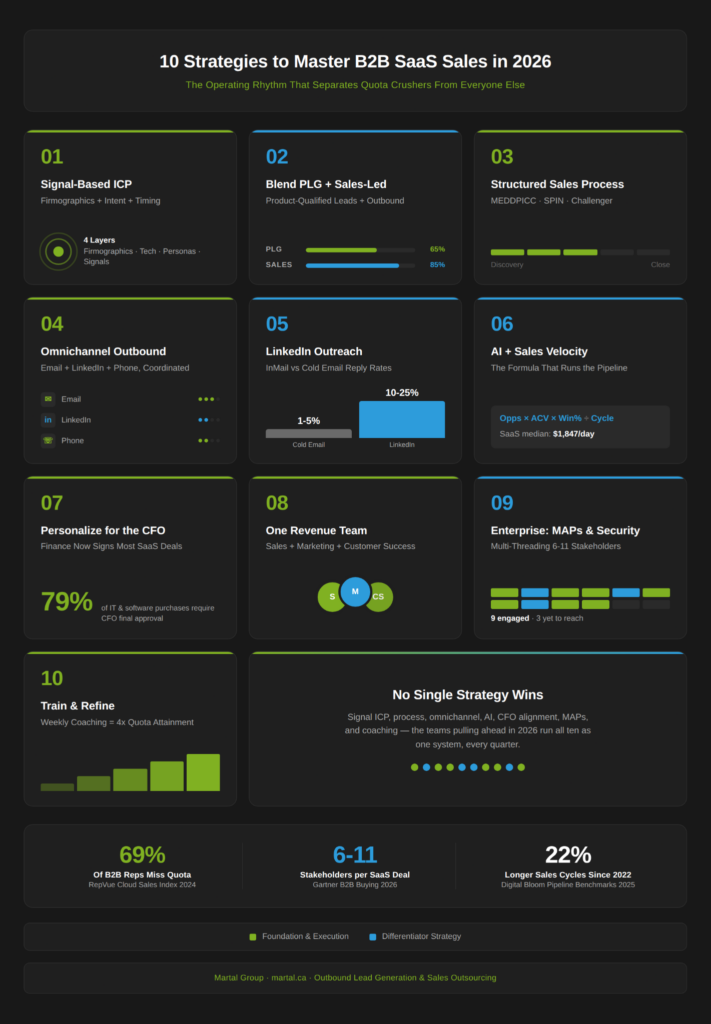
The ten strategies below are the ones we see separating the SaaS teams hitting quota in 2026 from the ones falling short. They’re organized to move from foundation to execution to optimization:
- Strategies 1–3 build the foundation — signal-based ICP, the PLG-plus-sales model decision, and the sales process that runs on top of both.
- Strategies 4–6 cover execution — how outbound actually reaches the right buyer, how LinkedIn fits in, and how AI and the sales velocity framework sharpen every decision.
- Strategies 7–9 focus on closing — personalizing for the CFO and the buying committee, aligning internal teams, and running enterprise deals with Mutual Action Plans and security readiness built in.
- Strategy 10 is the meta-strategy — how to train your team and keep improving so the other nine compound over time.
What separates SaaS teams that execute from SaaS teams that don’t is how consistently they run all ten — not just the two or three that feel easiest.
Here’s the full list:
- Define a Signal-Based ICP — Not Just a Firmographic One
- Blend Sales-Led and Product-Led Growth Motions
- Run a Structured Sales Process with a Modern Methodology
- Execute Omnichannel Outbound with Intent-Layered Cadences
- Make LinkedIn Outreach a Core Pipeline Channel
- Use AI and the Sales Velocity Framework to Sharpen Decision-Making
- Personalize Around Value — Especially for the CFO in the Room
- Align Sales, Marketing, and Customer Success as One Revenue Team
- Master Enterprise Sales with MAPs, Multi-Threading, and Security Readiness
- Invest in Continuous Training and Build a Culture of Refinement
Let’s work through each one.
1. Define a Signal-Based ICP, Not Just a Firmographic One
Companies with a clearly defined Ideal Customer Profile (ICP) increase win rates by up to 68%.
Reference Source: Unstoppable
Most B2B SaaS sales teams already have an ICP document. The problem is what’s in it.
A firmographic ICP — industry, company size, geography, revenue band — is table stakes. It tells you who fits your product. What it doesn’t tell you is when any of those companies are actually ready to buy. And in 2026, with sales cycles 22% longer than they were in 2022 (16) and buying committees of 6 to 11 stakeholders per deal, the cost of chasing the right account at the wrong moment is steep.
A good firmographic ICP, layered with real-time buying signals, is what separates outbound that lands from outbound that gets archived unread.
SaaS companies with a clearly defined ICP have been found to increase win rates by up to 68%. That number gets quoted everywhere, but the detail that matters is what “clearly defined” means. It isn’t just a slide with a few bullet points. It’s a working profile that answers three questions at the same time: who should we target, what signal tells us they’re ready, and what specific pain does our product solve for them right now?
One thing we see often in outbound work: the teams who struggle aren’t lacking effort — they’re targeting too broadly. When we tighten the ICP with a client, narrowing from “mid-market SaaS” to something like “mid-market B2B SaaS in logistics, 50–500 employees, running a legacy ERP, with a recent VP of Operations hire in the last 90 days,” response rates go up, SQL quality goes up, and senior selling time stops getting spent on prospects who were never going to buy.
What a Signal-Based ICP Actually Contains
A useful ICP in 2026 goes four layers deep. The firmographics tell you the shape of the account. The technographics tell you the friction. The personas tell you who signs. The signals tell you when.
- Firmographics — industry, revenue band, employee count, geography, growth stage, funding status
- Technographics — current tech stack, competing tools in use, integration dependencies, legacy systems that create the pain your product solves
- Buyer personas — the economic buyer, the champion, the technical evaluator, the blocker (each needs different language)
- Timing signals — recent funding rounds, leadership changes, hiring surges, competitor losses, office expansions, public job posts mentioning the problem you solve, recent tech stack changes
Most ICP documents stop at layer two. They name the firmographics and the tech stack, then hand the rep a list and say “go.” The fourth layer — timing signals — is what makes outbound feel relevant instead of random.
The practical test is simple: if your ICP doesn’t tell your SDRs why now, it’s not finished yet.
How Signal-Based Prospecting Changes Outbound Performance
Intent data, job-post monitoring, funding-round tracking, and tech-stack signals are what turn a generic list of 10,000 accounts into a working list of 300 that are actually in-market this month. The signals themselves aren’t exotic — they’ve been available for years — but the teams treating them as a filter layer rather than a nice-to-have are the ones seeing outbound response rates hold up in an environment where generic cold outreach has collapsed.
From an execution standpoint, signal-based outreach does three things at once:
- Compresses the sales cycle by reaching prospects who are already evaluating
- Improves reply rates because the message references something real in the prospect’s world (a funding round, a new hire, a recent tech adoption)
- Reduces wasted senior time on prospects who fit the ICP on paper but aren’t ready
This is also where the old 2015-era debate about “quality vs. quantity” in outbound finally resolves. With signal-layered ICPs, the two stop being a trade-off.
Actionable Tips
- Document your ICP across all four layers. A one-line ICP like “mid-market SaaS” is not a working document. A real one reads: “Mid-market fintech (50–500 employees), running a legacy FP&A stack, where the CFO or Head of FP&A owns software purchasing, with recent signals including new CFO hire, Series B or later funding, or a public job post for a FinanceOps role.”
- Align Sales, Marketing, and Customer Success on the same definition. Most “bad leads” arguments are actually misalignment at this layer, not execution failures downstream.
- Refine quarterly with closed-won data. Every 90 days, look at which ICP segments converted fastest and which churned within 12 months. If a segment isn’t closing or is quietly bleeding out, adjust before you spend another quarter of pipeline budget chasing it.
- Make signals a required field, not a bonus. No prospect enters a sequence without at least one documented buying signal. This rule alone raises reply rates meaningfully.
The payoff shows up over time. In this SaaS use case, a B2B SaaS provider of CMMS and EAM software aimed at maintenance and operations leaders across healthcare, manufacturing, food & beverage, utilities, and hospitality industries.
Over 26 months, Martal generated 1,708 qualified leads, 185 SQLs, and 144 booked meetings by layering precise firmographic targeting with role-specific messaging for each vertical.
When one product can serve many verticals, the ICP has to segment by vertical — not flatten them into one list. Six well-defined ICPs outperform one broad one.
Get the signal-based ICP right and every strategy that follows — the sales process, the outbound cadence, the personalization, even the enterprise close — gets easier. Skip this step, and no amount of outreach volume will compensate for aiming at the wrong accounts at the wrong time.
2. Blend Sales-Led and Product-Led Growth Motions
58% of B2B SaaS companies now run a product-led growth motion — and of those that do, 91% plan to increase investment in PLG further.
Reference Source: ProductLed
For a long time, the product-led vs. sales-led debate was framed as an either/or. In 2026, it’s not.
The evidence has settled: most B2B SaaS companies have already deployed a product-led motion — it exists in 58% of companies surveyed, and 91% of those plan to increase their PLG investment (2). At the same time,65% of SaaS buyers say they strongly prefer both sales-led and product-led experiences when buying a solution (17). The winning SaaS companies aren’t choosing one motion. They’re running both, and they’ve figured out how to hand off cleanly between them.
If you’re still operating a pure sales-led model, you’re leaving a compounding acquisition advantage on the table. If you’re pure PLG and relying on self-serve conversion alone, you’re likely watching high-value accounts churn through freemium without ever getting a human conversation. Only 27% of PLG companies report sustained year-over-year expansion — the majority struggle with churn, low conversion rates, and rising acquisition costs (18). The missing piece, in most cases, is the sales layer.
What a Blended Motion Actually Looks Like
A blended PLG-plus-sales motion isn’t complicated. It runs on two tracks simultaneously:
- The PLG track — free trial, freemium, or product-qualified signup lets users experience value without a sales conversation. Activation and time-to-value metrics are tracked closely.
- The sales-led track — outbound, ABM, and enterprise motions target accounts the PLG motion won’t reach cleanly: regulated industries, accounts requiring security reviews, buying committees with 8+ stakeholders, or deals above a certain ACV threshold.
The two tracks feed each other. Product usage data identifies which self-serve users are actually buyers in disguise (the Product-Qualified Lead, or PQL), and sales reaches out at the moment of real intent rather than cold. Conversely, enterprise deals closed by sales often land in accounts where individual users were already experimenting with the product via PLG.
From an execution standpoint, this is the model most competing sources point to: the most successful SaaS products blend product-led and sales-led touchpoints (19). What separates the teams that run it well from the ones that don’t is mostly operational discipline — the handoffs between product, marketing, and sales have to be clean, and the triggers for when a PLG user becomes a sales-assisted opportunity have to be explicit.
When PLG Makes Sense and When It Doesn’t
PLG works well when:
- Time-to-value is short. The user can get genuine value from the product in under an hour, without a demo or a training session.
- The product has natural virality or team-based adoption. One user becomes five, five become fifty, and the account converts from the inside out.
- The buyer and the user are the same person — or close to it. Self-serve purchasing works when the person with the pain also has a credit card.
PLG stops working cleanly when:
- The buying committee is large. With 25 stakeholders typical for technology purchases and 33 for enterprise, self-serve motions rarely get to signature on their own (3).
- Security, compliance, or procurement reviews are required. SOC 2, GDPR, and vendor risk reviews add 2–4 weeks to the cycle even for small deals — a signup flow doesn’t replace that.
- The CFO has to approve. With 79% of IT and software purchases now requiring CFO final approval (3), a credit-card self-serve path stops scaling around the point the deal value crosses the CFO’s notice threshold.
The practical implication: even if your SaaS product is a great PLG fit for SMB, you likely need a sales-assisted motion for mid-market and enterprise. That’s the blend.
How the Sales Team’s Role Changes Under PLG
This is where most SaaS sales leaders get stuck. In a blended motion, the sales team isn’t doing traditional cold outbound into accounts that have never heard of the product. They’re doing something more valuable: reaching into accounts where users are already using the product, and converting account-level expansion.
Practically, this shifts rep priorities:
- PQL follow-up becomes the top inbound queue — these are warmer than most outbound leads because the prospect has already experienced value.
- Expansion selling becomes a core revenue motion, not a customer success afterthought. A self-serve user at a 10,000-person enterprise is an opening for a seven-figure account expansion.
- Outbound still matters for accounts the PLG motion won’t reach — enterprise, regulated, or ICP-fit accounts that aren’t signing up on their own.
Actionable Tips
- Decide explicitly which accounts belong in PLG vs. sales-assisted. A simple rule: accounts above a certain ACV threshold, in a certain employee-count range, or in a regulated industry go to sales. Everything else runs self-serve first.
- Build a PQL definition that sales actually wants. If your PQLs aren’t converting, it’s not a sales problem — the definition is too loose. A good PQL includes activation events, team size, and firmographic fit, not just “they signed up.”
- Keep outbound active even if PLG is working. PLG fills the top of the funnel with SMB-scale signups. Enterprise pipeline still requires outbound. Do not decommission your outbound motion because your freemium funnel looks healthy.
- Track blended metrics. The old pipeline-generated metric misses the full picture. Track PQL-to-paid conversion, expansion revenue from PLG-originated accounts, and outbound-sourced pipeline separately so you can see where each motion is carrying its weight.
Where This Connects to Outbound
For SaaS companies running a blended motion, outbound’s job narrows — and gets more valuable. You’re not outbounding into a cold universe. You’re outbounding into:
- High-fit accounts that haven’t engaged with your PLG motion yet
- Enterprise or regulated accounts that will never sign up via freemium
- Accounts where PLG activity has started but needs a sales push to close at the buying-committee level
This is where a specialized outbound partner earns its keep. A team running Martal-style omnichannel outbound for a PLG-heavy SaaS company isn’t competing with the freemium funnel — they’re filling the gap the freemium funnel can’t reach.
Blending PLG and sales isn’t about picking a winning motion. It’s about running both with clean handoffs, a clear PQL definition, and discipline about which accounts belong on which track.
3. Run a Structured Sales Process with a Modern Methodology
Companies using a formal, guided sales process see 28% higher revenue than those that don’t.
Reference Source: HireDNA
A sales process is either a system your team actually runs, or it’s a diagram hanging unused in a Notion doc. There’s not much in between.
Top-performing B2B SaaS sales teams run the former. They follow a defined sequence of stages, apply a consistent qualification methodology, and adjust the playbook as the data comes in. In fact, 90% of companies using a formal, guided sales process ranked as top performers, and standardizing the process can boost revenue by 28% compared to running it ad hoc (4). Process isn’t bureaucracy. It’s the reason new reps ramp faster, why forecasts match reality, and why nothing critical falls through the cracks.
One thing we see often in SaaS outbound engagements: the teams that miss quota rarely have a messaging problem. They have a stage-consistency problem. Deals sit in “discovery” for six weeks without a clear qualification conversation. Demos happen before the prospect has even articulated the pain. Proposals go out before the economic buyer is identified. A structured process fixes all three, not with more meetings, but with clearer stage-exit criteria.
The Modern B2B SaaS Sales Stages
Specific stages vary by company, but a typical B2B SaaS sales cycle runs through:
- Prospecting and lead generation — identifying in-ICP accounts via outbound, inbound, PLG signup, or referral
- Qualification (discovery) — confirming the prospect matches the ICP, has a real pain, has authority or access to it, and has a defined timeline
- Product demo / value presentation — showing the software solving the specific pain the prospect surfaced in discovery (50% of B2B buyers expect a product demo in initial meetings, so be ready to tailor early)
- Proposal and negotiation — aligning on pricing, procurement, and security requirements; for enterprise deals, this stage includes security questionnaires and legal redlines
- Closing — securing the signature, which for SaaS often requires buy-in from legal, finance, IT, and the CFO
- Onboarding and customer success handoff — ensuring implementation goes smoothly and the account lands in Customer Success with full context
These stages form the repeatable roadmap. But stages alone aren’t a process. What turns a list of stages into a working system is the qualification methodology underneath.
Choosing the Right Sales Methodology
A methodology is how your team evaluates whether a deal deserves to move forward. In 2026, the most widely used methodologies in B2B SaaS remain:
- Solution Selling / Consultative Selling — frame your product around the customer’s problem, ask more than you pitch, and act as a consultant rather than a vendor
- Challenger Sale — bring a new insight the prospect hadn’t considered, reframe their thinking, and challenge their status quo; particularly effective for complex or novel solutions
- MEDDIC / MEDDPICC — Metrics, Economic buyer, Decision criteria, Decision process, Identify pain, Champion (plus Paper process and Competition in MEDDPICC); rigorous, widely used in enterprise SaaS, and a strong fit for deals with large buying committees
- SPIN Selling — Situation, Problem, Implication, Need-payoff questions that build urgency before the pitch; a classic technique that still works
The specific choice matters less than the consistency. A sales team running MEDDPICC consistently will outperform a sales team switching methodologies every quarter, even if MEDDPICC isn’t the theoretically best fit for their deal type. Pick one. Train the team. Run it for at least four quarters before evaluating.
How PLG Changes the Process
If you’re running the blended PLG-plus-sales motion from the previous section, your sales process needs an extra stage: the PQL handoff. This is where a product-qualified lead — someone already using the product — crosses from self-serve into sales-assisted.
The handoff has three practical elements:
- A defined PQL threshold — specific activation events, team size, and firmographic fit that together trigger a sales outreach
- A context packet — what the user has done in the product, how long they’ve been using it, which teammates they’ve invited, and any account-level signals (funding, hiring, role changes)
- A different opener — you’re not cold-calling; you’re reaching out to someone who already knows the product. The messaging should reflect that. “I noticed your team is actively using [feature] — happy to walk you through how other customers at your stage scaled from there” lands very differently than a generic prospecting email.
Sales teams that treat PLG handoffs like inbound leads — meaning no differently than a form fill — leave real expansion revenue on the table.
Why Process Matters More in 2026
Sales cycles have lengthened. Buying committees have grown. Procurement reviews have gotten stricter. The teams that hit quota in this environment aren’t working harder — they’re running tighter processes. Companies that pair structured processes with sales automation have reported 10-15% efficiency gains in sales, which in a world of 6-to-11-stakeholder buying committees is the difference between hitting forecast and missing it.
The old management adage applies: if you can’t describe what you’re doing as a process, you don’t know what you’re doing. In SaaS sales, knowing what you’re doing — and doing it consistently — is the direct path to more closed deals.
Actionable Tips
- Document your stages with exit criteria, not just labels. “Discovery complete” should mean specific things: pain identified, economic buyer named, timeline confirmed. If any one is missing, the deal stays in discovery.
- Pick one qualification methodology and run it for at least four quarters. The measurable gains from methodology consistency show up in year two, not month two.
- Build a PQL stage into the pipeline if you run PLG. Treat it as its own stage with its own conversion target. Lumping it in with inbound distorts the data.
- Review stage-to-stage conversion quarterly. If one stage shows a 60% drop-off while others hold steady, that’s where the process is broken — not in the stages that look fine.
In this real world SaaS sales example, we ran full sales cycle outsourcing for a sales performance management SaaS company expanding from Israel into the US and Canada, generating roughly 3,500 prospects a month and delivering 13 SQLs monthly. Across the engagement, the team managed more than 100 active deals through a structured process that kept every opportunity moving through defined qualification, demo, and proposal stages. The lesson is straightforward: when the process is consistent, volume compounds into closed revenue rather than stalling in nurture.
Treat the sales process like a working system, not a reference diagram. Define the stages, pick the methodology, build in a PQL handoff if you need one, and refine quarterly as the data comes in. The teams doing this will pull away from the teams that aren’t.
4. Execute Omnichannel Outbound with Intent-Layered Cadences
Cold email reply rates in B2B now average 3.4%, with top-quartile campaigns at 5.5% and elite performers exceeding 10.7%.
Reference Source: Instantly
Multichannel outreach used to be a competitive edge. In 2026, it’s the minimum entry fee.
The numbers underline why. Instantly’s 2026 Benchmark Report, analyzing billions of cold email interactions, puts the platform-wide average reply rate at 3.43%, with top performers exceeding 10% (20) — meaning roughly 19 out of 20 cold emails now get ignored. Phone still works, but it’s a numbers game on its own. LinkedIn drives strong response when messaging is relevant and tanks when it isn’t. No single channel carries the load anymore, and most of them have gotten harder, not easier, in the last three years.
Three things actually move outbound performance in 2026:
- Signal-layered targeting — every prospect in a sequence has at least one documented buying signal
- Coordinated channels — email, LinkedIn, and phone working as one cadence, not three separate workstreams
- Disciplined follow-up — enough touches to cross the response-rate threshold without tipping into spam territory
Teams that run all three well outperform teams running one or two of them by a wide margin. It’s not a tactics problem. It’s an orchestration problem.
The Omnichannel Advantage: Why One Channel Isn’t Enough
Every channel has a ceiling. Cold email averages hover in the low single digits for reply rates once you strip out inflated opens from Apple Mail Privacy Protection. Cold calling works, but typically only about 2% of cold calls result in an appointment, and it often takes eight or more attempts to reach a single prospect. LinkedIn response rates are strong when messaging is relevant, but prospects quickly tune out pitch-heavy connection requests that look like lazy templates.
The answer isn’t picking the best channel. It’s orchestrating all three. A coordinated omnichannel sequence keeps a prospect moving through multiple touchpoints with consistent messaging, so familiarity compounds across channels. Multi-channel sequences combining email, phone, and LinkedIn generate 40% higher engagement than single-channel approaches (21).
Different buyers respond to different channels. Some will reply to an email after a week of silence. Others only return a call. Others only engage after the fourth LinkedIn touch. 56% of customers still appreciate phone calls during the sales process, and 28% of B2B buyers say social media is their preferred first touchpoint (22).
Running one channel well reaches only one slice of the buying committee — which, in 2026, averages 6 to 11 stakeholders per SaaS deal and climbs higher for enterprise technology purchases. Omnichannel isn’t about casting a wider net. It’s about making sure the deal doesn’t die because one decision-maker prefers a different channel than the one the rep is running.
Intent-Layered Prospecting: The 2026 Differentiator
This is where most teams leave the biggest gains on the table.
Traditional outbound starts with a list, writes a message, and hopes the timing works out. Intent-layered outbound starts with a signal — a funding round, a leadership hire, a tech-stack change, a competitor switch, a job post mentioning the pain you solve — and only then builds the sequence. The prospect in the sequence isn’t random; they’re demonstrably in a buying moment.
The impact shows up in the numbers. Generic lead lists convert at 2.5% MQL-to-SQL, and email campaigns without genuine buyer intent achieve only 0.9% conversion (23). When you flip that — when every message references a real, recent event in the prospect’s world — reply rates move up an order of magnitude.
Practical signal types to layer into outbound:
- Funding events — Series A, B, or C rounds typically signal budget, hiring, and tool evaluation
- Leadership hires — a new VP of Sales, CFO, or Head of RevOps brings new vendor scrutiny in their first 90 days
- Technology signals — adoption of a complementary tool, or removal of a competitor’s tool, creates a window
- Hiring surges — rapid headcount growth typically precedes a pain the right tool can solve
- Public job posts — when a company posts for roles that describe the problem your product solves, that’s explicit intent
- Market triggers — M&A activity, new market entry, or executive-level strategic announcements
The rule we run with: no prospect enters a sequence without at least one documented signal. This one rule alone raises outbound reply rates meaningfully, because every message has a reason to exist.
The Modern Omnichannel Cadence (What Actually Works)
A cadence that works in 2026 isn’t complicated. It coordinates touches across channels over roughly three weeks, with every touch referencing something specific to the prospect. A working template:
- Day 1: Personalized email, signal-anchored opening (“Saw you just brought on a new VP of Operations”)
- Day 2: LinkedIn connection request (no pitch, contextual note)
- Day 4: Follow-up email with a specific value angle tied to the signal
- Day 6: Cold call — well-researched, warm-toned, referencing the email trail
- Day 9: LinkedIn message or comment on a recent post
- Day 12: Third email, often a “different angle” message or a relevant case study
- Day 15: Second call attempt, different time of day
- Day 19: Breakup email — short, honest, leaves the door open
The specifics matter less than the principles: coordinate across channels so one touch references the last, space touches so they don’t overwhelm, and keep every message anchored to a real signal.
How Many Follow-Ups Is Too Many?
This is one of the most common questions SaaS sales teams wrestle with. The honest answer: it depends on deal size and ICP, but the pattern is consistent.
A healthy cold email campaign typically aims for a 1–5% positive reply rate, and the sweet spot for follow-ups is between 4 to 6 touches. Campaigns with 1–3 emails in a sequence see a 9% reply rate, while those with 4–7 emails generate a 27% reply rate, which is three times higher (24). This suggests that 4–7 follow-ups is an effective range before diminishing returns set in. After that, continued emails without engagement are less likely to yield positive results.
That tracks with what we see running outbound for SaaS clients: SMB sequences tolerate more follow-ups and often reward them, while enterprise sequences need to be shorter and sharper. Enterprise prospects ghost fast and punish persistence.
The follow-up strategy matters as much as the count. Generic “just checking in” follow-ups destroy reply rates. Follow-ups that reference something new — a fresh signal, a new case study, a different angle on the problem — continue to earn responses well past the first touch.
Actionable Tips
- Put a signal requirement on every sequence. No prospect enters outbound without at least one documented buying signal. This single rule raises outbound ROI more than any copy change.
- Coordinate across channels, don’t parallelize. Email, LinkedIn, and phone should reference each other. A prospect who got your email and LinkedIn message, then a call, is meeting a consistent person — not being ambushed from three directions.
- Build cadences around the buyer, not the rep. SMB prospects tolerate 6–8 touches; enterprise prospects often need only 3–5 before the pattern gets invasive. Don’t run the same cadence across all ICPs.
- Track reply rate and positive reply rate separately. A “no thanks” is still a signal — it means the message landed. Count opens and bounces, but benchmark on what’s actually moving deals forward.
This plays out in real engagements. On a recent five-month outbound program we ran for a cybersecurity SaaS company selling data protection software into enterprise IT, the team generated 284 qualified leads, 42 SQLs, and 12 booked meetings by layering firmographic precision with role-specific messaging across CISOs, VPs of IT, Directors of IT, SecOps Managers, and Cloud Security Analysts, then running a coordinated email-LinkedIn-phone cadence rather than three parallel workstreams.
A CISO pitch looks nothing like a SecOps Manager pitch, and the cadence only works when every touch references something specific to that role and that account.
Run outbound like a system — signal-first, coordinated across channels, disciplined about follow-up volume — and the math starts working in your favor. Skip any of those three, and you’re just adding noise to inboxes that are already full.
5. Make LinkedIn Outreach a Core Pipeline Channel
LinkedIn InMail delivers 10–25% response rates across B2B industries, compared to 1–5% for cold email.
Reference Source: Salesmotion
LinkedIn stopped being a supplementary channel sometime around 2023. In 2026, if you’re running B2B SaaS outbound and treating LinkedIn as a secondary play, you’re leaving most of the response on the table.
The reply-rate math says most of it. Cold email reply rates are running at 1% to 5% industry-wide, while LinkedIn InMail delivers 10% to 25% response rates across B2B industries (25). Including a personalized note with a connection request increases acceptance rates by up to 58%, especially in B2B tech and SaaS sectors (26). Outreach tied to recent activity — a job change, published content, a company announcement — boosts response rates by 32% according to Sales Navigator data (26). None of that is marginal. It’s where most of the modern SaaS pipeline now gets built.
That said, SaaS is harder than most sectors on LinkedIn, not easier. SaaS and Technology sits near the bottom of industry reply rates at 4.77% due to inbox saturation (27). Every SDR in every SaaS company is pitching the same kinds of VPs. The LinkedIn inbox of a VP of Sales at a mid-market SaaS is a battlefield. What separates the outreach that gets replies from the outreach that gets blocked is relevance — specifically, whether the message references a real reason to be reaching out right now.
What LinkedIn Outreach Actually Means in 2026
To be clear about what we’re discussing: LinkedIn outreach is the direct messaging side of LinkedIn — connection requests, InMails, and follow-up messages sent to in-ICP prospects. It’s not personal brand coaching, not content strategy, not influencer playbooks. Those are adjacent disciplines that matter, but they’re not where most SaaS sales teams should focus their LinkedIn investment.
LinkedIn outreach done well is a targeting, timing, and messaging discipline. It works the same way cold email works — identify the right prospect, reference a specific reason for contact, keep it short, follow up with relevance — except the channel itself has higher baseline engagement and richer data on who the prospect actually is.
From an execution standpoint, the three things that move LinkedIn outreach performance:
- Profile credibility before the first message. Prospects check profiles before replying to connection requests. A thin or sales-pitchy profile tanks response rates before the message even gets read.
- Signal-anchored opening lines. Generic “Hi {firstName}, I’d love to connect” hits the archive button. “Saw you just joined as VP of RevOps — congrats on the move” opens a conversation.
- Short messages. The most effective LinkedIn outreach messages stay under 300 characters and get 19% more responses than longer, pitch-heavy alternatives (26).
Why LinkedIn Outreach Works Harder Than Cold Email in 2026
Cold email has gotten harder every year since 2022. Spam filters are tighter, Apple Mail Privacy Protection inflates open rates without helping reply rates, and 17% of cold messages never reach the inbox at all (25). LinkedIn, by comparison, still delivers messages to prospects in a context where they’re at least partially primed to engage in professional conversations.
But the real difference is what LinkedIn gives you that email can’t: signals. A prospect’s LinkedIn profile tells you when they started their current role, what they post about, whose content they engage with, who they’re connected to, and what their company recently announced. All of that informs a message that couldn’t be written from a database pull alone.
This is where LinkedIn ties directly back to the signal-based ICP from Strategy 1 and the intent-layered cadence from Strategy 4. The prospect in your LinkedIn outreach isn’t just someone who fits your firmographics — they’re someone whose LinkedIn profile proves a buying signal is real right now.
Running LinkedIn as Part of the Omnichannel Cadence
LinkedIn outreach on its own outperforms cold email on its own. But the best SaaS teams aren’t choosing between them. They’re running both, coordinated.
A practical coordinated sequence:
- Day 1: Email with a signal-anchored opening
- Day 2: LinkedIn connection request with a short, contextual note that references the same signal
- Day 4: Follow-up email
- Day 6: Phone call
- Day 9: LinkedIn message if the connection was accepted, or thoughtful engagement on a recent post
- Day 12: Different-angle email
- Day 15: Second call attempt
The cadence lets each channel reinforce the others. A prospect who saw your email, then got a connection request from the same person, then heard a voicemail — that prospect is being met across three channels with consistent messaging. It doesn’t feel like spam. It feels like a persistent professional trying to reach them.
Outreach that combines email with LinkedIn and phone in a coordinated omnichannel sequence can boost results by over 287% compared to email-only sequences (28). The gain comes from coverage, not volume — you’re reaching the same prospect in more places, not bombarding more prospects in fewer places.
How Do You Get Responses on LinkedIn When No One Is Replying?
This is one of the most common questions we hear from SaaS founders and sales leaders, and it’s echoed across Indie Hackers, SaaS growth communities, and Reddit threads: “No one is replying to my cold outreach, should I keep trying?”
The honest answer is almost always a targeting issue, not a messaging issue. When you reach out to people who have expressed the pain you’re solving for, reply rates run around 1:3 to 1:5 — but for general target audiences without that intent layer, reply rates drop to 1:10 to 1:15 (29). That’s a 3–5x difference from the same rep sending similar messages. The variable isn’t the rep. It’s the list.
If your LinkedIn outreach is getting silence:
- Check the signal layer first. If every prospect on the list was chosen by title and industry alone — no signal — response rates will always underperform.
- Shorten the message. Messages over 300 characters underperform significantly on LinkedIn. If your first message is three paragraphs, rewrite.
- Check the profile, not the message. Prospects look at who’s reaching out before replying. A weak profile kills reply rates regardless of how good the message is.
- Stop asking for a meeting in message one. The LinkedIn response game in 2026 is starting a conversation, not booking a demo. A soft open (“curious what you’re using today for X”) consistently outperforms “got 15 minutes?”
Actionable Tips
- Optimize every rep’s profile before scaling outreach volume. A clean, credible, value-focused profile with a professional photo and a headline that speaks to what the rep helps customers do. This is the cheapest outbound performance lever in your stack.
- Anchor every message to a signal. The opening line should prove the rep did research. If the opener could have been sent to 10,000 people with the same wording, rewrite it.
- Run LinkedIn and email as one cadence, not two. Coordinate timing so the prospect gets consistent messaging across channels, not parallel streams.
- Use LinkedIn to multi-thread, not just reach the one champion. For any enterprise deal, connect with 3–5 stakeholders at the account. If the champion leaves, the deal doesn’t die.
- Track “positive reply” separately from “reply.” A dismissive response is useful data — it means the message landed and the prospect isn’t a fit. An interested response means something very different.
The ranking sales teams in 2026 aren’t the ones running the loudest outreach. They’re the ones running the most relevant. LinkedIn, when treated as a core pipeline channel with signal discipline and short, personalized messaging, is the highest-leverage relationship-starter available to B2B SaaS sales teams right now. If LinkedIn isn’t pulling its weight in your outbound motion, the gap isn’t the channel. It’s how you’re using it.
6. Use AI and the Sales Velocity Framework to Sharpen Decision-Making
80% of companies prioritize efficiency in their AI initiatives, 64% say AI drives innovation, but only 39% report a positive EBIT impact at the enterprise level.
Reference Source: McKinsey
In 2026, the question isn’t whether to use AI in sales. Everyone is using AI in sales. The question is whether the way you’re using it produces measurable pipeline, or whether you’ve added a tool without changing how the team actually makes decisions.
AI adoption in sales has crossed the tipping point — 81% of sales teams have implemented or are experimenting with AI, and teams using AI are 1.3x more likely to see revenue growth (3). At the same time, nearly88% of organizations now use AI in at least one business function, yet only about 5.5% are seeing meaningful financial returns from it (31). The gap between adoption and impact is where most SaaS sales teams are quietly bleeding budget — producing more outbound than ever and growing less than expected.
The teams closing that gap share one habit: they stopped treating AI as a feature to bolt on and started using it to sharpen specific decisions. Which accounts deserve senior selling time? Which deals are actually going to close this quarter? Which part of the funnel is leaking revenue? The framework that makes those decisions legible — and the reason top SaaS sales orgs now track it weekly — is sales velocity.
What the Sales Velocity Framework Actually Tells You
The formula itself is simple:
Sales Velocity = (Qualified Opportunities × Average Deal Size × Win Rate) ÷ Sales Cycle Length
The output is a single dollar figure representing the revenue your pipeline generates per day. The exact number matters less than what the formula exposes, which is where revenue is actually getting created or lost.
Because all four variables sit in one equation, sales velocity forces a question most SaaS teams don’t answer clearly: which lever would most improve our pipeline this quarter? Every lever has a different cost, effort, and timeline:
- More qualified opportunities usually requires marketing, outbound, or partnership investment
- Larger average deal size comes from moving upmarket, better packaging, or structured upsells
- Higher win rate comes from better qualification, stronger enablement, and tighter ICP discipline
- Shorter cycle length comes from procurement friction removal, multi-threading, and faster proposal turnaround
Improving win rate from 20% to 25% doesn’t just add five percentage points — it increases velocity by 25% across your entire pipeline. A company generating $50K daily velocity at a 20% win rate jumps to $62.5K daily at 25%, generating an additional $375K monthly without adding a single opportunity. That’s the kind of math sales velocity makes visible.
In B2B SaaS specifically, the benchmarks to measure against in 2026: a 67-day average cycle with 22% win rate for an average deal size of $12,400 (32). The average B2B win rate is 21% across all opportunities, rising to ~29% for qualified opportunities only, with enterprise deals above $100K ACV seeing median win rates of just 15% (33). If your numbers fall significantly outside these ranges, that gap is your starting point for diagnosis.
Where AI Actually Moves the Velocity Math
AI won’t magically improve all four variables at once. But deployed against specific velocity constraints, it produces measurable lift.
On opportunity volume. AI-powered prospecting tools scan intent signals, job posts, funding events, and tech-stack changes at a speed no human SDR team can match. AI SDRs process 1,000+ contacts per day versus 50–80 for a human rep. The volume gain is real. The catch is conversion quality: AI SDRs convert meetings to opportunities at just 15% compared to human reps, and AI SDR tools churn at 50-70% annually — roughly double the turnover rate of the human reps they replace (34). The lesson: AI is better used to feed signals and prospect lists to human reps than to replace the human conversation entirely.
On win rate. AI conversation intelligence tools analyze call recordings to identify patterns that correlate with closed-won deals. Which discovery questions predict conversion? Which competitor mentions predict losses? These platforms can surface those patterns across thousands of calls — something no sales manager can do manually. Used well, they shorten the gap between top reps and the rest of the team.
On cycle length. AI-driven deal scoring and risk flagging identify stalled deals before they go dark. If a prospect hasn’t engaged in 14 days during a trial, the system surfaces it. If a champion’s been replaced, the system flags it. Deals where proposals are sent within 24 hours of demo close 35% faster (32), and AI-generated proposal drafts make that turnaround realistic at scale.
On deal size. AI-powered account intelligence — company news, hiring signals, tech adoption, intent data — gives reps the context to reframe the conversation around enterprise-scale value rather than departmental utility. A prospect described as “VP of Operations at a 500-person logistics company” is one set of context; the same prospect described as “VP of Operations at a 500-person logistics company that just acquired a smaller competitor and is hiring five new regional managers” is a completely different ACV conversation.
The Core Rule: Human Judgment on the Deal, AI on the Signal
The teams winning in 2026 figured out the division of labor. The teams winning aren’t the ones with the most sophisticated AI — they’re the ones using AI to put the right signal in front of the right rep at the right time, and then letting the human do what humans do best (34). In SaaS sales specifically, that means AI handles:
- Signal detection and scoring — which accounts are in-market right now
- Contact enrichment — who’s the economic buyer, who’s the champion, what’s the tech stack
- Outreach drafting and A/B testing — generating variations, spotting what works, flagging what doesn’t
- Deal health and risk flags — early warnings when momentum stalls
And humans handle:
- Discovery conversations — where nuance, empathy, and judgment actually move the needle
- Champion enablement — coaching the internal advocate on how to sell the deal inside their org
- Negotiation — every enterprise SaaS deal has custom terms, and custom terms need humans
- Strategic account planning — multi-threading, executive sponsorship, complex deal design
This framing matters because most SaaS teams either over-index on AI (expecting it to generate pipeline without judgment) or under-index (running it as a side tool without changing workflows). Neither works. The sales teams pulling away from the pack in 2026 built the handoff deliberately.
One Quick Question Most SaaS Sales Leaders Ask
“Is cold outbound dead because of AI?” — appears across Reddit, LinkedIn, and SaaS community forums on a weekly basis.
The honest answer: generic outbound has gotten harder, not obsolete. The volume plays that worked in 2020 — blast lists, templated emails, weak personalization — don’t work anymore because AI-driven spam filters and prospect fatigue shut them down. But signal-based outbound, targeted to real buying moments and paired with human conversation, is more effective than it was five years ago because the data is better. The dead thing isn’t outbound. It’s lazy outbound.
Actionable Tips
- Calculate your sales velocity today and track it weekly. If you don’t know your current revenue-per-day, you can’t tell which lever to pull. Make it a standing agenda item in every sales leadership meeting.
- Pick one velocity lever per quarter. Trying to move all four simultaneously diffuses effort. Most SaaS teams get the biggest early lift from win rate or cycle length, not opportunity volume.
- Use AI for prospecting and signal detection, not for closing. The ROI evidence consistently points to AI improving the top of the funnel (research, enrichment, scoring) more than the bottom (negotiation, close).
- Treat AI-generated outreach drafts as starting points, not final copy. A rep’s 15-minute edit on an AI draft outperforms either pure AI or pure manual writing in reply-rate testing.
- Audit your CRM data quality before buying more AI tools. Most AI tools are only as good as the data they sit on. Fixing CRM hygiene often produces bigger velocity gains than adding another platform.
Running a tighter pipeline in 2026 isn’t about doing more. It’s about making sharper decisions about where to spend rep time, and the sales velocity framework combined with the right AI tooling is what makes those decisions measurable. The SaaS teams that close the adoption-to-impact gap are the ones that stop treating AI as a feature and start using it to sharpen the math that already runs their business.
7. Personalize Around Value, Especially for the CFO in the Room
79% of IT and software purchases now require CFO final approval — up sharply as finance scrutiny has expanded across every SaaS buying decision.
Reference Source: G2
Personalization used to be a message-level tactic. In 2026, it’s an org-chart-level strategy.
Here’s why: 79% of IT and software purchases now require CFO final approval, because SaaS spending affects budgets, forecasting, and ROI calculations across fiscal years (3). The economic buyer — the person who actually signs — is almost always in the finance function now, even when the pain, the decision criteria, and the day-to-day user sit in operations, sales, marketing, or product. If your personalization effort stops at the department head, you’re persuading the wrong person.
This is a real change in what “personalization” needs to mean. In 2022, tailoring a demo to a VP of Sales was enough to move a deal. In 2026, that same demo has to produce a business case the CFO will sign — because the VP of Sales can advocate for your product, but they rarely have the authority to buy it outright.
The data on why this matters is consistent. In 2026, finance teams have transformed into Revenue Operations Engines — they use FinOps platforms to audit SaaS usage in real-time, and tools with low adoption are flagged for cancellation automatically. Vendors are now required to provide CFO-ready business cases before the contract is signed (35). A defining feature of 2026 is that finance leaders are less willing to fund vague transformation stories.
From an execution standpoint, this reshapes how personalization actually works in SaaS sales. You’re not personalizing one pitch to one buyer. You’re building stakeholder-specific assets for a buying committee that includes the user, the champion, the technical evaluator, procurement, and the CFO — with each one getting a different version of the same value story, in the language they respond to.
Why Value-Based Selling Became Table Stakes (and What It Really Means Now)
The old frame — “sell value, not features” — is still right, but it’s been commoditized. Every SaaS rep says they sell value. Most of them don’t actually do it.
Real value-based selling in 2026 means three specific things:
- Quantified outcomes tied to the buyer’s KPIs. Not “our platform saves time.” It’s “our platform reduces your AP processing time by 45%, which at your current volume is worth $280K annually in labor costs you’re currently paying.”
- Transparent assumptions. CFOs distrust black-box ROI calculators. Every projection you present should show its inputs: what data was used, what assumptions were made, what would change the outcome.
- Benchmarks your buyer can validate. “Customers at your size in your industry see X” is far more compelling than “our customers see X.” Tie every claim back to a reference customer the buyer can call.
Companies with strong personalization see clear results — B2B SaaS companies often sell to multiple stakeholder types (CTO, CFO, VP of Marketing, etc.), each with distinct priorities, and reps who tailor their approach per persona close more deals than reps running a single pitch (36). The reason is simple: every buyer on the committee has a different question, and the rep who answers all of them gets the contract.
Personalizing for the CFO in Particular
Selling to the CFO isn’t selling to another stakeholder. It’s selling to an investment committee of one. CFOs don’t buy products — they approve investments. The pitch you built for the VP of Sales won’t land with them, not because they’re hostile, but because they’re evaluating a different set of variables.
What CFOs actually want to see:
- Cost of inaction, quantified. What happens if we don’t buy this? What’s the status quo costing per quarter in lost pipeline, wasted SDR time, or missed renewals? Frame the decision as “here’s the revenue leak we can stop” rather than “here’s a nice-to-have tool.”
- Payback period, not just ROI. A 3x ROI over five years is less compelling than a 7-month payback. CFOs optimize for capital efficiency — how fast does the investment return itself.
- TCO, not just sticker price. Implementation costs, integration costs, training costs, and renewal escalators all matter. A $40K/year tool that requires $80K of implementation is a $120K decision in year one.
- Risk mitigation. Any CFO approving a new vendor is approving a risk. SOC 2, GDPR, data handling, uptime SLAs — these aren’t procurement checkboxes, they’re what keep the deal from getting killed in the final review.
A practical approach: for any deal over $25K ACV, build a one-page CFO brief. Payback period at the top. TCO breakdown in the middle. Security and compliance summary at the bottom. Champion enablement package behind it. This is what your internal advocate needs to walk into the finance meeting with. Without it, they won’t win that meeting — no matter how good your product is.
Personalizing Across the Buying Committee
The average B2B SaaS buying committee in 2026 involves 6 to 11 stakeholders, and technology purchases often climb to 25 or more. Each stakeholder has a different lens. The same solution — your SaaS product — has to get framed differently for each:
- The end user. “Here’s what your daily work looks like with this tool versus without it.” Offer trial access, sandbox environments, pilot programs.
- The champion (typically a manager or director). “Here’s how you’ll look when you bring this to your boss, and here’s the business case you can walk in with.” Give them the ROI slide, the case study, the implementation plan.
- The technical evaluator. “Here’s the integration architecture, the API documentation, the data handling approach.” IT and security leaders disqualify vendors faster than any other role — give them what they need early.
- The CFO. “Here’s the one-page investment summary: payback period, TCO, risk profile, reference customers.” See above.
- Procurement. “Here’s the pricing rationale, the standard contract, the flexibility we can offer on terms.” Smooth procurement saves weeks.
- The executive sponsor. “Here’s why this matters strategically, and here’s what good looks like in 12 months.” They don’t want tactical detail — they want direction.
You can’t send six different messages to six different stakeholders in parallel without coordination. But you can equip your champion to carry different parts of the story to different rooms. That’s champion enablement, and it’s explicit in enterprise SaaS sales now, not implicit.
A Real Question From SaaS Sales Leaders
“How do you get to the CFO without burning your champion?” — a question that surfaces regularly in SaaS sales communities, on LinkedIn, and in peer forums.
The answer is to go with your champion, not around them. A direct CFO cold-email in the middle of an active deal usually backfires — it signals that you don’t trust your internal advocate. Instead, equip the champion to bring the CFO into the conversation: “My finance team is going to want to review this anyway. Would it make sense for the three of us to get 30 minutes together so you can answer their questions directly?”
That framing gives the champion a way to escalate without feeling sidestepped, and it gets you into the room where the deal actually closes. Early CFO involvement means the CFO shapes the business case with you, not against you — the second the budget enters the conversation, finance should be in the room.
Actionable Tips
- Build a stakeholder-specific asset library. Pre-built materials for each persona on a typical buying committee — end-user demo scripts, champion business cases, CFO one-pagers, IT security packets, procurement-ready contracts. Every rep pulls from the same library.
- Run the first-call discovery with the buying committee in mind, not just the meeting participant. “Who else on your team will want to see this?” is one of the most important discovery questions. Multi-threading starts on call one.
- Write the CFO brief before you need it. For any deal over $25K ACV, have the one-page investment summary ready. Don’t wait until the champion asks for it — by then, you’ve already lost momentum.
- Speak the CFO’s KPIs, not yours. Payback period, NRR impact, cost-per-lead reduction, AE productivity lift, CAC payback — these are the metrics finance tracks. If your pitch doesn’t connect to at least two of them for any deal over $50K, rewrite it.
- Use reference customers strategically. A CFO’s best validation isn’t your pitch — it’s a peer CFO telling them it worked. Keep a short list of finance-leader references ready for late-stage deals.
The teams closing more SaaS revenue in 2026 aren’t necessarily running better demos. They’re running better multi-stakeholder motions — with the CFO front and center, not as an afterthought. The rest of your pitch can be brilliant, but if the finance case isn’t airtight, the deal stalls in the final review.
8. Align Sales, Marketing, and Customer Success as One Revenue Team
54% of sales leaders say that sales-marketing alignment directly contributes to increased revenue.
Reference Source: Spotio
SaaS companies that treat Sales, Marketing, and Customer Success as three functions with three agendas are competing against SaaS companies that run them as one revenue team. The second group wins. It’s not close.
The data has gotten blunter every year. Only 8% of B2B SaaS companies achieve full marketing and sales alignment, yet aligned teams lift win rates by 38% and pipeline revenue by 208% (15). And the retention side tells the same story — 75% of software companies reported declining retention rates in 2024, making retention optimization critical (14). If Sales and CS aren’t aligned on what they sold versus what they’re delivering, that number is where the leak shows up.
SaaS teams that win in 2026 will align marketing, sales, and customer success under one revenue strategy. The term most 2026 operators use for this operating model is RevOps — not a function, but the default shape of how the revenue team runs. Shared data, shared metrics, shared accountability across the full customer lifecycle.
What Real Alignment Looks Like in 2026
Alignment isn’t weekly sync meetings or a shared Slack channel. It’s four specific operating conditions that either exist or don’t:
- One shared definition of the funnel. MQL, SQL, PQL, Opportunity, Closed-Won, Activated, Expanded — every team uses the same criteria, and the criteria are documented.
- Shared goals, not just shared dashboards. Marketing is accountable for pipeline, not just lead volume. Sales is accountable for net-new ARR, not just closed deals. CS is accountable for expansion and retention, not just renewals.
- Visibility across the full customer lifecycle. Marketing sees which leads converted. Sales sees which customers are churning. CS sees which accounts came in with unrealistic expectations. All three operate from the same source of truth.
- Explicit handoffs with service-level agreements. Marketing commits to pass qualified leads within X hours. Sales commits to follow up within Y. Sales commits to pass customer context to CS at close. If any handoff is unclear, that’s where deals and customers leak.
None of these are complicated. Most SaaS teams just don’t have them written down.
Why Customer Success Matters More Than Sales Alone in SaaS
This is the piece every SaaS sales leader eventually learns the hard way. In a subscription business, the sale isn’t the finish line — it’s the starting line. A customer who signs a $50K annual contract and churns after 11 months is a financial loss, not a win. A customer who signs the same $50K contract, activates quickly, expands in year two, and refers a peer is worth $200K+ over three years.
The pipeline math bears this out. B2B SaaS churn rate is 3.5% annually, split between 2.6% voluntary churn and 0.9% involuntary churn (14), and about half of new ARR at mature SaaS companies now comes from existing customers through expansion. If CS isn’t tightly integrated with Sales, the expansion motion falls apart — and expansion is where the best SaaS growth math lives.
From an execution standpoint, this means three things for SaaS sales teams specifically:
- Sales should care about renewal rate, not just win rate. A rep who closes deals with customers who later churn is creating negative value. Sales comp plans in high-performing SaaS orgs increasingly tie a component to 6- or 12-month retention.
- The handoff from Sales to CS needs to be structured, not casual. CS should get the full context — what the customer bought, why, what promises were made, what success looks like in their words. A one-line Salesforce note isn’t a handoff. A 15-minute joint call with the customer is.
- CS feedback should loop back into ICP definition. Which customers are retaining? Which are churning? Which segments expand? CS has real data on this, and that data should refine the ICP that Marketing and Sales work from.
Where PLG Fits Into Alignment
If your SaaS company runs a blended PLG-plus-sales motion (Strategy 2), alignment gets more complicated — and more important. Product usage data becomes a cross-functional asset. Marketing uses it to refine ICP, Sales uses it to identify PQLs, CS uses it to predict churn. If any one team owns that data in isolation, the other two are flying blind.
The PQL handoff introduced in Strategy 3 is a clear example. The PQL isn’t Marketing’s lead, isn’t Sales’ opportunity, and isn’t CS’s customer yet — it’s all three at once. The teams treating PQLs as a shared asset are the ones turning them into revenue. Teams where one function “owns” the PQL tend to miss the handoff entirely.
How Do You Actually Get Teams to Align?
A common question we hear from SaaS revenue leaders: “We all agree alignment matters. Why is it so hard to actually make happen?”
The honest answer is that alignment breaks down on incentives, not intentions. When Marketing’s bonus is tied to MQL volume and Sales’ bonus is tied to closed revenue, they will make different trade-offs — because they’re being paid to. When CS is measured on NPS and Sales is measured on bookings, they optimize for different outcomes.
The fix isn’t another meeting. It’s the incentive structure. The most critical KPIs focus on revenue efficiency rather than vanity metrics — CAC payback period under 80 days for top performers, LTV:CAC ratio above 3:1, Net Revenue Retention exceeding 110% (15). When all three teams share ownership of metrics like NRR, pipeline coverage, and CAC payback, the incentive structure forces collaboration.
Actionable Tips
- Audit your handoff agreements first. Before any alignment workshop or new dashboard, document exactly what happens when a lead moves from Marketing to Sales, and from Sales to CS. If either handoff is informal, fix that first — the rest doesn’t work without it.
- Run a weekly “revenue team” meeting, not separate department meetings. Sales, Marketing, and CS leadership in one room, one agenda, one shared metric set. The meeting that replaces three sync meetings is the meeting that actually moves revenue.
- Tie at least one Sales metric to post-close outcomes. Six-month retention, expansion rate on the accounts each rep closed, or reference conversion. Even a small comp weighting changes behavior.
- Make CS part of the sales process for strategic accounts. Introduce the likely CS manager before the deal signs. This shortens onboarding, reduces post-sale surprises, and builds trust with the customer.
- Align the ICP quarterly using CS data, not just closed-won data. Who’s retaining? Who’s expanding? Those are the customers to target more of. Who’s churning? Those are the ones to deprioritize — even if they’re closing.
Alignment isn’t a project you finish. It’s the operating model you maintain. The SaaS companies that stop treating Marketing, Sales, and CS as separate functions and start running them as one revenue team are the ones with durable growth. The ones that don’t will keep losing deals they should have won and customers they should have kept — and they’ll usually blame the wrong function when it happens.
9. Master Enterprise Sales with MAPs, Multi-Threading, and Security Readiness
B2B purchase decisions now involve an average of 11 or more stakeholders.
Reference Source: Thinkific
Enterprise SaaS sales is not mid-market sales at a slower pace. It’s structurally different — and SaaS sales leaders who treat it as a scaled-up version of their SMB motion lose deals they should have won. Enterprise software sales means $100K+ deals, 8-12 stakeholders, and 6-24 month cycles, with median OTE of $265K but only 40.9% of reps hitting quota (13). The skills that make someone a great mid-market closer — speed, volume, charm — actively hurt them in enterprise.
What wins in 2026 is a different operating model built around three specific disciplines: multi-threaded relationship building, Mutual Action Plans as the deal’s central source of truth, and security and compliance readiness built in from day one rather than bolted on at the end.
Every enterprise SaaS deal we’ve seen stall unnecessarily failed on one of these three. The teams that close at enterprise scale run all three in parallel.
Why Single-Threaded Enterprise Deals Die
This is the single most common enterprise sales mistake, and the one with the most measurable cost.
Enterprise SaaS sales have evolved into long, high-touch processes of 3–12 months, often with contracts exceeding $100K, where buying committees average 6–10 stakeholders across IT, finance, and legal (12). If your deal is single-threaded — built on one champion — it’s exposed to every personnel change, political shift, and calendar conflict inside the target account. The champion gets promoted. The champion leaves. The champion loses budget. Any of these kills a single-threaded deal.
Multi-threading means engaging multiple stakeholders at a target account simultaneously — building relationships with 3–7 decision-makers and influencers so the deal survives personnel changes, internal politics, and committee decisions. Deals that include at least three stakeholders in meetings have significantly higher close rates, and for larger enterprise accounts, targeting 18–20 individuals across various roles yields the best results (11).
The stakeholders you need to cover in a typical enterprise SaaS deal:
- Economic buyer — usually the CFO or a VP-level budget owner who signs
- Technical champion — the person running the evaluation, often a Director or Senior Manager
- User buyer(s) — the team that will actually use the product daily
- IT / security reviewer — the person who will block the deal if the SOC 2 report raises concerns
- Procurement — who redlines the contract and negotiates terms
- Executive sponsor — the VP or C-level leader who cares about the strategic outcome
- Influencer(s) — peers, industry advisors, or internal consultants whose opinion matters
Single-threading on the technical champion is the default failure mode. Reps get one engaged contact, spend six weeks running a great evaluation, and then discover the CFO had never heard of the project when it hit her desk for approval. That deal just added four weeks of procurement confusion at best, or died at worst.
Mutual Action Plans: The Deal’s Central Source of Truth
A Mutual Action Plan (MAP) is a shared document between seller and buyer that outlines every step required to close the deal, assign owners, and hit the buyer’s target go-live date. It’s not a project plan. It’s a mutual commitment — every milestone has a name next to it, and the buyer has signed off on the plan.
Every effective MAP includes five core elements: who (the customer organization, the champion, and the account owner from your team), when (the desired go-live date to anchor the timeline), the why that grounds the plan and creates real urgency, the milestones required to get there, and the owners of each milestone. The point isn’t documentation for its own sake. It’s giving the champion a document they can use to manage the deal internally without coming back to you for every question.
For RevOps, a mutual action plan is a tool to execute your sales methodology with precision — frameworks like MEDDIC, Challenger, and Solution Selling give you the strategy, but a MAP provides the structure to put that strategy into action. Most sales leaders make MAPs formal when the deal reaches somewhere between $50K and $75K ACV — below that, a simple checklist may be enough (10).
From an execution standpoint, MAPs do three things at once:
- They force multi-threading. Building a MAP requires identifying every stakeholder and every approval gate, which naturally surfaces who still needs to be engaged.
- They create accountability for the buyer. If the champion has agreed to deliver a security questionnaire response by date X, the MAP makes that commitment visible. It’s much harder to drift when there’s a shared timeline.
- They improve forecast accuracy. MAPs track deals at a milestone level, giving managers deeper visibility — when a deal reaches a critical step like security review, that might correlate to a 90% likelihood of closing.
The MAP’s most valuable role isn’t closing the deal. It’s exposing where the deal actually is, so reps and managers can see when momentum is slipping before it’s too late to recover.
Champion Enablement: How to Arm Your Internal Advocate
Enterprise SaaS deals don’t close in your rooms. They close in the buyer’s rooms — budget meetings, executive reviews, procurement conversations — that you’re not invited to. Your champion is running those meetings. The question isn’t whether they’ll advocate for your solution. It’s whether they’ll do it well.
Champion enablement is the discipline of giving your internal advocate everything they need to sell your deal when you’re not there. Practically:
- A one-page business case. ROI, payback period, TCO summary, reference customers. The format that lands on a CFO’s desk in a 15-minute review meeting.
- A stakeholder-specific FAQ. What IT will ask, what procurement will ask, what the exec sponsor will ask — with your approved answers ready.
- Competitive positioning. If the evaluation is comparing three vendors, your champion needs the 2-minute version of why you win, not the 45-slide marketing deck.
- Security and compliance packet. SOC 2 report, DPA/BAA if applicable, privacy policy, incident response summary. Pre-packaged so the champion doesn’t have to chase you down when IT asks.
- Direct access to you when they need it. A Slack channel, a direct mobile number, or a shared workspace — something faster than email.
The best champions don’t want a 30-minute coaching call. They want a one-page cheat sheet they can scan before their CFO meeting. Build the cheat sheet once per deal, and your close rate on enterprise deals changes measurably.
Security Reviews, SOC 2, and GDPR: The Hidden Deal Bottleneck
This is where most SaaS sales teams lose deals they thought were already won.
SOC 2 isn’t legally required, but it’s become the entry ticket for B2B companies that store or process customer data — if you’re selling to enterprise buyers, they’ll ask for your SOC 2 report before signing. Enterprise buyers now issue lengthy questionnaires, request SOC 2 reports, BAAs, DPAs and security addenda, and scrutinize control evidence — deals can stall if vendors cannot answer questions or provide recent attestation.
In practice, security review adds 2–4 weeks to a typical enterprise SaaS cycle — and often more, when the vendor isn’t prepared. Common bottlenecks:
- Security questionnaire backlog — some enterprises use 300+ question vendor security questionnaires. If your team handles each one manually, response time drags deal velocity.
- Missing or out-of-date SOC 2 report — if your last Type 2 audit expired three months ago and the new one isn’t complete yet, enterprise prospects may walk.
- GDPR, HIPAA, or industry-specific compliance gaps — regulated industries (healthcare, financial services, EU-based enterprises) have hard floors your product has to clear to even enter the evaluation.
- Data residency or sub-processor issues — where data is stored and who else touches it. Enterprises increasingly require specific answers here.
The teams that handle this well aren’t the ones with the most sophisticated compliance programs. They’re the ones that make security readiness part of the sales motion from discovery forward:
- Pre-package a security/compliance packet that champions can access without waiting for you
- Have your SOC 2 report current and available — if it’s expired or in-progress, say so explicitly and provide the bridge letter
- Know your DPA and contract flexibility in advance — reps should know what you can agree to and what requires legal escalation
- Respond to security questionnaires within 48–72 hours — faster response signals maturity and keeps deal momentum intact
Miss SOC 2 and you lose enterprise deals. Miss GDPR and you face regulatory fines that dwarf the savings. In 2026, the table stakes for playing in enterprise SaaS include SOC 2 Type 2, GDPR readiness if you sell into the EU, and a security packet your champion can access in 30 seconds.
How Do You Know When to Engage the CFO?
A common question from SaaS sales leaders: “When exactly do I bring the CFO into the conversation without blowing up my champion?” — this comes up on Reddit, LinkedIn, and in peer sales communities regularly.
The answer is built into the MAP. If the MAP is built correctly, the CFO’s name is in it from the start — with specific milestones for their involvement (business case review, payback period validation, final approval). That framing makes CFO engagement a natural, pre-agreed step rather than a surprise end-run around the champion.
In practical terms: any deal above $50K ACV should have the CFO mapped as a stakeholder by week 2 of the evaluation. Any deal above $250K ACV should have the CFO engaged directly — typically in a joint call with the champion — before the proposal is sent.
Actionable Tips
- Build a MAP on every enterprise deal above $50K ACV. Below that, a shared checklist is usually enough. Above that, a formal MAP is non-negotiable.
- Map 5–7 stakeholders per account within the first 30 days. If you can’t name at least five named stakeholders by week 4, your deal is single-threaded and structurally at risk.
- Pre-package your security packet. SOC 2 report, DPA, BAA if needed, sub-processor list, data residency documentation, incident response summary. One link. Champion can access anytime.
- Have a standard 24–72 hour SLA on security questionnaires. Slow response signals immaturity. Fast response signals competence and protects deal velocity.
- Train reps on champion enablement, not just discovery. Enterprise closers are good at preparing champions to carry the deal forward when the rep isn’t in the room.
- Run deal reviews against the MAP, not against the pipeline stage. Stage-based forecasting misses the specific blockers. Milestone-based reviews catch them.
How This Actually Plays Out
On a 31-month engagement we ran for a supply chain SaaS company based in Ontario targeting CIOs, VPs of Supply Chain, Directors of Procurement, and EDI/ERP Managers across retailers, suppliers, logistics organizations, and manufacturers, the team generated 1,491 qualified leads, 225 SQLs, and 108 booked meetings — working complex enterprise sales motions where each account typically had 6 to 11 stakeholders and where security reviews and procurement processes regularly added 4 to 8 weeks to every deal. The numbers came from a disciplined enterprise motion: multi-threaded outreach from the start, structured qualification, and consistent follow-up through procurement cycles that would have killed a less patient approach.
The lesson: enterprise SaaS sales compounds when the motion is disciplined. The teams that treat enterprise as “mid-market with more steps” never build the muscle. The teams that treat it as its own discipline — MAPs, multi-threading, security readiness built in from day one — pull away over 12 to 24 months.
10. Invest in Continuous Training and Build a Culture of Refinement
Organizations with strong sales training programs see a 353% average ROI on their training investments.
Reference Source: Qwilr
The first nine strategies in this guide are about what to do. The tenth is about how to keep doing it better.
This matters because the gap between a good SaaS sales team and a great one isn’t usually one big breakthrough — it’s hundreds of small improvements, compounded quarter after quarter. The teams pulling ahead in 2026 aren’t the ones running a one-time sales kickoff. They’re the ones who built continuous training and structured refinement into the operating rhythm, so the whole organization gets sharper every month instead of drifting back to the habits that worked two years ago.
And the stakes are measurable. 69% of B2B sales reps are falling short of quota, with average quota attainment sitting at just 47% (5). Only 26% of reps receive weekly coaching, yet reps with structured coaching outperform peers 4-to-1 in quota attainment (13). The math is stark — most sales organizations are leaving a 4x coaching multiplier on the table because the rhythm isn’t in place.
Why Training Is an Investment, Not an Expense
SaaS sales leaders who cut training budgets when numbers get tight are usually the same leaders who wonder why quota attainment doesn’t recover.
For every dollar spent on sales training, companies see an average return of $4.53 — a 353% ROI, making structured learning one of the highest-leverage investments a revenue team can make (6). Organizations using effective training, coaching, and managers are 63% more likely to produce top performers, and companies with effective training report 33.8% turnover vs. 45.5% without (7). The retention math alone justifies the training investment — replacing a sales rep costs 1.5 to 2x their annual salary when you factor in recruiting, onboarding, ramp time, and lost pipeline (7).
But the pattern that separates real training ROI from theater is the rhythm, not the event. Event-based training — workshops, SKOs — ignores human biology. The Ebbinghaus Forgetting Curve dictates that without active reinforcement, humans forget up to 87% of new information within 30 days (7). That means a $3,000 offsite methodology training with no follow-up disappears in a month. The same $3,000 spread across 12 months of weekly manager coaching, role-plays, and call reviews compounds.
What Continuous Training Actually Looks Like in 2026
Four rhythms, running in parallel:
- Structured onboarding — new hires ramp on a defined curriculum covering product, ICP, methodology, and process. The faster ramp-to-productivity cycles compound quota attainment across the team.
- Weekly manager coaching — 30 minutes per rep per week, non-negotiable, tied to live deals and real calls. This is the single highest-leverage sales investment most teams underfund.
- Methodology-based deal reviews — every two weeks, using your chosen framework (MEDDPICC, SPIN, Challenger, Solution Selling) as the review structure, not just “what’s the next step?”
- Call grading — record calls, grade them against the methodology, and share examples of great calls and terrible ones. Reps learn faster from real calls than from role-plays.
This is where AI genuinely helps without overreach. AI-powered sales training increases quota attainment by 3.7x when reps effectively partner with intelligent tools (6). Conversation intelligence platforms surface patterns across thousands of calls — which discovery questions predict conversion, which objection handling moves correlate with wins, which competitor mentions signal losses. That pattern recognition at scale is what used to take a sales manager six weeks of call shadowing. Now it happens continuously.
The Continuous Refinement Loop: Win-Loss Analysis
Training without feedback is one-way. The other half of continuous improvement is structured feedback from the deals you run — wins, losses, and no-decisions — back into how you run the next ones.
Win-loss analysis is the mechanism. Done consistently, it uncovers what’s actually happening in deals rather than what the CRM says is happening. Organizations conducting consistent win-loss analysis for two years or more report an average 10–20% lift in win rate, plus shorter sales cycles, improved competitive positioning, and fewer losses due to preventable misalignment between sales, product, and marketing (8).
What the best win-loss programs surface:
- Champion confidence failures — the internal advocate runs out of ammunition before the final decision. Champion confidence failure accounts for 21.3% of actual losses across B2B deals, manifesting as the champion being unable to articulate differentiation against competitors or unable to justify the pricing model to finance (9). This is where Strategy 7’s CFO brief and Strategy 9’s champion enablement packet pay off — or fail visibly.
- Qualification gaps upstream. 63% of losses happen before needs assessment, which means better upfront qualification is the single highest-leverage improvement most teams can make (33). If you’re losing in the proposal stage, the problem is usually discovery.
- Competitive positioning gaps. Which competitor are you losing to most? Why? Is it price, features, or a relationship advantage you can’t overcome — or something you could actually fix with a messaging update?
- No-decision patterns. The hardest losses to diagnose. When a deal dies from inertia rather than a competitor, the usual culprit is a weak business case that the champion couldn’t move inside their org.
The point isn’t doing one win-loss report a year. It’s building the rhythm — a structured interview with the buyer within two weeks of a closed deal, every deal above $25K ACV, with the insights feeding back into playbooks and training within the quarter.
Staying Tuned to How Buyers Actually Buy
Buyer behavior keeps changing. The sales approach has to keep up.
A few 2026 patterns worth tracking:
- Most of the research happens before the rep shows up. B2B buyers now complete a large portion of their evaluation independently, using AI search, vendor websites, review sites, and peer networks before ever speaking to sales. The reps who still open with basic discovery (“so, tell me about your business”) signal they didn’t prepare — and signal it loudly.
- The CFO is in more deals, earlier. Strategy 7 covered this in depth, but it affects training too. Reps selling SaaS in 2026 need to be fluent in financial framing (payback period, TCO, NRR impact) in a way their 2022 counterparts weren’t.
- Speed on inbound matters more than ever. Responding to inbound interest within 5 minutes correlates with 21% higher win rates, and after 24 hours rates drop roughly 60% (33). Training programs that don’t cover rapid-response workflows are missing a 21% win rate lever.
- Remote and hybrid selling is the default, not the exception. Training needs to cover video selling skills, digital sales rooms, and asynchronous deal management — not just in-person enterprise pitches.
Experiment Deliberately, Celebrate the Small Wins
Continuous improvement sounds abstract. In practice, it’s a handful of specific habits:
- Run controlled experiments. A/B test an email subject line, a call opener, a proposal format, a demo sequence. Measure. Roll out what works.
- Solicit feedback from reps weekly. The people running outbound every day know what’s broken before any manager does. If reps keep flagging the same objection, that’s a training gap, not a rep problem.
- Update the playbook quarterly. Remove outdated techniques. Add new messaging that’s working. Refresh the ICP based on CS data from Strategy 8. The playbook is a living document or it’s dead.
- Celebrate the wins from improvements. “We changed our proposal follow-up cadence last month and our close rate improved by 10%” reinforces the culture. Teams that celebrate small operational wins develop the muscle of continuous improvement. Teams that only celebrate big closes don’t.
Actionable Tips
- Budget training as a fixed percentage of sales comp. 3–5% of total sales comp, ring-fenced, not the first thing cut when budgets tighten. If training is discretionary, it disappears when it matters most.
- Make weekly 1:1 coaching non-negotiable for managers. Block 30 minutes per rep per week. Tie it to live deals, not generic “how are you doing” conversations.
- Run win-loss interviews on every deal above $25K ACV. Structured interview, within two weeks of close, insights feeding into the playbook within 90 days.
- Build methodology-based deal reviews, not stage-based ones. “What’s the next step?” is a weak question. “What’s the score on MEDDPICC?” is a diagnostic one.
- Set aside one hour per quarter for formal strategy review. Look at the data, audit what’s working and what isn’t, and decide one specific thing to change for the next quarter. One change at a time, executed well, beats five changes executed poorly.
The SaaS sales teams that compound in 2026 are the ones that built the operating rhythm. Not the ones with the best single training program, or the cleverest single campaign, or the loudest kickoff. The ones that show up every week, coach every rep, debrief every deal, and update the playbook every quarter. That’s how a good sales team turns into a great one — and how a great one stays great.
Conclusion: Turning Strategy into Sales Pipeline
None of the ten strategies in this guide are new inventions. Signal-based ICP, structured process, omnichannel outbound, LinkedIn discipline, AI augmentation, value-based selling, revenue team alignment, enterprise MAPs, and continuous refinement — they’ve all existed for years. What’s changed in 2026 is the cost of not running them well.
Buying committees are larger. CFOs sign more deals. Security reviews add weeks. Cold outreach with no signal layer gets archived. Champion failures kill more opportunities than competitor losses do. The margin for running B2B SaaS sales on a 2020 playbook has closed. The SaaS teams compounding revenue in 2026 aren’t executing one brilliant strategy — they’re running all ten with discipline, every quarter, without letting any one of them drift.
The common thread across all ten: none of them work in isolation. Signal-based ICP only matters if the outbound cadence uses the signal. The sales process only works if reps use the methodology. Enterprise MAPs only close deals when the champion is enabled. The whole thing is a system. And systems compound — that’s why the gap between a disciplined SaaS sales motion and an ad hoc one keeps widening.
Pick two or three strategies to sharpen this quarter. Audit your ICP against the signal layer. Build a MAP on every deal above $50K ACV. Put a weekly coaching rhythm in place. Small, consistent changes compound faster than sweeping overhauls that never get executed.
Ready to Build a Predictable SaaS Pipeline?
If building the outbound engine, multi-threaded enterprise motion, or signal-layered prospecting feels like more than your team can take on in-house right now, that’s often the point where the right partner changes the math.
We’re Martal Group. For 16+ years, we’ve run outbound lead generation, appointment setting, and sales outsourcing for B2B SaaS companies — combining experienced onshore Sales Executives with our AI-powered sales platform to execute cold email, cold calling, and LinkedIn outreach as one coordinated omnichannel motion. Not three tools running in parallel. One system, one team, one outcome.
If you’re ready to see what qualified pipeline looks like for your business, book a consultation. We’ll walk through your ICP, your current motion, and where signal-layered outbound, multi-threaded enterprise deals, or sales outsourcing could fit. No pressure, no obligation — just a straight conversation about what’s working and what isn’t.
In SaaS sales, the teams that win in 2026 are the ones that build the motion and run it with discipline. The strategies above are the roadmap. The next move is yours.
References
- IcCube
- Productled
- Reechee Blog
- HireDNA
- MeetRecord Inc.
- Apollo
- Auto Interview AI
- Clozd
- User Intuition
- GTMnow
- Pclub
- Mind Reader
- Prospeo
- Olivermunro
- SaaS Hero
- ORM Technologies
- McKinsey & Company
- Medium
- Maxio
- Instantly
- Salesmotion
- Highspot
- The Digital Bloom
- Woodpecker
- Rev-Empire
- Martal Group
- Cleverly
- Salesso
- Indiehackers
- Autobound
- Grow
- Outreach
- Salesmotion
- MarketBetter Blog
- Editorialge
- Martal Group SaaS Buyer Persona
FAQs: B2B SaaS Sales
How long does a typical B2B SaaS sales cycle take?
The median B2B SaaS sales cycle runs around 84 days, but the range is wide and the spread matters more than the average. SMB deals under $15K ACV close in 14–30 days, mid-market deals ($15K–$100K) run 30–90 days, and enterprise deals above $100K typically take 90–180 days or more. Sales cycles have lengthened 22% since 2022, largely because buying committees expanded and CFO involvement increased. Pipeline plans built on 2021 cycle assumptions will miss forecasts consistently in 2026.
How do I sell B2B SaaS to a CFO without cutting out my champion?
Go with your champion, not around them. A direct CFO cold email mid-deal usually backfires — it signals you don’t trust your internal advocate. Instead, equip the champion to bring the CFO in: “My finance team will want to review this anyway. Would it make sense for the three of us to meet together so you can answer their questions directly?” That framing gives the champion a way to escalate without feeling sidestepped. Any deal above $50K ACV should have the CFO mapped as a stakeholder by week 2, and any deal above $250K ACV should have the CFO in a joint call with the champion before the proposal goes out.
Is cold outbound still worth doing in 2026, or is it dead?
Generic cold outbound has gotten harder, not obsolete. The volume plays that worked in 2020 — blast lists, templated emails, weak personalization — don’t work anymore because spam filters and prospect fatigue shut them down. But signal-based outbound targeting real buying moments, paired with human conversation, is more effective than it was five years ago because the data is better. The dead thing isn’t outbound. It’s lazy outbound. Teams running outbound with documented buying signals on every prospect consistently see reply rates several times higher than teams running generic lists.
How many follow-ups should I send before giving up on a prospect?
It depends on deal size and ICP, but the pattern is consistent: 4 to 6 touches is the sweet spot across most B2B SaaS outbound. Persistence is key — roughly 70% of replies come from follow-up emails rather than the first touch — but after 7 emails with no response, you’re becoming a nuisance. SMB sequences tolerate more follow-ups and often reward them; enterprise sequences should be shorter and sharper because enterprise prospects ghost fast and punish persistence. What matters more than the count is the quality: generic “just checking in” follow-ups destroy reply rates, while follow-ups that reference something new continue earning responses.
Why is no one replying to my LinkedIn outreach?
Almost always a targeting issue, not a messaging issue. When you reach out to people who have expressed the pain you solve, reply rates run around 1:3 to 1:5 — but for general target audiences without that intent layer, reply rates drop to 1:10 to 1:15. A 3–5x difference from the same rep sending similar messages. If LinkedIn is going silent: check the signal layer first (is there a reason to be reaching out right now?), shorten messages to under 300 characters, check the rep’s profile (prospects look before replying), and stop asking for a meeting in message one. Soft opens (“curious what you’re using today for X”) consistently outperform “got 15 minutes?” in 2026.
What’s the difference between a SaaS sales funnel and an enterprise SaaS sales process?
A SaaS sales funnel is the stage progression from prospect to closed customer. An enterprise SaaS sales process is how that funnel runs when the deal involves 8–12 stakeholders, a 6–24 month cycle, and procurement, security, legal, and CFO reviews. Mid-market SaaS deals often close with 2–3 decision-makers, a simple proposal, and 30–60 day cycles. Enterprise requires Mutual Action Plans, multi-threaded relationships across 5–7 stakeholders per account, pre-packaged security documentation (SOC 2, GDPR, DPA), and structured champion enablement. The skills that make someone great at mid-market SaaS sales — speed, volume, charm — actively hurt them in enterprise. It’s a different discipline, not a scaled-up version of the same one.
How do I know if my sales team needs to be outsourced or kept in-house?
Outsourcing makes sense when any of the following are true: you need to scale outbound pipeline faster than you can hire, your team is overstretched and missing follow-up, you’re entering a new market where you lack local expertise, or building an SDR function in-house would take 6+ months before producing SQLs. In-house works when you have the time and budget to hire, train, and manage a team, and when your product requires deep technical knowledge that takes months to transfer. Many SaaS companies run a hybrid model — in-house AEs handling closing, outsourced partners running top-of-funnel outbound and appointment setting. The decision usually comes down to whether pipeline velocity matters more than maximum control.