
 Martal
 Technology
 Education and training
 Web Development and UI / UX
 Healthcare/Medical
 Logistics and Supply Chain
 Information Technology
 Insuretech and Financial Services
 Marketplaces
 Software Development
 E-commerce and retail
 AI and Machine Learning
 Energy and Solar
 Manufacturing
 Security and Surveillance
 Digital Marketing Agency
 Transportation
 MSP
MSP
 Telecom
 B2B SaaS
 Cybersecurity
 HR tech
 Fintech
 Cleantech
 Consulting
How to Hire Appointment Setters to Book More Sales Meetings in 2026
Major Takeaways: How to Hire Appointment Setters
Strong communication, persistence, and CRM proficiency consistently correlate with higher meeting conversion, with top SDRs booking 12–15 meetings per month in B2B environments.
Global hiring platforms, freelance marketplaces, and outsourcing partners expand talent access, with offshore hiring reducing labor costs by 50–70% while maintaining performance.
Structured interviews, role-plays, and objection-handling tests reveal real selling ability, which predicts ramp speed and long-term meeting quality more effectively than resumes.
Outsourcing often outperforms in-house hiring in cost and speed, with outsourced SDR teams launching in weeks versus the 2–3 month ramp required for new internal hires.
U.S. appointment setter salaries average ~$39K, while offshore roles average $4–10K annually, and outsourced appointment setting services can reduce cost per meeting significantly.
Structured 30–60–90 day onboarding programs increase productivity by over 70%, especially when paired with standardized scripts, persona training, and ongoing call coaching.
Meetings set, show rates, conversion to pipeline, and cost per meeting provide a complete view of SDR effectiveness and help leaders optimize outbound economics.
As soon as sales reps spend more than 20–30% of their time prospecting, hiring or outsourcing appointment setters provides immediate revenue leverage.
Introduction
Are your sales reps spending more time chasing cold prospects than closing hot deals? If so, you’re not alone. Studies show reps spend 60% of their time on non-selling tasks (1), leaving barely 40% for actual selling. That’s a lot of valuable hours lost to prospecting, admin, and follow-ups. The solution? Hire dedicated appointment setters or partner with B2B appointment setting services to fill your pipeline with qualified meetings, so your account executives can focus on closing.
In 2026, knowing how to hire appointment setters effectively has become a strategic advantage. Remote work and global talent platforms mean you can tap into skilled candidates anywhere in the world. But with more options (in-house vs freelance vs outsourced, local vs offshore), it’s critical to approach hiring with a plan. You need the right skill set, the right hiring model, and a process that maximizes ROI.
In this ultimate guide, we’ll walk through everything Sales and Marketing leaders need to know about hiring appointment setters. You’ll learn:
- Where to find appointment setters for hire (platforms and talent pools globally)
- Key skills and qualities to target (and how to vet for them)
- Interview questions that surface top performers
- Comparing in-house vs. freelance vs. outsourced appointment setters (cost, speed, control)
- How to write a job description that attracts the right candidates
- Compensation benchmarks and hiring costs in 2026
- Training and onboarding best practices to get new setters producing ASAP
- Performance metrics and KPIs to measure success
- An FAQs section answering common questions about how to hire appointment setters.
By the end, you’ll have a strategic blueprint for hiring appointment setters in 2026 – and a clear picture of why outsourcing this role is often the most efficient, cost-effective path to consistent pipeline growth. Let’s dive in.
When is the Right Time to Hire an Appointment Setter for my Team?
If your sales reps or founders are maxed out on follow-ups and cold outreach, and it’s preventing them from focusing on closing deals, it’s probably time to bring in an appointment setter. Many companies make this hire once they have a steady flow of leads to work or a large target market to go after, but limited internal bandwidth.
A common inflection point is when your account executives are spending more than 20-30% of their time prospecting instead of selling – at that stage, an appointment setter can offload the prospecting. Also, if you’re expanding into a new market or segment, an appointment setter (or team) can be hired to focus on generating meetings in that specific area while your core team works existing pipeline. Even early-stage startups sometimes outsource or hire a part-time appointment setter to test outbound sales motion before investing in a full SDR team. In short, the right time is when pipeline generation needs exceed your current capacity – a good appointment setter will quickly pay for themselves by accelerating revenue growth.
Where are the Best Places or Platforms to Find Appointment Setters for Hire?
Outsourced appointment setting can cut your labor and overhead expenses byup to 65% compared to hiring internally.
Reference Source: Martal Group – Appointment Setting
Finding qualified appointment setters in 2026 is easier with the plethora of hiring platforms and global talent networks available. Here are the top platforms and channels to scout for appointment setters:
- Professional Networks (LinkedIn): Leverage LinkedIn’s huge talent pool and recruiting tools. Nearly 95% of recruiters use LinkedIn regularly to source candidates, making it a prime channel to find appointment setters (2). Post your job opening on LinkedIn Jobs and search profiles using keywords like “appointment setter,” “SDR” (Sales Development Representative), or “business development.” Engage in relevant LinkedIn groups for sales and lead generation – often you’ll find posts from appointment setters open to work. Don’t forget your own network: a quick post announcing you’re looking to hire appointment setters might surface strong referrals.
- Online Job Boards: Standard job sites like Indeed, Glassdoor, and Monster have global reach and allow targeted job postings. These are effective for in-house roles. Be clear that the role is an “Appointment Setter” (or SDR) and outline if it’s remote or location-specific. Niche boards (e.g. AngelList for startups) can also attract talent with relevant industry experience. Expect many applications (popular postings can receive hundreds of resumes), so be prepared to screen for the specific skills you need.
- Freelance Marketplaces: If you prefer contractors or want to test candidates on a project basis, try platforms like Upwork, Freelancer.com, Fiverr and others. You can find appointment setters for hire on these sites who charge hourly or per appointment. The freelance economy has exploded – 78% of businesses planned to hire flexible freelance talent by late 2025 (3) – so there’s a deep global pool of experienced remote appointment setters available. On Upwork, for example, you’ll find profiles ranging from $5/hour offshore cold callers to $50/hour U.S.-based SDR experts. Freelance hiring lets you scale up or down quickly. Just vet freelancers carefully: check ratings, reviews, and give a small trial project to assess their communication and results.
- Outsourcing Agencies (Sales-as-a-Service Providers): This is the “turnkey” solution – partnering with a firm that provides trained appointment setters on demand. Providers like Martal Group (our team), among others, specialize in B2B appointment setting as a service. We handle recruiting, training, and managing the SDRs for you, acting as an extension of your team. This approach is ideal if you want to skip the hiring process entirely and start seeing meetings immediately. Later in this guide, we’ll dive deeper into outsourced vs. in-house, but when sourcing, know that using sales outsourcing services from an agency can help you deploy a ready-made team in a matter of weeks. As one analysis notes, outsourcing can launch campaigns in 4–6 weeks vs. the 3–6 months it often takes to hire and ramp an in-house SDR (6). If speed and proven process matter, consider this route.
- Recruiting Firms & Networks: For a direct hire, especially if the role is senior or strategic, you might engage a recruitment agency or headhunter specializing in sales roles. They often have a pipeline of vetted sales development candidates. Additionally, tap into sales communities (online forums, Slack groups, etc.). There are active communities for sales and SDRs (e.g. SDR Chronicles, Modern Sales Pros) where job postings can attract interest. Employee referrals are excellent too – ask your team if they know talented BDRs/appointment setters from past jobs.
- Virtual Assistant Services: Some companies source appointment setters through virtual assistant services as a flexible, cost-effective outsourcing option. These services provide trained staff who can handle outbound appointment setting, calling, and emailing at a lower overhead than hiring in-house. It’s essentially outsourcing on an individual level. You might not get the sophistication of a sales agency, but if your needs are basic (e.g. confirming webinar appointments), this can be cost-effective. Just ensure any VA dedicated to appointment setting has the sales aptitude and training; don’t treat it purely as an admin role.
Global Talent Pools: One big trend in hiring appointment setters is looking internationally to save costs while maintaining output. Thanks to remote work tech and flexible schedules, you can hire an effective appointment setter from virtually anywhere. In fact, companies in the US, UK, and Australia can cut labor and overhead costs by up to 65% by offshoring roles like appointment setting (14). Those savings come from dramatically lower wages and overhead – an appointment setter in Manila or Bogotá might earn a fraction of a U.S. salary (more on benchmarks in the costs section). Of course, you must weigh time zones, cultural familiarity, and oversight requirements, but with good training and communication, a global hire can perform just as well as local. Bottom line: cast a wide net. The talent is out there – use these platforms and channels to find the right fit for your organization.
What Skills Should I Look For When Hiring an Appointment Setter?
Communication remains the top in-demand skill globally, ranking first for employers for four consecutive years.
Reference Source: LinkedIn
Hiring an appointment setter is not just about having someone dial the phone – you need a specific skill set and personality to effectively turn cold leads into warm appointments. Experienced sales leaders know that hiring the wrong person can be costly, so zero-in on these key skills and qualities when evaluating candidates:
- Exceptional Communication: This is non-negotiable. Appointment setters must be clear, engaging communicators over phone, email, and social media. They should actively listen and respond compellingly to prospects’ questions or objections. In fact, “communication” is ranked as the #1 in-demand skill in many modern hiring surveys (2). Look for articulate candidates who can convey complex ideas simply and keep a conversation flowing naturally.
- Persistence & Resilience: A great appointment setter doesn’t give up after one unanswered call or a single “no.” They have the tenacity to follow up methodically. Remember that in B2B sales, 80% of sales require five or more follow-ups (5) – so your setter must handle rejection and politely persist until they get the meeting. During hiring, assess a candidate’s attitude toward rejection. Do they stay motivated after setbacks? Do they have a strategy for the 5th or 8th touchpoint? This grit is often what separates top SDRs from average ones.
- Strategic Questioning & Active Listening: Setting appointments isn’t about reading a script verbatim; it’s about engaging prospects in dialogue and uncovering needs. Strong appointment setters use consultative questioning to pique interest and qualify the lead (e.g. asking pain-point questions, timeline, decision process). They also listen actively to pick up cues and tailor their pitch. This requires a mix of emotional intelligence and product understanding. Look for candidates who demonstrate they can think on their feet and adjust their approach based on what the prospect says.
- Organization & Time Management: The day-to-day of an appointment setter involves juggling dozens of calls, emails, and LinkedIn messages, often across different time zones. Excellent appointment setters are highly organized – they keep meticulous notes in the CRM, set reminders for follow-ups, and manage their cadence so no lead falls through the cracks. They should be comfortable using productivity tools (CRM, sequences, calendars) to stay on top of a high volume of outreach. During interviews, ask how they organize their work or have them describe a typical prospecting day; their answer will reveal a lot about their discipline.
- Quick Learner of Industry and Product: While appointment setters don’t need the depth of product knowledge that a sales engineer or closer might, they do need to grasp your value proposition and target industry quickly. They should be able to learn the basics of a prospect’s business and pain points to personalize outreach. A strong candidate will demonstrate curiosity and the ability to absorb new info (e.g. ask them to pitch something after giving them a brief – can they synthesize it?). In 2026, with products evolving fast, the ability to learn continuously is key. You want someone who will become conversant in your space within weeks, not months.
- Tech-Savvy and Data-Driven: Modern appointment setting uses a suite of tools – from CRM systems (Salesforce, HubSpot) to sales engagement platforms (Outreach, Salesloft), data tools (LinkedIn Sales Navigator, ZoomInfo), and even AI assistants. While you can train specifics, it helps if the candidate is already comfortable with technology and leveraging data. For example, do they understand concepts like lead scoring or intent data? Have they used dialers or email automation? A tech-savvy SDR ramps up faster. Moreover, top performers treat their outreach like a science: they’ll know their conversion metrics and tweak approaches based on what the data tells them. That analytical mindset is a big plus.
- Positive Attitude & Team Collaboration: Appointment setting can be a grind – you want someone with a positive, energetic attitude who can handle the monotony of dialing and the sting of rejection with a smile (at least when talking to prospects!). Culture fit matters: this person will often be the first touchpoint of your company to prospects, so they should embody your company’s professionalism and values. Also, while they often work independently, good appointment setters collaborate with account executives and marketing (e.g. relaying market feedback). Seek candidates who are team players – willing to share insights with colleagues and coordinate to improve overall results.
Pro tip: During the hiring process, consider a role-play or mock call to test these skills. Have the candidate attempt to book you for a meeting based on a sample product one-pager. You’ll see their communication style, persistence, listening, and adaptability in action. It can be far more illuminating than canned interview answers. And above all, trust the data and patterns: if a candidate has a track record of consistently hitting or exceeding meeting quotas at previous roles, that’s a strong indicator they have the right mix of the above qualities. (Just make sure to validate the context – e.g. 15 meetings/month at a company giving them warm leads vs. 15 purely outbound makes a difference.)
What Interview Questions Should I Ask to Hire the Best Appointment Setter Candidate?
Asking the right interview questions is crucial to identify candidates who possess the skills we outlined. You want to go beyond generic answers and dig into how the person operates under real-world prospecting conditions. Here are some effective interview questions (and what to listen for in responses) when you’re hiring an appointment setter:
- “How do you handle rejection on a call?” – Every appointment setter faces rejection daily. A strong candidate will describe concrete coping strategies or mindsets (e.g. staying optimistic, treating “no” as “not yet,” using each rejection as a learning opportunity). Look for emotional resilience. Red flag: if someone gets defensive or flustered talking about rejection – they may struggle in a role where it happens 20+ times a day.
- “Give an example of a persistent follow-up that led to a booked meeting.” – This asks them to demonstrate persistence and strategy. A great answer might be: “I contacted a CIO 7 times over 6 weeks. Initially he said they had no budget, but I kept sharing short insights. On the fourth touch, I referenced a new industry regulation and how our solution helped others comply – that caught his interest. By the seventh touch (a voicemail mentioning I’d be in his area), he agreed to a call, which I set for our sales exec.” This shows creativity and determination. You want to hear specifics about cadence and messaging changes, not just “I keep calling until they answer.”
- “What research do you do before reaching out to a prospect?” – Top appointment setters do their homework. The candidate should mention checking the prospect’s LinkedIn profile, company news, industry triggers, or the prospect’s role and pain points. If they say they don’t research and just play the pure numbers game, that might indicate a boiler-room approach that could hurt quality. Ideally, they strike a balance: enough research to personalize effectively, but not so much they only make 5 calls a day. Listen for use of prospecting tools (ZoomInfo, LinkedIn Navigator, etc.) and how they tailor their opener or email based on that intel.
- “Can you walk me through your outreach cadence for a cold lead?” – This probes their process. Strong candidates will outline a multi-touch sequence: e.g. “Day 1 call + email, Day 3 call, Day 5 LinkedIn message, Day 7 email referencing something new, etc., over, say, 2-3 weeks.” They should mention varying touch types and content. This shows organization and understanding that persistence over several touches is often required (remember those 5+ follow-ups stat). If someone has no structured approach (“I just call a few times whenever I remember”), that’s a bad sign. Ideally they reference using a cadence tool or having set intervals.
- “What metrics were you measured on in your last role, and how did you perform?” – Great appointment setters know their numbers. They might say, “I was measured on calls per day, conversations, and meetings booked. The target was 100 calls/day and 20 meetings per month; I consistently hit ~18-22 meetings/month and was in the top 10% of the team.” (11) If a candidate can’t clearly state what success looked like in their previous role, they may not have been paying attention or performing well. Listen for specifics and pride in their achievements. Also, if they mention conversion rates or pipeline generated, that shows a deeper business understanding.
- “How do you qualify a prospect before booking a meeting?” – This assesses whether they focus on quality, not just quantity. A thoughtful answer might involve ensuring the prospect meets some basic criteria (authority, need, interest) or asking a few qualifying questions (“I always confirm they’re the right person for the topic, and that they indeed have a challenge we can solve, before I schedule a meeting”). Good appointment setters act as filters, not just meeting schedulers – they won’t waste your account execs’ time with unqualified appointments. If someone says “I’ll book a meeting with anyone who is willing,” dig deeper on how they define a good lead.
- “Let’s do a quick role-play. Convince me to set an appointment for a product you sold before.” – This is where the rubber meets the road. Role-playing might make a candidate nervous, but even a rough attempt is illuminating. Pay attention to how they open the conversation, handle an objection you throw, and attempt a close. Are they courteous and confident? Do they ask you questions to understand your needs, or just deliver a monologue? Can they think on their feet if you say “I’m busy” or “Not interested”? It’s not about nailing a perfect pitch, but rather demonstrating core skills: listening, responding, and asking for the meeting. Candidates who at least try to close (“Would next Tuesday at 10 work for a 15-minute chat?”) have that fearless SDR DNA.
- “Why do you want to work as an appointment setter for our company?” – This may sound generic, but it tests if they’ve researched your business and are genuinely interested. Top candidates might say they thrive on the hunt for leads, are impressed by your product or growth, or have relevant domain interest. It also reveals their career goals – some see appointment setting as a pathway to higher sales roles (which is common), and that ambition can be positive if managed. Beware of candidates who are just looking for any job; you want someone who understands the specific demands of this role and chooses it because they enjoy the challenge.
When evaluating answers, listen for evidence and specifics. Great candidates use concrete examples (“In Q4 I booked 60 meetings with a 70% show rate”) whereas weaker ones stay vague (“I did well and booked a lot of meetings”). Also, gauge their enthusiasm – appointment setting can be repetitive, so a passionate, high-energy demeanor can be a predictor of success (they’ll bring that energy to prospect interactions). By using targeted questions and even live simulations, you’ll filter out the mere smooth talkers from the truly skilled appointment setters who can deliver results.
In-House vs Freelance vs Outsourced Appointment Setters
Outsourcing appointment setters lets your team scale 3× faster than training in-house SDRs.
Reference Source: Martal Group
One of the biggest strategic decisions is how you hire appointment setters – do you hire in-house employees, engage freelancers/contractors, or outsource the function to an agency or appointment setting companies? Each model has its pros and cons in terms of cost, control, speed, and scalability. Let’s break down the differences to help you decide which route aligns with your goals and resources.
In-House Appointment Setters (Hire Internally)
Hiring an appointment setter as an in-house employee means they are fully part of your team – you recruit them (or a team of them), put them on payroll, and manage them day-to-day.
Pros of In-House:
- Full Control & Alignment: You have direct oversight of an in-house rep’s activities, training, and messaging. You can shape how they represent your brand and ensure they follow your processes exactly. They’ll also become immersed in your product and culture, often gaining deeper product knowledge and alignment with your company’s values than external hires.
- Dedicated Focus: An in-house appointment setter works exclusively for you. They aren’t juggling other clients (as a freelancer or agency rep might). Their goals are 100% your company’s goals. This focus can lead to higher-quality conversations and appointments that are better qualified, since they live and breathe your business.
- Team Cohesion & Growth: In-house SDRs collaborate closely with your sales and marketing teams. They can provide immediate feedback from the market to marketing, and work hand-in-hand with account executives to refine targeting. Over time, they often grow into more senior sales roles (common for SDRs to get promoted to Account Exec). So, hiring junior appointment setters can be a way to build a long-term sales talent pipeline for your organization.
Cons of In-House:
- High Cost (Salary + Overhead): In-house hires come with significant fixed costs. Besides base salary and any commissions, you have benefits, taxes, equipment, software licenses, office space (if on-site), and training costs. The fully-loaded cost of one SDR can be substantial. For instance, by the time you factor salary, benefits, tools, management overhead and ramp-up time, an in-house SDR in the U.S. can cost well into the six figures annually (6). (For example, one analysis put an average in-house SDR at $125K–$150K per year when all costs are included.) (6) This is much higher than either a freelancer or outsourcing engagement for the equivalent output. In short, you pay a premium for that dedicated presence.
- Longer Hiring & Ramp Time: Recruiting a good appointment setter takes time – you might spend 6–8+ weeks to post the job, interview multiple candidates, and get someone in seat. Then, they need to be onboarded and reach full productivity. Many companies find ramp-up takes ~3 months for a new SDR to start consistently hitting meeting targets. That’s a quarter of the year gone before you’re at full steam. If you need immediate pipeline, this delay is a drawback compared to, say, outsourcing, where an agency can deploy trained reps in a matter of weeks.
- Turnover Risk: The reality of SDR/appointment setter roles is that they have high turnover industry-wide (often 30-40%+ annual attrition in sales development). In-house, if your setter leaves after 9 months, you’re back to square one – incurring another round of hiring and training costs while that seat remains empty and pipeline suffers. This “revolving door” can be very disruptive when you invest in employees who depart quickly (which is common as many SDRs move up or on to other companies). You carry the burden of rehiring and retraining each time.
- Scaling Limitations: If you suddenly need more appointment setting capacity (e.g. to penetrate a new market or handle a surge of leads), scaling an internal team is slow. You’d have to hire additional SDRs, which, as noted, takes time and money. In-house teams are also limited by geography (unless you open remote roles) and business hours. Covering multiple languages or time zones means hiring a diverse team, which may not be feasible for a small firm.
In summary, in-house appointment setters give you control and potentially higher synergy with your core team, but at significantly higher cost and with greater management responsibility. This model can make sense if you have a well-defined sales process, the budget to invest, and you view the SDR role as a feeder for your future sales staff. Companies often choose in-house when selling very complex products that require tightly controlled messaging or when they want to cultivate a bespoke team culture. Just go in with eyes open on the cost and retention challenges.
Freelance/Contract Appointment Setters
Using freelance appointment setters means hiring individuals on a contract basis (often part-time or for a short-term project). This could be through a platform like Upwork or a direct contract with an independent SDR.
Pros of Freelance:
- Cost-Effective & Flexible: Freelancers typically cost less than a full-time hire because you’re not paying benefits or long-term fixed salaries. You might pay an hourly rate or per-appointment fee. And you can scale the hours up or down as needed. Need extra coverage this month? Increase hours. Slow season next month? Scale back. This flexibility can be budget-friendly. For example, you might hire a freelancer in a lower-cost region at $15/hour – if they work 20 hours a week, that’s only ~$1,200/month, far less than a full-time salary and with no strings attached if you pause the contract.
- Quick to Engage: You can often find and start with a freelancer in days, not months. There are thousands of experienced freelance appointment setters advertising their services – many can hit the ground running with minimal training if they’ve done similar projects. This makes freelancers great for immediate needs or short-term campaigns (e.g. an event follow-up project). The onboarding can be as simple as a one-day briefing on your product and script.
- Global Talent Access: Freelance platforms allow you to tap global talent easily. You could, for instance, contract a bilingual appointment setter in Latin America to cover Spanish-speaking prospects, or a team of 3 freelancers in different time zones to achieve 24-hour coverage. You’re not limited to local hires. And you can experiment – if one freelancer isn’t delivering results, it’s relatively easy to end the contract and try another. You’re not left with a firing and vacancy situation as with an employee.
- Low Commitment: With freelancers, you typically don’t have long-term commitments. It’s common to work month-to-month or on a project basis. This low commitment is useful if you are testing out appointment setting or have an uncertain volume of work. It’s essentially pay-as-you-go lead generation labor. You avoid the risk of hiring someone permanently who might underperform or whom you might not need in 6 months.
Cons of Freelance:
- Variable Quality & Reliability: The biggest challenge is finding truly skilled and reliable freelance appointment setters. There’s a wide spectrum of talent. Some freelancers are rock-star SDRs who choose independent life; others may exaggerate their experience. You have less vetting time and no long-term accountability. A freelancer might also be juggling multiple clients, meaning your project doesn’t always get top priority. And if they decide to quit mid-project, you’re stuck. In short, quality control and consistency can be issues. You’ll need to monitor their work closely (ask for call recordings, monitor their output in your CRM) to ensure they represent you well.
- Less Control & Brand Immersion: A freelancer is an outsider to your company. They won’t absorb your culture or depth of product knowledge as an internal team member would. You can train them on your value prop and script, but since they might work remotely and autonomously, you have less day-to-day control over how they pitch. There’s a risk they go “off-script” or use approaches you wouldn’t condone (especially if they come from a different sales culture). Also, freelancers might not attend your team meetings or get all the updates, so they could be out of sync on messaging unless you manage communication tightly.
- Management Overhead: People often think freelancing is hands-off – in reality, you act as the manager. You must onboard them, set expectations, check in on progress, and provide the leads or systems to call. If you hire multiple freelancers, that management burden multiplies. Unlike an agency where a supervisor might handle performance issues, with freelancers you’ll need to address any performance or quality problems directly. Essentially, you become the SDR manager (albeit for contractors). Make sure you have the bandwidth and expertise to do this, or the model could falter.
- Data Security & Compliance: When giving an external contractor access to your lead data and CRM, ensure you have proper NDAs and data handling policies. There’s a slight risk factor in opening your systems to someone who isn’t an employee. Also, make sure any compliance requirements (like GDPR for prospect data handling) are understood by the freelancer – a misstep in email/call compliance by a contractor can still create liability for your company.
Freelance appointment setters are often a good fit for early-stage or budget-conscious teams that need appointments now but aren’t ready for full-time hires. They’re also useful to augment an in-house team during peak campaigns. The key is to invest effort in vetting (review their work history, maybe do a trial week) and to manage them almost like you would an employee in terms of setting activity and quality standards. When you find a great freelancer, treat them well – increase their pay or bonus per meeting to keep them motivated and loyal to your project.
Outsourced Appointment Setters (Through an Agency/Service)
Outsourcing appointment setting means partnering with a specialized firm or appointment setting call center that provides a team (or at least one dedicated rep) to handle your appointment setting as a service. This is sometimes called Sales-as-a-Service or fractional SDRs. Essentially, you’re hiring a ready-made SDR team from outside.
Pros of Outsourced:
- Fast Ramp-Up with Trained Talent: Outsourcing agencies maintain a bench of trained appointment setters (and managers) who are already skilled in outbound prospecting. When you sign on, they can deploy a team in as little as a few weeks, complete with playbooks and tools. You skip the hiring and training phase; the reps start booking meetings in far less time than building an in-house team. For example, at Martal Group we’re often able to launch an outbound campaign within 2–4 weeks of kickoff, since the SDRs, data researchers, and tech platform are all in place. If you need immediate pipeline, this speed is a huge advantage.
- Lower Cost & Predictable Budget: While agencies charge a fee (typically a monthly retainer or pay-per-meeting), it often ends up cheaper than the fully-loaded cost of in-house SDRs. You’re basically sharing the cost of management, tools, training, etc., with other clients of the agency – and benefiting from economies of scale. Many companies see significant savings: one study found businesses achieve about 15% average cost savings by outsourcing business processes versus in-house (13), and mature outsourced programs can push savings even higher (30%+) through efficiencies (4). Additionally, you get a fixed, predictable cost structure – e.g. $X per month for Y meetings – which can be easier to budget for than the variable costs (and surprises) of building your own team.
- Expertise and Infrastructure: Good outsourcing providers come with proven expertise, playbooks and technology. It’s their specialty. For instance, we (Martal) have refined multi-channel outreach techniques across dozens of industries – our appointment setters follow a data-driven cadence, and our proprietary AI sales platform boosts email deliverability and targeting. As a client, you tap into these refined processes and tools without having to invest in them yourself. The outsourced team is also managed by experienced sales managers. This means higher performance: they know how to coach SDRs, optimize scripts, and maximize conversion rates. In essence, you’re renting a high-performing machine that’s already built, rather than DIY-building one. It’s “the ideal way to scale your pipeline quickly without scaling your staff” as we like to say.
- Scalability and Flexibility: Need to double the number of meetings next quarter? An outsourced provider can add more reps quickly to your account (assuming you upgrade your package). Conversely, if you need to scale down, you’re not laying off employees – you can often adjust the service level. This flexibility is fantastic for adapting to market changes. Also, agencies can often cover multiple markets/languages if you’re expanding globally, by leveraging their diverse team. For example, Martal’s team spans North America, Europe, LATAM, etc., so we can set appointments across regions without our clients having to hire separate local SDRs. Your outsourced SDR partner grows with you as needed.
- Outsourced Burden of Management: The day-to-day management of the appointment setter(s) – recruiting, training, KPI monitoring, replacing low performers – is handled by the agency’s management layer. You don’t have to micromanage the individual SDRs; you liaise with an account manager or team lead who ensures the team is on track. This frees up your time and spares you the headache of SDR turnover. High SDR turnover (often 60%+ annually in-house) can “quietly destroy ROI”, as one report noted, but outsourcing shifts that burden to the provider (11). If an SDR quits, the agency will slot in another and keep the wheels turning – you don’t have gaps in outreach coverage.
- Results and ROI Focus: Reputable outsourcing firms tie their success to your results. Service contracts often include performance commitments (e.g. a certain number of appointments or replaceable if no-shows). They have skin in the game to deliver ROI. Many also provide detailed reporting on metrics like contact rates, meeting hold rates, pipeline generated – giving you transparency. Since they work with multiple clients, they can benchmark and often achieve higher productivity per rep (through refined appointment setting techniques) than a typical in-house setup. For instance, an outsourced SDR might book 12–15 meetings/month consistently (4), where an average in-house might do 8–10; that efficiency translates to better ROI on your spend.
While outsourcing appointment setting comes with some trade-offs like less direct day-to-day control, the need to integrate the team with internal AEs, potential quality variance between providers, and contract commitments, it can be far more cost-effective and efficient than managing an in-house SDR team.
Instead of shouldering salaries, recruiting, training, and managing every detail, you gain a skilled, ready-made team that follows your ICP and qualification criteria, aligns with your messaging, and ramps up faster. With the right agency, clear guidelines, and regular check-ins, you avoid the overhead of hiring full-time staff while still maintaining quality and accountability, making outsourcing a scalable, ROI-driven alternative to internal appointment setting.
The Smart Choice for Growth: Outsourcing Appointment Setting
Outsourcing appointment setting is often the best choice for companies that want fast, scalable B2B appointment setting and an ROI-driven solution without building a full internal team. It’s particularly useful for businesses looking to break into new markets quickly, those struggling to hire skilled SDRs, or organizations that want a “plug-and-play” sales team to accelerate growth.
Outsourcing for Cost Efficiency
One of the biggest advantages of outsourcing your sales is the potential to significantly reduce overhead. External appointment setters don’t require office space, equipment, or lengthy onboarding. As soon as you finalize an agreement with a reputable agency, you gain a team ready to hit the ground running and accelerate your sales cycle.
Expertise Without Extra Training
Third-party sales development representatives (SDRs) bring proven experience and skills to the table. They’re already familiar with the tools and techniques needed to generate, nurture, and convert leads, saving you time and avoiding additional training costs.
Why Cheap Internal Teams Can Backfire
Hiring a low-cost, inexperienced in-house team might seem budget-friendly, but it can actually cost more over time. Slow lead generation and appointment setting can stall growth. Think of outsourced sales as an investment: the upfront cost is outweighed by faster results, higher ROI, and more predictable performance.
Real Savings Example
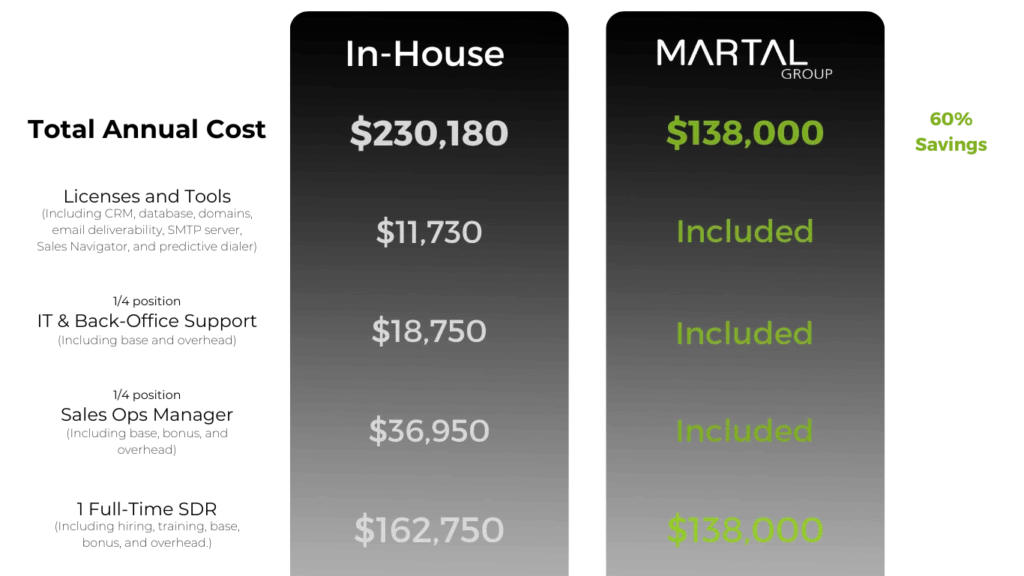
To put it in perspective, companies that outsource sales to agencies like Martal Group save, on average, $92,180 annually compared to hiring an in-house team (15). Over half of organizations now outsource front-office functions like sales in some capacity, and many see cost savings of 15% or more while benefiting from specialist expertise.
Curious how much your company could save? Use this ROI calculator.
Source: Martal Group
How Do I Write an Effective Job Post to Attract Qualified Appointment Setters?
Short job posts under 300 words get 8.4% more applications than longer listings.
Reference Source: LinkedIn Talent Blog
Your job description (JD) is often the first impression you make on potential appointment setter candidates. A clear, compelling JD will attract higher-quality applicants and set proper expectations. Here’s how to craft a job description that gets the right people to apply:
1. Use an Accurate, Descriptive Job Title: The title should be straightforward – e.g. “Appointment Setter”, “Sales Development Representative (Appointment Setting)”, or “Outbound Sales Appointment Setter (Remote)”. Including “Appointment Setter” explicitly will ensure candidates searching that term find your post. Avoid internal jargon or fancy titles (“Growth Outreach Ninja”) which can confuse search algorithms and candidates. Since many appointment setters search for “appointment setters for hire” opportunities, being literal in the title helps surface your job.
2. Start with a Strong Summary: Open with 2-3 sentences that sell the role and your company. For example: “Job Overview: Acme Corp is seeking a proactive Appointment Setter to join our B2B sales team. In this role, you’ll be the first point of contact, reaching out to enterprise HR leaders to schedule meetings for our Account Executives. If you love the thrill of connecting with new people and have a track record of high-volume outreach success, we want to talk to you!” This summary should convey the core function (setting meetings), the target audience (enterprise HR leaders), and a bit about your company/product domain to entice those with relevant interest.
3. List Key Responsibilities: Use bullet points to outline what the appointment setter will do daily. Be as specific and action-oriented as possible. For example:
- Conduct 50–70 outbound calls per day to prospective clients in our target market.
- Send personalized follow-up emails and LinkedIn messages as part of a multi-touch cadence.
- Qualify prospects against our Ideal Customer Profile to ensure high-quality meetings.
- Schedule meetings on account executives’ calendars, coordinating availability and sending invites.
- Maintain accurate records of interactions in our CRM (Salesforce), updating lead status and notes.
- Achieve weekly and monthly targets for outreach and appointments set (e.g. 15 meetings/month).
These bullets paint a clear picture of the day-to-day and performance expectations. Candidates can self-assess if they’ve done similar tasks. Keep bullets concise (1-2 lines each) – remember, candidates often spend only ~14 seconds scanning a job post before deciding to read more or skip (8). Clarity and brevity win. In fact, research shows shorter job posts (under 300 words) receive ~8.4% more applications per view than longer ones, so focus on the most important points (8).
4. Define Required Qualifications and Skills: This is where you specify the must-haves and nice-to-haves. Again, bullet format is best. For example:
Minimum Qualifications:
- 1+ year of experience in a sales, telemarketing, lead generation, or SDR role (outbound calling experience highly preferred).
- Excellent spoken and written English; confident phone presence.
- Proven ability to handle rejection and persist – a positive attitude is a must.
- Strong organizational skills to manage follow-ups and multiple prospects.
- Familiarity with CRM software (Salesforce, HubSpot, or similar) and basic office tools.
Preferred Qualifications:
- *Experience setting appointments or selling in [Your Industry] or to [Your Target Audience] (e.g. HR software to enterprise). *
- Track record of meeting/exceeding KPI targets (please share examples in your application).
- Bachelor’s degree in Business, Communications, or related field (optional if not strictly needed).
- Multilingual (e.g. Spanish or French) is a plus, as our client base is global.
Be realistic in requirements. Don’t demand 5 years of experience for an entry-level SDR role – you’ll deter good candidates. Focus on skills and achievements over credentials. Notice we said “1+ year or related experience” – if someone has the core skills but in a different context, they shouldn’t be discouraged from applying. Also emphasize soft skills like persistence and organization, which are critical.
5. Highlight What You Offer (Compensation & Benefits): Great candidates often have multiple options, so sell the role. If possible, mention the compensation range or structure. For appointment setters, this could be hourly plus bonus per meeting, or base salary plus commission. For example: “Compensation: Base salary of $40,000–$45,000 DOE, plus commission of $50 per kept appointment. On-target earnings ~$55,000/year. We also offer full benefits (health, dental, 401k) and generous PTO.” Being transparent here can actually increase applicant quality and trust. (In fact, 61% of candidates say salary range is the most important part of a job description (8), so providing it can attract the right talent and filter out those with mismatched expectations.)
Also tout any benefits of working with you: growth opportunities (promotion path to AE), training and mentorship, company culture, remote work flexibility, etc. And describe your product/mission in a sentence to excite candidates who align with it: “Join a fast-growing team making waves in AI-driven healthcare – your work booking demos will directly fuel our growth.”
6. Format for Readability: Use clear section headings (Responsibilities, Qualifications, Benefits, etc.) and bullet points, as we’ve done here. Avoid long paragraphs. Ensure the tone is inviting and enthusiastic, yet professional. Remember, the JD is as much a marketing tool as it is a filtering tool.
7. Include a Call-To-Action: End the job listing with how to apply and encourage them. e.g. “How to Apply: If this sounds like you, please submit your resume and a brief cover letter telling us why you’re interested in this appointment setter role at Acme. We review applications daily and will reach out to qualified candidates to schedule an initial phone screen. We can’t wait to hear from you!” A friendly CTA can increase the likelihood that an interested candidate actually completes the application.
By carefully crafting your job description with these elements, you not only attract more applicants but the right applicants. You’ll filter in those who understand what the role entails and have the experience and mindset to thrive. This upfront effort in writing a great JD saves you time later by yielding a stronger candidate pool – essentially setting the stage for a successful hire from the start.
(One more tip: especially in 2026, consider posting your JD on social platforms as a visually engaging post or using video – some companies have hiring managers record a 2-minute video about the role. It can complement the written JD and convey passion to potential hires.)
Hiring Costs & Compensation Benchmarks
Outsourcing your sales team can cut annual costs by 60%, saving an average of $92,180 compared to building an in-house team.
Reference Source: Martal Group
What will it cost to hire an appointment setter in 2026? Compensation can vary widely based on geography, experience, and whether someone is in-house or outsourced. Let’s break down the cost factors and give some benchmarks so you can budget and negotiate confidently.
Salary and Hourly Rate Benchmarks (In-House):
For a full-time in-house appointment setter (SDR) in the United States, the average base salary is around $39,000 per year (7). Entry-level folks might be in the low $30k’s base, while experienced SDRs at lucrative tech companies could be $50k+ base. On top of base salary, it’s common to have a commission or bonus structure for meetings set or deals that result. For example, many companies pay a bonus like $25-$100 per completed appointment or a small percentage of any deal that comes from an appointment. These incentives typically add another 5-15% of base pay if targets are hit.
In countries with lower labor costs, salaries are significantly lower. For instance, the average annual salary for an appointment setter in the Philippines is about ₱258,600 PHP (7)– that’s roughly $4,600 USD per year (only a few thousand dollars!). Even highly experienced English-speaking SDRs in the Philippines might earn $6k-$8k/year, which is why offshoring is enticing. In Eastern Europe or Latin America, you might see solid SDRs for $10k-$20k/year equivalent. Compare that to a U.S. SDR at $40k – the global wage arbitrage is substantial. By outsourcing appointment setters, companies can save as much as 65% on labor and overhead versus full-time internal hires (14).
Freelancer Rates: If hiring on an hourly basis, rates will range widely by location and skill. U.S.-based freelance SDRs might charge anywhere from $20 to $50+ per hour. Overseas freelancers (Philippines, India, Pakistan, parts of Africa) might charge $5 to $15 per hour. On platforms like Upwork, you’ll find people at all points in between. Keep in mind time zone differences – if you need them calling U.S. prospects during U.S. hours, some overseas freelancers adjust their schedule (often for a higher rate) or you hire ones located near your region (e.g. a Latin American rep in U.S. time zones for maybe $15-$25/hour as a middle ground). Also consider per-meeting pricing some freelancers or agencies offer. For example, a freelancer might say “$50 per each completed show” – this can be appealing as you pay strictly for results. Just ensure you define “completed show” (the prospect actually shows up) and what qualifies as a valid meeting.
Outsourced Agency Costs: Outsourced appointment setting firms typically charge either a flat monthly fee for a campaign (which covers a certain volume of work/meetings) or a Pay-Per-Meeting (PPM) model. PPM rates can range from around $100 to $400 per held appointment depending on your industry’s difficulty and deal size (high-end enterprise targets cost more per meeting). Retainer models might be, say, $3,000–$8,000 per month for a dedicated SDR resource plus some number of meetings guaranteed. While it may seem high upfront, this appointment setting cost includes all overhead, management, data, tools, and more, not just one person’s salary. When you compare apples-to-apples, many find outsourced costs quite competitive. For example, one source noted in-house fully loaded cost per meeting can be $350–$600, whereas an outsourced partner might deliver meetings at $300 or less each (depending on volume and quality) (11). The ROI calculation should include the value of your time saved and faster ramp-up too.
Commission Structures: Aside from base pay, think about incentives. Common approaches:
- Per Meeting Bonus: e.g. $20 for every meeting that occurs with a qualified prospect, sometimes with accelerators after a certain number. This directly motivates setting more meetings that hold (encouraging them to confirm and remind prospects).
- Per Opportunity or Deal Bonus: e.g. $100 for any meeting that converts to a sales-qualified opportunity, or a % of closed deal revenue (usually small, like 2-5%). This incentivizes quality – they target prospects more likely to convert, not just anyone who will take a meeting.
- Team-Based Bonuses: if you have multiple setters, you might set team appointment setting goals and reward everyone if the team hits say 120% of quota. This encourages collaboration and best-practice sharing rather than pure competition.
Make sure whatever incentive you choose aligns with your objectives (e.g. if no-shows are a problem, pay on held meetings; if pipeline quality is an issue, pay on pipeline generated).
Other Hiring Costs: Don’t forget the ancillary costs. If hiring in-house, factor recruiting time (or fees if you use an agency), training resources, and equipment (laptop, phone stipend, etc.). Some estimates put the average cost to hire a new employee at around 20-30% of their salary in recruitment and onboarding expenses. And as mentioned earlier, a bad hire is costly – a U.S. Department of Labor estimate says a bad hire can cost 30% of that employee’s first-year earnings in wasted expenses (9). Translation: hiring the wrong $40k SDR might set you back $12k in lost time and effort. This underscores why spending a bit more to get a great person (or using a proven outsourced service) pays off.
Global vs Local Compensation: If you’re considering international remote hires, be mindful of paying a fair rate for the locale. While you can hire someone in a lower-income country for a fraction of a U.S. wage, offering slightly above local market rate will help you attract and retain the best talent there (and still save you money). For instance, if the going rate for a full-time experienced appointment setter is $500/month in a region, paying $600-$700 might get you a top 1% performer who will stick around – still an excellent deal for you. Also consider time zone overlap compensation; if you ask someone to work graveyard shift their time consistently, a premium is warranted.
Benefits: In the U.S., a full-time in-house role might come with health insurance, retirement matching, etc. These benefits typically add an extra ~20-30% on top of base salary cost. Remote international contractors usually don’t get those from you; they manage their own. Agencies incorporate their staff benefits into their pricing, so you don’t handle it directly.
To give a concrete sense:
- In-House U.S. Scenario: Base $40k + ~$10k benefits + $5k commission = ~$55k/year per SDR. Plus maybe $2k in tools/training. So around $57k annually. That’s about $4.75k/month. You’d expect ~10-15 meetings per month from that rep, so roughly $316 – $475 per meeting cost (not counting downstream close rates).
- Outsourced Scenario: Perhaps you pay $5,000/month to an agency for a package that yields ~15 qualified meetings/month. That’s $333 per meeting – in line or better, with far less management effort on your part. Plus, if someone quits, the agency replaces them at no cost to you, whereas in-house you’d spend to re-hire.
- Freelance Scenario: Say you hire a freelancer at $15/hour for 40 hours/week = ~$2,600/month. If they produce 8 meetings, that’s $325/meeting. If they produce 4, it’s $650/meeting (not so good). So freelance is a bit more variable in ROI – you must manage output closely.
Every model has trade-offs, but these ballparks help set expectations. It’s wise to also check local job listings or salary databases to refine your specific range. For example, search Glassdoor for “Appointment Setter” in your city to see current offers.
Negotiating Tip: Many appointment setter candidates (especially junior ones) may accept a slightly lower base if there’s an uncapped commission structure that realistically allows them to earn more when they perform. If your company is cash-conscious, you can structure a package that’s, say, 10% below market base salary but with aggressive meeting bonuses that make up for it when they hit goals. This attracts go-getters who believe in their ability to earn the incentives. Just ensure the goals are attainable – nothing demoralizes an SDR faster than a commission plan that’s out of reach.
Finally, keep the big picture in mind: the cost of an appointment setter should be dwarfed by the value of the pipeline they generate. If one setter costs you $5k a month and they produce 10 meetings that turn into $100k of new pipeline, and even $25k of closed revenue, that’s a fantastic return. Measuring Cost Per Opportunity or Cost Per Dollar of Pipeline is often more meaningful than their raw salary. Many organizations find that outsourcing or paying top talent is worth it, because skilled appointment setters deliver more meetings and higher-quality opportunities through qualified appointment setting – easily covering their higher pay. As we’ll discuss next, training and metrics will further help maximize that ROI.
Training & Onboarding Best Practices for New Setters
Strong onboarding programs improve new-hire retention by 82% and productivity by over 70%.
Reference Source: StrongDM
Hiring the right appointment setter is only half the battle – how you onboard and train them can make a huge difference in their performance and retention. A well-structured onboarding can turn even a junior rep into a meeting-booking machine in short order (and conversely, a sink-or-swim approach can lead to struggles or turnover). Here are best practices for ramping up your new appointment setters for success:
1. Provide Deep Product and Persona Training: Even though appointment setters aren’t doing full demos, they need a solid grasp of your product/service’s value proposition and the pain points of your target customers. In the first week, train them on who your ideal prospects are (roles, industries, common challenges) and how your solution helps. Equip them with case studies, product one-pagers, and success stories that they can reference in conversations. Consider having them sit through a few sales demos or use your product themselves (if feasible) to internalize what they’re pitching. The goal is not to make them technical experts, but to ensure they sound credible and can handle basic prospect questions. Many companies undervalue this – but an appointment setter who truly understands the prospect’s world will book more qualified meetings.
2. Teach the Tools and Process Early: On day 1, get them set up in your CRM and sales engagement tools, and train on your workflow. Show how leads are assigned, how to log activities, how to use the dialer or sequence software, etc. Provide templates for emails and call scripts (more on scripting next). A new setter should never be guessing how to use the system – give a clear checklist: e.g. “Each morning, pull up tasks in Outreach, make calls, log outcomes in Salesforce this way, then send follow-up emails using Template A or B depending on outcome.” By standardizing the process, you make it easier for them to reach productivity. Shadowing an existing successful SDR or doing role-plays through the process can accelerate their comfort. Also ensure they know any compliance aspects (e.g. respecting do-not-call lists, GDPR opt-out requirements) as part of tool training.
3. Emphasize Cold Call and Email Tactics (with Scripts): Even if they have prior experience, train them on your approach to cold calling and emailing. Provide an appointment setting script or talk tracks for common scenarios – not for them to read robotically, but as a framework. Practice key opening lines, how to handle the top 5 objections you hear, and how to close for a meeting. Do live role-playing during onboarding: manager plays prospect, setter practices the pitch. Provide feedback on tone, pace, and content. Similarly, share your best-performing email templates and explain why they work (e.g. personalization, value prop, call-to-action). New reps should also learn how to navigate gatekeepers (if calling offices) and how to leave effective voicemails. All these little tactical skills add up. . Use appointment setting tips during training to help reps refine their technique. The first couple of weeks, consider daily or every-other-day check-ins to review their call quality and help refine. Remember, effective onboarding can boost new hire retention by 82% and productivity by over 70% (10) – investing time up front pays off hugely.
4. Set Clear Activity and Outcome Goals (Ramp Expectations): Be very clear about what’s expected in the ramp period versus fully ramped. For example, in week 1 maybe the goal is just 20 calls a day to get comfortable; by week 4 you expect 80+ calls and 1-2 meetings set per week, and by week 8 you expect full quota of e.g. 4 meetings/week. A documented 30-60-90 day plan works well. This gives the new setter targets to strive for without feeling overwhelmed on day 1. Also align on working hours and time management – e.g. if they’re remote, do they need to overlap certain hours? Provide a sample daily schedule (e.g. “8-10am = send follow-up emails, 10-12 = calls, 1pm team huddle,” etc.) to instill good habits. Setting these expectations early ensures there’s no ambiguity about what “good” looks like. It also allows you to spot early if someone is struggling to meet activity levels so you can intervene with coaching.
5. Pair New Setters with a Mentor or Buddy: If you have an existing team, assign a top-performing appointment setter or SDR as a buddy to the new hire. This provides a go-to person for all the “small” questions that inevitably come up (from “How do I disposition this call in CRM?” to “What do I do if someone wants pricing info?”). New hires often feel more comfortable asking a peer than a manager for every little thing. The buddy can also share personal tips that helped them succeed. Even if you’re a very small team or one SDR operation, you as the leader can fulfill this role – but the key is making the new rep feel supported, not isolated. Frequent communication is key in the first few weeks. In a remote environment, consider daily quick Slack check-ins or a short Zoom sync to maintain connection.
6. Simulate Real Scenarios: Classroom training is good, but nothing replaces learning by doing. Early on, have the new appointment setter practice with internal folks before they hit real prospects. For example, have them call a manager or another team member as if that person were a prospect, and go through a complete call. Or let them draft some practice emails for review before they send to real leads. Many companies will start a new SDR on slightly older or colder leads for the first few days so any mistakes are lower stakes, then gradually feed hotter leads as they gain confidence. Another tactic: use a recorded call library (if you have call recording) – have them listen to a bunch of good calls and a few bad calls. Discuss together what made the good ones work and what went wrong in the bad. This accelerates learning by example.
7. Emphasize Company Culture and Mission: Don’t treat the appointment setter as a telemarketing appointment setting robot – include them in the bigger picture. During onboarding, share with them the company’s story, mission, customer success stories, and how their role contributes. An engaged, mission-driven employee will put more passion into their calls. Also cover internal culture basics: introduce them to the broader team, clarify who’s who in case they need help (e.g. if a prospect asks a technical question, know which sales engineer or AE to pull in). Feeling part of a team motivates setters to succeed not just for commission, but for team pride. If possible, have an executive or founder spend 30 minutes with new sales hires to reinforce the importance of what they’re doing – that can be incredibly motivating.
8. Provide Resources and Cheat Sheets: The new hire should have quick-reference materials at their fingertips. This could be a one-page objection handling cheat sheet (common objections and suggested rebuttals), a product FAQ, a persona guide summarizing key talking points for different prospect types, etc. Also ensure they know where to find things: the sales playbook, case study repository, your calendar to book meetings, etc. If you want them to use certain email templates or scripts, make those easily accessible (e.g. in the CRM template library or a shared drive). The easier you make it for them to execute, the faster they’ll ramp.
9. Ongoing Coaching and Feedback: Onboarding doesn’t end after week 1. In the first 1-2 months, schedule regular coaching sessions. For example, every Friday, listen to a few of their call recordings together and provide constructive feedback. Highlight what they did well (“Great job building rapport there”) and what to tweak (“Next time, try handling the price objection by focusing on ROI before offering to send material”). Likewise, review their email open and reply rates – help refine their messaging if needed. New SDRs crave feedback; it’s how they improve. Also encourage them to share challenges – maybe they’re constantly getting a certain brush-off you hadn’t covered. Work through solutions together. A culture of coaching not criticism will boost their confidence. Remember, employees who feel well-supported in onboarding are far more likely to stay – one study found that a strong onboarding process improved new hire retention by 82% (10). Retaining your appointment setter longer maximizes your training investment in them.
10. Set Short-Term Wins: Finally, help the new setter achieve a quick win to build momentum. Maybe that’s setting their first appointment within 2 weeks, or getting praise from a prospect, or hitting a calls-made milestone. Celebrate those small victories – give a shout-out in the team meeting or Slack channel. Early wins boost confidence and cement that the person made the right choice joining your company. It creates a positive feedback loop: they book a meeting, get recognition, feel motivated, book more meetings.
In summary, be structured, be supportive, and be thorough. A thoughtful onboarding program that covers tools, tactics, and continuous coaching will ramp up your appointment setter to full productivity faster – often cutting the ramp time significantly. More importantly, it sets them up to stay and succeed. Given the cost of turnover and ramp, an investment in great onboarding pays for itself many times over. As a bonus, your new hire will feel valued and prepared – and a confident, well-trained appointment setter will project that confidence to prospects, leading to more meetings on the calendar.
What Performance Metrics Should I Set When Hiring an Appointment Setter?
In-house SDR teams can cost $350–$600 per meeting, while optimized outsourced teams often reduce cost per meeting by 30–50%.
Reference Source: SalesHive
Once your appointment setter is up and running, how do you know if they’re doing a good job? Simply counting appointments set isn’t the whole story. You’ll want to track a range of performance metrics to gauge efficiency, effectiveness, and the business impact of their work. Here are the key metrics and success indicators for appointment setters, and some benchmark values to keep in mind:
- Appointments Set per Month: This is the most direct output metric – how many meetings are they scheduling for your sales team. Depending on your product complexity and lead flow, an average full-time SDR might book anywhere from 8–15 meetings per month. Studies show median SDRs produce about 8-10 qualified meetings monthly, while top performers hit 12-15 (11). You should set a quota or target in this range that fits your business. Track this monthly and note trends. Hitting the target consistently is a primary success indicator. If someone is booking far fewer than expected (or the meetings are unqualified leading to no-shows/cancellations), it’s a red flag to address.
- Held Appointment Rate (Show Rate): Of the meetings set, what percentage actually happen (the prospect shows up and it’s completed)? A setter could book 15 meetings but if only 5 take place, that’s an issue. Typical show rates for outbound-set appointments might be 60-80%. With confirmation steps and calendar invites, you should aim for at least around 70% held-meeting rate. For example, if 10 meetings were set this month, at least 7 should occur. If your rate is much lower, diagnose why – are the leads not fully qualified or interested? Is the setter not properly reminding or setting expectations? This metric ensures quality of setting, not just quantity. Many teams compensate on held meetings specifically to encourage high show rates.
- Conversion Rate to Opportunities or Pipeline: This measures meeting quality. Of the meetings held, how many convert into a defined next stage (e.g. sales-qualified opportunity, or however your org labels a successful outcome like a prospect entering the pipeline)? If your account executives have 10 meetings from the setter and only 1 is a real qualified opportunity, that’s 10% conversion – possibly indicating poor targeting or low prospect interest. On the other hand, if 5 out of 10 become pipeline opportunities, that’s 50% – solid quality. Industry benchmarks vary, but often 30–50% of held appointments turning into pipeline is considered good for outbound. One industry dataset noted ~73% of appointments set become sales opportunities in best-in-class teams (12) – though that seems high and likely includes some warm leads. The key is to monitor this over time. If one setter’s meetings consistently yield pipeline and another’s don’t, you can investigate differences in approach.
- Dials/Calls per Day and Other Activity Metrics: These are the input metrics – the effort being put in. For phone-centric outreach, track how many calls they make daily or weekly. If you expected ~80 calls/day and someone is doing 30, that’s an issue (unless they are compensating with more emails/LinkedIn activity). Similarly, monitor number of emails sent, LinkedIn connections or messages, etc., depending on your sequence. Setting up a dashboard with their activities vs. target can be helpful. Modern sales engagement tools will give you these stats. While more activity doesn’t always equal more results, at the early stage of pipeline building they are highly correlated – you generally need a certain volume of attempts to yield a meeting (e.g. perhaps a 5% connect-to-meeting conversion, so fewer calls means fewer meetings). If output is lagging, activity metrics are the first place to check.
- Connect/Conversation Rate: Out of calls made, how often do they connect to a decision-maker and have a conversation? If they made 100 calls and had 10 conversations, that’s a 10% connect rate. This can vary by list quality and industry (for direct dials you might see 15-20%, for switchboard dialing maybe 5%). Track this to understand if they’re having enough live interactions. A low connect rate might mean your data needs improvement (lots of wrong numbers) or calling times should adjust. It also helps separate effort from effectiveness – if connects are decent but meetings low, it suggests an issue in the pitch or qualification, not just effort.
- Meetings per Conversation (Conversion Rate on the Phone): When they actually reach a prospect, how often do they succeed in securing a meeting? For example, if they had 20 live conversations this month and booked 4 meetings, that’s 20% conversion on conversations. Top appointment setters often convert a higher share of conversations by skillfully handling objections. If one rep is only converting 5% of connects to meetings, listen to their calls and provide coaching – perhaps they aren’t asking for the meeting assertively or not creating enough value. Benchmarks here vary, but aiming for 15-25% is reasonable in many B2B scenarios (i.e. one meeting for every 4-7 conversations). This essentially measures their pitch effectiveness.
- Email Engagement Metrics: If emailing is a big part of your strategy, look at open rates and reply rates on their outreach emails. Say they send 100 emails and get 3 positive replies – that’s a 3% positive response rate. Compare this to team averages or historical data. Low engagement could mean their templates need improvement or targeting is off. Many outreach tools track per-user stats, so you can see if one rep’s emails underperform others and then tweak subject lines or content. Also track how quickly they follow up on inbound replies or form leads (speed-to-lead) if that’s part of their role.
- Cost per Meeting: From a management perspective, especially if you’re comparing hiring models, calculate how much each meeting is costing you. Take all-in monthly cost of the setter (salary + benefits or their contract cost) and divide by meetings they set. For instance, if total cost is $5,000/month and they set 10 meetings, it’s $500 per meeting. You can track this over time to ensure efficiency is improving. If you hire more setters or outsource, it’s a good metric to benchmark vendors or team performance. Over time, as a rep gets seasoned, you’d expect cost per meeting to decrease (because they set more meetings for the same cost). If it’s increasing or too high versus industry norms, that flags a need to adjust (either through sales training for higher output or reconsidering your approach).
- Tenure and Retention: While not a performance metric per se, keep an eye on how long appointment setters stay in the role and your ability to retain them. High turnover in this role will kill your momentum (constant resetting of ramp). If you notice a trend of reps burning out after 6 months, look into workload, career path (are you promoting top performers?), and overall job satisfaction. A well-supported appointment setter ideally should stay 12-18 months before moving up or on – anything shorter might indicate an issue in hiring fit or environment. Given that industry turnover can be 30-50%, any improvement in retention (like keeping your setters happily productive for 2+ years) is a competitive advantage – it means more cumulative expertise and relationships built.
- Qualitative Feedback from Sales Team: Lastly, gather input from the account executives who take the meetings. Are the meetings well-prepared? Are they with the right prospect persona? Does the prospect know why they’re meeting (context set)? If AEs start complaining that “these meetings are duds,” that’s a qualitative KPI that something’s off. You might institute a quick internal rating – after each meeting the AE rates lead quality 1-5. Patterns in that feedback can guide coaching for the setter on better qualification.
To manage these metrics, set up a dashboard if possible. Many CRM systems can report on calls, meetings, conversion rates, etc., by rep. Review metrics weekly with the setter in one-on-ones. This keeps them data-aware (top SDRs are often very metrics-driven). For example, show: “This week you made 200 calls, had 20 conversations (10% connect), and booked 3 meetings (15% conversion). Let’s brainstorm how to boost that to 5 meetings – maybe you need to improve the ask on the call or try calling at different times to raise connect rate.” Metrics turn coaching from opinion to objective.
Also consider stacking individual performance against team or industry benchmarks. If your one setter is doing 8 meetings/month and industry average is 10, you have room to grow. On the flip side, maybe your conversion rates are high but activity low – then perhaps feeding them more leads or hiring another setter could dramatically increase pipeline (because they clearly make the most of each conversation).
In summary, measure what matters at each stage of the appointment funnel– activity, conversion, and outcome. By tracking a balanced scorecard of these metrics, you can quickly diagnose where an appointment setter excels or struggles. And importantly, you can demonstrate the value of their work to the business (e.g. “Setter A generated $500k in pipeline this quarter at a cost of $15k – a great 30x pipeline-to-cost ratio”). Managing by metrics, with human coaching layered on, will drive continuous improvement in your appointment setting function.
Conclusion
Hiring appointment setters – whether in-house or outsourced – can be a game-changer for B2B sales teams. The process starts with a clear strategy: decide on the model that fits your goals, then recruit for the skills that matter (communication, persistence, etc.) using effective interviews. Invest in training and onboarding to ramp them up quickly (remember, strong onboarding boosts retention and productivity). Manage performance by the numbers – track meetings, conversion rates, and continually coach for quality. If done right, an appointment setter (or team) will consistently fill your pipeline with qualified opportunities, allowing your closers to focus on what they do best. In today’s global, digital environment, you have more hiring options than ever – local or remote, employee or contract, domestic or offshore. Use the tactics in this guide to evaluate those options and build a solution that maximizes ROI for your organization.
Ultimately, successful appointment setting is about connecting with the right prospects at the right time. With the strategies outlined here, you’ll not only hire the right people to make those connections, but also set them up to thrive. The result? A predictable flow of meetings with interested buyers – and a sales organization that consistently hits its revenue targets.
Ready to Supercharge Your Sales Pipeline? If you want to skip the learning curve and start getting qualified appointments immediately, consider partnering with experts. At Martal Group, we offer a seasoned outsourced appointment setting teamthat can act as a seamless extension of your salesforce. We handle the hiring, training, and execution using proven techniques – delivering sales meetings with your ideal clients right to your calendar. You get the results without the ramp-up time or management headaches. Book a consultation with us to discuss your goals and see how our global team of sales development specialists can help you maximize your pipeline in 2026. Let’s talk and start filling your schedule with prospects eager to speak with you!
References
- Salesforce
- LinkedIn Pulse
- Upwork Research
- SalesHive
- Invesp
- Leads at Scale
- ERI SalaryExpert
- LinkedIn Talent Blog
- HumCap
- StrongDM
- SalesHive, Pay-per-Meeting Benchmarks
- Tenbound
- Nasdaq
- Martal Group – Appointment Setting
FAQs: How to Hire Appointment Setters
What’s the difference between an Appointment Setter and an SDR/BDR?
An appointment setter focuses primarily on booking qualified meetings through outbound calls, emails, and social outreach. SDRs/BDRs perform similar tasks but often take on additional responsibilities such as deeper qualification, account research, or multi-channel sequencing. Many companies use the terms interchangeably. The core function remains the same: generate initial sales conversations and move prospects into the pipeline.
Can appointment setters work remotely effectively?
Yes. Appointment setters can work remotely with no performance loss when supported by CRM access, sales engagement tools, and structured coaching. Remote SDRs routinely achieve the same KPIs as on-site teams. Success requires a quiet calling environment, scheduled check-ins, clear daily activity expectations, and visibility into metrics. Remote hiring also expands access to lower-cost global talent.
How do I ensure appointment setters book high-quality meetings?
Define clear qualification criteria—industry, role, pain points, buying authority—and train setters on these standards. Require brief qualification notes for every booked meeting and implement AE feedback loops after each call. Tracking show rates and conversion to pipeline will quickly reveal quality gaps. Ongoing coaching using call recordings is essential to improving consistency.
How many appointment setters does my sales team need?
A common ratio is one appointment setter for every two to four AEs, depending on sales cycle length and desired outbound volume. Calculate backward from your meeting targets: if one setter can deliver 10–15 meetings a month and your AEs can handle 40, aim for two or three setters. Scale as pipeline needs increase.
Should I outsource appointment setting or build an internal team?
Outsourcing is typically faster and more cost-effective, offering trained reps, proven processes, and immediate scalability. In-house hiring offers more control and cultural alignment but requires higher investment and longer ramp times. Many companies adopt a hybrid model: outsource for speed and volume, build in-house for strategic segments.
How do I vet an outsourced appointment setting service?
Request case studies, verify industry experience, and evaluate their qualification frameworks. Review sample messaging, understand reporting standards, and confirm whether you receive visibility into call notes or recordings. Start with a pilot program to assess meeting quality, show rates, and ROI. A strong partner will be transparent about performance expectations and integrate well with your existing sales process.
