
 Martal
 Technology
 Education and training
 Web Development and UI / UX
 Healthcare/Medical
 Logistics and Supply Chain
 Information Technology
 Insuretech and Financial Services
 Marketplaces
 Software Development
 E-commerce and retail
 AI and Machine Learning
 Energy and Solar
 Manufacturing
 Security and Surveillance
 Digital Marketing Agency
 Transportation
 MSP
MSP
 Telecom
 B2B SaaS
 Cybersecurity
 HR tech
 Fintech
 Cleantech
 Consulting
Rethinking GTM Strategy for 2026: A B2B Framework and the Role of AI in Execution
GTM Strategy: The B2B Framework, AI Execution, and What Actually Drives Pipeline
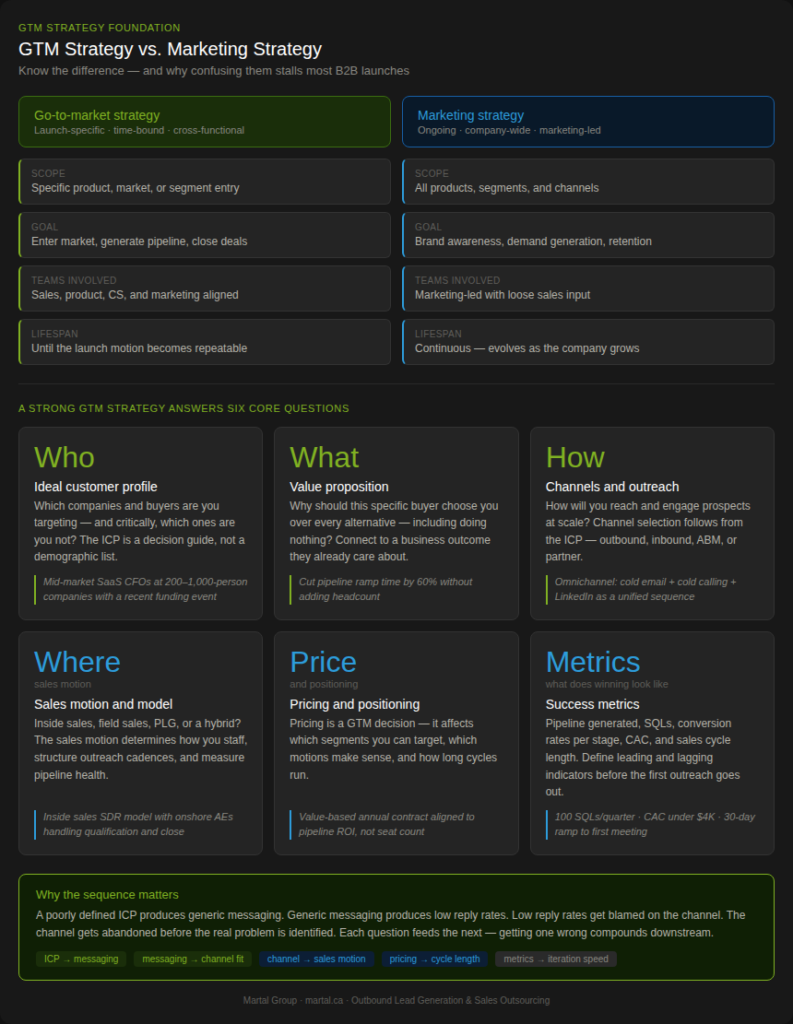
A go-to-market strategy is a time-bound, launch-specific plan that defines ICP, positioning, pricing, channels, sales motion, and success metrics. A marketing strategy is broader and ongoing. Confusing the two leads to misaligned teams and launches that scatter across tactics without a shared objective.
ICP definition, value proposition, pricing and packaging, channel selection, outbound execution, and measurement. These steps run in sequence — each one informs the next. Skipping or rushing any step typically surfaces as an execution problem later, not a planning one.
Most B2B product failures trace back to execution gaps: messaging that missed the buyer, channels that reached the wrong audience, or sales and marketing teams operating without a shared definition of a qualified lead. A sound GTM strategy closes those gaps before launch.
The four primary GTM motions — sales-led, marketing-led, product-led, and partner-led — each suit different buyer types, ACVs, and sales cycle lengths. Most B2B companies with complex offerings and high-ACV deals succeed with a sales-led motion anchored in outbound execution. Choosing the wrong motion wastes budget and delays pipeline regardless of how strong the product is.
AI and automation compress the time from ICP to active campaign, improve personalization at scale, and surface intent signals that manual prospecting can’t reliably capture. But they require a sound strategy underneath. AI amplifies a strong GTM motion. It exposes a weak one.
Even with a clear framework, pipeline stalls when outbound execution is inconsistent. Coordinated omnichannel outreach — cold email, cold calling, and LinkedIn outreach operating as a unified sequence — consistently outperforms single-channel efforts. The channel isn’t the problem. The coordination is.
Companies that build intent signal logic into their outbound targeting — prioritizing accounts with active buying triggers over accounts that simply match firmographic criteria — generate materially different conversations at the top of the funnel. Timing transforms a cold outreach into a timely one.
For B2B teams entering new markets or scaling pipeline without in-house bandwidth, outsourcing the outbound pipeline function to an experienced team with AI-powered infrastructure shortens time-to-qualified-meeting significantly. Most Martal clients generate their first sales-qualified leads within 30 days of launch.
Introduction
Most B2B companies have a marketing plan. Far fewer have a real go-to-market strategy, and the difference shows up in the pipeline.
A marketing plan tells you what content to publish and which ads to run. A GTM strategy tells you exactly who you’re targeting, why your offering wins in that segment, how you’ll reach buyers at scale, and what success looks like at each stage. When those two things get confused, launch efforts scatter and pipeline stalls — often before the first qualified conversation happens.
This guide covers both layers. We’ll start with the foundation: what a GTM strategy actually is, how it differs from a marketing plan, and what the core framework looks like for B2B teams.
Then we’ll look at how AI and automation have changed the execution side, not by replacing the framework, but by accelerating it. We’ll also cover the most common GTM mistakes, real-world examples, and the best practices that separate launches that build momentum from ones that fizzle.
We put this guide together to help B2B teams move from GTM strategy on paper to qualified meetings in the calendar — whether they’re entering a new market, launching a new product, or scaling an existing pipeline.
One note on scope: this guide was built by reviewing leading research, drawing on Martal’s 16+ years of B2B outbound experience, and supplementing with curated industry sources where topics extend beyond our direct delivery model — pricing, positioning, and inbound. Where we discuss those broader GTM components, we’re drawing on curated research and business logic rather than first-hand delivery.
What Is a Go to Market Strategy?
Companies with tightly aligned sales and marketing teams achieve 36% higher customer retention rates and generate 38% more revenue from their go-to-market efforts.
Reference Source: Zoominfo
Two questions come up constantly in B2B conversations about go-to-market: “What is Go to Market strategy — can someone explain with an example?” and “What does go-to-market actually mean in practice, beyond the buzzword?” Both are fair. The term gets used loosely — sometimes as a synonym for a product launch plan, sometimes for a marketing strategy, sometimes for a sales playbook. Here’s what it actually means.
At its core, a go to market strategy is a comprehensive plan that outlines how a company will introduce and deliver a product or service to the market. It defines the target customer segments, the value proposition, the marketing and sales approach, and the distribution channels needed to reach those customers (6).
In essence, a GTM strategy covers all the activities required to acquire and retain customers – from crafting the right messaging, to choosing pricing and positioning, to deciding whether you’ll sell via a direct sales team, online self-service, partners, or some combination. It’s a roadmap for launching a new product, entering a new market, or even simply scaling an existing offering to a wider audience.
A strong GTM strategy addresses six core questions:
- Who is your ideal customer, and what specific problem are you solving for them?
- What is your unique value proposition — and why does it win against alternatives?
- How will you reach and engage prospects at scale (channels, outreach motions, partners)?
- What does your sales process look like — inside sales, field sales, channel partners, or a hybrid?
- How are you pricing and positioning relative to the competitive landscape?
- What are your success metrics — pipeline generated, conversion rates, CAC, revenue targets?
Answering these before launch ensures a cohesive approach rather than disconnected efforts across teams.
Marketing Strategy vs. GTM Strategy: What’s the Difference?
Some of the most commonly asked questions in B2B planning are “What is the difference between a go-to-market strategy and a marketing plan?” and “Is there a difference between a sales strategy and a GTM strategy?” The confusion is real, and it’s one of the most common reasons B2B launches underperform.
A marketing strategy is broad and ongoing. It covers brand positioning, content, demand generation, and channel investment over time. It isn’t tied to a specific launch. It evolves continuously as the company grows.
A go-to-market strategy is time-bound and launch-specific. It exists to answer one question: how do we successfully enter this market, or bring this product to this segment, and generate revenue from it? Once the launch matures and the motion is repeatable, the GTM strategy gets absorbed into the broader marketing and sales operating model.
In practice: a company might have a single marketing strategy running across all products and segments, while maintaining separate GTM strategies for each new product launch, new vertical entry, or new geographic expansion.
The most common result of blurring this distinction: teams treat every new launch as a marketing problem when what they actually need is a GTM plan — a cross-functional blueprint that aligns sales, marketing, product, and customer success around a shared target, message, and motion.
Why GTM Strategy Matters for B2B
Go-to-market strategy isn’t only for startups or first-time product launches. Established businesses need GTM planning whenever they expand into new customer segments, enter new geographies, or reposition an existing offering. The moment you’re trying to reach a market that doesn’t already know you — or doesn’t already associate you with the problem you solve — you need a GTM plan.
The cost of skipping it is steep. Many B2B product failures trace back not to product quality but to execution gaps: messaging that didn’t resonate with the actual buyer, channels that reached the wrong audience, or sales and marketing teams that operated on different definitions of a qualified lead. A GTM strategy closes those gaps before launch, not after.
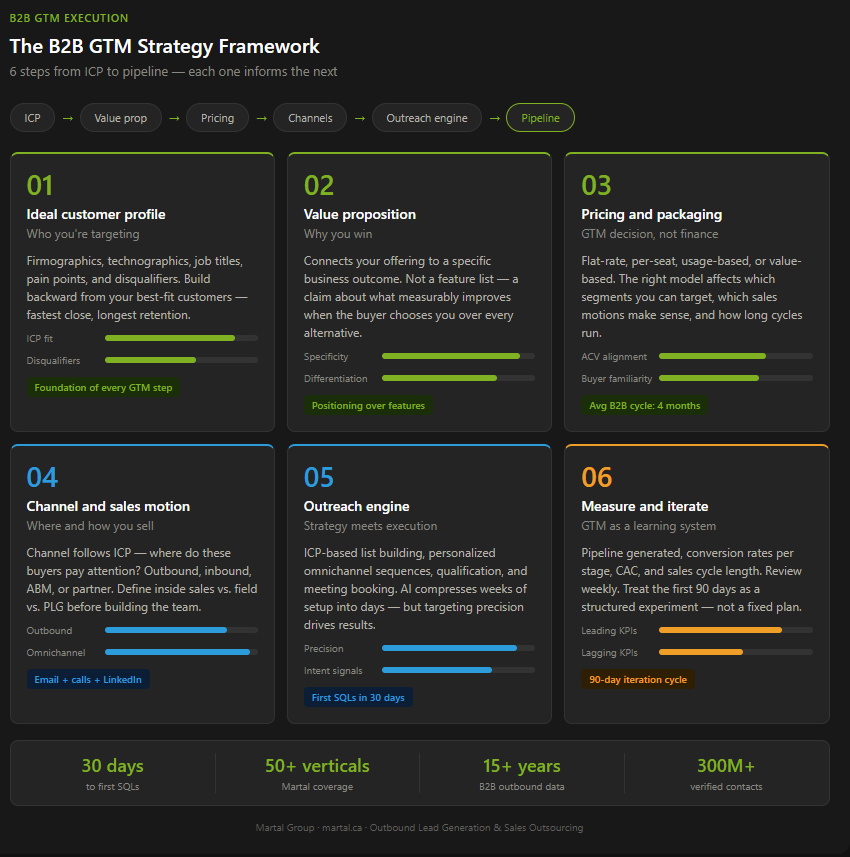
The B2B GTM Strategy Framework: 6 Steps from ICP to Pipeline
From what we see across the B2B outbound programs we run, GTM plans that stall rarely fail on strategy — they fail on sequence. Messaging gets built before the ICP is locked. Channels get selected before the value proposition is validated. Revenue targets get set before anyone agrees on what a qualified lead actually is.
A sound B2B GTM framework runs in sequence. Each step informs the next. Here’s how we’d structure it — and where the execution typically breaks down.
Step 1: Define Your Ideal Customer Profile (ICP)
The ICP is the foundation of everything else in your GTM plan. It’s not a demographic list — it’s a decision guide. A strong ICP for B2B includes firmographics (industry, company size, revenue range), technographics (what tools the target uses), job titles involved in the buying decision, common pain points and triggers, and disqualifying characteristics that signal a poor fit.
The most reliable way to build a useful ICP is to work backward from your best existing customers — the ones that closed fastest, renewed longest, and got the most value. What do they have in common? That’s your ICP. If you’re entering a market with no existing customers, model it from competitive intel and first conversations rather than assumptions.
Where it breaks down: Teams often build an ICP that’s too broad (“mid-market B2B companies in North America”) or too rigid (a 40-field scoring model nobody uses). The goal is a tight, actionable profile that makes prioritization obvious for both sales and marketing.
Step 2: Define Your Value Proposition and Positioning
Your value proposition answers: why should this specific buyer choose us over every available alternative — including doing nothing? Positioning answers: where do we fit in the competitive landscape, and what category or frame of reference makes our differentiation most obvious?
For B2B, a strong value proposition connects your offering to a specific business outcome the ICP cares about. It isn’t a list of features. It’s a claim about what gets better — measurably, specifically — when someone uses your product or service.
Where it breaks down: Positioning is often written by the product team based on what the product does, rather than by the sales team based on what buyers actually respond to. The gap between internal positioning and how buyers describe the problem leads to messaging that sounds polished but doesn’t land in cold outreach or sales conversations.
Step 3: Set Pricing and Go-to-Market Packaging
Pricing is a GTM decision, not just a finance one. How you structure pricing affects which segments you can realistically target, which sales motions make sense, and how long your sales cycles will run.
For B2B, common pricing structures include flat-rate, per-seat, usage-based, and value-based models. The right choice depends on your ACV, the complexity of the buying process, and how buyers in your target segment are accustomed to purchasing. A $150K enterprise deal requires a fundamentally different GTM motion than a $5K self-serve SaaS product.
Where it breaks down: Pricing often gets set and then left alone, even as GTM execution reveals that prospects are objecting on price consistently — which is usually a signal of a positioning problem, not just a pricing one.
Step 4: Select Channels and Define the Sales Motion
Channel selection should follow from the ICP, not precede it. The question is: where do the buyers in my ICP actually pay attention, and what purchasing behavior do they have?
For most B2B companies selling complex, high-ACV products, the primary channel options include outbound (cold email, cold calling, LinkedIn outreach), inbound (SEO, content, paid), partnerships, and account-based marketing. These aren’t mutually exclusive — but in early-stage GTM, resource constraints require prioritization.
Alongside channels, define the sales motion: will you run inside sales, field sales, a product-led motion, or some combination? The answer determines how you staff the team, how you structure outreach cadences, and how you measure pipeline health.
From an outbound execution standpoint, this is where many B2B GTM plans break down in practice. Companies select three channels but resource only one. Or they run cold email without cold calling support, then conclude “outbound doesn’t work” before the motion is fully deployed. Coordinated omnichannel outreach — cold email, cold calling, and LinkedIn outreach working as a unified sequence — consistently outperforms single-channel efforts. We see this pattern across the B2B clients we run outbound pipeline generation for across 50+ verticals.
Step 5: Build and Execute the Outreach Engine
Once channels and sales motion are defined, the GTM shifts from planning to execution. This is where prospecting lists get built, messaging gets written, sequences get launched, and pipeline starts accumulating.
For outbound-led GTM motions, this step involves ICP-based list building, personalized outreach across channels, consistent follow-up cadences, and a qualification process that converts initial interest into sales-ready conversations. The quality of execution here — targeting precision, message relevance, timing, follow-up persistence — determines whether pipeline goals are hit or missed.
This step is also where AI has had the most visible impact. AI-powered outreach platforms can compress the time from ICP definition to active campaign from weeks to days, automate personalization at scale, and use intent signals to prioritize which accounts to reach first.
Proof point: When Spirit AI, a London-based AI trust and safety company, needed to enter the North American market with no existing US sales resources, Martal built and executed the outbound motion from scratch, generating 35 qualified leads per month in a niche category where few established players had meaningful reach. The GTM framework was sound; the execution infrastructure made it move (3).
Step 6: Measure, Learn, and Iterate
A GTM strategy is not a launch event — it’s a learning system. The metrics that matter most in B2B GTM are pipeline generated, conversion rates at each funnel stage, sales cycle length, customer acquisition cost, and — eventually — revenue and retention.
Set up dashboards that surface these metrics in real time, not quarterly. Define the leading indicators (meetings booked, SQLs generated, reply rates) that predict lagging outcomes (revenue, churn). Review them on a cadence — weekly or biweekly for active campaigns — and treat underperformance as a signal to investigate, not ignore.
In outbound-led GTM motions, the leading indicators worth tracking weekly are reply rates, meetings booked, and SQL conversion rate — not raw send volume or open rates. Those lagging indicators will confirm what the leading ones already told you three weeks earlier.
In outbound-led GTM motions, the leading indicators worth tracking weekly are reply rates, meetings booked, and SQL conversion rate — not raw send volume or open rates. Those lagging indicators will confirm what the leading ones already told you three weeks earlier.
The companies that get the most out of their GTM investment are the ones that treat the first 90 days of execution as a structured experiment: test messaging variations, compare channel performance, identify which ICP segments are converting fastest, and reallocate accordingly.
The Four GTM Motions and Which One Works for B2B
Not all go-to-market strategies run the same way. Before selecting channels or building outreach sequences, B2B teams need to decide which GTM motion fits their business — because the motion shapes everything else: how you staff the team, how long the sales cycle runs, and where pipeline actually comes from.
One of the most direct questions we hear from B2B founders and revenue leaders is: “How do we convert demand into revenue — should we go PLG, SLG, or some kind of hybrid?” It’s exactly the right question to ask before building the outreach motion. The answer depends on four variables: your ACV, your buyer’s purchasing behavior, your sales cycle length, and how fast you need pipeline.
The four primary GTM motions are:
Sales-led growth (SLG) — Pipeline is built through direct outreach, qualification, and a human-driven sales process. Best suited for high-ACV products, complex buying committees, and categories where buyers need education before committing. Most effective for B2B companies with deals above $10K ACV and sales cycles longer than 30 days. This is the dominant motion for enterprise and mid-market B2B.
Marketing-led growth (MLG) — Demand is generated through content, SEO, paid acquisition, and inbound. Works well when buyers are already searching for a solution and your category is established. Requires meaningful content investment and a longer time-to-pipeline than outbound. Most effective when organic traffic can reliably generate qualified inbound volume.
Product-led growth (PLG) — The product itself drives acquisition through free trials, freemium tiers, or self-serve onboarding. Suits lower-ACV software products where buyers want to evaluate before talking to sales. Requires low friction-to-value and strong in-product activation. Common in developer tools, collaboration software, and horizontal SaaS.
Partner-led growth — Pipeline comes through channel partners, resellers, or integration ecosystems. Effective for companies with an established product and a partner network that has distribution into the target buyer. Requires significant enablement investment before it produces consistent pipeline.
Which GTM Motion Is Right for Your B2B Company?
Most B2B companies don’t run a pure motion — they blend two. The most common and most effective combination for complex B2B products is sales-led plus marketing-led: outbound execution builds pipeline while content and SEO build credibility and support inbound. The outbound motion shortens time-to-pipeline; the marketing motion reduces friction over time.
A few signals that point clearly toward a sales-led motion:
- ACV above $10K — the deal size justifies a human-led process
- Buying committee of three or more stakeholders — consensus selling requires relationship management, not self-serve evaluation
- Category is not yet well-established — buyers don’t know to search for your solution yet
- You need pipeline in 30–60 days — outbound is the only motion that generates qualified meetings on that timeline
From the outbound campaigns we run across 50+ B2B verticals, the companies that struggle most with GTM execution are often ones that chose a marketing-led or PLG motion for a product that needed a sales-led motion — then wondered why inbound leads were thin and self-serve conversion was low. The motion has to match the buyer’s purchasing behavior, not the founder’s preference for low-touch sales.
How AI Has Changed GTM Execution and Why It’s Now a Competitive Requirement
74% of sales reps say that AI and automation will significantly shape how they work in the years ahead.
Reference Source: 1up
Go-to-market strategies have always had to adapt to the times. In the past, GTM execution was largely a manual, human-driven process: sales reps would cold call from lists, marketers would blast out mass emails or run broad TV/radio ads, and market research meant weeks of surveys and focus groups. Over the last decade, automation began to change this. Email marketing platforms, CRM systems, lead generation software, and sales automation tools allowed teams to scale their outreach and client management with far less manual effort. Repetitive tasks like scheduling meetings or sending follow-up emails could be automated, freeing up human reps to focus on high-value interactions. Still, those early automations were rule-based – essentially scripts following “if X then Y” instructions – and while they improved efficiency, they lacked the adaptability and intelligence that modern AI brings.
In 2026, and we are in the midst of an AI revolution in go-to-market. The rise of machine learning and generative AI has supercharged what automation can do. We’ve moved from simple automation (sending the same generic email to 1,000 contacts) to “precision AI” – targeted, task-specific AI that can personalize and optimize each step of the sales process (2). Today, solutions like AI pack generators illustrate this shift perfectly. Instead of relying on one-size-fits-all outreach or rigid scripts, these tools bundle data, insights, and content recommendations into ready-to-use packages tailored for each prospect or campaign. For GTM teams, this means less manual prep work and more time focusing on conversations that actually move deals forward. This evolution means AI doesn’t just increase volume; it increases effectiveness. For example, instead of a sales development rep (SDR) manually researching a prospect’s company for 15 minutes before crafting an email, an AI agent can instantly gather relevant insights (like the prospect’s recent funding news or industry trends) and even draft a first-pass personalized email for the rep (1). The rep then reviews and sends, dramatically cutting down the time spent per contact while actually improving the relevance of outreach.
One notable shift is the emergence of roles like GTM (go-to-market) engineers and IT architects focused on digital transformation for IT architect initiatives – essentially technical specialists embedded in sales/marketing teams to build automations and integrate AI tools into workflows (1). Rather than relying solely on traditional RevOps or SalesOps staff to manage CRM dashboards and reports, companies are tasking these GTM engineers to create custom solutions: think automated lead routing systems, AI-driven dashboards that pull data from multiple sources, or custom chatbots for initial lead qualification. This reflects how important technology has become in executing GTM strategy. In fact, sales technology and automation expertise are now as important as classic sales skills. As Columbia Business School researchers noted, companies are embedding technical talent into sales teams because sales tech is “no longer a luxury—it is a necessity”(1) for selling smarter and faster.
Nowhere is the impact of AI more apparent than at the top of the funnel. B2B sales lead generation and initial prospecting have been transformed by AI. Instead of an SDR manually doing each step – finding companies that fit the Ideal Customer Profile, searching LinkedIn for the right contacts, writing outreach emails, following up repeatedly – we now see AI agents handling many of these tasks in sequence (1). Modern sales engagement platforms can autonomously identify ideal prospect profiles, compile contact info from databases, personalize outreach across email and even phone/text, and manage the cadence of touches. For instance, an AI can be instructed: “Find all VP of Finance at mid-size tech companies in the healthcare sector, then send each a tailored email referencing a relevant industry pain point, follow up a week later with a case study, and alert a human rep only when a prospect clicks a link or replies.” This isn’t future talk – it’s happening now with advanced sales AI systems operating as co-pilots or even autonomous agents for GTM teams (1). The benefit is a highly targeted outbound engine that operates 24/7 and at a scale no human team could match, all while preserving personalization.
The statistics tell the story of this evolution. Sales professionals themselves recognize how central AI and automation have become. AI is delivering measurable impact for sellers, with 89% reporting deeper customer understanding and 87% saying it helps reduce job-related stress (5). No`t long ago, automation in sales was viewed with skepticism – maybe useful for simple email sequences or CRM updates, but not core to the craft of selling. That’s completely changed. Now, nearly every repetitive or data-heavy aspect of go-to-market execution is a candidate for AI augmentation. From predictive analytics that score leads (telling you who is most likely to convert) to AI-driven content generation (producing tailored pitch decks or blog posts in a fraction of the time), the toolbox is rich. Early adopters of these technologies have reported impressive gains: efficiency improvements of 10-15% and sales uplift of up to 10% just from initial sales automation efforts (6). And those are likely conservative figures as AI capabilities accelerate.
The shift that matters most isn’t speed — it’s precision. Marketing automation used to mean sending 1,000 emails at once. If the targeting was poor, it just meant more irrelevant outreach hitting more inboxes faster. AI changes the input, not just the output. It can analyze your CRM history, external market data, and behavioral signals to surface patterns — which segments convert fastest, which messages generate replies, which accounts are likely to churn — and feed those findings back into targeting and messaging decisions. One thing we see consistently across the outbound campaigns we run: AI-informed segmentation reduces the noise in a prospect list as much as it increases the volume. The result is a higher reply rate with fewer sends, not just more sends with the same reply rate.
It can also personalize content: instead of one generic message to all, AI can write 10 different variants of an email tailored to different sub-segments or even individuals, referencing specifics that matter to each. The result is that automated outreach is no longer the impersonal brute-force approach it once had a reputation for. When done right, it feels human and relevant to recipients, yet still operates at machine scale.
One concrete example of evolution is in outreach cadences. A few years back, a typical outbound cadence (sales sequence) might be 6 emails and 2 calls over a month, same content to all. Now, AI can optimize cadences in real-time: if a prospect is highly engaged (say, opens emails immediately and clicks links), the AI might accelerate and tailor the cadence – perhaps sending more info or scheduling a webinar invite. If another prospect never opens anything, the AI might downshift or try a different channel (like reaching out on LinkedIn with a connection request and personalized note). These micro-optimizations used to require manual monitoring by reps; today AI can manage it automatically across hundreds or thousands of prospects.
Another area of change is internal enablement and training. AI is also being used to train GTM teams faster – through AI-driven role-play coaches, for example, that simulate tough customer conversations, or AI tools that analyze call recordings to give reps feedback on talk ratio, questions asked, sentiment, etc. In short, the evolution of GTM strategy thanks to automation and AI touches every part of the funnel: top-of-funnel lead gen, mid-funnel deal nurturing, and even post-sale upselling and account management (with AI predicting which customers are ripe for expansion or at risk of churn). The companies that embrace this evolution are seeing clear benefits in productivity and effectiveness. Those that have not yet modernized are finding it harder to compete. The gap is widening, making adoption of AI not just a nice-to-have, but an imperative for modern go-to-market execution.
The evolution is directional and accelerating. GTM strategy has moved from manual and intuition-driven, to automated and data-driven, to now AI-enhanced and signal-informed. The teams that are moving fastest aren’t the ones with the biggest headcount, they’re the ones with the tightest feedback loops between outreach data and strategic adjustment.
Why AI and Automation Are Essential for Modern Market Entry Strategy
86% of B2B buyers are more likely to purchase from vendors that demonstrate an understanding of their business needs.
\Reference Source: Salesforce
Go-to-market execution has moved through three distinct phases over the past two decades: manual and intuition-driven, automated and data-driven, and now AI-enhanced and signal-informed. Each phase didn’t replace the one before it — it compressed the time required to execute well and raised the baseline for what “good” looks like.
The earliest automation wave gave GTM teams email sequencing, CRM updates, and meeting scheduling. Useful, but rule-based — if X then Y, with no adaptation. What’s changed is the input, not just the output. Modern AI doesn’t just execute faster. It changes what gets targeted, how messages get written, and which accounts get prioritized — before a rep touches anything.
The Shift That Actually Matters: Precision, Not Volume
The most common misreading of AI in GTM is treating it as a volume multiplier. Send more emails faster. Reach more prospects per day. That framing misses the point — and often makes results worse, not better.
The shift that matters is precision. AI can analyze CRM history, external market data, and behavioral signals to surface patterns: which segments convert fastest, which messages generate replies, which accounts are showing buying signals right now. One thing we see consistently across the outbound campaigns we run: AI-informed segmentation reduces the noise in a prospect list as much as it increases the volume. The result is a higher reply rate with fewer sends — not just more sends returning the same reply rate.
That distinction matters for GTM planning. If the ICP isn’t tight, AI will target the wrong buyers faster. If the messaging isn’t differentiated, AI will deliver it to more inboxes and return the same low reply rates at higher volume. AI accelerates a strong GTM motion. It exposes a weak one.
What AI Makes Possible at Each Stage of GTM Execution
At the top of the funnel: AI agents can identify accounts matching your ICP across databases of 300M+ contacts, score them against intent signals — funding rounds, hiring surges, technology changes, competitor displacement — and surface the accounts most likely to be in a buying window right now. What used to require hours of manual research per account now happens in seconds, at scale, before the first outreach touch.
In outreach and personalization: Instead of one generic message sent to 1,000 contacts, AI generates variations tailored to each prospect’s role, industry, recent company activity, and tech stack. Buyers in 2026 respond to relevance — and AI-driven personalization at scale is now both technically possible and increasingly expected eLearning Industry by buyers who receive dozens of outreach attempts daily. The differentiator is no longer whether you personalize — it’s whether the personalization reflects genuine signal or surface-level substitution.
In sequencing and cadence optimization: AI monitors engagement across every prospect and adjusts in real time. A prospect who opens emails immediately and clicks links gets an accelerated, content-rich follow-up. One who never opens anything triggers a channel switch — a LinkedIn connection request or a direct dial — rather than a fifth ignored email. These micro-adjustments used to require manual monitoring across hundreds of prospects. Now they happen automatically, continuously.
In enablement and performance feedback: AI-assisted tools now analyze call recordings, surface coaching insights, and flag which messaging patterns are driving pipeline versus stalling it Highspot — giving GTM teams a feedback loop that used to take a full quarter to generate manually.
The Emerging Role of GTM Engineers
One concrete signal of how central AI has become: the emergence of GTM engineers — technical specialists embedded in sales and marketing teams to build automations, integrate AI tools into workflows, and create custom solutions that standard RevOps tooling doesn’t cover. Think automated lead routing systems, AI-driven dashboards pulling from multiple data sources, or custom qualification bots for initial lead screening.
As researchers at Columbia Business School have noted, sales technology expertise has shifted from a luxury to a necessity for companies that want to sell smarter and faster. The companies building GTM engineering capability now are creating a structural execution advantage that’s difficult to replicate quickly.
Why This Is Now a Competitive Requirement
AI adoption in business has accelerated sharply — with 88% of companies using AI in at least one function by end of 2025, up from 78% the prior year (7). That gap closes fast. The companies that executed AI-powered GTM motions early are already running tighter ICPs, better-timed outreach, and faster pipeline cycles than competitors still relying on manual prospecting and static lists.
The cost of misalignment — and of delayed AI adoption — shows up directly in pipeline: missed targets, ballooning CAC, and deals that stall before they reach a rep. The GTM teams pulling ahead aren’t necessarily the ones with the biggest headcount. They’re the ones with the tightest feedback loops between outreach data and strategic adjustment.
86% of B2B buyers are more likely to purchase from vendors that demonstrate a clear understanding of their specific business needs (8).
That understanding doesn’t come from volume. It comes from signal-informed targeting, relevant messaging, and outreach that arrives at the right moment — all of which AI now makes achievable at scale. The question for GTM leaders in 2026 isn’t whether to integrate AI into execution. It’s how fast, and where to start.
Real-World GTM Strategy Examples: What Works in Practice
Automate 80% of repetitive tasks and reduce 12 tools to one with an AI SDR platform, so you can launch omnichannel campaigns faster and focus on closing deals.
Reference Source: Martal AI SDR Platform
Theory is useful for building the plan. What actually tests it is execution — where ICP assumptions meet real buyers, where messaging assumptions meet real reply rates, and where market entry timelines meet real pipeline. Here are examples across different GTM contexts that show what AI-powered execution looks like when it’s working.
Example 1: Entering a Niche Market with No Existing Local Presence
How Spirit AI built a North American pipeline
Spirit AI, a London-based company specializing in AI trust and safety tools, needed to build a North American pipeline from scratch. The category was niche, the buyer was technical and skeptical, and Spirit had no existing US sales infrastructure.
Martal built and executed the outbound motion, ICP definition, prospecting, cold outreach across email and LinkedIn, and qualification. Within the first months of the engagement, the program was generating 35 qualified leads per month in a segment where most vendors struggled to book initial conversations at all.
The takeaway for GTM planning: niche doesn’t mean small. It means the ICP has to be tighter, the messaging has to be more precise, and the outreach has to demonstrate domain credibility from the first touch. Broad messaging in a niche market gets filtered out immediately. Specific, signal-informed outreach doesn’t.
Example 2: Scaling Market Entry Across a New Geography
How Polygon scaled into the US
Polygon, a Stockholm-based IoT climate control company, needed to build a US pipeline without relocating the team or standing up a domestic sales function. The challenge was both geographic and category-level: IoT hardware with a B2B application, sold into a market that didn’t know the company.
Over a 24-month engagement, Martal generated 139 meetings with qualified North American buyers. The outreach ran omnichannel — cold email, cold calling, and LinkedIn outreach coordinated as a single sequence, not three separate efforts. The market entry was treated as a structured GTM execution problem: define the ICP for the US market, build the list, write the messaging, launch, measure, and adjust.
The takeaway: geography is a GTM variable, not an obstacle. With the right outbound infrastructure and a clear ICP for the target market, a company can build a meaningful pipeline in a new region without a physical presence.
Example 3: Speed-to-Pipeline in a Competitive Category
How a Transportation Company Built Pipeline Fast in a Competitive Category
A transportation company offering AI-powered freight solutions needed to build pipeline fast in a crowded, price-competitive market. The window to establish early relationships was narrow — a common situation in categories where differentiation is real but buyer attention is finite.
Over three months, Martal generated 353 qualified leads and 108 meetings — a pace most internal teams can’t sustain even with significantly more headcount. The program ran on a coordinated outbound model: tight ICP, omnichannel outreach, AI-assisted targeting and personalization, with onshore sales executives handling qualification and meeting booking.
GTM takeaway: Speed-to-pipeline in competitive GTM is almost always an execution problem, not a strategy problem. The strategy can be correct and the pipeline still stalls if the outreach infrastructure isn’t built to move at the pace the market requires.
Example 4: Long-Term GTM Partnership Delivering Enterprise Results
How Clickworker Evolved Outbound Strategy for Long-Term Results
Clickworker, a global crowdsourcing and data annotation marketplace, partnered with Martal over nine years to sustain consistent pipeline generation across multiple markets and buyer segments — including Fortune 10 and Fortune 500 accounts. Over the course of the engagement, the partnership generated $4.5M in recurring revenue and a 500% ROI on the program investment.
What made this work long-term wasn’t any single tactic — it was the feedback loop between outreach data and strategy adjustment. Which messaging landed in enterprise vs. mid-market? Which verticals converted fastest? Which cadences sustained reply rates without prospect fatigue? Each campaign answered those questions, and the answers shaped the next one.
GTM takeaway: GTM is not a launch event. The companies that build sustained pipeline treat execution as a learning system — every campaign generates data, and the best teams use that data to improve the next round.
Example 5: Intent-Based Outreach Shortening Sales Cycles
How Forerunner Built an Intent-Driven GTM Strategy
Forerunner Technologies, a telecom equipment provider, faced a GTM challenge common in technical B2B categories: long sales cycles driven by extended evaluation periods and multi-stakeholder buying committees. The question was whether better timing intelligence could compress the path from first conversation to qualified opportunity.
Martal built intent signal logic into the outbound targeting — prioritizing accounts showing buying triggers (relevant hiring activity, technology changes, competitive displacement signals) over accounts that simply matched the ICP firmographically. Over a 24-month engagement, the program generated 1,442 leads and 339 meetings — and the quality of early conversations was measurably stronger because outreach was landing when prospect interest was already active.
GTM takeaway: Intent data doesn’t replace the sales conversation — it determines when you have it. Reaching a prospect when a buying trigger has just occurred produces a different quality of first conversation than cold outreach against a static list. The former is a continuation of something already in motion. The latter is interruption.
Example 6: B2B Market Entry from a New Country into a Target Market
How Joopy broke into the US and Canadian market from Israel
Joopy, an Israeli-based HR technology company offering sales performance management software, needed to build pipeline in North America — a market where they had no existing relationships, no brand recognition, and no local sales infrastructure.
The GTM challenge was layered: a new geography, a niche category (SPM software), and a buying committee that spanned HR, Finance, and Sales leadership simultaneously. Getting the ICP right meant accounting for all three stakeholders — not just the most obvious entry point.
Over a 28-month engagement, Martal built and executed the outbound motion from scratch. The program generated pipeline that secured contracts covering over 20,000 payees — a metric that reflects the scale of enterprise accounts closed, not just meetings booked.
The approach that worked: tight ICP definition across all three buyer personas, coordinated omnichannel outreach sequenced to hit the right stakeholder at the right stage, and outbound messaging that addressed the CFO’s ROI concerns and the VP of Sales’ operational ones simultaneously.
GTM takeaway: Cross-border market entry into North America requires more than translating an existing sales motion. The ICP has to be rebuilt for the new market’s buyer behavior, organizational structure, and purchasing norms. Getting that right before launching outreach is what separates a pipeline that builds from one that stalls at the first objection.
Data, Personalization, and Intent Signals in Market Entry
Companies using intent-driven, personalized outreach see 78% higher conversion rates.
Reference Source: LinkedIn – Intent Data
One of the recurring themes in the examples and points above is the central role of data. In 2026, data is the lifeblood of any effective go-to-market strategy – especially when venturing into new markets or customer segments. The mantra “data-driven” is no longer just a buzzword; it’s a necessity. Let’s break down how data, personalization, and intent signals come together to turbocharge market entry, and why ignoring these elements can leave you flying blind.
Data as the Foundation
Before AI, most GTM decisions relied on small-sample research, leadership intuition, or whatever the CRM happened to surface. Now, B2B teams have access to firmographic data (company size, industry, etc.), technographic data (what tools a company uses), behavioral data (website visits, content downloads), and much more. Used together, these inputs let you build an ICP that goes far beyond a job title and a company size filter.
Successful market entry starts with using this data to deeply understand your target market and customers.
- Who are the best potential buyers?
- What do their pain points and needs look like (and how do those show up in data – e.g., search trends or content engagement)?
- How do they typically buy solutions: do they respond to email, attend webinars, prefer phone calls?
Every data point is an answer to a question about where to focus first.
The dependency that most teams underestimate is data quality. AI tools are only as useful as what’s feeding them — and in most B2B organizations, the data infrastructure is messier than anyone wants to admit. Siloed systems, duplicate records, outdated contacts, and disconnected CRM fields produce misdirected targeting regardless of how sophisticated the model sitting on top of them is. A critical early step in any data-powered GTM is an honest audit: what’s clean, what’s missing, what needs to be unified before AI can act on it reliably. Skipping this step is why many AI-powered outreach programs underperform in the first 60 days — the problem isn’t the AI. It’s what the AI is working with.
The foundation matters because AI tools are only as useful as what feeds them. At the platform level, precision targeting at scale requires a database that’s continuously verified — not a static export that decays the moment it’s downloaded. Martal’s AI SDR Platform sources prospects from 300M+ verified contacts across 24M+ company accounts, each enriched with 1,500+ data fields. That depth is what separates signal-informed targeting from glorified list-blasting.
Personalization at Scale
Data is the raw material. Personalization is how it creates differentiated outreach.
In B2B, personalization means more than using a prospect’s first name in the subject line. At its most effective, it means the message references something specific and relevant to that prospect’s world, their industry’s current challenges, a recent company event, a hiring signal that suggests a relevant initiative is underway. That kind of specificity is what separates a 1% reply rate from a 10% one.
The barrier used to be that genuine personalization didn’t scale. A rep could write five highly personalized emails a day; they couldn’t write 500. AI removes that constraint. Outreach platforms can now generate personalized content variations at volume, drawing on data about each prospect’s role, company, industry context, and behavioral signals, and deploy them across email, LinkedIn, and cold calling sequences simultaneously.
What matters most for GTM execution is that personalization reflects real relevance, not surface-level substitution. A message that swaps in a company name and an industry vertical into a generic template isn’t personalized — buyers can tell immediately. Genuine personalization requires underlying data quality and a messaging framework that actually addresses the buyer’s specific situation.
Genuine personalization at scale requires two things: underlying data quality and a messaging framework that actually addresses the buyer’s specific situation. One thing we see consistently in the campaigns we run: the personalization elements that generate replies are almost always contextual — a recent funding round, a new hire in a relevant role, a technology the prospect just adopted. Surface-level substitution (company name, job title) generates the same reply rates as a generic template. Signal-informed personalization generates something different.
Leveraging Intent Signals
Intent data is one of the highest-leverage inputs available to a B2B GTM team — and still one of the most underused.
Intent data refers to information that indicates a prospect is actively interested in or searching for a solution like yours. This could be first-party intent (actions they take on your own digital properties, like frequent visits to your product page) or third-party intent (actions on external sites, like reading articles, comparison shopping, keywords searched, etc.).
Why does intent matter? Because it’s the closest thing to reading a prospect’s mind. It tells you who is in-market now.
Imagine you’re entering a new market and you have a list of 1,000 target companies. Without intent data, you might start methodically reaching out to all of them. With intent insights, you could discover that, say, 150 of those companies have shown recent spikes in relevant activity (like visiting competitor websites or downloading whitepapers on your topic). You’d likely prioritize those 150 with an aggressive outreach, since they’re “warm.” The others you might nurture more slowly until they show intent. This is a smarter allocation of your sales energy. It’s essentially fishing where the fish are biting.
One thing we see consistently in the outbound programs we run: intent-triggered outreach generates materially different conversations at the top of the funnel. When a prospect is already researching the category, the first call or email doesn’t have to start from zero. There’s a context to reference, a question to ask that’s already on their mind. That changes reply rates, and it changes the quality of the conversations that follow. Timing transforms a cold outreach into a timely one.
The Forerunner Technologies engagement illustrated this directly. By building intent signal logic into the outbound targeting — prioritizing accounts with active buying triggers over accounts that simply matched firmographic criteria — the program generated 339 qualified meetings over 24 months in a technical B2B category where buyer evaluation cycles are long and early conversations are hard to secure.
Putting It Together – The Data-Powered Market Entry
When ICP data, personalization, and intent signals operate together, rather than in isolation, the GTM motion becomes adaptive in real time. Prospects who show higher intent get prioritized. Messaging adjusts based on what’s resonating across segments. Follow-up cadences shift based on behavioral signals from each account.
The practical output is a GTM engine that gets smarter with each campaign cycle. Open rate data informs subject line testing. Reply rate data informs message framing. Conversion data informs ICP refinement. Each loop tightens the targeting and improves the next round of outreach.
A note on data ethics that’s worth stating explicitly: using intent data effectively means using it subtly, not bluntly. A prospect who has been reading about AI security solutions doesn’t want an email that says “We saw you researching AI security.” They want an email that addresses AI security as if it’s naturally on your radar — which it is, because you work in their space. The signal informs the relevance. It doesn’t become the pitch.
Common GTM Mistakes and How AI Helps You Catch Them Early
79% of marketing leads never convert into sales due to lack of effective nurturing.
Reference Source: Martal Group
A recurring theme in B2B GTM discussions is the frustration that “nothing works anymore.” The pipeline feels harder to build. Outbound response rates are down. Inbound is slower. And the common question that follows is: “How do I know if my GTM strategy is actually going to work?”
The honest answer is that most GTM strategies don’t fail because the idea was wrong. They fail because one of eight execution mistakes compounds quietly until the pipeline math stops working. Here’s what those mistakes look like — and what AI-powered execution can do to catch them early.
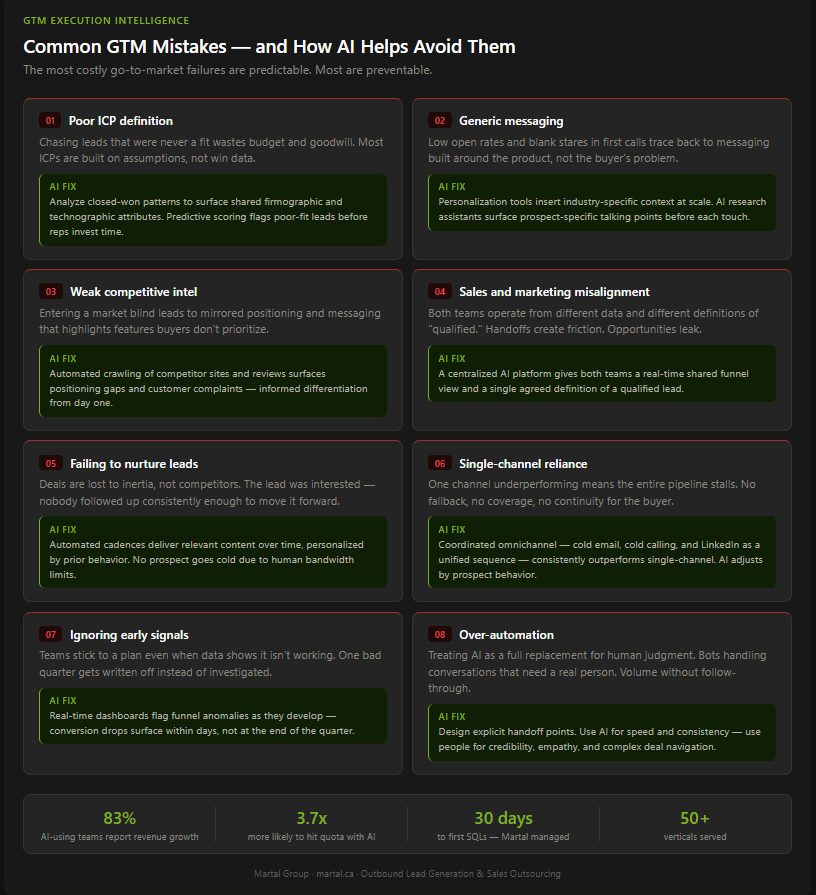
- Targeting the Wrong Audience or Poor ICP Definition: One classic mistake is not clearly defining your Ideal Customer Profile (ICP) and thus chasing leads that aren’t a good fit. This wastes precious time and resources. It might happen due to assumptions (“our product is great for everyone!”) or insufficient research.
AI Fix: Use data analysis to identify patterns among your best customers. AI can crunch your customer data to surface attributes common to successful deals (like industry, company size, tech stack, etc.), helping refine your ICP. Additionally, predictive lead scoring models can evaluate incoming leads and flag those that don’t match your historical success profile. This steers your team toward prospects with the highest likelihood of converting, rather than barking up the wrong trees.
- Generic Messaging That Doesn’t Resonate: Many GTM launches fail because the value proposition and messaging are too generic or not aligned with what the customer cares about. If prospects don’t quickly see how you solve their specific problem, they tune out. Mistake signs include low email open rates, poor engagement on ads, and blank stares in sales meetings.
AI Fix: Content personalization tools can tailor messaging to each audience segment at scale, inserting industry-specific pain points, relevant use cases, and contextual signals into outreach automatically. At the rep level, AI-powered research assistants can gather prospect-specific context before each touch and suggest talking points most likely to resonate. The result is messaging that feels written for the individual, not pulled from a template library.
- Lack of Sufficient Market Research & Competitive Intel: Entering a market without a clear view of the competitive landscape leads to positioning that mirrors established players, pricing that misses the mark, or messaging that highlights features buyers don’t actually prioritize.
AI Fix: Competitive intelligence tools can now crawl competitor websites, aggregate review platforms, and surface the specific complaints buyers have about existing solutions — in minutes rather than weeks. The practical output isn’t a comprehensive competitor profile. It’s a targeted positioning brief: where the gaps are, what the market is frustrated about, and where your differentiation is most defensible. That’s what shapes messaging that actually lands.
- Sales and Marketing Misalignment: This is a perennial problem – marketing might generate lots of leads that sales deems “junk,” or sales might not follow up promptly on marketing’s leads, leading to finger-pointing. In a critical go-to-market launch, misalignment can be deadly, as precious launch opportunities are squandered.
AI Fix: Automation ensures every marketing-qualified lead is immediately routed to the right rep with no manual handoff delays. A centralized AI-driven platform gives both teams a shared real-time view of the funnel, who’s engaged, what they’ve seen, where they are in the buying process. Lead scoring creates a shared definition of what “qualified” means, so marketing and sales stop arguing about lead quality and start working from the same criteria.
- Failing to Nurture Leads (Lack of Follow-Up): The leakage is significant — research has consistently shown that the majority of marketing-generated leads never convert to sales, with inadequate follow-up cited as the primary cause. One thing we see often in outbound pipeline work: companies with a healthy volume of initial responses but weak nurture cadences lose deals not to competitors, but to inertia. The lead was interested. Nobody followed up consistently enough to move it forward.
AI Fix: Automated nurture sequences ensure no lead goes cold from inaction. A prospect who expressed interest but didn’t book a meeting can be enrolled in a follow-up cadence — timed, personalized, and triggered by behavior rather than a calendar. One thing we see consistently in outbound pipeline work: companies with a healthy volume of initial responses but weak nurture cadences lose deals not to competitors, but to inertia. The lead was interested. Nobody followed up consistently enough to move it forward. AI removes that failure mode by making follow-up systematic rather than dependent on rep bandwidth.
- Relying on a Single Channel (One-Trick Pony Syndrome): Betting the GTM on one approach, only cold email, LinkedIn, or paid ,creates a single point of failure. If that channel underperforms or reaches the wrong audience, the entire pipeline stalls.
AI Fix: Coordinated omnichannel outreach — cold calling, cold email, and LinkedIn operating as a unified sequence — consistently outperforms single-channel approaches in B2B pipeline generation. AI manages the orchestration automatically: a prospect engaged on email gets email-weighted follow-up; one unresponsive there but active on LinkedIn gets a channel switch. The prospect experiences consistent, relevant presence. The team doesn’t manually coordinate three separate motions. The channel isn’t the problem — the coordination is.
- Ignoring Early Signals and Data (Stubbornness): Sometimes teams stick to a plan even when early metrics show it’s not working – perhaps due to HIPPO syndrome (Highest Paid Person’s Opinion) or sunk cost fallacy. This is a mistake because one of the virtues of modern GTM is the ability to pivot quickly based on data.
AI Fix: Real-time dashboards surface underperformance before it compounds. If demo-to-trial conversion drops in a new market segment, an AI-monitored pipeline flags it within days — not at end of quarter when the damage is done. The commitment should be to outcomes, not to a particular tactic. AI keeps that honest by making the gap between strategy and results visible continuously, not retrospectively.
- The Mistake Nobody Talks About: Over-Automation: Most GTM mistakes involve too little AI — weak targeting, no follow-up, misaligned teams. This one is the opposite.
Some teams, after investing in AI-powered outreach infrastructure, automate everything and then fail to handle what the automation generates. Ten thousand personalized emails go out. Replies come back. Nobody responds promptly because the team assumed the platform would handle it. Or a chatbot qualifies a lead to a certain threshold and then drops it at the handoff because the human side of the process was never defined.
The mistake isn’t using AI. It’s assuming AI ends the conversation rather than starting it.
AI Fix: Map every automation to a human handoff point before you launch. When a prospect replies with interest, a rep should be in their inbox within hours — not days. When a chatbot qualifies a lead, there should be a defined trigger that routes it to a human immediately. When a campaign generates SQLs, there should be a follow-up SLA that treats those leads with the same urgency as an inbound request. AI handles the scale. Your team handles the moments that actually close deals. Neither works without the other.
The best-performing GTM teams operate with a clear internal division: AI owns speed, scale, and consistency. People own credibility, empathy, and judgment. That combination — what some describe as a human-AI selling motion — produces both pipeline volume and deal quality. Neither element alone gets you there.
Avoiding these eight mistakes won’t guarantee GTM success — but it eliminates most of the preventable failure modes. The teams that build sustainable pipeline aren’t the ones with the most sophisticated tools. They’re the ones who get the fundamentals right: tight ICP, relevant messaging, consistent follow-up, aligned teams, and a willingness to act on what the data is telling them before it’s too late to course-correct.
Best Practices for Implementing an AI-Powered GTM Strategy
83% of sales teams using AI report revenue growth, compared to 66% of teams not using AI.
Reference Source: Salesforce
Adopting an AI-powered GTM strategy isn’t a single decision, it’s a sequence of them. Which capabilities to prioritize first. How to align the team around new workflows. How to measure progress before the pipeline results fully materialize. Getting that sequence right determines whether the investment compounds or stalls.
Based on how high-performing B2B GTM teams approach this, and what we see working across the outbound programs we run, here are the nine practices that separate effective AI-powered GTM execution from expensive experimentation.
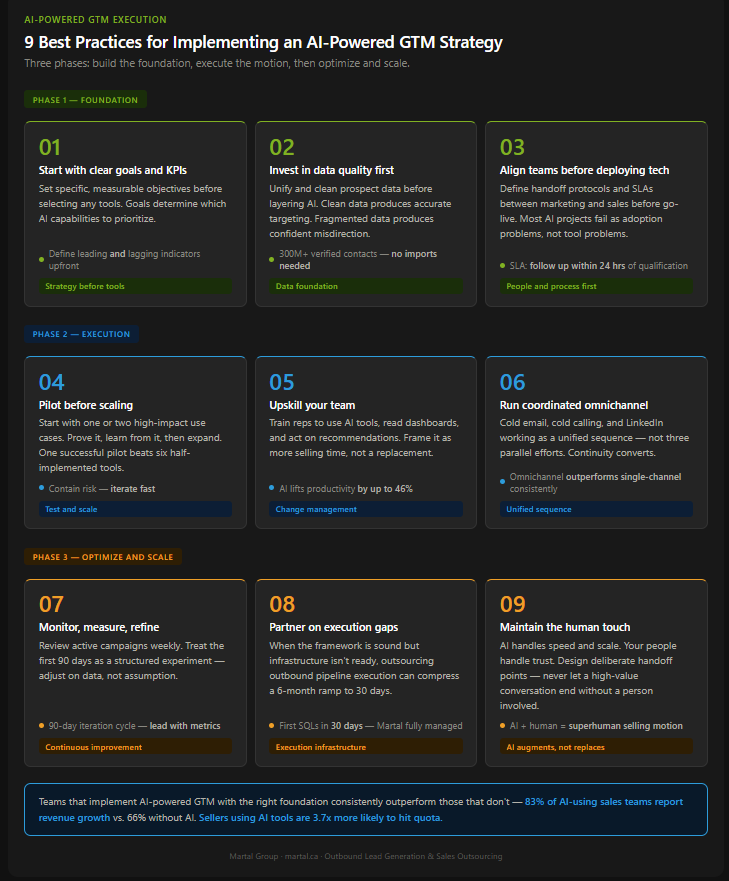
- Start with Clear Goals and KPIs: Before selecting tools or building workflows, define what success looks like in concrete terms. Is the goal 100 qualified leads per quarter? A specific pipeline value within six months? Penetration of 10 named accounts in a new vertical?
Clear objectives determine which AI capabilities to prioritize. If the goal is pipeline generation, the focus goes to AI for prospecting and outreach. If it’s shortening sales cycles, the focus shifts to intent data and sales enablement. If it’s improving conversion rates, the priority is personalization and lead scoring.
Set up measurement from day one — not as an afterthought once the tools are live. AI produces a lot of data. Without predefined KPIs, that data becomes noise rather than signal. - Invest in Data Quality and Integration: AI is only as good as the data feeding it. Before layering AI on top of existing systems, audit the data infrastructure: are customer and prospect records clean and current? Are your marketing, sales, and CRM systems talking to each other, or operating in silos? Are there gaps in firmographic or technographic coverage that would limit targeting precision?
This step isn’t glamorous, but it’s the one most teams skip — and then wonder why their AI-powered campaigns underperform.
Clean out duplicates and outdated info. If you have multiple databases, consider a Customer Data Platform (CDP) or at least ensure your AI tools can access all needed sources. Break down silos – maybe your marketing has data that sales doesn’t see or vice versa; fix that. Also, enrich your data where possible (for instance, use third-party data to fill in missing firmographics or technographics on your accounts). Why go through this effort? Because an AI model or automation workflow is going to make decisions based on what’s in your data. Garbage in, garbage out. Conversely, clean, rich data in – powerful insights out (2). Many top-performing GTM teams dedicate time to setting up a robust “data foundation” as step zero of their AI journey. It pays off massively in the accuracy and effectiveness of everything that follows. - Align Your Team and Strategy First (People + Process Before Tech): AI implementation isn’t just a technology project; it’s a change in how your team works. Ensure you have buy-in from both sales and marketing (and product, if needed) on the go-to-market game plan and the role AI will play.
It’s crucial that everyone sees AI as an enabler, not a threat. For example, involve your sales reps in selecting an AI sales tool so they feel ownership and understand it’s there to help them, not watch over them.
Define new processes clearly: if AI scores leads, how will sales use that score? Who monitors the AI dashboards? If a chatbot qualifies a lead, how is that handed to sales? Map these processes so that there’s no confusion.
A practical alignment mechanism many high-performing GTM teams use is a formal SLA between marketing and sales — for example, marketing qualifies leads to a defined threshold, and sales commits to follow up within 24 hours. Without that agreement in writing, even the best AI-assisted lead scoring produces friction at the handoff.
One alignment mechanism high-performing GTM teams use consistently: a formal SLA between marketing and sales — for example, marketing qualifies leads to a defined score threshold, and sales commits to follow up on all such leads within 24 hours. Without that agreement in writing, even the best AI-assisted lead scoring produces friction at the handoff. - Start Small with High-Impact Use Cases: Pick one or two high-impact areas as pilots rather than automating everything at once. AI email outreach for SDRs, intent-based lead scoring, or a qualification chatbot are all contained enough to generate a clear result quickly. One successful pilot builds more internal momentum than six half-implemented capabilities delivering partial results. Scale what works. Cut what doesn’t. Iterate.
- Upskill Your Team – Training and Change Management: AI-powered GTM still relies on people to steer it. When rolling out new tooling, run focused training sessions on how to interpret AI-generated suggestions, how to personalize content with the platform, and how to read a performance dashboard without getting lost in vanity metrics. The teams that get the most from AI adoption are the ones that treat it as a workflow change, not just a software installation — and address the adoption friction directly rather than assuming it will resolve itself. For companies that want to accelerate the process, B2B sales training partnerships can compress the ramp significantly.
- Leverage Omnichannel and Multi-Touch Strategies: Design GTM campaigns to coordinate touchpoints across channels and use AI to orchestrate the sequencing rather than managing it manually.
For instance, you might set up a sequence where a prospect who downloads a whitepaper gets an automated follow-up email, is added to a retargeting ad audience, and if they click the email link but don’t sign up for a demo, they then get an automated LinkedIn message from a rep the next week.
Mapping out these journeys ensures you meet the prospect in different contexts and keep the outreach fluid. Use AI to personalize across channels – maybe the LinkedIn message references that whitepaper they downloaded, for example.
Consistency is key: Design campaigns so that cold email, cold calling, and LinkedIn outreach operate as a coordinated sequence — not three parallel efforts running on separate schedules. AI orchestrates the timing and channel logic: which prospect gets which channel next, based on how they’ve engaged so far. The prospect experiences consistent, relevant presence. Your team doesn’t manually coordinate three separate motions. The goal is a single campaign across every channel — not disparate efforts by platform that happen to share a target list. - Monitor, Measure, and Refine Continuously: Implementation is not a one-and-done. Make sure you set up dashboards and regular review cadences to monitor how your AI-powered GTM is performing. What do the metrics say? Are you seeing an increase in leads, conversion rates, shorter cycles? Identify where the funnel might still have bottlenecks. AI will give you a lot of data; use it.
For example, you might discover through AI analytics that a certain email template is underperforming – then you refine it and test again. Or perhaps one segment is showing unexpected high interest – maybe that’s a signal to pivot more resources there. The beauty of an AI-driven approach is you often get granular insights quickly. But you must act on them. Have a process: maybe a bi-weekly growth meeting where the team looks at GTM metrics and decides tweaks.
Adopt an experimental mindset: A/B test whenever possible and let the data decide. Over time, this continuous improvement loop can significantly boost your GTM effectiveness. It’s like compounding interest – small tweaks each month lead to huge gains over a year. One caution: measure what matters. Reply rates, meetings booked, SQL conversion rate, and pipeline value are the metrics that predict revenue. Open rates and send volume are useful for diagnosing deliverability problems — they are not GTM performance indicators. Set up dashboards around the former. Review them weekly. The ones that correlate with pipeline are the ones worth optimizing. - Partner with Experts and Utilize Outsourcing Strategically: The most common GTM execution gap isn’t strategy — it’s infrastructure. The framework is sound. The outbound engine to run it consistently isn’t in place yet. Building it from scratch while chasing near-term pipeline targets is a difficult combination, and the ramp cost is real.
In those situations, outsourcing the outbound pipeline execution function — rather than the broader GTM strategy — can compress a six-month ramp to 30 days. What makes this work is specificity of scope. Partnering on outbound lead generation, cold outreach, and qualification is a defined, measurable engagement with clear deliverables. Outsourcing “sales” broadly is vague and hard to hold accountable.
Martal’s model is built around that distinction. Onshore sales executives run coordinated omnichannel outreach — cold email, cold calling, and LinkedIn lead generation operating as a unified sequence — supported by an AI platform trained on 15+ years of B2B campaign data across 50+ verticals. For clients entering new markets or scaling pipeline without in-house bandwidth, most are generating their first sales-qualified leads within 30 days of launch. - Maintain the Human Touch and Ethics: AI is a means, not the end. The end goal is building trust with buyers — and trust requires human presence at the moments that matter most.
Use AI to draft outreach, but let reps add a line that reflects something genuinely specific to that prospect. Use chatbots for initial qualification, but route to a human the moment the conversation becomes substantive. Build handoff points into every automated workflow so that no high-value conversation ends without a person involved.
The best-performing GTM teams operate with a clear division: AI handles the speed, scale, consistency, and data processing. Their people handle credibility, empathy, judgment, and relationship-building. That combination, what some describe as a “superhuman” selling motion, is what produces both pipeline volume and deal quality. Neither element alone gets you there.
The data is directional: 83% of sales teams using AI report revenue growth, versus 66% of teams not using AI. That gap isn’t closed by adopting more tools — it’s closed by integrating AI into a GTM motion that already has the right ICP, the right messaging, and the right execution infrastructure behind it. The practices above are how you build that foundation.
GTM Strategy Template: A Pre-Launch Checklist for B2B Teams
A GTM strategy document can run 20 pages or fit on one. The length isn’t the point — coverage is. Before any B2B launch, market entry, or pipeline-scaling effort, the following checklist covers the decisions that determine whether execution will build momentum or stall.
Use this as a working reference — not a one-time exercise. Each item represents a decision that needs a clear owner, a documented answer, and a review date.
Phase 1: ICP and Market Definition
- Ideal Customer Profile defined — firmographics, technographics, job titles, buying triggers, and disqualifiers documented
- ICP validated against best existing customers (or first-conversation data for new market entry)
- Total Addressable Market sized — TAM, SAM, SOM calculated for the target segment
- Buying committee mapped — all stakeholders involved in the purchase decision identified by role and influence
- Disqualification criteria defined — signals that indicate a prospect is not a fit, documented before outreach begins
Phase 2: Positioning and Messaging
- Value proposition written for each ICP persona — outcome-focused, not feature-focused
- Competitive positioning defined — where you win, where competitors win, and how to handle the comparison
- Differentiation tested against actual buyer language — not internal terminology
- Objection responses prepared for the top three objections in your category
- Messaging validated with at least five prospect conversations before scaling outreach
Phase 3: Pricing and Packaging
- Pricing model selected — flat rate, per-seat, usage-based, or value-based — and aligned to buying behavior
- ACV confirmed and sales motion matched — deals above $10K ACV require a sales-led motion
- Pricing objection handling defined — is consistent price pushback a pricing problem or a positioning problem?
- Packaging options clear — buyers should be able to understand what they’re getting and what it costs in under two minutes
Phase 4: Channel Selection and GTM Motion
- Primary GTM motion selected — sales-led, marketing-led, PLG, or partner-led — based on ACV, buyer behavior, and timeline
- Channel mix defined — which channels are primary, which are supporting
- For outbound-led motions: cold email, cold calling, and LinkedIn outreach confirmed as coordinated sequence — not standalone efforts
- For inbound-led motions: SEO, content, and paid channels resourced with realistic timeline to first pipeline
- Sales and marketing SLA documented — shared definition of a qualified lead, handoff criteria, and follow-up commitments
Phase 5: Execution Infrastructure
- Prospect list built from verified, enriched data — not a static export
- Outreach sequences written and reviewed — personalization reflects real signal, not template substitution
- Domain warm-up and deliverability infrastructure in place before launch
- Qualification criteria defined — what makes a prospect sales-ready, and who owns the qualification call
- CRM or pipeline tracking live — all leads tracked from first touch to booked meeting
Phase 6: Measurement and Iteration
- Primary KPIs defined before launch — reply rates, meetings booked, SQLs, pipeline value
- Leading indicators identified — the metrics that predict pipeline outcomes three to four weeks before they show up
- Weekly review cadence scheduled — with a defined owner who can make tactical adjustments
- 30/60/90-day milestones set — with clear criteria for what success looks like at each stage
- Iteration protocol defined — what data triggers a messaging change, a channel shift, or an ICP refinement
Conclusion
A go-to-market strategy is only as strong as its execution. The framework covered in this guide, ICP, positioning, pricing, channel selection, outbound engine, and measurement, is the structure. What determines whether it produces a pipeline is how precisely and consistently it gets run.
That’s where most GTM plans stall. The strategy is coherent on paper. The outbound execution is inconsistent in practice. Messaging is broad when it needs to be specific. Follow-up is sporadic when it needs to be systematic. Channels are treated as separate efforts when they need to operate as a coordinated sequence.
AI and automation have made it significantly faster to close that gap — but only when the underlying framework is sound. If the ICP isn’t tight, AI will target the wrong buyers faster. If the messaging isn’t differentiated, AI will deliver it to more people and return the same low reply rates at higher volume. The technology accelerates a strong GTM strategy. It exposes a weak one.
Two things tend to separate the B2B teams that build sustainable pipelines from the ones that don’t: they treat the GTM framework as a living system rather than a launch checklist, and they invest in execution infrastructure that matches the ambition of the strategy.
If your team has the GTM framework but needs the execution infrastructure to run it — the AI-powered targeting, the coordinated omnichannel outreach, the qualification motion — that’s where Martal operates. Our onshore sales executives run cold email, cold calling, and LinkedIn outreach as a unified sequence supported by an AI platform built on 15+ years of B2B campaign data across 50+ verticals. Most clients generate their first sales-qualified leads within 30 days of launch — without building the infrastructure from scratch.
Book a consultation to talk through your GTM execution gaps and what a qualified pipeline looks like for your market.
References
- Business Columbia
- Demand Base – AI Strategies
- Martal Group – AI Case Study
- McKinsey
- Salesforce
- Amplitude
- Via Marketing
- Salesforce — Sales AI Statistics
FAQs: GTM Strategy
What is a GTM strategy and what does “go-to-market” actually mean?
GTM strategy — short for go-to-market strategy — is a time-bound, launch-specific plan that defines how a company will bring a product or service to a specific market and generate revenue from it. It covers the target customer, the value proposition, the pricing model, the channels used to reach buyers, the sales motion, and the metrics that define success. Unlike a marketing strategy, which is ongoing and brand-wide, a GTM strategy exists to answer one question: how do we successfully enter this market or launch this product and build pipeline from it?
What is the difference between a go-to-market strategy and a marketing plan?
A marketing strategy is broad and ongoing — it covers brand positioning, content, demand generation, and channel investment across the entire business over time. A GTM strategy is time-bound and launch-specific — it exists for a particular product launch, market entry, or segment expansion. A company can have one marketing strategy running continuously while maintaining separate GTM strategies for each new launch or expansion. Confusing the two is one of the most common reasons B2B launches underperform.
What are the main components of a GTM strategy?
The core components of a B2B GTM strategy are:
- ICP definition — who you’re targeting and why
- Value proposition and positioning — why buyers choose you over alternatives
- Pricing and packaging — structured to match your buyer and sales motion
- Channel selection — where and how you reach buyers
- Outbound execution — the outreach engine that builds pipeline
- Measurement and iteration — the metrics and review cadence that improve performance over time
Should I go PLG, SLG, or a hybrid? How do I choose the right GTM motion?
A GTM motion is the primary mechanism through which a company generates pipeline and closes revenue. The four main motions are sales-led (direct outreach and human-driven sales), marketing-led (inbound demand generation through content and paid), product-led (the product drives acquisition through free trials or self-serve), and partner-led (pipeline through channel partners or resellers). For B2B companies with complex products, high ACV deals, and buying committees of three or more stakeholders, a sales-led motion is almost always the right starting point — it’s the only motion that generates qualified meetings on a 30–60 day timeline.
How does AI actually improve GTM execution, or is it just hype?
AI improves GTM execution at every stage: at the top of the funnel by identifying ICP-matched accounts and scoring them against real-time intent signals; in outreach by generating personalized messaging variations at scale; in sequencing by adjusting channel and cadence based on how each prospect engages; and in performance analysis by surfacing what’s working before the quarter ends. The key distinction is precision over volume — AI doesn’t just make outreach faster, it makes it more targeted. The result is higher reply rates with fewer sends, not just more sends returning the same reply rates.
How do I know if my GTM strategy is actually working and how long should it take?
For outbound-led B2B GTM motions, the first marketing-qualified leads typically emerge within two to three weeks of launch, and the first sales-qualified leads within 30 days — assuming the ICP is well-defined, the outreach infrastructure is in place, and the qualification criteria are clear. For inbound-led motions (SEO, content), the timeline to first pipeline is typically three to six months. The fastest path to early pipeline is a sales-led outbound motion with coordinated omnichannel outreach — which is why most B2B companies entering new markets or scaling pipeline on a defined timeline start there.