
 Martal
 Technology
 Education and training
 Web Development and UI / UX
 Healthcare/Medical
 Logistics and Supply Chain
 Information Technology
 Insuretech and Financial Services
 Marketplaces
 Software Development
 E-commerce and retail
 AI and Machine Learning
 Energy and Solar
 Manufacturing
 Security and Surveillance
 Digital Marketing Agency
 Transportation
 MSP
MSP
 Telecom
 B2B SaaS
 Cybersecurity
 HR tech
 Fintech
 Cleantech
 Consulting
Sales Outsourcing in Europe: Choose the Right Partner from the Top 10
Major Takeaways: Sales Outsourcing in Europe
Outsourcing delivers faster deployment, lower overhead, and broader regional reach than building in-house — advantages that become more pronounced in Europe’s fragmented, compliance-heavy, multilingual markets. Many B2B companies run both in tandem: an outsourced partner owns top-of-funnel prospecting while the internal team focuses on closing.
Yes. The global B2B sales outsourcing market is projected to reach nearly $180 billion by 2031 at a 9.78% CAGR, with Europe consistently holding a ~30% share of global revenue — driven by technology, finance, and manufacturing sectors adopting Sales-as-a-Service models at scale.
The most common risks are GDPR non-compliance, inconsistent lead quality, and cultural misalignment between outreach and target market. All three are manageable with clear qualification criteria, a structured onboarding process, and a partner with genuine European delivery experience — not just European market claims.
Buyer expectations, communication styles, and preferred outreach channels vary significantly across European markets. German and Austrian buyers expect formal, detail-oriented messaging. Scandinavian markets respond well to directness. Southern European markets place greater weight on relationship context before a commercial conversation. A credible European sales partner adapts tone, channel, and timing by market rather than applying one playbook across the region.
Yes, when the model is right. Concrete results depend on targeting precision, campaign structure, and qualification standards — not outreach volume. Companies that define clear SQLs, align on ICP before launch, and treat the outsourced team as an extension of their revenue function consistently outperform those that treat it as a lead-generation vendor.
GDPR governs how prospect data is sourced, how contact is made, and how opt-outs are handled across the EU and UK. Non-compliance can result in fines up to €20 million or 4% of global annual revenue. Quality European sales partners have GDPR compliance embedded in their process — not bolted on — and can explain their data sourcing, legal basis for outreach, and suppression list management in detail.
Prioritize partners with onshore, locally aligned teams, a transparent methodology, GDPR-compliant outreach practices, and demonstrated results in your target markets and verticals. Key alignment points before signing: ICP definition, qualification criteria, reporting cadence, and how the partner handles regional variation across DACH, UK, Nordics, and Southern Europe.
Alignment between marketing and outsourced SDRs improves conversion at every stage of the funnel. Shared ICP definitions, defined lead handoff processes, consistent messaging across channels, and regular joint reviews are the four practices that determine whether the two functions compound each other or operate in parallel without impact.
Introduction
Sales outsourcing in Europe is no longer a stopgap for companies without a sales team, it’s a deliberate growth strategy for businesses that want to move faster, cover more ground, and compete in markets where local knowledge genuinely matters.
The numbers reflect that shift. The global B2B sales outsourcing market was valued at $96 billion in 2023 and is projected to reach nearly $180 billion by 2031 (9.78% CAGR) (2), with Europe alone accounting for roughly 30% of global B2B sales outsourcing revenue (1). More recent analyst estimates place the longer-term ceiling even higher, but the direction is consistent. Europe is not a secondary market for sales outsourcing. It’s one of the primary ones.
For marketing and sales leaders in Europe – whether a CMO planning a pan-European campaign or a VP of Sales at a tech scale-up – the question isn’t should you leverage sales outsourcing, but rather how and with whom.
This guide was built to help answer that. We reviewed the leading providers operating in European markets, compared their models, and interpreted the findings through Martal’s direct experience running outbound campaigns across North America, Europe, and LATAM. The goal is to make this category easier to evaluate — not just to list names.
“Should sales be outsourced?” is a question that comes up the moment a growth-stage company starts hitting the limits of what its internal team can cover. The answer depends almost entirely on context. Outsourcing works well when you need to move faster than a hiring cycle allows, when the target market has compliance or cultural complexity your team hasn’t navigated, or when you want to test demand in Germany, France, the Netherlands, or the UK before committing to a local hire. It tends to underperform when the ICP is undefined, the product lacks a repeatable value proposition, or leadership expects pipeline in week one without investing in onboarding. This guide is written for the companies in the first category — the ones asking the right question at the right time.
Here’s what we cover: the in-house vs. outsourced debate in a European context, the key benefits and real challenges of outsourcing (including GDPR and regional variation), and profiles of the top 10 sales outsourcing partners active in Europe, including a detailed look at how Martal Group approaches this market.If you’re already familiar with the case for outsourcing and want to go straight to the vendor comparison, jump to our Top 10 list.
In-House vs. Outsourced Sales Teams: Which Suits Your European Strategy?
42% of salespeople say prospecting is the most challenging part of the sales process, above closing or qualifying leads.
Reference Source: Spotio
Choosing between building an in-house sales team versus outsourcing sales is one of the more consequential decisions a B2B company can make, and the tradeoffs look different in Europe than in most other markets.
Europe’s fragmented landscape (multiple languages, varying regulatory requirements, and distinct buyer cultures across regions) amplifies the cost and complexity of building in-house. The comparison below draws on public research, Martal’s experience running outbound campaigns in European markets, and our review of how companies at different stages typically approach this decision.
In-House vs. Outsourced Sales Comparison
Factor
In-House Sales Team
Outsourced Sales Partner (Sales Agency)
Upfront & Overhead Costs
High – Salaries, benefits, office space, tools, training, and long-term commitments add up. In Western Europe, expect €60K+ per rep before overhead.
Lower – Typically pay a monthly fee or contract; no permanent hires, reducing overhead (no benefits or facility costs).
Time to Ramp Up
Slower – Recruiting talent in Europe’s tight labor market can take months; new hires then need onboarding and time to reach full productivity.
Faster – Established teams can launch campaigns in weeks, plugging into proven processes (3). Hiring and training phases are already done.
Sales Expertise
Variable – Depends on your hires. Small in-house teams might lack specialized skills (e.g. multilingual prospecting or industry-specific know-how).
High – Outsourcing firms bring seasoned SDRs/BDRs with 3–5+ years experience on average, often across various industries. You access a team that focuses exclusively on pipeline generation.
Scalability
Limited – Scaling up means recruiting and budgeting for more headcount; scaling down risks morale issues. It’s hard to quickly adjust team size across Europe.
Flexible – Scale up or down as needed. Start with a fractional SDR team and expand into new regions on demand. No HR headaches.
Geographic Coverage
Locally constrained – Your team’s language abilities and location limit which European markets you can effectively cover. Covering DACH, UK, Nordics, and Southern Europe simultaneously is expensive to staff.
Broader reach – Quality sales agencies operate with onshore, locally aligned teams across major European markets, giving you regional presence without setting up offices in each country.
Tools & Technology
DIY investment – You must purchase CRM, sales engagement platforms, databases, etc. High-end tools (intent data, AI analytics) may be too expensive or complex for a small team.
Advanced stack included – Top outsourcing partners provide AI-driven outreach platforms, intent-data tools, and CRM integrations as part of their service (3). You access a continuously optimized tech stack without owning it.
Control & Oversight
Direct control – You manage hires daily, set their priorities, and can align them closely to your culture. The tradeoff is significant management overhead.
Managed externally – You relinquish some day-to-day control. The partner manages the reps and strategy execution. Transparent reporting and communication are crucial to ensure alignment with your goals. (Reputable firms will feel like an extension of your team.)
Consistency & Pipeline
Variable – In-house teams often struggle with consistent lead flow when reps focus on closing deals (3). Vacations and turnover create gaps.
Reliable – Outsourced teams focus purely on pipeline generation. They follow documented processes to keep leads flowing steadily. Providers also have multiple reps and can backfill quickly if someone rolls off, keeping your outreach uninterrupted.
Compliance & GDPR
Learn as you go – You must ensure your cold email campaigns, call lists, and data practices comply with GDPR and local regulations. Mistakes carry real legal exposure.
Compliance-ready – Quality European sales partners have GDPR compliance built into their data sourcing, outreach, and opt-out processes (9). They reduce your legal risk rather than adding to it.
Cost per Lead
Potentially higher – Without scale or specialized skills, cost per lead climbs. The average B2B CPL runs around $198 (3), but inexperienced execution drives it higher.
Lower with efficiency – Agencies leverage refined targeting and automation to lower cost-per-lead by focusing on high-probability prospects (3). Optimized outreach honed across many campaigns typically yields more qualified meetings per dollar spent.
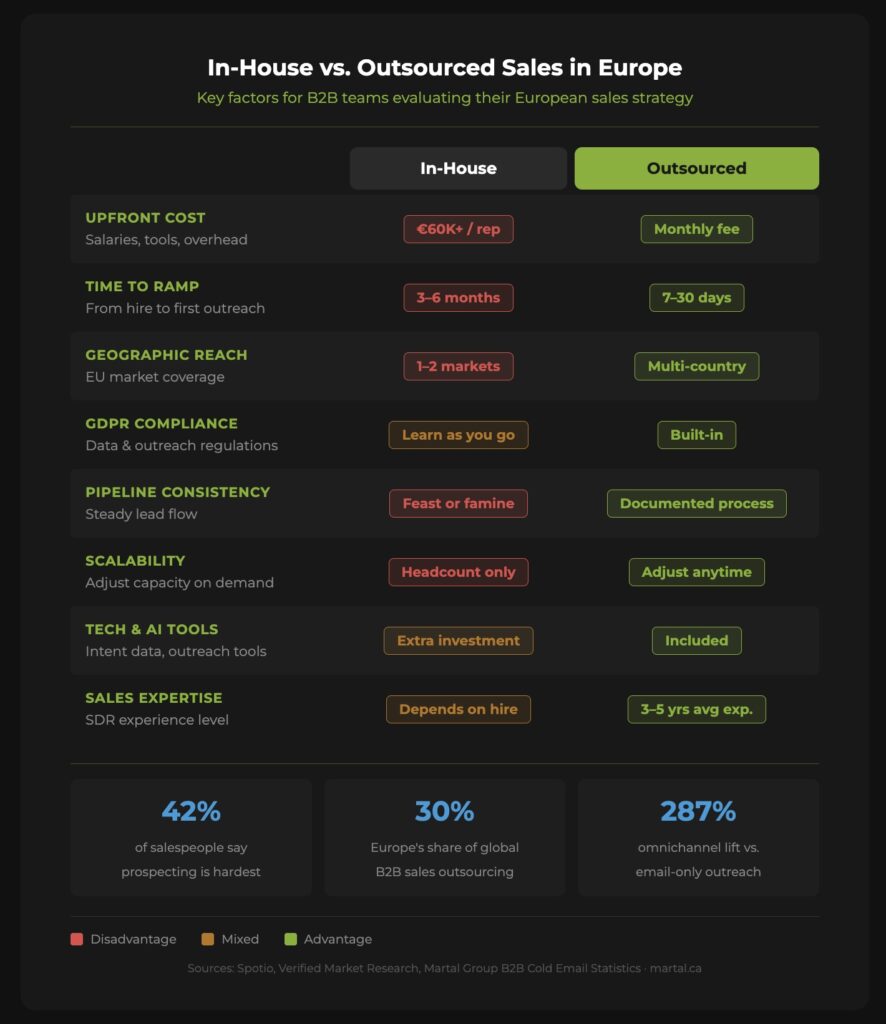
Key Takeaway: In-house sales teams offer control and cultural immersion in your company, but they come with higher costs and slower scalability – especially challenging when covering Europe’s multilingual markets.
By contrast, outsourcing sales in Europe provides instant expertise, multi-country coverage, and faster results, albeit with less direct oversight. The best choice depends on your goals, budget, and timeline.
Many B2B companies blend both approaches: a core in-house team handles closing sales deals and strategic accounts, while an outsourced partner owns the top-of-funnel engine. That division of labor tends to produce better pipeline consistency than either model alone.
It’s worth noting that 42% of salespeople identify prospecting as the hardest part of their job (4) ranking above closing or qualifying. That’s precisely the activity most companies choose to outsource first, freeing internal reps to focus on the conversations that actually close.
Benefits of Outsourcing Sales in Europe – Why Companies Are Embracing “Sales-as-a-Service”
The global B2B sales outsourcing market is projected to reach $180 billion by 2031, growing at a CAGR of 9.78%.
Reference Source: Verified Market Research
Outsourcing certain sales functions isn’t just a cost-cutting tactic – it’s increasingly seen as a competitive advantage. Europe’s business environment, with its high labor costs and fragmented markets, makes the case even stronger.
Here are some core benefits and trends driving the sales outsourcing services market:
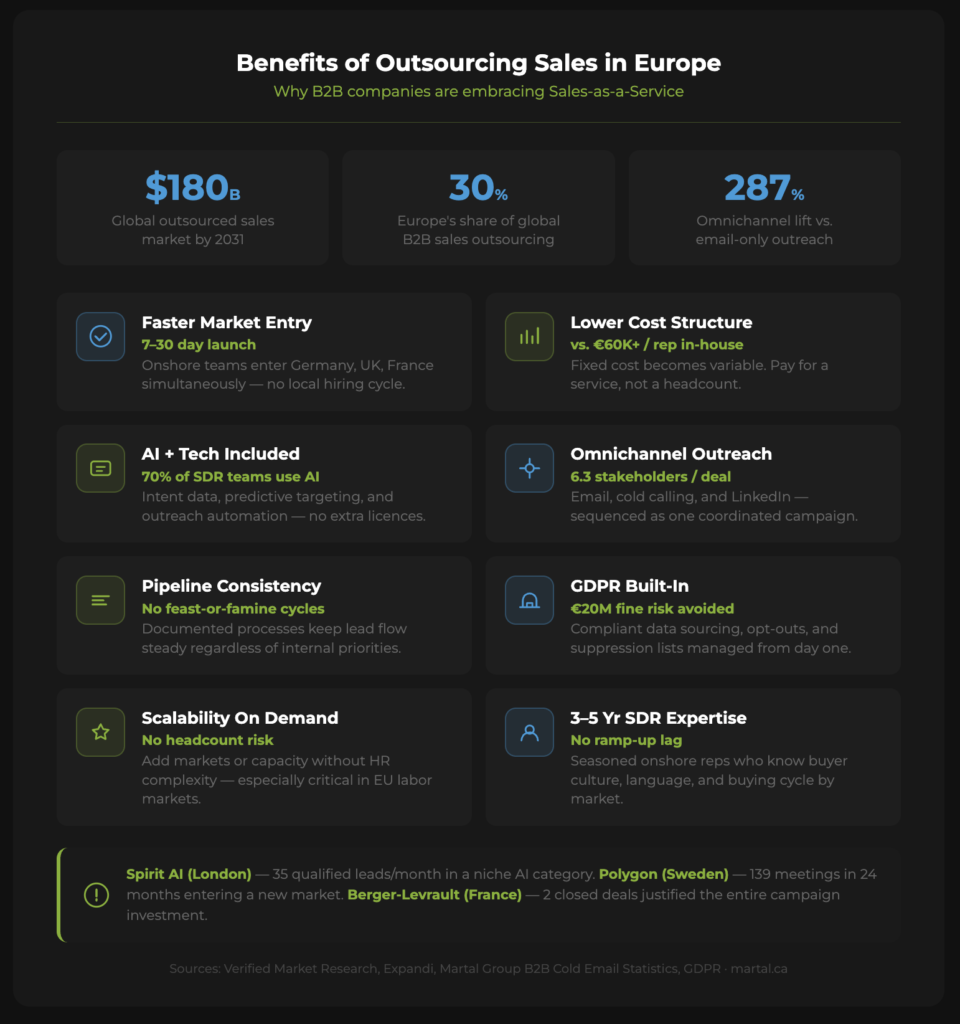
- Accelerated Market Entry & European Expansion: An outsourcing partner can deploy onshore, locally aligned reps in a new European market in weeks, no hiring cycle, no office setup, no months of onboarding before the first outreach goes out. Entering Germany, France, and the UK simultaneously becomes operationally feasible when the infrastructure already exists. When Spirit AI, a London-based AI company, needed to build a pipeline outside its home market, Martal delivered 35 qualified leads per month in a niche category where most outbound approaches struggle to gain traction (5).
- Cost Efficiency and ROI: Building an in-house sales operation across European markets is expensive, €60K+ per rep in Western Europe before overhead, tools, and turnover costs.
Two questions buyers ask at this stage, “How are outsourced sales services charged?” and “What percentage of gross sales should you expect to pay for outsourcing your sales?” On pricing models: most reputable European providers operate on a monthly retainer, typically ranging from €3,000–€15,000 depending on market complexity, team size, and whether the engagement covers one country or several.
Commission-only or pay-per-meeting models exist but come with tradeoffs — they can create incentives for volume over qualification quality. On percentage: the question only makes sense once you know your average deal value. A company closing €50,000 contracts should be thinking in terms of cost-per-SQL and pipeline-generated, not gross revenue percentage. A well-run managed program typically delivers a cost-per-qualified-meeting that drops significantly between year one and year two as targeting refines.
Outsourcing converts that fixed cost into a variable one. Companies consistently cite expense reduction as a primary driver (2), and because agencies run optimized campaigns across many clients, they tend to deliver a lower cost-per-appointment than in-house teams working from scratch.
- Immediate Access to Expertise and Technology: Outsourced teams arrive with specialized industry knowledge and a complete tech stack already running. Martal operates on a proprietary AI SDR Platform trained on 15+ years of B2B outbound data and 40M+ campaigns, giving clients access to intent data, predictive targeting, and sequence optimization without licensing or managing those tools themselves. Over 70% of sales teams now use AI or automation to qualify leads and personalize outreach (1), a capable partner brings that as a baseline.
- Omnichannel Outreach at Scale: Buying committees now average 6.3 stakeholders per B2B deal, and sales cycles routinely stretch six months or longer (29). Executing a coordinated sequence across cold email, LinkedIn, and phone, consistently, across every active prospect — is beyond what most in-house teams can sustain alongside active deals. Current data shows omnichannel outreach outperforms email-only sequences by over 287% (31). An outsourced SDR builds that cadence into every campaign by default.
- Faster Sales Cycles and Internal Focus: Pre-qualified, warmed-up leads arrive ready for a real conversation — which means your closers spend less time prospecting and more time on deals that can actually move. Outsourcing segments the sales funnel by specialization: lead generators at the top, your team at the bottom. That division shortens the overall sales cycle and reduces rep burnout, particularly in European markets where deal complexity and longer nurture cycles are the norm.
- Scalability Without Headcount Risk: In markets with strong labor protections, much of Western and Northern Europe, scaling an in-house team up or down is genuinely difficult. Outsourced services are elastic by design. Add coverage for a new country, ramp up ahead of a product launch, or pull back when priorities shift, all without a headcount plan. Companies rank flexibility and speed to market nearly as highly as cost savings when evaluating outsourcing (10).
- Regulatory Compliance Built In: GDPR non-compliance can result in fines up to €20 million or 4% of global annual revenue (8). A capable European sales outsourcing partner has compliance embedded in their process — GDPR-compliant data sourcing, opt-out management, suppression lists, and SDRs trained on regional rules from day one. That reduces your legal exposure and means outreach is correctly calibrated by market before the first email goes out.
- Data-Driven Pipeline Improvement: Outsourcing firms run campaigns across many clients and verticals simultaneously. That breadth produces benchmarks most in-house teams never accumulate — what messaging converts in Germany vs. the Nordics, where drop-off happens in a six-touch cadence, which sequences work in fintech vs. manufacturing. As a client, you inherit that learning. Regular reporting on response rates, SQL conversion, and pipeline value, with continuous refinement between cycles, produces a more predictable, optimized sales pipeline that improves as the engagement matures.
The case for outsourcing sales in Europe is practical. It gets you faster into the market, lowers your cost structure, and puts compliance and outreach execution in the hands of teams already built for it. The variable that determines whether it works is partner selection, which is where the real complexity lives.
Challenges and Considerations in European Sales Outsourcing
Non-compliance with GDPR can result in fines up to €20 million or 4% of global annual revenue.
Reference Source: Intersoft Consulting
The benefits of outsourcing sales in Europe are real, but so are the friction points. Business leaders must be mindful of certain challenges and due-diligence points when engaging an external sales agency in Europe. Here are the considerations that matter most.
- GDPR and Data Privacy Compliance: Europe’s General Data Protection Regulation fundamentally changes what B2B outreach can look like. Unlike in North America, you cannot simply run cold email campaigns to any prospect list without a clear legal basis for contact. Fines for non-compliance can reach €20 million or 4% of global annual revenue (9) — and enforcement has become more consistent, not less, since GDPR’s introduction.
Three questions from buyers evaluating European outbound come up more than any others: “Can I cold email under GDPR?”, “Will GDPR affect cold emailing?”, and “How can I keep doing cold email prospecting with the new GDPR?” The short answer to all three: yes, cold email is legal under GDPR for B2B contacts, but the legal basis, data sourcing, and opt-out mechanics matter — and they vary by country.
When evaluating any outsourcing partner, ask directly: how do they source prospect data? What legal basis do they rely on for outreach — legitimate interest or consent? How do they handle opt-outs, suppression lists, and data subject access requests? Do they have a Data Protection Officer? Their answers will tell you quickly whether compliance is embedded in their process or bolted on as an afterthought. For UK and Canadian-targeted campaigns specifically, note that cold email restrictions are stricter — reputable partners run calling and LinkedIn outreach in those markets rather than cold email [(see channel rules by region)].
- Cultural and Language Nuances: Europe is not a single market. Outreach that converts well in one country can fall flat — or create friction — in another. German and Austrian buyers typically expect more formal, detail-oriented communication than UK or Irish prospects. Scandinavian markets tend toward directness and have strong professional networking cultures. Southern European markets, including Spain, France, and Italy, often place greater weight on relationship-building before a commercial conversation begins.
Channel preferences vary too. LinkedIn is a primary business tool across most of Western Europe, with Ireland and Scandinavia showing particularly strong outreach response rates. In DACH markets, professional networking behavior has shifted largely to LinkedIn over the past few years, though formality in messaging remains important. An experienced European sales partner understands these distinctions — and adjusts tone, timing, and channel accordingly rather than applying a single playbook across the region.
- Market Fragmentation & Strategy Alignment: Targeting “Europe” as a single territory means running what are effectively multiple parallel campaigns — different ICPs, different messaging, different channel mixes, different regulatory constraints. The complexity compounds quickly. A challenge arises when an outsourcing partner treats the entire EU as one audience and pushes the same campaign across all markets.
Work with any prospective partner to establish a clear regional prioritization before the campaign starts: which country clusters are the highest priority, how the ICP differs by market, and whether to run market-specific tracks (for example, a DACH-focused SDR alongside a separate UK and Nordics track) or a phased approach starting with English-speaking markets. Partners who ask these questions proactively are the ones with genuine European experience.
- Brand Integration and Quality of Interaction: Two questions surface consistently when decision-makers start evaluating outsourced sales: “How do I control outsourced sales reps?” and “What are the downsides of outsourcing sales?” Both are fair. And both have practical answers that go beyond reassurance.
On control: the assumption that outsourcing means losing visibility is one of the most persistent myths in this category. The reality is that a well-structured engagement gives you more visibility than most in-house SDR setups — weekly reporting, live pipeline sheets, shared qualification criteria, and campaign-level data across every channel. What you are giving up is direct line management. What you are gaining is a team that already knows how to run the process.
On downsides: the real risks are not philosophical. They are operational. Misaligned qualification criteria, a partner who launches before they understand your ICP, messaging that does not reflect your brand voice — these are the failure modes that actually occur. The mitigation is front-loaded: onboarding rigor, approved messaging before the first outreach goes live, and weekly reviews from day one rather than month three.
The best agencies run a structured onboarding that surfaces your value proposition, ICP, competitive context, and messaging preferences before a single outreach goes out. Treat that process seriously: provide playbooks, objection-handling guides, case studies, and direct access to a subject matter expert for the first few weeks. The quality of that foundation directly determines the quality of the conversations your partner books.
What to Evaluate When Vetting a Partner
Once you’ve shortlisted providers, the evaluation criteria below separate partners with genuine European capability from those applying a generic model to a complex market:
- Technology and reporting: Does the partner use a modern outreach platform with real-time analytics? Will you have visibility into campaign activity — emails sent, LinkedIn touches, calls made, MQLs, SQLs — on a weekly basis, not just monthly?
- Data sources: Where does their prospect data come from? Is it GDPR-compliant? Do they use intent signals to prioritize outreach timing?
- Customization: Do they build a strategy specific to your ICP and target markets, or plug you into a standard sequence? Ask whether they’ve run campaigns in your specific target countries and industries.
- Flexibility: Can they adjust mid-campaign if messaging isn’t resonating? Can you expand to new markets or scale back without structural contract changes?
- Pricing model: Understand whether you’re paying a flat retainer, per appointment, or a hybrid. Each model has different incentive structures — per-appointment models can produce volume at the expense of quality without clear qualification criteria in place.
- Communication: Is there a dedicated account manager? Are weekly reviews standard? How they communicate during the sales process is usually how they’ll communicate once you’re a client.
Taking the time to vet properly pays off. Many companies speak to two or three providers before deciding — and the differences in how they answer these questions are often more telling than any case study they put in front of you.
Selling Into Europe’s Key Markets: What Changes by Country
One of the most common questions from companies planning a European push is whether they can run a single outbound strategy across the region, or whether each country genuinely requires a different approach. “Can I run the same outbound campaign across all European countries?” The direct answer is no — and the differences are more consequential than most teams expect before their first campaign lands flat in Berlin or gets flagged as non-compliant in Paris.
Europe rewards specificity. A campaign that converts in the UK will not automatically translate to Germany, and what works in France may fall flat in the Netherlands. Here is what changes — and what it means for how you select and brief a sales outsourcing partner.
Germany
Germany is Europe’s largest B2B economy and one of the most frequently targeted markets for tech companies entering the continent — but it is also one of the most unforgiving for generic outreach. German buyers expect formal, detail-oriented communication, a clear value proposition before any commercial conversation, and outreach that respects local data regulations under both GDPR and Germany’s UWG law, which governs unsolicited B2B contact more strictly than most EU markets.
Cold email to German-targeted prospects requires careful legal grounding. Cold calling and LinkedIn outreach are the more reliable channels in this market. Messaging that works in English-speaking markets often needs to be adapted — not just translated — for a German audience. A partner with verifiable DACH campaign experience and locally aligned reps is not optional here; it is the difference between traction and noise.
For companies targeting German buyers or German tech companies expanding internationally, Martal’s outbound lead generation in Germany covers both directions — inbound market entry and outbound expansion.
France
France is a high-value European market with a strong enterprise and mid-market tech sector, but it follows a distinct buying rhythm. Relationship context matters more in French B2B sales than in Northern European markets — cold outreach without a warm hook or relevant contextual angle tends to underperform. Formal titles and professional tone are expected. Decision-making can involve multiple stakeholders and a longer nurture cycle before a commercial conversation progresses.
Compliance-wise, France follows GDPR alongside its own CNIL guidelines on data processing. Cold email to French prospects requires the same legitimate interest framework as the broader EU. Calling and LinkedIn are the more reliable primary channels. The Berger-Levrault engagement — where two closed deals justified Martal’s entire campaign investment — is a direct example of what structured outbound in the French enterprise market can produce when the approach is calibrated correctly.
For B2B companies building pipeline in France, Martal’s lead generation France program is designed around the specific buying culture and compliance requirements of the French market.
The Netherlands
The Netherlands is one of Europe’s most digitally mature B2B markets and a natural gateway for companies entering Benelux and Northern Europe. Dutch buyers are direct communicators — they tend to evaluate vendors quickly and expect clear, data-backed value propositions without excessive formality. LinkedIn penetration in the Netherlands is among the highest in Europe, making it a particularly effective outreach channel for B2B campaigns.
Amsterdam and the broader Randstad region concentrate a significant density of tech, fintech, logistics, and SaaS companies, making the Netherlands a high-value target for both market entry and account expansion. As a GDPR-originating jurisdiction, Dutch buyers are also sophisticated about data practices — partners with transparent data sourcing and clear opt-out processes are better received.
For companies building pipeline in the Netherlands or using Amsterdam as a regional entry point into Benelux, Martal’s sales outsourcing Netherlands program covers both inbound and outbound campaign models.
United Kingdom
The UK remains one of the most accessible European markets for B2B outreach — English-language campaigns run without localization overhead, and the professional culture is generally receptive to direct, value-led outreach. LinkedIn is heavily used across UK business sectors, and cold calling remains a legitimate and effective channel. However, UK-targeted cold email falls under PECR (Privacy and Electronic Communications Regulations) alongside GDPR, which means permission and legitimate interest requirements still apply.
Post-Brexit, UK-based companies targeting EU markets — or EU companies entering the UK — face separate compliance considerations on each side. A partner with experience running campaigns in both directions is worth prioritising. The UK also has some of the highest LinkedIn reply rates in Europe, particularly in sectors like SaaS, fintech, and professional services.For B2B companies building pipeline in the UK or using London as a regional hub, Martal’s sales outsourcing United Kingdom program covers omnichannel outbound into UK enterprise and mid-market buyers.
Aligning Marketing and Sales Outsourcing for a Unified European Strategy
62% of companies that outsource their sales processes report an improvement in their overall sales performance.
Reference Source: Statista via Verified Market Reports
For sales leaders evaluating outsourced sales in Europe, one question comes up consistently: should we use a marketing agency, a sales outsourcing partner — or both?
The honest answer is usually both, in sequence or in parallel — but only when the two functions are genuinely aligned. A marketing agency running brand campaigns while an outsourced SDR team contacts completely different audiences in different markets produces noise, not pipeline. When they’re coordinated, the compounding effect is real.
The distinction in roles is straightforward. B2B marketing agencies focus on one-to-many communications, brand awareness, content, inbound leads, LinkedIn advertising, regional SEO. Their output is typically MQLs and engaged visitors.
Sales outsourcing partners focus on one-to-one, direct engagement, outbound prospecting, personalized sequencing across email, phone, and LinkedIn, qualification, and booked meetings. Their output is SQLs and pipeline. The two functions cover different parts of the funnel and work best when they’re reinforcing the same message to the same audience.
Here’s what that alignment looks like in practice:
Shared ICP across both functions. If your marketing agency is targeting manufacturing CFOs in France with a sector-specific report, your outsourced SDRs should be working the same audience — not unrelated SaaS buyers in a different market. A unified Ideal Customer Profile is the foundation everything else depends on. Without it, both functions generate activity that doesn’t compound.
A defined lead handoff process. Marketing-generated interest — webinar sign-ups, content downloads, ad engagements — should route directly to your outsourced SDR team with a clear follow-up SLA. A prospect who downloaded a whitepaper and then receives a relevant, timely call is significantly warmer than a cold contact. Define exactly how and when those handoffs happen, and which system holds the record of truth.
Consistent messaging across every touchpoint. If your UK marketing campaign emphasizes ESG compliance benefits, the outsourced SDRs reaching UK prospects should be referencing the same value proposition. Buyers encounter your brand across multiple channels — ads, social, email, calls — and when those touchpoints reinforce each other rather than conflict, trust builds faster. A simple messaging brief shared with your outsourcing partner at onboarding prevents most of the inconsistency that erodes campaigns.
Regular joint debriefs. Outsourced SDRs are on the front line of market feedback. When Martal’s team working with Jedox, a German-based financial planning software company, identified which pain points resonated most in specific verticals, that intelligence fed directly back into campaign refinement (6). If SDRs are consistently hearing a particular objection or interest signal in a specific market, that’s intelligence your marketing function should be acting on, and vice versa.
Account-Based Marketing (ABM) synergy: In ABM (targeting specific high-value accounts), coordination is everything. If you pursue ABM in Europe, you might have your marketing agency serve targeted display ads or send direct mail gifts to a list of 50 big accounts, while your outsourced sales team concurrently works on contacting the buying committee at those accounts. Make sure the timing and messaging align.
Perhaps an SDR calls a prospect referencing a recent executive brief the prospect likely saw from the marketing side. When done right, the prospect feels like your company is everywhere, speaking directly to their needs – a very effective approach. Some sales agencies (like Martal) explicitly offer omnichannel ABM outreach as part of their service, which bridges marketing and sales outreach. Leverage those capabilities.
ABM coordination where relevant. In Account-Based Marketing approaches targeting high-value European accounts, timing between marketing activity and SDR outreach matters significantly. If a prospect has just seen your company’s content or attended a regional event, an SDR reaching out in that window with a relevant, contextual message lands differently than cold outreach. Martal’s omnichannel approach is built to support this kind of coordinated sequencing across lead generation campaigns.
The bottom line: marketing and outsourced sales don’t compete for the same budget—they support different stages of the same funnel. In a complex market like Europe, running both in parallel with clear coordination is typically far more effective than relying on either one alone. With 62% of companies that outsource their sales processes reporting measurable improvements in overall sales performance (7), the case is strong. Start with the function that addresses your most immediate constraint, then expand toward a fully integrated model.
Top 10 Sales Outsourcing Partners in Europe to Accelerate Your Growth
Choosing a sales outsourcing partner in Europe is not a commodity decision. The right fit depends on your target markets, deal complexity, industry vertical, and whether you need a dedicated SDR team, a virtual local office, or a full omnichannel outbound engine.
To build this list, we reviewed the leading providers operating in European markets, examined their service models, verified their regional track records, and assessed how well each fits the specific challenges B2B buyers face when scaling across Europe. We also filtered strictly for partners with genuine European presence — headquartered in Europe or operating with onshore European delivery as their primary model.
Here is what that landscape looks like in 2026.
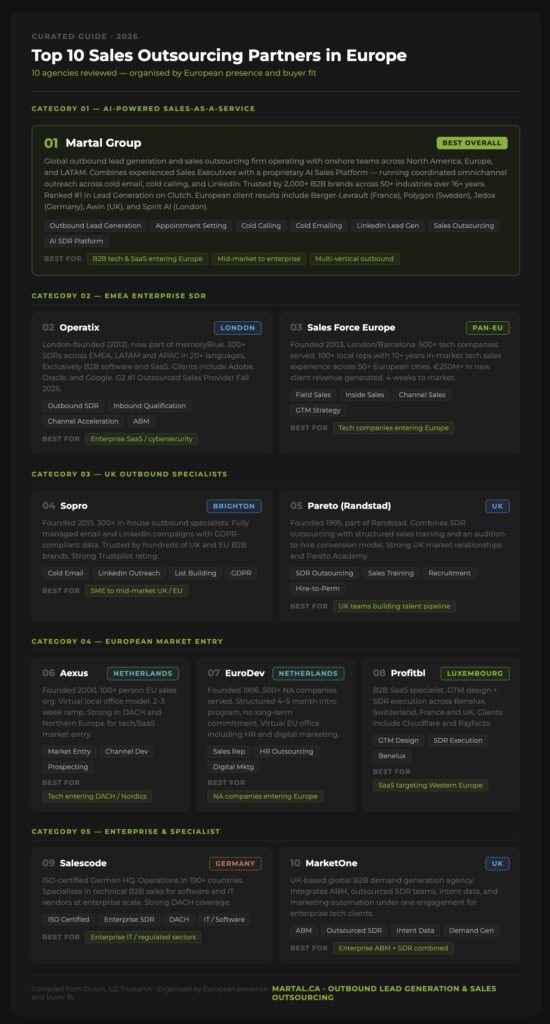
1. Martal Group — AI-Powered Sales-as-a-Service Partner
Martal Group is a B2B sales outsourcing and outbound lead generation company with over 16 years of delivering pipeline for tech, SaaS, and B2B service companies across North America, Europe, and LATAM.
Martal runs active campaigns across key European markets, including Germany, France, the Netherlands, and the United Kingdom, with onshore teams calibrated to the buying culture, channel norms, and compliance requirements of each market
The model is built around onshore Sales Executives averaging 3–5 years of B2B experience, supported by a proprietary AI Sales Platform — not the reverse. The technology handles research, sequence automation, intent targeting, and deliverability. The Sales Executive handles qualification, conversation, and the judgment calls that automation cannot.
How the campaign runs
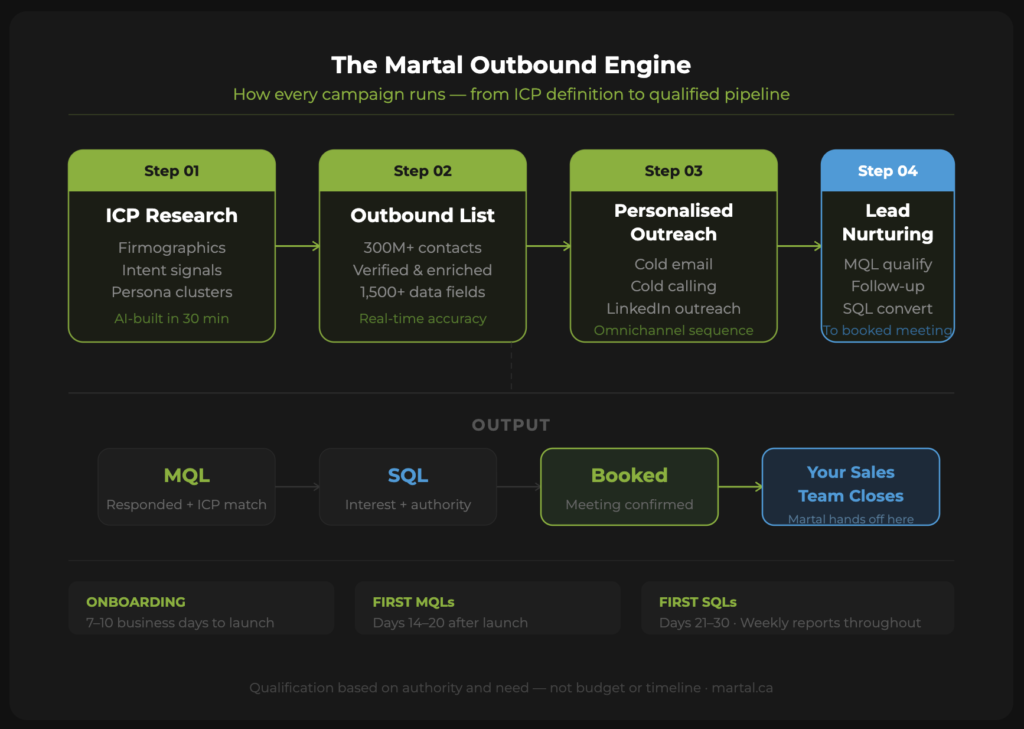
Every Martal engagement follows the same four-step outbound engine — visible in the diagram above:
Step 01 — ICP Research. The AI Sales Platform builds your business profile and generates persona-level ICP clusters from firmographic data, technographics, intent signals, and buying group composition. This happens within 30 minutes of profile approval, not after weeks of manual scoping.
Step 02 — Outbound List. Prospect lists are drawn from a database of 300M+ verified contacts across 24M+ company accounts, each enriched with 1,500+ data fields. Lists are continuously refreshed — contacts are validated against current roles and active emails before outreach begins.
Step 03 — Personalised Outreach. Campaigns run as coordinated omnichannel sequences across cold email, cold calling, and LinkedIn lead generation — not three parallel activities, but one sequenced campaign calibrated to each prospect’s channel preference and buying stage. Messaging is persona-tuned, not templated.
Step 04 — Lead Nurturing. MQLs are prospects who have responded and match the ICP. SQLs are prospects who have expressed interest in next steps. Martal’s Sales Executives manage the nurture cycle through to a booked meeting — at which point the handoff to your closing team happens. Qualification is based on authority and need, not budget confirmation or timeline.
European track record: Martal has run this model directly in European markets.
- When Berger-Levrault, a French enterprise software company, needed to generate new business, Martal’s outbound campaign delivered results where two closed deals alone justified the full campaign investment.
- For Polygon, a Swedish IoT company expanding internationally, Martal generated 139 meetings in 24 months.
- For Jedox, a German-based financial planning software company, Martal ran targeted outbound into enterprise accounts across multiple verticals.
- For Awin, a UK-based digital marketing company, and
- Spirit AI, a London-based AI firm, Martal delivered a consistent qualified pipeline in markets where generic outreach rarely gains traction.
These are direct delivery results from Martal’s European onshore teams, the same model applied to every engagement.
What Sets Martal Apart
Martal combines two things most providers offer separately: experienced onshore Sales Executives who own the entire outreach process, and a proprietary AI SDR Platform trained on 15+ years of B2B outbound data and 40M+ campaigns. The platform handles research, sequence automation, email deliverability, and intent-based targeting — freeing the Sales Executives to focus on qualification and conversation quality rather than administrative execution.
The result is a coordinated omnichannel outreach engine across cold email, cold calling, and LinkedIn lead generation, not three parallel activities, but one sequenced campaign calibrated to each prospect’s channel preference and buying stage.
Key Services:
- Outbound Lead Generation and Appointment Setting
- Cold Calling, Cold Emailing, and LinkedIn Lead Generation — coordinated omnichannel
- Fractional SDR teams or dedicated full-time Sales Executives
- Sales Outsourcing — full top-of-funnel ownership
- B2B Lead Gen & Sales Training via Martal Academy
Ideal For: B2B companies in tech, SaaS, cybersecurity, manufacturing, logistics, and professional services targeting mid-market to enterprise buyers. Companies entering European markets from North America or LATAM. Teams that want a qualified pipeline, not just outreach activity.
2. Operatix — EMEA SDR Outsourcing for B2B Software
Overview: Founded in London in 2012 and now operating as part of the memoryBlue group, Operatix focuses exclusively on B2B software and SaaS vendors. Their 300+ SDR team runs campaigns across EMEA, LATAM, and APAC in 20+ languages, with a client roster that includes Adobe, Oracle, and Google. The exclusive tech-sector focus means non-tech B2B companies — manufacturing, logistics, professional services — are outside their scope, and the high-touch engagement model is priced accordingly.
Key Features:
- Outbound and inbound SDR programs across EMEA
- Channel acceleration and partner pipeline development
- Account-based selling into enterprise accounts
- Marketing acceleration services including nurture and ABM support
- Campaigns across email, phone, and LinkedIn in 20+ languages
Ideal For: Growth-stage to enterprise B2B software and SaaS vendors that need dedicated EMEA SDR coverage — particularly cybersecurity, cloud, and enterprise tech companies entering or scaling across multiple European markets.
3. Sales Force Europe — Pan-European Tech Sales Representation
Overview: Founded in 2003 and headquartered in London and Barcelona, Sales Force Europe has helped over 500 technology companies expand into European markets, generating more than €250 million in new client revenue. Their model centers on a network of 100+ local sales representatives — each with 10+ years of in-market tech sales experience — operating across 50+ European cities under a single contract. The model is built around field and inside sales representation for tech companies, which means it is less suited to multi-vertical or non-tech B2B companies, and the cost structure reflects the seniority of the reps deployed.
Key Features:
- 100+ local tech sales reps across 50+ European cities
- Inside sales, field sales, and channel sales management
- Single European contract covering all target markets
- 4-week-to-market model for fast regional entry
- Option to transition outsourced reps into permanent hires
Ideal For: SaaS, Telco, and consumer electronics companies entering European markets for the first time and needing credible local presence across multiple countries without setting up regional offices.
4. Sopro — Managed Outbound Lead Generation
Overview: Founded in Brighton in 2015, Sopro provides a fully managed outbound lead generation service trusted by B2B companies across the UK and Europe in sectors including SaaS, finance, IT, and professional services. Their in-house team of 300+ outbound specialists handles list building, copywriting, sending infrastructure, and campaign optimization. The service is primarily email-led — phone outreach is not a core component — which limits its fit for enterprise sales cycles requiring heavy direct engagement or complex multi-stakeholder outreach across European markets.
Key Features:
- Fully managed outbound campaigns across email and LinkedIn
- Proprietary data platform with GDPR-compliant prospect sourcing
- Live campaign reporting via the Sopro platform
- CRM integrations with HubSpot, Salesforce, and Pipedrive
- Scalable engagement — pause or adjust outreach as needed
Ideal For: SMEs to mid-market B2B companies across the UK and Europe that want a fast, managed outbound launch without building internal SDR infrastructure — particularly in SaaS, fintech, IT, and professional services.
5. Aexus — European Sales Expansion and Market Entry
Overview: Founded in the Netherlands in 2000, Aexus is a 100+ person sales organization that operates as a virtual local office for technology and software companies entering European, American, and Asian markets. Their model emphasizes long-term market development — building prospect networks, managing relationships, and representing clients as an in-country team — rather than high-volume short-cycle outreach. Engagements are typically deeper and longer than those of campaign-based SDR providers, which makes them less suited to companies seeking a short validation pilot or quick top-of-funnel volume.
Key Features:
- Outbound prospecting via email, phone, and LinkedIn
- Market research and validation before full campaign commitment
- Consultative selling for complex technology solutions
- Distribution channel and partner network development
- 2–3 week ramp-up to campaign launch
Ideal For: Tech and software companies entering European markets — particularly Northern Europe and DACH — that want established local buyer networks and in-market cultural knowledge rather than a generic outreach service.
6. Salescode — ISO-Certified Sales Outsourcing
Overview: Headquartered in Germany, Salescode specializes in technical B2B sales outsourcing for software and IT vendors at enterprise scale. They are one of the few ISO-certified providers in this category, which adds a layer of process governance relevant to clients in regulated industries. Operations span 190+ countries with a multilingual team. The enterprise orientation — and the compliance infrastructure that supports it — means the model is not cost-effective for SMBs, early-stage companies, or teams needing a lean pilot engagement.
Key Features:
- Scalable SDR and BDR programs across DACH and pan-European markets
- ISO-certified processes for quality assurance and compliance
- Technical B2B sales expertise for software and IT vendors
- Campaigns in multiple European languages
- Performance-oriented frameworks for enterprise deal cycles
Ideal For: Enterprise tech and IT companies needing DACH-centric or pan-European SDR operations with compliance-grade processes — particularly those in regulated sectors where ISO certification carries weight in procurement.
7. Profitbl — B2B SaaS Sales for Western Europe
Overview: Based in Luxembourg and focused exclusively on complex B2B sales for technology organizations, Profitbl combines go-to-market strategy with SDR execution across Benelux, Switzerland, France, and the UK. Their model goes beyond outreach delivery into campaign structure and ICP design, which adds value for companies with complex solutions but extends ramp time relative to providers that launch campaigns faster. Profitbl is a focused specialist rather than a scaled operation — pan-European campaigns requiring broad simultaneous coverage across many markets may exceed current capacity.
Key Features:
- ICP design and market research before campaign launch
- Outbound SDR campaigns across email, phone, and LinkedIn
- CRM integration and pipeline tracking
- Retainer and commission-based engagement models available
- Senior SDRs with experience in complex tech sales cycles
Ideal For: B2B software companies entering or scaling in Benelux, Switzerland, or France with complex or high-value solutions where go-to-market design matters as much as outreach execution.
8. MarketOne — Demand Generation and Outsourced SDR
Overview: A UK-based B2B demand generation and sales development agency with European delivery capability, MarketOne serves enterprise and mid-market tech companies running account-based programs across EMEA. Their model integrates marketing strategy, intent data, and outsourced SDR execution — making them relevant for companies that want marketing and sales development coordinated under one partner. The integrated model comes at enterprise investment levels; companies needing straightforward top-of-funnel prospecting without a broader marketing component will find the scope and cost disproportionate.
Key Features:
- Account-based marketing combined with outsourced SDR execution
- Intent-driven outreach and data-led account prioritization
- Multi-channel campaign management across EMEA
- Marketing automation integration with existing tech stacks
- Demand generation and pipeline development under one engagement
Ideal For: Enterprise B2B tech companies running ABM programs where marketing and SDR outreach need to work in sync — particularly for complex buying committees and long European enterprise sales cycles.
9. EuroDev — European Market Entry for North American Companies
Overview: Founded in the Netherlands in 1996, EuroDev operates as a structured market entry partner for North American and Canadian companies building their first European presence. They provide sales representation, HR outsourcing, and digital marketing under one European contract with a structured 4–5 month introductory program that requires no long-term commitment. The model is specifically designed for the US-to-Europe expansion journey — European companies scaling within the continent, or companies targeting enterprise deal volume, will find the scope too narrow.
Key Features:
- Structured 4–5 month introductory program with no long-term liability
- Virtual European office model with local sales representation
- HR outsourcing and talent services alongside sales
- Digital marketing and GDPR compliance support
- Coverage across the Netherlands, France, and broader European markets
Ideal For: North American SMEs targeting initial European revenue — typically in the $1–10M range — without the resources to open a local office or hire in-country staff, particularly in industrial, B2B services, and technology sectors.
10. Pareto (Randstad) — Sales Development and Talent Pipeline
Overview: Founded in 1995 and part of the Randstad group, Pareto combines outsourced SDR deployment with a structured talent development model. Candidates are recruited, trained through the Pareto Academy, and deployed either as outsourced SDRs or direct hires. Because the model is built around developing early-career talent rather than deploying experienced operators, companies with complex B2B solutions, long sales cycles, or enterprise buying committees will need to invest significantly in onboarding and enablement to achieve full productivity.
Key Features:
- Outsourced SDR deployment and sales placement
- Intensive sales training via the Pareto Academy
- Recruitment and candidate assessment
- Audition-to-hire conversion model for talent retention
- Workshops for SDR managers and sales leaders
Ideal For: Companies in the UK or Europe that want trained SDRs with a structured path to converting top performers into permanent hires — useful for organizations simultaneously building pipeline and building a sales team.
Those are seven noteworthy sales outsourcing partners active in Europe (and beyond). Each offers a slightly different flavor so you can choose based on what aligns with your strategy, budget, and target market.
Remember: Whichever partner you consider, success will depend on close collaboration. Treat them as an extension of your team: share your goals, product knowledge, and feedback continuously.
When you find the right fit, a sales outsourcing partnership can significantly accelerate your revenue growth in Europe, delivering qualified opportunities straight to your pipeline while your internal team focuses on closing deals.
Next Steps to Accelerate Your Sales Expansion Across Europe
Europe offers genuine pipeline opportunity for B2B companies that approach it with the right infrastructure. The market is large, the demand is real, and the companies that move fastest tend to be the ones that stopped trying to build European sales capability from scratch and started working with partners who already have it.
The decision that matters most is not whether to outsource — it is who you outsource to and how well the engagement is structured from day one. Clear ICP alignment, a coordinated omnichannel approach across cold email, cold calling, and LinkedIn lead generation, and a partner who treats your pipeline as their primary metric — those are the variables that separate campaigns that build momentum from those that plateau after the first month.
If you are ready to evaluate what a structured European outbound program could look like for your business, Martal offers a consultation to assess your target markets, ICP fit, and realistic pipeline expectations — with no obligation to proceed. Book your consultation with Martal Group.
References
- Activated Scale
- Verified Market Research
- Martal Group – Small Business Lead Generation
- Spotio
- Martal Group – AI Safety & Security Case Study
- Martal Group – Outbound Lead Generation Case Study
- Statista via Verified Market Reports
- Intersoft Consulting
- Sales Force Europe
- LLCBuddy
FAQs: Sales Outsourcing in Europe
Are outsourced sales services in Europe suitable for startups and SMBs, or only for enterprise companies?
Outsourced sales works across company sizes — the model just looks different depending on scale. Startups benefit from fast ramp-up and regional reach without needing to hire in-house. SMBs gain cost-effective pipeline coverage, and enterprises use outsourced teams to enter new European markets or fill top-of-funnel gaps their internal teams cannot cover. The key variable is not company size — it is whether your ICP is clearly defined and your deal size justifies the investment in qualified outreach.
What should I look for when comparing outsourced sales providers for Germany or the wider DACH market?
DACH buyers expect formal, detail-oriented communication and a clear value proposition before a commercial conversation begins. Look for partners with verifiable experience running campaigns in Germany, Austria, and Switzerland — not just broad European coverage claims. Ask specifically about messaging approach, whether they have run campaigns in your vertical in DACH, and how they handle the compliance layer under GDPR and Germany’s UWG regulations. Experience in the market is not the same as a presence in the market.
How do European outsourcing partners handle GDPR and data privacy compliance?
Reputable European sales partners comply with GDPR by using legally sourced prospect data, relying on legitimate interest or documented consent as the legal basis for outreach, providing opt-out mechanisms in all communications, and maintaining suppression lists. They should also be able to confirm whether a Data Processing Agreement is included in the engagement. During evaluation, ask directly how they source data, what legal basis they use, and how they handle data subject access requests — their answers will tell you quickly whether compliance is embedded or assumed.
How long does it take to get started with an outsourced sales model?
For a fully managed program with structured onboarding, the typical ramp looks like this: days 1–10 for business profile, ICP clusters, messaging, and campaign approval; days 11–20 for first outreach and first MQLs; days 21–30 for first SQLs; days 31–90 for volume ramp, weekly optimisation, and trend line development. Expecting results in week one is the most common reason early-stage engagements stall — not because the partner failed, but because the brief was unclear and the first three weeks were spent correcting it. The companies that see the fastest ramp are the ones that treat the onboarding as a strategic investment, not a formality.
What is the difference between a sales outsourcing partner and a B2B marketing agency in Europe?
A B2B marketing agency focuses on one-to-many communications — brand awareness, content, inbound lead generation, and advertising. Their output is typically MQLs and engaged visitors. A sales outsourcing partner focuses on one-to-one direct engagement — outbound prospecting, qualification, and appointment setting via cold email, cold calling, and LinkedIn outreach. Their output is SQLs and booked meetings. The two functions serve different parts of the same funnel and produce the strongest results when they are coordinated around a shared ICP and consistent messaging rather than run independently.
Can sales outsourcing support market entry into multiple European countries simultaneously?
Yes — and this is one of the primary reasons B2B companies choose to outsource rather than build in-house. Partners with onshore, locally aligned teams across multiple European markets can run parallel campaigns targeting Germany, the UK, France, and the Nordics simultaneously, each calibrated to local buyer expectations, channel preferences, and compliance requirements. Building that coverage in-house would require hiring, onboarding, and managing multiple country-specific reps — a significantly slower and more expensive path to the same outcome.
I already have a sales team of two people. What are the processes offered by the sales outsourcing company that can help in boosting sales?
Yes — and this is one of the most common use cases. The most effective model is to keep your internal team focused on active opportunities and closing, and outsource the prospecting and qualification work that currently eats into their selling time. A two-person sales team doing their own prospecting is spending, conservatively, 30–40% of available time on tasks that could be handed off. Outsourcing the top of funnel lets them focus on what actually drives revenue. For European expansion specifically, it also means you can add country-level coverage in Germany, France, the Netherlands, or the UK without adding local headcount in each market simultaneously.