
 Martal
 Technology
 Education and training
 Web Development and UI / UX
 Healthcare/Medical
 Logistics and Supply Chain
 Information Technology
 Insuretech and Financial Services
 Marketplaces
 Software Development
 E-commerce and retail
 AI and Machine Learning
 Energy and Solar
 Manufacturing
 Security and Surveillance
 Digital Marketing Agency
 Transportation
 MSP
MSP
 Telecom
 B2B SaaS
 Cybersecurity
 HR tech
 Fintech
 Cleantech
 Consulting
Top 10 Social Media Lead Generation Companies for B2B (2026 Edition)
Major Takeaways: Social Media Lead Generation Companies
The most effective agencies combine platform expertise, data-driven targeting, and omnichannel execution to drive B2B sales-ready leads at scale. Industry knowledge, a rigorous qualification process, and transparent reporting separate consistent performers from agencies that produce activity without pipeline.
LinkedIn delivers 80% of B2B social media leads and converts visitors at 2.74% — nearly 3.5x higher than Facebook (0.77%) and X/Twitter (0.69%) — making it the highest-intent social channel for B2B. With 1.3 billion members and near-universal adoption among B2B marketers, it remains the primary channel for reaching decision-makers directly.
Omnichannel outreach combining LinkedIn, cold email, and phone generates 31% lower cost-per-lead than single-channel efforts — and intent-driven targeting shortens sales cycles by up to 40%. The sequence logic between channels matters as much as the channels themselves.
Focus on industry experience, transparency, lead qualification processes, and scalability. Ask for pipeline-focused proof points — SQLs delivered and meetings booked — not activity metrics. Request a sample report and ask to speak with an existing client before committing.
96% of B2B marketers now use AI in their roles, but the programs producing results are using it at the targeting and qualification layer — not just for content generation. Businesses with AI embedded in their prospecting infrastructure report a 50% increase in sales-ready leads and up to 60% lower customer acquisition costs compared to programs running without it.
Poorly targeted outreach, low-quality leads, and brand damage can result from generic or non-compliant tactics. Agencies that measure success by activity metrics rather than pipeline metrics are a particular risk — volume numbers can look productive while qualification rates remain poor. Always verify an agency’s compliance standards, qualification process, and track record across multiple clients.
Outsourcing is most effective when paired with a clear ICP and defined qualification criteria. Companies that outsource to specialists report up to 3x faster ramp time and cost reductions of up to 65% compared to building an equivalent capability in-house — without the overhead of recruiting, onboarding, and managing an internal SDR team.
Introduction
61% of B2B marketers use social media as an active lead generation channel (2) and yet pipeline remains the #1 growth challenge for most B2B sales teams. The gap isn’t awareness. It’s execution.
Most companies understand that LinkedIn, in particular, should be working harder for them. The problem is that building a consistent, qualified pipeline from social media requires more than posting content or sending connection requests. It takes a coordinated strategy, the right targeting infrastructure, and experienced people who know how to turn engagement into booked meetings.
That’s where specialized agencies come in and where choosing the right one matters enormously.This guide covers both sides of the decision. First, we profile the top 10 social media lead generation companies for B2B in 2026, including specialists in LinkedIn lead generation. Then we break down 10 factors for evaluating any lead generation partner, so you can make a confident, informed choice. We built this list by reviewing agency positioning, client outcomes, service models, and how each provider approaches the B2B pipeline, not just social media activity.
Why Social Media Is Now a Core B2B Lead Generation Channel
80% of B2B leads sourced from social media come from LinkedIn.
Reference Source: LinkedIn Content Marketing Playbook
Social media isn’t just for B2C brands or networking – it’s now a cornerstone of B2B lead generation. The numbers are unambiguous: 89% of B2B marketers use LinkedIn for lead generation, and 62% say it actively produces leads for them (3), not just impressions or engagement, but pipeline. LinkedIn accounts for 80% of high-quality B2B social media leads, far ahead of any other platform. With 1.3 billion members and over two-thirds of users interacting with brand content weekly, it’s where B2B decision-makers are spending time and making purchasing decisions.
Three out of four B2B buyers use social media in their purchase process (5) and B2B buyers today are typically 70–90% of the way through their research before they ever contact a vendor (6). That means your company’s LinkedIn presence, the content your team shares, and how your outreach lands in someone’s inbox are all shaping purchase decisions before your sales team even knows a prospect exists. Companies that aren’t actively working social channels aren’t just missing leads — they’re missing the conversation entirely.
LinkedIn’s conversion advantage is measurable, not just perceived. Its visitor-to-lead conversion rate of 2.74% is nearly 3.5x higher than Facebook (0.77%) and X/Twitter (0.69%). LinkedIn Lead Gen Forms convert at roughly 13% — compared to a typical landing page benchmark of around 2.35%. And 58% of B2B marketers now name LinkedIn as their top ROI platform for social spend (7). The data consistently points in one direction: for B2B pipeline generation, no social channel comes close.However, success on these platforms requires strategy and expertise. That’s where specialized agencies come in. The next section profiles ten leading companies that excel at turning social media into a B2B lead engine. Each has a unique approach — from LinkedIn outreach services to omnichannel campaigns — so you can get a sense of the landscape.
How Companies Use Social Media for B2B Lead Generation in 2026
The mechanics have shifted significantly in recent years. What used to mean running a few LinkedIn ads or posting thought leadership content now involves a more layered, intelligence-driven approach. Here is how high-performing B2B teams are using social media for lead generation today:
Outbound prospecting via LinkedIn: Rather than waiting for inbound interest, companies use LinkedIn Sales Navigator and signal-based targeting to identify in-market prospects and initiate personalized outreach. The key shift in 2026 is precision — targeting based on hiring signals, funding events, and technology changes rather than job title alone.
Omnichannel sequencing: Social media touchpoints rarely work in isolation. The most effective programs coordinate LinkedIn outreach with cold email and phone follow-up in a structured sequence. This approach consistently produces lower cost-per-lead and higher response rates than any single channel alone.
AI-assisted engagement: According to Martal’s LinkedIn statistics data, 41% of LinkedIn users are now leveraging AI tools in their outreach — and AI-assisted outreach produces roughly double the response rates of traditional cold approaches. Agencies that have embedded AI into their prospecting and personalization workflows have a measurable advantage in 2026.
Intent-based targeting: The strongest social lead generation programs in 2026 don’t target by demographics alone — they target by behavior. Monitoring buying signals such as content engagement, competitor research activity, and company-level triggers allows agencies to time outreach when a prospect is actively evaluating solutions.
Content-led demand generation: For companies with longer sales cycles, LinkedIn content (thought leadership posts, case studies, event promotion) works as a top-of-funnel warm-up layer that improves response rates on direct outreach downstream.
From an execution standpoint, the companies that generate the most consistent pipeline from social media are the ones treating it as a coordinated outbound function — not a brand-building activity.
What exactly do social media lead generation companies do?
Social media lead generation companies specialize in identifying, attracting, and converting potential customers through social platforms. They design strategies that target specific audiences, create engaging content, manage ad campaigns, and optimize campaigns to capture high-quality leads for businesses. Additionally, they analyze audience behavior and market trends to continuously refine approaches, ensuring that leads generated are not just numerous but highly relevant and likely to convert into sales.
How does social media lead generation differ from traditional digital lead generation?
Social media lead generation leverages user engagement, network targeting, and platform-specific content to attract leads, while traditional digital lead generation often relies on email campaigns, SEO, or website forms. Social media allows more personalized, interactive, and real-time lead capture. It also benefits from social proof, sharing, and community building, which can drive higher trust and engagement compared to traditional methods.
Top 10 Social Media Lead Generation Companies (2026)
Omnichannel outreach campaigns achieve 31% lower cost-per-lead compared to single-channel email efforts.
Reference Source: Sopro
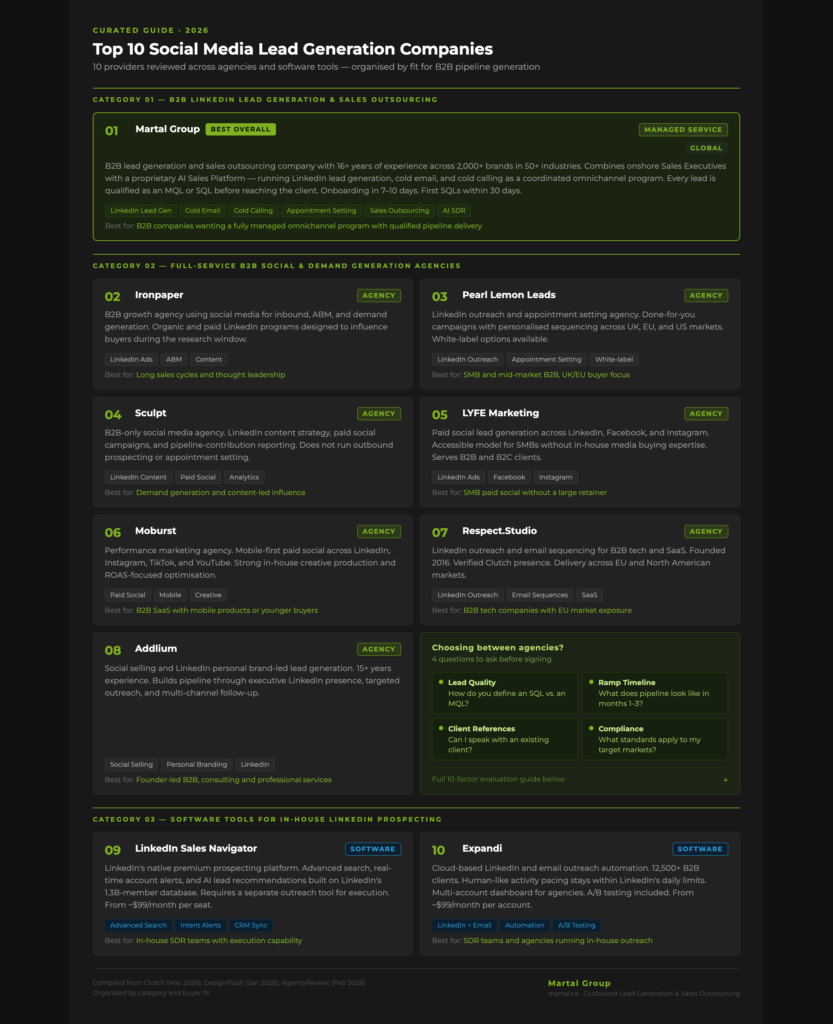
We reviewed the leading options in this category — comparing agency models, platform specialization, client outcomes, and fit for B2B buyers at different stages of growth. The list below mixes fully managed agencies with software tools, because the right answer for your business depends on whether you want to outsource execution entirely or run a tighter in-house program. Each entry includes what the provider actually does well and who it is best suited for.
1. Martal Group – Best for B2B LinkedIn Lead Generation
Martal’s LinkedIn campaigns generated 108 booked meetings and 122 sales-qualified leads in 3 months for one client.
Reference Source: Martal Group
Martal Group is a B2B lead generation and sales outsourcing company with 16+ years of experience and a track record across 2,000+ B2B brands in more than 50 industries. Where most agencies treat LinkedIn as a single channel, Martal runs it as part of a fully coordinated omnichannel program — connecting LinkedIn lead generation with cold email and cold calling in a structured, signal-driven sequence.
The model is built around experienced onshore Sales Executives who manage outreach personally — through real LinkedIn profiles, not bots or automated spam — combined with Martal’s proprietary AI Sales Platform, which identifies in-market buyers using intent signals, technographic data, and lookalike modeling. That combination of human judgment and AI-driven targeting is what separates Martal’s results from agencies relying on volume alone.
For B2B teams, the practical advantages are significant:
- Omnichannel execution: LinkedIn outreach, cold email, and cold calling run as a coordinated campaign — not parallel efforts on separate tracks. Prospects experience consistent, relevant outreach across every touchpoint.
- Signal-driven targeting: Outreach is timed around buying signals — funding rounds, hiring surges, technology changes — so prospects are engaged when they are most likely to respond.
- Qualified pipeline delivery: Every lead is classified as an MQL or SQL before it reaches the client. Martal’s qualification standard is based on authority and need — not vanity metrics like connection requests or profile views.
- Proven scale: Martal has delivered results ranging from 20 leads per month for lean teams to 1,400+ leads over multi-year engagements for enterprise clients across SaaS, cybersecurity, manufacturing, logistics, fintech, and more.
- Fast ramp: Onboarding takes 7–10 business days, with first SQLs typically delivered within 30 days. Campaigns scale 3x faster than building an in-house SDR team — at up to 65% lower cost.
Martal is rated #1 in Lead Generation on Clutch with 200+ five-star reviews across Clutch, G2, and Capterra. For B2B companies that want a fully managed, accountable lead generation program with LinkedIn at its core, Martal is the benchmark.
Got it. Rewriting all 9 non-Martal entries now — shorter, neutral, structured consistently, with a subtle limitation woven into each one. Martal’s entry stays unchanged.
2. Ironpaper — B2B Inbound and Social Content Strategy
Overview Ironpaper is a New York-based B2B growth agency that uses social media as part of broader inbound and demand generation programs. Their work focuses on content creation, paid LinkedIn campaigns, and ABM-aligned social strategies designed to support the buyer research process. Their model is built around long-term brand presence rather than direct outbound pipeline generation — which means results tend to compound over time rather than surface quickly.
Key Features
- Organic and paid LinkedIn campaign management
- Content strategy and editorial production for B2B audiences
- ABM-aligned social targeting for specific accounts
- Analytics tied to pipeline contribution rather than vanity metrics
Ideal For B2B companies with longer sales cycles that want social media to support demand generation and thought leadership over time — particularly those that already have some form of outbound running and need a content layer to complement it.
3. Pearl Lemon Leads — LinkedIn Outreach and Appointment Setting
Overview Pearl Lemon Leads is a London-based agency offering done-for-you LinkedIn outreach and multi-channel prospecting for B2B clients. They manage prospect list building, connection sequencing, and inbox handling on behalf of clients across UK, EU, and US markets. Their focus is on personalized messaging over volume — though their delivery model is primarily LinkedIn-centric, with email as a secondary follow-up channel rather than a fully integrated omnichannel program.
Key Features
- Done-for-you LinkedIn campaign management
- Profile optimization ahead of outreach
- Personalized connection and follow-up sequences
- Email follow-up integration
- White-label delivery options for agencies
Ideal For SMB and mid-market B2B companies looking for a LinkedIn-specialist agency with a personalization focus, particularly those targeting UK or European buyer audiences.
4. Sculpt — B2B Social Media Content and Demand Generation
Overview Sculpt is a B2B-only social media agency based in Iowa City. Their model centers on LinkedIn content strategy, paid social campaigns, and full-funnel analytics for companies with complex buying cycles. They do not run direct outbound prospecting — their work sits upstream of pipeline, building the content presence and account awareness that makes direct outreach more effective downstream. Teams expecting booked meetings as a direct output will need to pair Sculpt with a separate outbound execution partner.
Key Features
- LinkedIn content strategy and editorial production
- Paid social campaign management
- Sponsored content and retargeting
- Pipeline-contribution reporting
Ideal For B2B companies that want a specialist social media agency focused on demand generation and content-led account influence — best paired with a dedicated outbound program for full-funnel coverage.
5. LYFE Marketing — Paid Social Lead Generation for SMB
Overview LYFE Marketing is an Atlanta-based digital marketing agency offering paid social lead generation across LinkedIn, Facebook, and Instagram. Their model is built for accessibility — making paid social manageable for smaller teams without in-house media buying expertise. Their client base spans both B2B and B2C, which means their frameworks are generalist by design rather than optimized specifically for B2B pipeline outcomes or complex sales cycles.
Key Features
- LinkedIn Ads, Facebook, and Instagram campaign management
- Lead Gen Form campaigns on LinkedIn
- Organic social media management
- CPL and conversion reporting
Ideal For B2B SMBs looking for straightforward paid social management without a large agency retainer — particularly those that need basic LinkedIn advertising alongside broader social presence work.
6. Moburst — Mobile-First Paid Social and Performance Marketing
Overview Moburst is a performance marketing agency with offices in New York and Tel Aviv. Their specialty is mobile-first social campaigns — paid social and app-centric lead generation across LinkedIn, Instagram, TikTok, and YouTube. Their strength sits in creative production and paid media optimization. They are not a B2B outbound or LinkedIn prospecting agency — their model is built around advertising performance rather than direct sales development, so the leads generated typically require a separate qualification and follow-up process.
Key Features
- Paid social campaign management across multiple platforms
- In-house video and creative production
- Performance-based campaign optimization
- Mobile app install and in-app lead capture campaigns
Ideal For B2B tech and SaaS companies with mobile products or digitally-native buyer profiles that want performance-driven paid social alongside traditional LinkedIn outreach — not as a standalone outbound solution.
7. Respect.Studio — LinkedIn Outreach for B2B Tech and SaaS
Overview Respect.Studio is a B2B digital marketing agency founded in 2016, with offices in the US and Ukraine. They specialize in LinkedIn outreach and email sequencing for technology and SaaS companies across European and North American markets. Their delivery is LinkedIn-first — which works well for companies targeting a single geography, but may limit reach for B2B teams needing coordinated outreach across multiple regions or channels simultaneously.
Key Features
- LinkedIn outreach campaign management
- Email sequence integration
- Prospect list building and ICP targeting
- EU and US market delivery
Ideal For B2B tech and SaaS companies that want a LinkedIn-specialist agency with experience in European markets — particularly those in earlier growth stages targeting a defined, single-region ICP.
8. Addlium — Social Selling and LinkedIn Personal Brand-Led Lead Generation
Overview Addlium is a sales and lead generation agency with 15+ years of experience focused on LinkedIn social selling — building pipeline through a combination of personal brand development, targeted outreach, and multi-channel engagement. Their model depends heavily on the willingness of senior leaders to invest in their own LinkedIn presence as a lead generation asset. For companies where executive visibility is limited or leadership bandwidth is constrained, the model requires meaningful internal commitment before outreach can scale.
Key Features
- LinkedIn personal brand strategy and content for executives
- ICP-targeted outreach and connection campaigns
- Direct messaging sequences and follow-up management
- Multi-channel expansion with email
Ideal For B2B tech, consulting, and professional services firms where founder or senior leadership visibility is a realistic growth lever — and where internal stakeholders are prepared to actively participate in the social selling program.
9. LinkedIn Sales Navigator — In-House LinkedIn Prospecting Tool
Overview LinkedIn Sales Navigator is LinkedIn’s own premium prospecting platform. It provides advanced search filters, account alerts, and AI-powered lead recommendations built directly on LinkedIn’s member data. It is a prospecting and research tool — not a campaign execution platform. Teams using Sales Navigator still need to conduct outreach manually or pair it with a separate automation or sequencing tool, which adds operational overhead and requires internal expertise to run effectively.
Key Features
- Advanced search filters across 30+ criteria
- Real-time alerts on job changes, funding, and company activity
- AI-powered lead recommendations based on saved ICP criteria
- TeamLink for warm introduction mapping
- CRM integration with major platforms
- Pricing from approximately $99/month per seat
Ideal For B2B sales teams building an in-house LinkedIn prospecting function that have the internal capacity and expertise to manage outreach execution alongside the tool.
10. Expandi — LinkedIn and Email Outreach Automation Platform
Overview Expandi is a cloud-based LinkedIn automation and email outreach platform serving over 12,500 B2B businesses and agencies. It automates connection requests, messaging sequences, and email follow-ups from a single dashboard — with compliance controls designed to stay within LinkedIn’s daily activity limits. As a self-serve platform, the quality of results depends entirely on the team operating it. Strategy, copywriting, ICP targeting, and lead qualification all remain the user’s responsibility, which requires meaningful internal sales development capability to generate consistent pipeline.
Key Features
- LinkedIn and email Smart Campaign sequencing
- AI-assisted message personalization with dynamic variables
- Cloud-based account safety and human-like activity pacing
- Multi-account dashboard for agencies
- A/B testing and reply rate reporting
- Pricing from approximately $99/month per account
Ideal For B2B SDR teams, growth agencies, and founders with existing sales development expertise who want to automate LinkedIn and email outreach in-house — and have the internal capacity to manage strategy, copy, and qualification alongside the tool.
How to Choose the Right Social Media Lead Generation Company (10 Factors for Success)
79% of businesses say sales outsourcing accelerated their growth and expansion
Reference Source: TTEC
Selecting a lead gen partner is a pivotal decision. You’re trusting an external team with your brand reputation and your sales pipeline. So, how do you ensure you choose the right social media lead generation company for your needs?
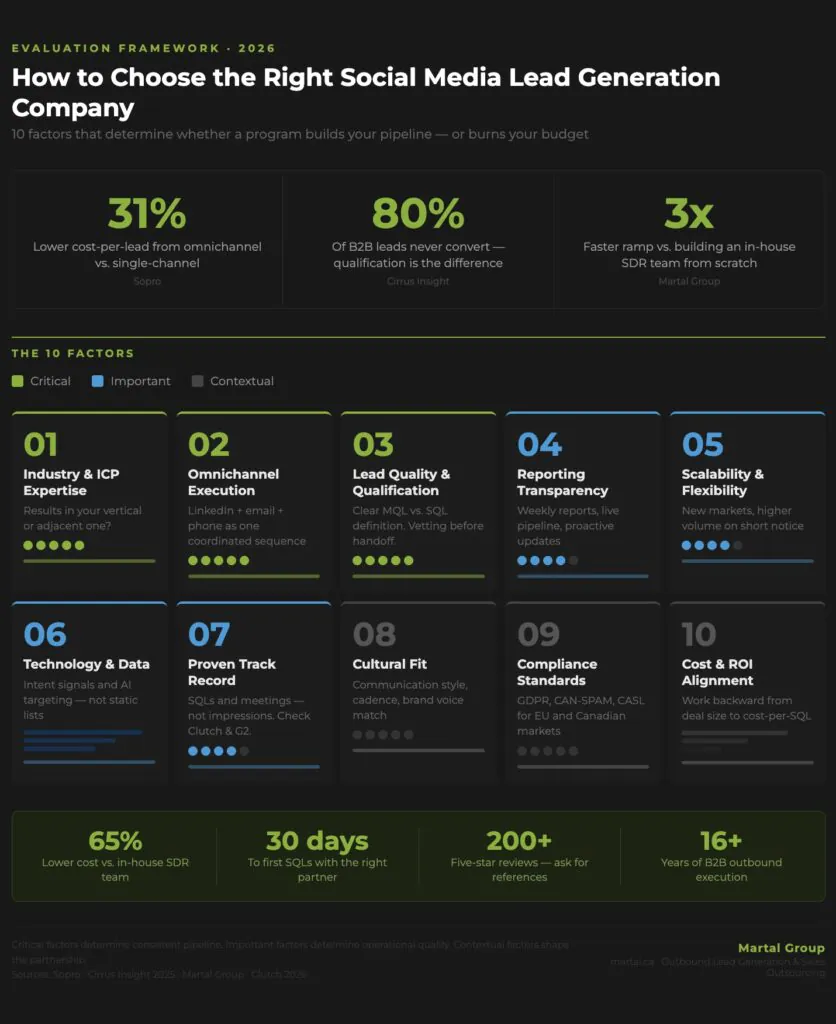
These 10 factors give you a structured framework for evaluating any social media lead generation company — whether you are comparing agencies, assessing a software platform, or deciding between outsourcing and building in-house.
1. Industry and ICP Expertise
First and foremost, look at the agency’s experience with your industry or similar sectors. Have they successfully generated leads for businesses like yours? A company that understands your ideal customer profile (ICP) will ramp up faster and deliver better quality leads. For example, if you sell enterprise software, a lead gen firm that has worked with tech companies will know how to navigate long sales cycles and technical content.
What to check: Case studies or references in your field. If none are publicly available, ask in initial meetings: “Have you worked with [manufacturers/financial services firms/etc.] before? What were the results?” An agency fluent in your industry’s language won’t need a steep learning curve and is less likely to target the wrong prospects or use messaging that misses the mark.
2. Omnichannel Execution Capability
In 2026, effective lead generation rarely comes from a single channel. Companies with strong omnichannel engagement see significantly higher conversion rates – one study showed 31% lower cost per lead for multi-channel campaigns vs. single-channel (4). Ensure the agency can leverage all relevant channels for you: LinkedIn, email, cold calling, content, perhaps even events or direct mail in some cases.
Since our focus is social media, dig into how they use social platforms. Do they just run ads, or can they execute organic outreach? Can they integrate social touches with email follow-ups (for instance, sending a LinkedIn message, then an email sequence)? Ask whether the agency follows LinkedIn InMail best practices to maximize response rates and avoid spammy messaging. A lead generation social media marketing company should demonstrate skill in creating a cohesive journey for prospects – maybe a prospect first sees a helpful LinkedIn post, then visits your website and chats with a bot, and finally gets a call to schedule a meeting. All those touchpoints should be orchestrated, not siloed.
What to check: Ask for a high-level campaign plan. A strong agency will outline a multi-channel strategy (e.g. “We’ll start with LinkedIn outreach, nurture via email, and use retargeting ads on Facebook to stay top-of-mind”). If a provider only talks about one channel, be cautious – you want a partner who can adjust and add channels as needed to maximize results.
3. Lead Quality and Qualification Process
Volume is easy to manufacture. Qualified pipeline is not. When evaluating agencies, the most important question is not how many leads they deliver — it is how they define a lead and what qualification criteria a prospect must meet before reaching your sales team.
The strongest programs distinguish clearly between prospects engaged, MQLs (prospects who responded and match your ICP), and SQLs (prospects who expressed interest in a next step). Agencies that blur these definitions — or that count connection requests and profile views as leads — will inflate your reported numbers while delivering little actual pipeline value. According to Marketing Sherpa (Via Salesforce), 79% of leads generated across B2B programs never convert to customers due to poor qualification and nurturing (9).
What to check: Ask the agency to define exactly what constitutes a lead in their delivery model. Ask how they handle prospects who respond but do not meet your ICP criteria. Ask whether they offer any form of lead replacement or quality guarantee. The more specific and structured their answer, the more confidence you can have in what they will actually deliver.
4. Transparency in Reporting and Communication
A reliable agency should function like an extension of your team, which means open communication and clear reporting. You’ll want to know what’s happening in your outbound campaigns – which messages are going out, what the response rates are, how many leads were generated this week, etc. The strongest providers share both performance data and market intelligence: what is working, what is not, what objections prospects are raising, and what that reveals about your messaging or targeting.
Weekly reporting cadence, live pipeline visibility, and proactive communication are baseline expectations — not premium features. If an agency is vague about methodology during the sales process, that pattern will continue once you are a client.
What to check: Request a sample report before signing. A strong report shows prospects contacted, response rates by channel, MQLs delivered, SQLs delivered, meetings booked, and qualitative notes on common objections or patterns. Also gauge their communication style: Do they respond promptly to your emails? Are they proactive in scheduling check-ins? Remember, communication is part of the service. If it’s subpar during the sales process, it likely won’t improve when you’re a client.
5. Scalability and Flexibility
Your pipeline needs today will not be your pipeline needs in six months. Growth, new product launches, market expansion, and headcount changes all affect what you need from a lead generation partner. The right agency should be able to scale outreach volume, add new markets, and adjust ICP targeting without requiring a full contract renegotiation each time.
Scalability also cuts the other way. If early results come in below expectations, you need a sales agency willing to reduce scope, pivot strategy, or adjust targeting, not one locked into a rigid deliverable model that cannot flex.
What to check: Ask directly: “If we wanted to double our lead volume in Q3, how would you accommodate that?” and “If early results are below target, what does the adjustment process look like?” Ask about their largest and smallest lead generation campaigns. Their answers reveal whether they have genuine operational capacity to scale or whether they are essentially a fixed-size team selling a fixed-size program. Also review contract terms for flexibility – avoid very rigid long-term commitments unless you’re sure.
6. Technology and Data Infrastructure
The agencies generating the most consistent B2B pipeline in 2026 are the ones with real data infrastructure behind their targeting — not just a LinkedIn Sales Navigator seat and a spreadsheet. Intent data, signal-based prospecting, contact enrichment, and AI-assisted personalization have moved from differentiators to table stakes for programs that need to perform at scale.
From an execution standpoint, the difference is visible in lead quality. Agencies using buying signals — funding rounds, hiring surges, technology changes, competitive displacement — are reaching prospects at the moment of highest receptivity. Agencies without that infrastructure are reaching the same ICP with the same generic outreach timing as every other agency targeting that space.
What to check: “What tools do you use in your outbound lead generation process?” is a great question. If they mention using a state-of-the-art sequencing tool, a social listening platform, or data enrichment services, that’s a positive sign. Also ask if you’ll have access to the data collected. For instance, will they input everything into your CRM? Will you see detailed info on each lead (company size, LinkedIn profile, etc.)? The more transparency and data sharing, the better – you paid for those leads, you should own the insights too.
7. Proven Results and Client Testimonials
Results claims are easy to make. The difference between a credible agency and one that is not becomes clear when you ask them to be specific — named clients where permitted, industry-contextualized outcomes where not, and independent platform reviews that cannot be manufactured or gamed.
The most useful proof points are framed in pipeline terms: SQLs delivered, meetings booked, sales cycle impact, and revenue influenced. Volume metrics — prospects contacted, emails sent, connection requests made — tell you nothing about what actually reached your sales team in a qualified state. An agency that leads with activity numbers rather than pipeline outcomes is signaling, intentionally or not, that the pipeline numbers are not worth leading with.
Long client retention is a more reliable signal than a strong first case study. Agencies that retain clients for multiple years are delivering ongoing value — not just a well-optimized launch quarter followed by declining performance. When reviewing case studies, look for engagements that show sustained results over 12 months or more, not just a strong sprint in the first 90 days.
Speed of ramp from a standing start is another dimension worth probing directly. Many agencies perform reasonably well when a client has an established market presence and a warm ICP. Fewer perform well when a client is entering a new market with no existing brand recognition, no warm prospect base, and no prior outbound infrastructure in place. That scenario is where qualification standards, targeting precision, and execution discipline are tested most directly.
To illustrate what credible ramp performance looks like in practice: in one Martal engagement, an AI video security company entered the US market from zero — no existing pipeline, no prior US sales presence, and a niche product category with a limited addressable market. Within 4 months, Martal delivered 120 sales-ready leads (8), qualifying prospects against a tightly defined ICP in a space where volume was structurally constrained and lead quality mattered far more than raw output. That result reflects what a disciplined qualification process and signal-driven targeting can produce even under conditions most agencies would describe as challenging starting conditions.Independent validation matters alongside direct case study claims. Check Clutch, G2, and Capterra for third-party reviews that reflect patterns across multiple clients — not just the highlights a company chooses to feature on its own website. Martal carries 200+ five-star reviews across these platforms, accumulated over 16+ years and 2,000+ client engagements — a volume of independent validation that reflects consistency rather than isolated performance.
What to check: Ask for a case study in your industry or an adjacent vertical. If none exists, ask how they have handled comparable starting conditions — a new market, a niche ICP, a limited addressable universe. Ask whether you can speak with an existing client. Ask specifically what the typical ramp timeline looks like and what SQL volume is realistic in months one through three versus months four through six. Agencies confident in their track record will answer these questions with specifics. Those that default to vague reassurances or redirect to their best-case outcomes deserve appropriate skepticism.
8. Cultural Fit and Working Style
This factor is underweighted in most agency evaluations and consistently cited as a contributor to partnership failures. Your lead generation partner’s team will ideally work closely with your outbound sales and marketing teams. A good cultural fit ensures smoother collaboration. Consider things like: Are they corporate and formal, while your team is casual and startup-y (or vice versa)? Do they seem to understand and respect your company values and brand voice? For instance, if your brand avoids hard-sell language, the agency’s outreach strategies should align with that tone.
Consider how much involvement you want in the day-to-day program. Some agencies operate with high client involvement — weekly collaborative sessions, shared messaging approval, joint targeting decisions. Others prefer a more autonomous model — delivering results with minimal client input required. Neither is inherently better, but a mismatch creates tension.
What to check: Reflect on your interactions during the vetting process. Were they listening actively to your goals, or mostly pushing a generic service? Did they seem flexible when you suggested an idea? Trust your gut: if communication felt easy and positive, that’s a good sign for future collaboration. Also, consider time zone and availability – if the agency is overseas, do they have overlapping working hours for meetings? Ensuring logistical compatibility will save headaches later.
9. Compliance and Ethical Outreach Standards
Lead generation involves initiating contact with people who have not heard of you. Done well, it is professional and respectful. Done poorly, it damages your brand, triggers platform restrictions, and in regulated markets, creates legal exposure. GDPR, CAN-SPAM, CASL, and LinkedIn’s own Terms of Service all impose real constraints on how outreach can be conducted — and not every agency takes those constraints seriously.
Beyond legal compliance, there is a practical brand risk. The agency’s representatives may be the first contact a prospect has with your company. If their outreach is aggressive, generic, or poorly targeted, that first impression belongs to your brand — not theirs.
What to check: Ask about their compliance measures. For example, “How do you source contact data, and how do you make sure our outreach complies with anti-spam laws?” A strong answer might mention using reputable data providers, contacting only business emails or LinkedIn profiles in a respectful manner, providing opt-out links in emails, etc. If phone calls are involved, do they honor do-not-call lists? For EU and Canadian markets in particular, cold email restrictions mean outreach must be structured differently — and agencies without regional compliance experience create real risk. Ask to review cold call scripts and sales email templates before the program launches.
10. Cost Structure and ROI Alignment
Pricing models vary significantly across the lead generation landscape — monthly retainers, pay-per-lead, pay-per-appointment, and hybrid performance models all exist. The right model for your business depends less on which structure sounds most attractive and more on what your deal economics actually support.
Also, discuss how they define success and how that ties to payment. Some agencies include a certain number of leads in their fee and then charge extra if they exceed that. Others have bonus incentives for hitting targets. Ideally, you want a partner who is motivated to improve your results, not just check the minimum boxes. For instance, if they generate 20% more leads one month, do you both celebrate, or do you get hit with surprise charges? Clarity here prevents misalignment.
What to check: Beyond the proposal, talk about ROI. “For clients similar to us, how long does it typically take to see a return on investment? What sales KPIsdo you use to measure success?” Their answer can reveal if they think in transactional terms or long-term partnership terms. Ask what their average ramp timeline looks like, most credible agencies are transparent that the first 30–60 days are calibration, with volume ramping from month two onward. Ask what the realistic monthly SQL volume looks like for a company at your stage and ICP complexity. And ask directly how they measure success — agencies that anchor on pipeline metrics rather than activity metrics are aligned with the outcomes that actually matter.
By evaluating these 10 factors, you’ll be well-equipped to choose a social media lead generation company that delivers substance and strategic value, not just buzzwords. The right partner will feel like an extension of your team, driving a steady flow of quality leads that your salespeople can turn into revenue. For companies looking to save time and scale quickly, a done for you LinkedIn lead generation service can be a game-changer, handling outreach, messaging, and prospect nurturing on your behalf. In the next section, we’ll wrap up with a quick recap and how Martal Group meets these criteria, should you be considering us among your options.
The Evolving Landscape of Social Media Lead Generation in 2026
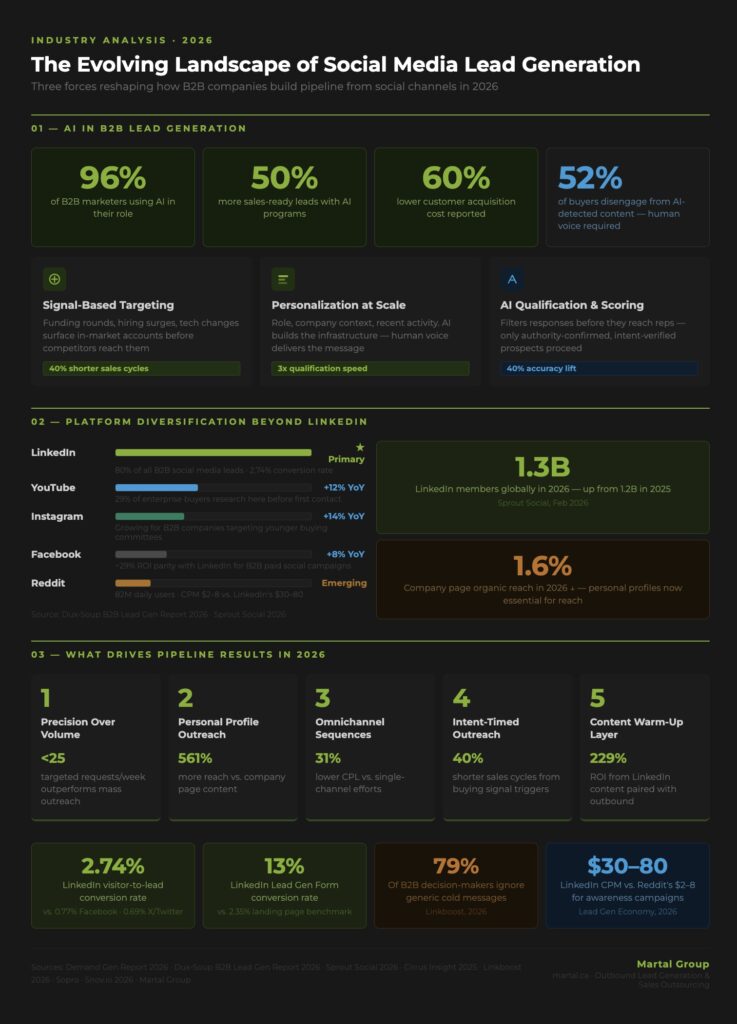
Social media lead generation has changed more in the past two years than in the five years before that. Three shifts are reshaping how B2B companies approach the channel — and understanding them matters before you evaluate which agency or tool is the right fit for your pipeline.
AI’s Role in Social Media Lead Generation
AI is no longer a differentiator in B2B lead generation. According to Demand Gen Report’s 2026 B2B Trends Research, 96% of marketers are now using AI in their roles — with nearly half ranking it as the top trend shaping their work. The practical implication is that “AI-powered” has become the floor, not the ceiling. The question is no longer whether an agency uses AI, but how meaningfully it is embedded in their targeting, personalization, and qualification process.
The impact on results is measurable. According to Martal’s B2B Lead Generation Statistics, businesses using AI for lead generation report a 50% increase in sales-ready leads and up to 60% lower customer acquisition costs compared to programs running without it. That gap is not coming from AI-generated email copy — it is coming from intelligence applied upstream, at the targeting and prioritization layer.
Specifically, the highest-performing programs in 2026 are using AI in three ways:
Signal-based prospecting. Rather than building static ICP lists and blasting them with outreach, AI monitors behavioral signals — funding announcements, hiring changes, technology adoption, competitive displacement — and surfaces accounts showing active buying behavior. Outreach timed to these signals reaches prospects when they are already evaluating solutions, which meaningfully improves response rates and shortens the path to qualification.
Personalization at scale. AI-assisted message personalization goes beyond inserting a prospect’s first name and company into a template. The strongest programs pull in role-specific context, recent company activity, and industry-relevant framing to produce outreach that reads as researched rather than automated. The important caveat: according to Linkboost’s B2B Social Media Marketing 2026 analysis, 52% of B2B buyers reduce engagement when they suspect content is AI-generated. The programs winning in 2026 use AI for the infrastructure of personalization — the research, the targeting logic, the data enrichment — while keeping the final outreach voice distinctly human.
Qualification and pipeline scoring. AI is increasingly used to filter inbound responses and classify leads before they reach a human reviewer. According to Cirrus Insight’s 2025 Lead Generation Statistics, programs with AI-assisted qualification report up to 40% improvement in qualification accuracy and 3x faster qualification speed — because reps are spending time on prospects that have already been screened for fit, timing, and intent rather than working every response manually.
From an execution standpoint, the agencies and tools on this list that have embedded AI into their prospecting infrastructure — rather than bolting it on as a content generation layer — are the ones likely to produce more consistent pipeline results over time.
Platform Diversification Beyond LinkedIn
LinkedIn remains the primary channel for B2B social media lead generation. That will not change in the near term. But the 2026 B2B Lead Generation Report from Dux-Soup, drawing on 244 B2B marketers surveyed at B2B Marketing Live, documents a clear directional shift: Instagram usage among B2B marketers grew by 13.71% year-over-year, YouTube by 12.09%, and Facebook saw a resurgence of 8.11% — all signals that B2B teams are expanding their social footprint beyond a LinkedIn-only strategy.
The reasons are structural. LinkedIn company page organic reach has declined sharply — Linkboost’s 2026 B2B social media analysis documents current organic reach at approximately 1.6% for company pages, as the platform’s algorithm increasingly favors personal profiles and native content over company broadcasting. For B2B teams relying entirely on company page activity, this means diminishing returns from the same tactics that worked previously.
Here is how the expanded platform landscape is actually being used by B2B marketers:
YouTube functions less like a social network and more like a research engine. According to Linkboost’s LinkedIn lead generation 2026 analysis, approximately 29% of enterprise buyers search YouTube for product demos, software reviews, and technical tutorials before contacting a vendor. For B2B companies in SaaS, professional services, or any category with a demonstrable product, YouTube content has a compounding return — a single well-produced explainer or customer interview continues driving awareness and inbound signals for years after publication.
Instagram and short-form video are gaining traction as top-of-funnel brand touchpoints, particularly for B2B companies targeting younger buying committees. According to HubSpot’s State of Marketing Report 2026, Facebook and Instagram deliver tied ROI of roughly 29% each for paid social — comparable to LinkedIn for certain audience profiles and deal economics. For B2B companies with visually demonstrable products or services, paid social on these platforms can supplement LinkedIn outreach cost-effectively.
Reddit is an emerging and frequently misunderstood B2B channel. According to Measure Marketing’s Reddit B2B demand generation guide, the platform now exceeds 82 million daily active users — and its subreddit communities covering startups, SaaS, engineering, and sales are actively used by practitioners and decision-makers seeking peer recommendations, tool comparisons, and vendor assessments. Reddit is not a direct outbound channel. It works as a credibility and presence layer: authentic participation in relevant subreddits builds brand visibility in the communities where buyers research before shortlisting vendors.
Reddit Ads also offer a meaningful cost advantage. According to The Lead Gen Economy’s Reddit B2B strategy guide, Reddit Ads typically deliver CPMs of $2–8 versus LinkedIn’s $30–80 — making it a cost-effective awareness channel when creative is adapted for the platform’s native tone and community expectations. One important caveat: Firebrand’s analysis of Reddit for B2B notes that Reddit’s citation rates in AI-generated search results have shifted recently, which means it should be treated as a diversified component of a broader social strategy — not a standalone pipeline channel.
The practical takeaway for B2B teams is not to abandon LinkedIn — it is to recognize that buyers are researching across multiple platforms simultaneously. A company with strong LinkedIn outreach, YouTube content, and a credible Reddit presence will be visible at more stages of the buyer’s research journey than one relying on a single channel.
How Companies Use Social Media for B2B Lead Generation: What Works in 2026
The tactical landscape has shifted considerably. What worked two years ago — high-volume connection requests, generic InMail sequences, company page posts with external links — is producing diminishing returns. According to Linkboost’s LinkedIn lead generation 2026 report, LinkedIn’s algorithm now actively penalizes high-volume, low-engagement activity — suppressing the reach of accounts that generate ignored or rejected connection requests at scale.
The programs producing consistent pipeline in 2026 share a different set of characteristics:
Outbound precision over volume. Rather than reaching as many prospects as possible, the strongest programs identify a tighter target list — accounts showing active buying signals — and invest more in the quality and relevance of each outreach. Linkboost’s 2026 LinkedIn lead generation data shows that reducing outbound volume to under 25 highly targeted connection requests per week, combined with more researched messaging, produces higher response rates than high-volume generic campaigns.
Personal profile-led outreach. According to Linkboost’s B2B social media strategy analysis, employee-led content generates 561% more reach than identical content published from company pages. For B2B companies, this means the most effective LinkedIn programs are run through the personal profiles of Sales Executives, founders, or senior team members — not from a company page. The authenticity of individual outreach is both a platform advantage and a measurable trust signal for prospects.
Omnichannel coordination. The data is consistent across multiple studies: omnichannel programs — coordinating LinkedIn, cold email, and phone in a structured sequence — outperform single-channel efforts on both response rate and cost-per-lead. According to Sopro’s lead generation statistics, omnichannel campaigns generate 31% lower cost-per-lead than single-channel email efforts. A prospect who receives a LinkedIn connection request, a follow-up email, and a well-timed call is significantly more likely to engage than one who receives any single touchpoint in isolation. The sequence logic matters as much as the channels themselves.
Intent-driven timing. Outreach timed to buying signals — a company raising a funding round, hiring for a role that signals expansion, dropping a competitor’s tool, or entering a new market — reaches prospects at the moment of highest receptivity. According to Cirrus Insight’s lead generation statistics, intent-driven targeting produces 40% shorter sales cycles and 3x more qualified opportunities compared to outreach sent on a fixed calendar cadence regardless of account context.
Content as a warm-up layer. For companies with longer sales cycles, LinkedIn content — thought leadership posts, case studies, event promotion — functions as a trust-building layer that improves response rates on direct outreach downstream. According to Snov.io’s 2026 lead generation statistics, the ROI from organic LinkedIn content activity has been documented at 229% across B2B industries when integrated with an active outbound motion. Prospects who have seen your team’s perspective on a relevant topic before receiving a connection request are more likely to accept and respond.
One thing worth stating directly: none of these tactics produce results in isolation. The companies generating the most consistent pipeline from social media in 2026 treat it as a coordinated outbound function — not a set of independent activities managed across separate channels.
Conclusion: Finding the Best Partner to Boost Your Social Media Leads
The social media lead generation landscape in 2026 is more capable — and more crowded — than it has ever been. Agencies have multiplied. Tools have proliferated. AI has made it easier than ever to produce the appearance of a sophisticated program without the substance behind it.
That is exactly why the decision deserves more than a quick vendor comparison. The right partner is not simply the one with the most recognizable name or the most polished pitch deck. It is the one that understands your ICP, has delivered qualified pipeline in conditions similar to yours, runs outreach as a coordinated omnichannel program rather than a single-channel effort, and can show you — specifically — what ramp looks like in the first 30, 60, and 90 days.
The 10 factors in this guide exist to help you cut through the noise and focus on what actually separates consistent pipeline performance from activity that looks productive but does not convert. Industry expertise, qualification standards, reporting transparency, compliance discipline, and a verifiable track record are not nice-to-haves. They are the variables that determine whether a lead generation program builds your pipeline or burns through your budget.
A few things worth carrying into any final evaluation:
LinkedIn remains the highest-intent B2B social channel — but the programs producing results in 2026 are not relying on it in isolation. Omnichannel coordination, intent-driven targeting, and AI-assisted personalization are the infrastructure behind the results you see in the strongest case studies.
Lead quality is a function of qualification standards. Volume is easy to manufacture. The agencies worth working with measure their performance in SQLs and booked meetings — not connection requests, profile views, or MQL counts that include every response regardless of fit.
Ramp speed matters, but sustainability matters more. A strong first quarter followed by declining performance is a pattern worth asking about directly. The partnerships that deliver the most value are the ones built to improve over time — not optimized for a strong initial showing.
At Martal, we have spent 16+ years building the kind of program this guide describes. Our onshore Sales Executives run LinkedIn lead generation, cold email, and cold calling as a coordinated omnichannel strategy — supported by our proprietary AI Sales Platform, which identifies in-market buyers using intent signals, technographic data, and lookalike modeling. Every lead is qualified against your ICP before it reaches your team. Every engagement is backed by weekly reporting, live pipeline visibility, and a team that treats your pipeline as seriously as you do.
The results reflect that approach. From delivering 120 sales-ready leads in 4 months for an AI video security company entering the US market from zero (10), to generating 108 booked meetings in 3 months for a client in the AI freight and transportation space (11), our programs are built to produce qualified pipeline, not activity metrics.
If your team is ready to build a social media lead generation program that actually fills your pipeline, we would be glad to show you what that looks like for your specific ICP and market.
Book a consultation with Martal and let’s talk about what a qualified pipeline looks like for your business.
References
- Highperformr
- Gitnux
- LinkedIn Lead Generation
- Sopro
- Digital Marketing Magazine
- DemandGen Report
- SQ Magazine
- Martal Group – Security & Surveillance Case Study
- Marketing Sherpa (Via Salesforce)
- Martal Group – AI Video Security Case Study
- Martal Group – Transportation Case Study
FAQs: Social Media Lead Generation Companies
Which social media platform is best for B2B lead generation?
LinkedIn is the strongest platform for B2B lead generation by a significant margin. It accounts for 80% of B2B social media leads, delivers a visitor-to-lead conversion rate of 2.74% — nearly 3.5x higher than Facebook or X/Twitter — and is used by 89% of B2B marketers for lead generation activity. For direct outreach to decision-makers, no other social platform produces comparable qualification rates or pipeline yield. That said, B2B buyers in 2026 research across multiple platforms simultaneously, which means YouTube, Reddit, and paid social on Instagram and Facebook all play supporting roles at different stages of the buying journey.
What is the 70/20/10 rule for social media?
The 70/20/10 rule recommends allocating social media content as follows: 70% informative and educational content that addresses your audience’s challenges, 20% curated content from credible third-party sources, and 10% promotional content about your own products or services. The principle behind the ratio is that buyers engage with and trust brands that consistently deliver value — not brands that use every touchpoint as a sales pitch. For B2B companies, this framework is most relevant to content strategy and LinkedIn publishing cadence, where sustained relevance over time tends to outperform high-frequency promotional posting.
What is the best company to get leads?
The best company depends on what your pipeline problem actually is. For B2B companies that want a fully managed, omnichannel program with experienced onshore Sales Executives handling LinkedIn outreach, cold email, and cold calling as a coordinated strategy — Martal Group is the benchmark. Rated #1 in Lead Generation on Clutch with 200+ five-star reviews and 16+ years of B2B outbound experience across 50+ industries, Martal combines AI-driven targeting with human-led qualification to deliver sales-ready pipeline rather than raw lead volume. For companies that want to run outreach in-house, LinkedIn Sales Navigator and Expandi are strong starting points depending on whether you need a prospecting database or an outreach execution platform.
How do social media lead generation agencies help businesses grow their sales pipeline?
They grow the pipeline by handling the top-of-funnel work that internal sales teams rarely have the bandwidth to execute consistently. That means building targeted prospect lists, launching coordinated outreach campaigns, qualifying responses against your ICP, and passing sales-ready leads to your team at the moment of highest buying intent. The strongest agencies also surface market intelligence as a byproduct of outreach — patterns in objections, competitor mentions, and ICP behavior that sharpen targeting and messaging over time. The practical result for most B2B companies is shorter ramp time, lower cost-per-qualified-lead, and a more predictable pipeline than an internally resourced team can sustain at comparable volume.
What are the most common mistakes companies make when using social media for lead generation?
The most consequential mistakes are structural rather than tactical. Targeting too broad an ICP means outreach volume is high but qualification rates are low — a pattern that is costly and demoralizing for sales teams. Treating social media channels as independent activities rather than a coordinated sequence means prospects receive inconsistent touchpoints that rarely build enough momentum to convert. Measuring success by activity metrics — connection requests sent, emails delivered, calls made — rather than pipeline metrics — MQLs, SQLs, booked meetings — creates a reporting picture that looks productive while masking poor lead quality. And failing to integrate social outreach with a clear qualification standard means leads that reach the sales team are often not ready for a commercial conversation, eroding trust between sales and marketing over time.
How do companies measure success for social media lead generation campaigns?
The most meaningful metrics are pipeline-focused: SQLs delivered, meetings booked, sales cycle length, and revenue influenced. Activity metrics — connection requests, email open rates, impressions — provide useful diagnostic information but should never be the primary measure of campaign performance. Cost-per-SQL and cost-per-booked-meeting are the most direct expressions of program efficiency, because they connect spend directly to the output that drives revenue. For companies with longer sales cycles, tracking MQL-to-SQL conversion rate over time reveals whether lead quality is improving as targeting and messaging are refined — which is often the most actionable signal for program optimization.
What innovations are reshaping social media lead generation in 2026?
The most consequential shift is the move from volume-based to signal-based outreach. AI platforms that monitor buying signals — funding rounds, hiring surges, technology changes, competitive displacement — allow agencies and in-house teams to reach prospects at the moment of highest receptivity rather than on a fixed cadence regardless of account context. Intent-driven targeting is consistently producing shorter response cycles and higher qualification rates compared to traditional list-based outreach. Beyond targeting, AI-assisted personalization is raising the baseline quality of outreach at scale — though the programs producing the best results are using AI for research and data infrastructure while keeping outreach voice distinctly human. Platform diversification is also accelerating, with YouTube, Reddit, and paid social on Instagram complementing LinkedIn outreach at different stages of the B2B buying journey.
How do companies use social media for lead generation?
The most effective B2B programs in 2026 treat social media as a coordinated outbound function rather than a broadcast channel. In practice, this means using LinkedIn for direct outbound prospecting through personalized connection and message sequences, coordinating those LinkedIn touchpoints with cold email and phone follow-up in a structured omnichannel sequence, and using intent signals to time outreach around moments when target accounts are most likely to be evaluating solutions. Content — thought leadership posts, case studies, industry commentary — runs as a parallel layer that warms prospects before direct outreach begins, improving acceptance and response rates downstream. For a deeper breakdown of the specific tactics and platforms driving results right now, see the LinkedIn InMail best practices guide and the evolving landscape section earlier in this post.