
 Martal
 Technology
 Education and training
 Web Development and UI / UX
 Healthcare/Medical
 Logistics and Supply Chain
 Information Technology
 Insuretech and Financial Services
 Marketplaces
 Software Development
 E-commerce and retail
 AI and Machine Learning
 Energy and Solar
 Manufacturing
 Security and Surveillance
 Digital Marketing Agency
 Transportation
 MSP
MSP
 Telecom
 B2B SaaS
 Cybersecurity
 HR tech
 Fintech
 Cleantech
 Consulting
What Is a B2B Buyer? Inside the Modern Purchase Journey (2026)
Major Takeaways: What Is a B2B Buyer
Today’s B2B buyer is digitally native, predominantly Millennial or Gen Z, and drives decisions through independent research, peer validation, and committee consensus — long before a sales rep enters the conversation.
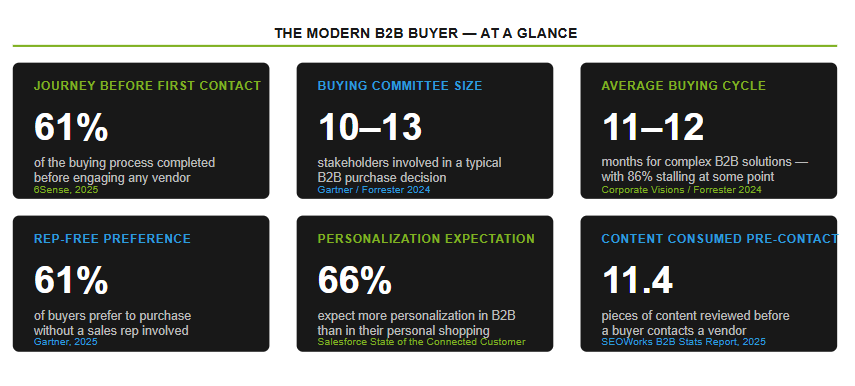
B2B buyers now complete approximately 61% of the buying journey before engaging a vendor — arriving earlier than in prior years but far better informed, having reviewed an average of 11.4 pieces of content and consulted peers along the way.
Buyers expect omnichannel access, fast digital experiences, and personalized engagement that speaks to their specific role, pain points, and industry context. Generic outreach is actively avoided by 73% of buyers.
Over 90% of B2B buyers who read peer reviews share those findings with at least one other decision-maker — meaning your review profile, case studies, and third-party validation are doing active selling work inside committees you may never directly engage.
Purchase decisions now involve 10 to 13 stakeholders across multiple departments, with 74% of buying teams experiencing internal conflict before reaching consensus and 86% of deals stalling at some point in the process.
Teams must use intent-signal-driven outreach, stage-matched content, and consultative sales strategies that help buyers build internal consensus — not just close the individual they’re speaking with.
Two-thirds of B2B buyers expect more personalization in their professional buying experience than in their personal shopping — and 73% actively avoid vendors that send irrelevant outreach. Relevance isn’t a differentiator in 2026; it’s the baseline.
Introduction
Your next buyer has already done the research. They’ve consulted peers on LinkedIn, read third-party reviews, and quietly built a shortlist — all before your sales team has said a word. That’s not a trend. It’s now the baseline.
Research shows 82% of B2B buyers now expect the same speed, ease, and personalization from business purchases that they get as consumers (1). Meanwhile, Millennials and Gen Z now make up over 70% of B2B buyers (1) — a generation that grew up with Google and Amazon and expects B2B interactions to match.
So, what is a B2B buyer? Simply put, a B2B buyer is a professional decision-maker — or group of decision-makers — responsible for purchasing products or services on behalf of a business. This guide was built by reviewing the latest buyer behavior research and interpreting the findings through Martal’s experience running outbound campaigns across hundreds of B2B companies. The goal: give sales and marketing leaders a clear, honest picture of who today’s buyer is — and what actually moves them.
Whether you’re a CMO recalibrating your go-to-market or a VP of Sales rebuilding pipeline, understanding how the modern B2B buyer actually makes decisions isn’t optional — it’s the foundation everything else is built on.
What Is a B2B Buyer? (Definition & How It’s Changed)
93% of B2B buyers require a business case for all tech investments.
Reference Source: Gartner
What does B2B buyer mean? A B2B buyer is a professional — or group of professionals — responsible for purchasing goods or services on behalf of a business. Unlike a consumer purchase made for personal use, a B2B buying decision is made on behalf of an organization, involves multiple stakeholders, requires formal justification, and typically unfolds over months rather than days.
That accountability changes everything: the timeline, the stakeholders involved, the evidence required, and the risk calculus behind every decision. Here’s what that looks like in practice.
- Decision by Committee: A B2B buyer often isn’t a single individual. They’re part of a buying committee or team.
The average B2B buying group now involves 10 to 13 stakeholders (2) (11), and for enterprise-level deals, that number can climb well above 20. These stakeholders span end-users, managers, finance, IT, legal, compliance, and the C-suite. Notably, 74% of buying teams experience unhealthy internal conflict before reaching a decision (12) — which means your job as a seller isn’t just to persuade one champion. It’s to help an entire committee reach consensus.
- Rational and Emotional: Traditionally, we think of B2B purchases as purely rational, driven by business value and ROI. Economic justification is table stakes. Today’s B2B buyers also weigh the experience — asking themselves whether a vendor feels like a genuine partner or just another company trying to close a quarter. A deal has to check the logical boxes and feel low-risk on a personal level. The person championing a purchase internally is staking their credibility on it.
- High Stakes, Longer Cycles: B2B purchases often involve higher price tags and bigger implications than consumer buys. Adopting a new software platform or switching suppliers can impact an entire operation.
Buying cycles for complex B2B solutions average 11 to 12 months (2) — and Forrester’s 2024 research found that 86% of B2B purchases stall at some point during that process, often because a single stakeholder’s concerns went unaddressed early (13). Buyers take their time. They require proposals, security documentation, demos, procurement reviews, and often a formal business case before any decision moves forward. One Gartner survey found 93% of buyers insist on a business case for all tech investments (8) — a reminder that even a well-received pitch needs financial justification behind it.
- Multiple Stages & Touchpoints: The B2B purchase process usually goes through stages like need identification, research, evaluation, procurement, and post-purchase evaluation. In 2026, this journey is far from linear.
Buyers loop through stages as new stakeholders weigh in or new information surfaces. They browse your website, attend webinars, download whitepapers, read reviews on G2 or Capterra — often well before anyone on your team knows they exist. On average, B2B buyers review 11.4 pieces of content before they’re ready to contact a vendor (10). By the time they reach out, they’ve already formed a view.
What is an example of a B2B buyer? A VP of IT evaluating cloud security platforms for company-wide deployment is a B2B buyer. So is a Director of Operations assessing supply chain software, or a CFO approving a new financial planning tool. In each case, the buyer represents their organization, works alongside other decision-makers, and bases their choice on business fit, ROI, and risk — not personal preference. The stakes are organizational, not personal — and that distinction shapes everything about how the process unfolds.
What is the difference between B2B and B2C buyers? A B2C buyer makes a purchase for personal use — often quickly, independently, and with limited financial risk. A B2B buyer makes a purchase on behalf of an organization, typically as part of a committee, against a formal set of requirements, and with accountability for the outcome. B2B purchases involve longer timelines, higher average values, more stakeholders, and significantly more due diligence. The emotional dimension is different too: a B2C buyer asks “will I like this?” — a B2B buyer asks “can I justify this, and will it work for my team?”
In essence, a B2B buyer is a business-savvy, well-informed professional looking to solve their company’s problem or capitalize on an opportunity through a purchase. What’s changed is how they go about it. To appreciate how much the B2B buyer has changed and why the old playbook keeps failing, here’s a direct comparison.
Aspect
Traditional B2B Buyer (Past)
Modern B2B Buyer (2026)
Demographics
Often Gen X or Baby Boomers in decision roles.
Predominantly Millennials (and emerging Gen Z). Millennials now account for 73% of B2B buyers (4), many in senior roles.
Research Approach
Relied heavily on sales reps for information. Limited online research sources.
Self-directed research is the norm. Buyers independently consume blogs, reviews, and videos – completing 61% of the buying process before engaging sales — arriving earlier than in previous years, but still better prepared than most sellers expect (9).
Buying Process
Linear and seller-guided. Initial contact made early, and sales rep steers the process.
Non-linear and buyer-led. Buyers often delay contact – many engage sales only after they’re ~61% through their journey (9), a shift from prior years as AI-assisted research compresses the early discovery phase. Multiple iterations and info sources are involved.
Communication Channels
Primarily face-to-face meetings, phone calls, and emails. Limited digital touchpoints.
Omnichannel engagement. Buyers hop between email, LinkedIn, Zoom calls, messaging apps, and e-commerce portals. 84% of B2B buyers want suppliers active across multiple online/offline channels (4).
Expectations
Willing to tolerate formal, slower sales processes and generic pitches.
High expectations for speed and personalization. They demand fast responses (even instant chat). 97% insist on a fast, simple online experience (4) and tailored content. A clunky “request a demo and wait 3 days” approach frustrates them.
Trust Building
Relied on brand reputation, in-person rapport, and references provided by vendor.
Trust through transparency and proof. Buyers pore over user reviews, case studies, and third-party validations. Peer recommendations and independent research carry significant weight. (For example, 2 in 5 buyers share online reviews with four or more colleagues on their team (3).)
The comparison makes one thing clear: the B2B buyer hasn’t just evolved — the power dynamic has flipped. They arrive informed, move on their own timeline, and expect vendors to meet them where they are. The next section unpacks exactly who these buyers are and what’s driving their behavior.
Next, we’ll break down who these buyers are demographically and behaviorally, and how their expectations are reshaping B2B sales and lead generation strategies.
Meet the 2026 B2B Buyer: Demographics & Key Traits
73% of B2B buying decisions are made by Millennials, with 44% being final decision-makers.
Reference Source: Digital Commerce 360
Young, tech-savvy professionals now dominate the B2B buying landscape, bringing new expectations to the table.
A decade ago, most B2B purchase decisions were led by executives who grew up before the internet. That’s no longer the case. The buyers your team is selling to today are predominantly Millennial, and increasingly Gen Z professionals who have spent their entire careers in a digital-first environment. That shift changes how they research, what they trust, and what makes them tune out.
- Millennials and Gen Z are in charge. Millennials (born ~1981–1996) are no longer the “next” generation—they are the majority of decision-makers now.
A LinkedIn B2B report found that Millennials make up 73% of all B2B buyers, including 44% of final decision-makers (4). Gen Z is beginning to enter buying roles — often as researchers or influencers within a committee — while Gen X and Boomers are gradually stepping back. The practical implication: if you’re selling B2B today, you’re almost certainly selling to someone under 40. Your messaging, your channels, and your sales motion need to reflect that.
- Digital natives with different habits. Younger B2B buyers are the first generation that grew up with the internet and smartphones. They’re comfortable navigating digital sources of information and expect instant access to knowledge.
As consumers, they’ve been spoiled by Google, Amazon, and mobile apps – and they bring those same expectations into professional purchasing.
These buyers are multitaskers who might research solutions on their phone after work, compare notes in an online forum, and schedule a Zoom meeting – all in a day’s work. They tend to be skeptical of old-school sales tactics; a pushy cold call or a generic sales deck won’t impress them. Forrester’s research on Millennial buyer behavior consistently finds that this cohort expects B2B interactions to be as intuitive and frictionless as the consumer experiences they grew up with (4). A slow onboarding, a clunky demo request form, or a generic pitch deck signals immediately that a vendor doesn’t understand how they work.
- Highly independent and resourceful. The modern B2B buyer doesn’t like being dependent on a sales rep for basic education. They self-educate through content. A typical buyer will read blog posts, download e-books, watch product videos, and scroll through user reviews long before they ever talk to a company representative.
Gartner’s most recent data puts the rep-free preference at 61% of B2B buyers — updated from the widely cited 75% figure, reflecting that buyers are now engaging sellers slightly earlier in the process (5). That’s still a majority who would rather not deal with a salesperson if they can help it. More telling: 73% actively avoid vendors that send irrelevant outreach (14). The bar for earned attention has never been higher.
- Community and peer influenced. B2B buyers in 2026 are social learners. They actively seek out peer opinions and third-party validation. It’s common for a buyer to ask for recommendations in Slack communities, check Reddit or LinkedIn discussions about a product, or trust what current users say on review sites.
They’re often part of networks (online or offline) where they exchange experiences about vendors. This generation places a high premium on authenticity. They can identify overhyped marketing quickly and will trust a candid customer review or a personal referral over a polished sales pitch every time. One thing we see consistently in outbound work: personalized outreach that references a shared connection, a relevant case study, or a genuine industry insight outperforms generic messaging by a significant margin — because it signals that the sender has done their homework, not just blasted a list.
- Impatient yet thorough. If that sounds like a contradiction, welcome to the modern buyer psyche. They move fast to gather info (expecting websites to load quickly, answers to be a click away, and sales follow-ups within hours, not days).
80% of B2B buyers say they expect near-instant responses to inquiries (3) — a direct carry-over from the on-demand consumer experience they’re accustomed to outside work. Slow follow-up doesn’t just frustrate them; it reads as a signal about how responsive you’ll be post-sale.
What are the three types of B2B buyers? While the behaviors above apply broadly, B2B buyers typically fall into three categories:
- Commercial enterprise buyers (technology companies, manufacturers, and service providers purchasing business solutions),
- Institutional buyers (hospitals, universities, and non-profits with formalized procurement processes), and
- Government buyers (public sector agencies operating under strict compliance and tendering requirements).
Each type brings different procurement timelines, approval structures, and risk tolerances — which is why understanding your specific buyer type matters as much as understanding the general B2B buyer profile.
The 2026 B2B buyer is younger, more informed, and holds vendors to a higher standard than any previous generation. Despite their age, many have been making B2B purchasing decisions for a decade or more — they’re experienced buyers with consumer-grade expectations applied to professional contexts. For sales and marketing leaders, the implication is direct: your approach needs to match the buyer, not the other way around.
B2B Buyer Behavior & Expectations in 2026
If one phrase captures B2B buyer behavior in 2026, it’s this: informed before you arrive, skeptical until you prove it, and gone if you waste their time. These buyers chart their own path to purchase — and they won’t settle for vendor experiences that don’t meet their standards. Here’s what that looks like across five defining behaviors.
1. Digital Self-Service & Independent Research
75% of B2B buyers prefer a sales experience without a sales rep if it can be self-serve.
Reference Source: Gartner – B2B Buying
One of the hallmark shifts in recent years is the rise of self-service in B2B buying. Modern buyers prefer to control the flow of information themselves rather than relying on salespeople for education. Consider these eye-opening facts:
- Buyers do homework on their own: Studies consistently show that today’s B2B buyers arrive at approximately 61% through their purchase research before contacting a vendor — earlier than in prior years, as AI-assisted research compresses the discovery phase, but still well ahead of most sales teams (9). They’re using that time to read content, evaluate competitors, and figure out exactly what they want. By the time you hear from them, they often have a shortlist and a clear set of requirements. In practical terms, this means your online content and presence often serve as your “first sales rep.”
- They initiate contact (when ready): In the past, sales reps did a lot of the outreach and education. Now, 81% of B2B buyers initiate the first contact with sellers themselves (2) – not the other way around. The power dynamic has flipped; buyers will reach out when they are good and ready (and you need to be findable and attractive when they do). Outbound still works — but only when it’s relevant. The teams that break through do so by reaching buyers with the right signal at the right moment, not by adding volume to a list. Timing and relevance have replaced frequency as the primary drivers of response.
- Preferring a “rep-free” experience: As mentioned, 61% of buyers would rather not engage with a sales rep if the process can be self-served (5) — down from the widely cited 75% figure, reflecting that buyers are engaging earlier but on much more specific terms. Critically, 73% actively avoid vendors that blast irrelevant outreach (14). The rep isn’t unwelcome — the irrelevant rep is. This is why we see a surge in interactive product demos, free trial offers, knowledge bases, and AI chatbots on B2B websites – buyers want to get answers right now, at any hour, without scheduling a call. 68% of millennial B2B decision-makers prefer to research on their own via digital channels instead of talking to a sales rep (4).
- Multiple sources of information: The 2026 B2B buyer is not looking at just your brochure or a single whitepaper. They’re consulting a mix of sources to validate what they learn. B2B buyers review an average of 11.4 pieces of content before they’re ready to contact a vendor (10) — drawing from a mix of free trials, product demos, peer reviews, vendor websites, and analyst content. Vendor salespeople consistently rank last on that list of trusted sources. Notice how vendor salespeople come in last on that list. Buyers want to test and verify claims themselves. For example, if you offer a software solution, a buyer might sign up for a free trial and read peer reviews on G2 before ever giving your sales team a chance to speak.
- Collaborative internal research: Within a buying committee, today’s stakeholders often divvy up research tasks. One person might evaluate technical specs, another gathers pricing options, another reads case studies. They then share notes internally (often via Slack or email threads). Information circulates fast inside a buying committee. Research shows 40% of buyers share content or reviews with four or more teammates (3) during the evaluation process — which means a single well-placed piece of content, case study, or third-party review can influence stakeholders you’ve never directly engaged. So if you impress one researcher on the team with a great blog or tool, that goodwill can multiply. Conversely, if your info is lacking, that negative impression can spread to others.
In 2026, your digital presence is your first sales rep — and for most buyers, it’s doing the bulk of the convincing before your team ever enters the conversation.
2. Seamless, Consumer-Grade Experience
97% of B2B buyers say a fast, easy digital experience is a key part of their vendor evaluation.
Reference Source: Digital Commerce 360
B2B buyers don’t leave their high standards at the office door. They bring their B2C expectations into every B2B purchase. Remember, this generation is used to one-click ordering, personalized Netflix recommendations, and 24/7 customer service bots. So, when they interact with a B2B vendor, they expect a comparable level of convenience and polish:
- Fast and frictionless digital touchpoints: A slow website or cumbersome process can be a deal-breaker.
97% of B2B buyers say a fast, easy online experience matters in their vendor evaluation (4) — which means your website, demo flow, and response process are being assessed alongside your actual product or service.
If your contact form is 20 fields long or you require a phone call just to get basic pricing info, you risk frustrating the buyer. Today’s buyer will assume that if your digital experience is clunky, your product or service might be too.
On the flip side, companies that make the B2B buying process feel easy and modern can really stand out. Think of an “Amazon-like” experience: instant search results, a clear catalog of solutions, and maybe even a self-service purchase option for simpler transactions.
- Omnichannel presence: Modern buyers fluidly switch between channels – researching on a laptop, then continuing on a phone, maybe visiting a physical event or demo center, then back to an online portal. They expect consistency and continuity across channels. It’s not just about being digital; it’s about being everywhere your buyer might want to engage.
84% of B2B buyers say it’s important for suppliers to be active across multiple channels (4) — and 94% believe an omnichannel sales model is as effective or more effective than traditional methods. One channel isn’t enough. Buyers hop between LinkedIn, email, review sites, and direct conversations — often within the same week. What they expect is consistency and continuity across all of them.
What does this look like in practice? A buyer might discover your product via LinkedIn, then read reviews on a third-party site, then chat with your sales executive on your website, and later receive an email with relevant case studies – and all these touchpoints should feel cohesive.
Martal’s own omnichannel lead generation approach embraces this. We engage prospects via targeted emails, LinkedIn outreach, and even phone calls as needed – meeting buyers where they prefer to interact (a strategy that aligns with the statistic above).
- Smooth purchasing process: When a B2B buyer is ready to pull the trigger, they crave simplicity. If you offer e-commerce or online ordering for B2B (common in industries like software or office supplies), ensure the checkout process is painless.
Even for complex sales that involve proposals, the experience should be streamlined. Surprises like hidden fees, convoluted quote processes, or slow contracting can sour the excitement.
Even back-end details like payment terms affect the outcome. Research found that two-thirds of B2B buyers would walk away from a purchase if flexible payment options aren’t available (6) — a reminder that the experience doesn’t end with the sales conversation.
- Support on-demand: “Seamless” also means that if a buyer hits a snag or has a question, help is readily available. This could be live chat support, a responsive account manager, or an AI assistant that answers FAQs at 11pm.
When buyers do reach out, they expect a fast response — 80% say near-instant replies matter (3). The best model combines self-service for early-stage research with fast, human access at the moments that actually move a deal. Slow response at that point doesn’t just frustrate — it disqualifies.
To put it bluntly, B2B buyers will gravitate toward vendors who make their life easy. If your B2B sales process feels like a bureaucratic headache, don’t be surprised if buyers quietly drop off and choose a competitor that “gets it.”
Strive to simplify every interaction, from first website visit to final contract signature. In 2026, how you sell is part of what you’re selling. Buyers are evaluating your responsiveness, your clarity, and your digital fluency as proxies for how you’ll perform as a partner.
3. Hyper-Personalization & Relevance
66% of B2B buyers expect more personalization in their business buying experience than they do in their consumer life.
Reference Source: Salesforce
Gone are the days when a one-size-fits-all sales deck could win over a sophisticated buyer. With the glut of information out there, buyers will tune out anything that doesn’t speak to their specific context. They expect vendors to know who they are and tailor the approach accordingly:
- Expectation of personalization: B2B buyers now want the kind of personalized treatment that was once reserved for consumer marketing.
Two-thirds of B2B buyers expect more personalization in their professional buying experience than they get as consumers (6). That’s the bar. Not matching consumer personalization — exceeding it.
That’s a striking statement – it implies that many companies still lag behind in delivering tailored experiences, and buyers notice the gap.
Personalization can mean many things: addressing the buyer’s industry in your messaging, acknowledging their specific pain points, or providing content that’s exactly relevant to their stage in the journey.
- Data-driven targeting: Today, we have the tools and data to personalize at scale, and buyers know it. They react well to things like account-based marketing (ABM), outbound campaigns that feel custom-made for them.
For example, an enterprise software seller might send a custom benchmarking report to a target account, showing how that prospect’s metrics compare to peers – rather than a generic brochure.
At Martal, we use real-time intent signals, firmographic data, and technographic targeting to shape omnichannel outreach for each client’s ideal customer profile — so when a prospect hears from us, the message reflects their specific context, not a generic value proposition. That precision is what separates outreach that earns a reply from outreach that gets deleted.
- No patience for spam: The flip side of personalization is an intolerance for irrelevant messaging. Mass-blast emails or cold calls that show no research get deleted in seconds — or worse, flagged. In practice, one of the most common reasons outbound campaigns underperform isn’t the channel or the volume. It’s the relevance. A message that could have been sent to anyone reads as a message sent to no one.
Modern buyers are often juggling dozens of vendors vying for their attention, and they will ignore anything that doesn’t immediately speak to their needs. This is why personalization isn’t just a nice-to-have; it’s necessary to even get through the noise.
Personalized emails and content dramatically outperform generic ones in terms of engagement. One marketer’s rule of thumb: if the buyer can’t tell within a few seconds that your message is specifically for them, you’ve lost them.
- Consistent personalization across channels: It’s not enough to personalize one email and then treat the same prospect generically in a follow-up call.
Buyers expect that if they’ve shared information with you, you’ll use it to keep customizing the conversation. For instance, if a potential customer downloaded a whitepaper on AI-driven lead generation, your SDR should know that and perhaps start the next conversation discussing that topic.
If a buyer attended your webinar about B2B purchase trends in retail industry, they shouldn’t get case studies only about finance industry. Use your CRM and marketing automation to track buyer interactions and ensure every touchpoint – email, LinkedIn message, sales call, even ads they see – reflects a coherent, relevant narrative. That level of coordination takes deliberate effort — but it’s what separates vendors that feel like partners from those that feel like a campaign.
In short, B2B buyers in 2026 expect you to do your homework on them. Generic value propositions won’t cut it. The good news is that personalization, when done right, builds a lot of goodwill.
Buyers feel understood and are more likely to engage. It’s reasonable to assume buyers are reciprocating with higher response rates and loyalty when they feel catered to. In 2026, personalization isn’t a tactic — it’s the price of admission. Generic value propositions don’t just underperform; they actively signal to a buyer that you haven’t done the work.
4. Trust, Transparency & Proof
90%+ of B2B buyers share peer reviews with at least one other stakeholder during the purchase process.
Reference Source: Buttered Toast
In an era of information overload and rampant marketing hype, trust has become the currency of B2B transactions. Modern buyers are inherently cautious – they’ve seen bold claims before, and they won’t take vendor promises at face value.
What do B2B buyers look for in a vendor? In 2026, trust sits at the top of that list. Buyers are looking for evidence over assertion — real numbers, named clients, third-party validation, and transparency about what a solution can and cannot do. They also evaluate the sales experience itself as a proxy for the vendor relationship: how fast you respond, how specific your knowledge is, and whether you treat them as an informed professional rather than a lead to be closed.
To earn their business, you need to pass the trust test by providing evidence and transparency at every turn:
- Data-backed claims: B2B buyers in 2026 expect you to prove what you say. Have a productivity improvement metric? Show the case study with real numbers, a named client where possible, and outcomes tied to a timeframe. In our experience running outbound campaigns across hundreds of B2B companies, the single most effective trust-builder in a late-stage conversation is a specific, verifiable result — not a feature list.
Be prepared to share your security certifications and performance benchmarks. As one vendor aptly put it, “Trust isn’t built with buzzwords; it’s earned with evidence.”
This is reflected in buyer behavior: they will ask tough questions and often request references or demos that validate your claims.
We see many buyers conducting proof-of-concept (PoC) projects or trials as a standard part of their vetting process now – essentially saying, “I’ll believe it when I see it.” Vendors who facilitate this (with trial periods, pilot programs, etc.) stand a better chance than those who insist the buyer commit blindly.
- Rise of peer reviews and third-party validation: As mentioned earlier, peer reviews on sites like G2, Capterra, or TrustRadius play a significant role. A majority of buyers check these sites to see unfiltered feedback.
Research shows over 90% of B2B buyers who read reviews share those findings with at least one other committee member (3) — meaning your G2 profile, Clutch reviews, and case study library are doing active selling work inside buying committees you may not even know are evaluating you.
Similarly, analyst reports (Gartner Magic Quadrant, Forrester Wave, etc.) or industry awards can influence perception – they are seen as more objective than your own marketing.
It’s important to manage your online reputation: encourage satisfied customers to leave reviews, and be transparent in addressing any negative feedback. Buyers appreciate when a vendor responds professionally to a less-than-stellar review, as it shows openness and customer care.
- Transparency in process and pricing: Buyers have a strong aversion to feeling “in the dark.” If they sense that a vendor is hiding information or not being upfront (for example, dodging questions about pricing or glossing over a product limitation), it raises red flags.
On the contrary, being proactively transparent can be a competitive advantage. This can range from publishing pricing tiers on your website (where feasible) to openly discussing how you handle data security or customer support.
Lack of transparency remains one of the top friction points in B2B buying. Sana Commerce’s B2B Buyer Report found that buyers consistently express frustration when they can’t readily access implementation details, ROI expectations, or contract terms (7). The vendors winning in 2026 are the ones making that information easy to find — not hiding it behind a discovery call.
- Building personal credibility: In high-value B2B deals, people still buy from people they trust. This means your sales reps and subject-matter experts need to come across as credible advisors, not just quota-carriers.
B2B buyers often evaluate the salesperson as much as the product – are they knowledgeable, honest, and genuinely trying to solve my problem?
In 2026, successful sales teams practice “transparent selling.” They’re forthright about what their solution can and cannot do, and they focus on diagnosing the buyer’s problem even if it means admitting when their product isn’t the best fit.
This approach builds long-term trust and often wins deals because buyers feel respected and safe.
Corporate Visions research shows that when sellers and buyers are aligned on both the problem and the solution, win rates increase significantly (2) — alignment that only comes from honest, two-way dialogue, not a polished pitch delivered at the buyer.
To sum up, earning a B2B buyer’s trust in 2026 takes more than a friendly smile and a firm handshake (especially when many deals happen over Zoom!). It requires substance: real-world proof, openness, and reliability.
By focusing on building trust – through testimonials, transparent data, and authentic interactions – you not only increase your chances of winning the deal, you also pave the way for a stronger partnership post-sale, which is crucial for renewals and upsells.
5. Longer Decision Cycles & More Stakeholders
B2B purchase decisions now involve an average of 10 to 11 stakeholders.
Reference Source: 6Sense
We touched on this earlier in the definition, but it’s worth exploring as a behavioral trend: B2B purchases have become more complex internally on the buyer’s side.
How long does the B2B buying process take? For complex B2B solutions, the average buying cycle runs 11 to 12 months — and Forrester found that 86% of purchases stall at some point during that process. For large multinational deals, timelines regularly stretch beyond 16 months. The non-linear nature of modern buying means cycles rarely proceed in a straight line: new stakeholders join, requirements shift, and committees revisit earlier stages as their evaluation deepens.
Even as buyers want faster info and digital ease, the decision-making itself has slowed and grown more intricate in many organizations:
- Growing buying committees: The number of people involved in B2B purchase decisions has climbed over the past few years. Aside from the core decision-makers, many companies now involve cross-functional teams to evaluate new solutions.
Gartner puts the typical buying committee at 10 stakeholders; Forrester’s 2024 State of Business Buying report raised that figure to 13, with 89% of B2B purchase decisions crossing multiple departments (11). For enterprise deals, committee sizes of 20 or more are not unusual. Every additional stakeholder brings their own success metrics — IT cares about security and integration, Finance wants ROI modeled out, Operations wants to know implementation won’t disrupt their team.
These could range from executives to end-users who give input, to procurement and legal personnel who approve contracts. What’s driving this? Partly risk aversion – companies want all perspectives to avoid costly mistakes – and partly the increasing specialization of roles (e.g., you might need an IT security sign-off, a finance sign-off, etc., for a software purchase).
- Longer, nonlinear buying journey: More stakeholders naturally mean more deliberation and potentially more delays. Each stakeholder might have different concerns, which can prolong the evaluation. It’s not uncommon for B2B buyers to loop back to earlier stages of the process (for example, after seeing a demo, the team might realize they need to redefine requirements or check an additional vendor).
The typical B2B buying cycle averages 11 to 12 months for complex solutions (2) — and Forrester found that 86% of purchases stall at some point, most often because one stakeholder’s concerns weren’t surfaced early enough (13). Large multinational deals regularly stretch past 16 months. The non-linear nature of the journey means a deal that looks dead often isn’t — it’s stalled internally, waiting for the right prompt to move again.
- Internal alignment is hard: As a vendor, you might woo your champion at the target company, only to realize they have to sell the idea internally to a skeptical CFO or to an end-user team that’s resistant to change.
CFOs and finance stakeholders now hold final decision-making authority in the majority of significant B2B purchases — especially for technology and infrastructure spend (2). That means your proposal needs to speak the language of ROI, payback period, and risk mitigation — not just product capability.
Gartner’s research adds another layer: 74% of buying teams experience unhealthy internal conflict before reaching a decision (12). When committees do achieve consensus, they are 2.5x more likely to rate the outcome a high-quality decision. Your job as a seller isn’t just to persuade — it’s to help a fractured group align.
Meanwhile, 52% of buying groups now include VP-level or higher executives (2) who care about strategic alignment, and often initial evaluators and ultimate approvers have different priorities.
This complexity is the new reality for buyers – and they know it. Many buyers proactively involve more people to cover all bases, even hiring external consultants 72% of the time in some cases to guide the purchase (2). That can further complicate things (consultants bring another perspective and can slow decisions, although they aim to ensure a correct decision).
- Risk mitigation and consensus-building: What’s clear is that B2B buyers are ultra-focused on making the right decision, not just a fast one. The stakes are high for them – nobody wants to champion a purchase that becomes a flop.
So they conduct extensive due diligence and seek consensus internally. We see a trend of formalizing this: buyers may have checklists, scorecards or pilot programs that every shortlisted vendor must go through.
They might run a trial with two competing products simultaneously, involving end-users to gather feedback. All of this is rational from the buyer’s perspective — the stakes are high, and nobody wants to champion a purchase that becomes a liability. As a seller, that means being prepared for a marathon.
The outbound campaigns we run for clients routinely involve nurture cycles of six months or more before an SQL converts to a booked meeting — and in complex enterprise deals, that timeline can extend further. In this cybersecurity use case, Martal delivered 284 leads and 42 SQLs across a 5-month campaign — with pipeline progressing through multiple stakeholder touchpoints before reaching a buying conversation.
For B2B sales and marketing teams in 2026, the priority isn’t closing faster — it’s staying relevant longer. Longer sales cycles and expanding committees mean the teams that win are the ones who show up consistently with the right message for the right stakeholder at the right moment — not the ones who push hardest at the end.
We’ve painted a picture of the 2026 B2B buyer that is highly informed, digitally driven, demanding of personalization, cautious yet independent, and operating in a complex internal environment.
It’s a lot to take in, especially if your outbound sales and marketing approach was crafted for a bygone era. The obvious question becomes: how do you adapt your sales and marketing motion to match this buying reality?
The next section covers the strategies that are actually working in 2026 — grounded in data and in what we see driving results across outbound campaigns.
We’ll tie these behaviors to actionable tactics (many of which we at Martal Group employ daily as we help clients connect with hard-to-reach buyers). After that, we’ll wrap up with a handy FAQ and a game plan for moving forward.
Keep in mind: while the modern B2B buyer is indeed more empowered and choosy than ever, those sellers and marketers who do earn their trust and meet their expectations often build stronger relationships and higher lifetime value outcomes. If you can win a 2026 B2B buyer, chances are you’ve won a loyal advocate for your brand.
How to Win Over the 2026 B2B Buyer (Strategies for Sales & Marketing)
Companies that reach buyers using intent signals see 2x higher conversion rates compared to outreach without signal-based targeting.
Reference Source: Martal Group
The picture is clear. B2B buyer behavior in 2026 has shifted in ways that make the old playbook — volume-first outreach, generic pitches, single-channel follow-up — progressively less effective.
The good news: the same shifts that make buyers harder to reach also make them more responsive when the approach is right. Here are seven strategies that work.
1. Build a true omnichannel sales motion
Buyers in 2026 don’t live on one channel. They might ignore a cold call but reply to a LinkedIn message referencing the same insight. They might read your email, look you up on G2, and then respond three days later. A strategy that covers only one or two channels leaves the majority of potential engagement points untouched.
The key word is coordinated — not just present across channels, but running a connected sequence where each touchpoint reinforces the last. 84% of B2B buyers say it’s important for suppliers to operate across multiple channels(4), and they reward vendors who make engagement feel cohesive rather than repetitive.
At Martal, omnichannel outreach means coordinating email, LinkedIn outreach, and phone as a single connected strategy — not three parallel efforts. Each touchpoint is timed and sequenced so prospects experience continuity, not noise. That coordination is what separates outreach that compounds in effectiveness from outreach that just adds volume.
2. Use intent signals to reach buyers before the shortlist forms
The biggest missed opportunity in B2B outbound is timing. By the time most sellers reach out, a buyer has already formed a shortlist — and vendors not on it rarely break through. Intent data changes that equation by surfacing accounts that are actively researching your category before they’ve made up their minds.
Buyers reached during this active research window are significantly more receptive. Martal’s AI SDR Platform monitors 10M+ real-time intent signals — funding announcements, hiring surges, technology adoption, content engagement — to identify when a prospect is warming up to solutions like our clients’. Intent-based targeting delivers 2x higher conversion rates compared to outreach without signal data (13), and technographic targeting can deliver up to 4x conversion for technology-focused campaigns.
The practical takeaway: if your team is reaching out to accounts based purely on firmographic fit, you’re working the right list at the wrong time. Layer in intent signals and you’ll find the same list performs dramatically differently.
3. Map content to the buyer’s stage — not just your funnel
Buyers review an average of 11.4 pieces of content before they’re ready to contact a vendor. Most of that consumption happens before your team is involved. That means your content library isn’t just a marketing asset — it’s doing active selling work in the 61% of the journey you’re not in the room for.
The frame that works: match content to the buyer’s job at each stage.
- Early stage — thought leadership on the problem your solution solves, without leading with the pitch. Buyers in this phase are defining the problem, not evaluating solutions.
- Mid stage — comparison guides, ROI calculators, and use-case explainers that help buyers evaluate options and build an internal case. This is where your outbound campaigns can drive real engagement.
- Late stage — named case studies, security documentation, implementation guides, and reference calls that address the final objections standing between a committee and a decision.
The test for any piece of content: could a buyer use this to move their internal process forward without needing to call you? If yes, publish it. If it only makes sense with a sales rep explaining it, rethink the format.
4. Train your sales team to lead with questions, not pitches
A buyer who arrives at 61% through their journey doesn’t need educating on the basics — they’ve done that themselves. What they need is a conversation that helps them think through the decision more clearly. Reps who show up with a pre-loaded pitch miss the point entirely.
Consultative selling in 2026 means asking better questions than the buyer has already asked themselves. It means understanding which stakeholders are aligned, which are skeptical, and what evidence each one needs. It means being willing to say “that might not be the right fit for you right now” — because that kind of honesty builds more trust than a polished close.
Corporate Visions’ research consistently shows that sellers who initiate proactively — rather than simply responding to buyer-led inquiries — generate 19–30% higher annual revenue and significantly better margins (2). Proactive doesn’t mean pushy. It means showing up with a relevant point of view before the buyer asks for one.
5. Simplify the decision and reduce perceived risk
With 10–13 stakeholders involved and 86% of deals stalling at some point, the biggest competitive advantage a seller can offer isn’t a better product — it’s a smoother path to yes. Every friction point you remove from the buying process improves your odds.
A few approaches that consistently move deals forward:
- Pilot programs and proof-of-concept offers — let the product prove itself before commitment. This directly addresses the trust gap identified earlier.
- Ready-made internal justification materials — a one-page ROI summary a champion can send to their CFO, a security FAQ pre-answered for IT, an implementation timeline for Operations. Arm your champion with what they need to sell internally.
- Flexibility on procurement — if a buyer has a specific purchasing process, adapt to it. Rigidity at the contracting stage loses deals that were otherwise won.
Responsiveness matters here too. In one engagement with a software development client targeting mid-market buyers, Martal-sourced leads progressed through nurture cycles of up to 10 months before converting — the pipeline was real throughout, but required sustained, relevant engagement at each stage to keep moving. The sellers who stayed present and useful throughout that window won the business. The ones who went quiet didn’t.
6. Lead with ROI — early and specifically
Today’s buyer operates under pressure to show results fast. 78% of buyers expect ROI within 6 months of implementing a new solution (2) — which means the long-term value story alone won’t close deals. Buyers need to believe in the short-term case too.
Frame your pitch around a 30/60/90-day value narrative: what does a client gain in the first month, the first quarter, the first half-year? Back it with case study data tied to a specific timeframe and a comparable buyer profile. The more a prospect can see their own situation in your evidence, the easier it becomes for their internal champion to replicate that argument upward.
This is also where industry-specific proof outperforms generic claims. A cybersecurity SaaS buyer doesn’t want to hear about your results in logistics — they want to know what happened with the last three security companies you worked with, what their pipeline looked like at 90 days, and what objections came up. The more specific the evidence, the lower the perceived risk.
7. Let your customers do some of the selling
Buyers trust their peers far more than they trust vendors — and that gap is widening. In 2026, the vendors winning competitive evaluations are the ones whose customers are visible, vocal, and specific about the results they’ve seen.
A few practical ways to activate peer proof:
- Reference calls — connect late-stage prospects with a customer in the same industry or role. Brief your reference to be candid, not promotional. Authenticity is the point.
- Targeted review encouragement — G2, Clutch, and Capterra entries are being read inside buying committees before sales reps are ever contacted. A strong review profile with recent, specific entries from identifiable company types materially affects shortlisting.
- Community presence — show up in the LinkedIn groups, Slack communities, and forums where your buyers ask questions. Not to advertise, but to contribute. Buyers notice which vendors are genuinely useful in spaces they inhabit, and that recognition carries into formal evaluations.
The goal is to build a visible trail of peer validation that works inside buying committees — with stakeholders you’ve never directly engaged — long before any formal opportunity is created.
How Martal connects you with the 2026 B2B buyer
Everything covered in this section — omnichannel coordination, intent-signal targeting, consultative outreach, sustained nurture — is what Martal’s Sales-as-a-Service model is built around.
Our onshore Sales Executives run fully managed outbound lead generation campaigns that combine email, LinkedIn, and phone as a single coordinated strategy — sequenced around each client’s ICP and powered by Martal’s AI SDR Platform, which surfaces the intent signals and prospect intelligence that make outreach relevant at the right moment.
The result is pipeline built the way modern buyers actually want to buy: through consistent, relevant engagement across the channels they use — not a volume play that treats all prospects the same.
We also offer B2B Lead Gen & Sales Training for teams that want to develop these capabilities internally, equipping sales leaders and their reps with the frameworks, tools, and playbooks to engage the 2026 buyer more effectively.
Trusted by 2,000+ B2B brands across 50+ industries over 16+ years — and ranked #1 in Lead Generation on Clutch.
Adapting to the 2026 B2B Buyer — and Winning
The B2B buyer of 2026 isn’t harder to reach because they’re disengaged. They’re harder to reach because they’re better informed, more deliberate, and less tolerant of outreach that hasn’t earned their attention.
That’s actually good news for sellers who are willing to do the work. When you understand how buyers research, what they trust, and what moves a committee from stalled to decided, you stop competing on volume and start competing on relevance. That’s a game the right team can win.
A few things worth keeping in mind as you apply these insights:
- Audit your current motion against what buyers actually expect. Where are the gaps between how you’re selling and how your buyers prefer to buy?
- Equip your champions. The person advocating for you internally is selling on your behalf to stakeholders you’ve never met. Give them the evidence, the ROI framing, and the answers to objections they’ll face — before they have to ask.
- Stay present through long cycles. The deals that stall aren’t always lost. Most of them are waiting for the right prompt — a relevant case study, a timely insight, a check-in that shows you’ve been paying attention. The sellers who stay useful through the full cycle win a disproportionate share of the decisions.
- Measure pipeline quality, not just volume. A smaller number of well-qualified, well-nurtured sales leads will consistently outperform a large number of poorly targeted ones. The modern B2B buyer rewards precision.
If your team is ready to move beyond manual prospecting and disconnected outreach, Martal’s Sales-as-a-Service model brings together experienced onshore Sales Executives and our proprietary AI SDR Platform — running omnichannel outreach across email, LinkedIn, and phone as a single coordinated strategy, powered by intent signals and built around your ICP.
The result: qualified pipeline that reflects how your buyers actually buy — not how sellers used to sell.
Book a consultation with Martal Group to see how we can build and manage a pipeline strategy aligned to the 2026 B2B buyer.
References
- Market Insider Group
- Corporate Visions
- Buttered Toast
- Digital Commerce 360
- Gartner – B2B Buying
- Demand Gen Report
- Sana Commerce
- Gartner
- 6Sense
- SEO Works
- Forrester
- Gartner Sales Survey
- Martal Group – How it Works
- Gartner Press Release
FAQs: What Is a B2B Buyer
What does B2B buyer mean?
A B2B buyer is a professional — or group of professionals — responsible for purchasing goods or services on behalf of a business. Unlike a consumer purchase made for personal use, a B2B buying decision is made on behalf of an organization, involves multiple stakeholders, requires formal justification, and typically unfolds over months rather than days. The term covers everyone from a sole decision-maker at a small company to a 13-person buying committee at an enterprise.
What is an example of a B2B buyer?
A VP of IT evaluating cloud security platforms for company-wide deployment is a B2B buyer. So is a Director of Operations assessing supply chain software, or a CFO approving a new financial planning tool. In each case, the buyer represents their organization, works alongside other decision-makers, and bases their choice on business fit, ROI, and risk — not personal preference. The stakes are organizational, not personal — and that distinction shapes everything about how the process unfolds.
What is the difference between B2B and B2C buyers?
A B2C buyer makes a purchase for personal use — often quickly, independently, and with limited financial risk. A B2B buyer makes a purchase on behalf of an organization, typically as part of a committee, against a formal set of requirements, and with accountability for the outcome. B2B purchases involve longer timelines, higher average values, more stakeholders, and significantly more due diligence. The emotional dimension is different too: a B2C buyer asks “will I like this?” — a B2B buyer asks “can I justify this, and will it work for my team?”
What are the three types of B2B buyers?
The three primary categories are commercial enterprise buyers (technology companies, manufacturers, and service providers purchasing business solutions), institutional buyers (hospitals, universities, and non-profits with formalized procurement processes), and government buyers (public sector agencies operating under strict compliance and tendering requirements). Each type brings different procurement timelines, approval structures, and risk tolerances — which is why understanding your specific buyer type matters as much as understanding the general B2B buyer profile.
What do B2B buyers look for in a vendor?
In 2026, trust sits at the top of that list. Buyers are looking for evidence over assertion — real numbers, named clients, third-party validation, and transparency about what a solution can and cannot do. They also evaluate the sales experience itself as a proxy for the vendor relationship: how fast you respond, how specific your knowledge is, and whether you treat them as an informed professional rather than a lead to be closed.
How long does the B2B buying process take?
For complex B2B solutions, the average buying cycle runs 11 to 12 months — and Forrester found that 86% of purchases stall at some point during that process. For large multinational deals, timelines regularly stretch beyond 16 months. The non-linear nature of modern buying means cycles rarely proceed in a straight line: new stakeholders join, requirements shift, and committees revisit earlier stages as their evaluation deepens.