
 Martal
 Technology
 Education and training
 Web Development and UI / UX
 Healthcare/Medical
 Logistics and Supply Chain
 Information Technology
 Insuretech and Financial Services
 Marketplaces
 Software Development
 E-commerce and retail
 AI and Machine Learning
 Energy and Solar
 Manufacturing
 Security and Surveillance
 Digital Marketing Agency
 Transportation
 MSP
MSP
 Telecom
 B2B SaaS
 Cybersecurity
 HR tech
 Fintech
 Cleantech
 Consulting
Psychographic Segmentation 101 for Sales & Marketing Leaders (2026 Edition)
Major Takeaways: Psychographic Segmentation in B2B
Psychographic segmentation groups prospects by values, interests, lifestyles, attitudes, and personality traits — revealing why they buy rather than just who they are. Where firmographic data tells you a prospect’s title and company size, psychographic data tells you how they think, what they prioritize, and what it takes to earn their trust. That deeper understanding is what makes outreach feel relevant rather than generic.
Psychographic segmentation is the most effective segmentation method for B2B businesses — outperforming demographic and behavioral approaches for pipeline conversion. With three-quarters of business leaders calling personalization essential, and high-performing marketers 2.8x more likely to use customer data to create relevant experiences, teams that understand why buyers decide consistently outperform those working from firmographics alone.
It works in two phases: collecting psychographic data — through surveys, interviews, behavioral CRM signals, LinkedIn analysis, and AI-assisted pattern recognition — and building actionable segments from that data through a defined process. The output isn’t a list of contacts. It’s a set of buyer profiles with distinct messaging approaches, channel preferences, and objection patterns — each calibrated to how a specific type of buyer actually thinks and decides.
The five core variables — personality traits, values and beliefs, attitudes and opinions, interests and lifestyle, and social status — combine into composite profiles that reveal a buyer’s dominant mindset. No single variable defines a segment. The most actionable profiles layer all five into a picture of how this type of buyer thinks, what they prioritize, and what they need to hear before they’ll move.
By aligning cold email sequences, cold calling talk tracks, LinkedIn outreach, and omnichannel sequencing to each segment’s psychological profile — not just their job title — sales and marketing leaders can improve qualification rates, shorten sales cycles, and fill the pipeline with buyers already oriented toward their solution. The practical starting point: segment your next outbound campaign across two distinct psychographic profiles and measure the difference in reply rate and meeting conversion.
The strongest B2B examples share a common pattern: same ICP, different psychological profiles, different campaigns required. Martal and Polygon targeted three distinct buyer roles — Directors of Sustainability, Risk, and Preconstruction — with messaging calibrated to each role’s core values, delivering 203 SQLs and 139 meetings over 24 months. Salesforce wins market share through identity alignment rather than feature comparison. Slack built an entire go-to-market around a single psychographic insight about how its buyers felt about enterprise software. In each case, the segmentation insight preceded the messaging — not the other way around.
The advantages — deeper buyer understanding, improved personalization, competitive differentiation, emotional connection, and more efficient resource allocation — consistently outweigh the disadvantages for teams that implement with appropriate scope. The disadvantages — data collection complexity, assumption reliance, smaller segment sizes, implementation overhead, and privacy considerations — are all manageable with the right pilot approach. Starting with two segments, testing against real campaign data, and refining before scaling resolves most common failure modes.
Start by analyzing your best-fit closed-won accounts — what attitudes, priorities, and working styles do they share? Layer in CRM behavioral signals and a short survey to your existing client base. Run a single segmented campaign across two distinct psychographic profiles, measure reply rates and conversion, and refine before scaling. The goal isn’t a perfect segmentation model on day one — it’s a feedback loop that makes your targeting sharper with every campaign cycle.
Introduction
Psychographic segmentation has moved from a marketing theory to a practical pipeline advantage for B2B teams that have figured out how to use it. Three out of four business leaders now say personalization is essential to success (6), but most outbound campaigns still target personas built entirely on firmographic data: company size, job title, industry.
That tells you which B2B leads fit on paper. It does nothing to explain why they buy, what they value, or what it takes to earn their trust. Psychographic segmentation fills that gap, grouping prospects by the psychological traits that actually drive decisions, from values and risk tolerance to working style and attitude toward change.
This guide covers what psychographic segmentation is, how it works in B2B practice, and how to actually apply it, from identifying the right variables to building segments your sales team can use in the field. We reviewed the primary frameworks used by marketing and research practitioners, examined how leading B2B teams implement psychographic targeting, and interpreted the findings through Martal’s experience running omnichannel outbound campaigns across 50+ verticals. You’ll find real-world examples, a step-by-step segment-building process, and an honest breakdown of what this approach requires to work. If you’re a CMO, CRO, or VP of Sales looking to make your targeting sharper and your outreach more relevant, this is built for you.”
What is Psychographic Segmentation?
71% of B2B and B2C buyers expect personalized experiences and 76% report frustration when that expectation goes unmet.
Reference Source: The CMO
Psychographic segmentation is the practice of dividing a market into groups based on shared psychological characteristics like beliefs, values, personality traits, lifestyles, interests, and attitudes (1) (9). Where demographic segmentation tells you who your buyer is, psychographic segmentation tells you why they make the decisions they do. A 45-year-old VP of Sales in Chicago is a demographic profile. Whether that VP is a data-driven skeptic who needs proof before moving, or an early adopter who responds to vision and momentum, that’s psychographic. And in outbound sales, the difference changes everything about how you approach them.
Psychographic segmentation sits alongside demographic, geographic, and behavioral segmentation as one of the four core bases of market analysis. Used in isolation, each approach has limits. Combined, they give you a complete picture: firmographics tell you which companies to target; psychographics tell you how to win the people inside them. Two prospects can share the same title, industry, and company size — and require completely different approaches. One CFO prioritizes cost reduction and needs proof. Another sees themselves as a strategic transformation driver and responds to vision. Psychographic segmentation is how you tell them apart before you send the first email.
At its core, psychographic segmentation in marketing answers the questions that firmographic data never can: What does this buyer value? What’s their attitude toward risk or change? What motivates them to act — and what makes them stall? When B2B marketers and sales teams understand these dimensions, they stop crafting campaigns for job titles and start crafting them for people. That’s where relevance and results actually come from (1).
Why Psychographics Matter vs. Demographics (Quick Example)
To see the gap psychographics fills, consider two identical prospects on paper.
Client A
Client B
Title
Marketing Manager
Marketing Manager
Age
30
30
Location
New York City
New York City
Company size
200 employees
200 employees
Psychographic profile
Ambitious innovator — early adopter, risk-tolerant, wants to lead trends
Practical optimizer — values proven methods, stability, skeptical of unproven tools
Demographically and firmographically, these two are identical. But the pitch that converts Client A will lose Client B and vice versa. The innovator responds to bold outcomes, cutting-edge features, and competitive differentiation. The optimizer needs case studies, ROI evidence, and reassurance that this is the safe choice.
Psychographic segmentation lets you treat them as the two distinct buyers they actually are, not as one undifferentiated persona defined by a shared job title. In B2B outbound, that distinction determines whether your message opens a conversation or gets ignored.
Psychographic vs. Behavioral Segmentation: What’s the Difference?
A question that comes up often, and reasonably so, since the two are frequently discussed together. The distinction matters in practice.
Behavioral segmentation tracks what buyers do: which emails they open, which pages they visit, which content they download, how frequently they purchase. It’s based on observed actions and is largely quantitative.
Psychographic segmentation tracks what buyers believe and value: their attitudes toward risk, their professional identity, their priorities when evaluating a vendor. It explains why they behave the way they do — the motivation behind the action.
The two work best together. A prospect who consistently opens emails about ROI benchmarks (behavioral signal) is probably analytically oriented and values proof over promise (psychographic inference). Behavioral data surfaces the pattern; psychographic thinking explains it. Neither is complete without the other, but psychographics is what allows you to predict behavior in new situations where you don’t yet have behavioral data, like the first cold email you send to a prospect you’ve never engaged before.
Why is Psychographic Segmentation Important?
Segmented and personalized campaigns drive 77% of all marketing ROI.
Reference Source: Aerospike
Generic outreach gets ignored. It’s what the data shows, consistently across every channel and segment type. Psychographic segmentation directly addresses the reason most outbound campaigns underperform: the message is built for a demographic profile, not for a real buyer’s mindset. Here’s what the research shows when companies fix that:
- Higher conversion and ROI: Companies excelling at personalization generate 40% more revenue than average-performing peers and the gap is growing as buyer expectations rise (10). And broadly, personalized campaigns built on segmentation drive markedly better results – one analysis found 77% of marketing ROI comes from segmented, targeted campaigns (11).
- Faster profit growth: Businesses that tailor strategy to specific customer segments achieve 15% annual profit growth, three times the rate of those using undifferentiated approaches (5). In other words, failing to account for differences in customer psychology can leave serious money on the table.
- Meeting customer expectations: Today’s customers simply expect personalization. 76% of buyers are more likely to purchase from brands that personalize and 78% will recommend those brands to others. In B2B, three-quarters of business leaders now call personalized buyer experiences essential to competitive performance (6). Psychographic segmentation is what allows you to personalize beyond surface-level traits, so your emails, ads, and sales pitches don’t feel like “one-size-fits-all” blasts.
- AI-powered psychographic profiling: 78% of marketers say they need more personalized content than they can produce and 75% are turning to AI to close that gap, with content personalization as their top use case. The implication for psychographic segmentation is direct: AI is making it possible to build and act on psychographic profiles at scale, without the research budgets that once made this approach inaccessible (13)
The harder-to-measure but often more consequential benefit is emotional relevance. B2B buying decisions involve more stakeholders and longer cycles than B2C, but they are not more rational. Gartner research on buying committees consistently shows that when a vendor’s message aligns with a stakeholder’s values and working style, that vendor gets shortlisted faster and encounters fewer objections.
Psychographic segmentation is what creates that alignment systematically, rather than by luck or a skilled rep’s instinct. When a prospect feels genuinely understood — not just targeted — trust builds earlier. That accelerates qualification, shortens the sales cycle, and improves close rates across the board.
McKinsey’s analysis puts a number on what most sales leaders already sense: companies that excel at personalization, the kind enabled by psychographic insight, generate 40% more revenue than peers who don’t. The chart below shows how that performance gap manifests across business functions, from acquisition through retention.
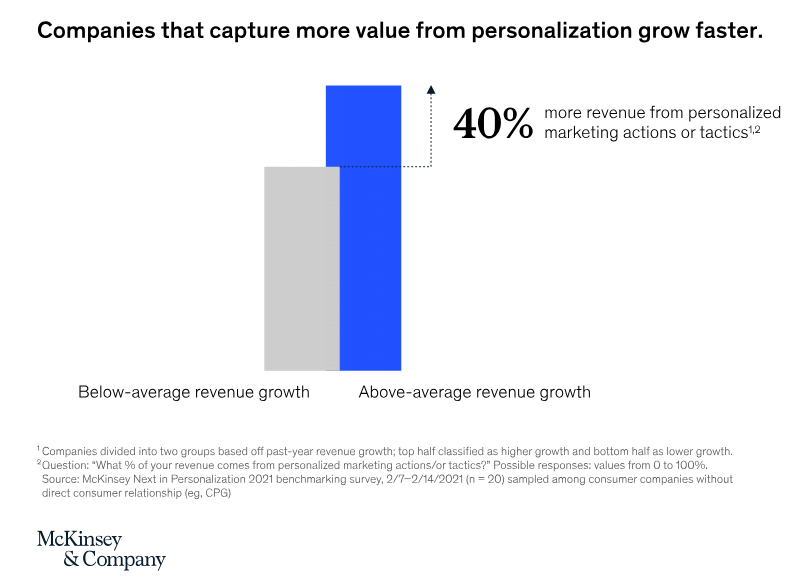
Source: McKinsey & Company
Key Psychographic Segmentation Variables
98% of marketers hit barriers to personalization and data issues are the most common obstacle.
Reference Source: Salesforce
Psychographic data is built from five core variables. Used individually, each adds a layer of insight. Combined into a composite profile, they give you a working picture of how a buyer thinks, what they prioritize, and what it takes to earn their trust, before you’ve sent a single message.
The variables below are what separate teams that break through from those that keep sending generic campaigns:
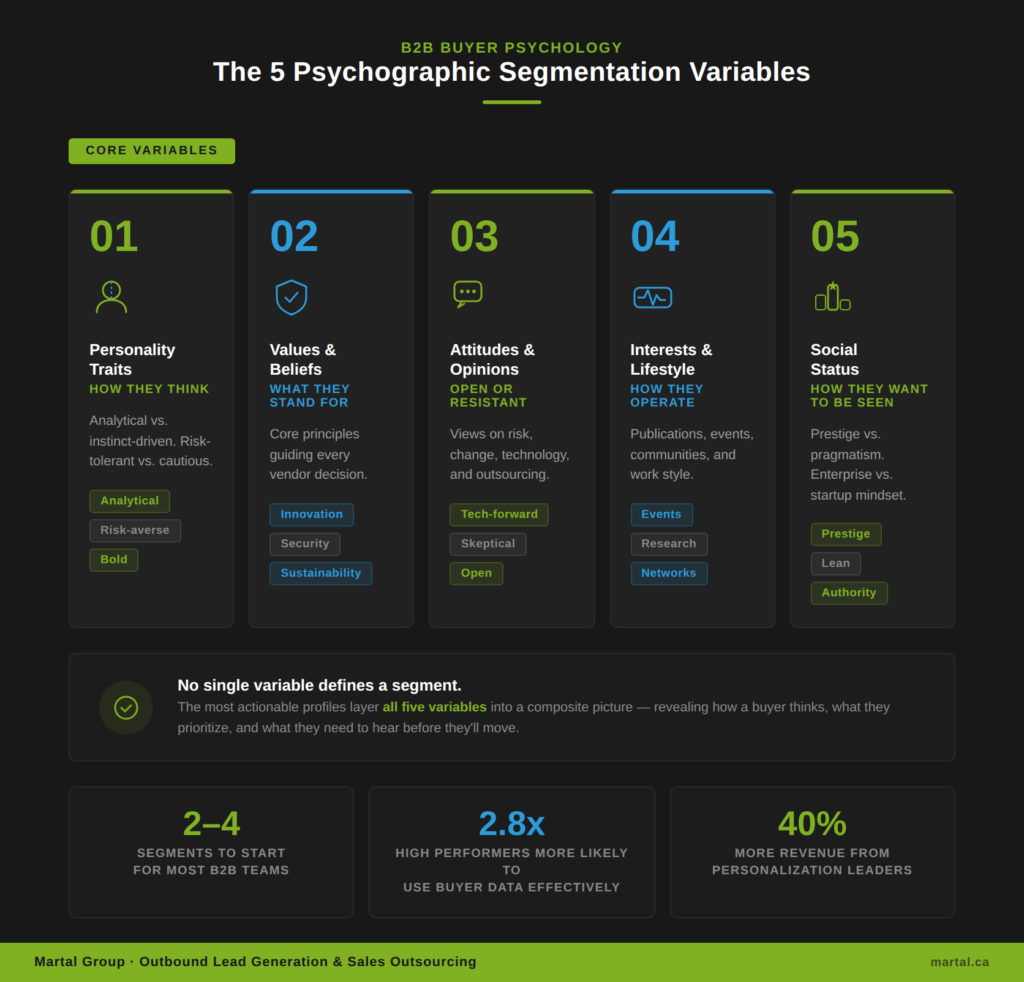
- Personality Traits describe how someone naturally thinks and behaves — introverted or extroverted, analytical or instinct-driven, risk-tolerant or risk-averse. In B2B sales, personality shapes how a prospect receives your approach before they’ve evaluated your product. A cautious, detail-oriented buyer needs proof, process, and time. A bold, curiosity-driven buyer wants vision and momentum. Frameworks like the Big Five personality model or simpler archetypes — ‘Driver vs. Supporter,’ ‘Analytical vs. Expressive’ — give sales teams a practical shorthand for adapting in real time.
When a rep recognizes early in a cold call that a prospect is asking procedural questions rather than strategic ones, that’s personality signaling — and it should change the conversation immediately (7). - Values and Beliefs are the principles that guide a buyer’s decisions at a level deeper than business logic. A founder who prioritizes sustainability will be drawn to vendors who demonstrate it. An executive who values innovation will disengage when presented with a legacy-positioning pitch.
Values alignment accelerates trust and values misalignment can quietly kill deals that should have closed. In B2B, this plays out most visibly in vendor selection: buyers increasingly evaluate cultural and values fit alongside capability fit. If your outreach doesn’t reflect an understanding of what a prospect stands for, you’re asking them to do extra work to see themselves in your solution. - Attitudes and Opinions reveal how open or resistant a prospect is to change and that single dimension can determine your entire sales approach. A buyer with a favorable attitude toward outsourcing inside sales is already sold on the model; your job is to differentiate on execution.
A skeptic needs the model validated before your solution can even be considered. Attitudes also shift by context: the same VP of Sales who embraces AI tools for their team may be deeply resistant to changing their outbound process. Knowing where a prospect stands, before your first sales pitch, lets you enter the conversation at the right level rather than spending the first half of every call diagnosing resistance. - Interests and Lifestyle describe how a buyer moves through their professional world, what they read, which events they attend, which communities they belong to, how they manage their time.
In B2B, lifestyle signals are particularly visible on LinkedIn: the prospect who consistently shares leadership development content has a different professional identity than the one who posts about competitive intelligence and market data.
Both might hold the same title. But one responds to a consultative, relationship-first approach; the other wants sharp analysis and a clear edge. Referencing a shared interest or speaking to a prospect’s obvious professional passions isn’t small talk, it’s psychographic targeting in action. - Social Status shapes what a buyer wants a vendor relationship to signal, about them, their judgment, and their organization. A senior executive at an enterprise account often values credibility markers: client logos, tenure, peer validation, and the confidence that comes from choosing a known quantity.
A founder at a growth-stage company may value agility, directness, and a partner who treats them like a priority rather than a portfolio entry. Understanding where a decision-maker sits in their own professional hierarchy, and how they want their choices to reflect on them helps you position not just your solution, but your relationship. That distinction matters most in competitive situations where capability is roughly equal across vendors and perception becomes the deciding variable.
These variables often overlap and interact. In practice, you wouldn’t look at just one – you’d create a composite profile (persona) that captures a mix of these factors. These variables don’t operate in isolation, they combine into profiles that feel like real buyers, because they are. Two examples that come up consistently in B2B outbound work:
‘The Data-Driven Decision Maker’ — analytical personality, values efficiency and measurable outcomes, optimistic about automation, reads industry research, works long hours with little downtime. This buyer needs proof before they move. Lead with case studies, quantifiable results, and a clear process. Skip the vision pitch — they’ll find it hollow.
‘The Relationship Builder’ — extroverted, values trust and team alignment above all, skeptical of purely automated approaches, active at industry events and in peer networks, guards their work-life balance deliberately. This buyer needs to feel the relationship before they evaluate the solution. Lead with warmth, shared context, and social proof from people they recognize.
Both could be sales directors at mid-sized B2B companies. Both would receive identical outreach from a firmographic-only targeting model. In practice, one approach would open each conversation and completely close the other. That gap is what psychographic segmentation is designed to close.
It’s worth noting that psychographic segmentation variables tend to be more stable over time than things like behavior. Someone’s core values or personality usually don’t shift overnight, which means psychographic segments have a longer shelf-life once defined (1). However, they can be harder to identify and measure – which brings us to how to actually gather this psychographic data.
Psychographic Segments vs. Buyer Personas: Are They the Same Thing?
Not quite, though the confusion is understandable since both involve profiling buyers.
A buyer persona is typically a composite description of a target buyer: job title, industry, company size, goals, and challenges. It’s a useful tool for aligning marketing and sales teams around a shared picture of who they’re selling to. Most buyer personas are built primarily from demographic and firmographic data.
A psychographic segment goes deeper — it describes the psychological profile of a buyer type: their values, their attitude toward change, their professional identity, and what motivates them to act. Two buyers can share the same persona (same title, same industry, same company size) but belong to different psychographic segments entirely.
In practice, the most useful approach is to layer psychographic profiles onto existing buyer personas. The persona tells you who to find. The psychographic segment tells you how to approach them once you do.
How Does Psychographic Segmentation Work? (Data Collection & Implementation)
High-performing marketers are 2.8x more likely to use customer data to create relevant experiences and 2.4x more likely to have unified their data sources.
Reference Source: BusinessDasher
Psychographic segmentation has two distinct phases and most teams only do the first one. They collect data through surveys, interviews, and behavioral analysis, build a rough sense of their audience, and stop there.
The second phase, turning that data into defined, actionable segments with real profiles your sales team can use, is where the conversion impact actually lives. Here’s how both phases work in practice:
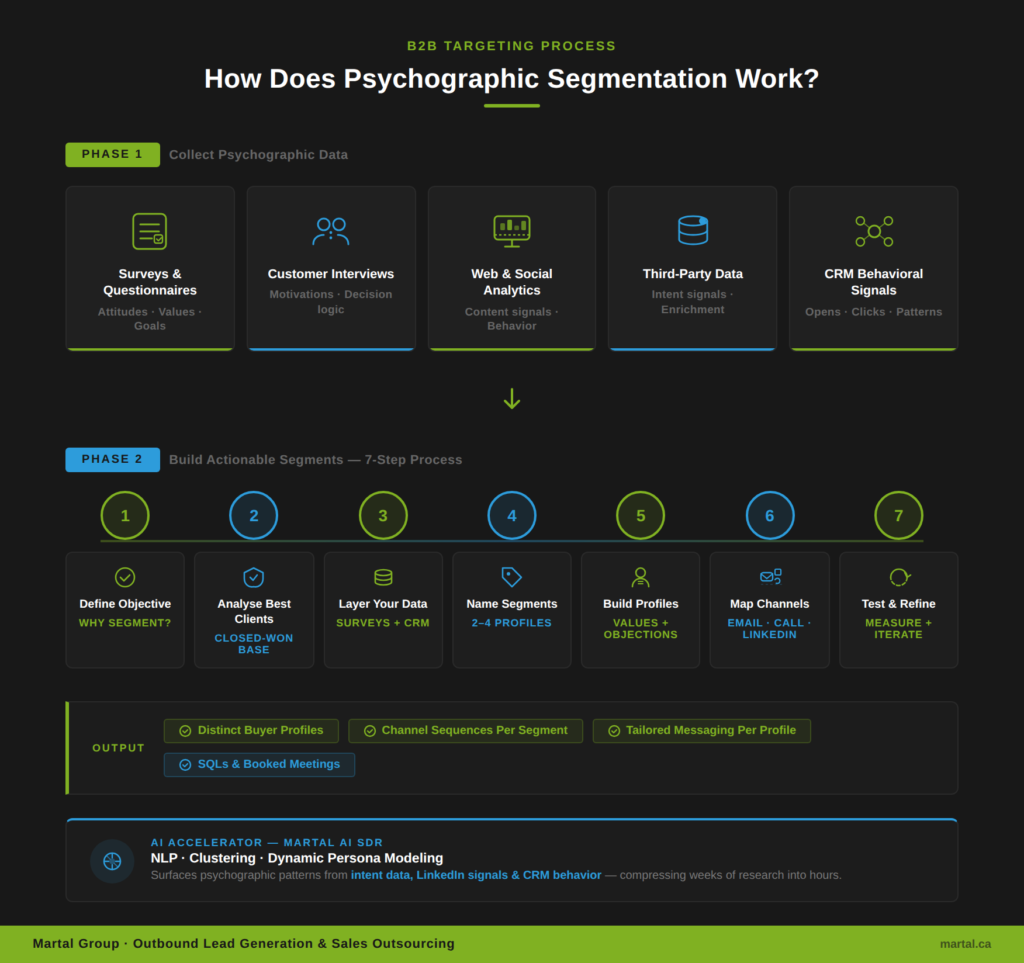
Collecting Psychographic Data: Unlike demographic info (which you can find in a database) or behavioral data (clicks, opens, purchase history automatically tracked by tools), psychographic insights often require more intentional research. Here are some effective methods:
- Surveys & Questionnaires: The most direct method — and often the most underused. Well-designed surveys surface motivations and attitudes that no CRM can infer automatically.
The key questions aren’t demographic: ‘What do you value most in a vendor relationship?’ ‘What would make you walk away from a deal?’ ‘How does your team typically evaluate new tools?’
Keep surveys under five minutes and anchor questions to business decisions rather than personal preferences, B2B respondents disengage fast when questions feel irrelevant to their work context. Likert-scale questions (‘I prefer proven solutions over emerging ones — strongly agree to strongly disagree’) give you quantifiable attitudinal data you can use to cluster segments. - Customer Interviews: One-on-one interviews surface what surveys miss: the hesitations people don’t write down, the cultural dynamics behind a decision, the moment a deal actually turned.
Lost-deal debriefs are particularly valuable. Asking a prospect why they chose a competitor often reveals more about their psychographic profile than a won-deal ever would. (‘We went with the other vendor because they felt more like a partner than a provider’ is a values statement, not a feature comparison.)
The limitation is scale, interviews are time-intensive and can’t be your primary data source. Use them strategically: one round of ten well-chosen interviews can validate or refute an entire segment hypothesis built from survey data. - Website & Social Media Analytics: You can infer psychographics from the content and behaviors your audience exhibits online. Behavioral data from your website and social channels can surface psychographic patterns without a single survey.
Google Analytics affinity categories reveal interest clusters among your site visitors — an IT services company might find a disproportionate segment engaged with ‘project management’ or ‘business productivity’ content, suggesting an operational-efficiency mindset worth building into a persona.
On LinkedIn, the signals are even more direct: which posts does a prospect share, what topics do they comment on, which thought leaders do they follow?
A prospect who consistently engages with change management content has a different professional identity than one who engages with data benchmarks and performance metrics — and your opening message should reflect that difference. - Third-Party Data & Research: Third-party data providers can append psychographic and behavioral attributes to your existing contact lists — useful for enriching records before a campaign launches rather than waiting for organic data collection.
Industry research also works as a proxy: a study on CFO priorities, CTO decision-making patterns, or VP of Sales pain points contains psychographic signal even when it wasn’t designed as segmentation research. Use it to form hypotheses, then validate through direct outreach.
One practical note: purchased psychographic data requires careful handling under GDPR for EU-targeted campaigns and CASL for Canadian targets — ensure any enrichment provider can demonstrate compliant data sourcing before appending to outreach lists. - Observation of Behavior (to infer Psychographics): Your CRM is already collecting psychographic signal, most teams just aren’t reading it that way. Prospects who consistently open emails about ROI and efficiency metrics are telling you something about their values.
Prospects who click on thought leadership about emerging trends are showing you their professional identity.
When you overlay these behavioral patterns onto survey data, the segment picture sharpens considerably: a prospect who says they value innovation and clicks on your AI-related content is a stronger ‘innovator’ signal than either data point alone. The combination of stated attitudes and observed behavior is the most reliable foundation for a psychographic segment.
How to Build Psychographic Segments: A Step-by-Step Process
Collecting data is only half the work. Here’s how to turn raw psychographic insight into segments your marketing and sales teams can actually use:
Step 1: Define the segmentation objective Before analyzing anything, establish what the segment will be used for. Persona-based email sequences have different requirements than ABM account prioritization or cold call talk tracks. A clear objective determines which psychographic variables matter most and prevents over-engineering segments beyond your team’s capacity to act on them.
Step 2: Identify your highest-value existing customers Start with your closed-won base, not your total addressable market. Pull your best-fit clients — those with the shortest sales cycles, highest retention, and strongest expansion revenue — and look for shared psychographic patterns. What attitudes, values, or working styles appear consistently? This is your benchmark persona, and it’s built from real data rather than assumptions.
Step 3: Collect and layer your data Run a short survey to your existing client base. Conduct three to five lost-deal interviews. Review LinkedIn engagement patterns for your top prospects. Layer behavioral CRM data — email engagement, content consumption, meeting behavior — against the attitudinal data you’ve gathered. You’re looking for clusters, not individuals: where do attitudes, values, and behaviors consistently co-occur?
Step 4: Identify and name your segments Look for two to four meaningful groups that share enough common characteristics to warrant a distinct approach. Give each segment a descriptive name that captures their dominant mindset — not a demographic label. ‘The Pragmatic Cost-Optimizer’ is more useful to a sales rep than ‘Mid-Market CFO.’ Name it in a way that instantly communicates how to engage them.
Step 5: Build a profile for each segment For each named segment, document: dominant personality orientation, core values and what they signal about vendor preference, typical attitude toward change and new solutions, professional interests and content consumption patterns, and the specific objections or friction points most likely to arise. Keep profiles to one page — if a rep can’t recall the key points before a call, the profile is too complex.
Step 6: Map messaging and channel approach to each segment Define how each segment should be approached differently: which value proposition to lead with, which proof points carry the most weight, which channel sequence to prioritize, and what tone to use. A segment that values trust and relationship will respond differently to a cold LinkedIn message than one that values efficiency and data. The messaging map is where psychographic segmentation becomes operational.
Step 7: Test, measure, and refine Run a controlled campaign — same offer, different messaging — to two distinct psychographic segments. Measure reply rates, meeting conversion, and sales cycle length by segment. The goal isn’t perfection on the first pass; it’s building feedback loops that make your segments sharper over each campaign cycle. Segments that don’t show differentiated response patterns either need refinement or consolidation.
One thing we see consistently in outbound campaigns across verticals: teams that define even two clear psychographic segments — and actually adjust their messaging for each — outperform those running unified messaging to the same audience, even when the unified list is larger. The precision matters more than the volume.
How AI Is Changing Psychographic Segmentation
The most significant practical shift in psychographic segmentation over the last two to three years isn’t conceptual — it’s operational. AI and machine learning have made it possible to build and act on psychographic profiles at a scale and speed that manual research methods couldn’t support.
Three specific capabilities are driving that shift:
Natural language processing (NLP) for signal extraction. NLP tools analyze large volumes of text — LinkedIn posts, job descriptions, company announcements, content engagement patterns — and surface psychographic signals automatically. A prospect who consistently publishes content about change management and organizational transformation is displaying a value orientation that would previously have required a survey or interview to surface. NLP reads it from public behavior.
Clustering and pattern recognition. Machine learning clustering algorithms identify which combinations of behavioral and attitudinal signals group together naturally — discovering psychographic segments that human analysts might not have predicted. Rather than defining segments upfront and searching for evidence, clustering lets the data suggest where meaningful differences actually exist. A 2025 peer-reviewed study in the Journal of Strategic Marketing demonstrated this approach using LLMs to identify psychographic value segments from large-scale textual data — producing consistent, actionable results at a fraction of the cost of traditional primary research. (4)
Dynamic persona modeling. Traditional psychographic segments are static — built once, refined occasionally. AI-driven models update continuously as new behavioral signals come in. A prospect whose content engagement shifts from operational efficiency topics to innovation and competitive strategy is signaling a change in professional priorities. Static segments miss that shift. Dynamic models catch it and adjust outreach accordingly.
In practice, this means machine learning tools can now analyze LinkedIn behavior, content engagement, and intent signals to surface psychographic patterns that previously required weeks of manual research — identifying, for example, that a cluster of target accounts consistently engages with risk-management content, signaling a conservative-buyer profile worth building a distinct messaging approach around. For B2B teams without dedicated research budgets, that compression changes what’s actually achievable.
Martal’s AI SDR Platform applies this kind of signal-based profiling directly to outbound campaign construction — using intent data, technographic signals, and behavioral patterns to identify best-fit buyer profiles before outreach begins, so messaging can be calibrated to mindset rather than just job title. The platform doesn’t replace the human judgment that good psychographic segmentation requires, but it compresses the research phase significantly, surfacing the patterns that inform persona-building in the time it used to take to pull a list.
The practical caution remains: AI-derived psychographic inference should be validated against real interactions. A predicted ‘risk-averse’ profile that responds enthusiastically to a bold, disruptive pitch is telling you something your model missed. Build in feedback loops — weekly sales team debriefs on what’s resonating by segment — and treat AI-generated profiles as strong hypotheses rather than confirmed facts.
Psychographic Segmentation in Marketing and Sales (B2B Applications)
B2B companies using persona-based segmentation see 2–5x higher click-through rates in email campaigns.
Reference Source: HubSpot
Psychographic data is only valuable when it changes what you do. Here are the highest-impact ways B2B sales and marketing teams apply psychographic segmentation, from how they write a subject line to how they structure an entire ABM campaign. Here are a few high-impact applications:
- Tailored Value Propositions: Different psychographic segments perceive value differently and pitching the wrong version of your value proposition to the right company is one of the most common reasons deals stall at the first conversation.
A ‘time-crunched operations manager’ persona values your solution because it reduces friction and saves hours. A ‘strategic growth driver’ CTO values the same solution because it gives their organization a competitive edge. The product hasn’t changed. The framing must.
In practice, this means creating distinct positioning statements — and in some cases separate landing pages or proposal templates — for each primary segment. Not because your solution is different for each buyer, but because what makes it compelling is. The teams that get this right stop leading every pitch with the same three bullet points and start leading with the specific outcome that matters most to the person in front of them - Personalized Messaging & Content: Psychographics should shape more than what you say — they should shape how you say it, which format you use, and what you ask the prospect to do next.
- For a segment that values analytical, data-driven decisions: lead with research, quantified outcomes, and detailed case studies. Make the ROI case explicit. Avoid vague claims about transformation.
- For a segment motivated by trust and relationship: lead with peer validation, testimonials from recognizable names, and a consultative tone that signals you’re here to help them think, not just sell. Move slower. Ask more questions.
- For a segment driven by competitive advantage: lead with what their peers are already doing and what they risk by waiting. Create urgency through market context rather than artificial deadlines.
The channel matters too, an efficiency-oriented persona may prefer a concise email they can read and act on in two minutes. A relationship-oriented persona may respond better to a call that starts with genuine curiosity about their business. Outbound campaigns that ignore these distinctions tend to produce uniform mediocrity across every segment.
- Channel and Sequence Prioritization: Psychographic research often reveals that different segments have fundamentally different communication preferences — and leading with the wrong channel creates friction before a conversation has even started.
Younger tech-startup executives who value efficiency and autonomy typically prefer asynchronous communication: an email or LinkedIn message they can respond to when it suits them. Interruption-based outreach — a cold call at 2pm on a Tuesday — registers as disrespectful of their time regardless of how good the message is.
Seasoned executives who prioritize relationships and credibility often respond better to a direct phone call, precisely because it signals the effort most vendors aren’t willing to make.
In practice, psychographic profiling informs not just which channel to use first, but how to sequence the full omnichannel approach. A relationship-oriented decision-maker might receive a warm LinkedIn connection request before any email — while a data-driven efficiency persona gets a concise, stat-led email first with a call follow-up timed to their engagement signal. The sequencing is the strategy - Cold Calling & Sales Pitches: Psychographics can script the first thirty seconds of a cold call — and the first thirty seconds determine whether there’s a conversation or a hang-up.
For a detail-oriented, analytical prospect: open with a specific, relevant data point. ‘We helped a manufacturing company reduce their sales cycle by 25%. I have the breakdown if you’re open to a quick conversation.’ Precision signals credibility to this persona before you’ve even made a claim.
For a big-picture, visionary prospect: open with a bold question or challenge. ‘Most companies in your space are still building pipeline the same way they did five years ago. I wanted to ask whether that’s something you’re looking to change.’ Vision before proof.
During the call itself, psychographic cues emerge in real time. A prospect who asks multiple risk-related questions — about implementation complexity, contract terms, or what happens if results don’t materialize — is telling you their dominant concern. The right response isn’t to push past it; it’s to address it directly, offer a lower-risk entry point, and let the caution be the roadmap for the rest of the conversation.
One thing we see consistently across cold calling campaigns: reps who adapt their opening based on a prospect’s visible professional identity — their LinkedIn activity, the content they publish, the events they speak at — convert cold calls to conversations at a meaningfully higher rate than those working from a single script. Psychographic awareness doesn’t require a research dossier. It requires paying attention to what a prospect is already telling you about themselves - Account-Based Marketing (ABM) Personalization: In ABM, psychographic segmentation moves from the individual level to the account level, profiling not just the buyer, but the culture of the organization you’re trying to enter.
Two enterprise accounts in the same industry, with the same firmographic profile, can have fundamentally different organizational psychologies. One leadership team talks constantly about digital transformation and market disruption. The other emphasizes risk management, regulatory compliance, and controlled growth. These aren’t just different talking points — they’re different buying cultures that require different campaign architectures.
The innovation-oriented account gets a campaign themed around competitive positioning and forward momentum: what’s changing in their market, what their peers are already doing, and what first-mover advantage looks like. The stability-oriented account gets a campaign built on trust signals: compliance credentials, proven implementation methodology, client retention data, and incremental proof of value.
Gartner’s research on B2B buying committees consistently shows that empathetic, tailored approaches outperform one-size-fits-all pitches, particularly in multi-stakeholder deals where different members of the same buying committee may hold different psychographic profiles (3). A pitch that converts the CFO might actively alienate the Head of Operations sitting next to them.
Psychographic Segmentation in Practice: A B2B Outbound Example
Enterprise cybersecurity campaigns illustrate the challenge well. Within the same ICP sales strategy – targeting CISO and VP of Security titles at regulated-industry companies – two distinct psychographic profiles typically emerge: compliance-driven operators focused on risk reduction and auditability, and forward-looking technology leaders oriented toward strategic differentiation and competitive positioning. Firmographically identical. Psychographically, they require different campaigns entirely. Building messaging that speaks to both without collapsing into generic positioning is one of the more common challenges we see in security-sector outbound work.
The results when it’s done well speak for themselves. In one engagement with a cybersecurity SaaS company, Martal generated 284 leads and 12 qualified meetings, targeting an ICP where understanding the psychological profile behind the title mattered as much as finding the right title in the first place. See how Martal approaches cybersecurity lead generation for a closer look at what that kind of campaign looks like in practice.
- Omnichannel Lead Nurturing: Psychographic data makes multi-touch nurture sequences feel individually crafted rather than automated — because each touchpoint is calibrated to what a specific type of buyer needs to move forward.
- ‘Skeptical Evaluators’ — buyers who question everything and need evidence before they engage — respond to a nurture flow built around credibility: a case study email first, a LinkedIn message offering a specific data report or audit second, then a call focused entirely on answering their questions rather than pitching. Every touch earns the next one.
- ‘Enthusiastic Champions’ — buyers who move fast, love new ideas, and respond to momentum — need a different cadence entirely: a bold success story, a fast-follow invitation to a live demo or pilot, and a tone that matches their energy. Slow them down with too much process and you lose them.
The channel sequence for each follows the same omnichannel framework — email, LinkedIn, phone — but the content, tone, and timing differ entirely based on the psychological profile. That’s the difference between a nurture sequence and a sales funnel that actually moves people.
- Product Positioning & Development: Psychographics inform not just how you sell, but how you position what you’re selling — which features you lead with, which outcomes you emphasize, and how you frame the category itself.
- A technophile segment — buyers who actively seek out new tools and see technology adoption as part of their professional identity — wants to know your solution is sophisticated, current, and capable of integrating with whatever they’re building. Lead with capability depth and roadmap.
- A risk-conscious operator segment wants simplicity, reliability, and evidence that implementation won’t disrupt what’s already working. For them, positioning the same solution as straightforward, supported, and proven will outperform any feature-led pitch.
This principle extends to value proposition design, sales collateral, and even proposal structure. Psychographic awareness at the positioning level means your entire sales motion — from first touch to final proposal — reflects a consistent understanding of what this buyer actually needs to hear.
The through-line across all of these applications is the same: alignment between what you say and what your buyer is actually wired to respond to. When that alignment exists, outreach feels relevant rather than intrusive. Qualification conversations move faster. Objections surface earlier and resolve more cleanly.
Psychographic segmentation also pays forward into customer relationships — not just prospect pipeline. Account managers who understand a client’s working style, communication preferences, and values make better decisions about what to bring to renewal conversations, which upsell opportunities to surface, and how to handle the moments when something goes wrong. The same insight that wins the deal can keep it.
Psychographic Segmentation Examples: From Global Brands to B2B Campaigns
The clearest way to understand psychographic segmentation is to see it working — in companies your buyers already recognize, and in sales scenarios your team encounters every week. Here are five B2B examples that show what the approach looks like in practice, from global platforms to product-led growth strategies:
Example 1: Martal Group & Polygon – Three Buyers, One Product, Three Psychographic Profiles
Polygon, a Stockholm-based IoT company, came to Martal with a specific challenge: building a pipeline in the North American construction and architecture market for a climate control solution that could be sold to multiple stakeholders within the same target account, each with a fundamentally different reason to care about it.
The buyer profile documented in the campaign spanned three distinct roles: Directors of Sustainability, Directors of Risk, and Preconstruction Executives.
Firmographically, they worked at the same type of company.
Psychographically, they had different professional identities, different success metrics, and different reasons to engage.
- A Sustainability Director is motivated by environmental accountability and ESG outcomes — the value proposition that resonates with them is about reducing a building’s carbon footprint and demonstrating measurable environmental impact.
- A Risk Director is motivated by liability reduction and regulatory compliance — the same product becomes a tool for controlling exposure and meeting standards.
- A Preconstruction Executive is motivated by project certainty and cost control — climate management during construction directly affects timelines and budgets.
One solution. Three psychographic frames. Three different conversations.
Martal ran omnichannel outreach, email, LinkedIn, and cold calling, coordinated across all three buyer profiles, with messaging calibrated to what each role’s professional identity and core priorities actually responded to.
Over 24 months, the campaign delivered 440 leads, 203 SQLs, and 139 booked meetings. Polygon’s Director of Marketing noted that Martal brought “professional North American reps and a simple project approach”, the kind of credibility signal that lands specifically with enterprise buyers whose professional identity is built around precision and reliability.
Read the full case study to see how multi-stakeholder psychographic targeting translates into pipeline at scale.
Example 2: Salesforce — Selling to Identity, Not Just Industry
Salesforce operates in one of the most crowded software categories in enterprise technology. Its psychographic segmentation strategy is what separates its marketing from the dozens of CRM competitors targeting the same job titles at the same companies (2).
Rather than leading with features or pricing, Salesforce builds its messaging around a specific psychological profile: values-driven professionals who see technology as a vehicle for transformation, inclusion, and impact. Their campaigns don’t ask “does your company need a CRM?” They ask “do you want to be the kind of leader who empowers their team and puts the customer first?” That’s a values and identity appeal — psychographic segmentation operating at the brand level.
The practical effect is that Salesforce doesn’t just attract buyers who need CRM software. It attracts buyers who want to be associated with what Salesforce stands for. In competitive deals against functionally similar products, that identity alignment is frequently the deciding variable — particularly at the C-suite level where values fit influences vendor preference as much as feature comparison (8).
Example 3: HubSpot — Segmenting the Buying Committee by Mindset
HubSpot’s approach to B2B psychographic segmentation is built into its own product marketing. Its ‘Make My Persona’ tool — used by thousands of B2B marketing teams — explicitly documents not just demographic attributes but psychographic ones: goals, motivations, fears, communication preferences, and decision-making patterns.
More instructively, HubSpot segments its own buying committee by psychological role rather than job title. A decision-maker persona (controls budget, evaluates risk) receives different content and messaging than a user persona (cares about daily workflow and ease of use) or a champion persona (motivated by looking smart to their organization and being seen as an innovator). These three personas can exist inside the same company — sometimes the same team — but require fundamentally different appeals.
The lesson for B2B teams is structural: psychographic segmentation isn’t only about finding the right company. It’s about understanding which psychological role each stakeholder plays in the buying process, and building a campaign architecture that speaks to all of them simultaneously without collapsing into the lowest-common-denominator pitch (12).
Example 4: LinkedIn Ads — Psychographic Targeting Built Into the Platform
LinkedIn’s own advertising platform is designed around B2B psychographic segmentation — a fact that its own marketing documentation makes explicit. Beyond job title and company size, LinkedIn allows advertisers to target by career aspirations, professional values, industry association memberships, and topic-based interests that signal psychological orientation.
The platform’s guidance specifically recommends that B2B advertisers “research and profile their customers’ psychographic traits” — including professional challenges, career aspirations, special interests, and social status signals — before building campaigns. The rationale is direct: two C-suite executives at similar companies have different psychological profiles that determine how they receive outreach, what content they engage with, and which vendors they take seriously.
For B2B sales and marketing teams, LinkedIn’s psychographic targeting layer means that persona-based segmentation isn’t just a messaging strategy — it’s a targeting capability that can be activated at the ad level, reducing wasted spend on job-title matches who don’t share the psychological profile of your best buyers (14).
Example 5: Slack — Building an Entire B2B Go-to-Market Around a Psychographic Profile
Slack’s rise from a 2013 beta with 8,000 users to a $26 billion enterprise platform is one of the most studied growth stories in B2B SaaS. What’s less often discussed is that the foundation of that growth wasn’t a feature advantage — it was a psychographic insight.
Stewart Butterfield articulated it directly in a memo to his team before launch: Slack’s job wasn’t just to build something useful, but to understand what people thought they wanted and translate Slack’s value into their terms. (15). The target wasn’t “companies that need a communication tool.” It was buyers who felt that existing enterprise software was unnecessarily complex, impersonal, and misaligned with how people actually wanted to work. People who valued simplicity, transparency, and the idea that work could feel human rather than transactional.
That psychological profile — call it the “anti-corporate professional,” someone who rejects the friction and formality of traditional enterprise tools — shaped everything: the product’s personality, the onboarding experience, the tone of every piece of marketing copy, the brand humor, and the decision to position Slack not as an IT tool but as a cultural improvement. Even the company’s codified tone of voice, trained consistently across support, sales, and marketing, was psychographic targeting made operational.
The result was a product and brand that didn’t just solve a problem — it resonated with a self-image. Buyers didn’t just choose Slack because it worked. They chose it because it reflected how they saw themselves as professionals: modern, collaborative, and done with the way things had always been done.
For B2B teams, the Slack example illustrates the highest-order application of psychographic segmentation: when you understand your buyer’s values and self-image deeply enough, the product, the brand, and the messaging become a single coherent signal — and competitors who rely purely on feature comparison rarely know what they’re up against.
Across all five examples, the mechanism is consistent: a message — or a product, or an entire brand — built around a specific psychological profile outperforms one built for a demographic category.
The practical starting point for most B2B teams isn’t a brand reinvention or a platform rebuild. It’s a sharper look at your best closed-won accounts: what attitudes, priorities, and professional identities do they share? That pattern is your first psychographic segment. Everything else builds from there.
Before scaling any psychographic strategy, it’s worth understanding what the approach genuinely requires — and where it tends to break down. The next section covers both honestly.
Advantages and Disadvantages of Psychographic Segmentation
Brands that excel at personalization using segmentation achieve 40% more revenue than their peers.
Reference Source: McKinsey & Company
Psychographic segmentation delivers real competitive advantages, but it also requires more investment and discipline than firmographic targeting. Understanding both sides of the equation is what separates teams that implement it successfully from those that build elaborate personas and never act on them.
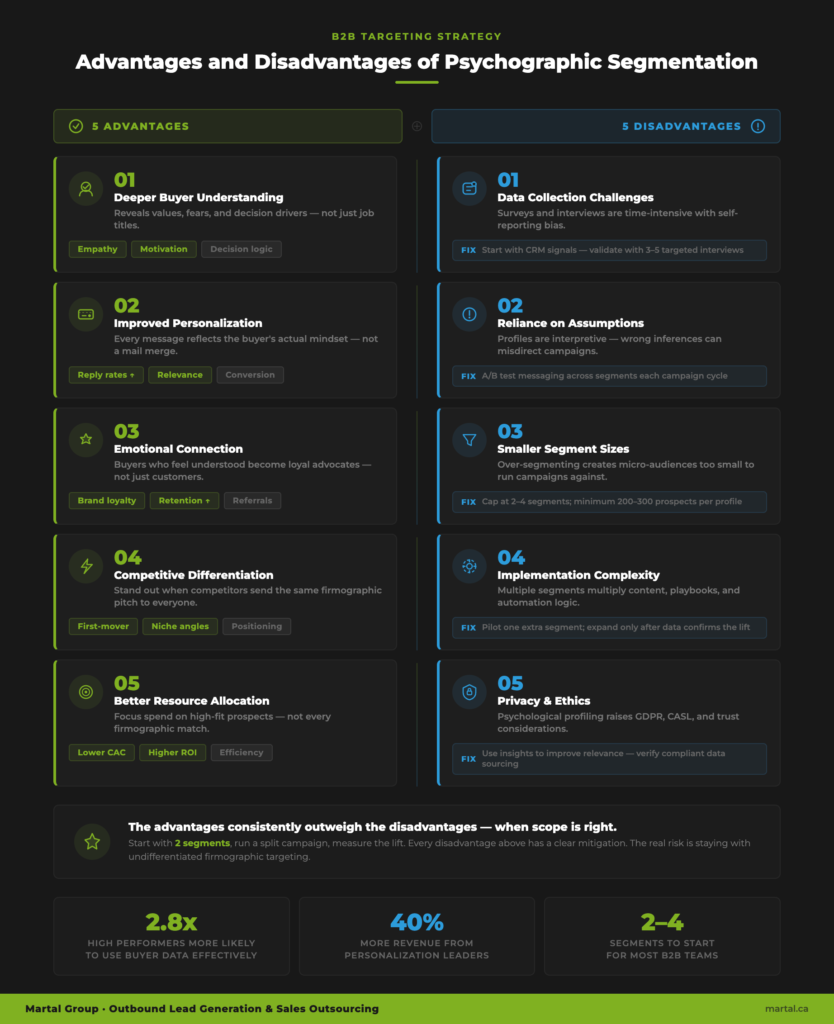
Advantages of Psychographic Segmentation
- Deeper Customer Understanding: Psychographic data answers the questions firmographic data never can — what a buyer actually values, what makes them cautious, and what makes them move. That depth translates directly into sales conversations that feel less like pitches and more like the vendor already understood the problem before walking in.
For teams that sell complex solutions with long cycles and multiple stakeholders, that difference in perceived understanding is often what gets a vendor onto a shortlist, or keeps them off it. - Improved Personalization & Relevance: Psychographic segmentation moves personalization beyond first-name tokens and industry-specific subject lines into something that actually changes what you say and how you say it.
A prospect who values autonomy and efficiency receives a different email than one who values collaboration and peer validation, not because the product changed, but because what makes it compelling to each buyer is genuinely different. That level ofsubject line and message calibration consistently drives stronger open rates, higher reply rates, and better-qualified conversations.
Relevance earned through psychological understanding is harder to manufacture at scale and harder for competitors to replicate. - Emotional Connection and Brand Loyalty: B2B buyers are not purely rational actors — they bring professional identity, personal values, and past experience to every vendor evaluation. When a company’s outreach and positioning consistently reflect an understanding of what a buyer stands for, something shifts: the relationship starts at a different level of trust. That trust compounds over time into retention, expansion revenue, and referrals.
The practical signal is straightforward. If your best clients regularly introduce you to peers without being asked, there’s usually a psychographic alignment story underneath it. They’re not just satisfied with results; they feel understood. - Competitive Differentiation: Most B2B outreach is still built on firmographic targeting, same job titles, same industries, same generic value propositions sent to the same list.
In a competitive market where buyers receive dozens of cold approaches weekly, a message that reflects a genuine understanding of their professional mindset and priorities reframes how a vendor is perceived from the first touch.
If your competitors are all leading with the same efficiency or ROI angle, finding the psychographic sub-segment that responds to a completely different appeal, competitive advantage, risk reduction, or professional identity, can open conversations that uniform messaging never reaches. - Better Allocation of Resources: Psychographic profiling shifts prospecting from volume-based to precision-based. Rather than maximizing outreach to every contact that matches a firmographic ICP, teams can prioritize the sub-segments whose psychological profile aligns most closely with their value proposition — reaching fewer prospects with far higher relevance.
In practice, this means sales reps spend more time in conversations with buyers who are already oriented toward the solution, and less time diagnosing resistance that could have been anticipated from the prospect’s profile. That efficiency compounds across a full pipeline cycle.
Disadvantages of Psychographic Segmentation
- Data Collection Challenges: Psychographic data doesn’t live in a database. Unlike firmographic attributes that can be pulled from a contact list, psychological profiles require active collection — surveys, interviews, behavioral analysis, or third-party enrichment — all of which take time and carry quality risks.
Self-reported data is particularly prone to social desirability bias: buyers tend to describe themselves as more innovative, open-minded, or data-driven than their actual behavior demonstrates. This makes psychographic profiles built entirely from surveys less reliable than those cross-validated against real behavioral signals.
How to mitigate it: Start with behavioral data you already have — email engagement patterns, content consumption, LinkedIn activity — and use surveys to validate the hypotheses those signals generate, not to build profiles from scratch. Three to five win/loss interviews are often more revealing than a 100-response survey. Build small, then scale. - Reliance on Assumptions: Psychographic segments are always interpretive at some level. You’re inferring that a set of observed attitudes and values will consistently predict buying behavior — and that inference can be wrong in ways that firmographic targeting rarely is.
A segment labeled ‘risk-averse operators’ might behave very differently depending on what’s at risk, who’s in the room, or what quarter they’re in. Overclaiming certainty in a psychographic profile can produce messaging that feels presumptuous rather than perceptive — the opposite of what the exercise is meant to achieve.
How to mitigate it: Treat psychographic profiles as strong hypotheses, not fixed facts. Build A/B testing into every segmented campaign — run variant messaging against two profiles with the same offer, measure differentiated response, and let the market tell you whether the segmentation is working. Revisit and refine segments every two to three campaign cycles. - Smaller Segment Sizes: The more precisely you define a psychographic profile, the smaller the reachable audience becomes. Taken too far, micro-segmentation produces messaging that’s highly relevant to a group of twenty people — which is rarely a useful campaign unit. This is a genuine tension: the precision that makes psychographic segmentation valuable is the same force that can make it operationally impractical if applied without constraint.
How to mitigate it: Start with two to three psychographic segments maximum. Enough to create differentiated messaging, not so many that execution becomes fragmented. Each segment should be large enough to run a meaningful campaign against — typically a minimum of 200 to 300 well-matched prospects. If a defined segment doesn’t meet that threshold, consolidate rather than proceed with too small a sample. - Implementation Complexity: Psychographic segmentation multiplies operational requirements. More segments mean more messaging variants, more sales playbooks, more content tracks, and more complex automation logic. Teams that attempt to run five psychographic segments simultaneously without the infrastructure to support them typically end up with inconsistent execution — prospects receiving the wrong messaging track, sales reps forgetting which persona they’re supposed to be addressing, and campaign performance data that’s impossible to interpret cleanly.
How to mitigate it: Sequence the rollout. Pilot with one additional psychographic segment alongside your existing approach. Measure the lift in reply rate, meeting conversion, and sales cycle length. If the data supports the investment, expand. The goal is a manageable system that improves over time — not a complete segmentation overhaul that collapses under its own complexity in the first quarter. - Privacy and Ethical Considerations: Psychographic targeting involves collecting and acting on personal and professional information that buyers may not have consciously shared for marketing purposes. Done poorly — or communicated poorly — this crosses from perceptive personalization into surveillance-adjacent territory that damages trust rather than building it. The line between ‘this vendor really understands our business’ and ‘this vendor knows things about me that I didn’t tell them’ is real, and buyers notice when it’s crossed.
This consideration has regulatory dimensions too. Campaigns targeting EU and UK buyers operate under GDPR, which governs how personal data — including data used to build psychological profiles — can be collected, stored, and used for commercial outreach. Canadian-targeted campaigns operate under CASL with similarly strict parameters.
How to mitigate it: Use psychographic insight to improve the quality and relevance of your messaging — not to demonstrate how much you know about a specific individual. The goal is for outreach to feel well-informed, not intrusive. Reference professional context rather than personal detail. And ensure any data enrichment provider used for psychographic profiling can demonstrate compliant data sourcing before it goes near an outreach campaign.
The advantages consistently outweigh the disadvantages for teams that implement psychographic segmentation with appropriate scope and discipline. The risks like bad data, over-segmentation, and implementation complexity, are all manageable. The cost of staying with undifferentiated firmographic targeting is harder to see in a single campaign, but compounds quietly across every quarter of missed relevance.
The simplest pilot: take your next email drip campaign and split it across two psychographic profiles, same offer, different messaging framing, different value proposition emphasis. Measure reply rate and meeting conversion by segment. That single test will tell you more about your buyer psychology than a year of uniform outreach and give you the data to justify a broader rollout.
Conclusion: Putting Psychographics into Action with Martal Group
Understanding your buyer at the psychological level, what they value, how they make decisions, and what kind of vendor relationship they’re actually looking for, is no longer a differentiator reserved for companies with large research budgets.
AI-driven intent data, behavioral CRM signals, and accessible survey tools have made psychographic segmentation practical for any B2B team willing to build it into their targeting process.
The teams doing this now are building a compounding advantage: each campaign cycle sharpens their segment definitions, improves their messaging, and shortens the time from first touch to qualified conversation. The teams that aren’t are sending the same outreach to buyers who require fundamentally different approaches and wondering why reply rates stay flat.
At Martal, psychographic profiling is built into how we structure campaigns from the start, not added as a layer after the ICP is defined. Our onshore Sales Executives research buyer mindset alongside firmographic fit: what does this type of decision-maker value, what objections are they predisposed to, and what framing is most likely to open a genuine conversation rather than trigger a delete.
That insight shapes the cold email sequence, the LinkedIn approach, the cold calling talk track, and the sequencing of the omnichannel campaign as a whole. The result is outreach that prospects experience as relevant rather than intrusive and a sales pipeline that fills with buyers who were already oriented toward your solution before the first meeting.
If your team is ready to move beyond firmographic-only targeting, Martal’s Sales-as-a-Service model combines experienced onshore Sales Executives with our proprietary AI SDR Platform running coordinated outbound lead generation across cold email, cold calling, and LinkedIn outreach as a single omnichannel strategy, with messaging calibrated to the psychological profile of your buyer, not just their job title. Most campaigns begin generating SQLs within 30 days. Book a consultation to see what a pipeline built around your buyers’ actual motivations looks like in practice.
References
- Qualtrics
- Brafton
- Gartner
- Informa
- Yieldify
- Exploding Topics
- Crobox
- M1-Project
- Conjointly
- McKinsey & Company
- Aerospike
- HubSpot Make My Persona
- Salesforce
- LinkedIn Marketing Solutions
- GrowthHackers
FAQs: Psychographic Segmentation
What is the psychographic segmentation?
Psychographic segmentation is the practice of dividing a market into groups based on shared psychological characteristics, values, attitudes, interests, lifestyles, and personality traits. Where demographic segmentation tells you who your buyer is, psychographic segmentation tells you why they make decisions. For B2B teams, that distinction determines whether outreach feels relevant to the person receiving it or generic to their job title.
What are the 5 psychographic segmentation variables?
The five primary variables are personality traits, values and beliefs, attitudes and opinions, interests and lifestyles, and social status/class. Together they form a holistic view of a prospect’s mindset, allowing sales and marketing teams to tailor messages to motivations that drive decision-making. In practice, the most useful psychographic profiles combine all five into a composite picture rather than relying on any single variable alone.
What is a psychographic example?
B2B psychographic segmentation example: two CISOs at enterprise financial services companies. Same title, same industry, same company size.
One is a ‘Risk-Averse Protector’, their dominant concern is system stability and compliance. They respond to proven methodology, certification credentials, and client retention data.
The other is a ‘Change Agent’, they define their professional identity around modernization and competitive differentiation.
They respond to AI-driven capabilities and strategic advantage framing. Same product, same ICP, two completely different campaigns required. That gap between what the firmographic profile suggests and what the psychographic profile reveals is where most B2B outreach underperforms.
What are the 4 types of market segmentation?
The four main types are demographic (who they are), geographic (where they are), psychographic (why they behave as they do), and behavioral (what they do).
Each layer adds a different dimension: demographics size the market, geography locates it, behavioral data tracks what buyers do, and psychographics explain the motivation behind those actions.
For B2B teams, the most effective targeting combines all four, but psychographic segmentation is consistently identified as the most effective approach specifically for B2B buying decisions, where motivation and values drive complex, multi-stakeholder purchasing processes.
How many psychographic segments should a B2B company use?
Most B2B teams find two to four psychographic segments workable — enough to create meaningfully differentiated messaging without overwhelming execution capacity. The right number depends on two things: how distinct your buyers’ psychological profiles actually are, and whether your team has the bandwidth to run and maintain multiple messaging tracks simultaneously.
The practical starting point is two segments alongside your existing approach. Same offer, differentiated messaging framing. Run a campaign cycle, measure reply rates and meeting conversion by segment, and let the data tell you whether the differentiation is working. If it is, expand. If segments show similar response patterns, consolidate and refine the profiles before adding complexity.
The most common mistake is building five or six highly specific psychographic profiles that look impressive in a deck but exceed the team’s operational capacity to execute consistently — resulting in sporadic personalization that’s worse than a well-executed unified approach.
Is psychographic segmentation the same as creating buyer personas?
Related, but not the same and the distinction matters in practice.
A buyer persona describes who your target buyer is: their job title, company size, industry, goals, and typical challenges. Most buyer personas are built primarily from demographic and firmographic data. They’re useful for aligning marketing and sales teams around a shared picture of the target audience.
A psychographic segment describes why that buyer makes decisions: their values, attitude toward risk and change, professional identity, and what motivates them to act. Two buyers can match exactly the same persona — same title, same industry, same company size — but belong to different psychographic segments entirely, requiring completely different messaging approaches.
The most effective B2B campaigns use personas to define the firmographic target and psychographic segmentation to determine how to engage them once found. Personas answer ‘who should we reach?’ Psychographic segments answer ‘how do we actually reach them in a way that resonates?
How is psychographic segmentation different from behavioral segmentation?
“Behavioral segmentation tracks what buyers do — which emails they open, which pages they visit, which content they download, how frequently they engage. It’s observable, quantitative, and based on recorded actions.
Psychographic segmentation tracks what buyers believe and value — their attitudes toward risk, their professional identity, their priorities when evaluating a vendor. It explains why they behave the way they do, not just what they’ve done.
The two are most powerful in combination. Behavioral data surfaces patterns — a prospect who consistently opens emails about compliance and governance is showing you something. Psychographic segmentation interprets that pattern — that prospect likely has a risk-averse orientation and needs proof and process before they’ll engage seriously. Behavioral data gives you the signal. Psychographic thinking tells you what to do with it.