
 Martal
 Technology
 Education and training
 Web Development and UI / UX
 Healthcare/Medical
 Logistics and Supply Chain
 Information Technology
 Insuretech and Financial Services
 Marketplaces
 Software Development
 E-commerce and retail
 AI and Machine Learning
 Energy and Solar
 Manufacturing
 Security and Surveillance
 Digital Marketing Agency
 Transportation
 MSP
MSP
 Telecom
 B2B SaaS
 Cybersecurity
 HR tech
 Fintech
 Cleantech
 Consulting
Selling to the C-Suite in 2026: 6 Appointment Setting Strategies for the Era of Pre-Decided Buyers
Major Takeaways: Selling to the C-Suite
More structured — and harder — than ever. According to the 6sense Buyer Experience Report, B2B buyers now complete roughly 60% of their evaluation independently and pre-rank vendors before first seller contact, which makes early, role-specific access to the C-suite more valuable than it has ever been (8).
Apply six strategies as a coherent system, not a checklist: thorough research, role-specific personalization, referrals and thought leadership, omnichannel outreach, professional persistence, and value- and AI-fluent messaging. Skip any one of them and the others have to work harder to compensate.
Gartner research shows the average B2B buying group includes 6 to 10 stakeholders and 75% of B2B buyers now prefer a rep-free sales experience (10). The few outreach moments executives do engage with carry more weight, and the messages they ignore get filtered out faster than ever.
Trigger-event-based research. Gartner found that 99% of B2B purchases are driven by a specific organizational change (10) and the first seller to reach a decision-maker after a trigger event is roughly 5x more likely to win the deal. Show up before the executive has finished ranking the field.
Omnichannel. A coordinated 21-day cadence across email, LinkedIn, and phone yields nearly 3x the engagement of single-channel outreach and reaches the 6-to-10-stakeholder buying committee around the executive — not just the title on the cover.
Significantly. The 6sense Buyer Experience Report found that 89% of B2B purchases now include AI features, and 58% of buyers engage sellers earlier specifically to clarify AI-related details (8). AI fluency — knowing where AI sits in your solution and how to address risk and capability questions clearly — is the new credibility test for C-suite outreach in 2026.
Martal runs onshore omnichannel outbound campaigns built to book qualified meetings with CEOs, CFOs, CTOs, COOs, CISOs, and other C-level decision-makers — trusted by 2,000+ B2B brands across 50+ verticals over 16+ years, and ranked #1 in Lead Generation on Clutch.
Introduction
The job of selling to the C-suite has changed more in the last 18 months than it did in the previous decade. By the time most C-level executives ever take a meeting with a vendor, they have already finished roughly 60% of their buying journey on their own — researching, comparing, and ranking vendors before a seller enters the conversation. The 6sense Buyer Experience Report found that 94% of buying groups arrive at the table with a preferred vendor already in mind, and that preferred vendor wins the deal about 77% of the time (8).
That is the new reality. Cold outreach to the C-suite is not less important — it is more important — because the only way to influence a buying decision in 2026 is to show up before the executive has finished ranking the field.
The bad news: doing that well is genuinely hard. The sobering truth highlighted by sales practitioners is that 90% of salespeople fail when selling to the C-Suite, with most executives “writing them off” as a waste of time within the first five minutes (5). Add to that Gartner’s research showing 75% of B2B buyers now prefer a rep-free sales experience (10), and the picture sharpens: C-level meetings are harder to win — and the few that do land carry more weight than ever.
The good news: the playbook for breaking through is more learnable than it looks. Across our outbound campaigns, the same six things separate the sellers who consistently book executive meetings from the ones who don’t.
Before we get into them, a quick definition. What does C-level mean in business? It is shorthand for a company’s highest-ranking executives — the members of a company’s C-suite, including the Chief Executive Officer (CEO), Chief Financial Officer (CFO), Chief Operating Officer (COO), Chief Technology Officer (CTO), Chief Marketing Officer (CMO), Chief Information Security Officer (CISO), Chief Revenue Officer (CRO), and others depending on the organization. These are the leaders with the final say on strategic direction and budgets. If you are targeting them, you are engaging in c-suite lead generation — developing business leads and opportunities at the executive level. The stakes are high; the payoff is higher.
In this guide, we’ll share six appointment-setting strategies for selling to the C-suite that consistently land meetings in the buying environment of 2026 — when the executive on the other end has already done their homework, ranked their vendors, and is harder to reach than ever.
The 6 Strategies for Selling to the C-Suite in 2026
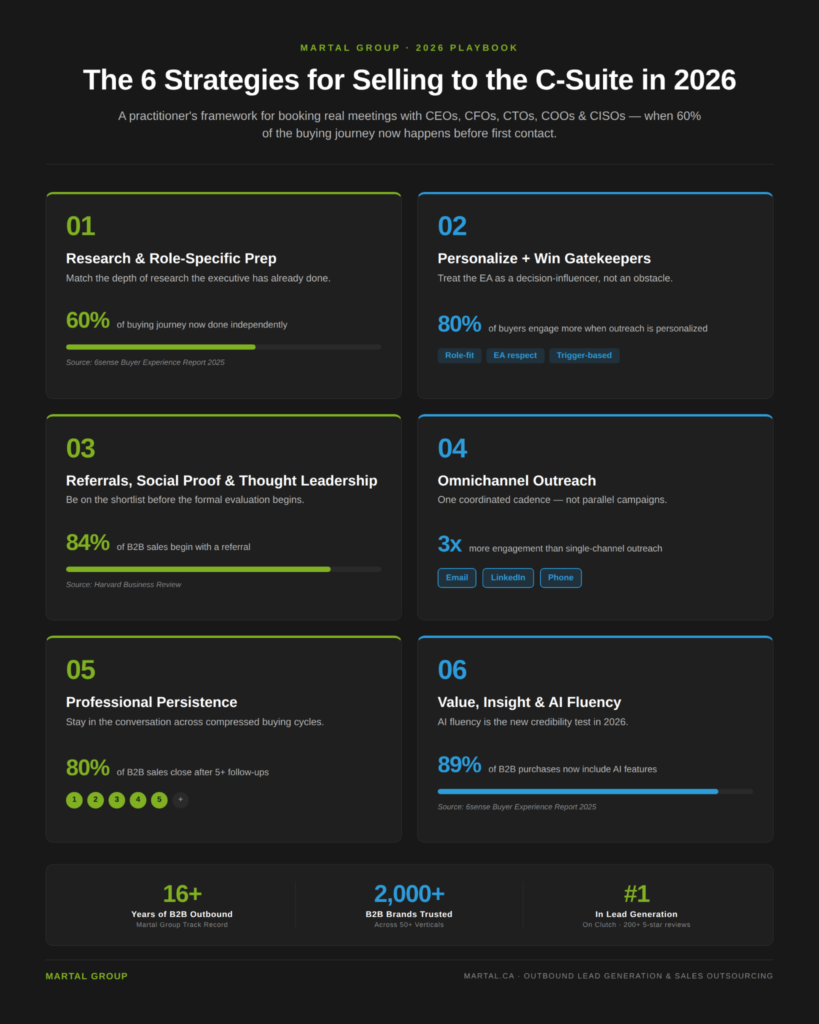
Across our outbound campaigns to CEOs, CFOs, CTOs, COOs, CISOs, and other C-level decision-makers, these six strategies consistently separate the sellers who book executive meetings from those who do not. They build on each other in order:
- Research and role-specific preparation — because executives have already done their own homework, and your prep needs to match the depth they have put in.
- Personalize every outreach — and win over their gatekeepers — because executive assistants and chiefs of staff are not obstacles, they are decision-influencers.
- Leverage referrals, social proof, and thought leadership — because trust signals at the buying-committee level get you onto the shortlist before the formal evaluation begins.
- Adopt an omnichannel outreach strategy — because no single channel reaches every executive, and the deal lives or dies on the broader buying committee, not just the title.
- Be professionally persistent — because 80% of B2B sales still close after five or more follow-ups, and buying cycles are getting shorter, not longer.
- Lead with value, insight, and AI fluency — because executives give time only to sellers who bring something new to the conversation, and AI fluency is the new credibility test.
Skip any one of these and the others have to work harder to compensate. Apply all six consistently and you do not just book more C-level meetings — you start being invited back.
1. Selling to the C-Suite Starts with Thorough Research and Role-Specific Preparation
82% of B2B decision-makers say sales reps are unprepared to engage with them effectively.
Reference Source: Saleslion
The first strategy for selling to the C-suite is the simplest one: do your homework. The catch in 2026 is that “homework” means more than skimming a LinkedIn profile and pulling a recent press release. Today’s executives are arriving at the meeting having already done most of their own research — the 6sense Buyer Experience Report shows buyers complete roughly 60% of their journey before first seller contact (8), and Gartner research finds B2B buyers spend only 17% of their total purchasing time meeting with potential vendors (10). When you finally get a slice of that 17%, your prep needs to match the depth they have already done on their own. Yet 82% of decision-makers still say most reps fall short (1). In other words, failing to prepare is preparing to fail — and C-level prospects can tell within minutes.
Across our outbound campaigns, the research phase is what separates a meeting that gets booked from one that gets ignored. Three things have to come together: the right executive, the right trigger, and the right role-specific message.
Identify the right C-level executive
Larger organizations have several C-suite titles, each owning a different problem. Pinpoint who owns the problem your product solves. Pitching a cybersecurity solution? The Chief Information Security Officer (CISO), Chief Information Officer (CIO), or Chief Technology Officer (CTO) is the target — not the CEO. Offering a sales automation tool? The Chief Revenue Officer (CRO) or VP of Sales is the better fit. Selling supply chain software? Aim at the COO or VP of Supply Chain. Picking the wrong door is one of the most common reasons cold outreach to “the C-suite” gets nowhere — the message lands in front of someone who simply does not care about the problem you solve.
Research the right things — and time it to a real signal
Once you know who, dig into what is changing in their world. Annual reports, earnings calls, press releases, podcast interviews, LinkedIn posts, industry news, hiring patterns, technology adoption, funding rounds — these are not nice-to-haves. They are how you find a trigger event: a recent change inside the account that creates a real reason to reach out now rather than next quarter.
Trigger-event research matters more in 2026 than it ever has, for one simple reason. According to Gartner, 99% of B2B purchases are driven by a specific organizational change (10), and the first seller to reach a decision-maker after a trigger event is roughly 5x more likely to win the deal (11). Generic outreach without that signal lands around a 3% reply rate; signal-personalized outreach referencing a real, recent event in the executive’s world lands closer to 18%. The implication for selling to the C-suite is straightforward: showing up at the right moment is at least as important as showing up with the right pitch.
What counts as a real trigger? A recent funding round. A leadership change at the VP+ level. An acquisition or expansion announcement. New job postings that suggest a strategic initiative is forming. A CISO publicly commenting on a breach in their industry. A CFO mentioning cost discipline in an earnings call. The work is finding the one that genuinely matters to the executive you want to reach — and getting there before three other vendors find the same signal.
Tailor your prep to the role, not just the executive
This is where most C-suite outreach falls apart. Even when sellers identify the right executive and the right trigger, they pitch all C-level titles as if they share the same priorities. They do not. A CFO and a CTO can read the exact same outreach and walk away with completely different impressions of whether you understand their world. The fix is to anchor your research and your message around what each role is actually accountable for — and what specific outcomes get them promoted, fired, or noticed by the board.
C-Suite Roles and Top Priorities
Role
Top Priorities
Common Pressure Points
Messaging Angle That Lands
CEO
Growth, vision, board confidence, market position
Hitting growth targets, beating competitors, capital efficiency
Strategic outcome — competitive edge, market timing, category leadership
CFO
Financial efficiency, margin protection, ROI, risk
Cost discipline, forecast accuracy, capital allocation
Hard numbers — cost saved, revenue retained, payback period, downside risk
COO
Operational performance, scale, execution
Process inefficiency, scaling without breaking, cross-functional friction
Operational impact — hours saved, throughput, friction reduced
CTO / CIO
Technical innovation, architecture, integration, technical debt
Build vs. buy decisions, integration complexity, vendor sprawl
Technical credibility — integration depth, security posture, time-to-value
CISO
Risk mitigation, compliance, threat response
Audit findings, breach exposure, regulatory pressure
Risk reduction — exposure reduced, compliance gaps closed, response time
CMO
Pipeline, brand, customer acquisition, retention
CAC inflation, attribution, brand differentiation
Demand impact — qualified pipeline, CAC efficiency, brand lift
CRO
Pipeline, win rates, quota attainment, sales productivity
Stalled deals, ramp time, revenue predictability
Revenue outcome — booked meetings, conversion rate, sales velocity
Once you have mapped the role correctly, your research has direction. For a CFO, look for budget signals and recent cost-discipline commentary. For a CTO, look for tech-stack changes and architectural priorities. For a CISO, look for compliance milestones and recent industry breaches. The point is not to drown in research — it is to walk in with one or two findings sharp enough that the executive thinks, “This person understands my actual job.”
Condense your research into one piece of actionable insight
The final step is compression. Most reps over-prepare and under-edit. They walk into a call with twelve facts about the company and zero point of view. The executive does not want a recital — they want one observation that earns the meeting and a hint at what comes next.
For example: a CEO said in a podcast last quarter that customer retention is the company’s number-one focus for the year. That is the hook. Open the email or call by referencing the goal and signaling — concretely, in one line — how you can help. “Saw your podcast comment that retention is the priority this year — we’ve helped three SaaS companies in your category cut churn by 15–25% within six months. Worth a 15-minute conversation?” That sentence alone signals respect for time, role-level fluency, and a relevant outcome. It is the difference between an outreach that gets ignored and one that gets opened.
What this looks like in practice. In one engagement with a US-based IT company specializing in HTAP and data management, our team targeted CFOs, CTOs, and VPs of Technology across enterprise tech, manufacturing, finance, insurance, and healthcare. By anchoring every outreach to a specific role-level priority and a real trigger inside the account — recent funding, a tech-stack change, a regulatory deadline — we delivered 148 leads, 119 MQLs, 35 SQLs, and 21 booked meetings in five months. The CEO’s takeaway captured why the approach worked: “No fluff to their marketing — they were genuine in their messaging.” That kind of genuine framing only comes from doing the prep before the outreach goes out.
In short, meticulous, role-specific, signal-aware preparation is the foundation of C-suite appointment setting. The best sellers come to the conversation as quasi-consultants — already familiar with the executive’s world, the buying committee around them, and the change inside the account that makes now the right moment. Skip that work, and a C-level prospect will know within minutes. Do it well, and you will be the rare seller they actually invite back.
2. Personalize Every Outreach When Selling to the C-Suite — and Win Over Their Gatekeeper
71% of customers expect companies to deliver personalized interactions.
Reference Source: McKinsey & Company
The era of blasting template pitches is over — especially when the inbox belongs to the C-suite. Busy executives do not respond to generic outreach, and they have less patience for it now than they did even two years ago. Personalization is the floor: 80% of buyers are more likely to engage when a message feels tailored to them (2), and Gartner’s 2025 research found that 75% of B2B buyers now prefer a rep-free sales experience (10), meaning the few outreach moments you do get are higher-stakes than ever. The flip side is the opportunity: when an executive can tell you have actually paid attention to their world, you stand out from a wave of sellers who clearly have not.
Personalization picks up where your research left off. The intel you gathered in Strategy 1 becomes the raw material for outreach that sounds written for one specific human being, not pasted from a sequence template. Across our outbound campaigns to CEOs, CFOs, CISOs, COOs, and CROs, three layers of personalization separate the messages that get replies from the ones that get archived: what you reference, how you deliver it, and how you handle the people who guard the executive’s calendar.
Reference something specific — and recent
Start with specifics. Mention a real company development. Quote something the executive said in a podcast or interview. Reference an industry trend that has hit their P&L. The example below has worked for us in real campaigns to SaaS executives:
“Hi Jane, I saw in your latest shareholder letter that customer experience — particularly reducing churn — is a top priority for ACME Corp this year. We recently helped another B2B SaaS company cut churn by 15–25% within six months. Worth a 15-minute conversation next week?”
A message like that signals two things at once. First, you have done your homework. Second, you are not going to waste the meeting on basics — you are already inside the conversation. That is a meaningful contrast to the generic “We help companies like yours increase revenue” outreach a CEO sees ten times before lunch.
Match your tone to the executive, not your template
Beyond what you say, consider how you deliver it. The C-suite is made up of individuals with very different communication styles. Some CEOs write in clipped, no-nonsense sentences on LinkedIn — mirror that brevity. Others are detail-oriented and want hard numbers — lead with a stat, not a story. Some CTOs respond best to technical specificity; others to strategic narrative. Match channel and cadence to what their public footprint suggests they prefer. If they post short, write short. If they cite data, cite data.
This is the part of personalization that AI-generated outreach still gets wrong. AI can pull a fact and stitch it into a template, but it does not consistently match an individual’s voice. The outreach that converts in our campaigns is human-edited at the executive level — AI handles the heavy lifting on research and variables, and the Sales Executive writes the final message that lands in the inbox.
Personalize for the role, not just the person
Each C-suite title reads the same value prop differently. A CFO wants hard numbers. A CTO wants technical credibility. A COO wants operational impact. A CISO wants risk reduction. (We broke this down in detail in the role-by-role table in Strategy 1.) When you write, frame value through the lens of the role on the receiving end — not whatever framing your marketing team happens to find most compelling.
Handle the gatekeeper as a real audience, not an obstacle
Here is where most C-suite outreach overlooks the most important person in the conversation: the executive assistant or chief of staff. People often ask, “How do you get past an executive assistant?” or “Should I try to bypass the gatekeeper?” Both questions miss the point. You are not trying to get past the EA — you are trying to get through them, with their help.
Senior executive assistants are not low-level filters. They are trusted operators who know what the executive cares about, what is on their calendar, and what is currently noise versus signal. They have real influence. They also have long memories. Treat them with respect, explain who you are and why you are reaching out clearly, and your odds rise dramatically. We have had EAs forward outreach to their executive with a personal endorsement after a single thoughtful exchange — and we have had cold, dismissive emails killed on the spot.
A few things that actually work when EAs are part of the equation:
- Be transparent about who you are and what you want. “I’d like 15 minutes with [Executive] to discuss [specific, relevant topic] — would early next week work?” is far stronger than a vague “can I get on her calendar?”
- Acknowledge the EA’s role. Address them by name. Ask if there is a better contact or a better time. Treat the exchange as a genuine collaboration.
- Respect the no. If an EA tells you the timing is wrong or the topic does not fit, do not push. Ask when might be better, thank them, and follow up then. They will remember the professionalism.
- Do not try to outsmart the calendar. Tactics like “scheduling around” the EA, sending direct calendar invites without prior conversation, or going around them to other employees almost always backfire. EAs talk to each other. So do executives.
Practical ways to layer personalization
A few additional moves we use across campaigns to push outreach beyond surface-level personalization:
- Use the executive’s name and correct title. Double-check spelling and whether they go by a short name (Bill vs. William). A misspelled name is the fastest way to be marked as spam in the executive’s mind.
- Reference a mutual connection. A name they will recognize — a peer, a customer, a board member — instantly raises your credibility. (More on referrals in Strategy 3.)
- Cite their company’s recent news. A funding round, a product launch, an executive hire, a market entry — anything that signals you are paying real attention to their world right now.
- Tailor your case studies. To a CISO, lead with a security-leadership win. To a CFO, lead with a financial outcome. To a CMO, lead with a brand-and-pipeline result. Reuse the role mapping from Strategy 1.
- A/B test your hooks. When working a list of multiple C-level prospects, experiment with different opening angles — quote-driven, trend-driven, signal-driven — and refine based on which replies actually come back.
What this looks like in practice. In one engagement with a US-based cybersecurity SaaS company specializing in data protection, our team targeted CISOs, CFOs, and VPs of IT — a buyer set that punishes generic outreach harder than almost any other. By tailoring every message to the executive’s role, the company’s specific risk posture, and the compliance pressures showing up in their industry that quarter, we delivered 284 leads, 167 MQLs, 42 SQLs, and 12 booked meetings in five months. The CEO summed it up: “Their high-quality prospecting and great database of contacts are amazing.” That outcome rests on personalization at the role level, not just at the executive level.
In short, treat each C-level prospect as the specific human being they are, surrounded by the specific gatekeeper team they trust. The extra work pays compound interest — a busy executive is far more likely to respond when the outreach feels relevant and bespoke (2). It is the difference between being ignored and getting “Sure, I’ll hear you out — how’s next Thursday at 10 a.m.?” in response.
3. Leverage Referrals, Social Proof, and Thought Leadership in Selling to the C-Suite
84% of B2B buyers begin the purchasing process based on a referral.
Reference Source: Harvard Business Review
When it comes to scoring meetings with high-level executives, who you know — or who knows you — can be just as important as what you say. C-level leaders are far more receptive to someone who comes recommended or endorsed by a trusted peer. A Harvard Business Review analysis put the figure at 84%: roughly that share of B2B sales begin with a referral (3). The directional finding has held up. More recent research continues to show that 73% of B2B marketing executives rank word-of-mouth and peer recommendations as the most influential factor in deciding which vendors to consider (12), and 56% of buyers consult existing product users before purchasing — a number that climbs to 71% on enterprise deals.
What has changed since 2016 is the form trust now takes. Referrals are still the gold standard for C-suite access. But in 2026, two newer trust signals matter almost as much: peer social proof at the buying-committee level, and consistent thought leadership that lets executives vet you before any sales conversation begins. Sellers who use all three — referrals, social proof, and thought leadership — get into more C-suite calendars than sellers who rely on cold outreach alone.
Why referrals still beat cold (and always will)
Put yourself in an executive’s position. Would you rather take a cold call from a stranger, or a call from someone a colleague vouches for? Senior leaders rely heavily on their inner circle to filter opportunities. If a fellow CEO, board member, or respected employee says, “You should talk to this vendor — they delivered great results for us,” that meeting is essentially booked. It is no surprise that a referred prospect is 4x more likely to buy and has a 16% higher lifetime value on average (7). The trust is pre-built.
How do you operationalize referrals when selling to the C-suite?
- Tap into your existing customers and network. The fastest path to a new executive is often through one you already know. If you have a strong relationship with a VP or director, ask if they would introduce you to their CEO or another C-level peer who would benefit from your solution. Investors, advisors, and colleagues’ networks count too. A warm intro — “John, I’d like to introduce you to Sarah; she’s been doing impressive work for us in [area]” — is gold. Even a friendly mention on a call (“I was speaking with Jane from [partner company] and she suggested I reach out to you”) changes the response rate dramatically.
- Ask for referrals at the right time. Timing matters. The best moment to ask is right after you have delivered value — a milestone hit, a project successfully wrapped, a renewal closed. Goodwill is at its peak. “I’m so glad we hit [X result] together. I’m trying to help more companies like yours at the executive level — do you know any other CEOs or CFOs facing similar challenges? I’d love an introduction if you’re comfortable.” Make it easy on them: draft a short intro paragraph they can forward, so the lift on their side is minimal.
- Use LinkedIn and social proximity. Sometimes you do not have a direct connection but you do have a second-degree one. Use LinkedIn to map mutual contacts. Shared group memberships, alumni networks, and industry communities create threads you can pull on. Thoughtful engagement with the executive’s posts in the weeks leading up to outreach also warms the room — when your message arrives, your name is already familiar.
- Drop credible client names tactfully. Social proof is not just direct referrals. Naming peers and recognizable companies you have worked with shifts the executive’s risk calculation. “We’ve recently partnered with [FinTech CFO] on a similar initiative…” or “Teams at [Recognizable Brand] use this approach.” Make sure you have permission, and use it without bragging. The implication should be clear: people you respect have already trusted us.
- Reciprocate every referral generously. When someone refers you, treat it like the gift it is. Thank them. Update them on the outcome. Send a referral their way when you can. The relationships that produce repeat referrals are the ones where the value flows in both directions.
Use thought leadership as your front door to the C-suite
Here is the meaningful shift. Even when you do not have a referral, you can build pre-meeting trust at scale through high-quality thought leadership. The Edelman-LinkedIn B2B Thought Leadership Impact Report — the seventh annual collaboration between Edelman and LinkedIn — found that 64% of hidden decision-makers and 63% of target decision-makers spend more than an hour per week consuming thought leadership content (9). Even more telling: executives explicitly use thought leadership as a way to vet potential vendors before any sales conversation happens.
The implication for selling to the C-suite is direct. The CEO or CFO you are trying to reach may already be reading content from your category — they may even have an opinion about your company before you knock. A consistent thought-leadership presence puts you on their shortlist quietly, in the background, while your competitors are still asking for cold meetings.
The bar at this level is high but reachable. Edelman’s research found hidden buyers are less likely to take sales meetings but actively read content that questions assumptions and offers genuinely new perspectives. They reward boldness, not blandness. For sellers, that means three things:
- Publish original points of view, not summaries. Recycled industry takes do nothing. Strong thought leadership names a problem the executive recognizes and offers a perspective they have not seen before.
- Use the executive’s preferred channels. LinkedIn is the dominant venue for C-suite content consumption. Newsletters, podcasts, and curated reports trail behind but matter for specific roles (CFOs trail finance newsletters; CISOs trail security publications).
- Reference your own thinking in outreach. When you finally reach out, anchor the message to a piece you have published. “I wrote a piece last month on why [specific category problem] — wondering if it lines up with what you are seeing at [their company]?” The outreach now has a credibility anchor that a generic pitch does not.
Combined with referrals and social proof, thought leadership is the long game that compounds. Referrals get you in the door once. Thought leadership keeps your name in the executive’s awareness for months — so when the trigger event hits and they go to their shortlist, you are already on it.
One more reason this matters: deals that stall
The same Edelman-LinkedIn report found that more than 40% of B2B deals stall due to internal misalignment within buying groups. That figure is the hidden cost of relying solely on the executive on the cover. The C-suite buyer often needs internal champions to get a deal across the line — and those champions form their opinion of you partly through the thought leadership and social proof they encounter in their own research. The trust you build with the buying committee around the executive is what unsticks deals later.
What this looks like in practice. Clickworker — a global crowdsourcing AI training-data marketplace — partnered with us in a long-running engagement targeting COOs, CTOs, VPs of AI and Data Analytics, and Heads of Data Science. Over a nine-year partnership, the campaign generated $4.5M in recurring revenue, closed three Fortune 10 and three Fortune 500 clients, and delivered 500% ROI. Enterprise C-suite deals at that scale are not won on cold outreach alone. They are won through a sustained mix of credible introductions, peer-level social proof at the buying-committee level, and the kind of consistent presence in front of executive readers that earns a place on the shortlist.
In short, do not go it alone. Referrals open doors. Social proof shifts the executive’s risk math. Thought leadership keeps you in their awareness during the 60% of the buying journey that happens before they ever talk to you. The vast majority of big deals trace back to some combination of all three — so build all three muscles, not just one.
4. Adopt an Omnichannel Outreach Strategy for Selling to the C-Suite
Omnichannel campaigns using three or more channels achieve a 287% higher purchase rate.
Reference Source: Demand Experts
If you have been relying on one method — say, cold email alone — to reach C-level executives, it is time to expand the playbook. Omnichannel outreach is no longer optional. The C-suite inbox is overflowing, calendars are guarded, and buyers complete most of their evaluation independently before any seller enters the picture. To get noticed, you need a coordinated presence across the channels the executive actually uses — orchestrated, not parallel — and you need to do it without being noisy.
The data backs this up. An omnichannel approach yields nearly 3x the engagement of single-channel outreach (2), and Gartner research shows B2B buyers spend only 17% of their total purchasing time meeting with potential vendors (10). Within that narrow window, missing an executive on their preferred channel can cost the deal. The fix is not louder outreach. It is broader, better-coordinated outreach.
A quick note on language. Across our campaigns we use omnichannel, not multi-channel — and the distinction matters. Multi-channel means running parallel campaigns (an email blast and a LinkedIn campaign and a cold-call program) that often duplicate, contradict, or overwhelm. Omnichannel means one coordinated sequence flowing across channels, where each touch references the previous one and adapts to the prospect’s response. The first feels like noise. The second feels like attention.
Why omnichannel works for the C-suite
Different executives prefer different channels. One CEO lives in her inbox. Another never reads cold email but picks up the phone for a known number. A third is highly active on LinkedIn but ignores everything else. Limit yourself to one channel and you may be missing the executive entirely on the medium they actually use.
Repetition across channels also builds quiet familiarity. By the third or fourth coordinated touch — an email, a LinkedIn message, a voicemail — the executive starts to recognize the name. That recognition is what turns a fourth attempt into a reply. Done badly, this looks like spam. Done well, it looks like persistence in a respectful, professional package.
Multi-thread the buying committee — not just the executive
This is the largest 2026 update to the omnichannel playbook. The “C-suite buyer” is rarely buying alone. Gartner research finds the average B2B buying group now includes 6 to 10 stakeholders (10), and Forrester’s State of Business Buying report puts the figure at 13 stakeholders in many enterprise deals, with 89% of buying decisions crossing multiple departments. Each stakeholder arrives at the table with four to five pieces of independently gathered research that they share with the group before a unified decision gets made (13).
That has a direct implication for outreach: targeting only the named C-level executive is not enough. The deal stalls — and Forrester data confirms that 86% of B2B purchases stall at some point in the cycle (13) — because someone in the buying committee was never engaged. The remedy is multi-threading: identifying the broader buying group around the executive (typically including a function head, a technical evaluator, a financial gatekeeper, and an end-user champion) and running coordinated outreach across all of them.
A practical multi-thread plan for selling to a single C-level priority:
Stakeholder
Why they matter
What you send them
C-level executive (e.g. CFO)
Final budget owner, sets strategic direction
Strategic outreach tied to a trigger event, role-level priority, and ROI angle
Direct report / function head (e.g. VP Finance)
Often the executive’s recommender; runs the evaluation
Operational outreach focused on workflow, integration, and fit
Technical evaluator (e.g. IT or RevOps lead)
Decides whether the solution is implementable
Technical outreach focused on integration, security, time-to-value
End-user champion (e.g. FP&A manager)
Internal advocate who lives with the tool
Outreach focused on usability, training, day-to-day impact
The goal is not four separate campaigns. It is one coordinated outreach motion where each stakeholder hears a consistent strategic story expressed in their language — so that when the buying group convenes internally, the messaging holds together instead of contradicting itself.
A 21-day omnichannel cadence that actually works
Below is the cadence we run across most C-suite outbound campaigns. It is not the only valid version — different industries and roles call for different rhythms — but it captures the right principles: spaced touches, varied channels, value layered into each message, and respect for the executive’s time.
The 21-Day Omnichannel Cadence
Day
Channel
Touch Type
Purpose
Day 1
Research-anchored opening message
Introduce yourself, reference a specific trigger event, hint at one outcome
Day 4
Connection request + brief value-led note
Establish presence on the executive’s preferred channel; reference Day 1 email
Day 8
Phone
Direct call (voicemail if missed)
Mention previous email and LinkedIn touches; offer specific topic for a 15-min call
Day 11
Follow-up email with new angle
Share a relevant case study, insight, or peer benchmark — do not repeat Day 1
Day 15
Engage with their content + brief DM
Comment thoughtfully on a recent post; lightly reference your prior outreach
Day 19
Phone
Second call attempt at a different time
Try a different window of day; voicemail if missed
Day 21
Graceful “breakup” email
Acknowledge the silence, restate the offer, close the door politely — leaves the lane open for future re-engagement
Seven coordinated touches across three channels in three weeks. Each one builds on the last. None of them is a copy-paste of the previous touch. By the end of the cadence, you either have a meeting, a productive “not now, try Q3” response (which is genuinely useful), or a clean exit that protects your ability to re-engage in three to six months. That is not annoying. That is professional persistence — the kind executives respect because it mirrors the persistence required to run a business.
Be consistent in story, varied in format
Keep the core value proposition consistent across every touch, but adapt the format to the channel. Email allows three paragraphs and a clear ask. LinkedIn rewards brevity and a conversational tone. A phone pitch needs the elevator version — one line on who you are, one line on why you are calling, one question. The executive should hear a coherent story across all three; the touches should feel related but not duplicated.
A common failure mode: sellers send the same paragraph by email and then again as a LinkedIn DM. That is not omnichannel — that is repetition. True omnichannel reframes the same core idea differently across channels so the executive recognizes the through-line without feeling battered by it.
Use AI to coordinate at scale — but keep the human at the executive level
Modern omnichannel outreach is increasingly AI-assisted. AI handles signal monitoring, list enrichment, channel timing, and personalization variables across the entire prospect base. That is exactly the right role for AI — repetitive, data-heavy work where speed and pattern-matching matter. Across our campaigns, our AI Sales Platform tracks intent signals, surfaces in-market accounts, and orchestrates the cadence. But the final outreach to a C-level executive is written and approved by a senior Sales Executive. That balance — AI for orchestration, human for the executive-level message — is what keeps the outreach feeling considered rather than mass-produced.
A note on what not to automate: never fully automate LinkedIn or text-message outreach to senior executives. They can tell. Generic templated outreach gets flagged, and one auto-generated misfire can poison the entire account for months.
What this looks like in practice. In one engagement with a US-based business-brokerage firm in financial services targeting owners, founders, and CEOs of eCommerce, tech, and internet businesses, our team ran a coordinated omnichannel outbound campaign — email, cold calling, and LinkedIn — over a three-year partnership. The result: 2,316 leads, 1,048 MQLs, 1,219 SQLs, and 832 booked meetings. The Executive Director’s takeaway: “We are impressed with the quality and quantity of opportunities Martal Group has been able to generate for us.” That kind of sustained C-suite meeting volume is not achievable on any single channel. It is only achievable when email, calling, and LinkedIn run as one orchestrated motion across the buying committee, week after week. Read the full case study.
In short, do not put all your eggs in one outreach basket. The modern C-suite inbox is crowded; the modern buying committee is bigger; the modern executive is harder to reach than ever. Strategic omnichannel persistence — across channels, across stakeholders, and across weeks — is often the only way to break through. Be everywhere your prospect is, in a coordinated and respectful way, and eventually they will notice and engage.
5. Be Professionally Persistent — Follow-Up Is Critical When Selling to the C-Suite
Sales success depends on persistence, with 80% of deals needing 5–12 contact attempts.
Reference Source: Qwilr
If one trait separates the sellers who get meetings with the C-suite from those who do not, it is persistence. The most common mistake is giving up too soon. You craft one strong email to a CEO, hear nothing, conclude they are not interested, and move on — handing the win to a more persistent competitor. The reality is that executives are insanely busy, and many almost expect multiple touches before they commit any attention. The stat above bears repeating: the vast majority of B2B sales (80%) only progress after five or more follow-ups (4). Most reps stop after one or two tries.
Two 2026 trends make professional persistence even more important than it used to be. First, buying cycles are getting shorter. The 6sense Buyer Experience Report found that average B2B buying cycles compressed from about 11 months in 2024 to 10 months in 2025 (8) and 49% of buyers said financial pressure directly shortened their cycles, with 62% engaging sellers earlier as a result. The window for influence is narrower, which means the seller who is already in the conversation during that compressed window is the one who wins. Second, even though cycles are shorter, the touch count is not. The same 6sense research found buyers averaged 16 interactions per person with the winning vendor in 2025 — unchanged from the year before. Translation: persistence is still the price of admission. Just delivered faster, more relevantly, and across more channels than before.
Persistence means you keep reaching out periodically. Professional persistence means you do it politely, with value each time, and without crossing into annoyance. That is a real line to walk — and it is walkable with the right discipline.
Don’t interpret silence as rejection
C-level managers ignore the first few attempts because other fires are burning. It is rarely personal. Until you get a clear no, assume not yet and plan the next touch. One CEO might quietly test vendors by ignoring the first three emails to see who actually wants the business. Another may have intended to respond but had your message buried under a re-org or a board prep cycle. Politely persisting signals genuine interest — and keeps you top of mind for the moment they are ready.
Follow a schedule, then stick to it
Map out a follow-up schedule for every prospect, and do not rely on memory or whim. Day 1 outreach → Day 4 → Day 8 → Day 14 → Day 21. (The full omnichannel cadence is in Strategy 4 above.) Use your CRM or platform to track it. Many deals are lost not because the rep failed to convince, but because the rep failed to follow up on time.
Add value or new context in every follow-up
The fastest way to wear out your welcome is to keep sending the same “just checking in” message. Each follow-up should have a purpose. In your second email, share a relevant industry insight or a short case study addressing a challenge they face. In a voicemail, reference a specific result (“We recently helped another company in your category cut churn by 22% — wanted to share what worked, briefly”). In another touch, ask one thoughtful question worth their time. Show that you are not pestering — you are persistently trying to help. Even when they do not respond, they may be reading. You are building credibility with every touch.
Vary the channel and the timing
Persistence is not just frequency — it is technique. If two emails went unanswered, try a phone call next, or a LinkedIn message. A change of medium often elicits a response (“Oh, I meant to get back to you — thanks for the LinkedIn note”). Vary the time of day too. An 8 a.m. email may get buried; a LinkedIn message in the early evening may catch them during a quieter moment. And occasionally, a deliberate pause — followed by a single thoughtful re-entry a few weeks later — produces better results than another immediate follow-up.
Know when to gracefully back off
Professional persistence also means knowing when an executive truly is not interested, so you do not burn the bridge. After roughly six to seven attempts across four to six weeks with zero engagement, step back. Send a final note along these lines:
“I understand now may not be the right time. I’ll pause here. If something changes on your end — or I come across an idea I think will be genuinely useful to you — I may reach out again. Otherwise, thank you for your time.”
Two things often happen after that note. First, it leaves a positive final impression (you persisted, but you respected their lack of response). Second — surprisingly often — it triggers a reply. Sometimes a meeting. Sometimes a “not now, try Q2” that is itself useful information. Either way, you can re-engage three to six months later cleanly.
A note on mindset
Rejection — or, more often, silence — can be discouraging. Do not take it personally. Set the process and trust it. Celebrate small wins: a reply that is not an outright no, or even a polite brush-off (you got feedback). Keep the pipeline full so no single prospect carries the emotional weight of the quarter. That detachment is what lets you stay calmly persistent rather than desperately persistent — and executives can tell the difference instantly.
What this looks like in practice. In one engagement with a US-based manufacturing company specializing in industrial tools and printing equipment, our team targeted owners, presidents, CEOs, VPs, and directors of operations, facilities, safety, and EHS. Over 14 months, the campaign generated 1,596 leads, 1,364 MQLs, 203 SQLs, and 107 booked meetings. The most telling quote came from the National Account Executive on the client side: “We went with two other providers first. On our third try, we went to Martal Group because their model was different.” The buyer themselves had to be persistent to find the right partner — and the eventual partnership outperformed precisely because the model held up under that scrutiny. Read the full manufacturing use case.
That story captures the meta-lesson of this strategy. Persistence pays — for both sides of the conversation. A C-level meeting is rarely won on the first ask. By following up diligently and adding value at every touch, you signal reliability, conviction, and the discipline that mirrors how executives themselves operate. Polite tenacity, paired with professionalism and value, will eventually wear down resistance — or confirm definitively that the deal is not there. There are stories from across our sales development representative campaigns of executives who only said yes on try number seven or eight — sometimes because the timing finally aligned, sometimes because the latest subject line finally landed, sometimes simply because the seller was the only one still showing up.
In short, be politely relentless. Don’t let one ignored message kill the effort. C-level leaders respect persistent sellers — provided the persistence is professional. Couple it with value, and over time the resistance gives way to “alright, let’s talk.”
6. Lead with Value, Insight, and AI Fluency to Entice C-Level Meetings
C-suite executives are 23% more likely to respond to cold emails that align with strategic priorities.
Reference Source: Be Executive Events
This final strategy is the one most directly tied to whether the meeting actually goes anywhere. If you want a C-level executive’s time — 30 minutes, 15 minutes, sometimes 5 — you have to earn it by offering clear value up front. Time is the most precious asset any executive has, and they will not give you a slice of it unless they believe it will be worth it. The stark reality is that only 1 in 10 executives find sales meetings valuable enough to continue (5). Most sellers squander C-suite opportunities by delivering generic pitches, shallow questions, or a laundry list of product features. To break into the top 10%, come with insight, speak the executive’s language, and make every second count.
Here is how to craft outreach and meeting conversations that actually deliver value at the C-level.
Hook them with a compelling insight, not a product intro
Rather than leading with “let me introduce my product,” lead with an insight about their business or a solution to a problem they care about. For instance: “In reviewing your last quarterly report, I noticed your customer acquisition cost has been climbing — common in your industry right now. We’ve developed a strategy that helped a similar SaaS company cut CAC by 20% without lowering spend. Worth comparing notes?” That is a powerful hook. It shows you understand a real issue on their plate and immediately offers a hint at a solution. It is not a vague “we can help you improve results” — it is specific and relevant. This approach is often called insight selling, and it works because executives do not want a basic sales pitch. They want a perspective they have not seen before.
Be outcome-focused, not product-focused
C-level managers care about results: revenue, profit, efficiency, market share, risk reduction. They do not care about your product’s features. Frame everything in business value. Instead of “Our software uses AI algorithms to optimize supply chain processes,” say “Our solution could save your supply chain team dozens of hours a week and millions in operating costs by using AI to optimize logistics — we’ve done this for companies similar in size to yours.” See the difference? The second version zeroes in on what the CEO or CFO actually cares about. When preparing, ask yourself: if I were this executive, what outcomes would impress me — or make me look good to my board? Then orient the conversation around those outcomes. Cut straight to impact.
Be AI-fluent — because they will ask
The biggest shift in selling to the C-suite is that buyers now expect AI fluency from every vendor — and the vendors who cannot answer AI-related questions clearly are getting filtered out before the conversation even starts. The 6sense Buyer Experience Report found that 89% of B2B purchases now include AI features, and 58% of buyers engaged sellers earlier in the cycle specifically to clarify AI-related details that vendor websites and marketing failed to explain (9). This is called “the AI information gap” — buyers want to understand AI capabilities, data sources, security implications, and cost models, and most vendor materials still do not address those questions clearly.
For the seller, the implication is straightforward: come prepared to discuss how AI fits into your solution and into the executive’s problem in concrete terms — not marketing platitudes. Three things to lock down before any C-level conversation:
- Be ready for the capability question. Where does AI sit in your product? What does it do that a non-AI alternative would not? What are the limits? Executives are sophisticated buyers — vague answers signal you are still figuring it out.
- Address the risk question without flinching. How is data handled? Is the model trained on customer data? What are the security and compliance implications? These are real concerns at the CISO and CFO level. Have clear, simple answers.
- Use AI in your own preparation visibly and thoughtfully. Reference where AI helped you research the prospect — intent signals, industry trends, peer benchmarks. But make clear that the strategic outreach itself was crafted by a human. Research from Forrester via Apollo shows 89% of B2B buyers now use generative AI for self-guided research (6) they will recognize generic AI-generated outreach instantly and discount it.
The flip side is the opportunity. Sellers who can clearly articulate where AI helps, where it does not, and how their solution applies to the executive’s specific problem stand out from the noise. It is the new credibility test and most sellers have not yet caught up.
Keep it high-level — and avoid jargon unless they use it
In the initial meeting or pitch, brevity and clarity beat depth and detail. You should be able to articulate your value in a succinct executive summary. Busy executives will not sit through a 50-slide deck or a 10-minute monologue about your company history. They will interrupt — or mentally check out — if you do not get to the point. One effective structure: “You have X challenge; we offer Y solution; resulting in Z benefit.” For example: “As a CFO, you’re focused on improving forecast accuracy (X). Our platform uses real-time analytics (Y) to increase forecast accuracy by an average of 30% (Z).” That is the value stated. After that, let them indicate where they want to dive deeper. Mirror the executive’s level of technical detail — some are deeply technical, others want the strategic frame first. Generally, lead strategic; the technical layer comes in the next meeting with their team.
Engage with smart questions — but few of them
A C-suite meeting is not the place for 20 discovery questions about pain points. You should have done that homework already. Executives are quick to disengage when asked basic questions they could have answered with a Google search. However, a few well-crafted, provocative questions can demonstrate expertise and prompt a real conversation. After presenting an insight, ask something like “How are you currently addressing [X issue]?” or “What changes if [scenario] plays out next year?” Great questions provide value in themselves — they make the executive reflect, sometimes reveal something important, and naturally lead toward your solution. Ask them sparingly. You are there to collaborate on solving a problem, not to interrogate. As Chris Orlob notes, asking generic questions is the single biggest mistake sellers make with the C-Suite (5) — make sure your questions are well-crafted, context-led, and few.
Bring evidence — concise, relevant, and credible
To reinforce the value you promise, come prepared with one or two relevant case studies, data points, or testimonials. Executives respect data. “Clients in your category typically see a 3x increase in pipeline within six months,” or “This approach saved a peer company $2M last year” — those land. Visuals help if you have a slide showing before-and-after impact. A quote from another CEO about your work helps even more (peer influence is huge). Keep proof points concise and on-target. The goal is to answer the unspoken question in every executive’s mind: “Will this actually work for me, or is this hype?” Hard numbers and real outcomes tilt them toward believing it is real.
Close efficiently
Finally, keep the meeting itself efficient. If you booked 30 minutes, aim to finish early unless the executive chooses to extend. They will appreciate it. Summarize key points, confirm interest or next steps, and thank them genuinely for their time. Even at the end, restate the core value (“I’m excited about the possibility of reducing your churn by 15% as we discussed — I’ll send over the data”) so that is the takeaway in their mind.
What this looks like in practice. In one engagement with a US-based healthcare AI company specializing in supply chain management, our team targeted COOs, CFOs, VPs of Supply Chain, Directors of Supply Chain, and Supply Chain Managers. Over nine months, the campaign generated 128 leads, 76 MQLs, 31 SQLs, and 21 booked meetings — meaningful volume in an enterprise healthcare-supply-chain audience that is notoriously hard to reach. The CEO captured the value-led approach in one sentence: “The Martal team translates our value proposition to clients and brings in a steady stream of opportunities.” Translation is the right word. C-suite outreach succeeds when a complex AI-driven offering is rendered as a clear, role-relevant outcome — not as a product description. Read the full healthcare and medical use case.
In essence, value is the currency you trade for a C-suite meeting. Bring a valuable insight, a valuable solution, or a valuable question — ideally all three — and you distinguish yourself from the 90% of sellers who walk in unprepared and add no new value (and thus get shown the door (5)). Apply this consistently across the buying group, and you do not just win one meeting — you build an ongoing relationship as a trusted advisor. That is the ultimate win in selling to the C-suite.
Summary: Mastering the Art of Selling to the C-Suite in 2026
Selling to C-level executives in 2026 is harder than it has ever been. Buyers complete most of their evaluation alone, decide on a preferred vendor before the first call, and reserve only a sliver of their time for meetings with sellers. The six strategies above are the ones we see consistently work inside that compressed window — and they work better applied together than in isolation. Here is the quick recap:
- 1. Research and role-specific preparation. Thorough, signal-aware homework is non-negotiable. Identify the right C-level executive, find the trigger event that creates a real reason to reach out now, and tailor your prep to the role on the receiving end. Generic prep gets ignored — 82% of decision-makers still say most reps fall short (1).
- 2. Personalize every outreach — and win over their gatekeepers. Treat each C-level prospect as the specific human they are, surrounded by the specific gatekeeper team they trust. Personalization at the role and individual level lifts engagement, and a respectful relationship with the executive’s EA is often what gets the meeting scheduled in the first place.
- 3. Leverage referrals, social proof, and thought leadership. Enter through a warm door whenever possible — 84% of B2B sales begin with a referral (3). When a referral is not available, consistent thought leadership gets you onto the shortlist quietly: the Edelman-LinkedIn report found 64% of decision-makers spend more than an hour a week consuming it (9).
- 4. Adopt an omnichannel outreach strategy. No single channel reaches every executive. A coordinated 21-day cadence across email, LinkedIn, and phone — multi-threaded across the broader 6 to 10-stakeholder buying committee — yields nearly 3x the engagement of single-channel outreach (2). The C-suite buyer is not deciding alone; reach them, their team, and the buying group around them in one orchestrated motion.
- 5. Be professionally persistent. 80% of B2B sales still close after five or more follow-ups (4). With buying cycles compressed from about 11 to 10 months in 2025 per the 6sense Buyer Experience Report, the seller already in the conversation when the window opens is the seller who wins (8). Polite tenacity, paired with value at every touch, is what carries deals through.
- 6. Lead with value, insight, and AI fluency. Only 1 in 10 executives finds sales meetings valuable enough to follow up (5). To break into the top 10%, come with a sharp insight, an outcome focus, and clear answers to the AI capability and risk questions buyers are now asking on every call. AI fluency is the new credibility test.
By applying these six strategies as a coherent system rather than a checklist, you transform how you approach selling to the C-suite. Instead of being ignored or passed down the chain, you start landing the calendar invites — and the conversations themselves start feeling like real strategic dialogue, not pitches. Each meeting with a CEO, CFO, CTO, COO, or other C-level decision-maker is a real opportunity, and the playbook above is how you earn it.
Every interaction at the C-level is ultimately about building trust and delivering value. Do that consistently across the buying group, and you will not just set appointments — you will build the kind of long-term relationships that produce repeat business, referrals, and the strongest pipeline you can build.
Now, as you start lining up those high-level meetings, the question becomes who is going to help you fill the top of the funnel with the right C-suite opportunities to begin with — and keep that pipeline full, month after month. That is where we come in.
Ready to Boost Your C-Suite Pipeline? Let Martal Group Help
Breaking into the C-suite is harder than ever — but you do not have to do it alone. If your team is ready to move beyond manual prospecting and start booking real meetings with CEOs, CFOs, CTOs, COOs, CISOs, and other C-level decision-makers, Martal Group can run that program for you.
Here is what makes Martal different. We are an outbound sales partner — not a list provider, not a generic SDR shop. Our onshore teams across North America, Europe, and LATAM run coordinated omnichannel outbound campaigns — cold calling, cold email, and LinkedIn lead generation — for B2B companies in SaaS, AI, cybersecurity, fintech, manufacturing, healthcare, energy, and 50+ other verticals. Our experienced Sales Executives act as the authentic voice of your brand, applying every strategy in this guide — research, role-specific personalization, gatekeeper navigation, omnichannel cadence, professional persistence, and value- and AI-fluent messaging — to fill your calendar with meetings that actually convert. Behind them, our proprietary AI SDR Platform tracks intent signals, surfaces in-market accounts, and orchestrates the cadence at scale, so the Sales Executive team focuses on the conversations that matter.
The track record speaks for itself. Martal is #1 in Lead Generation on Clutch, with 200+ five-star reviews across Clutch, G2, and Capterra, and trusted by 2,000+ B2B brands worldwide over 16+ years of running C-suite outbound. Our clients have closed enterprise deals at Fortune 10 and Fortune 500 companies, broken into new markets in months instead of years, and generated up to 500% ROI on their outbound investment.
Whether you need to fill the top of the funnel with more CEO-qualified opportunities, break into a new market, or get a foot in the door at a strategic enterprise account, Martal can be the engine behind your 2026 growth.
Book a consultation to see how it works. In a no-obligation 30-minute call, we will discuss your goals, your ICP, and the specific C-suite roles you want to reach — and walk you through what a customized outsourced lead generation program would look like for your business. We will also answer any questions you have about our process, our team, our appointment-setting services, and what realistic results look like inside your industry and average contract value range.
It is time to stop wishing for more executive meetings and start making them happen.
References
- Saleslion
- Martal Group – Lead Generation
- Havard Business Review
- Growthlist
- Apollo
- Customergauge
- 6sense Buyer Experience Report
- Edelman-LinkedIn Report
- Gartner
- Prospeo
- Corporate Visions
- Forrester
FAQs: Selling to the C-Suite
How do I get a meeting with a CEO?
Start with the right executive — match the problem you solve to the role that owns it (CISO for security, CFO for finance, COO for operations, and so on) — then pair role-specific research with a real trigger event inside the account. Reference something specific the executive recently said or a recent change at the company in your first outreach. Run it omnichannel: email, LinkedIn, and a phone call coordinated over a 21-day cadence rather than blasted in parallel. And expect persistence: 80% of B2B sales close after five or more follow-ups, so plan a value-led sequence, not a one-shot pitch. The sellers who book CEO meetings consistently combine all of those — research, personalization, omnichannel, persistence, and value — rather than relying on any one in isolation.
How do you handle gatekeepers like executive assistants?
Treat them as decision-influencers, not obstacles. Senior executive assistants are highly trusted operators who control the calendar and know exactly what their executive cares about. Be transparent about who you are and why you are reaching out — “I’d like 15 minutes with [Executive] to discuss [specific topic]” lands far better than vague “can I get on her calendar?” Address the EA by name, ask if there is a better time, and respect a no when you get one. Avoid tactics like sending unsolicited calendar invites or going around the EA to other employees — both almost always backfire. EAs talk to each other and to their executives. A respectful exchange with an EA is often what actually books the meeting; an aggressive one can poison the entire account for months.
How many follow-ups does it take to reach a C-suite executive?
Plan on five to seven coordinated touchpoints across two to three channels over roughly 21 days. The often-cited figure is that 80% of B2B sales close only after five or more follow-ups — and that does not change just because the prospect is a CEO. What changes is how you follow up. Each touch should add value: a relevant industry insight, a peer benchmark, a short case study, a thoughtful question. Never repeat the same “just checking in” message. After six or seven attempts with zero engagement, send a graceful exit note that leaves the door open for future re-engagement. That cadence respects the executive’s time, signals professionalism, and keeps you eligible for a meeting when the timing finally aligns.
What’s the best way to write a cold email to a CEO?
Lead with one specific, recent observation about their company — a line from an earnings call, a quote from a podcast, a funding announcement, a strategic move. Pair that observation with one concrete outcome you have helped a peer in their category achieve, with a real number attached. Keep the email short (four to six sentences), make the ask specific (a 15-minute conversation, not “a quick chat”), and skip the company-history paragraph. A useful template: “Saw [specific recent thing] — we recently helped [peer company or role] achieve [specific outcome]. Worth a 15-minute conversation next week to compare notes?” Avoid generic openers, marketing buzzwords, and fully AI-generated copy. Executives pattern-match to spam fast. The only thing that earns a reply is a message that could only have been written for them.
Do C-suite executives still respond to cold outreach in 2026?
Yes — but the bar is higher than it used to be. The 2025 6sense Buyer Experience Report found that buyers complete roughly 60% of their journey independently before contacting any vendor, and Gartner’s research shows 75% of B2B buyers now prefer a rep-free sales experience. That means the few outreach moments executives do engage with carry more weight, and the messages they ignore get filtered out fast. Cold outreach absolutely still works at the C-level — but only when it is signal-based, role-specific, omnichannel, and tied to real value. Generic cold outreach without research or a clear reason to reach out now lands around a 3% reply rate. Signal-personalized outreach lands closer to 18%. The gap is the playbook.
What do C-suite executives care about most?
It depends on the role. CEOs focus on growth, market position, and board confidence. CFOs care about financial efficiency, margin protection, and ROI. COOs prioritize operational performance and execution. CTOs and CIOs focus on technical architecture and integration. CISOs care about risk mitigation and compliance. CMOs prioritize pipeline, brand, and customer acquisition. CROs focus on revenue, win rates, and quota attainment. The common thread: every C-level executive cares about the outcomes that make them look good to their board and their peers. Outreach that pitches a product fails at this level. Outreach that frames what your solution does in the language of the specific role lands. The full role-by-role mapping appears in the table in Strategy 1: Research and Role-Specific Preparation earlier in this guide.