
 Martal
 Technology
 Education and training
 Web Development and UI / UX
 Healthcare/Medical
 Logistics and Supply Chain
 Information Technology
 Insuretech and Financial Services
 Marketplaces
 Software Development
 E-commerce and retail
 AI and Machine Learning
 Energy and Solar
 Manufacturing
 Security and Surveillance
 Digital Marketing Agency
 Transportation
 MSP
MSP
 Telecom
 B2B SaaS
 Cybersecurity
 HR tech
 Fintech
 Cleantech
 Consulting
Where to Find B2B Leads in 2026: The Omnichannel Playbook for Pipeline Growth
Major Takeaways: How to Find B2B Leads in 2026
Pipeline comes from a coordinated mix of intent data, LinkedIn, cold email, cold calling, and AI-enriched databases. Buyers now use an average of 10+ channels in a single purchase journey, and 42% touch 11 or more before they ever talk to sales.
Cold email on its own averages a 3.4% reply rate. Coordinated email + LinkedIn + phone sequences lift outcomes by up to 287% over email-only. Buyers experience one journey, not separate channels — and the data reflects it.
Intent-sourced leads convert 3.4x more often than cold ICP-match outreach (18.7% vs. 5.5%), and they carry 23% higher average contract values because they enter the funnel later, with budget already in motion.
AI lead finders and agentic AI SDR platforms have reduced cost-per-meeting from $312 to $94 in 2026 cohorts and lifted qualified-lead volume 50–70% versus manual prospecting. Speed and precision are the real unlock — not automation for its own sake.
Yes, but the bar is higher than it used to be. Generic email blasts get under 1% replies; campaigns with advanced personalization hit 15–18%. The channel works when it is targeted and sequenced — not when it is loud.
The benchmark is 12–15 touches across email, phone, and LinkedIn over 2–3 weeks. Yet 48% of reps never send a second message, and 80% of sales close only after five or more follow-ups. Persistence is where most teams break.
When ramp speed, omnichannel coordination, or specialized tooling are the constraint. Internal SDR builds typically take 6–9 months to hit productivity; an outsourced motion paired with intent data and a real database starts producing SQLs in 30 days.
Across our managed campaigns, omnichannel sequences have produced 832 booked meetings over three years for a financial services firm, 108 meetings in three months for an AI freight platform, and — in one case — a single closed deal that covered the entire campaign cost. Real proof beats round numbers.
Introduction
Sourcing quality leads is still the number one challenge for B2B marketers — 61% say it’s their biggest struggle (15). That’s rarely a tooling problem. It’s a coordination problem. Buyers now move across 10+ channels in a single purchase journey, and 42% touch more than 11 different touchpoints before they ever speak to a sales rep (1). Teams still running single-channel outreach are losing pipeline to the ones who aren’t.
The questions we hear most often from sales and marketing leaders — and that show up consistently on online communities — keep returning to the same theme: where do B2B leads actually come from now, and how do you find them without buying a stale list?
We built this guide from three sources. The most current data on channel performance, intent signals, and AI-assisted prospecting. The lead-source categories sophisticated buyers actually use to evaluate vendors. And 16+ years of running outbound campaigns at Martal across SaaS, cybersecurity, manufacturing, fintech, and more than 50 other verticals. The goal is a working playbook, not another listicle.
Here’s what we’ll cover: where to find B2B leads in 2026 — the six real source categories, including AI lead finders, intent data platforms, communities, and databases — followed by how to engage those leads across email, LinkedIn, and phone in a coordinated omnichannel sequence. We’ll show what’s working in the data, where most teams break, and what an outsourced motion looks like when you’d rather skip the build phase entirely.
Why Omnichannel Outreach Is How You Find B2B Leads in 2026
B2B customers now use an average of 10 different channels in their buying journey.
B2B buyers don’t experience your motion as email versus phone versus LinkedIn. They experience one journey with multiple entry points. Data shows buyers now use an average of 10+ channels in a single buying process (1) — roughly double what it was five years ago — and 42% touch 11 or more before they make a decision.
That shift has made channel integration the work that actually moves pipeline. A prospect might find you through a LinkedIn post, research your website, read a G2 review, attend a webinar, get an email from an SDR, and finally pick up a phone call. They expect those touches to feel connected. Sellers stuck on one or two channels miss the buyers who only respond on the third.
What “omnichannel” actually means in 2026. It’s not multiple channels running in parallel. It’s a single campaign sequenced across channels, where the email references the LinkedIn touch, the call references the email, and the whole sequence reflects the same value hypothesis. When that coordination breaks, prospects feel like they’re hearing from three different companies — and momentum dies.
The performance data is now unambiguous:
- 287% lift — the average gain when teams add LinkedIn and calls to email-only sequences (12); cross-referenced in our own B2B sales statistics roundup (14).
- 3.4% average cold email reply rate — single-channel teams are competing for a shrinking slice of inbox attention (13).
- 80% of sales require five or more follow-ups, yet roughly 48% of reps never send a second message — persistence is where most outbound programs break (12).
- 60% of buyers switch suppliers because of poor cross-channel experiences, and B2B firms with strong omnichannel engagement see up to a 20% lift in customer satisfaction (14).
Different prospects also respond to different channels — and most teams underestimate how much that varies by role. The executive who ignores cold emails will often pick up a phone call. The buyer who lives on LinkedIn hates voicemail. A real omnichannel approach covers the spread instead of betting on the channel your team prefers.
Working example — Afton Tickets. When we ran a 9-month omnichannel program for Afton Tickets — combining email, LinkedIn, and phone outreach across the events and venues sector — the campaign produced 518 engaged prospects, 97 SQLs, and 5 closed deals. One closed deal alone covered the full campaign cost. That kind of return doesn’t come from any single channel. It comes from sequencing.
The harder truth: omnichannel is operationally demanding. Coordinating timing, messaging, and tooling across channels is exactly why only 41% of marketers say they’re fully satisfied with theircurrent outreach strategy (2). The teams pulling ahead are the ones treating omnichannel as one orchestrated process — not a checklist of disconnected channels.
That orchestration starts with knowing who to target and when. Next, we’ll cover how intent data and ICP work change which leads you find — and which ones you waste cycles on.
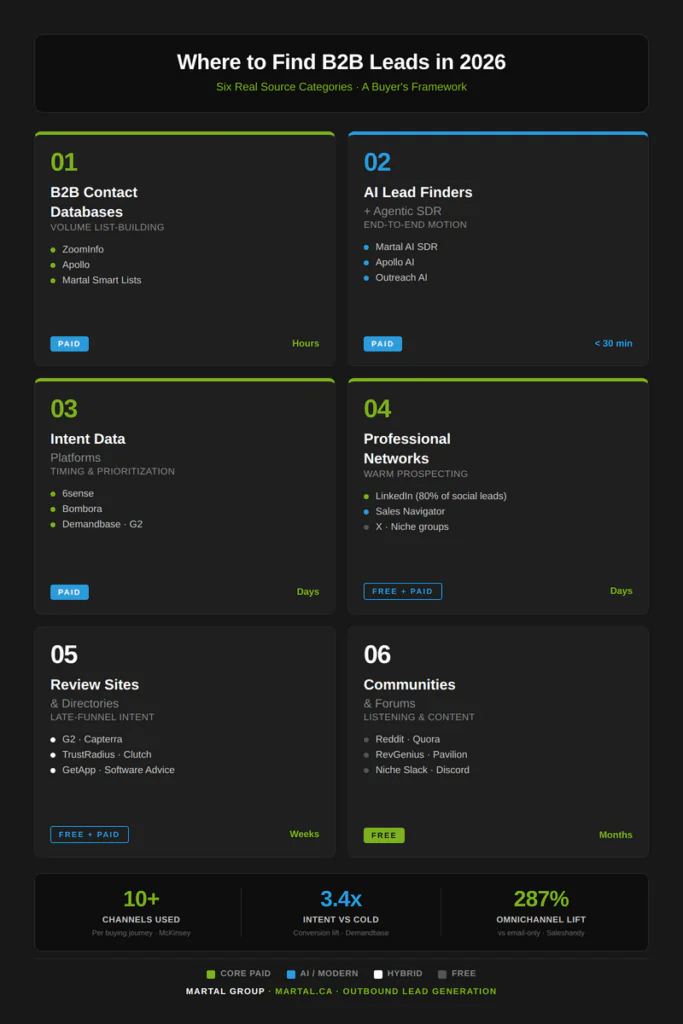
Where to Find B2B Leads in 2026: The Six Real Source Categories
Not every “lead source” delivers the same kind of lead. The fastest way to fill pipeline is knowing which category fits which gap in your motion.
In online sales communities the same questions come up over and over from founders and sales leaders: “Where do you guys find leads for your business?” and “Where can I find B2B leads besides LinkedIn?” The honest answer is that there isn’t one place. There are six recognizable categories of lead sources, each solving a different problem.
Below is the framework we use when we build campaigns for clients across SaaS, cybersecurity, manufacturing, fintech, and 50+ other verticals. The categories aren’t ranked. They’re complementary. The mistake most teams make is picking one and assuming it solves the whole pipeline problem.
Category 1 — B2B Contact Databases
What they are: Subscription platforms that aggregate verified contact data — names, emails, direct dials, firmographics, technographics — across millions of companies. ZoomInfo, Apollo, Cognism, Lusha, RocketReach, and Martal Smart Lists all sit in this category.
Strengths: Scale and speed. A database can produce a 2,000-prospect list inside an hour and a 50,000-prospect list inside a day, segmented by industry, headcount, role, and tech stack. For most outbound motions, this is the starting point.
Limitations: Data decays fast. Contact accuracy on most databases sits in the 70–85% range, which means a meaningful percentage of every list is stale on arrival. Pricing also climbs steeply at enterprise scale.
When it fits: Anytime your motion needs a fresh, segmented lead list at the top of the funnel. Most providers offer trials or freemium tiers worth testing before committing.
Where Martal fits: Smart Lists pulls from a waterfall of 20+ underlying databases and runs continuous AI enrichment — 300M+ verified contacts across 24M+ accounts, with 1,500+ enrichment fields per company record. The difference from a single-source database is that lists keep updating as people change roles, companies raise funding, or new accounts enter your ICP criteria. No manual rebuild.
Category 2 — AI Lead Finders & Agentic SDR Platforms
What they are: A newer category that combines database access, intent signals, and AI-generated outreach in one platform. Instead of building a list in one tool, enriching in another, and sending from a third, an AI lead finder handles the full motion — list-building from natural language inputs, qualification, sequencing, and follow-up.
Strengths: Speed-to-campaign. The best platforms move from ICP input to live outbound in under 30 minutes. They also learn from campaign data over time — what subject lines work, which personas convert, where the cadence breaks. AI-assisted SDR programs have reduced cost-per-meeting from $312 to $94 in 2026 cohorts (10).
Limitations: AI doesn’t replace strategy. The tools work when they have a clear ICP, a real value proposition, and human judgment in the loop. Teams treating AI lead finders as a “set and forget” replacement for sales judgment get the same generic outreach everyone else does.
When it fits: Teams that already have an outbound motion but want to stop stitching together five tools. Also teams that want intent-based prioritization and personalized outreach without hiring a full SDR bench.
Where Martal fits: Our AI SDR platform was trained on 15+ years of outbound campaign data, 40M+ campaigns, and 50M+ sales interactions. It runs across email, LinkedIn, and phone as one coordinated motion — not three parallel tools — and surfaces 10M+ real-time buying signals so outreach hits when something has just changed in a buyer’s world. Campaign live in under 30 minutes.
Category 3 — Intent Data Platforms
What they are: Tools that monitor what companies research across the web — funding rounds, hiring surges, content downloads, G2 comparisons, technology adoption — and surface accounts most likely to buy soon. 6sense, Bombora, Demandbase, ZoomInfo Intent, and G2 Buyer Intent are the standard names.
Strengths: Timing. Intent-sourced leads convert 3.4x more often than cold ICP-match outreach — 18.7% vs. 5.5% — and carry 23% higher average contract values, because they enter the funnel later in the buying process with budget already in motion (10).
Limitations: Intent data without an outreach motion is just a dashboard. You also need ICP fit on top of intent — a company researching your category isn’t automatically a buyer for your product.
When it fits: When your sales cycle is long, deal sizes are high, and your team can move fast on a signal. Less useful for transactional motions where every account is worth the same.
Where Martal fits: Smart Lists and the AI SDR both monitor 10M+ intent signals in real time and feed prioritized accounts directly into campaign orchestration. Intent-based targeting has lifted client conversion 2x in our own intent-based programs.
Category 4 — Professional Networks & Social Platforms
What they are: LinkedIn (and Sales Navigator), X/Twitter, niche professional groups, and increasingly Bluesky for tech audiences. Free at the base tier, paid for advanced filters and outreach volume.
Strengths: Real-time signals on the people themselves — job changes, new roles, posts about pain points, engagement with competitors. 80% of B2B social media leads originate on LinkedIn (5). For warm prospecting, this is the strongest channel in the mix.
Limitations: No built-in verified contact info. You’ll need a database or enrichment tool to convert a LinkedIn profile into an email and phone number you can act on at scale.
When it fits: Always — but especially when your buyers are senior decision-makers who research peers and competitors publicly. See our breakdown of LinkedIn lead generation for the specific tactics that work in 2026.
Category 5 — Review Sites & Software Directories
What they are: G2, Capterra, GetApp, TrustRadius, Clutch, Software Advice. Free to use as a buyer; paid to claim and promote a presence as a vendor.
Strengths: Visitors are in active comparison mode — late-funnel intent, not awareness. Many platforms also surface buyer-intent data showing which companies viewed your competitor’s profile or downloaded a comparison.
Limitations: Coverage depends on whether your category is well-defined on these platforms. New or niche categories are thinly covered; mature ones are saturated.
When it fits: Two distinct plays. First, defensively — to make sure your presence is strong on the sites buyers actually use. Second, offensively — buying intent signals from G2 or pulling competitor reviewer lists for outbound.
Category 6 — Communities & Forums
What they are: Reddit (r/sales, r/Entrepreneur, industry-specific subs), Quora, niche Slack groups, RevGenius, Pavilion, industry-specific Discord servers and forums. Free to participate.
Strengths: Real questions from real buyers. The exact pain points your prospects type into Reddit at 11pm are usually more honest than what they tell vendors on discovery calls.
Limitations: Not scalable as a primary channel. Promotion is punished — anything that smells like a pitch gets removed. The play is genuine contribution over months, not direct outreach.
When it fits: Best as a listening and content distribution channel rather than a direct lead source. Sales leaders building authority and content marketers researching pain points get the most out of it.
Paid vs. free: what most teams get wrong
A common Reddit and Quora question: “What are some cost-effective ways to generate leads?” The honest answer is that the cheapest channels (communities, review sites, organic LinkedIn) require the most time. The most expensive (databases, intent platforms, AI SDR platforms) save the most time but require investment up front.
Source category
Cost profile
Speed to first lead
Best primary use
B2B contact databases
Paid (mid–high)
Hours
Volume list-building
AI lead finders / SDR platforms
Paid (mid–high)
Under 30 min
End-to-end outbound motion
Intent data platforms
Paid (mid–high)
Days
Account prioritization & timing
LinkedIn & professional networks
Free + paid tiers
Days
Warm prospecting & research
Review sites & directories
Free + paid tiers
Weeks
Late-funnel intent capture
Communities & forums
Free
Months
Listening & content distribution
The teams getting the strongest pipeline aren’t picking one. They’re combining a paid source for scale (database or AI SDR), a paid signal layer for timing (intent data), and a free channel for trust-building (LinkedIn or communities). The buying group is on all six. Your sourcing motion should be too.
What about buying lists? Another question that comes up constantly on Quora and Reddit — “What is a good place to buy B2B leads from?” — usually has the wrong assumption baked in. Static, purchased lists decay the moment you download them and frequently include prospects who never opted in. The better mental model is to subscribe to a continuously enriched database (Category 1) or a continuously updating lead engine (Category 2), where the list maintains itself.
Case-study proof — financial services brokerage. When we ran an omnichannel program for a US-based business brokerage across Categories 1, 3, and 4 of this framework, the campaign produced 2,316 engaged prospects, 1,219 SQLs, and 832 booked meetings over three years. The executive director’s verdict: “We are impressed with the quality and quantity of opportunities Martal has been able to generate for us.” This is what happens when sourcing isn’t a one-channel bet. View the full Insurtech and Financial services case study.
Now that you know where to find leads, the next question is which channels to engage them on — and how to coordinate the touchpoints. We’ll start with email, then layer in LinkedIn and phone.
Use Data and Intent Signals to Find Leads Who Want to Buy
97% of marketers say intent data enables them to find high-quality leads.
Don’t just find leads — find the right leads at the right time. Most outbound programs underperform not because the channels are broken, but because the targeting is. Sending 500 cold emails to a list that’s only 5% in-market produces 25 real opportunities and 475 ignored messages. Reversing those numbers is where intent data and ICP work earn their cost.
What intent data actually is. Behavioral information about which companies are researching, evaluating, or preparing to buy in your category right now. It comes from a few sources: third-party providers like Bombora that aggregate content consumption across thousands of B2B publications; first-party signals like your own website visits and content downloads; and trigger events such as funding announcements, hiring surges, technology adoption, and leadership changes.
The conversion math has changed enough that intent is no longer a “nice to have”:
- Intent-sourced leads convert 3.4x more often than cold ICP-match outreach — 18.7% vs. 5.5% — and carry 23% higher average contract values because they enter the funnel later in the buying process (10).
- 61% of B2B teams now use AI for lead scoring, up from 23% in 2024. Intent enrichment (47%) and dynamic nurture sequencing (38%) are following (10).
- 20–30% reduction in sales cycle length is the typical lift when teams prioritize accounts using intent signals (10).
A question we see constantly on Quora — “Is intent data worth it for B2B?” — usually comes down to deal size. For transactional motions where every account is worth roughly the same, the answer is “probably not at enterprise pricing.” For complex sales with cycles longer than 60 days and deal sizes north of $25K, the answer is almost always yes.
How to actually use intent data to find leads
A few practical moves we run for clients:
- Layer intent on top of ICP, not instead of it. A company researching your category is interesting. A company researching your category and matching your ICP is a meeting. Run both filters before campaign launch.
- Watch first-party signals on your own properties. Who’s visiting your pricing page? Who downloaded the buyer’s guide? Who showed up on G2 comparing you to a competitor? These are higher-signal than any third-party feed.
- Monitor trigger events. A prospect downloading a whitepaper, asking a question on a forum (9), hiring a new VP, or raising a Series B all suggest something has just changed in the buyer’s world. That window is when outreach lands.
- Score and tier accounts. The top 10% matching your ICP and showing intent should be fast-tracked into a full omnichannel cadence. The rest stay on a lighter nurture track. We walk through this in our guide to B2B lead scoring.
Working example — Polygon. When we ran a 24-month engagement with Polygon, an IoT facilities-services company expanding into North America, the campaign produced 440 engaged prospects, 203 SQLs, and 139 booked meetings. That’s a 46% prospect-to-SQL conversion rate — roughly 4–5x what cold ICP-match outreach produces in the same period. The director of marketing’s verdict: “Professional North American reps, simple project approach.” The targeting precision came from layering intent signals on top of ICP work — not from sending more emails.
There’s also a data-quality dimension most teams underestimate. Clean, enriched contact data — verified email, direct phone, LinkedIn URL, current role, recent firmographic changes — is what makes every other channel actually work. A perfectly timed call to the wrong number is still a wasted call. Most successful outbound teams now use two or more data tools (LinkedIn Sales Navigator, a contact database, and an intent platform) layered together before a single message goes out.
The shortcut for teams that don’t want to build that stack themselves is to subscribe to a platform that already integrates ICP work, intent signals, and outreach — which is most of what an AI SDR platform like Martal’s does. The Martal AI Sales Platform monitors 10M+ intent signals in real time and feeds prioritized accounts directly into the campaign orchestrator.
In short: start your prospecting motion by defining who you target (ICP) and when (intent signals). When email, LinkedIn, and phone all reference the same pre-qualified set of accounts, every channel performs better. Email is the natural place to start — still a workhorse for B2B outreach and a core piece of any motion to find leads.
How to Find B2B Leads Through Cold Email Outreach (Without Becoming Inbox Noise)
Email marketing delivers an average ROI of $36 for every $1 spent.
Cold email is not dead. It is, however, less forgiving of lazy execution than it was three years ago. 61% of B2B decision-makers still prefer email as their primary first-touch channel (12), and the channel continues to deliver one of the strongest ROIs in B2B at $36–$42 returned for every $1 spent. The bar for what counts as a competent cold email has simply moved.
Two questions show up constantly in r/sales and on Quora: “Why are my cold emails not getting replies?” and “Is cold email still effective in 2026?” The honest answer to both is the same. The channel works when the targeting is right, the message is personalized for the actual reader, and the sender follows up. It doesn’t work when teams send 5,000 identical emails and hope volume covers for relevance.
The current benchmarks worth measuring against:
- 3.4% average reply rate across cold email campaigns — but campaigns with advanced personalization (beyond first-name merge tags) hit 15–18% (12) (13).
- 27.7% average open rate — lower than the 36% benchmarks from 2023, mostly because Apple Mail Privacy Protection inflated older numbers. Reply rate is the more reliable signal in 2026.
- 42% of all replies come from follow-up emails, not the first message. Yet roughly 48% of reps never send a second one (12).
- 80% of sales require five or more touchpoints to convert. Sending the fifth or sixth email — when the rest of the market is on attempt two — is one of the cheapest ways to differentiate.
What an effective cold email actually looks like in 2026
If you worked through the previous sections, you already have a lead list of pre-qualified prospects. Now the question is what to send them. After running B2B cold email campaigns for 16+ years across SaaS, cybersecurity, manufacturing, fintech, and 50+ other verticals, a few patterns hold consistently:
- Write a subject line that earns the open. Under seven words. Specific to the prospect. Sounds like a peer, not a campaign. “Quick question about {company}’s Q4 hiring” outperforms “Introducing Our Solution” every time. Personalized subject lines lift open rates by up to 50%.
- Keep the body under 80 words. Top performers routinely stay under that threshold. Busy prospects skim. A good cold email reads in eight seconds.
- Lead with a hook that’s about them, not you. “Hi {Name}, noticed your team is hiring three account executives — congrats on the growth” beats any version of “We help companies like yours…” One specific observation signals you did the research.
- Anchor the value in a specific outcome. “Helped a client in {industry} cut sales cycle by 25% in three months” lands harder than “We drive transformative growth.” Numbers, named industries, and short proof points hold weight.
- Close with a low-friction CTA. “Mind if I send over a one-page case study?” or “Open to a 15-minute chat next Tuesday?” Make saying yes easier than saying no.
- Personalize at scale, not by spray-and-pray. Use merge fields for the basics (name, company, role) and one human-written sentence for the specific thing — a recent post, a funding round, a new hire. Campaigns with multiple custom fields lift replies by up to 142% over generic templates (8).
Follow-up is where most teams break
A workable email cadence for cold prospects looks roughly like this:
- Day 1 — Intro email. The principles above. Specific subject line, short body, one CTA.
- Day 3 — First bump. Reply in the same thread with a fresh angle. “Thought this might be relevant — we recently helped {peer company} with {specific outcome}.”
- Day 7 — Value-add touch. Share a useful insight or short case study instead of pushing for a meeting. Demonstrate competence; don’t keep asking.
- Day 14 — Breakup email. “Should I close the file? Happy to revisit later if now isn’t the right window.” Counterintuitively, these often produce the highest reply rate of the sequence because they remove the social pressure.
Each touch should add a new angle. The fastest way to get unsubscribed is to send “just checking in” five times in a row.
A few execution details that compound: emails go out 9:30–11:30 AM in the recipient’s local time zone for the best reply rates. Tuesday through Thursday outperforms Monday and Friday. Roughly 60% of emails now open on mobile first, so the message has to scan well on a phone — short sentences, short paragraphs, no walls of text. And the sender name should be a real human, not [email protected].
Working example — a US manufacturer of industrial tools and printing equipment. When we ran a 14-month managed campaign for this manufacturer, the email-led omnichannel program produced 1,596 engaged prospects, 203 SQLs, and 107 booked meetings. The national account executive’s framing was telling: “We went with two other providers first. On our third try, we went to Martal because their model was different.” Email worked here — but only as part of a coordinated motion. If you want the same setup managed end-to-end, our cold email service is built around exactly this kind of campaign.
Email alone opens doors. To turn those doors into meetings, pair email with the next channel: LinkedIn. The fastest way to get a reply to a cold email is often a LinkedIn touch referencing it — same person, different medium, reinforcing the same value hypothesis.
How to Find B2B Leads on LinkedIn (and Why It Outperforms Other Social Channels)
80% of B2B social media leads come from LinkedIn.
LinkedIn isn’t just a professional network — it’s where most B2B decision-makers go to research vendors, evaluate peers, and absorb category-level commentary before they’re willing to talk to a sales rep. 80% of B2B social media leads come from LinkedIn, far outpacing X, Facebook, and every other social channel combined (5). 75% of B2B buyers say social media — primarily LinkedIn — directly informs their vendor decisions, and 56% of sales professionals now use social media as a primary prospecting channel. That makes LinkedIn the most concentrated source of sales leads generated through any social platform.
A question that comes up constantly on Reddit and Quora: “How do I find B2B leads on LinkedIn without Sales Navigator?” The honest answer is that you can — but Sales Navigator pays for itself fast for any team running outbound seriously. Native LinkedIn searches have aggressive volume limits that make systematic prospecting hard. Sales Navigator (or an equivalent tool) is the unlock for using LinkedIn as a real source channel.
The current LinkedIn benchmarks worth measuring against:
- InMail response rates of 18–25% — significantly higher than the 3.4% cold email reply average. The trade-off is that InMail is limited by your subscription tier and pricier per touch.
- 40% of B2B buyers have reached out to a vendor after seeing them on LinkedIn (LinkedIn internal data, summarized in our lead generation statistics roundup (3).
- 94% of B2B marketers use LinkedIn for content distribution — the highest of any platform (11).
- 56% of sales professionals use social media to discover new prospects, with LinkedIn the overwhelming starting point.
Where to find B2B leads on LinkedIn specifically
Three plays that consistently produce pipeline:
- Sales Navigator search. Filter on industry, title, company size, region, and recent activity. Build a list of 200–500 ICP-fit prospects and refresh it monthly. This is the foundation — everything else layers on top.
- Competitor follower lists and engagement. Pull the followers of competitors or category-adjacent vendors. People who engage publicly with a competitor’s content are publicly identifying themselves as in-category — a useful signal.
- Group membership and content engagement. LinkedIn Groups have lost some organic reach since 2020, but niche industry groups still concentrate people you’d otherwise have to find one by one. The same applies to prospects engaging with the right hashtags or commenting on relevant posts. Building a consistent content presence — supported by a LinkedIn scheduler or similar tool — keeps your name in the feeds of those same prospects between active outreach touches.
What actually works in LinkedIn outreach
After running LinkedIn lead generation campaigns at scale for clients across 50+ verticals, a few tactics keep producing results — and a few keep killing them.
- Optimize the sender profile first. Prospects will check your profile within minutes of receiving a message. It should read like a peer’s profile, not a recruiter pitch. Headline, banner, and About section should make it obvious who you help and how.
- Engage before you pitch. Like or comment on a prospect’s recent post before the connection request. Make the comment substantive — a real reaction, not “Great post!” By the time the request lands, your name is already familiar.
- Send a connection note with context, not a pitch. “Hi {Name}, enjoyed your recent post on {topic}. I work with a few {role}s on that exact challenge — would love to connect.” That’s enough. No links. No demos. No mention of your product.
- Lead with value once connected. The first DM should not be a sales pitch. Share a relevant resource — a short framework, a recent article, a useful data point — and treat it as the start of nurturing the lead, not the moment to close. “Thanks for connecting. Saw your team is hiring three AEs — here’s a one-pager on SDR ramp time we’ve used with similar teams.”
- Use video sparingly but well. A 30-second personalized video on LinkedIn — addressing the prospect by name and referencing something specific about their business — still cuts through, mostly because the rest of the channel is text. The novelty is decaying, but it remains effective when the content is genuinely tailored.
- Don’t automate the personal touches. LinkedIn penalizes accounts that look automated. The connection request and first DM should be written by a human even when the rest of the workflow is tooled. The cost of a permanent ban on a senior rep’s account is much higher than the time saved by automation.
Other social platforms — where they fit
LinkedIn dominates B2B social, but the other channels have specific use cases:
- X (formerly Twitter) — useful for tech, developer, and creator audiences. Real-time engagement around launches, hot takes, and category conversations. Less useful for enterprise sales motions.
- Industry Slack and Discord servers — niche communities where the right buyers congregate. RevGenius, Pavilion, Demand Curve, and category-specific servers can produce real conversations, but the play is contribution over months, not direct outreach.
- YouTube and podcasts — increasingly important for late-funnel research. Buyers watch demos and listen to operator interviews on long-haul drives or workout sessions. Showing up as a guest or producing your own series builds category authority that compounds.
Working example — Spirit AI. When we ran an outbound program for Spirit AI — a London-based AI trust and safety company expanding into the US market — the campaign engaged 15,000+ prospects per month and produced ~35 SQLs per month in a tightly-defined niche category. LinkedIn carried disproportionate weight for the work, because the buyers (heads of trust and safety at gaming, social, and creator platforms) are concentrated there and rarely respond to cold email without prior LinkedIn warmth. Niche US market entry is where LinkedIn earns its position as the primary channel.
LinkedIn excels at warming up leads through familiarity and trust. It rarely closes deals on its own — but it makes every other channel more effective. A prospect is much more likely to reply to a cold email if they’ve already seen your name in their LinkedIn feed twice in the same week. In the omnichannel motion we’ll map out shortly, LinkedIn is the connective tissue.
Next: the channel most people assume is dead and isn’t — the phone.
How to Find Leads by Cold Calling (and Why the Phone Isn’t Dead in 2026)
Only 2% of cold calls directly result in an appointment, but they remain valuable for building trust and real-time dialogue.
A question that comes up constantly on sales communities: “Is cold calling still effective in 2026?” Yes — but the dispersion between top and average performers has widened. Generic dial-down-the-list cold calling produces roughly a 2% appointment rate. AI-assisted, intent-prioritized calling that’s coordinated with email and LinkedIn touches regularly hits 6–10% for top performers (12). The phone hasn’t lost its power. The bar for using it well has moved.
The phone also remains a high-bandwidth tool for prospecting in scenarios where email and LinkedIn fall short — handling objections in real time, reading tone, and getting a definitive yes-or-no instead of a maybe.
The current data on phone as a B2B channel:
- 57% of C-suite buyers still prefer phone outreach when the conversation is high-stakes. Only 37% of reps say they close most deals via cold calls — there’s a buyer-seller gap most teams underestimate.
- 82% of buyers have booked a meeting with someone who reached out via cold email or cold call in the previous year. The phone is still a working entry point (12).
- 287% engagement lift when phone is coordinated with email and LinkedIn versus running phone outreach in isolation. The phone is most powerful as the third touch in a sequence, not the first.
Where the phone actually fits in an omnichannel motion
Cold calling in 2026 isn’t smile-and-dial from a phone book. It works best after an email or LinkedIn touch has put your name in the prospect’s awareness. The proven pattern: email Monday, the prospect opens it but doesn’t reply; Wednesday you call and reference that email. “Hi {Name}, this is {Rep} from Martal. I sent a short note earlier this week about helping your team find leads in new markets. Wanted to briefly get your thoughts on whether that’s on your radar right now.” Recognition does the heavy lifting — they’re not getting an unsolicited call, they’re getting a follow-up. The integrated call-plus-email cadence has been validated across multiple sales-coaching frameworks, including Woodpecker’s multichannel cadence analysis (6).
The execution details that compound:
- Best call times: 10–11 AM and 4–5 PM in the recipient’s local time zone. Mid-morning catches prospects between meetings; late afternoon catches them as the day winds down.
- Best call days: Tuesday through Thursday. Mondays are clogged with weekly planning; Fridays are reserved or out-of-office.
- Plan multiple attempts on different days and times. Most pickups happen on attempts three through six, not on the first try. A rep should expect to dial a prospect five to eight times across a 2–3 week window before either connecting or moving them off the list.
- Always leave a voicemail. Keep it under 25 seconds. Name, company, one specific reason for the call, and a callback number. “Hi Amy, this is Raj from Martal Group. We help fintech firms accelerate pipeline. I’ll send a short note with details. Number’s 123-456-7890.” Then — within two minutes — send the email referenced in the voicemail. The one-two punch lifts response rates dramatically.
A workable cold call script opens with permission framing (“Did I catch you at a bad time?” — which counterintuitively produces more conversations than “How are you today?”), states the reason for the call in one specific sentence, and pivots quickly to a discovery question the prospect can answer in under 30 seconds. The rest of the call is listening. The full mechanics are in our cold calling guide for B2B sales.
Phone-adjacent channels: SMS and voice notes
Two channels are growing alongside the phone but require more discipline:
- SMS / text outreach. Research suggests SMS messages have a 98% read rate and roughly 45% response rate when used appropriately (4). We don’t run SMS prospecting as a primary channel at Martal — our omnichannel motion is built around email, phone, and LinkedIn — but the channel has real traction when used as a follow-up to existing conversations where the prospect has explicitly opted in. The legal and compliance bar is meaningfully higher than email; teams running it well treat it as a relationship-deepening channel, not a first-touch tool.
- Voice notes via email or LinkedIn. A 30-second audio message through LinkedIn or email is novel enough that prospects often listen out of curiosity. The format adds human voice without the friction of a live call. It works best when the message is genuinely tailored — name, company, one specific observation — rather than templated.
Why the phone still matters
Two reasons. First, a single phone conversation can accomplish what 10 emails cannot: handle objections in real time, gauge tone, and get a definitive yes-or-no. Second, fewer reps are calling in 2026. Many outbound teams have over-rotated toward email and LinkedIn, which makes a well-executed call differentiating — especially with senior buyers who appreciate directness.
Working example — Forerunner Technologies. When we ran an outbound program for Forerunner, a telecom equipment and services provider, the campaign engaged roughly 7,000 prospects per month and produced ~22 SQLs per month. Telecom is a phone-heavy buying environment — buyers expect to talk through technical specs and contract terms, not just trade emails. The phone-led omnichannel motion built consistent pipeline in a competitive market where the alternative was sending emails into the void.
The mental model worth holding: phone calls are the highest-bandwidth channel in the outbound mix. Use them where bandwidth matters — re-engaging cold prospects, handling objections, closing the gap between SQL and booked meeting. Pair them with email and LinkedIn rather than running them as a standalone motion, and the channel still pulls its weight.
Now that you have the three core channels covered, the next question is sequencing — how to coordinate email, LinkedIn, and phone into a single cadence that builds pipeline systematically. We’ll walk through a working example next.
Omnichannel Outreach Sequence to Find Leads: A 14-Day Blueprint for 2026
The optimal prospecting sequence includes 12–15 touchpoints across email, phone, and social over 2–3 weeks.
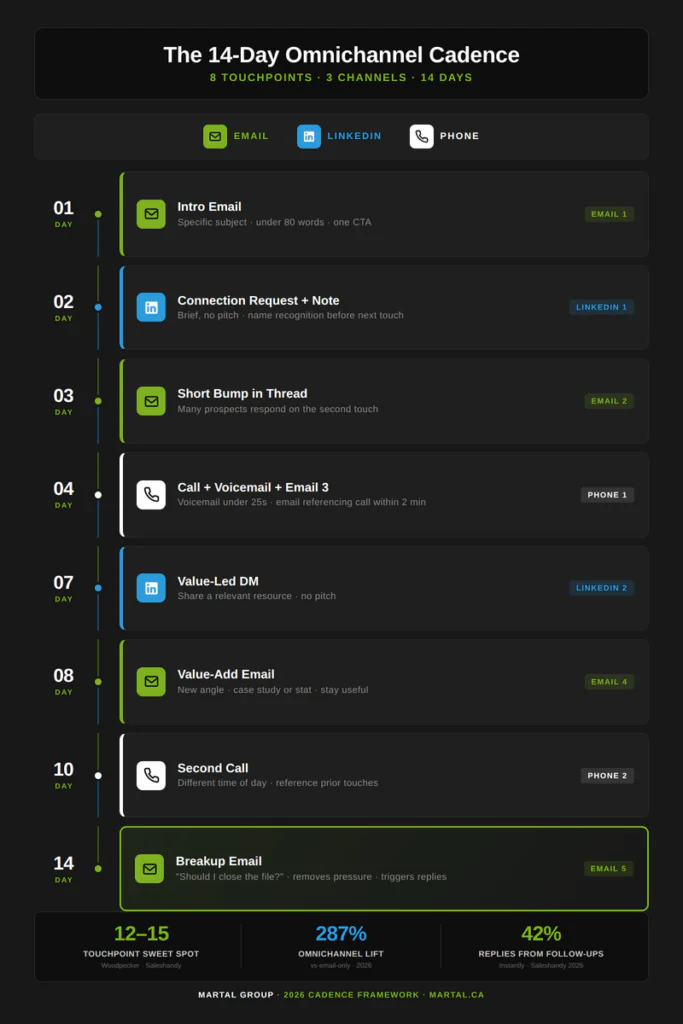
A question that comes up constantly in r/sales and on Quora: “How many cold emails should I send in a sequence?” and “What’s a good cadence for B2B outbound?” The data converges on 12–15 touches across email, phone, and LinkedIn over 2–3 weeks (6). Coordinated email + LinkedIn + phone sequences lift response rates by up to 287% over email-only outreach. The pattern below is the working version we use across managed campaigns. Adjust timing and content to fit your motion.
The 14-day omnichannel cadence
- Day 1 — Email 1: Send a personalized introductory email. Specific subject line under seven words, body under 80, one CTA. Focus on a pain point and value hypothesis. No reply yet? You’re just starting.
- Day 2 — LinkedIn touch: Visit the prospect’s LinkedIn profile (they’ll see the view) and send a connection request with a brief note: “Hi, we work with a few companies in your space — would love to connect.” No pitch. The goal is name recognition before the second email.
- Day 3 — Email 2: Reply in the same thread with a short bump. “Hi, just following up — any thoughts on the idea I shared?” Many prospects respond on the second touch, not the first.
- Day 4 — Phone Call 1 + Email 3: Start the cold call the same week. If they answer, ask whether they saw the email and pivot into a discovery question. If voicemail, keep it under 25 seconds and reference the email. Then — within two minutes of the call — send Email 3 saying “Just tried reaching you by phone; here’s the short version…” The voicemail-plus-email one-two punch consistently lifts response rates.
- Day 7 — LinkedIn message: If your connection request was accepted, send a value-led DM. “Hi {Name}, since you’re working on {topic}, thought you might find this {short framework / article / data point} useful. Let me know what you think.” No pitch. If they haven’t accepted the invite, send an InMail with similar framing.
- Day 8 — Email 4 (value-add): Another follow-up, this time leading with new value. A short case study, a specific stat, or a relevant insight. “Companies running coordinated email + LinkedIn + phone sequences see up to 287% more engagement than email-only outreach — curious if you’ve considered an omnichannel strategy?” Position yourself as useful, not persistent.
- Day 10 — Phone Call 2: Call again, at a different time of day. Reference the resources you’ve shared. “I have a quick idea for {company} I’d love your feedback on. I’ll try again next week.” The second voicemail makes clear you’re being intentional, not aggressive.
- Day 14 — Final email (breakup): A polite sign-off. “Should I close the file? Happy to revisit later if now isn’t the right window.” Counterintuitively, these often produce the highest reply rate of the sequence — the absence of pressure makes it easier for a busy prospect to engage.
That’s 8 touches across email, LinkedIn, and phone in 14 days — roughly the minimum threshold the data supports. Sales coach Jason Bay’s KISS framework extends this to 15 touches over 3 weeks (six emails, six calls, three social), which is closer to the 12–15 sweet spot for cold prospecting (6).
Tips for running the cadence
- Track and adjust. Use a CRM or sales engagement tool to track each touch. If a prospect opens every email but never picks up the phone, double down on email and LinkedIn. If another never clicks emails but answers calls, focus there. Meet the prospect on the channel they prefer.
- Mix up the messaging. Don’t repeat the same generic pitch each time. One touch focuses on a problem, another on a success story, another on a question. Showing different facets of value keeps the sequence from feeling redundant — which is the fastest way to get unsubscribed.
- Multi-thread when possible. Omnichannel isn’t just about multiple channels — it can mean multiple contacts within the same account. Connect with a manager on LinkedIn while emailing the director. Coordinate so you’re not stepping on toes, but multi-threading expands your foothold in larger buying groups.
- Respect opt-outs. If a prospect says they’re not interested or asks to be left alone, bow out cleanly. Omnichannel done right is persistent but professional. The reputation hit from over-pursuing outweighs the upside of one more email.
What sustained cadence discipline produces over time
A 14-day cadence is the right structure for a single account. Multi-year cadence discipline across a full pipeline is where compounding starts to show.
Working example — Awin. When we ran a three-year omnichannel program for Awin, a digital marketing and affiliate platform, the campaign produced 1,204 engaged prospects, 100 SQLs, and 74 booked meetings. The sales manager’s framing: “Martal works as an effective extension of our team.” Three-year results aren’t about one perfect cadence — they’re about running the same cadence consistently across thousands of accounts while adjusting messaging based on what the data shows.
Running this kind of cadence across an entire territory — data-driven targeting, personalized emails, consistent LinkedIn presence, multiple call attempts, tracking every touch — is a lot of work for an in-house team. Many companies, especially growing ones, struggle to execute the full motion internally. That’s where outsourcing changes the math. Many B2B teams now run their omnichannel cadences through outsourced sales development representatives rather than building the capability from scratch. Next, we’ll cover when that decision makes sense — and what it looks like in practice.
When Outsourcing Lead Generation Makes Sense (and What It Actually Delivers)
Organizations with dedicated SDR functions experience 47% faster sales cycles.
The honest framing for outsourcing isn’t “do this instead of building in-house.” It’s “this is when outsourcing makes more sense than the build.” The internal build is the right call if you have a long runway, a senior sales leader who can recruit and train SDRs full-time, and the tooling budget to assemble a deliverability stack, an intent platform, a contact database, and a CRM. The outsourced motion is the better call when one of those is missing — and most growing teams have at least one missing. Lead generation is now one of the most commonly outsourced B2B operations for exactly this reason (7).
A few signals that outsourcing is the better path:
- You need pipeline this quarter, not next year. Internal SDR teams typically take six to nine months to reach productivity. An outsourced motion paired with intent data and a real database starts producing SQLs in 30 days.
- Your team is over-rotated. Founders running outbound on the side, marketing leaders building sequences between campaigns, sales managers manually building lists — these are signals the work isn’t getting the focus it needs.
- You don’t want to license five tools to run outbound. A database, an intent platform, an email infrastructure, a dialer, and a sales-engagement tool together can run $4K–$8K per month in tooling alone before you hire a single rep.
- You want specialization across verticals you don’t already know. Entering manufacturing, fintech, or cybersecurity from a non-native team means months of category education. An outsourced partner already running campaigns in those verticals skips that learning curve.
What outsourcing actually delivers
Across our managed campaigns in SaaS, manufacturing, fintech, cybersecurity, and 50+ other verticals, the operating advantages compound in five places:
- Dedicated focus. An outsourced sales team wakes up each day with one mission — sourcing and engaging leads. Reps aren’t wearing five hats or getting pulled into internal product meetings. Faster follow-ups, more consistent touches, fewer leads slipping through. The first vendor to respond wins 35–50% of deals, and an outsourced SDR or BDR team is built to be that first responder.
- Experienced talent on day one. Our reps average 3–5 years of B2B outbound experience, trained in the latest outreach strategies across 50+ industries. They already know which subject lines open, how to handle gatekeepers, and what objections come up in fintech versus manufacturing. Plug into that on day one instead of training it from scratch.
- Intent data and tooling built in. Our cold email service and broader managed motion include the underlying intent platform, contact database, and AI-assisted prospecting — 300M+ verified contacts, 24M+ company accounts, 10M+ real-time intent signals, all monitored as part of the engagement. You don’t license each layer separately.
- Omnichannel execution at scale. We run lead generation campaigns coordinating personalized email, LinkedIn outreach, and phone calls as one unified motion — the 14-day cadence from the previous section, executed across a full territory. If a channel isn’t working, we pivot quickly based on weekly data review, not quarterly micromanagement from your side.
- ROI you can model. Outsourced lead generation typically pays for itself through higher conversion rates and lower customer acquisition costs — one speed-to-lead analysis put the CAC reduction at up to 58% with optimized outreach processes. The math gets compelling fast once you factor in the cost of missed opportunities from running an under-resourced internal motion.
We also operate with onshore teams across North America, Europe, and LATAM, covering 50+ industry verticals. Trusted by 2,000+ B2B brands worldwide over 16+ years. #1 in Lead Generation on Clutch.
The outsourcing case in one client
Clickworker. When we began working with Clickworker, a German marketplace for AI training data and crowdsourcing services, the goal was North American market expansion. Nine years later, the engagement has produced $4.5M+ in recurring revenue, three Fortune 500 and three Fortune 10 customers, and 500% ROI. Outsourcing isn’t a shortcut. It’s a partnership that compounds when the cadence is run consistently across years rather than rebuilt every time the internal team turns over.
This is the version of outbound that’s hard to replicate in-house — not because the tactics are exotic, but because they require the kind of operational discipline that’s difficult to maintain alongside everything else a growing company has to do.
Where to start
If your pipeline isn’t producing the SQLs your sales team needs to hit number, or you’ve been weighing whether to build versus buy your outbound motion, the cheapest next step is a conversation. We run a free 30-minute consultation that walks through your ICP, current outbound performance, and where an omnichannel motion would actually move the needle. No commitment, no pitch deck — just a working session.
You can also explore how our Sales-as-a-Service model combines experienced onshore SDRs with our proprietary AI platform to handle cold email, cold calling, and LinkedIn outreach as a coordinated omnichannel motion.
The omnichannel blueprint in this guide works. Running it consistently across your full territory is where most teams break — and where the right partner can change what’s possible in your pipeline.
References
- Mckinsey & Company
- Warmly.ai
- Martal Group lead generation statistics
- LinkedIn – SMS marketing
- Foundation Inc.
- Woodpecker
- Reply.io
- Cleverly
- DML Training
- Digital Applied
- Market Me More
- Saleshandy
- Instantly
- Martal Group – B2B sales statistics
- DemandSage
FAQs: How to Find B2B Leads in 2026
Where do you find leads for your business in 2026?
B2B leads come from six recognizable categories: contact databases (Martal Smart Lists, ZoomInfo, Apollo), AI lead finders and agentic SDR platforms, intent data platforms (6sense, Bombora), professional networks (LinkedIn and Sales Navigator), review sites (G2, Capterra, TrustRadius), and communities (Reddit, Quora, niche Slack and Discord servers). The teams getting the strongest pipeline don’t pick one — they combine a paid source for scale, a paid signal layer for timing, and a free channel for trust-building. Buyers now move across 10+ channels in a single purchase journey, so your sourcing motion should match that breadth rather than betting on a single source.
Where can I find B2B leads besides LinkedIn?
While LinkedIn produces 80% of all B2B social-sourced leads, plenty of high-value sources exist beyond it. B2B contact databases like Apollo, Cognism, and Martal Smart Lists provide segmented lists in hours. Intent data platforms (6sense, Bombora, Demandbase) surface companies actively researching your category. Review sites like G2 and Capterra capture late-funnel buyer intent and supply technographic data on competitor users. Niche communities — Reddit, Quora, RevGenius, and industry-specific Slack and Discord servers — work for relationship building over months rather than direct outreach. The right mix depends on your buyer: enterprise buyers concentrate on LinkedIn; technical buyers also engage on X and developer-focused channels; procurement and finance respond more to direct outreach grounded in intent signals.
What is the best AI tool to find B2B leads?
AI lead finders split into two camps. Prospecting-focused tools (Apollo AI, Clay, Cognism) excel at building enriched lists from natural-language inputs. Agentic SDR platforms (Martal AI SDR, Outreach AI features) handle list-building, intent monitoring, personalized outreach, and qualification in one motion. The right pick depends on whether you already have an SDR team. If yes, a prospecting tool augments it. If no, an agentic platform can replace several layers of stack and a hire. Martal’s AI SDR was trained on 15+ years of B2B outbound campaign data and 40M+ real campaigns, and launches a live omnichannel campaign in under 30 minutes.
Is cold email still effective in 2026?
Yes, but with widening dispersion between top and average performers. Generic email blasts get under 1% reply rates. Campaigns with advanced personalization hit 15–18%. The average sits at 3.4%, and 42% of all replies come from follow-up emails, not the first message. Cold email also delivers $36–$42 in ROI for every $1 spent, and 61% of B2B decision-makers still prefer email as their primary first-touch channel. The channel works when targeting is precise and the sequence includes five to seven follow-ups; it doesn’t work when teams blast volume without relevance.
How many cold emails should I send per day?
For a single sender on a warmed domain, 30–50 cold emails per day is the safe ceiling for maintaining deliverability. Above that, spam filters and Gmail’s authentication thresholds (DMARC, DKIM, SPF) start throttling delivery. Teams running higher volume typically rotate across multiple warmed inboxes — three to five inboxes can sustain 100–250 emails per day combined without burning sender reputation. Volume alone isn’t the goal. A tightly targeted 50-email campaign with personalization typically books more meetings than a 500-email blast with generic copy.
Is intent data worth it for B2B?
For complex sales with cycles longer than 60 days and deal sizes above $25K — yes. Intent-sourced leads convert 3.4x more often than cold ICP-match outreach (18.7% vs. 5.5%) and carry 23% higher average contract values because they enter the funnel later in the buying process. For transactional motions where every account is worth roughly the same, the ROI math is harder at enterprise pricing. The strongest use case is layering intent on top of ICP filtering — a company researching your category and matching your ICP is a meeting; a company researching alone is interesting but not yet actionable.