
 Martal
 Technology
 Education and training
 Web Development and UI / UX
 Healthcare/Medical
 Logistics and Supply Chain
 Information Technology
 Insuretech and Financial Services
 Marketplaces
 Software Development
 E-commerce and retail
 AI and Machine Learning
 Energy and Solar
 Manufacturing
 Security and Surveillance
 Digital Marketing Agency
 Transportation
 MSP
MSP
 Telecom
 B2B SaaS
 Cybersecurity
 HR tech
 Fintech
 Cleantech
 Consulting
Full-Funnel Marketing Agencies: 11 Best Picks to Compare in 2026
Major Takeaways: Full-Funnel Marketing Agency
Full-funnel marketing coordinates strategy across every funnel stage — awareness, consideration, and conversion — to cut drop-offs and raise lead quality. Organizations with strong sales-and-marketing alignment generate up to 208% more revenue from marketing. [ZoomInfo]
Most agencies concentrate on lead generation or marketing alone. Few — Martal Group among them — combine outbound outreach, appointment setting, and sales execution under one integrated model, which is what separates a full-funnel marketing agency from a single-stage vendor.
Many agencies stop at MQLs or booked meetings, leaving internal teams to carry leads to close. That handoff gap is where pipeline stalls and ROI leaks.
Companies with tightly aligned sales and marketing report 36% higher customer retention and 38% higher win rates, and are 67% better at closing deals. [ZoomInfo]
Outbound channels — cold email, LinkedIn, and cold calling — remain essential for reaching decision-makers directly. Agencies without live prospect engagement leave a conversion gap no amount of inbound traffic fully closes.
Look for a partner that unites inbound, outbound, nurturing, and reporting and can scale pipeline without adding headcount — particularly for mid-market and enterprise B2B sales.
No. Appointment setting alone is not full-funnel. A true full-funnel marketing agency supports the stages on either side of the meeting: qualification, nurture, and deal progression.
Marketing automation, CRM sync, and intent data unify the buyer journey. Agencies without an integrated tech stack struggle to deliver a consistent experience from first touch to closed deal.
Introduction
Is your marketing agency dropping leads halfway through the funnel? It’s a real risk now that roughly 80% of B2B sales interactions happen in digital channels (1) and buyers move nearly 70% of the way through their journey before they ever talk to sales (2). When prospects self-educate that far in private, a fragmented marketing-then-sales handoff quietly loses deals in the gaps. What B2B teams need is a partner that engages buyers from the first touch all the way to a closed deal — not one that stops at a form fill or a booked meeting.
This guide compares the full-funnel marketing agencies that cover the entire sales funnel — from awareness through conversion and beyond. Whether you’re a CMO aligning marketing with sales, a CRO accelerating pipeline, or a sales leader chasing more qualified meetings, the goal is simple: make it easier to see which agency actually fits your funnel, and where each one stops.
To build this list, we reviewed how each agency engages buyers across the funnel — the channels they run, where their work ends, and who carries leads from there to revenue. We work in B2B outbound and pipeline generation every day, so we’ve focused the comparison on the stage most roundups skip: what happens between a marketing-qualified lead and a closed deal.
Before the agency breakdowns, here are the numbers that explain why full-funnel coverage matters.
What Is Full-Funnel Marketing, and How Does It Cover the Entire Sales Funnel?
Companies with strong sales and marketing alignment can achieve up to 36% higher customer retention.
Reference Source: Zoominfo
Full-funnel marketing engages prospects at every stage of the buyer’s journey — from initial awareness at the top of the funnel (TOFU), through nurturing consideration in the middle (MOFU), down to conversion at the bottom of the funnel (BOFU), and into post-sale retention. The aim is one connected experience that moves leads toward becoming customers [Outbrain] — which means tightly integrating marketing and sales: attract the right audience up top, nurture and educate in the middle, and equip sales to close at the bottom.
The full-funnel journey from Awareness (TOFU) through Consideration (MOFU) and Conversion (BOFU) to Retention. A true full-funnel approach keeps every stage connected.
This matters more than ever for B2B growth. Buyers run complex, non-linear journeys and complete most of their research in digital channels before they ever speak to a vendor (1). Budget pressure is pushing the same shift from the buy side: Gartner reports that budget and resource constraints are the top challenge for 63% of CMOs heading into 2026, and 39% plan to cut back on agency spend — streamlining rosters and ending unproductive agency relationships rather than juggling a different vendor for every funnel stage (1).
The cost of a disconnected funnel is steep. Roughly 80% of new B2B leads never turn into sales when follow-up and nurturing break down (8), and up to 70–80% of MQLs stall before becoming sales-qualified opportunities when marketing and sales operate in silos (9). Strong lead nurturing and sales enablement close those gaps — companies that excel at nurturing generate 50% more sales-ready leads at 33% lower cost (10).
In a full-funnel strategy:
- Top-of-funnel efforts — educational content, SEO, and broad outreach — fill the pipeline with prospects.
- Mid-funnel tactics — email nurturing, webinars, and personalized content — build trust and address pain points.
- Bottom-of-funnel activity — demos, tailored proposals, and sales follow-up — converts interest into revenue.
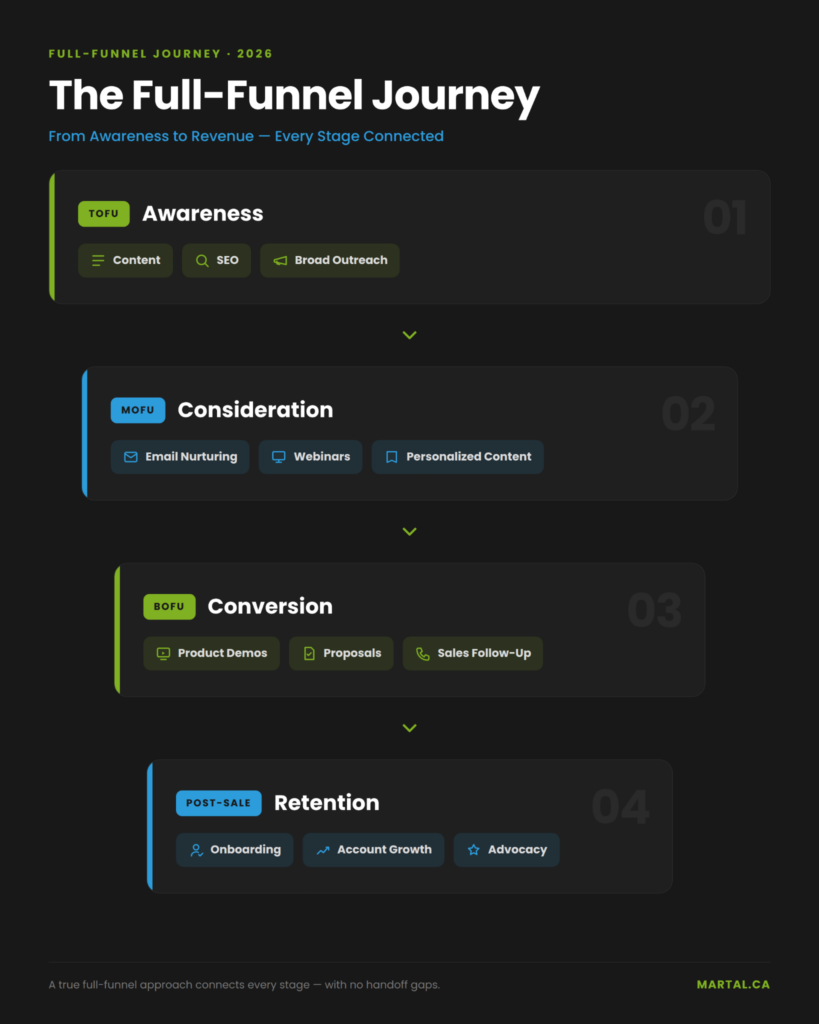
Each stage has to stay connected and data-informed. When marketing captures buying signals at the top and middle, sales engages only warm, qualified leads — which prevents drop-offs and lifts ROI on every lead. That continuity, not any single tactic, is what separates a full-funnel marketing agency from a vendor that owns one slice of the journey.
Below, we compare 11 full-funnel marketing agencies and show exactly where each one’s coverage begins and ends.
Top 11 Full-Funnel Marketing Agencies Compared for 2026
We compared the full-funnel marketing agencies leading the category in 2026, the channels each runs, and, more importantly, where each’s coverage tends to end. Instead of ranking them one-through-eleven, we’ve grouped the field by how much of the funnel an agency is built to own, from top-of-funnel demand to booked meetings and closed deals, so you can match a partner to the stage you can’t staff internally.
The table below summarizes where each agency focuses and where the handoff back to your own team usually happens.
Agency
Primary focus
Where coverage typically stops
Martal Group
Omnichannel outbound, appointment setting, sales outsourcing
Carries leads through booked meetings and sales execution
Unbound IA
Buyer-led GTM, demand, ABM, sales alignment
Stays involved through revenue execution and sales alignment
New Engen
Paid media, creative, measurement
Paid acquisition; no live outreach or sales
Tinuiti
Paid media across commerce, search, social, TV
Media and measurement; no outbound or meeting-booking
Power Digital
Paid media, SEO, lifecycle, analytics
Marketing channels; no live outreach team
Single Grain
SEO, paid, content, CRO
Inbound/paid plus on-site conversion; no outbound
Directive Consulting
Paid, SEO, CRO, RevOps, ABM (SaaS)
Demand generation; the client’s team closes
Refine Labs
Demand creation (paid, content, research)
Demand strategy; no outbound or appointment setting
NoGood
Growth experimentation, paid and organic, creative
Channel growth; no live qualification to meetings
Ironpaper
Demand gen, ABM, content, sales enablement
Marketing and alignment; no outbound prospecting
Kalungi
Fractional CMO, full-service SaaS marketing
Marketing leadership and execution; no live outbound
Martal Group – Full-Funnel B2B Lead Generation & Sales Partner
Martal Group is a full-funnel B2B lead generation agency that doesn’t just deliver leads, it drives them through to sales opportunities. With 16+ years in B2B sales outsourcing and a track record trusted by 2,000+ B2B brands worldwide, Martal runs an omnichannel strategy across cold email, LinkedIn outreach, content, and cold calling to engage prospects at every stage. We go beyond a typical marketing agency with Sales-as-a-Service: experienced sales executives who act as your outsourced SDR team and can progress deals toward closing. The result is no gap between marketing and sales. We use technographic filters and intent signals to build targeted lead lists.
We back the approach with data and AI. Our proprietary AI platform automates prospect research, multivariate email testing, and pipeline analytics in real time. We use technographic filters and intent signals to build targeted lead lists, then craft personalized sequences with AI copy trained on 40M+ outbound campaigns. Outreach is genuinely omnichannel: a campaign might pair email with LinkedIn touches and phone cadences via a power dialer, coordinated across 8+ touchpoints — which matters given that 72% of B2B companies using 10+ channels grew market share.
The results show the full-funnel effect. For Afton Tickets, a nine-month omnichannel campaign delivered 518 leads, including 320 MQLs and 97 SQLs — and one closed deal covered the entire engagement cost, with five deals closing in total. For Clickworker, a multi-year, full-funnel engagement spanning lead generation, onboarding, and account management produced $4.5M in recurring revenue and a 500% ROI, including deals with Fortune 500 and Fortune 10 companies. The throughline: we measure success in qualified pipeline and revenue, not raw volume.
Key Services & Strengths:
- Omnichannel Lead Generation: Coordinated email, LinkedIn, and phone campaigns that fill your pipeline with sales-ready leads. Each rep runs a dedicated sending domain and SMTP setup to protect email deliverability, plus LinkedIn and calling tools to lift connect rates.
- Appointment Setting: Our outsourced sales team books qualified meetings straight to your calendar — closing the classic gap between marketing and the first sales conversation.
- Sales Outsourcing & Closing Support: Need more than meetings? Fractional SDR teams can manage the full sales process, from outbound prospecting to contract — ideal if you want to scale without hiring internally.
- AI-Driven Campaign Optimization: Our AI engine accelerates onboarding (auto-generating ICP profiles in minutes) and tunes outreach in real time, running multivariate tests and adapting sequences to lift reply and conversion rates.
- B2B Sales Training & Enablement: Beyond running lead generation campaigns, we train client teams through Martal Academy — sharing playbooks and aligning marketing messaging with sales follow-up so your reps carry opportunities forward.
Ideal For: Mid-market and enterprise B2B companies in tech, SaaS, and professional services with complex sales cycles — organizations that need both high-quality top-of-funnel lead generation and the resources to engage, qualify, and convert those sales leads. If you want a single partner to drive revenue, consider outsourcing lead generation, sales, and marketing to Martal Group — #1 in Lead Generation on Clutch and rated an average 4.9/5 across Clutch and G2.
Unbound IA – Buyer-Led GTM Strategy & Full-Funnel Revenue Partner
Unbound IA is a B2B go-to-market consultancy founded in 2017 on a simple belief: brand visibility and commercial performance should be part of the same conversation. Instead of treating marketing channels as separate initiatives, Unbound IA helps B2B technology and SaaS companies build integrated GTM systems that bring together strategic positioning, demand generation, and revenue execution into a unified growth engine.
The focus is on helping organizations move from unpredictable pipeline performance to scalable, repeatable revenue growth. Every engagement is designed around the full buyer journey, combining AI-enabled insights, account-based programs, and sales alignment frameworks to bridge the gap between marketing activity and measurable business outcomes.
Unlike traditional agencies that hand off leads once a campaign is complete, Unbound IA remains closely involved throughout the process. The team works alongside both marketing and sales functions, aligning them around shared revenue goals and ensuring that every initiative contributes to pipeline velocity and long-term revenue growth.
Key Features:
- GTM Strategy Development: Buyer-led positioning, market entry frameworks, and competitive differentiation tailored for B2B tech and SaaS organizations entering new markets or scaling globally.
- Demand Engine Design: Full-funnel demand programs built to generate qualified pipeline at scale, guiding prospects from awareness to conversion.
- Account-Based Programs: Precision-targeted ABM strategies aligned with high-value accounts, prioritizing pipeline quality over raw lead volume.
- Sales Alignment Frameworks: Revenue operations and marketing-to-sales integration designed to accelerate pipeline velocity and minimize drop-off between stages.
- AI-Enabled Insights: Data-driven strategic inputs that improve targeting, strengthen positioning clarity, and enhance program performance across the funnel.
Ideal For: B2B tech, SaaS, and AI-driven companies led by revenue-focused teams looking for structured GTM transformation. This is especially relevant for organizations dealing with inconsistent pipeline performance, expanding into new markets, or scaling globally and needing marketing and sales teams aligned around measurable business outcomes.
New Engen – Performance Marketing & Creative-Led Growth
New Engen is an integrated performance marketing agency founded in 2016 and headquartered in Seattle, with teams across the U.S. The agency reports managing roughly $1 billion in annual ad spend and is built around a “creative-led growth” model that pairs media strategy with content production and measurement. Its center of gravity is paid acquisition and analytics across search, social, programmatic, video, CTV, influencer, affiliate, and retail media.
Because the work concentrates in paid channels and creative, live prospect outreach and direct sales conversations sit outside New Engen’s scope. Generated demand is handed to the client’s own team to qualify and close.
Key Features:
- Paid Media Management: Paid search, paid social, programmatic, video, and retail media run as one connected, measurement-driven program.
- Creative-Led Growth: In-house creative production — static, motion, UGC, and CTV — treated as performance infrastructure rather than a one-off deliverable.
- Measurement & Attribution: Incrementality testing and attribution modeling that let spend in one channel inform the next.
- Lifecycle & Retention: Email and lifecycle support to retain and re-engage acquired customers across channels.
Ideal For: Consumer and DTC growth brands consolidating paid media, creative, and measurement under one data-driven partner.
Tinuiti – Independent Full-Funnel Media at Scale
Tinuiti, founded in 2004 and based in New York, is the largest independent performance marketing agency in the U.S., with more than 1,000 employees and roughly $4 billion in media under management. Its strength is media buying and measurement at scale across commerce, search, social, and TV/audio, powered by its proprietary Bliss Point measurement technology and deep platform partnerships spanning Amazon, Google, Meta, TikTok, and the major streaming networks.
Tinuiti builds awareness and demand through paid placements rather than running outbound prospecting or booking sales meetings, so pipeline qualification and conversion stay on the client side.
Key Features:
- Paid Search & Social: Large-scale campaign management across Google, Meta, and emerging ad platforms.
- Commerce & Retail Media: Amazon and marketplace advertising, a core specialty for retail and CPG brands.
- Streaming & Connected TV: CTV and streaming campaigns with performance-based measurement.
- Bliss Point Measurement: Proprietary analytics that model marketing impact and flag wasted spend.
Ideal For: Consumer and commerce brands with substantial media budgets that want scaled, accountable paid acquisition.
Power Digital – Tech-Enabled Growth Marketing
Power Digital, founded in 2012 and headquartered in San Diego, is a growth marketing firm that combines paid media, SEO, lifecycle marketing, PR, and creative, supported by its proprietary nova analytics platform. It serves both B2C and B2B brands and positions itself around connecting channel activity to revenue signals through nova.
Execution is concentrated in marketing channels and analytics; the firm doesn’t field a live outreach team, so converting interest into booked meetings stays in-house.
Key Features:
- Paid Media: Campaign management across paid search and paid social.
- SEO & Content: Organic search and content programs to grow qualified traffic.
- Lifecycle, Email & CRM: Retention and nurture programs across the customer journey.
- nova Platform: Proprietary data and analytics tooling for planning, measurement, and budget allocation.
Ideal For: Direct-to-consumer and growth-stage brands consolidating digital channels under a single analytics-led partner.
Single Grain – Revenue-Focused Digital Marketing
Single Grain is a Los Angeles digital marketing agency revived by Eric Siu in 2014 (the company was originally founded around 2009). It built its reputation on a revenue-and-ROI-focused model that spans SEO, paid advertising, content marketing, and conversion optimization, more recently adding AI systems and automation. Clients range from startups to enterprises such as Amazon, Uber, and Salesforce.
The agency’s focus is inbound and paid acquisition plus on-site conversion; outbound prospecting and live sales engagement aren’t part of the model, so turning generated demand into qualified meetings falls to the client.
Key Features:
- SEO & Content Marketing: Technical SEO and content programs aimed at compounding organic traffic.
- Paid Advertising: ROI-focused campaigns across Google, Meta, LinkedIn, TikTok, and YouTube.
- Conversion Rate Optimization: A/B testing and on-site experimentation to lift conversion.
- AI Systems & Analytics: AI tooling and measurement deployed inside the client’s martech stack.
Ideal For: SaaS, tech, and ecommerce companies prioritizing search visibility, paid traffic, and on-site conversion over live outreach.
Directive Consulting – B2B “Customer Generation”
Directive Consulting is a B2B performance marketing agency founded in 2013 and headquartered in Irvine, California, focused on SaaS and technology companies. Its proprietary “Customer Generation” methodology is built around customer acquisition cost and lifetime value rather than raw lead volume, and the agency reports serving 420+ brands and generating more than $1B in client revenue. It connects paid media, search, and conversion work to revenue-efficiency metrics.
The engagement generates demand through marketing channels; the client’s own sales team works and closes that pipeline, since outbound prospecting and meeting-booking aren’t part of the service.
Key Features:
- Paid Media (SaaS-Tuned): Paid search and paid social across Google, LinkedIn, and Meta, optimized for pipeline.
- SEO & Performance Content: Organic programs built to grow qualified demand.
- CRO & Performance Design: Conversion optimization and design tied to revenue outcomes.
- RevOps & ABM: Revenue operations, attribution, and account-based programs for high-value targets.
Ideal For: SaaS and technology companies focused on efficient paid and inbound acquisition tied to pipeline and revenue.
Refine Labs – B2B Demand Creation
Refine Labs is a B2B SaaS demand generation agency founded in 2019 by Chris Walker and now led by CEO Megan Bowen. It popularized a “demand creation” model — using paid media, content, and buyer research to drive pipeline — and organizes its work around a Brand → Demand → Expand framework. Its methodology deliberately weights pipeline and revenue attribution over MQL-based measurement, and it works primarily with mid-market and enterprise SaaS companies.
There’s no human outbound or appointment-setting layer, so lead qualification and closing stay with the client’s sales team.
Key Features:
- Demand Strategy & Buyer Research: Research-led demand programs aligned to how modern B2B buyers actually purchase.
- Paid Media Management: Paid programs measured against pipeline rather than lead volume.
- Content Creation & Distribution: Thought-leadership content and distribution to build market preference.
- Pipeline & Revenue Measurement: Attribution and analytics focused on revenue impact.
Ideal For: Mid-market and enterprise B2B SaaS companies shifting from a lead-generation to a demand-creation model.
NoGood – Growth Marketing & Experimentation
NoGood is a growth marketing agency founded in 2016 and based in New York, with additional teams in Miami, San Francisco, and Los Angeles. It’s built around experimentation and rapid testing across acquisition channels, with senior practitioners spanning SaaS, healthcare, fintech, B2B, and consumer brands — from VC-backed startups to Fortune 500s. Services range across paid growth, organic social, performance creative, SEO/AEO, analytics/CRO, and digital PR.
Its focus is channel growth through paid and organic experiments; leads aren’t carried through live qualification to booked meetings, so sales follow-through remains with the client.
Key Features:
- Growth Experimentation: High-frequency, structured testing across acquisition channels.
- Paid & Organic Acquisition: Performance marketing across Google, Meta, TikTok, and LinkedIn, plus organic social and content.
- Performance Creative: Data-informed creative produced at scale for paid channels.
- SEO/AEO & CRO: Traditional search plus answer-engine optimization and conversion work.
Ideal For: Startups, scale-ups, and growth teams seeking rapid, test-driven channel growth.
Ironpaper – B2B Demand Gen & ABM
Ironpaper is a strategy-focused B2B agency founded in 2002 and based in New York that works to connect marketing and sales through demand generation and account-based programs, including a “deal-based ABM” model that concentrates on live opportunities. A HubSpot Diamond partner, its engagements emphasize content, website conversion, measurement, and department alignment over channel volume.
The model centers on strategy and marketing execution, so outbound prospecting and direct deal conversion remain with the in-house sales team.
Key Features:
- Demand Generation & ABM: Integrated demand and account-based programs for complex B2B buying groups.
- Content & Website Conversion: Content marketing and site optimization built to attract and convert qualified buyers.
- Performance Analytics & Lead Scoring: Lead scoring, attribution tracking, and behavior analytics to improve marketing-to-sales efficiency.
- Marketing-and-Sales Alignment: Programs that connect marketing activity to pipeline and sales follow-through.
Ideal For: B2B firms with long sales cycles that want stronger marketing efficiency and tighter alignment between departments.
Kalungi – Fractional CMO for B2B SaaS
Kalungi is a B2B SaaS growth agency founded in 2018 and based in Seattle that provides full-funnel go-to-market support, frequently through a fractional CMO and embedded team model built around its T2D3 methodology. A HubSpot Diamond partner, it pairs senior marketing leadership with execution across content, SEO, paid media, ABM, and marketing operations for early- to growth-stage SaaS companies.
The support is weighted toward marketing leadership and planning rather than a live outbound or meeting-booking operation, so direct prospect engagement stays in-house.
Key Features:
- Fractional CMO Leadership: Senior, SaaS-experienced marketing leadership without a full-time executive hire.
- Full-Funnel SaaS GTM: Go-to-market strategy and execution tied to growth milestones.
- Content, SEO & Demand Gen: Channel programs built on proven SaaS playbooks.
- Marketing Operations & Analytics: RevOps, HubSpot configuration, and measurement to support scale.
Ideal For: Early- to growth-stage B2B SaaS companies that need outsourced marketing leadership plus execution.
How to Choose a Full-Funnel Marketing Agency
The best full-funnel marketing agency is the one that covers every stage you can’t staff internally — and proves it with pipeline, not impressions. Most agencies excel at one slice of the funnel, so the goal is to find where their coverage ends and whether that gap lands on your team. Six criteria separate a true end-to-end partner from a single-stage vendor:
- Full-funnel coverage, not single-stage. Map any agency against the B2B sales funnel: demand generation, outreach, qualification, appointment setting, and closing. If their work stops at MQLs or booked meetings, your internal team owns everything after — which is where most pipeline stalls.
- Live prospect engagement. Ask whether they actually talk to your buyers. Many “full-funnel” agencies generate demand through paid media and content but never run outbound outreach or qualify a lead by phone, email, or LinkedIn. Demand creation and demand conversion are different jobs.
- Senior ownership, not junior handoffs. Confirm who runs the account day to day. Experienced operators navigate objections and complex buying groups; a shared junior coordinator does not. One thing we see often is that the gap between a strong program and a weak one comes down to who’s actually executing — which is why we field experienced onshore reps rather than junior SDRs.
- Outcome-based measurement. A credible partner reports on sales-qualified leads, booked meetings, pipeline, and revenue — not opens, clicks, or impressions. If the dashboard centers on vanity metrics, the engagement probably ends before revenue does.
- Reporting and visibility. Look for a defined cadence — weekly performance reviews, live pipeline visibility, and market feedback — so you always know what’s working and what to adjust. (For reference, here’s how we structure that cadence.)
- Industry and sales-cycle fit, with modern tooling. The agency should understand your buying cycle and use technology — AI included — to sharpen targeting and personalization. This matters in 2026: Gartner reports 70% of CMOs see becoming an AI leader as a critical goal (11), yet only 30% have the maturity to scale it. The right partner already operates that way.
A practical shortcut: run each shortlisted agency through the comparison matrix above as a five-point scorecard. The one that earns full marks across outreach, qualification, and closing — not just demand generation — is the one that will carry a lead all the way to revenue.
How Much Does a Full-Funnel Marketing Agency Cost?
Most full-funnel B2B engagements run $3,000 to $25,000+ per month, with the exact figure driven by scope more than anything else. Narrow, single-channel work sits at the low end; full-funnel coverage with a dedicated team sits at the high end. Pricing usually follows one of five models:
Pricing model
Typical 2026 range
Best when
Watch for
Monthly retainer (flat)
$3,000–$25,000/mo (B2B SaaS often $3,000–$15,000)
Ongoing, multi-channel programs
Paying for scope you don’t use that month
Project-based
$10,000–$50,000+ per project
Defined one-time builds or launches
No ongoing optimization after delivery
Performance-based
Base fee + variable per lead/opportunity/revenue
Aligning cost to outcomes
How “qualified” is defined and verified
Percentage-of-spend
10–20% of ad budget
Heavy paid-media engagements
Rewards more spend, not more efficiency
Dedicated SDR/SE capacity, scaled to need
Scaling pipeline without adding headcount
Confirm senior reps, not junior coordinators
The more useful question isn’t cost per month — it’s cost per outcome. A $6,000 retainer that produces vanity metrics is more expensive than a higher retainer that books qualified meetings, because only one of them creates revenue. Evaluate any agency on cost per sales-qualified lead, cost per booked meeting, and payback period — our ROI calculator is a simple way to model that math against your own numbers.
That’s also where the build-versus-buy decision favors a partner. Standing up an in-house outbound function means salaries, tooling, management, and months of ramp before the first qualified meeting. Outsourcing the same motion can cut costs by up to 65% versus in-house and ramp roughly 3x faster, because the team, data, and playbooks already exist (12). For complex B2B sales cycles, that combination of lower cost and faster time-to-pipeline is usually the deciding factor.
Why Full-Funnel Marketing Campaigns Fail
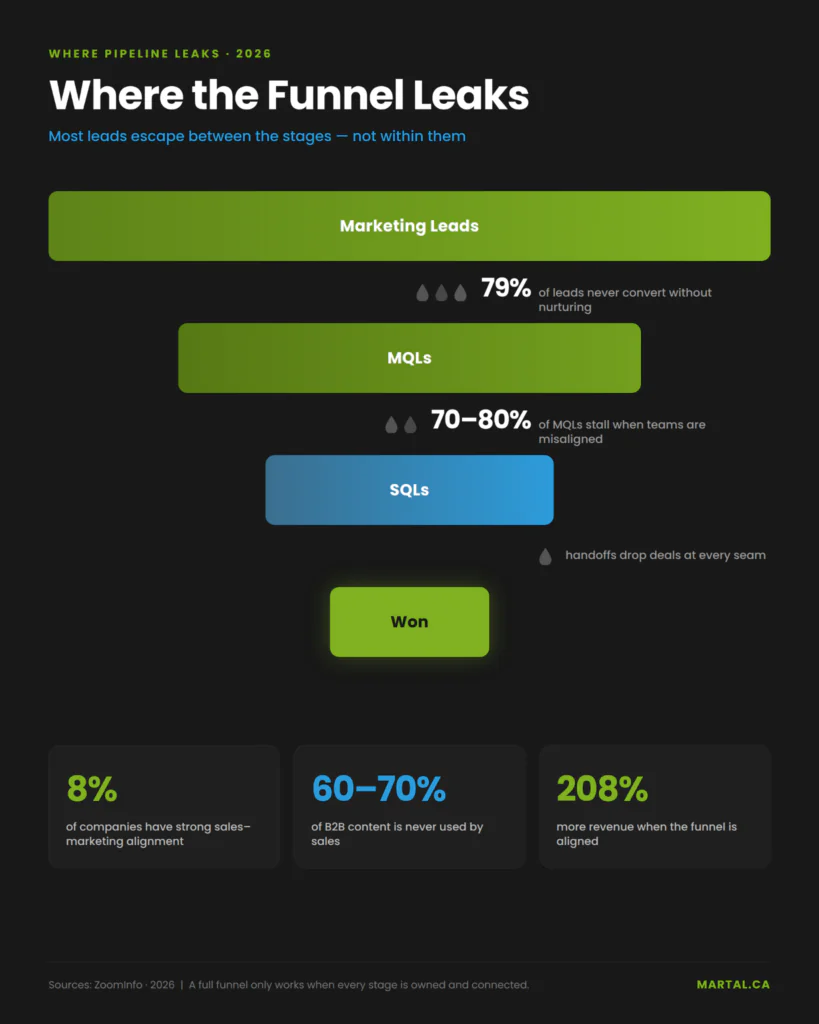
Even well-funded full-funnel programs break in predictable places — almost always at the seams between stages, not within them. The most common failure points:
- The marketing-to-sales handoff. When lead nurturing and follow-up break down, roughly 79% of marketing leads never convert (4). Leads don’t fail because they were bad; they fail because no one carried them forward.
- Stopping at the MQL or booked meeting. Generating interest isn’t converting it. When marketing and sales operate in silos, a large share of MQLs stall before becoming real opportunities. The funnel needs someone owning the stages on either side of the meeting.
- Vanity metrics over pipeline. Programs optimized for opens, clicks, and impressions look healthy on a dashboard and empty in the CRM. If success isn’t measured in SQLs and revenue, the campaign is measuring the wrong thing.
- Disconnected channels. Running email, LinkedIn, and calling as separate, uncoordinated efforts creates noise instead of continuity. Omnichannel outreach — coordinated touches in sequence — consistently outperforms channels fired in parallel.
- Junior execution. A common issue for outbound teams is putting inexperienced reps on complex buying groups. Without operators who can navigate objections and multi-stakeholder deals, even a strong top-of-funnel leaks at the point of conversion.
The throughline across all five: a full funnel only works when every stage is owned and connected. The leaks appear wherever ownership is handed off and dropped.
Conclusion
With hyper-informed buyers and long B2B purchase cycles, connecting every stage of the funnel isn’t a nice-to-have — it’s a competitive necessity. Each agency in this guide can strengthen part of your marketing-to-sales continuum, but most cover only a slice of it. The decisive question is what happens between a marketing-qualified lead and a closed deal — and whether your agency owns that stretch or hands it back to you.
That gap is where a true full-funnel partner earns its keep. The strongest model pairs demand generation with live outreach, qualification, appointment setting, and the sales execution that turns interest into booked meetings — so marketing spend translates into real revenue, not just activity at the top of the funnel.
That’s the model we built Martal Group around. We generate leads, nurture them through omnichannel outreach, and deliver sales-ready meetings — integrating with your sales process or acting as your outsourced team through Sales-as-a-Service. It’s coverage of the entire buyer journey, from the first digital touchpoint to the booked appointment, with no gaps or silos.
If your team is ready to move beyond fragmented, single-stage marketing, Martal’s model combines experienced onshore sales executives with our proprietary AI platform — running cold email, cold calling, and LinkedIn outreach as one coordinated omnichannel strategy, backed by appointment setting and B2B sales training. Book a consultation to see what a full-funnel pipeline of qualified leads looks like for your business.
References
- Gartner
- Demand Gen Report
- McKinsey & Company
- Zoominfo
- Martal Group – Top Appointment Setting Companies
- Martal Group – B2B Lead Generation & Sales Agency
- Martal Group – Afton Tickets case study
- EmailVendorSelection
- Amra & Elma
- Mojenta
- Gartner CMO Spend Survey
- Martal Group – Sales Outsourcing
FAQs: Full-Funnel Marketing Agency
What is a full funnel marketing agency?
A full-funnel marketing agency manages marketing and sales across the entire buyer journey — from first awareness to closed deal. Rather than owning one slice (paid ads, SEO, or content alone), it connects demand generation, nurturing, outreach, qualification, and conversion so leads don’t stall between stages. The strongest full-funnel marketing agencies also run live outreach and appointment setting, turning generated demand into booked meetings and revenue instead of handing raw leads back to your internal team.
What is full-funnel marketing, and what is its main goal?
Full-funnel marketing engages prospects at every stage of the funnel — top (awareness), middle (consideration), and bottom (conversion) — plus post-sale retention. Its main goal is to guide buyers through each stage with the right message at the right moment, building trust and nurturing interest until it converts. The payoff is fewer drop-offs and higher ROI per lead: tightly aligned funnels generate up to 208% more revenue from marketing, according to ZoomInfo.
What are the stages in a full funnel marketing strategy?
A full-funnel strategy follows the buyer’s path through four connected stages. Top of funnel (TOFU) builds awareness through content, SEO, and broad outreach. Middle of funnel (MOFU) nurtures consideration with email, webinars, and personalized content. Bottom of funnel (BOFU) converts interest through demos, proposals, and sales follow-up. Retention keeps customers through onboarding and account growth. The point of a full-funnel approach is keeping every stage aligned so leads move efficiently toward a sale.
How does a marketing funnel work?
A marketing funnel visualizes how prospects become customers: wide at the top, where you cast a broad net for awareness, then narrowing as people move through consideration toward a buying decision. At each stage, fewer prospects remain but intent rises, so messaging gets more targeted. A full-funnel marketing agency works the whole shape — generating top-of-funnel interest, nurturing the middle, and engaging high-intent buyers at the bottom — rather than optimizing one stage in isolation.
How much does a full-funnel marketing agency cost?
Most full-funnel B2B engagements run $3,000 to $25,000+ per month, driven mainly by scope — narrow single-channel work sits at the low end, full-funnel coverage with a dedicated team at the high end. Pricing models include flat monthly retainers, project-based fees, performance-based pricing, percentage-of-spend, and fractional/outsourced teams. The more useful metric is cost per outcome — cost per sales-qualified lead and per booked meeting — since outsourcing an outbound motion can cut costs up to 65% versus building in-house.
