
 Martal
 Technology
 Education and training
 Web Development and UI / UX
 Healthcare/Medical
 Logistics and Supply Chain
 Information Technology
 Insuretech and Financial Services
 Marketplaces
 Software Development
 E-commerce and retail
 AI and Machine Learning
 Energy and Solar
 Manufacturing
 Security and Surveillance
 Digital Marketing Agency
 Transportation
 MSP
MSP
 Telecom
 B2B SaaS
 Cybersecurity
 HR tech
 Fintech
 Cleantech
 Consulting
Lead Generation Specialist: What They Do, Cost, and How to Hire One in 2026
Major Takeaways: Lead Generation Specialist
A lead generation specialist identifies, qualifies, and nurtures prospects so the sales team can stay focused on closing. With 61% of marketers reporting that generating high-quality leads is their single biggest challenge, dedicated expertise has stopped being optional — it’s how growing B2B companies keep pipeline predictable.
Lead generation specialists sit at the intersection of sales and marketing, owning the top-of-funnel work neither team has time to do well. Unlike a marketing coordinator who runs campaigns or an account executive who closes, the specialist’s entire job is producing qualified opportunities — researching, engaging, and qualifying until a prospect is ready to talk to a closer.
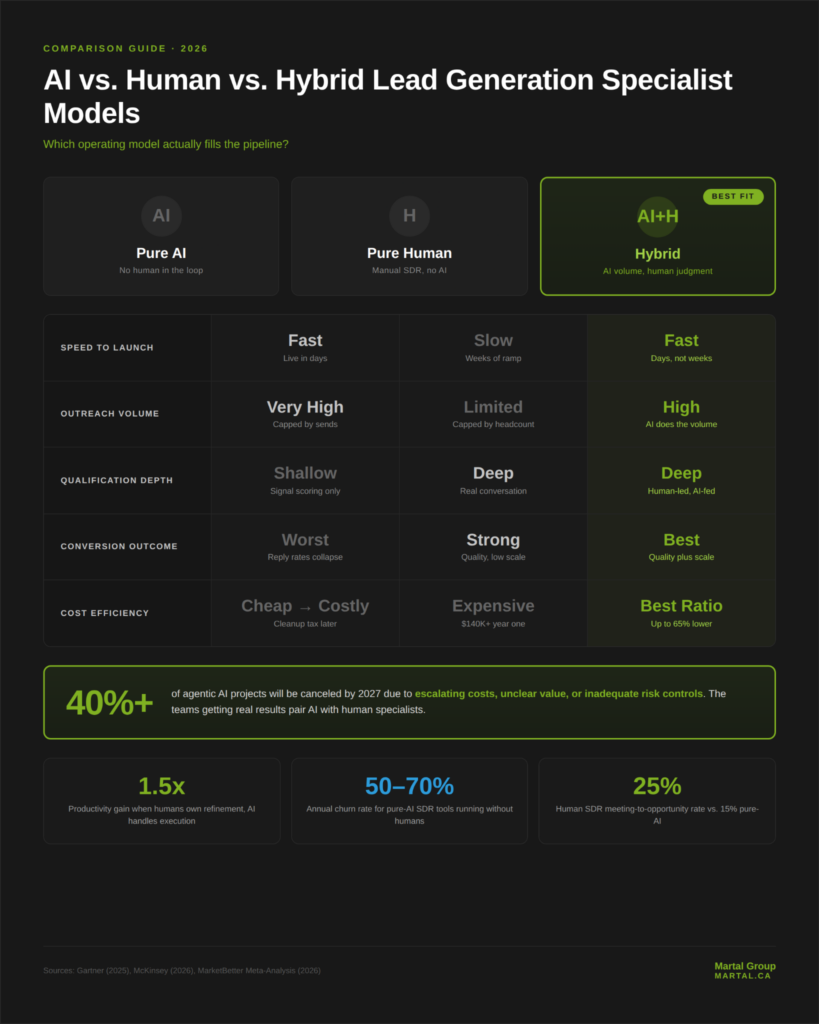
No — but the role is changing fast. Industry data shows hybrid AI + human SDR programs are becoming the new median by late 2026, and McKinsey research found teams running this model became at least 1.5x more productive when humans owned refinement and AI handled execution. Pure-AI SDR setups have an estimated 50–70% churn rate within a year because reply rates collapse once buyers recognize the messaging is automated. The specialist’s job is shifting toward qualification, judgment, and conversation — not disappearing.
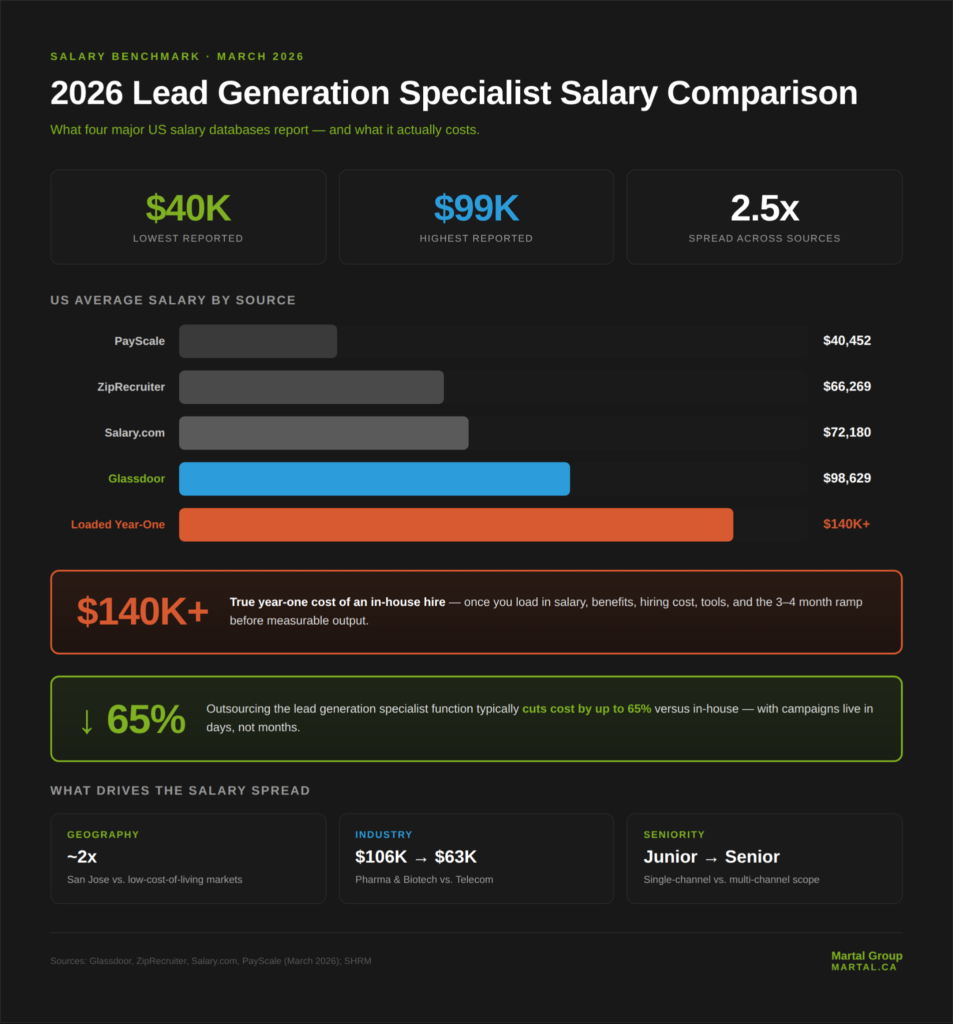
Salaries vary widely. Glassdoor reports an average of $98,629 for US-based lead generation specialists, while ZipRecruiter and Salary.com place the range closer to $66,000–$72,000, and PayScale reports an average of $40,452. The 2.5x spread reflects geography, industry, and seniority. Once you load in benefits, hiring cost, tools, and ramp time, an in-house hire commonly crosses $140,000+ in year-one total cost — which is the math driving most outsourcing decisions.
The strongest specialists combine five things: data analysis, communication, problem-solving, time management, and AI fluency. The newest skill on that list is the one most hiring managers underestimate — a specialist who can’t operate AI tools is operating at a fraction of capacity, and a specialist who relies on AI without judgment generates noise. The right candidate runs both with intention.
Building an in-house lead generation specialist function takes time, training, and tools most companies underestimate. Outsourcing the function can cut costs by up to 65% versus in-house, with ramp-up measured in weeks rather than months. In our work, that ramp typically delivers first SQLs within 30 days of campaign launch — versus the 3–4 month ramp typical of an in-house hire.
For most B2B teams below ~$50M ARR, the math favors a fractional agency model for the first specialist hire — an established team running campaigns end-to-end with the AI tooling, verified database, and operational infrastructure already assembled. Freelance works for narrowly scoped engagements but breaks down at scale. In-house makes sense once pipeline volume justifies dedicated headcount and the in-house cost-per-lead drops below the outsourced equivalent.
The right time is before the pipeline gap shows up in the revenue forecast. Five signals indicate readiness: inbound has stalled, the sales team is buried in prospecting, you’re entering a new market, you’re scaling faster than headcount can keep up, or AI tools are running but not converting. If any of these describe your current situation, you’re not “thinking about” hiring a specialist — you’re already overdue.
Introduction
Pipeline doesn’t fix itself. With 61% of marketers reporting that generating high-quality leads is their single biggest challenge, more revenue leaders are pulling the lead generation function out of “everyone does a little” territory and handing it to someone whose entire job is filling the funnel (5).
That someone is a lead generation specialist — and in 2026, the role looks different than it did even eighteen months ago. AI now handles the research, the list-building, and parts of the sequencing. The human specialist has become the qualification layer, the messaging editor, and the person who actually carries a conversation when a prospect replies. The teams getting this right aren’t choosing between AI and humans. They’re running both.
This guide walks through what a modern lead generation specialist does, the skills and tools they need, what they cost (in-house and outsourced), and how the role is evolving alongside AI. We pulled it together by reviewing what the leading agencies, job platforms, and industry analysts are publishing in 2026, then layered in what we see day-to-day running outbound and appointment-setting campaigns — and evolving B2B lead generation strategies — for B2B teams across SaaS, Cybersecurity, AI/ML, Telecom, Web Development, Digital Marketing, Logistics, Energy, Ecommerce, MSP, and 50+ more verticals.
Whether you’re building an in-house team or evaluating a lead generation agency, the goal here is to help you make a sharper hiring decision — not just describe a job title.
What is a Lead Generation Specialist?
The median MQL-to-SQL conversion rate fell from 13% in 2024 to 9.8% in 2026 — and top-quartile programs achieve 4.7x lower cost-per-lead than the bottom quartile.
Reference Source: Digital Applied
A lead generation specialist is the person responsible for finding the right prospects, qualifying them against your ICP, and handing the sales team opportunities that are actually worth a discovery call. The role most often shows up in B2B organizations, where the sales cycle is longer, the buying group is bigger, and the cost of a misqualified lead is real.
Structurally, the specialist sits at the seam between marketing and sales. They’re not running brand campaigns and they’re not closing deals — they’re operating the layer in between, where a prospect goes from a name on a list to a qualified buyer ready for a sales conversation. In our work, the strongest specialists are the ones who don’t act like a department of one. They stay in lockstep with the AE picking up their handoffs, with marketing on positioning, and with operations on data hygiene. That coordination is what keeps the pipeline numbers honest.
The job calls for sourcing leads from multiple inputs at once — verified databases, intent signals, referrals, ICP-based lookalike modeling, and the messaging tests that surface what’s actually resonating in the market this quarter, not last year.
What Do Lead Generation Specialists Do?
Lead generation specialists — also known as lead generators — combine research, outreach, and qualification to keep the sales team supplied with prospects that are actually worth pursuing. In B2B, the work skews heavily outbound: most pipeline doesn’t show up on its own, and waiting for inbound to fill quota is rarely a strategy.
The day-to-day usually breaks down into six core activities. The strongest specialists run them as a coordinated omnichannel program, not a list of standalone tasks:
- Cold Calling: Reaching decision-makers by phone, opening with a relevant hook, and surfacing whether there’s a real reason to keep the conversation going.
- Cold Email Outreach: Sending personalized, deliverability-tested emails that earn a reply — not bulk sequences dressed up with first-name personalization.
- LinkedIn Lead Generation: Identifying high-fit prospects, building credible touchpoints, and moving the conversation forward through messaging that respects the channel.
- Account-Based Marketing (ABM): Running tailored multi-touch programs against a defined list of high-value accounts — usually where the deal size justifies the extra orchestration.
- Lead Qualification: Filtering responses against the ICP — checking authority, need, and fit before anything reaches an account executive’s calendar.
- Setting Appointments: Booking the discovery call, briefing the AE on context, and making sure the prospect actually shows up ready to talk.
In practice, the specialist’s job isn’t picking the best channel — it’s running all of them in concert so a prospect who ignored the first email might pick up the call, and the LinkedIn message a week later lands as continuity, not noise.
What Are Some Other Names for a Lead Generation Specialist?
The same role goes by several titles depending on whether the work is in-house or outsourced. Inside a company, the equivalents are usually business development representatives (BDRs) or sales development representatives (SDRs). Some teams use lead specialist or sales lead generator for the same scope of work — particularly in smaller organizations where titles haven’t fully standardized.
Externally, the function is delivered by outsourced lead generation agencies, sales-as-a-service partners, or outsourced sales consultants — many of whom offer fully managed engagements with fractional or full-time specialists. These external specialists typically have more years of focused lead generation experience than in-house counterparts, since the work is the agency’s core product, not a stop on a longer career path.
For the rest of this article, we’ll focus on the skills, duties, and hiring decisions that apply to outsourced lead generation specialists — both because the term is most commonly used in this context, and because the outsourcing question is where most pipeline-building decisions actually get made.
What Are Some Other Names for a Lead Generation Specialist?
There are many different names for lead generation specialists. In-house equivalents are known as business development representatives (BDRs) or sales development representatives (SDRs). External lead generation specialists are often hired through companies referred to as outsourced lead generation agencies, sales as a service partners, or outsourced sales consultants, many of which offer done for you lead generation as a fully managed service. These fractional BDRs are experts in their field and have backgrounds in a multitude of industries and strategies. They oftentimes have more years of experience in lead generation than in-house specialists.
For the purposes of this article, we will focus on the skills, roles, and responsibilities of outsourced lead generation specialists, as the term is more commonly used in this context.
Why do Companies Hire a Lead Generation Specialist?
40% of agentic AI projects will be canceled by the end of 2027, due to escalating costs, unclear business value or inadequate risk control, a sharp reminder that AI alone isn’t a pipeline strategy.
Reference Source: Gartner
Lead generation is the foundation of revenue growth, and most B2B teams hit a ceiling without dedicated expertise running it. The companies that hire a specialist tend to do so for a specific reason — pipeline has stalled, the sales team is buried in prospecting, a new market is on the roadmap, or the in-house headcount math no longer pencils out.
The benefits of lead generation expertise — refined ICP targeting, omnichannel orchestration, faster qualification, sharper messaging — far outweigh the cost of bringing one on. In our work with Berger-Levrault, an HR/ERP software company expanding across the US and Canada, two major deals alone justified the entire campaign investment. That’s the practical case for hiring a specialist: not “leads in the pipeline,” but the right qualified opportunities reaching your AEs at the right time.A specialist also unlocks two outcomes most teams underestimate — improved unit economics and a clean way to test new markets without disrupting the existing pipeline. Both are covered below, alongside the cost case for outsourcing versus building in-house. Tying it all together is the lead generation workflow the specialist owns end-to-end.
Boost Brand Awareness and Shorten Your Sales Cycle
Brand awareness in B2B isn’t about being on the minds of the majority — it’s about being on the minds of your ideal clients. Building that awareness in a competitive market without burning through ad budget takes the right talent and the right targeting. A team of lead generation specialists knows how to drive recognition at scale through advanced lead generation strategies and well-curated databases, connecting with the people most likely to convert rather than spraying the market.As your name reaches the right buyers more consistently, the sales cycle naturally tightens. The lead generation process keeps evolving in response to the market, so a specialist will continually optimize ICP definition, messaging, and channel mix based on the data coming back from campaigns. In our experience, what actually compresses sales cycles isn’t faster outreach — it’s earlier qualification. Disqualifying a poor-fit prospect in week one is worth more than ten warm follow-ups, because it frees the AE to spend time on deals that close.
Reduce Labor Hours and Overhead Costs
Prospecting comes at a price — and most teams underestimate the full one. A few benchmarks worth pricing in before you decide between in-house and outsourced:
- $98,629 average salary for a US-based lead generation specialist (6) with the typical range running between $75,474 and $131,370 depending on geography, experience, and industry.
- $28,000+ hiring cost for an executive-level employee (1), covering recruiting, onboarding, training, and ramp before the first lead is generated.
- $140,000+ true year-one cost when you load in salary, benefits, training time, and the tools needed to execute lead generation campaigns — which is the realistic floor for a full-time specialist hire in 2026.
By contrast, outsourcing to a lead generation specialist can cut costs by up to 65% compared to building in-house. The economics work because an established agency spreads tooling, training, and operational overhead across a much larger book of work. You access the same caliber of talent — often more experienced — at a fraction of the loaded cost.
The other factor most companies undervalue is ramp speed. An in-house hire spends weeks in onboarding before producing measurable output. An outsourced specialist team is already trained, equipped, and running proven processes — campaigns can be live within days, with first SQLs typically reaching the pipeline inside 30 days.
Test and Validate a New Product or Market
Whether you’re entering a new market with a proven product or testing a new product in your current market, validation campaigns are the lowest-risk way to confirm fit before committing real resources. The challenge is that pulling your existing team off the pipeline to run tests creates the worst of both worlds — your core revenue motion stalls and the test data is rarely clean.
This is where an outsourced specialist team earns its keep. A dedicated team can run a contained validation campaign without disrupting your in-house pipeline, generating real signal on whether the market responds. We’ve seen this play out repeatedly — for one IoT facilities-services client expanding from Stockholm into North America, our team delivered 139 booked meetings and 203 SQLs over 24 months in a market where the company had no prior presence. Whether the test succeeds or fails, you walk away with clean data, an automated lead generation infrastructure that can be scaled up or shut down quickly, and the freedom to make the next decision based on evidence rather than assumption.
How AI Is Reshaping the Lead Generation Specialist Role
Hybrid human–AI sales teams saw at least 1.5× higher productivity by shifting focus from content creation to client interaction and refinement.
Reference Source: Mckinsey & Company
The lead generation specialist role looked one way in 2023 and looks meaningfully different in 2026. AI hasn’t replaced the specialist — but it has redrawn what the job actually is.
What AI Now Does (and Does Well)
The repetitive, time-consuming parts of the role have been automated almost entirely. Modern AI handles:
- Prospect research and list-building — pulling firmographic, technographic, and intent data from multiple sources and assembling targeted lists in minutes rather than days.
- First-draft outreach copy — generating personalized email and LinkedIn drafts informed by role, industry, recent activity, and tech stack.
- Sequence orchestration — timing follow-ups, rotating sending domains, and adapting cadence based on prospect engagement.
- Signal monitoring — surfacing accounts entering buying windows based on funding rounds, hiring trends, technology adoption, or content engagement.
- CRM updates and reporting — eliminating most of the administrative work that historically consumed a third of a specialist’s day.
According to IBM, AI SDRs are designed to replicate and extend the role of human SDRs by handling time-intensive and repetitive tasks (7), engaging large volumes of inbound and outbound leads in real time and operating continuously. The productivity gains are real. The mistake is assuming this is the whole job.
What AI Still Cannot Replace
The teams that have tried full automation are running into the same walls. Pure-AI outbound sends generic messages at scale, prospects recognize them, and reply rates collapse — usually within a quarter. Independent reviews note that fully autonomous AI SDRs have shown mixed results at scale in 2026, with many teams adopting hybrid (AI + human) models rather than full replacement (8).
In practice, three things break down without a human specialist:
- Real qualification. AI can score a lead based on signals. It cannot tell whether a “yes, send more info” reply is a serious buyer or someone politely deflecting. That distinction usually shows up in the follow-up conversation, not the response itself.
- Objection handling and nuance. When a prospect pushes back on pricing, asks about a competitor, or surfaces an internal political dynamic, the conversation needs judgment. Generative models still hallucinate, and a wrong answer in week one of a sales conversation can end the deal.
- The handoff to the AE. A booked meeting is only useful if the prospect actually shows up informed and the AE walks in with context. That briefing layer — what was said, what wasn’t, what the real objection looks like — is where human specialists earn their keep.
Where the Role Has Shifted
Industry data and sales-leader commentary increasingly describe the same shift: the human specialist’s center of gravity has moved from prospecting toward qualification and conversation. Industry analysts project that most B2B sales organizations will adopt hybrid models where AI agents handle repetitive tasks while human SDRs focus on relationship building and complex problem-solving.
For the buyer evaluating a lead generation specialist — in-house or outsourced — that means three questions matter more than they used to:
- What does their AI stack actually do? The honest answer is “research, drafting, sequencing, signal detection.” If a vendor claims AI handles qualification and closes deals autonomously, treat that as a flag.
- Who handles the response? When a prospect replies with interest, who writes the next message, qualifies the conversation, and books the meeting? If the answer is “the AI” — keep looking.
- What’s the human ratio? Hybrid programs work because there are enough humans on the campaign to cover the conversations the AI generates. A platform that promises one human overseeing 50,000 daily messages isn’t running a hybrid model — it’s running pure automation with a human nameplate.
Martal’s Approach to Hybrid Lead Generation
We’ve operated the human-led, AI-powered model for years — well before “hybrid AI SDR” became a category label. Our specialists are senior onshore Sales Executives, supported by Martal’s AI SDR Platform handling the research, list-building, drafting, and sequencing layer. The humans own the qualification, the conversation, the messaging refinements, and the handoff. The AI keeps them moving fast enough to do that work at scale.
That structure isn’t theoretical — it’s what produced 1,442 leads, 346 SQLs, and 339 booked meetings in 24 months for one telecom equipment company we worked with (9), and 139 booked meetings over 24 months for an IoT facilities-services client entering the North American market from Stockholm (10). The volume is the AI’s contribution. The conversion is the human’s.
If you’re evaluating whether AI alone will solve your pipeline problem, the short answer is: it won’t. Most agentic AI projects right now are early stage experiments or proof of concepts that are mostly driven by hype and are often misapplied, per Gartner. The companies getting real results aren’t picking AI or humans. They’re running both — and they’re hiring specialists who know how to do that. (11)
Lead Generation Specialist Skills and Experience
AI SDRs process 1,000+ contacts per day vs. 50–80 for a human rep, but convert meetings to opportunities at just 15% vs. 25% for human SDRs — a 40% performance gap.
Reference Source: MarketBetter
Hiring a lead generation specialist means evaluating a different mix of skills than it did three years ago. AI now handles a meaningful share of the manual work — list-building, drafting, sequencing — so the human skills that matter most are the ones AI can’t replicate: judgment, conversation, and the ability to make the AI work harder rather than louder.
Five skill areas separate the strongest specialists from the rest.
Research and Data Analysis Skills
Research and data analysis sit at the foundation of everything else. A lead generation specialist needs to formulate a campaign strategy from market research and consumer data, run their own prospect research, and read campaign metrics well enough to know what’s actually working — not what looks like it’s working.
In our experience, the meaningful difference shows up in how a specialist reads data. A weak one looks at open rates and reply rates in isolation. A strong one correlates those metrics with lead attributes — industry, persona, company size, intent signal — to figure out which combinations of audience and message produce real opportunities. That kind of pattern recognition is what compounds campaign performance over time.
Communication Skills
A lead generation specialist spends most of their day in communication — written, verbal, sometimes both. Modern B2B buyers don’t respond to features-and-benefits pitches; they respond to messaging that names the problem they’re already trying to solve. Specialists who demonstrate genuine empathy and understanding earn the conversation. The ones who don’t, get filtered out before the prospect ever opens the second email.
Active listening matters as much as outbound messaging. Specialists should ask provoking lead generation questions based on what the prospect actually said — not based on a script — and use the answers to surface the real pain underneath the surface objection. That’s how a “we already have a solution” reply becomes a discovery call rather than a dead end.
Problem-Solving Skills
The work is full of obstacles. A skilled specialist needs to handle objections, navigate competitor positioning, and adapt mid-campaign when something stops working — usually without anyone telling them what to change.
Discovering the root of a prospecting problem requires technical knowledge, consumer insight, and critical thinking. Understanding the psychology of persuasion makes it easier to deduce what’s pulling prospects into the pipeline and what’s pushing them out. That diagnostic skill is what lets a strong specialist troubleshoot leaks in the funnel and build campaigns that outperform competitors who are still doing the same thing they did last year.
Time Management Skills
Time management is where ROI is won or lost. Recent lead generation statistics highlight a critical gap — 63% of a lead generation specialist’s time goes to activities that don’t directly generate revenue, yet only 28% follow a structured time management system. The specialists who follow a deliberate cadence — aligned to sales and marketing objectives, tracked against lead generation KPIs — consistently outperform the ones running on instinct.
Practically, that means identifying and prioritizing the activities that actually move pipeline, recognizing peak prospecting windows (early-morning calls land differently than mid-afternoon ones), and scheduling lower-value administrative work — CRM notations, training, reporting — for the hours when prospects are unlikely to respond anyway.
AI Fluency
AI fluency is the new entry on this list, and it matters more than most hiring managers realize. A specialist who can’t operate AI tools is now operating at a fraction of their potential capacity. A specialist who relies on AI without judgment is generating noise the rest of the team has to clean up.
The strongest specialists treat AI as a force multiplier for the parts of the job they used to do manually — research, list-building, drafting, signal monitoring — while keeping ownership of qualification, message refinement, and the conversation itself. They know when an AI-generated draft needs a rewrite versus a light edit. They know when an AI-flagged “high-intent” account is actually high-intent versus when the signal is noise. And they know how to feed performance data back into the system so the AI gets smarter on the next campaign rather than repeating the same mistakes.
That balance — using the tools without being used by them — is what makes a specialist materially more productive than a 2023 specialist running the same role.
Lead Generation Specialist Salary: What Should You Expect to Pay?
The four largest US salary databases place the average lead generation specialist salary anywhere from $40,452 to $98,629.
Reference Source: PayScale/Glassdoor
If you’re considering an in-house hire, the salary question gets messy fast. The same job title shows up at very different price points across major US salary databases, and the spread is wider than most hiring managers expect.
Current US Salary Benchmarks
Here’s what the four largest databases report as of early 2026:
- Glassdoor: $98,629 average, with a typical range of $75,474–$131,370 (6)
- ZipRecruiter: $66,269 average, with a 25th–75th percentile range of $39,000–$83,000 (4)
- Salary.com: $72,180 average, ranging from $59,189–$83,146 (3)
- PayScale: $40,452 average, with senior specialists earning up to $70,000 (2)
The variance comes down to who’s submitting the data. Glassdoor and Salary.com pull from companies and verified employees, often skewing toward enterprise and mid-market roles in higher-cost-of-living markets. ZipRecruiter aggregates job posting data, which tends to capture the broader US market. PayScale relies on smaller voluntary submissions, which usually skew earlier-career.
Why the Range Is So Wide
Three factors explain most of the spread:
- Geography. A specialist in San Jose or San Francisco earns roughly 2x what the same role pays in a low-cost-of-living state.
- Industry. Pharmaceutical and Biotechnology specialists earn the highest median compensation at $105,973, while Telecommunications specialists earn closer to $63,360. (6)
- Seniority and scope. A junior specialist running a single channel sits at the bottom of the range. A senior specialist owning multi-channel campaigns, qualification, and team coordination sits at the top.
The Loaded Year-One Cost
Salary alone isn’t the right number to plan around. Once you load in the full cost of an in-house hire, the math gets meaningfully different:
- Base salary: ~$66,000–$98,000 (depending on which benchmark you use)
- Benefits and payroll taxes: Add roughly 25–30% on top
- Hiring and onboarding cost: SHRM data places this at $28,000+ for an executive-level employee (1)
- Tools and tech stack: $5,000–$15,000 for the database access, sequencing platform, dialer, intent data, and AI tooling a modern specialist needs to do the job
- Ramp-up time: First productive output typically lands in month three or four, meaning real ROI on the hire doesn’t begin until late year one
Add it all up, and a single in-house specialist hire commonly crosses $140,000+ in year-one total cost — before you’ve measured a single SQL.
How That Math Compares to Outsourcing
This is where the outsourcing case gets concrete. Outsourcing the lead generation specialist function typically delivers comparable or stronger output at up to 65% lower cost than building in-house. The savings come from real economies of scale — established agencies spread tooling, training, and operational overhead across a larger book of work, and you access more experienced specialists than you’d typically hire at an in-house junior or mid-level salary band.
The other variable most teams undervalue is time-to-output. An in-house hire spends weeks ramping. An outsourced specialist team is already trained, equipped, and running proven processes — campaigns can be live within days, with first SQLs typically reaching the pipeline inside 30 days.
For most B2B teams below ~$50M ARR, the math favors outsourcing for the first specialist hire. Once pipeline volume justifies dedicated headcount and the in-house cost-per-lead drops below the outsourced equivalent, building internally starts to make sense. Most companies underestimate where that crossover point actually lands — and end up paying twice while they figure it out.
Lead Generation Specialist Duties, Roles and Responsibilities
61% of marketers report that generating high-quality leads is their single biggest challenge and the volume problem is no longer the bottleneck.
Reference Source: DemandSage
Lead generation is a cyclical process — most of the responsibilities below repeat daily, weekly, or monthly depending on the cadence of the campaign. The strongest specialists treat the cycle as a living system, not a checklist. Each round of outreach generates new data, that data refines the next campaign, and the campaign that worked last quarter is rarely the campaign that wins this one.
Four core responsibilities define the day-to-day work.
Research and Identify Target Audiences
Before prospecting begins, the specialist defines who they’re going after and why. That means building out buyer personas, marketing materials, and campaign angles tailored to a specific ideal customer profile. Once the target audience is defined, the specialist curates a lead list of decision-makers based on demographic, psychographic, firmographic, and technographic attributes — typically pulled from a verified database, then enriched with intent signals and lookalike modeling against the client’s best existing customers.
In our experience, the strongest specialists revisit ICP definition every campaign — not annually. Lead generation trends shift, buyer behavior shifts, and the persona that converted last quarter often isn’t the same persona converting this one. Adjustments to targeting based on real campaign feedback are what separate a campaign that improves over time from one that decays.
Generating Qualified Leads Through Various Channels
A lead generation specialist owns the leads from creation through nurturing — using coordinated outreach across email, LinkedIn, and phone to maximize touchpoints and conversion. The strongest specialists run all three as a single omnichannel program, not as separate parallel tracks. A prospect who didn’t open the email might pick up the call. The LinkedIn message a week later lands as continuity, not noise.
For outbound work, the qualification starts before the prospect ever hears from the specialist — list curation against the ICP filters out most of the poor-fit accounts up front, so the specialist spends time on prospects who match the profile. Once a lead is engaged, the specialist gauges interest, answers questions, and prepares the prospect for the next step. We’ve seen this play out repeatedly — for an EDI consulting firm we worked with, a single fractional specialist running this exact omnichannel motion delivered 161 leads, 23 SQLs, and 14 booked meetings in five months. Volume came from the channels working in concert. Quality came from the specialist owning the qualification at every stage.
Set Appointments with Prospective Clients for the Sales Team
As prospects move further down the funnel, the specialist looks for the moment to transfer the conversation to the sales team — usually through a discovery call or a product demo. The specialist’s job at this stage isn’t just booking the calendar slot. It’s verifying the prospect’s actual interest, confirming they meet the qualification metrics the sales team has set, and briefing the AE so the call starts with context rather than introductions.
Budget and timing rarely need to be confirmed before the first call — those can shift in the right partnership. What matters is authority and need. When the purchasing process requires buy-in from multiple decision-makers, the specialist often arranges for those people to be on the same call. And once the meeting is booked, the work isn’t done — the specialist follows the deal through to close, because understanding which deals were lost or won is what informs the next campaign’s targeting and messaging.
Analyzing Data and Making Optimization Recommendations
Optimization is where a strong specialist earns the title. Lead generation specialists condense many individual data points into a single score or grade per campaign — using primary metrics like open rate, response rate, and conversion rate to surface what’s working. The most effective specialists go a layer deeper, looking for correlations between those rates and lead attributes to uncover the optimal target audience, the messaging that’s actually resonating, and the call-to-action that’s driving the meaningful click-throughs.
Sequence schedules, touchpoint frequency, and channel mix all get refined the same way — through controlled A/B testing rather than guesswork. Because lead generation drives the rest of the pipeline, metrics and test data should be reviewed weekly. Anything less and you’re optimizing in the rear-view mirror. Done well, this is the discipline that turns a campaign that produces decent leads in month one into a campaign that produces meaningfully better leads by month four.
How Do I Hire a Lead Generation Specialist?
By outsourcing to a lead generation specialist, businesses can reduce labor and overhead expenses by up to 65%, driven by economies of scale and expert execution.
Reference Source: Martal Group
Hiring a lead generation specialist can accelerate growth meaningfully — but the wrong hire (or the wrong model) costs more than just the salary. Three decisions matter most: what to evaluate, what to ask, and which model to choose.
What to Evaluate Before You Hire
Before the first conversation, define what the role actually needs to deliver. The questions worth answering up front:
- Which channels matter most? Cold calling, cold email, LinkedIn lead generation, or all three running as a coordinated omnichannel program?
- What’s the ICP? A specialist who’s worked your industry will ramp faster than one who needs to learn it from scratch.
- What does success look like in 90 days? SQLs delivered, meetings booked, pipeline value generated — pick the metric the role will be measured against and align everyone on it before signing.
- How does AI fit in? A specialist who can’t operate AI tools is operating at a fraction of capacity. A specialist who relies on AI without judgment generates noise. The right answer is someone who runs both with intention.
Once those questions have answers, evaluate candidates on real track record — what they’ve actually produced for similar companies, in similar industries, against similar buyer personas. Communication skills matter too: this person will be representing your brand in the first conversations buyers have with your company.
What to Ask in the Interview
The interview should test for the skills that actually predict performance — not just the ones a candidate is rehearsed to discuss. Useful questions to bring:
- How do you define and measure lead quality? A strong specialist has a clear, replicable answer. A weak one defaults to “it depends.”
- Walk me through a campaign that didn’t work — and what you changed. This surfaces the diagnostic skill that separates senior specialists from junior ones.
- What does your AI stack look like, and what do you not use AI for? Reveals whether they understand where the tool ends and judgment begins.
- How do you handle the handoff to the AE? A booked meeting is only useful if the AE walks in informed.
- Show me the dashboard you’d report against weekly. What they choose to track says more than any pitch.
Ask for references and case studies. A credible specialist can point to specific outcomes — leads delivered, meetings booked, deals closed — and explain the strategy behind them clearly.
Freelance vs. In-House vs. Agency
This is the question most companies don’t think through carefully enough — and where the cost math gets meaningfully different depending on which model you pick.
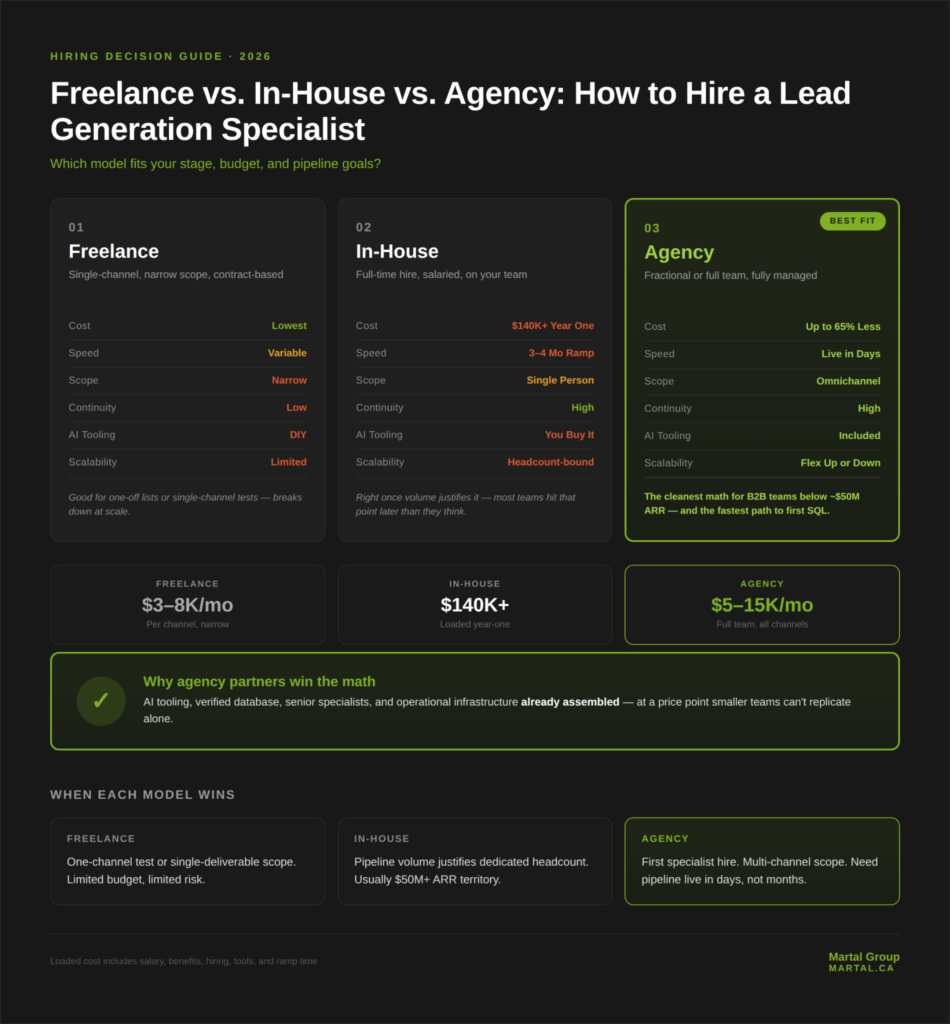
Freelance specialists are the cheapest option on paper. The right freelancer can be effective for a narrowly scoped engagement — running a single channel, building a list, executing a defined outreach cadence. Where freelance breaks down is in coordination, continuity, and accountability. If the freelancer leaves, the institutional knowledge leaves with them. If the campaign needs to scale across multiple channels, the freelancer model usually can’t keep up.
In-house specialists make sense once your pipeline volume justifies dedicated headcount and the in-house cost-per-lead drops below the outsourced equivalent. The trade-off is the $140,000+ year-one cost (loaded), the 3–4 month ramp before meaningful output, and the management overhead of recruiting, training, and retaining the role. Most companies hit the in-house crossover point later than they think.
Agency partners sit in the middle of the cost curve and at the top of the speed curve. Outsourcing to a lead generation specialist typically reduces cost by up to 65% versus in-house, with campaigns going live in days rather than weeks. The right agency brings the AI tooling, the verified database, the senior specialists, and the operational infrastructure already assembled — you don’t pay the year-one ramp tax.
In practice, the model that usually works best for B2B teams below ~$50M ARR is fractional — a small dedicated team running campaigns end-to-end, scaling up as pipeline justifies it. We’ve seen this play out clearly: for one EDI solutions client we worked with, a single fractional specialist delivered 14 SQLs in a 3-month pilot, with the first two SQLs booked in week two. That’s the kind of speed-to-output an in-house hire structurally can’t match.
Why Outsourcing Tends to Win the Math
When the decision lands on the agency side, five things make the case:
- Specialized expertise and focus. Outsourced specialists do this work full-time, every day. Your internal team stays focused on strategy and closing rather than prospecting.
- Cost efficiency. No recruiting, training, or management overhead. The agency’s economies of scale spread tooling and operational costs across a larger book of work.
- Scalability. Outsourced engagements flex up or down with demand. Adding (or pausing) capacity doesn’t require a hiring cycle or a layoff.
- Access to the right tools. Reputable agencies bring database access, sequencing platforms, intent data, lead generation software, AI tooling, and dialer infrastructure already integrated — at a price point smaller teams can’t replicate independently.
- Performance accountability. The right agency operates against measurable outcomes. The wrong one operates against activity metrics. Make sure the contract is structured around the former.
When evaluating an outsourced partner, do the homework. Check references. Ask for outcomes from companies in your industry. Confirm what’s included in the scope. And confirm who actually does the work — senior specialists, junior offshore reps, or AI with a human nameplate.
When is it Time to Hire a Lead Generation Specialist?
The right time to hire a specialist is rarely the moment a CMO or CRO finally has time to think about it. It’s earlier — usually when one of these signals shows up in the pipeline, before the gap reaches the revenue forecast.
A specialist is worth bringing on when:
- Inbound has stalled or never started. If pipeline depends on referrals or a single inbound channel, you don’t have a system — you have a streak. Specialists build the outbound layer that makes pipeline predictable.
- Your sales team is buried in prospecting. Every hour an AE spends building lists, drafting cold emails, or chasing unqualified leads is an hour they’re not closing. The math almost always favors moving prospecting to a specialist and freeing the closers to close.
- You’re entering a new market or launching a new product. Validation campaigns need a contained team that can run a clean test without disrupting the core revenue motion. We’ve seen this pattern repeatedly with clients expanding from Europe or Asia into North America — the right specialist team produces real signal in weeks, not quarters.
- You’re scaling faster than headcount. When pipeline targets jump but adding SDRs would take six months, an outsourced specialist team scales with you immediately.
- AI tools are running but not converting. If you’ve invested in an AI SDR platform and the meetings booked aren’t converting to opportunities, you’re missing the qualification layer. Adding a human specialist on top of the AI is usually what turns the math around.
If any of these describe your current situation, you’re not “thinking about” hiring a specialist — you’re already overdue.
Ready to Move Beyond Manual Prospecting?
If your team is hitting any of those signals, the question isn’t whether to bring in expertise. It’s how to bring it in without paying the year-one ramp tax of an in-house hire or the conversion gap of a pure-AI tool.
At Martal Group, we run the human-led, AI-powered model the rest of the industry is still describing. Our senior onshore Sales Executives — supported by Martal’s proprietary AI Sales Platform — handle the full omnichannel motion across outbound lead generation, cold calling, cold email, LinkedIn lead generation, and B2B appointment setting. The AI does the volume. The specialists own the qualification, the conversation, and the handoff to your AEs. The model has been refined across 2,000+ B2B brands over 16+ years and #1 ranking in lead generation on Clutch.
Book a consultation and we’ll walk through what a fractional specialist team could realistically deliver against your pipeline targets in 30, 60, and 90 days. No deck, no pitch — just the math.
References
- SHRM
- PayScale
- Salary.com
- ZipRecruiter
- Digital Applied Team
- Glassdoor
- IBM
- Amplemarket
- Martal Group- Telecommunications Use Case
- Martal Group – IoT case study
- RCR Wireless News
FAQs: Lead Generation Specialist
Can AI replace lead generation specialists?
Not in 2026 — and not for most B2B teams. AI handles the parts of the role that are research-heavy and repetitive: prospect identification, list-building, first-draft outreach copy, sequence orchestration, signal monitoring, and CRM updates. What it cannot reliably handle is real qualification, objection handling, and the nuanced conversation that happens once a prospect actually replies. Pure-AI SDR tools have shown 50–70% annual churn rates because reply rates collapse once buyers recognize the messaging is automated. The teams getting real results are running hybrid models — AI scales the volume, the human specialist owns the qualification, the conversation, and the handoff to the AE. The role has shifted toward judgment work, not disappeared.
How much does a lead generation specialist make?
It depends heavily on the source you trust. Glassdoor reports an average of $98,629 for US-based lead generation specialists, with a typical range of $75,474 to $131,370. ZipRecruiter places the average at $66,269, Salary.com at $72,180, and PayScale at $40,452. The wide variance reflects who’s submitting the data — Glassdoor and Salary.com skew toward enterprise and verified employees in higher-cost markets, while PayScale captures more early-career roles. Geography, industry, and seniority all drive the spread. Once you load in benefits, hiring cost, tools, and ramp time, an in-house specialist commonly crosses $140,000+ in year-one total cost — which is the math driving most outsourcing decisions for companies below $50M ARR.
What does a lead generation specialist actually do all day?
Most of the day breaks down into four buckets: research and ICP refinement, omnichannel outreach (cold calling, cold email, LinkedIn), qualification of inbound responses, and analysis of campaign data to optimize the next round. The exact mix varies by company. Specialists running heavy outbound spend more time in conversation — calls in the morning, follow-ups across the day, qualification calls in the afternoon. Specialists running ABM spend more time in research and personalization. In 2026, a meaningful share of the manual research and drafting work has shifted to AI tools, freeing specialists to spend more time on qualification, message refinement, and the handoff to the sales team. The strongest specialists also block 1–2 hours weekly for data analysis — looking for the correlations between lead attributes and conversion that surface what’s actually working.
Should I hire a freelance lead generation specialist or use an agency?
This is the question most companies don’t think through carefully enough. A freelance specialist is the cheapest option on paper and works well for narrowly scoped engagements — a single channel, a defined cadence, a contained list. Where freelance breaks down is in coordination across channels, continuity if the freelancer leaves, and accountability when the campaign needs to scale. An agency partner sits at a higher monthly cost but typically reduces total cost-per-lead by up to 65% versus building in-house — because the agency brings the AI tooling, verified database, senior specialists, and operational infrastructure already assembled. For most B2B teams, the right model for the first specialist hire is fractional through an agency: a small dedicated team running campaigns end-to-end with the ability to scale up as pipeline grows. Once volume justifies dedicated headcount and in-house cost-per-lead drops below the outsourced equivalent, building internally starts to make sense.
Is a lead generation specialist the same as an SDR?
Closely related, but not identical. An SDR (sales development representative) is the in-house title for someone doing top-of-funnel work inside a company — usually salaried, usually reporting into a sales manager, often a stepping-stone role to an account executive position. A lead generation specialist is the same scope of work, but the term is more commonly used for outsourced or fractional specialists working through an agency, and for senior practitioners who own multi-channel campaigns rather than a single outbound queue. In practice, the role is the same: identify, engage, and qualify prospects so the sales team can focus on closing. The titles get used interchangeably in most B2B contexts, with BDR (business development representative) sometimes added to the mix for accounts-focused work.
What is a lead generator?
A lead generator is the same role as a lead generation specialist — the term is used more often in agency contexts and on freelance platforms, while “lead generation specialist” is used more often in formal job descriptions. Both refer to the person responsible for finding, engaging, and qualifying prospects who match a company’s ideal customer profile, then handing those qualified opportunities to the sales team. The work spans cold email, cold calling, LinkedIn outreach, account-based marketing, lead qualification, and appointment setting — usually run as a coordinated omnichannel program rather than a series of standalone tactics. A modern lead generator also operates AI tools alongside the manual outreach: the AI handles research, drafting, and sequencing, while the specialist owns the qualification and the conversation.