
 Martal
 Technology
 Education and training
 Web Development and UI / UX
 Healthcare/Medical
 Logistics and Supply Chain
 Information Technology
 Insuretech and Financial Services
 Marketplaces
 Software Development
 E-commerce and retail
 AI and Machine Learning
 Energy and Solar
 Manufacturing
 Security and Surveillance
 Digital Marketing Agency
 Transportation
 MSP
MSP
 Telecom
 B2B SaaS
 Cybersecurity
 HR tech
 Fintech
 Cleantech
 Consulting
12 Lead Generation Trends Driving B2B Growth in 2026
Major Takeaways: Lead Generation Trends
B2B buyers now complete an estimated 60–70% of their research before ever engaging a vendor, and 94% have a preferred vendor shortlist locked in before first contact. High-volume generic outreach is reaching buyers after their decision is already forming. Precision targeting, signal-based timing, and coordinated omnichannel outreach are replacing spray-and-pray as the operational standard for high-performing B2B pipeline programs.
81% of marketing leaders now have AI agents in the piloting or production phase, and 98% of high performers expect AI agents to deliver significant business results — according to Gartner’s Q1 2026 CMO Quarterly. AI SDR platforms are reducing ramp time, lifting lead quality by 50–70%, and enabling signal-personalized outreach at a scale no human SDR team can match manually. The competitive gap between AI-supported and manual outbound programs is widening every quarter.
Coordinated omnichannel sequences ,email, LinkedIn, and phone working as a unified system, drive up to 250% higher conversion rates than single-channel outreach and 287% better results than email alone. The key word is coordinated: channels that share a unified prospect profile and respond to each other in real time produce a coherent buyer experience. Channels that run in parallel without coordination produce noise. B2B buyers use 10+ channels during their purchasing journey — the outreach model needs to match that reality.
Signal-based selling uses real-time behavioral data, funding announcements, hiring surges, technology changes, content engagement, to identify accounts that are actively in a buying window right now. Traditional lead scoring is rule-based and static; it cannot tell you that an account just added three SDR job postings and dropped a competitor tool. Intent-driven outreach achieves reply rates of 15–25% compared to the 3–5% industry average for cold outreach — a 5× improvement driven entirely by timing and relevance rather than volume.
Third-party cookies are effectively gone, 67% of US adults have already turned off tracking, and Chrome’s privacy controls have accelerated the transition. For B2B teams, this means prospect data built on third-party sources is eroding in accuracy while first-party behavioral signals, website visits, content engagement, CRM interactions, are becoming the primary targeting layer. Companies leveraging first-party data strategies achieve 2.9× better customer retention and 1.5× higher marketing ROI compared to those still dependent on third-party alternatives.
Traditional SEO optimizes content to rank on Google’s search results pages. GEO optimizes content to be cited and recommended by AI platforms, ChatGPT, Perplexity, Google AI Overviews, when they generate answers to user queries. The distinction matters because 94% of B2B buyers now use large language models during their purchasing process, and 93% of AI search sessions end without a website click. If your brand is not visible in AI-generated answers, you are invisible to a growing share of buyers who are forming vendor preferences before they ever visit a search results page.
The MQL model creates structural misalignment: marketing passes a volume of leads over a scoring threshold, declares success, and moves on. Sales receives leads that do not convert. Nothing improves. Misaligned sales and marketing teams cost B2B firms an estimated $1 trillion annually in lost productivity and abandoned deals — yet only 35% of organizations achieve meaningful alignment. RevOps solves this by unifying teams around shared definitions, shared data, and shared accountability for revenue outcomes. Organizations achieving alignment report 27% faster profit growth, 36% higher customer retention, and 208% revenue growth compared to misaligned competitors.
Gartner’s research shows marketing budgets are holding steady at 7.7% of revenue while CMO accountabilities are projected to expand from five areas to eight by 2029, without proportional resource increases. Sales-as-a-Service closes that gap by delivering a full outbound pipeline function, experienced onshore SDRs, AI-supported outreach, coordinated omnichannel execution, at 60–65% of the cost of building and maintaining an equivalent in-house team. Teams using outsourced sales models ramp 3× faster and report 80% higher lead quality compared to internal-only programs.
Introduction
B2B lead generation is under real pressure heading into 2025 and 2026. Nearly 47.7% of marketing teams have faced budget cuts in the past year [3], yet pipeline targets have stayed flat or grown. Sales and marketing leaders are being asked to do more with less, and many of the old playbooks are no longer cutting it.
Buyer behavior has also fundamentally changed. B2B buying committees now involve an average of 10 or more decision-makers, buyers complete over 60% of their research before ever engaging a vendor (12), and 94% had already built their preferred vendor shortlist before speaking to sales (13).If your B2B lead generation strategies haven’t kept pace with those realities, you’re arriving late to conversations that have already been decided.
The global lead generation industry is expected to hit $295 billion by 2027, growing at a 17% CAGR (14) a signal that despite the budget pressure, investment in smarter, more efficient lead generation is accelerating, not retreating. The question isn’t whether to invest in lead gen. It’s whether you’re investing in the approaches that actually move the needle.
This article breaks down 12 trends defining B2B lead generation in 2026. Each trend is grounded in current research, real performance data, and Martal’s direct experience running outbound and sales outsourcing programs across more than 2,000 B2B clients. For the benchmarks behind these trends, our lead generation statistics resource covers the numbers in depth. Here, the focus is on what each shift means in practice and how to build it into your pipeline strategy going into 2026.
We reviewed leading industry reports, examined performance data from Martal’s outbound programs, and organized findings around the challenges B2B sales and marketing leaders are actually facing in 2025–2026. The goal is to cut through trend noise and focus on shifts that affect pipeline outcomes.
Top 12 B2B Lead Generation Trends You Need to Know
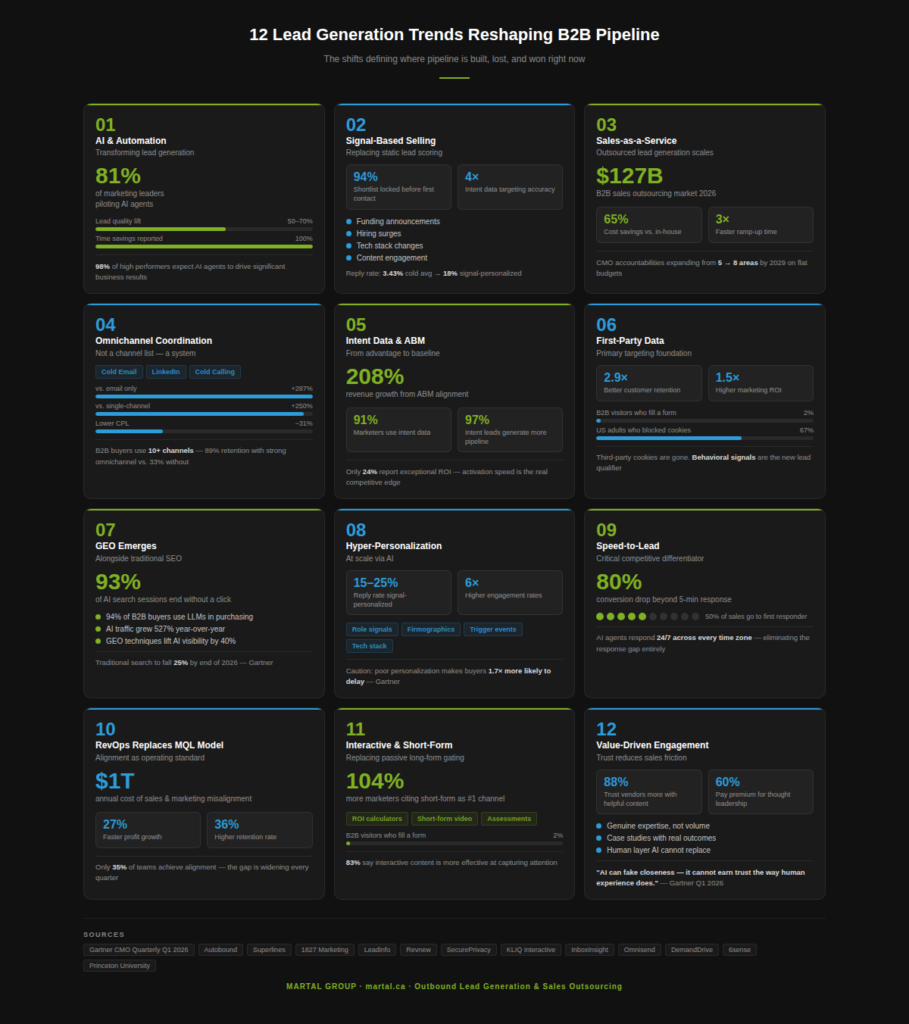
The 12 trends reshaping B2B lead generation in 2026 do not operate in isolation. They connect, reinforce, and in several cases depend on each other.
- AI and automation are transforming what outreach can accomplish at scale.
- Signal-based selling is making static lead scoring obsolete.
- Sales-as-a-Service models are letting companies build pipeline without expanding headcount.
- Omnichannel coordination is separating teams running one unified conversation from those blasting the same pitch across disconnected systems.
- Intent data and ABM have moved from competitive advantage to operational baseline — while the collapse of third-party cookies is forcing every B2B team to build first-party data foundations they should have started building two years ago.
- Discovery is shifting as Generative Engine Optimization (GEO) emerges alongside traditional SEO, reshaping how buyers find vendors before they ever visit a website.
- Hyper-personalization at scale is now achievable without sacrificing accuracy — but only when the underlying data is clean and the signals are current.
- Speed-to-lead has become a conversion variable that no manual process can reliably win.
- RevOps alignment is replacing the MQL model as the operating standard for teams that want pipeline they can trust.
- And both interactive and short-form content and value-driven, authentic engagement are proving that the teams earning buyer attention in 2026 are not the ones publishing the most — they are the ones publishing what actually helps.
Together, these 12 shifts define where B2B pipeline is generated and lost right now. The sections below break down each one with the data, the practical implications, and what high-performing teams are doing differently.
1. AI and Automation Transforming B2B Lead Generation
81% of marketing leaders now have AI agents in the piloting or production phase, and among high performers, 98% expect AI agents to deliver significant business results.
Reference Source: Gartner CMO Quarterly Q1 2026
According to Gartner’s 2025 Marketing Transformation Survey, 81% of marketing leaders now have AI agents in the piloting or production phase — and among high performers, 94% expect AI agents to deliver significant operational efficiencies while 98% expect significant business performance results (15). The teams still running manual prospecting, static lead scoring, and untailored outreach aren’t just behind on tooling. They’re handing pipeline opportunities to competitors who are reaching the same buyers faster, with more relevant context, at higher volume.
The shift playing out now is not just about automation. It’s about what automation can actually do, and the answer in 2026 is considerably more than most teams realized possible two years ago.
Prospecting efficiency: doing in minutes what used to take hours
The most immediate productivity gain from AI is in prospect research and list building. Tasks that once consumed hours of SDR time — finding contacts that match your ICP, validating data, pulling contextual signals to personalize outreach — can now be completed in minutes.
64% of sales reps now save 1–5 hours per week through AI automation, with those using AI specifically for prospect research saving an average of 1.5 hours per week (16). Scaled across a team of five SDRs, that recaptured time represents an additional 37+ hours of selling capacity weekly — without adding headcount.
The broader productivity picture is even more compelling. 56% of sales professionals now use AI daily, and 38% save over 1.5 hours per week on research while generating better-quality leads (17). That time compounds directly into more conversations, more follow-ups, and more pipeline. Building a structured lead generation workflow around AI tooling is one of the fastest ways to improve outreach output without proportional headcount investment.
For Martal’s teams, this is exactly what our AI SDR Platform delivers in practice. Rather than spending the first days of a campaign on manual list building, our platform pulls from 300M+ verified contacts, enriches each record with 1,500+ data fields, and surfaces intent signals — so our sales executives focus on outreach and qualification from day one.
Personalization at scale: the end of the generic sequence
The other major AI impact in 2026 is on personalization. Signal-personalized outreach, messages built around specific buying signals like funding events, hiring surges, or technology changes, now achieves 15–25% reply rates, compared to the 3–5% industry average for generic cold email (16). That is a five-fold improvement in response rate, compounding across every downstream metric.
Customized emails driven by AI personalization achieve 2× higher reply rates compared to standard templates (18).And 57% of businesses have increased AI spending on prospecting and personalization, highlighting a strong shift in revenue strategy for 2026 (19).
The math is stark: a team sending 1,000 generic emails at a 3% reply rate generates 30 conversations. A team sending 200 signal-targeted emails at a 20% reply rate generates 40 conversations, with 80% fewer emails sent, and each conversation grounded in genuine relevance to the buyer’s current situation.
Martal’s AI platform generates outreach trained on 40M+ outbound campaigns, personalizing sequences at the persona level using each prospect’s role, industry, tech stack, and recent activity, then adapts based on what each audience actually responds to.
Lead qualification: AI scoring vs. gut feeling
Traditional lead qualification was static, rule-based, and only as good as the person who set up the scoring model. AI-powered qualification is different — it analyzes historical win patterns, CRM signals, engagement behavior, and real-time intent to rank and route leads continuously.
AI-powered lead scoring improves qualification accuracy by 30–50% compared to traditional methods (20) and companies using AI SDR tools and lead generation software report up to a 300% increase in qualified meetings booked (21).
Martal’s qualification model identifies SQLs based on authority and need — not numeric scores, with AI supporting the identification and prioritization layer while human sales executives handle the actual qualification conversations.
24/7 outreach and automated lead generation
Automation through AI extends well beyond office hours. Automated lead generation systems can respond to inbound signals, trigger follow-up sequences, and engage website visitors the moment intent appears — regardless of time zone or business hours.
94% of B2B buyers have their preferred vendor shortlist locked in before first contact (13). That means the teams that can identify and engage buying intent as it emerges, rather than waiting for a form fill, are structurally advantaged. Conversion probability drops up to 80% when follow-up is delayed beyond five minutes (22). AI removes that delay entirely, responding within seconds to signals that a human team would catch hours later.
The next evolution: Agentic AI
Everything described above, AI-assisted research, personalized outreach, automated follow-up, represents the first wave of AI in sales. What is emerging in 2025 and accelerating rapidly into 2026 is something meaningfully different: agentic AI.
Where earlier AI tools assist sales reps by suggesting actions or drafting content, agentic AI systems take autonomous action. They plan, execute, and adapt without waiting for a human to approve each step. An agent doesn’t just draft a follow-up email — it identifies the prospect showing intent, enriches the contact record, writes the message, sends it at the optimal time, and routes the response to the right sales executive. All without manual intervention.
The global agentic AI market was valued at $7.29 billion in 2025 and is projected to grow to $9.89 billion in 2026, expanding at a 42% CAGR through 2031 (23).
In GTM specifically, the results are being documented. Agentic AI systems in sales and marketing are producing 2–3× improvements in pipeline velocity (24).Automated SDRs using agent architectures research leads, personalize outreach, and boost meeting conversions 4× faster than manual efforts (25).
This is the capability Martal’s AI SDR platform was built to deliver. Our agentic AI handles the repeatable, data-intensive steps of top-of-funnel execution,l ICP identification, contact sourcing, campaign setup, and sequence personalization, while our onshore sales executives focus on discovery, qualification, and relationship-building. The result is a model where AI and human expertise are doing what each does best, rather than asking humans to perform tasks that AI handles faster and more accurately.
Human + AI: the model that consistently outperforms
Despite the pace of AI adoption, the strongest performing outbound programs in 2025 and 2026 are not fully automated — they are hybrid. 69% of sellers report that AI helped them shorten their sales cycle, and 68% say AI insights helped them close more deals (26). But the top performers use AI to handle volume, research, and initial engagement — then hand off to human judgment for discovery conversations, objection handling, and deal navigation.
Martal’s model is built on exactly this balance. AI handles the research, the data, the sequencing, and the qualification signals. Our experienced onshore sales executives handle the conversations that actually advance deals. It’s not AI instead of humans. It’s AI allowing humans to do the parts of the job that human judgment does better.
Bottom line: In 2026, AI is no longer a feature of ambitious sales teams, it is the operating infrastructure of any team that wants to stay competitive. The question has moved from “should we use AI?” to “how quickly can we build the right combination of agents, automation, and human expertise?” The teams that answered that question early are already running more pipeline, with better conversion rates, at lower cost per qualified opportunity. The window to catch up is narrowing.
2. Signal-Based Selling Replaces Static Lead Scoring
Signal-personalized outreach achieves reply rates of 18% compared to the 3.43% cold email average, a 5x improvement driven entirely by timing and relevance, not volume.
Reference Source: Autobound
The average cold email reply rate in 2026 sits at just 3.43%.(27) Signal-personalized outreach, where every message references a specific, real-time trigger event at the prospect’s company, achieves 18% reply rates.(27) That is a 5× improvement from the same channel, with fewer emails sent and far more meaningful conversations started.
The difference is not better copywriting. It is better timing — and timing now comes from signals, not schedules.
This is the defining shift in B2B lead generation heading into 2026. The old model — building a list, assigning lead scores based on job title and firmographics, and working through it on a quarterly cadence — is losing ground fast. The new model prioritizes outreach based on observable changes happening at a company right now: a funding round, a leadership hire, a competitor being dropped, a pricing page visited three times in 48 hours. These signals tell you that a prospect is in motion. Static scoring tells you they look good on paper. The two are not the same thing.
Why the MQL model is breaking down
Traditional lead scoring was built on a flawed assumption: that demographic fit is a reliable proxy for buying readiness. It is not.
The hard evidence is in the numbers. The MQL-to-SQL conversion rate industry average is just 13%, meaning roughly 87 out of every 100 marketing-qualified leads never become sales opportunities (28). That gap is largely caused by misaligned qualification criteria and insufficient buying intent signals. The scoring told the team a lead was ready. The lead was not.
Organizations that have replaced static MQL scoring with intent-driven, signal-based qualification report 30–40% improvement in MQL-to-SQL conversion rates, not by generating more leads, but by engaging the right accounts at the right moment (28). The lead generation process itself becomes more efficient when the filter is readiness, not just fit.
One of the signal-based model’s most important insights: only 3% of your target market is actively in a buying cycle at any given time (29). Targeting the other 97% with the same urgency doesn’t improve outcomes — it creates noise, burns rep time, and trains buyers to ignore your outreach. Signal-based selling focuses effort precisely on that 3%, at the moment they enter a buying window.
What signals actually look like in 2026
Signal-based selling is not a single data point. It is a stack of behavioral, firmographic, and technographic indicators that together create a picture of account-level buying readiness. The most reliable signals include:
- Pricing page visits — multiple visits within a short window, especially from different IPs (indicating a buying committee is reviewing)
- Competitor research activity — tracked through third-party intent data providers like Bombora, 6Sense, and G2
- Technology changes — a company drops a competitor tool, or adopts a new platform in an adjacent category
- Hiring surges — new headcount in roles that typically precede a purchase in your category
- Funding events — a recent capital raise signals budget availability and growth intent
- Job changes — a new decision-maker joins in a key role, often triggering a vendor re-evaluation
Martal’s AI SDR Platform monitors 10M+ real-time intent signals and events, funding announcements, hiring patterns, technology adoption, and content engagement, and surfaces the accounts most likely to convert right now. That’s not a list. It’s a live feed of buying readiness. When our sales executives reach out to these accounts, the outreach arrives when something has just changed in the prospect’s world — which is the only time cold outreach doesn’t feel cold.
ABM: from strategy to standard operating procedure
Account-Based Marketing has reached mainstream status in 2026. The debate about whether to invest in ABM is over, 70% of B2B marketers now have an active ABM program in place, with companies dedicating an average of 29% of their total marketing budget to ABM strategies.(30)
The results justify it. 87% of marketers report higher ROI from ABM compared to other marketing investments (30). And 97% of marketers say ABM delivers a higher return compared to traditional demand generation.These are not incremental improvements — they reflect a fundamentally more efficient way of allocating sales and marketing effort.
The reason ABM works is also the reason signal-based selling works: both start from the premise that relevance beats volume. You are not trying to reach everyone in a segment. You are trying to reach the right people at the right accounts when they are actually ready. ABM provides the account-level focus. Signal data provides the timing. When the two are combined, outreach that would previously be ignored becomes a conversation.
The buying committee problem, and why it changes everything
One of the most important structural changes in B2B buying is the size of the committee now involved in a typical purchase. Gartner’s 6sense Buyer Experience Report data, cited in the CMO Quarterly, confirms that buying committees average 10.1 people, each conducting independent research, and 94% had their preferred vendor shortlist locked in before first vendor contact,with 77% ultimately buying from their preliminary favorite. (15)
This changes what “early outreach” means. Getting in front of an account during their research phase, not after they have already formed preferences — is now the primary objective. Advanced lead generation in 2026 is about showing up before your competitors are even aware the evaluation has started.
For lead generation KPIs in 2026, this means tracking not just conversion rates but SAL velocity (the average time from first intent signal to a Sales-Accepted Lead) and in-market coverage (what percentage of your total addressable market showing active buying signals you have successfully engaged). Raw lead volume is the wrong metric to optimize for. Buying window penetration is the right one.
Signal stacking in practice: how Martal applies it
One pattern we see consistently across outbound programs: the accounts that convert fastest are rarely the ones that looked best on a static ICP list. They are the ones where multiple signals arrived in a short window, a new CMO hire, a spike in competitor research activity, a recent funding announcement. The convergence of signals tells you the window is open.
We have applied this approach across verticals from SaaS to manufacturing to healthcare. In one engagement with a transportation technology company, combining signal-based targeting with coordinated omnichannel outreach resulted in 108 booked meetings in three months — a result that generic list-based outreach at the same volume could not have produced.
If you want to explore the data behind your current qualification model, lead generation questions worth asking include: what percentage of your MQLs actually convert to SQLs, how long after a signal fires before your first touch, and how many accounts in your TAM are in a buying window right now that you have not yet contacted.
Bottom line: Static lead scoring made sense when buyer behavior was linear and data was limited. In 2026, buyers move fast, research independently, and form vendor preferences before a sales conversation ever starts. Signal-based selling, layering behavioral intent, technographic changes, and real-time trigger events, is the methodology that matches how B2B purchasing actually works. .
3. Sales-as-a-Service and Outsourced Lead Generation Scale Rapidly
Outsourcing lead generation cuts costs by up to 65% compared to building and maintaining an equivalent in-house SDR team.
Reference Source: Martal Group
The global B2B sales outsourcing market is valued at $127 billion in 2026 — and is forecast to reach $260 billion by 2035 (31).That trajectory reflects something that has become undeniable in how B2B companies approach revenue growth: building an in-house SDR team from scratch is no longer the default. For a growing number of organizations, Sales-as-a-Service has become the faster, leaner, and more predictable path to qualified pipeline.
The shift is not about cutting corners. It is about recognizing that specialist execution, purpose-built infrastructure, and AI-augmented outreach are things a dedicated partner can deliver immediately — while an in-house team would take months to assemble and years to mature.
Over 70% of B2B companies plan to expand their outsourced SDR investment through 2026 to improve adaptability and maintain consistent pipeline flow despite tighter budgets and longer sales cycles (32).The lead generation outsourcing segment alone is projected to grow at 8.9% annually through 2033, reaching $7.6 billion — driven by rising customer and lead acquisition costs, increasing complexity in outbound execution, and the growing sophistication required to run signal-based, omnichannel outreach programs effectively (33).
The economics that make outsourcing hard to argue against
The cost comparison between in-house and outsourced is decisive for most B2B teams once they account for the full picture. The fully loaded annual cost of a single in-house SDR — salary, OTE, benefits, tools, recruiting, management overhead — averages $140,000–$150,000 per year (32). And that figure does not include the 3.2-month ramp to full productivity or the cost of replacement when that SDR leaves — which happens on average every 14–18 months.
The organizational pressure driving this shift is reflected clearly in Gartner’s 2025 CMO Spend Survey: marketing budgets are holding steady at 7.7% of revenue — essentially flat — while expectations on CMOs are simultaneously expanding. Gartner projects that CEOs and CFOs plan to increase marketing’s accountabilities from an average of five areas today to eight areas by 2029, without a proportional increase in resources. (15)
Against that baseline, outsourced lead generation through a Sales-as-a-Service model typically delivers 60–70% cost savings versus the fully loaded in-house alternative (1). Companies that outsource lead generation also report achieving 43% faster sales cycle times compared to in-house equivalents, and 80% say lead quality is higher through outsourced programs than through internal teams. (5)
For done for you lead generation, the math compounds further: one study found companies with fully outsourced, tech-enabled lead generation programs achieve 23% faster revenue growth than competitors relying solely on in-house efforts (2).
The 2026 model: AI-augmented human execution, not one or the other
What has changed most about Sales-as-a-Service heading into 2026 is not the value proposition — it has always been cost efficiency and speed. What has changed is the model itself.
The best outsourced programs in 2026 are no longer purely human. They are human-led and AI-augmented — where experienced lead generation specialists handle strategy, relationship-building, qualification, and objection handling, while AI handles the data-intensive tasks that previously consumed the majority of rep time: prospect research, intent signal monitoring, list enrichment, message personalization, send-time optimization, and follow-up sequencing.
Activated Scale’s 2025 Global Sales Outsourcing Trends report predicts that by 2026, most outsourced SDR programs will incorporate AI-driven intent data and automation to enhance performance — not as an experiment, but as standard operating procedure (32). McKinsey projects that hybrid sales structures — combining internal leadership with specialized external execution — will dominate B2B go-to-market by 2030. (6)
Martal’s model reflects exactly this evolution. Our onshore sales executives — averaging 3–5 years of B2B experience — work alongside our proprietary AI SDR Platform, which sources prospects from a database of 300M+ verified contacts, monitors 10M+ real-time buying signals, and generates campaign copy trained on 40M+ outbound interactions. The result is outreach that is both faster and more relevant than either a purely human or purely automated approach can deliver on its own.
Clients start receiving sales-qualified leads within 30 days of kickoff. Lead generation campaigns go live in 7–10 business days from signed agreement — a ramp that no internal hiring process can match.
What the results look like at scale
The proof is in the outcomes, not the promise.
A transportation technology company needed to build pipeline in a new market, fast. Within three months, Martal delivered 108 booked meetings — a result that would have taken a newly hired internal team the better part of a year to match, once hiring, onboarding, and ramp time are factored in.
Over a longer horizon, the compounding value becomes even clearer. Clickworker, a global marketplace platform, has been partnering with Martal for over nine years. That sustained program has generated $4.5M in recurring revenue and a 500% ROI, with closed deals including Fortune 10 and Fortune 500 accounts. For energy company Total Energy Connections — a company of approximately ten people — Martal generated 20 qualified leads per month, building a consistent pipeline their internal team could never have produced at that scale.
These results share a common thread: an experienced external team executing with purpose-built infrastructure delivered outcomes that were structurally impossible for the same companies to replicate in-house at comparable cost and speed.
Who is driving adoption in 2026
The profile of companies choosing Sales-as-a-Service has broadened significantly. What was once primarily a startup-and-scaleup strategy is now widely adopted across growth-stage technology companies, mid-market B2B firms entering new verticals, and enterprise organizations launching new product lines or geographic expansions.
The common triggers remain consistent:
- Internal sales teams are stretched thin and pipeline is inconsistent
- A new market or vertical needs outbound built from scratch
- Customer acquisition costs have climbed to an unsustainable level
- Speed-to-pipeline is the constraint, not budget or headcount
- The complexity of running signal-based, omnichannel outreach has exceeded internal bandwidth
79% of businesses report faster market expansion when using outsourced sales programs, (7) and companies can scale outreach activity 3× faster through outsourcing than through internal SDR hiring and ramp. (3). For teams trying to enter new markets or respond quickly to competitive pressure, that speed differential is often the deciding factor.Bottom line: Sales-as-a-Service has crossed the inflection point from growth tactic to mainstream B2B strategy. The market is growing at nearly 10% annually. The cost, speed, and performance advantages over in-house models are well-documented and widening as AI augmentation raises the baseline of what an outsourced program can deliver. For B2B leaders heading into 2026, the practical question is not whether to consider outsourcing — it is whether the current model is producing the pipeline growth the business needs, and at what cost per qualified opportunity.
4. Omnichannel Outreach as a Coordinated System, Not a Channel List
Coordinated omnichannel outreach with email, LinkedIn, and phone working as a unified sequence drives 40% higher engagement and 31% lower cost-per-lead than single-channel strategies.
Reference Source: Martal Group
Coordinated omnichannel outreach, email, LinkedIn, and phone working as a unified sequence, drives 40% higher engagement and 31% lower cost-per-lead than single-channel strategies. (5) When those three channels are not just present but actively coordinated — where a LinkedIn reply pauses an email sequence, and a call follows a specific content interaction — the lift becomes even more pronounced. Multi-channel sequences combining all three can boost overall conversion rates by up to 250% compared to email-only outreach. (6) And omnichannel outreach combining email, LinkedIn, and phone can boost results by over 287% versus email alone. (7)
Those numbers explain why the word “omnichannel” has moved from marketing language to operational requirement. The question in 2026 is no longer whether to use multiple channels. It is whether those channels are genuinely coordinated — or just running in parallel and creating noise.
The critical distinction: omnichannel vs. multichannel
Most teams that think they run omnichannel outreach are actually running multichannel outreach — and the difference matters more than most sales leaders realize.
Multichannel means using email, LinkedIn, and phone, but each operates independently. Your email platform does not know a prospect replied on LinkedIn. Your calling team does not see the email bounce. A prospect receives a cold email, a LinkedIn InMail, and a voicemail in two hours — all with the same generic pitch, none of which references the others. The prospect experiences this as spam, not outreach.
Omnichannel means every touchpoint shares a unified prospect profile that updates in real time. When a prospect replies on LinkedIn, the email sequence pauses automatically. When they visit your pricing page, a call is triggered with that specific context loaded for the rep. Every interaction builds on the last, so the prospect experiences a coherent, escalating conversation — not disconnected pings from multiple systems that don’t talk to each other.
B2B buyers now use an average of 10+ different channels during their purchasing journey (6) — and 42% of B2B respondents say they used more than 11 different touchpoints before making a purchase decision. (8) With that level of channel-hopping, a disconnected approach doesn’t just underperform — it actively damages credibility with prospects who recognize the lack of coordination instantly.
What each channel contributes in a coordinated sequence
Each channel in a properly structured lead generation workflow plays a specific role. Understanding what each does best is what separates effective omnichannel from chaotic multichannel.
Cold email is the workhorse and primary channel for most B2B outreach. 83% of B2B marketers rank email as one of their most important channels for engaging prospects, and 88% of professionals check email daily. (6) Email works best for delivering value, sharing context, and establishing relevance — but it rarely closes the loop on its own. In 2025–2026, outreach emails of 50–125 words achieve the highest reply rates, approximately 50% higher than longer formats. (7)
LinkedIn outreach adds credibility and relationship context that email cannot. LinkedIn drives 75–85% of all B2B leads from social media (9) and when a prospect receives a LinkedIn connection request that references a prior email, recognition replaces suspicion. AI-assisted LinkedIn outreach is producing 10.3% response rates compared to 5.1% for cold email alone (9) and reps with strong LinkedIn Social Selling Index scores are 51% more likely to hit quota. (10)
Cold calling has made a meaningful comeback as part of coordinated omnichannel sequences — not as a standalone channel. 80%+ of sales leaders say calling is essential to their outbound strategy, and 82% of B2B buyers will agree to a meeting from a cold call when the outreach is relevant. (6) The key phrase is “when the outreach is relevant” — a call that arrives after two email touches and a LinkedIn connection is not truly cold. The prospect already recognizes the name and has had time to consider the value proposition. That context changes the conversation entirely.
The AI layer that makes true omnichannel possible at scale
Running a genuinely coordinated omnichannel sequence across dozens or hundreds of active prospects simultaneously is operationally impossible without automation. 80% of marketers report that marketing automation generates more leads and conversions than manual approaches (6), and the automated lead generation infrastructure is what enables the synchronization that makes omnichannel work.
In practice, this means a system where a prospect’s engagement with one channel immediately updates their status across all channels. If they open an email but do not reply, the system queues a LinkedIn touch. If they click a link in that email, the call queue is prioritized with that content noted. If they reply to a LinkedIn message, the email sequence is paused and the rep is alerted to respond personally. The entire lead generation campaign behaves as one conversation, not three separate parallel ones.
Martal’s AI SDR Platform coordinates this across email, LinkedIn outreach, and direct calling — handling the sequencing, timing, and channel coordination automatically so that our sales executives can focus their energy on the conversations that require human judgment, not on tracking which touch was sent on which channel.
Gartner predicts that by 2028, 60% of brands will use agentic AI to facilitate streamlined one-on-one interactions, collapsing channel-technology architectures and redefining customer journeys entirely. (15) The shift is already underway: multichannel marketing vendors are deploying conversational APIs that enable unified channel access and real-time interactions across email and mobile simultaneously. The implication for outbound teams is direct — the infrastructure gap between running three parallel single-channel sequences and running one coordinated agentic sequence is closing fast. The teams building coordinated omnichannel workflows now will have a meaningful head start when agentic orchestration becomes the baseline expectation.
What happens when you get this right
One of the clearest ways to see omnichannel coordination in action is through results that single-channel approaches cannot produce.
Over a 26-month engagement with a B2B SaaS company, coordinated omnichannel outreach — email, LinkedIn, and calling working as a unified system — generated 1,708 leads and 144 booked meetings (11). For a manufacturing client entering the US electrical and safety market for the first time, the same coordinated approach produced 1,596 leads and 203 sales-qualified leads in 14 months (34). In both cases, cold email was one component of a structured sequence, not the entire strategy. That distinction is what produced outcomes that stand apart from what email-only or disconnected multichannel programs deliver.
The principle translates regardless of vertical or deal size. Companies with strong omnichannel engagement strategies retain 89% of customers, compared to just 33% for those with weak omnichannel approaches. (8) For advanced lead generation programs, the continuity and consistency of the prospect experience across channels is not a nice-to-have — it is the mechanism through which trust is built before the first real conversation.
A practical sequence structure for 2026
The most effective B2B omnichannel sequences in 2025–2026 follow a pattern refined from extensive testing. A 7–10 touchpoint sequence across LinkedIn, email, and phone over 2–3 weeks consistently improves connection and reply rates by targeting different buyer preferences at different moments in the sequence. (5)
A practical structure looks like this:
- Day 1 — personalized email referencing a specific company trigger.
- Day 3 — LinkedIn connection request mentioning the email and adding relevant context.
- Day 5 — phone call attempt with a brief, relevant voicemail if no answer.
- Day 7 — follow-up email with a different angle or piece of value.
- Day 10 — LinkedIn message building on the prior touch. The prospect experiences a coherent, escalating conversation from a company that clearly understands their world. Not a batch of templates sent by disconnected systems.
Follow-up messages account for 50–70% of total responses in outreach campaigns — most prospects do not reply to the first touch. (5) The teams that build persistence and coordination into the sequence architecture are the ones filling pipeline consistently in 2026.
Bottom line: Omnichannel outreach is not a channel count — it is a coordination standard. The gap between teams running truly coordinated omnichannel sequences and those running parallel single-channel efforts is widening every quarter. The performance data is unambiguous: coordinated sequences produce 2–3× the engagement and pipeline at lower cost per lead than any single channel can deliver on its own. In 2026, if your channels are not sharing the same prospect context in real time, you are not running omnichannel outreach. You are running three separate campaigns at the same people and calling it a strategy.
5. Intent Data and ABM Move from Competitive Advantage to Baseline Requirement
Companies implementing ABM strategies have experienced a 208% increase in marketing-generated revenue over three-year periods.
Reference Source: Revnew
Two years ago, intent data was a differentiator. In 2026, 91% of B2B marketers now use intent data to prioritize accounts — meaning if you are not using it, you are in the minority and likely losing ground to teams that are. (13) ABM has followed the same arc. 70% of marketers have an active ABM program in place and companies are dedicating an average of 29% of their total marketing budget to ABM strategies. (30)
The ROI case is unambiguous. 87% of marketers report higher ROI from ABM compared to other marketing investments, and companies implementing ABM have seen a 208% increase in marketing-generated revenue over three-year periods. (30) When ABM is combined with intent data, B2B companies using intent data in 2026 see an average 25% uplift in pipeline efficiency. (3)
The adoption warning, however, is important. Only 24% of teams report exceptional ROI from their intent data investment despite near-universal adoption. (13) The data is widely available — but most teams are not yet activating it with the precision and speed that makes it produce results. The gap between having intent data and using it to trigger timely, relevant outreach within hours (not days) is where the real competitive advantage now lives.
The modern ABM + intent approach layers two models: ICP fit scoring first (does this account match our ideal customer profile?), then intent scoring (is this account actively researching right now?). Accounts with high fit and high intent get fast-tracked for immediate sales engagement. Accounts showing fit but no intent signals enter nurture. The result is that outreach arrives when a buying window is genuinely open — not when a rep gets around to working their list. (4)
Martal’s AI SDR Platform monitors 10M+ real-time intent signals and events across categories including funding announcements, hiring surges, technology adoption, and content engagement activity — surfacing the accounts most likely to convert right now and feeding them directly into coordinated omnichannel outreach sequences.
94% of B2B organizations have adopted ABM in some form, and 97% of intent-identified leads generate more pipeline than leads without intent insights. (35) In 2026, intent data plus ABM is not the advanced strategy — it is the baseline. The advanced strategy is executing it faster and with better signal-to-noise than the other 91% who are also running it.
6. First-Party Data Becomes the Primary Targeting Foundation
Companies leveraging first-party data strategies achieve 2.9x better customer retention rates and 1.5x higher marketing ROI compared to those dependent on third-party alternatives.
Reference Source: SecurePrivacy
Third-party cookies are gone. Chrome’s full deprecation followed Safari and Firefox, and 67% of U.S. adults have already turned off cookies or website tracking to protect their privacy. (36) The retargeting and audience-building tactics that B2B teams built their digital strategies around over the past decade are no longer available in the form they once were. What has replaced them is first-party data — and the transition is not optional.
Gartner’s 2026 Brand and Business Strategy Survey found that 30% of brand leaders say their organization went through a brand refresh or new brand launch within the last year, meaning first-party data systems are being rebuilt from the ground up at many organizations simultaneously, not just upgraded. (15) That timing creates both risk and opportunity for B2B teams. The risk is that prospect data collected under old cookie-dependent systems is eroding in accuracy faster than replacement infrastructure is being built. The opportunity is that teams investing now in consent-based, first-party data collection will have a cleaner, more accurate, more durable targeting foundation than competitors who delay.
85% of publishers expect the role of first-party data in monetization to increase even more through 2026, and companies leveraging first-party data strategies achieve 2.9× better customer retention rates and 1.5× higher marketing ROI compared to those still dependent on third-party alternatives. (37) For B2B teams, this is both a compliance requirement and a strategic opportunity.
First-party data — collected from your own website, CRM, email interactions, event attendance, and content engagement — is more accurate, more compliant, and more actionable than anything a third-party broker could provide. Only 2% of B2B website visitors ever fill in a form. (38) Website visitor identification tools that surface the 98% who leave without converting — identifying the companies visiting your site, the pages they consumed, and the frequency of their visits — are now essential infrastructure for any serious lead generation workflow.
The practical build-out looks like this: comprehensive first-party data collection across all touchpoints, unified into a single customer profile, activated through AI-powered segmentation and outreach. That data then feeds into ABM targeting, LinkedIn retargeting based on first-party audiences, and sales engagement sequences triggered by specific behavioral signals. The companies ahead in 2026 are those that started building this infrastructure in 2024 and 2025 — and the gap is widening every quarter for those who have not.
For outbound-focused teams like Martal, first-party data integration means our AI SDR Platform combines verified contact data from our 300M+ database with behavioral signals from client websites and campaign engagement, creating a continuously enriched prospect profile that drives increasingly precise targeting over the lifetime of a program.
7. Generative Engine Optimization (GEO) Emerges Alongside SEO
94% of B2B buyers now use large language models during their purchasing process, making AI citation visibility a direct pipeline variable.
Reference Source: OpenLens
B2B buyers no longer only “Google it.” 94% of B2B buyers now use large language models during their purchasing process, and 72% encounter Google’s AI Overviews during product research. (39) When a prospect asks ChatGPT, Perplexity, or Google AI “what are the best B2B sales outsourcing companies,” they receive a synthesized answer from sources the AI considers authoritative — and they rarely click through to websites afterward. Around 93% of AI search sessions end without a website click. (40)
This is the central challenge of GEO — Generative Engine Optimization — which has moved from an emerging concept to an active strategic priority for B2B marketing teams in 2026. GEO is the practice of structuring and optimizing content so that AI platforms select it as a cited source when generating responses. According to Princeton University research, GEO techniques can increase visibility in AI responses by up to 40%. (41) The GEO market itself is valued at $848 million in 2025 and projected to reach $33.7 billion by 2034 at a 50.5% CAGR. (40)
AI-referred traffic grew 527% year-over-year between January and May 2025 — and while the volume of traffic is still small, the quality is disproportionately high. Users referred from ChatGPT spend an average of 15 minutes on site versus 8 minutes for Google referrals, and convert at 7% versus 5%. (42) What AI search sends is fewer visitors but far more qualified ones.
Content with verifiable statistics and named citations achieves 30–40% higher AI visibility than unoptimized content. (42) Gartner projects traditional search engine volume will fall by 25% by end of 2026 as AI chatbots and agents absorb more of the research phase. (43)
GEO does not replace SEO. It runs alongside it — both reward content quality, structured data, and authoritative sourcing. But ignoring GEO in 2026 means being invisible to an increasingly large share of B2B buyers who are forming vendor preferences before they ever open a search results page.
8. Hyper-Personalization at Scale Powered by AI
B2B buyers who encountered poorly executed personalization were 1.7x more likely to delay their purchase decision.
Reference Source: Gartner CMO Quarterly Q1 2026
Generic outreach is not just underperforming — it is being actively punished. Buyers receive hundreds of messages per week, and the ones that get responses are the ones that demonstrate genuine knowledge of the prospect’s world. Signal-personalized outreach achieves 15–25% reply rates versus the 3–5% industry average — a 5× improvement driven entirely by relevance, not volume. (16)
Hyper-personalization in 2026 means using real-time data — firmographics, behavioral signals, technographic changes, recent trigger events — to craft outreach that speaks specifically to what is happening at that company right now. Personalized experiences can drive up to 6× higher engagement rates across digital channels (44), and 73% of B2B buyers now expect personalized experiences at the same standard they receive as consumers. (45)
AI makes this achievable at scale. Where a human SDR could personalize five emails per day with real specificity, AI can generate persona-level, trigger-informed outreach for hundreds of prospects simultaneously — referencing their company’s recent funding round, a new hire in a key role, or a technology they just adopted. Martal’s AI SDR Platform generates campaign copy trained on 40M+ outbound messages, then our experienced sales executives refine and send — combining AI speed with human judgment to ensure every message is accurate and genuinely relevant.
The practical lead generation process shift this creates is significant: instead of a rep researching each prospect manually before reaching out — a process that takes 15–30 minutes per lead — an AI agent enriches the account with current signals, drafts a relevant message referencing those signals, and queues it for human review in seconds. The rep adds the final human layer, approves or adjusts, and moves on. The result is outreach that reads as if it was written specifically for that person — because it effectively was.
9. Speed-to-Lead as a Critical Competitive Differentiator
Conversion probability drops by up to 80% when follow-up is delayed beyond five minutes.
Reference Source: Teamgate
Conversion probability drops up to 80% when follow-up is delayed beyond five minutes. (22) This is not a new finding — but in 2026, for the first time, the infrastructure exists to eliminate the response gap entirely at scale. AI agents respond to inbound signals, website visits, and form completions instantly — 24 hours a day, across every time zone — without requiring a human to be online and available.
The competitive implication is direct: up to 50% of B2B sales go to the first vendor to respond. (Kondo — B2B Sales Benchmarks 2025) A company whose AI agent responds to a prospect’s pricing page visit within two minutes, with a personalized message referencing the specific pages visited, will have a meaningful head start on any competitor whose rep sends a follow-up email the next morning.
Speed-to-lead is no longer just about inbound response. It applies to outbound signal activation too. When Martal’s AI SDR Platform detects that a target account has crossed a threshold of multiple high-value intent signals in a short window — a hiring surge, a competitor research spike, a funding announcement — outreach goes out within hours, not days. Most of the teams we compete against are still reviewing their intent data weekly in batch reports. The accounts that are genuinely in a buying window right now are not willing to wait a week to be contacted.
Structuring your lead generation workflow around speed means building automated triggers that fire the moment a high-fit account displays a qualifying signal — not routing those signals into a review queue where they age out before anyone acts on them. In 2026, the benefits of lead generation systems that operate in real time compound quickly: the same pipeline volume at significantly higher conversion rates, simply from engaging the right accounts at the right moment instead of whenever the queue is worked.
10. Revenue Operations (RevOps) Alignment Replaces the MQL Model
Misaligned sales and marketing teams cost B2B firms an estimated $1 trillion annually, yet only 35% of organizations achieve meaningful alignment.
Reference Source: 1827 Marketing
Misaligned sales and marketing teams cost B2B firms an estimated $1 trillion annually in lost productivity, abandoned deals, and suboptimal resource allocation. Despite this, only 35% of marketers successfully achieve meaningful sales-marketing alignment. (46)
Gartner’s 2025 Marketing Transformation Survey found that 62% of CMOs say AI-driven automation has already forced them to rethink which marketing roles are essential — and nearly 50% report that generative AI has shifted roles and responsibilities faster than they expected. (15) This acceleration is reshaping RevOps in a specific way: the handoff friction between marketing and sales that the MQL model creates is increasingly being absorbed by AI agents that qualify, route, and enrich leads in real time — removing the human coordination bottleneck that made MQL-to-SQL conversion slow and inconsistent. The RevOps shift is not just organizational. It is being accelerated by AI agents that make the old handoff model structurally obsolete.
The MQL model — where marketing passes a volume of leads over a scoring threshold and declares victory — is the primary structural reason for that misalignment. Sales receives leads that do not convert. Marketing reports success anyway. Nothing improves.
Revenue Operations (RevOps) solves this by unifying sales, marketing, and customer success under shared definitions, shared data, and shared accountability for revenue outcomes. By 2026, RevOps is no longer a differentiator — it is becoming the standard operating model for high-performing B2B organizations. (4) Organizations achieving alignment report 27% faster profit growth, 36% higher customer retention, and 208% revenue growth compared to misaligned competitors. (46)
The metric shift that drives this is practical: moving from MQL volume as the primary KPI to Sales-Accepted Lead (SAL) velocity — the average time from first intent signal to a sales-accepted opportunity — and pipeline contribution — the percentage of closed revenue attributable to marketing-sourced opportunities. Tracking lead generation KPIs through this lens immediately exposes where leads are stalling and where the qualification criteria are misaligned between teams.
For Martal’s outsourced lead generation programs, RevOps alignment translates directly into how we define success with clients: not meetings booked as an isolated metric, but SQLs delivered and the downstream pipeline those SQLs generate. Weekly reporting includes not just outreach activity but lead quality indicators and conversion rates at each stage — giving clients the data to make informed decisions about targeting, messaging, and ICP refinement in real time.
11. Interactive and Short-Form Content Replaces Passive Long-Form Gating
Only 2% of B2B website visitors ever fill in a form, meaning 98% of buyers researching your category leave without identifying themselves, regardless of how much gated content is published.
Reference Source: Leadinfo
The gated whitepaper download is losing ground fast. Only 2% of B2B website visitors ever fill in a form (38), meaning 98% of the buyers researching your category are leaving without identifying themselves, regardless of how much gated content you publish. Forcing information collection upfront before delivering value is a friction model that 2026 buyers increasingly skip entirely.
What is replacing it is a two-part shift: interactive tools that deliver immediate value while collecting behavioral data, and short-form video that earns attention before longer content converts intent.
83% of marketers say interactive content is more effective at capturing audience attention than static alternatives, and 78% plan to increase investment in interactive experiences in 2026. (14) ROI calculators, assessment tools, and product configurators give prospects something useful immediately — and generate higher-intent behavioral data than a form fill ever could. A prospect who spends eight minutes working through your ROI calculator has demonstrated more genuine interest than one who submitted their email address for a whitepaper they may never read.
Short-form video has become the dominant content format for B2B awareness and trust-building. Short-form video now delivers the highest ROI of any content format, with 104% more marketers citing it as their most valuable channel in 2025 versus 2024. (47)
Gartner predicts that by 2027, brands will allocate 50% of their influencer marketing budget to content and creator authenticity initiatives to optimize engagement in AI search environments — driven by the finding that the share of social content at the top of the Google SERP has nearly doubled in the past year, rising from 11.2% to 21.7%. (15) The broader implication for B2B content teams is clear: AI-powered search and recommendation systems are increasingly prioritizing content authenticity, provenance, and trust signals over production volume. Publishing more generic, gated content does not improve AI search visibility. Publishing fewer, more credible, more genuinely useful pieces — written with evident expertise and verifiable claims — does.
For the lead generator building a demand generation strategy in 2026, 60-second educational clips on LinkedIn — demonstrating specific outbound tactics, sharing qualification frameworks, or breaking down a case study result — build audience trust that converts into inbound inquiries over time.
The principle underlying both shifts is the same: deliver value first, collect intent data from behavior rather than forms, and let the quality of what you publish do the qualification work. The lead generation questions worth asking about your current content strategy: how much of your content delivers immediate value without requiring a gate, and how much of your prospect intelligence comes from behavioral signals versus form submissions?
12. Value-Driven, Authentic Engagement Builds Trust and Reduces Sales Friction
88% of B2B buyers say they trust vendors more when the content they receive is genuinely helpful.
Reference Source: InboxInsight
In a market flooded with AI-generated outreach, generic content, and automated sequences, the thing that breaks through in 2026 is authenticity — and the data confirms it is not just a brand principle but a measurable commercial advantage.
88% of B2B buyers say they trust vendors more when the content they receive is genuinely helpful to their business. (48) 90% of buyers say they are more likely to engage with content from a brand they already know and trust. (48) 60% of B2B buyers say strong thought leadership makes them willing to pay a premium to work with that firm. (47) These are not soft metrics — they translate directly into shorter sales cycles, higher close rates, and lower CAC.
The practical application is straightforward but requires discipline to execute consistently. It means leading outreach with a useful insight rather than a pitch. It means publishing content that genuinely helps your ICP solve problems — not content that exists primarily to generate leads. It means being honest about what your solution does and does not do, rather than overclaiming capabilities. And in a world where AI can generate infinite generic content instantly, it means the voice behind the content — the specific expertise, the real case study, the genuine point of view — becomes the primary differentiator.
Martal’s approach to this reflects what we have seen across thousands of outbound programs: the accounts that convert fastest are rarely the ones we reached first. They are the ones that already knew us — from a blog post, a case study, a LinkedIn post from one of our executives — before the first outreach message arrived. That familiarity compresses the trust-building phase that every B2B sale requires. It is the advanced lead generation model that compounds over time: every piece of genuinely useful content published today reduces the friction on every sales conversation tomorrow.The inverse is also true and increasingly urgent. As AI-generated content floods every channel, buyers have become more skeptical and more efficient at filtering it out. 94% of buyers now use AI tools in their research process — meaning they are also increasingly exposed to AI-generated outreach and content, and increasingly capable of recognizing it. (49) The teams that win in this environment are the ones whose expertise is genuinely visible — in their content, in their outreach, and in every conversation their reps have with prospects.
What These 12 Lead Generation Trends Tell Us About B2B Pipeline in 2026
Taken individually, each of these trends is significant. Taken together, they describe something more fundamental — a structural shift in how B2B pipeline is built, how buyers research and decide, and what separates the companies filling their calendars from the ones still wondering why volume-based outreach stopped working.
The pattern running through all 12 trends is the same: precision is replacing volume, coordination is replacing channel silos, and trust is replacing noise as the primary currency of B2B sales.
AI and automation are not replacing outbound — they are making it faster, smarter, and more targeted. Signal-based selling is not a new tactic — it is a new operating model that makes every touchpoint more relevant. Omnichannel coordination is not a checklist — it is the architecture that lets email, LinkedIn, and phone reinforce each other instead of competing. First-party data and GEO are not future considerations — they are already active variables in whether a B2B brand gets found, considered, and remembered. RevOps alignment, speed-to-lead, interactive content, and authentic engagement are not nice-to-haves — they are the mechanics through which qualified pipeline converts into closed revenue.
The teams winning in 2026 are not necessarily the ones with the biggest budgets. They are the ones that combined the right signals with coordinated outreach, built trust before the first conversation, and structured their pipeline programs around outcomes rather than activity metrics.
What this means for your pipeline right now
If your current lead generation model was built for 2022, it is almost certainly underperforming in 2026 — not because the fundamentals changed, but because the execution layer has. The buyers are still there. The decision-makers still need what you sell. The difference is that they are researching earlier, moving faster, expecting more relevance, and forming vendor preferences before your SDR team ever reaches out.
The question is not whether to adapt. It is how quickly you can build the signal-based, omnichannel, AI-supported pipeline engine that these trends collectively point toward — and whether you build it yourself or partner with a team that has already built it for over 2,000 B2B companies across more than 50 verticals.
How Martal helps B2B teams navigate this shift
Martal’s Sales-as-a-Service model was built for exactly the environment these trends describe. Our experienced onshore sales executives work alongside Martal’s AI SDR Platform — handling cold email, LinkedIn outreach, and direct calling as a coordinated omnichannel system, not three separate channels.
We monitor 10M+ real-time intent signals to surface accounts in their buying window. We use 300M+ verified contacts to build precision-targeted prospect lists without external data tools. And we start generating sales-qualified leads within 30 days of onboarding.If your pipeline needs to perform better this year, not next year, not after a six-month hiring cycle, the fastest path is a conversation about what a qualified pipeline actually looks like for your specific market, ICP, and growth goals. Book a consultation with Martal’s team.
References
- Outsource Accelerator
- Reach Marketing
- Expozive
- The Smarketers
- Martal Group – LinkedIn Cold Messaging Guide 2026
- Martal Group – Omnichannel Statistics 2026
- Martal Group – B2B Cold Email Statistics 2026
- Instantly
- Martal Group – LinkedIn Statistics 2026
- Kondo – B2B Sales Benchmarks 2025
- Martal Group – PLG with Outbound Lead Generation
- Corporate Visions
- Autobound
- Martal Group – Lead Generation Statistics
- Gartner CMO Quarterly Q1 2026
- Autobound – State of AI Sales Prospecting
- Outreach.io
- Ernst & Young
- Chatboq
- Insight Market Research
- Teamgate
- Mordor Intelligence
- Joget
- Master of Code
- Cirrus Insight
- Autobound – Signal-based Selling
- Martal Group – B2B Sales Statistics
- Specificity
- Revnew
- Business Research Insights
- DemandDrive
- Martal Group – Outsourced Lead Generation
- Martal Group – Manufacturing Case Study
- Martal Group – ABM List Building 2026
- OnSpot Data – Cookieless Marketing 2026
- SecurePrivacy
- Leadinfo
- OpenLens
- Superlines
- Frase.io
- Similarweb
- Gartner
- Content Matterz
- Martal Group – Manufacturing Sales Guide
- 1827 Marketing
- KLIQ Interactive
- InboxInsight
- 6Sense
FAQs: Lead Generation Trends
What are the most important B2B lead generation trends in 2026?
The most impactful B2B lead generation trends in 2025–2026 include AI and automation transforming outbound execution, and signal-based selling replacing static lead scoring.
Sales-as-a-Service is scaling quickly, while omnichannel outreach is becoming a coordinated system. Intent data and ABM are now standard, and first-party data is replacing third-party cookies. GEO is emerging alongside traditional SEO, and AI is enabling hyper-personalization at scale.
Speed-to-lead is becoming a key conversion advantage, while RevOps alignment is replacing the MQL model. At the same time, interactive and short-form content are replacing passive gating, and authentic, value-driven engagement is building buyer trust.
How is AI changing B2B lead generation in 2026?
AI is transforming B2B lead generation at the execution layer, not replacing human judgment, but automating the research, targeting, sequencing, and qualification steps that previously consumed most of an SDR’s time.
AI SDR platforms monitor intent signals in real time, build enriched prospect lists from verified databases, generate signal-personalized outreach across email and LinkedIn, and qualify responses before a human rep steps in.
The result is a higher volume of genuinely relevant outreach, faster lead response times, and a significant reduction in the cost per qualified opportunity.
What is the difference between omnichannel and multichannel B2B outreach?
Multichannel outreach means using email, LinkedIn, and phone as separate, parallel programs.
Omnichannel outreach means those channels share a unified prospect profile that updates in real time, so a LinkedIn reply pauses the email sequence, and a call arrives with the full context of every prior interaction loaded for the rep.
Multichannel produces noise; omnichannel produces a coherent buyer experience.
How does Martal’s approach to lead generation align with these trends?
Martal’s Sales-as-a-Service model is built around the trends described in this article. Our AI Sales Platform monitors 10M+ real-time intent signals and sources prospects from a 300M+ verified contact database, eliminating the need for separate data tools.
Our experienced onshore sales executives run coordinated omnichannel outreach across cold email, LinkedIn, and direct calling as a single connected sequence. We qualify based on authority and need, not numerical lead scores, and deliver sales-qualified leads within 30 days of onboarding. Across 2,000+ B2B clients in 50+ verticals, the model consistently produces pipeline that compounds over time.
What is Generative Engine Optimization (GEO) and should B2B companies invest in it now?
GEO is the practice of structuring and optimizing content so that AI platforms, ChatGPT, Perplexity, Google AI Overviews, select it as a cited source when generating answers to user queries. For B2B companies, it matters because buyers now use LLMs during their purchasing process, and most AI search sessions end without a website click.
Brands not optimized for AI answer engines are invisible to a rapidly growing segment of buyers who form vendor shortlists before visiting a single website.
GEO techniques, structured content, verifiable statistics, named citations, regular freshness updates, can increase AI visibility. B2B companies with strong educational content should begin optimizing it for GEO now, not after their competitors do.
How quickly can outsourced lead generation produce results?
With Martal’s fully managed service, onboarding takes 7–10 business days and first sales-qualified leads typically arrive within 30 days. Cold calling begins in the first week while email and LinkedIn campaigns are approved and launched.
The ramp-up period from days 31–90 sees MQL and SQL volume trend upward as the team refines targeting, messaging, and sequencing based on early response data. For comparison, hiring, onboarding, and fully ramping an in-house SDR typically takes 3–6 months before consistent pipeline output is achieved, making outsourced models 3× faster to productive output on average.