
 Martal
 Technology
 Education and training
 Web Development and UI / UX
 Healthcare/Medical
 Logistics and Supply Chain
 Information Technology
 Insuretech and Financial Services
 Marketplaces
 Software Development
 E-commerce and retail
 AI and Machine Learning
 Energy and Solar
 Manufacturing
 Security and Surveillance
 Digital Marketing Agency
 Transportation
 MSP
MSP
 Telecom
 B2B SaaS
 Cybersecurity
 HR tech
 Fintech
 Cleantech
 Consulting
The Ultimate 2026 Guide to B2B Lead Generation Benefits
Major Takeaways: Benefits of Lead Generation
Astrong lead generation program ensures a steady flow of qualified leads, helping B2B companies avoid pipeline gaps and consistently meet revenue targets.
Targeted lead generation yields better-fit prospects, resulting in faster sales cycles and up to 133% more revenue compared to non-optimized funnels.
Lead generation marketing channels like email, SEO, and LinkedIn outreach often produce lower cost-per-lead than traditional advertising, boosting ROI.
AI-powered lead generation improves speed, personalization, and engagement—cutting qualification time by 30% and increasing lead accuracy by up to 77%.
Outsourcing lead gen to expert partners enables faster go-to-market, lower costs, and access to experienced SDRs on demand.
Consistent lead gen campaigns build brand credibility and trust, positioning your business as a thought leader and increasing top-of-funnel visibility.
Effective lead generation creates clear roles between marketing and sales teams, improving handoffs and boosting conversion success through shared KPIs.
With AI tools and automated workflows, companies can respond to inbound leads 24/7, maximizing conversion opportunities at any hour of the day.
Introduction
Lead generation is the engine that keeps a B2B revenue model running. Without a consistent flow of qualified prospects entering the pipeline, every other part of the sales process, the messaging, the demos, the follow-up, ends up sitting idle.
That is not a new idea, but the way companies approach it has shifted considerably. Modern B2B lead generation strategies now incorporate AI-powered outreach, intent-based targeting, and outsourced sales teams, changing what a well-functioning lead gen program looks like in practice. Data shows that 49% of marketing leaders name lead generation as their top priority, ahead of customer satisfaction and brand awareness (1). Everything downstream of lead generation depends on it being done well.
This guide breaks down the core benefits of B2B lead generation and explores how approaches like AI-driven prospecting and outsourced campaigns amplify those benefits. It draws on public research, market data, and Martal’s perspective from over 15 years running outbound pipelines and sales outsourcing services for B2B companies across North America, Europe, and beyond.
The goal is to make this easier to evaluate, not just list the benefits, but help you understand what they mean operationally and where the real leverage is.
What are the Main Benefits of Lead Generation for Businesses?
Companies with effective lead generation strategies generate 133% more revenue than those without.
Reference Source: WSI World
B2B lead generation is all about attracting and converting prospects who are the right fit for your product or service. When done effectively, it delivers tangible advantages that directly impact sales and ROI. Below are some of the top benefits of a well-designed B2B lead generation strategies:
- Increased Sales Opportunities and Revenue: The most immediate benefit is more qualified sales opportunities, which lead to more closed deals and revenue growth. By systematically targeting the right audiences and capturing their interest, you create a steady stream of potential customers entering your sales funnel. Companies with a strong B2B lead generation process dramatically outperform their peers – one study found businesses with effective lead generation see revenue exceed expectations by 133% (2). In other words, filling your pipeline with high-quality leads today translates to stronger sales and higher revenue tomorrow.
- Higher ROI through Targeted Marketing: Lead generation enables focused, efficient marketing. Instead of casting a wide net and hoping for the best, you zero in on ideal customer profiles and channels that produce results. This targeted approach maximizes return on investment by allocating budget and effort where they matter most – on prospects who are likely to convert. Every dollar you spend on a lead gen outbound campaign is more productive when it’s aimed at a specific, data-backed audience segment. As a result, B2B lead generation delivers better ROI than broad, untargeted marketing. By eliminating wasted spend on unqualified leads, companies ensure each marketing activity drives value.
- Shorter Sales Cycles & Better Conversion Rates: Focusing on leads that fit your Ideal Customer Profile (ICP) means your sales team spends time with prospects who genuinely need your solution. These marketing qualified leads (MQLs) progress through the lead generation funnel faster and convert at higher rates than cold contacts. It’s far easier to close a deal when the prospect already has interest and intent. Lead generation efforts include nurturing and qualifying activities (like informative content or discovery calls) that warm up leads before sales engages. The result is a smoother sales process – by the time a lead reaches an Account Executive, they’re primed to discuss specifics. This improved conversion efficiency is a key benefit: you might close 30 customers out of 100 well-qualified leads, versus struggling to get the same 30 from 1,000 random contacts. In short, lead gen lets you do more with less by focusing on quality over quantity.
- Consistent Pipeline & Scalable Growth: A disciplined lead gen engine ensures you never run out of prospects to talk to. Rather than relying on sporadic referrals or one-off campaigns, you have a repeatable lead generation workflow continuously feeding new leads into your CRM. This consistency prevents the volatility in the sales pipeline. It also makes growth scalable – you can turn up the volume by investing more in the channels that work, or expand into new segments methodically. Over time, a consistent pipeline translates to predictable revenue and easier forecasting. Leadership can plan for growth confidently knowing that marketing is delivering a reliable flow of leads to fuel the sales team.
- Better Alignment Between Marketing and Sales: When lead generation is firing on all cylinders, it aligns marketing and sales around a shared goal (driving revenue) and a shared definition of a quality lead. Marketing focuses on bringing in leads that meet agreed-upon criteria, and sales trusts that those leads are worth the follow-up. This sales-marketing alignment boosts performance – companies with tightly aligned teams see 19% faster growth and 15% higher profits (3). A good lead gen process often includes collaboration on defining ICPs, lead scoring, and nurturing content, which breaks down silos between teams. Everyone works together on converting leads to customers, rather than pointing fingers about lead quality.
Bottom line: An effective B2B lead generation program is a growth engine. It drives more sales, higher ROI on marketing, and faster, scalable expansion of your customer base. As we’ll explore next, it’s not just about quantity of leads but also the strategic quality of engagement, addressing key lead generation questions that determine whether your marketing efforts truly convert.
The Full-Funnel Impact of Lead Generation Marketing
Lead generation is the top goal for 91% of marketers this year—driving pipelines, revenue, and results.
Reference Source: Sopro
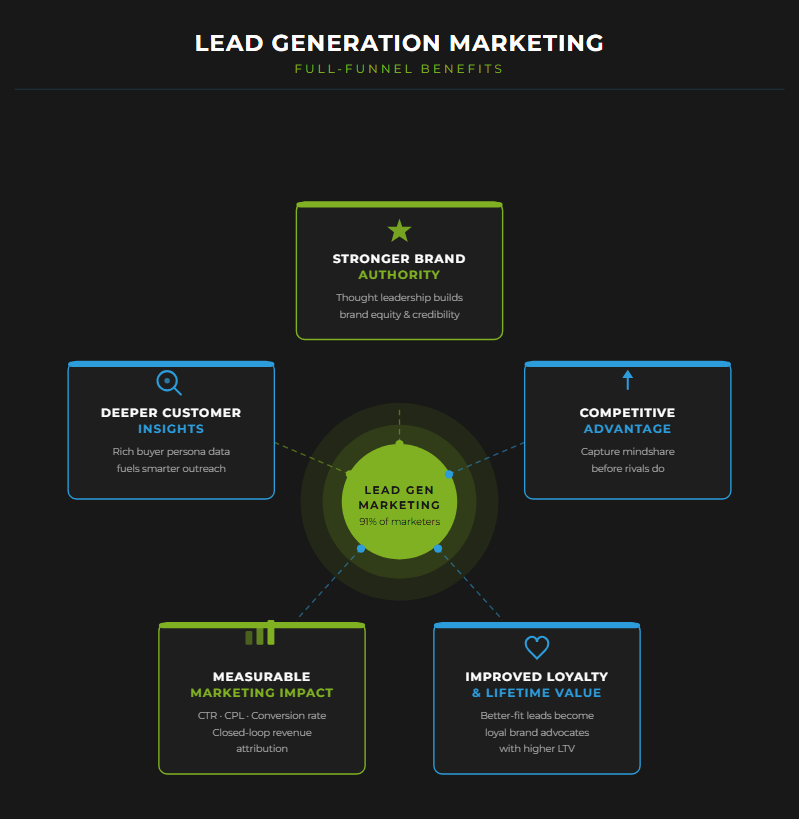
“Lead generation marketing” refers to all the marketing tactics and strategies specifically aimed at acquiring and nurturing leads (as opposed to general brand advertising or product marketing). This includes content marketing, SEO, B2B email campaigns, social media outreach, webinars – any marketing effort designed to attract prospects and collect their contact info for follow-up. Beyond the direct sales benefits discussed above, a well-crafted lead generation marketing strategy produces several indirect benefits for your company:
- Stronger Brand Authority: Lead gen marketing inherently involves creating valuable content and thought leadership to attract prospects – for example, publishing expert blog posts, whitepapers, or research that addresses your audience’s pain points. These efforts boost your brand’s visibility and credibility in the market. As you consistently share useful insights, your company gains a reputation as a go-to authority in your field. Over time, this enhanced brand awareness makes future lead generation even easier (prospects recognize and trust your name) and supports sales conversations. In short, generating leads also generates brand equity by positioning your team as industry experts.
- Deeper Customer Insights: Every lead gen campaign is an opportunity to learn about your target audience. By monitoring which content offers get downloads, which ads drive clicks, or which emails get responses, your marketing team gathers rich data on prospects’ needs, interests, and pain points. You can then feed this data back into not just marketing optimization but product development and sales messaging. Lead generation marketing thus acts as market research – you’re effectively polling your audience based on what they engage with. Over time, you build detailed profiles of different buyer personas. These insights allow for highly tailored outreach and also help refine your overall value proposition to better resonate. Understanding your potential customers on a deeper level is a powerful fringe benefit of lead gen marketing.
- Competitive Advantage: Companies that excel at lead generation often leapfrog competitors who rely on more passive or old-school tactics. For instance, using modern inbound methods (SEO, helpful content, social engagement) to pull in leads is far less intrusive than spammy cold calls or untargeted ads – and buyers appreciate that. A savvy lead gen strategy signals to the market that your organization is in tune with customer expectations and willing to provide value upfront. This customer-centric approach differentiates you from competitors who only push product. Moreover, if you’re consistently engaging prospects through multiple touchpoints and nurturing them over time, you’re effectively locking out competitors from those relationships. By the time a rival notices a prospect, that lead might already be deep in your funnel. In short, great lead gen marketing helps you capture mindshare and market share ahead of the competition.
- Improved Customer Loyalty and Lifetime Value: The benefits of lead generation don’t stop when a lead becomes a customer. The very process that attracted them – providing relevant content, personalized communication, and solving their problem – sets the stage for a positive customer experience. Sales leads acquired through proper marketing tend to be a better fit and have clearer expectations (since they’ve been educated along the way). As a result, they often turn into more satisfied customers who stay longer and continue to engage with your content. Additionally, many lead gen strategies double as brand engagement tactics that keep your company top-of-mind. For example, offering a useful newsletter or inviting leads to a free webinar provides value that can continue post-sale. All of this means lead-gen-sourced customers are more likely to become repeat buyers and even advocates for your brand. A full pipeline today can translate into a community of loyal clients tomorrow.
- Measurable Marketing Impact: One often overlooked benefit of lead generation marketing is how measurable and optimization-friendly it is. Unlike broad awareness campaigns, lead gen efforts typically have clear metrics and lead generation KPIs (click-through rates, conversion rates, cost per lead, etc.) and funnel stages to analyze. This makes it easier for marketing teams to prove their impact on revenue – e.g. “our webinar drove 200 leads, which turned into 30 sales opportunities.” With closed-loop analytics, you can attribute closed deals back to the campaign and channel that sourced the lead. This data-driven approach justifies marketing spend to the C-suite and allows continuous improvement. You can experiment with messaging, channels, and content, then double down on what works. The result is a marketing engine that gets more efficient over time, continuously lowering your cost per lead acquisition.
In essence, lead generation marketing benefits your company at both the top and bottom of the funnel. It not only fills the funnel with leads, but also elevates your brand, provides actionable market intel, differentiates you from competitors, and sets the foundation for long-term customer relationships. It’s a holistic strategy that drives immediate sales results and strengthens your marketing effectiveness in the long run, especially when supported by done for you lead generation programs that provide consistent pipeline growth.
Now that we’ve covered the why, let’s talk about how companies can supercharge these benefits – namely by leveraging two game-changing approaches: outsourcing and AI. First, we’ll examine why many B2B firms choose to outsource lead generation (and the unique benefits that can bring), and then we’ll dive into AI-driven lead generation and its advantages.
Scaling Smarter: The Business Case for Outsourcing Lead Generation
Outsourced lead generation can lower costs by up to 65% versus in-house efforts.
Reference Source: Martal Group
Is it better to generate leads with your own in-house team or to partner with an external provider? From our firsthand experience running outbound lead generation programs, we see these dynamics play out in real time. Because our work centers on outbound lead generation and appointment setting, the benefits described below come directly from what we observe across client campaigns and pipeline performance every quarter.
Instant Access to Working Infrastructure
Building an outbound SDR function from scratch takes longer than most companies expect. Hiring, onboarding, tooling, messaging refinement, list sourcing, sequencing logic, a realistic timeline to a productive in-house team runs 12 to 18 months for most organizations. An outsourced team with an established playbook compresses that timeline significantly.
At Martal, new clients are typically running active outreach within weeks, not months. The infrastructure — data, sequences, SDRs, quality review processes — is already in place. What changes is the targeting and messaging, which we build around the client’s ICP and value proposition.
Scalability Without Hiring Risk
One of the practical limits of an in-house SDR team is that scaling it up requires hiring, which is slow, expensive, and risky if the timing is wrong. Scaling it down means layoffs or stranded headcount.
Outsourced models absorb those changes cleanly. If a client needs to increase outbound volume for a product launch or pull back during a budget cycle, the engagement adjusts without the friction of internal headcount decisions. That elasticity is particularly valuable for companies with variable pipeline targets or unpredictable growth periods.
Better Leads Through Specialization
Lead generation statistics show that 45% of B2B companies cite generating enough leads as their biggest challenge (5). Part of what makes outsourcing effective is that a specialized provider has done this work across dozens of industries and verticals. The pattern recognition around what messaging works, which titles respond, and how to sequence multi-channel outreach is built up over thousands of campaigns — not learned from scratch on a single client’s budget.
That specialization produces better-fit leads, not just more volume. The goal is not activity. It is qualified meetings with prospects who actually have the problem you solve.
Focus Where It Matters
When outbound prospecting is handled externally, internal sales talent can concentrate on what they do best — closing deals, managing relationships, and moving pipeline forward. The separation is a genuine efficiency gain, not just a division of labor. It changes how your team’s time is spent, which changes outcomes.
Advanced Tools Without the Overhead
Premium sales intelligence platforms, outreach automation, intent data, analytics tooling, these are not cheap, and maintaining them properly requires dedicated focus. Outsourced providers spread those costs across client engagements and invest in the tools because they run campaigns at scale.
Clients effectively inherit that infrastructure. Rather than making individual tool decisions and managing contracts, they gain access to a fully integrated, actively maintained stack built for advanced lead generation.
Faster Expansion into New Markets
Entering a new vertical or geographic market without existing relationships is a slow, expensive process. An outsourced team with prior experience in that space can accelerate the learning curve considerably. They already know what resonates with those buyers, which channels perform, and how to avoid the mistakes that slow down cold-start campaigns.
To summarize, outsourcing B2B lead generation can deliver more leads, faster, and at lower cost – all while letting your team concentrate on closing deals. It’s like plugging a pre-built growth engine into your business. As one report put it, outsourced lead gen offers “fast access to lead generation specialists and scalable outbound programs – ideal for teams lacking internal bandwidth or targeting new markets”. Of course, success depends on choosing the right sales agency and aligning on goals. But when done well, outsourcing can significantly amplify all the benefits of lead generation we discussed earlier.
Our Lead Generation Tiered Pricing Model
We offer tiered lead generation service packages to fit different needs.
- Tier 1 focuses on core outbound lead generation (building targeted lists, running email/LinkedIn campaigns, and booking initial sales meetings).
- Tier 2 adds support with customer onboarding and deal closing, helping negotiate and transfer warm leads into signed customers.
- Tier 3 is a full lead gen + account management service, where we not only generate and onboard leads but also help manage those accounts for long-term value.
This flexible model lets clients outsource as much of the sales funnel as makes sense for them. By outsourcing sales and marketing, you can choose a service tier that complements your in-house strengths, whether you just need top-of-funnel pipeline or end-to-end sales support.
Next, let’s explore the other big trend reshaping lead generation in 2026: AI-powered lead generation. If outsourcing provides the people and processes at scale, AI provides the speed and precision. Used together, they’re incredibly powerful. But first, we’ll dig into what AI-driven lead gen means and the benefits it unlocks for B2B teams.
How AI is Transforming B2B Lead Generation
AI is transforming lead scoring with 75% of businesses using it, and 90% of marketers see better accuracy.
Reference Source: Super AGI
Artificial intelligence is transforming how B2B companies find and engage leads. AI-driven automated lead generation refers to leveraging algorithms and automation to identify prospects, qualify them, and even initiate outreach – tasks traditionally done manually by sales executives or marketers. In 2026, AI has matured to the point that it’s a game-changer for B2B lead gen programs. Early adopters are seeing significant improvements in efficiency and lead quality by weaving AI into their sales process. Here are some of the key benefits of AI-driven lead generation for B2B companies:
AI-powered lead generation brings efficiency, better lead quality, personalized engagement, and scalability, as illustrated above.
- Enhanced Efficiency – More Leads in Less Time: AI excels at automating tedious, repetitive parts of lead generation. For example, AI tools can scrape websites and databases to build lead lists in minutes, log activities to your CRM automatically, or send email follow-ups on a schedule without human intervention. By offloading grunt work (data entry, list research, sequence sending) to “smart” software, your team frees up countless hours. One huge efficiency gain is in lead qualification. Rather than reps manually reviewing each inbound form fill or trial signup, an AI-driven scoring model can instantly analyze dozens of data points (title, industry, site behavior, etc.) and determine if a lead fits your criteria. AI lead scoring models can cut the time spent on qualifying leads by up to 30% (6). That means your team spends one-third less time sorting through leads and more time talking to the best prospects. Overall, AI allows a smaller team to handle a larger volume of leads effectively. AI tools can reduce outbound prospecting time by 50% while simultaneously improving lead quality through smarter targeting (7).
- Higher Quality Leads through Smart Targeting: A traditional challenge in lead gen is chasing a lot of leads that go nowhere. AI flips the script by helping you focus on the right leads at the right time. Machine learning models can analyze huge datasets (web traffic, firmographics, prior CRM outcomes) to predict which prospects are likely to convert. For instance, AI can crunch engagement signals – like which companies have been visiting your pricing page or interacting with your emails – and alert your team to the highest-intent accounts. It can also cross-reference external data (e.g. funding news, job postings) to gauge a prospect’s buying likelihood. The result is a list of leads ranked by quality, so reps spend time where it counts. AI-driven lead scoring is on the rise – 70% of companies use it, and 90% of marketers report improved accuracy (8), meaning far fewer low quality in the pipeline. Additionally, AI can continually learn and refine its criteria as it sees which leads actually progress to deals, getting even better over time. The payoff is a pipeline stuffed with sales-ready leads, not just names.
- Personalization at Scale (Better Engagement): Modern buyers are bombarded with generic sales pitches, which is why personalization is crucial. But personalization is hard to do manually beyond a small scale – you can’t write 500 completely bespoke emails easily. This is where AI shines. AI-driven lead gen tools can generate tailored messages and content for each prospect by analyzing their profile and behavior. For example, AI writing assistants can draft an email that references a prospect’s industry and a specific pain point inferred from their LinkedIn posts. AI chatbots on your site can greet visitors by company (“Hi Acme Corp, we help many fintech firms like you…”) using reverse IP lookup data. Personalization extends to timing and channel as well – AI might learn that a certain lead responds better via LinkedIn in the afternoons, and schedule your outreach accordingly. The net effect is each prospect gets a more relevant, timely, and valuable touch, which dramatically boosts engagement. Outreach campaigns that feel “hand-crafted” to the recipient’s needs drive higher reply and conversion rates. In fact, generative AI now allows sales teams to craft one-to-one outreach messages in seconds – studies show this can boost reply rates by up to 300% without sacrificing quality (7). That’s triple the engagement simply by having AI inject smart personalization at scale. In short, AI lets you humanize your approach for hundreds or thousands of leads in parallel, something impossible to do manually.
- Always-On, 24/7 Lead Nurturing: Another benefit of AI in lead gen is that it never sleeps. AI-powered systems can respond to leads or trigger actions in real time, at any hour. Consider a scenario: a potential buyer downloads an eBook from your site at midnight and indicates interest. Instead of waiting until your team gets in the next morning, an AI workflow could automatically send a follow-up email five minutes later with additional resources or even alert an on-call rep if the account is high-value. Speed matters – one famous study found that companies who follow up with online leads within an hour are nearly 7 times more likely to qualify that lead than those who wait longer. AI makes that kind of rapid response feasible by handling the initial touch instantly. Similarly, AI chatbots on your website or messaging apps can engage inbound inquiries in real time, answering common questions or gathering info, so that no lead falls through the cracks overnight or on weekends. This “follow-up while hot” capability greatly increases conversion rates from initial interest to sales opportunity. Moreover, AI-driven nurture sequences can keep leads warm over long periods with minimal human oversight – scheduling a series of touches based on lead behavior (e.g. viewing a pricing page triggers a specific email a day later). With AI, you effectively have a tireless assistant making sure every lead is tended to promptly and thoughtfully.
- Scalability and Consistency: Scaling human-led lead generation is linear – if you want to contact 10x more prospects, you usually need ~10x more staff or hours. AI-driven lead gen, on the other hand, scales exponentially. Once the AI systems and processes are set up, contacting 1,000 leads versus 100 doesn’t require much extra effort; the lead generation software handles the heavier load. This means you can massively widen your top-of-funnel reach without proportionally increasing headcount. AI can handle a high volume of data and outreach tasks in parallel.
This scalability is game-changing for ambitious sales teams – it lets you aggressively grow your pipeline without immediately having to hire dozens of SDRs or lead generators. Furthermore, AI brings consistency to execution. People have good days and bad days; AI performs the same routine with reliability. Your follow-ups won’t slip through the cracks due to human error (e.g. forgetting to call back a lead) because the AI is following the playbook every time. As Outreach.io notes, with AI handling high volumes of leads and tracking engagement across channels, you can grow your pipeline without overwhelming your team. Essentially, AI is like an army of virtual assistants that scale your efforts smoothly.
- Data-Driven Optimization: One often underappreciated benefit of AI is the depth of analytics and insights it can provide for continuous improvement. AI doesn’t just do tasks – it also monitors and learns from the results. For example, AI can A/B test different email subject lines across thousands of prospects and determine which variant yields a higher open rate, then automatically standardize on the winner. It can analyze responses to identify which value propositions resonate most in your target industry. Over time, the system might notice patterns like “leads in the financial sector are more likely to book a meeting if we mention regulatory compliance in the email.” These kinds of granular insights are often missed by humans due to sheer data volume. But AI will crunch the numbers and provide actionable feedback. Sales leaders can get reports highlighting, say, the top intent signals correlated with won deals, or which content pieces produced the most pipeline. This data-driven clarity helps you double down on what works and fix what doesn’t. In essence, AI becomes a strategist too – guiding your team on where to focus efforts for maximum yield. The longer you utilize AI in lead gen, the smarter and more fine-tuned your entire process becomes.
To sum up, AI-driven lead generation empowers B2B organizations to work smarter, faster, and at greater scale than ever before. It’s like having a supercharged engine under the hood of your sales machine: automating low-level tasks, pointing you to the best leads, personalizing outreach at scale, responding instantly to buyer signals, and continuously optimizing itself. No wonder 81% of sales leaders say AI reduces manual tasks and boosts lead conversion accuracy in their process (9). By adopting AI for lead gen, companies can significantly lower their cost per lead, improve pipeline quality, and gain an edge in responsiveness and personalization.
Introducing Martal’s AI SDR Platform: Smarter Outreach. Better Leads.
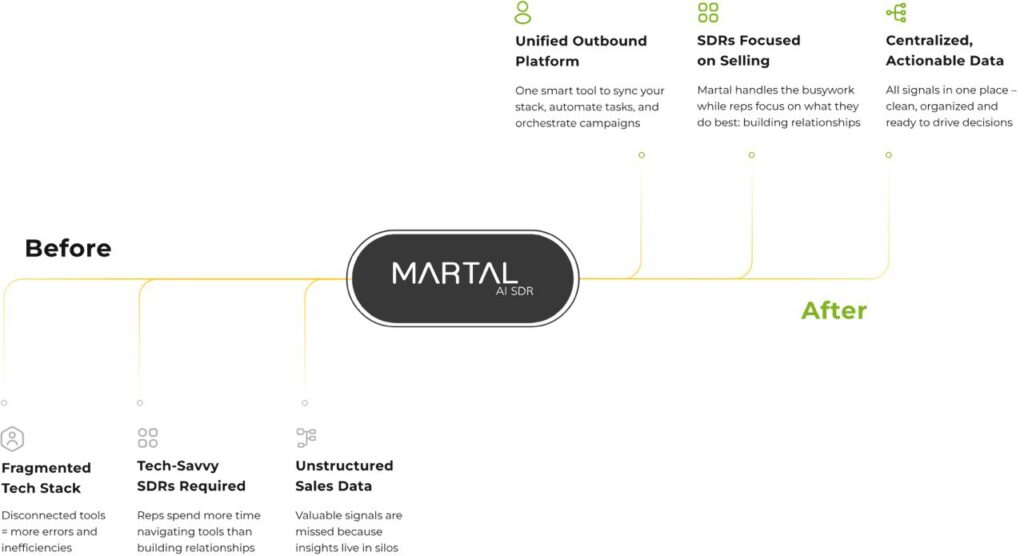
Our proprietary AI SDR platform analyses 15+ years of B2B sales expertise into one intelligent system. It includes an extensive B2B contact database, AI algorithms for lead scoring and intent detection, automated email and LinkedIn outreach, plus even AI-generated messaging to boost replies. Because our AI platform is trained on successful lead generation campaigns campaigns by our top sales reps, it effectively gives clients the playbook of a seasoned sales team on autopilot.
The results have been remarkable – we’ve seen clients launch multi-channel campaigns in 30 minutes and achieve 4–7× higher conversion rates compared to traditional methods. By combining AI efficiency with our human know-how, we help organizations scale outreach without losing the personal touch. It’s like having an elite SDR team working around the clock, perfectly executing the best practices we’ve honed over thousands of campaigns. This hybrid of human + AI is where we see B2B lead generation heading in 2026 and beyond.
Conclusion: Turning Lead Generation Benefits into Growth
In 2026, B2B companies that master lead generation will have a clear advantage in the market. We’ve seen that the benefits of B2B lead generation – from more sales and higher ROI to strong brand positioning – are simply too important to ignore. Whether you harness those benefits with an in-house team, an outsourced partner, AI technology, or (ideally) a blend of all three, the goal is the same: build a predictable engine for growth.
The lead generation trends are clear. Buyers are more digitally savvy and expect personalized, timely engagement across channels. Traditional spray-and-pray tactics are fading, and data-driven, targeted lead generation approaches are rising. Teams are embracing outsourcing to add expertise and scale quickly, and adopting AI to work smarter and faster than the competition. The companies that put these pieces together are filling their pipelines, hitting their revenue targets, and expanding into new markets even in the face of stiff competition. Those that don’t are left struggling with the age-old challenge of “needing more leads.”
If all this sounds daunting, don’t worry – you don’t have to tackle it alone. This is where a partner like Martal Group comes in. Our team will help you develop a tailored strategy, whether that means augmenting your efforts with our AI-powered platform, running integrated email/LinkedIn/cold calling campaigns (so you use every channel your prospects use), or providing seasoned SDRs to act as an extension of your team. We focus on delivering qualified leads and meetings on your calendar so that your team can focus on doing what only you can do – closing deals and driving your business forward.
Ready to experience the benefits of lead generation first-hand? Let’s talk! Martal Group has helped 2000+ B2B companies build robust pipelines through omnichannel outreach, and we can do the same for you. Book a consultation with our team to see how our Sales-as-a-Service model and AI-driven approach can fuel your growth in 2026. We’d love to learn about your goals and show you why Martal is the ideal partner to accelerate your lead generation success. Here’s to smashing your sales targets with an overflowing funnel of quality leads!
References
- EmailToolTester
- Intellistart
- Forrester
- NNc Services
- Sopro
- SuperAGI
- Kontax
- Qwilr
- SuperAGI – AI Lead Targeting
FAQs: Benefits of Lead Generation
How does lead generation help increase sales and revenue?
By targeting prospects with demonstrated intent, lead generation shortens the path from awareness to purchase. Sales reps spend less time prospecting cold contacts and more time closing deals. Higher-quality leads mean better conversion rates, larger deal sizes, and faster sales cycles, all of which directly drive top-line revenue growth.
How does lead generation help build a predictable sales pipeline?
A structured lead generation program creates a repeatable process for filling the top of the funnel. With consistent volume and quality metrics tracked over time, sales leaders can forecast revenue more accurately, allocate resources effectively, and identify gaps before they impact quarterly results. Predictability reduces risk and supports confident business planning.
Does B2B lead generation shorten the sales cycle?
Yes. When leads are properly qualified before reaching sales, reps skip early discovery steps and move directly to solution-focused conversations. Nurturing campaigns also warm up prospects in advance, so by the time a lead speaks with sales, they already understand the product’s value, compressing the time from first contact to closed deal.
Is outsourcing lead generation better than building an in-house team?
It depends on stage and goals. Outsourcing is typically faster to launch, lower in upfront cost, and ideal for testing new markets. An in-house team offers deeper brand knowledge and tighter alignment with sales. Many companies use a hybrid model, outsourcing top-of-funnel prospecting while in-house reps handle qualification and closing, to get the best of both approaches.
What are the benefits of outsourcing B2B lead generation services?
Outsourced B2B lead generation providers specialize in multi-channel prospecting, list building, and outreach at scale. They bring trained SDRs, data tools, and refined messaging frameworks that would take months to build internally. For companies entering new verticals or scaling quickly, outsourcing accelerates pipeline growth while minimizing hiring risk and operational complexity.
How can outsourcing lead generation reduce costs for companies?
Hiring, training, and retaining in-house SDRs is expensive and slow. Outsourcing converts those fixed costs into a variable expense that scales with need. Companies also avoid overhead costs like benefits, software licenses, and management time. When measured by cost per qualified meeting or cost per pipeline dollar, outsourced lead generation is typically more cost-efficient, especially early in growth.