
 Martal
 Technology
 Education and training
 Web Development and UI / UX
 Healthcare/Medical
 Logistics and Supply Chain
 Information Technology
 Insuretech and Financial Services
 Marketplaces
 Software Development
 E-commerce and retail
 AI and Machine Learning
 Energy and Solar
 Manufacturing
 Security and Surveillance
 Digital Marketing Agency
 Transportation
 MSP
MSP
 Telecom
 B2B SaaS
 Cybersecurity
 HR tech
 Fintech
 Cleantech
 Consulting
Business Development vs Sales in 2026: Key Differences, Strategic Insights & Sales‑as‑a‑Service
Major Takeaways: Business Development vs Sales
Business development opens doors for future revenue — new markets, new partnerships, new buyer relationships. Sales converts qualified opportunities into closed-won revenue. A healthy pipeline needs both, and teams that blur the business development vs sales lines lose deals in the hand-off between prospecting and closing.
Business development runs on a 6–18 month horizon, focused on strategy, market entry, and pipeline creation through outbound prospecting and partnerships. Sales runs on weekly and quarterly quotas, focused on closing the opportunities BD has developed.
BDRs typically own outbound prospecting — researching cold accounts, running cold calling and cold email, opening conversations from zero. SDRs typically qualify inbound leads from marketing and hand them to account executives. When companies treat the titles as interchangeable, lead quality suffers and pipeline hand-offs break.
6sense’s 2026 Buyer Experience research shows roughly 80% of B2B deals go to the vendor the buyer contacts first — because buyers rank their shortlist before ever reaching out. Business development’s real job in 2026 is landing your brand on that Day One shortlist through targeted outbound and relationship work.
The Sales-as-a-Service model combines outbound prospecting, qualification, appointment setting, and sales execution inside one provider — removing the hand-off gap that usually sits between a BDR team and an account executive team and compressing cost-per-opportunity.
AI SDR platforms now handle the repetitive business development layer — prospect research, list building, signal monitoring, and personalized sequencing — while human sales executives handle qualification, consultative conversations, and closing. The B2B teams winning in 2026 pair both.
High-performing B2B companies are about 2.5× more likely than their peers to align sales and marketing around the buyer journey. When business development is folded into that alignment, the full funnel — from first touch to closed-won — tightens materially.
Martal’s Sales-as-a-Service engagements include Clickworker ($4.5M recurring revenue, 500% ROI across nine years, Fortune 500 and Fortune 10 deals closed), Complete EDI (14 SQLs in a 3-month pilot with one fractional rep), and Berger-Levrault (two deals alone justified the full campaign investment).
Introduction
Ask five B2B leaders to define the difference between business development and sales, and you will get five different answers — often inside the same company. The titles blur together on LinkedIn, the responsibilities overlap in practice, and the hand-offs between the two functions are where most pipeline quietly leaks out.
The distinction matters more in 2026 than it did five years ago. Buying committees now span 6 to 10 decision-makers (12), the average complex B2B purchase touches60+ interactions (13) before a deal closes, and 6sense’s 2026 research shows that roughly 80% of deals go to the vendor the buyer contacts first (14), meaning the work business development does before sales ever enters the room increasingly decides who wins. Sales alone cannot carry that workload. Business development alone cannot close the revenue. The companies that figure out where each function starts, ends, and hands off are the ones building predictable pipelines. The ones that do not are the ones running quota misses every quarter.
This guide breaks down how business development and sales actually differ in 2026 — across roles, metrics, timeframes, and buyer interaction. We cover BDR vs SDR, Business Development Manager vs Sales Manager, where marketing fits into the picture, and how the Sales-as-a-Service model has evolved to unify the two functions under one provider. We close with how Martal approaches this at scale for our clients.
How and Why We Built This Guide
We wrote this guide for the operators inside this problem every week — CROs, VPs of Sales, Heads of Revenue, and Marketing leaders deciding whether to hire a BDR, outsource an SDR function, or restructure the hand-off between prospecting and closing. We pulled findings from 2025 and 2026 research by Gartner, 6sense, Forrester, and McKinsey, then layered on what we see directly. Martal has run outbound pipeline engagements for over 2,000 B2B brands across 50+ verticals since 2009, and the patterns that separate a healthy BD-to-sales hand-off from a broken one show up in our campaign data long before they show up in research reports. Where we cite someone else’s research, we say so. Where we draw on what we see in our own sales outsourcing engagements, we say that too.
Difference Between Sales and Business Development
80% of B2B deals go to the vendor buyers contact first, because buyers rank their shortlist before ever reaching out.
Reference Source: 6sense
At a high level, sales and business development share a common goal – growing revenue – but they approach it from different angles and timeframes. Sales focuses on closing deals in the near term, while business development focuses on opening doors for future growth.
To clarify is business development sales or something more, consider their core objectives and methods:
- Sales teams work to convert qualified leads into customers now. They engage directly with prospects, demo products, handle objections, negotiate pricing, and ultimately close deals to hit monthly or quarterly targets. Success is measured in immediate revenue – deals closed, quotas met, conversion rates, etc. (5) Sales operates in the present, emphasizing transactional interactions that solve a customer’s current need.
- Business development (BD) teams, in contrast, work to create long-term value for the business. They scout new markets, identify strategic partners or channels, and generate qualified leads to hand off to sales. Their focus is on the future – developing relationships and opportunities that may not pay off immediately but seed the pipeline for sustained growth (5). Success for BD is measured in things like new opportunities created, partnerships formed, or market segments entered (not just immediate sales revenue).
In essence, sales is about executing on existing demand, while business development is about creating demand. A handy comparison can highlight the differences:
Aspect
Business Development (BD)
Sales
Primary Focus
Identify new opportunities, markets, and partnerships for growth
Convert leads and opportunities into customers and revenue
Timeframe
Long-term (months/years outlook for strategic growth)
Short-term (weekly, quarterly targets for immediate sales)
Key Activities
Market research, prospecting new leads, networking, building alliances
Pitching products/services, conducting demos, handling objections, closing deals
Customer Interaction Stage
Early in buying journey (educating, nurturing prospects pre-purchase)
Later in buying journey (engaging ready-to-buy prospects to finalize purchase)
Relationships
Often relational – fostering partnerships and trust over time (5)
Often transactional – one-time exchanges to fulfill a current need (5)
Metrics of Success
Pipeline growth, qualified leads added, new markets or channels opened
Sales volume, revenue booked, conversion rate, quota attainment (5)
Table: Business Development vs Sales – key focus areas and metrics differ.
Read the table and the complementary structure is obvious. BD fills the funnel and develops the strategic relationships; sales finishes the deal and generates revenue. As one business outsourcing report put it, BD covers functions spanning lead generation and outbound prospecting to appointment setting and partnership building, whereas sales teams turn those opportunities into paying clients. (4) Understanding this division helps leaders allocate resources intentionally — dedicated BD reps (often called BDRs or business development representatives) to prospect, and dedicated sales reps or account executives to close.
2026’s buyer dynamics sharpen the contrast. Buyers are more informed and more independent than they have ever been. 6sense’s 2026 Buyer Experience Report found that the point of first contact with a vendor has moved from 69% through the buyer’s journey to 61% (14), meaning buyers are reaching out to sales about six to seven weeks earlier than they did two years ago. That is not because buyers are eager to talk to reps;75% still prefer a rep-free experience (12) when possible. It is because AI-driven purchases now require earlier expert validation and economic pressure is forcing faster cycles.
Here is the critical implication for BD and sales alignment: when buyers do finally reach out, ~80% of deals go to the vendor they contact first, because shortlists are ranked before outreach ever begins. That means the work business development does to put your brand on the Day One shortlist — through content, early engagement, outbound relationship-building, and partnerships — increasingly decides which sales reps get to close what.
What this means for execution: BD’s job in 2026 is not just to generate leads. It is to make sure your company is already the familiar, preferred choice by the time a buyer is ready to evaluate. Sales’ job is not just to close. It is to validate, consult, and de-risk a decision the buyer has already mostly made. The orgs that still run BD as a volume function and sales as a pitch function are losing to the orgs that treat BD as shortlist-building and sales as sensemaking.
Business Development Manager: What They Actually Do
A Business Development Manager (BDM) owns outbound pipeline generation and strategic growth work. In our own campaigns, the BDM role that performs best is the one with a clear outbound charter and freedom from quota-close pressure — the moment a BDM starts getting measured on closed revenue, the prospecting discipline slips and the pipeline thins out two quarters later. The job is different from a sales rep’s job by design.
Here is what a strong BDM actually does:
- Identify new leads and markets. Researching industries, regions, and customer segments for high-potential opportunities. A BDM constantly asks, “Where can we find new business?” — at industry events, in trend reports, and through tools that surface prospects fitting the ideal customer profile.
- Prospect and nurture leads. Generating interest through cold outreach (email, calls, LinkedIn) and nurturing prospects until they become qualified opportunities. The BDM often acts as an outbound SDR — sending the first emails, making the first calls, starting the first conversations.
- Build partnerships. Establishing alliances with organizations that open new channels — OEM deals, referral partners, strategic alliances that drive indirect sales. This is long-term relationship work, not one-off transactions.
- Plan growth strategy and pitch ideas. Internally, BDMs shape market entry plans, propose new business models, and feed on-the-ground insight into marketing and product. Externally, they pitch the company’s value to partners and markets in a consultative register, not a close-the-deal register.
- Manage long-term relationships. Unlike sales reps moving to the next opportunity after close, BDMs maintain relationships with contacts who aren’t yet ready to buy — quarterly check-ins, resource sharing, staying top of mind until the opportunity matures.
Think of the BDM as a hunter for growth opportunities. Success is measured in qualified meetings generated, pipeline size created, and new revenue channels opened. BDMs typically do not close sales — they hand qualified leads to the sales team (account executives) who own the close. That hand-off is where most pipeline gets lost, which is why many organizations now position BDMs at the intersection of sales and marketing, reporting through a CRO or VP of Revenue rather than siloed under one function.
Sales Manager: What They Actually Do
A Sales Manager leads the sales team responsible for hitting revenue targets. The job is about conversion velocity and deal execution, not pipeline creation.
- Manage a sales team. Recruiting, training, and coaching sales reps or account executives. A sales manager sets quotas, monitors performance, and coaches on pitching, product knowledge, and closing technique.
- Own pipeline and deal management. Reviewing deals in motion, forecasting revenue, and removing friction so deals don’t stall. For high-value accounts or complex negotiations, the sales manager often joins the calls.
- Drive customer engagement and closing. While individual reps run front-line selling, sales managers often step into key accounts to address client concerns directly. They structure deals (pricing, contract terms) to reach mutually workable closes.
- Translate company strategy into sales tactics. Defining which products to push each quarter, which territories to prioritize, which promotional levers to pull. They work closely with marketing on messaging and with business development on ensuring business leads get real follow-up.
- Report on metrics and motivate the team. Tracking sales KPIs — conversion rates, deal size, sales cycle length, quota attainment — and adjusting lead generation strategies when numbers slip. Many also manage commission structures and spiff plans.
In short, the sales manager is an executor and coach — the person accountable for converting the leads BD and marketing deliver into revenue. Performance is judged on short-term sales results. Commission plans typically tie to team quota attainment, whereas BDM incentives tend to track pipeline quality and long-term deal value. That difference in incentive structure is why conflating the two roles almost always produces worse outcomes in both.
Is a Business Development Manager higher than a Sales Manager?
No. In most B2B orgs, BDM and Sales Manager sit at the same level, reporting to a VP of Sales, VP of Revenue, or CRO. A BDM might be an individual contributor or team lead focused on strategic initiatives; a Sales Manager typically manages people and active deals directly. In companies where strategic growth gets heavier weighting, a senior Business Development Director may outrank a Sales Manager — but that is a structural choice, not a default hierarchy.
BDR vs SDR: The Confusion Behind the Titles
Ask ten B2B companies to define BDR and SDR and you will get twelve answers. Job boards list the same responsibilities under both titles. Some companies call every prospecting role a BDR; others call every prospecting role an SDR. One of the most commonly surfaced questions in sales forums is a version of: “Is BDR just a fancier name for SDR?” — and the honest answer is that it depends on the company, but there is a meaningful distinction when orgs use the titles correctly.
Here is the distinction that holds up across well-structured sales teams:
- BDR (Business Development Representative) owns outbound prospecting — cold outreach to accounts that have never heard of your company. Researching target accounts, running cold email and cold calling sequences, sending LinkedIn messages, opening conversations from zero. The job is higher volume, higher rejection, and more strategic in its targeting.
- SDR (Sales Development Representative) owns inbound lead qualification — the leads generated by marketing (content downloads, demo requests, webinar sign-ups, pricing page visits). The job is faster cycle, warmer conversations, and more focused on qualifying whether the inbound lead is actually sales-ready.
Both roles feed qualified opportunities to Account Executives (AEs), who own the close. The table below captures the operational difference:
Aspect
BDR (Outbound)
SDR (Inbound)
Lead Source
Cold accounts, no prior interaction
Marketing-generated inbound leads
Primary Activity
Cold calling, cold email, LinkedIn outreach
Qualifying form fills, demo requests, webinar leads
Volume Profile
High-volume outreach, lower reply rates
Lower volume, warmer conversations
Key Skill
Research, persistence, consultative openers
Active listening, fast qualification, discovery
Hand-Off
Qualified outbound meeting to AE
Qualified inbound opportunity to AE
Success Metric
Meetings booked, pipeline created from cold
Speed-to-qualify, inbound conversion rate
Both roles exist because AEs are too expensive to spend their time cold-calling strangers or filtering inbound form fills — their hourly cost is better spent running discovery calls and closing qualified deals. Separating the prospecting and qualification functions into specialized roles is how modern B2B teams compress cost-per-opportunity.
A real question from the field: “Do BDRs actually just cold call all day?” The short answer is no. A well-run BDR role combines research, account mapping, personalized multichannel sequencing, and live conversations. The orgs that still treat BDRs as a phone-dialing machine lose their best reps within six months and end up with exactly the kind of transactional outbound buyers increasingly tune out.
One more distinction worth naming: in practice, many tech companies use BDR and SDR interchangeably — and call both SDR. That is fine as long as the team is structurally clear on who owns inbound vs outbound. The problem is not the title. The problem is when the title hides a muddled responsibility split.
Business Development Director vs Sales Director
At the leadership tier, Business Development Director and Sales Director (or Director of Sales) mirror the same core split — one builds for the future, one delivers this quarter.
- Business Development Director owns the company’s growth strategy beyond the current quarter. They manage BDR and BDM teams, drive major partnership deals, evaluate new market expansion, and sometimes handle corporate development work like mergers and acquisitions. The horizon is 6–18 months. They coordinate closely with marketing and product to align new offerings with market opportunities.
- Sales Director owns meeting sales targets and driving revenue quarter by quarter. They manage sales managers or regional heads, set goals, and carry accountability for the bottom-line sales number. Meetings revolve around forecast accuracy, pipeline velocity, B2B sales process optimization, and unblocking stalled deals.
In most modern B2B structures, both report to a CRO or CEO. Some companies combine the functions at the VP level (a Sales & BD VP), but in larger orgs the two stay distinct. The BD Director drives future growth strategy. The Sales Director drives current period revenue. Both need to collaborate — growth strategy grounded in sales reality, sales efforts aligned with strategic accounts — or the org ends up with a plan that doesn’t close and a close rate that doesn’t scale.
Sales and Business Development: Collaboration for Growth
BDRs often spend weeks nurturing a lead, but 35–50% of deals go to the vendor that responds first — making speed and context from BDR to sales rep the difference between closed-won and lost.
Reference Source: Spotio Sales Statistics
We have drawn a clear line between sales and business development. In practice, those teams have to work in tight coordination. Sales and business development alignment is a central theme for high-growth B2B companies in 2026 — buyers expect seamless continuity from the first touch to the final sale, and internal silos cause deals to leak out between functions.
Here is where the collaboration actually matters.
Smooth Lead Hand-Off
A BDR might spend four to six weeks nurturing a prospect through cold conversations. If that prospect suddenly signals buying intent, the sales team has to pick up the conversation immediately with full context — history, pain points, stakeholder map, competitive positioning from the BDR’s notes. Best-in-class organizations formalize this: opportunity briefs, joint calls between the BDR and the AE to introduce the account, CRM fields required before hand-off. (5) The prospect should never have to repeat themselves, and they should see a unified front.
In our own engagements, the hand-off is where most B2B orgs lose the deals they would otherwise win. A BDR books a qualified meeting, the AE joins the call cold without reading the account notes, the prospect senses the disconnect in the first three minutes, and the opportunity stalls. The fix is structural — a required hand-off brief, a two-person intro call, and a shared CRM view — not a culture memo about “better communication.”
Shared Insights Both Directions
Business development teams surface a lot of market intelligence — new use cases buyers care about, pain points that keep surfacing across accounts, feedback from prospects who passed on a demo, signals about which industries are suddenly moving. When that intelligence gets routed to sales in real time, AEs close more deals because they show up with current buyer language.
The reverse flow matters just as much. Sales teams know which leads converted well and why, which objections keep surfacing, which industries are quietly drying up. When that feedback loops back to BD weekly, targeting tightens and list quality improves. The orgs that run BD and sales as separate reporting lines with separate all-hands meetings lose this loop entirely. (6)
Unified Strategy and Shared Goals
The highest-performing B2B orgs share goals between BD and sales instead of splitting them. Rather than measuring BD purely on leads generated and sales purely on closes, the two functions share a pipeline or revenue target. That structural choice removes the classic conflict where BD floods the top of the funnel with unqualified volume to hit quota and sales complains about lead quality while ignoring half the leads coming in.
One sales leader framed it this way: when “everyone understands the responsibility around generating pipeline,” pipeline quality improves across the board. (8) High-performing B2B companies areabout 2.5× more likely (15) than their peers to align sales and marketing around the buyer journey — and when BD is folded into that alignment alongside marketing and sales, the full funnel tightens from first touch to closed-won.
Avoiding Gaps in the Funnel
When business development and sales don’t communicate, funnel gaps open up in predictable places. BD generates leads that sales deems unqualified and ignores — wasted outbound investment. Sales complains of too few leads while BD believes plenty were handed off — meaning the qualification threshold was never aligned in the first place. Prospects slip through the cracks when the BDR stops following up and the AE never picks up the thread.
Alignment closes those gaps. A growing number of B2B orgs now unify sales, BD, and marketing under a shared Revenue Operations function — one source of truth for data, one set of shared metrics, one incentive structure that rewards pipeline quality over function-specific volume. The outcome is measurable: organizations with tightly aligned revenue functions consistently report15–20% higher growth rates (11) than those running BD, sales, and marketing as siloed reporting lines.Tools also help close the loop in 2026 — shared CRM systems, cross-functional Slack channels between BDRs and AEs, and revenue tech stacks that track a prospect from the first email open to the signed contract. But the tooling matters less than the structural choice to align incentives and goals. The orgs that fix the structure first and layer the tools on afterward outperform the ones that buy the tech and hope it fixes the silos.
Business Development vs Sales vs Marketing
75% of B2B buyers still prefer a rep-free purchase experience, meaning marketing and business development now do the work of building preference long before sales enters the conversation.
Reference Source: Gartner – B2B Buyer Journey
We covered BD and sales head to head. Marketing is the third function that belongs in the same conversation, and the orgs treating it as a separate reporting line with separate goals are the ones losing deals to competitors who aligned the three.
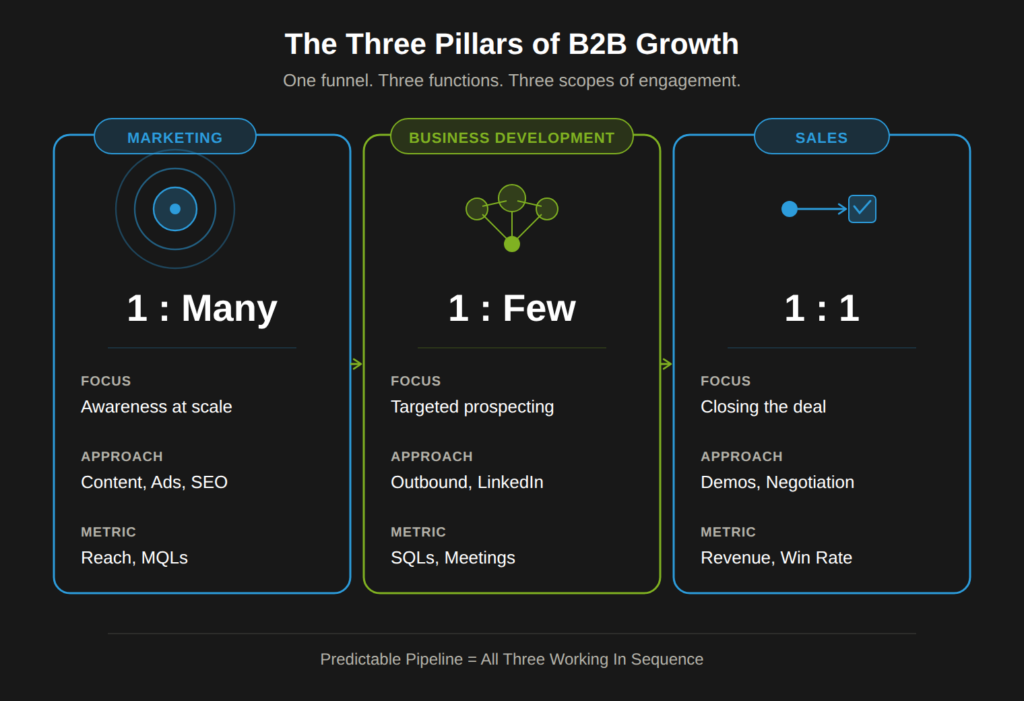
- Marketing creates awareness and interest at scale. It is a one-to-many function — content marketing, paid ads, SEO, webinars, and events that attract potential leads into the top of the funnel. Marketing warms the market and delivers inbound leads when someone downloads a whitepaper, fills out a contact form, or signs up for a webinar. In the BD vs sales vs marketing conversation, marketing is the broad net capturing many, from which BD and sales identify the most promising.
- Business Development takes a targeted approach. BD is one-to-one or one-to-few, focused on specific prospects or partners identified as high-value. If marketing casts a wide net, BD is spear-fishing the right accounts. The overlap shows up in lead generation campaigns — which can originate either in marketing (inbound) or in BD (outbound) depending on the org structure.
- Sales picks up when a lead is ready for a direct sales conversation. Sales is one-to-one. Where marketing generates a lead and BD qualifies it, sales guides the individual lead through product evaluation to purchase. Marketing and BD explain why the market should consider the product; sales tailors the message to the specific buyer and asks for the order.
Is Business Development the Same as Sales Development?
This question surfaces constantly in sales communities — and the answer depends on how your company uses the titles. The clean answer: sales development is a subset of business development. Sales development focuses specifically on finding and qualifying sales leads. Business development encompasses that work and broader growth initiatives — market entry, strategic partnerships, channel development, long-term account relationships.
In practice, many tech companies use the titles interchangeably. A BDR at one company does exactly what an SDR does at the next. That is fine as long as the role charter is clear internally. The problem shows up when the title conflates outbound prospecting with inbound qualification, or mixes cold-account research with marketing-lead follow-up. See the BDR vs SDR comparison above for the operational distinction that actually matters.
Is Business Development the Same as Marketing?
A less-discussed but recurring question. The answer: no, but they share the same goal. Marketing operates one-to-many to build awareness and interest at scale. Business development operates one-to-few to build targeted relationships with specific accounts. They feed the same pipeline, they share the same ideal customer profile, and in modern B2B orgs they often share reporting lines under a CRO or Chief Growth Officer. But the day-to-day work looks different — marketing produces content, runs campaigns, and owns the brand layer; BD runs personalized outreach, builds partnerships, and owns the one-to-one relationship layer.
The Bridge Between Marketing and Sales
Business development is the bridge. Marketing builds the road. BD drives the right car down the right road to find the right buyer. Sales travels the last mile to the closed deal. All three are needed, and the metaphor matters because it explains why skipping BD — a pattern we see often in smaller B2B companies trying to run lean — reliably produces either too many unqualified inbound leads for sales to filter or too few qualified opportunities to hit quota.
Alignment across marketing, BD, and sales is essential and easier said than done. Misalignment example: marketing attracts high-volume small-business leads while sales is targeted at enterprise accounts — a mismatch BD should catch and correct through ICP feedback loops. Another: sales promises features during closing that product and marketing did not know were important — signaling marketing should produce content on that use case and BD should target similar prospects.
This is why the strongest B2B orgs in 2026 run marketing, BD, and sales under a unified Revenue Operations structure or a Chief Revenue Officer. Some companies call the unified function a “Growth team.” Some split it across cross-functional pods assigned to the same target accounts. The shape varies; the principle does not — when the three functions operate on shared data, shared ICP, and shared revenue targets, the full funnel converts better than when they work as separate silos.
Strategic Insights: Trends Shaping Sales & Business Development in 2026
The average B2B buying journey now takes 272 days from first impression to closed revenue, up from 211 days just two years ago for complex software deals.
Reference Source: Dreamdata
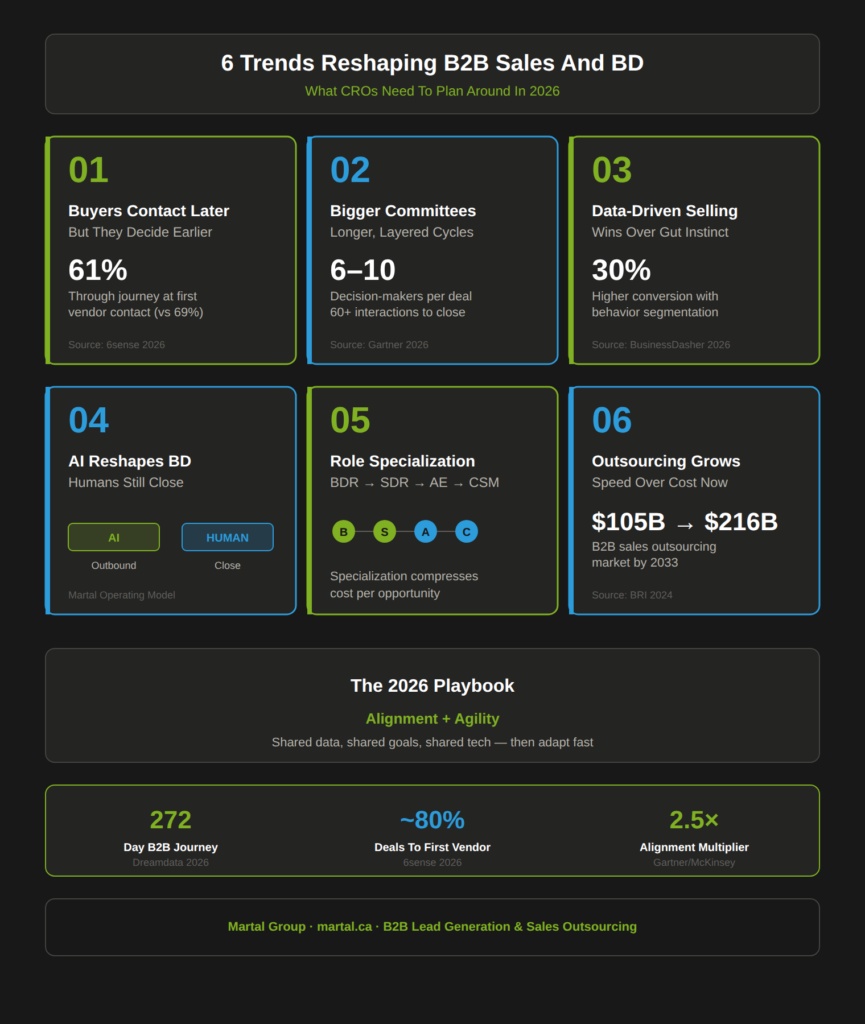
Sales and business development are being reshaped by a handful of shifts B2B executives need to plan around in 2026. Here are the trends that actually change how CROs, VPs of Sales, and Marketing leaders should structure their teams.
Digital-First Buyer Behavior
Buyers are doing more research independently and engaging sales later — but the dynamic has gotten more nuanced than the old “70% of the journey happens before sales” cliché. In 2026, the Point of First Contact has compressed from 69% through the journey to 61%, meaning buyers are reaching out to sales roughly six to seven weeks earlier than they did two years ago. Not because buyers want more rep interaction — they still don’t — but because AI-driven purchases require earlier expert validation, and economic pressure is shortening cycles across the board.
For BD teams, this raises the bar on digital prospecting quality. Generic cold outreach lands in deleted-items folders faster than ever. The BDRs winning in 2026 combine research depth, personalized multichannel sequencing, and content that maps to specific buyer stages. For sales teams, it means mastering consultative virtual selling — most deals still close without anyone being in the same room, and the reps who run sharp digital sales rooms outperform the ones still trying to turn every deal into an in-person meeting. Hybrid sales models (mixing virtual and in-person engagement) remain the dominant structure, and omnichannel outreach — email, LinkedIn, phone, and video coordinated in sequence — has moved from optional to table stakes.
Larger, Longer, More Complex Buying Cycles
The average B2B purchase now involves 6 to 10 decision-makers, up from 6-7 two years ago. The total number of interactions before a complex deal closes has grown from 17 in 2020 to 60+ today, sometimes exceeding 100 for high-value purchases. And as noted above, the journey itself has stretched to 272 days on average for complex software — even as commodity categories compress.
Business development has to engage the entire buying committee, not just the economic buyer. The practical implication is account-based outreach where BD and sales jointly focus on target accounts, map stakeholders across the buying committee, and personalize the conversation to each role. When the B2B buying process finally involves sales, expect more touches, more stakeholders on the call, and higher personalization requirements across the full sequence.
A real question we hear often from CROs: “If buyers are engaging later and committees are larger, why not just pour more budget into marketing and skip the BD layer?” Because marketing builds awareness but rarely drives the one-to-one account conversations that get your company onto the Day One shortlist of a 10-person buying committee. The orgs trying to substitute marketing spend for BD capability consistently end up with strong inbound lead volume and weak pipeline quality.
Data-Driven Everything
Gut feel is out. Data is the operating system of modern sales and BD teams. High-performing B2B organizations are significantly more likely to use data-driven segmentation, buying signal data, and AI-prioritized account lists than their peers — and the gap is widening. Behavior-based segmentation improves B2B conversion by up to 30% compared to static firmographic filtering, and personalized campaigns based on current segmentation drive 5-8× higher ROI than generic ones.
In practice, this looks like BD teams using intent data to prioritize which accounts to outreach (e.g., funding announcements, hiring signals, tech stack changes), and sales teams using AI-derived insights to tailor each conversation. The companies getting meaningful lift aren’t the ones who bought the most tools — they’re the ones who cleaned up their data pipelines first and layered AI on top.
AI Is Reshaping the BD Layer, Not Replacing the Sales Layer
A trend worth its own section. AI SDR platforms and agentic AI systems now handle the repetitive BD layer — prospect research, list building, real-time intent monitoring, personalized sequence generation, response classification — with a quality and speed a human team cannot match at scale. That frees BDRs and sales executives to do the work AI is worst at: live consultative conversations, objection handling, stakeholder navigation, and judgment-driven qualification.
In our own campaigns at Martal, the AI layer does the heavy lifting on prospect targeting and sequence personalization while our onshore Sales Executives handle the qualification, conversation, and relationship work. The split isn’t theoretical — it’s the operating model that delivers consistent pipeline for clients in B2B SaaS, cybersecurity, manufacturing, and fintech across North America, Europe, and LATAM. The organizations still debating whether AI replaces BDRs are asking the wrong question. The right one: which parts of BD should AI run, and which parts belong to humans? The answer consistently lands in the same place — AI at the outbound execution layer, humans at the conversation layer.
Role Specialization
The generalist salesperson doing everything from cold call to close to account management is fading in B2B. Specialized structures have taken over: BDRs on outbound prospecting, SDRs on inbound qualification, AEs on closing, CSMs on post-sale retention and expansion. Each role hones a specific skill set, and each role’s economics work because specialization compresses cost-per-opportunity.
The structural requirement is clear handoffs between roles. BDRs need to know exactly when to pass to AEs and what context to include. AEs need to respect the prospect relationship the BDR built. CSMs need to pick up the account without the customer feeling handed off to a stranger. The orgs running smooth specialization out-perform the orgs running messy specialization — and both outperform the generalist model at scale.
Outsourcing and Sales-as-a-Service
Outsourcing is no longer a back-office strategy. The majority of executives now use third-party providers for front-office functions including sales development, with Deloitte’s research showing that flexibility and access to talent have overtaken cost reduction (10) as the primary drivers. Two-thirds of U.S. companies outsource at least one function, and sales and BD are prime candidates because the cost of hiring, training, and retaining SDRs in-house keeps climbing.
The global B2B sales and marketing outsourcing market is projected to grow from $105B in 2024 to $216B+ by 2033. (4) The growth isn’t about cost — it’s about speed, scale, and specialized talent. A company leveraging outsourced SDRs or appointment setting services can ramp a new market in weeks rather than the 6-9 months it takes to hire, train, and get a BDR team productive in-house. This model — now often called Sales-as-a-Service — is the subject of the next section.
Customer-Centric, Consultative Selling
The role of sales has shifted from information provider to advisor. Buyers have more information than ever before they ever speak to a rep; what they need from sales isn’t a pitch, it’s help making sense of options. The consultative or “sensemaking” approach — understanding the buyer’s context deeply, helping them navigate competing vendors, de-risking their decision — is what separates top-performing sales teams in 2026 from the ones still following product-first scripts.
Business development plays the setup role here. Educational insights in early BD conversations — not hard sells — earn the right to be on the shortlist. The orgs training their BD and sales teams on industry context and buyer economics (not just product features) build trust faster and win more deals against competitors running traditional feature-benefit pitches.
Sales-as-a-Service: Combining the Best of Sales & Business Development
The global B2B sales outsourcing market is expected to grow from $105B in 2024 to over $216B by 2033.
Reference Source: Grand View Research – B2B Sales Outsourcing Market
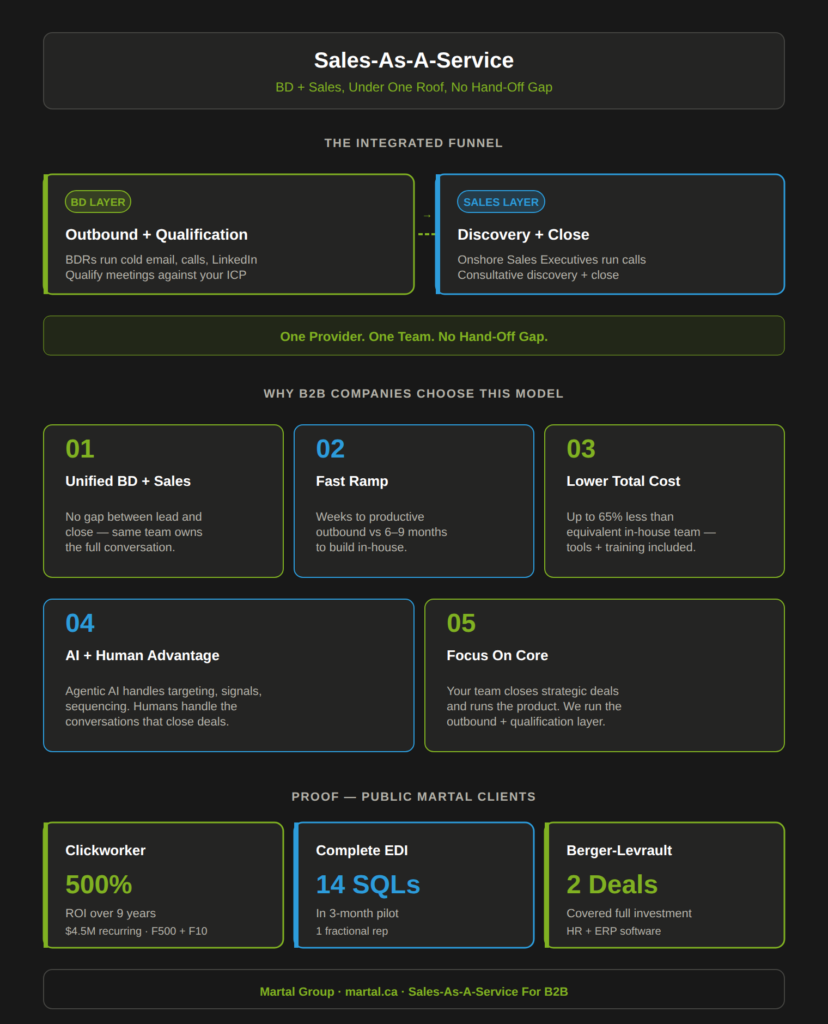
The idea behind Sales-as-a-Service is straightforward: instead of building a BDR team, training them, retaining them, and separately building an AE team to close what the BDRs generate, you engage one outsourced partner that handles both layers. The BD layer does the outbound work. The sales layer closes. The hand-off happens inside the provider, not across a gap you have to manage.
Sales-as-a-Service is the practice of outsourcing inside sales — part or all of your sales function — to a third-party provider who specializes in both sales and business development. The provider typically delivers a trained team: BDRs running outreach, account executives running qualification and closing conversations, sometimes account managers supporting post-sale. The model is often structured as a fractional extension of your team rather than a volume-contract vendor relationship.
What distinguishes Sales-as-a-Service from traditional sales outsourcing is the integration. A traditional outsourcing vendor might run cold outreach and hand leads over the wall. A Sales-as-a-Service partner handles outsourced lead generation, lead qualification, appointment setting, and the actual sales conversations inside a single team operating under shared accountability. (7) The goal is a coordinated 360° sales process delivered as a service.
Here are the five reasons B2B companies move to this model in 2026.
Combines BD and Sales Strengths in One Provider
A Sales-as-a-Service provider brings specialists for every stage of the funnel. BDRs trained in cold outreach, research, and appointment setting. Sales executives trained in discovery, objection handling, and consultative closing. That structure eliminates the hand-off gap where most B2B pipelines lose opportunities — because the hand-off happens internally inside the provider rather than between your BDR team and your AE team.
Martal’s Sales-as-a-Service engagement with Clickworker is a useful illustration. Over a nine-year partnership, our team handled end-to-end outreach through closing conversations for a B2B marketplace targeting enterprise buying teams — COOs, CTOs, VPs of AI and Data Analytics. The engagement generated $4.5M in recurring revenue and a 500% ROI, and closed deals with 3 Fortune 500 and 3 Fortune 10 companies. The result wasn’t just pipeline volume — it was qualified enterprise deals closed by a team that knew the business well enough to sound like an internal extension.
Speed and Scalability
Sales-as-a-Service compresses the ramp timeline that kills in-house sales team builds. Hiring, training, and getting a BDR team productive in-house typically takes 6-9 months. An outsourced team that already has playbooks, tools, and industry experience can start booking meetings within weeks of onboarding.
Complete EDI tested this model with a single fractional Martal rep over a 3-month pilot before deciding whether to expand. The pilot delivered 14 SQLs — enough proof of concept to validate the model and scale. This is the pattern we see consistently: clients pilot with a small fractional engagement, validate the pipeline quality, and then scale. The speed of ramp is why Sales-as-a-Service has gained ground specifically with B2B companies entering new markets, launching new products, or scaling a startup from zero to a predictable pipeline without hiring an in-house team first.
Sales-as-a-Service also scales down as easily as it scales up. Pausing or reducing capacity during slow quarters is a month-to-month decision rather than a layoff, which is a critical flexibility most in-house structures cannot match. Deloitte’s outsourcing research confirms the shift: flexibility and talent access have overtaken pure cost reduction as the primary reasons B2B companies outsource sales functions (10).
Cost-Effectiveness
Although cost is no longer the primary driver, Sales-as-a-Service is often materially cheaper than the in-house equivalent. A fully loaded BDR costs $80K-$120K in total comp before you count tools, training, management, and the expected turnover cost of running a BDR team. Add an AE team and the cost multiplies. An outsourced team that already carries the tools, has ongoing training structures, and absorbs the turnover cost on their side delivers comparable output at typically up to 65% lower cost than the in-house equivalent (9).
The fractional model is where the economics really shift. Berger-Levrault — a public client in HR and ERP software — engaged Martal for outbound targeting Sales Executives, Financial Managers, and HR Directors. Two deals from the campaign alone justified the full investment, with the pipeline continuing to generate opportunity beyond those initial closes. The ROI profile on a well-run fractional engagement is what makes the model sustainable: the first two or three closed deals typically cover the campaign, and everything after that is return on investment.
Data and Technology Advantage
A serious Sales-as-a-Service provider runs on a tech stack most B2B companies cannot assemble or afford internally. AI-driven prospecting tools, intent signal platforms, deliverability infrastructure, CRM integration, and dialers — plus the playbooks and cold call scripts refined across hundreds of campaigns.
At Martal, the stack is Martal’s AI SDR Platform — our agentic AI system trained on 15+ years of B2B outbound data and 40M+ campaigns. The AI handles prospect research, signal scoring, list building, and personalized sequencing. Our onshore Sales Executives handle qualification, conversation, and the consultative close. The combination delivers higher conversion rates versus traditional outreach — intent-based targeting delivers up to 2× conversion, technographic targeting up to 4× conversion (3).
Focus on Core Business
Outsourcing the heavy lifting of B2B prospecting and initial outreach lets your internal team focus on the work that only they can do — refining product, closing strategic deals, managing key customer relationships. For most B2B tech companies, cold calling and lead gen aren’t core strength. They are necessary functions that consume disproportionate internal capacity.
Awin — a digital marketing and affiliate platform — captured the pattern in their Sales Manager’s description of the engagement: “Martal works as an effective extension of our team.” That framing is what strong Sales-as-a-Service engagements aim for. Not a vendor you manage. A team that runs the outbound and qualification layers so the internal team can focus on what they do best.
Who This Model Fits
Sales-as-a-Service is not a startup-only solution. Startups use it to reach their first enterprise deals without building a sales team from scratch. Mid-market companies use it to enter new geographies — EMEA expansion, LATAM entry, or breaking into the US market for non-US-based B2B companies. Enterprise companies use it to augment in-house sales development without adding permanent headcount or to support specific product launches.
The common thread: companies that want a predictable pipeline and don’t want to run the hiring, training, tooling, and retention work required to build the equivalent team internally. For those companies, the model consistently pays back inside the first two to three closed deals.
Supercharging Your Sales & Business Development with Martal Group
The Sales-as-a-Service model can reduce outbound sales costs by up to 65% while tripling pipeline volume.
Reference Source: Martal Group
If everything above describes what Sales-as-a-Service should look like, Martal is what it looks like in practice. We run the model for B2B companies across SaaS, cybersecurity, manufacturing, fintech, logistics, healthcare, and 50+ other verticals — operating the BD layer through outbound campaigns, operating the sales layer through onshore Sales Executives, and anchoring the whole engagement in the AI platform that identifies which accounts to target and when.
Here is what working with our team actually looks like.
Full BDR Capability Across the Omnichannel Stack
Our team runs cold calling, cold emailing, and LinkedIn lead generation as a coordinated omnichannel package — not three separate services. Every prospect hears from us across three channels in a structured sequence designed around their role, industry, and buying signals. Martal’s AI Sales Platform identifies the right accounts using intent signals, firmographics, technographics, and funding signals, then generates personalized sequences that our BDRs refine before execution. The result is outreach that lands because it is relevant, not because it is voluminous.
Experienced Onshore Sales Executives
Our Sales Executives are senior professionals averaging 3–5 years of B2B experience — not junior reps reading from scripts. Deployed across North America, Europe, and LATAM in the same timezone as your buyers, they handle qualification calls, discovery conversations, and consultative sales meetings as an extension of your team. Whether running an initial discovery with a VP of Operations at a manufacturing firm or a product demo for a CISO at a cybersecurity buyer, they represent your brand with the depth that only comes from actually knowing the vertical.
Outbound Lead Generation Campaigns Tailored to Your ICP
Entering a new vertical or geography? We’ve run the playbook. Martal designs and executes outbound lead generation campaigns against a specific ICP — cold email sequences, LinkedIn outreach, phone outreach — using a multi-touch cadence across channels. MAX USA Corp, a manufacturer of industrial tools and printing equipment, chose Martal specifically because our operating model was different from two previous providers they’d tried. The result was niche industrial-tools market penetration across a buying committee spanning Owners, Presidents, VPs of Operations, Safety & EHS Managers, and Engineering Leaders. That level of committee coverage is what a well-run outbound program looks like.
Appointment Setting and Qualified Pipeline
The immediate deliverable is qualified meetings booked with the right decision-makers. We qualify interest thoroughly before confirming a meeting — the no-show rate on meetings we book is notably low because we don’t book meetings with prospects who won’t show up. Our team follows up after the meeting, gathers market feedback, and feeds it back to you weekly so your internal team knows what buyers are actually saying.
Sales Training and Enablement
Some clients want us to run the pipeline long-term. Others want to eventually build their own team using our methodology. Both paths are supported. Martal’s B2B sales training and SDR programs train internal teams in the playbooks that have powered 2,000+ Martal campaigns since 2009 — cold call techniques, objection handling, modern outbound sales tooling, and the AI-driven prospecting workflow. The goal is to move you toward a model that works for your company’s stage, not to lock in a dependency.
Why Companies Choose Us
Martal’s model combines a senior onshore sales team with the AI platform that does the targeting, sequencing, and signal work at scale. The difference shows up in the numbers: #1 ranking in Lead Generation on Clutch, 200+ five-star reviews across Clutch, G2, and Capterra, and the kind of client retention rates that come from delivering qualified pipeline consistently across economic cycles. We have run outbound programs for over 2,000 B2B brands since 2009.
Two things matter most in how we structure engagements: (1) the pilot is designed to prove value before you scale, and (2) month-to-month engagement terms after the pilot mean we have to continuously justify the budget. That structure keeps the operating accountability in the right place.
If your team is ready to move past manual prospecting or disconnected BD-to-sales hand-offs, the next step is a consultation. We’ll evaluate your current sales development process, identify the highest-leverage gaps, and show you what our Sales-as-a-Service model would look like for your specific ICP and market. No generic pitch — a specific read on where qualified pipeline is likely hiding in your market and how to surface it. Book a consultation with Martal Group to discuss your pipeline goals. We handle the outbound, qualification, and appointment setting layers so your internal team can focus on closing.
References
- Winbound Blog
- Spotio Sales Statistics 2025
- Martal Group – How it Works
- Grand View Research – B2B Sales Outsourcing Market
- ActivatedScale Blog
- TheKnowledgeAcademy
- MarketStar
- HubSpot
- Martal Group ROI Calculator
- Deloitte
- Forrester
- Gartner
- Acorn Marketing
- 6sense
- Business Dasher
FAQs: Business Development vs Sales
What Is the Difference Between Business Development and Sales?
Business development creates new opportunities — new markets, new buyer relationships, new partnerships — on a 6 to 18 month horizon. Sales converts those opportunities into closed-won revenue on a weekly or quarterly quota cycle. BD “fills the funnel” through outbound prospecting, ICP targeting, and strategic relationship building. Sales “finishes the deal” through discovery calls, demos, negotiation, and closing. The two functions work together: BD opens the door, sales walks through it. Companies that treat the roles interchangeably typically see both pipeline quality and close rates suffer, because the skill sets, metrics, incentives, and time horizons are genuinely different. See the BD vs Sales comparison table earlier in this guide for a full operational breakdown.
Is Business Development the Same as Sales Development?
No. Sales development is a subset of business development focused specifically on finding and qualifying sales leads — typically through cold outreach, form-fill follow-up, and early-stage qualification. Business development encompasses that work plus broader growth initiatives: strategic partnerships, new market entry, channel development, and long-term account relationships. Many tech companies use the titles BDR and SDR interchangeably in practice, and that’s fine as long as the role charter is clear internally. The problem shows up when the title conflates inbound qualification with outbound prospecting or mixes warm marketing-lead follow-up with cold-account research.
What Is the Difference Between a Business Development Representative and a Sales Development Representative?
In well-structured B2B sales teams, a BDR (Business Development Representative) owns outbound prospecting — cold outreach to accounts that have never heard of your company, through cold calling, cold email, and LinkedIn. A SDR (Sales Development Representative) owns inbound lead qualification — leads generated by marketing through content downloads, demo requests, and webinar signups. Both roles feed qualified opportunities to Account Executives. The key operational difference: BDRs run higher-volume outreach with lower reply rates on cold accounts, while SDRs have warmer conversations because the prospect already signaled intent. Many companies use the titles interchangeably, so always verify the actual responsibilities rather than relying on the title alone.
Do BDRs Actually Just Cold Call All Day?
No — and the companies treating BDRs as phone-dialing machines are losing their best reps within six months. A modern BDR role combines account research, ICP refinement, personalized multichannel sequencing (email, LinkedIn, phone coordinated in sequence), live qualification conversations, and CRM discipline. Cold calling is one component of the job, not the entire job. In 2026, with buyers more research-independent than ever, the BDR work that actually produces pipeline is the strategic part — identifying which accounts are in-market, what triggers they’re responding to, and which personalized message earns a response. Volume dialing without that upstream work produces call activity, not qualified meetings.
Is BDM Higher Than Sales Manager?
The Business Development Manager and SDR Manager roles are typically parallel in structure. A Sales Manager oversees a team focused on closing deals; a Business Development Manager identifies new opportunities and generates pipeline. Neither role is inherently superior — they serve different functions. Both commonly report to a VP of Sales or a CRO. Some organizations position a senior Business Development Director above a Sales Manager if strategic growth gets heavier weighting, but that’s a structural choice rather than a default hierarchy.
Is Business Development a Stressful Job?
Yes. Business development carries real pressure — high volume of rejected outreach, performance metrics tied to pipeline generation, and persistent self-motivation requirements in a role that involves cold conversations most of the working day. The role demands strategic thinking, account research depth, and resilience under repeated rejection. That said, the same pressure rewards reps who stick with it: BD is one of the fastest paths into account executive and leadership roles in B2B, and the skill set (strategic thinking, objection handling, consultative communication) transfers across functions.
What Is the Highest Title for Business Development?
Common senior titles include Director of Business Development, VP of Business Development, and Chief Business Development Officer (CBDO). In many B2B organizations, business development responsibilities roll up under a Chief Growth Officer or Chief Revenue Officer at the C-suite level. Structures vary by company size and growth stage — early-stage companies may have a single VP of Revenue overseeing both BD and sales, while larger B2B orgs typically split the functions at the VP level and unify them at the CRO tier.