
 Martal
 Technology
 Education and training
 Web Development and UI / UX
 Healthcare/Medical
 Logistics and Supply Chain
 Information Technology
 Insuretech and Financial Services
 Marketplaces
 Software Development
 E-commerce and retail
 AI and Machine Learning
 Energy and Solar
 Manufacturing
 Security and Surveillance
 Digital Marketing Agency
 Transportation
 MSP
MSP
 Telecom
 B2B SaaS
 Cybersecurity
 HR tech
 Fintech
 Cleantech
 Consulting
High-Ticket Sales: What It Is, How It Works, and Whether the ROI Is Worth It
Major Takeaways: High Ticket Sales
High ticket sales involve premium-priced offerings ($1,000–$100,000+) and complex buying processes with multiple stakeholders and long cycles. In B2B, enterprise deals alone average over $100,000, making the category far more common than most teams realize.
A single high-ticket client can generate the same revenue as 50+ small clients, with significantly lower churn, stronger retention, and real expansion potential through upsells and multi-year contracts.
Modern enterprise buying groups average 10–11 stakeholders, with larger deals involving 15 or more — spanning finance, IT, procurement, and the C-suite. 79% of purchases now require CFO sign-off, making multi-threaded engagement the baseline, not the exception.
Precision ICP targeting, account-based outreach, and coordinated omnichannel campaigns — combining cold email, cold calling, and LinkedIn outreach — are the foundation. Spray-and-pray tactics don’t generate high-ticket pipeline. Relevance and timing do.
Yes. More than 70% of B2B buyers are comfortable making purchases over $50,000 through a fully remote process. The fundamentals haven’t changed — trust, consultative discovery, and stakeholder alignment still drive the close — but the mediums have shifted.
Intent signals, technographic data, and AI-powered prospecting now allow sales teams to identify which accounts are actively in a buying cycle before they raise their hand. Teams using signal-based outreach are seeing meaningfully higher conversion rates than those still relying on static lists.
Long sales cycles (often 6–12 months for deals over $100K), deal volatility, and the reality that 89% of B2B buyers report at least one stalled deal in a given year. The upside is significant — but requires pipeline depth, patience, and a disciplined qualification process.
The funnel needs to account for multi-stakeholder consensus, not just one decision-maker. That means strategic discovery, tailored value propositions per stakeholder, coordinated follow-up across channels, and post-sale relationship management to protect and expand the account.
Introduction
Closing one well-qualified enterprise deal can do more for your pipeline than a hundred smaller wins. That’s not a sales pitch, it’s the math behind why high-ticket B2B sales has become a deliberate growth strategy for companies that want fewer, bigger, stickier accounts.
But the complexity has increased. Buying groups now average 10–11 stakeholders. Sales cycles for deals over $100K routinely stretch 6–12 months. Win rates across B2B are hovering around 20–21%, and most complex deals stall not because the product is wrong, but because the process is.
Getting in front of the right accounts, staying coordinated across a multi-stakeholder committee, and sustaining momentum over a long cycle, these are execution problems as much as sales problems.
We put this guide together to help B2B teams navigate that complexity more clearly. It draws on publicly available research, Martal’s experience running outbound campaigns for high-value B2B clients across 50+ verticals, and the patterns we see repeatedly when pipeline stalls or breaks down in complex sales environments.
High-ticket sales means selling premium-priced products or services — typically $10,000 and above in a B2B context — through a consultative, multi-stakeholder process. Deal sizes can reach six or seven figures. Cycles are long. But a single win can equal the revenue of dozens of smaller accounts, and the right clients tend to stay.
What follows covers the full picture. What high-ticket sales actually is, how the complex sales funnel works at each stage, what’s changed with remote selling and AI-assisted prospecting, the skills and roles that drive results, and an honest look at whether the ROI justifies the investment, including where it doesn’t.
Why High-Ticket B2B Sales Is Hard in 2026 and Why It’s Worth Getting Right
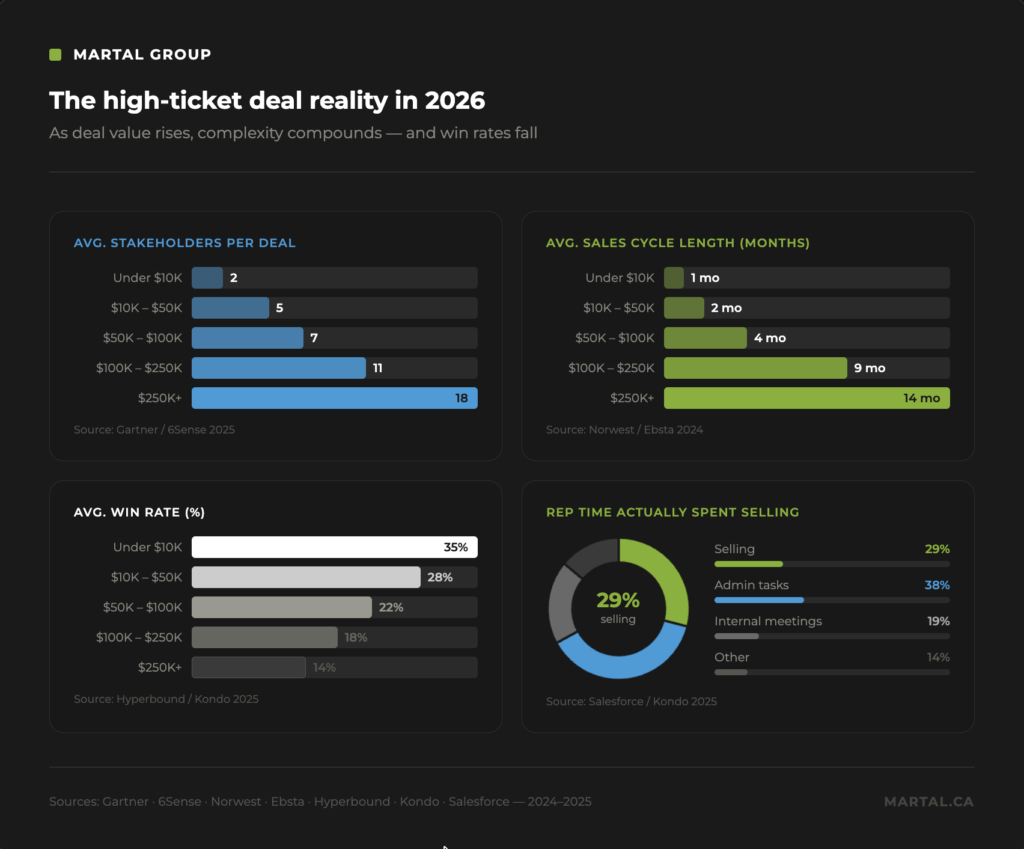
The numbers are sobering, but they’re worth knowing upfront.
The average B2B win rate now sits at 20–21%. For enterprise deals specifically, it drops to around 15% (13).
Buying committees for large purchases have expanded to an average of 10–11 stakeholders (14), and in deals above $250K, that number climbs further. Sales cycles for contracts over $100K routinely run 6–12 months (15). Meanwhile, the average sales rep spends only 28–30% of their week actually selling (16), the rest disappears into coordination, administration, and follow-up.
And yet, high-ticket B2B sales remains one of the highest-leverage growth strategies available to companies that execute it well. One enterprise account can generate more revenue than 50 smaller ones. Churn rates are lower. Expansion potential is real. And the credibility that comes from landing a marquee client opens doors that no marketing campaign can.
The gap between the teams that win consistently at high-ticket and those that don’t usually isn’t about product quality. It’s about process, specifically, the ability to identify the right accounts early, engage the full buying committee with relevant messaging, and sustain coordinated outreach over a long cycle without losing momentum.
That’s what this guide is about.
What Is High-Ticket Sales? (Definition and Examples)
High-ticket B2B deals ($10K+) involve multiple stakeholders, longer sales cycles, and greater risk scrutiny.
Reference Source: Apollo
High-ticket sales refers to the process of selling high-value products or services – typically $10,000 or more in a B2B context (17). Deal sizes can reach six or seven figures. In practice, “high-ticket” in B2B often means enterprise software contracts, large professional services engagements, or complex solution sales where the buying process is as demanding as the product itself.
The exact threshold varies by industry, but generally any offering $1,000 or more could be considered high-ticket (7) (8). What matters more than the number is the nature of the sale: high scrutiny, multiple decision-makers, long evaluation cycles, and a buyer who is investing enough that getting it wrong has real consequences.
Some B2B high-ticket sales examples include:
- Enterprise software licenses or SaaS subscriptions – e.g. a $100,000 per year software contract for a large company.
- Complex professional services and consulting packages – e.g. a $250,000 consulting project or a $5,000/month retainer (common for premium B2B service agencies).
- Industrial or IT equipment sales – e.g. selling manufacturing machinery or IT infrastructure worth six figures.
- Real estate or capital investments – e.g. selling commercial real estate, luxury vehicles, or other big-ticket assets in a B2B transaction.
- High-end training or coaching programs – e.g. a $3,000+ per seat leadership training or an executive coaching package (7) (8).
What these have in common isn’t just the price. It’s the weight of the decision for the buyer — and what that weight demands from the seller.
What makes high-ticket B2B sales different
The financial commitment is significant enough to trigger scrutiny. A buyer spending $100K isn’t clicking a checkout button. They’re running a vendor evaluation, looping in finance and legal, and likely comparing at least two or three alternatives. The higher the price, the more formal that process becomes.
Volume drops, value concentrates. High-ticket is a low-volume, high-value model. You’ll close fewer deals, but each one is worth far more. One enterprise account generating $200K ARR can outweigh 40 SMB accounts at $5K each — and typically requires less operational overhead to serve well.
Sales cycles stretch. For deals over $100K, expect 6–12 months from first contact to close. Deals over $250K often take longer. These aren’t quick wins — they require sustained pipeline management, consistent follow-up, and the patience to stay engaged across a long evaluation period without forcing the close.
Buying committees, not single buyers. Enterprise B2B purchases now involve an average of 10–11 stakeholders — spanning end users, managers, IT, finance, procurement, and the C-suite. Each brings different priorities. Winning the deal means building consensus across all of them, not just convincing one champion. And with 79% of purchases now requiring CFO sign-off, financial justification has become non-negotiable at every tier.
Consultative approach is the baseline, not a differentiator. High-ticket buyers expect a salesperson who understands their business, asks the right questions, and tailors the solution — not someone running a standard demo script. The selling motion is closer to consulting than pitching.
Expectations scale with price. When a client commits $150,000 to a solution, they expect premium service, clear communication, and a team that takes their success seriously. Post-sale delivery matters as much as the close — because renewal, expansion, and referral all depend on it.
To make the contrast concrete: selling a $50/month project management tool to a small business might close in a single call with the founder. That’s low-ticket — minimal friction, fast decision.
Selling a $500,000 enterprise software deployment to a Fortune 500 company is something else entirely. You’ll run multiple discovery sessions, a technical proof of concept, executive presentations, security reviews, and a legal negotiation — over six months or more, with a dozen people involved. That’s high-ticket. The process is the product, long before the contract is signed.
What Are the Differences Between High-Ticket and Low-Ticket Sales?
The mechanics of high-ticket and low-ticket sales are different enough that treating them as variations of the same motion is a common mistake. The table below captures the key contrasts — but the core idea is simple: low-ticket is optimized for volume and speed; high-ticket is optimized for value and depth.
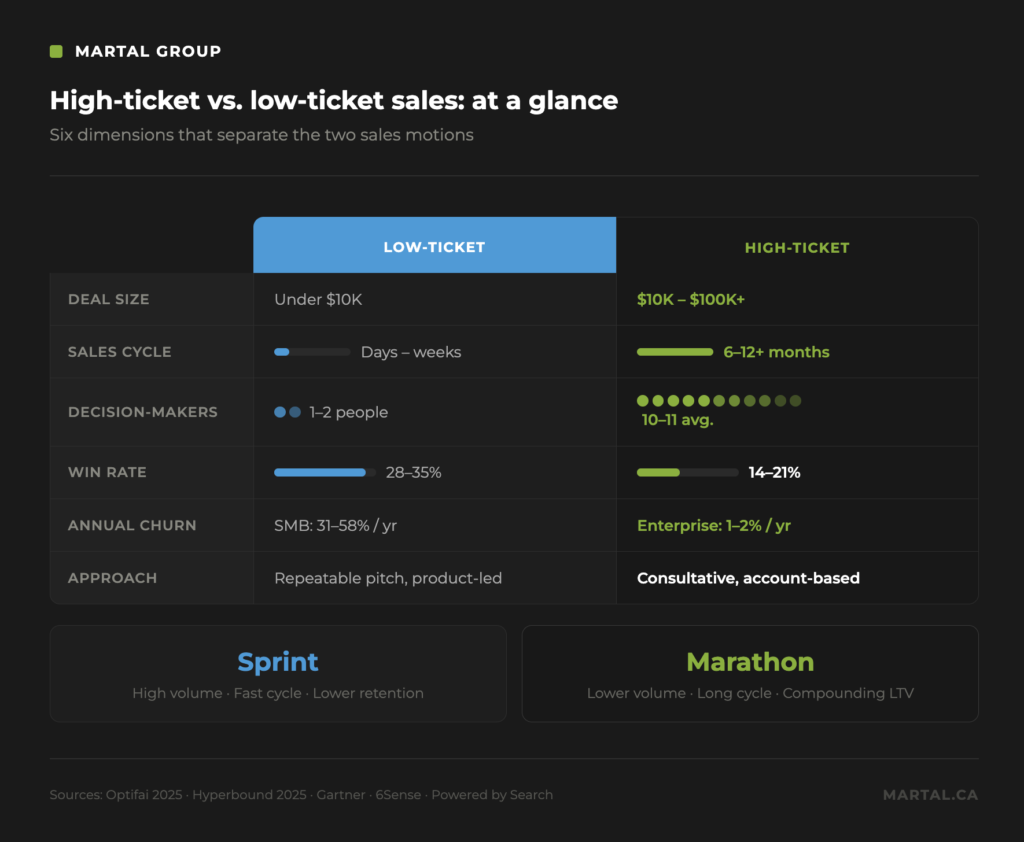
The churn contrast is worth pausing on. Enterprise SaaS maintains1–2% annual churn (18), while SMB-focused SaaS faces 3–5% monthly churn (19), which compounds to 31–58% annually. That gap fundamentally changes the lifetime value math. A high-ticket client who stays for three years at $150K ARR is worth more than almost any volume of small accounts churning at SMB rates.
The win rate trade-off cuts the other way. High-ticket deals are harder to close, lower probability, more stakeholders, longer cycles. But one win can carry a quarter. That asymmetry is what makes the strategy worth pursuing for companies with the right product, the right team, and a pipeline process built for the long game.
Low-ticket is a sprint. High-ticket is a marathon — slower, more demanding, but the finish line is worth considerably more.
Lead Generation for the Complex Sale
67% of the enterprise buying journey happens digitally, long before buyers become leads.
Reference Source: Forrester
Generating leads for a $100K+ deal is nothing like generating leads for a $5K one. The process is slower, more deliberate, and far more dependent on targeting the right accounts at the right moment — not reaching the most accounts overall.
Only 5% of B2B accounts are actively buying at any given moment (20). Volume-based outreach wastes the other 95%. The teams that consistently fill high-ticket pipelines have shifted from spray-and-pray to signal-led, account-based outreach, and the gap in results between the two approaches is significant.
Here are key strategies to generate leads for high-ticket sales:
- Identify your ideal high-ticket customer profile (ICP): High-ticket lead generation starts before any outreach is sent. The first step is defining an Ideal Customer Profile that goes beyond firmographics, industry, headcount, revenue, and specifies the conditions under which a company is likely to be in a buying window.
That means layering in signals: is the company hiring for roles that suggest a relevant initiative? Did they recently raise funding? Are they using a competitor’s tool? Have they engaged with relevant content? A well-defined ICP for complex sales isn’t a static description, it’s a set of conditions that, when met, indicate a company is worth prioritizing now.
One thing we see often in outbound programs that underperform: the ICP is defined broadly enough to include everyone, which means it effectively excludes no one. Precision in ICP definition is what separates a targeted program that generates 20 qualified meetings per month from a generic one that generates noise.
- Use intent signals to find accounts in their buying window: Organizations using intent data experience 30% higher sales productivity and 77% more accurate lead qualification (20). For high-ticket sales specifically, this matters enormously — because reaching the right company six months too early or too late can mean the difference between winning the deal and being told “we already went with someone else.”
Intent signals worth tracking for complex B2B sales include: funding announcements, executive hiring surges, technology stack changes, competitor contract expirations, content engagement with category-relevant topics, and event attendance. These signals don’t guarantee a deal — but they identify which accounts are worth the investment of a sustained, multi-stakeholder outreach sequence right now.
At Martal, we use intent data and technographic targeting as core inputs to every outbound campaign. Technographic targeting alone, reaching companies based on the tools they use, delivers 4x higher conversion rates than standard outbound, because relevance is built into the premise of every message.
- Build an omnichannel outreach sequence, not a single-channel campaign. B2B buyers now engage across an average of 10 channels before making a purchasing decision, up from just 5 channels in 2016. (20) A company running email-only outreach is visible in roughly 10% of the places where their buyers are evaluating options.
For high-ticket accounts, effective outreach coordinates cold email, cold calling, and LinkedIn outreach as a single connected sequence — not three separate efforts running in parallel. Each channel reinforces the others. A prospect who receives a relevant email, then a thoughtful LinkedIn connection request, then a follow-up call from someone who references both, experiences continuity rather than noise. That continuity builds familiarity, and familiarity builds the kind of trust that eventually gets a meeting booked.
Companies using at least three lead generation channels realize 18.96% higher engagement rates and a 9.5% annual revenue boostcompared to single-channel approaches (21). For enterprise-level deals where the sales cycle is long and competition is real, that engagement gap compounds over time.
- Content that educates and builds trust: High-ticket buyers are typically in “research mode” long before they talk to sales. They consume whitepapers, reports, case studies, and webinars to self-educate. Effective complex-sale lead gen often uses valuable content to attract and nurture leads. For instance, publish blog articles or guides addressing the specific pain points of your target customers (this can bring in organic leads via SEO). Offer downloadable resources like ROI calculators, in-depth case studies, or executive guides that speak to the challenges your high-ticket solution solves. This positions your company as an expert and helps buyers self-qualify.
By the time they engage with your sales team, they already recognize the value you provide. 93% of B2B buyers say they’re more likely to engage with a vendor that provides personalized, relevant content addressing their needs (4). So use content not as a direct sales pitch, but as a way to educate and build credibility with high-value prospects.
- LinkedIn and network outreach: For B2B high-ticket leads, LinkedIn is often the hunting ground. Sales development representatives (SDRs) or business development reps should be actively leveraging LinkedIn Sales Navigator to find decision-makers, engage with their posts, and send connection requests or messages that are personalized (no spammy templates).
In addition, consider having your company’s executives connect with peers at target accounts (sometimes C-level to C-level outreach can open doors that SDR outreach can’t). Also leverage your personal and professional networks – referrals are gold in high-ticket sales.
If a current client can introduce you to a similar high-value prospect, the lead quality and close probability shoot way up. Many complex B2B deals originate from networking, referrals, or thought leadership events (industry conferences, webinars where your team presents insights). Cultivate those channels to fill the top of your funnel with warm, qualified leads.
- Qualify hard, early, and often: With a 6–12 month sales cycle ahead, the most expensive mistake in high-ticket lead gen is investing significant effort in accounts that were never going to close. Strict qualification criteria, budget, authority, need, and timeline (BANT), or a more rigorous framework like MEDDIC for enterprise deals, applied early prevents that waste.
86% of deals stall at some point during the sales cycle due to disagreement among committee members. (20) Many of those stalls are avoidable if qualification had surfaced the misalignment earlier. The question to answer at the top of the funnel isn’t “could this company ever buy?”, it’s “is this company in a position to buy now, and do we have access to the people who need to say yes?”
What this looks like in practice
In one case study, Martal worked with an AI freight technology company entering a competitive US market and generated 353 leads and 108 meetings in just 3 months, starting from zero US pipeline. The program combined precise ICP targeting, intent-signal-based account prioritization, and coordinated omnichannel outreach across cold email, cold calling, and LinkedIn. Speed to qualified pipeline at that scale is only possible when lead generation is treated as a system, not a series of individual outreach attempts.
The broader pattern holds across verticals. High-ticket lead generation that works is precise, omnichannel, signal-led, and built around the buying committee, not just the most obvious contact in a database.
In summary, generating leads for high-ticket sales is about precision and personalization, not volume.
As author Brian Carroll (in Lead Generation for the Complex Sale) advised, it’s a multimodal approach to generate highly profitable leads – blending targeted outbound, content marketing, and careful lead nurturing (1).
You might get far fewer leads per month than a mass-market campaign, but each lead is worth far more. And because the sales process will be intensive, you only want leads that have strong potential to become your next $50K+ customer.
Stat to note: 80% of deals require five follow-ups or contact attempts before closing (11). Keep this in mind as you generate and nurture high-ticket leads – persistence is essential. You can’t assume one call or email will do the trick. Expect a long courting process and plan your outreach cadences accordingly.
How Does High-Ticket Sales Work? (The Complex Sales Funnel)
B2B buying groups average 6–10 stakeholders, each consulting 4–5 sources, and 95% revisit decisions at least once.
Reference Source: Gartner
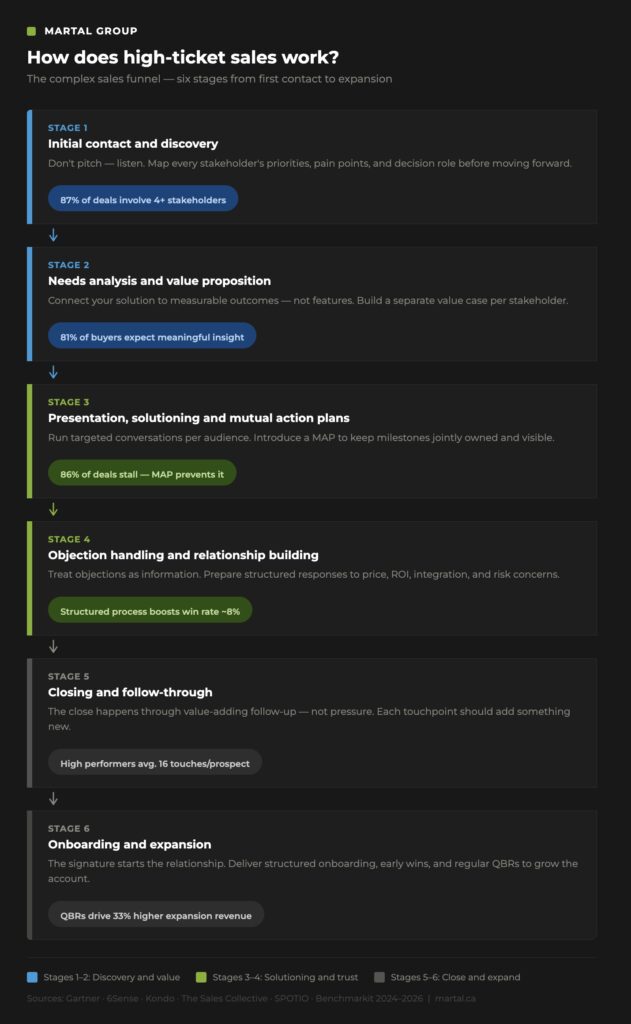
Understanding the high-ticket sales process means understanding a fundamental shift in timeline. The typical B2B buying journey is 211 days, and 70% of that time happens outside the sales pipeline, before a prospect ever enters your CRM.(23) By the time someone fills out a contact form or responds to outreach, they’ve already been researching for months.
That context matters for how you run each stage. The funnel isn’t a sequence you control, it’s a process you align to.
Here’s how it typically unfolds for high-ticket B2B deals, and what strong execution looks like at each stage.
Stage 1: Initial contact and discovery
The first conversation is not the place to pitch. It’s the place to listen.
In high-ticket sales, discovery is the most leveraged activity in the entire process. A rep who spends the first meeting understanding the prospect’s pain points, internal dynamics, decision-making process, and success criteria will outperform one who opens with a product overview every time.
The questions that matter at this stage: What problem are they trying to solve, and how long have they been trying to solve it? What have they already tried? Who else is involved in the decision? What does success look like in 12 months? What happens if they do nothing?
This is also where stakeholder mapping begins. Identifying who the economic buyer, champion, technical evaluator, and potential blocker are, early, prevents the most common deal-stall scenario: a deal progressing smoothly with one contact while a decision-maker you’ve never spoken to quietly kills it internally.
On average, 6 or more decision-makers are involved in B2B purchases, and large deals can involve dozens of people across a buying committee (6), starting the mapping process at discovery, not at proposal stage, is what separates deals that close from deals that stall.
Stage 2: Needs analysis and value proposition
Needs Analysis & Value Proposition: Based on discovery, your next step is to align your solution to the prospect’s specific needs and objectives. This is where you craft a tailored value proposition: how exactly will your product/service deliver a meaningful ROI or solve a major problem for this client? High-ticket sales is all about selling the outcome, not just the product features.
High-ticket buyers are ROI-focused by nature. The person signing a $200,000 contract wants to know what they’re getting for it in measurable terms: revenue gained, costs reduced, risk mitigated, time saved. Generic value propositions don’t survive CFO scrutiny. Specific, quantified ones do.
At this stage, build a tailored value case for the account, one that speaks to their industry, their current state, and the outcomes they’ve told you they care about. If they mentioned that their current process costs them 40 hours a week in manual work, your value proposition should address exactly that. Not a version of it. That.Different stakeholders need different versions of this story. The CFO wants a payback period. The VP of Operations wants an implementation timeline and disruption risk. The end user wants ease of adoption. 81% of buyers expect sellers who understand their specific needs and add meaningful insights, generic pitches fall flat with a committee that has already done significant independent research before your first call.
Stage 3: Presentation, solutioning and mutual action plans
In a complex sale, the “presentation” isn’t a one-time demo or pitch – it may be an ongoing series of conversations, demos, and workshops. You might start with a high-level executive presentation to get buy-in, then dive into technical demos for the user teams, and later provide a detailed proposal to financial stakeholders. Customize your sales presentations to each audience. For end-users, show ease of use and functionality; for executives, show strategic impact and ROI; for finance, show cost-benefit numbers. High-ticket sales often involve trial periods or pilot projects as well – for instance, a 60-day pilot program (possibly paid) to let the client evaluate the solution in their environment. Be prepared to co-create solutions with the client.
What separates high performers at this stage is the use of a Mutual Action Plan (MAP): a shared document that outlines agreed milestones, decision checkpoints, stakeholder sign-offs, and a target close date. MAPs reduce deal stall by making next steps explicit and jointly owned. Advancing the deal forward means orchestrating next steps with focus, navigating timing, budget alignment, stakeholder coordination, and evaluation criteria, all while staying aligned with the buyer’s expectations. (24) A MAP is the structural tool that keeps that orchestration on track.
Because these deals are high-value, clients may request custom features, extra services, or specific terms. If it’s within reason, accommodating such needs can be the difference between a win or a loss. Your sales funnel becomes a collaboration: you and the prospect working together to craft the best solution.
This consultative mindset (“let’s solve this together”) helps build trust – the currency of high-ticket sales. As one high-ticket sales guide noted, “Trust is the currency in high ticket sales. The more social proof and credibility you present, the less risky your offer feels.” (7) Use case studies, testimonials, and success stories liberally to reinforce trust at this stage. Seeing that others have achieved results with you helps ease a prospect’s fear of making a big investment.
Stage 4: Objection handling and relationship building
In any sale, objections are normal; in high-ticket sales, expect a lot of them, and often quite tough ones. Common objections in complex sales include: “It’s too expensive,” “What’s the ROI guarantee?” “How will this integrate with what we have?” “We need C-suite approval,” and even “Is this vendor reputable enough for such a big partnership?”
Instead of seeing objections as roadblocks, welcome them as an opportunity to provide reassurance and build the relationship. The most common objections at this stage: price relative to budget, ROI uncertainty, integration complexity, change management risk, and procurement timeline. Each has a specific response pattern. Price objections are best addressed by returning to the value case, the cost of inaction, the revenue upside, the payback period. Risk objections are best addressed with references, case studies, and phased implementation options.
Companies with a structured sales process increased their win rates by about 8% (25) compared to those with informal or ad hoc processes, and objection handling is one of the areas where that structure pays off most visibly. Reps who have a prepared, evidence-based response to the five most common objections in their category will consistently outperform those who improvise.
Relationship building at this stage is deliberate, not incidental. Involving your own leadership in key meetings, a CTO for a technical validation, a CEO for an executive sponsor call, signals organizational commitment and often shifts the dynamic in the deal. High-ticket buyers are evaluating your company as much as your product.
Stage 5: Closing and follow-through
High-performing sales organizations average 16 touches per prospect (26). Most reps give up well before that. In high-ticket sales, the close rarely happens on the first ask, it happens after sustained, value-adding follow-up that keeps the deal warm without becoming noise.
Often, 5 or more follow-up meetings or touchpoints are needed to get to the finish line (8). Perhaps the client needs to loop in a new executive last-minute, or budget got tighter and you need to negotiate terms.
Keep your enthusiasm and persistence up. This is where many salespeople get fatigued, but winners stick with it (without being pushy).
Continue to provide value with each follow-up: a new case study, an answer to a lingering question, a quick ROI recalculation – something that shows you are responsive and invested in their success.
Also, stand your ground on value during negotiations. High-ticket buyers will often negotiate hard (they might ask for discounts or extra scope). While some flexibility is fine, avoid the trap of slashing price unnecessarily – instead, reinforce the ROI and unique value of your offering. If you’ve built enough value and relationships in prior stages, the close should be the natural next step.
And once you do get verbal agreement, help the customer through procurement, legal, and all the final steps (these can drag out in enterprise deals). Guide them with procurement-friendly paperwork, be quick in redlining contracts, etc., to prevent deal fatigue at the 1-yard line.
Stage 6: Onboarding and expansion
The signature is not the finish line, it’s the start of the relationship that determines whether this account becomes a long-term revenue driver or a one-time transaction.
After closing, how you deliver and support the client is crucial. Successful high-ticket salespeople stay involved to ensure implementation goes well and the promised value is achieved.
Firms that run regular quarterly business reviews report 33% higher expansion revenue (27), because staying visible to the account creates the conditions for upsell, cross-sell, and renewal. The accounts that churn are almost always the ones where delivery went quiet after the kick-off call.
The land-and-expand model is where high-ticket sales generates its most outsized returns. Clickworker, a Martal client in the marketplace vertical, grew from initial engagement to $4.5M in recurring revenue and 500% ROI over nine years (28), including Fortune 10 and Fortune 500 deals, because the relationship was treated as a long-term partnership, not a closed transaction.
The common thread across all six stages is this: high-ticket sales rewards patience, preparation, and genuine alignment with the buyer’s goals. Teams that rush the process, skip discovery, or go single-threaded will consistently underperform teams that treat the funnel as a system designed for the buyer’s decision process, not their own quota calendar.
Remote High-Ticket Sales in 2026: Closing Big Deals from Anywhere
More than 70% of B2B buyers are willing to spend over $50,000 through a fully remote sales process.
Reference Source: Mckinsey & Company
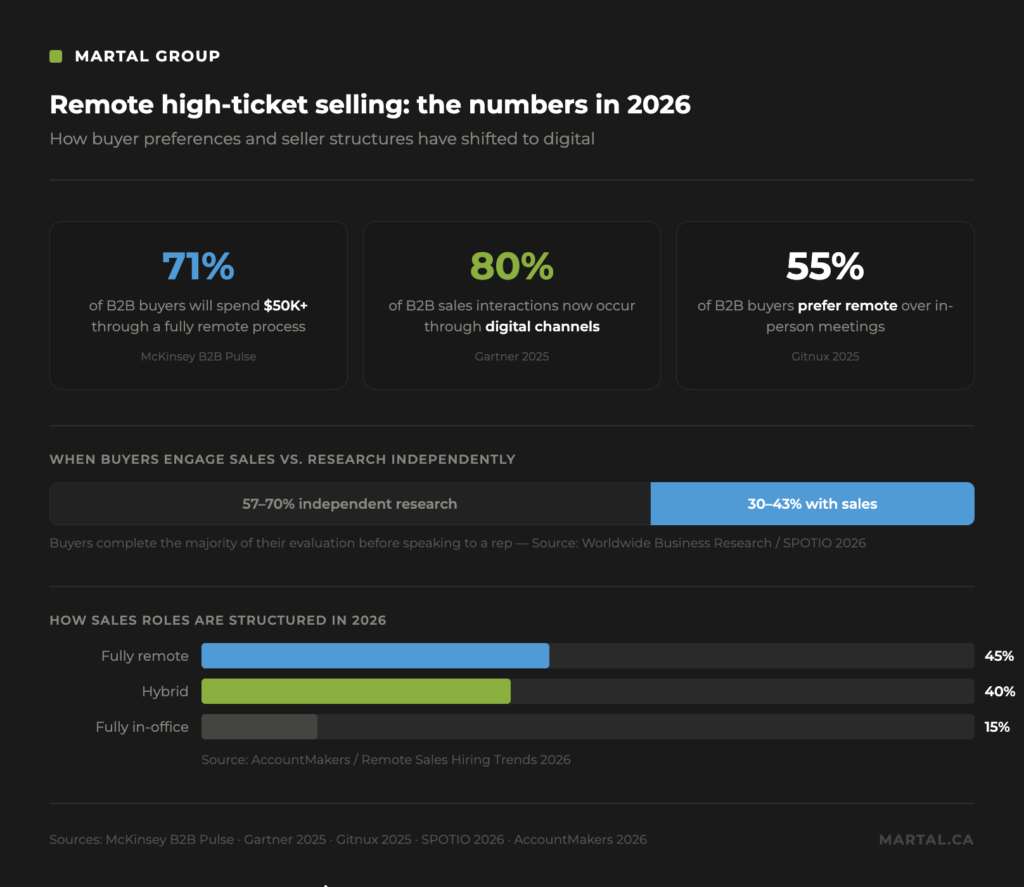
In decades past, big-ticket B2B deals were often done in person – think boardroom presentations, golf course meetings, expensive dinners. But in 2025, the landscape has shifted. Remote high-ticket sales (or high ticket remote sales, as some call it) have become the norm, not the exception (7). Thanks to technology and changing buyer preferences, it’s entirely possible to close enterprise deals without ever shaking the client’s hand in person.
Here’s what you need to know about high-ticket sales in a remote/online environment:
- Virtual meetings are standard: Zoom, Microsoft Teams, WebEx – these video conferencing tools are now standard for sales calls, demos, even contract negotiations. Many B2B buyers actually prefer the convenience of virtual meetings. It saves travel time and allows them to involve colleagues from different offices easily.
As a result, high ticket online sales processes have evolved to leverage video heavily. Your team should be adept at giving polished virtual presentations and demos. Small details matter – good lighting, clear audio, professional background – because you’re often making a first impression on a CEO via a webcam. The good news: clients are now willing to make large purchases via Zoom calls that once would have required on-site visits.
A survey by McKinsey found upwards of 70% of B2B decision makers are open to fully remote sales processes for deals over $50,000 (12). In other words, remote closing high-ticket sales is not only possible, it’s increasingly common.
- Digital-first buyer journey: Today’s B2B buyer often goes through most of their journey digitally – researching vendors online, reading reviews, attending webinars – before ever engaging a rep. By the time they speak to you, they may have already formed a strong impression from your website or LinkedIn presence. Ensure your digital touchpoints exude credibility.
This includes having a robust website with case studies and ROI content, active social proof (testimonials, client logos), and even your sales reps’ LinkedIn profiles being optimized as thought leaders. High-ticket prospects often Google the people and company they might do business with. A polished digital presence can reinforce trust before a conversation even happens.
Also, consider implementing virtual sales tools like interactive demos, personalized video messages, or online ROI calculators that prospects can play with. These tools can engage remote buyers effectively. Research shows that B2B buyers complete 57–70% of their journey before contacting sales, so it’s critical to meet them where they are: online (29).
- Remote high-ticket closers: The rise of remote selling has given birth to a role known as the “remote high-ticket closer” – essentially a sales professional who specializes in closing high-value deals over phone/Zoom, often working from anywhere.
Many companies now hire high-ticket closers who work remotely to handle inbound leads or to jump on virtual calls with prospects coming from webinars or marketing funnels. Yes, high ticket closers do work remotely – in fact, a large portion of high-ticket coaching programs and agencies operate with fully remote closers taking sales calls from home. In 2026, approximately 45% of sales roles are fully remote — particularly in SaaS, technology, and services where deals are sold virtually from first call to close. (30)
These closers are trained to build rapport quickly over the phone, run consultative discovery, and lead prospects to a decision in a single call or a short series of virtual meetings. If you’re building a high-ticket sales team, you can absolutely source talent remotely – you’re not limited to your local area for finding great enterprise sales reps or closers. The key is that they have the experience and discipline to manage complex deals via digital communication.
Companies are comfortable now hiring a high-ticket sales representative located across the country if they have the right skills, because tools make collaboration easy and clients often don’t mind (or even notice) where the rep is based, as long as they bring value.
- Challenges of remote complex sales: While remote selling brings convenience, it also has challenges. Without face-to-face interaction, it can be harder to read body language or build personal connection. Complex sales that might benefit from on-site visits (like seeing a client’s factory or meeting their whole team) require creative adaptation.
Some strategies to mitigate this include: shorter, more frequent video calls (rather than one marathon meeting), using screen sharing and virtual whiteboards to collaborate, and sending physical mailers to accompany your digital touches (for example, some reps send a handwritten note or a book to a prospect’s office to stand out – blending digital with physical can leave an impression).
Also, ensure you involve all stakeholders by scheduling group video calls or separate sessions for different stakeholders. It’s easy for a decision-maker to hide behind email in a remote scenario. Proactive reps make it a habit to confirm the right people are in the room at each stage, rather than letting the deal advance with key stakeholders unengaged. Remember too that remote buyers often juggle other work while on calls – so make your virtual meetings engaging and concise to combat digital fatigue.
- Global reach and scheduling: Remote high-ticket sales open opportunities to sell globally, since you’re not traveling physically. Your high ticket sales business might find its next big client in another country thanks to virtual selling. Be prepared for the logistics: dealing with time zones, cultural nuances on calls, and potentially longer sales cycles if there are cross-border corporate layers (e.g. selling to an international conglomerate).
On the flip side, remote selling can accelerate scheduling – getting a VP, a director, and an engineer all in the same boardroom might take weeks, but getting them on the same Zoom could be much faster. Use scheduling tools and be flexible with meeting times to accommodate stakeholders in different regions. It’s not uncommon now to close a six-figure deal with a customer you’ve never met in person – a scenario that is now standard practice across most B2B verticals, but is now fairly routine.
The bottom line is, remote and online channels now permeate high-ticket sales. Buyers have grown comfortable making large decisions via digital interaction. As sellers, we need to master the art of building trust and demonstrating value virtually. The fundamentals of high-ticket sales remain (consultative approach, ROI focus, relationship building), but the mediums have expanded beyond conference rooms to video conferences, beyond handshake deals to e-signatures.
One advantage of this digital shift: it can actually streamline parts of the complex sale. For instance, coordinating demos or stakeholder meetings via screen-share is more efficient than traveling on-site multiple times.
And tools like CRM-integrated email tracking, proposal analytics, and AI-driven conversation insights (from platforms like Gong or Chorus) can give remote sales teams an edge in tracking deal progress. Many organizations also report that remote selling has lowered their cost of sales – fewer flights and dinners – improving the ROI of pursuing high-ticket deals.
To succeed in high-ticket online sales, double down on communication and personal connection in every digital interaction. Be prompt in emails, show your face on video, and over-communicate next steps (since hallway conversations to clarify things aren’t happening). When needed, don’t hesitate to suggest an in-person meeting for critical moments – a hybrid approach is fine if it helps close a major account (e.g. perhaps you do 10 Zoom calls and then an in-person final meeting to sign the contract). But many deals will not require that at all.
In 2026 and beyond, remote high-ticket sales are here to stay. The most agile sales teams will leverage this to their advantage, accessing a wider market and using digital tools to sell smarter. If you equip your team with the right skills and technology, you can land big deals from the comfort of your (home) office.
Skills, Training, and Roles in High-Ticket Sales
Only 26% of B2B sales reps hit quota in 2025, down from a traditional benchmark of 70%
Reference Source: eSearchPro
High-ticket sales often demand a higher level of skill and specialization compared to typical sales. The stakes are higher, the conversations more complex. As a result, roles have emerged to address different parts of the process, and training has become paramount. Let’s look at who drives high-ticket deals and how to ensure they have the expertise needed:
High-Ticket Sales Representatives
In many B2B organizations, your high-ticket sales rep (or high-ticket sales representative) is essentially your senior account executive or enterprise salesperson. These are seasoned professionals adept at consultative selling.
A high-ticket sales rep needs to wear many hats: part consultant, part project manager, part negotiator. They must communicate effectively with C-suite executives one moment and technical users the next. Critical skills include active listening, problem-solving, strategic thinking, and patience. They also need domain expertise – understanding the client’s industry and challenges deeply.
Often, companies assign their most experienced reps or a special enterprise sales team to handle high-ticket opportunities. These reps are comfortable with long sales cycles and can navigate corporate bureaucracy. It’s not a role for a junior salesperson; there’s a reason postings for enterprise sales roles often ask for 5-10+ years of experience.
High-ticket sales reps are also typically adept at building relationships over months or years, keeping deals warm without dropping the ball. Importantly, they are outcome-focused – always tying the conversation back to business value for the client. If you’re hiring or grooming talent for high-ticket sales, prioritize consultative selling skills and resilience over ability to do quick pitches.
High-Ticket Closers
You might have heard the term “high-ticket closer” floating around, especially in the context of online coaching or course sales. A high-ticket sales closer is a salesperson who specializes in the final stage of the sale – converting a warm lead into a paying high-ticket client, often on a one-call close.
This role gained popularity via online business gurus, but it’s rooted in a real need: sometimes the person who prospect and nurtures a lead isn’t the best one to close it, so a specialist steps in. In B2B companies, a closer might be a sales executive brought in for big negotiation meetings or to sign the deal. In the context of high-ticket coaching or agencies, the closer might be a contractor who takes sales calls after a prospect has been through a marketing funnel (webinar, etc.).
What makes a great high-ticket closer? Typically, empathy, sharp objection-handling, confidence, and an ability to create urgency without being pushy (8). Sales professionals who incorporate social selling report being 51% more likely to achieve quota (23), and for remote closers in particular, LinkedIn fluency has become as important as phone presence. They follow a consultative script: ask questions, listen, then help the prospect overcome doubts and “close” by taking payment or signing. High-ticket closers often work remotely (as discussed earlier) and may operate on commission per deal.
For a B2B firm, you might not label someone a “closer,” but you may designate a lead salesperson to handle closing once an SDR or BDR has qualified a lead and set a qualified appointment. Whether it’s one-call closing in a coaching business or multi-step closing in enterprise sales, having someone who excels at guiding prospects to a “yes” is invaluable. If your team lacks strong closers, consider training or hiring specifically for this skill set.
High-Ticket Sales Consultants: Sometimes companies bring in outside expertise to help with their high-ticket sales strategy. A high-ticket sales consultant could be a freelance expert or agency that advises on improving your sales process, messaging, and team skills for landing big clients. This might overlap with sales trainers or fractional SDRs or CROs (Chief Revenue Officers) who specialize in complex sales.
For instance, if a mid-market company wants to start selling to enterprise clients (a big leap in deal complexity), they might hire a consultant to craft an enterprise sales playbook and train the team.
High-ticket sales consultants can provide a fresh, experienced perspective, helping identify where deals are stalling or how to better target ideal accounts. They often have experience closing large deals themselves and can coach your team on best practices.
Engaging a consultant is worth considering if you’re entering a new market segment or your win rates on big deals are low. They can audit your proposals, do role-play sessions with reps, and refine your high-ticket sales funnel from lead gen to close.
At Martal, for example, we act as strategic partners to our clients, not only generating leads but advising on outreach sequences and sales tactics that resonate with high-level buyers – in a sense providing sales consultation alongside execution.
Sales Training & Coaching
Because high-ticket sales is so skill-intensive, ongoing training is a must. This is where a high-ticket sales coach or structured high-ticket sales training program comes in.
Training can take many forms: enrolling your reps in workshops or courses, hiring an external sales coach to do weekly coaching calls, or building an internal training curriculum (some companies even have “Sales Academies” for continuous learning).
The focus of training should be on areas like advanced negotiation, financial ROI selling, enterprise account management, and relationship-building techniques.
For example, training reps to quantify ROI in dollar terms can significantly improve their effectiveness in front of CFOs. Or teaching them MEDDIC (a methodology for complex deal qualification) can help eliminate weak deals early.
Role-playing common high-ticket scenarios – like selling to a skeptical CFO, or handling the “we don’t have budget” objection for a $100K ask – is extremely valuable. Many salespeople from transactional backgrounds struggle with high-ticket sales until they unlearn old habits (like talking too much about features) and learn new ones (like mapping stakeholders and customizing value props).
A skilled high-ticket sales coach can observe your team’s calls or meetings (recordings are great for this) and give tailored feedback. The teams that consistently close complex deals invest in role clarity, knowing exactly who owns prospecting, who owns the relationship, and who owns the technical close. Ambiguity at the team level creates the same stall risk inside the sales org as a disengaged stakeholder creates inside the buyer’s org.
In short, if you want to excel in high-ticket sales, invest in training. 79% of sales executives say improving the productivity of existing reps is a key factor in hitting new targets (23) which is why training isn’t a one-time onboarding event for high-ticket teams, it’s an ongoing investment.
As part of Martal’s commitment to sales excellence, we established Martal Academy to train SDRs and sales reps in modern B2B sales techniques, including high-ticket outbound strategies.
Whether it’s cold email outreach, outbound strategy, qualification frameworks, or omnichannel prospecting, our program focuses on real-world skills to book meetings with hard-to-reach prospects. Such training ensures that when our reps are on the front lines for clients selling high-ticket offerings, they can confidently secure appointments and nurture interest at the highest executive levels.)
AI-powered coaching platforms, which analyze real call recordings to flag objection-handling gaps, pacing issues, and qualification weaknesses, are now widely used across enterprise sales teams to scale coaching without adding manager headcount.
Sales Team Structure
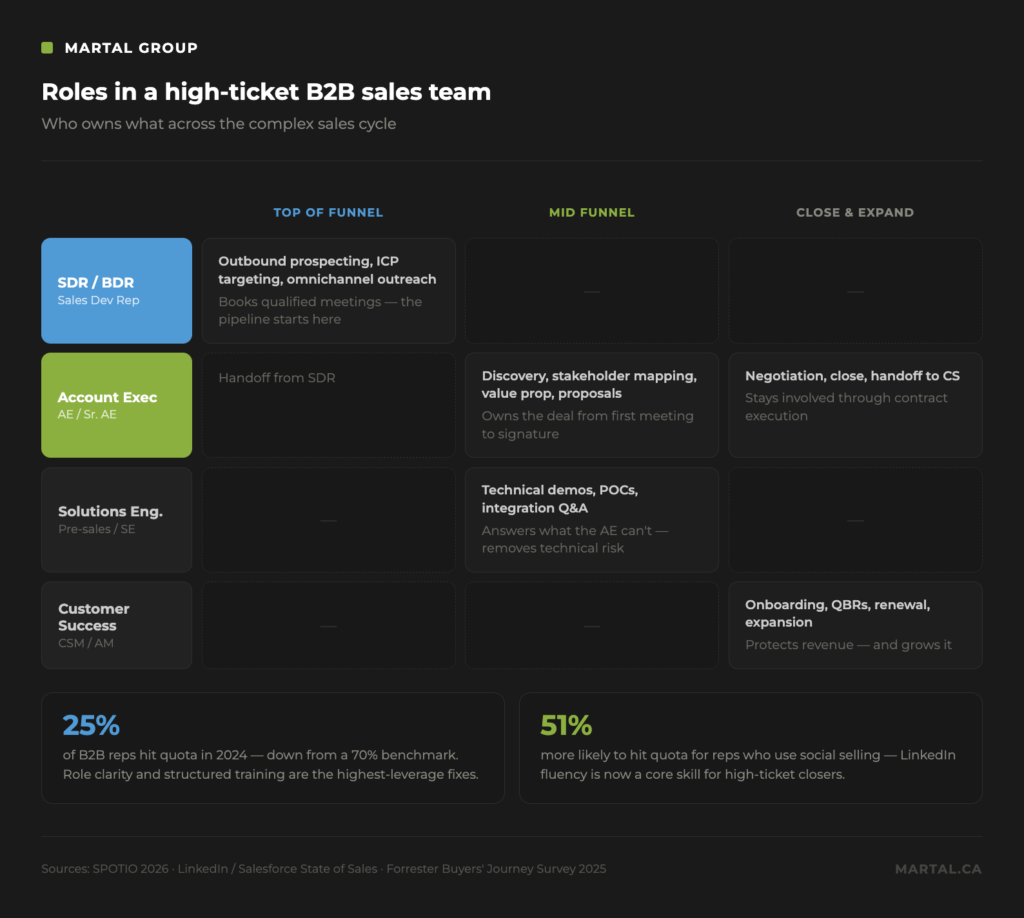
Often, high-ticket sales involves a team selling approach. It’s hard for one person to single-handedly do everything on a large deal. You might have an SDR/BDR doing the prospecting, an account executive handling the main sales cycle, a solutions engineer providing technical demos, and a SDR manager or VP stepping in for executive-level negotiations.
Everyone should be aligned and clear on their roles. Regular internal deal strategy meetings can help the team strategize next steps for each big opportunity (e.g. “We need to get the CTO on a call, let’s have our CTO join that meeting to answer deep technical questions.”). In complex sales, leverage the whole team to show the depth of your company’s commitment and expertise to the prospect.
For instance, bringing your CEO or technical expert to a sales call at the right moment can impress upon the client that you mean business and can address their every concern. High-ticket prospects often evaluate your entire company, not just the sales rep – they notice the caliber of people you involve.
In summary, people and skills are the ultimate drivers of high-ticket sales success. The right roles (rep, closer, consultant, etc.) and robust training can dramatically increase your win rates.
Conversely, sending inexperienced or under-trained reps to chase enterprise deals is a recipe for disappointment. Treat high-ticket sales as a craft to be honed. Invest in your team’s skills – whether through coaching, courses, or hiring proven talent – and you’ll see that investment reflected in the revenue won.
Weighing the ROI: Is High-Ticket Sales Worth It?
Let’s tackle the big question head on: is high-ticket sales worth it for your B2B company? After all, it sounds great to close $100K+ deals, but not if you spend $200K chasing them.
Ultimately, the goal of any sales strategy is a healthy return on investment (ROI). So how does high-ticket selling stack up in terms of ROI, and what are the risks versus rewards?
The case for high-ticket ROI (rewards):
- High revenue per deal: This is obvious but crucial – with high-ticket sales, each win brings in a significant lump of revenue. For example, one enterprise deal worth $250,000 could equal the revenue of 50 smaller deals at $5,000 each. This concentration can be very efficient. In one engagement with a marketplace platform client, a single outbound program generated $4.5M in recurring revenue and 500% ROI over nine years (28), with Fortune 10 and Fortune 500 deals among the wins. That kind of compounding return is only possible when the initial high-ticket relationship is built on solid delivery.
- Better client retention and expansion: High-ticket B2B relationships tend to be stickier and longer-term. When a client invests heavily in your solution, they are likely to stick around if you deliver value, because switching is painful. Existing customers now generate 40% of new ARR across B2B SaaS, and over 50% for companies above $50M ARR. (31) Retention delivers 5–25x better ROI than acquisition (18), making the land-and-expand model not just a growth strategy but a financial efficiency argument.
Additionally, big clients can grow: they might expand usage, buy additional modules or services, or roll out your solution to more divisions. The lifetime value (LTV) of a high-ticket client can be enormous – sometimes 5-10x the initial contract if you land-and-expand.
This recurring revenue and upsell potential means the ROI of winning a high-ticket account isn’t just the first contract, but the multi-year stream of business that follows.
- More bang for your marketing buck: There’s a saying, “It costs the same to market to a big client as a small client.” While not entirely true, there is some logic: the effort to run a campaign or set a meeting might be similar whether the prospect’s potential is $5K or $500K. By focusing on high-ticket prospects, your customer acquisition cost (CAC) can be very efficient relative to the deal size.
For instance, perhaps you spend $10,000 on an ABM campaign (ads, content, outreach) targeted at a handful of Fortune 1000 companies. If one becomes a client at $100K, the CAC ($10K) vs. Deal ($100K) is quite good – a 10:1 ratio. With smaller deals, you might spend $500 to acquire a $5,000 client (also 10:1), but you’d need 20 such clients to equal the revenue of that one big fish.
Many companies find that the highest ROI marketing channels are those that generate high-ticket leads, even if the volume is low. It’s like fishing with a spear vs a net; a spear (targeted campaign) might catch one big fish very efficiently, whereas a net catches many small ones and you throw most back.
81% of B2B organizations with ABM programs say ABM delivers higher ROI than other marketing activities (2)
- Market credibility and referrals: Landing notable high-ticket clients can have an intangible but powerful ROI in terms of brand credibility. It’s easier to win more big deals when you can say “Company X is our client” (especially if X is a respected brand). Big clients often talk to each other; impress one and you might get referral business in the industry. For example, a consultancy that wins a $1M project with a top pharma company can leverage that success story to pitch other pharma companies and likely win more.
High-ticket success tends to have a snowball effect – it positions your firm as a “player” in that league. This can reduce sales cycles and marketing costs for future deals (another ROI boost). There’s truth in the adage: big deals lead to bigger deals because of the confidence and reputation gain.
- Efficiency of focus: Serving many small customers can actually be operationally complex and costly (supporting 1000 tiny accounts vs 10 big accounts). High-ticket sales allows you to focus your organization’s resources on a smaller number of important clients. Your customer success and delivery teams can give world-class service to a few key accounts, rather than being spread thin.
This focus can improve overall service quality and client satisfaction, which in turn protects that revenue (less churn). When evaluating ROI, remember to factor in the cost to serve clients post-sale. A high-ticket model might have lower cost-to-serve per dollar of revenue, because you’re scaling one solution across a large deployment instead of handling many separate small deployments.
The case against (risks and challenges):
- Long payback period: The sales cycle and ramp time for high-ticket deals is long. This means you invest a lot upfront (sales salaries, travel, demos, POCs, etc.) without guarantee of a win. The payback period – time until the deal closes and revenue comes in – can be many months or even years. If your company’s cash flow can’t support that, high-ticket sales can strain finances.
For example, an enterprise deal might cost you $50K in presales engineering, proposal prep, and sales rep time, and then the deal slips to next year – or worse, you lose it. That’s a lot of sunk cost. This risk is manageable with a strong pipeline (so wins eventually make up for losses) and by targeting deals wisely. But it’s a real risk: you might spend a fortune pursuing a whale that never comes onboard.
- Higher likelihood of “zero outcome”: With many small deals, if you lose one or two, it’s no big deal; others fill the gap. With high-ticket, if a few key deals don’t close as expected, you can miss your entire revenue targets. There’s inherent revenue volatility risk in putting big eggs in few baskets.
A last-minute budget cut at one prospect could wipe out what your team worked 12 months for. In that sense, high-ticket sales can be feast or famine. A company must be prepared for uneven results and have contingency plans (or a financial cushion) for deals slipping.
You can mitigate this by maintaining a robust pipeline of big deals (so one loss doesn’t derail you) and by diversifying across industries or client types. Still, relying on a handful of deals is inherently riskier than having hundreds of small transactions.
- Resource and personnel costs: High-ticket sales requires top talent (which is expensive) and often a higher ratio of support (sales engineers, solution architects, legal, etc. involved in each deal). The customer acquisition cost for an enterprise deal can be quite high in absolute terms. If your team spends 6 months and $100K worth of effort to win a $200K ARR client, the CAC payback period might be a bit long (though acceptable if LTV is high).
Additionally, servicing big clients can mean dedicating account managers, custom features, higher support SLAs, etc., which all are costs that eat into margins. The standard benchmark across B2B is an LTV:CAC ratio of at least 3:1 (2), meaning for every dollar spent acquiring a high-ticket client, the goal is three dollars in lifetime return. For enterprise deals at $100K+ ACV with 1–2% annual churn, that ratio is highly achievable. For deals that require heavy customization and compress margins, it may not be, which is why deal qualification at the top of the funnel protects profitability at the bottom.
You have to be sure the math still works out in profit terms, not just revenue. Many SaaS companies, for instance, find that enterprise customers negotiate bigger discounts and demand more handholding, which can compress margins. So is the ROI worth it? It can be, but you must price and structure deals wisely to ensure they’re profitable over their life (including the support costs).
- Execution risk: High-ticket sales strategies can fail if not executed well. It’s not a silver bullet. If your team isn’t experienced with complex sales, you might invest in trade shows, fancy brochures, and long demos and still come up empty. There’s also competitive risk – big deals attract stiff competition, often from other top vendors.
Losing a big deal to a competitor not only hurts revenue, it can be a blow to morale and market perception (e.g. “Company X beat us in that Fortune 500 account”). Also, big clients can be very demanding and influence your product roadmap heavily, which could pull you away from other opportunities.
In short, there are strategic risks in focusing on high-ticket: you might neglect the bread-and-butter small deals, or over-customize for one client and create technical debt. The ROI of high-ticket sales depends on disciplined strategy – picking the right battles and not chasing every shiny large prospect.
Calculating the ROI: To quantitatively decide if high-ticket sales are worth it for your business, calculate some metrics:
- CAC vs. LTV: Compare your customer acquisition cost for large deals to the lifetime value of those deals. If you spend $50K to win a client that pays $200K over 2 years, CAC/LTV is 0.25 – pretty good. If it’s inverted (spend $200K to win $50K), that’s obviously bad.
Two Martal engagements illustrate how this math plays out in practice. HALO Recognition generated $10M+ in new business opportunities through Martal’s outbound program (32). Berger-Levrault closed two deals that alone justified the entire campaign investment (10). They reflect what happens when a high-ticket pipeline is built through precise targeting and sustained omnichannel outreach rather than volume prospecting.
- Win rate and deal size: Maybe your win rate on big deals is lower (say 20% vs 35% on small deals), but if the deal size is 10x bigger, the math may still favor big deals. You might allocate 50% of resources to enterprise pursuits that only yield a few wins a year, but those wins could be, for example, $2M total vs. $1M total if those resources chased many small clients.
- Time to revenue: Consider the ramp time. If you need immediate revenue (short runway), high-ticket might not pay off fast enough. But if you have patience, those longer-term deals can snowball.
- Impact on organization: Does focusing on high-ticket align with your product and service capacity? If you’re built to serve enterprise, great. If not, the ROI might suffer as you stretch to meet demands.
In many cases, companies find a hybrid approach optimal: a base of smaller customers for steady cash flow, plus a strategic push for high-ticket wins as “home runs.” This hedges bets.
For example, a SaaS company might have SMB customers paying $5K ARR, but also pursue a few enterprise accounts at $100K+ ARR. The SMB side covers baseline costs, while the enterprise wins drive big growth spurts. If an enterprise deal slips, the company still has revenue coming in from SMBs – a buffer.
So, is it worth it? When done right, absolutely yes – high-ticket sales can deliver tremendous ROI.
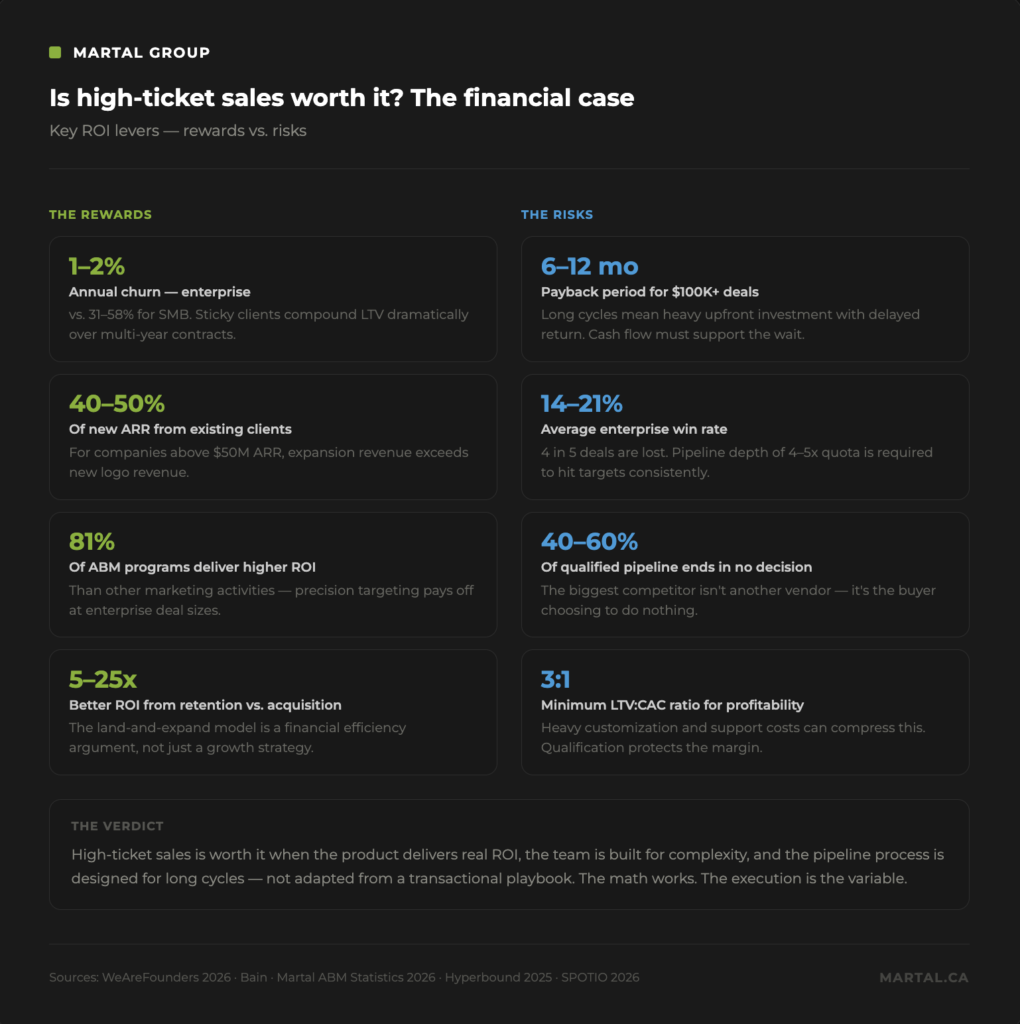
The combination of large annual contract values, strong retention, and market credibility can propel a B2B company’s growth and profitability. Many of the fastest-growing B2B firms owe their success to landing big enterprise clients (think of how landing one Fortune 500 account often leads to 5 others due to credibility and referrals).
However, it’s only worth it if you have the strategy, team, and stomach for it. If you half-heartedly pursue big deals without the proper investment, you might see no ROI at all (just a lot of spent effort). But if you commit to developing the necessary capabilities, the payoff can be transformative.
At Martal, we’ve seen this play out with our clients time and again – those who implement robust high-ticket sales strategies (often leveraging our outbound appointment setting to get their foot in the door with marquee accounts) reap major rewards.
Conclusion: High-Ticket Sales as a Strategic Advantage
High-ticket sales in 2026 is a deliberate growth strategy — one that, when executed well, compounds over time in ways that transactional selling never can. We’ve covered how it works, from what high-ticket sales means to the nitty-gritty of complex sale lead generation, multi-step sales funnels, remote selling adjustments, and the skills required to close big deals. The overarching theme is clear: high-ticket sales is about quality over quantity, relationships over transactions, and value over price.
For companies willing to invest in this approach, the answer to “Is it worth it?” tends to be yes – provided you have a product that delivers real ROI and a team capable of conveying that value. If you check those boxes, high-ticket sales can elevate your business to the next level. It can mean fewer clients, but each is a marquee account; longer sales cycles, but each win is a game-changer.
At Martal, we’ve spent 16+ years running these exact programs for B2B companies across 50+ verticals, building pipeline for high-ticket accounts through coordinated omnichannel outreach that combines cold email, cold calling, and LinkedIn outreach as a single connected strategy, not three separate efforts.
We’ve also trained internal teams through our Martal Academy to adopt the best practices you’ve read about in this guide – from consultative selling to omnichannel prospecting. The companies that succeed in high-ticket sales are those that combine persistence, personalization, and process. They don’t shy away from the long game, and they use data and insights (like the ones cited in this article) to continuously improve their approach.
If your team is ready to build or scale a high-ticket pipeline — whether that means getting more qualified meetings with enterprise decision-makers, training your in-house team on complex sales methodology, or outsourcing the outbound motion entirely, we’re here to help.
Book a consultation to talk through your pipeline goals and see what a targeted outbound program looks like in practice. Our Sales-as-a-Service model handles the outbound, cold email, cold calling, and LinkedIn outreach as a coordinated omnichannel program, so your team stays focused on what they do best: closing.
References
- Amazon
- Martal Group
- Saleslion
- Martal – B2B Sales Guide
- Qwilr
- HubSpot – Sales Statistics
- LettrLabs
- SeeBiz
- Lead Forensics
- Martal Group – Case Study
- Invesp
- Mckinsey & Company
- HubSpot
- Unbound
- Salesmotion
- Salesforce
- Apollo
- Genesysgrowth
- Optifai
- Growleads
- ALM Corp
- Pepperinsight
- Spotio
- Highspot
- The Sales Collective
- Zoominfo
- Serpsculpt
- Martal Group Case Study
- Worldwide Business Research
- Accountmakers
- Hypefury
- Martal Group – Case Study
FAQs: High Ticket Sales
What is considered high-ticket in B2B sales?
In a B2B context, high-ticket sales typically refers to deals valued at $10,000 or more — though in enterprise sales, most meaningful contracts start at $50,000 and frequently reach six or seven figures. The threshold matters less than the nature of the sale: high scrutiny, multiple decision-makers, a long evaluation cycle, and a buyer who expects measurable ROI in return for a significant financial commitment.
How long does a high-ticket B2B sales cycle typically take?
For deals between $10,000 and $50,000, expect 2–4 months. For contracts over $100,000, the average cycle runs 6–12 months, with larger enterprise agreements frequently stretching beyond that once procurement and legal review are factored in. Sales cycles have extended 22% longer since 2022, driven by larger buying committees and increased CFO involvement in purchase approvals.
How many decision-makers are involved in a high-ticket B2B deal?
Modern enterprise buying groups average 10–11 stakeholders — spanning end users, managers, IT, finance, procurement, and the C-suite. Larger deals can involve 15 or more, and 79% of purchases now require CFO sign-off. Single-threaded selling — engaging only one contact and hoping they carry the deal internally — is one of the most common reasons high-ticket opportunities stall.
Can high-ticket B2B deals be closed remotely?
Yes. More than 71% of B2B buyers are comfortable completing purchases over $50,000 through a fully remote process, and 80% of B2B sales interactions now occur through digital channels. Remote high-ticket selling requires the same fundamentals as in-person — consultative discovery, stakeholder alignment, and structured follow-up — but executed through video, email, and coordinated omnichannel outreach rather than conference rooms.
What is the difference between an SDR and a high-ticket closer?
An SDR (Sales Development Representative) focuses on top-of-funnel activity — prospecting, outbound outreach, and booking qualified meetings. A high-ticket closer, typically an Account Executive or Senior AE, takes over from the first discovery meeting through to contract signature. In complex B2B sales, the two roles are deliberately separated because the skills required are different: SDRs need strong prospecting and qualification discipline; closers need consultative depth, stakeholder navigation, and negotiation experience.
Is high-ticket sales outsourcing a viable option for B2B companies?
Yes — and for many teams, it’s the fastest path to qualified high-ticket pipeline. Outsourcing the outbound lead generation function to a specialist team means you get experienced SDRs, omnichannel outreach infrastructure, and ICP targeting in place within 30 days rather than the 3–6 months it typically takes to hire, ramp, and train an in-house team. The key is choosing a partner with direct experience in your vertical and a model that coordinates cold email, cold calling, and LinkedIn outreach as a connected omnichannel program — not three separate activities running in parallel.