
 Martal
 Technology
 Education and training
 Web Development and UI / UX
 Healthcare/Medical
 Logistics and Supply Chain
 Information Technology
 Insuretech and Financial Services
 Marketplaces
 Software Development
 E-commerce and retail
 AI and Machine Learning
 Energy and Solar
 Manufacturing
 Security and Surveillance
 Digital Marketing Agency
 Transportation
 MSP
MSP
 Telecom
 B2B SaaS
 Cybersecurity
 HR tech
 Fintech
 Cleantech
 Consulting
The Top 12 Outreach Tools for B2B Sales Teams: A 2026 Buyer’s Guide
Major Takeaways: Outreach Tools
Cold email reply rates have compressed to a 3.43% platform-wide average in 2026, down from 5.1% in 2025 — making precision, personalization, and the right tooling the difference between pipeline and silence.
Top-performing campaigns now exceed 10% reply rates — 2 to 4 times the platform average — by combining AI personalization with intent-based targeting and signal-driven timing.
Automated outreach systems ensure consistent follow-ups and reduce human error — 80% of B2B deals require 5+ follow-ups, yet most reps stop after the fourth, which is exactly where automation pays back.
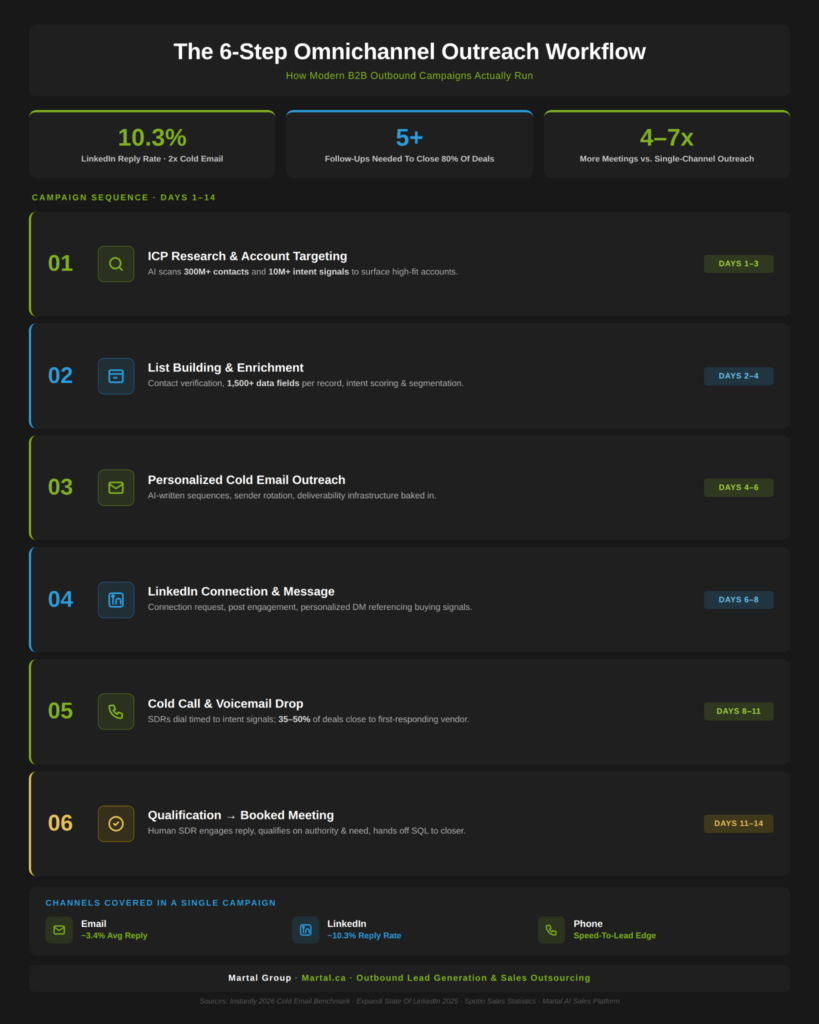
LinkedIn messages still see roughly 10.3% reply rates — double the cold email average — making coordinated omnichannel cadences (email + LinkedIn + phone) the new baseline, not the upgrade.
Platforms like Martal’s AI SDR analyze 10M+ real-time intent signals to surface high-fit accounts in their buying window — outreach lands at the right moment, not on the wrong list at the wrong time.
The four real evaluation criteria are deliverability infrastructure, native channel coverage, AI quality control, and compliance — including GDPR, CAN-SPAM, CASL, and SOC II for regulated industries and global teams.
Fully autonomous AI SDRs (Artisan’s Ava, 11x’s Alice, AiSDR) make sense when your ICP, messaging, and unit economics are already proven — they amplify a working motion; they don’t fix a broken one. We’ve seen the difference firsthand: clients who switched to Martal after trying software-only AI SDRs typically describe the gap as “quality of leads, not quantity of activity.”
Pricing in 2026 spans a wide range — from ~$25/month for entry-level cold email tools (Saleshandy) to $1,000–$5,000+/month for full sales engagement platforms or autonomous AI SDR agents, plus the hidden costs of data, dialers, and deliverability infrastructure stacked around them.
Disconnected tools, poor list quality, and the absence of a clear operating model — most teams are stitching together 5 to 12 separate platforms, and that fragmentation is where ROI quietly leaks. A unified stack — or an outsourced partner like Martal that runs it end-to-end — closes the gap.
Automating repetitive prospecting tasks can reduce cost-per-lead by up to 65% versus traditional in-house outbound — letting teams scale pipeline without scaling SDR headcount.
Introduction
The job description for a B2B outreach tool has changed.
Two years ago, “best outreach tools” meant whichever platform could send the most personalized emails the fastest. In 2026, it means something more precise — the platform that reaches the right buyer at the right moment, in their preferred channel, without burning your sender reputation or your brand. The reason is structural. Cold email reply rates have compressed to a 3.43% platform-wide average across billions of sends (9), down from 5.1% the year prior. Sales cycles are longer. Buying groups are bigger. And inboxes are noisier than at any point in the last decade.
The teams pulling ahead are not the ones sending more. They are the ones sending better — with cleaner data, sharper timing, and tools designed to coordinate channels rather than fragment them. 42% of salespeople still say prospecting is the hardest part of their job (1) — and the tools that solve for that pain have evolved into three distinct categories: sales engagement platforms, AI-native autonomous agents, and managed services that combine both with human SDRs.
We put this guide together to help B2B teams cut through the noise. We reviewed the leading sales outreach tools in the market, examined how each fits different buyer profiles and budgets, and organized our findings around what actually matters to revenue teams: omnichannel coverage, AI quality, deliverability, compliance, and total cost to operate.
We’ll cover why automated outreach is now table stakes, walk through the top 12 outreach tools — grouped by category and use case — and close with a build-vs-buy framework, compliance considerations, and FAQs sourced from real operator questions. Let’s get into it.
Why Sales Teams Need Automated Outreach Tools in 2025
3.43% is the platform-wide cold email reply rate in 2026 — down from 5.1% the year before. Top performers exceed 10%.
Reference Source: Instantly
The case for outreach automation is not “do more, faster.” It is “do less, better — and never miss a follow-up.” Here is how the right tools earn their place in a modern outbound stack.
Efficiency and Scale Without Adding Headcount
Most reps spend only about a third of their time actively selling. The rest is swallowed by admin work, list-building, and CRM hygiene (1). Outreach tools reclaim those hours by automating prospect research, sequencing, email follow-ups, and CRM logging.
The payoff compounds across the funnel. Companies running AI-assisted outbound report 4–7x more responses and meetings versus traditional methods (5), and the reason is mechanical: 80% of B2B deals require 5+ follow-ups, but 92% of reps quit after the fourth attempt (1). An automated outreach system holds the line on persistence where human reps fall off — keeping lead nurturing running until the prospect is ready to convert.
In our own outbound work, the most common ROI breakdown is not at the top of the funnel — it is in follow-up #3 through #6, where the buyer is finally paying attention but the rep has already moved on.
Speed to Lead — The First-Response Advantage
In B2B sales, the vendor who engages first wins 35–50% of the deal (1). Automated outreach platforms protect that edge by responding to new inquiries or intent signals in minutes, including outside business hours. AI agents can monitor buying signals — a competitor mention, a pricing-page visit, a funding announcement — and trigger an immediate personalized touch. Being first matters more than being clever.
Pro tip: If existing AI agents fall short of your current needs or expectations, use an AI agent builder to assemble these signal-to-action workflows.
Personalization at Scale (Without It Sounding Like AI)
The trade-off in outbound sales used to be quantity versus quality. Modern AI outreach tools make both possible — but only if the inputs are right. They analyze role, industry, tech stack, recent activity, and intent signals to tailor each message, then automate the delivery.
The numbers back the approach: 73% of decision-makers say personalization matters to whether they engage with cold outreach (10), and campaigns using deeper personalization (beyond first name) hit reply rates up to 18% — roughly double the average (11).
The catch: when AI writes thousands of emails with no human review, output quality degrades fast. We see this every quarter in clients who come to us after trying fully autonomous AI SDRs — the campaigns generate activity, but the replies are mostly opt-outs. Personalization works when an experienced human shapes the framework and AI handles execution at scale.
AI Insights, Lead Scoring, and Prioritization
The best sales outreach tools also optimize the workflow itself. AI-driven lead scoring and predictive analytics surface which prospects are most likely to convert, so reps focus first on the highest-probability opportunities.
Some platforms analyze engagement to recommend send times or alert reps when buying intent spikes. AI agents now handle ~80% of research and sequencing for elite outbound teams(9), freeing humans to spend time on positioning, messaging strategy, and the conversations that actually close. The shift is from “how many emails?” to “how precisely can we target?”
Why Omnichannel Beats Single-Channel
Email alone is no longer enough. While cold email reply rates have compressed to roughly 3.43% (9), LinkedIn messages still see around a 10.3% reply rate — roughly double (4). Phone, SMS, and even voice messaging round out the channel mix.
Sales outreach platforms now make it straightforward to run omnichannel lead generation campaigns — a LinkedIn connection request, a follow-up email referencing a recent post, a phone call timed to a buying signal, all coordinated in one sequence. The teams winning treat email, LinkedIn, and phone as a single orchestrated motion, not three parallel ones running in isolation.
If LinkedIn is not yet part of your outbound playbook, you are leaving the highest-converting channel on the table.
Cost Savings That Compound
Outreach automation lowers customer acquisition cost in a way that compounds with scale. By increasing each rep’s capacity, automation lets you do more with a smaller team. Martal’s AI-driven outreach platform, for example, can reduce cost-per-lead by up to 65% versus traditional in-house outbound — a benchmark we hit by combining onshore senior SDRs with our proprietary AI on a single platform rather than stitching together 8–12 point solutions.
You also save on the invisible costs: missed leads, slow follow-ups, duplicated tooling, fragmented reporting, and the operational drag of training new reps to use five different systems. Streamlining the stack cuts software costs and shortens ramp time on every new hire. Over a full quarter, those savings tend to outweigh the platform fee several times over.
In short, sales outreach tools are not a nice-to-have — they are the operating system of a modern B2B revenue team. The next section breaks down the top 12 outreach tools for 2026, organized by category so you can match the right tool to the bottleneck you are actually trying to solve.
Top 12 Sales Outreach Tools for 2026
Most B2B teams pick the wrong outreach tool because they compare every platform on the same scorecard. They are not the same product. An enterprise sales engagement platform like Outreach.io and a LinkedIn-first automation tool like HeyReach are solving for different bottlenecks and serving different buyers.
To put this guide together, we reviewed the leading sales outreach platforms across pricing pages, G2 and Trustpilot reviews, published benchmarks, and our own perspective from running B2B outbound campaigns for 2,000+ B2B brands over 16+ years. We grouped the top 12 tools for 2026 into six categories — so you can match the platform to the problem you are actually trying to solve.
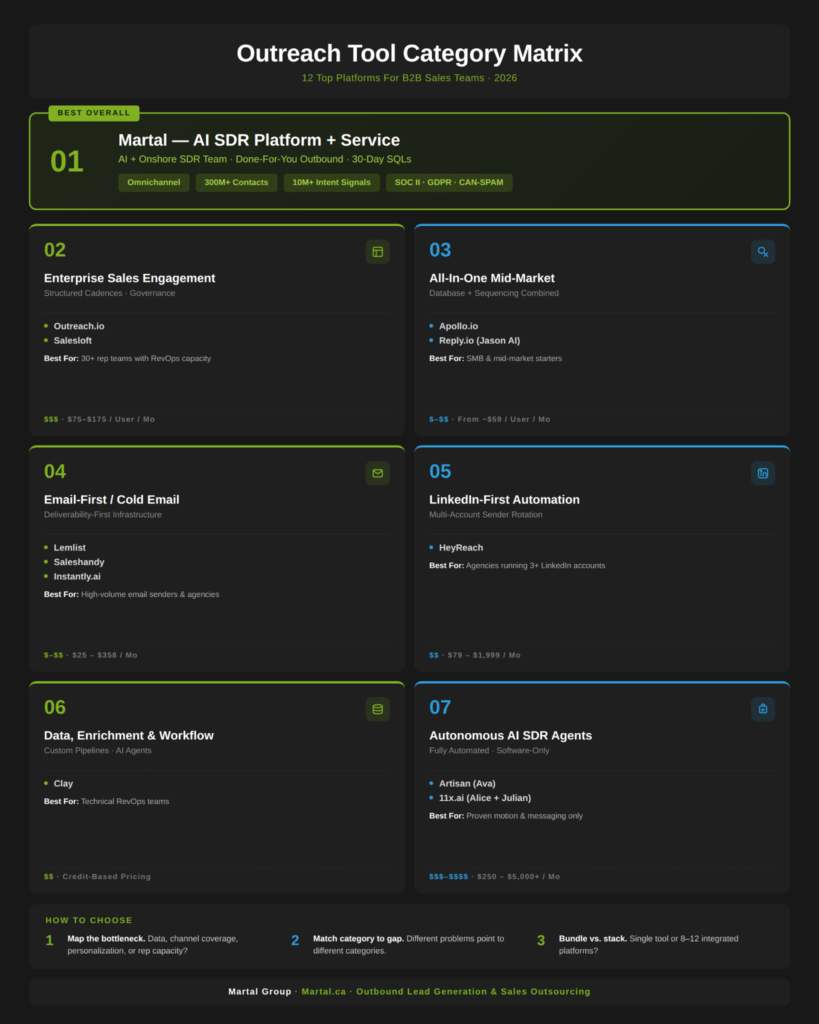
The Six Outreach Tool Categories
- AI SDR + Done-for-You Service — Outsourced outbound execution backed by AI. Lowest internal overhead. (Martal)
- Enterprise Sales Engagement Platforms — Mature, governance-heavy infrastructure for 30+ rep teams. (Outreach.io, Salesloft)
- All-in-One Mid-Market Platforms — Combined database + sequencing for SMB and mid-market teams. (Apollo.io, Reply.io)
- Email-First / Cold Email Specialists — Deliverability-first infrastructure for high-volume email. (Lemlist, Saleshandy, Instantly.ai)
- LinkedIn-First Automation — Multi-account LinkedIn sender rotation at scale. (HeyReach)
- Data, Enrichment & Workflow — Spreadsheet-style workflow builders and enrichment. (Clay)
- Autonomous AI SDR Agents — Fully autonomous “AI employee” agents that run outreach end-to-end. (Artisan, 11x.ai)
The Top 12 Sales Outreach Tools — At a Glance
Tool
Category
Best For
1. Martal AI SDR + Service
AI SDR + Done-for-You
Teams that want outbound results without building, hiring, or managing an SDR team
2. Outreach.io
Enterprise Sales Engagement
30+ rep teams needing structured cadences and governance
3. Salesloft
Enterprise Sales Engagement
Mid-market and enterprise teams prioritizing coaching workflows
4. Apollo.io
All-in-One Mid-Market
SMB and mid-market teams wanting database + sequencing in one
5. Reply.io
All-in-One + AI SDR
Mid-market teams adding AI SDR capabilities to existing sequencing
6. Lemlist
Email-First (Multichannel)
Teams prioritizing visual personalization and creative outbound
7. Saleshandy
Email-First (Deliverability)
Cost-conscious teams sending high-volume cold email
8. Instantly.ai
Email-First (Deliverability)
Agencies and volume-first teams running email-only campaigns
9. HeyReach
LinkedIn-First
Agencies managing 3+ LinkedIn sender accounts
10. Clay
Data, Enrichment & Workflow
Technical teams building custom enrichment workflows
11. Artisan (Ava)
Autonomous AI SDR
Teams testing fully autonomous outbound on a proven motion
12. 11x.ai (Alice + Julian)
Autonomous AI SDR + Phone
Enterprise teams with large TAM and phone-agent need
1. Martal – AI SDR Platform + Sales-as-a-Service
The integration of AI with human strategy has generated 4–7× higher response and meeting rates compared to previous methods.
Reference Source: Martal AI SDR Platform
We are not a tool you have to figure out — and we are not an autonomous AI agent that runs your outreach unsupervised. We deliver outbound results: a proprietary AI Sales Platform operated by senior onshore Sales Executives who own each campaign end to end.
The platform itself is trained on 15+ years of B2B outbound data, 40 million campaigns, and 50 million real sales interactions. It identifies high-fit accounts from a database of 300M+ verified contacts across 24M+ companies, monitors 10M+ real-time intent signals, generates personalized outreach across email, LinkedIn, and phone, and coordinates the entire omnichannel cadence in one automated outreach system. The human layer handles the work AI cannot reliably do at scale — interpreting strategy, navigating objections, qualifying responses, and protecting brand voice in every reply.
The model came out of a specific philosophy our CEO, Vito Vishnepolsky described when we launched the platform:
“We seamlessly integrated a human-centric approach to outbound lead generation with our proprietary AI tool, thoughtfully designed to enhance productivity.
Reference Source: Newsfile Corp.
Our AI-powered platform helps B2B sales professionals spend less time on campaign management and more time building genuine, meaningful relationships.”
That separation is what tends to matter most. We see it directly when clients come to us after running software-only stacks or fully autonomous AI SDRs: activity is high, replies are mostly opt-outs, and qualified meetings never materialize. A Manufacturing client put the experience plainly after switching to us from two prior providers: “We went with two other providers first. On our third try, we went to Martal Group because their model was different.” That campaign went on to generate 1,596 leads and 203 SQLs in 14 months in a niche industrial tools and printing equipment market — outbound work that pure-software outreach platforms had not been able to crack.
Key Features Built Around Real Outreach Workflows
- Omnichannel Sequences Across Email, LinkedIn, and Phone — Coordinated outreach in a single campaign, with the AI optimizing send times, channel mix, and message variants based on each prospect’s behavior. No stitching together separate tools for email, LinkedIn automation, and dialing.
- Signal-Driven Targeting — Real-time analysis of 10M+ intent signals — funding announcements, hiring trends, technographic changes, content engagement — feeds high-fit accounts directly into your outreach pipeline so cold emails and LinkedIn touches land when buying interest is highest.
- 300M+ Verified Contacts, Continuously Enriched — Every record carries 1,500+ data fields per company, so your outreach is targeting current decision-makers, not stale data that decays 30% a year.
- AI Copywriter Trained on 40M+ Campaigns — Personalized email and LinkedIn copy generated from patterns that have actually worked in B2B outbound, not generic LLM output.
- Built-In Deliverability Infrastructure — Domain warm-up, sender rotation, and inbox placement monitoring — the deliverability layer most teams have to buy separately is included by default.
- Senior Onshore SDRs + Fractional Sales Operations Manager — A dedicated team of 2 Sales Executives and 1 SOM owns each campaign. SEs average 3–5 years of B2B experience, navigate objections in real conversations, and hand off only sales-qualified meetings.
- 30-Day Path to SQLs — Onboarding takes 7–10 business days; the first SQLs typically arrive within 30 days of campaign launch.
- Compliance Built In — SOC II certified, GDPR compliant, CAN-SPAM compliant — outreach runs without compliance risk for teams in regulated industries or global markets.
What This Looks Like in Practice
The proof points that matter most for an outreach-focused buyer are not headline numbers — they are what happens in specific outbound motions:
- Spirit AI: 15,000 prospects engaged monthly across email, LinkedIn, and phone; 35 qualified leads/month in a niche AI trust and safety category where templated outreach had been failing.
- Awin: Three-year partnership generating 1,204 leads and 74 booked meetings through coordinated omnichannel cadences targeting CMOs, VPs of Marketing, and Ecommerce Directors. The client’s words: “Martal works as an effective extension of our team.”
- AI Freight Platform: 108 qualified meetings in just 3 months of outbound from a standing start — proof that the AI + human model can ramp pipeline in the timeline most SaaS contracts ask for.
- Cybersecurity SaaS: 284 leads and 42 SQLs in 5 months targeting CISOs, VPs of IT, and SecOps managers across HR, manufacturing, and technology verticals — outreach in a category where messaging precision and compliance matter as much as volume.
- Trusted by 2,000+ B2B brands across 50+ verticals over 16+ years. #1 in Lead Generation on Clutch, with 200+ five-star reviews across Clutch, G2, and Capterra.
Ideal For
B2B tech, SaaS, manufacturing, fintech, and service companies — from startups lacking outbound infrastructure to enterprise teams entering new markets — that want predictable pipeline without hiring, training, and managing an in-house SDR team. Especially valuable for sales leaders who have tried fully autonomous AI SDRs and found the replies were mostly opt-outs, teams stitching together 8–12 separate point solutions, and companies expanding into North America from the EU, UK, LATAM, or APAC where onshore presence and timezone alignment with US and Canadian buyers materially improve response rates.
2. Outreach.io — Enterprise Sales Engagement Platform
Overview
Outreach is a sales engagement platform built for large B2B sales orgs that need structured cadences, governance, and pipeline visibility. The platform supports email, call, and LinkedIn sequences with AI guidance and CRM logging. It is sequencing-first by design — data, signals, and deliverability infrastructure are not native and typically require additional tools layered on top, which can extend the time required to build a complete outreach motion.
Key Features
- Multi-step sequence automation with conditional branching
- Kaia, an AI assistant for real-time call coaching and email suggestions
- Analytics dashboards for sequence and rep performance
- Salesforce and CRM integrations with deep activity logging
Ideal For
Medium-to-large B2B sales teams with established sales operations, dedicated admin support, and the budget for $130–$175 per user per month. Less suited to small teams or organizations that want a fully managed solution rather than infrastructure to build on.
3. Salesloft — Sales Engagement + Revenue Orchestration
Overview
Salesloft operates as a sales engagement and revenue orchestration platform following its merger with Clari. The unified product combines cadences, conversation intelligence, and forecasting. The interface emphasizes usability and coaching workflows, though some buyers note the platform is most useful once an in-house team has the structure and headcount to operate it consistently.
Key Features
- Multi-channel cadences across email, call, LinkedIn, SMS, and direct mail
- Rhythm AI for signal-based rep prioritization
- Built-in coaching, leaderboards, and conversation intelligence
- CRM and revenue intelligence integration via the Clari layer
Ideal For
Mid-market and enterprise sales teams that want engagement, coaching, and forecasting in one environment, with the operational maturity to run structured cadences across 10+ reps.
4. Apollo.io — All-in-One Prospecting Database + Outreach
Overview
Apollo combines a B2B contact database with built-in sequencing for email, calls, and LinkedIn tasks. It is structured as a self-serve platform, which means strategy, copy, qualification, and reply management remain the buyer’s responsibility — a tradeoff for the lower entry price.
Key Features
- Contact database with firmographic, technographic, and intent filters
- AI-assisted account and lead recommendations
- Integrated email, call, and LinkedIn sequencing
- Engagement analytics and basic conversation insights
Ideal For
Startups and SMBs that want combined prospecting and outreach in one platform at an accessible price point, with internal capacity to manage campaigns, messaging, and follow-ups.
5. Reply.io — Multichannel Sequencing with AI SDR Add-On
Overview
Reply.io is a multichannel sales engagement platform that automates outreach across email, LinkedIn, SMS, WhatsApp, and calls. It includes Jason AI, an optional AI SDR agent. The core platform is solid for sequencing; the AI SDR component is positioned as an add-on rather than a fully integrated layer, which means buyers running both end up coordinating between two workflows inside the same product.
Key Features
- Multichannel sequences across email, LinkedIn, SMS, WhatsApp, calls
- Jason AI SDR add-on for autonomous prospecting and follow-ups
- Built-in B2B contact data and enrichment
- AI-assisted personalization and email writing
Ideal For
Mid-market sales teams and agencies running structured multichannel campaigns who want optional AI SDR capabilities layered on top of their existing sequencing workflow.
6. Lemlist — Email + LinkedIn Outreach with Visual Personalization
Overview
Lemlist is a multichannel outreach platform built around creative personalization — dynamic image and video tokens, conditional logic, and a visual campaign builder. The platform’s strength is in email and creative outbound; LinkedIn actions are gated behind a higher-tier plan, meaning teams that want genuine multichannel from day one pay the upgraded price, and outreach execution still depends on the buyer’s own SDR team operating it.
Key Features
- Email sequences with dynamic image, video, and landing-page personalization
- LinkedIn outreach on the Multichannel Expert plan
- Built-in email warm-up (lemwarm) on higher tiers
- 600M+ contact database with intent signal filters
Ideal For
SMB and mid-market sales teams that prioritize personalization quality and creative outbound campaigns, with the internal capacity to manage messaging and reply handling.
7. Saleshandy — Email-First Outreach at Volume
Overview
Saleshandy is a cold email platform centered on deliverability and high-volume sending, with unlimited email accounts included on every plan. The platform is built for email; LinkedIn, phone, and broader multichannel orchestration are not native, so teams running coordinated outreach across channels typically add a second tool to handle the rest.
Key Features
- Unlimited connected email accounts and sender rotation across all plans
- Built-in email warm-up (TrulyInbox) and inbox placement monitoring
- 700M+ B2B lead database with credit-based contact reveals
- Unified inbox and A/B testing (up to 26 variants on higher tiers)
Ideal For
Cost-conscious sales teams, agencies, and high-volume cold email operators who need scalable email infrastructure at an accessible price point ($25–$149/month, annual billing).
8. Instantly.ai — Cold Email at Scale
Overview
Instantly.ai is a cold email platform focused on deliverability infrastructure at the lowest entry price in the category. It is deliberately single-channel — there is no native phone, LinkedIn, SMS, or AI voice — and the lead database (B2B Lead Finder) is sold as a separate subscription, so teams running multichannel sequences end up assembling the rest of the stack themselves.
Key Features
- Unlimited sending accounts with one of the largest email warm-up networks
- Inbox rotation, bounce management, and deliverability monitoring
- AI Sales Engagement features on higher tiers
- B2B Lead Finder available as a paid add-on
Ideal For
Agencies and email-only outbound teams running high-volume cold campaigns where multichannel coordination is not required.
9. HeyReach — LinkedIn Outreach at Scale
Overview
HeyReach is a LinkedIn automation platform built for agencies and teams managing multiple LinkedIn sender accounts. The platform’s flat-rate model and unified inbox solve the multi-account problem cleanly. The tradeoff is scope — there is no native email, phone, data, or AI layer, so HeyReach typically sits inside a broader stack rather than running outreach end to end on its own.
Key Features
- Multi-account LinkedIn sender rotation across 3 to unlimited senders
- Unified inbox aggregating conversations from all connected LinkedIn accounts
- Connection requests, messages, InMails, and profile views in one campaign
- CRM integrations (HubSpot, Pipedrive) and webhook support
Ideal For
Lead generation agencies and sales teams running LinkedIn outreach across 3+ sender accounts, paired with a separate email or sales engagement tool for the rest of the outreach motion.
10. Clay — Lead Research and Enrichment Workflows
Overview
Clay is an AI-powered lead research and enrichment platform with a spreadsheet-style interface and AI agents that pull data from multiple sources. Clay produces enriched, qualified lists; it does not run outreach itself, so teams using it pair it with a separate sequencing platform to actually send and orchestrate the campaigns.
Key Features
- AI Agents that pull and enrich data from 50+ sources
- Real-time intent signals and event triggers for lead prioritization
- Custom scoring, filtering, and segmentation logic
- Integration with most outreach platforms via push to CRM or sequencer
Ideal For
Data-driven RevOps teams and technical operators who want to build custom enrichment workflows and intent-based lead scoring, with the technical capacity to design and maintain the workflow.
11. Artisan — Autonomous AI SDR (Ava)
Overview
Artisan positions Ava as a fully autonomous AI SDR — an “AI employee” that handles prospect research, message generation, sending, and reply monitoring with minimal human input. The platform bundles a 300M+ contact database directly. Buyers should be aware that public reviews and G2 feedback have flagged output quality concerns at high volume, and Artisan’s LinkedIn automation was restricted by the platform in early 2026, removing a core channel from Ava’s multichannel coverage.
Key Features
- Ava, an autonomous AI BDR running Autopilot or Copilot mode
- Built-in 300M+ contact database (no separate data subscription required)
- AI-generated email outreach with personalization waterfall
- Autonomous A/Z testing and meeting booking workflows
Ideal For
Teams with a proven ICP, validated messaging, and the budget (~$250+/month, sales-led) to test fully autonomous outbound — and the internal capacity to monitor output quality before issues compound at scale.
12. 11x.ai — Autonomous AI SDR + Phone Agent (Alice + Julian)
Overview
11x.ai offers two AI agents — Alice for autonomous outbound prospecting and Julian for inbound and outbound phone calls — positioned as a digital revenue team for enterprise buyers. The platform’s vision is broad; the practical execution has drawn scrutiny in 2026 over customer churn rates, output quality at scale, and customer-claim disputes that surfaced publicly, all of which buyers should factor into a procurement decision at enterprise pricing levels.
Key Features
- Alice, autonomous AI SDR for outbound email and social outreach
- Julian, AI phone agent for inbound calls and outbound follow-ups in 30+ languages
- Self-improving messaging AI with multivariate testing
- Enterprise integrations and 24/7 agent operation
Ideal For
Enterprise sales organizations with large undifferentiated TAM, an existing data subscription (ZoomInfo, Apollo, or equivalent), the budget for ~$5,000/month enterprise contracts, and the internal capacity to vet output quality continuously.
Build vs. Buy: What Most Teams Get Wrong About the Outreach Tooling Decision
Once you understand the categories, the harder question shows up: do we build outbound in-house using these tools, or outsource the entire motion to a partner who runs the platform on our behalf?
This is where most teams get the math wrong. The default assumption — that buying software is cheaper than buying a service — collapses once you account for what each path actually costs to operate.
The Real Cost of Building Outbound In-House
Software is the smallest line item. The total cost to run outbound in-house in 2026 includes:
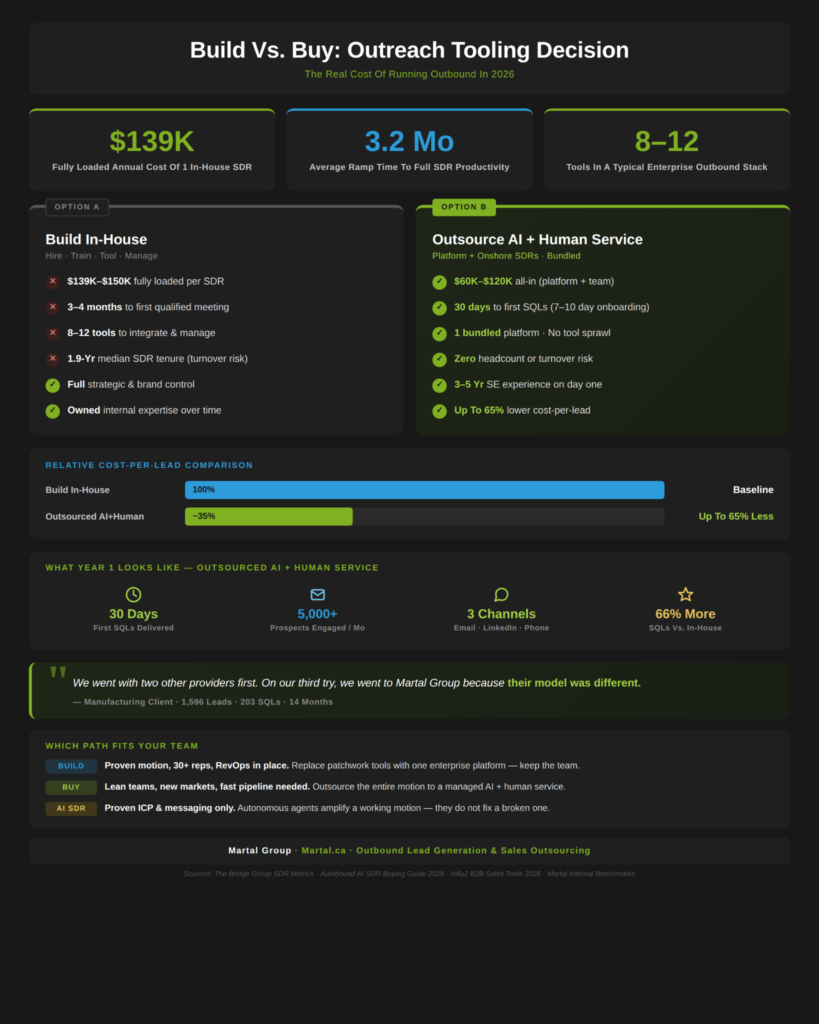
- A fully loaded SDR salary — $75,000–$110,000 base, climbing to $139,000–$150,000 fully loaded once benefits, commissions, tools, recruitment, and training are factored in (8).
- Ramp time — 3.2 months on average to full productivity per The Bridge Group, with peak productivity often not landing until month 15 (8).
- Turnover — Median SDR tenure is 1.9 years; the total cost of a single SDR departure is estimated above $150,000 once you include recruitment, onboarding, and lost pipeline momentum.
- The tool stack itself — Most in-house teams stitch together a sales engagement platform ($75–$175/user/month), a data provider ($1,000+/month at scale), a dialer, an enrichment tool, a deliverability infrastructure layer, and an analytics layer. Enterprise stacks routinely exceed $800–$1,000 per user per month before implementation fees (7).
- Management overhead — An SDR manager, RevOps support, and ongoing coaching add another $120K–$180K in fixed cost.
The in-house model works — when the team is large enough, the messaging is already proven, and there is internal capacity to manage the platform, coach the reps, and continuously refine the campaigns. Below those thresholds, the unit economics tend to break down.
The Outsourced Model — AI Platform + Onshore SDR Team
The alternative is a managed service that bundles the platform, the data, the SDRs, the deliverability infrastructure, and the campaign operations into a single engagement. The clearest version of this in 2026 is Sales-as-a-Service — what we do at Martal — where a dedicated team of 2 Sales Executives and 1 Sales Operations Manager runs an AI-powered campaign on your behalf.
The cost structure looks different:
- No salary, ramp, turnover, or recruitment cost. The team is fractional and already trained.
- Software, data, and deliverability are bundled. No separate ZoomInfo, Outreach, dialer, and warm-up tool subscriptions to assemble.
- 30-day path to SQLs vs. 3.2 months of in-house ramp (8).
- Cost-per-meeting and cost-per-lead are typically lower because the model spreads platform and ops cost across multiple clients. Internally, we benchmark this at up to 65% lower cost-per-lead than equivalent in-house outbound.
Build vs. Buy — Side by Side
Factor
Build In-House
Outsourced AI + Human Service
Year 1 cost (1 SDR equivalent)
~$139K–$150K fully loaded + $10K–$30K tool stack
~$60K–$120K all-in (platform + service bundled)
Time to first qualified meeting
3–4 months (ramp)
30 days
Tools to integrate and manage
8–12 separate platforms
1 (bundled)
Headcount risk
High (1.9-year median tenure)
None
Campaign expertise
Built over time
Senior SDRs with 3–5 years’ experience on day one
Strategic control
Full
Shared (client owns ICP, messaging direction, brand voice)
Best for
Proven ICP, proven messaging, 30+ rep teams
Pre-product-market-fit, scaling fast, entering new markets, lean teams
Which Path Fits Your Team
Build in-house if: Your motion is proven, you have 10+ SDRs already, you have RevOps and management capacity to run the stack, and your team’s pipeline depends on full strategic control over every aspect of outbound.
Buy a self-serve platform (Outreach, Salesloft, Apollo, Lemlist) if: You have the in-house team to run it, but want to upgrade your tooling. The platform replaces the patchwork; the team stays.
Outsource to a managed AI+human service if: You need pipeline within 30 days, you do not have an SDR team or want to avoid hiring one, you are entering a new market where local presence matters, or you have tried autonomous AI SDRs and found the replies were mostly opt-outs.
Try fully autonomous AI SDRs (Artisan, 11x.ai, AiSDR) if: Your ICP and messaging are already proven, your deal economics can absorb $5K–$15K/month in tooling before pipeline appears, and your sales motion is high-volume / low-personalization. Be aware that platform reliability and output quality concerns are still active conversations in this category.
The honest answer for most B2B teams is not “AI replaces sales” or “sales tools fix outreach.” It is the model in the middle: AI handles the repetitive 80% of outreach work, experienced humans handle the 20% that closes meetings. Whether that human layer sits inside your company or comes from a managed partner depends on your stage, your motion, and how much in-house capacity you actually have.
Why Compliance and Deliverability Now Decide Whether Your Outreach Works
Most “best outreach tools” guides treat compliance and deliverability as a checkbox at the bottom of a feature comparison. In 2026, they decide whether your campaigns work at all.
Two structural shifts reshaped cold outreach over the last 18 months. Gmail and Outlook deployed stricter sender requirements and AI-based spam classification that reads intent, not just keywords (6). And inbox saturation crossed a threshold where buyers in regulated industries — finance, healthcare, government, enterprise tech — actively filter for non-compliant outreach. The result is a widening gap between teams that invested in deliverability infrastructure and compliance posture, and teams that did not. Top performers now hit 8–12% reply rates while bottom performers sit below 0.5% (3) — and the difference is rarely copy. It is data quality, sender reputation, and compliance discipline.
The 2026 Deliverability Bar — What “Good” Now Means
The technical requirements to land in the primary inbox are no longer optional. Any outreach tool or partner you evaluate should handle the following by default:
- Authenticated sending domains with SPF, DKIM, and DMARC configured correctly. Missing or misconfigured DMARC is now one of the top causes of cold emails going to spam.
- Domain warm-up infrastructure that ramps new sending domains gradually — typically 3–5 emails per inbox per day to start, scaling over 2–4 weeks.
- Sender rotation across multiple inboxes to distribute volume. Sending 200+ emails from a single inbox will trigger spam filters regardless of content quality.
- Bounce rate monitoring under 2%. Bounce rates above 5% are the single biggest red flag for sender reputation; bottom-performing teams routinely bounce at 12%+ (15).
- Inbox placement testing before campaigns scale, so you know whether messages are landing in the primary inbox or the promotions/spam folder.
- List verification on every contact before sending — roughly 17% of cold emails never reach the inbox at all, mostly because of stale or invalid data.
Tools that bake this infrastructure in (Saleshandy, Instantly, Lemlist, and managed services like Martal) protect your domain reputation by default. Tools that treat warm-up and verification as a separate subscription line up the responsibility — and the risk — for the buyer to manage.
What Each Compliance Standard Actually Requires
The four standards that govern B2B cold outreach in 2026 are not interchangeable. Each one applies to a specific market and carries specific obligations:
- CAN-SPAM (United States) — Cold email is legal, but every message must include a clear sender identification, a valid physical mailing address, an honest subject line, and a working opt-out mechanism that is honored within 10 business days.
- GDPR (European Union, UK) — B2B cold email is permitted under “legitimate interest” provided the outreach is relevant to the recipient’s role, an unsubscribe option is provided, and personal data is handled in line with GDPR data minimization principles. PECR (UK) adds additional layers around how and to whom marketing emails can be sent.
- CASL (Canada) — Cold email to Canadian recipients requires either implied consent (existing business relationship) or express consent. Canadian-targeted cold email campaigns are functionally restricted; cold calling and LinkedIn outreach remain compliant channels.
- SOC II — Not an outreach regulation, but increasingly required by enterprise buyers in regulated industries who need to know the platform handling their prospect data has audited security controls.
For teams targeting EU, UK, or Canadian buyers, the channel mix has to change. Cold email is restricted in Canada and operates under GDPR constraints in Europe; cold calling and LinkedIn outreach remain compliant. At Martal, we run GDPR-compliant outreach targeting EU and UK buyers through calling and LinkedIn rather than cold email — and full omnichannel campaigns for EU and Canadian clients targeting the US market, where CAN-SPAM applies.
Why This Is a Differentiator, Not a Footnote
Compliance and deliverability tend to look like cost centers — but in practice they are the cheapest performance levers available to most outbound teams. Deliverability fixes alone commonly raise reply rates 10–30%, and that gain compounds for every campaign you run after. Compliance posture is also increasingly visible to enterprise buyers: procurement teams in finance, healthcare, and government routinely ask for SOC II certification and GDPR documentation before they will respond to outreach, let alone evaluate a vendor.
The tools and partners worth shortlisting are the ones who treat compliance and deliverability as platform-level commitments — built into the infrastructure, not bolted on as add-ons or buyer-managed afterthoughts. At Martal, our platform and service delivery are SOC II certified, GDPR compliant, and CAN-SPAM compliant as a baseline. For teams in regulated industries or operating globally, that compliance posture is not a feature — it is the price of entry to campaigns that actually convert.
Integrating Outreach Tools into a Cohesive Sales Strategy
The biggest performance lever in 2026 is precision, not volume. Top-performing outbound teams use AI agents to handle roughly 80% of research and sequencing — and route every reply to a human within minutes.
Reference Source: Instantly
Buying an outreach tool is the start of the work, not the end of it. The biggest reason teams don’t see ROI from their outreach stack is the same in 2026 as it was three years ago: disconnected systems, poor list quality, and no operating model around the tooling. Here is how to build the integration layer that makes any of the platforms in this guide actually pay back.
1. Map Your Workflow Before You Pick the Tools
Start with the sales process, not the software. Walk through the end-to-end outbound motion: prospect identification, list enrichment, initial outreach across cold email, call, and social, follow-ups, qualification, and handoff to AEs. Identify where the actual bottleneck sits.
The honest question is whether your problem is data quality, channel coverage, personalization, or rep capacity. Different problems point to different tools. A team struggling to find good sales leads needs a data-first solution like Clay or a database-plus-outreach platform like Apollo. A team with good lists but no scale needs a sequencing platform. A team with no SDRs at all needs a managed service, not another piece of software to operate.
The integration layer is what most teams underestimate. Set your CRM as the single source of truth, then connect every outreach tool so emails, calls, and LinkedIn activity log automatically. When a prospect replies or books a meeting, the workflow should trigger — move the lead, alert the AE, update the stage. The goal is one connected flow of information across every tool you use. When integration breaks down, the stack becomes overhead instead of leverage.
2. Build the List Before You Build the Campaign
No tool overcomes a bad list. The math gets brutal at scale: a 17% bounce rate from stale data can tank your sender reputation in a week, and once domain reputation drops, every subsequent campaign suffers — even on a different list.
Lead with AI intent data and ICP filters to focus on accounts most likely to convert. Most teams overestimate how broad their TAM actually is. Contacting 500 well-targeted prospects almost always outperforms blasting 5,000 loosely-relevant ones, and the difference shows up immediately in reply rate: campaigns under 50 recipients average a 5.8% reply rate versus 2.1% for sends above 1,000 (2). Tight beats broad, every time.
Run sales-ready lead verification on every contact before they enter a sequence. Re-enrich anything older than 90 days. B2B data decays at roughly 30% per year — the database you paid for six months ago is already a third obsolete.
In our own work, the single biggest variable separating campaigns that hit benchmark from campaigns that miss is list precision. Messaging adjustments help. List discipline transforms.
3. Personalize the Framework, Then Automate the Delivery
The instinct most teams have is backwards: automate first, personalize later. The right order is the opposite — design the personalization framework, then automate the delivery. Build a persona matrix mapping the top 2–3 pain points and value hooks for each ICP segment. Then let AI assemble personalized variants at scale.
Prospects can detect generic AI output in seconds. Modern spam filters can too — Gmail and Outlook now route obviously templated outreach to promotions or spam regardless of warm-up status. Strong personalization protects deliverability and reply rates simultaneously.
This is also where the autonomous AI SDR experiment has consistently struggled in 2026. When AI writes and sends thousands of emails without a human reviewing the framework, output drifts toward generic patterns prospects recognize. The teams getting strong results from AI outreach treat it as the execution layer on top of human-designed messaging, not as a replacement for messaging strategy itself.
4. Use AI for Continuous Improvement, Not Set-and-Forget
The platforms in this guide all generate analytics; few teams actually read them. Pay attention to what your tool tells you about subject lines, cold call scripts, send times, channel mix, and message variant performance.
Run A/B tests systematically. Most outreach platforms can declare a winner across 200–500 sends, faster if you use auto-optimization (Martal’s platform, for example, runs multivariate tests in the background to surface the variants that convert) (8). Feed the learnings back into your messaging framework, not just into the next campaign. The teams that compound performance over quarters treat every campaign as data for the next one.
5. Protect the Human Layer Where It Actually Matters
Automation owns prospecting and follow-ups. Humans own conversations.
The handoff point is the reply. The moment a prospect engages — a “tell me more,” a question about pricing, a request for a meeting — that conversation needs to land in a trained rep’s hands within minutes, not hours. 80% of B2B deals require 5+ follow-ups (1), but most of those follow-ups should be human after engagement, not automated emails into silence.
The teams winning set automation to handle the cold-and-quiet portion of the funnel — research, sequencing, scheduling, deliverability — and route every signal of engagement to a human within minutes. Tools should escalate. Humans should respond.
This is the structural reason Martal pairs the AI Sales Platform with onshore SDRs rather than running it as a self-serve product. The reply is where the deal starts — and an autonomous agent that mishandles the first human response can burn the lead and the brand at the same time.
6. Measure Cost Per Meeting, Not Cost Per Send
Most outreach metrics measure activity. The ones that matter measure outcomes.
Track the funnel: delivery rate, open rate, reply rate, positive response rate, and meeting conversion rate. Then track the metric that ties to revenue — Cost Per Meeting (CPM) — how much time and money you spend to land one qualified meeting on a closer’s calendar.
CPM is where the build-vs-buy math gets clear. An in-house SDR running an enterprise stack typically lands meetings at a meaningfully higher CPM than a managed service running the same campaign with bundled platform and personnel cost. The platform fee is the smallest line item; the SDR salary, the ramp time, and the management overhead dwarf it. Run the math on your own motion before signing a 12-month software contract.
Speed-to-lead is the other metric most teams under-instrument. Responding to a demo request or buying-signal trigger within minutes — including outside business hours — directly improves conversion. AI outreach systems make this trivially possible; the question is whether the human layer is set up to take the handoff fast enough.
The teams pulling ahead are not running better software than their competitors. They are running a tighter operating model around it — clean data, sharp messaging, integrated workflow, fast handoffs, and continuous learning. The tools amplify the operating model. They do not replace it.
Conclusion: Pick the Tool That Matches Your Actual Bottleneck
The “best outreach tool” is the tool best suited for your team’s stage, motion, and bottleneck.
The structural shift this year is that the decision is no longer just which platform. It is also which model — build your own outbound stack in-house, run a self-serve platform, deploy an autonomous AI SDR, or outsource the entire motion to a managed AI + human service. Each path has a real case in its favor. None of them is the right answer for every team. The teams that get this right tend to start with a clear-eyed look at where their pipeline is actually breaking down, then match the tool to the bottleneck — not the other way around.
When the Outsourced AI + Human Model Is the Right Call
At Martal, we built our service for the specific buyer who has read a guide like this and concluded that running outbound in-house is more cost and complexity than it is worth — or who has tried a fully autonomous AI SDR and watched the replies come back as opt-outs. We pair our proprietary AI Sales Platform with onshore SDRs who own each campaign end to end, so you get the automation of modern tooling without the operational overhead of building it yourself. Most of our clients are in pipeline within 30 days, running coordinated outreach across email, LinkedIn, and phone, with outreach strategies tailored to their ICP and market — not generic templates running on autopilot.
If you are weighing build versus buy on your outbound motion, book a consultation. We will walk through your current setup, your ICP, and your pipeline goals, and give you a straight answer on whether outsourcing makes sense for your team — even if the answer is that you are better off keeping it in-house. Your sales team deserves an honest take, not another vendor pitch.
References
FAQs: Outreach Tools
Are AI SDR tools actually worth it, or is it all hype?
The honest answer in 2026 is “it depends on your motion.” Fully autonomous AI SDRs (Artisan, 11x.ai, AiSDR) work when your ICP is proven, your messaging converts, and your deal economics can absorb $250–$5,000/month before pipeline appears. They consistently underdeliver when teams deploy them to fix messaging or figure out ICP — the AI scales whatever you give it, so a weak motion produces weak output at higher volume.
Reddit threads capture the sentiment plainly: “Pretty much all hype… the problem with all the AI SDR startups was that they tried to automate the entire workflow, which they did poorly.” The model that has held up is the hybrid — AI handles research, sequencing, and deliverability; humans handle replies, qualification, and brand voice. That is the model we run at Martal.
How do I get my cold emails out of spam in 2026?
Three structural fixes do most of the work. First, set up SPF, DKIM, and DMARC correctly on every sending domain — Gmail and Outlook now route unauthenticated mail to spam regardless of content. Second, warm up new sending domains gradually (3–5 emails per inbox per day, ramping over 2–4 weeks) and rotate volume across multiple inboxes. Third, verify every contact before sending and keep your bounce rate under 2%. Bounce rates above 5% will tank sender reputation, and bottom-performing teams routinely bounce at 12%+ on stale lists. Beyond infrastructure, cut spam-trigger language (“quick call,” “just checking in”), keep first emails under 80 words, and personalize beyond the first name. Most “cold emails going to spam” problems are infrastructure problems disguised as copy problems.
What’s the best outreach tool for a small team or solo founder?
For a 1–5 person team running email-led outbound, the typical answer is Saleshandy ($25–$149/mo, unlimited inboxes) or Instantly.ai ($37–$358/mo) — both prioritize deliverability and are accessible without enterprise procurement. Apollo.io is the best fit if you want a contact database bundled in. For LinkedIn-focused outreach across multiple sender accounts, HeyReach is built specifically for that use case.
For a solo founder or small team where the bottleneck is time rather than tooling — meaning you do not actually want to learn and operate the platform — outsourcing to an AI + human SDR service typically produces meetings faster than the months of ramp required to run outbound in-house. The right call depends on whether your scarcer resource is budget or attention.
How long does it take to see results from a new outreach tool or campaign?
For self-serve platforms, first qualified meetings typically land 60–90 days after kickoff once you account for domain warm-up (2–4 weeks), sequence testing, list refinement, and the natural 5–7 touchpoint cadence required to generate replies. Ramping an in-house SDR adds another 3.2 months to full productivity on top of that.
For managed AI + human services, the timeline compresses meaningfully. At Martal, onboarding takes 7–10 business days, the first MQLs typically arrive in days 14–20, and the first SQLs land within 30 days of campaign launch — because the platform, deliverability infrastructure, and SDR team are all already in place. The structural difference is whether you are building infrastructure or operating it.
What’s the difference between sales engagement platforms and AI SDR tools?
Sales engagement platforms (Outreach.io, Salesloft, Apollo, Reply.io) are infrastructure for your reps — they automate cadences, log activity, and surface analytics, but a human SDR still owns each campaign. AI SDR tools (Artisan, 11x.ai, AiSDR) are autonomous agents marketed as replacements for human SDRs — the agent identifies prospects, writes copy, sends sequences, and handles replies with minimal human input.
The categories are not interchangeable, and most “AI SDR” buying mistakes come from confusing them. Sales engagement platforms work because they amplify existing rep capacity. Autonomous AI SDRs work when your motion is already proven and you want to scale capacity without scaling headcount. They struggle when teams expect them to create the motion in the first place.
Can I just use one tool for everything, or do I need a stack?
Depends on team size and motion complexity. Most teams under 10 reps can run a clean motion on 2–3 tools: a sales engagement platform with built-in data (Apollo.io is the most common starting point), a deliverability-first email tool for high-volume sequences (Saleshandy or Instantly), and a LinkedIn automation layer (HeyReach) if LinkedIn is a meaningful channel.
Enterprise stacks routinely sprawl to 8–12 tools — separate platforms for CRM, sales engagement, data, enrichment, intent signals, dialer, conversation intelligence, and forecasting — and the integration overhead becomes its own line item. The opposite extreme is a managed service that bundles platform, data, deliverability, and SDR operations into a single engagement, which is what we run at Martal. The honest answer for most B2B teams is: simpler is usually better, until you outgrow it.