
 Martal
 Technology
 Education and training
 Web Development and UI / UX
 Healthcare/Medical
 Logistics and Supply Chain
 Information Technology
 Insuretech and Financial Services
 Marketplaces
 Software Development
 E-commerce and retail
 AI and Machine Learning
 Energy and Solar
 Manufacturing
 Security and Surveillance
 Digital Marketing Agency
 Transportation
 MSP
MSP
 Telecom
 B2B SaaS
 Cybersecurity
 HR tech
 Fintech
 Cleantech
 Consulting
B2B Telesales Companies in 2026: Pricing, Providers, and How to Choose the Right Partner
Major Takeaways: Telesales
Accurate, enriched data boosts connect rates by ensuring calls reach the right decision-makers, with direct dials outperforming switchboard calls.
Tailored messaging based on research and prospect context increases engagement, with relevant openers outperforming generic pitches.
Coordinating calls with email and LinkedIn touches can double connect rates, warming up prospects before direct phone outreach.
Continuous coaching and skill development improve objection handling and conversion, reducing turnover in high-pressure telesales roles.
AI optimizes call timing, enriches data, and automates admin tasks, freeing SDRs to spend more time on high-value prospect interactions.
Partnering with B2B telesales companies enables rapid scaling, market entry, and pipeline growth without in-house hiring delays.
Multi-touch follow-ups increase success rates, with most viable prospects connecting by the third call attempt in a structured sequence.
A move from random cold calls to data-driven, value-led outreach integrated into a broader omnichannel strategy for lead generation.
Introduction
Is B2B telesales still worth investing in for 2026? Short answer: yes — but not the version most companies are running.
The Gartner prediction that 80% of B2B sales interactions would move to digital channels by 2025 (8) has largely played out. Buyers self-serve research, attend demos through links, and prefer asynchronous email threads to scheduled calls. And yet, two things remain stubbornly true: 82% of B2B buyers still accept meetings from sellers who reach out, and 57% of C-level executives prefer phone contact over any other channel (7). The phone hasn’t lost its power. It’s just gotten harder to use well.
What’s changed is the math. The average cold-call success rate dropped from roughly 4.8% in 2024 to 2.3% in 2025/2026, while top-quartile reps still hit 5–8%+ by combining verified data, sharper timing, and better openers — a gap of 3.6× between average and elite. (6) The same phone, the same script, against a buyer who screens unknown numbers and Googles your product before you finish your opener.
This is why companies are increasingly turning to B2B telesales companies rather than rebuilding internal SDR teams from scratch. Internal SDR compensation alone runs $53,000–$75,000 in the US before tools, data, management overhead, and ramp time, (5) and the channel is unforgiving of even small execution gaps. The winners are pairing quality data, personalization, and omnichannel outreach with outsourcing sales and marketing to specialized partners — handing the top-of-funnel motion to a team that does it every day, so closers can close.
This guide covers what good looks like in 2026. We’ll walk through the challenges that define the channel right now, the cost models you’ll see when you start evaluating providers, the compliance rules that govern outreach by region, and a comparison of leading B2B telesales companies — including how we operate at Martal. By the end, you’ll have a clear framework for deciding whether to outsource, build, or run a blended model.
The State of B2B Telesales in 2026
Giving a clear reason for the call can make you 2.1× more likely to book a meeting.
Reference Source: Prospeo
Telesaleshas become both harder and smarter in 2026. Remote and hybrid work is now permanent, which means B2B decision-makers are rarely at a desk phone — and corporate switchboards no longer route to where the buying decision actually gets made. Buyers also self-serve far longer before engaging. Most prospects have already Googled your solution, scanned your reviews, and compared at least two competitors before a sales rep gets a word in.
The math has shifted along with the behavior. The average B2B cold calling success rate now sits around 2.3% — a sharp drop from prior-year benchmarks closer to 4.8%. (7) The decline punished teams running stale lists, generic scripts, and one-touch cadences — and rewarded the ones that modernized.
What’s actually happening on the dial floor in 2026:
– 87% of Americans regularly refuse to answer calls from numbers they don’t recognize (3) — driven by years of robocall conditioning. Verified direct-dial mobile numbers now connect at meaningfully higher rates than office lines.
– The average conversation runs 93 seconds, with successful calls averaging closer to 5 minutes 50 seconds and failed calls averaging 3 minutes 14 seconds. (6) Time spent isn’t the issue — what’s said in those first 90 seconds is.
– 93% of all conversations that ever happen, happen by the 3rd call attempt; 98% by the 5th. (6) Past five attempts, you’re burning dials. The sweet spot is a tight, omnichannel cadence — not “call ten times and hope.”
– Top performers convert at 6–10%+ (4)— roughly 3× the industry average. The gap between average and elite isn’t talent. It’s data quality, cadence discipline, and onshore reps who can actually hold a conversation.
And yet, despite the harder math, telesales remains the most direct path to a B2B decision-maker. The phone is one of the few channels where you get real-time signal — interest, objections, hesitation, urgency — all in the same exchange. That’s why 57% of C-level and VP buyers still prefer phone contact over any other channel, (7) and 82% of buyers accept meetings from sellers who reach out — when the outreach is relevant.
Forus at Martal, this plays out daily across our managed campaigns. In one engagement with a US-based financial services firm, our team engaged 2,316 prospects over three years and converted 1,219 of them into SQLs and 832 booked meetings — a 52% SQL conversion rate driven primarily by phone-led outreach into a complex buying group. That’s not the average. It’s what trained onshore reps, verified data, and disciplined omnichannel cadence look like in execution.
Bottom line: The old playbook of smiling-and-dialing a random list is gone. The new playbook — and the one most B2B telesales companies now compete on — blends verified data, omnichannel cadence, signal-led timing, and trained human conversation. In the next sections, we’ll walk through the challenges B2B sales teams face on the channel right now and how to turn each one into a wedge for stronger pipeline.
Challenges and Opportunities in B2B Telesales
Every challenge on the channel hides an opening. Below are the seven hurdles B2B sales teams run into most often in 2026 — and how the strongest B2B telesales companies turn each one into an advantage. We see all seven play out across client campaigns; the response column reflects what actually moves the number, not theory.
#
Challenge
Why It Hurts
Strategic Response
1
Gatekept & screened
87% of buyers screen calls from unknown numbers
Verified direct dials paired with omnichannel touches so you reach buyers directly and stay familiar across channels
2
Low connect rates
Average cold-call success has fallen to ~2.3%
Intent-led targeting on accounts in a buying window — top performers still convert at 6–10%
3
Buyer fatigue
Generic, scripted pitches get ignored
Researched, personalized openers that reference the buyer’s role, industry, and trigger
4
Decaying contact data
B2B data degrades ~2% per month
Continuously refreshed, verified data so reps dial live roles, not dead numbers
5
Slow ramp & churn
In-house SDRs take 3–4 months to ramp; 35–40% annual attrition
An outsourced team that’s live in 30–60 days with continuous coverage
6
Single-channel limits
Calls alone stall without reinforcement
Coordinated omnichannel cadence across call, email, and LinkedIn
7
Compliance complexity
TCPA, CASL, and GDPR vary by market
Compliance-first, region-aware delivery built into the program
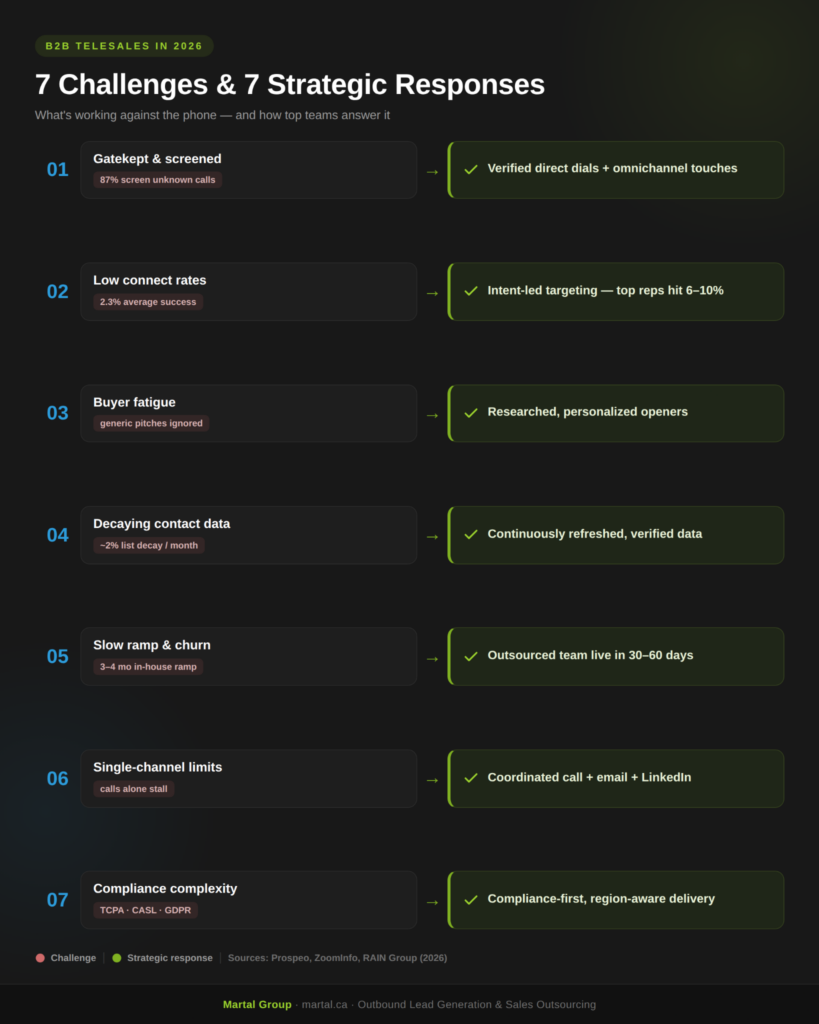
The rest of this guide breaks down the highest-impact responses in detail — starting with the one that fixes the most problems at once: data quality.
Data-Driven Telesales Lead Generation: Targeting High-Intent Leads
B2B contact data decays at roughly 2% per month, about a quarter of any list is stale within a year.
Reference Source: Marketing Sherpa
Challenge: “We’re dialing plenty of numbers, but hitting too many dead-ends.” That complaint is almost always a data problem before it’s a targeting problem. Reps waste over a quarter of their dials on dead numbers, wrong departments, and people who changed jobs months ago — and that’s before anyone asks whether the list was well-targeted in the first place. Remote and hybrid work has made it worse: corporate switchboards and office lines rarely forward to where the decision-maker actually sits, and gatekeepers screen the rest.
Opportunity: Prioritize quality over quantity. Better targeting and cleaner data move connect rates more than raw volume ever will. Start by defining your ideal customer profile — the decision-makers who have both the pain and the authority to buy — and filter your list to those high-intent profiles only. Then invest in clean, enriched data. That usually means sourcing direct-dial mobile numbers instead of generic office lines, because reaching a prospect’s cell dramatically increases the odds they pick up.
It also helps to weight your effort toward roles and verticals that still embrace the phone. 57% of C-level and VP buyers prefer phone contact in B2B outreach (7), and technology buyers tend to be more phone-receptive than buyers in finance — so a heavier call strategy fits some segments while a lighter touch fits others.
A few tactics make data-driven targeting real:
- Use intent data. Calling a lead inside their buying window — right after a funding round, a hiring surge, or a tech-stack change — is the single biggest lever on connect-to-meeting rate. This is the core of how we run targeting at Martal: outreach is timed to a signal, not a calendar.
- Keep data clean. Don’t let your CRM fill with stale contacts. Build a process — or a Data enrichment partner — to routinely verify titles, numbers, and company info. Even confirming a number is still in service saves reps real time.
- Segment your lead lists. Sort by industry, company size, or use case so reps can tailor their opener and spend call time on high-fit leads rather than random names. Pair this with disciplined lead qualification so only the right accounts make it onto the dial sheet.
We’ve seen this play out directly. For a US industrial manufacturing client entering the market for the first time, signal-led targeting and verified data helped our team engage a tightly defined buying group and convert it into 1,596 leads and 203 SQLs over 14 months — volume that only works when the list is clean before the first dial. In short, better data equals better dialing: you engage the right buyers at the right time, conversion improves, and morale climbs, because nothing motivates a rep like getting a real decision-maker on the line. View the complete manufacturing use case.
Personalization & Relevance: Standing Out to Savvy Prospects
82% of B2B buyers will accept a meeting from cold outreach when the seller demonstrates a genuine understanding of their business.
Reference Source: RAIN Group via Leads at Scale
Challenge: B2B buyers are buried in outreach, and they’ve grown cynical of cookie-cutter pitches. If every cold call sounds the same — “Hi, can I have five minutes to tell you about Product X?” — prospects tune out. They’ve also done their homework: nearly all buyers research independently before they ever speak to a rep, and 87% screen calls from numbers they don’t recognize (3). By the time you connect, they’ve formed opinions. Repeat what they already found online and you add nothing. The job is to earn attention and deliver insight in the first 90 seconds.
Opportunity: Make personalization and relevance your edge. In 2026, a telesales call lives or dies on the value it brings to that specific prospect — starting the moment you say hello. Instead of a generic opener, use a tailored hook: “Hi Dana, I saw your company just expanded into Europe — we helped another client navigate EU sales growth and I had a quick idea for you.” Compare that to “I’d like to tell you about our service.” The first shows you’ve done the work and connects to their context immediately.
Research doesn’t have to eat your day. Two minutes on a prospect’s LinkedIn or company news usually surfaces a usable hook — and top-performing reps almost always research before reaching out. A handful of moves consistently work:
- Lead with common ground. A shared group or mutual connection — “I noticed we’re both in the CRO Leadership Network” — measurably lifts engagement.
- Use collaborative language. Sales analysis consistently shows that framing the call as a shared problem (“together, we could explore how to cut your onboarding time in half”) reads as partnership, not pitch. Small shift, real lift.
- State a clear reason for calling. Prospects are silently asking “why are you calling me?” Answer it upfront: “I’m calling because I saw your CEO’s interview on scaling globally, and we have data on international sales you might find useful.” Giving a reason for the call makes you 2.1× more likely to book a meeting (6) people respect you for not wasting their time.
- Focus on them, not you. Keep the first few sentences about their pains and goals: “I talk to a lot of manufacturing CEOs, and one issue I keep hearing is keeping pipeline full during supply-chain crunches — is that on your radar?”
Moves like these address the core challenge of standing out. Instead of one more interruption, the call feels like a consultative conversation — you acknowledge a busy, informed buyer and bring a fresh angle. It takes more effort per call, but the payoff is higher engagement. Buyers are open to cold outreach when it’s relevant; do your homework, personalize obsessively, and you turn skeptics into listeners.
Omnichannel Cadence: Turning Cold Prospects into Warm Telesales Leads
Phone-focused reps averaged 6.8 quality conversations per day, compared to 3.3 for email-focused reps
Reference Source: Outbound Kitchen
Challenge: Getting prospects to actually pick up is half the battle. Rely on one channel — the phone — and a missed connection can kill the opportunity, while your emails sit unread and your LinkedIn messages disappear into a sea of requests. Persistence helps, but even the classic “call them five times” approach has limits: by the 5th attempt you’ve reached about 98% of the people you’ll ever reach (6), and extra dials yield almost nothing. So what’s the modern fix for low response rates?
Opportunity: Build an omnichannel prospecting cadence — a coordinated sequence of calls, voicemails, emails, and social touches that work together to warm the prospect. The goal isn’t to spam every channel; it’s to surround the prospect with value so that when your call lands, you’re no longer a stranger:
- Open with a value email or LinkedIn message. A day or two before you call, send a brief note with a relevant case study or stat. No hard sell — just enough that your name rings a bell when you dial.
- Use voicemails strategically. When a first call goes to voicemail, leave a short, intriguing message that ties to your email follow-up. Promise something useful instead of “call me back.”
- Engage lightly on LinkedIn. A thoughtful comment or a connection request mentioning a shared group humanizes you. Next time you call, you’re “the person who commented on my post,” not a total cold caller. (Done well, LinkedIn outreach makes the phone touch land warmer.)
- Time your touches. Mid-week calls connect best; Monday mornings and Friday afternoons are the weakest first-touch windows. Structure your sales cadence to hit the strong ones.
The power of omnichannel is in the results. Teams that integrate phone with email and social outperform single-channel teams — and while phone-centric reps had about 6.8 quality conversations a day versus 3.3 for email-centric reps, the strongest reps weren’t dialing in isolation. They combined formats. A lone email gets ignored and a lone call gets screened, but a call that references “the email I sent yesterday” earns a curious “wait, who is this?” instead of an icy brush-off.
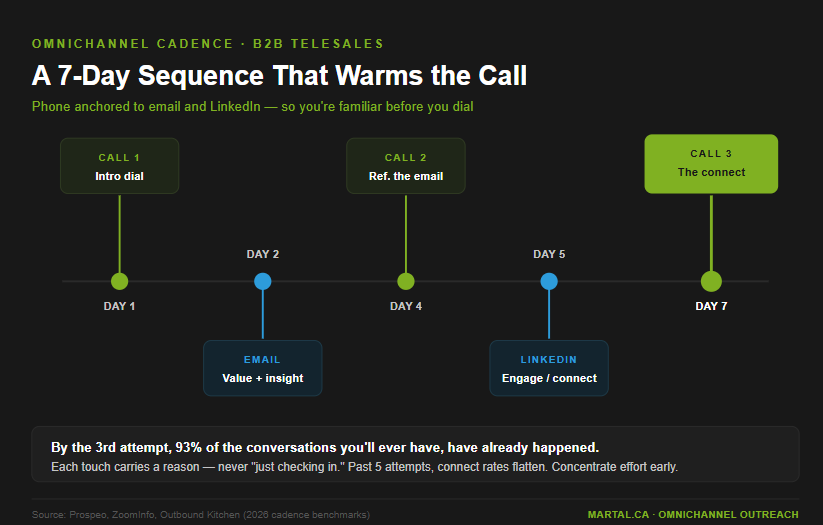
Persistence pays — to a point. Most prospects need five or more attempts before connecting, yet most reps quit after one or two (4) which is exactly the gap a structured cadence closes. A simple rhythm works: Call 1 on Day 1, value email on Day 2, Call 2 on Day 4, a LinkedIn touch on Day 5, Call 3 on Day 7 — concentrating effort in the first three attempts, where 93% of the conversations you’ll ever have already happen. Make “pleasantly persistent” the motto: every touch carries a purpose and a new piece of value, never just “checking in.”
This is the engine behind our fastest ramps. For a transportation client running an AI-freight platform, a tight omnichannel cadence — phone anchored to email and LinkedIn touches — produced 108 booked meetings in just three months. By the time a prospect picks up, their first words are “oh yes, I’ve seen your emails” — an invitation to keep talking, not a wall. That’s the difference a modern cadence makes. View the transportation case study.
Training & Team Development: Empowering Your Telesales Team
AI speeds up onboarding, helping new sales reps ramp up 42% faster than traditional training by acting as a 24/7 sales coach.
Reference Source: HubSpot
Challenge: Telesales is a hard job, and it’s gotten harder. Burnout and turnover among Sales Development Representatives are perennial. Annual SDR attrition runs 35–40%, with average tenure around 14 months (2) and every departure opens a two-to-three-month coverage hole plus another three-to-four months of ramp. Many reps don’t stay long enough to master the role, worn down by constant rejection and repetitive work. Meanwhile, even tenured reps are underused: a surprisingly small share of the day goes to actual selling, with the rest swallowed by CRM updates, list-building, and internal meetings. The core question: how do you train, motivate, and keep a high-performing telesales team in that environment?
Opportunity: Invest in your people — their skills, tools, and growth path. A few moves turn the talent challenge into an advantage:
- Onboard thoroughly, then coach continuously. The first months set a rep’s trajectory. Run role-plays, script practice, and product deep-dives, then make coaching ongoing with regular call reviews. AI can get new reps productive about 42% faster by acting as an always-on coach (1) flagging, for instance, when a rep is talking 80% of the time and should ask more questions.
- Cut the drudgery. Nothing demotivates like meaningless busywork. Automate call logging, follow-ups, and scheduling. HubSpot reports that many sales pros save one to five hours a week by handing routine tasks to AI — time reinvested into conversations and learning.
- Show a path forward. A big driver of churn is the sense that the role is a dead end. Map the progression to AE, team lead, or senior accounts, and celebrate internal promotions. Programs with clear SDR career tracks retain better. (Our own Martal Academy reflects this belief — reps grow when there’s a visible future.)
- Build a supportive culture. Share wins, treat losses as learning, and reward the behaviors that lead to results, not just the results. Even in remote teams, recognition and small competitions build resilience.
There’s also a structural reason our onshore reps perform: continuity. A dedicated team owns a campaign end-to-end, so product knowledge and market context compound instead of resetting with every new hire. When reps are well-trained, supported by the right tech, and shown a future, they execute with confidence and they stay — turning the challenge of SDR churn into an elite sales-development culture competitors envy.
Technology & AI: Boosting Telesales Efficiency
83% of sales teams using AI report increased revenue as a direct result
Reference Source: Salesforce Report
Challenge: The modern sales stack can feel like too much — dialers, CRM, sequencing tools, data platforms, dashboards. Tech is supposed to help, but teams struggle to integrate it, and there’s a real fear that automation makes outreach feel impersonal. The deeper problem usually isn’t too much tech; it’s not using it well. Reps lose a big share of the day to juggling systems and doing manually what could be automated. The opportunity — and the risk — is using AI to fix that without losing the human touch that makes telesales work.
Opportunity: Work smarter, not harder, and augment reps rather than replace them:
- Optimize call activity with AI. Use data to decide who to call, when, and what to lead with. Tuesday and Wednesday drive 44% of demos booked, and 10–11 AM and 2–3 PM are the strongest connect windows (4) so build call blocks there. Sentiment analysis can flag a weak opener or a rep talking over the prospect, which sharpens your cold call scripts over time. It’s no surprise that 83% of AI-using sales teams report revenue growth — they’re making data-backed decisions.
- Automate the routine, personalize the meaningful. Power dialers skip dead numbers and maximize talk time; automated voicemail drops keep messaging consistent; email sequencing sends timely follow-ups while the call is fresh. None of this replaces the human — it frees the human from busywork.
- Use AI for data quality and prep. AI now verifies numbers against live databases so reps stop dialing disconnected lines, and auto-enriches a lead with recent company news so reps walk into every call with a relevant hook.
- Strengthen coaching through tech. An AI that reviews every call surfaces coachable patterns no manager has time to catch manually — like reps ending calls the moment a prospect says “not interested” instead of asking one more question.
We lean on AI for exactly this — research, enrichment, timing, and reporting — while trained onshore reps own the conversation. The platform makes the human faster; it doesn’t replace the judgment. Used this way, technology turns friction into advantage: too few hours in the day, automation gives time back; inconsistent messaging, conversation AI brings clarity; uneven rep performance, AI-driven best practices lift the whole team. Small gains — a slightly higher connect rate here, a faster follow-up there — compound into a real edge.
Outsourcing & Partnerships: Leveraging B2B Telesales Companies for Scale
Outsourcing typically reduces sales operating costs by 40–70% versus an equivalent in-house team.
Reference Source: Hit Rate Solutions / Deloitte
Challenge: Sometimes the real constraint is bandwidth. You know what good looks like — clean data, omnichannel outreach, disciplined follow-up — but your in-house team is at capacity. Or you’re entering a new market or launching a product and need pipeline now, not in the quarter-plus it takes to hire and ramp SDRs. Building an effective outbound program is genuinely complex, and many teams that try it internally stall. Maybe your closers are great with warm leads but weak at cold prospecting; maybe your founders wear five hats and can’t manage an SDR team to success. Either way, pipeline generation stalls — dangerous for any B2B company that needs steady growth.
Opportunity: Partner with a B2B telesales company to augment or run your outbound lead generation. Sales outsourcing has gone mainstream — there are now over 5,000 sales-outsourcing companies on Clutch, and the outsourced-sales market is on track to surpass $4B (6). The right partner converts your constraints into momentum:
- Instant expertise. A reputable partner brings targeted data, skilled outreach, omnichannel cadences, and continual optimization — battle-tested playbooks instead of a wheel you reinvent internally. That’s especially valuable when selling into an industry your team doesn’t know cold.
- Scalability and speed. Need five reps in a new region next quarter? A partner deploys quickly, sidestepping hiring delays — and scales down just as easily for seasonal or experimental campaigns.
- Focus for your core team. Hand off top-of-funnel prospecting and your AEs do what they do best: advance and close. It’s a feeder system that keeps qualified meetings flowing, and conversion often rises because closers get more time per deal. (Outsourcing lead generation tends to improve ROI precisely because each role is optimized.)
- Multi-channel capability and tooling. Strong B2B telesales companies don’t just dial — they combine calls with email and LinkedIn and bring premium data and AI your budget might not otherwise reach.
This is our model. At Martal, a dedicated team — typically two Sales Executives and a Sales Operations Manager — owns your campaign end-to-end: targeting, omnichannel outreach, qualification, and booked meetings, with no handoffs. It’s the reason teams choose an outsourced SDR model over rebuilding internally. For a London-based AI company breaking into the US, our team sustained 35 qualified leads per month in a narrow trust-and-safety category — the kind of niche where in-house teams stall for quarters.
Outsourcing is still a strategic move, not a “set it and forget it” one. The best results come from treating the partner as a true extension of your team — aligning on ICP, messaging, and brand tone so the reps sound authentically like you. Done right, sales outsourcing services act as a force multiplier: you fill pipeline fast, enter new markets, and test new strategies without overburdening your core team.
By tackling all six challenges head-on — data focus, personalization, omnichannel orchestration, team empowerment, smart tech adoption, and the right partnerships — B2B telesales shifts from a daunting grind into a predictable, scalable revenue engine. In 2026, the companies that win on the phone are the ones that modernize at every step. They turn obstacles into openings while slower competitors keep insisting “cold calling doesn’t work like it used to.” It can work brilliantly — it just demands a modern mindset and disciplined execution.
From Dialing to Deals – Comparing Leading B2B Telesales Companies
Partnering with a B2B telesales company can be a fast track to scaling outbound. Instead of spending months hiring and training an in-house team, companies in 2026 are using telemarketing outsourcing to tap ready-made expertise and infrastructure. The market reflects it: there are now over 5,000 sales-outsourcing companies on Clutch, and the outsourced-sales market is on track to surpass $4B (6). Experienced partners bring trained reps, proven outreach playbooks, and data-driven targeting — turning cold calls into warm opportunities without the heavy lift of building everything internally.
To build this comparison, we reviewed leading B2B telesales and sales-outsourcing providers, looked at their delivery models, geographic footprint, and channel mix, and organized the findings around the criteria buyers actually weigh: where the reps sit, whether outreach is genuinely omnichannel, industry fit, and how pricing is structured. We’ve included Martal alongside others so you can see the trade-offs clearly, not just our own pitch.
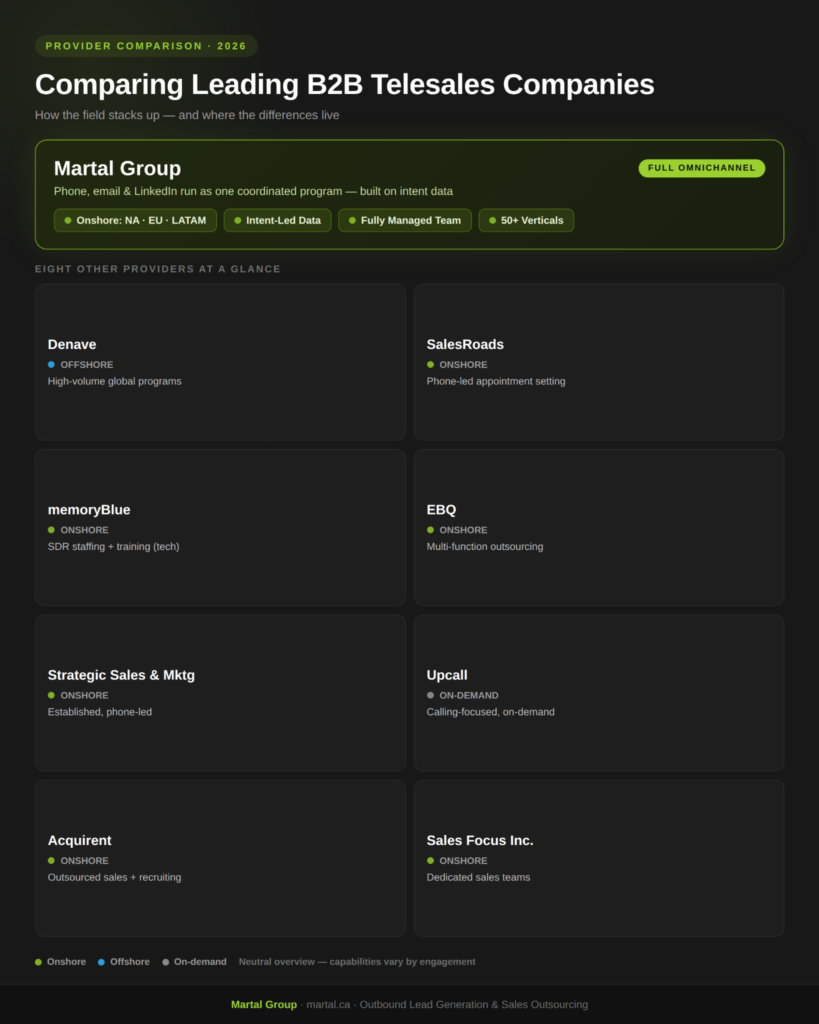
Martal Group
We’re an outbound lead generation and sales outsourcing firm built for B2B tech, SaaS, and other complex-sale industries. In practice, we operate as an extended SDR team — seasoned, onshore Sales Executives running omnichannel outreach so your in-house closers focus on closing, not prospecting. Our model centers on sales-ready opportunities primed for conversion, not raw contact volume. What sets us apart:
- Omnichannel outreach to decision-makers. We coordinate email, LinkedIn, and phone into one cadence aimed at C-level and senior stakeholders, so prospects see consistent, personalized value across channels rather than three disconnected touches.
- Experienced, onshore SDR teams. A dedicated team — typically two Sales Executives and a Sales Operations Manager — integrates directly into your pipeline. Reps are onshore across North America, Europe, and LATAM, mid- to senior-level, and fluent in your market’s language and business culture, which means sharper conversations and cleaner handoffs.
- Tech and complex-sale vertical expertise. We specialize in B2B tech, SaaS, cybersecurity, manufacturing, energy, fintech, and more — using intent signals and technographic data to reach buyers actively in-market. That focus lets us ramp quickly and land messaging that resonates.
- Transparency and pipeline impact. Clients get weekly reporting and live opportunity tracking, so you see exactly how campaigns perform. The goal is consistent, sales-qualified pipeline — not a flood of unvetted contacts. Across engagements we’ve delivered results like 832 booked meetings for a US financial services firm over three years and 108 meetings in just three months for a transportation client — the kind of outcomes disciplined onshore execution produces.
Denave
Overview: A global sales-enablement firm headquartered in India, offering B2B telesales, field sales, digital, and analytics services at scale. Delivery is primarily offshore, so North American and European campaigns run outside the buyer’s time zone — a factor worth weighing for outreach that depends on same-day responsiveness and local business nuance.
Key Features:
- High-volume outbound calling and lead qualification
- Market intelligence and analytics layered onto campaigns
- Multi-channel reach spanning telesales, field sales, and digital, supported by proprietary tooling
Ideal For: Large, volume-driven programs where offshore cost efficiency outweighs time-zone alignment.
SalesRoads
Overview: A US-based appointment setting and sales-outsourcing company with roughly 18 years of outbound experience and a track record of over 100,000 booked appointments. Outreach centers on phone and email; LinkedIn is used to support research rather than as a fully coordinated third channel, so teams wanting tightly orchestrated omnichannel sequencing may need to supplement it.
Key Features:
- Onshore, US-based SDRs running phone-led campaigns
- Human-driven outreach with limited automation
- Month-to-month engagement terms
Ideal For: Companies targeting North American buyers who want calling-first appointment setting and flexible contracts.
memoryBlue
Overview: A US sales-development firm founded in 2002 and based in Tysons, Virginia, concentrated on high-tech clients. Its scope spans outsourced SDR execution alongside recruiting and training, which leans the model toward sales-development staffing rather than a fully managed, multi-vertical campaign owned end to end.
Key Features:
- Phone-led SDR execution for tech firms
- Recruiting and training services for building internal teams
- Mid-market and enterprise focus
Ideal For: High-tech companies that want SDR support while also building in-house sales-development capability.
EBQ
Overview: An Austin, Texas–based provider offering appointment setting within full-service sales, marketing, and customer-service outsourcing. The breadth means a single partner can cover several functions, though that generalist span can come at the cost of deep specialization in any one vertical.
Key Features:
- Onshore teams covering sales, marketing, or service
- Dedicated pod model (consultant, project manager, specialist)
- Rapid onboarding and flexible contracts
Ideal For: Companies that want to outsource multiple go-to-market functions to one vendor.
Strategic Sales & Marketing (SSM)
Overview: A Hartford, Connecticut firm established in 1989, with a long history in B2B appointment setting and lead generation. Its roots are in traditional, call-led outreach, so buyers prioritizing intent-signal targeting, technographic data, and AI-assisted orchestration should confirm how current those capabilities are.
Key Features:
- Decades of appointment-setting experience
- Service menu spanning lead gen, email, coaching, and social
- Experience across varied company sizes and products
Ideal For: Teams that want established, phone-led appointment setting for straightforward B2B offers.
Upcall
Overview: A call-centric provider offering on-demand inbound and outbound calling — effectively a virtual call team for hire. Because the model is built around the phone, companies needing coordinated email and LinkedIn touches alongside calls will need to run those channels separately.
Key Features:
- Trained callers for cold outreach and inbound business inquiries follow-up
- Live transfer and direct calendar booking
- Detailed call reporting and analytics
Ideal For: Companies that need to scale phone outreach quickly without building an internal call team.
Acquirent
Overview: An Evanston, Illinois firm founded in 2004, providing outsourced B2B sales across small, mid-market, and enterprise accounts. Alongside lead generation it offers sales recruiting and training, so engagements can lean toward building or supplementing a team rather than running a self-contained, intent-led outbound program.
Key Features:
- Outsourced sales execution and team management
- Recruiting and training services
- Coverage from SMB to enterprise
Ideal For: Companies wanting outsourced sales execution paired with team-building support.
Sales Focus Inc.
Overview: A Columbia, Maryland firm founded in 1998, offering dedicated inside and outside sales teams across technology, energy, financial services, telecom, and healthcare. Its dedicated-team model is structured around staffing and deployment, which can place more of the data, targeting, and channel-orchestration responsibility on the client than a fully managed, signal-driven program would.
Key Features:
- Dedicated inside and outside sales teams
- Appointment setting and lead generation
- Multi-sector experience
Ideal For: Companies that want a dedicated outsourced team assigned to a defined sales territory.
How to Choose the Right B2B Telesales Company
Selecting the right partner is the difference between a steady flow of qualified meetings and a budget spent on dials that go nowhere. The question buyers raise most often — on Quora, in peer communities, and in our own first calls — is some version of “how do we choose the best B2B telemarketing or outsourced SDR vendor, and how do we know they’re legit?” The answer is to evaluate on outcomes, not activity. Before committing, weigh any provider against these criteria:
- Transparent pricing and flexible terms. Look for clear, upfront pricing and contract terms you can adapt as needs change (9). The market spans hourly rates, per-meeting fees, and monthly retainers — and the only number that matters is cost per qualified opportunity, not cost per call. Ask any provider to model that figure from their own historical data; the ones confident in their results will run the math with you. (We break down the full pricing landscape in the next section.)
- Industry experience and a verifiable track record. Prioritize firms with proven results in your sector and target markets (9). A partner who already understands your buyers’ pain points and vocabulary ramps faster and represents you more credibly. Always ask for case studies or references with businesses like yours — and be specific: ask for meeting-to-opportunity rates across several similar clients, not a single highlight reel.
- A clear definition of “qualified.” This is where most engagements quietly fail. If a provider defines a qualified lead as “anyone who agreed to receive more information,” your pipeline fills with noise. Agree on qualification criteria — based on authority and need — in writing, before the first dial.
- Modern data and tooling. Effective telesales now runs on more than a dialer and a script. The strongest partners bring verified, continuously refreshed contact data, intent signals, and AI-assisted research and reporting (9). Since contact data decays at roughly 2% a month, ask specifically how a provider keeps lists current — stale data is the single biggest drain on any outbound program.
- Performance reporting and visibility. Consistent reporting on the metrics that matter — calls made, contact rate, conversion rate, pipeline created, meetings held — is non-negotiable (9). Look for live dashboards or regular reporting plus a recurring strategy call. Visibility holds the provider accountable and lets you optimize together rather than waiting for a quarterly post-mortem.
- Onshore alignment and regional fit. If your buyers sit in specific regions, choose a partner whose reps operate in the same time zone and understand the local business culture (9). Same-day responsiveness and cultural fluency lift answer rates and reduce friction from the first touch — which is exactly why onshore teams aligned to the buyer’s market tend to out-connect offshore call centers on complex B2B outreach.
- Compliance discipline. A credible partner operates within the regulations that govern your target markets — TCPA in the US, CASL in Canada, GDPR across the EU and UK. Ask how they handle consent, Do-Not-Call screening, and call-recording data. (More on regional compliance in its own section below.)
- Reputation and longevity. Longevity signals stability, but recent client feedback signals whether a provider still delivers. Seek third-party reviews and ratings that speak to lead and meeting quality (9), not vanity metrics.
Choosing a B2B telesales company is a strategic decision that lands directly on your revenue pipeline. The right partner integrates with your sales motion, brings expertise and scale, and stays focused on qualified leads that convert to deals (9). The wrong fit burns budget on unproductive calls and can damage your brand with the exact buyers you’re trying to win. Vet on the factors above, align on one that fits your model, and you set the foundation for a partnership that drives consistent B2B growth.
When to Outsource Telesales vs. Build In-House
When to Outsource Telesales — and When to Build In-House
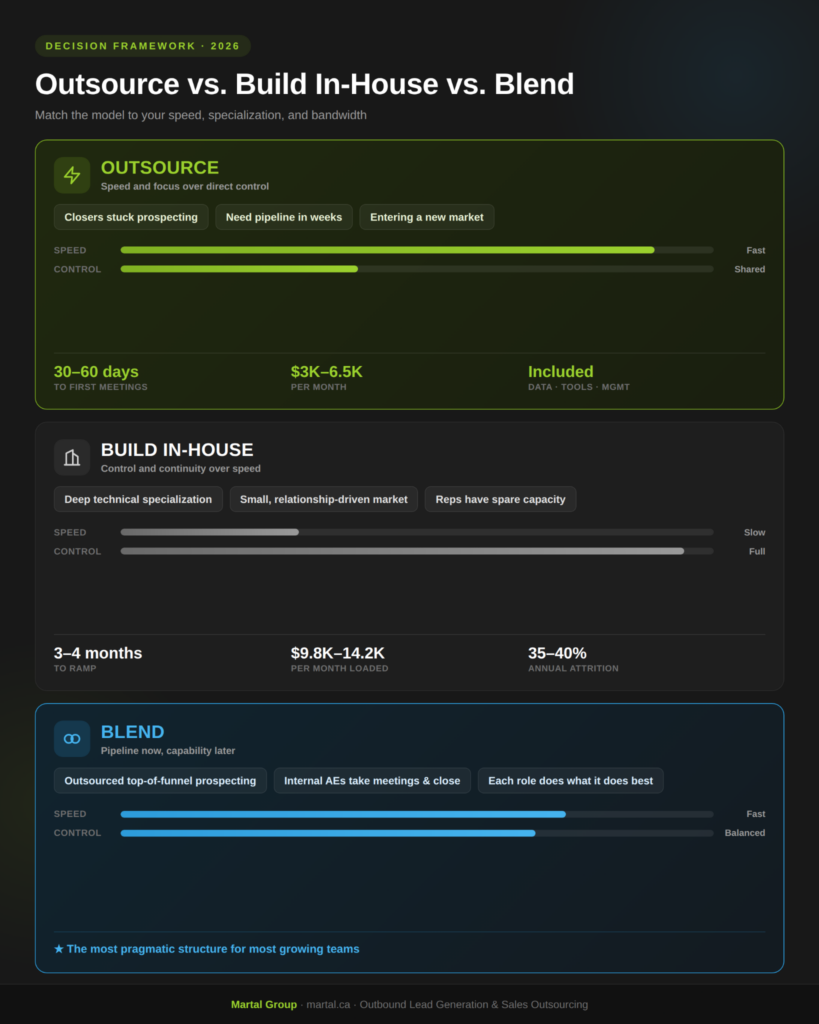
Not every team should outsource, and not every team should build. The honest answer to “should we outsource cold calling or hire SDRs?” depends on three things: how fast you need pipeline, how specialized your sale is, and whether you have the bandwidth to recruit, train, and manage reps well. Here’s how we’d frame the decision — including the cases where building in-house is the better call.
When outsourcing makes sense
Outsourcing fits when speed and focus matter more than direct control. A few clear signals:
- Your closers are prospecting. If AEs are spending hours building lists and dialing instead of closing, you’re paying your most expensive talent to do your least leveraged work. Moving top-of-funnel to a dedicated team frees them to do what they were hired for.
- You need pipeline in weeks, not quarters. Hiring an in-house SDR takes time, and a new rep then needs 3–4 months to ramp (6). An outsourced team that already has the data, tooling, and playbook can have first qualified meetings landing within 30–60 days (6).
- You’re entering a new market or testing a segment. Outbound into an unfamiliar region or vertical is exactly where an experienced partner’s playbooks shorten the learning curve — and where you can scale up or down without long-term headcount risk.
- You lack the bandwidth to manage SDRs well. SDR attrition runs 35–40% a year, with average tenure around 14 months (2). If you can’t commit to continuous coaching and a clear career path, in-house reps churn — and every departure resets the clock.
When building in-house makes more sense
Outsourcing isn’t always the right move. Keep it internal when:
- Your product demands deep technical specialization. If qualifying a lead requires nuanced product or domain knowledge that takes months to learn, a dedicated in-house rep — or a partner with proven specialization in your exact niche — matters more than raw capacity.
- Your market is small and relationship-driven. When your total addressable market is a few hundred accounts who all know each other, reputation and continuity can outweigh volume. Internal reps who fully embody your brand may serve that better.
- Your internal team has untapped capacity. If you already have strong SDRs hitting target below full quota, expanding their territory is cheaper than adding a vendor.
One caution worth stating plainly: don’t outsource before product-market fit. If you can’t yet close deals yourself, an outsourced team won’t manufacture demand that isn’t there. Outsourcing scales a motion that works; it doesn’t invent one.
The blended model
Many teams land in the middle: an outsourced team runs top-of-funnel prospecting and appointment setting, while internal AEs take qualified meetings and close. It’s often the most pragmatic structure — external reps fill the pipeline, your team advances and closes, and each role does what it does best. This is the model we run for most clients: a dedicated team owns targeting through booked meetings, then hands warm, qualified conversations to your closers with full context.
In-House vs. Outsourced Telesales: What It Actually Costs
The most common question we hear when a team starts evaluating providers is some version of “isn’t it cheaper to just hire someone?” On a salary line, it can look that way. But the fully loaded cost of an in-house SDR — once you add everything beyond base pay — is where the comparison usually flips. Here’s the honest breakdown for 2026.
The hidden cost of an in-house SDR
The trap is comparing a vendor invoice to an SDR’s base salary. That’s not the real number. US SDR base compensation alone runs $53,000–$75,000 (5) before you add employer taxes, benefits, a CRM seat, a dialer license, conversation-intelligence tools, data and list costs, the manager’s time, and sales-ops support. Stack it all and a fully loaded in-house SDR costs roughly $9,800–$14,200 per month (6).
Then there’s the cost of churn. SDR attrition runs 35–40% annually with average tenure around 14 months (2), and every departure opens a 2–3 month coverage hole plus another 3–4 months of ramp. Replacing a rep — screening, training, lost productivity — adds thousands more on top.
Side-by-side: in-house vs. outsourced
Cost Factor
In-House SDR
Outsourced Telesales
Monthly cost (fully loaded)
~$9,800–$14,200
~$3,000–$6,500 retainer
Annual cost
~$100,000–$130,000
~$30,000–$96,000
Time to first meetings
3–4 months (after hiring)
30–60 days
Recruiting & training
Your cost and time
Included
Tools, data, dialer, CRM seat
Purchased separately
Included
Management overhead
Your team
Handled by provider
Scaling up or down
New hires, fixed cost
Flexible, weeks
Coverage during turnover
2–3 month gaps
Continuous
The pattern is consistent across the data: outsourcing typically reduces sales operating costs by 40–70% versus an equivalent in-house team (2), and Deloitte’s research puts the savings at up to 40% (6) with the gap widening once you factor in zero recruiting cost and a 2–4 week ramp instead of 3–6 months.
The number that actually matters
Don’t anchor on monthly fee. Anchor on cost per qualified meeting. A $3,000/month vendor and an $8,000/month vendor aren’t selling the same thing — cheaper often means less experienced reps and higher turnover. Year-one cost per meeting for outsourced programs typically starts around $3,000–$5,000 and drops toward $250 as the program matures (6). Ask any provider to model cost per qualified opportunity from their own historical data before you sign — and judge the in-house option the same way, using the fully loaded number, not the salary line.
B2B Telesales Compliance: TCPA, CASL, and GDPR
One of the first questions buyers ask — and one that comes up constantly in sales communities — is simply “is cold calling even legal anymore?” The short answer: yes. B2B telesales is legal across North America and Europe, but it’s governed by regulations that differ by region, and a credible partner builds compliance into the program rather than treating it as an afterthought. For us, the compliance-first approach isn’t a constraint — it’s part of why clients trust us with their brand on the phone.
Here’s the high-level landscape buyers should understand.
United States — TCPA, TSR, and the DNC Registry
US telemarketing is governed by the Telephone Consumer Protection Act (TCPA), the FTC’s Telemarketing Sales Rule, and the National Do Not Call Registry (10). Calls are restricted to 8 a.m.–9 p.m. in the prospect’s local time zone, callers must identify themselves and their company, and violations carry penalties of $500–$1,500 per call (11). B2B calls to business lines carry fewer restrictions than consumer calls, but the line blurs when a prospect’s primary contact is a personal mobile (12) and a growing number of states add their own rules on top of the federal baseline. In the US, full omnichannel outreach — cold calling, cold emailing, and LinkedIn — is permitted when run correctly.
Canada — CASL
Canadian outreach follows Canada’s Anti-Spam Legislation (CASL) (11), alongside national telemarketing and Do-Not-Call rules. For Canadian-targeted campaigns, our approach centers on calling and LinkedIn rather than cold email — a deliberately compliance-first channel mix for that market.
EU & UK — GDPR
Outreach into the EU and UK is governed by GDPR, which regulates how personal data is collected and processed — including for outbound calls. As with Canada, campaigns targeting EU and UK buyers lead with calling and LinkedIn rather than cold email, structured to respect local data-privacy requirements.
Where Martal stands
Our platform and service delivery are built to meet international standards: GDPR compliant, SOC II certified, CAN-SPAM compliant, and aligned with CASL for Canadian campaigns. Just as important, our onshore teams operate in the buyer’s region and time zone, so calls land within permitted hours and reflect local business norms — and we adjust the channel mix by market rather than applying a one-size-fits-all sequence. For complex or industry-specific compliance questions, our team works through the specifics with you directly.
This section is general information, not legal advice. Telemarketing rules — especially at the US state level — change frequently. Consult qualified legal counsel for guidance specific to your markets.
Which Industries Get the Most From B2B Telesales
Telesales doesn’t perform equally across every market. The phone earns its keep in industries with complex sales, multiple decision-makers, longer cycles, and higher deal values — the kind of purchase where a real conversation does what an email never will. 54% of B2B technology buyers favor being contacted by phone, compared with 40% in financial services (13), and senior buyers across sectors lean toward the phone for first contact. When the deal is considered and the buying group is layered, voice cuts through.
Across our campaigns, a consistent pattern holds: the verticals where telesales drives the most pipeline are the ones where the product takes explaining and the decision takes a committee. A few stand out.
Manufacturing & industrial
Long procurement cycles and technical buying committees make the phone essential. For MAX USA Corp, a niche industrial-tools manufacturer, our coordinated email, LinkedIn, and phone outreach built a steady pipeline of sales-qualified leads — freeing its internal team to focus on nurturing and closing.
Telecom
Telecom equipment and services sell into technical, multi-stakeholder accounts. For Forerunner Technologies, scheduled email, LinkedIn, and cold-call campaigns generated a sustainable pipeline of qualified leads — with our reps qualifying prospects by phone and booking appointments directly for Forerunner’s sales team.
Energy
Energy and infrastructure buyers respond to direct, consultative outreach. For Total Energy Connections, email and LinkedIn campaigns paired with follow-up calls produced qualified leads that converted into closed deals for facility energy upgrades.
Financial services & business brokerage
Considered, relationship-driven, and high-value — a natural fit for the phone. For Website Closers, our Sales Executives have acted as an extension of the team since 2021, producing a steady stream of high-quality leads and booked appointments month over month across email, LinkedIn, and phone.
Logistics & supply chain
Operationally complex sales with multiple approvers reward persistent, omnichannel outreach. For Spice, a supply-chain data network provider, segmented prospect lists and coordinated email, LinkedIn, and cold-call outreach across the US and Canada opened new enterprise sales opportunities.
B2B software & technology
The vertical most receptive to the phone, and where intent-led timing matters most. For one onshore software development company, an omnichannel program segmented across four US regions generated 971 leads in 15 months — steady, compounding pipeline in a competitive category.
The throughline: telesales delivers the strongest ROI where the sale is complex enough that a conversation changes the outcome. If your buyers are technical, your cycle is long, or your deal value justifies a human touch, the phone — run as part of a coordinated omnichannel program — is still one of the highest-leverage channels available.
Conclusion: Building a B2B Telesales Engine That Performs
B2B telesales in 2026 isn’t about smiling and dialing — it’s about the smart orchestration of data, messaging, channels, and people. Sales leaders who adapt to the shifts in this guide find that the phone still opens doors to conversations and deals that no other channel reaches. The transformations worth committing to:
- From random calling to targeted outreach. Invest in verified, enriched data and focus on high-intent prospects. Clean data turns wasted dials into real conversations.
- From generic pitch to personalized value. Research-driven, relevant calls break through buyer apathy and build trust in the first 90 seconds.
- From single-channel to omnichannel. Combine calls with email and LinkedIn in one coordinated cadence. Warming prospects across channels lifts connect rates and results.
- From lone SDRs to empowered teams. Develop reps’ skills, lean on AI for the routine work, and build an environment people stay in. A supported team outperforms a churn-and-burn floor every time.
- From ad-hoc effort to strategic partnership. When bandwidth or expertise is the constraint, outsourcing inside sales — or augmenting your team with a specialist partner — accelerates results and frees your closers to close.
At Martal, we’ve run these transformations across 50+ verticals — from outbound lead generation powered by intent-led data to omnichannel prospecting that blends cold calling, email, and LinkedIn into one coordinated motion. The case studies in this guide aren’t outliers; they’re what disciplined execution produces when trained onshore reps, verified data, and a real cadence come together.
Ready to build a pipeline that performs?
If your closers are stuck prospecting, your pipeline is inconsistent, or you’re entering a market where every call counts, the issue usually isn’t the phone — it’s the system behind it. Our Sales-as-a-Service model pairs experienced onshore Sales Executives with our AI Sales Platform, running cold calling, cold emailing, and LinkedIn outreach as one coordinated omnichannel program — and delivering qualified meetings, not raw dials. We also keep teams sharp through our B2B appointment setting services and ongoing training via Martal Academy.
Book a consultation with our team. In 30 minutes, we’ll assess your current outbound approach, share tailored recommendations, and explore what a qualified pipeline could look like for your business — no strings attached. Your buyers may be harder to reach, but with the right strategy and the right partner, you can engage them, earn their trust, and hit your targets consistently.
References
- SalesPlay
- HitRate
- GrowthList
- ZoomInfo
- SalesHive
- Prospeo
- Leads at Scale
- Gartner
- Martal Group – Telemarketing Outsourcing
- FTC
- JustCall
- Hot Prospector
- RAIN Group
FAQs: B2B Telesales Companies
How can we choose the best B2B telemarketing or outsourced SDR vendor?
Evaluate on outcomes, not activity. Ask any provider to model cost per qualified opportunity from their own historical data, and agree on what “qualified” means — based on authority and need — in writing before the first dial. Beyond that, weigh five things: verifiable case studies in your industry, verified and continuously refreshed contact data, true omnichannel capability (phone, email, LinkedIn coordinated), transparent reporting on meetings held (not just dials), and reps who operate in your buyers’ time zone. A partner who leads with call volume rather than pipeline impact is telling you what they optimize for.
How much does it cost to outsource B2B telesales?
It depends on the model. In 2026, outsourced retainers typically run $3,000–$6,500 per month, pay-per-meeting models land around $175–$350 per qualified B2B meeting, and hourly rates for experienced onshore agents range from about $40–$90. For comparison, a fully loaded in-house SDR costs roughly $9,800–$14,200 per month once you add taxes, benefits, tools, data, and management. The number that matters most is cost per qualified meeting, not the headline fee — a cheaper provider often means less experienced reps and higher turnover.
Is cold calling still effective in 2026?
Yes, when it’s done well. The average success rate has dropped to around 2.3%, but top performers still convert at 6–10%+ by combining verified data, sharp timing, and trained reps. The phone remains one of the most direct routes to a decision-maker — 82% of B2B buyers accept meetings from sellers who reach out, and 57% of C-level and VP buyers prefer phone contact. Cold calling underperforms when it’s run on stale lists and generic scripts; it works when it’s targeted, omnichannel, and timed to a real buying signal.
Is telesales the same as telemarketing?
They overlap but aren’t identical. Telemarketing is the broader category — outbound activity spanning lead generation, qualification, appointment setting, and market research. Telesales is narrower, focused on selling or advancing a sale over the phone. In B2B, the distinction matters less than the goal: most companies want qualified meetings booked with the right decision-makers, with closing handled by their internal team. That’s appointment setting and lead qualification, delivered through coordinated phone, email, and LinkedIn outreach.
Do telemarketing laws apply to B2B?
Yes. B2B calls carry fewer restrictions than consumer calls, but they’re still governed by the TCPA, the FTC’s Telemarketing Sales Rule, and a growing patchwork of state laws — and several states regulate even manually dialed B2B calls. Calls into Canada follow CASL; calls into the EU and UK fall under GDPR. A credible partner handles consent, Do-Not-Call screening, calling hours, and recordkeeping as standard practice. (This is general information, not legal advice — consult counsel for your specific markets.)
Is it better to hire an in-house SDR or outsource telesales?
It depends on speed, specialization, and bandwidth. Outsource when your closers are stuck prospecting, you need pipeline in 30–60 days, you’re entering a new market, or you can’t commit to recruiting and continuously coaching reps. Build in-house when your product needs deep technical specialization, your market is small and relationship-driven, or your existing reps have spare capacity. Many teams run a blend: an outsourced team handles top-of-funnel prospecting while internal AEs take qualified meetings and close.