
 Martal
 Technology
 Education and training
 Web Development and UI / UX
 Healthcare/Medical
 Logistics and Supply Chain
 Information Technology
 Insuretech and Financial Services
 Marketplaces
 Software Development
 E-commerce and retail
 AI and Machine Learning
 Energy and Solar
 Manufacturing
 Security and Surveillance
 Digital Marketing Agency
 Transportation
 MSP
MSP
 Telecom
 B2B SaaS
 Cybersecurity
 HR tech
 Fintech
 Cleantech
 Consulting
Rethinking GTM Strategy for 2026: A B2B Framework and the Role of AI in Execution
Major Takeaways: GTM Strategy
A go-to-market strategy is a time-bound, launch-specific plan that defines ICP, positioning, pricing, channels, sales motion, and success metrics. A marketing strategy is broader and ongoing. Confusing the two leads to misaligned teams and launches that scatter across tactics without a shared objective.
ICP definition, value proposition, pricing and positioning, channel selection, outbound execution, and measurement. These steps run in sequence — each one informs the next. Skipping or rushing any step typically surfaces as an execution problem later.
Most B2B product failures trace back not to product quality but to execution gaps: messaging that missed the buyer, channels that reached the wrong audience, or sales and marketing teams operating without a shared definition of a qualified lead. A sound GTM strategy closes those gaps before launch.
AI and automation compress the time from ICP to active campaign, improve personalization at scale, and surface intent signals that manual prospecting can’t reliably capture. But they require a sound strategy underneath. AI amplifies a strong GTM motion. It exposes a weak one.
Even with a clear framework, pipeline stalls when outbound execution is inconsistent. Coordinated omnichannel outreach — cold email, cold calling, and LinkedIn outreach operating as a unified sequence — consistently outperforms single-channel efforts. The channel isn’t the problem; the coordination is.
Companies that build intent signal logic into their outbound targeting — prioritizing accounts with active buying triggers over accounts that simply match firmographic criteria — generate materially different conversations at the top of the funnel. Timing transforms a cold outreach into a timely one.
Without a shared definition of a qualified lead, agreed-upon handoff criteria, and a unified funnel view, GTM execution fragments regardless of how strong the strategy is. A formal SLA between marketing and sales — with defined qualification thresholds and follow-up commitments — is one of the highest-leverage alignment tools available.
For B2B teams entering new markets or scaling pipeline without in-house bandwidth, outsourcing the outbound pipeline function to an experienced team with AI-powered infrastructure shortens time-to-qualified-meeting significantly. Most Martal clients generate their first sales-qualified leads within 30 days of launch.
Introduction
Most B2B companies have a marketing plan. Far fewer have a real go-to-market strategy, and the difference shows up in the pipeline.
A marketing plan tells you what content to publish and which ads to run. A GTM strategy tells you exactly who you’re targeting, why your offering wins in that segment, how you’ll reach buyers at scale, and what success looks like at each stage. When those two things get confused, launch efforts scatter and pipeline stalls — often before the first qualified conversation happens.
This guide covers both layers. We’ll start with the foundation: what a GTM strategy actually is, how it differs from a marketing plan, and what the core framework looks like for B2B teams.
Then we’ll look at how AI and automation have changed the execution side, not by replacing the framework, but by accelerating it. We’ll also cover the most common GTM mistakes, real-world examples, and the best practices that separate launches that build momentum from ones that fizzle.
We put this guide together to help B2B teams, whether entering a new market, launching a new product, or scaling an existing pipeline, move from strategy on paper to qualified meetings in the calendar. It draws on public research, third-party case studies, and Martal’s perspective from running outbound pipeline generation for B2B clients across more than 50 verticals.
One note on scope: when it comes to full-funnel GTM strategy, Martal’s direct expertise sits on the outbound execution side, ICP targeting, cold outreach, qualification, and pipeline generation. Where we discuss broader GTM components like pricing, positioning, and inbound, we’re drawing on curated research and operational common sense rather than first-hand delivery.
What Is a Go to Market Strategy?
When sales and marketing are aligned as part of a GTM strategy, organizations achieve 19% faster revenue growth and 15% higher profitability.
Reference Source: TechClass
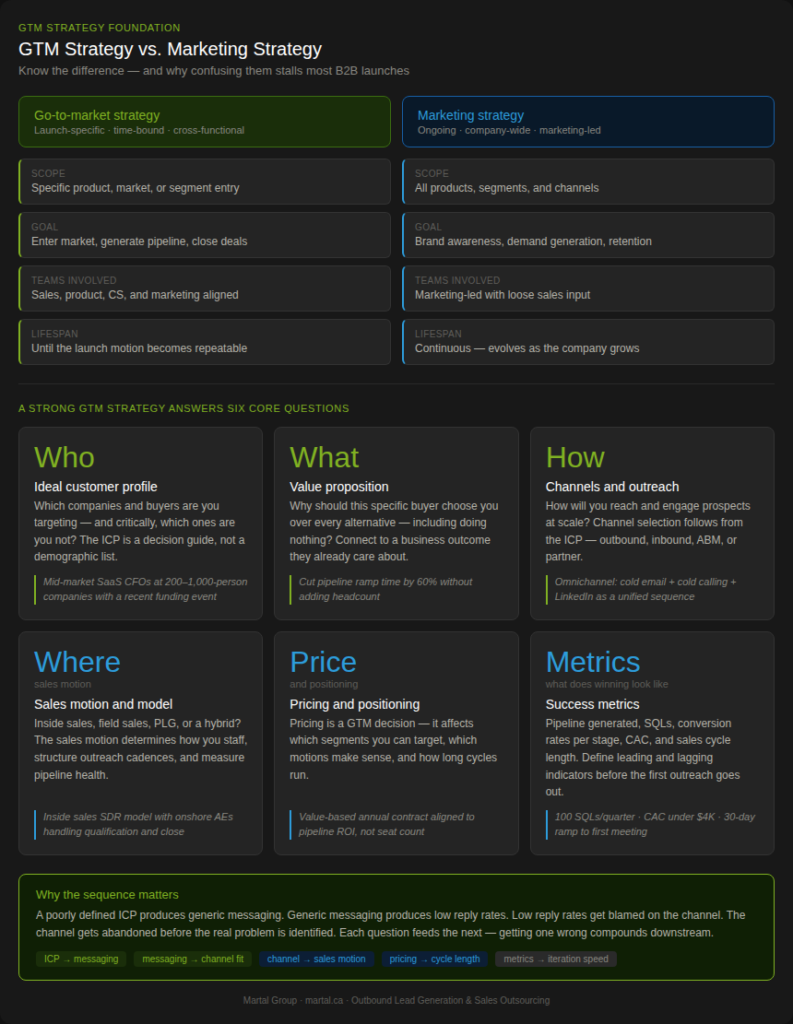
At its core, a go to market strategy is a comprehensive plan that outlines how a company will introduce and deliver a product or service to the market. It defines the target customer segments, the value proposition, the marketing and sales approach, and the distribution channels needed to reach those customers (11).
In essence, a GTM strategy covers all the activities required to acquire and retain customers – from crafting the right messaging, to choosing pricing and positioning, to deciding whether you’ll sell via a direct sales team, online self-service, partners, or some combination. It’s a roadmap for launching a new product, entering a new market, or even simply scaling an existing offering to a wider audience.
A strong GTM strategy addresses six core questions:
- Who is your ideal customer, and what specific problem are you solving for them?
- What is your unique value proposition — and why does it win against alternatives?
- How will you reach and engage prospects at scale (channels, outreach motions, partners)?
- What does your sales process look like — inside sales, field sales, channel partners, or a hybrid?
- How are you pricing and positioning relative to the competitive landscape?
- What are your success metrics — pipeline generated, conversion rates, CAC, revenue targets?
Answering these before launch ensures a cohesive approach rather than disconnected efforts across teams.
Marketing Strategy vs. GTM Strategy: What’s the Difference?
This distinction matters more than most teams realize — and the confusion between them is one of the most common reasons B2B launches underperform.
A marketing strategy is broad and ongoing. It covers brand positioning, content, demand generation, and channel investment over time. It isn’t tied to a specific launch. It evolves continuously as the company grows.
A go-to-market strategy is time-bound and launch-specific. It exists to answer one question: how do we successfully enter this market, or bring this product to this segment, and generate revenue from it? Once the launch matures and the motion is repeatable, the GTM strategy gets absorbed into the broader marketing and sales operating model.
In practice: a company might have a single marketing strategy running across all products and segments, while maintaining separate GTM strategies for each new product launch, new vertical entry, or new geographic expansion.
The failure to make this distinction leads to a specific, recurring mistake: teams treat every new launch as a marketing problem (“let’s run some campaigns”) when what they actually need is a GTM plan — a cross-functional blueprint that aligns sales, marketing, product, and customer success on a shared definition of the target, the message, and the motion.
Why GTM Strategy Matters for B2B
Go-to-market strategy isn’t only for startups or first-time product launches. Established businesses need GTM planning whenever they expand into new customer segments, enter new geographies, or reposition an existing offering. The moment you’re trying to reach a market that doesn’t already know you — or doesn’t already associate you with the problem you solve — you need a GTM plan.
The cost of skipping it is steep. Many B2B product failures trace back not to product quality but to execution gaps: messaging that didn’t resonate with the actual buyer, channels that reached the wrong audience, or sales and marketing teams that operated on different definitions of a qualified lead. A GTM strategy closes those gaps before launch, not after.
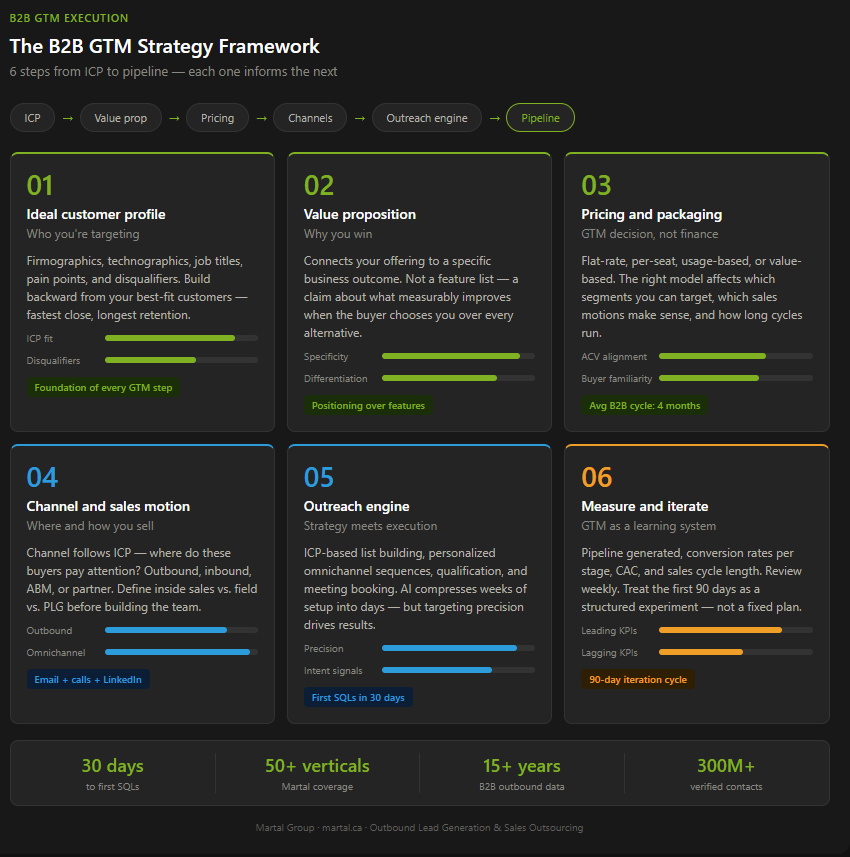
The B2B GTM Strategy Framework: 6 Steps from ICP to Pipeline
Most GTM plans stall not because the strategy was wrong, but because the framework was incomplete. Teams build out messaging before locking in the ICP. They choose channels before validating the value proposition. They set revenue targets before defining what a qualified lead actually is.
A sound B2B GTM framework runs in sequence. Each step informs the next. Here’s how we’d structure it — and where the execution typically breaks down.
Step 1: Define Your Ideal Customer Profile (ICP)
The ICP is the foundation of everything else in your GTM plan. It’s not a demographic list — it’s a decision guide. A strong ICP for B2B includes firmographics (industry, company size, revenue range), technographics (what tools the target uses), job titles involved in the buying decision, common pain points and triggers, and disqualifying characteristics that signal a poor fit.
The most reliable way to build a useful ICP is to work backward from your best existing customers — the ones that closed fastest, renewed longest, and got the most value. What do they have in common? That’s your ICP. If you’re entering a market with no existing customers, model it from competitive intel and first conversations rather than assumptions.
Where it breaks down: Teams often build an ICP that’s too broad (“mid-market B2B companies in North America”) or too rigid (a 40-field scoring model nobody uses). The goal is a tight, actionable profile that makes prioritization obvious for both sales and marketing.
Step 2: Define Your Value Proposition and Positioning
Your value proposition answers: why should this specific buyer choose us over every available alternative — including doing nothing? Positioning answers: where do we fit in the competitive landscape, and what category or frame of reference makes our differentiation most obvious?
For B2B, a strong value proposition connects your offering to a specific business outcome the ICP cares about. It isn’t a list of features. It’s a claim about what gets better — measurably, specifically — when someone uses your product or service.
Where it breaks down: Positioning is often written by the product team based on what the product does, rather than by the sales team based on what buyers actually respond to. The gap between internal positioning and how buyers describe the problem leads to messaging that sounds polished but doesn’t land in cold outreach or sales conversations.
Step 3: Set Pricing and Go-to-Market Packaging
Pricing is a GTM decision, not just a finance one. How you structure pricing affects which segments you can realistically target, which sales motions make sense, and how long your sales cycles will run.
For B2B, common pricing structures include flat-rate, per-seat, usage-based, and value-based models. The right choice depends on your ACV, the complexity of the buying process, and how buyers in your target segment are accustomed to purchasing. A $150K enterprise deal requires a fundamentally different GTM motion than a $5K self-serve SaaS product.
Where it breaks down: Pricing often gets set and then left alone, even as GTM execution reveals that prospects are objecting on price consistently — which is usually a signal of a positioning problem, not just a pricing one.
Step 4: Select Channels and Define the Sales Motion
Channel selection should follow from the ICP, not precede it. The question is: where do the buyers in my ICP actually pay attention, and what purchasing behavior do they have?
For most B2B companies selling complex, high-ACV products, the primary channel options include outbound (cold email, cold calling, LinkedIn outreach), inbound (SEO, content, paid), partnerships, and account-based marketing. These aren’t mutually exclusive — but in early-stage GTM, resource constraints require prioritization.
Alongside channels, define the sales motion: will you run inside sales, field sales, a product-led motion, or some combination? The answer determines how you staff the team, how you structure outreach cadences, and how you measure pipeline health.
From an outbound execution standpoint, this is where many B2B GTM plans break down in practice. Companies select three channels but resource only one. Or they run cold email without cold calling support, then conclude “outbound doesn’t work” before the motion is fully deployed. Coordinated omnichannel outreach — cold email, cold calling, and LinkedIn outreach working as a unified sequence — consistently outperforms single-channel efforts. We see this pattern across the B2B clients we run outbound pipeline generation for across 50+ verticals.
Step 5: Build and Execute the Outreach Engine
Once channels and sales motion are defined, the GTM shifts from planning to execution. This is where prospecting lists get built, messaging gets written, sequences get launched, and pipeline starts accumulating.
For outbound-led GTM motions, this step involves ICP-based list building, personalized outreach across channels, consistent follow-up cadences, and a qualification process that converts initial interest into sales-ready conversations. The quality of execution here — targeting precision, message relevance, timing, follow-up persistence — determines whether pipeline goals are hit or missed.
This step is also where AI has had the most visible impact. AI-powered outreach platforms can compress the time from ICP definition to active campaign from weeks to days, automate personalization at scale, and use intent signals to prioritize which accounts to reach first.
Proof point: When Spirit AI, a London-based AI trust and safety company, needed to enter the North American market with no existing US sales resources, Martal built and executed the outbound motion from scratch, generating 35 qualified leads per month in a niche category where few established players had meaningful reach. The GTM framework was sound; the execution infrastructure made it move (5).
Step 6: Measure, Learn, and Iterate
A GTM strategy is not a launch event — it’s a learning system. The metrics that matter most in B2B GTM are pipeline generated, conversion rates at each funnel stage, sales cycle length, customer acquisition cost, and — eventually — revenue and retention.
Set up dashboards that surface these metrics in real time, not quarterly. Define the leading indicators (meetings booked, SQLs generated, reply rates) that predict lagging outcomes (revenue, churn). Review them on a cadence — weekly or biweekly for active campaigns — and treat underperformance as a signal to investigate, not ignore.
The companies that get the most out of their GTM investment are the ones that treat the first 90 days of execution as a structured experiment: test messaging variations, compare channel performance, identify which ICP segments are converting fastest, and reallocate accordingly.
How GTM Strategy Has Evolved Through Automation and AI
74% of sales reps say that AI and automation will significantly shape how they work in the years ahead.
Reference Source: 1up
Go-to-market strategies have always had to adapt to the times. In the past, GTM execution was largely a manual, human-driven process: sales reps would cold call from lists, marketers would blast out mass emails or run broad TV/radio ads, and market research meant weeks of surveys and focus groups. Over the last decade, automation began to change this. Email marketing platforms, CRM systems, lead generation software, and sales automation tools allowed teams to scale their outreach and client management with far less manual effort. Repetitive tasks like scheduling meetings or sending follow-up emails could be automated, freeing up human reps to focus on high-value interactions. Still, those early automations were rule-based – essentially scripts following “if X then Y” instructions – and while they improved efficiency, they lacked the adaptability and intelligence that modern AI brings.
In 2026, and we are in the midst of an AI revolution in go-to-market. The rise of machine learning and generative AI has supercharged what automation can do. We’ve moved from simple automation (sending the same generic email to 1,000 contacts) to “precision AI” – targeted, task-specific AI that can personalize and optimize each step of the sales process (2). Today, solutions like AI pack generators illustrate this shift perfectly. Instead of relying on one-size-fits-all outreach or rigid scripts, these tools bundle data, insights, and content recommendations into ready-to-use packages tailored for each prospect or campaign. For GTM teams, this means less manual prep work and more time focusing on conversations that actually move deals forward. This evolution means AI doesn’t just increase volume; it increases effectiveness. For example, instead of a sales development rep (SDR) manually researching a prospect’s company for 15 minutes before crafting an email, an AI agent can instantly gather relevant insights (like the prospect’s recent funding news or industry trends) and even draft a first-pass personalized email for the rep (1). The rep then reviews and sends, dramatically cutting down the time spent per contact while actually improving the relevance of outreach.
One notable shift is the emergence of roles like GTM (go-to-market) engineers and IT architects focused on digital transformation for IT architect initiatives – essentially technical specialists embedded in sales/marketing teams to build automations and integrate AI tools into workflows (1). Rather than relying solely on traditional RevOps or SalesOps staff to manage CRM dashboards and reports, companies are tasking these GTM engineers to create custom solutions: think automated lead routing systems, AI-driven dashboards that pull data from multiple sources, or custom chatbots for initial lead qualification. This reflects how important technology has become in executing GTM strategy. In fact, sales technology and automation expertise are now as important as classic sales skills. As Columbia Business School researchers noted, companies are embedding technical talent into sales teams because sales tech is “no longer a luxury—it is a necessity”(1) for selling smarter and faster.
Nowhere is the impact of AI more apparent than at the top of the funnel. B2B sales lead generation and initial prospecting have been transformed by AI. Instead of an SDR manually doing each step – finding companies that fit the Ideal Customer Profile, searching LinkedIn for the right contacts, writing outreach emails, following up repeatedly – we now see AI agents handling many of these tasks in sequence (1). Modern sales engagement platforms can autonomously identify ideal prospect profiles, compile contact info from databases, personalize outreach across email and even phone/text, and manage the cadence of touches. For instance, an AI can be instructed: “Find all VP of Finance at mid-size tech companies in the healthcare sector, then send each a tailored email referencing a relevant industry pain point, follow up a week later with a case study, and alert a human rep only when a prospect clicks a link or replies.” This isn’t future talk – it’s happening now with advanced sales AI systems operating as co-pilots or even autonomous agents for GTM teams (1). The benefit is a highly targeted outbound engine that operates 24/7 and at a scale no human team could match, all while preserving personalization.
The statistics tell the story of this evolution. Sales professionals themselves recognize how central AI and automation have become. AI is delivering measurable impact for sellers, with 89% reporting deeper customer understanding and 87% saying it helps reduce job-related stress (7). Not long ago, automation in sales was viewed with skepticism – maybe useful for simple email sequences or CRM updates, but not core to the craft of selling. That’s completely changed. Now, nearly every repetitive or data-heavy aspect of go-to-market execution is a candidate for AI augmentation. From predictive analytics that score leads (telling you who is most likely to convert) to AI-driven content generation (producing tailored pitch decks or blog posts in a fraction of the time), the toolbox is rich. Early adopters of these technologies have reported impressive gains: efficiency improvements of 10-15% and sales uplift of up to 10% just from initial sales automation efforts (6). And those are likely conservative figures as AI capabilities accelerate.
The shift that matters most isn’t speed — it’s precision. Marketing automation used to mean sending 1,000 emails at once. If the targeting was poor, it just meant more irrelevant outreach hitting more inboxes faster. AI changes the input, not just the output. It can analyze your CRM history, external market data, and behavioral signals to surface patterns — which segments convert fastest, which messages generate replies, which accounts are likely to churn — and feed those findings back into targeting and messaging decisions. One thing we see consistently across the outbound campaigns we run: AI-informed segmentation reduces the noise in a prospect list as much as it increases the volume. The result is a higher reply rate with fewer sends, not just more sends with the same reply rate.
It can also personalize content: instead of one generic message to all, AI can write 10 different variants of an email tailored to different sub-segments or even individuals, referencing specifics that matter to each. The result is that automated outreach is no longer the impersonal brute-force approach it once had a reputation for. When done right, it feels human and relevant to recipients, yet still operates at machine scale.
One concrete example of evolution is in outreach cadences. A few years back, a typical outbound cadence (sales sequence) might be 6 emails and 2 calls over a month, same content to all. Now, AI can optimize cadences in real-time: if a prospect is highly engaged (say, opens emails immediately and clicks links), the AI might accelerate and tailor the cadence – perhaps sending more info or scheduling a webinar invite. If another prospect never opens anything, the AI might downshift or try a different channel (like reaching out on LinkedIn with a connection request and personalized note). These micro-optimizations used to require manual monitoring by reps; today AI can manage it automatically across hundreds or thousands of prospects.
Another area of change is internal enablement and training. AI is also being used to train GTM teams faster – through AI-driven role-play coaches, for example, that simulate tough customer conversations, or AI tools that analyze call recordings to give reps feedback on talk ratio, questions asked, sentiment, etc. In short, the evolution of GTM strategy thanks to automation and AI touches every part of the funnel: top-of-funnel lead gen, mid-funnel deal nurturing, and even post-sale upselling and account management (with AI predicting which customers are ripe for expansion or at risk of churn). The companies that embrace this evolution are seeing clear benefits in productivity and effectiveness. Those that have not yet modernized are finding it harder to compete. The gap is widening, making adoption of AI not just a nice-to-have, but an imperative for modern go-to-market execution.
The evolution is directional and accelerating. GTM strategy has moved from manual and intuition-driven, to automated and data-driven, to now AI-enhanced and signal-informed. The teams that are moving fastest aren’t the ones with the biggest headcount, they’re the ones with the tightest feedback loops between outreach data and strategic adjustment.
Why AI and Automation Are Essential for Modern Market Entry Strategy
86% of B2B buyers are more likely to purchase from vendors that demonstrate an understanding of their business needs.
\Reference Source: Salesforce
If you’re planning a market entry in 2026 – whether launching a startup, expanding into a new region, or rolling out a new product line – AI and automation shouldn’t be an afterthought; they should be central to your strategy. Modern market entry strategy is a high-stakes game: markets are dynamic and fast-moving, customer expectations are high, and established competitors aren’t standing still. Leveraging AI and automation gives you a fighting chance to not only enter a market successfully but to do so efficiently and at scale. Here are several reasons why these technologies are now essential for a winning GTM plan:
1. Speed and Scale: Entering a new market often comes with a narrow window of opportunity. You might have a head start with an innovative solution, but competitors will eventually catch up. AI-powered tools allow you to ramp up go-to-market activities at a speed that humans alone simply can’t match. For instance, an automated outreach system can initiate thousands of personalized touchpoints in the time it would take a human team to manually contact a few dozen prospects. If you need to quickly build brand awareness or sales pipeline in a new segment, AI helps you scale up fast without a linear increase in headcount. It’s a force multiplier. Without it, trying to break into a market dominated by faster-moving competitors means starting every sprint a lap behind gunfight.
2. Precision Targeting and Personalization: When entering a new market, understanding the nuances of customer needs is crucial. Automation and AI are essential because they turn raw data into actionable insights. AI can analyze market data, customer demographics, online behavior, and even intent signals (more on that soon) to pinpoint exactly which prospects you should focus on and how to approach them. This is a game-changer. Instead of a broad, hope-and-see approach, you can zero in on high-probability targets. And with AI, you can personalize your message to each stakeholder. Buyers in 2026 expect relevance – they are far more likely to engage if you speak directly to their pain points. In fact, research shows B2B buyers are 86% more likely to purchase when companies demonstrate a clear understanding of their business needs (10). AI helps achieve this at scale, by tailoring content and recommendations for each prospect. This level of personalization in market entry used to be impossible when dealing with large prospect lists; now it’s both possible and increasingly expected.
3. Data-Driven Decision Making: Entering a market has many unknowns. What if your messaging isn’t resonating? What if you’re targeting the wrong industry sub-vertical? In the past, you might only realize these things months into a launch when sales disappoint. AI and automation provide real-time feedback loops. You can deploy A/B tests on campaigns and have AI analyze engagement metrics on the fly, adjusting tactics quickly. Automated dashboards can surface trends (e.g., “leads from industry A are moving faster through the funnel than those from industry B”) so you can double down where it works. Essentially, AI enables a more agile market entry strategy – you can iterate and refine your approach in days or weeks instead of quarters. This agility is essential in 2026, where market conditions can change rapidly. Also, AI’s predictive analytics can forecast outcomes (like lead conversion rates or churn risk) better than gut instinct ever could, which means you plan and allocate resources smarter. The bottom line: automation and AI inject a level of intelligence and adaptability into your GTM strategy that’s vital for success under modern conditions.
4. Efficiency and Cost-Effectiveness: Launching into a new market often comes with budget constraints. You need to make every dollar count, especially in B2B where sales cycles can be long and customer acquisition cost (CAC) is a key metric. AI and automation help do more with less. By automating repetitive tasks (data entry, scheduling, basic customer queries), you reduce the labor hours required for GTM execution. By using AI to optimize targeting and lead qualification, your sales team spends time only on the most promising leads, improving win rates. This efficiency can dramatically lower your CAC and shorten sales cycles. One study revealed that businesses adopting AI not only see revenue growth but also improved sales productivity – sellers who partner with AI tools are 3.7× more likely to meet their sales quotas (4). When entering a market, hitting those targets can make the difference between establishing a foothold or retreating. Automation also ensures consistency – no lead gets forgotten because an automated system will ensure follow-ups happen on schedule. In short, AI reduces the waste in your go-to-market engine, which is essential when resources are limited and goals are ambitious.
5. Competitive Necessity: Perhaps the most compelling reason – your competitors are likely already using these tools. Surveys consistently show widespread AI adoption in sales and marketing, with 88% of businesses using AI in at least one function by the end of 2025, compared to 78% the previous year (8). This means if you’re not leveraging AI and automation, you are giving competitors a potential advantage. They might be reaching prospects faster, responding quicker, personalizing better, and making data-driven pivots while you’re still relying on periodic human analysis. A modern market entry strategy needs to account for the fact that the playing field includes AI-augmented players. Companies that fail to adapt risk being outpaced by those who do leverage cutting-edge tools to sell smarter and faster (1). In many ways, adopting AI in GTM is no longer optional – it’s the price of entry to compete in 2026. Sales technology and AI-driven processes have shifted from “luxury” to “necessity,” as noted earlier, especially in sectors like SaaS, tech, and telecom where innovation cycles are rapid.
6. Enhanced Customer Experience: Market entry isn’t just about blasting your message out – it’s about delivering value from the first touchpoint. AI can significantly enhance the customer’s buying experience. Consider AI-driven chatbots on your website that can engage visitors 24/7, answer their initial questions, and guide them to relevant resources. A well-implemented chatbot ensures a potential customer researching at midnight still gets a helpful interaction, rather than bouncing. Similarly, AI can help your team respond faster (or even instantly) to inquiries, and automation ensures no one falls through the cracks. When you enter a new market and customers don’t know you yet, providing a responsive, informative experience builds credibility and trust. AI helps newbies punch above their weight in professionalism – for example, automated personalized emails to new sales leads can make your startup look as polished in follow-up as a Fortune 500 firm. This level of responsiveness and attentiveness can differentiate you in a crowded market, and it’s largely enabled by smart use of automation.
7. Ability to Leverage Intent and Timing: We’ll dive deeper into intent data in the next section, but it’s worth mentioning here: AI is essential for picking up on buying signals and acting on them at just the right time. In B2B sales, timing can be everything. Imagine entering a market and being able to know which companies are currently researching solutions like yours (perhaps they’re reading articles, comparing vendors, or hiring roles related to your product). AI can sift through digital footprints to identify these signals. Armed with that insight, your team can reach out exactly when the prospect is most receptive – a huge advantage for market entry, where you have no existing customer base to rely on.
Manual methods can’t reliably capture these signals at scale; AI can, and it can trigger the right action at the right moment. In practice, the impact of intent-based timing is most visible at the top of the funnel, outreach that arrives when a buying trigger has just occurred (a new hire in a relevant role, a funding announcement, a competitive displacement) generates meaningfully better response rates than volume-based prospecting against a static list. We build intent signal logic into the outbound campaigns we run for B2B clients, and the difference in reply rates between triggered and non-triggered outreach is consistent enough that we treat it as a baseline, not an optimization.
In sum, AI and automation infuse a modern market entry strategy with speed, intelligence, and agility. They help you enter faster, target smarter, engage more personally, and iterate quicker. Importantly, they free up your human talent to focus on what humans do best – creative strategy, building relationships, and solving complex problems – while the machines handle the heavy data crunching and repetitive workload. The result is a leaner, meaner go-to-market machine poised to make a splash in new markets. Companies like Martal have seen this first-hand: embracing AI-driven processes in sales and marketing outsourcing and omnichannel marketing campaigns dramatically accelerates clients’ market entry results, whether it’s an AI startup breaking into the North American telecom sector or a European SaaS company expanding to the U.S.
Nearly every organization is on this train – over 90% of businesses use or plan to use AI in some capacity in 2026 (3). The ones that execute strategically are reaping the rewards. Those who integrate AI into their GTM motions are vastly more likely to meet and exceed their growth expectations (some surveys suggest as much as a 7× higher likelihood of beating performance goals) (4). In short, AI isn’t just a tech trend; it’s become the engine that powers successful go-to-market execution in the modern era.
Real-World GTM Strategy Examples: What Works in Practice
Martal achieved a 20% higher open rate using agentic AI technology combined with experienced human sales expertise to optimize outbound lead generation.
Reference Source: Martal AI Sales Platform
Theory is useful for building the plan. What actually tests it is execution — where ICP assumptions meet real buyers, where messaging assumptions meet real reply rates, and where market entry timelines meet real pipeline. Here are examples across different GTM contexts that show what AI-powered execution looks like when it’s working.
Example 1: Entering a Niche Market with No Existing Local Presence
How Spirit AI built a North American pipeline
Spirit AI, a London-based company specializing in AI trust and safety tools, needed to build a North American pipeline from scratch. The category was niche, the buyer was technical and skeptical, and Spirit had no existing US sales infrastructure.
Martal built and executed the outbound motion, ICP definition, prospecting, cold outreach across email and LinkedIn, and qualification. Within the first months of the engagement, the program was generating 35 qualified leads per month in a segment where most vendors struggled to book initial conversations at all.
The takeaway for GTM planning: niche doesn’t mean small. It means the ICP has to be tighter, the messaging has to be more precise, and the outreach has to demonstrate domain credibility from the first touch. Broad messaging in a niche market gets filtered out immediately. Specific, signal-informed outreach doesn’t.
Example 2: Scaling Market Entry Across a New Geography
How Polygon scaled into the US
Polygon, a Stockholm-based IoT climate control company, needed to build a US pipeline without relocating the team or standing up a domestic sales function. The challenge was both geographic and category-level: IoT hardware with a B2B application, sold into a market that didn’t know the company.
Over a 24-month engagement, Martal generated 139 meetings with qualified North American buyers. The outreach ran omnichannel — cold email, cold calling, and LinkedIn outreach coordinated as a single sequence, not three separate efforts. The market entry was treated as a structured GTM execution problem: define the ICP for the US market, build the list, write the messaging, launch, measure, and adjust.
The takeaway: geography is a GTM variable, not an obstacle. With the right outbound infrastructure and a clear ICP for the target market, a company can build a meaningful pipeline in a new region without a physical presence.
Example 3: Speed-to-Pipeline in a Competitive Category
How an AI-Powered Logistics Solution Scaled Sales Quickly
A transportation company offering AI-powered freight solutions needed to build pipeline fast in a crowded, price-competitive market. The window to establish early relationships was narrow — a common situation in categories where differentiation is real but buyer attention is finite.
Over three months, Martal generated 353 qualified leads and 108 meetings — a pace most internal teams can’t sustain even with significantly more headcount. The program ran on a coordinated outbound model: tight ICP, omnichannel outreach, AI-assisted targeting and personalization, with onshore sales executives handling qualification and meeting booking.
GTM takeaway: Speed-to-pipeline in competitive GTM is almost always an execution problem, not a strategy problem. The strategy can be correct and the pipeline still stalls if the outreach infrastructure isn’t built to move at the pace the market requires.
Example 4: Long-Term GTM Partnership Delivering Enterprise Results
How Clickworker Evolved Outbound Strategy for Long-Term Results
Clickworker, a global crowdsourcing and data annotation marketplace, partnered with Martal over nine years to sustain consistent pipeline generation across multiple markets and buyer segments — including Fortune 10 and Fortune 500 accounts. Over the course of the engagement, the partnership generated $4.5M in recurring revenue and a 500% ROI on the program investment.
What made this work long-term wasn’t any single tactic — it was the feedback loop between outreach data and strategy adjustment. What messaging landed in enterprise vs. mid-market? Which verticals converted fastest? Which outreach cadences sustained reply rates over time without prospect fatigue? Those questions got answered iteratively, campaign by campaign, and the answers shaped how the outbound motion evolved.
GTM takeaway: GTM is not a launch event. The companies that build sustained pipeline treat their GTM execution as a learning system — not a fixed plan. Every campaign generates data; the best GTM teams use that data to improve the next one.
Example 5: Intent-Based Outreach Shortening Sales Cycles
How Forerunner Built an Intent-Driven GTM Strategy
Forerunner Technologies, a telecom equipment provider, faced a GTM challenge common in technical B2B categories: long sales cycles driven by extended evaluation periods and multi-stakeholder buying committees. The question was whether better timing intelligence could compress the path from first conversation to qualified opportunity.
Martal built intent signal logic into the outbound targeting — prioritizing accounts showing buying triggers (relevant hiring activity, technology changes, competitive displacement signals) over accounts that simply matched the ICP firmographically. Over a 24-month engagement, the program generated 1,442 leads and 339 meetings — and the quality of early conversations was measurably stronger because outreach was landing when prospect interest was already active.
GTM takeaway: Intent data doesn’t replace the sales conversation — it determines when you have it. Reaching a prospect when a buying trigger has just occurred produces a different quality of first conversation than cold outreach against a static list. The former is a continuation of something already in motion. The latter is interruption.
Data, Personalization, and Intent Signals in Market Entry
Companies using intent-driven, personalized outreach see 78% higher conversion rates.
Reference Source: LinkedIn – Intent Data
One of the recurring themes in the examples and points above is the central role of data. In 2026, data is the lifeblood of any effective go-to-market strategy – especially when venturing into new markets or customer segments. The mantra “data-driven” is no longer just a buzzword; it’s a necessity. Let’s break down how data, personalization, and intent signals come together to turbocharge market entry, and why ignoring these elements can leave you flying blind.
Data as the Foundation
Before AI, most GTM decisions relied on small-sample research, leadership intuition, or whatever the CRM happened to surface. Now, B2B teams have access to firmographic data (company size, industry, etc.), technographic data (what tools a company uses), behavioral data (website visits, content downloads), and much more. Used together, these inputs let you build an ICP that goes far beyond a job title and a company size filter.
Successful market entry starts with using this data to deeply understand your target market and customers.
- Who are the best potential buyers?
- What do their pain points and needs look like (and how do those show up in data – e.g., search trends or content engagement)?
- How do they typically buy solutions: do they respond to email, attend webinars, prefer phone calls?
Every data point is an answer to a question about where to focus first.
The dependency, though, is data quality. AI tools are only as useful as what’s feeding them. Siloed or stale data, duplicate leads, outdated contacts, disconnected systems, produces misdirected targeting regardless of how sophisticated the model is. A critical early step in any data-powered GTM is an audit of the data infrastructure: what’s clean, what’s missing, what needs to be unified before AI can act on it reliably.
Martal’s AI SDR Platform sources prospects from a database of 300M+ continuously verified contacts across 24M+ company accounts, each enriched with 1,500+ data fields. That foundation is what makes precision outbound targeting possible at scale, not just reaching more companies, but reaching the right ones with the right context.
Personalization at Scale
Data is the raw material. Personalization is how it creates differentiated outreach.
In B2B, personalization means more than using a prospect’s first name in the subject line. At its most effective, it means the message references something specific and relevant to that prospect’s world, their industry’s current challenges, a recent company event, a hiring signal that suggests a relevant initiative is underway. That kind of specificity is what separates a 1% reply rate from a 10% one.
The barrier used to be that genuine personalization didn’t scale. A rep could write five highly personalized emails a day; they couldn’t write 500. AI removes that constraint. Outreach platforms can now generate personalized content variations at volume, drawing on data about each prospect’s role, company, industry context, and behavioral signals, and deploy them across email, LinkedIn, and cold calling sequences simultaneously.
What matters most for GTM execution is that personalization reflects real relevance, not surface-level substitution. A message that swaps in a company name and an industry vertical into a generic template isn’t personalized — buyers can tell immediately. Genuine personalization requires underlying data quality and a messaging framework that actually addresses the buyer’s specific situation.
Leveraging Intent Signals
Intent data is one of the highest-leverage inputs available to a B2B GTM team — and still one of the most underused.
Intent data refers to information that indicates a prospect is actively interested in or searching for a solution like yours. This could be first-party intent (actions they take on your own digital properties, like frequent visits to your product page) or third-party intent (actions on external sites, like reading articles, comparison shopping, keywords searched, etc.).
Why does intent matter? Because it’s the closest thing to reading a prospect’s mind. It tells you who is in-market now.
Imagine you’re entering a new market and you have a list of 1,000 target companies. Without intent data, you might start methodically reaching out to all of them. With intent insights, you could discover that, say, 150 of those companies have shown recent spikes in relevant activity (like visiting competitor websites or downloading whitepapers on your topic). You’d likely prioritize those 150 with an aggressive outreach, since they’re “warm.” The others you might nurture more slowly until they show intent. This is a smarter allocation of your sales energy. It’s essentially fishing where the fish are biting.
One thing we see consistently in the outbound programs we run: intent-triggered outreach generates materially different conversations at the top of the funnel. When a prospect is already researching the category, the first call or email doesn’t have to start from zero. There’s a context to reference, a question to ask that’s already on their mind. That changes reply rates, and it changes the quality of the conversations that follow. Timing transforms a cold outreach into a timely one.
The Forerunner Technologies engagement illustrated this directly. By building intent signal logic into the outbound targeting — prioritizing accounts with active buying triggers over accounts that simply matched firmographic criteria — the program generated 339 qualified meetings over 24 months in a technical B2B category where buyer evaluation cycles are long and early conversations are hard to secure.
Putting It Together – The Data-Powered Market Entry
When ICP data, personalization, and intent signals operate together, rather than in isolation, the GTM motion becomes adaptive in real time. Prospects who show higher intent get prioritized. Messaging adjusts based on what’s resonating across segments. Follow-up cadences shift based on behavioral signals from each account.
The practical output is a GTM engine that gets smarter with each campaign cycle. Open rate data informs subject line testing. Reply rate data informs message framing. Conversion data informs ICP refinement. Each loop tightens the targeting and improves the next round of outreach.
A note on data ethics that’s worth stating explicitly: using intent data effectively means using it subtly, not bluntly. A prospect who has been reading about AI security solutions doesn’t want an email that says “We saw you researching AI security.” They want an email that addresses AI security as if it’s naturally on your radar — which it is, because you work in their space. The signal informs the relevance. It doesn’t become the pitch.
Common Go to Market Mistakes and How AI Can Help Avoid Them
79% of marketing leads never convert into sales due to lack of effective nurturing.
Reference Source: Martal Group
Even a well-constructed GTM framework can stall in execution. Certain mistakes appear repeatedly across B2B market entries, and they tend to compound. A weak ICP leads to generic messaging. Generic messaging produces poor reply rates. Poor reply rates get blamed on the channel. The channel gets abandoned before the real problem is identified.
The good news is that most common GTM failures are detectable early — and many are exactly the kinds of problems that AI and automation are well-suited to surface or prevent. Here are the eight we see most often, and what to do about each.
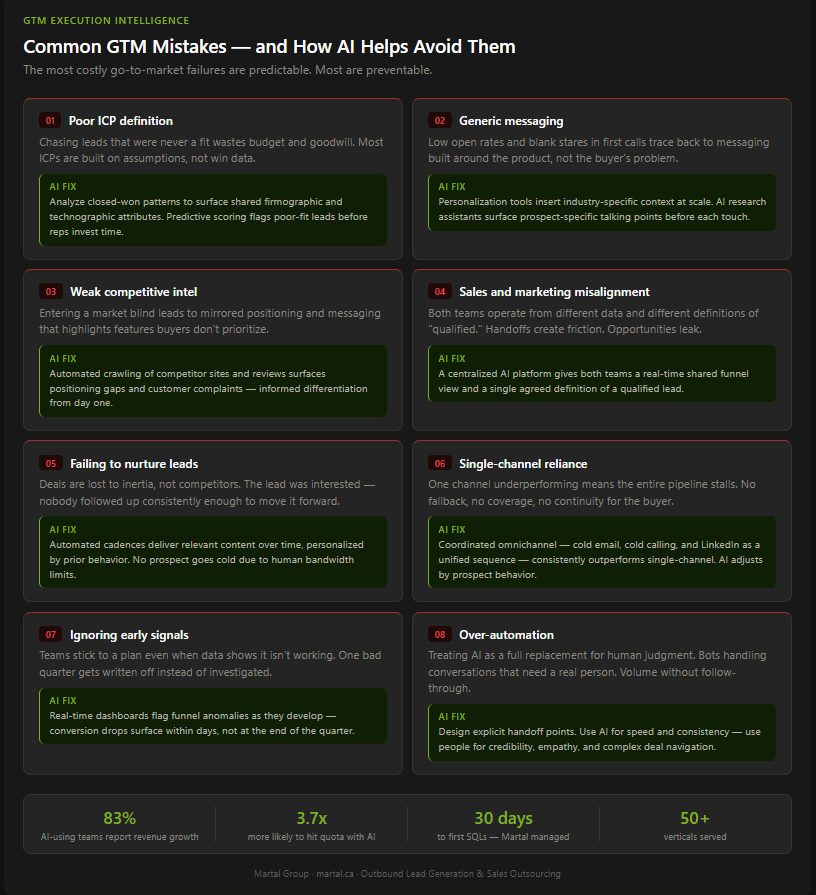
- Targeting the Wrong Audience or Poor ICP Definition: One classic mistake is not clearly defining your Ideal Customer Profile (ICP) and thus chasing leads that aren’t a good fit. This wastes precious time and resources. It might happen due to assumptions (“our product is great for everyone!”) or insufficient research.
AI Fix: Use data analysis to identify patterns among your best customers. AI can crunch your customer data to surface attributes common to successful deals (like industry, company size, tech stack, etc.), helping refine your ICP. Additionally, predictive lead scoring models can evaluate incoming leads and flag those that don’t match your historical success profile. This steers your team toward prospects with the highest likelihood of converting, rather than barking up the wrong trees.
- Generic Messaging That Doesn’t Resonate: Many GTM launches fail because the value proposition and messaging are too generic or not aligned with what the customer cares about. If prospects don’t quickly see how you solve their specific problem, they tune out. Mistake signs include low email open rates, poor engagement on ads, and blank stares in sales meetings.
AI Fix: Content personalization tools can tailor messaging to each audience segment at scale, inserting industry-specific pain points, relevant use cases, and contextual signals into outreach automatically. At the rep level, AI-powered research assistants can gather prospect-specific context before each touch and suggest talking points most likely to resonate. The result is messaging that feels written for the individual, not pulled from a template library.
- Lack of Sufficient Market Research & Competitive Intel: Entering a market without a clear view of the competitive landscape leads to positioning that mirrors established players, pricing that misses the mark, or messaging that highlights features buyers don’t actually prioritize.
AI Fix: AI tools can automate a lot of competitive intelligence gathering – for example, crawling competitors’ websites, news, and reviews to summarize their offerings and positioning. AI can also parse through customer reviews or social media to glean what target customers are complaining about (maybe everyone’s frustrated with Competitor X’s poor customer service – insight you can use in positioning). By arming yourself with data-driven intel, you won’t make the mistake of positioning your product exactly the same as a well-entrenched competitor or missing a key differentiator that matters to customers. Essentially, AI helps you enter the market eyes-open, having done thorough homework in minutes or hours instead of weeks.
- Sales and Marketing Misalignment: This is a perennial problem – marketing might generate lots of leads that sales deems “junk,” or sales might not follow up promptly on marketing’s leads, leading to finger-pointing. In a critical go-to-market launch, misalignment can be deadly, as precious launch opportunities are squandered.
AI Fix: Automation ensures every marketing-qualified lead is immediately routed to the right rep with no manual handoff delays. A centralized AI-driven platform gives both teams a shared real-time view of the funnel, who’s engaged, what they’ve seen, where they are in the buying process. Lead scoring creates a shared definition of what “qualified” means, so marketing and sales stop arguing about lead quality and start working from the same criteria.
- Failing to Nurture Leads (Lack of Follow-Up): The leakage is significant — research has consistently shown that the majority of marketing-generated leads never convert to sales, with inadequate follow-up cited as the primary cause. One thing we see often in outbound pipeline work: companies with a healthy volume of initial responses but weak nurture cadences lose deals not to competitors, but to inertia. The lead was interested. Nobody followed up consistently enough to move it forward.
AI Fix: Automation ensures every marketing-qualified lead is immediately routed to the right rep with no manual handoff delays. A centralized AI-driven platform gives both teams a shared real-time view of the funnel, who’s engaged, what they’ve seen, where they are in the buying process. Lead scoring creates a shared definition of what “qualified” means, so marketing and sales stop arguing about lead quality and start working from the same criteria.
- Relying on a Single Channel (One-Trick Pony Syndrome): Betting the GTM on one approach, only cold email, LinkedIn, or paid ,creates a single point of failure. If that channel underperforms or reaches the wrong audience, the entire pipeline stalls.
AI Fix: Coordinated omnichannel outreach, where cold calling, cold email, and LinkedIn work as a unified sequence rather than isolated efforts — consistently outperforms single-channel approaches in B2B pipeline generation. AI manages the orchestration: if a prospect is highly engaged on email, the system leans into that channel; if they’re unresponsive there but active on LinkedIn, the sequence adjusts accordingly. The prospect experiences consistent, relevant presence across touchpoints. The team doesn’t manually coordinate three separate motions.
- Ignoring Early Signals and Data (Stubbornness): Sometimes teams stick to a plan even when early metrics show it’s not working – perhaps due to HIPPO syndrome (Highest Paid Person’s Opinion) or sunk cost fallacy. This is a mistake because one of the virtues of modern GTM is the ability to pivot quickly based on data.
AI Fix: Implement real-time dashboards and alerts for your key lead generation KPIs (like lead flow, conversion rates at each stage, etc.). AI analytics can highlight anomalies or underperformance faster than manual reporting. For instance, if conversion from demo to trial is much lower in the new market than your baseline, an AI system might alert: “Hey, something’s off here.” This prompts investigation – maybe the demos need tweaking for the new audience. Essentially, AI keeps you honest and agile by surfacing the truth in the numbers continuously. It combats the human tendency to stick our heads in the sand until a quarter (or year) is lost. Instead, you can course-correct by month or week. The commitment should be to outcomes, not to a particular tactic – AI helps you see which tactics yield outcomes and which don’t, so you can double down or drop accordingly.
- Over-automation and Losing the Human Touch: It’s worth mentioning the opposite side too – a mistake some make is thinking AI can do everything and thus automating poorly. For example, blasting out 10,000 automated emails that are personalized but then not handling the replies promptly, or relying on a bot in situations where a human touch was actually needed (like complex negotiations). The mistake is believing AI can fully replace human relationship-building.
AI Fix: The fix here isn’t more AI, but rather using AI wisely. Understand its limits – bottom-of-funnel deal closing often still requires human finesse. AI should augment, not replace, your human team in those critical moments. So the “fix” is a mindset one: use AI for what it’s great at (speed, data processing, consistency) and use your people for what they’re great at (empathy, creativity, trust-building). Many AI platforms now have features to handoff seamlessly to humans at the right time (for example, a chatbot that loops in a human agent when the queries become complex or when a lead is hot). Implementing those handoff points is key.
In summary, while pitfalls abound in any go-to-market venture, an AI-enhanced approach acts like a safety net or a GPS system that helps you avoid wrong turns. It doesn’t guarantee success – you still need a product that delivers value and you still need skilled people at the helm – but it dramatically reduces the likelihood of certain common failures. By targeting better, personalizing messaging, ensuring follow-ups, coordinating channels, aligning teams, and learning from data, you eliminate many reasons GTM strategies typically fail. Many startups and even big companies have started to say that AI is like their “secret weapon” to avoid the mistakes their predecessors made. And they’re right – when you examine post-mortems of failed product launches, you often find issues like “we were talking to the wrong customers” or “we didn’t follow up enough” or “we didn’t realize the competition had a similar feature” – all problems that smart use of data and AI could likely have flagged or fixed.
For example, Martal’s own team, in helping dozens of companies with market entry, consistently sees that clients who had been struggling often were making one of the above mistakes. Perhaps they had a drawer full of old leads they never nurtured; Martal introduces an AI-nurture campaign and suddenly those dormant leads wake up and deals start materializing. Or a client was focusing on a suboptimal segment; by analyzing data, Martal helps refocus their ICP and their win rates jump. AI is not a panacea, but it provides clarity and efficiency – two things that combat human error very well.
One of the biggest GTM leakages is failing to nurture leads – a whopping 79% of marketing leads never convert to sales due to lack of effective follow-up (9). That’s a mistake you simply can’t afford, and it’s one that AI-driven automation can all but eliminate by ensuring every lead is touched with timely, relevant outreach. Avoid the common pitfalls, and you’ll be miles ahead of the many companies whose launches fizzle from these very avoidable errors.
Best Practices for Implementing an AI-Powered GTM Strategy
83% of sales teams using AI report revenue growth, compared to 66% of teams not using AI.
Reference Source: Salesforce
Adopting an AI-powered GTM strategy isn’t a single decision, it’s a sequence of them. Which capabilities to prioritize first. How to align the team around new workflows. How to measure progress before the pipeline results fully materialize. Getting that sequence right determines whether the investment compounds or stalls.
Based on how high-performing B2B GTM teams approach this, and what we see working across the outbound programs we run, here are the nine practices that separate effective AI-powered GTM execution from expensive experimentation.
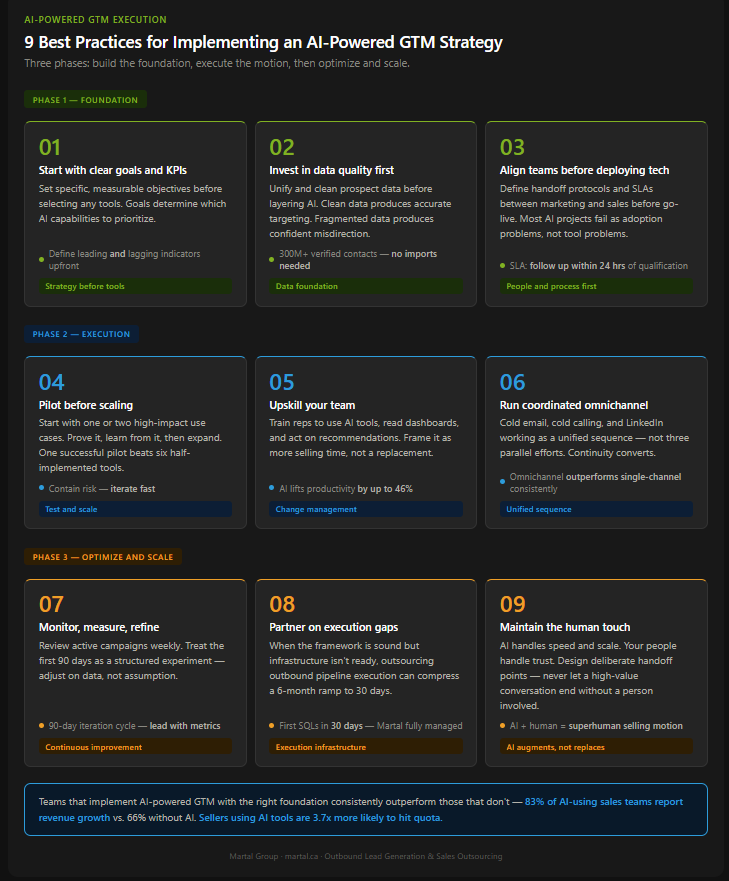
- Start with Clear Goals and KPIs: Before selecting tools or building workflows, define what success looks like in concrete terms. Is the goal 100 qualified leads per quarter? A specific pipeline value within six months? Penetration of 10 named accounts in a new vertical?
Clear objectives determine which AI capabilities to prioritize. If the goal is pipeline generation, the focus goes to AI for prospecting and outreach. If it’s shortening sales cycles, the focus shifts to intent data and sales enablement. If it’s improving conversion rates, the priority is personalization and lead scoring.
Set up measurement from day one — not as an afterthought once the tools are live. AI produces a lot of data. Without predefined KPIs, that data becomes noise rather than signal. - Invest in Data Quality and Integration: AI is only as good as the data feeding it. Before layering AI on top of existing systems, audit the data infrastructure: are customer and prospect records clean and current? Are your marketing, sales, and CRM systems talking to each other, or operating in silos? Are there gaps in firmographic or technographic coverage that would limit targeting precision?
This step isn’t glamorous, but it’s the one most teams skip — and then wonder why their AI-powered campaigns underperform.
Clean out duplicates and outdated info. If you have multiple databases, consider a Customer Data Platform (CDP) or at least ensure your AI tools can access all needed sources. Break down silos – maybe your marketing has data that sales doesn’t see or vice versa; fix that. Also, enrich your data where possible (for instance, use third-party data to fill in missing firmographics or technographics on your accounts). Why go through this effort? Because an AI model or automation workflow is going to make decisions based on what’s in your data. Garbage in, garbage out. Conversely, clean, rich data in – powerful insights out (2). Many top-performing GTM teams dedicate time to setting up a robust “data foundation” as step zero of their AI journey. It pays off massively in the accuracy and effectiveness of everything that follows. - Align Your Team and Strategy First (People + Process Before Tech): AI implementation isn’t just a technology project; it’s a change in how your team works. Ensure you have buy-in from both sales and marketing (and product, if needed) on the go-to-market game plan and the role AI will play.
It’s crucial that everyone sees AI as an enabler, not a threat. For example, involve your sales reps in selecting an AI sales tool so they feel ownership and understand it’s there to help them, not watch over them.
Define new processes clearly: if AI scores leads, how will sales use that score? Who monitors the AI dashboards? If a chatbot qualifies a lead, how is that handed to sales? Map these processes so that there’s no confusion.
A practical alignment mechanism many high-performing GTM teams use is a formal SLA between marketing and sales — for example, marketing qualifies leads to a defined threshold, and sales commits to follow up within 24 hours. Without that agreement in writing, even the best AI-assisted lead scoring produces friction at the handoff.
We often stress the importance of setting SLA (service-level agreements) between marketing and sales in an AI-driven funnel – e.g., “marketing will use AI to qualify leads to a score of X, and sales agrees to follow up on all such leads within 24 hours.” This keeps the human-machine partnership running smoothly. Remember, AI will expose any process misalignments quickly (for instance, if it generates more leads than sales can handle), so better to iron those out upfront. - Start Small with High-Impact Use Cases: Don’t attempt to automate everything simultaneously. Pick one or two high-impact areas as pilots. For example, you might start with something contained like an AI email outreach tool for SDRs, or implementing an AI chatbot on your site, or using AI for lead scoring in marketing. Pilot it, get quick wins, and learn from the experience.
This phased approach limits risk, gives the team time to adjust to new workflows, and builds internal momentum through early wins. One successful pilot is a better foundation for broader adoption than six half-implemented capabilities delivering partial results across the board. Scale what works. Stop what doesn’t. Iterate quickly. - Upskill Your Team – Training and Change Management: An AI-powered GTM strategy still relies on humans to steer it. Invest in training your team on the new tools and on data-driven decision making.
For instance, if you roll out an AI sales engagement platform, conduct workshops for your sales reps on how to interpret AI suggestions, how to personalize content with the tool, etc. Marketing folks may need training on using an analytics dashboard or account intent tool. Encourage a culture of curiosity and continuous learning.
It can be helpful to have your team learn some basics of data analysis – not that they need to become data scientists, but they should feel comfortable looking at a dashboard or understanding what the AI is doing.
Some organizations partner with experts or bring in consultants (or use providers like Martal for B2B sales training) to accelerate this knowledge transfer. Importantly, address any fears team members have about AI (“Will this replace me? Do I have the skills?”). Reinforce that AI is there to augment their abilities, and your investment in training is to make them even more valuable. When people see AI making their jobs easier (like saving them time or helping them hit targets), they become enthusiastic adopters. So focus on that “WIIFM” (what’s in it for me) when rolling out to the team – e.g., “This tool will free you from manual data entry so you can spend more time closing deals (and earning commission)!” - Leverage Omnichannel and Multi-Touch Strategies: Design GTM campaigns to coordinate touchpoints across channels and use AI to orchestrate the sequencing rather than managing it manually.
For instance, you might set up a sequence where a prospect who downloads a whitepaper gets an automated follow-up email, is added to a retargeting ad audience, and if they click the email link but don’t sign up for a demo, they then get an automated LinkedIn message from a rep the next week.
Mapping out these journeys ensures you meet the prospect in different contexts and keep the outreach fluid. Use AI to personalize across channels – maybe the LinkedIn message references that whitepaper they downloaded, for example.
Consistency is key: ensure the messaging is aligned (automation can help enforce that by templatizing and syncing across channels). Essentially, think of your go-to-market like a cohesive campaign rather than disparate efforts by platform.
Tools like marketing automation for emails, sales engagement platforms for direct outreach, and programmatic advertising can all talk to each other these days (with a bit of integration work). The more cohesive you make it, the better the customer experience and the higher the chance of conversion. Also, remember to include offline or human touches where appropriate – a personalized gift or a physical mailer can be scheduled as part of a sequence too, and sometimes that differentiation stands out in a digital barrage. - Monitor, Measure, and Refine Continuously: Implementation is not a one-and-done. Make sure you set up dashboards and regular review cadences to monitor how your AI-powered GTM is performing. What do the metrics say? Are you seeing an increase in leads, conversion rates, shorter cycles? Identify where the funnel might still have bottlenecks. AI will give you a lot of data; use it.
For example, you might discover through AI analytics that a certain email template is underperforming – then you refine it and test again. Or perhaps one segment is showing unexpected high interest – maybe that’s a signal to pivot more resources there. The beauty of an AI-driven approach is you often get granular insights quickly. But you must act on them. Have a process: maybe a bi-weekly growth meeting where the team looks at GTM metrics and decides tweaks.
Adopt an experimental mindset: A/B test whenever possible and let the data decide. Over time, this continuous improvement loop can significantly boost your GTM effectiveness. It’s like compounding interest – small tweaks each month lead to huge gains over a year. One caution: ensure you’re measuring what matters (back to those goals and KPIs). It’s easy to get caught in vanity metrics (like email open rate) if they’re not directly tied to the outcomes (like pipeline value) – keep the focus on the end-to-end picture. - Partner with Experts and Utilize Outsourcing Strategically: For companies entering a new market or scaling outbound pipeline without an internal team built for it, the execution gap is often the biggest obstacle. The GTM framework is sound. The infrastructure to run it consistently isn’t in place yet — and building it from scratch while trying to hit near-term pipeline targets is a difficult combination.
In those situations, outsourcing the outbound pipeline execution function — rather than the broader GTM strategy — can compress a six-month ramp to 30 days. What makes this work is specificity of scope. Partnering on outbound lead generation, cold outreach, and qualification is a defined, measurable engagement with clear deliverables. Outsourcing “sales” broadly is vague and hard to hold accountable.
Martal’s model is built around that distinction. Onshore sales executives run coordinated omnichannel outreach — cold email, cold calling, and LinkedIn lead generation operating as a unified sequence — supported by an AI platform trained on 15+ years of B2B campaign data across 50+ verticals. For clients entering new markets or scaling pipeline without in-house bandwidth, most are generating their first sales-qualified leads within 30 days of launch. - Maintain the Human Touch and Ethics: AI is a means, not the end. The end goal is building trust with buyers — and trust requires human presence at the moments that matter most.
Use AI to draft outreach, but let reps add a line that reflects something genuinely specific to that prospect. Use chatbots for initial qualification, but route to a human the moment the conversation becomes substantive. Build handoff points into every automated workflow so that no high-value conversation ends without a person involved.
The best-performing GTM teams operate with a clear division: AI handles the speed, scale, consistency, and data processing. Their people handle credibility, empathy, judgment, and relationship-building. That combination, what some describe as a “superhuman” selling motion, is what produces both pipeline volume and deal quality. Neither element alone gets you there.
When implemented with these best practices, an AI-powered GTM strategy can dramatically accelerate your success. To illustrate the payoff, consider this: 83% of sales teams using AI have seen revenue growth, versus only 66% of teams not using AI (10). That gap is significant – and it underscores that it’s not just about using AI, but using it well. Following the above principles helps ensure you’re in that successful cohort. You align technology with strategy, you empower your people, and you keep optimizing.
Many of Martal’s clients, for example, find that after adopting these approaches, they not only hit their immediate goals (like entering a new market successfully) but also become fundamentally more agile organizations. They can adapt to market changes faster, experiment with new ideas cheaply (because automation does the heavy lifting), and scale winning tactics quickly. Best of all, their sales and marketing teams start to operate as a cohesive revenue machine, supported by AI insights at every turn.
In essence, the AI-powered go-to-market journey is one of continuous improvement and learning. Start smart, build the right foundation, and then let the virtuous cycle of data and feedback drive you to ever better performance. Your team, augmented by AI, will achieve feats that wouldn’t have been possible a few years ago – whether that’s handling a volume of outreach that would’ve required 3× staff, or gleaning customer insights that traditionally only big-budget research could buy. This levels the playing field and often gives the advantage to the savvy over the merely big. By following these best practices, you’re setting yourself up to be among the savvy – those who not only have AI at their disposal but know how to wield it effectively in the go-to-market arena.
When executed correctly, AI-driven GTM strategies translate into real revenue impact – 83% of sales teams using AI report hitting their growth targets (with revenue increases), compared to just 66% for teams not using AI (10). In other words, the data shows that companies who marry AI and automation with their sales and marketing processes are far more likely to outgrow their competition. Best practices like the ones above are your roadmap to joining those high-performing ranks.
Conclusion
A go-to-market strategy is only as strong as its execution. The framework covered in this guide, ICP, positioning, pricing, channel selection, outbound engine, and measurement, is the structure. What determines whether it produces a pipeline is how precisely and consistently it gets run.
That’s where most GTM plans stall. The strategy is coherent on paper. The outbound execution is inconsistent in practice. Messaging is broad when it needs to be specific. Follow-up is sporadic when it needs to be systematic. Channels are treated as separate efforts when they need to operate as a coordinated sequence.
AI and automation have made it significantly faster to close that gap — but only when the underlying framework is sound. If the ICP isn’t tight, AI will target the wrong buyers faster. If the messaging isn’t differentiated, AI will deliver it to more people and return the same low reply rates at higher volume. The technology accelerates a strong GTM strategy. It exposes a weak one.
Two things tend to separate the B2B teams that build sustainable pipelines from the ones that don’t: they treat the GTM framework as a living system rather than a launch checklist, and they invest in execution infrastructure that matches the ambition of the strategy.
If your team has the strategy but needs the execution infrastructure — the outbound engine, the AI-powered targeting, the coordinated omnichannel motion — that’s exactly where Martal operates. Our onshore sales executives run cold email, cold calling, and LinkedIn outreach as a unified sequence, supported by an AI platform built on 15+ years of B2B campaign data across 50+ verticals. Most clients generate their first sales-qualified leads within 30 days of launch. Book a consultation to talk through your GTM execution gaps and what a qualified pipeline looks like for your market.
References
- Business Columbia
- Demand Base – AI Strategies
- Global Skill Development Council
- Demand Gen Report
- Martal Group – AI Case Study
- McKinsey
- Salesforce
- McKinsey & Company
- Martal – Generate Sales Leads
- Salesforce
- Amplitude
FAQs: GTM Strategy
What is a GTM strategy?
A go-to-market (GTM) strategy is a plan that defines how a company will bring a product or service to market, reach the right buyers, and generate revenue from it. It covers the ideal customer profile, value proposition, pricing and positioning, sales channels, outreach motion, and success metrics. Unlike a broader marketing strategy — which is ongoing and applies across the business — a GTM strategy is time-bound and launch-specific. It exists to answer one question: how do we successfully enter this market and convert interest into pipeline?
What is the difference between a marketing strategy and a GTM strategy?
A marketing strategy is broad and continuous — it governs brand positioning, content, demand generation, and channel investment across the entire business over time. A GTM strategy is narrow and time-bound — it’s built around a specific launch, market entry, or new segment. A company typically has one marketing strategy and multiple GTM strategies running at different stages. The confusion between the two leads to a common mistake: treating a new market entry as a marketing problem when it actually requires a cross-functional GTM plan that aligns sales, product, and customer success alongside marketing.
What are the key components of a B2B GTM strategy?
A B2B GTM strategy typically covers six components: ideal customer profile (ICP) definition, value proposition and positioning, pricing and packaging, channel selection and sales motion, outbound execution, and measurement. Each component informs the next — a poorly defined ICP produces generic messaging, which produces low reply rates, which gets blamed on the wrong channel. Getting the sequence right, and building each component on accurate data rather than assumptions, is what separates GTM strategies that build pipeline from ones that produce activity without results.
How does AI improve a go-to-market strategy?
AI improves GTM execution primarily in four areas: targeting precision (identifying the right accounts using firmographic, technographic, and intent data), personalization at scale (generating relevant, context-specific outreach across thousands of prospects), timing (surfacing intent signals that indicate when a prospect is actively in-market), and continuous optimization (analyzing campaign performance and adjusting targeting and messaging based on what’s working). AI doesn’t replace the GTM framework — it accelerates execution within it. A well-designed GTM strategy with AI-powered execution compresses the time from ICP definition to qualified pipeline significantly.
How long does it take to see results from a B2B GTM strategy?
It depends on the sales motion and market complexity, but for outbound-led GTM strategies, a well-resourced program with a tight ICP, coordinated omnichannel outreach, and AI-assisted targeting typically generates initial qualified conversations within 30 days of launch. Pipeline volume builds over the following 60–90 days as the outreach cadence matures and the feedback loop between campaign data and targeting refinement tightens. Longer sales cycles — common in enterprise B2B — mean individual deals take longer to close, but the leading indicators (meetings booked, SQLs generated, reply rates) should be visible and improving within the first 30–60 days of active execution.