
 Martal
 Technology
 Education and training
 Web Development and UI / UX
 Healthcare/Medical
 Logistics and Supply Chain
 Information Technology
 Insuretech and Financial Services
 Marketplaces
 Software Development
 E-commerce and retail
 AI and Machine Learning
 Energy and Solar
 Manufacturing
 Security and Surveillance
 Digital Marketing Agency
 Transportation
 MSP
MSP
 Telecom
 B2B SaaS
 Cybersecurity
 HR tech
 Fintech
 Cleantech
 Consulting
SDR Salary in 2026: What Sales Development Reps Earn and What They Actually Cost
Major Takeaways: SDR Salary
Most Sales Development Representatives now earn a base between $55,000 and $60,000, with U.S. tech markets and high cost-of-living cities pushing the top end past $65K.
A typical SDR OTE lands between $83K and $95K, but that assumes full quota attainment. With only about half of reps hitting quota, real take-home often sits closer to $70K–$75K.
Pure-commission models drive burnout, poor lead quality, and high turnover. The most effective plans keep a 60–70% base component.
Beyond salary, hiring, training, tools, benefits, and management add up — pushing the fully loaded cost of one in-house SDR to $90K–$100K+ per year.
Outsourced SDR solutions remove hiring, tooling, and management overhead and ramp faster — saving up to 65% per rep versus building in-house.
Entry-level SDRs typically earn $48K–$51K base, with commission and quick promotion potential lifting total pay into the $65K–$75K range.
Teams running coordinated omnichannel outreach across cold calling, cold emailing, and LinkedIn consistently outperform single-channel models on reply and conversion rates.
Fractional SDR teams provide expert-level output, faster ramp, and on-demand scalability with far less risk than full-time internal hires.
Introduction
A Sales Development Representative (SDR) is one of the most expensive seats you’ll fill on a B2B revenue team — and the salary line is only the start of the bill. The SDR role sits at the very front of your sales pipeline, so the talent you attract shapes the quality of every opportunity that follows it. That leaves revenue leaders with two questions worth getting right: what does a competitive SDR salary actually look like, and how do you weigh that cost against the pipeline it returns?
This guide answers both. We pulled current benchmarks from the major salary trackers, then read them through our own experience running outbound and fractional SDR teams for B2B companies — so you get the numbers and the operator context behind them. You’ll see how much SDRs make on average, why a base-plus-commission model beats commission-only, why on-target earnings rarely match real take-home pay, and how the hidden costs of an in-house rep — hiring, tooling, ramp, management, turnover — can nearly double the salary you budgeted. We’ll also show where outsourcing SDR functions can cut total costs by up to 65% (9) while shortening ramp time and protecting pipeline quality.
Whether you’re a CMO, CRO, VP of Sales, or SDR leader, the aim is practical: the data to build a fair, competitive comp plan if you hire in-house — and a clear-eyed comparison if you’re weighing an outsourced alternative.
SDR Salary Benchmarks and Average Compensation (What Do SDRs Earn?)
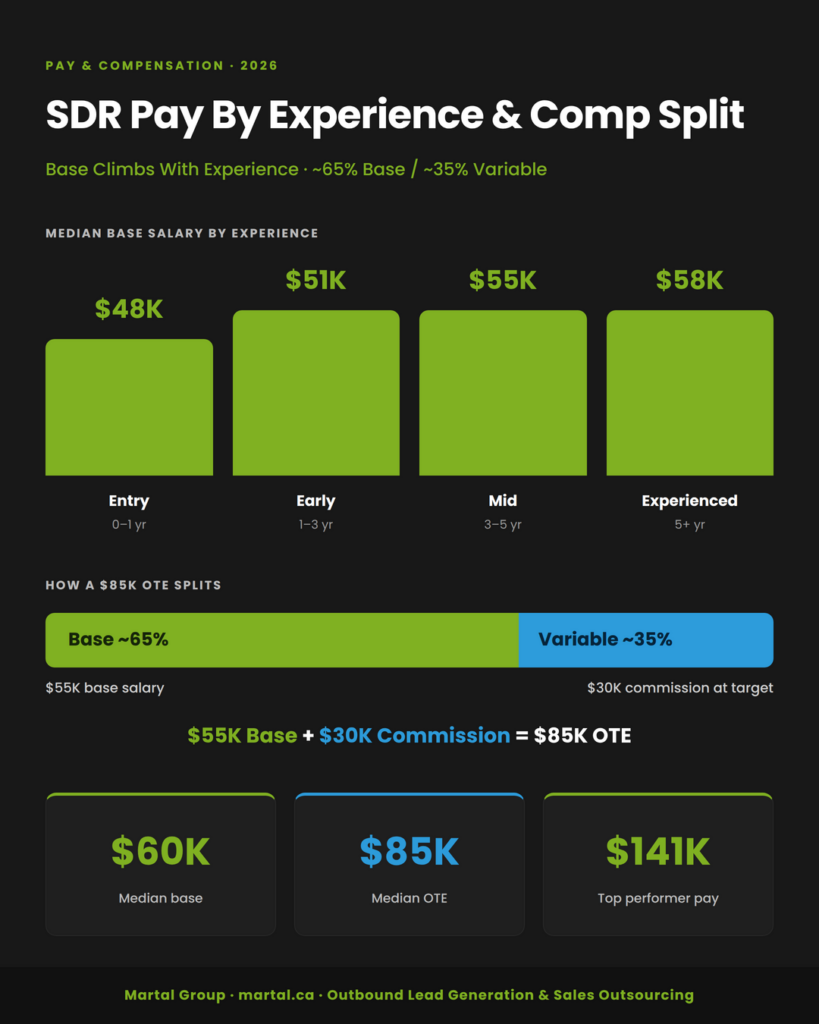
The median SDR base salary in the U.S. is about $60,000, with median on-target earnings around $85,000 in 2026.
Reference Source: RepVue
How much do SDRs make on average? The major trackers cluster in a tight band once you separate base from total comp. Here’s where the 2026 numbers land:
- Base salary: roughly $55,000–$60,000 for most U.S. markets. Market data puts the median base at $60,000, while broader datasets that include non-tech roles run a wider $50,000–$68,000 spread. (1) (16)
- On-target earnings (OTE): base plus commission at 100% quota, generally $83,000–$95,000. RepVue pegs median OTE at about $85,000, and a strong 2026 offer typically pairs a $55K–$65K base with an $85K–$95K OTE. (16) (17)
- Comp split: about 60–70% base / 30–40% variable (2) — so an SDR on an $85K OTE might carry a ~$55K base with ~$30K in commission at target.
- Top of market: top performers can earn up to roughly $141,000 a year, and enterprise SaaS reps in San Francisco, New York, and Austin regularly clear $110,000 OTE. (16) (18)
So do SDRs make good money? For an early-career role with no degree requirement, yes — the floor sits well above most entry-level jobs, and the ceiling climbs fast for reps who hit quota and get promoted. The catch is in that phrase “at target,” which we’ll come back to.
Geography and industry still move the number. The highest-OTE cities for SDRs in 2026 are Seattle (~$100K), New York (~$90K), and San Diego (~$90K), reflecting local demand and cost of living. Industry matters too: enterprise tech and regulated verticals tend to pay a premium, while smaller markets and lower-margin industries start closer to $45K–$50K. Education plays a smaller role — bachelor’s-degree holders historically average a few thousand more in base than associate-degree peers. (16)
Key takeaway: For 2026, plan on an SDR base of $55K–$60K for most markets and an OTE of $83K–$95K at target. That keeps your offer competitive without overpaying — but budget against realistic attainment, not the headline OTE. Next, we’ll look at entry-level pay and how quickly an SDR’s earnings climb with experience.
Entry-Level SDR Salary and Earning Growth
Entry-level SDRs typically earn a base salary of $48,000–$52,000, with total earnings often reaching $65K–$75K at target.
Reference Source: Indeed
Hiring an SDR with little to no experience? Entry-level SDR salaries sit toward the lower end of the range, but the floor is still high for an early-career role. Most companies start entry-level SDRs (0–1 year experience) at a base around $48,000–$51,000 (4) — well above many entry-level jobs, which reflects the skill set the role actually demands: sales acumen, resilience, and the discipline to keep prospecting through constant rejection.
Earnings climb quickly, though, and they climb with experience more than with tenure in the seat. Here’s how base pay typically progresses in 2026:
Experience level
Median base (2026)
What’s happening
That last row matters. How long should you stay an SDR? Most don’t stay long — and that’s by design. Top performers get promoted to Account Executive or team lead within 18–24 months, which resets their comp entirely. The reps who linger past a few years are often the exception, and at the upper end of the experience curve late-career SDR pay can stretch toward $100,000 at the 90th percentile for the rare specialists who stay. (19)
Within the first year, performance is the lever. Hitting or exceeding quota unlocks commission that meaningfully lifts take-home pay — an SDR might start at a $50K base with a $70K OTE, implying up to $20K in commission for booking enough qualified meetings. Many plans set on-target commission at ~30–40% of base for a new rep (4), or a $15K–$20K variable component for strong performance.
Most companies also run a defined promotion path (SDR → Senior SDR → Team Lead or AE), with a base bump of roughly 10–20% at each step. That ladder is a retention tool as much as a reward — without it, strong reps leave for roles where the salary pay stub reflects significantly higher earnings.
Entry-level SDRs and commission: Do new SDRs get commission? Almost always, yes. The structure for a junior rep is usually simple — a flat bonus per meeting set or per qualified lead passed to sales. A common plan pays $100–$200 per qualified meeting booked (4); at a 10-meeting monthly quota and $150 each, that’s ~$1,500/month, or roughly $18K/year at full attainment. This piece-rate model gives new reps skin in the game without betting their rent on it. For accurate documentation of salary and commissions, many SDRs use paystubs to generate professional earnings records. Next, we’ll break down commission structures in detail — and why a healthy base matters even for junior roles.
Remote SDR Salary: Does Location Still Set the Pay?
With most sales development now happening over phone, email, and LinkedIn, the obvious question is whether geography still moves the paycheck. Can SDRs work remotely, and do remote SDRs get paid less? Mostly yes to the first, and “it depends” to the second.
Remote SDR pay in 2026 lands close to the national averages, with a slightly wider floor:
- The average remote SDR earns about $55,000, with most landing between $42,000 and $61,000. (20)
- Remote SDR base salaries generally run $50,000–$75,000, with OTE between $65,000 and $95,000 or more, depending on company and level. (21)
- Pay policy varies by employer — some companies adjust compensation by location, while others offer standardized pay regardless of where the rep lives. (21)
The bigger pattern: remote work has started to compress the gaps between high- and low-cost markets, but it hasn’t eliminated them — companies still adjust pay based on talent competition and market expectations. A remote rep in a lower-cost region may take home a similar base to an in-office peer in a major hub, but the top of the range still skews toward companies competing for talent in places like Seattle and New York. (17)
Here’s the part that matters more for pipeline than for payroll: remote and onshore are not the same thing. A rep can be fully remote and still be locally aligned — operating in your buyers’ timezone, fluent in the market’s business culture, and reachable for same-day follow-up. One thing we see consistently is that response and connect rates hold up when reps share the prospect’s working hours and context, and slip when they don’t. So when you evaluate remote SDR talent — in-house or outsourced — the question isn’t only “what does this cost?” It’s “is this rep operating in the same timezone and market as the buyers I want to reach?” That alignment tends to do more for booked-meeting quality than any salary line on the offer.
SDR Base Salary vs. Commission: How SDRs Get Paid
A standard SDR compensation model is 60–70% base salary and 30–40% commission on average.
Reference Source: The Bridge Group (via Kalungi)
An SDR’s compensation has two parts: a base salary (fixed) and a commission or bonus (variable). Getting the balance right is what keeps reps motivated without leaving them financially exposed. Most SDR comp plans run a base + commission model, usually a 60/40 or 70/30 split — 60–70% of OTE in base, 30–40% variable (5). If OTE is $85K, the base might be ~$55K with ~$30K commission at target. That mix gives reps dependable income and real upside for hitting goals.
How does SDR commission work — do SDRs get commission on every sale? Not exactly. Since SDRs usually aren’t closing deals (Account Executives do), their commission is tied to activity or pipeline milestones, not closed revenue. Common SDR commission metrics include:
- Meetings or demos set — a flat amount per qualified demo or meeting booked with a prospect.
- Sales Qualified Opportunities created — a bonus when a lead is accepted by the sales team as a legitimate opportunity.
- Deals that close from SDR leads — sometimes a small share of revenue or a flat bonus when an SDR-sourced lead converts, to reward quality over quantity.
The most common structure is a flat rate per qualified meeting or SQL (4) — many companies pay $100–$200 per meeting that clears the lead qualification bar. Plans often layer in accelerators or tiered bonuses: an SDR might earn $125 per meeting up to quota, $150 above it, plus a $500 bonus when 5 of their meetings convert to wins in a quarter (4).
Here’s where the design choice gets consequential, and it’s a place we’ve watched comp plans quietly sabotage pipeline. Paying purely per meeting rewards activity — and activity alone produces a lot of meetings that never should have been booked. Paying per qualified opportunity rewards fit. Pay-per-meeting drives volume but tends toward low-quality meetings, while pay-per-opportunity rewards quality. The plans that hold up tie commission to qualification on real fit and intent — does the prospect have the authority and the need? — rather than to raw dials or calendar invites. Get that wrong and you’re paying reps to clog your AEs’ calendars. (22)
Why include a base salary at all? Because a lot of SDR work isn’t commissionable: researching lead lists, sending email follow-ups, lead nurturing, training, and team meetings. A base rewards the full responsibilities of the role, not just the deals that land (5). If a sales executive were paid only per meeting, the unglamorous-but-essential work — research, personalization — would get skipped. The base drives consistent effort; the commission drives specific targets (3).
There’s also a ceiling worth respecting. A common rule of thumb is to keep commission under ~40% of total comp, because when variable pay dominates, reps feel pressure to churn out meetings at the expense of quality (3). One sales-comp study found 64% of SDR pay is base vs. 36% variable on average (3) — roughly two-thirds fixed, one-third variable, which holds up as a sustainable mix.
In short, SDRs do get commission — almost universally — but it’s blended with a solid base. A well-built plan reads something like: “Base: $55,000, OTE: $85,000, Commission: $500 per qualified opportunity (uncapped).” Achievable upside, stable floor. Next, the pitfall to avoid entirely: commission-only SDR plans — and why we push back on them every time they come up.
Why OTE Isn’t What SDRs Actually Take Home
Most SDR salary guides — and most job offers — lead with OTE. It’s the biggest number on the page, and it’s the most misleading. Do SDRs actually make their OTE? Is OTE guaranteed? No, and no. OTE is the total you’d earn if you hit 100% of quota. It’s a ceiling, not a salary.
Here’s the gap between the headline and the paycheck:
- OTE assumes perfect attainment. The $83K–$85K OTE figure assumes 100% quota attainment, when in reality many reps land between 60% and 80%. (23)
- The real take-home is lower. An SDR with an $85K OTE offer may realistically take home closer to $70,000–$75,000. (23)
- Most reps don’t hit quota. Only about 55% of reps actually hit their quota — meaning nearly half fall short of the number on their offer letter. (24)
- Role and design change the odds. BDRs hit 88% of quota on average versus just 55% for SDRs, which says the system — quota math, lead quality, enablement — matters more than the title. (15)
That last point is where the operator perspective comes in. The pattern we see in outbound work lines up with the data: attainment is mostly a function of how the program is built, not how hard the rep tries. When targeting, timing, and follow-up are dialed in, reps hit quota and earn near their OTE. When reps are handed weak lists and unrealistic activity targets, OTE becomes a recruiting fiction — and you get the churn we’ll talk about in the next section.
So the right question isn’t “What’s the OTE?” It’s the one the sharpest reps and the smartest hiring leaders both ask: “What percentage of reps actually hit quota here?” (23)
For hiring leaders, this reframes the whole budgeting exercise. If you plan headcount and forecast against full-OTE attainment, you’ll over-project pipeline and overspend on a comp plan your reps can’t realistically reach. Budget against expected attainment instead — and design quotas your team can actually clear — and the numbers in this guide start telling the truth. It’s also part of why the in-house-versus-outsourced math (coming up) rarely favors the in-house side once you account for the reps who never ramp to quota at all.
The Case Against Commission-Only SDR Compensation
SDRs have an average annual turnover of 40%. That’s much higher for commission only roles.
Reference Source: The Bridge Group
It sounds tempting to a budget-conscious CEO: “Should SDRs be paid commission only — that way we only pay for results?” We’ll be direct, because we run these teams: it’s one of the costliest false economies in sales development. A commission-only SDR plan reliably backfires. Here’s why.
- High turnover and low retention. Commission-only offers no income security, which shrinks your candidate pool to the overconfident and the desperate. Nearly 40% of reps turn over in less than two years, and removing the base accelerates it — strugglers leave fast because they can’t make the income they need, and even strong reps jump ship the first time a slump hits (5). Every departure resets the hiring-and-ramp investment from zero. (14)
- Misaligned behavior and burnout. When the whole paycheck rides on the next payout, reps push unqualified meetings just to get paid — wasting AE time and damaging prospect relationships. It also breeds an every-rep-for-themselves culture that kills collaboration (5). The role is punishing enough as it is: SDRs are often expected to make 60 to 80 touchpoints a day and absorb near-constant rejection, which is the primary driver of burnout. Strip away the stable paycheck and you compound that pressure until people break. This is a big part of why SDRs quit — the math stops working before the skills do. (13)
- Difficult ramp and inefficiency. SDRs need a ramp period (typically 2–3 months) before they hit stride, and commission-only means those months pay almost nothing. The result is predictable: reps either can’t pay their bills or cut corners to book meetings at any cost. Critical non-commissionable work — research, market learning, personalization — gets skipped. With average SDR tenure already sitting around 15 months, you can’t afford a comp plan that makes the first quarter unsurvivable. (13)
The bottom line: commission-only SDR roles should be avoided. They attract the wrong candidates, drive brutal turnover, and incentivize exactly the behavior that erodes pipeline quality and team culture. A base + commission structure wins — a stable floor keeps reps engaged in every part of the job, not just the next commissionable event. The goal is a team that steadily produces qualified sales ready leads, and that only happens when reps feel supported instead of financially cornered.
Rather than zeroing out base pay to save money, the smarter move is to look at the full cost picture of an SDR — which is usually where the real budget surprises live. Next, we’ll break down the hidden costs of hiring and keeping in-house SDRs, and why so many B2B teams are turning to outsourced lead generation and SDR solutions as a more cost-effective alternative.
The Hidden Costs of In-House SDRs (Beyond Salary)
The fully loaded cost of one in-house SDR typically runs $85,000 to $110,000+ a year — well above the base salary you budgeted.
Reference Source: U.S. Bureau of Labor Statistics
When budgeting for an SDR, it’s easy to anchor on salary and commission. But the true cost of an in-house SDR runs far higher once overhead is in the picture. The general employment math is well established: the true first-year employer cost of any hire is typically 1.25× to 1.4× base salary once taxes, benefits, and onboarding are included. For SDRs specifically — high-churn, tool-heavy, management-intensive — it climbs higher. In the cost models we build for clients, a $50K-base SDR routinely lands near $90K–$100K+ fully loaded. Here’s where the money hides: (12)
- Recruiting, hiring & onboarding. SDRs churn more than most roles, so you’re hiring constantly. The average cost per hire is around $4,700, and external recruiter fees alone often run 15–25% of first-year salary. Add manager interview time and onboarding admin, and each SDR hire costs $5,000–$10,000 before the rep books a single meeting. (8)
- Training & ramp-up. New SDRs aren’t productive on day one. You pay full salary through 2–3 months of ramp at partial output — 3 to 8 months of reduced productivity is typical during ramp-up — plus the senior-rep and manager time spent coaching. Call it another $10,000+ in lost productivity and training before they’re at quota. (7)
- Benefits, taxes & overhead. Employment costs stack on top of salary fast. Benefits average about 30% of total compensation, and employer payroll taxes add 7.65% FICA on wages before health coverage — employer health insurance alone runs roughly $17,500–$18,500 per year. On a $55K base, that’s an extra $15K–$20K annually, before a laptop, software, or desk. (12) (7) (6)
- Sales tech stack & data. Good prospecting tools aren’t cheap — sales engagement platforms, CRM seats, data providers, dialers. Outfitting one rep runs $3,000–$5,000 per year, often buried in the Sales Ops or IT budget but directly attributable to each SDR.
- Management & leadership overhead. SDR teams need hands-on management — typically one SDR manager per 8–10 reps. A fully loaded manager runs $130K–$150K/year (10); apportioned per rep, that’s another $15K–$18K of cost the salary line never shows.
- Turnover & opportunity cost. Every departure walks the hiring-and-ramp investment out the door, and territories go cold while you backfill. With average SDR tenure around 15 months, many reps barely reach full proficiency before they leave — an intangible but very real drag on pipeline that never appears on a budget sheet. (13)
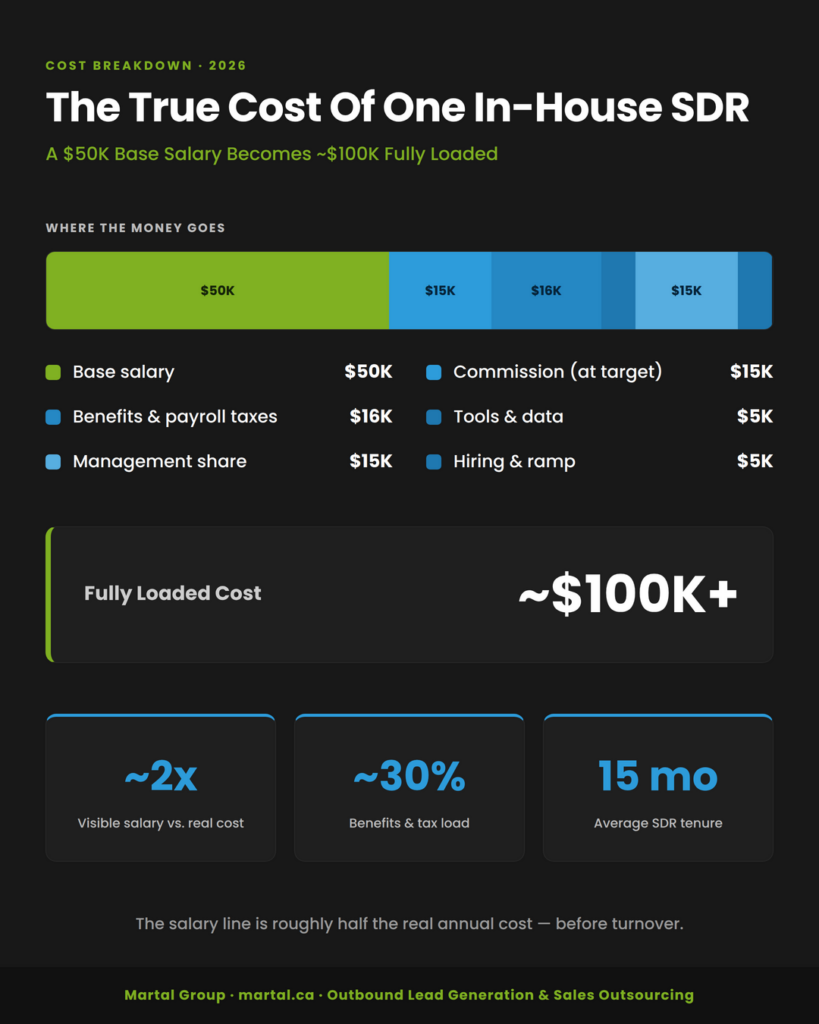
Put it together for a rep earning $50K base and $15K commission. You budget $65K. Then add ~$16K benefits and taxes, ~$5K tools, ~$15K management share, and ~$5K annualized hiring and training — and the true annual cost lands near $100,000. That’s the gap between what an SDR appears to cost and what they actually cost.
Understanding that full picture is exactly why so many B2B teams — especially in tech — are rethinking the all-in-house model. The next section covers the alternative: outsourcing SDR functions to strip out most of these hidden costs while still improving pipeline management and driving growth. (Want to run your own numbers? Martal’s ROI calculator models in-house vs. outsourced cost side by side.)
Outsourcing SDR Roles for Cost Efficiency and Greater ROI
Outsourcing SDR functions can cut total SDR costs by up to 65% compared to building in-house.
Reference Source: Martal Group
Given the mounting costs and churn of an in-house build, it’s no surprise so many B2B companies now weigh outsourced sales services instead. Outsourcing your sales development — through a fractional SDR team or a specialized agency — can dramatically lower your cost per lead and remove the management overhead entirely. A fully managed outbound engagement can cut total SDR costs by up to 65% versus an in-house team (9), while ramping faster. So the real question leaders wrestle with — is outsourcing SDRs worth it, or should we just hire in-house? — usually comes down to math, speed, and risk.
Here’s how outsourcing delivers those savings: instead of hiring employees, you pay a monthly fee for a fully-equipped SDR team — personnel, training, management, and lead generation tools for outbound campaigns, all in one price. The efficiency gains break down like this:
- No recruiting or training burden. Your partner handles hiring and ramp — you get ready-to-go talent. At Martal, our fractional SDR teams come battle-tested; in a role where average tenure is only about 15 months, that experience matters. In 2024, over 72% of our fractional SDRs had 15+ years of B2B experience (11), so they ramp in days, not months. While an in-house SDR takes 3–6 months to hire and fully ramp, outsourced teams can be operational within weeks (10). In one engagement with a security and surveillance company entering the US, leads were engaged within 10 days of signing the contract — the kind of speed an internal build simply can’t match. (13)
- Lower labor and overhead. A provider spreads overhead across many clients and taps onshore, locally aligned remote sales talent operating in your buyers’ timezone. You don’t pay payroll taxes, benefits, or idle ramp time — you pay for output (meetings booked, leads qualified). Tools and data infrastructure are the provider’s, not a line on your budget. Set against the ~$100K fully loaded cost of an in-house rep, that’s where the up-to-65% saving comes from.
- Expertise and omnichannel outreach. Specialist teams run coordinated omnichannel outreach, not three disconnected channels. Martal’s outbound programs combine B2B cold email, LinkedIn outreach, and phone calls in coordinated cadences so each prospect experiences continuity, not noise. An omnichannel marketing approach consistently outperforms single-channel efforts (10). The output speaks for itself: in one engagement, a manufacturing-focused AI knowledge platform turned 362 prospects into 153 SQLs and 84 booked meetings — a qualification rate an unspecialized internal team rarely reaches.
- Scalability and flexibility. You can scale up or down on demand — add capacity for a push, pull back when budgets tighten, without hiring or layoffs. The fractional model proves how lean this can run: Complete EDI saw 2 SQLs in week two and 14 SQLs across a 3-month pilot — with a single fractional rep. That’s expert coverage for a new market without a long-term headcount commitment.
- Performance and accountability. Reputable outsourced SDR partners align incentives with your results. If a rep underperforms, the provider fixes it — replace, retrain, or adjust strategy — at their cost, not yours. The upside shows up as better conversion rates and shorter sales cycles: an industrial LED and solar company generated 218 SQLs and 196 booked meetings; for Berger-Levrault, two deals alone justified the entire campaign investment; and Afton Tickets recovered its full campaign cost from a single closed deal. Quality goes up even as cost goes down with the right partner.
To make the comparison concrete:
- In-House SDR (fully loaded): ~$90K–$100K/year (base $50K plus benefits, tools, management share, and annualized hiring/ramp) — and higher if turnover hits mid-year.
- Outsourced SDR service (equivalent): ~$60K–$70K/year in fees, typically covering all compensation, tools, management, and a set volume of leads and meetings — with replacement risk on the provider, not you.
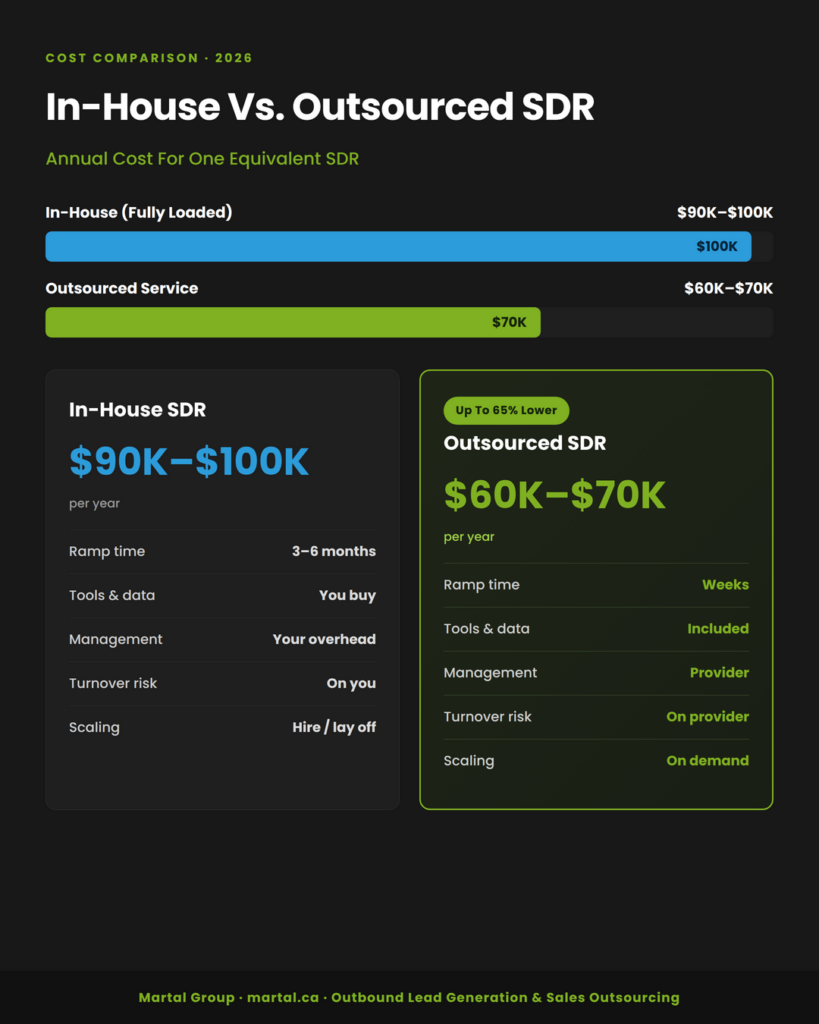
By outsourcing sales and marketing, you convert a fixed cost into a variable one tied to performance — usually spending less for the same or better outcomes.
The catch, of course, is choosing the right partner. You want a sales agency or fractional team that acts as a true extension of your sales team. At Martal, we embed our fractional SDRs into your workflow: they use your messaging and value propositions, coordinate with your AEs on hand-offs, and report in detail. We combine outbound lead generation, appointment setting, and AI-driven prospecting as one coordinated omnichannel service — a turnkey SDR function without the headaches.
And outsourcing doesn’t mean trading away quality — done right, it raises it, because you’re leveraging specialists. Our teams are run by experienced sales leaders who refine lead generation strategies across industries, and because outbound is our core business, we stay current on the tactics that move the needle — from LinkedIn targeting to email deliverability. The proof compounds over time: Clickworker’s nine-year partnership produced $4.5M in recurring revenue and a 500% ROI.
Bottom line: outsourcing SDR roles can meaningfully cut cost while increasing efficiency. You save on recruiting, training, salaries, and infrastructure, and gain a flexible, expert-driven pipeline engine — a strong fit for startups needing fast traction and mature teams optimizing spend alike.
In the final section, we’ll recap the key takeaways on SDR salaries and costs, and how to decide whether outsourcing with a sales partner like Martal is right for you.
Conclusion: Optimizing SDR Salary Spend and Next Steps
SDR salaries — and the broader cost of sales development — are make-or-break factors when you’re scaling a B2B revenue team. Here’s the recap:
- Average SDR compensation. Budget around $55K–$60K base for a capable SDR in 2026, with OTE of $83K–$95K at target (1). But plan against realistic attainment, not the headline OTE — with roughly half of reps hitting quota, real take-home often lands closer to $70K–$75K.
- Smart compensation structure. A base + commission plan (≈60–70% base, 30–40% variable) is the proven model — it rewards results (e.g., $100–$200 per qualified meeting) while keeping reps stable enough to protect lead quality (4). Avoid commission-only plans: cheap on paper, but they drive high turnover, burnout, and poor pipeline (5).
- Hidden costs of in-house SDRs. True cost runs far past salary. Recruiting, training, benefits, tools, and management roughly double the per-rep spend — most firms land near $90K–$100K per SDR per year, and turnover only amplifies it. Critical context for any honest budget or ROI model.
- Outsourcing as a cost-effective strategy. Outsourced or fractional SDR teams can cut total costs by up to 65% (9) while ramping in weeks instead of months. You shed hiring overhead, gain economies of scale on tools, and convert a fixed cost into a performance-tied variable one.
- Quality and efficiency gains. The right partner doesn’t just save money — it can increase sales and pipeline output. With coordinated omnichannel outreach, experienced reps, and fast ramp, you get more meetings and sales leads with less internal lift.
For revenue leaders, the mandate is clear: if you hire in-house, use this data to build a fair comp plan with an achievable quota — and budget for the support, tools, and turnover that come with it. If the cost or hassle of expanding an internal team is the bottleneck, an outsourced SDR solution is worth a serious look. Plenty of companies get better results at lower cost with a partner specialized in outbound sales, lead generation, and appointment setting.
If your team is ready to move past the hire-train-churn cycle, that’s exactly the problem we solve. Martal’s Sales-as-a-Service model pairs experienced onshore SDRs with our proprietary AI platform, running cold calling, cold emailing, and LinkedIn lead generation as one coordinated omnichannel strategy — delivering qualified meetings, not just activity. As one of the top lead generation companies, we’ll show you what a qualified pipeline actually looks like and tailor the approach to your industry and target market. Book a consultation to run your own in-house-vs-outsourced numbers and see where the 65% saving comes from for a team like yours.
References
- Coursera
- Kalungi
- Vouris
- Bentega
- Janek Performance Group
- Bureau of Labor Statistics
- VA Masters
- Zippia
- Martal Group – ROI Calculator
- Martal Group – SDR Manager: Outsourced vs In-House
- Martal Group – Fractional SDRs
- Qureos
- Climb
- Builtin
- Prospeo
- RepVue
- Trellus
- SyncGTM
- Payscale
- ZipRecruiter
- Sv
- Substack
- Visdum
- Sales So
FAQs: SDR Salary
Who gets paid more, BDR or SDR?
While the roles overlap, SDRs and BDRs earn almost the same — the gap is small enough to ignore. Median OTE runs about $85K for SDRs and $83K for BDRs. SDRs are often tied closely to quota-related performance through outbound prospecting, which can shape commission opportunity, while BDRs may carry broader responsibilities that are compensated differently. The differences are usually marginal — title and responsibilities vary by company, so pay depends more on sales team structure and quota design than on the role name itself. Roughly 60% of companies use the two titles interchangeably anyway.
Do SDRs actually hit their OTE?
Often, no — and this is the most important thing to understand about SDR salary. OTE is the total you’d earn at 100% quota attainment, not a guaranteed number. Only about 55% of reps actually hit quota, and at the more typical 60–80% attainment, an $85K OTE often translates to roughly $70,000–$75,000 in real take-home pay. Before accepting an offer, the smarter question isn’t “what’s the OTE?” but “what percentage of reps here actually hit quota?” Attainment depends heavily on lead quality, quota design, and enablement — the program matters more than the headline number. (24) (23)
Is SDR a tough job?
Yes — it’s one of the most demanding roles in sales. SDRs are often expected to make 60 to 80 touchpoints a day and absorb near-constant rejection, which is the main driver of burnout, and average tenure sits around 15 months. The role rewards resilience, sharp communication, and consistency under pressure. The upside is real, though: it’s one of the fastest on-ramps in B2B tech, with quick skill development and clear promotion paths into Account Executive or team-lead roles. With proper training, coaching, and fair pay, the SDR role can be both challenging and genuinely rewarding. (13)
Can you make a lot of money as an SDR?
Yes, depending on performance, location, and stage. Average total compensation (base + commission) sits around $83K–$95K, and top performers can earn up to roughly $141,000 a year, with enterprise SaaS reps in major hubs clearing $110K OTE. The bigger money usually comes from promotion: senior SDR, team lead, and Account Executive roles each reset comp upward. Entry-level reps start lower but can climb fast within 12–24 months. The lever is attainment — consistently hitting metrics tied to qualified meetings and pipeline created. (16)
Do remote SDRs make less money?
Not necessarily. The average remote SDR earns about $55,000 base, with most between $42,000 and $61,000, and remote base salaries generally run $50,000–$75,000 with OTE of $65,000–$95,000 or more. Some companies adjust pay by location; others pay a standardized rate regardless of where you live. Remote work has compressed the gaps between high- and low-cost markets, but hasn’t erased them — top-of-range pay still skews toward companies competing for talent in major hubs. For pipeline quality, what matters more than where a rep lives is whether they operate in your buyers’ timezone and market. (17) (20) (21)
Is it better to hire or outsource SDRs?
It depends on cost tolerance, speed, and risk appetite. A fully loaded in-house SDR runs $90K–$100K+ per year and takes 3–6 months to hire and ramp, with turnover risk on you. An outsourced or fractional team can cut total costs by up to 65%, ramp in weeks, and carry the management and replacement risk themselves. Hiring in-house makes sense when SDR work is core and you want full control day-to-day; outsourcing fits teams that need fast traction, want to test a new market, or prefer to convert a fixed cost into performance-tied spend. Many companies run both — an internal core plus outsourced capacity for expansion.