
 Martal
 Technology
 Education and training
 Web Development and UI / UX
 Healthcare/Medical
 Logistics and Supply Chain
 Information Technology
 Insuretech and Financial Services
 Marketplaces
 Software Development
 E-commerce and retail
 AI and Machine Learning
 Energy and Solar
 Manufacturing
 Security and Surveillance
 Digital Marketing Agency
 Transportation
 MSP
MSP
 Telecom
 B2B SaaS
 Cybersecurity
 HR tech
 Fintech
 Cleantech
 Consulting
Lead Generation Statistics: The 2026 Benchmarks That Move Pipeline
Major Takeaways: Lead Generation Statistics
61% of marketers say generating quality leads is their top challenge — underscoring that the 2026 problem isn’t lead volume, it’s lead readiness for sales.
The median B2B cost per lead reached ~$213, but the spread is enormous: ~$84 for disciplined, ICP-aligned programs versus ~$397 for volume-chasing teams — a 4.7× gap that makes cost-effective lead generation a function of targeting, not channel alone.
SEO (~$31), email marketing (~$53), and webinars (~$72) deliver the lowest average cost per lead among B2B channels, making them anchor tactics for high-ROI lead generation.
MQL-to-SQL conversion runs a median of ~13%, while top-quartile teams hit ~28% — and with roughly 79% of leads never converting, the widest gains sit mid-funnel in qualification, not at the website form.
Businesses using AI for lead generation report a 50% increase in sales-ready leads and up to 60% lower customer acquisition costs, confirming AI’s shift from experiment to pipeline infrastructure.
89% of B2B marketers use LinkedIn, it drives ~80% of all B2B social media leads, and it converts visitors to leads at 2.74% vs. 0.77% on Facebook — the clearest single-channel choice for reaching decision-makers.
Nurtured leads make 47% larger purchases, and companies that excel at nurturing generate 50% more sales-ready leads at 33% lower cost — the mechanism that converts the ~50% of leads not yet ready to buy.
Companies that blog consistently generate up to 13× more leads, and content marketing produces ~3× the leads at ~62% lower cost than many traditional channels.
Introduction
Lead generation statistics only matter if they change what you do next. In 2026, the gap between teams that hit pipeline targets and teams that miss is widening — and most of it traces back to a handful of decisions about channels, qualification, and follow-up that the data makes unusually clear. In this report, we break down the numbers behind B2B lead generation strategies — from industry-wide benchmarks to channel-specific performance — and interpret what they actually mean for the year ahead.
We built this guide by reviewing the leading benchmark reports, comparing what the most credible sources measured, and interpreting the findings through Martal’s own experience running omnichannel outbound campaigns across 50+ B2B verticals. The goal is simple: help B2B sales and marketing leaders cut through the noise, compare their options clearly, and focus on the metrics that move pipeline. Throughout, we’ll show how we apply these insights through our omnichannel, Sales-as-a-Service approach — filling client pipelines with qualified leads, not vanity metrics.
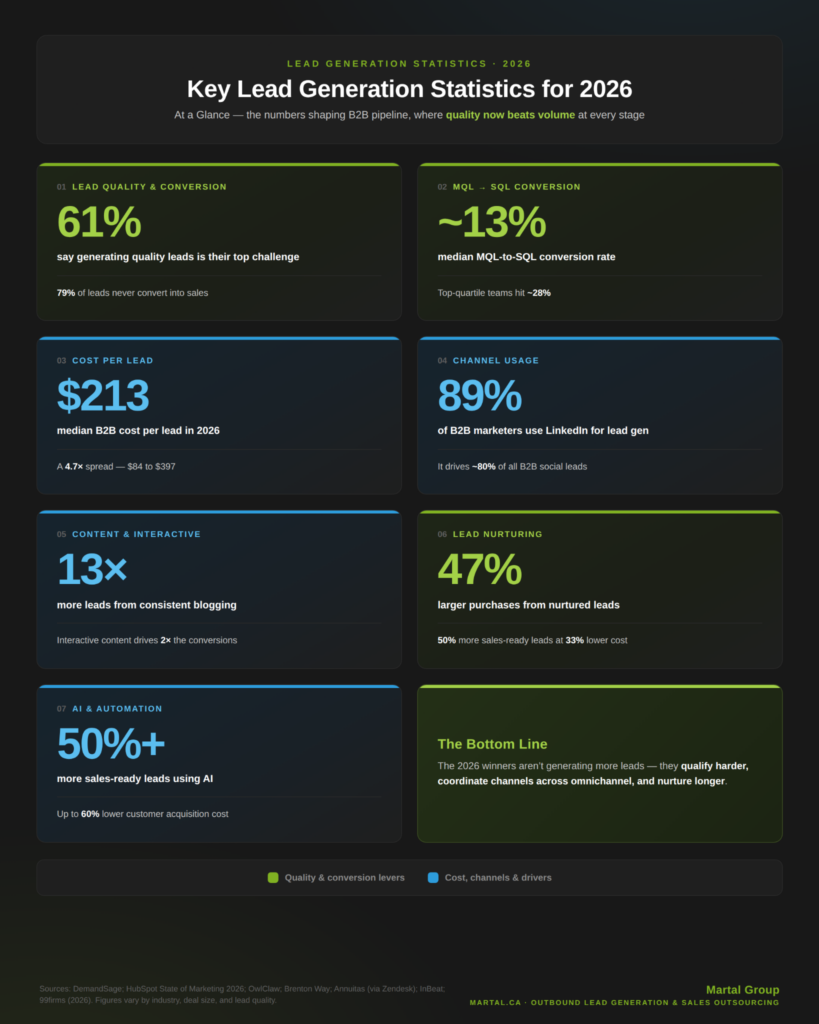
Key Lead Generation Statistics for 2026 (At a Glance)
Here’s a quick snapshot of the numbers shaping B2B lead generation in 2026 — what’s working, what’s getting more expensive, and where the gap between top and bottom performers is widening. Each stat is sourced; we unpack the most important ones in the sections that follow.
Lead Quality & Conversion
- 61% of marketers say generating quality leads is their top challenge (5)
- About 79% of leads never convert into sales, usually due to weak nurturing or qualification (15)
- Only ~20% of leads ultimately become customers (2)
- The average B2B website converts visitors to leads at ~2.23%; dedicated landing pages average ~6.6% (10)
Conversion Benchmarks: MQL → SQL → Close
- Average lead-to-MQL rate is ~25%; strong programs reach 35–45% (12)
- MQL-to-SQL conversion runs a median of ~13%, but top-quartile teams hit ~28% (33)
- Average lead-to-customer conversion is ~2.9% across 14 industries (31)
Cost Per Lead & Spend
- Median B2B cost per lead climbed to ~$213 in 2026 (up from $198 in 2025) — but the spread is enormous: top-quartile programs pay ~$84 vs. ~$397 in the bottom quartile, a 4.7× gap (33)
- Lowest cost-per-lead channels: SEO (~$31), email (~$53), and webinars (~$72) (5)
- 53%+ of marketers spend at least half their total budget on lead generation (2)
- Customer acquisition costs have risen ~60% over the past five years (30)
Channel Usage & Effectiveness
- 78% of companies use email, 67% use content marketing, and 66% use social media for lead generation (5)
- 89% of B2B marketers use LinkedIn for lead generation, and it drives ~80% of all B2B social media leads (18)
- LinkedIn converts visitors to leads at 2.74%, vs. 0.77% on Facebook and 0.69% on X (32)
- 73% of B2B marketers say webinars produce their best-quality leads (19)
Content & Interactive
- Companies that blog consistently generate up to 13× more leads (17); content marketing produces ~3× the leads at ~62% lower cost than many traditional channels (5)
- Interactive content drives ~2× the conversions and up to 4–5× more page views than static content (7)
Lead Nurturing
- Companies that excel at lead nurturing generate 50% more sales-ready leads at 33% lower cost (2)
- Nurtured leads make 47% larger purchases than non-nurtured leads (34)
- Roughly 50% of qualified leads aren’t ready to buy yet; effective nurture cycles typically run 6–12 touches (36)
AI & Automation
- Companies using AI for lead generation report 50%+ more sales-ready leads and up to 60% lower customer acquisition costs (3)
- 64% of businesses say AI chatbots help them generate more qualified leads (3)
- The AI lead generation market is projected to roughly double — from ~$7.4B today to ~$16.2B by 2034 (37)
What are the Statistics On Lead Generation?
79% of leads never convert into sales due to poor nurturing and qualification.
Reference Source: Marketing Sherpa (Via Salesforce)
B2B companies place enormous emphasis on lead generation – and with good reason. Nearly half (49%) of B2B marketers say that generating more leads is their biggest marketing priority, yet 41% also cite it as their biggest challenge (1). In other words, *demand generation is mission-critical, but consistently acquiring quality B2B leads is easier said than done. A skilled lead generation specialist understands that volume alone isn’t enough if those leads don’t convert, quality and intent matter just as much as reach. One thing we see often in our own campaigns: a list of 500 contacts that looks impressive on a dashboard can produce fewer real conversations than 80 prospects chosen for genuine fit. Reach is easy to manufacture. Relevance isn’t.
One striking statistic highlights the quality gap: about 79% of leads never convert into sales (15), often because they lack proper nurturing or qualification. No wonder 68% of B2B marketers say increasing lead quality is their number-one mission (2).
This aligns with the philosophy behindour lead generation services – we focus on sales-ready leads over vanity metrics. A reliable lead generator continuously feeds the pipeline with prospects that match your ideal customer profile, not just contacts that inflate your CRM. By rigorously qualifying prospects (e.g. through targeted lead generation questions and intent signals) and nurturing them over time, companies can dramatically improve outcomes. A structured lead generation workflow ensures every prospect moves through the right stage, from first contact to sales-ready handoff, without falling through the cracks. In fact, firms that excel at lead nurturing generate 50% more sales-ready leads at a 33% lower cost than those that don’t (2). It pays to treat lead gen as a process, not a one-off event. For teams without the internal resources to manage this end to end, done for you lead generation offers a practical path to consistent pipeline growth without the overhead of building everything in-house.
That distinction shows up in the numbers. In one engagement with a manufacturing company entering the US market for the first time, the program delivered 203 sales-qualified leads over 14 months — drawn from roughly 1,600 prospects engaged. The headline isn’t the volume at the top; it’s how many of those prospects became genuinely sales-ready opportunities, which is the only number that funds a pipeline. View the manufacturing use case.
Several other B2B lead gen stats show where successful teams are investing their energy:
- Landing pages and conversion paths: 68% of B2B businesses use strategic landing pages specifically for lead capture (4). Creating dedicated, well-optimized landing pages (with offers like demos or whitepapers) is a proven tactic to convert more visitors into leads.
- SEO and content: 59% of B2B marketers believe SEO has the largest impact on lead generation goals (2). Organic search visibility – often driven by content marketing (blogs, thought leadership) – consistently brings in high-intent traffic. We’ve found that combining SEO-informed content with targeted outbound outreach produces complementary benefits, organic content builds long-term pull while targeted outreach accelerates short-term engagement.
- LinkedIn and social prospecting: About 89% of B2B professionals use LinkedIn to generate leads (2) – a statistic we’ll unpack further in the LinkedIn section. B2B teams are clearly leveraging professional networks to find and engage decision-makers.
- Lead verification: Only 56% of B2B companies verify or validate leads before passing them to sales (2), which means nearly half are likely sending unvetted contacts to account execs. Close coordination between marketing and sales (and using tools to validate emails, titles, etc.) can prevent wasted effort on “leads” that aren’t truly viable.
Ultimately, effective B2B lead generation in 2025 and beyond is about working smarter, not just harder. High-performing teams balance quantity and quality – they use multiple channels to cast a wide net, but also employ data and personalization to filter and nurture the most promising prospects. In our own programs, we keep a close eye on metrics like lead-to-opportunity conversion rate and cost per qualified lead, rather than just total lead volume. As we’ll see in the sections below, the data points to strategies (from content to AI) that can significantly improve these metrics in 2026.
Lead Generation Industry Statistics: Market Size & Cost Per Lead
The global lead generation industry is projected to reach $295 billion by 2027, growing at an estimated 17% CAGR, as businesses invest heavily in automation and outsourced sales solutions.
Reference Source: Business Wire
Lead generation isn’t just a marketing task – it’s a booming industry in its own right. The market for lead generation services and software has grown rapidly and is poised to keep expanding through 2026. Globally, the lead generation industry is projected to reach about $295 billion in value by 2027, growing at a ~17% CAGR (16). More recent market modeling tracks the same trajectory: one analysis values the lead generation solutions market at roughly $4.3 billion in 2023, projected to reach about $15.6 billion by 2031 at a ~17.5% CAGR (31). Different analysts size the category differently depending on what they include, but the direction is consistent across every credible forecast — sustained double-digit growth driven by automation and outsourced sales.
To put the market size in perspective, well over 300,000 companies worldwide specialize in lead generation in some form (including agencies, tech platforms, data providers, etc.) (2). It’s a crowded field, and many B2B firms now turn to outside experts (like sales outsourcing or lead gen agencies) to supplement their internal teams. Our Sales-as-a-Service model fits into this landscape by giving tech companies on-demand access to experienced SDRs, intent data, and omnichannel outreach without having to build it all in-house.
From a budgeting standpoint, businesses are dedicating significant resources to lead acquisition. Over 53% of marketers report spending at least half of their total budget on lead generation (2), and this figure is trending upward. In many organizations, lead gen and sales development are the lifeblood of growth, which justifies the heavy investment. However, with increased spend comes increased scrutiny on ROI – every dollar needs to count.
Some industry-wide benchmarks are useful for setting expectations. Currently, organizations generate about 1,877 leads per month on average (5), though it’s worth noting that modern public benchmarks for raw monthly volume are thin, and this figure varies enormously by company size, sector, and how each team defines a ‘lead.’ Of course, “lead” is defined differently by each company (this could include everything from newsletter signups to demo requests), and lead counts vary wildly by company size and sector. Mid-sized and large enterprises often report a majority of their leads are marketing-qualified (MQL) but not yet sales-qualified – reinforcing the need for robust qualification processes. It’s also telling that 61% of companies say generating quality leads is a great challenge (5), nearly as many as those who call it a top goal. High volume doesn’t automatically translate to high quality.
Lead acquisition costs continue to climb. Studies indicate that customer acquisition costs have increased by approximately 60% over the past five years (30), reflecting growing competition for digital attention and rising paid media costs. This sustained increase in cost per lead (CPL) is pushing companies toward automation, data-driven targeting, and AI-assisted optimization to improve ROI.
For B2B companies, the median cost per lead reached about $213 in 2026, up from $198 in 2025 (32). But the median hides the real story. The same data shows a 4.7× gap between the top and bottom quartile — roughly $84 per lead for disciplined, ICP-aligned programs versus $397 for teams still chasing raw volume. From an execution standpoint, that spread is the whole game: a low CPL on poorly qualified leads is expensive once you trace it to cost-per-closed-deal, while a higher CPL on tightly targeted prospects often closes far more efficiently. The right benchmark isn’t CPL in isolation — it’s what each lead costs you at the deal stage.
Average Cost per Lead by Channel (B2B) (5)
Lead Generation Channel
Avg. Cost Per Lead (USD)
Events & Trade Shows
$811 – $881
Public Relations (PR)
~$294
Video Marketing
~$174
Search Engine Advertising
~$110
Content Marketing
~$92
Referrals
~$73
LinkedIn Advertising
~$75
Webinars
~$72
Display Advertising
~$63
Social Media Advertising
~$58
Email Marketing
~$53
SEO (Organic Search)
~$31
Source: DemandSage, HubSpot, BusinessWire
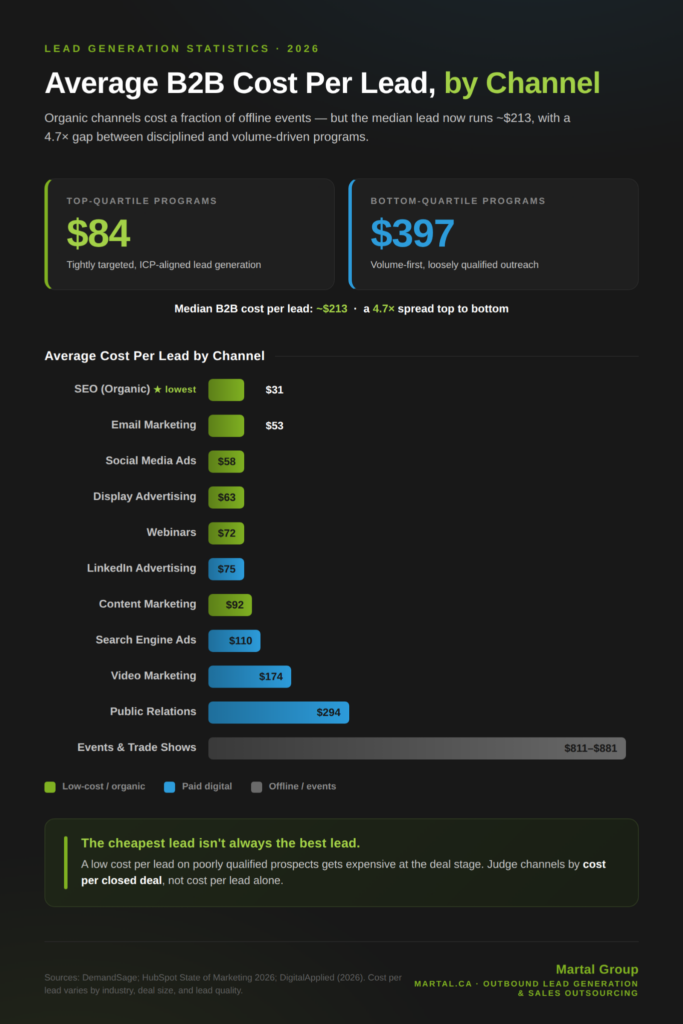
The cost disparities are striking – offline events and trade shows can cost hundreds of dollars per lead, while organic methods like SEO cost only a few tens of dollars per lead. This doesn’t mean trade shows or events are “bad” (they often produce very high-quality enterprise leads, hence the cost), but it does show why digital-first lead generation is so attractive. Channels like email, content, SEO, and social media can yield large volumes of leads at a fraction of the cost of traditional methods (1). It’s no surprise that many companies are reallocating budgets toward digital tactics in 2025.
Channels like email, content, SEO, and social media can yield large volumes of leads at a fraction of the cost of some traditional channels. As a result, many companies are adjusting their budget mix toward digital tactics while still deploying outbound approaches for targeted, immediate reach.
Finally, the industry is seeing technology play a bigger role in streamlining lead gen. Roughly 80% of marketers say that marketing automation software generates more leads and conversions for them (5), and 92% of marketing agencies invest in marketing automation tools (2). From CRM systems to AI-driven prospecting platforms (like our own Martal AI Sales Platform), the use of automation and analytics is now table stakes for scalable lead generation. We’ll discuss the impact of AI in a later section, but the key takeaway is that data and lead generation software are critical force-multipliers. The 2026 outlook is an industry that’s larger, more tech-enabled, and still rapidly evolving – meaning B2B leaders must stay agile and informed to keep a competitive edge.
Online Lead Generation Statistics
78% of companies use email, 67% rely on content marketing, and 66% leverage social media for lead generation—making these the top three digital channels.
Reference Source: DemandSage
If one thing is clear today, it’s that lead generation has decisively moved online. Modern buyers now complete the majority of their purchasing journey digitally before ever speaking with sales. Recent research shows that 67% of the B2B buying journey now happens online, while 90% of B2B buyers rely on digital channels as their primary way of discovering new vendors (27).
As a result, lead generation in 2026 is fundamentally a digital-first discipline driven by content, search, social platforms, and self-service experiences rather than traditional offline tactics.
Buyers increasingly prefer independent research as well, 81% conduct online research before making a purchase (28) and prospects are often more than halfway through their decision process before engaging a salesperson.
Effective lead generation is now an omnichannel digital game, where SEO, content marketing, AI-assisted outreach, and marketing automation outperform legacy channels like trade shows or print advertising. Traditional methods still have niche value, but pipeline growth today is overwhelmingly shaped by digital engagement.
So where are marketers actually focusing their online lead gen efforts? It’s one of the most common questions we hear — phrased on forums almost exactly as “What are some ways that businesses can generate new leads?” — and the honest answer is that most teams now run several coordinated channels at once rather than betting on one. Here’s a quick rundown of channel usage:
- Email marketing – Still the workhorse of B2B lead gen. 78% of companies use email campaigns for lead generation (5), making it the most-used tactic overall. It’s also frequently ranked as the top-performing channel (42% of companies say email is their most important lead factor (5)). We can attest: carefully crafted cold emails and email newsletters remain incredibly effective for engaging prospects – our own Martal cold email service consistently delivers strong response rates when personalization and timing are on point.
- Event marketing (webinars/virtual events) – Used by about 73% of organizations for lead gen (19). This includes hosting webinars, workshops, virtual conferences, etc., which we’ll explore in detail later. The key is that events (even online ones) create live engagement opportunities that can yield highly interested leads.
- Content marketing – 67% of companies rely on content (blogs, eBooks, case studies) to attract and convert sales leads (5). Content is the fuel for SEO, email nurturing, social sharing – essentially the inbound side of lead gen. It’s no coincidence that our Lead Generation programs often involve aligning outbound outreach with compelling content offers to warm up prospects.
- Social media – Around 66% of marketers have generated leads via social media by spending just 6 hours per week on it (4). Paid and organic social campaigns (on platforms like LinkedIn, Facebook, Twitter/X, Instagram) are mainstream in lead gen. Social media’s targeting capabilities and massive user bases are huge advantages, though as we’ll discuss, not all social platforms are equal for B2B leads.
- Paid search and online ads – Pay-per-click (PPC) campaigns on Google, Bing, and social ad networks are common for capturing leads searching or browsing related topics. In fact, 27% of marketers in one study said organic search brought them the most leads, and 21% cited social media as their top lead source (5). Paid search can amplify that presence. However, only 1% said paid search was their #1 source (5), indicating that organic efforts often outperform pure paid lead-gen in volume or cost-efficiency.
- Live chat and chatbots – A growing piece of the online mix. About 33% of businesses now use live chat or chatbots on their website to generate leads (5) (capturing inquiries, demo requests, etc. in real-time). This is an area where our Martal team sees a lot of potential, especially with AI chatbots qualifying site visitors automatically – more on this in the chatbot stats section.
Despite the plethora of channels, marketers still struggle to make them work together. Only 41% of marketers are completely satisfied with how well their channels are integrated (13), according to a Salesforce report. The rest are still tweaking the mix — which is exactly the problem coordinated, omnichannel sequencing is built to solve. The rest are tweaking and testing channel mixes to find the right balance. From our experience, the highest ROI comes from a coordinated omnichannel approach – for example, using email and LinkedIn and phone calls in a synchronized cadence, so prospects receive reinforcing touches. Martal’s omnichannel outreach (combining cold email sequences, LinkedIn messaging via our LinkedIn Lead Generation Service, and strategic cold calling) is designed around this principle. Each channel alone has limitations – for instance, cold calling is tough when 97% of people ignore unsolicited calls (5), but if that call is preceded by an intro email and a LinkedIn connection, the odds of engagement increase greatly.
Another critical factor is speed and follow-up in online lead gen. Digital leads expect a quick response – one study found there are 9× more chances of converting a lead if you follow up within 5 minutes of their inquiry (5). Yet 42% of sales reps feel too busy to follow up that fast (3), and 41% of businesses admit they don’t have an efficient lead nurturing process (3). This is where technology and process make a difference. Automated lead generation tools and sequences ensure no inbound lead goes cold, eliminating the lag that costs businesses valuable conversions. Automated alerts and sequences ensure no inbound lead goes cold. For example, if someone downloads a whitepaper from a site, the system (and SDR team) follows up while the interest is hot. The stats are clear that responsiveness can make or break conversions.
In short, online lead generation in 2026 is about being present where your prospects are active, and responding on their terms. The data shows most B2B buyers conduct extensive online research (via search, content consumption, social lurking) before ever speaking to sales. By deploying a mix of content, SEO, email, social, and chat touchpoints, and then following up swiftly with qualified outreach, companies can meet buyers at just the right moment. As we proceed, we’ll delve into each major channel and tactic to see exactly what the latest statistics reveal about effectiveness – and how those insights can shape a smarter 2026 lead gen strategy.
Content Marketing Lead Generation Statistics
Businesses that publish blogs consistently generate 13x more leads and achieve better returns.
Reference Source: HubSpot
In the B2B realm, it’s often said that “content is king” – and the numbers certainly back that up. Content marketing has become virtually ubiquitous as a lead generation strategy, because providing valuable content is a magnet for attracting prospects. A vast 91% of B2B marketers use content marketing in some form, and 74% say it’s effective for generating leads (10). This high adoption reflects a simple truth: decision-makers are far more likely to engage with your company if you educate or help them first. By sharing expertise through blogs, guides, videos, etc., you build trust and capture inbound interest.
Let’s look at a few stats that highlight content marketing’s impact on lead gen:
- Higher lead volume and ROI: Companies that commit to content see outsized results. Businesses that maintain an active blog generate up to 13× more leads on average than those that don’t (17). This is a long-cited HubSpot benchmark — it predates the current AI-content era, so treat the exact multiple as directional rather than precise. But the underlying pattern still holds: consistent, genuinely useful content compounds into organic discovery and warmer outbound conversations over time. What’s changed isn’t whether content works — it’s that the bar for ‘useful’ is far higher now, because both buyers and AI search engines filter aggressively for substance over volume.
- Cost efficiency: Content marketing isn’t just effective; it’s efficient. It costs 62% less than traditional marketing on a per-lead basis (5). Moreover, content marketing was shown to generate 3× as many leads as traditional outbound marketing (display ads, social media ads, direct mail, etc.) while costing significantly less than half per lead (5). These stats reinforce why so many teams invest in content – it scales well and keeps paying dividends through organic search and shares.
- Lead quality and nurturing: Content is a cornerstone for lead nurturing. 56% of marketers believe that providing compelling content at each stage of the buyer’s journey is key to email marketing success (5), and by extension lead nurturing. When you offer targeted content (like case studies for mid-funnel prospects or ROI calculators for late-funnel), you guide leads along and improve conversion rates. Our approach often involves equipping our outbound sales sequences with high-value content (webinars, whitepapers) so prospects see valuable insights instead of just sales pitches – a tactic that boosts reply and meeting rates.
- Impact on brand and demand: Content doesn’t only capture leads; it creates awareness that fills the top of the funnel. 76% of businesses reported that content marketing boosted their demand and lead generation (13), and 84% said it raised brand awareness too. These softer metrics translate into easier lead gen down the road – a recognizable, trusted brand will naturally attract more inbound inquiries. We’ve witnessed this with Martal’s own content (like our B2B Growth blog): prospects often reference our articles or guides, meaning the content has already “pre-sold” them on our expertise before the first call.
One noteworthy trend in 2026 is the diversification of content formats. While blogs and eBooks have been staples, new formats are gaining ground:
- Video and webinars: Video content’s popularity is surging – 70% of B2B marketers say video outperforms other content for engagement (10). Webinars combine the power of video with live interaction, making them highly effective (we’ll cover specific webinar stats in the next section).
- Podcasts: Surprisingly, 77% of marketers reported that podcasts are one of the most effective content types for generating leads (5). Audio thought leadership offers a more personal, on-demand way to connect with busy executives. Many companies now use podcast interviews or discussions to indirectly pitch their expertise and capture leads via episode sign-ups or follow-up content.
- Interactive content: About 45% of marketers find interactive content (quizzes, calculators, assessments) effective for lead generation. We have a whole section on interactive content stats later, but the short story is that interactive pieces can dramatically boost engagement and conversion rates, enriching your content arsenal.
B2B Content Marketing Lead Generation Statistics
Focusing specifically on B2B contexts, the reliance on content is even more pronounced. B2B buyers typically consume a variety of content before ever speaking to sales, from technical whitepapers to vendor comparison blogs. Here are some B2B-focused content stats:
- Virtually all B2B marketers use content: 91% use content marketing regularly, and three-quarters say it’s a lead-gen workhorse (10). In our experience, B2B sales cycles demand nurturing and education – content fills that role by addressing questions and pain points at scale.
- Effect on lead quality: 70% of B2B marketers affirm that content marketing generates leads effectively (5), and 58% believe it directly increases the quantity and quality of leads (5). Especially for complex or high-ticket solutions, detailed content (research reports, how-to guides, case studies) weeds out casual visitors and draws in serious prospects looking to solve a problem.
- Blogging yields more leads: B2B companies with blogs have historically reported 67% more leads than those without (4). This comes from an older Marketo study, so we’d treat it as a directional signal rather than a current guarantee — but the logic remains sound: a steady stream of blog posts aimed at a specific audience keeps capturing leads through organic search and sharing long after publication. For example, when we publish targeted content like our guide on outsourcing B2B sales [(9)], it educates the market and generates inbound consulting inquiries from companies that find it useful.
- Long-term trust building: Content helps B2B firms establish thought leadership, which pays off in lead gen. About 75% of businesses say they can demonstrate content marketing’s impact by the number of engaged audiences it attracts (5), and 78% measure content success by website traffic growth (5). These engaged visitors often convert down the line. We’ve seen that by the time an inbound lead comes to our Martal team, they may have already read several of our articles – essentially pre-qualifying themselves through content engagement.
In summary, content marketing is a foundational layer of lead generation. The 2026 outlook is that content will become even more personalized and interactive (with AI tools aiding content creation and customization). B2B marketing leaders should ensure they have a robust content strategy feeding their pipeline: think educational resources for top-of-funnel, persuasive content for mid-funnel, and proof-based content (case studies, ROI analysis) for bottom-of-funnel. And for those wondering – yes, content marketing and outbound efforts can symbiotically work together. In fact, our omnichannel Martal approach often amplifies client content via outbound channels, ensuring that no good whitepaper or webinar fails to reach a prospect who’d benefit from it. The data clearly shows that content is one of the best investments for sustainable lead generation.
Social Media Lead Generation Statistics
Marketers who spend as little as 6 hours per week on social media report generating measurable leads, with 66% confirming success through organic engagement.
Reference Source: BloggingWizard
Social media isn’t just for brand awareness or B2C marketing – it’s a significant lead generation channel for many businesses. In the B2B space, social media can play a dual role: organically distributing content to attract prospects, and serving as a platform for targeted advertising and direct outreach. The effectiveness of social media for lead gen can be a bit polarizing in surveys, but usage remains high.
First, consider adoption: over 80% of B2B marketers use some form of social media marketing, and 66% report generating leads via social networks with relatively little time invested (4). A study by Social Media Examiner found that two-thirds of marketers could produce new leads by spending roughly 6 hours per week on social marketing (4). That’s a reasonable commitment for potentially big payoff – one can schedule a few posts, interact in industry groups, or run a small ad campaign and see tangible lead results.
However, not all social platforms are equal in lead generation power (especially for B2B). Here are some key social lead gen stats and lead generation trends:
- LinkedIn leads the pack for B2B (by far): We’ll delve deeper into LinkedIn next, but it’s worth noting here that LinkedIn is responsible for around 80% of all B2B social media leads (4), according to an Oktopost analysis. B2B companies report that LinkedIn delivers the highest quality leads among social channels. This aligns with our experience – LinkedIn is a goldmine for connecting with decision-makers, which is why we offer a dedicated LinkedIn Lead Generation Service as part of our outreach programs.
- Effectiveness vs. efficiency: Marketers give mixed reviews on social lead quality. Only 19% of marketers agreed that social media produces “high quality” leads consistently (5), indicating some skepticism. It’s true that on networks like Facebook or Twitter, consumer noise can dilute B2B targeting. Yet, 73% of B2B marketers still find social media at least somewhat effective for achieving business objectives (10), showing that it does contribute value, especially for top-of-funnel awareness and retargeting.
- Lead gen as a motivator for new platforms: About 33% of marketers say the potential for lead generation is a top reason they invest in emerging social platforms (3). For example, as newer networks (like TikTok or emerging B2B communities) gain traction, marketers explore them hoping to tap new lead pools early. We’ve seen some Martal clients experiment with channels like Quora or Reddit for niche targeting – while not traditional “social networks” in the Facebook sense, they are social communities that can yield leads if approached correctly.
- Paid social ads: Paid social advertising allows fine targeting (by job title, interest, etc.) and can yield cost-effective leads — the average cost per lead on social ads is relatively low (~$58 per the data above). The catch is that converting a social-ad click into a real lead almost always hinges on a compelling, well-matched offer. For most B2B teams, a strong gated asset — a tech guide, a webinar signup, an ROI tool — is what turns a cheap click into an actual conversation.
- Social selling & outreach: For B2B, that predominantly means LinkedIn — the majority of B2B sales teams use it to research, identify, and engage prospects, making it the default social-selling channel (33). Twitter/X and Facebook can also help warm up a prospect (for example, by engaging with their posts) before direct outreach, though that role is more indirect.
One caution: focus your social media efforts on the platforms where your target audience actually engages. The shotgun approach of trying to be everywhere often leads to wasted effort. The data suggests LinkedIn and perhaps Twitter (for tech circles) are prime for B2B; whereas Instagram, TikTok, and Facebook might be secondary unless you’re targeting specific verticals or younger demographics. It’s also useful to align content type to platform – e.g., short video clips for LinkedIn or YouTube, infographic snippets for Twitter, etc.
Our strategy typically prioritizes LinkedIn for direct lead gen, while using other networks to amplify content. For example, we might repurpose a blog post into a series of informative tweets or an infographic on LinkedIn, driving traffic back to a landing page. Social proof and activity can also enhance credibility when prospects research your company (they often will check your LinkedIn or Twitter profile). Thus, even when social doesn’t produce a lead outright, it can nurture and support the lead generation process.
In summary, social media is a lead gen ingredient that needs the right recipe. The 2026 prediction is that social platforms will continue refining their B2B offerings (LinkedIn has been adding more lead gen forms and tools, for instance). We anticipate more integration between social media and CRM/automation tools too – e.g., auto-importing leads from LinkedIn campaigns into your pipeline, something our Martal tech stack already does to ensure no social-sourced lead falls through the cracks. Next, we’ll zero in on the star of B2B social media: LinkedIn.
LinkedIn Lead Generation Statistics
89% of B2B marketers use LinkedIn for lead generation.
Reference Source: LinkedIn Lead Generation
LinkedIn is widely regarded as “the B2B lead generation platform”, and the statistics unequivocally back this up. For any B2B marketer or sales team, LinkedIn is a non-negotiable channel in 2026. It’s where professionals network, research solutions, and engage in industry conversations – essentially a giant virtual trade show floor open 24/7. Here are the key LinkedIn lead gen stats that demonstrate its dominance:
What percentage of B2B marketers use LinkedIn for lead generation?
Approximately 89% of B2B marketers use LinkedIn for lead generation (18). This high adoption reflects LinkedIn’s unique role in business development. Around 62% of marketers report that LinkedIn produces leads effectively (14), and the platform drives roughly 80% of B2B social media leads (10).
- Nearly nine out of ten B2B marketing teams rely on LinkedIn to find prospects, distribute content, or run targeted lead generation ads. The platform’s precise targeting filters – by industry, job title, company size, and more – make it a goldmine for lead generation when used strategically. Social selling is also widespread: over half of B2B sales reps use LinkedIn to prospect or network, making it an indispensable channel for both marketing and sales teams.
At Martal, LinkedIn plays a central role in our omnichannel campaigns. Our SDRs combine connection-based outreach with sponsored posts and content-driven engagement, ensuring clients reach highly targeted B2B audiences efficiently. By integrating our LinkedIn lead generation services into a broader AI-powered and human-assisted sales strategy, we help companies capture more qualified leads and accelerate pipeline growth.
- LinkedIn’s lead generation effectiveness eclipses other social networks. One famous statistic: LinkedIn converts visitors to leads 277% more effectively than Facebook and Twitter (X) (33). The underlying numbers make it concrete — LinkedIn’s visitor-to-lead conversion rate is about 2.74%, versus 0.77% on Facebook and 0.69% on X (33). Originally a HubSpot finding and echoed widely since, it reflects something structural: LinkedIn’s users are there for business context. When we approach prospects on LinkedIn through our LinkedIn Lead Generation Service, they’re generally receptive because it’s an expected channel for professional conversation — unlike an unsolicited pitch on a consumer network.
- High share of B2B social leads: As mentioned, LinkedIn delivers 4 out of 5 B2B social media leads overall (4). It also earns strong marks for return: about 79% of B2B marketers rate LinkedIn as delivering the best results among social channels for their campaigns (33). We often tell clients that if you can only commit to one social platform for lead gen, make it LinkedIn — the lead quality and professional targeting (industry, role, company size) are unmatched.
- Decision-makers abound on LinkedIn: The platform now hosts over 1.1 billion members, including millions of senior decision-makers (34). In fact, 62% of professionals in one survey said LinkedIn helped them generate 2× more leads than the next-best social channel (2). When prospecting, finding the right contact is half the battle – LinkedIn’s database essentially gives you a constantly updated list of who’s who in each company. Our Martal team uses LinkedIn Sales Navigator extensively to zero in on ideal profiles (e.g., “CFOs in fintech companies with 50-200 employees in North America”) – a task that would be exponentially harder without LinkedIn.
- Conversion and customer acquisition: It’s not just about gathering contacts; LinkedIn leads tend to convert well. 59% of marketers claim they have successfully acquired customers through LinkedIn (5). Additionally, LinkedIn’s own marketing reports often cite that visitors from LinkedIn are more likely to convert on B2B websites than visitors from other social platforms. This speaks to the high intent level – if someone clicked your LinkedIn ad or engaged with your post, they likely have a relevant business problem and budget.
LinkedIn also offers specific features geared for lead gen: Lead Gen Forms (pre-filled forms on ads), Sponsored InMail, and the ability to post long-form articles or newsletters. These can be harnessed to capture leads directly on the platform. For example, we’ve run campaigns where a LinkedIn ad promoting a whitepaper uses a Lead Gen Form – when a user submits, their info flows straight into our CRM and an email with the asset is sent, all in minutes. The seamlessness of this process often yields high conversion rates, as the prospect doesn’t even have to leave LinkedIn to become a lead.
Another angle is personal branding and content on LinkedIn. Many sales and exec leaders build a following by sharing insights on LinkedIn, which in turn generates inbound leads. A robust presence can make your outreach more effective too – prospects will often check your profile. If they see you share valuable content and have a professional brand, they’re more inclined to respond. That’s why we encourage clients to invest in LinkedIn content and not treat it purely as an advertising channel.
From Martal’s perspective, LinkedIn is integral to our omnichannel marketing strategy. Our outsourced SDR teams use LinkedIn to complement cold emails and calls. Often, we’ll send a connection request to a prospect mentioning a recent pain point or industry topic (backed by our research), and follow up with a helpful snippet or case study. This warms the relationship and opens a dialogue. The stats show this approach aligns with buyer behavior – roughly 40% of B2B buyers say they’ve reached out to a vendor after seeing them on LinkedIn, according to LinkedIn’s own survey data. It’s a trust signal to be active and helpful on the platform.
Looking at 2026, LinkedIn’s role in lead generation will likely grow even more. Microsoft (LinkedIn’s owner) has been integrating AI and more robust analytics into the platform, which could further improve targeting. We foresee features like AI-suggested lead lists or enhanced intent data on LinkedIn. For now, the playbook remains: be active, be genuine, and leverage LinkedIn as a core pillar of B2B lead gen. The numbers make it clear: ignoring LinkedIn means leaving a huge number of potential leads on the table.
Webinar Lead Generation Statistics
73% of B2B marketers say webinars produce the highest-quality leads, making them one of the most efficient channels.
Reference Source: Cvent
Webinar lead generation has experienced a renaissance in the past few years, solidifying webinars as one of the highest-yield lead generation and prospecting tools, especially for B2B companies. In 2020-2022, the pandemic forced events to go virtual, and marketers discovered that well-executed webinars can produce a trove of engaged leads. Even as in-person events return, webinars remain extremely popular in 2026. The statistics around webinar marketing are quite compelling:
- Marketers consider webinars vital: An impressive 95% of marketers say webinars are key to their strategy and effective for lead generation (6). This indicates near-universal acknowledgment of webinars’ value. In our own practice, we frequently assist clients in promoting webinars and then following up with registrants – webinar sign-ups are essentially warm leads who have self-identified interest in a topic.
- High lead quality: Webinars are known for attracting high-quality leads. In fact, 83% of marketers report that webinars generate high-quality leads for them (6), and 73% of B2B marketers say webinars produce the best quality leads of any channel (19). Think about it: someone who will spend 30–60 minutes attending a webinar to learn about an industry topic is likely either a decision-maker or an influencer with serious interest. These aren’t tire-kickers; they’re often actively researching solutions. We’ve seen Martal clients close significant deals from webinar attendees who initially came just to educate themselves.
- Webinars outperform other channels in nurturing: Nearly 89% of marketers agreed that webinars outperform other channels for generating qualified leads (6). The interactive nature (Q&A, polls) builds trust and relationship in a way static content doesn’t. It’s essentially a one-to-many sales presentation that provides value first. Post-webinar, attendees are much more receptive to sales outreach. Recognizing the high engagement of post-webinar attendees, we treat them as hot MQLs and activate our B2B appointment setting service to accelerate conversions.
- Cost per lead advantage: Despite their richness, webinars can be cost-efficient. The average cost per lead from webinars is around $72, notably lower than many other channels – for context, that’s cheaper than PPC leads and far cheaper than trade show leads (6). One reason: a single webinar can attract dozens, even hundreds of leads in one go, amortizing the cost of producing the event. Compare $72/webinar lead to ~$92 per SEM lead or $811 per trade show lead from earlier stats – webinars deliver a great bang for the buck (6).
- Impact on pipeline: Webinars don’t just gather names; they propel prospects down the funnel. 62% of webinar attendees indicate interest in a sales demo following the webinar (6). We’ve observed similar patterns – a well-targeted webinar (say on a tech problem our client solves) often results in a flurry of demo requests or at least openness to a meeting. It essentially pre-qualifies and educates leads en masse. No wonder many SaaS companies run recurring webinar series as a core part of their demand gen.
- Engagement metrics: The average attendance rate for webinars is about 44% of registrants (6), which is actually quite good (nearly half of those who sign up do attend live). Attendees also stay engaged: the average viewing time is ~51-52 minutes, almost the full duration of typical webinars (6). These stats tell us that if you can get someone to register and show up, you have their attention for nearly an hour – a small miracle in today’s world of short attention spans! Many marketers cite webinars as having one of the highest engagement levels of any content format.
- Interactivity and satisfaction: Modern webinars incorporate interactive elements like polls, chat, and downloadable resources. 63% of attendees prefer interactive webinars over standard lecture-style (6), and it shows in feedback and conversion rates. Interactive webinars yield better post-event follow-ups because attendees feel involved. We always advise making webinars conversational and including audience Q&A – it not only delivers value, but those questions are sales clues for follow-up (each question hints at what that person cares about).
A few best-practice insights emerge from these stats: maximize attendance and follow-up quickly. Typical conversion funnel: For every 100 people who register, ~44 attend live, and perhaps another 20–30 watch on-demand if you offer a recording. Those attendees are prime leads – our Martal reps aim to reach out within 24-48 hours while the content is fresh in their minds. A friendly “Thanks for joining our webinar on X – any questions we didn’t get to address for you?” can spark many a sales conversation.
Also, promote webinars across channels (email, LinkedIn, etc.) to get that registration count high. Given only half may show up live, you want as many registrants as possible. Interestingly, on-demand content extends life: ~44% of webinar viewers actually consume the content on-demand later rather than live (6), so keep marketing the recording. Those on-demand viewers are just as valuable as live ones, though they might require a slightly different follow-up (“Saw you downloaded our webinar replay…”).
Webinars are likely to remain a staple in 2026. 98% of marketers plan to enhance webinars with AI in the next year (6) – imagine AI-driven personalization during the webinar, or using AI to analyze engagement and prioritize leads afterward. Virtual events are also expanding (the virtual events industry is projected to hit $100+ billion by 2032 (6)). For B2B firms, weaving webinars into the overall lead gen strategy is practically a must. It’s a tactic we regularly employ for Martal and our clients: educate broadly, then engage 1-on-1 with the hottest prospects that surface. The stats make it plain why – webinars deliver high-quality leads at a reasonable cost, and they build thought leadership along the way.
Interactive Content Lead Generation Statistics
81% of marketers say interactive content captures attention more effectively than static content.
Reference Source: Content Marketing Institute
As buyers become more digitally savvy and attention spans wane, interactive content has emerged as an innovative way to capture and keep prospects’ interest. Unlike static content (reading a blog or PDF), interactive content requires the user’s participation – think quizzes, assessments, calculators, interactive infographics, polls, and dynamic videos. The result is a more engaging experience that can significantly boost lead generation and conversion metrics. Let’s explore what the statistics say about interactive content in 2026:
- Preferred by buyers: The vast majority of business buyers prefer interactive and visual content when given the choice. A whopping 81% of B2B buyers say they prefer interactive content over traditional static content (20). This is a strong signal that if you want to impress your audience, turning some of your content interactive can differentiate your brand. For example, an interactive ROI calculator or product configurator on your site can pull a visitor in far more effectively than a PDF brochure.
- Dramatic lift in engagement: Interactive content doesn’t just look cool – it drives deeper engagement. Studies show that it generates 2× the engagement of passive content (7) (6), meaning users spend more time and interact more often. It also tends to produce more page views; interactive experiences can result in up to 4-5× more page views than ordinary static pages (7) as users click through multi-step content. In lead gen terms, every extra minute or page view is an opportunity to present a call-to-action or capture info. We’ve seen interactive tools like self-assessments work wonders in Martal’s outbound campaigns – prospects willingly provide their information at the end to get personalized results, essentially converting themselves into leads.
- Higher conversion rates: Perhaps most importantly, interactive content can yield double the conversions of static content (7) (6). One stat from Kapost/Demand Metric found interactive content drives 2× more conversions. Another survey put it this way: 70% of marketers said interactive content converts “moderately or very well”, versus only 36% saying the same for passive content (11). That’s a huge delta. The interactive format guides users along a journey, often ending with a tailored outcome or recommendation – by that point, the user is primed and often happy to submit a form or request more info, because they’ve received value first.
Conversion Rate Lead Generation Benchmarks: MQL to SQL
What is the average conversion rate for B2B lead generation campaigns?
Conversion rates for B2B lead generation campaigns can be measured at different funnel stages. One commonly cited benchmark is the average website conversion rate for B2B companies, which is around 2.23% (i.e. roughly 2 in 100 visitors convert into leads) (10). It helps to view conversion as a sequence of stages, not a single number. Recent benchmarks put the B2B funnel roughly here:”
– Lead → MQL: ~25% on average; strong, well-targeted programs reach 35–45% (35)
– MQL → SQL: a median of ~13%, but top-quartile teams convert at ~28% — and that gap is widening as AI-assisted scoring and routing separate the best programs from the rest (32)
– Lead → customer: low single digits overall, since roughly 79% of leads never convert (2)
→ “The pattern that jumps out: the widest performance gaps aren’t at the website form — they’re mid-funnel, in qualification and follow-up.
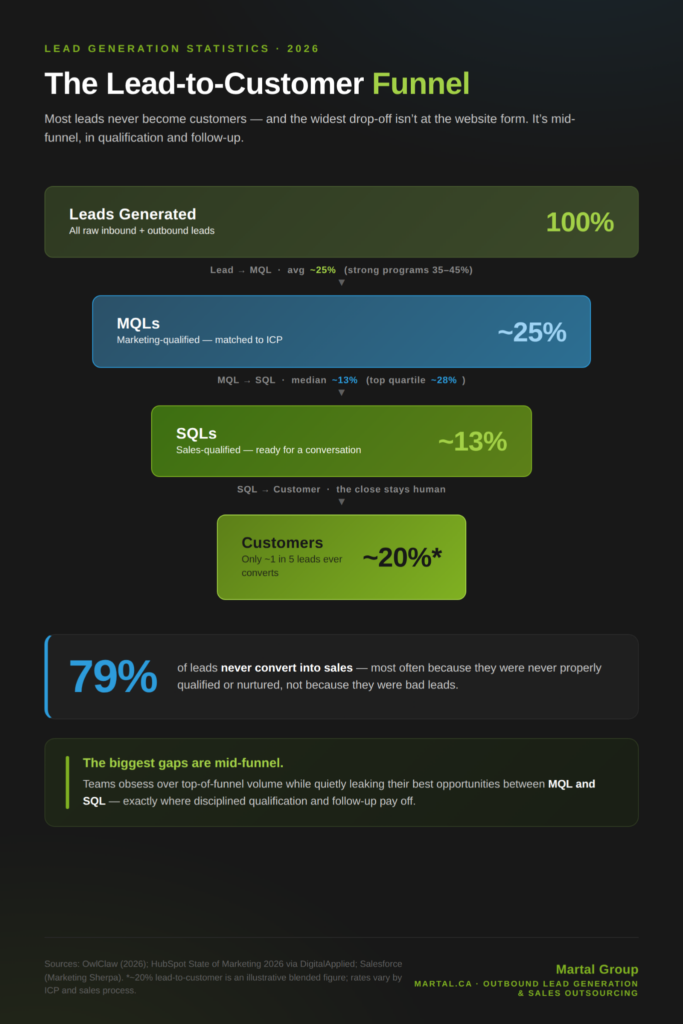
One thing we see often is teams obsessing over top-of-funnel volume while quietly leaking their best opportunities between MQL and SQL. It’s why a question we hear constantly — “How do you measure the real ROI of lead generation beyond cost per lead?” — matters so much. The answer is to track conversion at every stage and tie it back to closed revenue, not just CPL.
When we talk about converting leads into customers, the percentages shrink further. Industry data suggests that only about 20% of leads ultimately turn into sales – since approximately 79% of generated leads never convert to a purchase (2). In other words, if you gather 100 leads, maybe 20 might eventually buy (this ratio can be better or worse depending on lead quality and sales process). Specific campaign types have their own averages too: for example, an email campaign might have a 2-5% conversion from click to lead, and perhaps a 1-3% conversion from lead to customer. A well-optimized LinkedIn ad might convert at 10% from click to lead (LinkedIn users are highly targeted), whereas a broad Facebook ad could be under 5%.
To summarize, a rough average conversion for B2B leads to customers could be in the low-single-digit percentages. However, top-performing campaigns exceed these benchmarks – for instance, strong account-based marketing efforts sometimes convert 10%+ of target accounts into opportunities. Ultimately, comparing to averages is useful, but improving your own baseline is the real goal. Many B2B teams track their conversion rates at each stage and use those as internal benchmarks to beat through testing and optimization.
- Improved lead nurturing and education: Interactive content isn’t just top-of-funnel; it’s effective mid-funnel too. 67% of marketers say interactive content improves lead nurturing results (6), helping to warm up leads through deeper education. And 70% of B2B buyers feel interactive content is more effective for educating them (6). This makes sense – for complex B2B solutions, an interactive buyer’s guide or assessment can simplify a lot of information into an engaging format, making it easier for the buyer to grasp how a solution fits their needs. Educated prospects progress faster to sales-ready status.
- Growing adoption: Recognizing the impact of engagement-driven formats, marketers are rapidly expanding their use of interactive content. According to the latest marketing statistics, 83% of marketers say interactive content is more effective at capturing audience attention, while 78% plan to increase their investment in interactive experiences over the next year (14). As competition for attention intensifies, brands are expected to rely more heavily on interactive infographics, quizzes, calculators, clickable e-books, and choose-your-own-journey video experiences throughout marketing strategies.
- Brand differentiation and virality: Interactive experiences also help brands stand out. 88% of marketers believe that interactive content differentiates their brand and provides a unique experience (6). Additionally, interactive content has a higher chance of being shared – 60% of consumers are more likely to share interactive content on social media (6). So a clever interactive piece not only generates leads directly, but can amplify your reach through shares, bringing in even more prospects (essentially free advertising).
Some real-world examples of interactive lead gen assets include: calculators (e.g., “Estimate your ROI” tools), diagnostics (“What’s your marketing maturity score?” quizzes), interactive case studies (where the reader can click through decision points), and augmented reality product demos. On our end, we’ve incorporated interactive elements in campaigns like using polls in LinkedIn outreach (“What’s your biggest sales challenge? A/B/C”) or inviting prospects to take a short quiz as a call-to-action. The micro-commitment of clicking an option often leads to the macro-commitment of a conversation or sign-up.
To maximize leads from interactive content, it’s key to have a lead capture mechanism at the appropriate point. Many interactive tools gate the final result – for instance, “Enter your email to see your full personalized report.” Because the user has invested time, they are usually willing to exchange contact info for the payoff. This technique routinely produces conversion rates far higher than ungated static content.
One caution: ensure the experience truly delivers value. The fastest way to lose trust is to make something interactive just for the sake of it without meaningful substance (e.g., a pointless quiz). But done right, interactive content aligns with the modern buyer’s desire for self-service and personalization.
In 2026, interactive content will become mainstream. With generative AI lowering the cost of content creation, we might see AI-driven personalization making even PDFs or videos interactive on the fly. Martal’s strategy is to stay ahead by integrating these interactive experiences with our omnichannel outreach – for example, using an AI chatbot on a landing page to interact with a visitor who came via a cold email, effectively turning a static page into a conversation. The stats we’ve covered underscore why these investments are worthwhile: they create richer engagements and ultimately more conversions.
Lead Nurturing Statistics
Nurtured leads make 47% larger purchases than non-nurtured leads.
Reference Source: Annuitas, via Zendesk
If roughly 79% of leads never convert, lead nurturing is where most of that lost pipeline can be recovered. The data on this is consistent and, frankly, hard to ignore — yet nurturing remains one of the most under-built parts of the typical B2B funnel.
A few numbers that frame why nurturing earns its place in any lead generation strategy:
- Companies that excel at lead nurturing generate 50% more sales-ready leads at 33% lower cost than those that don’t (2)
- Nurtured leads make 47% larger purchases than non-nurtured leads (36)
- Lead nurturing emails earn 4–10× the response rate of standalone email blasts (24)
- Roughly 50% of qualified leads aren’t ready to buy yet, and effective nurture cycles typically run 6–12 touches across channels (12)
- Despite all this, an estimated 65% of businesses still have no documented nurture workflow (12)
That last gap is the opportunity. From the pipeline side, the real friction point isn’t usually generating interest — it’s the discipline to keep showing up with relevance over a buying cycle that may stretch for months. A common issue for outbound teams is treating a non-reply as a dead lead when it’s actually an early one.
This is exactly where patient, multi-touch nurturing pays off. For Southern Code, our team sustained roughly one closed deal per month — with some nurture cycles running as long as 10 months before a prospect was ready to move. Those weren’t leads that arrived sales-ready; they were prospects who needed consistent, value-led follow-up across email, LinkedIn, and calls before the timing aligned. In practice, this usually breaks down when teams give up after two or three touches, long before a slower-moving buyer has reached a decision.
The takeaway is that nurturing isn’t a “nice to have” layer on top of lead generation — it’s the mechanism that turns the 80% of leads who aren’t ready today into the pipeline you close next quarter. Treat it as a coordinated, omnichannel process, not a single automated email sequence, and the conversion math shifts in your favor.
Chatbot Lead Generation Statistics (2026)
With AI chatbots, 64% of agents handle mostly complex issues, compared to 50% without chatbots.
Reference Source: Salesforce
Chatbots – once a novelty – are now a common sight on websites and messaging apps, and they’re playing an increasing role in lead generation. The year 2025 has especially seen AI-powered chatbots become far more sophisticated (thanks to advances in natural language processing and generative AI). These bots can engage visitors in human-like conversations, answer questions, and even qualify leads, making them a powerful tool for teams looking to implement advanced lead generation at scale without adding headcount. Let’s dive into how chatbots are impacting lead gen, with the data to back it:
- Widespread adoption: Chatbots have quickly gone from experimental to mainstream. 58% of B2B companies are using chatbot software in some capacity (vs ~42% of B2C companies) (22). In essence, a majority of B2B firms have either already implemented chatbots on their site or plan to soon. We see this among Martal’s clients as well – many have a live chat or chatbot to capture inbound inquiries on their homepage or pricing page.
- Lead generation boost: The big question – do chatbots actually deliver more leads? The evidence says yes. 55% of marketing and sales leaders who use chatbots report an increase in the number of high-quality leads (8). And in another survey, 64% of businesses indicated that AI chatbots have helped generate more qualified leads for them (8). That’s a strong majority seeing tangible benefits of lead generation. These results come from chatbots’ ability to engage visitors instantly (no waiting for a human response) and guide them to provide contact info or schedule meetings.
- Higher conversion rates: Chatbots can capture leads that might otherwise slip away. For instance, 26% of B2B companies using live chat or chatbots report a 10–20% increase in lead volume (3). A bot can proactively greet a visitor (“Hi there, looking for something in particular?”) and convert what would have been a bounce into a conversation. Also, bots can qualify – for example, asking a few questions to determine if the visitor is a potential fit, which saves sales reps’ time on the back end.
- Cost and efficiency: From an efficiency standpoint, chatbots shine. Automated chat interactions cost a fraction of human interactions – about $0.50 per chatbot conversation vs. $6.00 for a human support session (23). They also work 24/7 without fatigue. This means you can capture leads around the clock, including from different time zones, without hiring night-shift staff. One metric suggests companies can save up to 30% on customer support costs with chatbots (24), which often justifies the investment alone – the extra leads are then icing on the cake.
- AI enhancements: Today’s chatbots, especially those powered by AI like ChatGPT or similar, can handle much more nuanced inquiries. They don’t just spit FAQs; they can have conditional logic or even integrate with backend databases. According to McKinsey, 60% of senior executives believe AI has a strong impact on lead identification (3), and we see that manifest in AI chatbots that identify intent signals during chat (e.g., if a visitor asks “Do you integrate with Salesforce?”, the bot flags them as a high-intent lead interested in integration). We apply this kind of AI in our AI SDR Platform, which scores and prioritizes prospects from real-time intent signals — surfacing the accounts most likely to convert so our team engages them first.
- Acceptance and expectations: Customers are increasingly comfortable interacting with bots for initial queries. Surveys show 82% of consumers prefer immediate responses from a chatbot over waiting for a human rep (8), and 96% feel companies that use bots are actually showing a commitment to good service (8). In lead gen context, a prompt response is crucial – if your bot can answer a prospect’s question in seconds at 9 pm on a Friday, you’ve made a positive impression while your competitors might not even have been available.
From a practical perspective, integrating chatbots into lead generation requires thoughtful design. A few tips gleaned from successes: give the bot a friendly, helpful tone; program it with lead-capturing prompts (“Can I get your email to have a specialist send more info?”); and ensure a seamless human handoff for complex questions. A practical best practice is to configure a bot to alert a human rep the moment a conversation hits a buying signal — say, a pricing question — a hybrid approach that captures the speed of automation without losing the human touch.
One trend to highlight is AI chatbots on social platforms (like WhatsApp, Facebook Messenger, Slack communities, etc.). Businesses are starting to generate leads by engaging users through these messaging app bots. For instance, a Facebook Messenger bot could run a quiz that qualifies a user and then directs them to schedule a demo.
In 2026, chatbot capabilities will only expand. The global chatbot market is projected to nearly triple from 2024 to 2029 (from $15.6B to $46B) (21), reflecting heavy investment in this tech. We anticipate more AI-driven personalization in chats – bots that remember a user’s past visits or tailor questions based on behavior. Martal’s focus is on using AI to scale personalized outreach — research, first-touch sequencing, and qualification — then routing genuinely interested prospects to our human sales team. Given that 80% of marketing and sales leaders either have or plan to deploy chatbots (8), it’s likely that in 2026, a chatbot (or virtual assistant) will be a standard member of every B2B sales team. The statistics so far paint a clear picture: when thoughtfully implemented, chatbots do generate more leads and can significantly improve efficiency in the lead generation process.
AI Chatbot Lead Generation Statistics 2025
It’s worth zooming in specifically on AI-powered chatbots – the ones infused with artificial intelligence (like machine learning or natural language models). These AI chatbots represent the next level of automation in lead gen, as they can understand context, handle unstructured inputs, and continuously improve. Here are some notable stats and predictions around AI chatbots and lead generation:
- Improving lead quality: We touched on this above, but to reiterate: 64% of businesses say AI chatbots have helped them generate more qualified leads (3). It’s not just volume; it’s quality. AI chatbots can ask qualifying questions (e.g., “What’s your timeframe for this project?”) and filter out casual shoppers from serious buyers. The net effect is that your sales team spends time on better prospects. In our own outbound work, a single sharp qualifying question — ‘Are you looking to implement a solution in the next six months?’ — often reveals more about readiness than a dozen data fields.
- Massive increase in leads with automation: Implementing AI in lead gen processes has shown staggering improvements in some cases. One stat claims companies using marketing automation (often AI-driven) with prospects see up to a 451% increase in qualified leads (3). This includes AI chatbots as part of the automation toolkit. While 451% might not happen for everyone, even a fraction of that gain is huge. Automation ensures every prospect gets timely, personalized touches – something humans alone can’t scale.
- Gen AI usage: About 55% of businesses using generative AI for lead generation report they are getting better quality leads (3). Generative AI (like GPT-4, etc.) can be used to craft personalized outreach messages, chatbot dialogues, or dynamic content. Quality improves because the AI can tailor the conversation/content to each prospect’s context (based on data it has). We’re already leveraging generative AI to customize email copy at scale and to power smarter chat interactions.
- Future outlook – AI ubiquity: In 2026, AI-powered agents will handle up to 95% of customer interactions (26), delivering fast, personalized support 24/7, signaling a shift from human-assisted service to AI-first customer engagement. In lead gen, this suggests AI will touch nearly every stage: identifying potential leads (through predictive analytics), engaging them initially (via chat or personalized content), and even nurturing them (with AI-driven, email drip campaigns). We at Martal see AI as an augmentation, not a replacement, of our human team – it handles the repetitive tasks and initial triage, freeing our sales experts to focus on high-value conversations.
- Executive buy-in: It’s telling that 60% of senior executives believe AI has a strong impact on identifying leads (3) (the first step of the funnel). With 78% needing more tailored content and 75% leveraging AI to meet expectations (29), organizations increasingly view AI as essential infrastructure for modern pipeline generation rather than an emerging trend.
In practical terms, integrating AI chatbots and tools requires strategy. We often counsel clients to start small: maybe deploy an AI chatbot on one high-traffic page to capture FAQ-type leads, or use an AI email assistant to follow up with cold leads. Measure results, then expand. The beauty of AI systems is they often come with analytics that can highlight friction points (e.g., where the bot couldn’t answer a question), allowing continuous improvement.
How does AI impact lead generation performance metrics?
AI is increasingly turbo-charging lead generation, improving metrics across the board. Artificial intelligence impacts lead gen performance in several ways:
- Higher lead volume and qualification: AI tools can identify and target prospects more efficiently than manual methods. Companies using AI for lead generation have seen over a 50% increase in sales-ready leads (3). AI can analyze huge datasets (e.g., web behavior, firmographic data) to pinpoint who is likely to convert, thus focusing efforts on the most promising leads. This boosts conversion rates because outreach is more targeted.
- Better lead quality (and lower costs): AI-powered chatbots and lead scoring systems help filter out unqualified leads early. Surveys show 64% of businesses believe AI chatbots generate more qualified leads (3), and organizations using AI report up to 60% cost reductions in customer acquisition (3). This is partly because AI automates the nurturing of “cold” leads until they’re warmer, allowing sales reps to spend time only on higher-intent prospects – improving the lead-to-sale conversion rate.
- Faster response and engagement: AI enables instant lead engagement (think chatbots greeting site visitors, or AI sending an immediate email follow-up). Quick response matters – engaging a lead within 5 minutes can make them 9 times more likely to convert (5). AI helps achieve those response times at scale. For example, if someone downloads a whitepaper, an AI-driven system might shoot over a personalized “recommended next read” or invite them to a demo within moments. This keeps prospects moving down the funnel, often improving metrics like MQL to SQL conversion.
- Personalization at scale: AI analyzes individual behaviors and preferences, allowing highly personalized content or outreach, which dramatically lifts engagement metrics. AI-driven personalization can double or triple email open rates and click-through rates in some cases. In fact, marketers leveraging AI-driven personalization were 215% more likely to report success in generating new leads (13). Higher engagement naturally translates to more leads and better conversion rates.
- Efficiency metrics: From a productivity standpoint, AI sales automations mean more touches and follow-ups happen without added human labor. One stat indicates companies that fully embrace marketing automation (often with AI components) witness 451% more qualified leads (3) – a sky-high figure that underscores how AI can multiply output. Even if you take more conservative outcomes, AI can do the work of many SDRs when it comes to initial outreach, significantly improving cost per lead and cost per acquisition metrics.
In short, AI positively impacts nearly all lead generation KPIs: it can increase lead volume, improve conversion rates, lower CPLs, and shorten sales cycles. We’ve seen this at Martal after implementing our AI Sales Platform – our team can generate more appointments for clients in less time, as the AI handles tasks like prospect research and follow-up cadences that used to eat up hours.
In one engagement with an AI-driven freight technology company, that pairing — AI handling research and sequencing, our SDRs handling the conversations — booked 108 meetings in just three months from roughly 350 prospects engaged. Speed at that level isn’t an AI story or a human story; it’s what happens when the two run in coordination. View the transportation case study.
The key is to use AI as an enhancer: it provides the data-driven muscle, while human marketers and sellers provide strategy and relationship-building. Together, they produce superior performance metrics that simply weren’t attainable at scale in the pre-AI era.
80% of Fortune 500 companies are already using generative AI tools like ChatGPT internally (8) – some of that is likely for sales and lead gen content/tasks. AI is becoming a standard competitive tool. In lead generation, those who harness it can achieve personalization and responsiveness at a scale that outperforms competitors still using purely manual methods.
AI chatbots and automation are not a future concept; they’re here now and yielding results. The stats we’ve reviewed show clear gains in lead volume and quality, which is why Martal has invested heavily in our AI capabilities. But we also temper this with a human touch – our philosophy is AI + human yields the best outcomes. AI handles the grunt work, humans build the relationship. In 2026 approaches, expect AI to continue driving lead gen performance upward, turning what used to be labor-intensive outbound prospecting into a more optimized, data-driven operation. The companies that leverage these tools wisely will likely see their sales pipelines flourish, even in the face of economic or market headwinds.
The Future of Lead Generation: What to Expect Beyond 2026
With The AI lead generation market is projected to roughly double — from about $7.4 billion today to $16.2 billion by 2034.
Reference Source: Prospeo
Two questions come up constantly in B2B circles, phrased on forums almost exactly like this: “Is lead generation dead? What are your thoughts?” and “What will be the future of lead generation?” The short answer to the first is no — demand for qualified pipeline isn’t going anywhere. The more useful answer is to the second: lead generation isn’t dying, it’s consolidating around a few clear shifts.
Here’s where the data points for 2026 and beyond:
- AI moves from tool to infrastructure. Organizations increasingly treat AI as foundational rather than experimental — 78% of marketers say they need more tailored content and 75% are leaning on AI to deliver it (29), and some forecasts expect AI-powered agents to handle up to 95% of customer interactions in 2026 (26). From an execution standpoint, that likely shifts AI into research, sequencing, and qualification — while the actual close stays human. The relationship-building that converts a qualified lead into a signed deal isn’t a task buyers want automated.
- Quality becomes the dividing line. The widening 4.7× spread in cost per lead and the growing MQL-to-SQL gap between median and top-quartile teams (32) point to the same thing: the distance between the best and worst programs is opening, and the lever pulling it apart is disciplined, AI-assisted qualification — not more volume. For most B2B teams, the mandate is fewer, better-targeted leads worked harder.
- Omnichannel coordination becomes table stakes. Single-channel outreach is losing ground to reinforcing touches across email, LinkedIn, and phone. Buyers now expect continuity, and the teams that orchestrate channels in sequence — rather than blasting each in parallel — will keep separating themselves.
- Signal-based targeting replaces spray-and-pray. As first-party data and real-time intent signals mature, the advantage moves to teams that reach buyers in their actual buying window instead of interrupting everyone equally.
None of this is a reason to fear that lead generation is going away. It’s a reason to build it more deliberately. The companies that treat 2026 as the year to tighten targeting, qualify harder, and coordinate channels — with AI doing the heavy lifting and people doing the closing — are the ones the dispersion data shows pulling ahead.
Turn These Lead Generation Statistics Into 2026 Pipeline
If the statistics in this report point to one conclusion, it’s that 2026 rewards precision over volume. The teams pulling ahead aren’t generating more leads — they’re qualifying harder, coordinating their channels, and following up with discipline while competitors quit after two touches. That difference is the gap between an $84-per-lead program and a $397 one.
That’s the model we run. Martal’s omnichannel, AI-augmented lead generation approach combines targeted cold emails, AI-driven cold calling services, and personalized LinkedIn engagement into one coordinated sequence — not three disconnected channels — supported by our AI Sales Platform for research, qualification, and prioritization. Our onshore Sales Executives across North America, Europe, and LATAM own the process end to end, so your prospects experience continuity instead of handoffs.
Whether you need top-of-funnel volume or help nurturing leads into booked meetings, our Sales-as-a-Service model scales to fit — from outbound SDR appointment setting to full outsourced lead generation and sales execution, to B2B sales training for your in-house staff. We function as an extension of your team, handling the heavy lifting of outbound lead generation while you focus on closing.
Throughout this report we’ve shared real results from that model — 203 SQLs in 14 months for a manufacturing company entering the US, 108 meetings in three months for an AI freight firm, and a sustained closed deal a month for Southern Code. If you’d like to see what a qualified pipeline could look like for your ICP and vertical, book a consultation with our team. In this no-obligation call, we’ll share tailored ideas, walk through examples of our lead generation campaigns, and answer your questions about working with Martal.
References
- EmailToolTester
- 99Firms
- InBeat Agency
- BloggingWizard
- DemandSage
- Amra & Elma
- POPcomms
- Tildo
- Martal B2B Sales Outsourcing Guide
- Power Digital
- CallPage
- Marketing LTB
- Warmly.ai
- HubSpot
- Marketing Sherpa (Via Salesforce)
- Business Wire
- HubSpot Blogging Statistics
- LinkedIn Lead Generation
- Cvent
- Content Marketing Institute
- stationIA
- Master of Code
- Elfsight
- Invesp
- Microsoft Cyber Pulse
- Apifon
- Business Dasher
- Gitnux
- Salesforce
- Paddle
- The Insights Partners
- Digital Applied
- Brenton Way
- Leadfeeder
- OwlClaw
- Zendesk
- Propseo
FAQs: Lead Generation Statistics
What is a good lead generation rate?
A good lead generation rate varies by channel, but 2–5% is average for B2B websites converting visitors into leads, while dedicated landing pages average closer to 6.6%. For lead-to-customer conversion, 10–20% is considered strong when leads are well-qualified — though most leads (around 79%) never convert at all. The more telling benchmark is mid-funnel: MQL-to-SQL conversion runs a median of ~13%, with top performers near 28%. Top-performing campaigns with tight targeting and disciplined follow-up consistently beat these averages.
How much does it cost for a B2B lead generation?
There’s no single price — the median B2B cost per lead is around $213 in 2026, but it swings from roughly $84 per lead for tightly targeted programs to $397 for volume-driven ones. Channel matters enormously: SEO (~$31), email (~$53), and webinars (~$72) sit at the low end, while trade-show leads can exceed $800. The key is to judge cost per lead in context — a cheap lead that never qualifies is expensive once you trace it to cost-per-closed-deal, so track lead cost all the way to revenue.
Which method of lead generation is considered the most effective and why?
No single method wins outright — effectiveness depends on your ICP and sales cycle. That said, the data favors a few: LinkedIn drives ~80% of B2B social media leads and converts far better than other networks, webinars are cited by 73% of marketers as producing their best-quality leads, and content marketing generates ~3× the leads at ~62% lower cost. In practice, the most effective approach is omnichannel — combining email, LinkedIn, and calling into coordinated sequences. The reason is simple: B2B buyers rarely act on a single touch, so reinforcing, well-timed contact across channels consistently outperforms any one tactic in isolation.
What is the ideal cost per acquisition for a lead generation advertising campaign?
There’s no universal target — the ideal cost per acquisition depends entirely on your customer lifetime value, deal size, and close rate. A workable rule of thumb is that CPA should stay comfortably below the profit from an average closed deal, leaving margin for the leads that don’t convert. A $300 CPA can be excellent if you’re closing high-ticket B2B contracts and disastrous for low-margin sales. Rather than chasing an industry-average number, anchor your target CPA to your own LTV and conversion math, then optimize targeting and follow-up to bring it down over time.
What are the four Ls of lead generation?
The four Ls are Lead Capture, Lead Magnet, Lead Qualification, and Lead Nurturing. Together they form the backbone of a strong lead generation engine — attracting interest, capturing contact data, filtering for genuine fit, and engaging prospects over time until they’re sales-ready. The framework is a useful reminder that capturing a lead is only the start; qualification and nurturing are where most pipeline is won or lost.
What are the most common challenges in lead generation according to recent surveys?
The top challenge by far is generating quality leads, cited by 61% of marketers. Close behind are converting leads to customers, coordinating outreach across multiple channels, and proving ROI. Many teams also struggle with lead nurturing, data accuracy, and aligning sales and marketing around a shared definition of a qualified lead. The through-line in 2026 surveys is consistent: the hard part is no longer generating volume — it’s generating leads that are ready to buy and following up well enough to convert them.