
 Martal
 Technology
 Education and training
 Web Development and UI / UX
 Healthcare/Medical
 Logistics and Supply Chain
 Information Technology
 Insuretech and Financial Services
 Marketplaces
 Software Development
 E-commerce and retail
 AI and Machine Learning
 Energy and Solar
 Manufacturing
 Security and Surveillance
 Digital Marketing Agency
 Transportation
 MSP
MSP
 Telecom
 B2B SaaS
 Cybersecurity
 HR tech
 Fintech
 Cleantech
 Consulting
Cold Outreach Automation in 2026: The B2B Blueprint for AI-Powered Prospecting
Major Takeaways: Cold Outreach Automation
Average B2B cold email reply rates have dropped to roughly 3.4%, with most generic blasts landing between 1–3%. Buyers now expect signal-based relevance — funding rounds, hiring surges, tech changes — and most cold sequences need 8–15 coordinated touchpoints across email, phone, and LinkedIn before a meeting gets booked.
Sales reps using AI and automated cold outreach tools reclaim about 2.15 hours per day on manual tasks, and AI-augmented outbound teams report up to a 47% productivity lift. The real gain is reach: a single rep with the right stack can run the volume of three or four manual SDRs without the headcount.
Lead sourcing, list enrichment, signal-based prioritization, sequence scheduling, follow-up cadences, deliverability management, and first-draft personalization can all be automated. What stays human: messaging strategy, objection handling, complex discovery, and the moments when a deal is actually being negotiated.
AI cold outreach automation‘s biggest impact is signal-based targeting — reaching the right person at the right moment. Teams running signal-personalized outreach see 5–18% reply rates, versus 1–3% for generic mass-blasts. The gap is now a 5x difference, and it widens every quarter.
Don’t automate strategic account selection, objection handling, complex discovery, or the messaging strategy itself. Buyers can spot a fully autonomous AI inside two sentences. The model that works in 2026 is AI does the work, humans approve and engage.
Automation removes the lag between a prospect’s interest and a confirmed meeting — and lag is where deals die. Coordinated omnichannel sequences (email + phone + LinkedIn) lift response rates by roughly 287% over single-channel outreach, and automated handoff into a calendar link converts replies to held meetings far more reliably than manual scheduling.
Companies running AI-augmented outbound see roughly 27% higher close rates, 10–15% lower customer acquisition cost, and 10–20% higher sales ROI. The economics also flip the build-vs-buy math: a fully loaded in-house SDR runs $90K–$130K annually, while a managed outbound program covering the full stack typically runs $4K–$12K per month.
AI agents now handle roughly 80% of research, list-building, and sequencing for elite outbound teams. The other 20% — strategic targeting, message review, live conversations, and closing — stays human. The teams hitting 10%+ reply rates are running this hybrid model, not fully autonomous AI SDRs.
Introduction
“Imagine if your sales team could double its outreach without doubling its workload.” Two years ago that line read like a pitch. In 2026 it reads like the standard. The teams hitting target are running AI-augmented outbound. The teams missing target are still doing it by hand.
Cold outreach itself hasn’t changed: you contact people who don’t know your company, you generate interest, you book meetings, you build pipeline. What’s changed is the math underneath it. Reps spend over one-third of their time on administrative tasks like outbound prospecting and follow-ups — time not spent selling (1). Average cold email reply rates have settled around 3.4%, with most generic campaigns landing between 1% and 5%(2). The teams clearing 10% are not sending more — they are sending smarter, with AI agents handling the research and sequencing humans used to grind out manually.
This is where cold outreach automation earns its keep. Not as a way to fire more emails into the void, but as a way to amplify the work your sales development representatives actually want to do — strategic conversations, qualification, closing — while AI handles the repetitive layer underneath. AI can now offload up to 80% of routine prospecting tasks (3), from list-building and signal monitoring to follow-up scheduling and deliverability management. The teams winning in 2026 aren’t asking should we automate? They’re asking what should we automate, and where does the human still belong?
This blueprint answers that question. We’ll cover what modern cold outreach actually looks like, how to automate every layer of it without sounding like a bot, where AI agents fit and where they don’t, what the new deliverability rules require, and what the math looks like when you compare in-house, tooling-only, and managed approaches. Along the way we’ll share how we at Martal Group run this exact model — AI agents on the heavy lifting, senior onshore SDRs on the conversations that matter — through our AI-driven Sales-as-a-Service platform.
How this guide was built: We pulled together current benchmarks from cold email infrastructure providers, sales engagement platforms, and SDR cost analyses, then layered in patterns we see across our own outbound campaigns running for B2B clients in SaaS, cybersecurity, manufacturing, fintech, and 50+ other verticals. Where a stat reflects the broader market, we cite it. Where a pattern reflects how Martal actually runs campaigns, we say so. The goal is a guide a CRO, VP Sales, or RevOps lead can hand to their team on Monday morning.
What Is Cold Outreach (and Why It’s Tougher Than Ever)?
48% of salespeople never follow up after the first cold email or call.
Reference Source: HubSpot
Cold outreach is the process of contacting prospective customers you have no prior relationship with — typically through email, phone calls, or LinkedIn messages. It’s the classic scenario of an SDR emailing a decision-maker out of the blue or calling a company to pitch a solution.
The goal: generate interest, qualify prospects, and book meetings that turn into pipeline. Done well, cold outreach opens doors to clients and markets that were never going to come inbound on their own. Done poorly, it burns your domain reputation and trains your buyers to ignore you. The gap between those two outcomes is wider in 2026 than it has ever been.
Let’s be honest: cold outreach in 2026 is harder than it has ever been. Prospects are bombarded with sales messages daily, and their tolerance for generic ‘spray and pray’ emails or interruptive cold calls is at an all-time low. Consider:
– About 95% of cold emails fail to get a reply. Average response rates sit between 1–5%, with platform-wide benchmarks landing around 3.4% (2).
– Cold call success rates have plunged to roughly 2–3% (15), and roughly 90% of C-level executives won’t even answer a cold call from an unknown number (4).
– Mass-blast generic outreach now sits in the1–3% reply range, while signal-personalized outreach — referencing a funding round, hiring surge, or specific tech change — pulls. The gap between the two has widened sharply in the last 12 months.
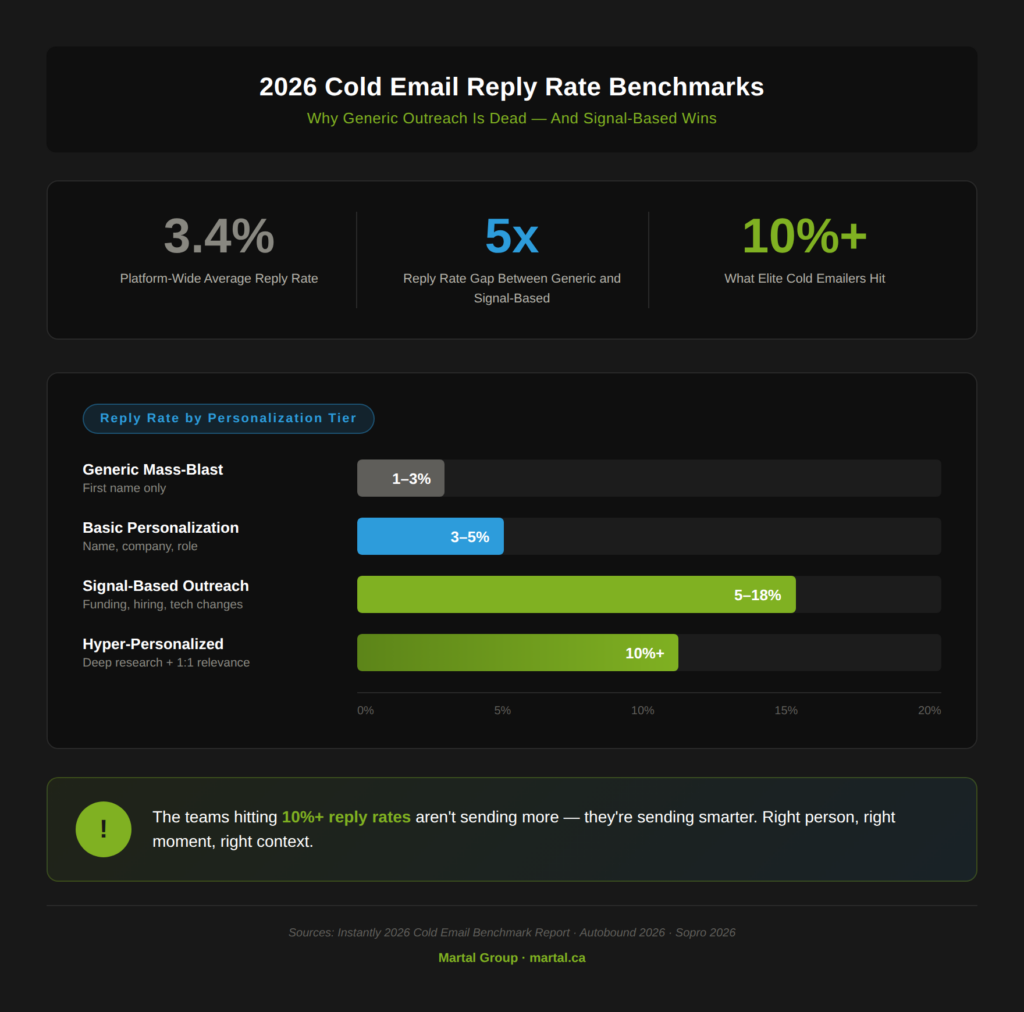
Outbound isn’t dead. The lazy version of outbound is dying. Breaking through the noise in 2026 requires more strategy, more personalization, and more persistence than it did even two years ago.
What’s changed? Three things, mostly.
Buyers are pattern-matching faster. Prospects can spot a templated email in seconds — and they’ve been trained to delete on sight. Generic openers like “I noticed you’re the {{title}} at {{company}}” used to do real work. They now do nothing.
The touchpoint count keeps climbing. Sales veterans remember when 5–7 touches across calls and emails would get the job done. Now most cold sequences need 8–15 coordinated touches across email, phone, and LinkedIn to break through, and fully cold prospects can require 20–50 touchpoints in total (16). Whether the right number is 8 or 18 for your market, the trend is the same: persistence is no longer optional.
Follow-up discipline is where most teams collapse. 48% of salespeople never send a follow-up after the first email (5) — and follow-up emails generate roughly 42% of all campaign replies when sequences are run properly. Half the pipeline is sitting in the gap between email one and email two, and most reps never go back to claim it. This is exactly the kind of gap automation closes — not by adding effort, but by removing forgetting.
Email deliverability is no longer a back-office concern — it’s a frontline buying decision. Roughly 17% of cold emails never reach the inbox at all (2), and that number gets worse fast if you skip the basics.
Since 2024, Google and Yahoo have enforced stricter sender requirements for any domain sending bulk email — proper SPF, DKIM, and DMARC authentication, one-click unsubscribe within 48 hours, and spam complaint rates kept under 0.3%. Miss any of those and your messages don’t just get throttled — they get filtered before they ever reach a human.
Domain warm-up went from a nice-to-have to a non-negotiable: new sending domains now need 3–6 weeks of gradual warm-up before they can carry real campaign volume. The teams treating deliverability as table stakes — not an afterthought — are the ones whose emails actually land. Everyone else wonders why their open rates collapsed. Only ~5% of cold outreach efforts generate any kind of engagement (6), and most of that gap traces back to deliverability hygiene long before it traces to copy.
Doing cold outreach the old-fashioned way — manually researching every lead, writing every email from scratch, tracking follow-ups in a spreadsheet — doesn’t survive contact with the new reality. It’s too slow, too inconsistent, and too easy to let prospects slip through the cracks. The work that used to take a junior SDR three days now needs to happen in minutes, with better targeting, cleaner data, and tighter follow-up than humans can sustain manually.
This is where automation steps in. Done right, automation isn’t about sending more — it’s about sending smarter, faster, and more consistently than a human team can on its own. It reaches more prospects with tailored messages, ensures no follow-up gets forgotten, and frees your reps to focus on the conversations where their expertise actually moves the deal. Before the how-to, let’s look at why automating cold outreach has become a strategic priority for B2B sales teams in 2026.
Why Automate Cold Outreach?
Sales reps save an average of 2.15 hours per day by automating manual tasks like data entry and follow-ups.
Reference Source: HubSpot
If you’re a sales or marketing leader, you’ve felt the pain: endless list building, data entry, writing and rewriting emails, scheduling calls, follow-ups tracked in a spreadsheet that nobody opens. It’s tedious work, it’s prone to human error, and it scales linearly with headcount — which is to say, it doesn’t really scale at all.
Automating the repetitive layer isn’t really about saving time (though it does that). It’s about freeing your team to focus on the activities that actually move the deal — strategic targeting, two-way conversations, qualification, closing. Here are the reasons cold outreach automation sits near the top of every revenue leader’s priority list in 2026:
Scale and Volume: To hit ambitious growth targets, you need to reach a lot of prospects. Automation lets your team exponentially increase outreach volume without increasing headcount
A single SDR using automation can do the work of several SDRs operating manually. For example, sales teams using automation software see an average 14.5% boost in productivity (11)), and reps using such tools make 23% more calls per day on average (11). When it takes dozens of touchpoints to yield a meeting, that extra capacity is crucial.
- Efficiency and Time Savings. Every hour an SDR spends copy-pasting templates, logging activities, or rebuilding lists is an hour they’re not talking to prospects. Automation eliminates most of that work. Sales professionals report saving roughly 2 hours and 15 minutes per day by using AI and automation for repetitive tasks (1) — about 10 hours a week per rep. Other studies put the figure closer to 6 hours per week (11), but either way the math is the same: a fraction of every rep’s week is spent on work that no longer needs a human in the loop.
- Consistency and Persistence. Automation ensures no lead gets left behind. People get busy or forget to follow up — automated sequences don’t. You program a multi-touch cadence once and every prospect gets the same number of follow-ups, at the right intervals, across the right channels.
The persistence pays off. Automated email follow-up sequences can lift response rates by roughly 250% over single-touch manual outreach (11). For cold calling, making at least 6 call attempts per prospect can boost contact rates by 70% (12) — something few reps actually do without a system nudging them. And follow-up emails alone generate roughly 42% of all campaign replies, which means half your potential pipeline is sitting in the gap between email one and email two if you’re relying on memory.
- Better Targeting and Personalization. This is where most outbound teams misunderstand automation. The point is not to send the same generic email to more people faster — that’s the formula for a damaged sender reputation. The point is that automation enables a level of relevance a manual rep can’t match.
Modern AI tools analyze hundreds of accounts in the time it takes a human to research five. They surface the ones matching your ICP, pull in firmographic and technographic context, and monitor signals — funding rounds, hiring surges, tech stack changes, leadership transitions — that indicate when a prospect is in their buying window. The result is outreach that arrives at the right moment with the right context, written for that specific buyer.
This is the difference between basic personalization (name, company, title) and signal-based outreach (referencing a specific event, role, or context the prospect just experienced). Basic personalization tops out at 3–5% reply rates (6). Signal-based outreach hits 5–18%. The teams that figured this out early are pulling further ahead every quarter, and most of the gap is closed by AI doing research that humans simply can’t perform at scale.
- Faster Lead Response. In outbound sales, speed-to-lead isn’t just for inbound leads. When a prospect hints at interest — clicks a link, replies positively, asks a question — automated workflows can respond immediately. They can send more information, surface a calendar link, or route the lead to a human rep before the prospect’s interest cools.
Lag is where deals die. Automating lead routing and follow-up can improve response time by up to 87% (11). For B2B specifically, the difference between a same-hour reply and a same-day reply often determines whether a meeting gets booked at all. Automation handles the first reply, the calendar handoff, and the CRM update — so by the time a human SDR steps in, the meeting is already on the books.
- Data-Driven Optimization. Automation tracks everything: opens, clicks, replies, call outcomes, sequence drop-off, channel performance. That data is the input that lets you keep getting better — and it’s the layer most manual teams never build, because it requires consistent execution to produce clean signal.
You might find that emails sent Tuesday morning get twice the response of Friday afternoon, or that a particular cold call script outperforms others by 30%. With AI in the loop, the system can adjust cadence, timing, and messaging on its own — testing variants, retiring underperformers, and surfacing what actually works. Companies using sales automation report it improves pipeline visibility and forecasting for 54% of teams, and 78% say it lifts both lead quantity and lead quality (11) through better tracking and scoring. The compounding effect matters more than the headline numbers — every campaign feeds the next one with cleaner data and sharper instincts.”
- Cost Reduction. Automating outreach lowers customer acquisition cost (CAC) by making each rep more productive. Rather than hiring three more SDRs to send more emails, you invest in tooling that lets your current team scale their reach. The math is now well-documented:
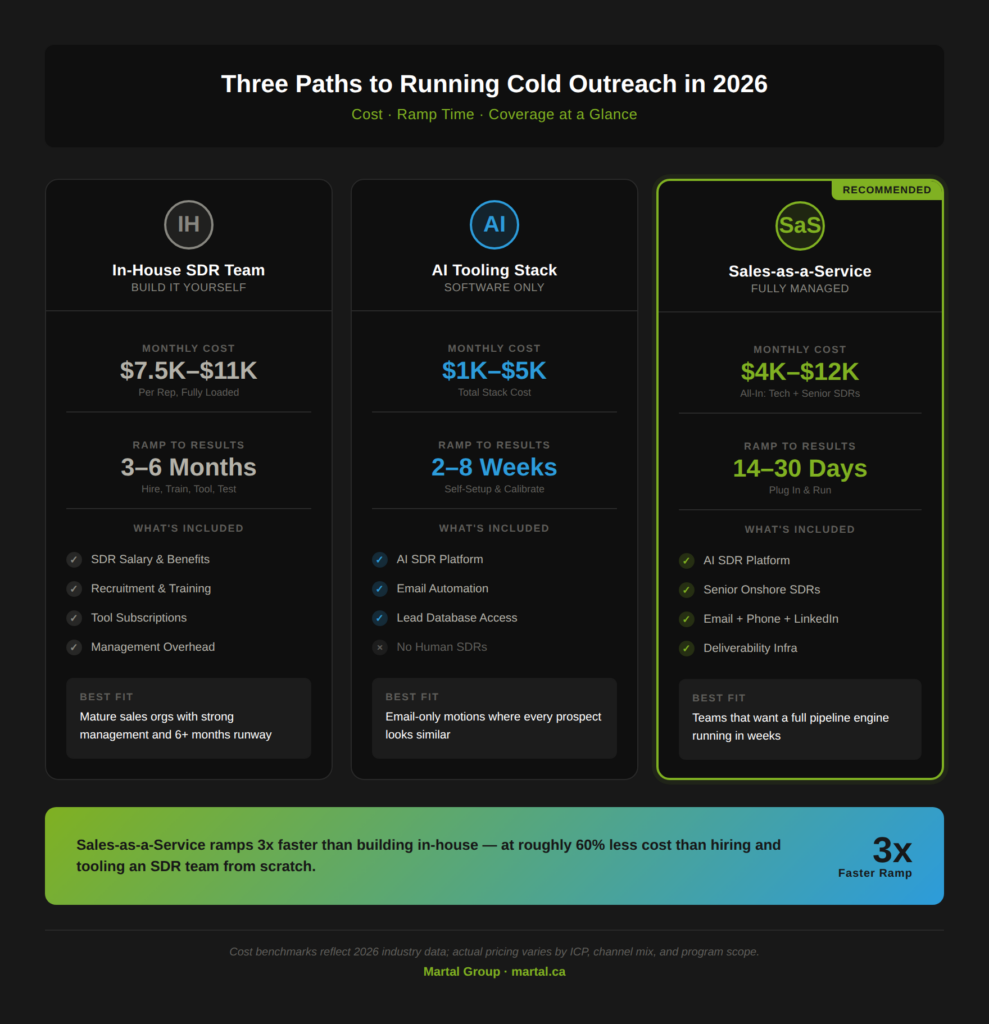
– A fully loaded in-house SDR runs $90,000–$130,000 per year in the US, including base, variable, benefits, tools, and management overhead.
– An AI SDR tool stack typically runs $1,000–$5,000 per month, but handles only the email-heavy slice and leaves cold calls and complex conversations untouched.
– A managed Sales-as-a-Service program — bundling onshore SDR talent, AI tooling, deliverability infrastructure, and reporting — typically runs $4,000–$12,000 per month.
Early adopters of sales automation see 10–15% cost reductions alongside revenue uplifts (13), and McKinsey research puts the average sales ROI lift at 10–20% for AI investments (1). One report finds an average ROI of $5.44 for every $1 spent on sales automation tools (11). Automation isn’t an expense — it’s the only way to keep CAC manageable as the cost of running outbound goes up.”
The case for automating cold outreach isn’t really about doing less work — it’s about doing the right work, at the right scale. Your reps operate at a higher altitude, focused on strategy, relationships, and closing. Automation handles the layer underneath.
But automation is not the same as autopilot. The teams that treat it as autopilot are the ones whose campaigns crater. Done thoughtlessly, automation comes off as spammy, irrelevant, or worse — a brand-damaging signal that gets you blocked, reported, or quietly filtered into spam. The next sections cover exactly how to automate each part of cold outreach effectively, and — just as importantly — what to leave to humans.
How to Automate Cold Outreach: A Step-by-Step Blueprint
Omnichannel sequences with 3+ touchpoints boost response rates by 287% compared to single-channel outreach.
Reference Source: ProfitOutreach
Automation sounds great, but where do I actually start?’ This is one of the most common questions we hear from sales leaders evaluating their outbound stack. Below is a practical, step-by-step blueprint to automate cold outreach in a B2B context — the assembly instructions for a scalable outbound engine.
We’ll walk through each stage of the process — from building a prospect list to scheduling meetings — and show how to streamline or automate cold outreach with AI at each step. Every layer can be optimized; most can be partly or fully automated. The teams that get this right end up with a system that runs 24/7 and produces qualified meetings on a predictable cadence.
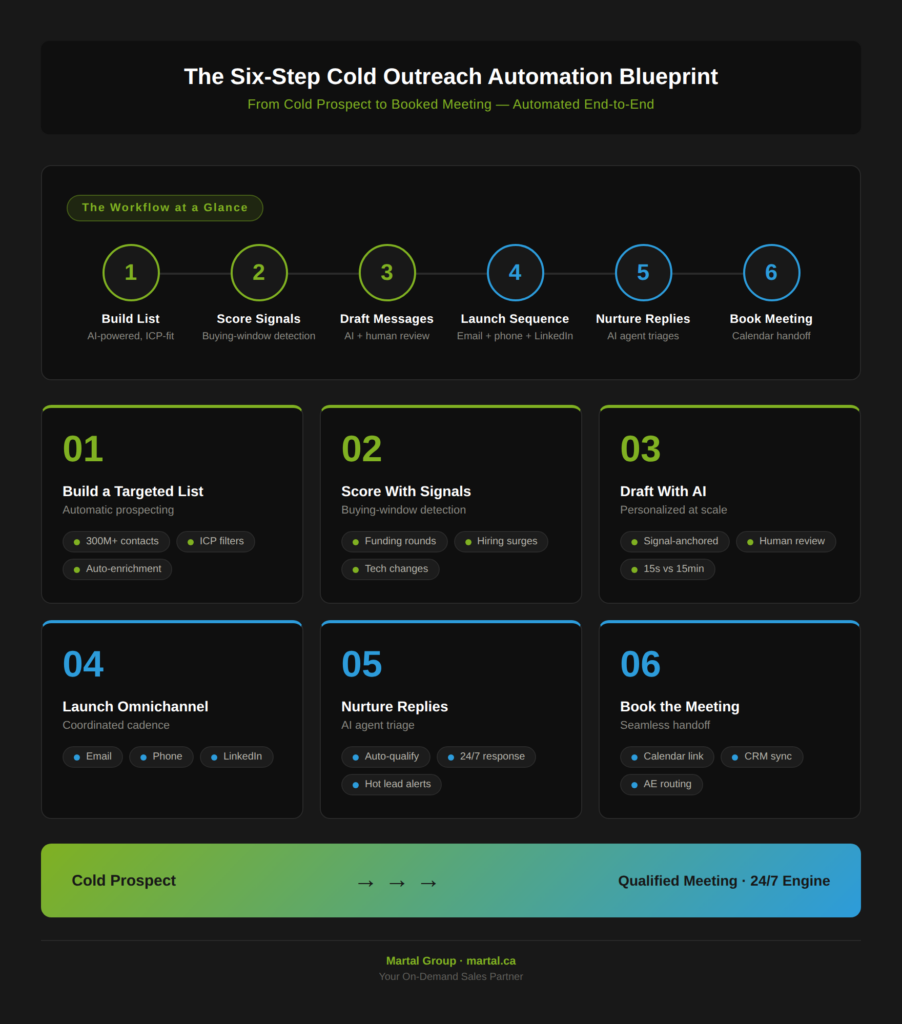
1. Build a Targeted Prospect List (Automatically). Every successful outreach campaign starts with a high-quality list. Manually hunting contacts on LinkedIn or scouring company websites doesn’t scale, and it produces lists that are stale by the time you finish building them.
Modern B2B data platforms — including Apollo, Clearbit, ZoomInfo, and our own Martal Smart Lists — can generate lists of companies and contacts that fit your ideal customer profile with a few clicks. The strongest platforms layer AI on top: define your ICP in plain language (‘VPs of Finance at fintech companies with 100–500 employees that recently raised a Series B’) and the system surfaces matching accounts in seconds, with verified contact data attached. AI can analyze millions of data points and find the prospects that look most like the customers you’ve already won.
Bonus. Automate contact enrichment as well — connect your data platform to your CRM so new leads are populated with email, phone, title, tech stack, and firmographic context automatically. No more reps spending an afternoon copy-pasting from LinkedIn into a spreadsheet. Done right, automated list-building and enrichment delivers a clean, targeted database of sales ready leads in a fraction of the time manual prospecting takes — and the data stays fresh as people change jobs and companies grow.
2. Segment and Prioritize Leads Intelligently. Once you have a list, automation helps you work smarter by deciding who to contact first. Sales engagement platforms with AI can analyze which prospects are most likely to engage — scoring accounts on firmographic fit, behavioral signals (like website visits), and buying-window indicators like recent funding rounds, leadership hires, or technology adoption. The most advanced systems use predictive models to continuously re-rank accounts as new data arrives.
This is where signal-based outreach earns its place in the 2026 stack. Generic personalization (name, title, company) gets you 1–3% reply rates. Reaching the right prospect at the right moment — right after they raised a Series B, right after a competitor’s tool got dropped from their stack, right after they hired a new CRO — gets you 5–18%. The signal is what flips the conversation from ‘who are you?’ to ‘how did you know to reach out today?’
Use the platform to bucket your list: ‘Tier 1 — high priority, signal-active’ versus ‘Tier 2 — nurture.’ Your team (or your AI sales agent) focuses effort where it counts. Lead scoring and prioritization can be a game-changer — research suggests companies using predictive scoring see up to a 20% increase in conversion rates further down the funnel (11). No human could re-rank a 1,000-prospect list every week based on dozens of variables. AI does it in real time.
3. Craft Personalized Messages at Scale (Using AI). Writing effective cold emails or LinkedIn messages used to take serious SDR time per prospect. Now, AI writing tools can do the heavy lifting — drafting outreach tailored to each prospect’s role, industry, recent activity, and the signals you uncovered in step two.
Modern LLM-powered writing tools take inputs about the prospect — industry, role, recent news, tech stack, intent signals — and generate first-draft emails that feel personalized. They’re not perfect on their own, but they get you to a solid 80% starting point your team can quickly refine. Many sales engagement platforms have this built-in: 47% of sales pros using AI leverage it to write sales content or prospect outreach messages (1), and 86% of salespeople using generative AI to write prospect messages find it effective(1). Feed in a template and a few custom details, get back a message that reads like a human spent 15 minutes on it — except it took 15 seconds.
For instance, AI might craft an opener like: ‘Hi Jane, I noticed your company is hiring dozens of engineers — often a sign of scaling up. As a CTO you’re probably juggling rapid growth challenges. That’s exactly where our solution helped Acme Corp cut onboarding time by 30%…’ — automatically inserting Jane’s title and the hiring-surge signal. This is what advanced personalization looks like — not a {{firstName}} merge field, but a message anchored to something that just changed in the prospect’s world.
One important caveat. The basic {{firstName}} variable is dead. Inbox filters and prospects have learned to recognize template-level personalization, and openers like ‘Hi {{firstName}}, I noticed you work at {{companyName}}’ now signal spam to both buyers and ESPs. The goal of AI-assisted writing is depth, not surface-level swap-ins.
Have humans review AI-generated content, especially early on, to catch tone issues, hallucinated facts, or context the AI got wrong. An AI word phraser can also help polish copy and save time, freeing your team to focus on connecting with leads. Done well, automated message creation lets you send thousands of genuinely tailored emails and LinkedIn messages a manual team couldn’t produce one-by-one — at quality the manual team probably couldn’t match anyway.”
4. Set Up Automated Omnichannel Sequences. Now it’s time to put the pieces together and launch. Sequences (or cadences) are predetermined sets of touches — Email Day 1, LinkedIn Day 3, Call Day 5, follow-up Day 7, and so on. Rather than your reps manually remembering each step, a sales engagement platform automates the sequence. You define the touchpoints and timing once, drop your prospects in, and the system runs.
This is where most outbound teams underperform without realizing it. They run multichannel outreach — email and phone and LinkedIn — but treat each channel as a separate, parallel campaign. The prospect gets an email at 9 AM, a different rep calls at 11 AM, and a third LinkedIn message arrives the next day, none of which reference each other or build on the same context. That’s not omnichannel. That’s noise.
True omnichannel sequences are connected. The LinkedIn message references the email. The call references the LinkedIn message. The follow-up adapts based on whether the prospect opened, clicked, or ignored the previous touch. Done right, every prospect experiences a coordinated series of touches that feels like a single conversation across multiple channels — not three separate sales pitches landing at the same time.
The data backs this up clearly: omnichannel sequences using 3+ coordinated touchpoints (email + LinkedIn + phone) boost response rates by 287% compared to single-channel outreach (7). LinkedIn outreach alone delivers roughly double the response rate of cold email when prospects are appropriately targeted. The compounding effect of coordinating those channels is the unlock.
Automation makes this feasible. It’s practically impossible for a rep to manually juggle a connected omnichannel sequence at scale — the timing alone breaks down past 50 prospects. With automation, you can pre-orchestrate the full motion: an email at 9 AM, a LinkedIn connection request two days later, an automated voicemail drop after a call attempt, a follow-up email referencing all of the above on day seven. Every prospect experiences personal-feeling touches; your reps aren’t manually pressing ‘send’ each time.
Martal’s own outbound campaigns typically run 5–7 coordinated touches per prospect across email, phone, and LinkedIn, with messaging that references prior touches and adapts based on response signals (8). This approach significantly outperforms one-and-done emails — and one of the patterns we see consistently across verticals is that the third and fourth touches are where the real conversations get started, not the first.
The sequence engine can also auto-adjust: pause further emails if someone replies, branch to a different path if they click a link versus stay silent, escalate to phone outreach if email engagement is high but no reply lands. The system isn’t just sending — it’s reading the prospect’s behavior and adjusting in real time.
5. Automate Follow-Up and Nurturing: Cold outreach doesn’t always convert on the first attempt – in fact, it usually doesn’t. This is where automated follow-up and nurturing come in. Beyond the initial sequence, you should have workflows that keep unresponsive or ‘not now’ prospects in a light drip over time.
For example, if a prospect never replied to your 5-touch sequence, you might drop them into a long-term nurture campaign (maybe one email every few weeks sharing some insight or case study).
This can all be automated by tagging the lead status and letting your marketing automation or sales engagement tool handle the rest. The goal is to stay on their radar until they’re ready, without a human having to remember to do it. If a prospect responds with interest, other automations can kick in: an AI chatbot or email bot might handle initial qualification questions, or an automated reply could send over your calendar link for scheduling.
In fact, AI sales assistants are now capable of carrying on email conversations to qualify a lead and set up a meeting, acting as a virtual SDR. Martal’s platform, for instance, uses AI agents that engage and nurture prospects via email/LinkedIn, then alert a human rep only when the prospect is warmed up and ready to talk specifics – meaning our human SDRs ‘step in for the high-intent leads’ after the AI has done the early work. This kind of AI-driven nurturing ensures you don’t lose viable leads due to slow response or lack of persistence. It’s like having an assistant work 24/7 to turn cold leads warm.
6. Streamline Meeting Scheduling and Handoff. The final mile of cold outreach is getting the meeting booked — or routing an interested prospect to an Account Executive without losing momentum. Automation makes this nearly seamless. Skip the back-and-forth ‘what time works for you?’ emails entirely with automated scheduling tools (Calendly, HubSpot Meetings, or built-in equivalents in your sales engagement platform).
When a prospect says ‘Yes, I’d like to learn more,’ they should immediately get a calendar link to a rep’s calendar — or an AI agent can propose a specific time based on calendar availability. Some advanced systems auto-schedule meetings once a prospect hits a defined score threshold or explicitly asks for a demo. The less friction between interest and a confirmed meeting, the higher your conversion from reply to held meeting.
One pro tip from running this at scale. Make sure the calendar invite and any prep materials — meeting agenda, video link, relevant case study or one-pager — are sent automatically along with the booking. This keeps the experience professional and consistent across thousands of meetings. After the meeting is booked, automation can route the prospect in your CRM: update lead status, assign to an AE, create an opportunity record, log the touchpoint history. The handoff that used to take a rep ten minutes of manual updates now takes zero.
The cumulative effect: the machine takes a cold stranger from initial outreach to a confirmed meeting on a rep’s calendar, with your humans only stepping in for the actual conversation. That’s the system. The efficiency comes from removing every avoidable manual step between interest and meeting; the quality comes from making sure the human steps that remain — the calls, the discovery, the close — are where your reps spend most of their time.
Follow these six steps and you’ve effectively automated the SDR cold outreach workflow end-to-end: data sourcing, signal monitoring, message drafting, omnichannel sequencing, follow-up nurturing, and scheduling. This is not ‘set and forget’ — you’ll continually tune messaging and targeting based on results — but the day-to-day execution runs on its own. The outcome is a prospecting engine running 24/7, scaling your reach to far more prospects than a manual team could handle, while still feeling personal and well-timed to each recipient.
Now that we’ve outlined how to automate everything, the important caveat: just because you can automate something doesn’t always mean you should. The next section covers the boundaries — which parts of cold outreach belong to automation, and which still require a real human touch to work.
What to Automate vs. What Not to Automate (Keeping the Human Touch)
69% of sales professionals believe automation should assist prospecting but not replace human interaction.
Reference Source: HubSpot
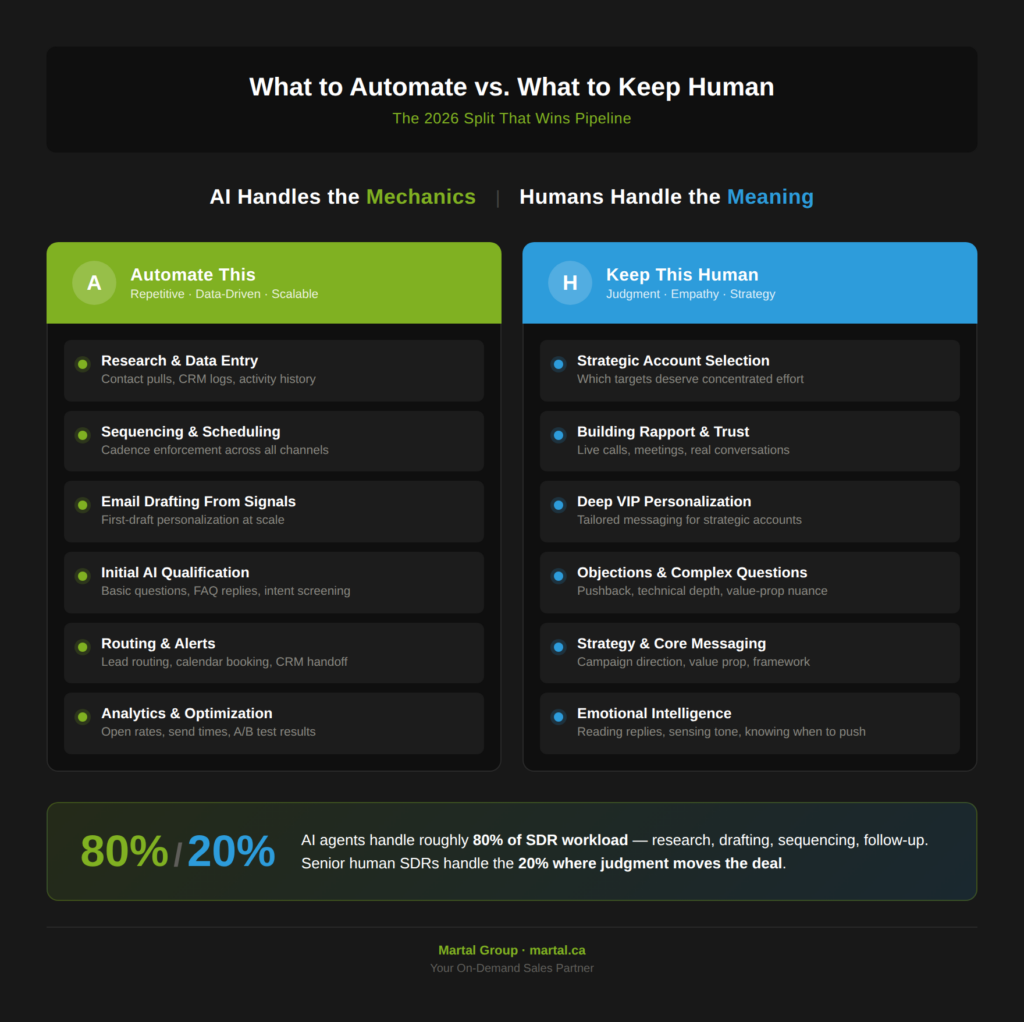
Automation is powerful, but it’s not a silver bullet for every task. Human connection and judgment still close deals — no algorithm fully replaces them, and buyers can sense a fully autonomous bot inside two sentences. The trick is to automate the right things — the repetitive, data-driven, scalable tasks — and leave anything that demands creativity, empathy, or nuanced judgment to your humans. Get this balance wrong and you produce the tone-deaf spam that gives automation a bad name. Get it right and your team operates at a higher level than either humans or AI could deliver alone.
A question we get often: ‘What should you not automate in cold outreach?’ The short answer is anything where your judgment is what makes the work valuable. The longer answer is below — let’s draw the line clearly:
Ideal Tasks to Automate
Tasks Requiring a Human Touch
Repetitive research and data entry — gathering company information, pulling verified contact data, updating CRM records, logging activity history.
Strategic account selection — deciding which target accounts deserve concentrated effort versus broad coverage. Requires judgment on revenue potential, fit, and timing.
Outbound sequencing and scheduling — sending follow-up emails, queuing social touches, dialing calls via auto-dialer at the right times, ensuring cadence consistency.
Building rapport and trust — live phone calls, video meetings, and the moments where a human voice and active listening actually move the deal.
Email drafting from templates and signals — using AI to draft personalized first-touch emails and follow-ups based on prospect signals, with human review before send.
Deep personalization for high-value accounts — crafting genuinely tailored messages for strategic targets, referencing a recent interview, podcast appearance, or specific business context AI can’t reliably surface.
Initial qualification via AI agent — having an AI agent ask basic qualifying questions and respond to common queries before routing to a human.
Handling objections and complex questions — when a prospect challenges the value proposition or has detailed technical questions, a human SDR or AE provides nuance and reassurance no bot can fake.
Workflow routing and alerts — moving prospects between nurture streams, alerting reps when a lead engages, booking meetings via calendar links, updating opportunity records.
Creative strategy and core messaging — defining the campaign strategy, value proposition, and core messaging framework. This requires creativity, market insight, and a feel for what resonates with the buyer.
Analytics and optimization — crunching open rates, reply rates, optimal send times, A/B test results, and surfacing what’s working. AI suggests; humans decide.
Emotional intelligence and judgment calls — sensing whether a prospect’s “maybe” is a soft no or an invitation to persuade further. Reading between the lines is still a human strength.
The pattern is consistent: automate the mechanics, keep humans on the meaning. Automation is unmatched at consistency, speed, and scale — use it for those strengths. Let it handle the who, the when, and the how of delivery. The why of your message — the part that actually persuades a buyer — still needs a human in the loop. A few concrete examples:
– Do automate the act of sending an email follow-up exactly three days after no response. Don’t automate the question of whether your follow-up actually sounds like a human who cares about the prospect’s outcome. Humans set the tone; automation enforces the cadence.
– Do automate data collection about a prospect’s company. Don’t automate the decision on which pain point to lead with in your sales pitch without a human reviewing whether it actually makes sense for that specific buyer. AI can surface a fact; a human decides if it’s relevant.
– Do automate routine interactions like meeting confirmations and basic FAQs (‘Do you integrate with Salesforce?’ — an AI agent or knowledge base handles this fine). Don’t automate complex negotiations, pricing discussions, or lead qualification past the initial yes/no — those still need a real rep who can read the room and adjust.
It’s also worth being explicit about keeping a human in the loop for quality control. If AI is generating your email content, have your SDR quickly review the output — at least early on, while you’re calibrating the system. If you’re sending LinkedIn connection requests, automate the prompt and the timing but let the rep personalize the message before hitting send. This hybrid approach prevents embarrassing mistakes (an AI misidentifying a prospect’s role, hallucinating a fact about their company, getting the tone wrong on a sensitive topic) and keeps the outreach feeling authentic.
The question isn’t should we automate, it’s where exactly does the human stay in the loop? Sales teams that have figured this out — AI handling the research, drafting, sequencing, and follow-up; humans handling strategy, judgment, and live conversations — are the ones running campaigns that scale without sacrificing reply quality. As one frequently cited survey notes, 69% of sales professionals believe reps should use AI/automation for prospecting but avoid becoming overly reliant on it (1). Use the tech as an assistant, not a crutch. When AI and SDRs work hand-in-hand, you get the efficiency of machines and the judgment of humans — and that’s the combination that books meetings in 2026.
The Role of AI in Cold Outreach Automation
74% of sales professionals say AI is significantly transforming how they sell and that share has climbed every year since.
Reference Source: HubSpot
We’ve mentioned AI throughout this guide, but it’s worth zooming in on its specific role — because AI is the engine driving the leap from automation to something genuinely new. Traditional automation follows pre-set rules: send X on day Y, route to rep Z, log to CRM field A. AI-powered outreach makes adaptive decisions — choosing whom to contact, when to send, what to say, and how to respond, based on real-time data the system continuously learns from. Here’s how AI cold outreach automation is actually reshaping prospecting in 2026.
- Smarter Lead Targeting. AI starts working before the first email goes out — it figures out who to contact in the first place. Machine learning models analyze your past customer data, find the patterns that predict conversion (CTOs in fintech with 50–200 employees who recently raised capital, for example), then score new prospects against those patterns. The system also taps into intent data — monitoring which companies are actively researching your category, hiring for relevant roles, or adopting adjacent technology — and surfaces ‘in-market’ accounts you’d otherwise miss.
This is what changes the math from sending 1,000 emails and hoping to focusing on 100 accounts AI ranks as most likely to engage this quarter. Higher hit rates, better deliverability protection, and a list that updates itself as new signals surface. The 5x reply-rate gap between generic and signal-based outreach lives or dies on this layer.
- AI-Driven Personalization. Modern LLM-powered writing tools have made hyper-personalized messaging genuinely possible at scale. AI can pull dynamic context for each prospect — recent blog posts they’ve written, their company’s latest funding round, a podcast appearance, a specific LinkedIn post — and incorporate it into outreach in seconds. It can mirror a prospect’s tone by analyzing their LinkedIn activity. The result is outreach that reads like a human took ten minutes of research before writing.
This is the layer that makes signal-based outreach work in practice. The signal tells the system when to reach out and why; the AI personalization layer turns that into a message that genuinely speaks to the prospect’s situation. 74% of sales pros using AI and automation say it’s significantly impacting how they do their jobs (1) — and most of that impact comes from AI’s ability to make outreach feel more relevant and timely than the templates it replaced. Ironically, the right AI makes your automated messages sound more human, not less.”
- Predictive Timing and Channel Optimization. AI doesn’t just help with what to say — it learns when and where to say it. By analyzing engagement patterns, AI systems predict the optimal send time for each prospect. If a contact tends to open emails late at night, future sends shift to evening. If another prospect has a clear morning rhythm, the system catches them in their first inbox check.
The same logic applies across channels. A contact who never clicks emails but often replies on LinkedIn? The AI prioritizes a LinkedIn DM for the next touch. A prospect who has opened your last three emails without replying? The system flags them for a phone call this afternoon, when they’re statistically most likely to engage. This kind of adaptive sequencing — choosing not just the next message, but the next channel and time — is only possible with AI monitoring behavior in real time and adjusting the playbook accordingly.
- Automated Conversation and Qualification. The most prominent application of AI in outreach is the rise of AI SDRs and AI sales agents — autonomous systems that can converse with prospects across email and LinkedIn, not just send templated messages.
A well-trained AI agent can handle the initial back-and-forth on a response. If a prospect replies asking ‘Can you tell me more about how it works?’, the AI agent can send a thoughtful reply with relevant context. If the prospect asks ‘Do you integrate with Salesforce?’, the AI pulls from a knowledge base and answers accurately. The AI can also ask its own qualifying questions: ‘Happy to share details — quick question, roughly how many users are you looking to support?’
By handling that opening exchange, AI agents can qualify or disqualify leads automatically — or nurture them with relevant content until they’re ready for a live conversation. A trained AI agent can schedule meetings, route leads to the right rep based on response signal, and operate around the clock.
A common buyer question on this:‘Will AI replace SDRs?’ The honest answer: probably not in the next two years, and not for the deals that actually matter. AI handles research, drafting, sequencing, and initial reply triage at a quality and speed humans can’t match. But the moment a buyer asks a question that requires nuanced judgment, real product depth, or genuine pushback, you want a human there. By the time a buyer engages meaningfully with your outbound, they’re often 60–90% through their decision process — which means human conversation at the right moment still closes the deal. Martal’s AI agents handle conversations across email and LinkedIn, qualify interest, and book meetings autonomously, but our senior onshore SDRs step in for the high-intent leads where their judgment moves the deal forward. That’s the model that works in 2026.
- Continuous Learning and Improvement. AI thrives on data, and the more you feed it, the sharper it gets. An AI-augmented outreach system learns from every interaction — every open, every reply, every booked meeting, every silent ignore — and uses that to refine the next campaign.
It might learn that healthcare prospects respond better to one value proposition angle while tech prospects prefer another, and tailor future messaging accordingly. It might notice a shorter subject line gets 18% more opens, and start defaulting to that pattern. It might detect that prospects in a specific persona open more readily on Tuesday mornings and adjust send schedules across that segment.
The AI behaves like an analyst living inside your campaign — testing variants, retiring underperformers, and surfacing what actually works at a pace no human team can match. This is the layer that compounds. Each campaign feeds the next one with cleaner data, sharper targeting, and refined messaging — and the gap between AI-augmented and manual outbound widens with every cycle. Roughly 92% of companies have signaled plans to expand AI investment in sales (9) — and the teams that started early are already several quarters ahead.
- Handling Scale with Precision. As volume grows — say you want to reach 10,000 prospects this quarter — manual execution starts producing the kinds of slip-ups that damage your sender reputation: duplicates, mis-segmentation, generic blasts to the wrong personas. AI maintains precision at that scale.
It ensures each of those 10,000 contacts gets the right tailored message, that the system prioritizes the best-fit accounts for human follow-up, and that no contact gets touched twice by mistake. AI makes ‘mass personalization’ a defensible operating model rather than an oxymoron. Sales teams using AI report roughly a 33% increase in efficiency overall (11), much of it from AI handling background work that would overwhelm a manual team.
One thing worth being explicit about: AI in outreach doesn’t operate in a vacuum. It works best as part of a hybrid model — AI plus human. The AI handles research, drafting, sequencing, optimization, and initial qualification; the human oversees strategy, approves outputs, and steps in for the conversations where judgment matters. This is the partnership that produces results.
The data on this is consistent: sales teams using AI are roughly 1.3x more likely to see revenue increases compared to teams that aren’t (14). It’s not magic — it’s that AI enables more touches, sharper targeting, and faster responses than humans can manage alone, which produces more opportunities and more closed deals.
The role of AI in cold outreach automation, summed up: augment your team’s capabilities at every stage of the funnel. AI finds the needles in the haystack, drafts the initial pitch, picks the right send time, carries the early conversation, and learns from every response. Your humans guide the mission and step in where their judgment moves the deal. This doesn’t eliminate the need for SDRs — it makes the work they do more valuable by reserving it for the moments that actually matter
One thing worth being explicit about: AI in outreach doesn’t operate in a vacuum. It works best as part of a hybrid model — AI plus human. The AI handles research, drafting, sequencing, optimization, and initial qualification; the human oversees strategy, approves outputs, and steps in for the conversations where judgment matters. This is the partnership that produces results.
The data on this is consistent: sales teams using AI are roughly 1.3x more likely to see revenue increases compared to teams that aren’t (14). It’s not magic — it’s that AI enables more touches, sharper targeting, and faster responses than humans can manage alone, which produces more opportunities and more closed deals.
The role of AI in cold outreach automation, summed up: augment your team’s capabilities at every stage of the funnel. AI finds the needles in the haystack, drafts the initial pitch, picks the right send time, carries the early conversation, and learns from every response. Your humans guide the mission and step in where their judgment moves the deal. This doesn’t eliminate the need for SDRs — it makes the work they do more valuable by reserving it for the moments that actually matter.
Benefits of Cold Outreach Automation (By the Numbers)
Companies using sales automation see 27% higher close rates on average.
Reference Source: HubSpot
Let’s quantify the impact of everything we’ve covered. What do companies actually gain by automating their cold outreach? Below is the data — facts, figures, and a few results we’ve seen in our own client work — broken down across the dimensions that matter most to revenue leaders.
- Significant Time Savings. Worth repeating: automation gives hours back to your team. Sales reps save over 2 hours per day on average by automating manual tasks like data entry, CRM updates, and follow-ups (1). That’s roughly a 25% increase in selling time available each week. High-performing salespeople are 17% more likely to heavily use their AI-enhanced CRM and automation tools (1) — they spend more time closing deals because they’re not buried in busywork.
- More Focus on High-Value Activities. With machines handling the repetitive layer, your reps concentrate on what humans actually do well — building relationships and closing. Early adopters of sales automation report 10–15% efficiency improvements and correspondingly more customer-facing time (13).
In practice, an SDR who used to manage 20 calls a day can now make 30 targeted calls and personalize key messages, because admin work isn’t eating their afternoon. There’s a morale dimension too — when reps get to spend their day on conversations rather than data entry, they perform like skilled professionals instead of feeling like email-cranking machines. The teams with the lowest SDR turnover tend to be the teams that automated the worst parts of the job first.”
- Consistency and Coverage. Automation ensures every prospect gets properly worked. No more leads slipping through cracks. No more reps cherry-picking easy calls and ignoring tougher accounts.
A sequence might guarantee every prospect receives 5 coordinated touches over 2 weeks across email, phone, and LinkedIn — every time, without exceptions. This systematic approach produces better outcomes: 78% of teams using automation say it improved their pipeline management and deal tracking (11). Consistency also strengthens brand perception. Prospects experience a cohesive, well-timed journey across channels, and your company comes across as organized rather than scattered.
This is the layer where Martal’s own delivery model lives. In one engagement with a B2B SaaS company in the maintenance management space (CMMS/EAM software), our team executed a coordinated outbound program that delivered 1,708 leads, 185 SQLs, and 144 booked meetings over 26 months — pipeline that wouldn’t have existed without consistent multi-channel coverage at the level a manual team can rarely sustain. Read the full case study.
- Higher Response and Conversion Rates. The most compelling argument for automation is the outcome lift. Reach the right people with the right timing and the right personalization, and response rates climb meaningfully.
70% of sales pros using AI-driven outreach report higher response rates from prospects (1). Automated follow-ups make prospects roughly 50% more likely to eventually reply versus a single touch (2). And those responses turn into pipeline: companies running sales automation see a 27% higher close rate on average (11).
We see this directly across our own client work. For Polygon, a Stockholm-based facilities and IoT climate control company expanding into North America, our coordinated omnichannel program delivered 440 leads, 203 SQLs, and 139 booked meetings over a 24-month engagement — pipeline density that would have taken a manual team several years to produce. Polygon’s Director of Marketing summed up the difference simply: ‘Professional North American reps, simple project approach.’ The combination of consistent outreach, coordinated channels, and human SDRs stepping in for the high-intent leads is what produces the conversion lift the headline numbers describe.
- Reduced Costs and Higher ROI. Automation makes sales development more cost-effective. By increasing each rep’s productivity, you may not need to hire as many SDRs to hit (or exceed) your targets — or you can shift the marginal hire from junior SDR to senior AE, where the impact lands closer to revenue.
Automated processes also reduce the kinds of errors that cost real opportunities — a missed follow-up, a wrong contact added to a sequence, a duplicate touch that damages domain reputation. McKinsey research finds that sales automation has the potential to reduce sales costs while unlocking additional revenue (13) — and the published numbers back it up: an average $5.44 ROI for every $1 spent on sales automation tools (11), and 10–20% sales ROI lifts for teams adopting AI (1).
One stat that lands hard: 61% of over-performing sales teams use automation, compared to 46% of underperforming teams (1). The teams hitting target are running automation. The teams missing target mostly aren’t. Automation isn’t a cost center — it’s a revenue accelerator that pays back multiples of what you invest, and the gap between adopters and non-adopters keeps widening.
For a real example: Clickworker, an AI training data marketplace and one of our long-standing clients, generated $4.5M in recurring revenue and a 500% ROI over 9 years of partnership — including closed deals with three Fortune 500 and three Fortune 10 accounts. Outbound automation paired with human SDRs handling the high-stakes conversations was the model that produced those results.
- Faster Scaling and Growth. With automation in place, scaling your outbound lead generation gets dramatically easier. Want to expand into a new vertical or geography? You don’t need to spin up an equivalent expansion of headcount — the platform handles the additional volume; you adjust the data, signals, and messaging for the new segment.
This agility matters most for high-growth companies. Instead of waiting 8–12 weeks to recruit, hire, and ramp a new SDR — the typical timeline for an in-house hire — automation lets a growth initiative (like a big campaign push after a funding round) launch within days. This is how we ramp campaigns 3x faster than traditional in-house teams — our AI-driven platform plus onshore SDR model is built for fast deployment (8).
For a concrete example of speed: for an AI freight platform client in transportation, we delivered 353 leads, 122 SQLs, and 108 booked meetings in just three months — net-new pipeline at a velocity an in-house team couldn’t have matched without sustained ramp time and infrastructure investment. The Director of Business Development described the shift simply: ‘Martal handily did better. We landed new logos.’ Companies that leverage automated, managed outbound can penetrate new markets or work large prospect lists in weeks rather than months. Read the full case study.
- Better Insights and Decision-Making. Automation tools come with analytics that give managers and executives genuine top-of-funnel visibility — which messages convert, which segments respond, how the team is actually performing — without anyone manually pulling reports. These insights enable data-driven strategy adjustments: maybe your SMB outreach is twice as efficient as enterprise, and you reallocate accordingly; maybe a specific persona is converting at 3x the average and deserves expanded coverage.
The shift toward data-driven selling is well-documented — roughly 72% of B2B organizations are now operating heavily data-driven sales motions, powered by AI and automation (11). Automation is what supplies the clean data that makes data-driven selling possible in the first place. The result is outbound managed like a metrics-driven operation, not a black box your CRO has to take on faith.”
The benefits of cold outreach automation span from the tactical (more emails sent, more calls made, more meetings booked) to the strategic (higher ROI, faster ramp into new markets, ability to scale without equivalent headcount growth). Together, they transform outbound from a labor-intensive process with hit-or-miss results into a streamlined operation that produces qualified pipeline on a predictable cadence — while actually improving the quality of each interaction through better personalization, timing, and follow-up.
Companies that have embraced this are pulling ahead. Those that haven’t risk falling further behind as competitors engage more prospects, more effectively, with automation that compounds. Top-performing reps are far more likely to use automation weekly: 80% of quota-crushers use sales tech weekly versus 58% of other reps (1). The pattern repeats across every dataset.
But the most important benefit isn’t a number at all — it’s giving your team the room to focus on human relationships at scale. By automating the drudgery, your salespeople get to be more human in the conversations where humans matter — creative, consultative, empathetic, and present. In B2B sales, those moments are what close deals.”
Bringing It All Together: Automation + Human Touch = Outbound Success
Organizations using AI for sales report 10–15% higher efficiency and up to 50% more leads compared to traditional methods.
Reference Source: HubSpot
We’ve covered a lot of ground — defining cold outreach, automating each layer of it, the role of AI agents, and where humans still belong. The overarching theme: successful B2B prospecting in 2026 comes from blending automation with human expertise. Neither wins alone. Automation without judgment produces spam — high-volume, low-relevance outreach that damages your sender reputation and trains buyers to ignore you. Human effort without automation is too slow and inconsistent to keep up with what the market now expects. The teams winning are the ones combining both thoughtfully.
This is exactly how we deliver results for clients at Martal. Our AI SDR platform automates roughly 80% of the repetitive SDR work — list-building, signal monitoring, sequencing, deliverability management, follow-ups (10) — and our senior onshore SDRs handle the other 20% where human judgment moves the deal: fine-tuning messaging, engaging in two-way conversations, qualifying high-intent leads, and building relationships across email, phone, and LinkedIn. Clients get the volume and precision of automation plus the trust-building of experienced human reps. Few internal teams can replicate that combination without significant investment in both technology and talent — and the talent is the part that’s hardest to build from scratch.
AI and automation aren’t experiments anymore. They’re proven tools in the modern sales stack. Roughly 92% of companies are expanding their AI investments in sales (9), and the teams that leverage these tools well consistently produce more pipeline and revenue than the teams that don’t. The challenge is execution. Implementing outreach automation effectively requires selecting the right software, building deliverability infrastructure that survives Gmail and Yahoo’s 2024 sender rules, crafting messaging that actually resonates, and continuously managing the system as signals and audiences shift. Most companies underestimate how much operational lift that takes the first time around — which is why so many turn to specialists.
So how do you actually put this blueprint into action? Two paths, with different speed and cost profiles:
Build it yourself. Use this guide as a roadmap. Audit your current outbound process, identify where automation saves time or lifts output, test AI tools for prospecting and writing, build the deliverability infrastructure first, and iterate. Start small — automate one layer (like follow-up sequences) before expanding to the full stack. Train your team to work alongside the tools; change management is the part most teams underestimate. Realistic ramp time: typically 4–6 months to get a fully automated, AI-augmented outbound program producing consistent results. The advantage is full control. The cost is the calendar.
Buy it managed. If you’d rather not spend two quarters building infrastructure and learning deliverability the hard way, consider outsourcing inside sales to a sales partner running Sales-as-a-Service with an AI-driven platform. We handle everything: building targeted lists, monitoring buying signals, crafting multi-touch personalized campaigns, executing email + phone + LinkedIn cadences, qualifying responses, and delivering ready-to-talk prospects to your AEs. Our approach has helped over 2,000 B2B companies fill their pipelines without rebuilding outbound from scratch internally — and because we blend automation with senior onshore SDR talent, clients typically ramp 3x faster and run roughly 60% less expensively than hiring and tooling an in-house SDR team from zero (8).
One question to anchor the decision: can you afford to have your team still doing outbound manually while your competitors arm their SDRs with AI and signal-based outreach? The gap between the two approaches keeps widening every quarter. Companies that embrace this blueprint now will be the ones setting meetings with your potential customers — at scale, at lower cost, with cleaner data, and with reps focused on the conversations where they actually win.
Conclusion
The blueprint for scalable B2B prospecting in 2026 comes down to one principle: automate the work AI does well, and reserve your team’s time for the conversations that close deals. Done right, this turns cold contacts into qualified pipeline efficiently and respectfully. Done thoughtlessly, it produces the kind of high-volume, low-relevance spam that damages your sender reputation and trains buyers to ignore you.
You’ve seen how automation handles the heavy lifting — from generating targeted lead lists and monitoring buying signals to executing coordinated omnichannel sequences and sending perfectly-timed follow-ups. You’ve seen where AI agents fit, where deliverability infrastructure has to be airtight, and where humans still belong in the loop. The teams running this model end up with a predictable sales pipeline instead of an unpredictable one — and they cut customer acquisition cost while doing it.
If your team is ready to move beyond manual prospecting and stitched-together tooling, Martal Group can help you skip the build phase entirely. We’ve spent 16+ years running B2B outbound for over 2,000 brands across SaaS, cybersecurity, fintech, manufacturing, healthcare, logistics, AI/ML, and 50+ other verticals — refining the AI-plus-human delivery model long before it became the standard.
Our managed Sales-as-a-Service program combines an AI SDR platform with senior onshore SDRs across North America, Europe, and LATAM (10). The AI automates roughly 80% of the workload — list-building, signal monitoring, sequence execution, deliverability management, follow-up, and reporting. Our human SDRs handle the other 20% — the messaging review, the qualifying conversations, the objection handling, the moments where judgment moves the deal. Campaigns typically launch in 14–30 days, and clients see qualified meetings on a predictable cadence with 4–7x more responses and bookings than they generated on their own.
Book a consultation to see what a qualified outbound pipeline looks like for your specific ICP and vertical. We’ll review your current outbound motion, share what’s working in adjacent verticals right now, and outline what a fully automated, human-led campaign could look like for your team. No strings attached — at minimum you’ll walk away with actionable insights, and at best you’ll find a partner to fill your pipeline at scale.
Don’t let your sales team toil on tasks technology can handle faster and better. Free them to do the work humans actually win on — connecting with buyers, qualifying interest, and closing deals — and outsource sales and marketing or automate the rest. The era of cold outreach automation isn’t on its way — it’s here. The teams that move first build the lead.
References
- HubSpot
- Infraforge
- Martal Group – AI Sales Automation
- OptinMonster
- HubSpot – Sales Statistics
- Mailshake
- ProfitOutreach
- Martal Group Blog – Sales Intelligence Tools
- McKinsey & Company
- Martal AI SDR Platform
- RepOrderManagement
- Klenty
- McKinsey & Company – Sales Automation
- Salesforce
- OnlyB2B
- Instantly
FAQs: Cold Outreach Automation
Is cold email dead in 2026?
Cold email isn’t dead — but the lazy version of cold email is. Generic mass-blasts referencing nothing specific now pull 1–3% reply rates and damage your sender reputation. Signal-based, personalized outreach hits 5–18%. The shift since 2024 is that Google and Yahoo’s stricter sender requirements (SPF, DKIM, DMARC, one-click unsubscribe, spam complaint thresholds under 0.3%) penalize sloppy senders aggressively. Teams running disciplined, AI-augmented outbound — with proper deliverability infrastructure and signal-based targeting — keep booking meetings consistently. Teams running templated mail merges from their primary domain don’t.
How do you automate cold outreach without losing personalization?
The trick is to automate the mechanics and let humans (or AI agents trained on your context) handle the meaning. Automate list-building, signal monitoring, sequence scheduling, follow-up cadences, deliverability management, and CRM updates. Leave creative messaging, objection handling, and live conversations to humans — and have humans review AI-generated outreach drafts before send, especially while you’re calibrating the system. The 2026 standard isn’t basic merge-field personalization ({{firstName}} is dead). It’s signal-based personalization: referencing a specific event, context, or change in the prospect’s world that the AI surfaced through real-time data monitoring. Done well, automation actually improves personalization quality compared to manual outreach because the AI catches signals humans miss.
How much does cold outreach automation cost in 2026?
It depends on which model you choose. A fully loaded in-house SDR costs $90K–$130K per year ($7,500–$11,000/month), including salary, variable comp, benefits, tools, and management overhead. AI tooling stacks alone (AI SDR platforms, email automation, lead databases) typically run $1,000–$5,000/month but cover only the email-heavy slice. Managed Sales-as-a-Service programs — bundling AI tooling, senior SDR talent, deliverability infrastructure, and reporting — typically run $4,000–$12,000/month. The build-vs-buy decision usually comes down to ramp time and existing infrastructure: in-house ramps take 3–6 months, managed programs launch in 14–30 days.
Why are my cold emails going to spam?
The most common reasons: (1) sending from an unwarmed or improperly authenticated domain — every sending domain needs SPF, DKIM, and DMARC configured plus 3–6 weeks of warm-up before carrying real campaign volume; (2) sending too much volume too fast and triggering spam filters; (3) low engagement quality (low reply rates and high spam complaints signal your content is irrelevant); (4) sending from your primary company domain, which damages every other email your company sends if cold outreach gets flagged. Best practice is to use lookalike sending domains separate from your main brand domain, run automated warm-up before launching, keep complaint rates under 0.3%, and prioritize relevance over volume.
Will AI replace SDRs?
Not in the next two years, and probably not for the deals that actually matter. AI handles research, drafting, sequencing, and initial reply triage at a quality and speed humans can’t match. But the moment a buyer asks a question requiring nuanced judgment, real product depth, or genuine pushback, you want a human there. By the time a buyer engages meaningfully with outbound, they’re often 60–90% through their decision process — which means human conversation at the right moment still closes the deal. The model that’s winning in 2026 is hybrid: AI agents handling 80% of the SDR workload (research, drafting, sequencing, follow-up), with senior human SDRs handling the 20% where judgment, relationship-building, and live conversation move deals forward.
What is a cold outreach strategy?
A cold outreach strategy is a structured plan to engage prospects who don’t know your brand. It defines your ICP, outreach channels, messaging framework, touchpoint cadence, deliverability infrastructure, and success metrics. A strong strategy in 2026 combines AI-driven signal monitoring (funding rounds, hiring surges, tech adoption), automated coordinated omnichannel sequences across email, phone, and LinkedIn, and disciplined human SDR involvement at the high-intent qualification and conversion stages. The teams seeing the strongest results aren’t the ones sending the most emails — they’re the ones reaching the right people at the right moment with the right context.