
 Martal
 Technology
 Education and training
 Web Development and UI / UX
 Healthcare/Medical
 Logistics and Supply Chain
 Information Technology
 Insuretech and Financial Services
 Marketplaces
 Software Development
 E-commerce and retail
 AI and Machine Learning
 Energy and Solar
 Manufacturing
 Security and Surveillance
 Digital Marketing Agency
 Transportation
 MSP
MSP
 Telecom
 B2B SaaS
 Cybersecurity
 HR tech
 Fintech
 Cleantech
 Consulting
Inbound Sales in 2026: Strategy, Execution, and When to Outsource
Major Takeaways: Inbound Sales
Inbound sales is a consultative selling approach where reps engage prospects who’ve already shown interest—through form fills, demo requests, chat conversations, or calls—and guide them to a decision with context and relevance. In 2026, 94% of B2B buyers use generative AI as a top tool for self-guided research, meaning prospects arrive pre-shortlisted and reps need to add value fast, not pitch from scratch.
Inbound is buyer-initiated; outbound is rep-initiated. Inbound leads convert at 5–10% on average, while outbound converts at 1–3%—but outbound reaches buyers who haven’t found you yet. The strongest B2B programs run both in coordination: most deals now require 5–12 touchpoints to close, and single-channel motions rarely clear modern buying committees.
Response time is the single most controllable variable in inbound conversion. Responding within 60 seconds boosts conversion by ~400%; responding within 60 minutes still delivers 7× higher qualification rates than waiting 24+ hours. When inbound response times slip past an hour, the rest of your sales process is fighting a colder, more skeptical prospect—or losing the deal to a competitor that replied first.
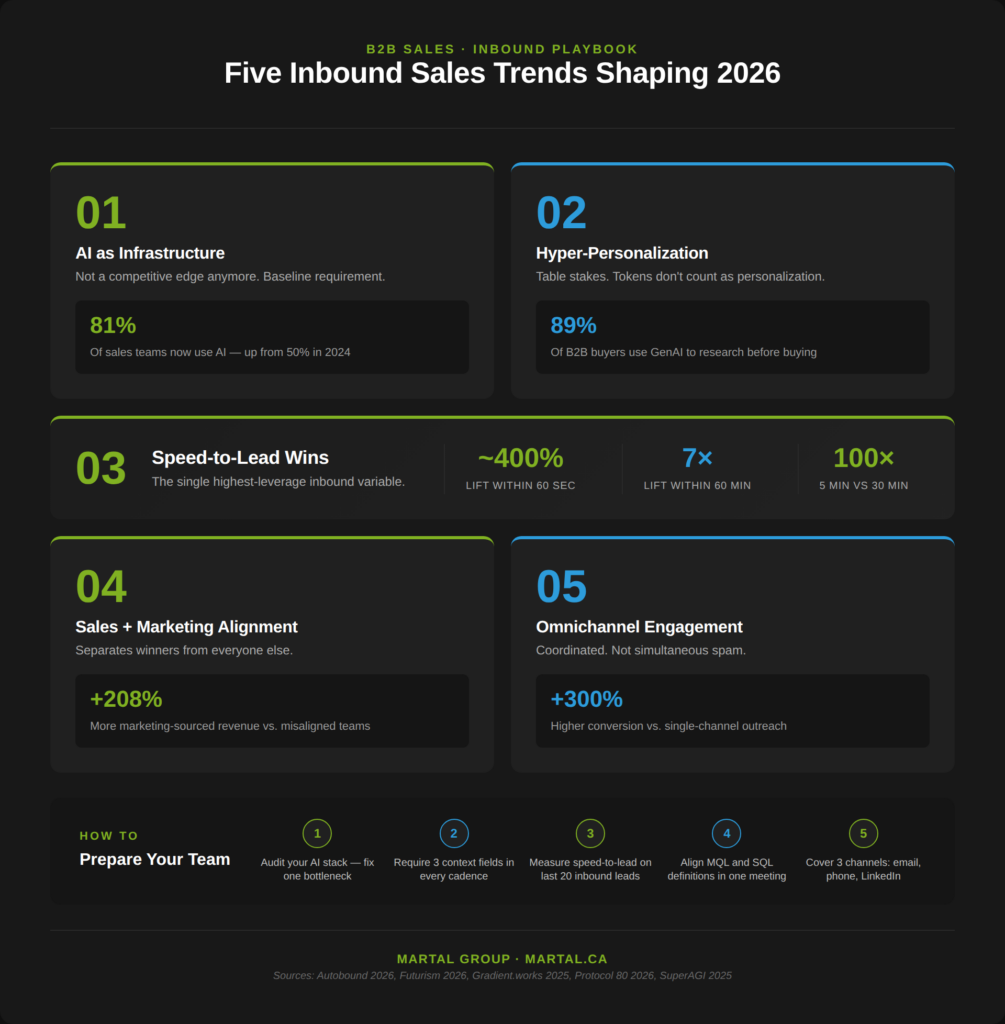
AI has crossed the threshold from competitive edge to infrastructural requirement. 81% of sales teams now use AI in some capacity in 2026, up from 50% in 202. Reps using AI are 3.7× more likely to hit their quota, and AI-driven chatbots, lead scoring, and email drafting free reps from admin work. The teams winning inbound aren’t replacing reps with AI—they’re using AI to make experienced reps faster and better-informed.
Personalization in 2026 means referencing specific prospect behavior, using context they’ve already given you, and tailoring demos to their actual priorities—not inserting first-name tokens into a templated email. Personalized emails produce 29% higher open rates and 41% higher click-throughs than generic messaging. 80% of B2B buyers now expect the same level of personalization they get as consumers.
Companies with strong sales-marketing alignment generate 208% more marketing-sourced revenue than poorly aligned teams. But only 41% of B2B companies rate their alignment as “very good” or “excellent”. Dedicated inbound SDR roles—separate from outbound prospecting—reduce context-switching and let inbound reps respond faster, often within minutes.
Omnichannel means coordinated coverage across email, phone, LinkedIn, and sometimes SMS or video—not spamming every channel with the same message. Companies using omnichannel strategies see up to 300% higher conversion rates than single-channel teams. Each channel plays a distinct role: email for reference content, phone for direct asks, LinkedIn for softer social touches.
Outsourcing inbound sales to a Sales-as-a-Service partner pays off when inbound volume exceeds internal capacity, when closers are too busy to prospect, when entering a new market or vertical, or when speed-to-capability matters more than internal team-building. Companies that outsource inbound sales see up to 43% better results than internal efforts, and Sales-as-a-Service providers can deploy trained teams in weeks instead of the months internal hiring requires.
Introduction
By 2026, inbound sales has become one of the most efficient ways for B2B companies to grow pipeline—but also one of the easiest to fumble. Buyers do most of their research before anyone in sales hears from them. 94% of B2B buyers now use generative AI as a top tool for self-guided research (14). By the time a lead fills out a form or requests a demo, they’ve already shortlisted vendors.
That changes what inbound sales has to do. Responding quickly isn’t enough. Reps need context, judgment, and a coordinated follow-up process that doesn’t drop warm leads into a black hole.
This guide covers how inbound sales actually works in 2026—what it is, how it differs from outbound, how the B2B sales funnel converts, and what separates teams that close inbound leads from teams that lose them. We’ll also cover the question most growth-stage companies eventually hit: when does it make sense to outsource sales and marketing functions to a Sales-as-a-Service partner, and when should inbound stay fully in-house?
We built this guide from current B2B sales research, our own outbound and hybrid pipeline work with 2,000+ B2B brands across 50+ industries, and direct observation of what’s working on inbound-heavy campaigns. The goal isn’t to teach inbound marketing theory—it’s to give you a practical picture of how inbound sales converts in today’s buying environment.
What Is Inbound Sales? Definition, Meaning, and How It Works
Inbound sales is a consultative approach to selling where reps engage prospects who have already shown interest—through a form fill, a content download, a chat conversation, or a call—and guide them toward a decision with relevant information and useful context. The buyer raises their hand first. Sales meets them there.
That changes the dynamic. Instead of trying to create interest from a cold start, the rep’s job is to understand interest that already exists, qualify whether the prospect is a real fit, and help them make a confident decision. Done well, inbound sales feels less like a pitch and more like a useful conversation with someone who knows the space.
How inbound sales works alongside marketing
Inbound sales sits downstream from marketing. Content, SEO, paid search, webinars, and organic social bring prospects in. Sales takes over once a prospect signals intent—requesting a demo, downloading gated content, starting a chat. The handoff is where most inbound programs live or die: a clean, fast, well-informed handoff converts; a slow or disjointed one loses the lead to whichever competitor responds first.
This is where the old “marketing generates leads, sales closes them” model breaks down. In practice, one thing we see often in inbound-heavy campaigns is that the boundary between the two functions gets blurry by design—marketing often owns the tools that route and score inbound leads, and inbound reps often sit closer to marketing than they do to outbound prospecting teams.
Inbound sales in practice
A VP of Marketing searches for “marketing automation for e-commerce,” finds a thought leadership article, reads it, and opens the chat on the pricing page. That’s an inbound lead. What happens next decides the deal.
A strong inbound sales development representative connects within minutes, references the article the prospect was reading, asks a useful question about their current stack, and offers either a short discovery call or a tailored resource. No hard pitch. No “can I tell you about our features” script. Just relevance, speed, and helpful context.
That behavior is the core of inbound selling. The rep is not trying to convince someone to care—the prospect already cares. The rep is trying to earn the right to a deeper conversation.
Inbound vs. traditional selling
Inbound stands in contrast to traditional outbound selling, where the rep initiates contact with prospects who haven’t signaled interest yet. Both have a place in a real B2B go-to-market, but they require different skills, different messaging, and different timing. The next section breaks down how they compare.
Inbound Sales vs. Outbound Sales: Key Differences
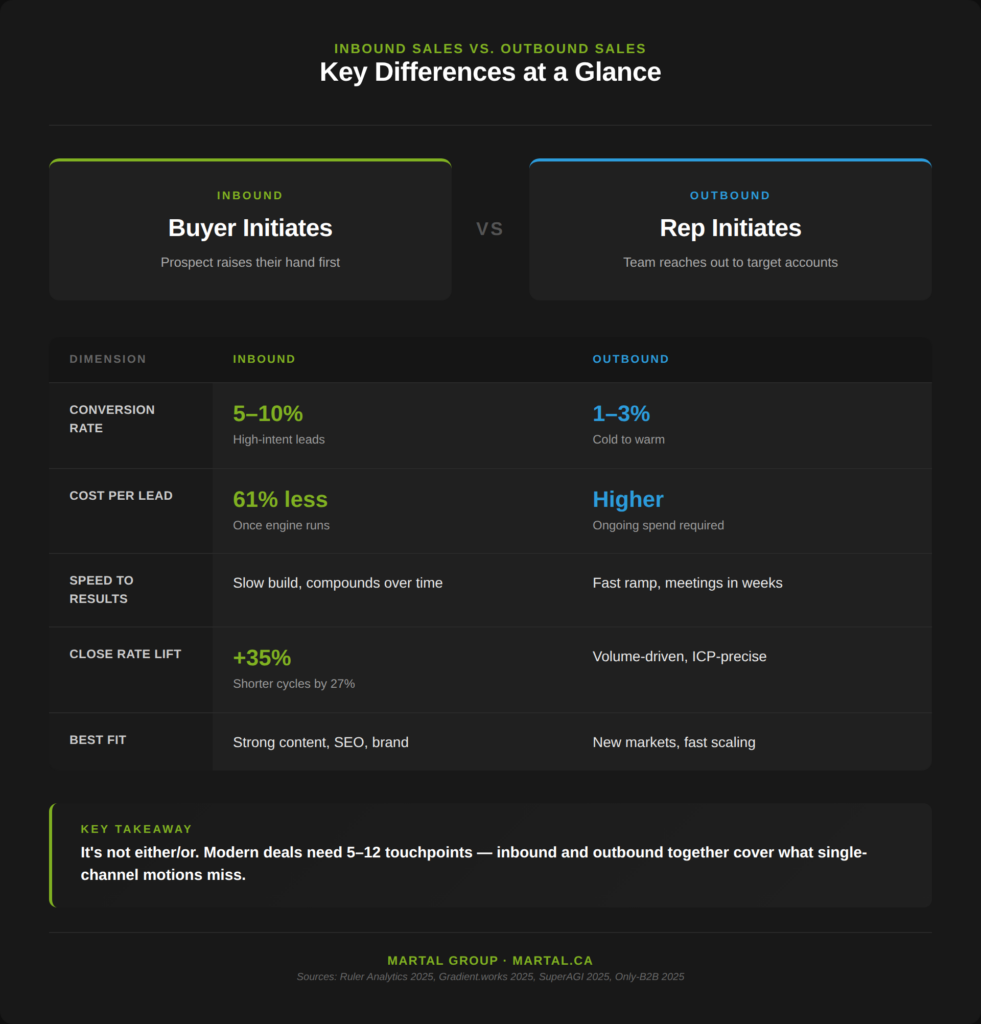
The core difference between inbound and outbound is who starts the conversation. In inbound sales, the buyer initiates—they download a resource, fill out a form, book a demo, or open your website chat. In outbound sales, the rep initiates—through cold calls, cold emails, or LinkedIn outreach to prospects who haven’t yet signaled interest.
That one difference shapes everything downstream: messaging, cadence, speed, cost, close rates, and the skills reps need to do the work well.
Inbound starts warm. The prospect is already researching, already partially convinced something in your category is worth exploring. The rep’s job is to be helpful, fast, and relevant. Outbound starts cold. The prospect may not have heard of you, may not be actively looking, and may be getting fifteen other cold emails that week. Decision-makers are inundated with B2B cold emails, which is why personalization, timing, and persistence matter so much more on the outbound side. One thing we see often across our own campaigns: outbound and inbound reward different reps for different reasons—and treating them as interchangeable is where most teams lose performance.
How inbound and outbound compare in practice
Dimension
Inbound Sales
Outbound Sales
Who starts the conversation
Buyer raises their hand
Rep initiates contact
Audience origin
High-intent prospects actively searching for a solution
Pre-defined ICP list, may or may not be in-market
Messaging
Educational, consultative, question-led
Proactive, persuasive, value-prop led
Speed of results
Long build—leads trickle in, compound over time
Fast ramp—outbound campaigns can produce meetings within weeks
Cost structure
Upfront investment in SEO and content; cost per lead drops over time—inbound leads run ~61% less than outbound on average (15)
Ongoing spend on sales tools, lead lists, ads, and SDR salary
Buyer intent at first touch
Hot—prospect already researching; companies using inbound lead generation strategies see 35% higher close rates and 27% shorter sales cycles (3)
Cold or unknown; why personalized outbound lead generation (video, 1:1 messaging) is rising
Close rate benchmark (2025–2026)
~5–10% inbound conversion rate (16)
~1–3% outbound conversion rate (16)
Best-fit use
Companies entering new markets, launching, or scaling faster than organic demand allows
It’s not either/or—it’s both
Despite how the comparison reads, inbound vs. outbound is not a strategic choice you make once. The strongest B2B programs run both, because each covers the other’s gaps. Outbound creates demand in markets where buyers haven’t found you yet. Inbound captures demand once it exists and builds brand trust at scale (15).
When synchronized, the combined motion multiplies touchpoints. Marketing-driven inbound brings in steady sales leads over time. An outbound SDR team works the same ICP in parallel—targeting high-fit accounts that haven’t engaged organically instead of waiting for them to find you.
That parallel motion matters more than ever because buying groups keep getting bigger. Most deals now require 5–12 touchpoints to close, and 89% of B2B buyers report a deal stalling in the past year (17). One channel—whether inbound or outbound—rarely gets a rep all the way through a modern buying committee.Key takeaway: Inbound pulls people in. Outbound reaches out. Inbound reps are advisors for interested buyers. Outbound reps are hunters opening new conversations. Both have a place in a real B2B sales strategy—but this guide focuses on inbound, so let’s look at how the inbound sales process actually converts.
How the Inbound Sales Funnel Works (and Where Most Teams Lose Deals)
The inbound sales funnel is the set of stages a prospect moves through from first hand-raise to closed deal. Models vary, but the shape is consistent: marketing brings prospects in at the top, sales qualifies and nurtures through the middle, and closers take it home at the bottom. What separates teams that convert inbound leads from teams that lose them is not the funnel diagram—it’s the handoff quality and the speed of execution at each stage.
Here’s how the stages break down.
The four stages of the inbound sales funnel
1. Attraction (top of funnel). Marketing draws prospects in through content, SEO, paid search, events, and social. The goal is to capture contact information through a form fill, download, or demo request. At this stage, sales is usually not involved. The output is a Marketing Qualified Lead (MQL).
2. Qualification and Lead Nurturing (middle of funnel). This is where inbound sales reps enter. An inbound SDR reaches out, confirms whether the prospect’s needs, authority, and timeline actually match your ICP, and keeps the conversation warm with useful information—resources, context, a relevant customer example. The output is a Sales Qualified Lead (SQL): someone who’s asking for a meeting, a proposal, or next-step information.
3. Consideration and proposal (bottom of funnel). An account executive takes over. Because the rep has discovery notes from the qualification stage, the demo and proposal land on the prospect’s actual pain points, not generic feature walk-throughs. Inbound doesn’t mean no selling—it means selling with context.
4. Closing and onboarding. The deal closes or it doesn’t. Either way, the handoff matters. A clean onboarding transition sets up referrals, expansions, and renewals. A messy one poisons future revenue and creates churn risk.
The HubSpot Inbound Sales Methodology: Identify, Connect, Explore, Advise
HubSpot’s widely adopted methodology breaks the rep’s side of the funnel into four actions (18). It’s a useful shorthand because it maps what the rep should actually be doing at each stage.
Identify. The rep spots prospects who’ve engaged—website visitors, content downloads, webinar attendees, pricing-page visits—and prioritizes active leads over passive list names (18). Modern teams use prospecting tools and intent data so reps see high-value inbound activity in real time (for instance, an alert when a target-account lead hits the pricing page).
Connect. The rep opens the conversation—typically within minutes, not hours (18). Personalization matters here more than volume. Referencing the specific content the prospect downloaded or the specific page they visited gets replies; generic “just checking in” outreach doesn’t.
Explore. A deeper discovery conversation. The rep asks questions to understand challenges, goals, and decision process. Good reps listen more than they talk. By the end of this stage, the rep should be positioned as a trusted advisor, not a vendor.
Advise. The rep frames a recommendation around what they learned—not a generic sales pitch. This is consultative selling at its peak: “Based on what you said about needing faster onboarding, here’s how our platform’s automation cuts that time in half.” It’s specific to the buyer, not a templated demo.
The methodology maps cleanly to the buyer’s journey—Awareness, Consideration, Decision—so the rep’s job at each point is to provide the right kind of help at the right time. Early on, share educational content. In consideration, send a relevant customer example or ROI calculator. At decision, deliver a tailored demo or pilot.
Speed-to-lead: the stage where most inbound programs fail
Everything in the inbound funnel pivots on response time. Because inbound leads have signaled interest, reaching them quickly compounds every other advantage in the process. Waiting hours—or worse, days—erases the intent signal entirely.
The benchmarks are unforgiving:
- Responding within 60 minutes yields 7× higher conversion rates than waiting 24+ hours (19).
- Responding within 60 seconds boosts conversion by roughly 400% (17).
- 66.4% of companies rate inbound phone calls as their highest-quality lead source (2)—people who pick up the phone are often ready to talk specifics.
One thing we see often on inbound-heavy campaigns: the single biggest predictor of conversion isn’t messaging quality or rep talent—it’s whether someone was actually available to respond when the lead came in. Teams that run SLAs (call-back within 15 minutes, same-day email response, rep-on-standby during business hours) outperform teams with better messaging and slower response. The mantra is simple: strike while the iron is hot.
How data and routing keep leads from falling through the cracks
Inbound sales depends on data systems as much as rep skill. Lead scoring prioritizes who gets reached first—marketing automation platforms weight pages visited, content downloaded, job title, and company fit, then alert sales when a lead crosses a threshold. The sales team works the highest-scoring leads first instead of burning hours on curiosity clickers (2).
By 2026, the tooling is getting more sophisticated. AI-driven lead scoring, real-time routing, and chatbots that qualify before a human rep sees the lead are now common in well-run inbound programs—we’ll get to those in the Trends section.
The Inbound Sales Representative: Role and Best Practices
An inbound sales representative—sometimes called an inbound SDR, inbound BDR, or inbound sales rep, depending on the company—is the person who picks up inbound leads, qualifies them, and either books a meeting or hands a sales-ready opportunity to an account executive. Unlike outbound reps, they’re not prospecting cold lists. They’re responding to people who already raised their hand: form fills, demo requests, chat conversations, and inbound calls.
The role sounds easier than outbound because the leads are warmer. In practice, it’s a different kind of hard. Inbound reps work against the clock on every lead, juggle prospects at different stages of the buying journey simultaneously, and get penalized fast when response quality slips.
Key responsibilities of an inbound sales executive
Respond to inbound leads immediately. Speed is the single most controllable variable in inbound conversion. When a prospect downloads a whitepaper or requests information, the rep reaches out within minutes, not hours. The outreach references the specific thing the prospect engaged with—the content they downloaded, the page they visited, the question they asked in chat. Generic “just checking in” follow-up loses to competitors that respond faster and more relevantly. The 60-minute response window yields 7× higher conversion rates than waiting 24+ hours (19).
Qualify and educate prospects. The rep asks discovery questions to determine whether the lead is a real fit: what are they trying to solve, who else is involved in the decision, what’s their timeline, what have they already tried. Qualification focuses on authority and need—whether this prospect has the problem your product solves and the authority to do something about it. At the same time, the rep educates the prospect with context and examples that help them make a decision, rather than pitching hard. Good inbound reps ask about B2B decision-makers early; modern deals almost always involve buying committees, not individual buyers.
Nurture leads through the funnel. Not every inbound lead is ready to buy on the first call. Good inbound reps stay in touch over weeks or months—sharing relevant resources, flagging new capabilities the prospect cared about, checking in when a known trigger event happens (funding round, leadership change, competitor announcement). A short note like “Saw your team just raised a Series B—wanted to send over the case study from the company that asked us the same questions you did last quarter” keeps the relationship warm without feeling like a chase.
Run inbound calls and demos. Inbound reps often handle first-touch demo calls and product consultations. For companies with heavy inbound phone volume, these calls matter disproportionately—66.4% of companies rate inbound phone calls as their highest-quality lead source (2). Someone who picks up the phone is usually ready to talk specifics.
Log everything and collaborate with marketing. Inbound reps keep detailed notes on what each lead engaged with, what questions they asked, and what objections came up. That data feeds back to marketing—what content is converting, what campaigns are bringing in fit leads, what messaging is dying on the vine. Many inbound SDR teams now report into marketing directly or work in tight integration with demand gen, because the functions share the same top-of-funnel tooling and goals.
What skills separate great inbound reps from average ones
Four skills move the numbers more than anything else:
Active listening. The best inbound reps talk less and ask more. Open-ended questions get prospects explaining their actual problem in their own words, which is what lets the rep recommend something useful later. Reps who jump straight into pitch mode after a form fill lose deals to reps who spent the first ten minutes listening.
Product and industry fluency. Inbound leads ask detailed questions (“how does this compare to X,” “how does this work with our current stack,” “do you support our industry’s compliance requirements”). Reps who can answer confidently, without pushing every question to a product specialist, close more. Generalist reps in complex categories struggle.
Time management. Inbound reps juggle dozens of active leads at different stages. One hour they’re answering a brand-new demo request; the next they’re following up with last week’s qualified lead who’s gone quiet. Reps who live in their CRM—tasks, reminders, notes, sequences—never drop leads. Reps who rely on memory do.
Clear, fast communication. Written and verbal both. Inbound reps send a lot of email and take a lot of calls, so clarity matters more than charisma. A friendly, consultative tone beats a formal, overly polished one almost every time.
Many teams equip new reps with cold call scripts and playbooks for common inbound scenarios—greeting language, the first discovery question, product-specific talking points, meeting-booking close language. Scripts give newer reps a floor. The best inbound reps use scripts as a starting point and adapt in real time based on what the prospect actually says. Rigid scripts lose inbound deals because inbound conversations are less predictable than outbound—the prospect is driving the conversation as much as the rep is.
What “executing brilliantly” actually looks like on inbound
Generic inbound rep best-practice guides don’t tell you much. Here’s what strong inbound execution looks like in an actual Martal engagement.
For Umbo Computer Vision, an AI video analytics security company, Martal ran a hybrid motion that combined outbound SDR work with inbound SDR coverage. In the first month alone, the combined inbound/outbound team engaged 70+ leads and booked 7 demos—a 10% demo conversion rate from first touch to booked meeting. The inbound reps converted at that rate because they did what good inbound reps do: responded fast, referenced the prospect’s specific context, qualified against real fit criteria, and handed warm opportunities cleanly to Umbo’s closers.
That’s the pattern that separates real inbound execution from the theory. Fast response, specific relevance, honest qualification, clean handoff. No single step is glamorous. All of them together are what moves the conversion number.
Five Inbound Sales Trends Shaping 2026 and How to Prepare Your Team
Reps using AI are 3.7× more likely to hit their quotas than reps who don’t use AI tools.
Reference Source: Spotio
Inbound sales is moving fast. AI has gone from experimental to infrastructural, buyer expectations have caught up to consumer-grade personalization, and speed-to-lead has become the single most controllable conversion variable in the funnel. B2B sales leaders—CMOs, CROs, VPs of Sales and Marketing, SDR managers—who ignore these shifts are already losing deals to teams that haven’t.
The five trends below are the ones that matter most for inbound sales execution in 2026. Each one includes current benchmarks, what’s actually working, and a practical tip you can apply without a full-scale program rebuild.
Trend 1: AI Is Now Infrastructure, Not A Competitive Edge
AI-powered lead generation strategies deliver 5–8× higher ROI than traditional approaches.
Reference Source: Uplead
AI has crossed the adoption threshold. It’s no longer the thing that gives teams an advantage—it’s the thing teams need to have working well to avoid falling behind. The inbound sales process, built on fast response and personalized follow-up, is one of the highest-leverage places AI actually moves the number.
How AI is being used on inbound leads in 2026
Four applications are doing most of the work:
- Chatbots and conversational AI engage visitors the moment they hit a pricing page or high-intent content, answer baseline questions, and either book a meeting directly or capture context for a human rep. The prospect doesn’t wait hours for a reply. By the time a rep steps in, the chatbot has already surfaced the intent signal and the rough fit.
- AI-driven lead prioritization scores inbound leads in real time based on engagement patterns—pricing page visits, repeat content downloads, email opens, company firmographics. Reps work the hottest leads first instead of burning the morning on curiosity clickers (2).
- AI-written outreach drafts give reps a personalized starting point for email follow-up, demo recap notes, and proposal language—drafted from CRM context, not a generic template.
- Conversational AI voice agents handle simple inbound callbacks and qualification (“I’m calling to confirm your demo request—is this still a good time?”), escalating to human reps only when the prospect is engaged.
The performance gap between AI-enabled and non-AI-enabled teams
The numbers are no longer directional—they’re decisive:
- Reps using AI tools are 3.7× more likely to hit their quota than reps who don’t (20).
- Research consistently shows sales reps spend only 28–30% of their time actually selling, with 70% consumed by administrative tasks. AI automation reclaims 4–7 hours weekly for revenue-generating activities (19).
- Revenue teams using AI-driven sales automation report 50% higher win rates and 30% shorter sales cycles (21).
- Data-driven, AI-enhanced lead generation strategies drive 5–8× higher ROI than manual approaches (22).
- AI SDR tools churn at 50–70% annually—roughly double the turnover rate of the human reps they replace (11).
That last number is worth pausing on. Two things are true at once: AI is accelerating inbound performance and the tooling is unstable enough that most full-AI SDR deployments don’t last a year. The teams getting real leverage aren’t replacing human reps with AI—they’re using AI to make human reps faster, better-informed, and freed from low-leverage admin work.
What this means for inbound execution
One thing we see often across our own outbound and hybrid campaigns: AI works best when it’s layered underneath an experienced rep, not positioned to replace one. AI-generated draft emails save a rep 30 minutes of typing. AI-scored lead lists save a rep 2 hours of manual prioritization. AI voice agents handle off-hours acknowledgments so prospects don’t sit in silence until Monday morning. None of those individually sound revolutionary. Stacked together, they move the conversion rate.
Teams that treat AI as a replacement for judgment tend to get the tooling churn number above. Teams that treat AI as leverage for judgment tend to get the win rate and sales cycle numbers.
Practical tip
Pick one high-leverage bottleneck and fix it with AI before rolling out a broader program. The best candidates on an inbound team: a chatbot on the pricing and contact pages to capture after-hours inquiries; AI lead scoring to reorder the morning call list; an AI assistant that drafts personalized email follow-up using CRM context. Measure the impact over 30 days before expanding. Most teams discover one or two of these produce outsized gains while others underperform—better to know which is which before scaling up.
Trend 2: Hyper-Personalization and Elevated Buyer Experience
Personalized emails see a 29% higher open rate and a 41% higher click-through rate than non-personalized ones.
Reference Source: SuperAGI
B2B buyers expect purchasing experiences that match what they get as consumers. 80% now expect the same level of personalization in B2B sales as they get in B2C shopping (8). That shifts the job of an inbound rep from respond quickly to respond quickly with context that proves you understand them. Fast-but-generic loses to slightly-slower-but-relevant almost every time.
The expectation has sharpened further in 2026 because buyers are arriving pre-researched. By the time someone fills out a demo request, they’ve often used generative AI to shortlist vendors, read reviews, compared pricing pages, and decided what categories of solution they’re evaluating. Generic “let me tell you about our product” replies waste the prospect’s time and signal the rep hasn’t caught up.
What good personalization on inbound leads looks like
Four things separate strong personalization from the wallpaper kind:
- Reference the specific behavior, not the category. If the prospect downloaded a guide on cloud compliance, the opener references the guide and the likely pain point (audit readiness, shared responsibility, vendor risk), not “I saw you’re interested in security.”
- Use what they’ve already given you. Every form fill, survey, chatbot conversation, or intent signal is context the rep should bring to the first touch. When a prospect has to re-explain themselves on a demo call, they’ve already downgraded the experience.
- Tailor the demo, not just the email. If the lead signaled interest in integration capabilities, spend demo time there and skip the features they didn’t ask about. A 20-minute focused demo beats a 45-minute feature tour every time.
- Build personalization into follow-up, not just first touch. A useful post-demo follow-up might say, “You asked about SOC 2—here’s how one of our clients in the same industry handled it.” That beats a generic “just following up” every time.
The performance payoff
Personalization moves every measurable engagement metric:
- Personalized subject lines and content produce a 29% higher email open rate and 41% higher click-through rate than non-personalized emails (5).
- 62% of B2B buyers respond when a salesperson shares content relevant to their business (1).
- 71% of companies say personalization has a strong impact on advancing customer relationships (5).
- Organizations incorporating video into prospecting sequences report 40% higher meeting booking rates (19).
- AI chat assistants improve lead qualification efficiency by up to 40% (10).
Compare those to the response rates on generic sales blasts—consistently in the low single digits—and the case for personalization stops being a preference and becomes a cost-of-doing-business requirement. Our own generic-vs-personalized email response rates show the same pattern: when messaging references specific prospect context (company, role, recent trigger event), reply rates climb meaningfully. When it doesn’t, the email lands in the same “just deleting these” pile as every other vendor pitch.
Personalization beyond the email
The trend extends past first-touch outreach into how you actually run the deal:
- Custom content for high-value leads. Successful marketing campaigns often include creating one-off assets for key accounts—a tailored slide, a prospect-specific audit, an ROI calculator pre-filled with the prospect’s data. High-lift effort, high-lift return on the right accounts.
- Personalized video messages. A 60-second video walking through the prospect’s website or referencing something specific to their business beats a cold email almost universally. Tools like Higgsfield’s AI Video Generator make video outreach fast enough to be viable at scale, and buyers notice the effort.
- Channel preference inference. Read signals in how the prospect engages. A C-level who picked up the phone after the form fill probably wants phone-first follow-up. A mid-manager who responded only in chat probably wants written communication. Personalize the channel, not just the message.
Where most teams go wrong
One thing we see often on inbound engagements: teams confuse personalization with personalization tokens. Inserting the first name and company name into a templated email isn’t personalization—it’s mail merge. Real personalization requires the rep (or the AI assisting the rep) to understand something specific about the prospect’s situation and use it as the anchor of the message. The effort difference is small. The conversion difference is not.
Practical tip
Audit your current inbound outreach against one question: Could this exact email have been sent to any other prospect in the same industry? If the answer is yes, it’s not personalized—it’s templated. Identify the three pieces of context every rep should be pulling into inbound follow-up (the content the prospect engaged with, the company’s recent trigger events, and the persona’s likely top priority) and build those into your cadence as required fields, not optional ones. That alone moves the number more than switching to yet another AI writing tool.The buyer already raised their hand. The only question is whether you respond like you noticed who they are, or like you’re blasting a list. Teams that consistently handle inbound sales ready leads with real context outperform teams that don’t—not by margins, by multiples.
Trend 3: Speed-to-Lead Is the Single Highest-Leverage Inbound Variable
Responding within 5 minutes boosts lead qualification odds by up to 100× compared to a 30-minute delay.
Reference Source: InsideSales
Speed-to-lead is the most controllable variable in the inbound funnel and the one most teams handle worst. Automation, chatbots, and AI voice agents have trained buyers to expect near-instant responses. When a B2B prospect fills out a demo form, they don’t assume a rep will call in three days. They assume a rep will call in three minutes—and if you don’t, a competitor will.
What the benchmarks actually look like in 2026
The numbers aren’t soft:
- Responding within 60 seconds lifts conversion by ~400%, and responding within 60 minutes still lifts qualification rates 7× vs. 24+ hour delays (14).
- Inbound web leads deliver 3× more SQLs per MQL than outbound sources (16)—but only when the response happens in the intent window.
- Responding within 5 minutes boosts lead qualification odds by up to 100× compared to a 30-minute delay (13).
- 7× more likely to have a meaningful conversation with a lead if you follow up within an hour (2).
- Speed-to-lead automation produces an 82% reduction in delays when properly implemented (10).
All of those numbers point to the same conclusion: the intent window on an inbound lead is measured in minutes, not hours. Miss it and the rest of your sales process is working against a colder, more skeptical prospect—if they’re still engaged at all.
How real-time engagement is structured in well-run inbound teams
Four tactics do most of the work:
- Round-robin with instant alerts. The moment a lead comes in, an available rep gets pinged through the CRM, Slack, or a dedicated dialer. No shared inbox monitoring. No batch-process-the-morning-queue.
- A rapid-response queue during business hours. A small pool of reps on explicit standby for inbound coverage, with a backup assignment that triggers if the primary rep doesn’t acknowledge within 5 minutes.
- Chatbots that triage after hours. When leads arrive at 10pm on a Tuesday, a conversational AI agent acknowledges the request, surfaces basic qualification info, and books a meeting for the next-available rep. The prospect doesn’t sit in silence overnight.
- Immediate callback tools on high-intent forms. For demo requests specifically, some teams use services that ring an available rep the moment the form hits—enabling a call-back measured in seconds, not minutes.
Sales tools for this category have matured significantly. The technology isn’t the bottleneck anymore. Process discipline is.
The persistence half of the equation
Speed gets you to the first conversation. Persistence gets you to the meeting. Both matter—and most teams still underdo the second one.
The benchmark that’s embarrassed a decade of sales leaders is still accurate: most deals require 5–12 touchpoints to close, yet 80% of sales require five or more follow-ups while 92% of reps give up after the fourth attempt (17).
On inbound leads specifically, that gap is especially costly because the prospect already signaled intent once. If they didn’t reply to the first callback, they didn’t lose interest—they got busy, the email got buried, or the timing was off. A strong inbound B2B sales process uses automated sequences and multi-channel follow-up (call, email, LinkedIn, occasional SMS where appropriate) at smart intervals until the prospect either engages or explicitly opts out.
A typical inbound nurture sequence after no first-touch reply
One example of what disciplined follow-up looks like: a prospect registers for a webinar but doesn’t respond to the post-webinar email. A well-run inbound team doesn’t stop there. Day 3: a second email referencing a specific topic from the webinar. Day 7: a phone call with a voicemail tied to the same topic. Day 10: a LinkedIn connection request with a short note. Day 14: a relevant resource share (case study, industry report). Many prospects engage on the fifth or sixth attempt—not because they changed their mind, but because that’s when the timing finally worked. Teams that stop at attempt two are handing deals to competitors who don’t.
Practical tip
Audit your current inbound response times in 30 minutes. Pull the last 20 inbound leads from your CRM, look at the timestamp of the lead arrival vs. the timestamp of the first rep touch, and calculate the average. If it’s more than an hour, you have the single highest-ROI fix available in the inbound funnel. The teams that move conversion rates on inbound aren’t investing in more tools—they’re closing the gap between form submission and first human response. That takes process discipline, not technology. Fast wins. Make sure your inbound team is structured to deliver it.
Trend 4: Alignment Between Sales and Marketing Separates Winners from Everyone Else
Aligned sales and marketing teams experience 32% higher revenue growth year-over-year.
Reference Source: Invoca
Sales and marketing alignment has been a boardroom topic for fifteen years. In 2026, it’s stopped being an aspiration and started being a requirement—especially for inbound sales, where the handoff between the two functions is the process. When alignment is weak, inbound leads fall into the gap between marketing’s “we handed it off” and sales’ “we never saw it.” When alignment is strong, the prospect experiences a single journey from content download to closed deal.
The alignment gap is bigger than most leaders think
There’s a trust gap at the top of most companies. 82% of C-level executives say their sales and marketing teams are aligned. Meanwhile, 65% of the people actually doing the work say alignment doesn’t exist (9). That gap alone explains why so many alignment initiatives stall or never get funded—the executives who’d sponsor them don’t believe the problem is real.
The numbers tell a different story. Only 41% of B2B companies rate their sales and marketing alignment as “very good” or “excellent,” and just 11% have successfully aligned both their audiences and created an effective hand-off process. 49% of chief sales officers report that their sales organization’s definition of a qualified lead differs greatly from marketing’s definition (9). When sales and marketing can’t agree on what “qualified” means, every inbound lead becomes a finger-pointing exercise instead of a pipeline opportunity.
The performance gap between aligned and misaligned teams
The numbers are not subtle:
- Aligned companies generate 208% more marketing-sourced revenue than misaligned ones (14).
- B2B organizations with tight alignment achieve 24% faster three-year revenue growth and 27% faster three-year profit growth (4).
- Aligned organizations are 67% more effective at closing deals and have 36% higher customer retention (7).
- Companies with poor sales and marketing alignment see a 4% revenue decline (4).
- Forrester research shows aligning people, process, and technology across the demand engine drives 36% more revenue growth and up to 28% more profitability (9).
- Misalignment between sales and marketing costs businesses an estimated $1 trillion annually (9).
Alignment isn’t a soft improvement. It’s the difference between compounding growth and steady revenue decline.
What alignment actually looks like in practice on inbound
Five things separate aligned inbound programs from dysfunctional ones:
- Shared Lead Generation KPIs and lead definitions. Marketing and sales agree on what an MQL is, what an SQL is, and what conversion rates between them look like. Joint targets (“marketing delivers X MQLs/month converting to SQL at Y%; sales commits to first-touch within Z hours”) prevent the handoff from becoming a blame loop.
- Regular cross-functional communication. Weekly sales-marketing standups or monthly pipeline reviews where inbound reps share what’s converting and what isn’t, and marketing shares upcoming campaigns so sales knows what prospects might be seeing. Generic MQL feedback (“these leads are bad”) doesn’t help. Specific feedback (“the last campaign’s leads ghost after the first email”) does.
- Integrated tech stack. Marketing automation and sales CRM sync in real time. Inbound reps have access to the same lead history marketing sees. Closed-loop reporting makes it possible to see which campaigns actually drive revenue, not just which generate leads. 75% of the highest-growth companies plan to deploy a RevOps model by 2025 (25)—and the underlying driver is technology consolidation, not org-chart gymnastics.
- Content and playbook collaboration. Inbound reps flag recurring objections and missing sales collateral; marketing creates one-pagers, comparison guides, or blog posts to address them. Sales sends marketing-created assets into deals; marketing watches which assets close business and makes more of those.
- Specialized inbound vs. outbound roles. Inbound SDRs focus on fast response to warm leads. Outbound SDRs focus on outbound prospecting against cold ICP lists. The skills overlap but the cadences don’t—and teams that specialize consistently outperform teams that ask one rep to do both. Inbound reps stay in “help this interested prospect” mode without context-switching to cold prospecting, which means they respond faster and qualify more thoughtfully (2).
Many inbound SDR teams now report into marketing
The org-chart shift is real. Nearly half of inbound sales teams now report directly to marketing, because marketing owns the technology that makes inbound reps effective—automation platforms, lead scoring systems, chatbots, attribution tooling. Putting inbound SDRs under marketing leadership tightens the feedback loop and removes the handoff friction that loses inbound leads in traditional org structures.
Whether you restructure reporting lines or not, the operational principle is the same: treat inbound sales as a continuation of the marketing motion, not a separate silo. The prospect doesn’t experience a handoff from “marketing” to “sales”—they experience a single conversation that gets progressively more consultative as they move closer to a decision.
Practical tip
Run a 15-minute alignment audit with your marketing leader. Agree on one specific answer to each of three questions: What defines an MQL in our system? What defines an SQL? What’s our committed response time from MQL creation to first rep touch? If marketing and sales can’t answer those three questions the same way, that’s not an alignment problem—it’s an unstarted alignment conversation. Start there before investing in tools, org changes, or RevOps restructuring.
Trend 5: Omnichannel Engagement Is How Modern Buyers Actually Want to Be Sold To
Companies using omnichannel strategies see up to 300% higher conversion rates than those using a single channel.
Reference Source: SuperAGI
Last but not least, omnichannel engagement has become a defining inbound (and outbound) sales trend. Inbound leads might come in through one channel – say, they filled out a web form. But that doesn’t mean your communication should stay confined to that channel. Top-performing sales teams engage prospects across multiple channels (email, phone, social media, SMS, events, etc.) to increase connection rates and build relationships.
Why is this important in 2026? Buyers are everywhere. A busy executive might ignore your emails but respond to a LinkedIn message. Another prospect might prefer text messages for quick coordination but wants to do a detailed discussion on a Zoom call. By being present on the channels your business leads prefer, you make it easier for them to engage. Plus, using multiple channels reinforces your message – a prospect might see your email, scroll past it, but then notice your LinkedIn DM later and respond. It’s about meeting the buyer where they are.
Data supports an omnichannel marketing approach. Companies that use multiple channels to communicate with prospects have significantly higher success rates – one report found they achieve a 300% higher conversion rate compared to those using a single channel (5). That’s because each channel offers another touchpoint and caters to different preferences. Think of it like an orchestra: email alone is like a solo instrument, but email + phone + LinkedIn in coordination is a full symphony that’s harder to ignore.
For inbound sales, omnichannel engagement could play out like this: an inbound lead comes from a webinar (so first touch was the webinar platform). The rep follows up via email with info promised during the webinar. They get no reply, so the next day the rep calls the prospect’s number and leaves a voicemail referencing the email (“I sent you those case studies – hope they were helpful”). Then the rep also finds the prospect on LinkedIn and sends a connection request with a short note. Over the next week, perhaps the rep even sends a text message if appropriate (some reps do this after a connection is established: e.g. “Just sent an email with the proposal – feel free to text me any quick questions”). By reaching out across 3-4 channels, the rep significantly increases the odds of engagement, and it demonstrates persistence and availability.
Buyers today often juggle many communication channels – by offering an omnichannel sales experience, you also subtly signal that your company is modern and customer-focused. It’s no surprise that 80% of buyers prefer a personalized experience across channels, and multi-channel orchestration is viewed as essential for delivering that (5). In fact, organizations using hybrid sales models (a mix of virtual touches like email/phone and in-person or more direct interactions) have been found to achieve up to 50% higher revenue growth than those sticking to single-channel or single-mode sales (8).
A big part of omnichannel success is knowing which channels your inbound leads favor. You can often infer this from their behavior or role. For instance, many C-suite executives still appreciate phone calls for certain conversations (8) (57% of C-level execs in one survey said they value phone outreach for important discussions (8)), whereas mid-level managers might prefer email for most communication (indeed, 80% of prospects overall prefer to communicate via email for sales (8)). Younger tech-savvy buyers might respond quickly on LinkedIn. Some industries congregate in specific places (if you sell to developers, maybe Slack or community forums are channels to consider; if you sell to doctors, perhaps they prefer phone and face-to-face). The key is to diversify your touchpoints and then pay attention to where each prospect seems most responsive.
One caution: omnichannel does not mean spamming the prospect on every platform relentlessly. It should be a coordinated effort with consistent messaging. The last thing you want is to annoy a lead by hitting them from all sides with generic outreach. Instead, use each channel thoughtfully. Perhaps your email is a longer form content share, your phone call is to directly ask for a meeting, and your LinkedIn interaction is more social/soft (commenting on a post of theirs or sharing relevant industry news). They should all reinforce your value proposition, but in varied ways that suit the channel. When done right, omnichannel outreach strategies make your presence feel ubiquitous without feeling spammy – the prospect just notices “this company is everywhere and they’re providing helpful info.”
In summary, inbound sales teams in 2026 should not confine themselves to one or two communication channels. Sales is now an omnichannel sport. Make sure your playbook includes phone calls, emails, LinkedIn (or other social media relevant to your buyers), and even newer channels like WhatsApp or SMS when appropriate (with permission). By weaving these together, you create a richer tapestry of touchpoints that can dramatically improve engagement and conversion. The companies embracing omnichannel prospecting and selling are clearly seeing better results – don’t let your team be left behind using only yesterday’s channels.
One thing we see often on our own campaigns: omnichannel isn’t about being everywhere—it’s about being where the specific prospect is responsive. Some prospects engage on LinkedIn first and everything else second. Others will only take meetings that came through a phone conversation. Track where each prospect actually replies, not just where your team likes to send from.
How to read buyer channel preferences by role
Channel preference correlates roughly (but not rigidly) with role and industry:
- C-suite executives still value phone for substantive conversations. 57% of C-level execs in one survey said they value phone outreach for important discussions (8).
- Mid-level managers skew toward email. 80% of prospects overall prefer email for sales communication (8). It fits their workflow and gives them time to read without interrupting other work.
- Technical buyers (engineers, developers, IT) often respond faster to LinkedIn, Slack communities, or technical forums than traditional channels.
- Younger buyers across roles tend to respond faster on LinkedIn DMs than cold email.
- Industry matters too. Healthcare buyers lean toward phone and in-person. SaaS evaluators respond to video and async channels. Logistics and manufacturing buyers still prefer phone and email over social.
Use these as starting hypotheses, not rules. The best signal is always how a specific prospect actually behaves—which contact they open, which channel they reply on, which invitation they accept. Calibrate follow-up cadence around that behavior, not around category averages.
The omnichannel mistake most teams make
One caution, and it’s the fastest way to burn an inbound lead: omnichannel does not mean sending the same message simultaneously across every channel. That’s spam with extra steps. Coordinated omnichannel means each channel carries a different kind of touch:
- Email is good for longer content shares, recaps, and reference links.
- Phone is good for direct asks—booking a meeting, confirming timing, clearing an objection.
- LinkedIn is good for softer social-context touches—commenting on a post, sharing an industry article, acknowledging a mutual connection.
- SMS (when permission has been established) is good for time-sensitive quick coordination—”just sent the proposal, let me know if you need anything.”
Each touch should reinforce the same value proposition but in a way that fits the channel. When this is done well, the prospect registers that you’re present and helpful across their workflow without noticing you’re “following up.” When it’s done badly, the prospect blocks your number, unsubscribes from email, and ignores your LinkedIn. Same rep, same prospect, very different outcome.
Practical tip
Build your inbound outreach strategies around at least three channels by default: email, phone, and LinkedIn. SMS and video can layer in for specific use cases. Audit your current inbound cadence: if reps are touching most leads only via email, you’re leaving conversion on the table. The teams winning inbound in 2026 aren’t the ones picking the newest channel—they’re the ones using multiple channels in coordination, tracking which channel each specific prospect responds to, and adjusting fast. Omnichannel is a discipline, not a toolset.
Those five trends—AI-as-infrastructure, hyper-personalization, speed-to-lead, alignment, and omnichannel—are the shape of inbound sales in 2026. Each one rewards teams that invest in execution and punishes teams that don’t. But there’s a harder question beneath all of them: what if your team can’t realistically operationalize all five in-house, at least not fast enough to keep up with competitors who already have? That’s where the conversation shifts from strategy to structure—specifically, to whether parts of your inbound sales motion belong inside your company or with a specialized partner.
Outsourcing Inbound Sales in 2026: When a Sales-as-a-Service Partner Actually Makes Sense
Companies that outsource inbound sales see up to 43% better results than in-house efforts.
Reference Source: LLCBuddy
Scaling an inbound sales operation requires three things: talent, technology, and time. Most companies run short on at least one. That’s the gap that sales outsourcing providers—also called Sales-as-a-Service partners or outsourced SDR teams—exist to close. We’ve operated in this space since 2009, running outbound and hybrid pipeline programs for 2,000+ B2B brands across 50+ industries, and the pattern for when outsourcing pays off is consistent. It’s not about company size or growth stage. It’s about whether a specific bottleneck in your sales motion is better solved by hiring, training, and managing an internal team—or by plugging in an external one that’s already built.
Here’s how to think about when to bring in a sales partner.
When outsourcing inbound sales makes sense
Five patterns tend to signal that outsourcing will outperform in-house:
When inbound volume exceeds current capacity. Marketing campaigns have taken off, demos are coming in faster than your team can respond, and speed-to-lead numbers are slipping. Outsourced lead generation teams can absorb that overflow quickly—weeks, not the months it takes to recruit, hire, and train in-house. Companies using sales outsourcing report faster growth as a direct result (6).
When you lack specialized expertise or tools. Doing inbound sales well in 2026 requires AI-driven lead scoring, intent data, enriched contact databases, sequencing platforms, and deliverability infrastructure that individual tool subscriptions rarely cover cost-effectively for small teams. A Sales-as-a-Service firm brings that stack ready-made, along with reps already trained in modern inbound and outbound sales execution. Survey data shows outsourcing lead generation can produce outcomes up to 43% better than internal team results (6).
When your closers are too busy closing. Account executives stretched across open deals rarely have the bandwidth—or the interest—to chase down every new MQL. Small teams where salespeople wear many hats hit the same wall. Outsourcing inbound SDR work frees closers to focus on the highest-value work (running deals, managing accounts, closing revenue) while outsourced reps handle qualification and meeting-setting at the top of the funnel. The division usually lifts productivity on both sides.
When entering a new market or region. Testing demand in a new vertical, geography, or product category is expensive to staff for internally—you’re hiring against a hypothesis that hasn’t been validated yet. An outsourcing partner with existing regional coverage can begin engaging inbound inquiries (or generating outbound demand) in the new segment without the commitment of local hires. If the market responds, you scale. If it doesn’t, you pivot. The risk profile is meaningfully different from building a local team that needs to be unbuilt if the thesis doesn’t work.
When cost control and ramp speed matter. In-house teams come with fixed costs: salaries, benefits, training, tooling, management overhead. Outsourcing trades that fixed structure for a service contract that can scale up or down. Smaller companies especially benefit because they avoid the recruitment and ramp-up costs of hiring SDRs who take months to become productive. Businesses outsourcing sales report meaningful cost savings from avoiding the overhead of full-time hires and working with teams that are already at peak productivity (6).
The benefits, in concrete terms
Beyond the scenario triggers, four benefits show up consistently across outsourced inbound engagements:
- Speed to a trained team. A reputable partner deploys a trained team in weeks. Hiring internally takes months—and that’s before the ramp period.
- Accumulated expertise. Sales outsourcing firms run hundreds of client campaigns simultaneously. Their reps have already handled the objection, written the cadence, fixed the deliverability issue. That compounds into a playbook advantage that’s hard to replicate internally.
- Infrastructure without the infrastructure bill. Premium contact databases, intent data, dialer systems, enriched firmographic data, AI sales platforms—these get expensive fast for a small team. Outsourced partners amortize them across multiple clients.
- Flexible capacity. Start with one rep. Double to three next quarter if demand justifies it. Scale back without layoffs if the market shifts. That flexibility matters more in 2026 than it did five years ago, because growth plans are being rebuilt faster than team structures can keep up.
The considerations—and how to mitigate them
Outsourcing isn’t free of friction. Three concerns come up often, and all three have clear mitigations.
Control and brand voice. An outsourced rep won’t know your product or company culture as deeply as a full-time hire. The mitigation: treat onboarding the outsourced team like you would any new hire. Share your knowledge base, invite them to product reviews and internal meetings, establish a feedback loop early. One thing we do on every engagement: the first 30 days include weekly syncs with the client’s sales leader, shared messaging reviews, and a live feedback channel for real-time corrections. By month two, most clients describe the outsourced team as functionally indistinguishable from in-house reps.
Internal team friction. Some in-house teams are wary of outsiders. The fix is role clarity: outsourced SDRs handle top-of-funnel lead qualification, in-house closers take it from there, everyone shares credit for wins. When it works, internal reps stop seeing the outsourced team as competition and start seeing them as people who put qualified meetings on their calendar. Complaints drop fast.
Confidentiality and data security. Reputable partners sign standard NDAs, comply with GDPR and CAN-SPAM, and typically hold SOC II certification. If a partner doesn’t have those standards baked in, that’s your signal to look at a different partner.
How Martal approaches this
Martal Group runs outbound and hybrid inbound/outbound lead generation programs for B2B tech companies. We deploy experienced onshore sales executives backed by our proprietary AI sales platform, covering inbound and outbound in a coordinated omnichannel motion—LinkedIn outreach, cold email, and phone coverage working in sequence rather than in parallel silos. We function as an extension of our clients’ teams, use weekly reporting and live campaign visibility to keep clients informed, and scale capacity up or down as demand shifts. If you’re trying to figure out whether outsourcing fits your situation, we offer a free consultation to look at your current inbound pipeline, identify where the conversion leaks are, and propose a tailored plan that makes sense for your stage. No obligation.
What outsourcing actually delivers—three real client results
Instead of a hypothetical, here’s what this looks like in real Martal engagements.
Umbo Computer Vision (AI video security SaaS): We ran a hybrid outbound + inbound SDR motion in Umbo’s first month. Combined, the team engaged 70+ leads and booked 7 demos—a 10% demo conversion rate from first touch to confirmed meeting. That’s what coordinated inbound + outbound coverage delivers when the handoff is clean and response times are fast.
Complete EDI (EDI solutions provider): We ran a 3-month pilot with a single fractional rep. Two SQLs landed in week 2. By the end of the pilot, 14 SQLs total—enough to justify a full engagement and significantly faster than in-house ramp typically allows.
Clickworker (AI training data marketplace): Over a multi-year engagement, Martal’s work generated $4.5M in recurring revenue, helped close deals with 3 Fortune 500 and 3 Fortune 10 companies, and delivered a 500% ROI—an outcome that would have required doubling internal headcount and waiting 12–18 months to see comparable results in-house.
Three different engagement sizes, three different industries, three different use cases. The common factor isn’t the Martal playbook—it’s the structural advantage of outsourcing to a team that’s already built for the work. The global B2B sales outsourcing market reflects that pattern: projected to nearly double in size over the next decade (12), with businesses increasingly embracing the outsourced SDR model as a practical path to revenue without the fixed cost of internal team-building.
Questions to ask before deciding
If you’re evaluating whether outsourcing inbound sales fits your situation, five questions clarify the decision fast:
- Do we have more inbound leads than we can realistically handle right now?
- Are our speed-to-lead numbers slipping below 60 minutes?
- Are closers spending time on top-of-funnel work that should sit with SDRs?
- Would outside expertise accelerate our sales outcomes faster than internal hiring?
- Can we test outsourcing on a specific scope (inbound qualification, meeting-setting, overflow coverage) before committing to a broader engagement?
If the answer to any of the first four is yes—and especially if the answer to the fifth is yes—it’s worth evaluating a sales agency. The right partner won’t push you into a full engagement upfront. They’ll let you start small, prove the model, and scale if it works.
Conclusion: Winning Inbound Sales in 2026 Comes Down to Execution
Inbound sales has matured from a growth tactic into the highest-leverage motion most B2B companies can invest in. The reason is simple: buyers initiate, buyers research, buyers shortlist—all before the first sales conversation. The companies that win inbound aren’t the ones with better marketing content or fancier tooling. They’re the ones that execute the five fundamentals consistently.
Here’s the compressed version of what this guide covered:
- AI is now infrastructure. Use it to remove delays and amplify rep judgment, not to replace it. Teams that treat AI as leverage for experienced reps outperform teams that treat AI as a substitute for them.
- Hyper-personalization is table stakes. Reference specific behavior, use prospect-given context, tailor demos, and never confuse personalization tokens with real personalization.
- Speed-to-lead is the single highest-leverage inbound variable. Response time drives conversion more than messaging quality does. Minutes matter. Hours cost deals.
- Alignment between sales and marketing separates winners from the rest. Shared lead definitions, joint KPIs, and a unified tech stack are the baseline. The rest is operational discipline.
- Omnichannel engagement meets buyers where they are. Three channels minimum—email, phone, LinkedIn—coordinated rather than parallel, with each channel playing a distinct role in the cadence.
None of those fundamentals are new. What’s changed is that execution is no longer optional. Competitors that respond faster, personalize better, and cover more channels are winning deals that used to go to whoever had the best product.
When to bring in outside help
That’s where outsourcing enters the picture. For many growth-stage companies, the gap between knowing what to do and actually doing it at scale is wider than a hiring plan can realistically close in the timeframe that matters. A Sales-as-a-Service partner can compress that gap—bringing trained reps, proven processes, and enterprise-grade tooling that would take quarters to build internally. It’s not the right choice for every company. But when speed-to-capability matters more than long-term internal team-building, outsourcing tends to win.
Practical next step
The fastest way to see whether your inbound motion has gaps worth fixing: run the audits this guide pointed to. Time your speed-to-lead on the last 20 inbound leads. Ask your marketing lead how your team defines MQL and SQL, then ask your sales lead the same question and compare answers. Review the last five personalized outreach emails against the “could this have been sent to any prospect in the industry?” test. Most teams find two or three clear fixes within an hour—and those fixes typically move more pipeline than a new tool purchase would.
If you’d rather have an outside perspective on where the leaks are, that’s what we do. Martal has run inbound and hybrid pipeline programs for 2,000+ B2B brands across 50+ industries since 2009. We combine experienced onshore sales executives with our proprietary AI sales platform to handle cold email, cold calling, and LinkedIn outreach as a coordinated omnichannel motion—not three disconnected channels. If you want to see where your current inbound pipeline is losing conversion and what a qualified, consistent pipeline actually looks like, book a consultation. We’ll review your current setup, identify the fixable leaks, and propose a tailored plan. No obligation, no pressure—just a clear read on what’s working and what isn’t.
Inbound sales in 2026 rewards the teams that execute consistently. Whether you build that execution in-house or bring in a partner to accelerate it, the shape of the work is clear. Run it.
References
- HubSpot Blog
- Revenue.io
- Only B2B
- ZoomInfo
- SuperAGI
- LLCBuddy
- Invoca
- Spotio
- Revenue Memo
- Insightmarkresearch
- MarketBetter Blog
- Verified Market Research
- InsideSales
- Ringly
- OpenView Partners
- The Digital Bloom
- Gradient
- HubSpot
- Martal Group
- Gartner
- Vocal Media
- LeadSpot
FAQs: Inbound Sales
What is the difference between inbound and outbound sales?
Inbound sales happens when a prospect reaches out to you first—through a demo request, form fill, content download, or inbound call—after finding your company through search, content, or referrals. Outbound sales happens when your team reaches out to a prospect who hasn’t yet signaled interest, typically through cold calls, cold emails, or LinkedIn outreach.
The core difference is who starts the conversation. Inbound leads are usually warmer and closer to a decision (inbound converts at ~5–10% on average); outbound leads start colder but let you reach buyers who don’t know you exist yet (~1–3% average conversion). Most successful B2B sales programs run both in coordination rather than choosing one.
Should I go into inbound or outbound sales first?
Both are valid entry points, and the “better” path depends on what you want to develop faster. Inbound sales roles tend to focus on fast response, consultative qualification, and managing high-volume warm leads—good if you want to strengthen product fluency and pipeline management skills. Outbound sales roles focus on prospecting, objection handling, and creating interest from cold—good if you want to develop resilience, research discipline, and straight-line selling ability.
Both translate into AE paths. Many senior sellers recommend outbound first because the skills transfer broadly, but inbound specialization is also a faster path to a closing role at companies with strong demand gen. Talk to the hiring manager about the company’s specific structure before deciding.
What does an inbound sales representative actually do?
An inbound sales representative (inbound SDR, inbound BDR, or inbound sales rep, depending on the company) picks up inbound leads, qualifies them, and either books a meeting or hands sales-ready opportunities to an account executive. The day involves responding to form fills within minutes, running discovery conversations, following up on past demos, logging interactions in the CRM, and collaborating with marketing on lead quality.
Unlike outbound reps, inbound reps don’t prospect cold lists. They work leads that already showed intent—making response speed, context, and qualification judgment the core skills.
Are inbound leads really better than outbound leads?
In general, inbound leads convert at higher rates because the prospect has already self-identified as interested. But “better” depends on fit, not just interest.
Some companies see a lot of inbound leads that download content but never intend to buy (curiosity clickers, students, competitors doing research). Some outbound-sourced leads become six-figure enterprise deals because the outbound team specifically targeted an ideal-fit account that wasn’t searching yet. The most useful frame: inbound leads are easier to contact, outbound leads are easier to target. The right mix depends on your ACV, market maturity, and sales cycle.
How fast should we respond to inbound leads?
As fast as possible—ideally within minutes, not hours. The benchmarks are consistent: responding within 60 seconds boosts conversion by ~400%, responding within 5 minutes lifts qualification odds up to 100× compared to a 30-minute delay, and responding within an hour still produces 7× higher conversion than waiting 24+ hours.
Most teams are missing this. If your current average inbound response time is more than an hour, that’s the single highest-ROI fix available in your sales process—higher leverage than new tools, new messaging, or headcount expansion.
What does inbound sales outsourcing include, and is it worth it?
Inbound sales outsourcing typically covers some combination of: inbound lead qualification, meeting setting, speed-to-lead response coverage, nurture sequences for unconverted leads, and sometimes full-cycle inbound sales management. Providers usually bring trained reps, enterprise sales tooling (databases, intent data, sequencing platforms, AI tools), and proven playbooks.
It’s worth it when inbound volume exceeds internal capacity, when speed-to-lead numbers are slipping, when closers are being pulled into top-of-funnel work, or when entering a new market. Survey data shows outsourcing lead generation can produce outcomes up to 43% better than internal results Martal Group, and outsourced teams typically deploy in weeks instead of the months internal hiring requires. It’s not the right choice for every company—but for growth-stage teams, it often closes the gap between “we know what to do” and “we’re actually doing it.”